December and Kalendar of Shepherds December 1st

French 15th Century December and the ‘Kalendar of Shepherds’

December comes from the Latin for ten – meaning the tenth month. Of course, it is the twelfth month because the Romans added a couple of extra months especially to confuse us. For a discussion on this, look at an early blog post which explains the Roman Calendar.

In Anglo-Saxon it is ærra gēola which means the month before Yule. In Gaelic it is An Dùbhlachd – the Dark Days which is part of An Geamhrachd, meaning the winter. The word comes from an early Celtic term for cold, from an ‘ancient linguistic source for ‘stiff and rigid’’, which describes the hard frosty earth. (see here for a description of the Gaelic Year). In Welsh, Rhafgyr, the month of preparation (for the shortest day).

For the Christian Church, it’s the period preparing for the arrival of the Messiah into the World. (see my post on Advent Sunday which this year was yesterday November 30th).

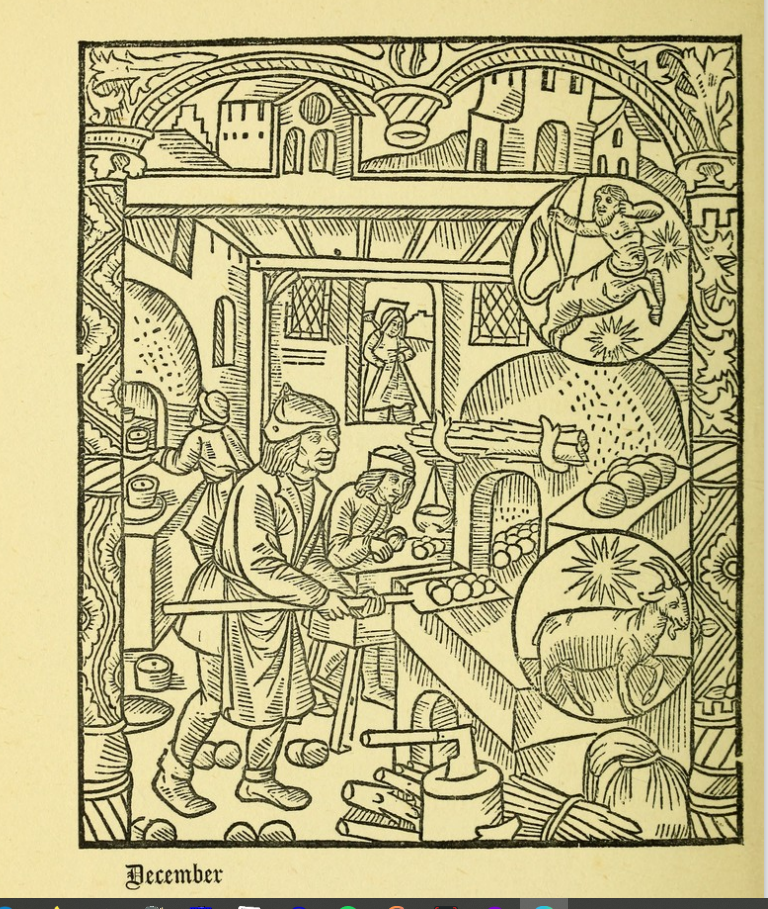
For a closer look at the month, I’m turning to the 15th Century Kalendar of Shepherds. Its illustration (see above) for December shows an indoor scene, and is full of warmth as the bakers bake pies and cakes for Christmas. Firewood has been collected, and the Goodwife is bringing something in from the Garden. The stars signs are Sagittarius and Capricorn.

The Sparrow and the Warm Hall

The Venerable Bede has an interesting story (reported in ‘Winters in the World’ by Eleanor Parker) in which a Pagan, contemplating converting to Christianity, talks about a sparrow flying into a warm, convivial Great Hall, from the bitter cold winter landscape. The sparrow enjoys this warmth, but flies straight out, back into the cold Darkness. Human life, says the Pagan, is like this: a brief period in the light, warm hall, preceded and followed by cold, unknown darkness. If Christianity, he advises, can offer some certainty as to what happens in this darkness, then it’s worth considering.

This contrast between the warm inside and the cold exterior is mirrored in Neve’s Almanack of 1633 who sums up December thus:

This month, keep thy body and head from cold: let thy kitchen be thine Apothecary; warm clothing thy nurse; merry company thy keepers, and good hospitality, thine Exercise.

Quoted in ‘the Perpetual Almanack of Folklore’ by Charles Kightly

December in the ‘Kalendar of Shepherds’

The Kalendar of Shepherds text below gives a vivid description of December weather. Dating from 1626 it gives a detailed look at the excesses of Christmas, which people are on holiday, and who is still working hard. But it concludes it is a costly month.
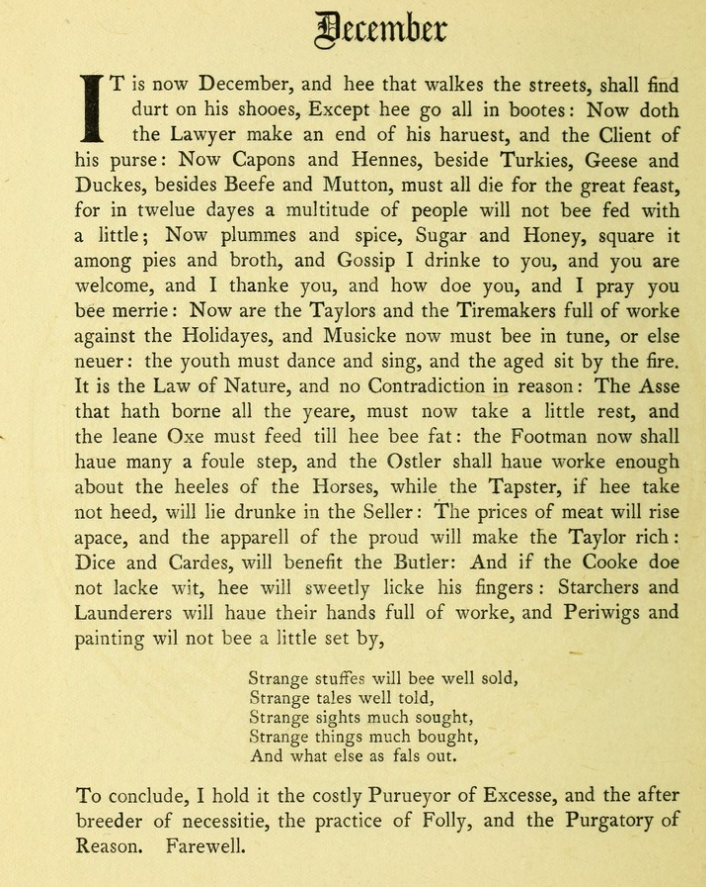
Nicholas Breton’s ‘Fantasticks of 1626 – December from the Kalendar of Shepherds

Six Dozen Years – a Lifespan

The other section of the Kalendar then elaborates on the last six years of a man’s life, with hair going white, body ‘crooked and feeble’. (from 66 to 72). The conceit here is that there are twelve months of the year, and a man’s lot of ‘Six score years and ten’ is allocated six years to each month. So December is not just about the 12th Month of the Year but also the last six years of a person’s allotted span. The piece allows the option of living beyond 72, ‘and if he lives any more, it is by his good guiding and dieting in his youth.’ Good advice, as we now know. But living to 100 is open to but few.
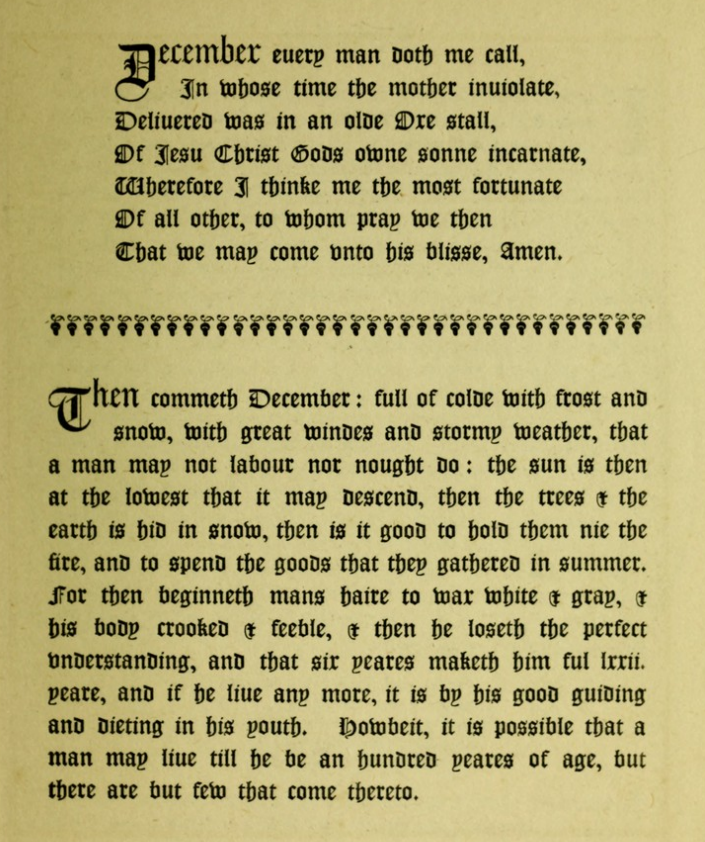
Kalendar of Shepherds

Interesting from my point of view as I have reached the end of my life span as suggested by the Calendar, and my father is 98 and approaching his hundred!

About the Kalendar of Shepherds.

The Kalendar was printed in 1493 in Paris and provided ‘Devices for the 12 Months.’ The version I’m using is a modern (1908) reconstruction of it. It uses wood cuts from the original 15th Century version and adds various texts from 16th and 17th Century sources. (Couplets by Tusser ‘Five Hundred Parts of Good Husbandrie 1599. Text descriptions of the month from Nicholas Breton’s ‘Fantasticks of 1626.) This provides an interesting view of what was going on in the countryside every month.

For more on the Kalendar look at my post here.

The original Kalendar can be read here: https://wellcomecollection.org/works/f4824s6t

To see the full Kalendar, go here:

On This Day

1981 – Launch of the BBC Micro

1990 The UK was rejoined to Europe for the first time for 8000 years, when the Channel Tunnellers breached the final wall of rock. French and British workers exchanged flags and shook hands. The Tunnel was opened to traffic in 1994 more than 10 years after work started and 200 years since Napoleon proposed the idea. Read what ICE has to say about the (ICE – Institute of Civil Engineers!).

Britain was connected to the Continent until about 6,100BC, the North Sea, the Channel, and the Irish Sea were all dry (or marshy lands). Water levels were rising and ice melting. the Storegga Slides in Norway saw huge cliffs of ice slipped into the sea. This caused a tsunami over 30ft high and penetrating 25 miles inland. Read the BBC here.

Since then, Britain has been an Island. Archaeologists have been exploring the flooded area which is known as Dogger Land, after the Dogger Bank. (for more on Dogger Land.)

First Published in 2024, republished 2025
Murmurations of Starlings and Queen Branwen November 26th

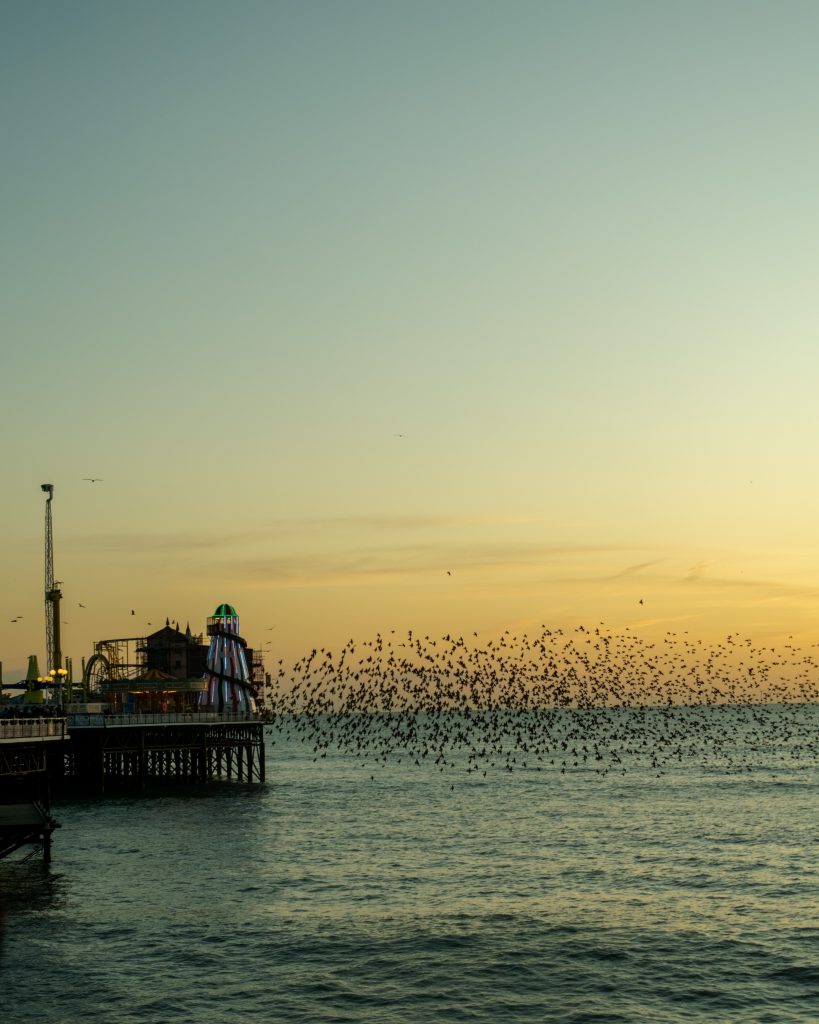
Starlings Photo by Rhys Kentish on Unsplash

Starlings begin to roost in September but their numbers increase as November passes. The RSPB says:

They mainly choose to roost in places which are sheltered from harsh weather and predators, such as woodlands, but reed beds, cliffs, buildings and industrial structures are also used. During the day, however, they form daytime roosts at exposed places such as treetops, where the birds have good all-round visibility.

RSPB Website

Starling numbers have been declining because of ‘loss of permanent pasture, increased use of farm chemicals and a shortage of food and nesting sites in many parts of the UK.’ The Starling was the most popular bird reported in gardens, it has now fallen to fourth. Prior to the year 2000, the starling was regularly the most numerous species recorded in the survey. This year it is behind the house sparrow, the blue tit and the wood pigeon.

Murmurations

Early evening, up to 100,000 birds will rise above their roosts wheeling and turning in tight formations. Research suggests that they achieve this not by following leaders but by, each bird, making small adjustments in accord with the birds immediately around them. Scientists have been able to construct algorithms that mimic the movement of a murmuration. These will allow flocks of drones to be easily controlled on mass with implications for agriculture, aerial displays and warfare. (https://www.bbc.co.uk/news/science-environment)

Sacred Birds

Starlings were sacred to the Celts and were used for divination by the Romans. Their augurs scrutinised the geometric patterns made by the murmurations to interpret the will of the Gods. In the Welsh Mabinogian a starling appears in the story of Bran, God-King of prehistoric Britain and his sister, Branwen, who was married to the King of Ireland.

Bran's head taken to Tower Hill
King Bran’s head buried at Tower Hill

To cut a long story short, (a version of which you can read on my February 18th’s blog post here), Branwen was banished to the scullery. So she trained a starling to send a message to her brother. He took an army over the Irish Sea to restore her to her rightful state, but Bran was mortally wounded in the battle that followed. He told his companions to cut off his head and take it back to the White Hill, London. His head was as good a companion on the way back as it was on the way out, but the journey home took 90 years. At last, they got to London and his head was buried on the White Hill, near the Tower of London, and as long as it were there Britain was safe from invasion. This was one of the Three Fortunate Concealments and is found in ‘the Triads of the Island of Britain.’

I am giving a Walk on the Myths, legends, and Archaeology of London, for London Walks on 24th January 2026.

Shakespeare and Starlings

Shakespeare in Henry IV Part 1 has Hotspur, annoyed with Bolinbroke say:

I’ll have a starling shall be taught to speak nothing but ‘ Mortimer,’ and give it him

Now if you think the idea of a talking starling is nonsense, have a look at this video.

First published on November 26, 2023. Revised in 2025.

November ‘the month of immolations’

Kalendar of Shepherds November

This post slipped through the editorial net.  So, I need to get it out there before November is a cold memory.

November is the 9th Month of the Roman Calendar. Novem coming from the Latin for nine. But the Romans added two months to the calendar during the time of the Dictator, Julius Caesar (for his reforms click here). So 9th month is now the 11th.

In Welsh it is ‘Tachwedd’ which means the month of slaughtering. Blōtmōnaþ (Blotmonath) in Anglo -Saxon – the month of blood. These reference the fact that this was the month when the surplus animals were slaughtered or as the historian, Venerable Bede has it, ‘the month of immolations’. In Irish the month of November is called sawhain. It is also the name of the festival marking the beginning of winter which starts at dusk on 31st October. We call it Halloween, the celts Sawhain or words similar. (see my post on Halloween).

The image, at the top of the page, from the Kalendar of Shepherds shows some aspects of November – star signs Scorpio and Sagittarius; Pigs are fattening up on the acorns in the forest and then being slaughtered, smoked or dried to preserve them through the hard winter. The text of the Kalendar (read it below) gives a good summary of what early modern life in November was like. In summary, the day when the ‘poore die through want of Charitie’.

Kalendar of Sherherds – November

For more details on the Kalendar of Shepherds see my post here.

Time to see the Pleiades

They can be seen from Autumn to Spring, but they are visible all night in the Northern Hemisphere in November and December.

Nebra Sun disc from Stonehenge Exhibition British Museum
Nebra Sun disc from Stonehenge Exhibition British Museum. The Pleiades is thought to be represented by the 7 stars in the cluster above and between the Sun and the Cresent Moon, on this bronze age copper and gold disc

First published in 2024, revised in 2025

Martinmas – Festival of Winter’s Beginning November 11th

Martinmas. Statue of St Martin at Ligugé

So, this is All Saints Day, Old style, also known as Martinmas, St Martin’s Day, one of the most important Christian festivals of the medieval world.

Father Francis Weiser in the Handbook of Christian Feasts and Customs suggests this was the Thanksgiving of Medieval Europe:

It was a holiday in Germany, France, Holland, England and in Central Europe. People first went to Mass and observed the rest of the day with games, dances, parades, and a festive dinner, the main feature of the meal being the traditional roast goose (Martin’s goose). With the goose dinner, they drank “Saint Martin’s wine,” which was the first lot of wine made from the grapes of the recent harvest. Martinmas was the festival commemorating filled barns and stocked larders.

It was celebrated with Bonfires in Germany, and with St Martin’s Beef and Mumming plays in England. Following the Reformation, its place in the Calendar has been taken by  Halloween and Bonfire Night.

St. Martin of Tours

St Martin of Tours, 20th Century Stained Glass, St James Church. Chipping Camden.Window 1925 Commemorating World War 1. St Martin’s Feast Day is Armistice Day.Photo K Flude

Martin was a soldier in the Roman Army who would not fight because of his Christian beliefs. When he met a beggar, he cut his cloak in half and shared his cloak. He rose in the hierarchy of the Gallic Church and became Bishop of Tours. According to legend, his funeral barge on the River Loire was accompanied by flowers and birds. He died in AD397. He is one of the few early saints not to be martyred. Martin is the saint of soldiers, beggars and the oppressed. Furthermore, he stands for holding beliefs steadfastly and helping those in need.

St Martin’s in the fields

Early 20th Century Image of Trafalgar Sq. St Martin’s is in the top right-hand corner.

There are two famous Churches dedicated to St Martin in Central London with possible early origins. St Martin’s in the Fields, near Trafalgar Square, has been the site of excavations where finds show a very early settlement, with early sarcophagi. It is the one place where a convincing case can be made for continuity between the Roman and the Anglo-Saxon period. It is possible, that the Church was founded soon after St Martin’s death (397AD). A kiln making Roman-style bricks was found. A settlement grew up near the Church and this expanded to become Lundenwic, the successor settlement to Londinium.

St Martin’s Within

Old Print of London c1540 showing St Pauls, with St Martin's by the wall to the left of the photo
Old Print of London c1540 showing St Pauls, with St Martin’s by the wall to the left of the photo

The other St Martins is St Martins Within, just inside the Roman Gate at Ludgate. Many early churches are found at or indeed above Gates. This one also has legendary links to burial places for King Lud, and for King Cadwallo. He. Cadwallon ap Cadfan, was the last British Kings to have any chance of recovering Britain from the Anglo-Saxons. Geoffrey of Monmouth says that Cadwallo was buried here in a statue of a Bronze Horseman. This was thereby a ‘Palladium’ – something which protects a place from invasion. (See my post about Palladiums of London). It has been suggested by John Clark, Emeritus Curator at the Museum of London, that Geoffrey of Monmouth might have used the discovery of a Roman Equestrian Statue as an inspiration for the story.

St Martin was also the saint of Travellers, and this might explain the location of the Church near the gate. Although there is nothing but legendary ‘evidence’, it would make sense for an early church to be built near Ludgate,. This is the Gate that leads to St Pauls which was founded in 604AD from Lundenwic which was booming in AD650.

Although the City seems to have mostly devoid of inhabitants from the end of the Roman period to the 9th Century, the presence of St Pauls Cathedral means that Ludgate was most likely still in use or at least restored around this period. It leads via Fleet Street and Whitehall, almost directly to the other St Martin.

St Martin and lime plaster

Michaelmas was also the time of year when lime plaster was renewed because lime needs to be kept moist when renewed. It takes three to four days to form the calcite crystals that make it waterproof. Lime plaster was used on most timber framed buildings.

On This Day

1100 – Matilda married King Henry I, thus united the English and Norman Royal Blood lines. The marriage nearly didn’t happen because she, originally called Edith, sheltered in Wilton Nunnery, as a teenager, fearful of kidnap and rape by Normans. Was she a Bride of Christ? or a visitor free to resume a normal life?

(Originally, posted 11 Nov 2021, revised 2022, 2023, 2024, 2025)

The Horned God & Preparing for Guy Fawkes Day November 4th

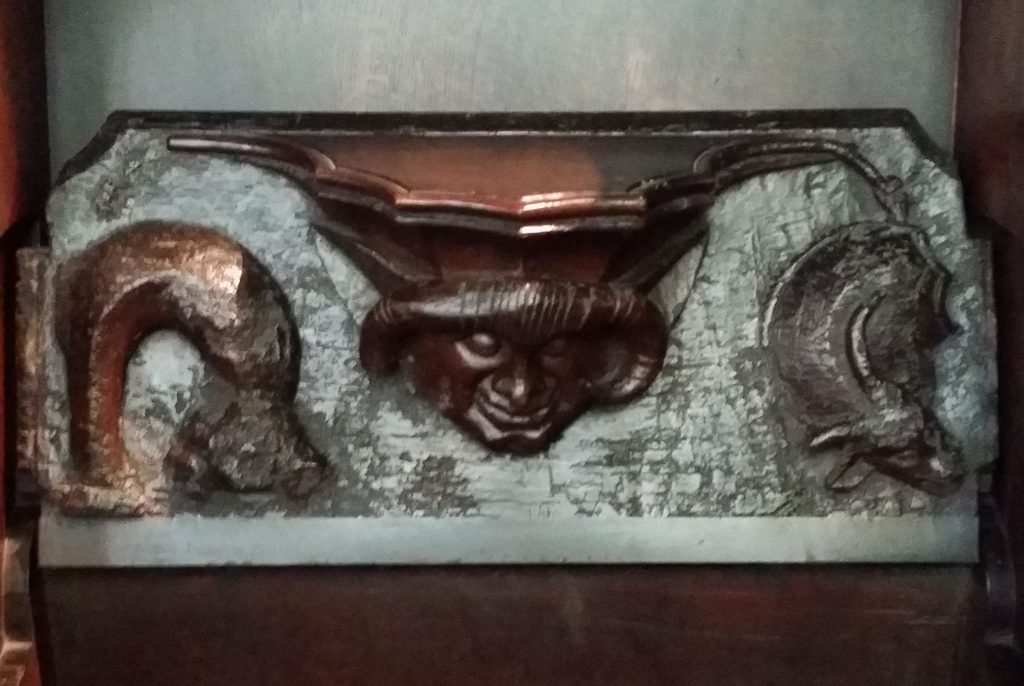
medieval monks seat showing carving of a Horned man (with Ram's Horn) at Stratford on Avon Holy Trinity Church) Photo: K Flude
Horned God (with Ram’s Horn) at Stratford on Avon Holy Trinity Church) Photo: K Flude. Carving of a dolphin to the left (symbol of Christ) a goat to the right (symbol of the damned – as Christ divides the sheep from the goats who are going to hell)

Horned Gods

November 4th is dedicated to hunting gods such as Herne, the Horned God, Cernunnos, The Green Man and Pan.

Herne the Hunter appears in Shakespeare:

There is an old tale goes, that Herne the
Hunter
(sometime a keeper here in Windsor Forest)
Doth all the winter-time, at still midnight
Walk round about an oak, with great ragg’d horns;
And there he blasts the tree, and takes the cattle,
And makes milch-kine yield blood, and shakes a chain
In a most hideous and dreadful manner.
You have heard of such a spirit, and well you know
The superstitious idle-headed eld
Receiv’d, and did deliver to our age
This tale of Herne the Hunter for a truth.

William Shakespeare, The Merry Wives of Windsor, Act 4, scene 4

I have recently seen a brilliant staging of the Merry Wives of Windsor at the Royal Shakespeare Company in Stratford. I saw it three times and think it one of the best Shakespeare productions I have seen. The lead actor, John Hodgkinson, with whom I used to play cricket, was a fantastic Falstaff.

Cernunnos

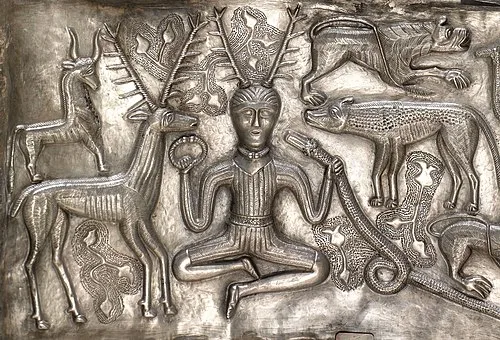
Cernunnos comes from karnon which means “horn” or “antler”. This may be the source of the name ‘Cerne’. (Please note that the Cerne Abbas Giant has just been redated from the Celtic to the Anglo-Saxon period.) Cerney and Cirencester in Gloucestershire might have similar origins for their names. The Cornovii is the name of three tribes in Britain. Cornwall, Shropshire and Caithness. It seems to mean people of the Horn, and the Horn thought to be stag’s horns. He is most often found in statues in the area around Paris, with an antler on his head, cross-legged and with a snake with him. He may be the god of the celtic underworld.

A Cernunnos-type figure on the Gundestrup cauldron (plate A). He sits cross-legged, wielding a torc in one hand and a ram-horned serpent in the other. Public Domain Wikipedia

The National Trust are appealing for funds to buy the Cerne Abbas Giant – click here to see the appeal.

Preparing for Guy Fawkes Day with Ginger Cake

Felicity Cloake The Guardian Parkin

Ginger cake is the traditional accompaniment to a cold night watching the Fireworks. There is a good recipe in Markham’s The English Housewife of 1683. But I’m suggesting you use this recipe from the Guardian for Parkin Cake. ‘Parkin is a gingerbread cake traditionally made with oatmeal and black treacle, which originated in Northern England.’ (Wikipedia).

For my post on November the 5th look here.

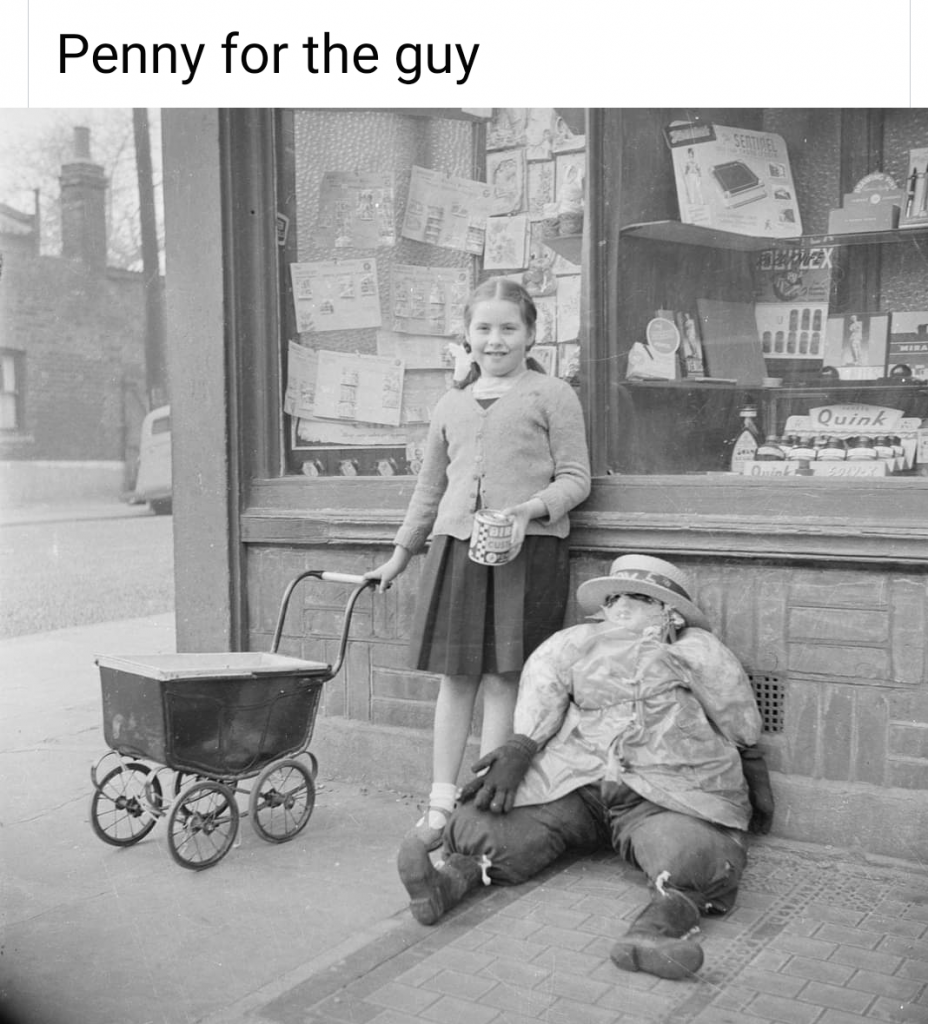
London picture Penny for the Guy on Guy Fawkes Day

I haven’t seen children asking for ‘a penny for the Guy’ for a while. But it was part of my childhood. We would create a ‘Guy’ out of old clothes and take it into the streets to raise money. The Guy is named after Guy Fawkes, who was discovered on 5th November 1605 in a cellar under Parliament. He was by a pile of barrels of gunpowder with a slow match. The plan was to blow up the King and Parliament, on the occasion of the Opening of Parliament on the 5th of November.

Once the plot had been broken and the plotters hanged, drawn and quartered, the King ordered that November 5th should be commemorated throughout the Country. Bonfires were a part of the seasonal celebrations at the time, used at Halloween, but this aspect was transferred to November 5th and continues as a major British event every year.

The money we raised, we spent exclusively on ‘bangers’ loud explosive fireworks not pretty fountains, Roman candles nor rockets. The bangers just made a horrendously loud bang. One stunt we experimented with was to cycle through the streets and to put a lit banger into the handle bars, which would act as a rocket launcher! Don’t try this at home.

Meanwhile, we would collect wood for the village bonfire:

A stick and a stake
For King George’s sake
Will you please to give us a faggot
If you won’t give us one, we’ll steal you two
The better for we and the worse for you.

English Folk Verse (c.1870)

First published 4th November 2021, republished 4th November 2024, 2025

Sliding Ducks & the Equivocation of Prophecy – November 3rd

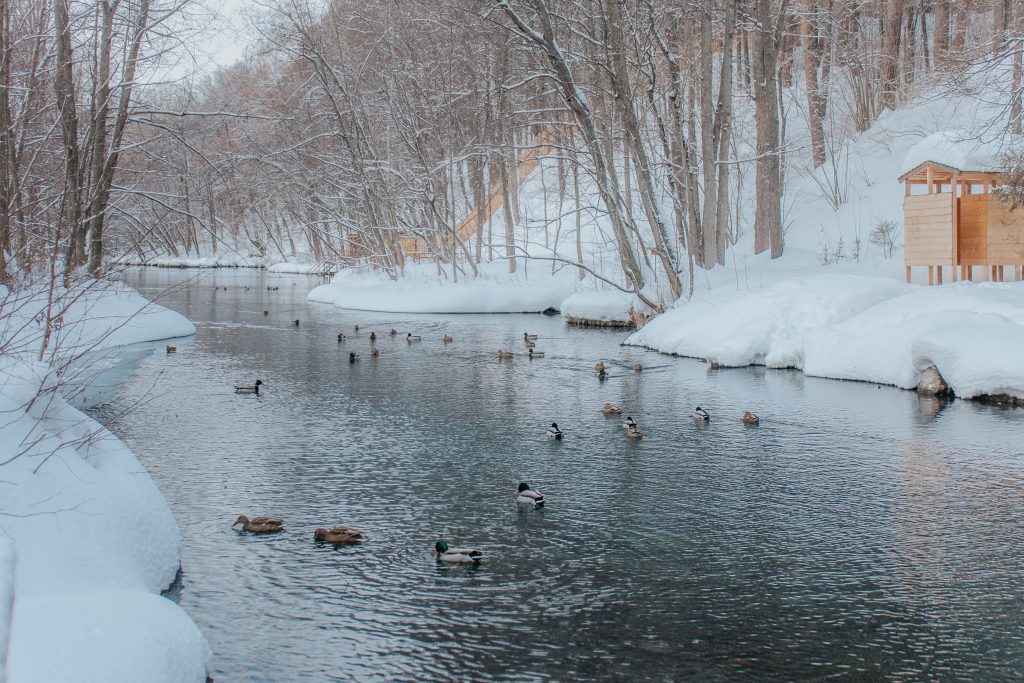
Ducks in Winter 
Photo by <a href="https://unsplash.com/@timromanov?utm_content=creditCopyText&utm_medium=referral&utm_source=unsplash">Timur Romanov</a> on <a href="https://unsplash.com/photos/ducks-on-water-a5U8v7Pm-yg?utm_content=creditCopyText&utm_medium=referral&utm_source=unsplash">Unsplash</a>
Sliding Ducks? or Swimming Ducks? Timur Romanov, Photo from Unsplash

Folklore is full of ways of predicting the future – mostly about the weather or love. The Perpetual Almanac by Charles Kightly features many of these in rhyme form of the ‘Sky at Night Shepherd’s Delight’ type. Here is a seasonal one.

If ducks do slide at Hallowentide
At Christmas they will swim
If ducks do swim at Hallowentide
At Christmas they will slide

From my experience, in the south of the UK, this is simply not true as we very rarely get ice in early November. Nor do we get snow at Christmas that often. But maybe, the further north you go, the truer this becomes.

Macbeth & Prophecy

But, as far as taking prophecy seriously, it’s good to remember what Macbeth said on seeing the wood moving to Dunsinane.

‘(I) begin to doubt the equivocation of the fiend, that lies like truth.’

He has just realised that prophecy is a double-edged sword which has led him to his doom. He had been told by the Three Witches that he:

‘shall never vanquish’d be until Great Birnam Wood to high Dunsinane Hill shall come against him’

Still, as he heads to the final battle, Macbeth knows he is invincible and that

‘none of woman born shall harm Macbeth’.

But in his savage fight with Macduff, he is told that Macduff was not of woman born, but was:

from his mother’s womb / Untimely ripped’.

So Macbeth is killed.

Google Map showing Birnam (Scotland), top left, and Dunsinane Hillwith red markers in the middle. Note Scone is where Macbeth is Macbeth was crowned

King Macbeth (Mac Bethad mac Findlaích) 1040 – 1057

In reality, Macbeth, was a successful King who reigned for 17 years. He was one of the last Gaelic Kings as Scottish society was changing with contact with England.

This is a draft of the text that (edited) forms part of my best-selling book ‘Divorced, Beheaded, Died’ The Kings and Queens of Britain in Bite-sized Chunks’

Macbeth was nicknamed the Red King. He was a Gaelic speaker, descended from the Kings of Dal Riata. Macbeth’s father, Finlay MacRory, was Mormaer (Grand Steward) of Moray and was was murdered by Gillacomgain. He took MacRory’s title. Gillacomgain was burnt to death with 50 of his followers, probably by Macbeth, who thus not only regained the title as ruler of Moray but married his dead rival’s widow, Gruoch. She was the granddaughter of Kenneth II. Macbeth was also himself descended from the Kings of Scotland via his mother Donada probably daughter of Malcolm II.

His claim to the throne was therefore strong, and following the disasters of King Duncan’s reign, Macbeth seized the opportunity to take the throne for himself.

He ruled well for nearly 2 decades imposing a strong sense of law and order, encouraging Christianity and leading successful raids across the border into England. In 1050 he went on pilgrimage to Rome. Exiled Normans, supporters of Edward the Confessor were settled in Scotland in Macbeth’s reign. There is no evidence that Macbeth was any more evil then the rest of the early Scottish Kings.

In 1057 Macbeth was killed in battle against Duncan I’s son who became Malcolm III. Macbeth is buried on Iona. He and Gruoch had no children but Guoch’s son, Lulach, son of Gillacomgain briefly followed Macbeth as king before being assassinated by Malcolm III

‘Divorced, Beheaded, Died’ The Kings and Queens of Britain in Bite-sized Chunks’ for more details look here.

Prophecy ‘lies like the truth’ a trope that is used in many ancient tales such as Oedipus Rex.

On this Day

Hilaria

The 3rd of November is also the Hilaria, the last day of the festival of Isis/Osiris. This is the day of the rebirth of Osiris. He was ‘the god of fertility, agriculture, the afterlife, the dead, resurrection, life, and vegetation.’ Isis was the wife (and sister) of Osiris God-King of Egypt. Osiris was killed by his brother. Set. Isis restored his body to life for long enough to conceive their son Horus.

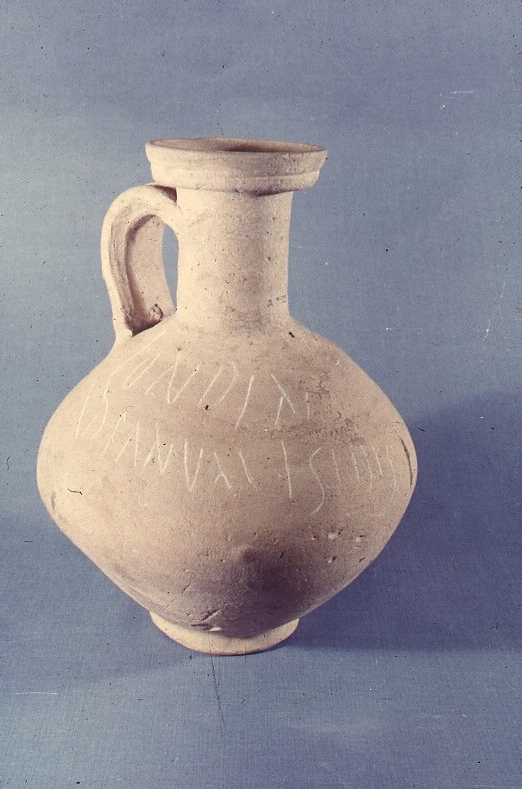
Horus revenged his father, regained the throne, restored Cosmic Order and completed the resurrection of Osiris. Isis is normally shown holding the baby Horus in a pose that may have influenced images of the Virgin Mary. Londinium would have had a celebration on this day as there is a pot found near London Bridge inscribed ‘At London, at the Temple of Isis).

Roman pot with Isis inscription, London

Head Graft and St Winifred

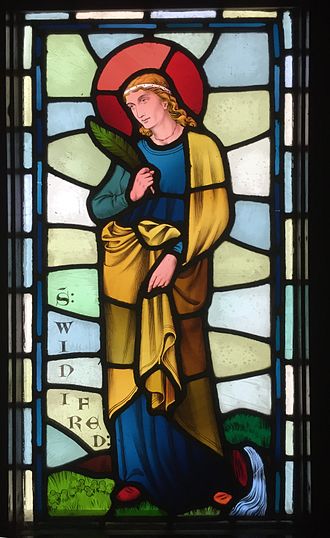
Stained glass depiction of St Winifred, designed by William Burges, at Castell Coch, Cardiff. Wikipedia Hchc2009 – Own work

St Winifred’s Day She was beheaded by Caradog who would not accept her refusal to have him because of her religious views. She was restored to life by St Beuno, or St Bono. Head and all. Where her head fell their slowed a spring. This is on the North Welsh Coast, and called Holywell. It was one of the Seven Wonders of Wales, and called the Lourdes of Wales.

First Posted on 3 November 2021. Revised 3 November 2023 & 2024 & 2025

All Hallows Day – November 1st

 chrysanthemums
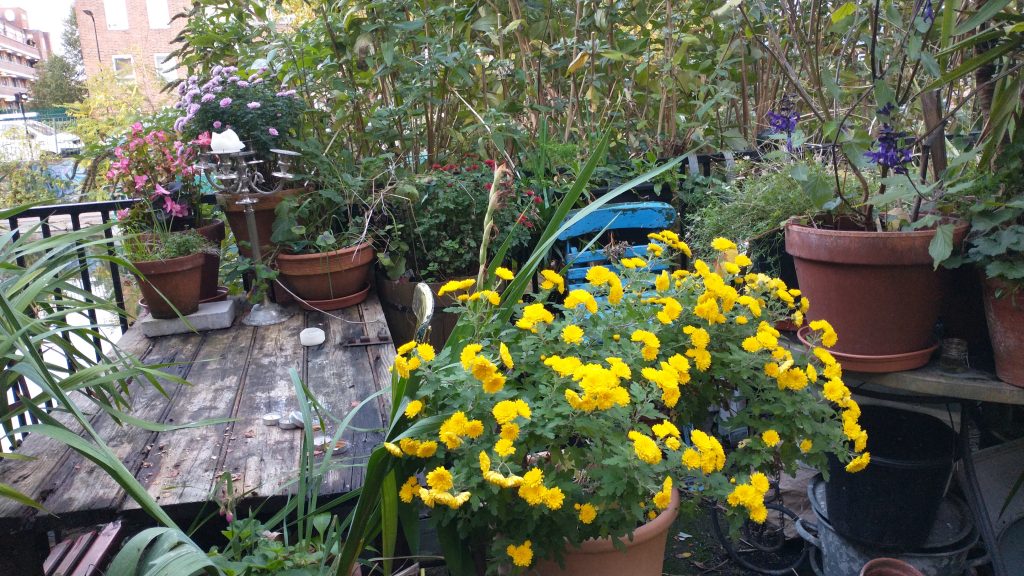
Chrysanthemums Flowers for the Dead (the author’s back garden)

How the Celtic festival that marked the beginning of Winter became All Hallows is not clear. Some say the Church set up its own festival independent of the Northern European traditions. But it is as likely that the Church adopted existing pagan festivals, and gave them a Christian spin.

Samhain, on October 31st, was, for Celtic religions, not only the beginning of Winter but also the beginning of the Year. As I noted on my Halloween post the Festivities began in the evening before the day because Celtic and Germanic traditions began their day at Dusk. So Halloween is not, in fact, the evening before, it is the start of the day of the festival.

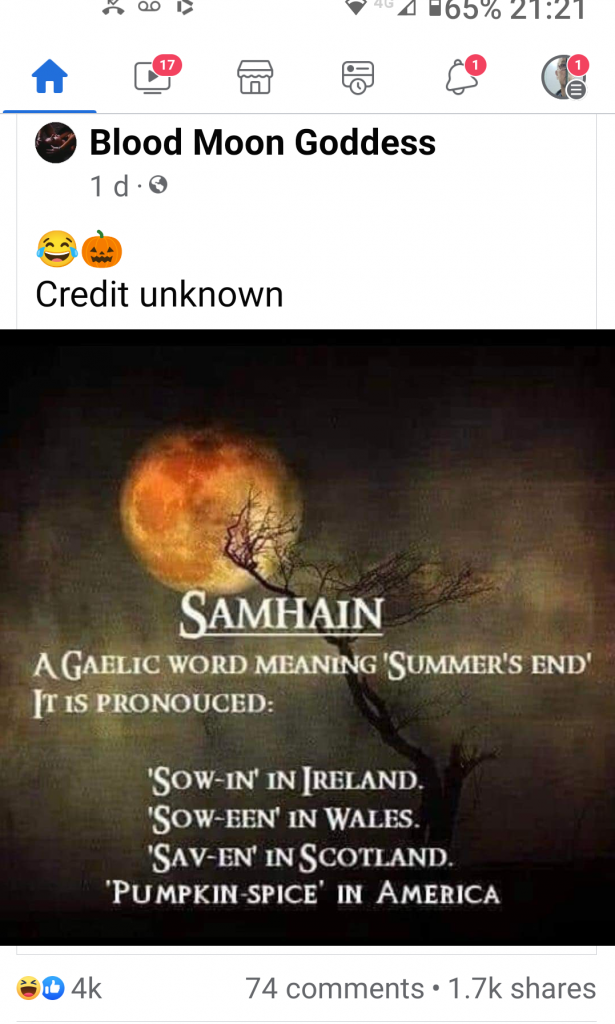
Facebook Image giving the words for Samhain in Celtic languages

The Church adopted the Roman tradition of the day beginning not at Dusk but at Midnight. So the festival of All Hallows is on November 1st not October 31st. But the Church mimicked the old ways of doing things by celebrating the evening before as the Vigil of All Hallows’ Day. This was called All Hallows Evening or Halloween.

All Hallows by the Tower, London

Engraving of All Hallows Barking

In London, there is a Church called All Hallows, on Tower Hill. It is associated with Barking Abbey, founded in the 9th Century. Therefore, it is known as All Hallows Barking or All Hallows by the Tower. The Church has a prominent position on Tower Hill, which would have been visible from boats coming up the Thames. Also in the Church is the earliest Post-Roman arch in a Church in the City of London. This is made of reused Roman bricks. Moreover, in the crypt are Roman tessellated floors.

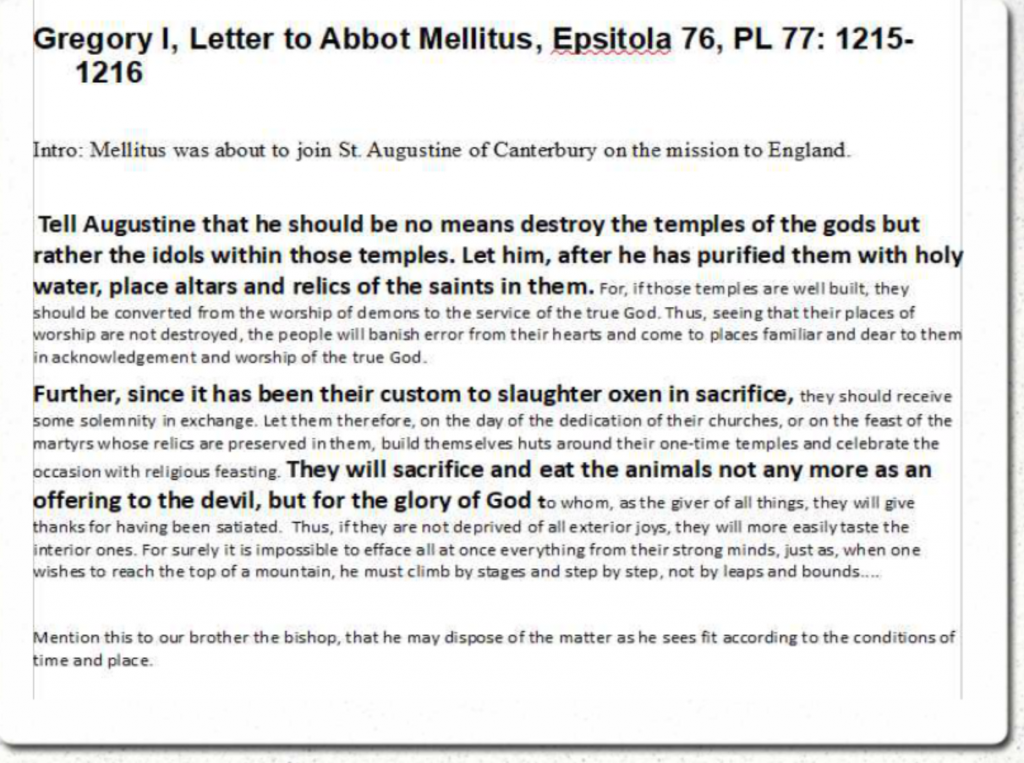
Letter from Pope Gregory to St Augustine

Now, I don’t want to be shot down in flames because there is no evidence that there was a Roman Temple here. Nor indeed a Roman or immediately Post-Roman Church. But it is one of the earliest Churches in the City of London. There must have been Christian Churches in Roman London, and this would be on my list of candidates. It is simply that the attribution to All Hallows provides a possible link to Celtic festivals. So speculation rather than anything else. The letter above, gives a context for the conversion of a pagan Temple to a Christian Place of Worship.

An Uncanny Day to Hallowed Day

For the Celts, Samhain was an uncanny day when all the sprites and spirits are alive and in the world. The Church took that, and span in on its head. So it became a ‘hallowed’ holy day when all Saints are celebrated and alive to us. Celebrated on October 31st and November 1st.

A celebration of All Saints was originally in May in the Church but was changed to the 1st November in the 7th Century by Pope Boniface. Later it was swapped back to May. But fixed again on the 1st November in the 9th Century. It is followed on the 2nd by All Souls’ Day. (see my post on All Souls Day here.

So on the 1st November, those celebrating the pagan festival would be in full swing after a hard night of celebration. The embers of the Fire would be still burning, stones left around the fire would be inspected for the prophecy they told of the future. Each person had a stone, and if it was still intact it was good luck, if it had disappeared the future was not good.

La Toussaint et Dia de Todo Los Santos

In France, All Hallows or All Saints is called La Toussaint, and flowers such as Chrysanthemums, which blossom in late October, were put on the graves. In Spain, it is Dia de Todo Los Santos and is a national holiday upon which people put flowers on the graves of the dead.

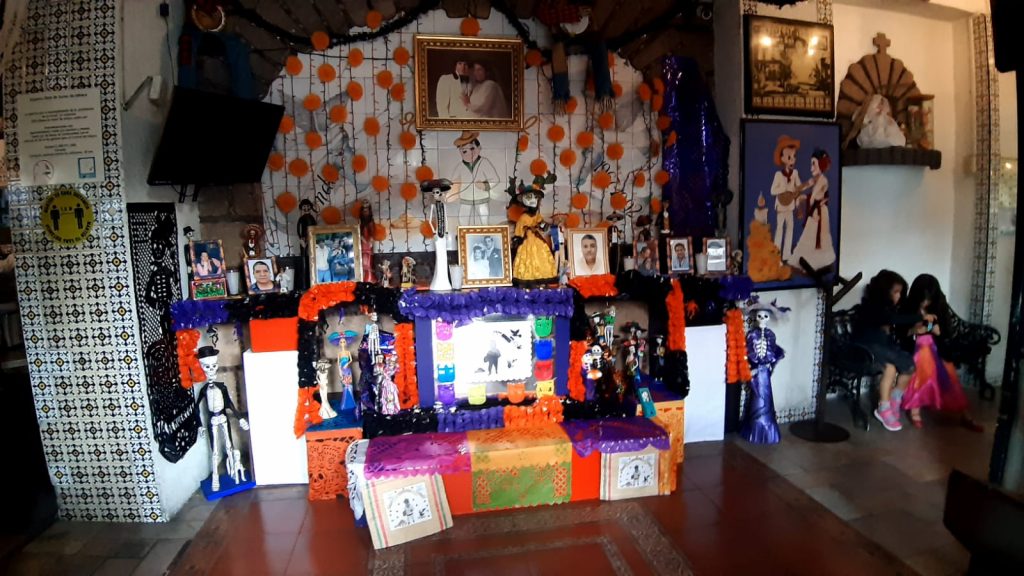
In Mexico, Dia de los Muertos celebrates Holy Innocents on the 1st. People create altars to the lost ones, with their favourite flowers, toys, food stuffs,, photographs. People argue about the pre-colombian aspects of the festival as there are similarities to European All Saints Days celebrations. But Quecholli, was a celebration of the dead that honoured Mixcóatl – the god of war. It was celebrated between October 20th and November 8th.

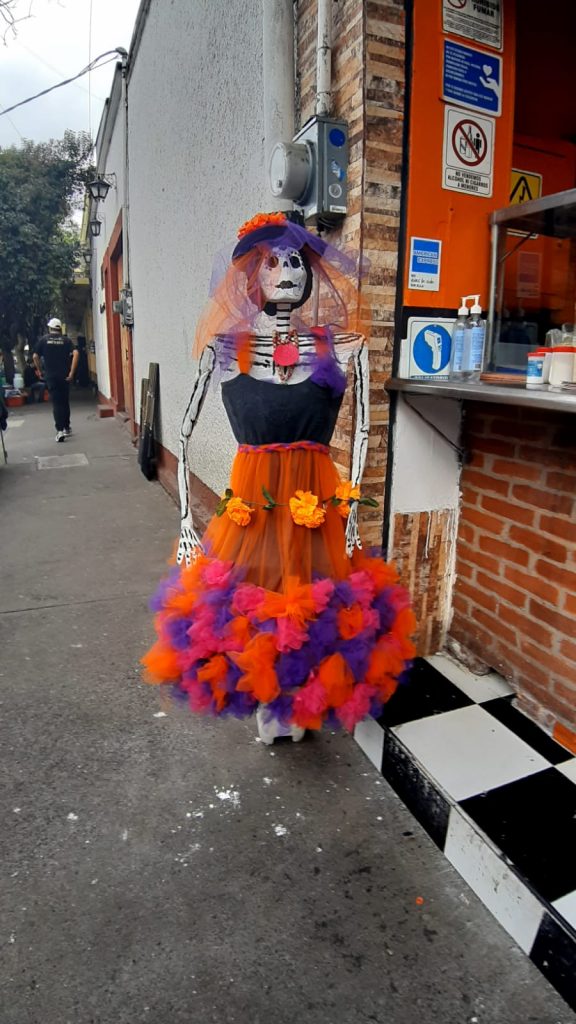
A correspondent in Mexico has sent back these pictures of the festivities in Mexico.

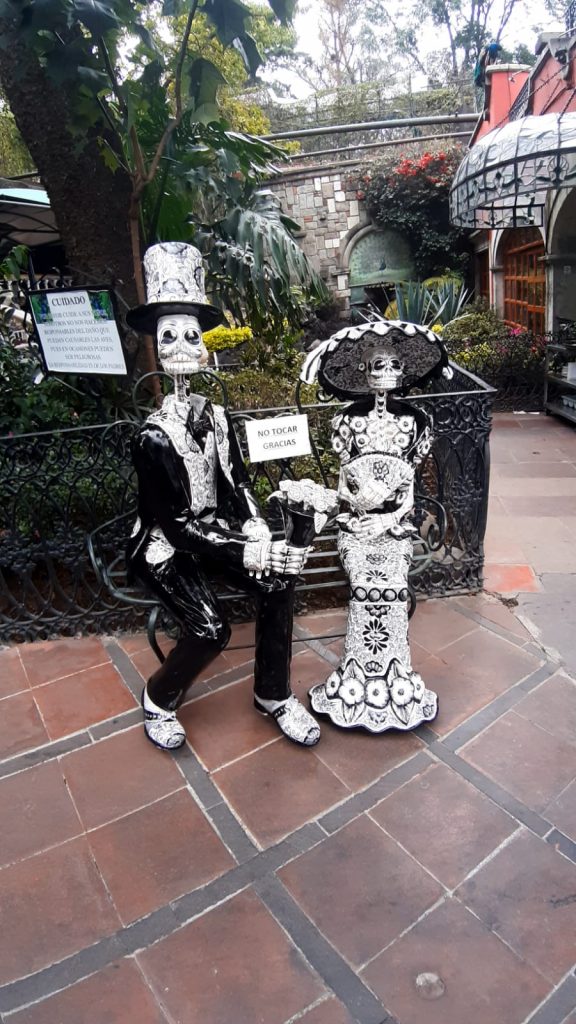
The female figure to the left is La Catrina. This image was popularised by an early 20th Century design by José Guadalupe Posada and developed in a mural by Diego Rivera. For more details click here.

A Day Off for the English

In the Laws of King Alfred the Great, this day was a day off for freemen. See my post on Days off in the Anglo Saxon Calender on August 15th.

First published in 2022, revised in 2023, 2024, 2025

Halloween October 31st

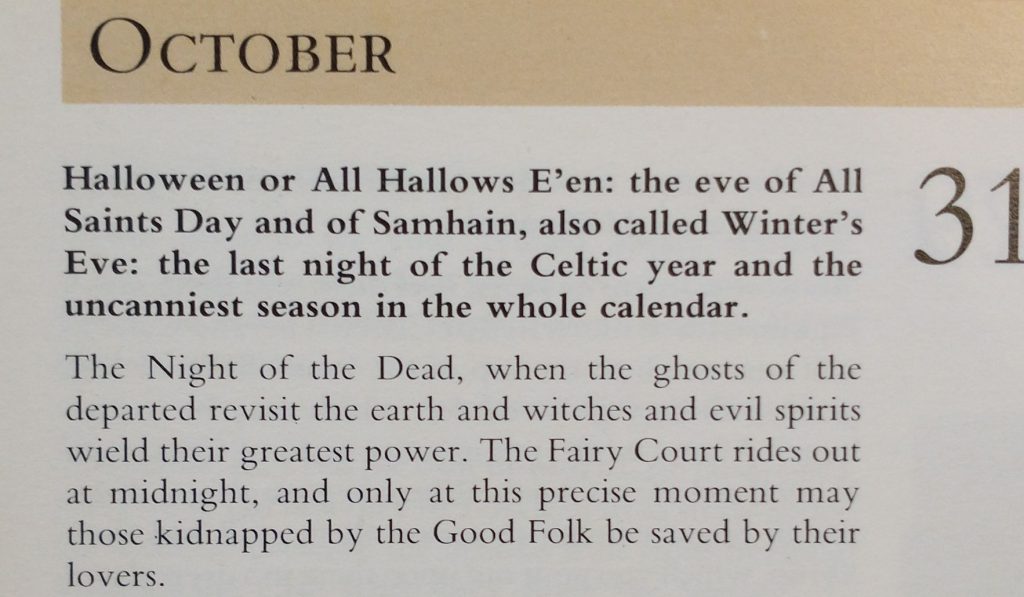
From the Perpetual Almanack of Folklore by Charles Kightly

I began my perpetual Almanac of the Past four years ago on the 31st October 2021. This was the first line:

‘This blog is to celebrate the Year. I will post, hopefully, once a day, so we can follow the seasons, as they happen naturally, and as people in Britain and Ireland have responded to the changes in the year.’

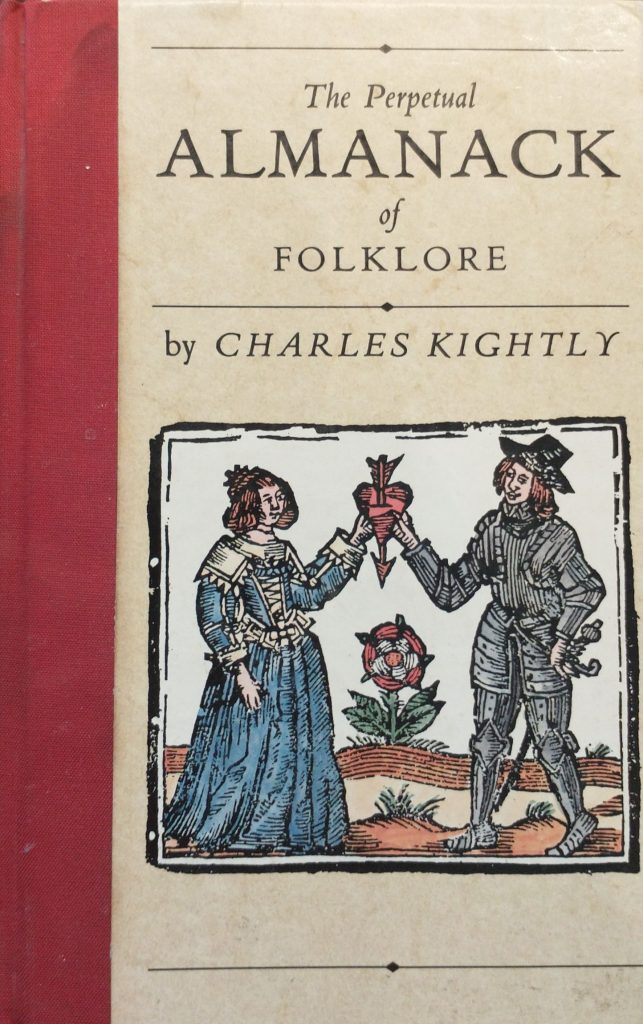
It was inspired by Charles Kightly’s book, which is a pot-pourri of folklore taken mostly from old Almanacs. I haven’t managed, yet to create a post for every day of the year, nearly managed it in the winter but falling behind in the Summer when I take Road Scholar groups around the UK. My plan is to fill in the gaps, improve posts and get rid of typos. Another aim is to add more London-specific content.

Cover of Charles Knightly's Perpetual Almanac
Cover of Charles Kightly’s Perpetual Almanac

I started on Halloween because Samhain (pronounced Sow-in) was the beginning of the year for the Celtic world. It may mean Summer’s End. In Wales, it is Calan Gaeaf (first day of winter) and Kala Goafiv (beginning of November in Brittany).

Why did the Celts start their year at such an unlikely time? A clue is that they began the next day at dusk. The Sun dies at dusk so it is the end of the day, and the next day begins with the death of the old day. 

So the New Year begins with the Death of the Old Year. Now that might suggest the Winter Solstice as the best time to start the year as this celebrates the death of the old Sun. (see my winter solstice post here :) But, the end of October has, perhaps a better claim. The harvest is in, the fruits in the trees and the nuts are harvested, all the growth of the Summer is over and collected.  Plants are mostly dead or dormant, except some evergreens. It is the end of the growing year. The seeds have fallen from the trees and shrubs and are nestling in the soil, ready to begin their cycle again. All is over and all is ready for the new year. Makes sense?

The Celtic way also explains eves; Christmas Eve, New Year’s Eve, May Eve, All Hallow’s Eve.  They are not the night before the day, they are the beginning of the day.  This is when you begin the celebration.

For the Romans, today is the day that Adonis is injured hunting a wild boar. Against his lover’s (Venus)  advice, he descends to the underworld. Nature withers and dies until he returns from the underworld. His blood stains a flower and was transformed into the Crimson Anemone. There is a similar story in Babylon of Ishtar and Tammuz.

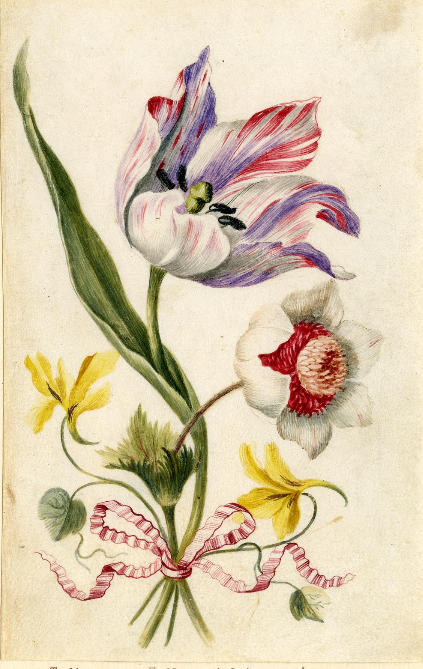
By Alexander Marshall, crimson and other anemones
Binyon 1898-1907 / Catalogue of drawings by British artists, and artists of foreign origin working in Great Britain (5(c))

Adonis comes back on May Day when he meets Venus again, so the world flourishes and is bright and warm.

Julius Caesar says the Gauls venerated the God Dis Pater on this day – an aspect of Pluto, the God of the Underworld, ruler of the Dead. There was a Roman Festival on the Kalends of November dedicated to Pomona, the goddess of the fruit of trees. This may influence the use of Apples, which are prominent in Halloween festivities.

For more about the origins of Halloween, please look at my post on All Hallows Day here:

First written in 2021, and revised 2023, 4 and 5.

October – Winterfylleth, Hydref, or Deireadh Fómhair

October from the Kalendar of Shepherds

Kalendar of Shepherds

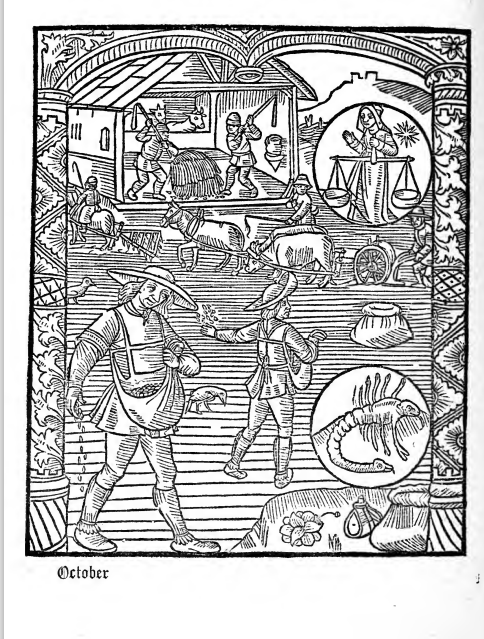
The 15th Century French illustration in the Kalendar of Shepherds shows October as a busy month. It is the time when the cereals are being flailed, the fields ploughed and sown. Perhaps winter wheat or barley or peas and beans?

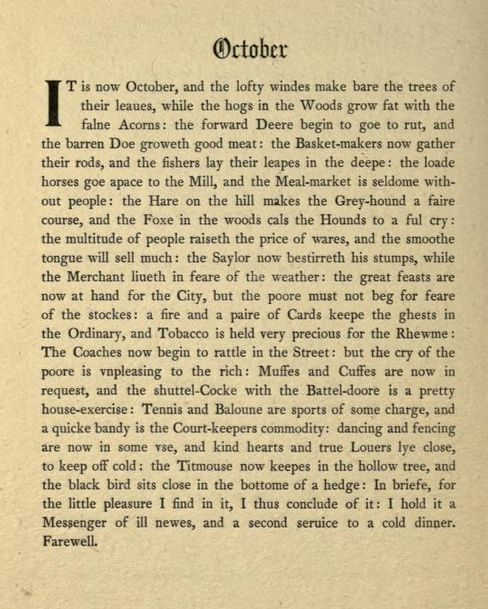
The 16th Century English text of the Kalendar of Shepherds (read the illustration) shows what a busy month it was, but the writer comes down hard against the month as ‘a messenger of ill news’ the harbinger of cold dark nights.

About the Kalendar of Shepherds.

The Kalendar was printed in 1493 in Paris and provided ‘Devices for the 12 Months.’ I’m using a modern (1908) reconstruction of it using wood cuts from the original 15th Century version. It includes various text from 16th and 17th Century sources. (Couplets by Tusser ‘Five Hundred Parts of Good Husbandrie 1599. Text descriptions of the month from Nicholas Breton’s ‘Fantasticks of 1626. This provides an interesting view of what was going on in the countryside every month.

https://wellcomecollection.org/works/f4824s6t To see the full Kalendar, go here:

Astrological October

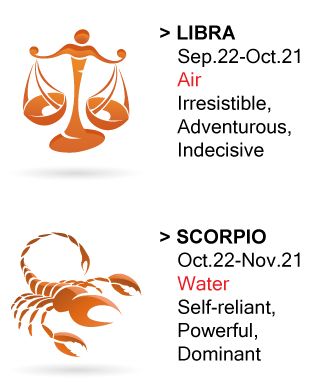
The star signs of October are the Scales of Libra and the Scorpion of Scorpio.

The star signs of October

Angelic October

Michael is the Angel of Autumn, the Angel of Judgement Day, and the Weigher of Souls. Uriel is the Angel of Libra and was sent by God sent to warn Noah. So the protector against, floods, fire and natural disasters. Scorpio’s Angel is Barbiel, he looks over health, genitalia and doubtful things. (‘An Angel Treasury’, Jacky Newcomb).

You might like to look at my post on Michaelmas here.

Roman October

In the Roman world it was, originally, the 8th Month (octo=8) but then they added January and February to the year. So it became the 10th Month. It was their time to celebrate the new wines of the Harvest. In Britain, the wine harvest is late September to October, but in hotter climes can be from July. But the grapes need to be processed, and the Romans thought that new wine was health giving and celebrated it in October.

Rustic October

But for many people, October is a beautiful month. The dying leaves bring a sophisticated array of rustic colours, which makes the wooded countryside exceptionally beautiful.

Autumn in Haggerston Park, London (photo Kevin Flude)

It can still be warm enough to go for pleasant walks. And the surfeit of the harvest and the culling of animals meant there was plenty to eat before winter austerity begins.

Anglo-Saxon Winter Fall

The Venerable Bede tells us that the month was called Winterfylleth, in the 8th Century. The English divided the year into Summer and Winter. And Winter began for the Anglo-Saxons on the first full moon of October. This means that this year winter begins on 7th October. This is the Harvest or Hunter’s Moon, which is also a supermoon, the first of 3 ending the year.

Celtic October

In Welsh, it is Hydref, which also means Autumn. For the Welsh it was the last month of Autumn and the last month of the year. The Celtic new year, and winter starts on 1st November. The same is true of the Irish Calendar. Autumn is called Fómhair, and October Deireadh Fómhair which means ‘End of Autumn’.

Astronomical & Meteorological Autumn

Astronomically, autumn ends at the Winter Solstice and meteorologically at the end of November. So the Celtic Autumn ends a whole month or more earlier than the other measures. My very personal view is that Winter begins on November 5th more often than not. This is an evening we often spend outside watching the fireworks displays to celebrate Guy Fawkes’ Night. It always seems to be the first time that you feel cold enough to need hat, gloves, and scarves.

First Published in Autumn 2024, revised 2025
The Archaeology of London Walk

Roman layer opus signinum,

This is Kevin Flude’s Walk for London Walks. It normally starts in the early evening and from Exit 3 Bank Underground Station To See if the walk is running soon follow this link.

Legend says that London was founded as New Troy. Historians believed it was founded as Londinium after the Bridge was built by the legionaries of the Emperor Claudius in AD 43.   Archaeologists in the 1970s and 1980s discovered that London was refounded as Lundenwic in the 7th Century and again in the 9th Century when it was called Lundeburg.

This walk tells the epic tale of the uncovering of London’s past by Archaeologists. And provides an insight into the dramatic history of the Capital of Britannia, and how it survived revolts, fires, plagues, and reacted to the decline and fall of the Roman Empire.  It became the foremost English City but with periods under Viking and Norman control.

We tell the story in the streets of the City of London, beginning in the valley of the River Walbrook by the Temple of Mithras, and visit many sites where important archaeological discoveries were made.

See my Roman London

Updated 7th October