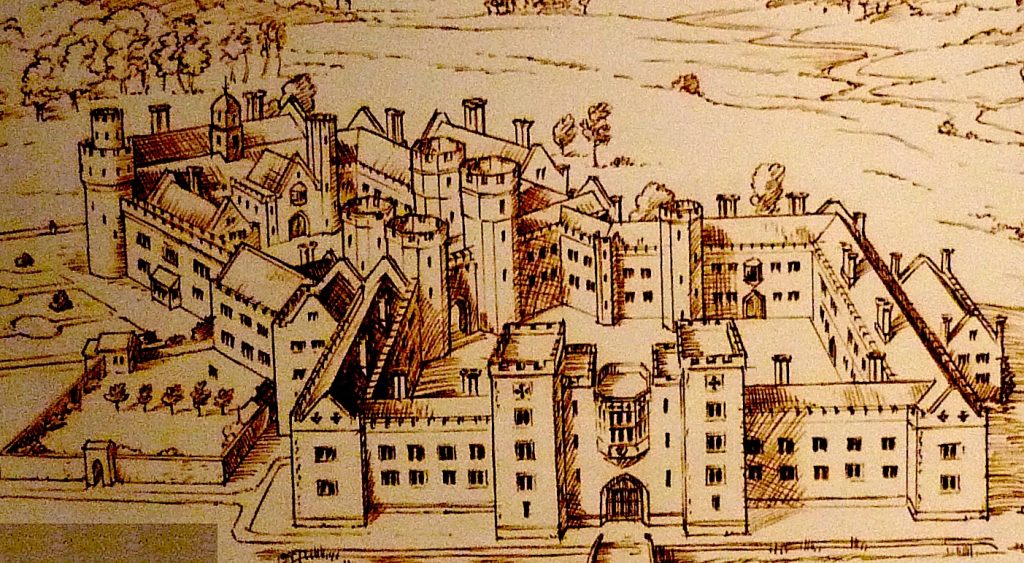
I was interested in this site because it was one of the many palaces owned by Henry VIII, and it began as a moated manor house before a transition into a small red brick courtyarded Palace, as seen above. Henry had, if my memory serves me well, approximately 57 Palaces and Manor Houses. 16 in the London area and 11 along the River Thames
But what I really liked when I visited the website was the charm of this lovely video by the Enfield Archaeology Society. Now those who know the wonderful TV Sitcom called the ‘Detectorists’ starring Toby Jones, Mackenzie Crook, Diana Rigg and others, will recognise the styling of the amateur archaeologists – all looking like rumpled would be Indiana Jones’s! Very English.
I have revised and updated three fascinating posts!
The first on the legacy of the Anglo-Saxon princess who changed Scotland when she became Queen.
The second is on the joy the Accession of Queen Elizabeth 1 gave to Protestants, with a description of the martyrdom of Thomas Tomkins of Shoreditch, London.
Almanacs and household guides of the 16th and 17th Century provide a list of seasonal things to do. These posts I have revised and reposted for your updated enjoyment. If you have to choose one, I suggest either the Old Parr post or have a look at the one on exercise, which will give you an excellent idea of early ideas of exercise.
Recent discoveries from Pompeii are being reported in a timely fashion on an interesting website – one of the recent posts is about the discovery of a Roman Electoral Poster. Please enjoy the read! electoral-inscriptions-discovered-in-pompeii
Below, I enclose a short section of my book ‘In Their Own Words – A Literary Companion To The Origins Of London‘ on Roman Elections, which might be of interest. But first, I have updated and republished my Almanac of the Past Blog posts for November 4th and November 5th, which you can see my following these links:
Extract from ‘In Their Own Words – A Literary Companion To The Origins Of London‘ about Roman Local Politics.
The forum in a Roman town was the central meeting place, used for offices, shops, market, meetings and political elections. Inscriptions show that the Londinium forum was the home of the provincial assembly, and that local government in London continued down to the ward (vicus) level. Surviving political `posters’ and graffiti from Pompeii provides some idea of the concerns of the Roman citizens:
Neighbours! Vote L Status Receptus for duumvir. He is fine. Posted by Aemilius Celer Vicinus.
A Plague on any wretch who scrubs this out!
Vote for M Casellius Marcellus ,a good aedile. He will grant great Games!
Bruttius Balbus for duumvir. Genialis supports him. He will conserve the treasury.
Trebius for aedile! The barbers support him.
M.Cerrinius Vatia for aedile! All night drinkers back him. Vatia for aedile! The pick pockets back him!
Spend for the public welfare! Keep the rates down!
— John Morris,‘londinium’22
A duumvir was the chief magistrate of the town, the equivalent of the Consul in Rome, and he was helped by `junior’ magistrates including aediles. As magistrates, they were expected to fund public works and entertainments from their pocket, so they had to be independently wealthy or backed by wealthy interests.
In addition, a property qualification could be imposed. A surviving charter provides:
A councillor of Tarentum…shall possessa buildingwithin the borders of the territory of Tarentumthat shall beroofedwithno fewer than1,500tiles.
Voting was strictly controlled, with returning officers, supervision by independent witnesses, and ballot boxes.
In Their Own Words – A Literary Companion To The Origins Of London‘ D A Horizons, 2009. Kevin Flude
To buy Kindle version click here. To buy paperback click on the paypal link below or email kpflude AT anddidthosefeet.org.uk
Electric Mountain Dinorwig Power Station, Llyn Peris (photo: K Flude)
I have revised the post on All Souls’ Day. If you follow the link you will read about ‘Souling’, Purgatory, and English, Mexican and Polish Customs for 2nd November.
But this post is prompted by an interesting article in the Guardian about the Dinorwig Power Station in North Wales. It’s a place I visit regularly. The photograph is from a Medieval Welsh Castle, Dobaldarn Castle, near the National Slate Museum in the new Unesco World Heritage Site of the Slate Landscape of North West Wales. The photo above gives an idea of the majesty of the destructive power of quarrying for slate.
Dobaldarn Castle, North Wales (photo by K Flude)
The Power Station is remarkable. It is a huge cavern in the mountain. When the National Grid has a lot of cheap energy, water is pumped to the top, and when electricity is in short supply, the water runs turbines to provide extra power. It is, in effect, a giant battery, and what makes it even more worthy of a part in a James Bond film is that it has the capability of initiating a Black Start to the Grid. If some cosmic catastrophe turns off the entire grid, Dinorwig can restart the Grid.
The article in the Guardian has some great pictures of it and the text is very interesting. You might want to start reading a third of the way down the article which has a long preamble.
I have just given a guided walk and a virtual tour of London in the prehistoric period. I rashly promised, as follow-up, a booklist. I have many books that I have found pivotal in shaping my own opinions, but I find myself very reluctant to recommend them in the light of the remarkable new, and recent, DNA discoveries.
The cause of this ‘revolution’ is the Petrous Bone – a small bone in/near the ear from which scientists can extract, without too much damage to ancient skeletons, a reliable source of ancient DNA. Previous studies were done on modern DNA and extrapolating backwards. Now, archaeologists can, relatively cheaply, investigate (and often debunk) archaeological theories about the spread of human cultures.
It is a salutary story. Early archaeologists had, what you might call, a colonial, diffusionist model of the past. So when a new culture was identified, normally on the back of the arrival of a new form of pottery. It was interpreted as being spread by diffusion, normally from the ‘civilised’ fertile crescent to barbaric pre-literate Europe. Hence, Stonehenge was thought to be built by a prince from Mycenae, on the basis of the Lion Gate in Mycenae having vague similarities with the Trilithons at Stonehenge (and other diffused cultural markers). And with a viewpoint, that the uncivilised Britons would not be able to build something so amazing!
Archaeologists in the 1970s rejected this imperialist model and preferred to think that cultures need not depend on advances from their betters, nor should ‘invasion’ be allowed to be the main means of technical and cultural advancement. The advent of Radio Carbon Dating profoundly affected how the past was dated, and showed that diffusionist chronologies, often, did not stand up. And thus Stonehenge was freed from cultural imperialism, and we Brits could take all the credit. And Prehistory lost a whole host of ‘invasions’ and ‘migrations’, and a start was also made on diminishing the centrality of the ‘invasions’ at the core of the Anglo/Saxon/Viking migrations into Briton.
Along comes the petrous bone and the development of the study of Ancient DNA, and we discover, in the last couple of years, that:
Farming was indeed introduced from the Continent, around 4000BC and the DNA of the UK was largely (but not completely) replaced by incomers. So it was not the Mesolithic hunter gathers who adopted farming but the ‘Western Neolithic’ people who settled bringing in sheep, cows, goats, pigs, wheat, oats, rye, barley, polished axes and pottery.
The Beaker Folk, DNA now tells us, came from abroad around 2,500 BC. Originally from the Steppes via the Netherlands, and their DNA replaced all but 10% of the Western Neolithic DNA. This happened at about the same time as Stonehenge was remodelled with the giant Trilithons.
So we now have at least 3 major population replacements before the coming of the Romans, Saxons, Vikings and Normans. Very annoying to find that those old-fashioned imperial archaeologists of the early 20th Century had it more correct than the enlightened archaeologists of the Late 20th Century.
View of London from the SE as it might have looked before the Roman Invasion
So to my book list. Firstly, you will have noted above that I have linked the stories to reliable websites, so you can get further information. Here are a few other important websites:
As to books, I suggest the best start is to read Mike Parker Pearson’s ‘Stonehenge A Brief History, Bloomsbury Academic 2023’ because it is up-to-date and Pearson has considered the DNA studies noted above.
For similar reasons and for a more general introduction to Britain in the Prehistoric period, you could try:
Roberts, Alice ‘Ancestors: A Prehistory Of Britain In Seven Burials ‘ Publisher: Simon & Schuster Ltd 2022
which has good reviews, but I have not yet read it.
I know that neither is about London, but the only ‘book’ on Prehistoric London I have is:
Merriman, N ‘Prehistoric London’ Museum Of London, 1991
And this is more of a booklet than a full academic book. There is another book, but then it was published in 1914:
Prehistoric London : its mounds and circles / by E.O. Gordon ; with appendices by John Griffith. Volume c.1 1914
For the period just before the Roman Invasion, I would highly recommend reading Julius Caesar’s opinions on Prehistoric Britain.
Caesar, Julius (ed Anne & Peter Wiseman). ‘The Battle For Gaul’ Chatto And Windus Ltd, London 1989
Peter Wiseman was my Professor at University, and it is an excellent introduction, still available new but also cheaply second hand at Abebooks.
You will find some interesting, relevant passages in my book:
Flude, Kevin ‘In Their Own Words – A Literary Companion To The Origins Of London’ D A Horizons, 2009
You can buy a hardback copy from me for £5 plus postage (email me, kpflude@chr.org.uk) or from Amazon in a Kindle version.