St George’s Day, Shakespeare’s Birthday  April 23rd

shakWilliam Shakespeare by Martin Droeshout from the 1st Folio
William Shakespeare by Martin Droeshout from the 1st Folio

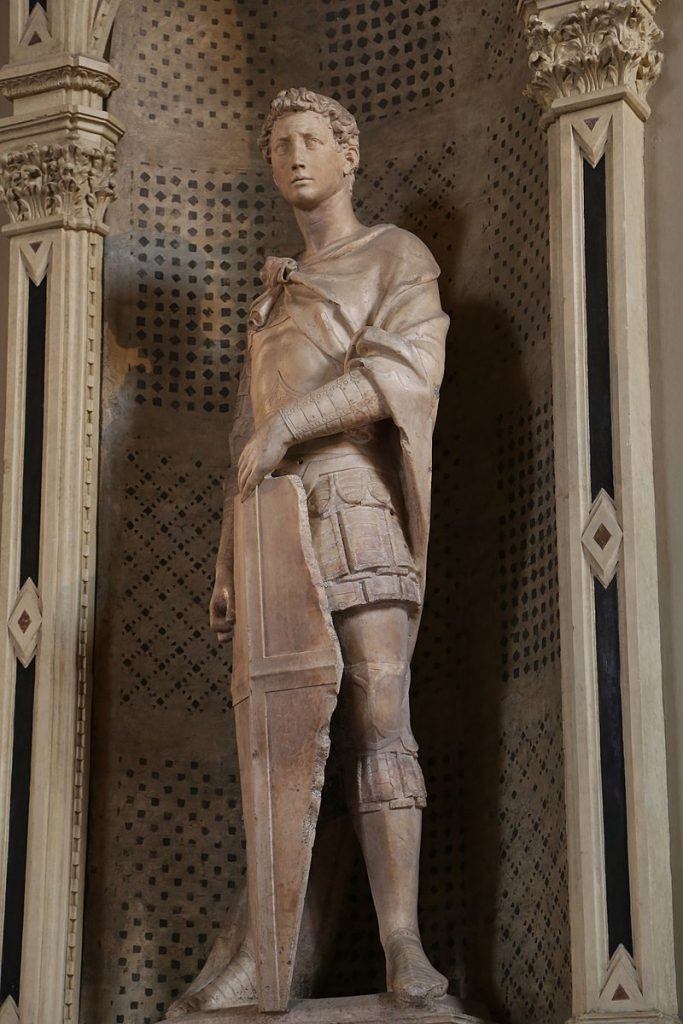
Today, is not St George’s Day but it is Shakespeare’s Birthday (Here is a wonderful website with everything you might like to know about St George.) By tradition, Shakespeare was born on St George’s Day. April 23rd 1564, 457 years ago. He died on the same day in 1616 at age 52. Cervantes died on the same day.

Shakespeare’s death date is given by the burial register at the Holy Trinity Church, Stratford on Avon where he was buried. His baptismal record also survives at the same church and is on April 26th 1564. So, we don’t actually know when he was born, but christening were held soon after birth for fear of the high infant mortality rates, so 23rd April, three days before, has been assigned to be Shakespeare’s birthday.

St George’s Day is normally on 23rd but not this year!

When St George’s Day falls between Palm Sunday and the Second Sunday after Easter it is transfered to the Monday after the Second Sunday of Easter. Soin 2025, It is on April 28th. Not many people know that including Keir Starmer, Theresa May, and London Mayor Sadiq Khan who all got it wrong the last time in happened in 2019. I got it wrong too! But I think the Church should stop such silly practices. Either it’s St George’s Day or it isn’t. Why does it matter?

Shakespeare’s Birthday, ‘taking to the chamber’

His mum, Anne Shakespeare would have ‘taken to her chamber’ about four weeks before the due date. The windows or shutters were fastened, as fresh air was thought to be bad for the birthing process. Female friends and relatives came to visit; the room was decorated with fine carpets, hangings, silver plates and fine ornaments. It was held that external events could influence the birth, any shocks or horrors might cause deformities and anomalies, so a calm lying-in room was clearly a good idea.

When labour began, female friends, relatives and the midwife were called to help out. A caudle of spiced wine or beer was given to the mother to strengthen her through the process. The maternal mortality rate for the 16th Century is estimated at 1500 per 100,000. Today, it’s 7 per 100,000. So most women would have heard of or attended the birth of a women who had died during or following children birth. There were also no forceps so if a baby were stuck and could not be manually manipulated out, then the only way forward was to get a surgeon to use hooks to dismember the baby to save the life of the mother. Doctors were not normally in attendance, but could be called in emergency,

Swaddling the Baby

Immediately after washing, the baby was swaddled. The swaddling was often very tight and could affect the baby’s growth, and might have affected the learning process, as movement of hands and feet are now considered significant in the early learning process. Swaddling lasted eight to nine months, and only went out of fashion after Jean Jacques Rousseau wrote against the practice.

Detail of tomb of Alexander Denton and his first wife Anne Willison, and her baby dressed in swaddling clothes Photo Wikipedia Hugh Llewelyn

Dangers of Childbirth

Puerperal fever killed many women even after successful childbirth, for example Queen Jane Seymour who died after 5 days. During these dangerous early days, the mother was kept in a dark room, and then, perhaps three days after birth, friends were invited to celebrate ‘upsitting’ when the mother was no longer confined to bed. This is when christening would take place. Edward VI was christened to a huge audience in the chapel at Hampton Court three days after his birth.

Licensed midwives could baptise newborn babies provided they used the correct wording and informed the Church so that the registration could be properly reported. Thomas Cromwell was responsible for the law in 1538 which insisted on a parish register to record weddings, christenings, and funerals. The law was reaffirmed by Queen Elizabeth in 1558 and registers had to be stored in a locked chest in the Church. (In 1597, the records had to be on parchment not paper, and in 1603 the chest had to have three locks!).

If the christening were in the church, the mother might not be there as she was expected to stay in her chamber for another week or so.

Churching and Breastfeeding

A week or a few weeks later, the mother would be ‘churched.’ This was a thanks-giving ceremony, although Puritans did not like the idea as it might be confused with a purification ceremony.

Breastfeeding would last a year or so but many high status women choose to use a wet-nurse. There was a real concern to find a suitable wet nurse as it was believed that the breast milk was important for the babies’ development both physically and temperamentally. Poor children who lost their mothers were very unlikely to survive as, without breast milk, the baby would be fed pap – bread soaked in cow’s milk.

Thanks very much to Alison Sim’s book ‘The Tudor Household’ for help in considering Shakespeare’s Birthday. For more on Shakespeare look at my post william-shakespeares-first-folio-400-years-old-today/

First published in 2023 and republished in April 2024, and 2025

John Stow, London’s Historian 22nd April

John Stow

On the corner of Leadenhall Street and St Mary Axe in the City of London is one of the very few medieval Churches that survived the Great Fire of London is 1666. It was sheltered by the firebreak that was the Leadenhall, a big market building made of stone. This is where the great London historian John Stow is buried. His Survey of London is one of the best sources for Medieval and Tudor London. Every three years, there is a commemorative service and his quill is changed. Last year it was on the 22nd April. The Lord Mayor attends and it is organised by Stow’s Guild – the Merchant Taylors.

John Stow, author of the ‘Survey of London‘ first published in 1598. Available at the wonderful Project Gutenberg: ‘https://www.gutenberg.org/files/42959/42959-h/42959-h.htm’

John Stow records that his father returned to his home at Austin Friars one day to find his house had been moved. He had no warning, nor payment for the loss of land. He had the misfortune to live adjourning the property of Thomas Cromwell.

St Andrew Undershaft

The Church is the Maypole Church as it was here the Maypole or the shaft was stored under the eves of the Church. Hence, St Andrew’s sobriquet of ‘Undershaft’. The May Day riot of 1517 put an end to the dancing around the Maypole but the pole itself survived until 1547. Then, in a Puritan riot, the ‘stynking idol’ was destroyed. (see my May Day blog post here for more more details.)

There is also a plaque to Hans Holbein, but no one knows for sure where he is buried. He died in London in 1543, possibly of plague. The present church was built in 1532, but it is first recorded in the 12th Century.

For my post on St Andrew – look here.

Agas Map 1561 showing St Andrews (right centre)

First Published on 30th November 2022, Revised 2023, moved to April in 2024, and revised 2025

St Beuno and a Poem to the Vagina April 20th


Drawing of a Stained glass window depicting Saint Beuno. D A R C 12345 – Own work

Today is St Beuno’s Day. St Beuno is also known as St Bono. He was an 8th Century Welsh Abbot of some power. The grandson of a prince of Powys in Wales who was descended from Vortigern. (see my post on Vortigern here.) Vortigern was a predecessor to King Arthur. Beuno was educated in Bangor Monastery, one of the foremost Celtic monasteries in Wales. During his ministry he restored 7 dead people to life including St Winifred (or Winefred).

Winifred & St Beuno

St Winifred’s Holywell, from Facebook.

She was Beuno’s niece, a virgin who refused the advances of a certain Caradog. Furious at her taking vows, Caradog tried to seduce her, but she refused. So, he chopped her head off.

Where her head landed a spring sprung amd became a holy spring.  The spot, in Flintshire is still called Holywell. It has been described as the Lourdes of Wales and one of my tours go past it that is how I heard about St Beuno.

Anyway the story goes that Beuno put his niece’s head back on her shoulders and restored her to life. How he did that, is a mystery.

From Facebook

She lived a full life with a brilliant Church career. Of course she is the patron of those who have suffered unwanted advances (but believe me there are many other candidates for that particular honour amongst the female Saints! Have a look at my post on St Agatha for another example of male sexual abuse.

Stained glass depiction of St Winifred, designed by William Burges, at Castell Coch, Cardiff. Wikipedia Hchc2009 – Own work

More on St Winefride’s on her feast day on 3rd November.

Medieval Powys, & Neglected Parts of the Female Anatomy

I drafted this in January, when I came across a reference to St Beuno in a fabulous exhibition at the British Library.  The show was called ‘Medieval Women – In their own Words’.

On display amongst the many wonderful manuscripts and books of the 11th – 15th Century was a Welsh poem.  The author was Gwerful Mechain (1460–1502), the only female medieval Welsh poet with a surviving and a substantial body of work. She is known for her erotic poetry, in which she praised the vulva among other things.

What is extraordinary is that I should, by complete chance, be publishing this the day after posting about the statue of the erect Minotaur! So, you can see how even-handed I am?

Here it is in full, in a modern translation:

To the Vagina by Gwerful Mechain

Every poet, drunken fool
Thinks he’s just the king of cool,
(Every one is such a boor,
He makes me sick, I’m so demure),
He always declaims fruitless praise
Of all the girls in his male gaze.
He’s at it all day long, by God,
Omitting the best bit, silly sod:
He praises the hair, gown of fine love,
And all the girl’s bits up above,
Even lower down he praises merrily
The eyes which glance so sexily;
Daring more, he extols the lovely shape
Of the soft breasts which leave him all agape,
And the beauty’s arms, bright drape,
Even her perfect hands do not escape.
Then with his finest magic
Before night falls, it’s tragic,
He pays homage to God’s might,
An empty eulogy: it’s not quite right:
For he’s left the girl’s middle unpraised,
That place where children are upraised,
The warm bright quim he does not sing,
That tender, plump, pulsating broken ring,
That’s the place I love, the place I bless,
The hidden quim below the dress.
You female body, you’re strong and fair,
A faultless, fleshy court plumed with hair.
I proclaim that the quim is fine,
Circle of broad-edged lips divine,
It’s a valley, longer than a spoon or hand,
A cwm to hold a penis strong and grand;
A vagina there by the swelling bum,
Two lines of red to song must come.
And the churchmen all, the radiant saints,
When they get the chance, have no restraints,
They never fail their chance to steal,
By Saint Beuno, to give it a good feel.
So I hope you feel well and truly told off,
All you proud male poets, you dare not scoff,
Let songs to the quim grow and thrive
Find their due reward and survive.
For it is silky soft, the sultan of an ode,
A little seam, a curtain on a hole bestowed,
Neat flaps in a place of meeting,
The sour grove, circle of greeting,
Superb forest, faultless gift to squeeze,
Fur for a fine pair of balls, tender frieze,
A girl’s thick glade, it is full of love,
Lovely bush, blessed be it by God above.

From: Gramich, Katie, Orality and Morality: Early Welsh Women’s Poetry, 2005, Cardiff University: Cardiff, pp. 8-9.
(http://www2.lingue.unibo.it/acume/acumedvd/Essays%20ACUME/AcumeGramichfinal.pdf)

Date: c1480 (original in Welsh); 2003 (translation in English) By: Gwerful Mechain (1462-1500) Translated by: Katie Gramich

For more about St Beuno https://en.wikipedia.org/wiki/Beuno

First published on April 20th 2025

Murder of St Alphage April 19th 1012

St Alphage. Church Tower on right, City Wall to left. Photo K Flude

I first came across St Alphage when I was working at the Museum of London. The Museum was built on the High Walk at London Wall. The raised Courbusian Walkway looked down on a ruin of a Gothic Church Tower, almost destroyed during the Blitz. This was St Alphage, a Church dedicated to the Saxon Archbishop of Canterbury. (Alphage is also spelt Alphege or Alfege).

On the other side of the Walkway was the old graveyard of the Church. This preserved one of the very best sections of the old London Wall. Special because on one side its huge height was displayed. On the other, the only crenelated bit of the City Wall. And the only surviving part of the Wall dating to the War of the Roses.

St Alphage Wall explained in an information plaque.
St Alphage Wall explained on an information plaque.

In the 1980’s fellow Museum of London Archaeologist, Paul Herbert and I set up a Guided Walks company (Citisights of London) . Our walks started from outside the Museum of London, and so St Alphage formed a big part of our success. It led to a life giving Guided Walks and tours. So, St Alphage, thank you!

A Citisights Day Tour of the 1980s

St Alphage Elsyng Spittle St Mary ?

The Church was previously a monastic settlement called Elsyng Spittle (aka St Mary within Cripplegate). The Augustinian Canons looked after 100 blind men. It was refounded by Williain Elsing, and dissolved by Henry VIII in 1536. The Church was kept for a Parish Church. But the Puritans were not keen on dedications to St Mary. So, they renamed it after a London based Christian Martyr.

It remained a Parish Church until damaged in an air raid in World War One. (possibly on 8th September 1916 in a Zeppelin Raid – but I am speculating). The Church was partly demolished in 1923, leaving the Tower. The lower part of the Medieval Tower survived bombing in the Blitz. At 12.15 am on 25th Aug 1940, the first bombs on the City of London fell nearby in Fore Street. But the tower was hit in 1940. It was listed Grade 1 in 1950. Kept by the rebuilding of London Wall, and the Barbican area. Then substantially benefitting from a remodelling of the area in an excellent scheme of 2022.

St Ælfheah of Canterbury and Greenwich

StAlfege Greewich - Doyle own work Wikipedia CC BY-SA 4.0
StAlfege Greewich – Doyle own work Wikipedia CC BY-SA 4.0

St Ælfheah was captured during a Viking attack on Canterbury. The Viking hoard relocated to Greenwich where they tried to negotiate a fat ransom for him. He was one of the richest men in the Kingdom. This is what the Anglo Saxon Chronicle says:

.. the raiding-army became much stirred up against the bishop, because he did not want to offer them any money, and forbade that anything might be granted in return for him. Also they were very drunk, because there was wine brought from the south. Then they seized the bishop, led him to their “hustings” on the Saturday in the octave of Easter, and then pelted him there with bones and the heads of cattle; and one of them struck him on the head with the butt of an axe, so that with the blow he sank down and his holy blood fell on the earth, and sent forth his holy soul to God’s kingdom.

St Alfege Greenwich, which is now a lovely Hawksmoor Church is said to be on the site of St Ælfheah‘s death.

St Alphage’s body was taken to St Pauls Cathedral where it was venerated. His remains were removed in suspicious circumstances by soldiers of King Cnut who translated the Saint’s bones to Greenwich. It is suggested King Cnut was punishing London for their opposition to him.

The Minotaur by Michael Ayrton

Also, part of the experience of visiting St Alphage from the High Walk was the statue of the Minotaur. I first came across this phallic Bull in the Postman’s Park and am very fond of it. Then it disappeared and reappeared on the High Walk. Now it is on the ground level near in the garden of St Alphage.

I understand that Michael Ayrton wanted to make a point about the destruction of London. He felt that the developers were more destructive than the Luftwaffe. They were like a Bull in a China Shop! So he created this statue of a very vigorous Bull representing the Minotaur. It is a very unusual work of art in that it sports a fully erect penis. Art History is full of naked women, but the male organ is largely left to pornography. For more about Ayrton follow this link.

First Written on April 19th 2025

Vortigern April 2nd 1796

Bill for the 1796 play Vortigern and Rowena Public Domain Wikipedia

Content Move April 2nd 2026 to:

https://chr.org.uk/anddidthosefeet/?p=5187

Heritage with my Grandson 2 – British Library & British Museum March 9th

Grandson on a visit to the British Library and British Museum. Photo of the Beethoven Exhibition, British Library, March 2022

A visit to the Britsh Museum & British Library? I think this might be worth reposting in the absence of anything else compelling for the day!

So this was my outing with my grandson on March 9th 2022.

For our second museum outing we went to the British Library. He didn’t like the Beethoven exhibition. It was too dark and nothing to surreptitiously climb on. He definitely does not like dark exhibitions. This is a shame because it seems to be the design idea of the moment. The Nero and the Stonehenge exhibitions were also dark spaces. The desigers working on creating atmospheric views using bright colours, spot lighting and spectacular objects on a dark background. But it doesn’t work for a sensitive 20 month year old!

Nor did the largely text based Paul McCartney’s Lyrics exhibition attract a second of his attention. ‘Paul who?’ he seemed to be saying as we stumped past to the very quiet sound of ‘Hey Jude’.

What he did like was the escalators. We went up and down, and up and down, and then onto the second set where we repeated the repeat.

British Library – note the escalator to the right

And then we went down and back up again, and no time to see the enigma machine. We ate in the upstairs Restaurant, which is a really pleasant place to spend a lunch time.

Enigma Machine, British Library

Time for him to have a sleep so we walked to the British Museum through Bloomsbury. However, there was very little sign that he wanted to nod off. But we found a couple of interesting revolutionaries of the 19th Century en-route. The first was to Robert Owen, the founder of the Cooperative Movement, famous for his model factories in New Lanarkshire.

Plaque to Robert Owen ‘father of the Cooperative Movement’, Burton Street

Then to Cartwright Gardens, named after John Cartwright, who was called ‘the Father of Reform’. He had quite an amazing life. He refused to serve in the Navy against the American Colonists in the War of Independence. Not only that, but he supported reform of Parliament, universal suffrage, annual Parliaments and secret ballots.

John Cartwright Statue Cartwright Gardens.

The milk soon did its job and my grandson was asleep. So I took him to the Member’s Room for a cup of tea.

Sleep in the Member’s Room overlooking the Great Court

When he woke we whizzed around the third Floor. But he was reluctant to leave his buggy because it was much more crowded than our last visit. Then he could run free around the almost empty galleries which he loved.

But, I was able to visit old favourites like the Portland Vase. This was smashed into hundreds of pieces, in 1848 by a drunken visitor. He threw a sculpture into the case and smashed the vase. It was restored, but 37 pieces were missing. In 1988 the vase was reunited with the missing pieces and expertly restored.

The Portland Vase – 15BC = 25AD Cameo Glass
Plate Cameo Glass 15BC – 25AD

For more exploration of Museums with toddlers see my post: https://www.chr.org.uk/anddidthosefeet/museums-for-toddlers/

First Published 9th March 2022.. Revised and reposted 2025

Not Archaeology Day 10th February

Yesterday was Almanac of the Past Misinformation Day! I have just found out that you received a post which was not only empty of content but also wrong! Details of that below. But, here are a couple of interesting archaeology projects I have been planning to post about.

Lost Books from the Ancient World

What has excited me most is the news that burnt scrolls from Heraculeum have been digitally unrolled. Then ‘read’ using AI. The scroll was in the library of Julius Caeser’s father in law it is thought. There are over 1,000 carbonised scrolls found in 1750 in the Villa of the Papyri. And this one reveals details of Plato’s last hours. But more than that, the technology opens the possibility of other lost books being discovered. Of the ‘known unknowns’ I would like to see are the lost history books of Tacitus. But perhaps the ‘unknown unknowns’ are even more exciting. What might we find out?

Here is an excellent introduction to the discoveries:

https://www.theguardian.com/science/2024/feb/05/ai-helps-scholars-read-scroll-buried-when-vesuvius-erupted-in-ad79

Cerne Abbas Giant

Cerne Abbas Giant 2017 photo by K Flude

The giant is one of the icons of Hardy’s Dorchester. It is ‘drawn’ or sculpted by cutting the turf to reveal the white chalk below. Chalk Cut figures appear particularly in the South West. The Vale of the White Horse chalk cut figures has been dated to the Late Bronze Age. Most people thought the Cerne Abbas Giant was in the Romano-Celtic tradition so was either pre-Roman, or perhaps Hercules and Roman.

Some dissenters believed the lack of references to the Giant showed that it could not have been cut until the 17th Century. Some even thought it might be a ‘cartoon’ of Oliver Cromwell!

How we laughed!

The National Trust embarked on a project to get the Giant properly dated. They used Optically Stimulated Luminescence (OSL) dating which had also been used on the White Horse. But the results came back were shocking. It appears to have been cut in the Late Saxon period.

I do admit to a certain amount of scepticism. The art style is similar to British Art of the Iron Age, part of the Celtic Art tradition. Also, how reliable is OSL dating? The process depends on taking soil samples from the soil nearest the chalk, and OSL measures the time since the soil was last exposed to light. It’s a relatively new technology although based on Thermoluminescence dating of pottery which has been around since the 1970s. There was also some corroboration in the form of snails which were not indigenous to the UK?. So a date of 700-1100AD is suggested. And I have nothing other than a gut reaction to the date they propose. Maybe I’m just disappointed by a Saxon date as I have no way of understanding the context.

https://www.nationaltrust.org.uk/visit/dorset/cerne-giant/history-of-the-cerne-giant

Here is a cartoon I really like:

Homer and the Cerne Abbas Giant, Image from Facebook of unknown origin.

Not the Archaeology Day but the Festival of Archaeology?

So, yesterday was not Archaeology Day. But it was last year and run on February 10th by the Council for British Archaeology. This year (2025) they are running their normal Festival of Archaeology from the 19th July to the 3rd of August. It is nationwide, and they have numerous local events which you can check out on their website here.

So how did this happen? I must have seen a reference to an archaeology Day on February 10th, assumed it would be an annual event. So, I added a ‘stub’ post to remind me about it. These, normally are stored in the ‘drafts’ folder, which I will then develop and post. But for some reason, this one got in the ‘Scheduled Posts’ Folder. And as I was working flat out preparing my ‘Jane Austen’s Bath’ Virtual Tour, I did not spot it. So, it was automatically posted. (The VT went very well, thank you very much).

Today, I looked up ‘Archaeology Day 10th February’ and found my post was the number one google source. In normal circumstances, this would be a matter of chest beating. I have been putting significant effort into improving my ‘SEO’ (search engine optimisation). Sadly, I got to the top of Google only because there are only two posts referring to an Archaeology Day on the 10th of February. Mine and a Council of British Archaeology, post who ran the event in York.

So, today is the Not Archaeology Day.

First published on February 10th 2025, and republished on February 11th 2025, text copied to Gemini Post on February 10th, 2026

The Jorvik Viking Festival February 2025

Screen shot from the Jorvik Viking Festival Site showing all the fun to be had if the Vikings invade your town!

The annual Jorvik Viking Festival is on from Monday 17th – Sunday 23rd February 2025 in York. The illustration above show there are Viking Trails, Feasts, Crafting, Berzerkering and encamping. And more! Visit the web site here.

The excavations under the floor of the Jorvik Centre. Photo K. Flude

York or Jorvik as the Vikings knew it as, has become the centre of all things Viking in the UK. Viking York came to the fore with the Coppergate Excavations in the 1980s. Underneath what is now a shopping mall and Primark, were the streets of Viking York in all its waterlogged glory. The waterlogging allowed the survival of organic material that rarely survives.

Excavation of Jorvik visible under the floor of the Museum. Photo By Chemical Engineer – Own work, CC BY-SA 4.0, https://commons.wikimedia.org/w/index.php?curid=58524883

At the time, the excavations were a sensation. York Archaeological Trust made a bold decision to turn part of the site into a ‘Dark Ride Experience’. The remnants of the excavation were preserved under glass, and nearby a replica of the townscape was created. Tourists sat in ‘cars’ with an audio guide and given a guided tour. It was very successful. The extensive profits were used for other York Archaeological Trust projects such as the reconstruction of medieval Barley Hall. Other historic towns followed suit and soon there were Dark Rides in Canterbury, London, Oxford and others. All, as far as I know have died a death except for the Jorvik Centre which continues to enthral visitors to York.

Tableau from the Jorvik Centre with Fishermen working. Photo By Chemical Engineer – Own work, CC BY-SA 4.0, https://commons.wikimedia.org/w/index.php?curid=58524883

The next best thing about Vikings are their colourfull names. Jorvik history vibrates with the deeds of ‘Ivan the Boneless’, Sihtric ‘the Squinty-eyed’and Erik Bloodaxe. For more on nicknames read my post!

First Published in February 2025

News of Virtual Tours

Sorry to send an additional post but coming up are a couple of fascinating Virtual Tours which I would like to remind you of!

Tonight is an exploration of early 19th Century London. It is based on the 1809 Picture of London Guide book. An original copy was given to me by someone grateful to have attended one of my lectures at the Old Operating Theatre Museum. It is a tour of what Jane Austen could have visited on her walks around London. There are Austen associations, but mainly we are looking at London in 1809.

Jane Austen’s ‘A Picture of London in 1809’ Virtual Walk Mon 7.30 27th Jan25 To book

Yesterday, I was asked to give a Cromwell’s London walk as a 75th Birthday present. I haven’t done one for at least 25 years. But I really enjoyed the research. So added a guided walk and a virtual tour to my programme. This is the first time I have done this VT and it is a cracking story.


The Civil War, Restoration and the Great Fire of London Virtual Tour 7:30pm Thurs 30th Jan25To book

Finally, April is the month we go on pilgrimages, as Chaucer said (in Old English). So, in addition to my Chaucer Walks, I have added a Virtual tour so we can go all the way to Canterbury.


Chaucer’s London To Canterbury Virtual Pilgrimage 7.30pm Friday 18th April 25 To book

I may add one or two more before the Sun comes back

To see all my walks see this page.

Sementivae Dies—the Days of Sowing January 24–26

Victoria and Albert Museum” by Nick Garrod, licensed under CC BY-NC-ND 2.0. First V&A Director, Sir Henry Cole, to the left of the picture. Greek Deities in the roundells

Sementivae, was a festival dedicated to seed and to Ceres. Ceres is an Earth Goddess who gives her name to our word cereal. The festival was also called. Paganalia. The Mediterranean world had many names for the Earth Goddess. Tellus, Demeter, Cybele, Gaia, Rhea etc..

Ceres can be seen on the top left roundel resting on the Globe on the marvellous Ceramic Staircase at the V&A (photo above). And in my slightly out of focus photograph below. (To be honest, in real life, it looks a little more like my photo than the gorgeous photo above!)

Ceres represented Agriculture, Mercury Commerce, and Vulcan Industry.  Old Photo by the Author.  T
Ceres represented Agriculture, Mercury Commerce, and Vulcan Industry. Old Photo by the Author.

Sementivae Dies – a moveable feast.

To create life, we need earth and water to nurture and seeds for fertility. And so into the cold dead world of January the Romans created a festival of sowing. It had two parts, one presided over by Mother Earth (Tellus) and the other by Ceres, the Goddess of Corn. The actual day of the festival was chosen not by rote on a set day of the calendar but by the priests, in accordance with the weather. This seems very sensible, as there is no point sowing seeds in terrible weather conditions. I’m assuming the Priests took professional advice!

On the 24th-26th January Tellus prepared the soil, and in early February seeds were sown under the aegis of Ceres. Tellus Mater (also Terra Mater) was known as Gaia to the Greeks.

Gaia

Gaia was selected by James Lovelock & Lynn Margulis in the 1970s as the face of their Gaia hypothesis. To me, the importance of the idea is not the scientific principle that environments co-evolve with the organisms within them. But, rather in Gaia as a personification of our world as a complex living ecosystem. One that we have to care for. Gaia exists as a series of feedback loops. Lovelock hypotheses that she will spit us out unless we can live in balance with our alma mater.

Ovid and Sementivae

This is what the Roman Poet Ovid has to say in his poetic Almanac known as ‘Fasti’ (www.poetryintranslation.com)

Book I: January 24

I have searched the calendar three or four times,
But nowhere found the Day of Sowing:
Seeing this, the Muse said: That day is set by the priests,
Why are you looking for moveable days in the calendar?
Though the day of the feast ís uncertain, its time is known,
When the seed has been sown and the land ís productive.
You bullocks, crowned with garlands, stand at the full
trough,
Your labour will return with the warmth of spring.
Let the farmer hang the toil-worn plough on its post:
The wintry earth dreaded its every wound.

Steward, let the soil rest when the sowing is done,
And let the men who worked the soil rest too.
Let the village keep festival: farmers, purify the village,
And offer the yearly cakes on the village hearths.
Propitiate Earth and Ceres, the mothers of the crops,
With their own corn, and a pregnant sow ís entrails.
Ceres and Earth fulfil a common function:
One supplies the chance to bear, the other the soil.
Partners in toil, you who improved on ancient days
Replacing acorns with more useful foods,
Satisfy the eager farmers with full harvest,
So they reap a worthy prize from their efforts.
Grant the tender seeds perpetual fruitfulness,
Don’t let new shoots be scorched by cold snows.
When we sow, let the sky be clear with calm breezes,
Sprinkle the buried seed with heavenly rain.
Forbid the birds, that prey on cultivated land,
To ruin the cornfields in destructive crowds.
You too, spare the sown seed, you ants,
So you’ll win a greater prize from the harvest.

For more on Ovid look at my post on Ovid and Juno here. Or you can search for Ovid in the Search box.

First Published in January 2023, republished in January 2024, 2025


Join the Mailing List

For occasional news of events