Love this monument in St Margaret’s Uxbridge to Dame Leonora Bennet.
She lies there resting on her arm with an insouciant air. She had three husbands before spending the rest of her life on good works. And the sculptors John and Matthew Christmas seem to me portray her as an attractive woman.
Love the contrast with the glimpse into the Charnel House below with the jumbled bones almost fighting to get out.
The Tomb of Leonora Benet. St Margaret’s Church, Uxbridge.The scene from the charnel house at the bottom of the tomb of Leonora Benet. St Margaret’s Church, Uxbridge.
I’m going to let this Quora answer speak for itself today. This is by Daniel Tiede and is his nomination for the last Germans to surrender in World War Two. You can find the article here:
The Master of St Giles, National Gallery. ‘St Giles and the Hind’ This work is in the public domain in its country of origin and other countries and areas where the copyright term is the author’s life plus 100 years or fewer.
St Giles
Today, is St Giles’ Feast Day. His story is mostly unknown, but his legend holds that he was a hermit who had a pet Hind in the Arles District of France sometime after the fall of the Roman Empire. The hounds of King Wamba (a Visigothic King) were chasing the deer, and shot an arrow into the undergrowth. The King and his men followed to discover Giles wounded by the arrow, protecting the hind, who he held in his arms. The hounds were miraculously stayed motionless as they leaped towards the hind. Wamba, which apparently means ‘Big paunch’ in Gothic, also had a Roman name: Flavius. Giles was injured in the leg, although the image above shows the arrow hit his hand. Wamba set him up as an Abbot of a Benedictine Monastery.
St Giles is, therefore, the patron saint of disabled people. He is also also invoked for childhood fears, convulsions and depression. He was very popular in medieval Britain, with over 150 churches dedicated to him, including four in London. Perhaps the two most famous are St Giles Without Cripplegate in London and St Giles Cathedral in Edinburgh.
St Giles Cripplegate, photographed by the Author at night from the Barbican Centre.
St Giles Cripplegate
St Giles was built in the 11th Century, rebuilt in the 14th Century and again in 1545-50 after nearly being destroyed by fire. It survived the Great Fire of London, being just beyond the extent of the Fire. But it was badly damaged in the Blitz, although the Tower and the outer walls survived.
Oliver Cromwell married Elizabeth Bourchier here. John Foxe of the Book of Martyrs, John Speed, the Cartographer, Martin Frobisher, the explorer and John Milton, the Poet were buried here.
Shenanigans with Milton’s Coffin
Milton’s coffin was opened in 1793 and he was said to have looked as if he had just been buried. One of those present, then, had a go at pulling Milton’s teeth out. A bystander helped by hitting his jaw with a stone. The few teeth Milton had left in his head were divided between the men, who also took a rib bone and locks of his hair. The Caretaker then opened the coffin for anyone who wanted to see the corpse!
From the London City Wall Trail.
Cripplegate
St Giles is without Cripplegate. It is one of the Gates in the City Wall (originally the North Gate of the Roman Fort). It may be named because St Giles made it agood place to gather for those trying to beg alms for their disabilities. An alternative explanation it from the Anglo Saxon crepel, which is an underground tunnel which is said to have run from the Gate’s Barbican to the Gate. Or perhaps because of the cure of cripples when Edmund the Martyr’s remains passed through the Gate in 1010.
The Corner Tower of the London City Wall, the Barbican in the background, and the tower of St Giles’ Church behind the Tower. Photo by the author
First Published in September 2024, and revised in 2025.
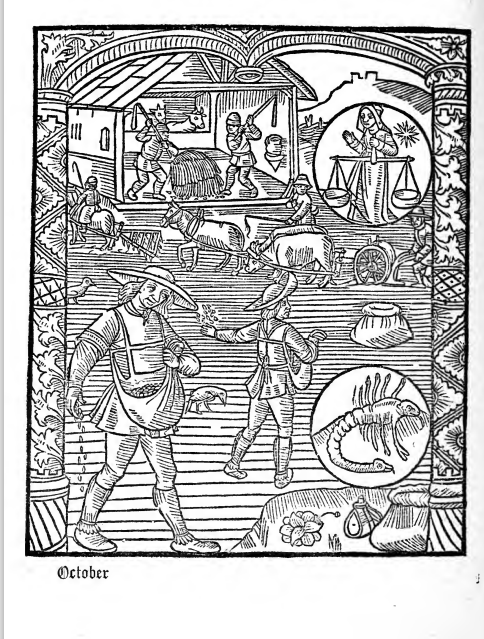
Kalendar of Shepherds illustration of September showing harvesting grapes and the astrological signs for Virgo (August 23 – September 22) and Libra (September 23 – October 22)
It is that time of the year when you say ‘Where has the Summer gone? It can’t be September already?’ But, meteorology, speaking, Autumn starts today. September 1st was chosen on a numerical basis for ease of measuring rather than any profound floral, agricultural or solar reason. So, there are three Gregorian Calendar months for each season, and each season starts on the first of the month. Autumn: September, November and December.
Autumn, Harvest, Fall
Autumn comes from Latin (autumnus) which went into French and then into English. The season was also called Harvest (which went into Dutch herfst, German Herbst, and Scots hairst -Wikipedia) or from the 16th Century: the ‘fall of the year’ or ‘fall of the leaf’ which spread to America as Fall.
Summer’s Ending
It still feels like summer. In England, we often have a glorious September, and what we can an ‘Indian’ Summer, an unexpectedly warm period in mid-September to October.
Solar Autumn
Of course, for the real Autumn, we have to wait for the Equinox, the beginning of Astronomical or Solar Autumn. This year, it is on Monday, September 22nd, 2025, 7:19 pm.
Astrological September
The star signs for astrological September are: Virgo which is linked to Aphrodite (Venus) the Goddess of Love and Libra which is linked to Artemis (Diana), virgin goddess of many things, including hunting, wild animals, children, and birth.
Star signs for September
September
September gets its name from the Romans, for whom it was the 7th Month of the year (septem is Latin for seven). Later, they added two new months so it became our 9th Month. (For more on the Roman year, look at my post here).
It is called Halegmonath in the early English language, or the holy month, named because it is the month of offerings, because of the harvest, and the mellow fruitfulness of September? Medi in Welsh is the month of reaping, and An Sultuine in Gaelic which means the month of plenty.
Roman personification of Autumn from Lullingstone mosaic
Early Modern September and the autumn of Life
Here is an early 17th Century look at September from the Kalendar of Shepherds – for more on the Kalendar, look at my post here.
From the Kalendar of Shepherds
The Kalendar has an additional shorter look at September (see below). And it continues with its theme, linking the 12 months of the year with the lifespan of a man – 6 years for each month. So September is a metaphor for man at 56 years of age, in their prime and preparing for old age.
September from the Kalendar of Shepherds. The last sentence beginning ‘and then is man’ shows the link between September and the beginning of the autumn of life.
Season of ‘mists and mellow fruitfulness‘
John Keats (1795 – 1821) wrote a great poem called ‘To Autumn’:
Season of mists and mellow fruitfulness, Close bosom-friend of the maturing sun; Conspiring with him how to load and bless With fruit the vines that round the thatch-eves run; To bend with apples the moss’d cottage-trees, And fill all fruit with ripeness to the core; To swell the gourd, and plump the hazel shells With a sweet kernel; to set budding more, And still more, later flowers for the bees, Until they think warm days will never cease, For summer has o’er-brimm’d their clammy cells.
Who hath not seen thee oft amid thy store? Sometimes whoever seeks abroad may find Thee sitting careless on a granary floor, Thy hair soft-lifted by the winnowing wind; Or on a half-reap’d furrow sound asleep, Drowsed with the fume of poppies, while thy hook Spares the next swath and all its twined flowers: And sometimes like a gleaner thou dost keep Steady thy laden head across a brook; Or by a cider-press, with patient look, Thou watchest the last oozings, hours by hours.
Where are the songs of Spring? Ay, where are they? Think not of them, thou hast thy music too,— While barred clouds bloom the soft-dying day, And touch the stubble-plains with rosy hue; Then in a wailful choir the small gnats mourn Among the river sallows, borne aloft Or sinking as the light wind lives or dies; And full-grown lambs loud bleat from hilly bourn; Hedge-crickets sing; and now with treble soft The redbreast whistles from a garden-croft, And gathering swallows twitter in the skies.
Written September 19, 1819; first published in 1820. This poem is in the public domain and available here:
Maponus was a Celtic God of Youth, linked, in the Roman period, to Apollo. He held sway in Gaul and Britain and is attested by Roman inscriptions.
Here is an example from Ribchester in Lancashire. This is from a Roman Cavalry Fort, founded c 70AD
To the holy god Apollo Maponus for the welfare of our Lord (the Emperor) and of Gordian’s Own Unit of Sarmatian cavalry of Bremetennacum Aelius Antoninus, centurion of the Sixth Legion Victrix, from Melitene, acting-commander and prefect, fulfilled his vow willingly, deservedly. Dedicated 31 August in the consulship of the Emperor Our Lord Gordian for the second time and of Ponpeianus.
The supplicant Aelius Antoninus was stationed at Ribchester which the inscription refers to as Bremetennacum, but he is from Melitene, which is on the Euphrates. (RIB583)
With the inscription was a sculpture of Maponus showing him with a cloak but naked and with a lyre and possibly a quiver of arrows. There were also two women one young, largely naked and crowned. The other full clothed. One theory is that they are personifications of the place and the province. Perhaps they are the Divine Mother and a lover? You can read more about this inscription on this wonderful Roman Inscriptions site: https://romaninscriptionsofbritain.org/inscriptions/583
Maponus was the divine ever-youthful God. He is mentioned on the Celtic Coligny Calendar. This is a very rare inscription which is written in Celtic, and explains the Celtic Calendar.
On it the 15th day of the month of Riuos is marked with the word “Mapanos”. This around the end of August and suggests the Altar might have been raised on the feast day of Maponus.
Maponus & Oengus mac Óc
Maponus is associated also with the Irish Divine Boy Oengus mac Óc. Son of the Dagda. There is more about Oengus and Maponus if you read this post. But from it I got this lovely quotation:
“And he was a beautiful young man, with high looks, and his appearance was more beautiful than all beauty, and there were ornaments of gold on his dress; in his hand he held a silver harp with strings of red gold, and the sound of its strings was sweeter than all music under the sky; and over the harp were two birds that seemed to be playing on it. He sat beside me pleasantly and played his sweet music to me, and in the end he foretold things that put drunkenness on my wits.”
Clochmabon or Lochmabon stone.Â
This is a stone surviving from a 9 stone megalithic circle on the shore of the Solway Firth in Dumfries and Galloway, Scotland. It was built around 3200 BC. (The stone fell over in 1982 and radio-carbon dating produced the date quoted here.)
The granite stone is 7 feet tall and 18 feet wide weighing 10 tons (10,000 kg). It has been identified as, possibly, the place called ‘Locus Maponi’ on the 7th Century  Ravenna Cosmography. In historic times it was a meeting point for armies, for truces and prisoner exchanges. Also used for community for local gatherings and markets. It was at one time the marker for the Border, and is near to Gretna Green.
Maponus appears to have been of special importance in the North West, and it is interesting how the stone retained its importance into the Christian era.
So King Edward gathered an army and landed in Normandy. It was the largest invasion force until D-Day.
Edward burnt his way to Paris. Within 2 miles of Paris Edward was confronted by superior forces and trapped on the wrong side of the Somme. His army was starved by the French scorched earth policy.
The English, only 6 miles away from the French Army forced their way across a defended tidal ford. Here they broke into an area which had not been scorched and were able to resupply. This success also restored English moral as the French defenders could not stand against the longbow men.
Sketch of statue of Edward III from Westminster Abbey
King Edward set up a defensive position at Crecy-en-Ponthieu, on land he owned. It offered protection from flanking attacks and an uphill struggle for the French attackers. The English dug pits to make French attacks more difficult. The English were badly outnumbered. Estimates vary but the French at least had double the number of troops. The English had about 15,000 troops, the French between 30,000 and 100,000.
Aerial view of the battle site according to Google.
The first attack came from Genoese crossbowmen but the English and Welsh longbow men had the advantage of range and the Italians soon retreated. French men-at-arms attacked in some confusion, killing Genoese as they attacked but were repulsed after terrible fighting. Wave after wave of French attacks followed. None succeeding. At the end of the two day battle very few English men were killed and many thousands of French, including the flower of the nobility.
English losses were 300 or less and the French lost are sometimes estimated as 30,000, but a third of that is probably more realistic.
The battle changed opinions about British fighting ability, and showed that heavily armoured wealthy knights could not stand against trained yeoman archers armed with long bows. The archers could shoot 3 arrows a minute with a range of up to 300 yards. There may have shot half a million arrows.
But it can also be argued that the victory lulled the English into the belief that they could hold France. This led to the fruitless slaughter of the 100 years war which England ultimately lost.
On the other hand Edward III captured Calais which remained an important and strategic asset until the 16th Century.
Google image with the Crecy in the orange bounded area bottom middle of the screen
Bartholomew Fair as illustrated in 1808, Wikipedia Public Domain. Thomas Rowlandson (1756–1827) and Augustus Charles Pugin (1762–1832) (after) John Bluck (fl. 1791–1819), Joseph Constantine Stadler (fl. 1780–1812), Thomas Sutherland (1785–1838), J. Hill, and Harraden (aquatint engravers)
The Fair began in 1133 a few years after the foundation of St Bartholomew’s Priory 1123. Smithfield held a weekly livestock market. But on St Bartholomew’s Day they held an annual Fair. It was originally 3 days long but expanded to 2 weeks by 1753. It became the chief wool fair for England by 17th Century. But it was also rowdy and in 1691, it was reduced to 4 days, and suppressed in 1855.
Ben Jonson wrote a marvellous play called Bartholmew Fair first performed in 1614 at the Hope Theatre on Bankside. In it, he portrays the characters who attended the Fair. There is a ballad singer who sings & sells printed ballad sheets. He spots where his customers keep their money purses. And signals to an accomplice cutpurse who steals the money. Then there is the horse-seller who cheats his customers with his tricks which make an old nag seem like a frisking colt. The Ale Wife in the beer tent froths up the beer, to short measure the beer drinkers, then whips away the beer pot before all the ale is finished, reselling the dregs. There is an absurd Puritan, pompous Citizens, a puppet show, the pig with two pizzles, and other freak shows.
Pie Powder Court
Cloth Fair, looking towards the Hand & Shears which where the Pie Powder Court was held.
Malfactors at the Fair could expect punishment at the Pie Powder Court, which was held in Cloth Fair at the Hand and Shears which is still a delightful London Pub.
St Bartholomew was one of the Apostles. But in case you haven’t heard of him he is identified as the same person St. Nathaniel.
The argument goes that Nathaniel was the son of Tolma or Bar-Tolmai, hence aka Bartholomew. He converted the King of Armenia, but the King’s Brother had him skinned alive. His eyes and tongue remained intact and he continued to proclaim the Gospel until he was beheaded.
So, being skinned he is the patron Saint of butchers, skinners, tanners, bookbinders, and all leather workers. Also of those suffering from skin diseases. He is the patron saint of Benevento, where his relics reside.
His martyrdom is depicted by Michaelangelo. And in the very marvellous St. Bartholomew’s Church in Smithfield, London, there is a golden sculpture of St Bart. by our very own Damien Hirst.
St Bartholomew by Damien Hirst, St Bartholomew’s the Great, Smithfield, Photo Kevin Flude
Bartlemas Weather Lore
If Bartlemas Day be fine and clear
You may hope for a prosperous autumn that year.
But it was also said that ‘St Bartholomew brings the cold dew’
It was also the day that might end the 40 days of rain brought by a wet St Swithun’s Day. (If such a long period of summer rain has ever occurred).
All the tears. St Swithin can cry St Barthelmy can wipe dry.
The St Bartholomew’s Day Massacre August 24th 1572.
This was the day when the Protestants of Paris were massacred. Up to 30,000 huguenots were killed in a massacre that spread from Paris to the countryside. It happened following a rapprochement between the religions and the marriage of the Catholic Marguerite de Valois and Huguenot Henry de Navarre on 18 August. Henry was heir to the throne, and prominent protestants were in fiercely Catholic Paris for the celebrations. Riots followed assassination attempts, and attempted genocide followed. Much like the St Brice’s Day Massacre in 1002 when the English King ordered the death of all Danes.
The French massacre led to wholesale emigration of the Protestants to the UK. William Shakespeare lodged with a Huguenot family in London. Being highly educated and skilled the immigrants generally did very well in England but the size of the wave wasn’t without opposition.
Title Page of publication Published 1 February 1980 Archaeometry
Today is the day that the World Wide Web was first introduced to the world. I was working as a freelancer helping set up computer systems for the Freud Museum, in London. The Freud Museum was funded by an American organisation who wanted to support the history of Freud and Psychoanalysis. They were early adopters of email, and one of the staff, Tony Clayton, I think, introduced me to this new thing called the World Wide Web. How soon it changed our lives!
So, this post is the first in an occasional series on my role in digital heritage.Â
My use of computers began in 1975/6 when I worked in the Research Laboratory for Archaeology and the History of Art, Keble College, Oxford University. I was a Research Assistant working with Mike Barbetti. He was a Research Fellow from Australia and an expert on the science of the earth’s magnetic field, and a pioneer in archaeomagnetism.
So what was it all about? In short, the Magnetic Pole does not always point due north. From time to time, it wanders around and sometimes reverses completely, pointing south. Also, the intensity of the magnetic field changes with time. Mike was interested in the science behind these reversals but also interested in the archaeological by-products of the findings.
We were using archaeology to get well dated samples to plot accurately magnetic fluctuations through time. It was hoped the changes in direction or intensity of the magnetic field would allow archaeological sites to be dated. Secondly, we could use the readings to determine whether clay deposits had been heated or not. The iron particles in clay would, when heated, align to the contemporary magnetic field. Mike had collected samples from Africa including the famous Olduvai Gorge, and we contributed to the discussions on the first use of fire by the genus homo.
It turned out that dating applications were severally limited, as it proved difficult to create an effective reference curve. But sporadically, a use for archaeomagnetism crops up in the literature.
Mike was kind enough to include me as joint author on 3 papers which were accepted by Nature and which remain my most cited papers.
When I thanked him, saying how kind it was for him to include me. He made a point of telling me I had every right to have my name on the papers as I not only did a lot of the work, but I contributed ideas to the study. He taught me a lesson that you should always be generous acknowledging contributions.
The specimens he brought back, were encased in plaster of Paris, I went to a shed in the garden of the terrace house that was the Research Lab. There I cut them up with a saw. We then measured the intensity and direction of the magnetic field in the samples. The results were processed by a computer program written by Mike. I prepared the experimental results on magnetic cards and uploaded them for a data run on the main frame computer at the Oxford University Computer Centre. The Computers were the size of a house, but there was a Unix minicomputer in the basement of our lab. There was always mistakes on the first run and then you reran the programme with edit cards at the front which were coded to do things like: ‘change 127 on the first card to 172’. The corrected results were rerun the next day. Seems very primitive and slow now but then it was cutting-edge technology.
After a couple of years, I began my career as a field archaeologist. Having seen how powerful computers could be, I decided, in the late 1970’s, that Archaeology needed computers. So I set out to find out how to use them for myself and where they might come in useful. This took me on an exciting journey of exploration which began with signing up for a Part-time PhD at Birkbeck College in Computer Applications in Archaeology, while I continued working at the Museum of London as an archaeologist. The study consisted of creating a database structure to hold archaeological field records, and to link this to digitised copies of context plans. I was hoping to show that we could interrogate the data, asking questions like ‘Draw a site plan of all contexts which have pottery dating to the Flavian period’. This would, perhaps, speed up the post excavation work, and enable a more sophisticated analysis of data.
Nottingham Charles I Raises the Standard sketch from engraving
This is the day when the English Civil War began. The King had been in York, and as he travelled South he was refused entry to first Hull, then Coventry. Attempts to mediate the dispute between King and Parliament were proving fruitless. King Charles I decided to call the people to join him to protect the Monarchy. He chose to do it at Nottingham, as he was hoping for a supply of weapons to come from Holland. His wife, Henrietta Maria was there selling their treasure to get weapons. The weapons could come up the Trent to Nottingham. Also, it was closer to London than other possible locations.
It was a wet day, and not many people had responded to the King’s military appeal. The King’s sons and nephews were there with a few courtiers and heralds.
They went to the top of Nottingham Castle. At the last moment the King decided to amend the statement that the Herald would deliver. So as the trumpets sang and the Royal Standard was unfurled the Herald found difficulty in reading the King’s writing. It added to a right Royal washout. 6 days later the Standard was blown down by the wind.
The Royal Standard
What did the Standard look like?
I was happy to come across this post by Alan Turton who has researched what the Royal Standard might have looked like. These are his drawings of the two sides of the Standard.
The motto means ‘God and my Right’. It expresses what got Charles to this unhappy pass. He believed he had a divine right to rule. Parliament thought he had to rule according to the laws of the land. This meant according to Magna Carta and with the consent of Parliament.
What lead up to the raising of the standard?
How did it get this far? I will be posting further posts on the Civil War over the next year. But, for now, here is preview:
Charles had ruled without Parliament for 9 years, and ruled arbitrarily against the tenets of Magna Carta. Then he stumbled into a war in Scotland, which he lost. So he needed to call Parliament. Parliament said yes, we can provide you with money, but only if you rule as a constitutional monarch.
On 4th of January 1642, Charles I attempted to regain the powers he had given away. He planned to arrest the leaders of Parliament. The King delayed his coup so that the 5 members: John Hampden, Arthur Haselrig, Denzil Holles, John Pym and William Strode were forewarned. They fled to seek the protection of Puritans in the City of London.
The King followed, again waiting a day. When he got to the Guildhall the mob was out in force. He was met by crowds of Londoners, shouting ‘Liberty of Parliament.’ He fled back to Westminster, and on January 10th went to Hampton Court. He then moved north.
Negotiations between King and Parliament continued, while both sides starting arming themselves. The House of Commons and House of Lords, on June 1st, sent the King ‘Nineteen Propositions’. The King rejected them while he was in York.
Towns and Counties began declaring for one side or the other. The King marched towards Kingston-upon-Hull on the Humber. Here, he had a stash of weapons left over from his unsuccessful campaign against the Presbyterians in Scotland. The recently Parliamentary-appointed Military Governor resisted the Royal forces, and the King retreated towards Nottingham.
The King then Raised the Standard to recruit subjects to join his army. He only had 800 mounted troops and 3000 foot soldiers. Parliament could raise double this from London alone.Troops were raised from the County or Borough Militias.
Battle of Edgehill
The Parliamentary forces were led by Lord Essex, who blocked the route to London. There followed two indecisive battles, which the Royalists ‘won’. At Edgehill the Royalist cavalry, swept both flanks of the Parliamentary Army away. What would have been a decisive victory was lost when Prince Rupert’s troops just kept pursuing their defeated flank rather than regrouping and attacking the King’s centre.
But the way was clear to London. Prince Rupert beat a small force of Londoners at Brentford. The Royalists marched to Turnham Green, in what is now Chiswick in West London. On November 13th, the two sides met. The outcome of which would decide the course of the Civil War.
Ice House in grounds of Keystone Pub, York, from Doubletree Hilton Photo K Flude
In 2023 I noticed a strange brick building dug into the bank in front of the City Wall. I could only see it from my Hotel Window, near Monk Bar. ‘Very curious.’ I thought, as I looked, ‘It’s either a kiln or an Icehouse. ‘ A ridiculous place for a kiln, I concluded, and as the weather was nice, I went out to explore.
By Monk Bar (Bar means Gate in York) I found a pub called the Keystones. Through its yard I could see the round brick structure, in the photo below.
Ice House in grounds of Keystone Pub, York Photo K Flude
‘Icehouse!’ I thought to myself with increasing confidence. The ladder to the cavernous conical hole beneath it proved the point. It dates to about 1800.
Detail of Ice House in grounds of Keystone Pub, York Photo K Flude
Ice cream has a long and fascinating history. It’s believed that the ancient Chinese were the first people to eat a form of ice cream, flavoured with fruit and honey. The Persians also had a version of ice cream using ice and grape syrup. In the 13th century, Marco Polo brought the idea of ice cream to Europe from China. The dessert became popular in Italy, where early recipes called for flavoured snow and ice. By the 18th century, ice cream was regularly served in English and American households. Today, ice cream is enjoyed all over the world in many variations and with a plethora of flavours.
JetPack AI Generated (I’ve improved spelling and grammar.)
Now, settle yourself down with that pistachio and ciocolata gelato and read real writing on the subject. This from the British Museum. Please note that the ice house pictured below is also, weirdly, just by a City Wall. But this time in Mesopotamia.
Blog Page from British Museum showing picture of an ancient Mesopotamian Ice House by a defensive wall.