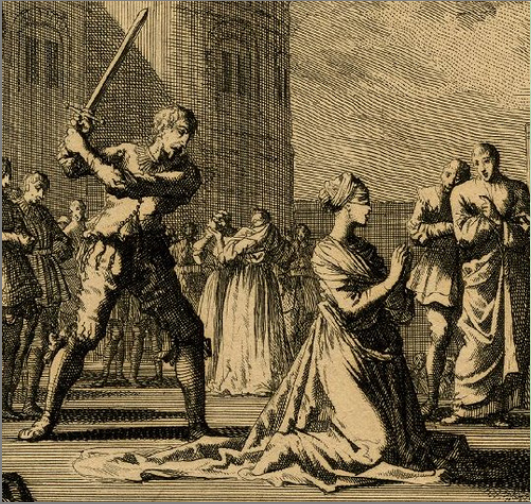
The beheading of Anne Boleyn began at 8am with her speech.
‘Good Christian people, I am come hither to die, for according to the law, and by the law I am judged to die, and therefore I will speak nothing against it.
I am come hither to accuse no man, nor to speak anything of that, whereof I am accused and condemned to die, but I pray God save the King and send him long to reign over you, for a gentler nor a more merciful prince was there never: and to me he was ever a good, a gentle and sovereign lord.
And if any person will meddle of my cause, I require them to judge the best. And thus I take my leave of the world and of you all, and I heartily desire you all to pray for me. O Lord have mercy on me, to God I commend my soul.’
She was blindfolded. She knelt down, putting her neck on the block and repeated:
‘ToJesus Christ I commend my soul; Lord Jesu receive my soul.’ The French Swordsman then chopped off her head.
Recorded by Edward Hall (spelling modernized)
Henry ViiI had allowed his wife the mercy of a French expert swordsman from English Calais. According to a letter from William Kingston to Thomas Cromwell:
‘And then she said “I heard say the executioner was very good, and I have a little neck,” and put her hand about it laughing heartily.‘
Here is a slightly annoyingly American youtube feature recreating what Anne Boleyn might have looked like. (adverts may preceed it from which I derive no advantage!).
You might like to read about Queen Elizabeth I’s nicknames for her chief advisers, here.
1798 – Napoleon Bonaparte and his expeditionary force leave France to invade Egypt. The idea was to reduce British influence in the Eastern Mediterranean and in India. But Nelson defeated the French Navy in the Battle of the Nile and Napoleon returned to France to take over control. The British took over the booty the French had seized and the Rosetta Stone came to the British Museum.
1962 – Marilyn Monroe sang “Happy Birthday” to John F. Kennedy at Madison Square Garden.
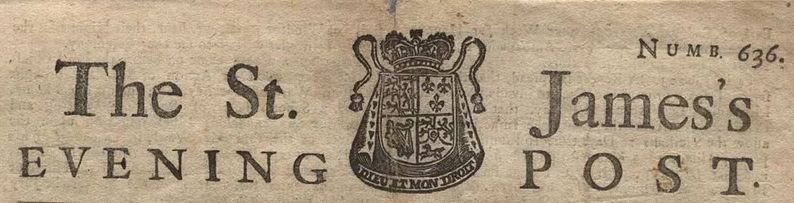
Mast head of the St James Evening Post (June 1719), the paper that carried the accusation of Sodomy
On 16th May 1719, the St James Evening Post (later called the Evening Post) reported on the Guilty Verdict returned against ex-servants Stephen Margrove and John Wood. The two men were accused of extorting money by threatening to expose George Smith as a sodomist (then punishable by death).
The Proceedings of the Old Bailey Archive gives details of the case. This took place in the Parish of St. Martins in the Fields (near what is now Trafalgar Square), on 18th, January 1718. George Smith told the Court that:
‘ the Prisoners came up to him (and John Wood took him hold by the Collar of his Coat) and demanded his Money, and said if he would not give it them they would take away his Life and swear Sodomy against him; that by means of this Violence, and being under a Terror, and in great-Fear he gave them what he had in his Pocket.’
But they wanted more and forced Smith to take them to his Master’s House in Golden-Square. Here, he gave them another Guinea, to add to the 22 shillings they had already extorted.
The Accusation of Sodomy
Margrove and Wood protested that Smith: ‘came up to Wood while he was making Water, and took hold of his Yard, using some unseemly Expressions, whereupon he (Wood) called out a Sodomite‘.
At this accusation, Smith ‘fell on his Knees, and begg’d them not to expose him‘ and gave them the money. So, the accused argued it could not be ‘robbing on the High Way‘ because their victim gave them the money.
The Defence
The Court held that the threats, and violence they used made them guilty of Violent Robbery. The men called witnesses to their good employment record, but were unable to show any evidence of ‘how they spent the last 6 Months of their Lives.’ And so the Jury found them Guilty, and the judge put on the Black Cap to pronounce the death sentence.
The Verdict
On the 8th of June 1719 10 people, 7 men and 3 women were sentenced to hang, but 5 were reprieved. Wood, aged 22, and Margrove, aged 21, were however, executed. Rictor Norton in ‘Homosexuality in 18th Century England has more details, including the confessions of the two extortionists.
For a tale about Body snatchers look to the bottom of my post here:
On This Day
1920 – In Rome, Pope Benedict XV canonizes Joan of Arc. Joan was executed in Rouen in 1431. In 1449 Rouen was liberated from the English, and Joan’s mother and brothers petitioned the Pope for a repeal of her condemnation for heresy. She was officially exonerated on 7 July 1456, She became a ‘folk-saint’ particularly for soldiers but it took until Pius X proclaimed her venerable on 8 January 1904. The Decree of Beatification formally passed on 24 January 1909. World War 1 saw her leading the French army to war, and Sainthood followed.
1929 – the firstAcademy Awards ceremony takes place. Charlie Chaplin and Warner Brothers were given honorary awards.
First Published in 2024, and republished in 2025, 2026
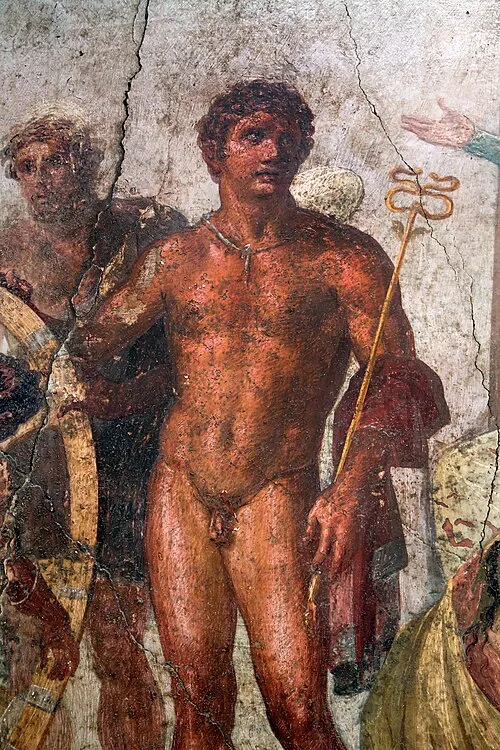
Mercury-Hermes, antique fresco from Pompeii (Wikipedia)@
May 15th in Rome was the feast of Mercury. Mercury was ‘the god of boundaries, commerce, communication (including divination), eloquence, financial gain, languages, luck, thieves, travellers, and trickery; he is also the guide of souls to the underworld.’ (wikipedia). Mercury is married to Maia the Goddess of May.
Ovid, in his almanac poem Fasti clearly has reservations about him. He mixes up Mercury’s roles as God of commerce and eloquence with his roles as God of thieves and trickery. In this extract, Ovid describes a trader, outwardly praying for his sins to be forgiven but in fact planning to continue to cheat his customers. The trader washes his goods in Mercury’s sacred spring, sprinkling with damp laurel. And yet plans to continue cheating guys customers.
Book V: May 15: Ides
On the Ides, the Senate founded for you, (Mercury) a temple facing The Circus: since then today has been your festival. All those who make a living trading their wares, Offer you incense, and beg you to swell their profits. There is Mercury’s fountain close to the Capene Gate: It ís potent, if you believe those who’ve tried it. Here the merchant, cleansed, with his tunic girt, Draws water and carries it off, in a purified jar. With it he wets some laurel, sprinkles his goods With damp laurel: those soon to have new owners. And he sprinkles his hair with dripping laurel too, And with that voice, that often deceives, utters prayers: ‘Wash away all the lies of the past’ he says, ‘Wash away all the perjured words of a day that’s gone. If I’ve called on you as witness, and falsely invoked Jove’s great power, hoping he wouldn’t hear: If I’ve knowingly taken the names of gods and goddesses, In vain: let the swift southerlies steal my sinful words, And leave the day clear for me, for further perjuries, And let the gods above fail to notice I’ve uttered any. Just grant me my profit, give me joy of the profit I’ve made: And make sure I’ll have the pleasure of cheating a buyer.’ Mercury, on high, laughs aloud at such prayers, Remembering how he himself stole Apollo’s cattle.
Bird of the Month
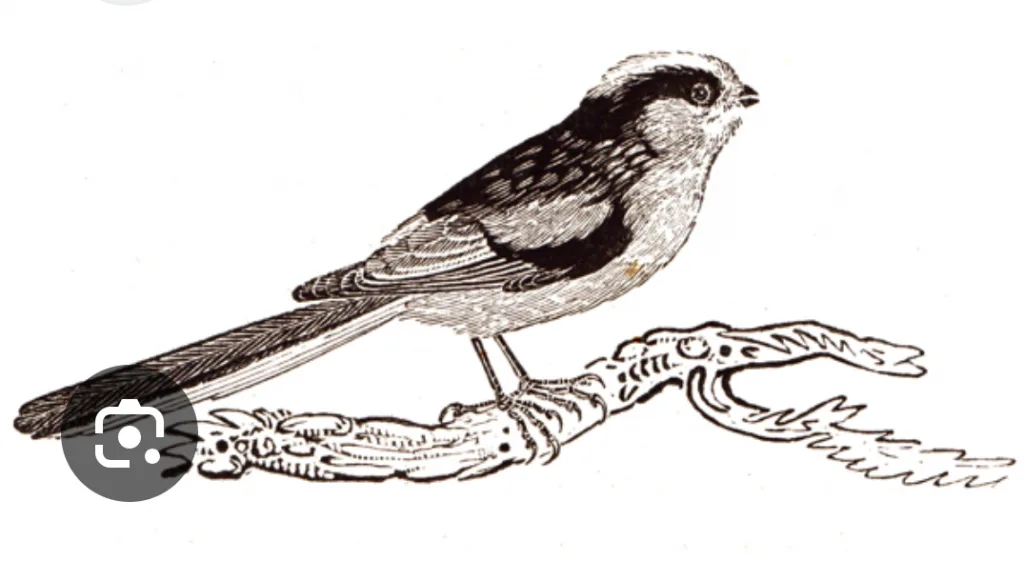
Long tailed Tit by Thomas Bewick (18th Century)
I saw a small but great exhibition on birds today at the Weston Library in Oxford, which inspired me to find a bird story for May.
The long tailed tit produces a marvellous nest. The outer shell is of thick moss and camouflaged with lichen. The binder is sticky spider silk and gossamer, which fixes the nest to tree forks or thorny bushes (such as gorse). This allows the nest to stretch, which allows it to accommodate as many as 12 to 16 chicks. The lining is an insulated bed of up to 2,000 feathers. There is a tiny entry via a small hole at the top of the dome.
Long tailed Tit nest (wikimedia)
Mating is over by May, unsuccessful birds often then find relatives and help them bring up their offspring. Pairs are monogamous.
1536 – Anne Boleyn, faces charges of treason, adultery and incest. She is condemned to death by beheading but is allowed a French swordsman rather than a London axeman. See my post on the beheading of Anne.
1567 – Mary, Queen of Scots, marries the Earl of Bothwell. A mysterious decision. Firstly, he probably arranged the murder of her previous husband, Lord Darnley. Secondly, was Mary forced into the marriage after he raped her? Subsequntly the married couple, lost in battle, after a hug they never saw each other again. She ended up imprisoned in England. He died after 10 years tied to a stake in a dungeon in Denmark.
The Temple of Vaccinia at Dr Edward Jenner’s House and Garden in Berkeley, Gloucestershire. (‘watercolour’ from a photo)
Edward Jenner returned to Berkeley, Gloucester having finished his medical training in London. (Jenner trained as a surgeon under John Hunter is St George’s Hospital, London) He noticed that milkmaids did not get smallpox. There had also been other experiments in use of cowpox. On May 14, 1796 he took cowpox pus from the hand of milkmaid Sarah Nelmes and placed it into a small cut on James Phipps’ arm. Phipps was Jenner’s gardner’s son. Sarah caught cowpox from a cow called Blossom. Blossom’s skin hangs on the wall of the St George’s Medical School library, now in Tooting, London.
The first vaccinations were done in the small hut above, which Jenner nicknamed the Temple of Vaccinia. It has just reopened after conservation work supported by public grants. The museum is at The Chantry, once Jenner’s home. It includes the Physic Garden, the Old Cyder House, and the Temple of Vaccinia. It opened in 1985. Jenner gave his inoculations free and did not patent the idea. ~Jenner chose Vaccinia because vacca is the latin word for cow.
After inoculating James Phipps with cowpox, Jenner took some smallpox and put it into a cut on James Phipps arm but Phills did not catch smallpox. This is, perhaps, not the most ethical way to proceed, but Jenner was proved right and now the world has virtually eradicated Small pox.
Inoculation and Variolation
Jenner himself was inoculated with a dose of smallpox as a 13 year old boy. This was called Variolation. Smallpox affected between 20 and 30% of the population, but if a small dose was taken from an infected patient and given to someone without an infection, the chance of death was 1-2%. But the person was prevented from further infection. 30% of people with smallpox died, so given how prevalent smallpox was it was a wise gamble. Lady Mary Wortley Montagu, whose brother died of smallpox, was disfigured by smallpox. In Turkey she witnessed inoculation, and had her 5 year old son inoculated. On its success she promoted inoculation in England.
Jenner’s insight was that cowpox was similar to smallpox, although not deadly, and if given to people it gave immunity to the smallpox, without the risk of death.
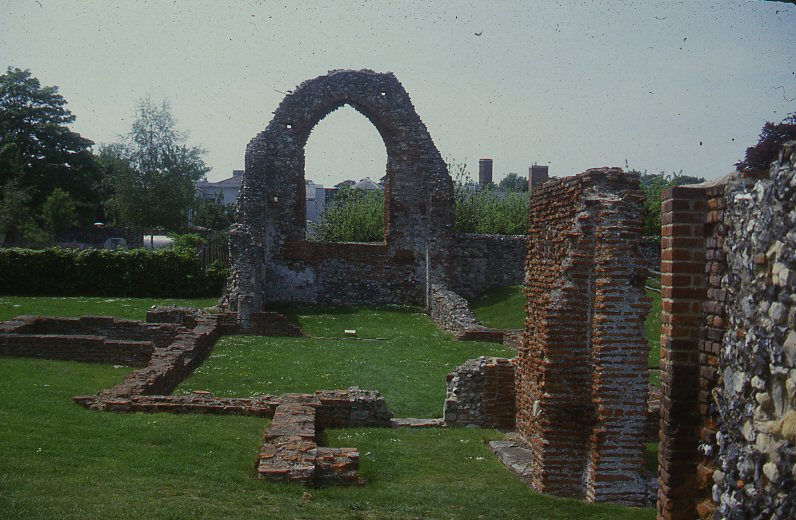
Ruins of St Pancras, Canterbury Photo: K Flude (note the reused Roman Bricks.)
St Pancras and the Ice Saints
It has been unusual cold in the last few days. You can blame this on the St Pancras and the Ice Saints. These are saints with feast days from May 11th to May 14th. They are: St. Mamertus, St. Pancras, and St. Servatius (and in some countries, Saint Boniface of Tarsus – Wikipedia). They represent a medieval belief that there was often a cold snap in early May. So the idea of the Ice Saints was probably to help persuade farmers to delay sowing until later in May. But modern statistics disprove this, but it is true that a late frost can cause havoc with crops.
St Pancras in Rome
He was a 14 year old who refused to give up his Christian Faith during the persecution of Christians by the Emperor Diocletian. He was beheaded on the Via Aurelia, in Rome, traditionally, on 12 May 303 AD. His body was buried in the Catacombs, but his head is kept in a reliquary in the Church of Saint Pancras in Rome.
Pancras means ‘all-powerful’ in Greek. His youth makes him the Patron Saint of children, but he is also the patron saint of jobs and health. He is ‘invoked’ against cramps, false witnesses, headaches, and perjury.
St Pancras in Canterbury
Pope Gregory is said to have given St Augustine relics from St Pancras when his mission came to Kent in 597AD. They built a church dedicated to St Pancras in Canterbury. The ruins still survive in the grounds of what is now St Augustine’s, Canterbury (see picture at top of this post).
St Pancras in London
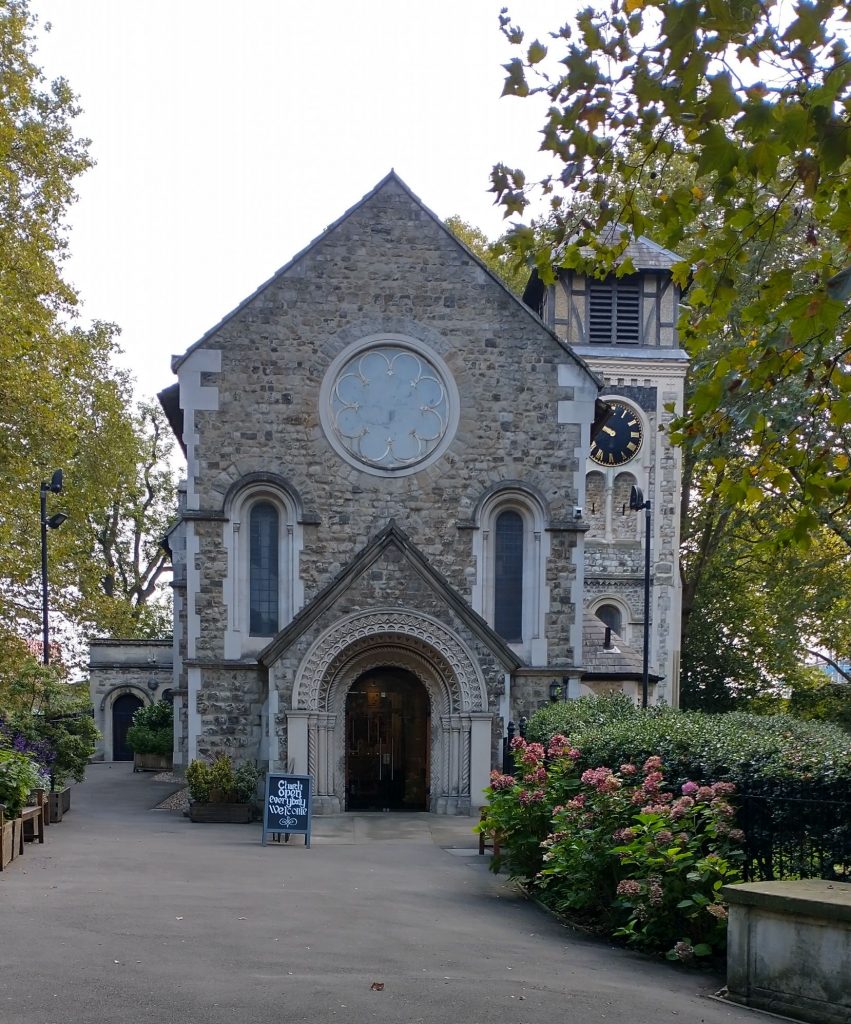
St Pancras, Old Church, London (Photo: Kevin Flude)
This story is partly responsible for the claims that St Pancras Old Church, in Camden (pictured above) is a very old foundation. It is claimed there was a late Roman place of worship here. But there is very little solid evidence for this. It is also argued that, if it isn’t late Roman, then it dates to just after 604AD. This is when St Mellitus, sent by St Augustine, established St Pauls Cathedral. It is suggested that Mellitus also founded St Pancras Church. St Pancras’ Church was a Prebend of St Pauls Cathedral (a Prebend provides the stipend (pay) to support a Canon of a Cathedral). But this is not evidence it was established as early as the Cathedral was, and there really isn’t any other credible evidence for a 604 date.
When the Church was restored, the architects said it was mostly Tudor work with traces of Norman architecture. However, it was reported that a Roman tile or two were reused in the fabric. This is about the only evidence, but it helps keep the legend going.
If you read the Wikipedia page, you will see evidence of two strands to the contributions. One is playing down the legends of its early foundation. The other trying to keep hold of its place as among the ‘earliest sites of Christian worship’. Read the wikipedia page here: https://en.wikipedia.org/wiki/St_Pancras_Old_Church to make up your own mind.
It is a lovely Church, on an impressive site, with links to Thomas Hardy, and Sir John Soane whose tomb is the design inspiration for the iconic Red Telephone Box.
As Patron Saint of Headaches, St Pancras Day is a good day to make worms come out of your head. Or so say the Fairfax Household Book of the 17th/18th Century as quoted in Charles Kightly’s ‘The Perpetual Almanac’:
‘To make a worm come out of the head. Take, in May, the marrow of a bull or cow, and put it warm into the ear, and the worm will come forth for sweetness of the marrow.’
Generally,willow bark was used for headaches. We know this would have worked as the bark contains salicin, which is converted by the body into salicylic acid. This is a precursor to aspirin (acetylsalicylic acid). But it is not as effective.
On This Day
113 – Trajan’s Column is finished in Rome. Reliefs sculptures on the Column celebrate his victory over the Dacians. There is a copy made of plaster on display at the V&A. The sculptures provide a prime document on the Roman army.
1593 – London playwright Thomas Kyd is arrested and tortured. He lived with Christopher Marlowe. In the search of their rooms, it was claimed they found evidence of atheism and blasphemous documents, including the claim that Jesus was homosexual. Kyd claimed the documents were Marlowe’s. Marlowe was awaiting news of whether he was going to prosecuted, when he was murdered in a tavern in Deptford, possibly by Government agents.
First Published in 2024, revised 2025 OnThis day added in 2026
In England, we have a saving ‘never cast a clout while May is out’. There are two explanations, one is that you should not put your coat away until the end of May. Once it snowed in June, so it is good advice.
But it can also mean keep a coat at hand while the May flowers (Hawthorn) are still out. Not much difference between the two meanings of the saying, but if it’s hawthorn’s May flower that are the arbitrator of when coats go away, then that will normally be earlier in May. Here is the entire saying:
Button to Chin, till May be in Cast not a clout till may be out
For more on the Folklore of Hawthorn -see my post here.
Mayfair
Mayfair is one of the world’s great shopping centres. Or, to put it another way, a shopping centre which rich people from all over the world like to shop in. I’ve not bought anything in any of the Mayfair shops, despite visiting many times on my Jane Austen Walks. (Ok the odd sandwich and bar of chocolate excepted.)
But it gets its name from London’s May Fair which took place in the area in the medieval period. It began as a fundraising event for St James Hospital. It was a hospital for young women with leprosy, until Henry VIII had it dissolved.
London historian John Stow says the
‘hospital of St. James, consisting of two hides of land, with the appurtenances, in the parish of St. Margaret in Westminster, and founded by thecitizens of London, before the time of any man’s memory, for fourteen sisters, maidens, that were leprous, living chastely and honestly in divine service.’
But the first documented date is 1267, when the Augustinian monastic settlement was limited to 8 brothers and 16 sisters. In 1290 King Edward 1st granted an 7 day annual fair to help fund the hospital. It took place on the eve of St James the Less’s Feast Day. So it started on May 2nd and went on to May 8th. But later on, it became so successful that it lasted 14 days. John Stow talks of a great procession on May 8th:
‘…on the 8th of May, a great muster was made by the citizens at the Mile’s end, all in bright harness, with coats of white silk, or cloth and chains of gold, in three great battles, to the number of fifteen thousand, which passed through London to Westminster, and so through the Sanctuary, and round about the park of St. James, and returned home through Oldborne.‘
But by the 16th Century the fair itself had become a rowdy event. There were sideshows, open air performances, gambling, drunkenness, brawls, prostitutions and all the fun of the fair. They tried to close it in 1664, but it survived. In 1688 Royal permission was given for a cattle market at Brookfield near Curzon Street. This revived the fair. At the Mayfair there:
‘were booths housing puppeteers, jugglers, prize-fighters, acrobats, dancers, fire-eaters, wild animals, freaks, and all kinds of shows and sights persuading people to part with their money.’
Quote from article on the Mayfair below. Please read for an excellent description of 18th Century fun to be had at the fair. The fair finally came to an end in 1764. The area changed from being fields outside of London, to a hot area of real estate. This soon housed the great and the good of 18th Century England. One of them was the Earl of Coventry and he used his influence to stop such rowdiness in his posh neighbourhood.
A swarm in May Is worth a load of hay A swarm in June Is worth a silver spoon A swarm in July Is not worth a fly.‘
‘Five Hundred Points of Good Husbandry’ published 1573, suggests we should:
‘Take heed to thy Bees, that are ready to swarm, the loss thereof now, is a crown’s worth of harm.’
According to Hillman’s ‘Tusser Redivus’ of 1710, swarming in May produces particularly good honey. ‘Their hours of swarming are for the most part between the hours of ten and three, and they ought to be watched every day.’ He advises following the bees to retrieve them:
‘You are entitled by custom to follow them over anyone’s land and claim them … but only so long as you ‘ting-tang’ as you go, by beating some metal utensil – the sound whereof is also said to make your bees stop.’
Much of the above is quoted from The Perpetual Almanac of Folklore by Charles Kightly.
Queen Bee
Bees swarm when a new Queen Bee takes a proportion of the worker bees to form a new colony. They will latch unto a branch or a shrub, even a car’s wing mirror. Then sending worker bees out searching for a suitable new home, such as a hollow tree. There may be hundreds or even thousands in the new colony. This may be very alarming. But, at this point, they will not be aggressive as they do not have a hive to protect. Look here for more information on swarming.
Sweet, Long Distance Flyers
An average hive will produce 25 lbs of honey, and the bees will fly 1,375,000 miles to produce it. This is like flying 55 times around the world (according to the British beekeepers Association (and my maths)) https://www.bbka.org.uk/honey
Swarming in Hackney
Swarm of Bees, Hackney (Photo Kevin Flude 30th May 2018). The Swarm is at the top of the Column and on the edge of the porch roof.
In 2018, on 30th May, I was perturbed to find a swarm of Bees hanging outside my front door. Frightened of leaving my house, I rang a local beekeeper, who came to take possession of the Bees and take them to a new home. By the time he came, they had moved 20 yards to a Buddleia bush.
Swarm of Bees, having moved 20 yards to a second perch, being ‘rescued’ by a bee keeper. You can see the swarm above his head.
Helping Bees
Bees are still having a hard time as their habitats are diminishing and threats increasing. In July, DEFRA hosts Bees’ Needs Week 2026: 13 to 19 July. This aims to increase public awareness of the importance of pollinators.
They suggest we can help by these 5 simple actions
Grow more nectar rich flowers, shrubs, and trees. Using window or balcony boxes are good options if you don’t have a garden.
Let patches of garden and land grow wild.
Cut grass less often.
Do not disturb insect nests and hibernation spots.
Think carefully about whether to use pesticides.
Patron Saints of Bees include: St. Ambrose, St. Gobnait, and St. Valentine. Click here to see my post of St Valentine.
On This Day
1821 – Napoleon dies in exile on the island of Saint Helena.
1835 – The first railway in continental Europe opens between Brussels and Mechelen, which is 36 kms.
1964 – Europe Day is launched by the Council of Europe but the European Union celebrates Peach and Unity in Europe on May 9th
First Published 2024, revised 2025, rearranged 2026
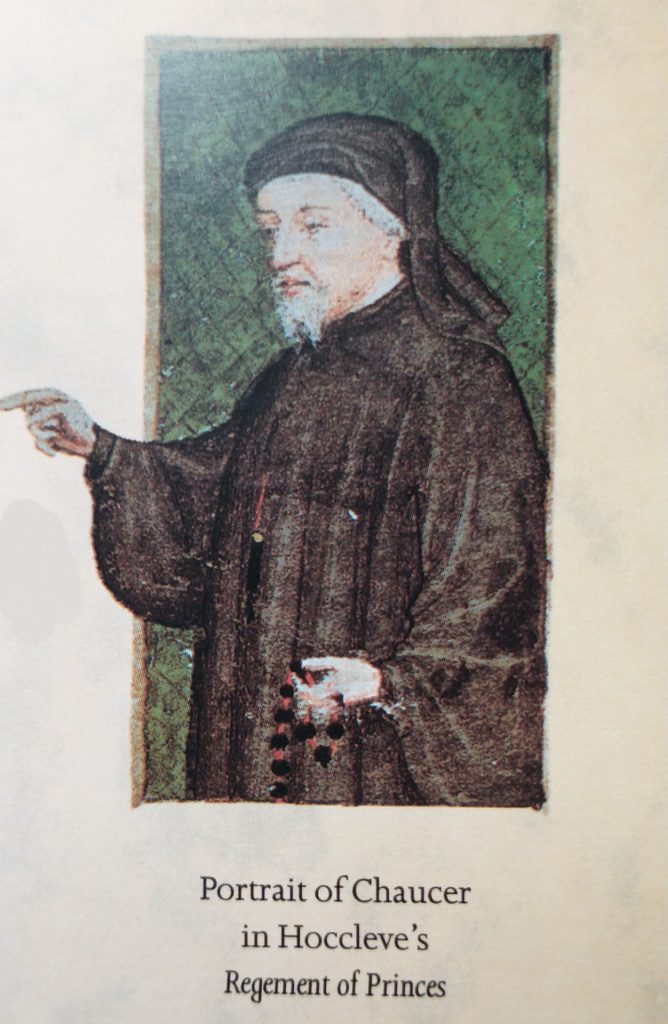
For many years, there has been a cloud over Geoffrey Chaucer’s name. On May 4, 1380, Close Rolls of the English Chancery reveals that Chaucer was released from “all manner of actions related to my raptus”. (“omnimodas acciones, tam de raptu meo”). The case involved Geoffrey Chaucer and Cecily Chaumpaigne, the daughter of a London baker.
Raptus can mean rape or kidnapping. We know he was not charged for the offence. But the original records suggest he was accused of it and possibly paid his way out of difficulty.
I attended a lecture 2 years ago relating recently discoveries by Euan Roger and Sebastian Sobecki. It shone light on the long misunderstood case, and cleared Chaucer of rape or kidnapping. The scholars were investigating medieval records, which academic opinion thought not worth pursuing.
Geoffrey Chaucer and Cecily Chaumpaigne
But in the papers they discovered that Chaucer and Cecily Chaumpaigne were on the same side in the legal dispute. Rather than being a case of Chaucer mistreating Champaigne, they were jointly accused of Raptus by her former employer, Thomas Staundon,
Taking the long view, the accusation came ultimately from the shortage of labour following the Black Death of 1348. It killed over one third of the population of the UK. With the loss of life, the ruling classes found they were having to pay higher wages to labourers, and goods. So, having control of Parliament, they passed legislation called the Statute of Labourers. This insisted that people should work at the same pay rate and conditions as before the Black Death. Labourers had to swear to keep to the old conditions, and drastic consequences, including imprisonment, awaited those who transgressed. It was one of the major causes of the Peasants Revolt of 1381. The legislation was still in use 30 years later.
So, it would seem that Cecily left her employer, Staundon, to work for Geoffrey Chaucer. Presumably at a more realistic higher pay rate. Her former employer pressed charges against her and Chaucer for breaking the financial rules and poaching a worker.
Screenshot from Ebay (There is no link to ebay on this image)
This is based on the flimsy premise/play on words that ‘May the 4th be with you’ is similar to ‘May the Force be with you’. The origins of the idea are explained in detail here.
In the UK Census of 2011, 390,127 self-declared themselves as Jedi under the question about religion. However, ten years later, the number declined to a mere 1,600. The cause appears to be a call from the Humanists that it was important to record the large number of people who were of ‘No religion’. A jokey identification as Jedi Knight weakened the argument. Sad?
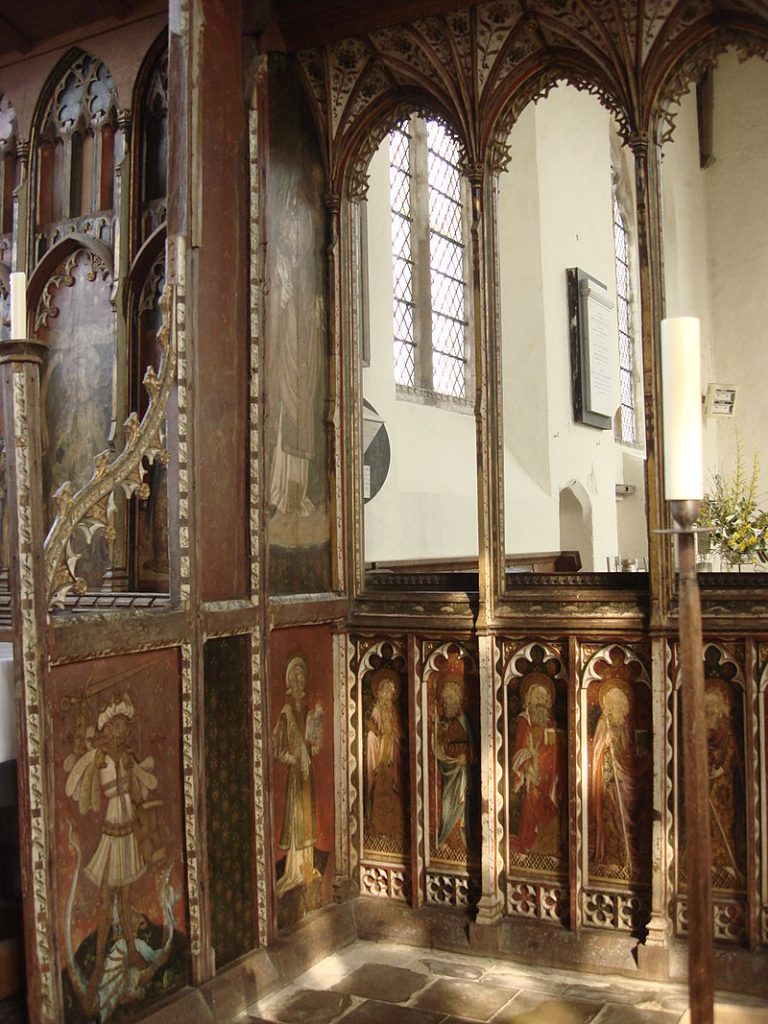
Rodmas – Rood screen in St. Helen’s church, Ranworth, Norfolk by Maria CC BY-SA 3.0
Rood is another word for the Cross. Parish Churches used to have a Rood Screen separating the holy Choir from the more secular Nave. This screen was topped with a statue of the Crucified Jesus nailed to a Rood. So, Roodmas, is the festival of the Holy Cross. Roodmas is celebrated on May 3rd and September 14th, although the Church of England aligned has itself with the Catholic Church’s main celebration on September 14th.
See my post on September 14th here for more on the True Cross.
Object of the Week
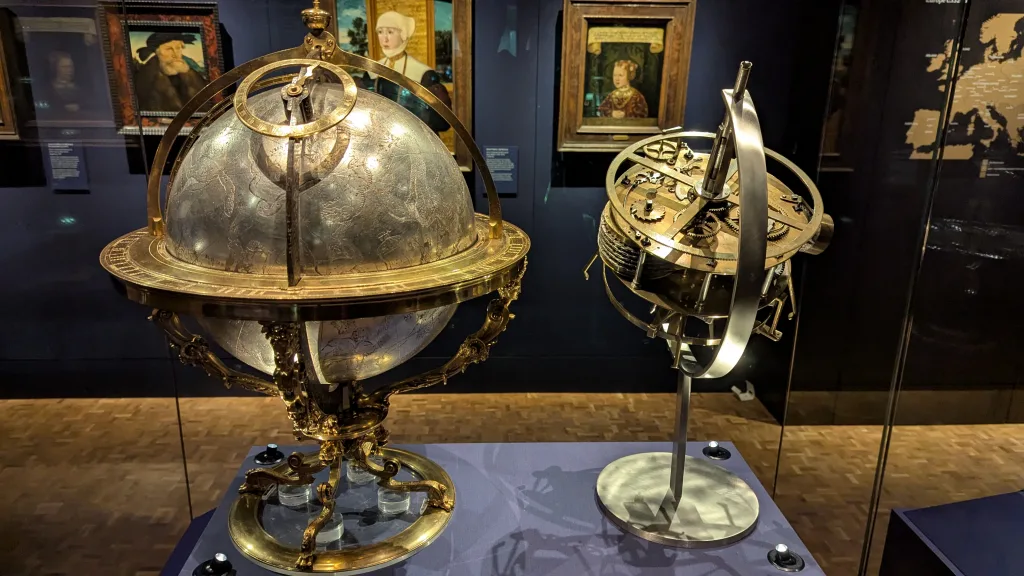
Mechanical Celestrial Globe, 1575 (Holburne Museum Bath) Photo K Flude
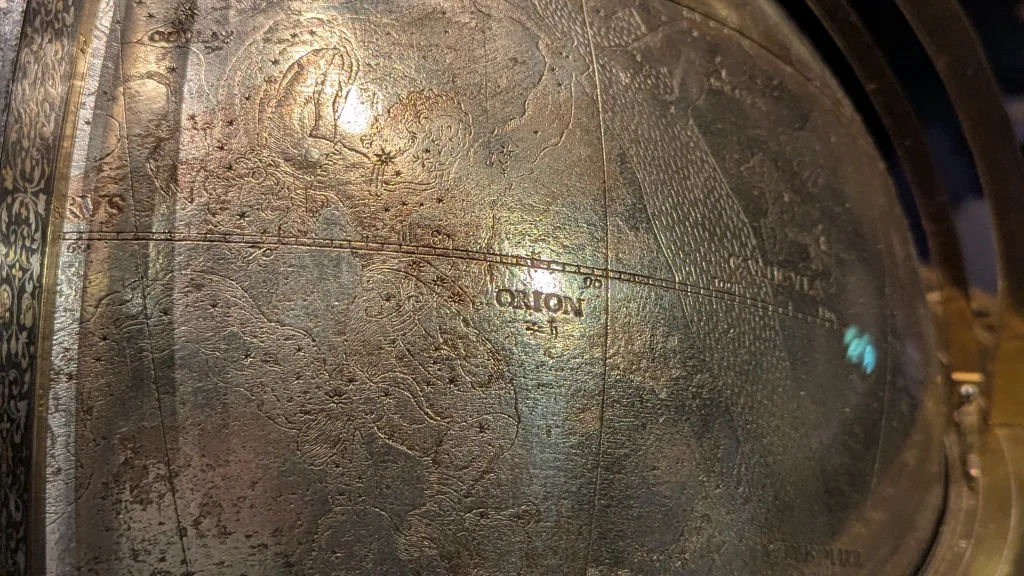
I spent a couple of days in Bath and revisited the Holburne Museum. Here I saw this amazing object from the 16th Century. The Globe is a model of the universe, and built to show the movement of the constellations, but it also tells the time and date. So the user can see when a constellation appears above the horizon and where it will be in real time. The mechanics are designed to be seen from inside the Globe, so reading it from the outside requires a mental adjustment to the mirror image of the stella sphere. It also show a pre-Copernican view as the stars were imagined as if on the inside of a huge sphere circulating around the earth. For more information please read the label below.
Museum Label for Celestial Globe.Close up of the surface of the Globe showing Orion. Photo K Flude
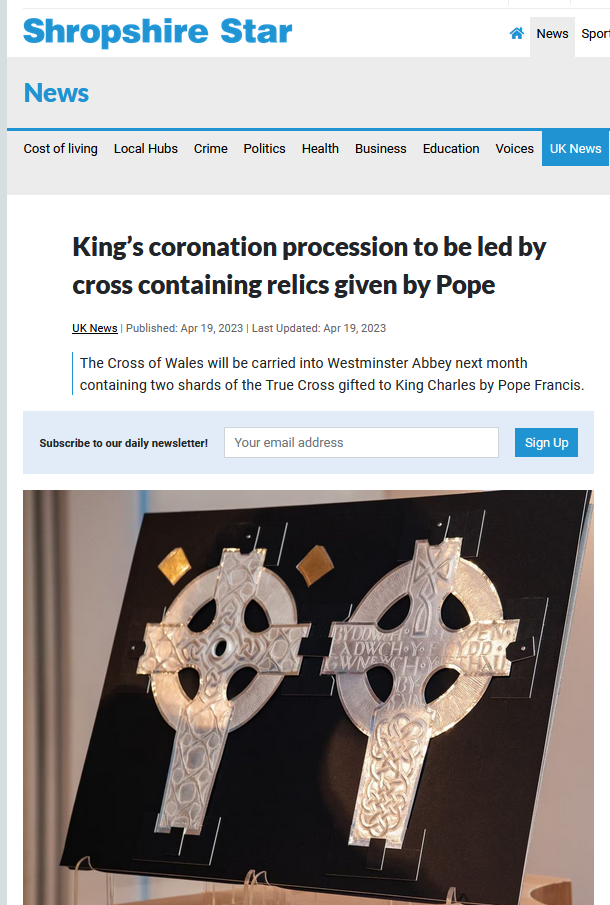
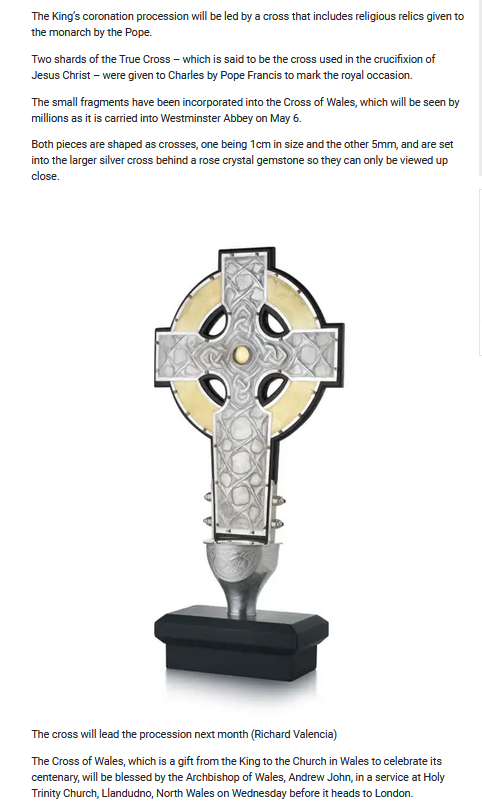
The Shropshire News reported that two pieces of the True Cross were given to Charles III by the Pope for the Coronation. They were installed into a cross called the Welsh Cross. This was part of the Coronation Procession. The King gave the Cross (I assume with the pieces of the Holy Cross) to the Church in Wales. Let the Shropshire News tell the story:
It is a clear reminder that we are subjects not citizens and news, as a nation, we still set store by superstitions.
The Duke of Buckingham and the True Cross
The Duke of Buckingham had a piece of the True Cross in his collection, which he kept at York House in the early 17th Century. How he got it, I don’t know. But I think he must have acquired it in the aftermath of the destruction of the Reformation. John Tradescant, who looked after the Duke’s collection until Buckingham was murdered, had a piece of the True Cross. Tradecant created Britain’s first Museum, Tradescant’s Ark. Again, I suspect (without any evidence) that he got the fragment from Buckingham. Was he gifted it? Did he acquire it after the murder? Or shiver off a timber fragment hoping no one would notice?
First Written on May 3rd 2023, revised 2024, 2025, Object of the Day added 2026
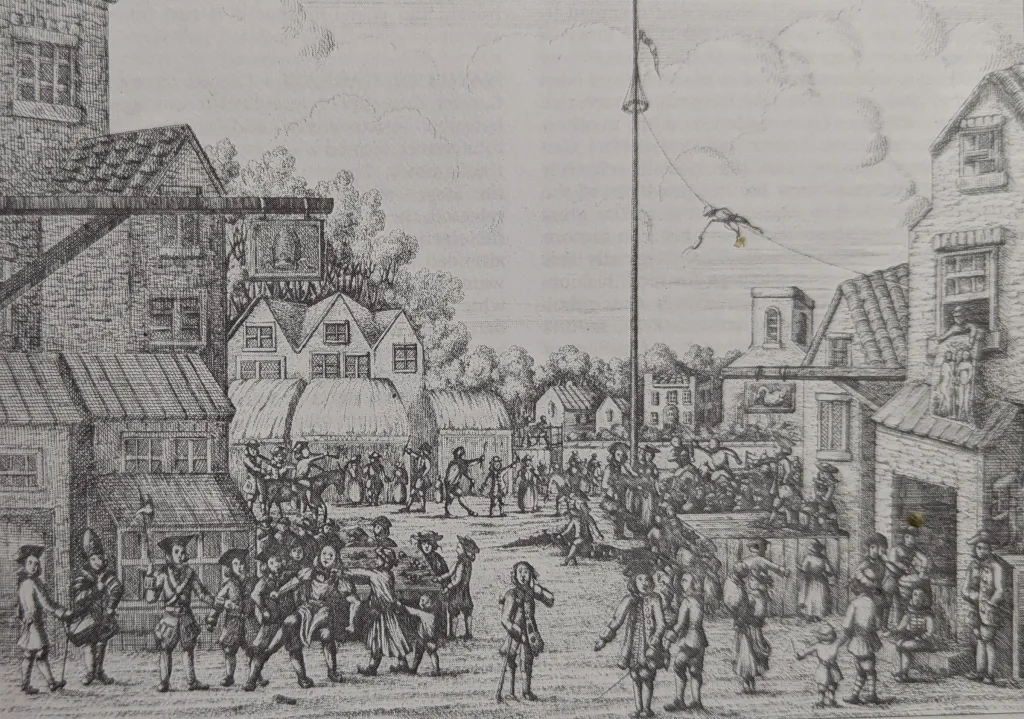
The Stinking Idol : An Imagined Scene at the Maypole at St Andrew Undershaft
This post is about the end of the Maypole in London but first:
On This Day
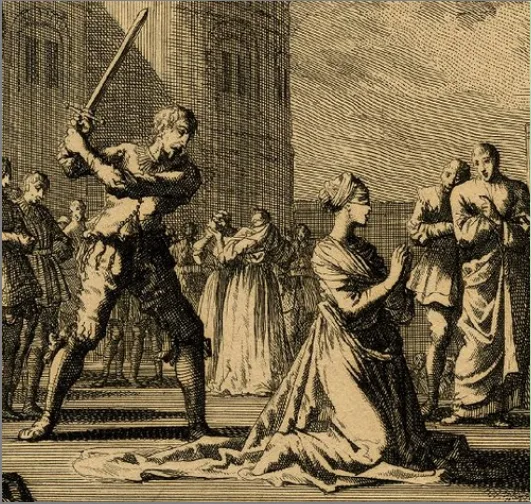
Old Print of the French Executioner dispatching Anne Boleyn with a sword rather than an axe.
1536 – Anne Boleyn arrested on ‘charges of adultery, incest, treason and witchcraft.’ But, Claire Ridgway in her post here and her book, show that she was never accused of witchcraft in court. The stories of extra fingers, and teats, are all later Catholic propaganda aimed at weakening Elizabeth’s claims to the throne. She was accused of adultery. Five men were executed for sleeping with her: her brother George Boleyn, (Lord Rochford); Sir Henry Norris, groom of the stool; courtier Sir Francis Weston; courtier William Brereton, and musician Mark Smeaton. Incest with her brother (one possible explanation of the incest is the idea that she desperately needed a baby and if she needed a surrogate then her brother was safest as the child would have a family resemblance to her and not rouse any suspicions from Henry of adultery. The other explanation is that Anne never commited incest!). Treason, well sleeping with someone other than the King risked imperilling the blood line of the Royal Family. It also gave a motive for killing the king.
A new portrait has been claimed to be of Anne Boleyn, the only one to have been done in her lifetime. But it has been revealed by AI, and some art historians are not convinced. Follow this link to see for your self.
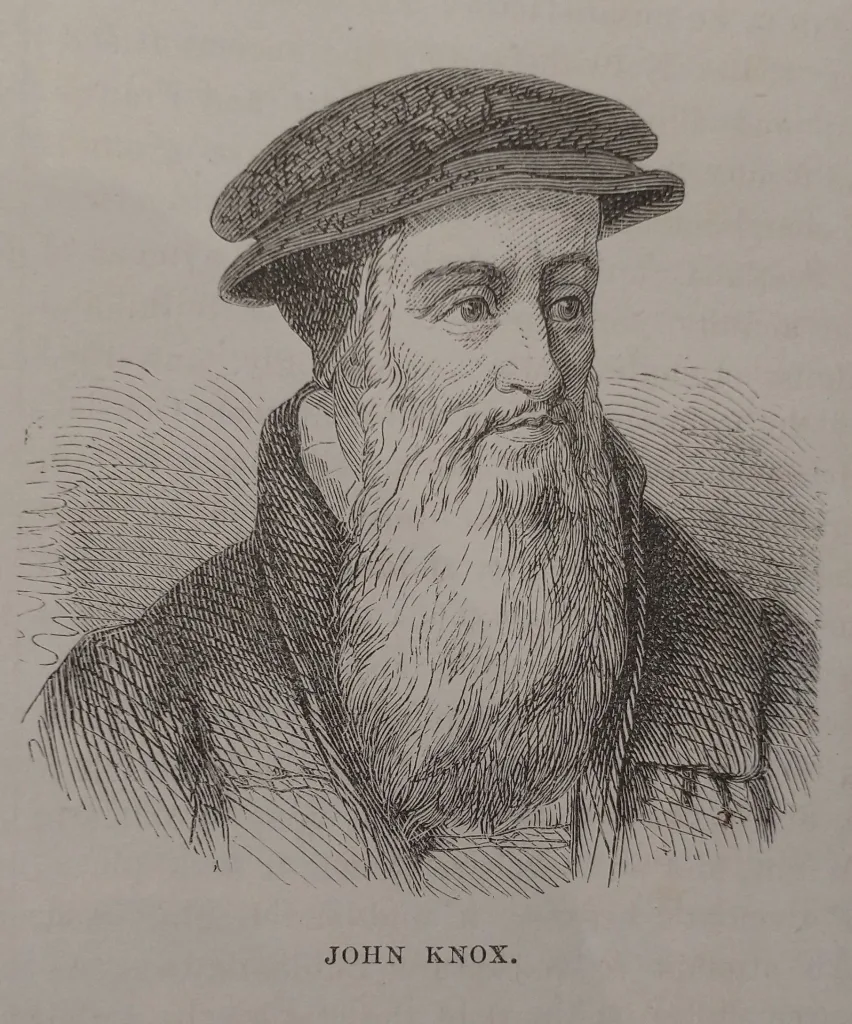
1559 – John Knox returns from exile to Scotland to lead the Scottish Reformation.
1568 – Mary, Queen of Scots, escapes from Lochleven Castle. You could blame John Knox for the hostility Mary faced as a Catholic governing a country rapidly turning Presbyterian.
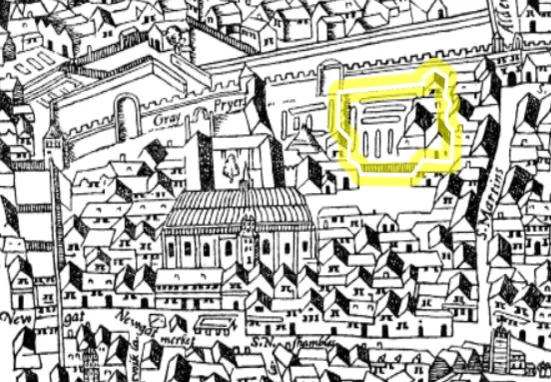
1611 – The King James Version of the Bible is published by printer Robert Barker. His printshop was at Northumberland House, Aldersgate Street, in the City of London. (as far as I can see no one else seems to know where the printing was done.)
Northumberland House marked in yellow nearAldersgate. The Map of Early Modern London, Edition 7.0, edited by Janelle Jenstad, U of Victoria, 05 May 2022, mapoflondon.uvic.ca/edition/7.0/NORT2.htm. INP.
The Printer then went on to create the worst possible error in publishing history by omitting the word NOT in the 6th or 7th Commandment, ‘Thou Shalt Commit Adultery’. This edition became known as the Wicked Bible. Barker & Howard are still in the publishing industry and have offices in the East End of London.
The King James Bible introduced many phrases into the English language, including:
The apple of his eye The four horsemen of the apocalypse Baptism of fire Chariots of Fire O death, where is thy sting? Like a thief in the night Weighed in the balance and found wanting
1670 – King Charles II of England granted a charter to the Hudson’s Bay Company. In 1917 my 17 year old Grandfather sailed to the Hudson bay as an able seaman for the Hudson’s Bay Company.
1982 – The British nuclear submarine HMS Conqueror sunk the Argentine cruiser ARA General Belgrano. It was controversial as the Belgrano was outside the Exclusion zone, and said to be sailing away from the conflict. 323 Argentine sailors were killed. The event, arguably, changed Mrs Thatcher political fortunes.
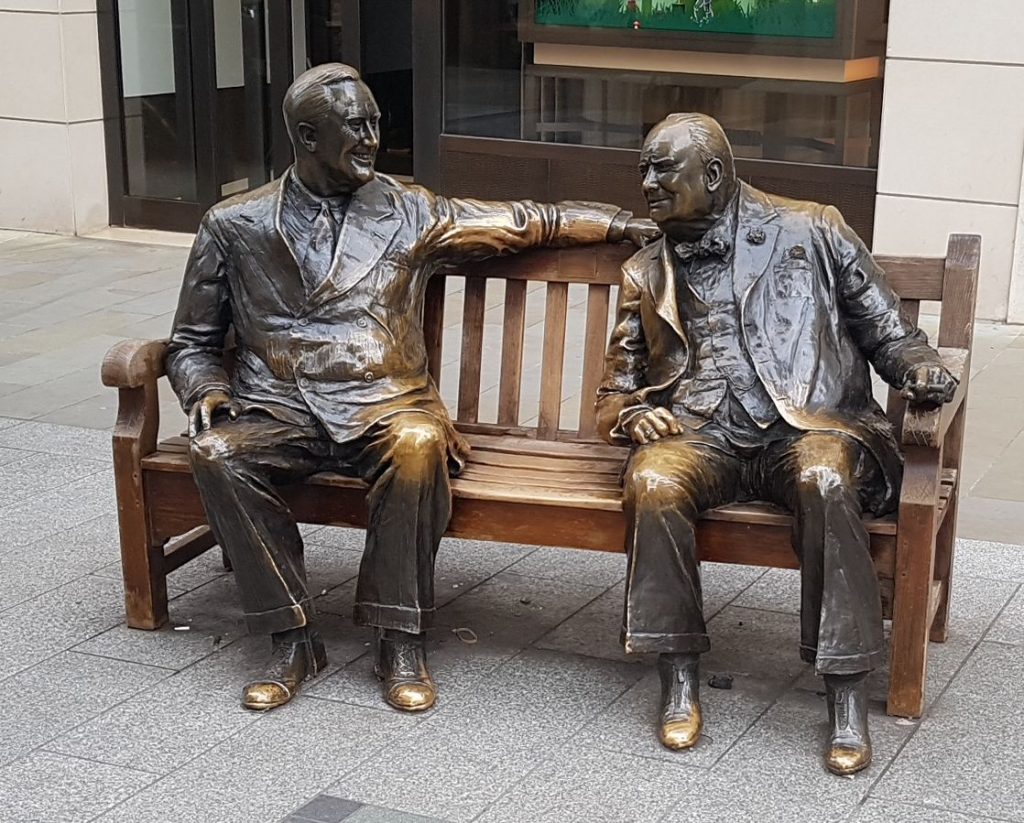
1995 – Allies Statue unveiled. The Statue of Churchill and Roosevelt set up to commemorate 50 years of peace. 30 years later, how we wonder what Churchill and Roosevelt would say about the current state of NATO? https://www.iwm.org.uk/memorials/item/memorial/11351
‘Allies’ Roosevelt and Churchill by by Lawrence Holofcener, unveiled on May 2nd 1995 by Princess Margaret and Lord Snowdon
The Maypole or rather ‘This Stinking Idoll’
Philip Stubbes, wrote a vitriolic attack on pagan practices in his ‘Anatomy of Abuses in 1583’. He fired a broadside at the tradition of dancing around the Maypole. He said they had: ‘as Superintendent and Lord ouer their pastimes and sportes: namely, Sathan Prince of Hell‘ as they erected ‘this stinking Idoll’. By which he meant the Maypole. Stubbes suggested that of the maids who went out to the woods on May Eve, less than one-third returned ‘undefiled‘.
Evil May Day Riots
The Maypole was stored at St Andrew Cornhill, which became known as St Andrew Undershaft. In 1517, it was attacked during the ‘Evil May Day riots’. The main focus of the riot was foreign workers. The Under Sheriff of the time, Thomas More, tried to quell it, meeting the rioters at the corner of Cheapside and St Martin’s Legrande. But 5,000 troops commanded by the Duke of Northfolk was necessary to regain control of the City. 300 rioters were arrested. One hanged, drawn and quartered, 13 hanged and nearly 300 pardoned after the intercession of Woseley and/or Katherine of Aragon (depending on which historian you read). The shaft was returned to its place under the eves of the houses in Shaft Alley. But apparently banned from being raised again.
1549 May Day Riots
However in 1549, the curate of nearby St Katharine Cree Church made an inflammatory speech. This incited a Puritan mob, who cut the shaft into pieces and burnt it. I always imagine the Curate’s sermons to be along the same lines as Phillip Stubbes attack on the Maypole.
Maypole: this Stinking Idol, Rather
Here is a longer description of the May Day Celebrations by Stubbes.
‘But their chiefest iewel they bring from thence is the Maie-poale, which they bring home with great veneration, as thus: They haue twentie, or fourtie yoake of Oxen, euery Oxe hauing a sweete Nosegaie of flowers tyed on the tip of his homes, and these Oxen drawe home this Maie-poale (this stinking ldoll rather) which is couered all ouer with Flowers and Hearbes, bound round about with strings from the top to the bottome, and sometimes painted with variable collours, with two or three hundred men, women and children following it, with great deuotion.
And thus being rearedvp, with handkerchiefes and flagges streaming on the top, they strawe the ground round about, bind green boughes about it, set vp Summer Haules, Bowers, and Arbours hard by it. And then fa! they to banquet and feast, to leape and daunce about it, as the a Heathen people did, at the dedication of their ldolles, whereof this is a perfect patteme, or rather the thing it selfe. I haue heard it crediblie reported (and that viua voce) by men of great grauity, credite, and reputation, that of fourtie, threescore, or a hundred Maides, going to the wood ouemight, there haue scarcely the third part of them returned home againe vndefiled.‘
The unraised pole seems to have survived until the beginning of the Civil War, (1644) when it was destroyed. But at the Restoration of Charles II a new and huge Maypole was ordered. It was joyously erected 134 ft high (41 metres) in the Strand. This one was danced around till 1713 when it was replaced. The original was sold to one Isaac Newton. He used it to support the biggest telescope in Europe, which was erected in Wanstead by a friend.
And that, my friends, is how you get from Superstition to Science in one easy story.
Old Print of Isaac Newton
Postscript.
I have always told people that the sermon leading to the destruction of the Shaft in 1549 was made at St Paul. I cannot remember where I read this. The suggestion that the Maypole in Cornhill was not used after 1517 seems strange. Why then would an unused maypole rouse a crowd to riot in 1549? Of the sources I have at hand, the London Encyclopedia mentions the riot of 1517 in its entry on St Andrew Undershaft but doesn’t elaborate more. ‘Layers of London‘ says ‘It was last raised in 1517 when ensuing riots led to the celebration being banned.’ which is definitive sounding. But is it? I wonder if it was banned for a year or two, then allowed again, and finally stopped in 1549?