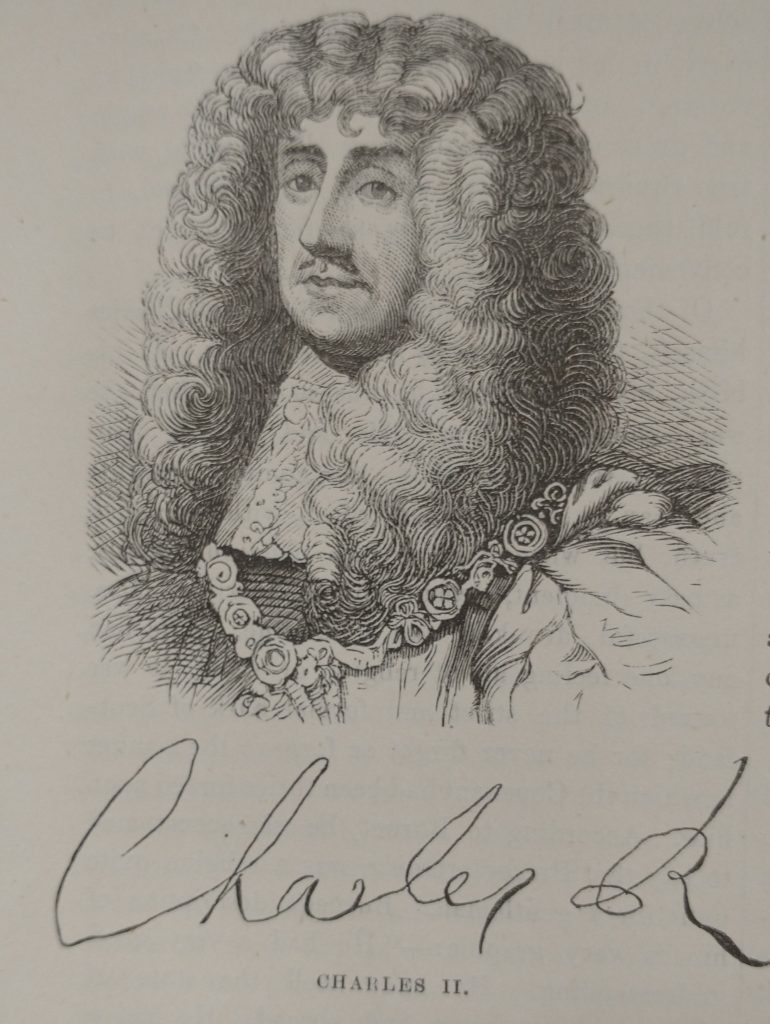
Oak Apple Day was set up by Parliament in 1660 as “An Act for a Perpetual Anniversary of Thanksgiving”. They were celebrating the restoration of Charles II to the throne in May of 1660. The Day was abolished in 1859, but a few places continue to celebrate the day.
The Oak was chosen partly as a symbol of England but particularly because after Cromwell’s Parliamentary Army defeated the Royalists at the Battle of Worcester (September 3rd 1651), Charles hid in an Oak Tree near Boscobel House in Shropshire on his epic journey to the South Coast and the safety of France.
People wore oak apples (or shick-shacks) which are a type of ‘plant-gall‘. This is an abnormal growth from a point of irritation on a plant. Or they were used sprigs of Oak leaves.
The text of the Parliamentary Bill said:
That in all succeeding ages, the 29th of May be celebrated in every parish Church and Chapel in England and the Dominions thereof, by rendering thanks to God for the Kings (Charles II’s) restoration to actual possession and exercise of his legal authority over his subjects’
Church Services for the Restoration; for the preservation from the Gunpowder Plot and the death of Charles the First were kept up until the year 1859.
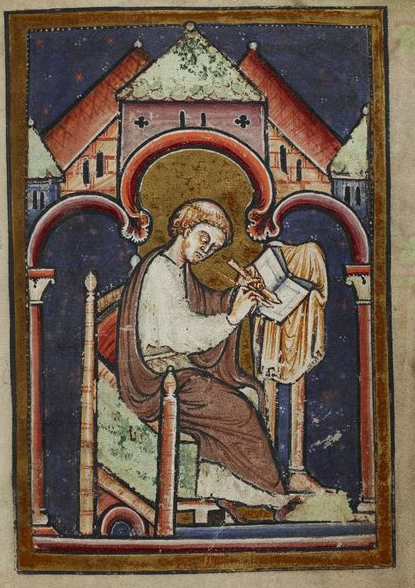
A Scribe – possibly the Venerable Bede. Late 12th Century from Lives of St Cuthbert.
He died on the evening of what we would call the 25th, but in ancient times, the Day changed at dusk. So for his contemporaries, he died on 26th May. But, as he shares his day with St Augustine, some celebrate the Venerable Bede on May 27th!
Called the Father of English History, the Venerable Bede was an excellent historian, who set the tone and standard for many centuries of English Historiography. He is mostly remembered for the ‘Ecclesiastical History of the English People’ which provides the most trusted account of the events of the Post Roman, Migration, and Anglo-Saxon periods.
So well regarded is he that he is the only Englishman mentioned in Dante’s Paradiso. This is the third part of the Divine Comedy. The other parts are about the bad people in Hell and Purgatory. Bede is with the Angels in Heaven.
He is Venerable not only in the general sense of being wise, old and respected, but also in the technical sense:
‘(in the Roman Catholic Church) a title given to a deceased person who has attained a certain degree of sanctity but has not been fully beatified or canonized.‘ (Oxford Languages)
In 1899, the Catholic Church honoured him with the title of Doctor of the Church – someone holy who had contributed to the theology of the Church.
He is considered by some to be the best historian in olden times, only equalled by Herodotus (said Thomas Carlyle). Thucydides surely says I! (Note: Herodotus is known as the ‘Father of History’ for his storytelling and breadth of the scope of his attention. While Thucydides didn’t tell tales, he concentrated on empirical evidence and so is known as the Father of Scientific History)
Bede is so good because he checked his sources and had access to a wide range of books. He even had a line to the Vatican so he could check his facts with Vatican records. This in the 8th Century! The Venerable Bede is the polar opposite of Geoffrey of Monmouth, (writing in the 12th Century). If Bede mentions a person or an event then they are accepted as part of the story of the English. By contrast, if Geoffrey of Monmouth mentions a person or event, without further corroboration, then historians tend to consider it a story, myth or simply made up by Geoffrey.
But, the truth is not so straightforward. Bede is not without his biases and his sources were not themselves always reliable, nor above accepting myth, legends and miracles as fact. Geoffrey also has access to some, probably, oral traditions so that some (but which?) of his many tales of the Kings of Britain may hold considerable historical information.
Bede’s Influence on English History
Bede followed Gildas (A British Monk writing in the 6th Century) in wondering why God allowed the native Christian Britons to be defeated by the foreign Pagan English. Gildas assumed God was punishing the Britons because of the evil deeds of their so-called Christian Kings. Bede extends this to argue that God is punishing the Britons for not trying to convert the English to Christianity AND by being generally not a great bunch of Christians. God knows that the English, when converted, will be much better Christians than the Britons.
This starts a histographical trend for the English to think of themselves as the chosen people. By contrast, the Britons (Welsh, Scots and Irish) are feckless Barbarians (they thought). Bede concentrates on the English and countless generations of Historians have either left out the Britons, or demeaned them in their histories of England and indeed of Britain.
For example, most histories of Kings, deal only with England and start either with William the Conqueror or Alfred the Great and omit any British, Welsh, Scots or Irish Kings. Except for my book on the Kings and Queens of Britain, which starts with the largely legendary Kings of Britain, and includes some Welsh and Scottish Kings. To buy it, you will find details of it here.
So Bede is a great historian without whom we would have an even less clear idea about what happened in the centuries following the Roman Period. But also, contributed to an Anglo centric view of history. He was writing in Northumberland at the Monastery of Jarrow, and is more sympathetic to Northumbria than to Wessex, Mercia, and the British Kingdoms.
Bede’s Books
He wrote over 60 books. One was about the theological science of computus. In particular, the dating of Easter. The British Church had one method, the Catholic Church another. This contributed to a series of confrontations between the 2 Churches. And was only finally resolved at the Synod of Whitby in the favour of the Catholic Church.
Bede was instrumental in making Dionysius Exiguus idea of dating from the birth of Christ as the standard AD /BC system. He also thought the Catholic calculation that Jesus was born 5000 years ago was wrong and used the Bible to calculate the more ‘correct’ date was 3952 BC. Archbishop Ussher in the 17th Century took Bede’s calculation and improved it and suggested the proper date was 4004 BC.
For more about Dionysius Exiguus and the division of time, see my post here.
Today, is the Day to go Cheese Rolling in the Cotswold! Coopers Hill Cheese Rolling takes place near Birdlip in Gloucestershire. For at least the last 200 years, people have gone to the top of the Hill, sent a Double Gloucester Cheese rolling down the hill at up to 70 miles an hour. Then chased after it despite the steep slope. Its mayhem. Watch this video:
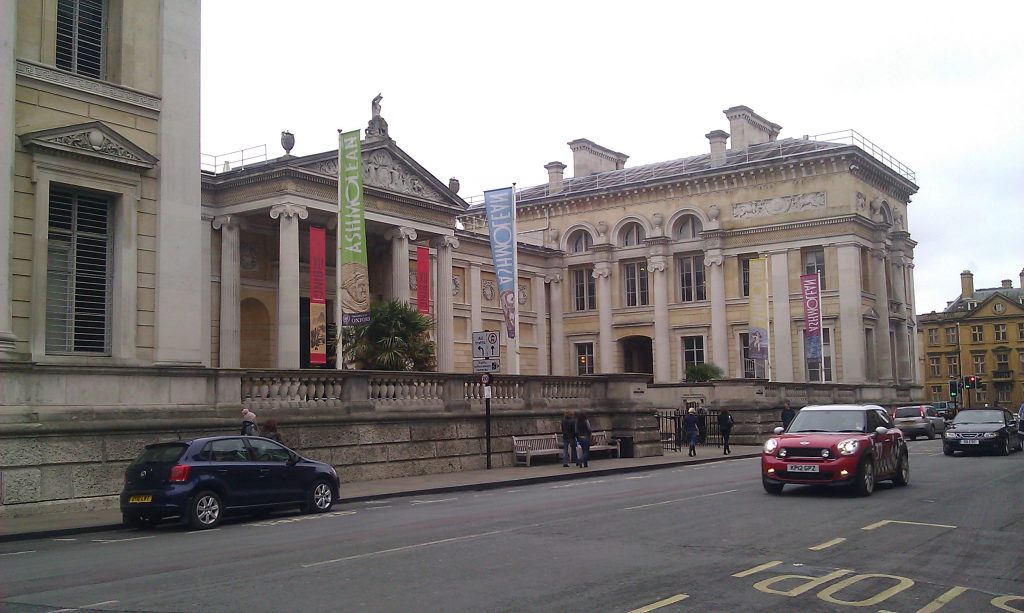
The Ashmolean is a lovely museum. It’s like a miniature combination of the British Museum, The National Gallery, and the V&A. It has a superb collection including the Cretan Archaeology excavated by the Museum’s Director, Arthur Evans in Knossos. Not only that, but it is Britain’s oldest secular Museum, opening over fifty years before the British Museum.
But its origins are even older. This is a story near to my heart. And and I’m going to tell the story as it was told to me by Mrs Nicholson. She founded the Garden History Museum (now Garden Museum) and a formidable person. I was the part-time Curator for a few years in the 1990s.
The Museum is in St Mary’s Church, Lambeth. The Church, despite being the last burial place of various Bishops of London, was going to be made redundant. Mrs Nicholson was not having this and launched a campaign to preserve it. In the graveyard was the grave of the famous Gardeners the Tradescants, father, son, and grandson. So, she hit on the idea of making the Museum into the Museum of Garden History. One of the first in the world, apparently. Some years later, I was employed as the part-time Curator, despite knowing very little about flowers or gardens.
So What Has This to do with the Ashmolean Museum
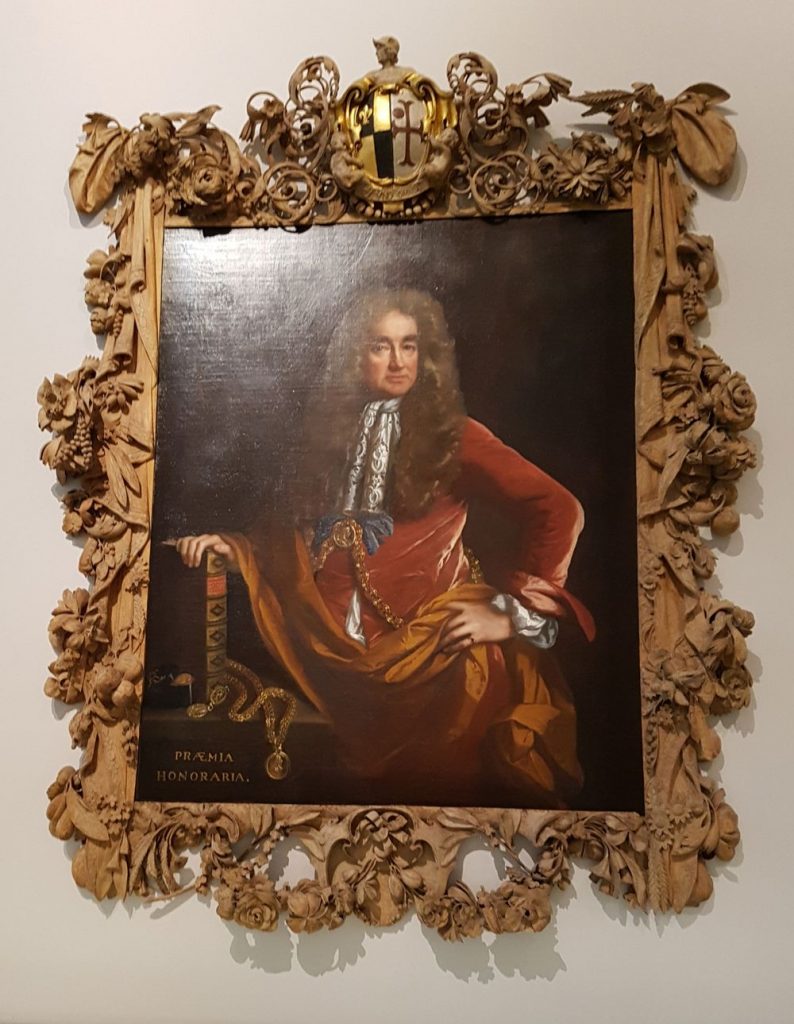
Elias Ashmole in a frame by Grlinling Gibbons, Ashmolean Museum, Photo K Flude
You are wondering?
When Mrs Nicholson came into the Church she stamped on the floor. I enquired why? And was told that this was where Elias Ashmole was buried. He being the founder of the Ashmolean Museum in Oxford. This is the wonderful story which I tell every time I take a group to the Ashmolean Museum.
The Tradescants
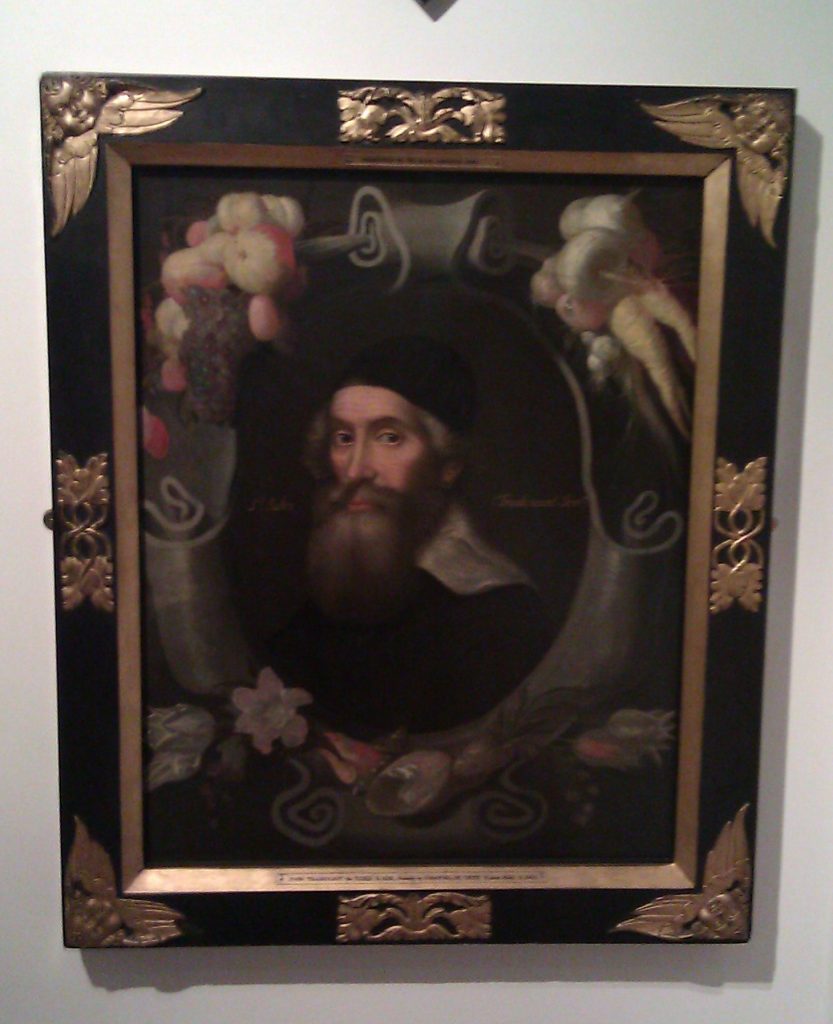
John Tradescant the Elder, Ashmolean Museum photo by K Flude
Apart from being among the first famous Garderners in the UK, the Tradescants ran Britain’s first Museum. It was in Lambeth, London and was called the Arc. The cabinet of curiosities was famous in Britain and Abroad. It had many wonders, shells, sculptures, weapons, clothes, shells, a piece of the True Cross, a Vegetable Lamb, and the lamp held by Guy Fawkes in the Gunpowder plot
John Tradescant the Elder, collected for the Duke of Buckingham. He also helped build the fortifications at the La Rochelle for Buckingham’s disastrous expedition. Tradescant travelled as far afield as Africa to collect curiosities. He also wrote to Ships’ Captains travelling to Africa to bring anything strange back for him.
John Tradescant Junior and Elias Ashmole
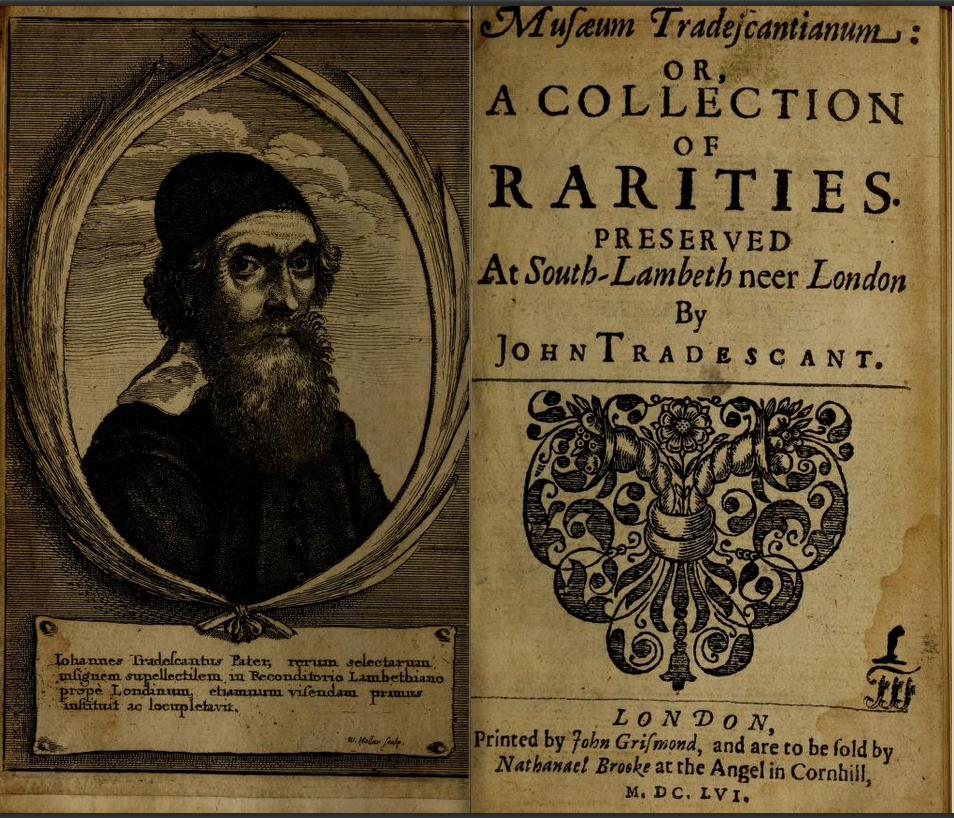
When he died, his son, John Tradescant the Younger, took over. Both the Gardening and the Museum. His neighbour Elias Ashmole helped out, and together they created Britain’s first Museum Catalogue (shown below).
Catalogue of the Museum Tradescantianum
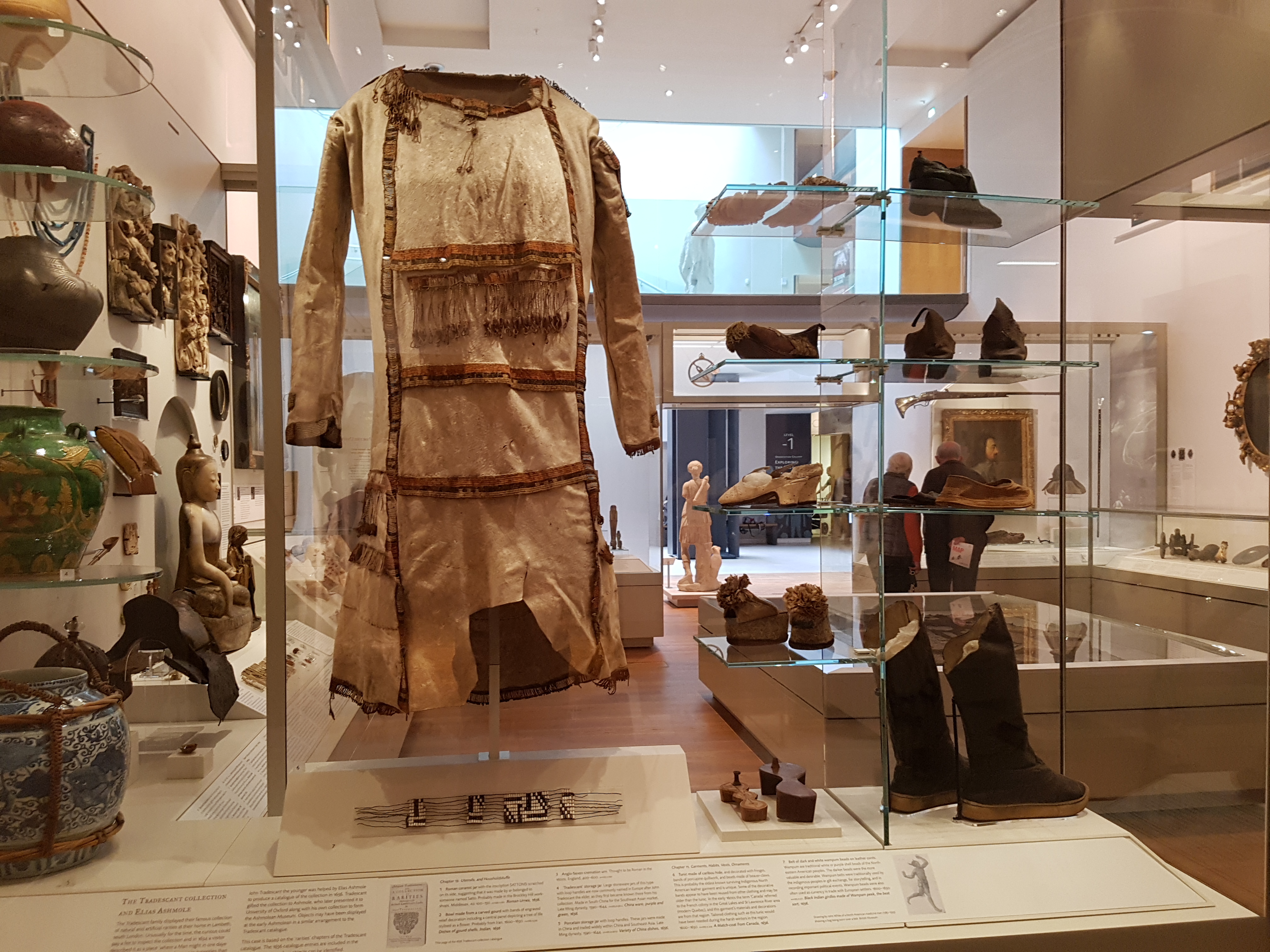
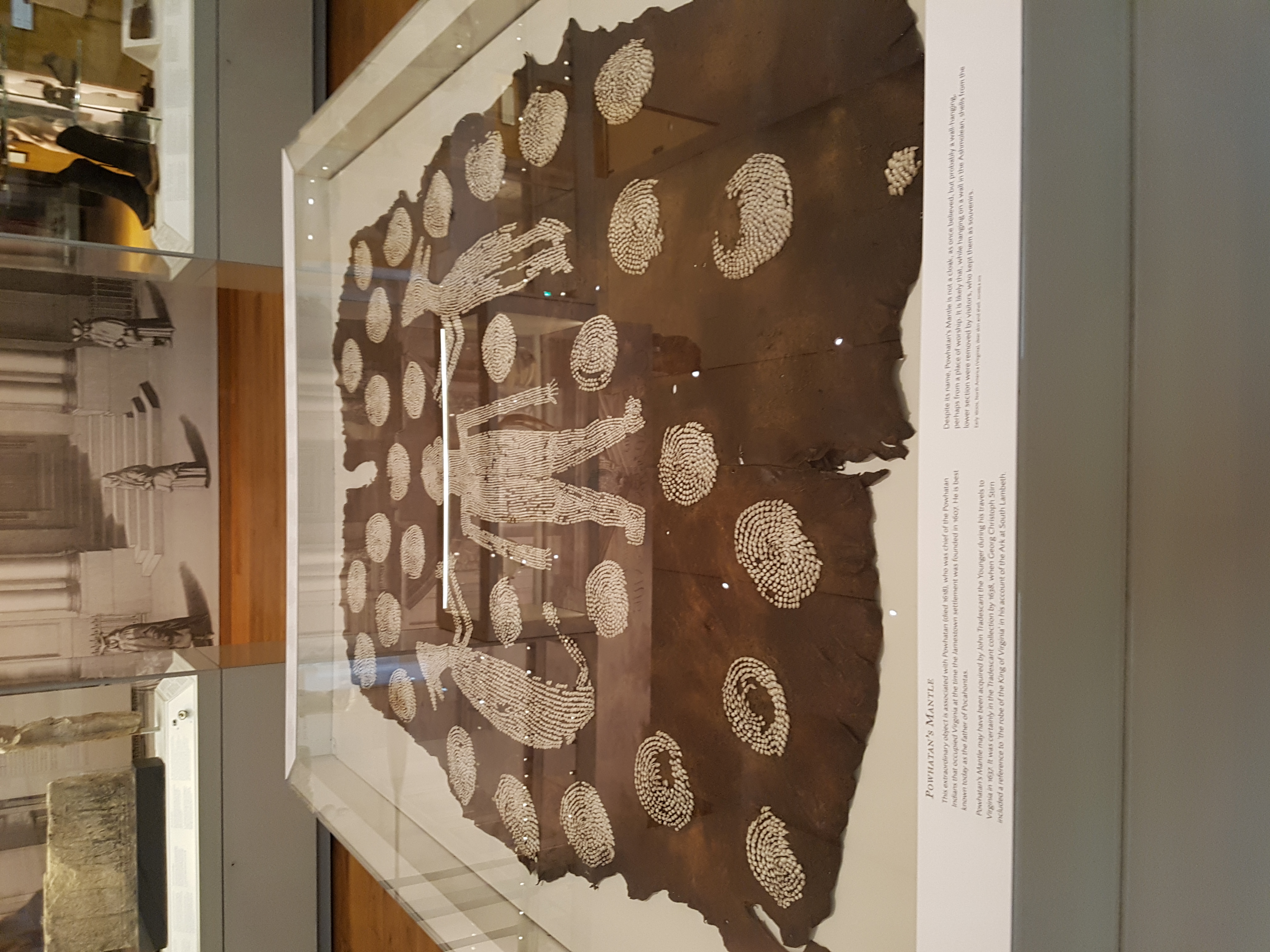
Sadly, the third John Tradescant, died. His father was bereft, and feared what would come of the wonderful collection. The collection his father had left him and which he had augmented. He travelled to America and bought back some of the oldest Native American clothing surviving, including Powhatan’s Mantle (or cloak).
Native American objects collected by John Tradescant the Younger.Powhatan’s Cloak – probably a religious cloth not a cloak
One day, he went to the pub at Elias Ashmole’s request. They discussed the problem of the survival of the collection. Ashmole took out a document and told Tradescant that if he signed it, it would ensure that the collection survived. Tradescant signed it. Went home, his wife, Hester called him a fool and told him to rescind it. Ashmole refused pointing out it was a legal document that had been freely signed before witnesses.
Hester Tradescant and the AshmoleMuseum
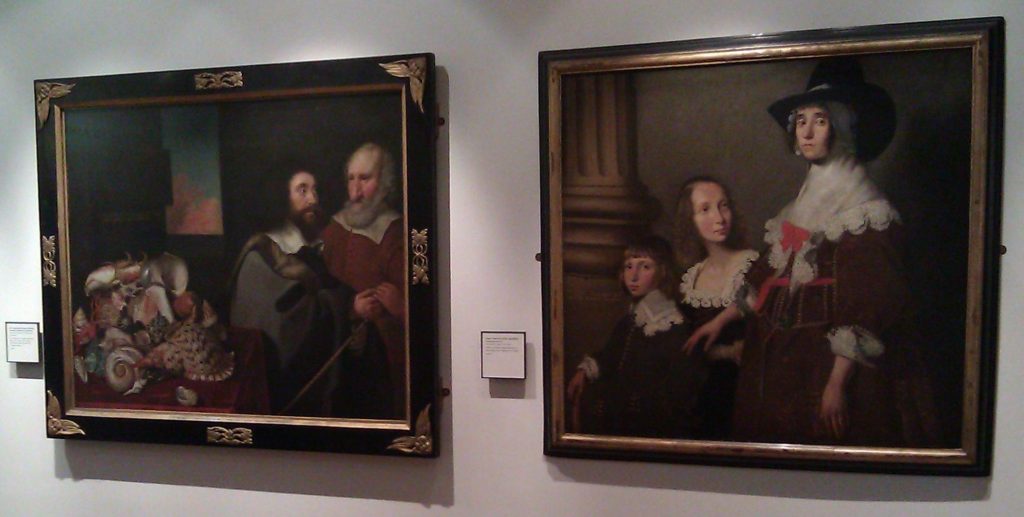
John Tradescant and his friend, Roger Friend with the collection of shells. right Hester Tradescant, daughter and John Tradescant the Youngest. Ashmolean Museum, photo K Flude
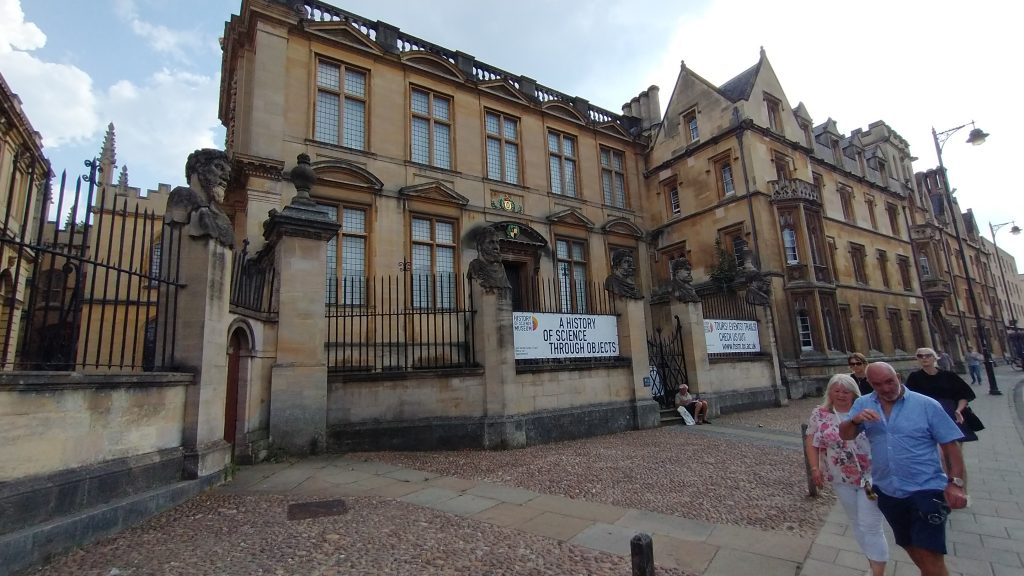
Tradescant died. His wife, who had control of the collection till she died, was legally harassed by Ashmole. He accused her of profiting from the collection. She was found dead in her garden pond. Ashmole shipped the collection up the Thames to Oxford. He made a legal agreement with the University to provide it a permanent home. They built the original Ashmolean which is still on Broad Street but is now the Museum of the History of Science. The building was not used just a collection of ‘knic-knackery’ as it was called but also a laboratory, dissection theatre, and with meeting rooms.
The Original Ashmolean Museum in Broad Street. Photo k Flude
Now, the problem with all this according to Mrs Nicholson, was twofold. Firstly, Ashmole was responsible for the death of Hester. Secondly, the oldest Museum in Britain should be called the Tradescant Museum, not the Ashmolean. The core of the Museum was, after all, Tradescant’s Arch, although Ashmole added his own collection to it. Mrs Nicholson could never forgive Ashmole for stealing the Tradescants’ glory. Arthur MacGregor, Director of the Ashmolean Museum was a trustee of the Museum of Garden History, and would point out that without Ashmole the collection might well not have survived.
First Published May 24th 2025.
For other posts relevant to Tradescant and Ashmole, see the following posts:
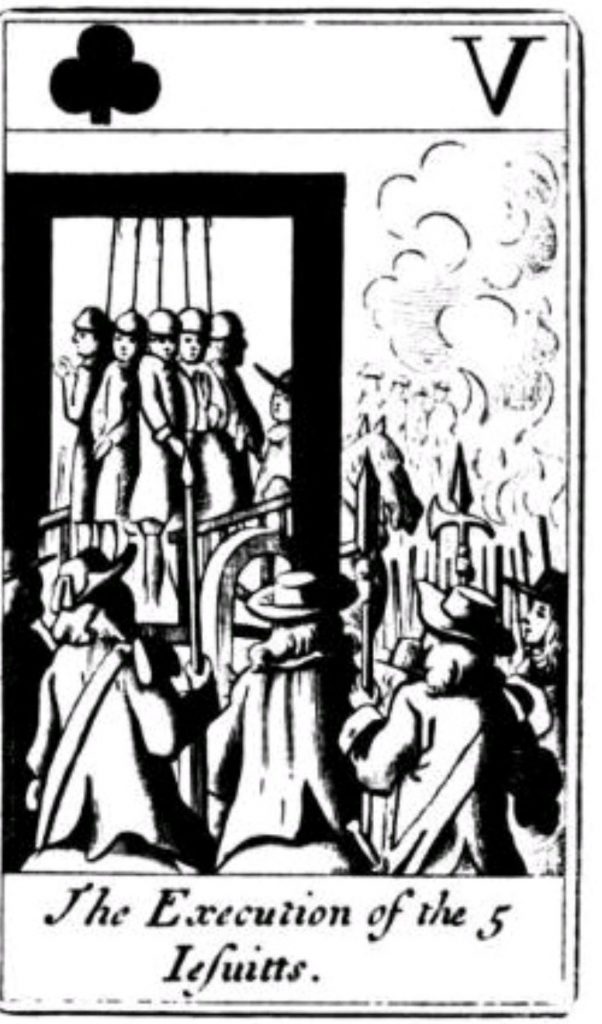
Titue Oates & Popish Plot. Set of playing cards themed on the Plot c1679 after a design by Francis Barlow
Titus Oates was a con-man. He accused leading Catholics of participating in a plot to kill King Charles II and restore a Catholic monarchy. Among his targets were the Queen, and the King’s Brother’s wife.
Titus Oates had a complicated past. He was a Baptist who turned to the Church of England on the Restoration of King Charles II. He went to Cambridge where he was accused of being a ‘Great Dunce’ and never took his degree. His next about turn saw him in St Omer to train as a Jesuit. He accused a man, whose job he wanted, of sodomy. Then, he became a Naval Chaplain. But he was, himself, accused of buggery and dismissed from the Navy. He was received into the Catholic Church while, at the same time, he wrote a series of anti-Catholic Pamphlets. He made accusations against over 500 people. This became known as the Popish Plot.
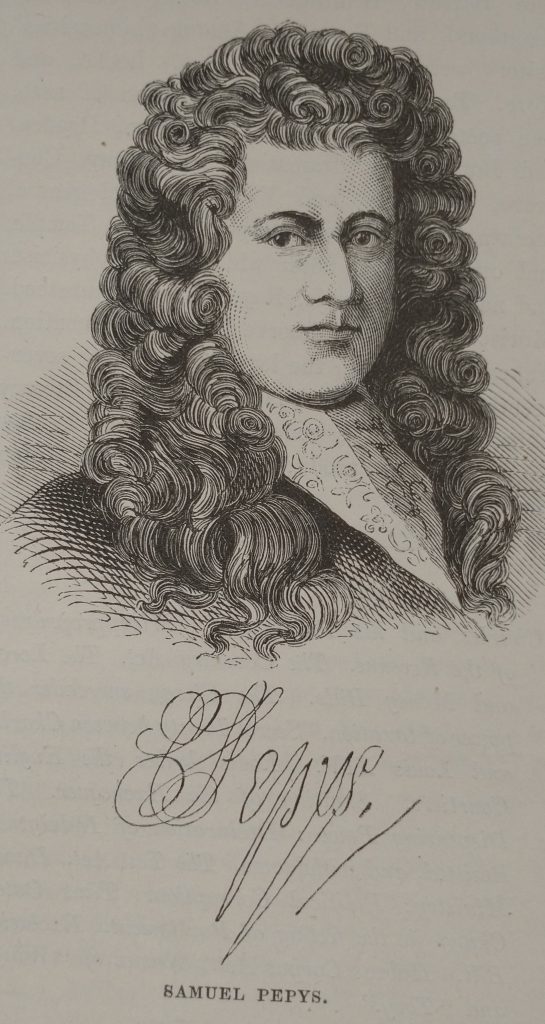
As a result, twenty-two people were executed, some ‘Hanged, Drawn and Quartered’ because of Oates’ baseless accusations. The Diarist, Samuel Pepys, was caught up in the anti-Catholic frenzy. Pepys was Secretary of the Navy during the Plot and was close to the Catholic, James, Duke of York. He was accused of selling secrets to the French. Awaiting trial for treason, he was imprisoned in the Tower of London. Eventually, he was able to clear himself and resume public life. (read this article on the /the-plot-against-pepys/.
Old Print of Samuel Pepys
It was only with the accession of James II that the climate of opinion changed. Then Titus Oates was found guilty of perjury. Perjury was not punishable with death, so Oates’ punishment was a long-drawn-out affair instead. He was sentenced to be imprisoned for life. And ‘whipped through the streets of London for five days a year for the remainder of his life.’
Oates was put in the pillory at Westminster Hall, where passers-by pelted him with eggs. He was again pilloried the next day in the City. On the third day, stripped, tied to a cart, and whipped from Aldgate to Newgate. The following day he was whipped from Newgate to Tyburn. (Source Wikipedia)
However, when the Catholic King, James II was, deposed and replaced by the joint Protestant monarchs William and Mary in 1689, Titus Oates was released and given a pension. He died in 1705.
For Pepys at the Execution of Charles I see my post here.
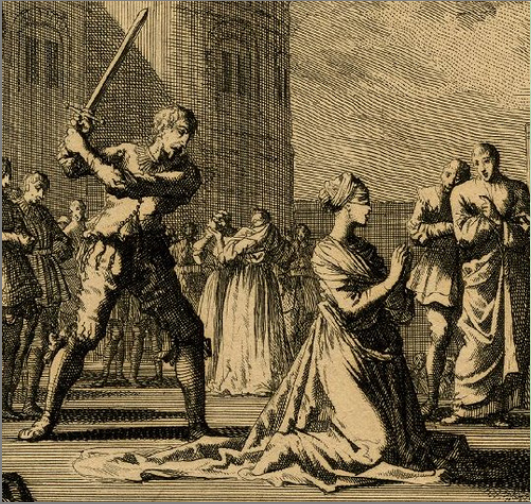
The beheading of Anne Boleyn began at 8am with her speech.
‘Good Christian people, I am come hither to die, for according to the law, and by the law I am judged to die, and therefore I will speak nothing against it.
I am come hither to accuse no man, nor to speak anything of that, whereof I am accused and condemned to die, but I pray God save the King and send him long to reign over you, for a gentler nor a more merciful prince was there never: and to me he was ever a good, a gentle and sovereign lord.
And if any person will meddle of my cause, I require them to judge the best. And thus I take my leave of the world and of you all, and I heartily desire you all to pray for me. O Lord have mercy on me, to God I commend my soul.’
She was blindfolded. She knelt down, putting her neck on the block and repeated:
‘ToJesus Christ I commend my soul; Lord Jesu receive my soul.’
Of course, the real news today is a new Pope and the 80th Anniversary of Victory in Europe Day. But, I can let other media covers those stories. (But more on VE Day below.)
Helston Furry Dance
At the end of the May Day/Beltane Festival, Helston in Cornwall holds its Furry (or Floral) Dance. It is normally on the 8th May. But it changes date if the 8th is a Sunday or a Monday (Helston’s market day). But it isn’t. So the Floral Dance was held asusual on the 8th May.
Padstow holds, perhaps, the most famous May Day festival on May 1st. Padstow feels more of a ‘pagan’ festival, while Helston is a more sedate, gentlemanly, dance. Padstow is more fuelled by a belly full of ale, while Helston by a Pims No 1, or a Gin and Tonic?
Do, have a look at both youtube videos and watch the Padstow one until at least you see the ‘obby ‘orse and the teaser dancing.
Children born between the two days, May 1st and May 8th are considered to have been ‘born with the skill of man and beast and power over both.’
On This Day
1945 – Victory in Europe Day. Official end of the War in Europe with the definitive surrender of Nazi Germany to the Allies, signed by Field Marshal Wilhelm Keitel in Eisenhowers HQ on 8 May 1945 (VE Day). Churchill broadcast the official end of the war at 3pm. In 2025, it was the 80th Anniversary of the defeat of Fascism. A truly significant date with a diminishing number of veterans and eye witnesses surviving to carry the torch. My 97 year old Father is one and he went to London to celebrate that magical day when the war in the west was over. this is what my dad wrote in his recently publish autobiography ‘A Boy from Haggerston:
At last, the War in Europe was over. This day would forever be known as VE day. Both my grandparents had survived the Blitz and only Uncle Charlie’s (my dad’s elder brother) two sons had lost their lives – Charlie died at Salerno and is buried near the beach in the war grave, and Jimmie died, aged 18, at the battle of Reichwald Forest, and is buried in the war grave in the forest. According to David Warren, who is now a battlefield tour guide, received information that Jimmie was reported by the Commanding Office as a typical bright Cockney lad.
Following the end of the war, we were then introduced to images of the emaciated prisoners in the recently freed concentration camps in the newspapers, and in the Pathé news broadcast at the cinema. The terrible news that the Nazis killed millions of Jews in an attempt to wipe out the Jewish race in occupied Europe, spread to a horrified world. This vile campaign is now known as the Holocaust, but is more precisely described as ethnic cleansing.
Jean and I went up to London for VE Day and later also for the VJ Celebrations, where there was singing and dancing in the streets. We went by train to Waterloo, and then walked to Piccadilly. We went with our friends Esther and Bob. It was a great time.
Front cover of ‘A Boy fomr Haggerston’ by Ben Flude
Now, it is up to us and the young to stop such a war ever starting again. What we know is that the vast majority of us don’t want war, but somehow we let it happen. That is our task how to create a world where war is unthinkable.
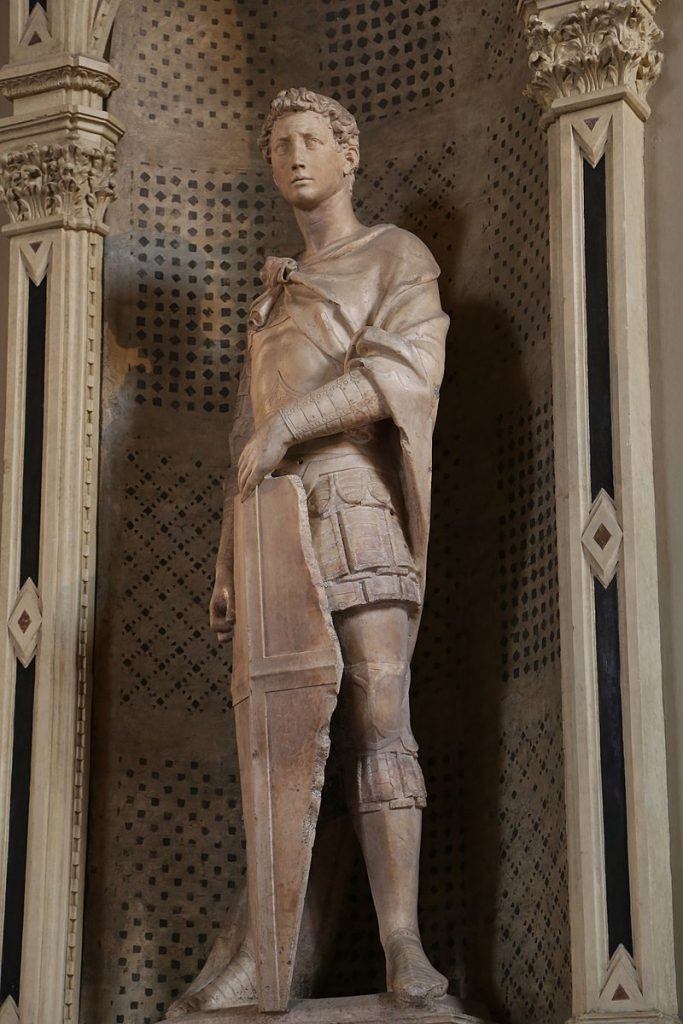
St George’s Day is normally on 23rd April but not this year!
When St George’s Day falls between Palm Sunday and the Second Sunday after Easter it is transferred to the Monday after the Second Sunday of Easter.
Got that? No, nor did I. Not many people know that. it seems. Last time it happened, Keir Starmer, Theresa May, and London Mayor Sadiq Khan all got it wrong in 2019. The first time I heard about this was 2025, when Keir Starmer appeared to have got it wrong again. A cleric fulminated about illiterate people who get it wrong!
But I think the Church should stop such silly practices. Either it is or it isn’t.
Tiled wall in Guernica after Picasso’s famous painting. Photo By Tony Hisgett from Birmingham, UK – Guernica, CC BY 2.0, https://commons.wikimedia.org/w/index.php?curid=64155674
Franco ordered the bombing as part of his campaign to overthrow the Basque Government. The Town was badly damaged and 1,654 civilians were killed. It was undertaken by ‘the Condor Legion of Nazi Germany‘s Luftwaffe and the Italian Aviazione Legionaria‘ (Wikipedia). Picasso began his famous painting almost immediately after he heard an eyewitness account of the attack. The iconic painting was finished by 4 June 1937. The bombing showed the potential damage war from the air could do to crowded Cities. The painting became one of the most famous campaigning works of art.
The War from the Air
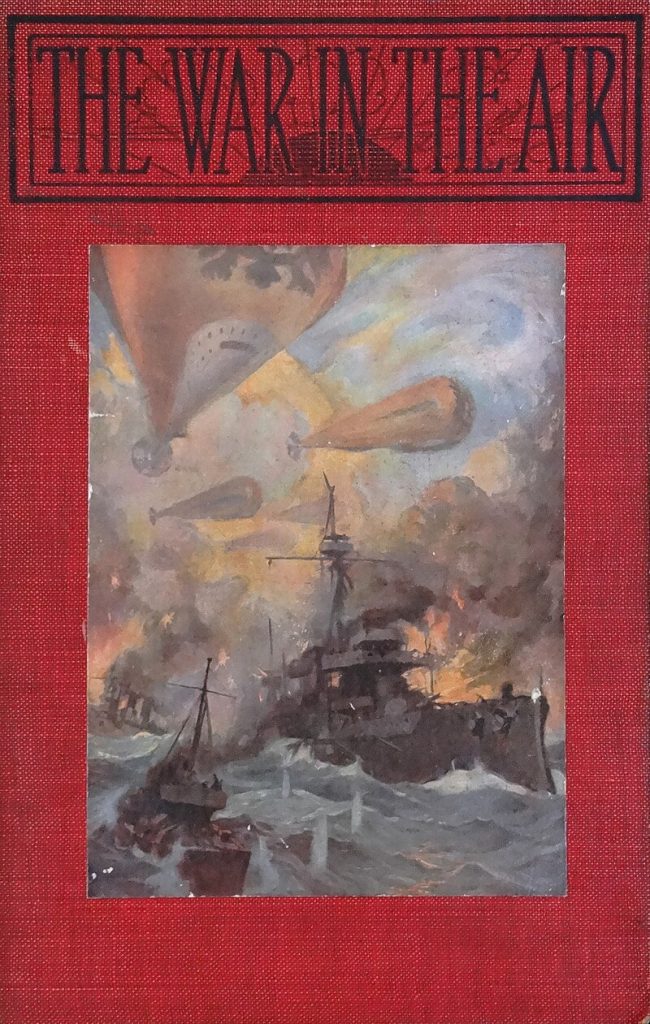
“The War in the Air” by H. G. Wells. London: George Bell & Sons, 1908. First Edition Illustration by A. C. Michael of Pall Mall Magazine –
Aerial warfare became a reality as soon as the Montgolfier Brothers flew the first Hot Air Balloon. In the Revolutionary Wars, the French used them for reconnaissance. Napoleon considered transporting troops by balloon in an invasion of Britain. With the arrival of planes and the development of the Zeppelin. Air warfare became a feature of speculative fiction, and began to absorb the planners.
H G Wells book, illustrated above, featured a war between Germany and the United Statesin which New York is obliterated by Aerial Bombing. This was written in 1908
In World War 1 London was the focus of a series of Zeppelin and Aeroplane raids. These killed over 500 people. (see my post on the London Zeppelin raid of Sept 8th 1916). As planes developed in capacity, war departments created plans that seem now to have been exaggerated. It is thought that Appeasement was partly a response to the feared casualties from war in the air. Before the Blitz, the authorities were planning for 1 million killed in London and double that number of people deranged by fear. In the event, casualties were far less, some 43,000 killed. However, 2 million houses were destroyed. The scale of destruction was fairly accurately predicted but the casualties exaggerated.