William Shakespeare by Martin Droeshout from the 1st Folio
By tradition, Shakespeare was born on St George’s Day April 23rd 1564. He died on the same day in 1616 at age 52. Cervantes died on the same day.
Shakespeare’s death date is given by the burial register at the Holy Trinity Church, Stratford on Avon where he was buried. His baptismal record also survives at the same church and is on April 26th 1564. So, we don’t actually know when he was born, but christening were held soon after birth for fear of the high infant mortality rates, so 23rd April has been assigned to be Shakespeare’s birthday.
Taken to the chamber
Anne Shakespeare would have ‘taken to her chamber’ about four weeks before the due date. The windows or shutters were fastened, as fresh air was thought to be bad for the birthing process. Female friends and relatives came to visit; the room would be decorated with fine carpets, hangings, silver plates and fine ornaments. It was held that external events could influence the birth, any shocks or horrors might cause deformities and anomalies, so a calm lying-in room was clearly a good idea.
When labour began, female friends, relatives, and the midwife were called to help out. A caudle of spiced wine or beer was given to the mother to strengthen her through the process. Today, the maternal mortality rate is 7 per 100,000. An estimate for the 16th Century is 1500 per 100,000. So most women would have heard of or attended the birth of a women who had died during or following children birth. There were also no forceps. So if a baby were stuck and could not be manually manipulated out, then the only way forward was to get a surgeon to use hooks to dismember the baby. This was the only way to save the life of the mother. Doctors were not normally in attendance, but could be called in emergency,
Swaddling
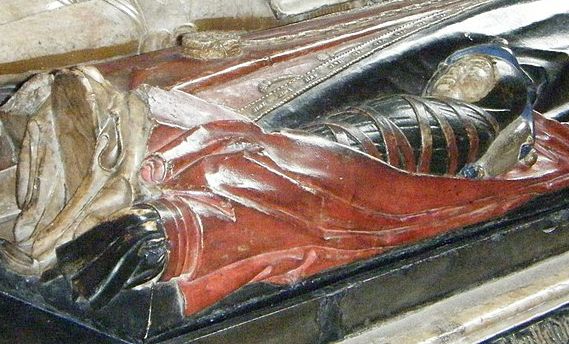
Detail of tomb of Alexander Denton and his first wife Anne Willison, and her baby dressed in swaddling clothes Photo Wikipedia Hugh Llewelyn
Immediately after washing, the baby was swaddled. The swaddling was often very tight and could affect the baby’s growth. Also, it might have affected the learning process. The free movemenb of hands and feet are now considered important in the early learning process. Swaddling lasted eight to nine months, and only went out of fashion after Jean Jacques Rousseau wrote against the practice.
Christening & Registration
Puerperal fever killed many women even after successful childbirth, for example Queen Jane Seymour who died after 5 days. During these dangerous early days, the mother was kept in a dark room. Perhaps three days after birth, friends were invited to celebrate ‘upsitting’ when the mother was no longer confined to bed. This is when christening would take place. Edward VI was christened to a huge audience in the chapel at Hampton Court three days after his birth.
Licensed midwives could baptise newborn babies provided they used the correct wording and informed the Church. This allowed the registration of the birth to be properly reported. Thomas Cromwell was responsible for the law in 1538 which insisted on a parish register to record weddings, christenings, and funerals. The law was reaffirmed by Queen Elizabeth in 1558. Registers had to be stored in a locked chest in the Church. In 1597, the records had to be on parchment not paper. In 1603 the chest had to have three locks! Since writing this I have realised the significance of the three locks. In St Eadburga’s Church in Broadway in there is a locked box for alms, and it has three locks too. This was so that it could only be opened when all 3 Church Wardens were present.
If the christening were in the church, the mother might not be there as she was expected to stay in her chamber for another week or so. A week or a few weeks later, the mother would be ‘churched.’ This was a thanks-giving ceremony. Puritans did not like the idea as it might be confused with a purification ceremony.
Breastfeeding
Breastfeeding would last a year or so but, buty high status women choose to use a wet-nurse. They went to some effort to find a suitable wet nurse. It was believed that the quality of the breast milk was important for the babies’ development both physically and temperamentally. Poor children who lost their mothers were unlikely to survive. For without breast milk, the baby would be fed pap – bread soaked in cow’s milk.
1016 – Edmund Ironside succeeded his father Æthelred the Unready as King of England. Unfortunately, Edmund dies soon after dividing England with Danish King Cnut. Subsequently, Cnut takes over the entire country.
1661 – King Charles II crowned in Westminster Abbey. Read my post on John Evelyn’s reaction to the restoration of Monarchy after the the Commonwealth period of Republican Government.
1942 – World War II: German bombers hit Exeter, in what became known as the Baedeker Raids. They were in retaliation for the success of the British bombing of Lübeck, and of Rostock. In the following days the Luftwaffe bombed Bath, Norwich and York. A German official said they would bomb every building with three stars in the Baedeker Tourist Guide. Hitler said the English were: ‘beings with whom you can only talk after you have first knocked out their teeth‘
First published in 2023 and republished in April 2024. On This day added 2026
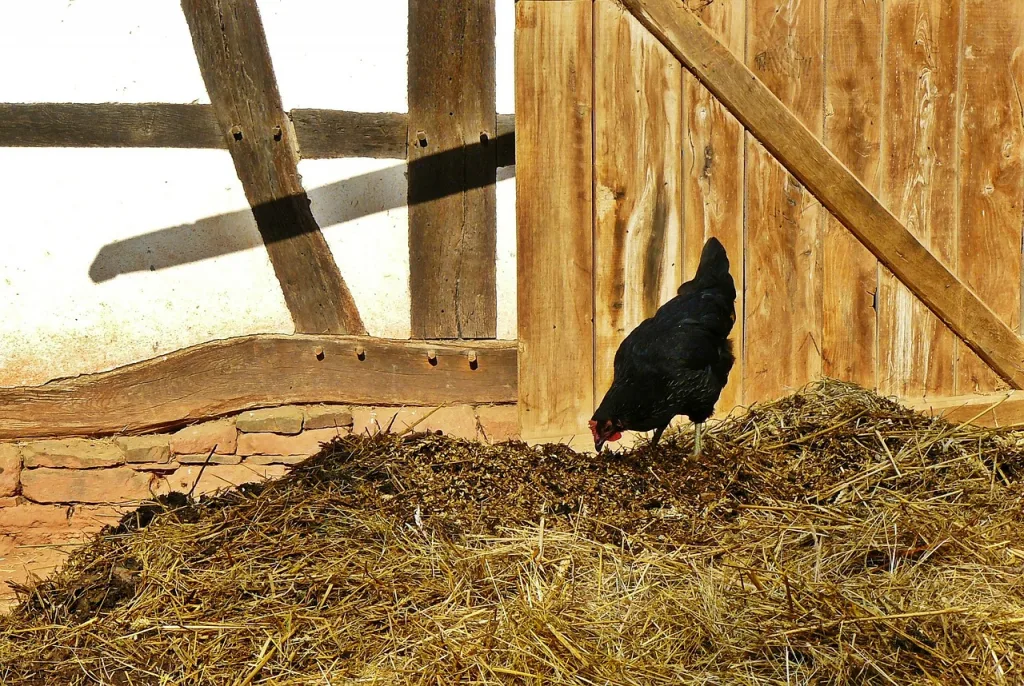
John Worlidge knew all about dung. And it is all spread out in his ‘Worlidge Systema Agriculurae’ of 1697 brought to my attention by Charles Kightly’s Perpetual Almanac.
Worlidge tells us that although it used not be esteemed, but Hens and Pigeons’s Dung is the best if mixed with common earth or sand, and let to rot. He says:
Pigeons or Hens dung is incomparable, one Load is worth ten Load of other Dung, and therefore it’s usually sown on Wheat (or Barly) that lieth afar off, and not easily to be helped; it’s extraordinary likewise on a Hop-garden.
… It’s generally little set by, because our Fore-fathers did not make any great matter of it, and because they understand not the strength and power of it; for when they take it out of the houses it’s of a very hot nature, and must needs injure some things, if laid thereon; but if it be mixed well with common Earth, Sand, or such-like, and let lie till it rot well together, you will finde it a very rich Manure, and of value to answer a great part of your Poultreys expence.
I have known a Quince-tree whereon Poultrey always pearched, that by reason of the Rain washing to its Roots the salt and fatness of the Dung, did bear yearly an incredible number of very excellent Quinces.
Mr. Camel is fascinated by his friend Dilbert Dung Beetle’s diet.
He thinks eating up excrement, feces and manure is a riot.
It is tasty! Delicious! You should try a salty elephant pie!
Dilbert Dung Beetle says. You would love it if you gave it a try!

Mr. Camel watches Dilbert dig in, gulping down gobs of the stuff.
He thinks it must have a weird smell, but Dilbert can’t get enough.
You might sample a tiny bit Dilbert says, it is delicious you see!
Mr. Camel shakes his head and says “Sorry, it does not appeal to me.”
Homemade Quince J am (just out of the freezerHomemade Quince Jelly
I made quince jam this winter for the third year running from my Father’s Tree. Likely to be the last year as he is 98 and has just gone into a lovely home. It’s very easy to make (although very hard to cut up the fruit) and delicious because it is not too sweet. Here is a recipe (not necessarily the one I used}. Indeed, my most successful year was when I didn’t use a recipe, just boiled the fruit with sugar to taste. Beginner’s Luck, I expect.
Quince is mentioned once in Shakespeare, when the Nurse says the pastry makers are calling for Quince and Dates. (Here is a recipe for Tudor Quince Pie) And of course, the mechanicals theatre director is Peter Quince the Carpenter. But the most famous reference is in the Owl and the Pussycat by Edward Lear.
They dined on mince, and slices of quince Which they ate with a runcible spoon; And hand in hand, on the edge of the sand, They danced by the light of the moon.
Quinces are native to the Caspian Seas, and Wikipedia says spread to England when planted at the Tower of London at the order of Edward I. Quinces were sacred to Aphrodite. and taste great with Cheese (dulce de membrillo) if you are in Span. The Balkans have an aqua vita called rakija. Quince is considered old-fashioned and not grown very much in gardens in the UK.
A man born in Pisces shall be a great goer, a fornicator, a mocker and covetous: he will say one thing and do another. He shall trust is his sapience, he shall have good fortune: He will be a defender of widows and orphans. He shall be fearful on water: he shall soon pass all adversities and live 72 years after nature.
The woman shall be delicious, familiar in jests, pleasant of courage, fervent, a great drinker. She shall have sickness of her eyes and be sorrowful by shame, needlessly. Her husband will leave her and she shall have much trouble with strangers. She shall travel much, have pain in his stomach and live seventy-seven years.
Both man and woman shall live faithfully.
Kalendar of Shepherds, 1604 (from the Perpetual Almanac by Charles Kightly)
What surprises me about the fortune-telling above is that it has to be nearly always wrong as the predictions are way too specific. The art of the fortune-telling is about being vague, with subtle predictions that can be interpreted in different ways.
Here is Old Moore’s Prediction for Pisceans this week:
‘Innovation and originality flow freely as your unique perspective solves problems that stump others. Social consciousness drives you toward meaningful causes or community involvement. While your independent streak is strong, collaboration with like-minded individuals amplifies your impact. An unexpected insight arrives through friendship.‘
Now, the Old Moore’s 2023 Almanac had a page on Liz Truss of all people, written before she became Prime Minister. It is clear they thought she had a real chance of being PM. They say she has ‘an almost steely determination and plenty of apparent ambition. …. She has every astrological requirement necessary to keep her nose clean and at this moment in time is certainly among the main contenders.‘. So yes, they are right about her being among the main contenders, but absolutely no hint of the epic disaster that her PMship was.
London Stone as a Palladium
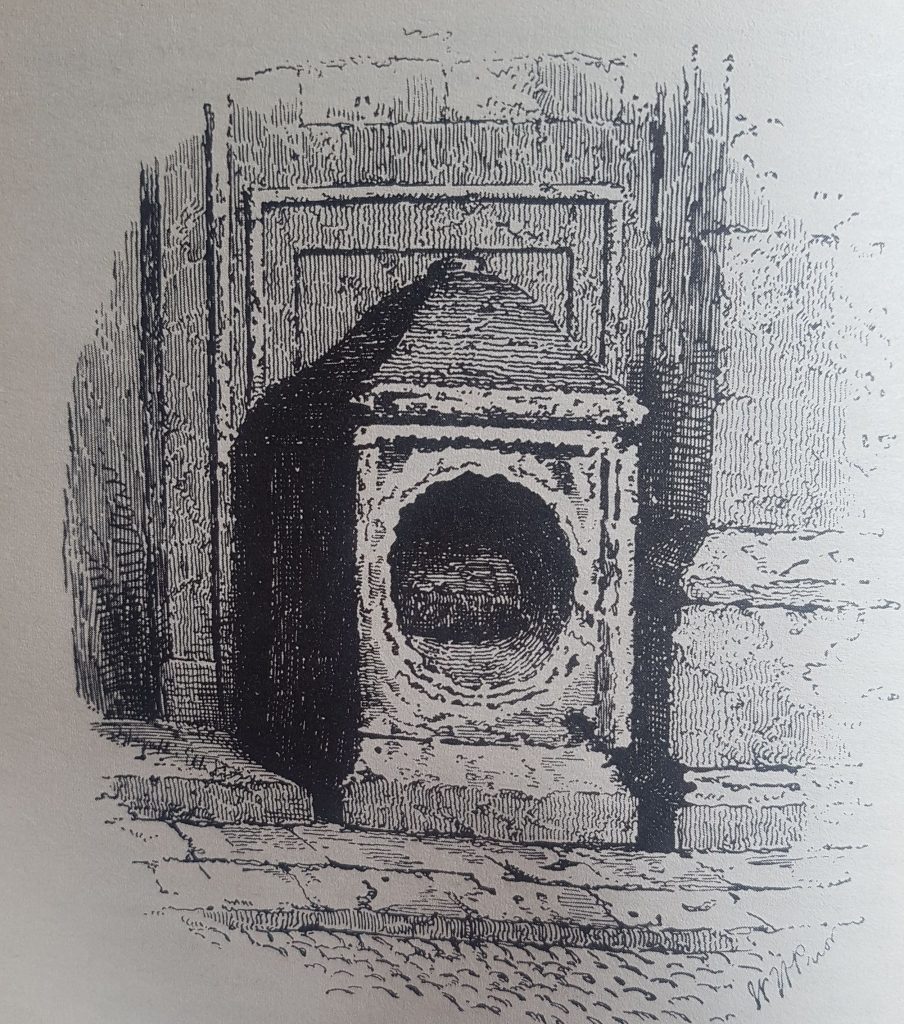
Old Engraving of London Stone, Cannon Street
On February 18th, I revised a post about Ravens, King Bran’s Head and other Palladiums that protected Britain (or London) from invasion. If you missed it, look here. A possible palladium I missed out is London Stone. To remind you, a palladium is something that stops your country or City being harmed or invaded.
London Stone is an eponymous stone found in Cannon Street, in the heart of the City of London, It is first mentioned in the 12th Century, and no one knows why it was famous. In 1862, an ‘ancient proverb’ surfaced:
“So long as the Stone of Brutus is safe, so long shall London flourish”
It was made anonymously in the journal Notes and Queries. In Welsh, it was “Tra maen Prydain, Tra lled Llyndain’. This verse, if genuine, would link the Stone to Brutus of Troy, the legendary founder of London. To be precise: by genuine, I don’t mean it would prove the stone was linked to King Brutus, or that Brutus was a real person. I mean, if genuine, it would prove that in the medieval period the stone was linked to Brutus.
However, the writer has been identified as Richard Williams Morgan, who was a passionate Welsh Nationalist and prolific author. He was, also, not very scrupulous with his analysis of sources. As no earlier source can be found, it is thought Morgan made it up.
He lived in London in the 1850s and was very struck by the London Stone. Archaeologists prefer the idea that London Stone is, likely, a milestone from which the Romans measured distance. For Shakespeare, it was the stone on which rebel Jack Cade claimed lordship of London. For the romantic, it was a coronation stone; a stone of power; the sword in the stone, stone; or an ancient megalith. The truth is, we have no idea. But it has been called the London Stone since the 12th Century. Why was it so named, and what was it ‘for’ or symbolic of?
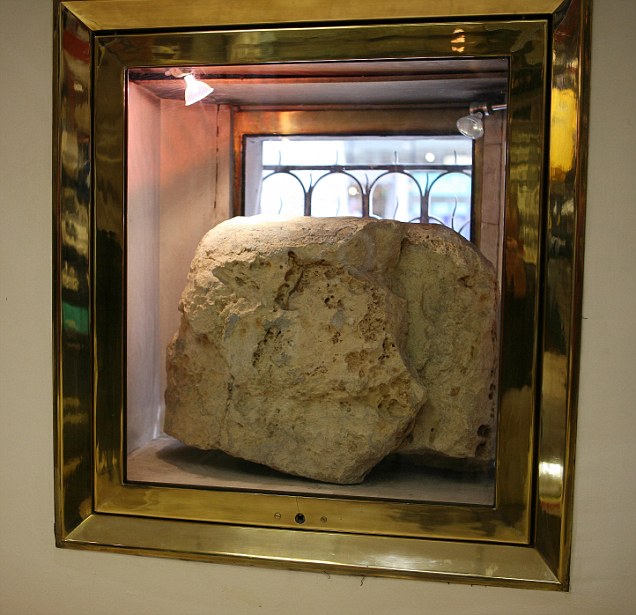
Pic by Graham Hussey pic shows the LONDON STONE which is in Canon Street, London .pic taken inside the Tech Sports shop
Morgan came to the conclusion it was the stone plinth on which the original Trojan palladium had stood. This was a wooden statue of Pallas Athene, that protected Troy from invasion. It was stolen by Odysseus and Diomedes shortly before the successful Trojan Horse plot. It was then taken to Italy.
Morgan’s idea was that King Brutus brought it from Rome when he sailed into Exile in Britain. Brutus, was a descendant of Aeneas. Aeneas was the only Trojan leader to escape from the destruction of Troy. He found his way to Rome, after leaving Dido in Carthage. He was the ancestor of Romulus who founded Rome, and the ancestor of King Brutus.
According to legend, Brutus gathered all the Trojan slaves and exiles in the Mediterranean. He then sailed to found a new Troy in our green and pleasant lands. His new capital he called Troia Nova (New Troy), which became Trinovantum, then Lud’s Dun, and finally London. Or so the Myths say.
Morgan’s theory held that the Stone was used as the altar stone of the Temple of Diana. Folklorist contend that the temple was originally on the site of St Pauls Cathedral. Morgan (in the 19th Century) was the first person to link London Stone with Brutus, or so people thought and still think (see Wikipedia). That was until 2018.
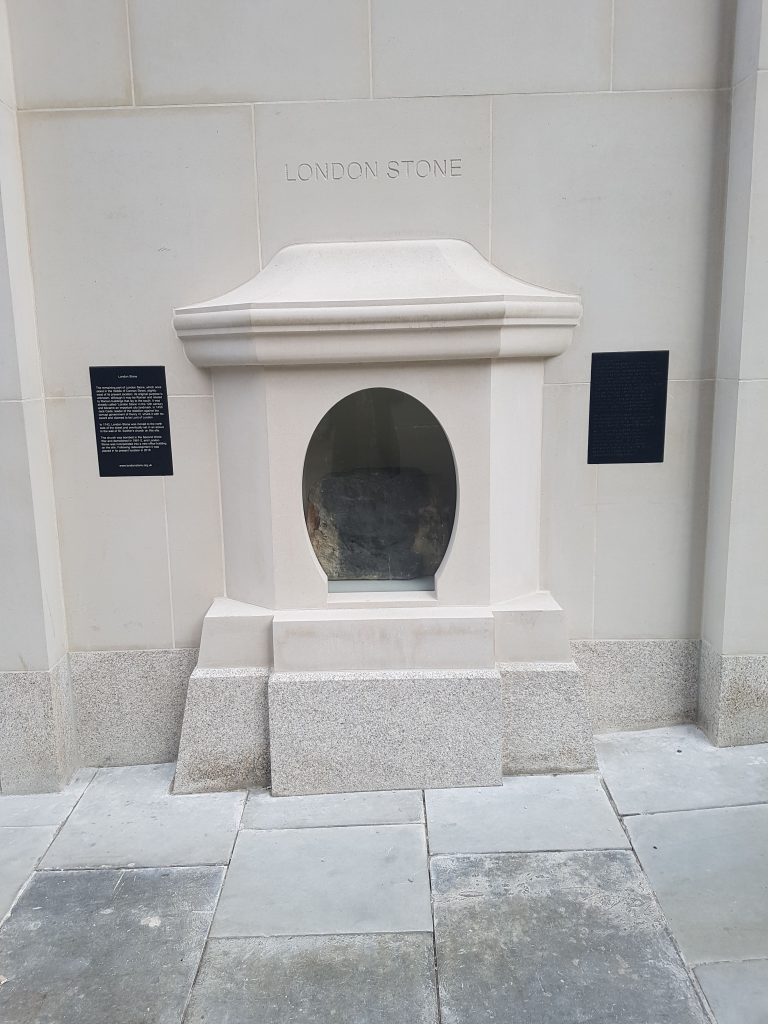
London Stone as recently rehoused.(Photo K Flude)
John Clark
John Clark, Emeritus Curator at the Museum of London, found a reference to a narrative poem of the 14th Century. This links London Stone to Brutus and to the future prosperity of London. Just as Morgan did. So, it makes it possible, at least, that Morgan did not just make the connection but drew on a medieval ‘tradition.’
Brutus set up London Stone And these words he said anon: ‘If each king that comes after me Makes this city wide and roomy As I have in my day, Still hereafter men may say That Troy was never so fair a city As this city shall be.’
From Burnley & Wiggins 2003b, lines 457–64(John Clark’s modern English version)
Recent archaeological discoveries reveal that London was the site of Late Neolithic feasting on a possibly large scale (discussed here:). This increases the possibility that the London stone is a ‘ritual’ stone from prehistory. But, of course, there is still no evidence that London Stone is prehistoric, and even less that Brutus actually existed.
On This Day
1472 – Orkney and Shetland are given to Scotland by Norway in lieu of dowry for Margaret of Denmark.
1933 – Adolf Hitler meets with German industrialists to arrange for financing of the Nazi Party’s election campaign. Democracy is doomed.
Written in 2023 and revised in February 2024 and 2025 Pisces and London Stone joined into one page 2026
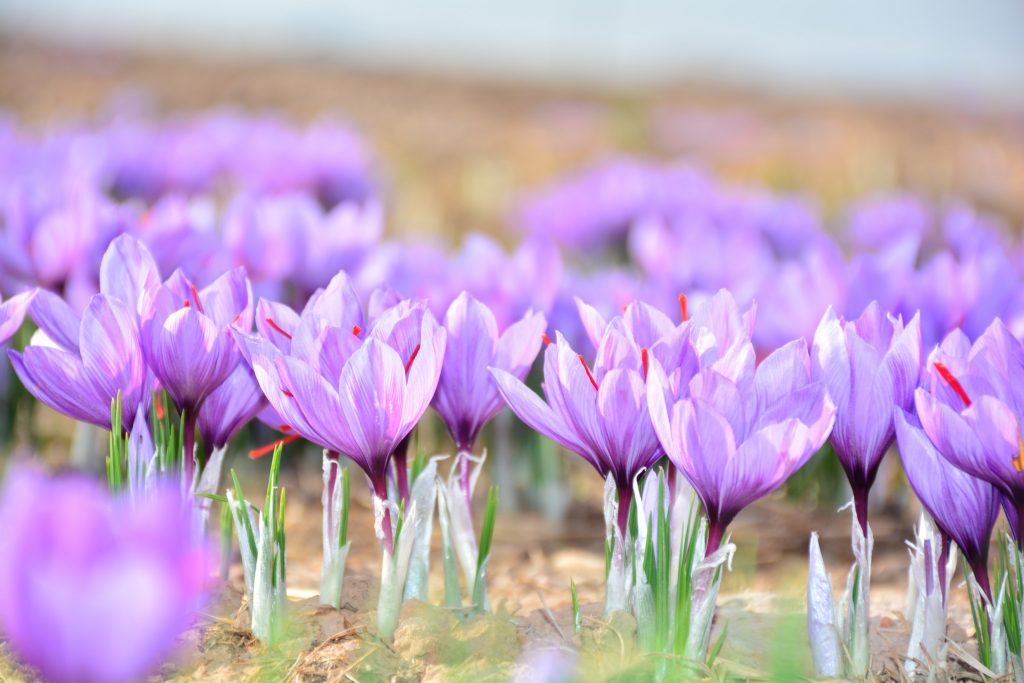
Photo Mohammad Amiri from unsplash. Notice the crimson stigma and styles, called threads, Crocus is one of the characters in Ovid’s Metamorphoses
The story of Crocus and Smilax is in Ovid’s Metamorphoses. The book tells the story of myths which involve the metamorphosis of a person to a flower, or to a constellation, or to an echo or some supernatural change in being. This poem is one of the most famous in the world, written in about 6 AD. It influenced Dante, Bocaccio, Chaucer, Shakespeare, Keats, Bernard Shaw, and me. Seamus Heaney and Ted Hughes have translated modern versions of some of the tales.
The mechanicals in ‘The Midsummers Night Dream’ perform Ovid’s story of Pyramus and Thisbe, Titian painted Diana and Actaeon. Shaw wrote about Pygmalion, and we all know the story of Arachne. She claimed to be better than Athene at weaving. And then was turned into a spider.
The poem is about love, beauty, change, arrogance and is largely an Arcadian/rural poem. This is a contrast to Ovid’s ‘Art of Love’ which I use for illustrations of life in a Roman town. The stories are all about metamorphoses, mostly changes happening because of love. But it is also an epic as it tells the classical story of the universe from creation to Julius Caesar.
Ovid’s Metamorphoses and the Crocus
‘Crocus and his beloved Smilax were changed into tiny flowers.’ Ovid tell us, but chooses to give us no more details. So we have to look elsewhere. There are various versions. In the first, Crocus is a handsome mortal youth, beloved of the God Hermes (Mercury). They are playing with a discus which hits Crocus on the head and kills him. Hermes, distraught, turns the youth into a beautiful flower. Three drops of his blood form the stigma of the flower. In another version, Crocus and the nymph Smilax, fall in love. And are rewarded by immortality as a flower. One tale has Smilax turned into the Bindweed.
Morning Glory or Field Bindweed photo Leslie Saunders unsplash
Ovid’s Metamorphoses and Bindweed
It turns out that Smilax means ‘bindweed’ in Latin. Bindweed is from the Convolvulus family, and I have grown one very successfully in a pot for many years. But they have long roots. According to the RHS ‘Bindweed‘ refers to two similar trumpet-flowered weeds. Both of which twine around other plant stems, smothering them in the process. They are difficult to remove. This, could suggest that Smilax is either punished for spurning Crocus, or that she smothered him with love. Medically, Mrs Grieve’s Modern Herbal says all the bindweeds have strong purgative virtues, perhaps another insight into Smilax’s psychology?
The Metamorphosis of Data and the correct use of the plural
Apparently, in the UK some say crocuses and others use the correct Latin plural, croci. On an earlier version of this post I used the incorrect plural crocii.
On the subject of Roman plurals, the Financial Times editorial department made an earth-shattering decision, a couple of years ago. They updated their style guide to make the plural word data (datum is the singular form) metamorphise into the singular form.
So it is now wrong to say ‘data are’ but right to say ‘data is’. For example, it was correct to say: ‘the data are showing us that 63% of British speakers use crocuses as the plural’ but now, it is better to write ‘the data is showing us that 37% of British people prefer the correct Latin form of croci’.
Violets and Crocuses
Violets and crocuses are coming out. They often come out for St Valentine’s Day, and so obviously associated with Love. White croci usually represented truth, innocence, and purity. The purple variety imply success, pride and dignity. The yellow type is joy.’ according to www.icysedgwick.com/, which gives a fairly comprehensive look at the Crocus.
Crocus & Saffron
The autumn-flowering perennial plant Crocus sativus, is the one whose stigma gives us saffron. Roman civilisation spread the plants around Europe. They used it for medicine, as a dye, and a perfume. It was much sought after as a protection against the plague, and extensively grown in the UK. Saffron Walden was a particularly important production area in the 16th and 17th Centuries.
Saffron in London
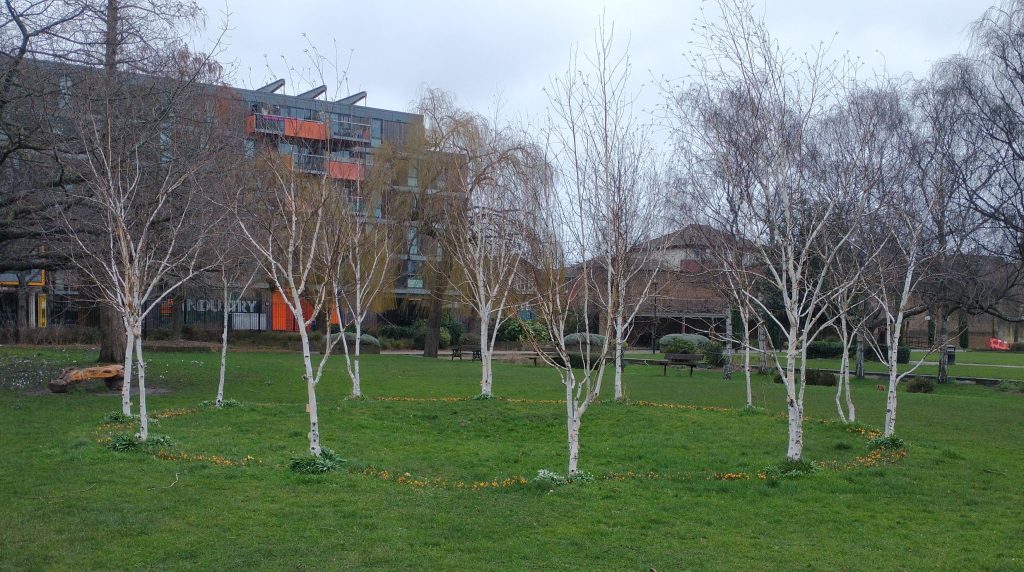
Snowdrop, Crocus, Violet and Silver Birch circle in Haggerston Park. (Photo Kevin Flude, 2022)
The Bishop of Ely grew Saffrom in his beautiful Gardens just outside of the City of London. The area remembered by the London street name: Saffron Hill. It is home to the fictional Scrooge. This area became the London home of Christopher Hatton, the favourite of Queen Elizabeth 1. His garden was on the west bank of the River Fleet, in London EC1, in the area now known as Hatton Garden. (For more on Christopher Hatton see my post on nicknames Queen Elizabeth I gave to her favourites).
I found out more about Saffron from listening to BBC Radio 4’s Gardener’s Question time and James Wong.
Croydon (on the outskirts of London) means Crocus Valley. A place where Saffron was grown. The Saffron crops in Britain failed eventually because of the cost of harvesting, and it became cheaper to import it. So, we now import it from Spain, Iran, and India amongst other places. But it is being reintroduced in Norfolk, Suffolk, Kent, and Sussex. These are – the hot and dry counties. The plant enjoys a South-facing aspect. But it needs protection from squirrels and sparrows who love it. To grow it, look at this post from the Garden Doctor.
Saffron Photo by Vera De on Unsplash
Violets
Viola odorata CC BY-SA 2.5 Wikipedia
The Celts used Violets as cosmetics; the Athenians to moderate anger; the Iranians for insomnia, and are loved by all because of their beauty and fragrance. They have been symbols of death for the young, and used as garlands, nosegays posies, which Gerard says are ‘delightful’.
For more on Ovid, use the search facility (click on menu) or read my post here.
On This Day
197 – The Battle of Lugdunum sees the victory of Septimius Severus over Clodius Albinus reputedly the bloodiest battle between Roman armies. The previous emperor Pertinax died in 193 during the Year of the Five Emperors. Three main contenders emerged Severus who was African, Niger was from Central Italy, Albinus was the Governor of Britain.
1800 – Napoleon proclaims himself First Consul making him the dictator of France.
1846 – The Republic of Texas officially transfers power to the State of Texas government and becomes part of the United States.
1878 – Thomas Edison patents the phonograph.
1945 – Battle of Iwo Jima began with the landing of 30,000 US troops.
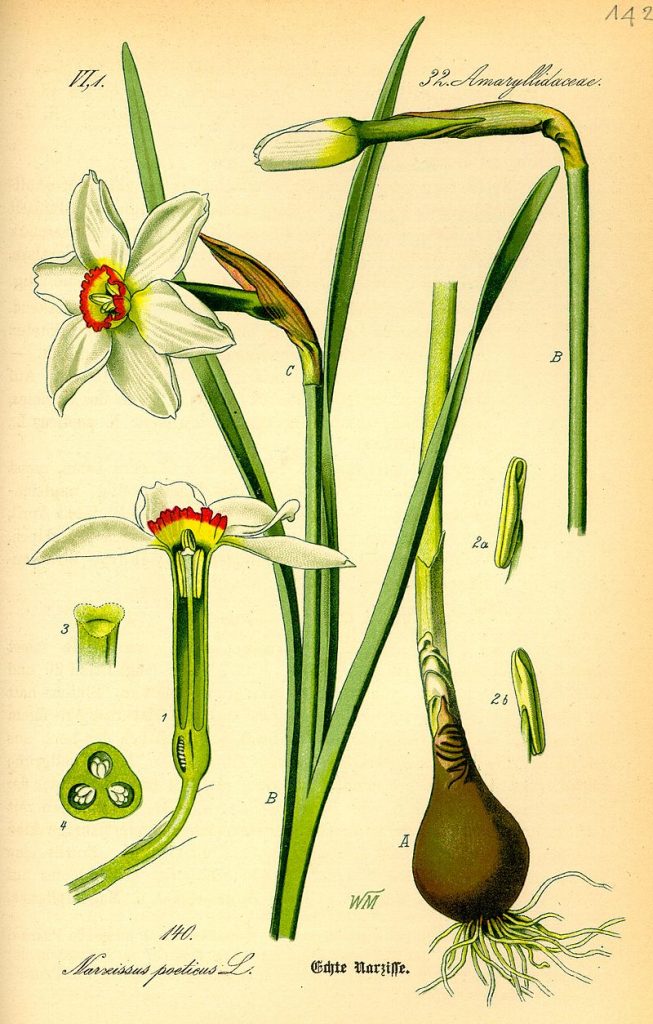
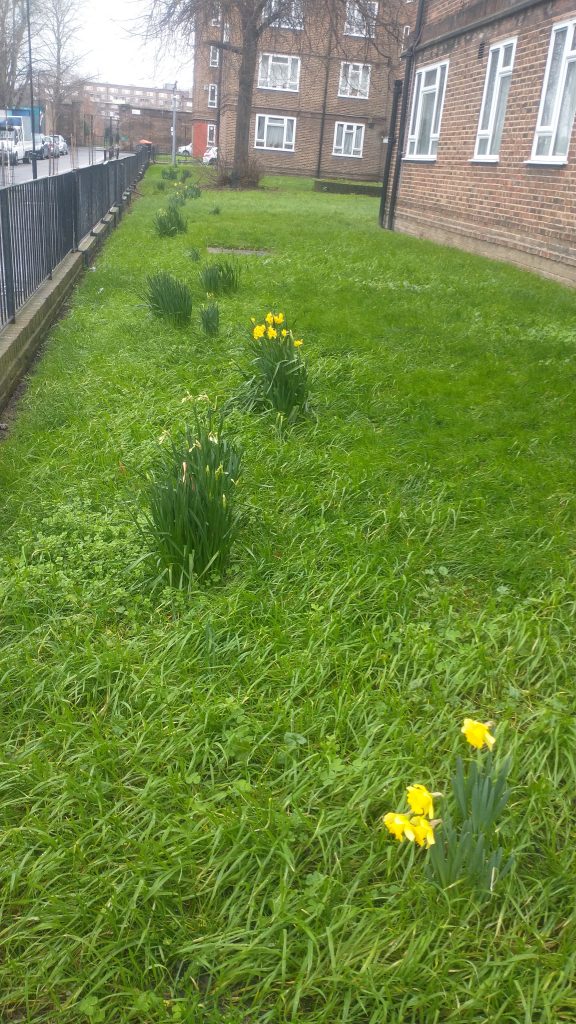
Daffodils & Narcissus. In 2023, I saw my first Daffodil in Hackney in a Council Estate on 12 January. My first daffodil in 2024 was outside my first floor window in early February. On February 11th, 2025, I saw the shoots of Daffodils in my garden but nothing blooming. However, there were daffodils on another Council Estate. In 2026, my first daffodil came out in early January. And the Estates and Parks around have been showing daffodils since late January. They bring such joy and hope for the return of the Sun.
12 Jan 2023. Hackney, London, the first Daffodil.
Narcissus the Flower
Their formal name is Narcissus. The Roman natural historian, Pliny tells us that the plant was:
‘named Narcissus from narkē not from the fabulous boy.’
Narkē is the Greek word from which we derive the word narcotic. It is a reference to the narcotic properties of the narcissus. An extract of the bulb applied to open wounds produced numbness of the whole nervous system and paralysis of the heart. The flowers are also slightly poisonous. So, they were used as an emetic. They brought on vomiting when it was felt necessary that the stomach be emptied. It was used to treat hysteria and epilepsy. They treated children with bronchial catarrh or epidemic dysentery. Among Arabian doctors, it was used to cure baldness and as an aphrodisiac. (Source: A Modern Herbal by Mrs M Grieve.) Please remember these are not recommendations for use medicinally, but are historic uses and may be dangerous.
The Fabulous Boy
The fabulous boy, mentioned by Pliny, was Narcissus. He, according to the Roman Poet Ovid, met the nymph Echo, and she fell in love with the beautiful boy. He spurned her, and she faded until all that remained of her was her voice – the echo we hear.
Nemesis, the Goddess of Revenge (the one with the fiery sword) decided on revenge upon the handsome boy. She lured the thirsty youth to a fountain, where, in the pool around the fountain, he saw an image of a breathtakingly handsome boy. He fell instantly in love with such beauty. But it was an image of himself. Realising he would never meet anyone as fabulous as himself, he faded from life. He eventually metamorphised into a white and yellow flower, which was named after him.
Nemesis, with her fiery sword, from the painting on the Staircase at Hampton Court by Antonio Verrio, Photo K Flude
Daffodils & Shakespeare
Daffodils are mentioned in a list of Spring Flowers by Shakespeare in the pastoral play The Winter’s Tale:
(Please note that as you read Shakespeare’s words below that Prosperpina is the wife of Pluto, the God of the Underworld, Dis, is another name for him, Cytherea is the Goddess of Beauty and Love. Phoebus is the Sun God. And the Spring Flowers are Daffodils, violets, primroses, oxlips (primula), Crown Imperial (Fritillaria imperialis), Lilies, flower-De-luce (Iris)
Perdita to Camillo
Out, alas! You’d be so lean that blasts of January Would blow you through and through. (To Florizel) I would I had some flowers o’th’ spring, that might Become your time of day – (to the Shepherdesses) That wear upon your virgin branches yet Your maidenheads growing. O Proserpina, For the flowers now that, frighted, thou let’st fall From Dis’s waggon! Daffodils, That come before the swallow dares, and take The winds of March with beauty; violets, dim, But sweeter than the lids of Juno’s eyes Or Cytherea’s breath; pale primroses, That die unmarried ere they can behold Bright Phoebus in his strength – a malady Most incident to maids; bold oxlips and The crown imperial; lilies of all kinds, The flower-de-luce being one: O, these I lack To make you garlands of, and my sweet friend To strew him o’er and o’er!
WT IV.iv.110.2
The reference to Daffodils suggests that for Shakespeare they are around to withstand the March Winds before the Swallows arrive in April. With selective breeding, early flowering species have been developed. Now February and even January are within the scope of the glorious bulb. (here is a post on winter flowering varieties). For my post on Shakespeare & Winter see here.
Once a noisy Nymph, (who never held her tongue when others spoke, who never spoke till others had begun) mocking Echo, spied him as he drove, in his delusive nets, some timid stags.—For Echo was a Nymph, in olden time,—and, more than vapid sound,—possessed a form: and she was then deprived the use of speech, except to babble and repeat the words, once spoken, over and over. Juno confused her silly tongue, because she often held that glorious goddess with her endless tales, till many a hapless Nymph, from Jove’s embrace, had made escape adown a mountain.
But for this, the goddess might have caught them. Thus the glorious Juno, when she knew her guile; “Your tongue, so freely wagged at my expense, shall be of little use; your endless voice, much shorter than your tongue.” At once the Nymph was stricken as the goddess had decreed;—and, ever since, she only mocks the sounds of others’ voices, or, perchance, returns their final words.
One day, when she observed Narcissus wandering in the pathless woods, she loved him and she followed him, with soft and stealthy tread.—The more she followed him the hotter did she burn, as when the flame flares upward from the sulphur on the torch. Oh, how she longed to make her passion known! To plead in soft entreaty! to implore his love! But now, till others have begun, a mute of Nature she must be. She cannot choose but wait the moment when his voice may give to her an answer. Presently the youth, by chance divided from his trusted friends, cries loudly, “Who is here?” and Echo, “Here!” Replies. Amazed, he casts his eyes around, and calls with louder voice, “Come here!” “Come here!” She calls the youth who calls.—He turns to see who calls him and, beholding naught exclaims, “Avoid me not!” “Avoid me not!” returns. He tries again, again, and is deceived by this alternate voice, and calls aloud; “Oh let us come together!” Echo cries, “Oh let us come together!” Never sound seemed sweeter to the Nymph, and from the woods she hastens in accordance with her words, and strives to wind her arms around his neck.
He flies from her and as he leaves her says, “Take off your hands! you shall not fold your arms around me. Better death than such a one should ever caress me!” Naught she answers save, “Caress me!” Thus rejected she lies hid in the deep woods, hiding her blushing face with the green leaves; and ever after lives concealed in lonely caverns in the hills. But her great love increases with neglect; her miserable body wastes away, wakeful with sorrows; leanness shrivels up her skin, and all her lovely features melt, as if dissolved upon the wafting winds—nothing remains except her bones and voice—her voice continues, in the wilderness; her bones have turned to stone. She lies concealed in the wild woods, nor is she ever seen on lonely mountain range; for, though we hear her calling in the hills, ’tis but a voice, a voice that lives, that lives among the hills.
Thus he deceived the Nymph and many more, sprung from the mountains or the sparkling waves; and thus he slighted many an amorous youth.—and therefore, some one whom he once despised, lifting his hands to Heaven, implored the Gods, “If he should love deny him what he loves!” and as the prayer was uttered it was heard by Nemesis, who granted her assent.
There was a fountain silver-clear and bright, which neither shepherds nor the wild she-goats, that range the hills, nor any cattle’s mouth had touched—its waters were unsullied—birds disturbed it not; nor animals, nor boughs that fall so often from the trees. Around sweet grasses nourished by the stream grew; trees that shaded from the sun let balmy airs temper its waters. Here Narcissus, tired of hunting and the heated noon, lay down, attracted by the peaceful solitudes and by the glassy spring.
There as he stooped to quench his thirst another thirst increased. While he is drinking he beholds himself reflected in the mirrored pool—and loves; loves an imagined body which contains no substance, for he deems the mirrored shade a thing of life to love. He cannot move, for so he marvels at himself, and lies with countenance unchanged, as if indeed a statue carved of Parian marble. Long, supine upon the bank, his gaze is fixed on his own eyes, twin stars; his fingers shaped as Bacchus might desire, his flowing hair as glorious as Apollo’s, and his cheeks youthful and smooth; his ivory neck, his mouth dreaming in sweetness, his complexion fair and blushing as the rose in snow-drift white. All that is lovely in himself he loves, and in his witless way he wants himself:—he who approves is equally approved; he seeks, is sought, he burns and he is burnt.
And how he kisses the deceitful fount; and how he thrusts his arms to catch the neck that’s pictured in the middle of the stream! Yet never may he wreathe his arms around that image of himself. He knows not what he there beholds, but what he sees inflames his longing, and the error that deceives allures his eyes. But why, O foolish boy, so vainly catching at this flitting form? The cheat that you are seeking has no place. Avert your gaze and you will lose your love, for this that holds your eyes is nothing save the image of yourself reflected back to you. It comes and waits with you; it has no life; it will depart if you will only go.
Nor food nor rest can draw him thence—outstretched upon the overshadowed green, his eyes fixed on the mirrored image never may know their longings satisfied, and by their sight he is himself undone. Raising himself a moment, he extends his arms around, and, beckoning to the murmuring forest; “Oh, ye aisled wood was ever man in love more fatally than I? Your silent paths have sheltered many a one whose love was told, and ye have heard their voices. Ages vast have rolled away since your forgotten birth, but who is he through all those weary years that ever pined away as I?
Alas, this fatal image wins my love, as I behold it. But I cannot press my arms around the form I see, the form that gives me joy. What strange mistake has intervened betwixt us and our love? It grieves me more that neither lands nor seas nor mountains, no, nor walls with closed gates deny our loves, but only a little water keeps us far asunder. Surely he desires my love and my embraces, for as oft I strive to kiss him, bending to the limpid stream my lips, so often does he hold his face fondly to me, and vainly struggles up. It seems that I could touch him. ‘Tis a strange delusion that is keeping us apart. Whoever thou art, Come up! Deceive me not! Oh, whither when I fain pursue art thou? Ah, surely I am young and fair, the Nymphs have loved me; and when I behold thy smiles I cannot tell thee what sweet hopes arise. When I extend my loving arms to thee thine also are extended me—thy smiles return my own.
When I was weeping, I have seen thy tears, and every sign I make thou cost return; and often thy sweet lips have seemed to move, that, peradventure words, which I have never heard, thou hast returned. No more my shade deceives me, I perceive ‘Tis I in thee—I love myself—the flame arises in my breast and burns my heart—what shall I do? Shall I at once implore? Or should I linger till my love is sought? What is it I implore? The thing that I desire is mine—abundance makes me poor. Oh, I am tortured by a strange desire unknown to me before, for I would fain put off this mortal form; which only means I wish the object of my love away. Grief saps my strength, the sands of life are run, and in my early youth am I cut off; but death is not my bane—it ends my woe.—I would not death for this that is my love, as two united in a single soul would die as one.”
He spoke; and crazed with love, returned to view the same face in the pool; and as he grieved his tears disturbed the stream, and ripples on the surface, glassy clear, defaced his mirrored form. And thus the youth, when he beheld that lovely shadow go; “Ah whither cost thou fly? Oh, I entreat thee leave me not. Alas, thou cruel boy thus to forsake thy lover. Stay with me that I may see thy lovely form, for though I may not touch thee I shall feed my eyes and soothe my wretched pains.” And while he spoke he rent his garment from the upper edge, and beating on his naked breast, all white as marble, every stroke produced a tint as lovely as the apple streaked with red, or as the glowing grape when purple bloom touches the ripening clusters.
When as glass again the rippling waters smoothed, and when such beauty in the stream the youth observed, no more could he endure. As in the flame the yellow wax, or as the hoar-frost melts in early morning ‘neath the genial sun; so did he pine away, by love consumed, and slowly wasted by a hidden flame. No vermeil bloom now mingled in the white of his complexion fair; no strength has he, no vigor, nor the comeliness that wrought for love so long: alas, that handsome form by Echo fondly loved may please no more.
But when she saw him in his hapless plight, though angry at his scorn, she only grieved. As often as the love-lore boy complained, “Alas!” “Alas!” her echoing voice returned; and as he struck his hands against his arms, she ever answered with her echoing sounds. And as he gazed upon the mirrored pool he said at last, “Ah, youth beloved in vain!” “In vain, in vain!” the spot returned his words; and when he breathed a sad “farewell!” “Farewell!” sighed Echo too. He laid his wearied head, and rested on the verdant grass; and those bright eyes, which had so loved to gaze, entranced, on their own master’s beauty, sad Night closed. And now although among the nether shades his sad sprite roams, he ever loves to gaze on his reflection in the Stygian wave. His Naiad sisters mourned, and having clipped their shining tresses laid them on his corpse: and all the Dryads mourned: and Echo made lament anew. And these would have upraised his funeral pyre, and waved the flaming torch, and made his bier; but as they turned their eyes where he had been, alas he was not there! And in his body’s place a sweet flower grew, golden and white, the white around the gold.
Elbridge signed a bill which created a voting district packed with voters for the Democratric-Republican Party. It was said to be shaped like a salamander, and so by joining his name to the last part of salamander the name gerrymandering was created. Gerry was Vice-President under Madison. Please, could someone tell me how gerrymandering is at all compatible with Democracy and the Constitution of the United States? And why it is tolerated in so brazen a fashion?
1826 – University College London was founded.
It was originally called London University. Until this time, England only had Oxford and Cambridge as Universities. In order to attend or teach, the candidates had to belong to the Church of England. ‘No Catholics, No Jews, no Hindus’. But UCL was created to be open to all faiths. This alarmed conservatives so much that they founded King’s College in London as a counterweight. This created a collegiate University of London, which now has 17 constituent colleges. Imperial College left the federation to become a separate University in 2007. It now brands itself as ‘A world-leading university. 2nd in the world, 1st in the UK and Europe’. Here is a promo for the 200th Anniversary of UCL. I’m proud to have been an honorary lecturer for a few years.
1945 – Yalta Conference agrees to set up the United Nations to help prevent future World Wars.
1975 – Mrs Thatcher defeats Ted Heath to become leader of the Conservative Party.
First published in February 2023, revise and republished in February 2024, 2025, 2026
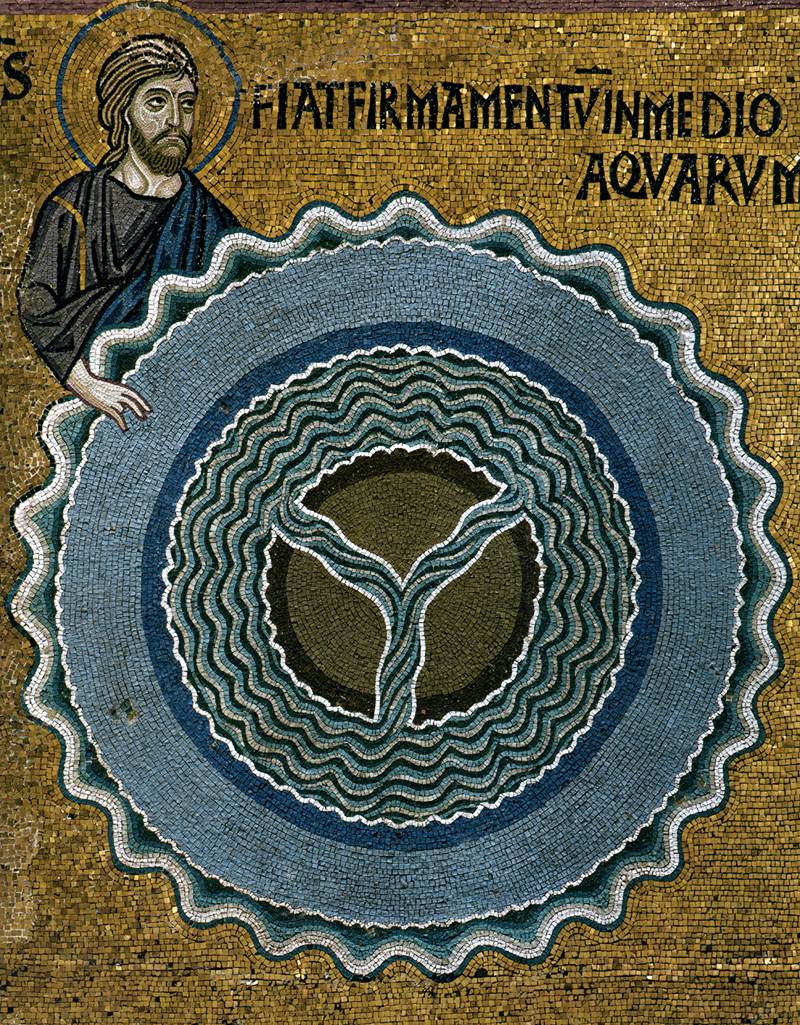
Capella Palatina Palermo 12th Century Mosaics God is shown creating the firmament. ‘And God said, Let there be a firmament in the midst of the waters, and let it divide the waters from the waters’
We are coming up to the key days in the year. And so will be looking at calendars and counting days. But what about ages, epochs and aeons?
‘Practical Magic in the Northern Tradition’ reports that there are seven ages of the world:
This is how they calculate it: the life of a yew tree is 729 years, and there are seven ages from the creation of the world until its doom. So the world will last 5103 years.
‘Practical Magic’ divides ages up as follows:
A wattle has a life of 3 years (1*3) Three wattles are the life of a hound – 9 years (3*3) Three hounds are the life of a steed – 27 years (9*3) Three steeds are the life of a man – 81 years (27*3) Three men are the life of an eagle – 243 years (81*3) Three Eagles are the life of a yew. – 729 years (243*3)
How Old is a Yew Tree/Eagle
A comment by a reader has prompted me to write the following about the ages given above:
‘Practical magic’ says the poem is ‘Ancient’. So it’s folklore and not science, and the ages are opinion not scientific fact.
As I understand it Yew trees live a long time but not quite as long as many people think. I base this on the Yew Tree at Steventon, Hampshire where Jane Austen was born. The tree has/had a plague on it saying it was 1200 years old. I used to visit it regularly. On one visit, I was told that an expert opinion suggested it was more like 700 years old. (ifmy memory serves). I do not have the details, but my source would have been one of the people associated with the Church.
The Woodland Trust (says Yew Trees get old at 900 years. They cite a few which are ‘said to be’ over 2000 years old. But are they? The scientific sites I have looked at suggest that Yew Trees should be described as ‘ancient’ from 400 not 900 years. There are problems with dendrochronology dating of yew trees, and so most methods depend upon an estimation from the width of the tree trunk. But that, itself, depends upon how much you believe in the claims of the ancient trees. So, I think it’s best to take the extreme cases with a very large pitch of salt. So 729 years is probably not so far off the mark for a Yew tree.
As to Eagles, this website on eagles says they can live to 30ish in the wild and 68 years in captivity. So the claim for 243 years is way off the mark! Wattles what are they? I have searched, but not found any reference. My guess is a short-lived bird.
The End Was Nigh
Archbishop Usher of Armagh (1581 – 1656) calculated that the world was created in 4004 BC. He counted the begettings in the Bible. If we accept his date, and apply the seven yew tree ages rule (5,103), then the world should have ended in AD 1099 (give or take a year). But it didn’t end then, did it? We are in the 9th Age and counting.
It doesn’t make sense to me to have a factor of 3 for the smaller divisions, and then to switch to a factor of seven. Surely, far more logical is to have a factor of 3*3 years. So, if there were nine ages of the world, then it would survive for 6561 years, which will end in approx. 535 years time (cAD2557). This calculation has the massive advantage of not yet being proved wrong! (Please note, cult owners, I have copyright on this date).
It’s notable that when a Cult declares the imminent end of the world, and they trudge up to the top of a high eminence to observe it (normally by Hampstead Pond in London). They seem quite happy to trudge back down again. Soon they are up and running again with the same enthusiasm for the next ‘end of the world’ date.
Of course, the world was created around 4.54 ± 0.05 billion years ago according to Wikipedia. According to the Doomsday Clock the world will end at 12 O’clock and we are 89 seconds away from it. This is based on a catastrophic end for our civilisation. If we avoid this then other scientists have suggested mammals will be wiped out in approximately 250 million years.
Abrahamic Ages
The Jewish tradition was for six or seven ages of 1000 years. The seventh didn’t really count because it was the age of the messiah when there was a 1000-year sort of super sabbath. Or another idea is that it was an age that ran parallel with the other six. So the world was to be 6000 years long.
With the coming of Christianity, dating the Creation, and (therefore the Day of Judgement) became more important. The Romans dated from the foundation of Rome, and the Greeks from the First Olympiad. But beyond that they had a whole mythology and creation myths about an Age of Gold. Followed by a Bronze Age (Troy and all that) followed by their very own base Iron age. You can read about this in my post about Hesiod.
An early Christian attempt to tell the age of creation was the Anno Munda‘s arrangement of the Year. This is pretty complicated and is based on a Talmudic tradition. A late Roman version uses ‘the Diocletian Years’, which is when the persecution of Christians began. It held that the world was created 5500 years before the Birth of Christ. So we are 5500BC plus 2025 years since the date of the creation. And it was supposed to have ended in 500AD. 6000 years after the Creation. so we have outlived Creation by 1525 years.
St Augustine of Hippo took the tradition of six ages and brought it into the Christian canon. These are the six ages:
The First Age “is from the beginning of the human race. That is, from Adam, who was the first man that was made. Down to Noah, who constructed the ark at the time of the flood“, i.e. the Antediluvian period.
The Second Age “extends from that period on to Abraham, who was called the father indeed of all nations”.
The Third Age “extends from Abraham on to David the king”.
The Fourth Age is “from David on to that captivity whereby the people of God passed over into Babylonia”.
The Fifth Age is “from that transmigration down to the advent of our Lord Jesus Christ“
The Sixth Age: “With His [Jesus Christ’s] coming, the sixth age has entered on its process.”
As each age is 1000 years, then you can see why so many people were worried as 1000 AD approached.
The Seven Ages of Man
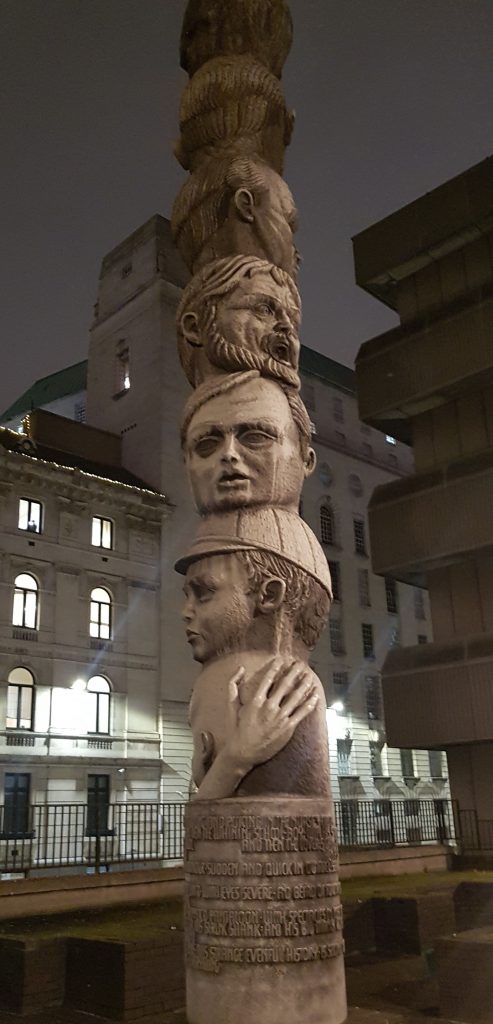
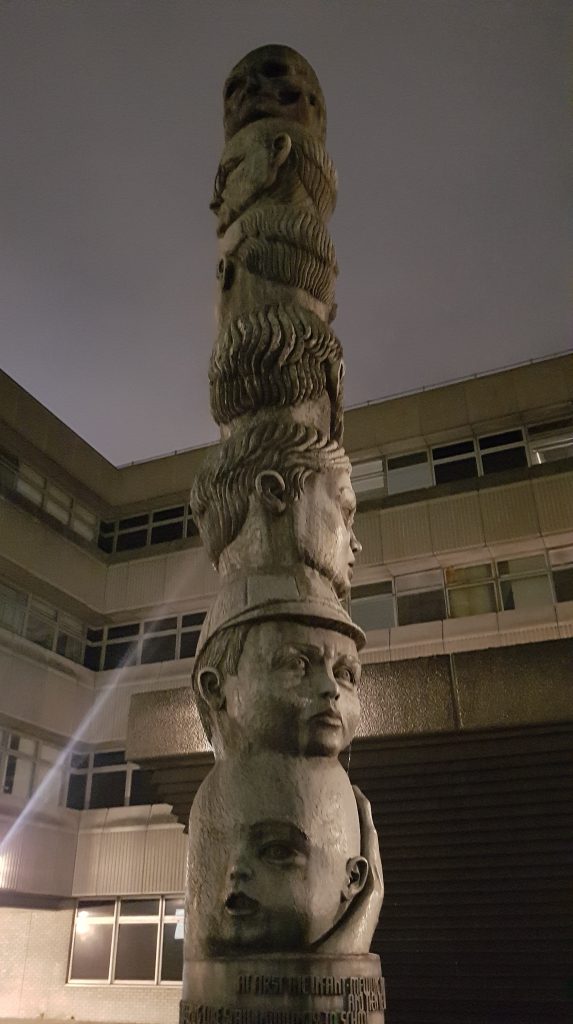
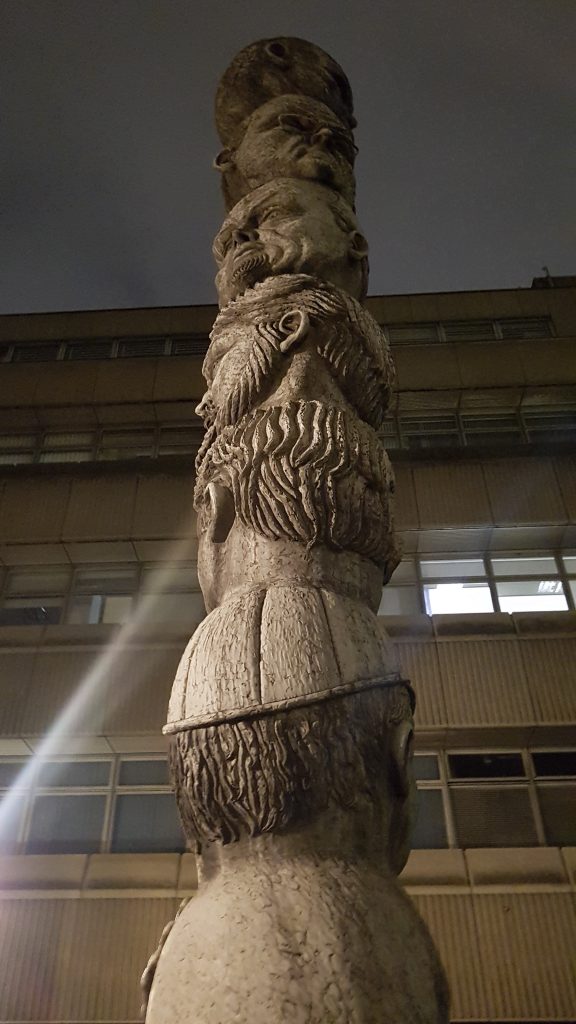
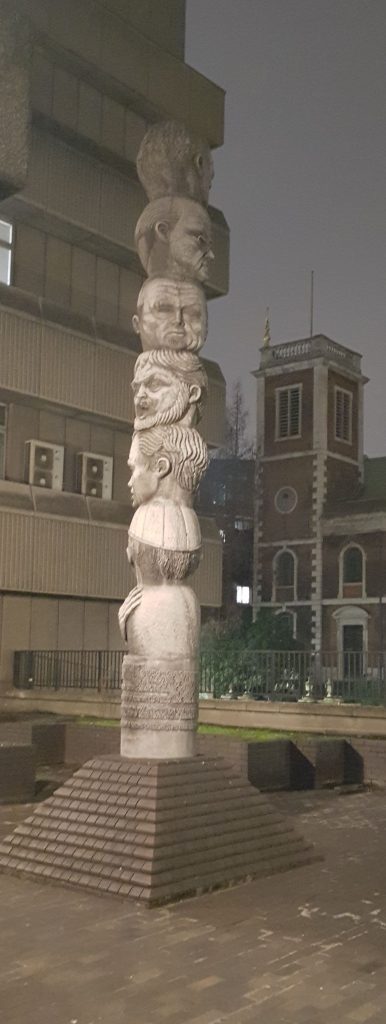
The Age of Man can also relate to the average age of a human lifespan. Of course, six is not such a magical number as seven, and so Shakespeare ran with the idea in the Seven Ages of Man spoken by Jacques in ‘As you like it’. If there are seven ages of human life, and we have a span of six score and ten, then each age is ten years.
All the world’s a stage, And all the men and women merely players; They have their exits and their entrances, And one man in his time plays many parts, His acts being seven ages. At first, the infant, Mewling and puking in the nurse’s arms. Then, the whining school-boy with his satchel And shining morning face, creeping like snail Unwillingly to school. And then the lover, Sighing like furnace, with a woeful ballad Made to his mistress’ eyebrow. Then, a soldier, Full of strange oaths, and bearded like the pard, Jealous in honour, sudden, and quick in quarrel, Seeking the bubble reputation Even in the cannon’s mouth.
And then, the justice, In fair round belly, with a good capon lined, With eyes severe, and beard of formal cut, Full of wise saws, and modern instances, And so he plays his part. The sixth age shifts Into the lean and slippered pantaloon, With spectacles on nose and pouch on side, His youthful hose, well saved, a world too wide For his shrunk shank, and his big manly voice, Turning again toward childish treble, pipes And whistles in his sound. Last scene of all, That ends this strange eventful history, Is second childishness and mere oblivion, Sans teeth, sans eyes, sans taste, sans everything.
(Jacques, Act 2, Scene 7)
Seven Ages of Man Statue 22-foot high cast aluminium Sculpture by Richard Kindersley, located on Queen Victoria Street, Blackfriars, near the Blackfriars. St Andrew’s by the Wardrobe in the background. Photos k. Flude
The Kalendar of Shepherds
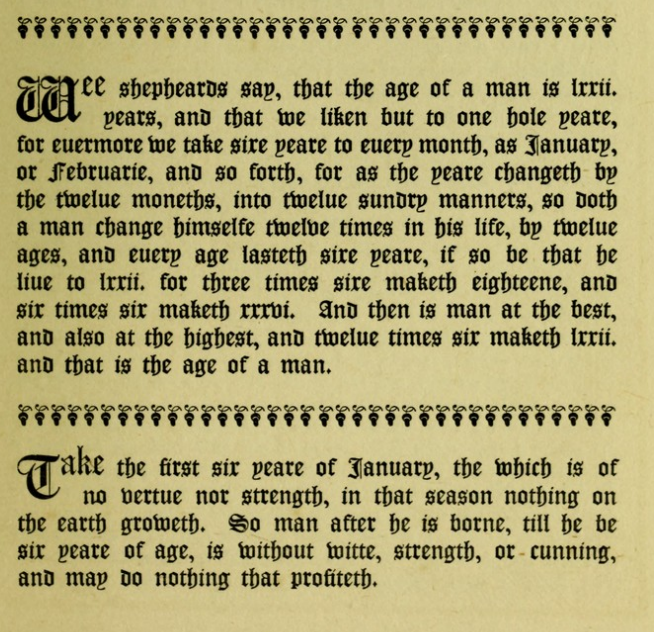
Now, the Kalendar of Shepherds has a similar idea, but it calculates it differently. The Kalendar, based on a 15th Century French original, says there are 12 ages of man, corresponding with the 12 months of the year. Each age is 6 years long, and so our likely lifespan is 72.
Kalendar of Shepherds
Each month is allocated to one of the ages, and has an insight into human life for that span. In January, the first 6 years of a human life are mapped out. If you read above you will see we have no ‘wit, strength or cunning. Nor ‘may do nothing that profiteth’ in those first years. A little harsh, and as a fond grandfather, it, I refute it. In December, the last 6 years are prefigured.
Our alloted span, says Practical Magic is 81 years, Kalendar of Shepherds say 72, and Shakespeare offers us 70.
Life expectancy at birth in the UK was 83.0 years for females and 79.1 years for males. This is an increase of 18 weeks from 82.7 years for females and 21 weeks from 78.7 years for males since 2019 to 2021.‘
Capella Palatina, Sicily
By the way, the Capella Palatina, illustrated at the top of this post, is a marvel of gold mosaics. It is absolutely stunning. It makes a trip to Palermo a must.
On This Day
1843 – Charles Dickens published ‘A Christmas Carol’
First Published on December 18th 2022, revised and republished in December 2023, 2024,2025
According to the Perpetual Almanac by Charles Kightly, this is the time when Robins are much to be seen singing their winter song, and when it is time to protect plants, particularly Rosemary, against winter frosts.
In December, rosemary flowers with a delicate blue flower. Rosemary was one of the most important plants, metaphorically and medically. Mrs Grieve, in her ‘Modern Herbal’ says it is used in medicine for illnesses of the brain and was thought to strengthen the memory. And as rosemary helps the memory, they are symbolically/metaphorically associated with friendship, love, worship and mourning. A branch of Rosemary was given as a gift to wedding guests, so they would remember the love shown at the ceremony. It was also entwined in the Bride’s wreath.
Shakespeare uses Rosemary in his plant lore in Hamlet.
OPHELIA: There’s rosemary, that’s for remembrance. Pray you, love, remember. And there is pansies, that’s for thoughts.
LAERTES: A document in madness: thoughts and remembrance fitted.
OPHELIA: There’s fennel for you, and columbines. There’s rue for you, and here’s some for me. We may call it herb of grace o’ Sundays. O, you must wear your rue with a difference.
There’s a daisy. I would give you some violets, but they withered all when my father died. They say ‘a made a good end.
(sings) For bonny sweet Robin is all my joy.
Ham IV.v.176
Rue is the herb of grace and has the sense of ‘regret’. Pansies are also for remembrance, and their heart shaped flowers are for love and affection. Fennel represents infidelity and Columbines insincerity or flattery. Daisies are for innocence. Violets are associated with death, particularly of the young. As to how Orphelia means them all to be understood is not entirely clear, particularly Fennel and Columbine. Some think they are directed towards Claudius and/or Gertrude.
Being evergreen, Rosemary was associated with religion and everlasting life. It was called the rose of the Virgin Mary. Lying on a bed of rosemary, the Virgin’s cloak was said to have been dyed blue. Indeed, Mary is mostly depicted in a blue cloak in Renaissance paintings.
And so Rosemary is especially important for Christmas. At Christmas, it was used to bedeck the house and used at funerals to remember the dead.
The Virgin Mary Googled.
Its strong aroma means it was used as an incense and also used in magic spells
Thomas More let rosemary ‘runne all over my garden walls’ because bees love it and as sacred to remembrance, therefore to friendship.
Rosemary flowering in December
I mostly use Rosemary for the very rare occasions when I cook lamb, but it is much more versatile than that, or so the SpruceEats website tells me:
‘Rosemary is used as a seasoning in various dishes, such as soups, casseroles, salads, and stews. Use rosemary with chicken and other poultry, game, lamb, pork, steaks, and fish, especially oily fish. It also goes well with grains, mushrooms, onions, peas, potatoes, and spinach. ‘
1917- End of the Battle of Cambrai in which Tanks were first used. The tanks had initial success when over 400 hundred of them were used by the British on the first day of the battle. Because the British Army did not precede the attack with the usual artillery barrage, the attack was a complete surprise and the British penetrated deep into the German Lines. But the army had too few troops to exploit the breakthrough and by early December the Germans had mostly recaptured the territory the tanks had won. So the battle was indecisive, but successfully showed the role of the tank in future battles. Casualties amounted to about 45,000 on each side.
1941 – Pearl Harbour bombed. The Japanese attack killed more than 2,300 U.S. military personnel were killed. Another 1,100 at least were wounded, and eight battleships were damaged or destroyed.
On December 8th,Congress approved Roosevelt’s request for a declaration of war on Japan. In the Senate, the vote was 82 – 0 and 388–1 in the House.
On 11 December 1941. Germany declared war on the US, in line with the Tripartite Pact between the two countries and Italy. Later that same day, the US declared war on Germany, with no dissenters from the vote.
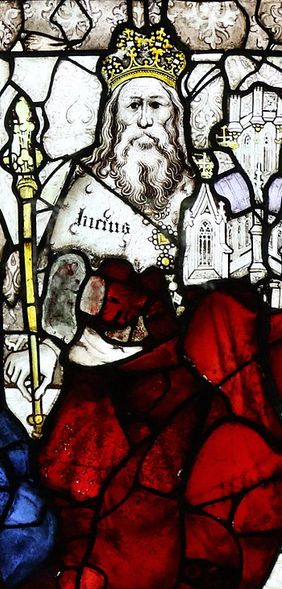
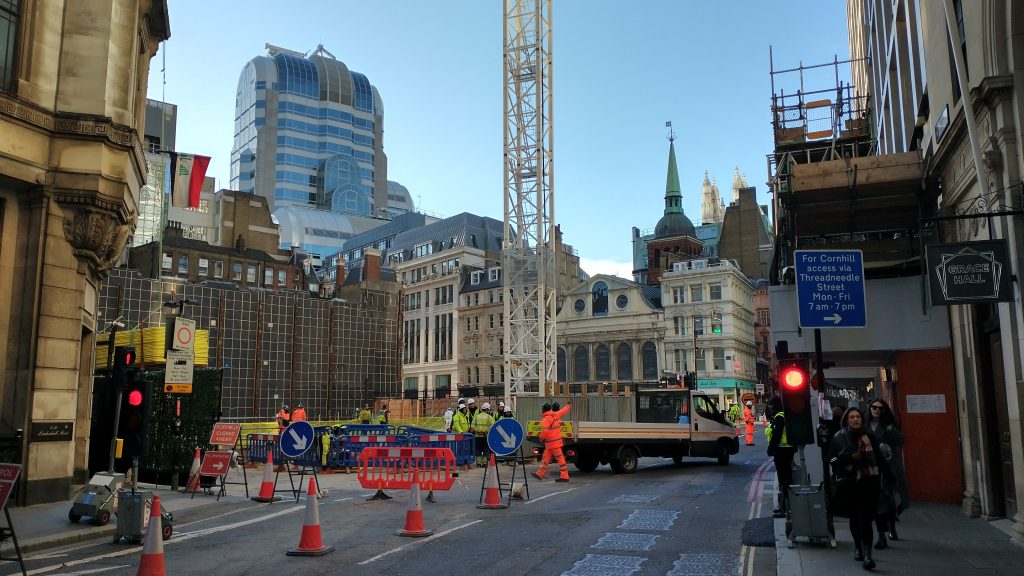
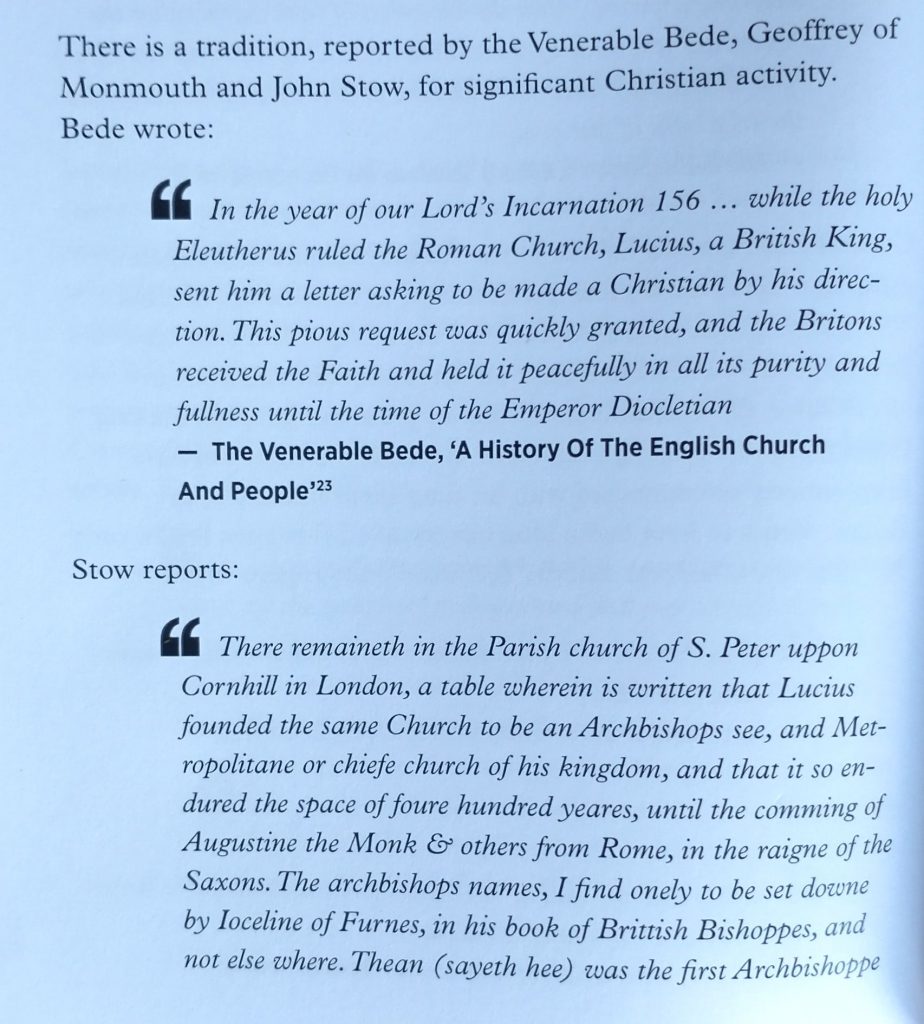
The Venerable Bede tells us that King Lucius converted to Christianity in around 180AD. He says that the King asked Pope Eleutherius to send teachers to instruct him. The Venerable Bede (died 735 AD) got this from the Liber Pontificalis of c 590. There is also a tradition that St Peter’s Cornhill in London was set up by King Lucius, and that St Peter’s is the oldest Church in London.
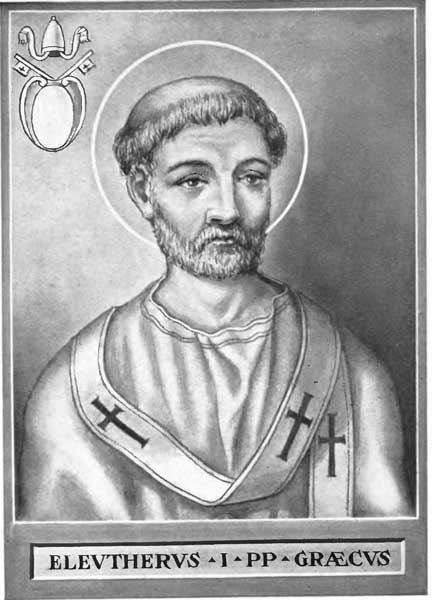
13th Pope Eleutherius
What to make of this? Bede is considered to be a reliable historian and got his information, in this case, from the Vatican. Pope Eleutherius is held to be a real Pope. He reigned at the right time, from perhaps as early as c. 171, and to his death which may be as late as AD 193. (Wikipedia). But the tradition of Lucius has been written off as a legend.
But to my mind there are questions that need asking. Not the least of the questions to ask about the veracity of this legend is: ‘What does it mean to be called the King of Britain in the middle of the Roman occupation?’
St Peters Church First Cathedral in Britain?
As to the early origin of St Peters Church, archaeologists dismissed the tradition of a Roman St Peters Church because it is built over the Roman Forum. So how can it have been the site of a Christian Church?
St. Peter’s seen from Cornhill in a rarely seen view as there is normally a building in the way. (Photo K Flude)
But the balance of possibilities, arguably, changed in the 1980s, when archaeologists led by Gustav Milne showed that the Basilica of the Forum was pulled down in about 300AD. So from being practically an impossibility, there is now a possibility that this subsequently became the site of a Roman Church. It doesn’t make it true but it makes it more of a possibility.
We know London sent at least one Bishop to Constantine the Great’s Council of Arles in AD 314. So a Christian community in London must have predated this time. There must have been Churches, here. And a site at the prestigious centre of the Capital of Londinium, makes a lot of sense. There are, in fact, three Churches on the site of the Roman Forum: St Peters, St Michael and St Edmund the Martyr.
Constantine the Great
In AD 306, Constantine was acclaimed Emperor on the death of his Father, Constantius Chlorus. Constantius’s wife was Helena, a Christian. He and his mother were in York when his father died. He was recognised as Caesar, (but not Augustus) by Emperor Galerius and ruled the province for a while. Then he moved to Trier, then moved on Rome, where he accepted the Christian God’s help to win the Battle of Milvian Bridge. This led him to supreme power in the Roman Empire. And might give a context for the demolished Basilica to be replaced by a Church.
There is, however, no archaeological evidence for St Peters being Roman in origin apart from the demolition of the Basilica and the legends. And there is certainly no evidence of the Basilica being turned into a Church as early as the 2nd Century.
Early Christianity in Britain
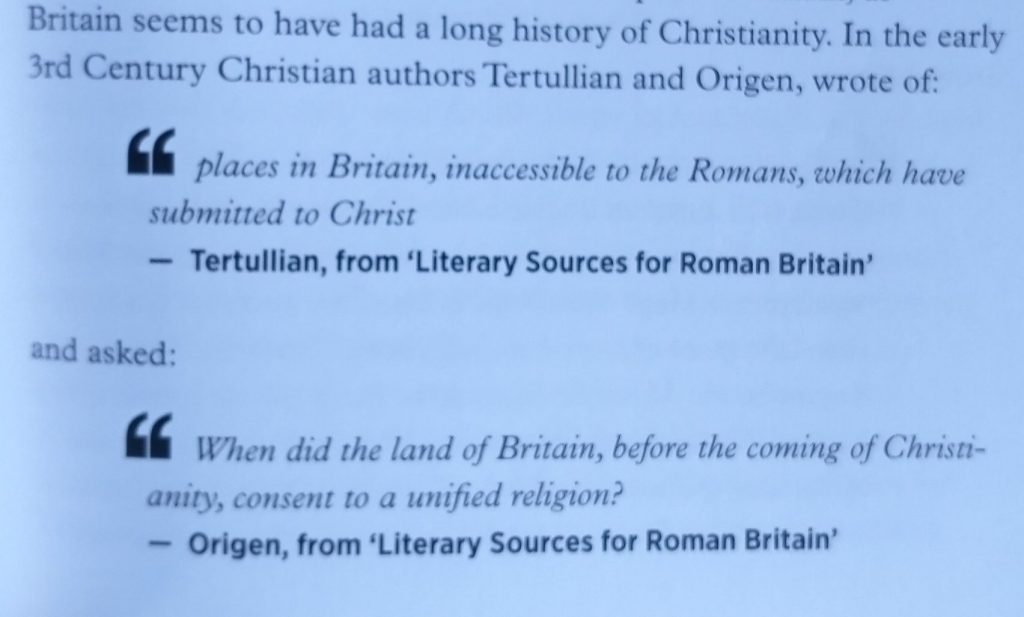
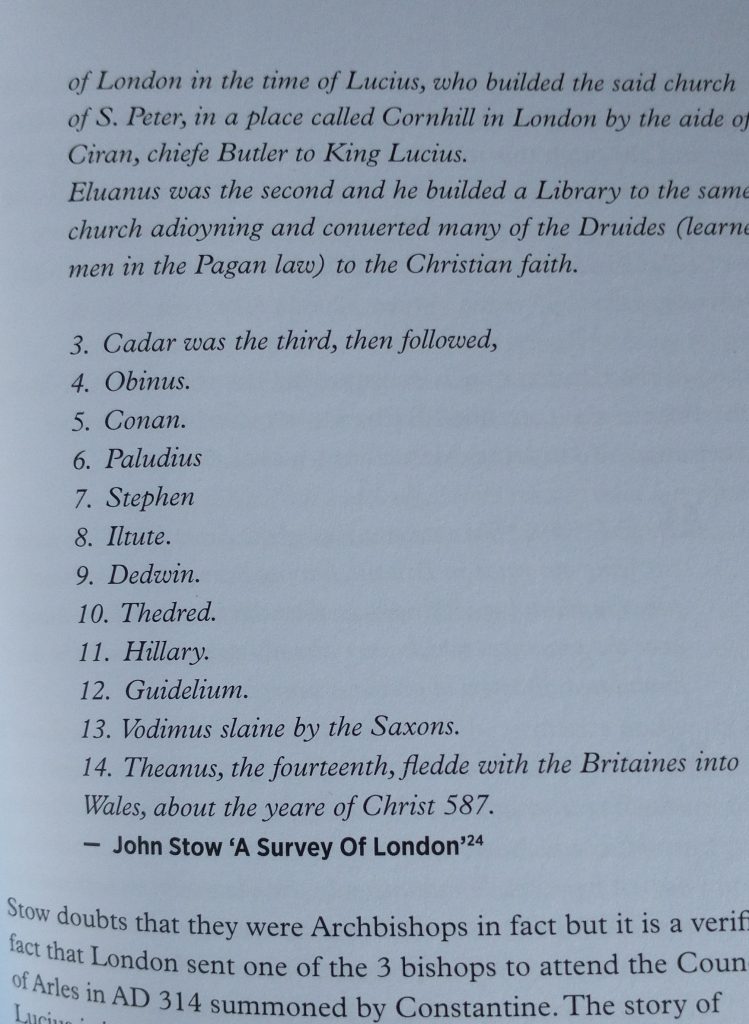
Where does that leave King Lucius? There are well attested Christian traditions that Britain was an early convert to Christianity. (The following quotes are from my book ‘In Their Own Words – A Literary Companion To The Origins Of London‘ D A Horizons, 2009 by Kevin Flude and available here.)
‘In Their Own Words – A Literary Companion To The Origins Of London‘ D A Horizons, 2009
So, an early date for an active Christian community is likely. A Church, replacing the Basilica, is plausible, particularly, after Constantine the Great probably passed through London on his way to seize the Roman Empire. So an early date for St Peters in possible. But there is no evidence for its origin as early as the late 2nd Century, the time of King Lucius.
A King of Britain in the Roman Era?
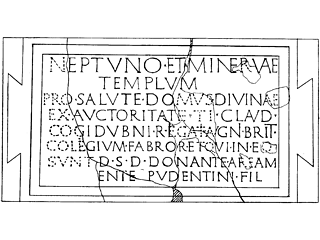
And could anyone, claim to be the ‘King of Britain’ at this date? We do know that King Togidubnus was called Great King of Britain in a Roman Temple inscription in Chichester in the First Century.
Altar Dedication, Chichester
To Neptune and Minerva, for the welfare of the Divine House by the authority of Tiberius Claudius Togidubnus, Great King of Britain, the Guild of Smiths and those therein gave this Temple from their resources, Pudens, son of Pudentinus, presenting the site.
Togidubnos seems to have been placed in control of a large part of Southern England, centred around Chichester, after the invasion of 43AD. He is thought to have been the successor to Verica, who was exiled and called on the Romans to restore his throne. Tactitus says that Togidubnos remained loyal down ‘to our own times’ that is to the 70s AD. So he presumably held the line for the Romans against the Boudiccan revolt in 60AD.
The Romans had used Verica’s fall as their excuse for invasion, and so an honorific of Great King to him and his successors makes sense. It is assumed that after Togidubnos’s death after 80AD, the title lapsed. But it might have stayed with the family as an empty honour? Furthermore, we know that Britain had a plethora of Kings and Queens before the Roman period. Also, the Romans never conquered the whole of Britain. There were, therefore, many British Kings all the way through the period of Roman control, not least beyond Hadrian’s Wall.
So, it is possible there was someone in Britain who had, or made, a claim to be ‘King’. Whether he was ‘a’ or ‘the’ or merely descended from a King of Britain, we don’t know. And that that someone, perhaps converted to Christianity, possibly in the time of Pope Eleutherius. He may have taken the Roman name Lucius. Who knows? Its possible.
Confusing Luci?
It has been suggested that King Lucius of Britain was confused with King Lucius of Edessa, but this is considered unsatisfactory. Also, the link to London and St Peters, need not be a contemporary one. It might be two traditions that are linked together at a later period. But, of course, there is a faint possibility that the Basilica shrine room, above which St Peter’s is built, was converted for Christian use at the earlier time necessary to make sense of the King Lucius story.
King Lucius may not be a proper saint, but he has a feast day. This is because of his connections to Chur in Switzerland. There is a tradition that Lucius was martyred here. This got him an entry in the Roman Martyrology. David Knight proposes that the Chur connection comes from the transplanting of rebellious Brigantes to the Raetia frontier in the 2nd Century AD. He suggests that the Brigantes brought the story of Lucius to Chur. At the end of the King’s life, is it possible he travelled to join his people in exile in Switzerland. Here he met his unknown end. If true, this would base the story of Lucius in the North rather than London. For further reading, see ‘King Lucius of Britain’ by David J Knight.
Early Bishops of London
John Stow in the 16th Century records the tradition of King Lucius, which comes with a list of early British Bishops of London. These he finds are recorded in Jocelin of Furness’s ‘Book of British Bishops’. This book is discussed by Helen Birkett ‘Plausible Fictions: John Stow, Jocelin of Furness and the Book of British Bishops’. In Downham C (ed) /Medieval Furness: Texts and Contexts/, Stamford: Paul Watkins, 2013.
Her analysis concludes that the book is a ’12th-century confection in support of moving the archbishopric from Canterbury ‘back’ to its proper place in London. (This information was included in a comment to the original post by John Clark, Emeritus Curator of the Museum of London.)
To sum up. We can’t bring King Lucius out of legend, nor find any credible source linking him him with St Peters Cornhill. But the site of St Peters is a plausible, though unproven, location for a Roman Church from the 4th Century onwards. It also makes sense of the choice of the Saxons, to name their Church St Pauls. St Peter is more common as a dedication for important Churches and perhaps they chose St Paul as they knew of the ruins of St Peters the old Cathedral.
Any other early Cathedrals?
Archaeologists have also tentatively identified a masonry building in Pepys Street on Tower Hill as the Episcopal Church of late Roman London. The foundations suggest a large aisled building. Its identification as a Cathedral springs from multiplying the found foundations symmetrically by a factor of four and comparing the result to Santa Tecla in Milan. The discovery of Marble and window glass doesn’t sit so well with the alternative suggestion that it is a granary. But, to my mind, it’s not very convincing, although Dominic Perring in his recent book ”London in the Roman World’ makes the most of the case for it being a Cathedral.
And Finally?
Roman ForumSite of Roman Forum Google Maps
If you look at the two maps above. The one on the left shows the Forum, the white lines are the Roman Road system. You might just be able to see the modern road system super-imposed. What this shows is that the Forum is on a different axis than the modern day road system. Cornhill cuts right across the North Western corner of the Forum. Where the letter L is, and to the left is under the modern road. So, that shows that this part of the Forum must have been knocked down before Cornhill was built. On the right hand side you can see the dark grey east-west road which is Cornhill. To the South of it you can see a dark area (above the green of St Peter’s Churchyard). This grey area is St Peters. What the Google map shows clearly, is that the orientation of St Peters, is clearly on a different orientation to that of the modern road of Cornhill. And that orientation is closer to the orientation of the Roman Forum. This makes it more likely that the axis upon which St Peters was originally built (assuming Wren followed the original axis when he rebuilt it after the Great Fire) conformed to the Roman grid pattern. This is by no means proof, and can only be proved by excavation. But, its interesting.
On This Day
1660 – Margaret Hughes became the first woman (we know about) to act on the English Stage. She played Desdemona in Shakespeare’s Othello. It was staged in a converted tennis court called the Vere Street Theatre, which was in Lincoln’s Inn Fields. In 1660 Charles II was restored to the throne, and had got used to watching female actors perform while he was in exile in France. So when he returned, he licensed two theatre managers, Thomas Killigrew and Sir William Davenant to run theatre. Davenant claimed to be the natural son of William Shakespeare, suggesting that Shakespeare stayed in his parents’ Inn, the Crown, in Cornmarket, Oxford on his way home to Stratford-upon-Avon.
First Published on December 3rd, 2022. Revised in December, 2023, 2024 and 2025
Droeshout Portrait of Shakespeare from the First Folio
Shakespeare was married at 18 years old. This was unusually young for the age. Young men generally entered into a 7-year apprenticeship followed by several years of wage labour as a journey man (from the french, jour, to denote being paid by the day.) At 18, he would have been unusual if he could afford a wife and household at this tender age. His wife was 26-year-old Anne Hathaway. This is slightly late for a woman to be married in the 16th Century, 22-23 would be more usual. Susanna, their daughter was baptised 26 May 1583, 6 months later. Twins, Hamnet and Judith, were baptised 2 February 1585.
The fact that Shakespeare was younger than Anne Hathaway, and that the baby was premature, has led many Shakespeare scholars to believe Shakespeare may have left Stratford to escape an unhappy marriage. This is often expressed in misogynist terms. But, there is an unstated assumption that Mrs Shakespeare stayed in Stratford while Shakespeare spent most of his life in London.
However, a new interpretation of a 1978 fragment has, for the first time, revealed evidence that, Mrs Shakespeare stayed with her husband in London. The piece is a request to Mrs Shakespeare in Trinity Lane (Little Trinity Lane today see map below) to pay the money her husband was holding on behalf of a young apprentice. Why Shakespeare was unable or unwilling to pay we have no idea. But perhaps the fact that it reveals that his wife was in London and seems to have independent means is more important.
How do we know this anything to do with our William Shakespeare? The answer is that the fragment was found in Hereford Cathedral’s Library as part of a binding of a book published by Richard Field. Field was from Stratford on Avon, and it was he who published Shakespeare’s ‘Venus and Adonis’ and ‘the Rape of Lucrece’. It seems unlikely it is about another couple of Shakespeares.
So, it really does change the view of the relationship. Little Trinity Lane is shown on the map below. It is near Southwark Bridge, and Mansion House Underground Station.
Map of the part of the City of London, Little Trinity Lane is in the ventre with an orange boomerang shape below it. Southwark and the Millenium Bridges can be seen at the bottom, and St Pauls top left corner.
I would recommend you read the original article, which discusses in detail all the evidence pertaining to these fragments. Here it is online for you to peruse.
On This Day
2003 My first edit on Wikipedia. As Director of the Old Operating Theatre Museum, I set about making sure the pages associated with the Museum, St Thomas Hospital and Guy’s Hospital were up to date. This is the latest version of the page I first updated. I updated the history of the Hospital. The earliest recovered wikipedia page was on January 15th 2001.
Droeshout Portrait of Shakespeare from the First Folio
On November 8th in 1623, the First Folio was registered at Stationer’s Hall near the publishing district around St Pauls Cathedral in London. It was actually called:
Mr. William Shakespeare’s Comedies, Histories, & Tragedies
Sketch of the First Folio
It was put together by his actor friends, John Heminge and Henry Condell seven years after his death. They wanted to replace all the corrupt editions of his plays and poems that had been:
“stol’n and surreptitious copies, maimed and deformed by frauds and stealths of injurious impostors”
The true texts of his plays and poems “are now offer’d to your view cured, and perfect of their limbes; and all the rest, absolute in their numbers as he conceived them.” Wikipedia
Shakespeare at the Frankfurt Book Fair
In fact, the plays were ready earlier than 1623, as they entered into the catalogues for the Frankfurt Book festival to appear between April and October 1622. How amazing is it that the Frankfurt Book festival is still the dream of any aspirant writer? Wikipedia tells me that hand-written books were traded at the general trade fair in Frankfurt from the 12th Century. But 1462 is the date that appointed as being when the Book Fair was certainly established.
The First Folio offers plenty of proof that Shakespeare was the author of the plays. He left gold rings of remembrance to Heminge and Condell in his Will. They were part of his Players Company, and had worked together on many of the plays. The Folio has forewords by people extolling the virtues of the writer. Enough proof for any reasonable person.
Heminge and Condell
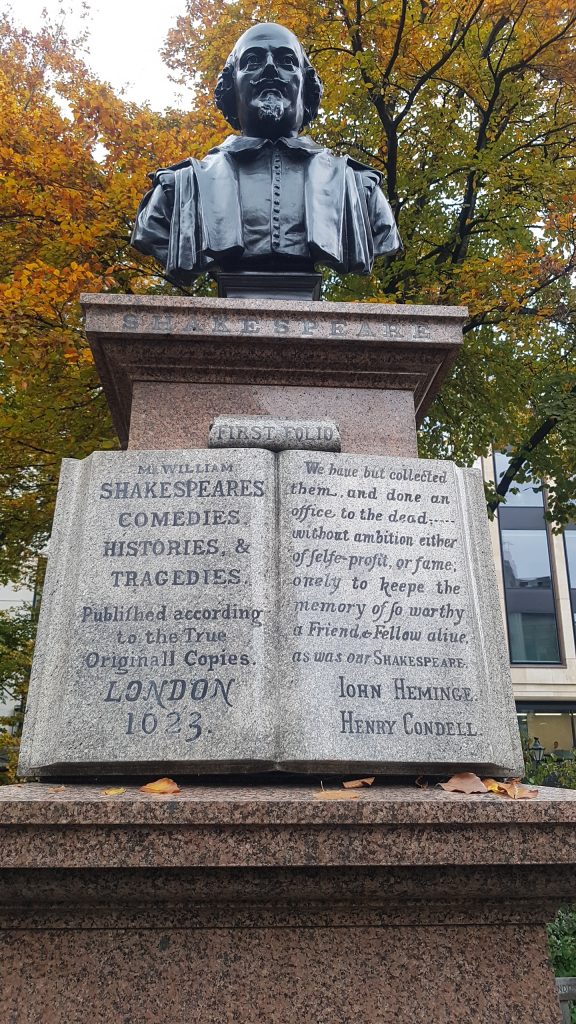
Heminge and Condell are commemorated in the Garden of St Mary Aldermary behind the Guildhall. They were Churchwardens of St Mary. A few streets away lived William Shakespeare in 1611. True friends, so don’t go telling me he didn’t write the plays!
St Mary Aldermany monument to Shakespeare, Heminge and Condell and the First Folio.
There was a wonderful BBC festival of Shakespeare on in 2023/24 to celebrate. If you look at this link, here. You will find great content. Much of it is available if you search BBC Sounds, or BBC iPlayer.