

On the seventh day of Christmas
My true love sent to me:
7 Swans a Swimming; 6 Geese a Laying;
5 Golden Rings;
4 Calling Birds; 3 French Hens; 2 Turtle Doves
and a Partridge in a Pear Tree
First Footing on New Year’s Eve
The first person to set foot into your house needs to be a ‘Tall, well-made man’. Dark-haired men are preferred to fair-haired, but he must not be dressed in black, nor be from the ‘professions’ (those people who can counter-sign your passport). He must not carry a knife, but he must bring gifts, particularly a loaf of bread, a bottle of whisky, a piece of coal or wood, and a silver coin. Silence is to welcome him to the house until he puts the coal on the fire, pours a glass of the whisky and greets the family.
He will bring in the luck through the front door on the stroke of midnight; the bread symbolising that you will be well-fed, the fuel that you will be warm and safe, the whisky that you will have fun and the coin will bring prosperity. Your first-footer will take the old year and its bad-luck out of the back door when he leaves.
An Irish tradition is that you should open your front door at Midnight to let the old year out and the New Year in. Perhaps, open the back door to let the old year out and the front door to let the New Year in.
Burn the Calendar
First wind in nine
Times round with red
Wool and thread
Cast into the flames
And say:
Burn, burn, burn
Old Day Book, Burn!
Old year’s troubles
Never Return
Ka!
Clean the house
And do the first
footing
With silver, bread
and a piece of coal
or charchoal
Old Rhyme
Hogmanay – Holy Month or New Morning
Is the Scottish name for New Year’s Eve. There is no certain explanation of the word. But it has been suggested it comes from the Ancient Greek for Holy Month (or from the Anglo-Saxon for Holy Month). Or the Gaelic word for Oat Cakes or from the Middle French word for mistletoe (aguillanneuf = meaning “to the mistletoe be the new year”). Perhaps, it is named from the great giant Gogmagog. Or from Norse, or Scots. or any number of other possibilities. See Wikipedia for more guesses.
Hogmanay was celebrated all the way down to Richmond in North Yorkshire. (Remember that Northumbria used to control North Britain up to and including Edinburgh, and sometimes into Fife. ) The vividness of the Scottish Celebration, may simply stem from the Scottish temperament. But it is often proposed that it stems from a Presbyterian tradition in Lowland Scotland, which disapproved of the superstition that was Christmas. So all that Christmas Joy was transferred to the New Year Celebrations.
Wassail in the Orchard
On New Year’s Eve, wassailers went to the oldest tree in the apple orchard. There they poured a liberal dose of wassail over the roots of the tree. Then they pulled down the branches to dip the end of the branches in the punch. They decorated the tree, and then drank the cider based wassail themselves.
We wish you a merry Christmas, a Happy New Year
A pocket full of money, and a cellar full of beer
A good fat pig to last you all the year
Please to give us a New Year’s Gift. (Radnorshire song)
For more on Wassail, see the bottom half of my post here.
New Year Weather Prophecy
The weather today will be reflected on the 7th month, according to Gervase Markham. First Day of the 12 Days of Christmas prefigures the weather in January and the 12th Day that in the following December. So we are going to have a cool, sunny winter, and a sunny June, July, August, by the looks of the weather forecast.
Or as a Scottish Rhyme has it (quoted in the Perpetual Almanac)
If New Year’s Eve night-wind blow south
That betokens warmth and growth
If west, much milk, and fish in the sea
If North, much cold and storms will be
If east, the tress will bear much fruit.
If north-east, flee it, man and brute,
The wind is currently varying between West and West North West. So it would seem we are in for a year of much milk and fish in the sea, with the occasional cold storm? .
New Year Reflections
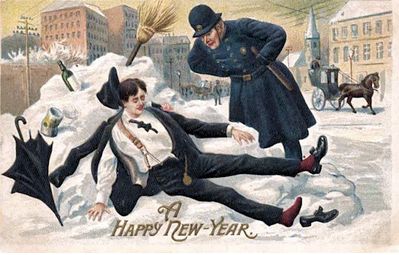
This is a day of preparation, and perhaps of anxiety. Have we got an invitation from anyone tonight? Is anyone going to come to our party? Can I take another blow-out feast, a belly full of alcohol and a very late night? I’ve just lost my Christmas weight, and you want me to come for a big feast?
My first memories of New Year’s Eve were spent with the parents watching some inexplicable variety show hosted in Scotland. Google has helped me remember that it was the ‘White Heather Club’ hosted by Andy Stewart. Up to 10 million people watched this between 1960 and 1968. I never understood the pleasure of it. To my rebellious teenage soul, it seemed a symbol of an old-fashioned world that was passing and irrelevant.
More recently, if not spent at a party, New Year’s Eve is often spent with Jools’ Annual Hootenanny, which is a music show masquerading as a live New Year’s Eve party. It features really excellent bands and singers. It is, however, recorded earlier in December (15th, 20th are dates I have seen) and hence a New Year’s fake. Here is a 2007 excerpt staring Madness’s ‘House of Fun’. The fun of this is to spot the stars grooving along to the music.
New Year’s Preparation
New Year’s Day needs a lot of preparation. Folklore suggests that this should include finishing off any unfinished work or projects, as a task carried forward is ill-omened. Your accounts for the year should be reconciled. As Charles Dickens suggests in the Chimes, his second Christmas Book, your moral account should also be addressed. So you can come into the New Year with a clean slate, good conscience and plans for a better new year. And don’t we all require that for 2025!
First Published 2024, revised 2025