
Last chance to make the Twelfth Night Cake & the Night Skies, January 4th

Twelfth Night Cake at the Museum of the Home
Twelfth Night Cake at the Museum of the Home, photo Kevin Flude

Twelfth Night Cake

On the 11th day of Christmas
My true love sent to me
11 pipers piping; Ten lords a-leaping; Nine ladies dancing
Eight maids a-milking; Seven swans a-swimming
Six geese a-laying
Five golden rings (five golden rings)
Four calling birds; Three French hens; Two turtle-doves
And a partridge in a pear tree.

Now is your last chance to make your Twelfth Night cake, its the 11th hour after all! Of course, Stir Up Sunday would have been the best day. Here is a recipe from 1604 by Elinor Fettiplace:

Take a peck of flower, and fower pound of currance, one ounce of Cinamon, half an ounce of ginger, two nutmegs, of cloves and mace two peniworth, of butter one pound, mingle your spice and flower & fruit together, but as much barme [the yeasty froth from the top of fermenting beer barrels] as will make it light, then take good Ale, & put your butter in it, saving a little, which you must put in the milk, & let the milk boyle with the butter, then make a posset with it, & temper the Cakes with the posset drink, & curd & all together, & put some sugar in & so bake it.

I found this on the excellent www.britishfoodhistory.com, where you can find more cooking instructions for Twelfth Night Cake and much more. If you want a more modern recipe, here is one from the BBC.

Whichever you choose, you should add a pea, and a bean to the recipe. These will be useful once you have read my Twelfth Night post.

The Night Skies in January.

The Quadrantid meteor shower appears from the point of the Plough’s handle. It continues to January 12th but peakon  January 4th. At the peak there may be 100 meteors an hour. But, it will be low in the north-eastern sky and best seen from low light pollution areas. Twinkling above the Southern Horizon will be Sirius and this month’s brightest star. In the NE, the Plough can easily be seen. The Orion nebula south of Orion’s belt will be seen as a hazy patch with the naked eye. (from the Night Sky. Month by Month by Gater and Sparrow).

We are also seeing the Wolf Moon, as it moves closer than usual to the Earth and so feels bigger. It got its name as Wolves were said to Howl at the Moon more when the Moon came close.

On This Day

1642 Charles I marched on the House of Commons to arrest five Members of Parliament. It failed, the MPs fled to Guildhall in the City of London. Charles followed and was surrounded by citizens of the City of London shouting ‘Priviledge of Parliament. He fled London and the Civil began soon after. See my post charles-i-raises-the-standard-august-22nd-1642

1649: The Rump Parliament votes to put Charles I on trial.

Today: Sow alpine seeds. This give them the period of cold they get in the wild, which is essential for their germination in spring. Take root cuttings. Lift and divide overgrown clumps of herbaceous perennials. ‘Gardening through the Year’ by Ian Spence. RHS.

Revised January 4th 2025,2026
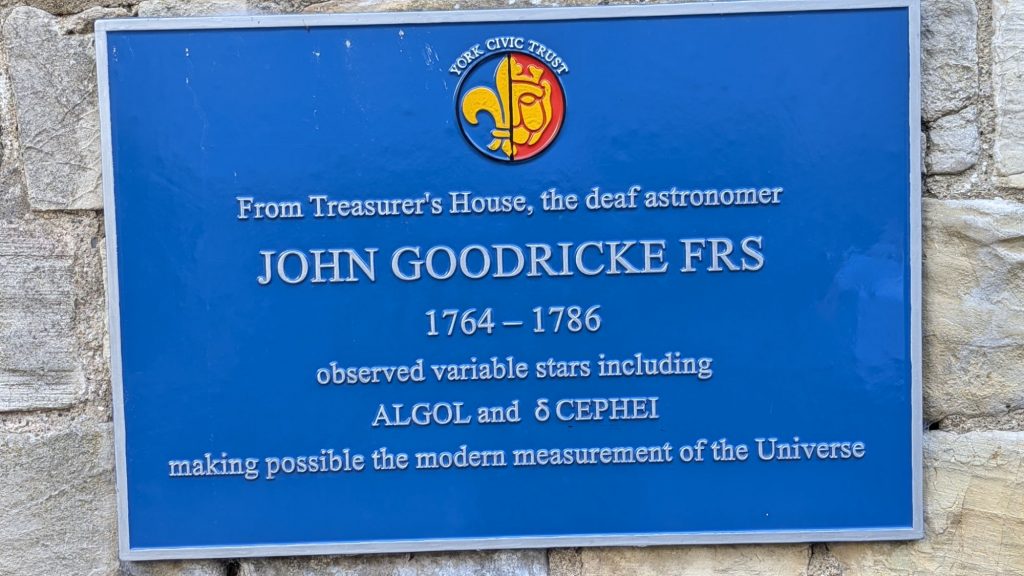
John Goodricke and the Variable Star. September 17th 1764

John Goodricke and the Variable Star

Newton

What I really admire are people who, through their sheer brain power, can change our views of the world.  The first example that comes to mind is Newton’s insight that if the universe were infinite, the night sky would not be dark as everywhere there would be tiny pinpricks of starlight.  So, we don’t live in a infinite universe. Another one is Einstein’s thought experiment that proves that time is relative. But see below for a description of that.  But, now to John Goodricke and the Variable Star. (for Newton and the Maypole see my post here).

Goodricke

Last year in York, near the Minster, I saw the blue sign above. I thought, what on earth are ‘variable stars’?  Behind me, I heard two women say something like. ‘Here it is,”variable stars”‘.  I turned around and asked them what was a variable star?

‘Donno’ they said, ‘we’ve ‘just doing this escape room walk around York.’  They showed me a booklet they had received on the internet,. This is what I would call a treasure trail. Sadly, they showed no interest in finding out what a variable star is!

Aristotle and ancient philosophers held that the universe was unchanging and eternal. The first breach in that theory was the identification in 1638 of star Omicron Ceti. Johannes Holwarda discovered that the star pulsed on an 11-month cycle.  This and the discovery, of supernovae (first observed in 1572), proved that the ‘The starry sky was not eternally invariable’. But there was, as yet, no explanation for the phenomena.

John Goodricke was educated at Thomas Braidwood‘s Academy, school for deaf pupils in Edinburgh, and Warrington Academy. He returned to live with his parents, who rented an apartment at the Treasurer’s Hall. This is near the Minister in York. He used a friend’s personal observatory to look for variable stars. He found two of the first 10, and was the first to propose a solution. This was that two stars orbited each other causing eclipses between them and the observer. Thus creating a variation in the light emitted. To be able to extrapolate from a simple observation, and provide an explanation which necessitates a complete rethink about the nature of the universe seems, to me, to be awesome.

Einstein’s Thought Experiment

Back to Einstein, his thought experiment was something like this:

A train is travelling through a station. There is an observer on the train towards the front, another on the platform as the train goes through. There are two simultaneous lighting strikes at either end of the train. The observer on the platform sees the strikes as simultaneous. Why? Because she is in the middle between the two lighting strikes and light travels at the same speed. The observer on the train who is near the front of the train will see the lighting strike at the front of the train before the light from the strike at the back of the train can reach him. It has further to go.

This means that time is not a constant, it is relative to the observer. And yet, we think of time as a constant, something that remorselessly ticks forward and which we cannot alter. But it isn’t.

For a better explanation, see https://en.m.wikipedia.org/wiki/Relativity_of_simultaneity

First written 2024, revised 2025