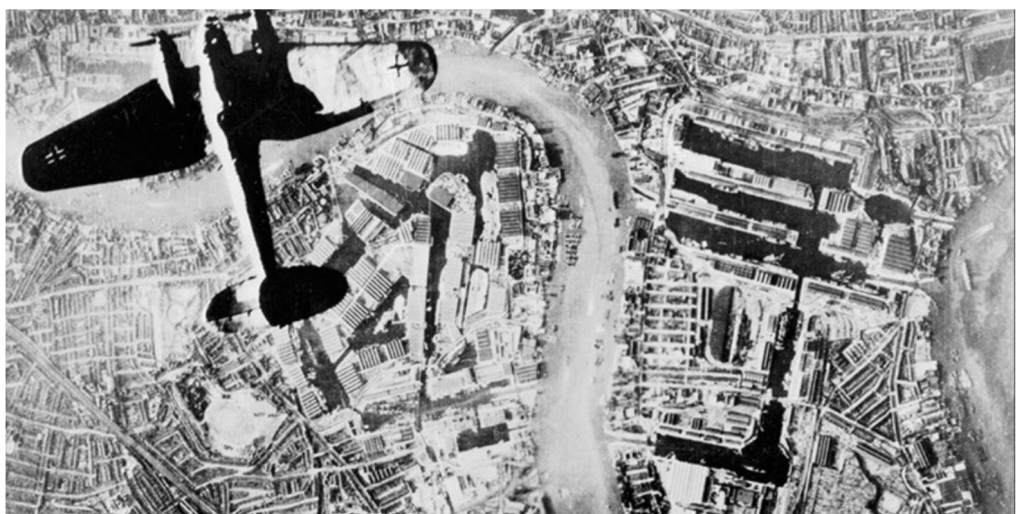
On September 15th 1940 Ray Holmes, World War 2 RAF Pilot, flying a Hurricane, took on three Luftwaffe Bombers over Central London. He shot one down, chased another off and engaged the third which seemed to be heading for Buckingham Palace.
Between the 8th and 13th of September 1940, the Palace had been hit 5 times. The London Blitz had only ‘begun’ on September 7th though the first raid on the City of London was on the 25th August on Fore Street.
Holmes, by now had ran out of bullets, but deliberately targeted the fin of the Dornier Bomber, and crashed into it causing the bomber to crash down into Victoria Station. Holmes’ Hurricane, spiralled down out of control, but he was able to bail out and landed in a dustbin, much to the bemusement of the locals. Holmes died aged 90 in 2005.
This post is heavily based on the story below, where it is told in full detail.
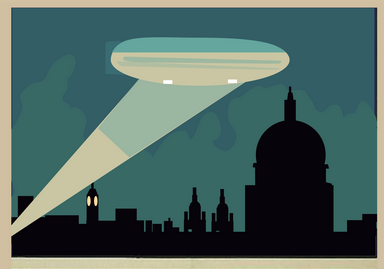
A silhouette of a Zeppelin caught in searchlights over the City of London
On the night of September 8th, 32 year old, Kapitanleutnant Heinrich Mathy piloted Zeppelin L 13 across Central London, dropping bombs as he went. This was the most damaging airship raid of the war.
Background to the War
Before World War One London was the centre of the largest Empire the world had ever known. It was the first great era of globalisation; international trade and finance was booming. London was full of the mega-rich, but poverty and substandard housing was extensive. Such extremes of rich and poor have only recently began to appear in our society.
Inner London was still the home of Industry, and home to large immigrant communities. Political dissent was widespread, with the Labour Party beginning to erode the Liberal Party’s power base. The issue of Female Suffrage was rocking society. Then, catastrophe struck as ‘the lights went out all over Europe’.
The Hague Convention in 1899 banned bombing from balloons or other aerial craft. But as the aircraft and air balloons developed, the threat moved from theoretical to actual. Zeppelins could undertake long flights at a speed of up to 47 mph. They could ascend and descend quicker than winged aircraft and achieve higher altitudes. The gas that held up the Zeppelins was held in over 200,000 bags of cattle intestines. The huge number needed in the war effort led to a shortage of sausages in Germany! But it also made them very difficult to be shot down with the technology available to Britain, France and Russia.
The Kaiser originally forbade bombing raids on London in deference to his relatives, the British Royal Family. But he progressively reduced restrictions until he allowed bombing of London itself. He first allowed bombing of the London docks on February 12th 1915, and on May 5th allowed London, East of the Tower of London to be bombed. The first Zeppelin raid on London took place on 31st May 1915. On July 20th, he allowed unrestricted bombing of London (albeit sparing historical and religious buildings).
On the 8th September, 1915 Mathy crossed the North Sea to the coast at King’s Lyne. He arrived at 8.45pm. The aircraft came South via Cambridge, Ware, circled to the North East of London and via Golders Green. Here he dropped 12 bombs at 10.40., and followed the Finchley Road to Primrose Hill, Regent’s Park. Over Euston he was at 8,500 ft, and slowed down to 37 mph.
The first incendiary bomb in Central London landed just north of Russell Square at Woburn Place. The next one landed in the garden in the middle of Russell Sq. He dropped his first Central London explosive bomb in the garden in the centre of Queen’s Square, near the Great Ormond St Hospital, where it is marked with a plaque. He was turning east along the Theobald’s Road where he dropped a number of bombs. One hitting the National Penny Bank killing a person standing outside. Another landed on the nearby Dolphin pub, blowing out the front of the pub and killing someone standing there. If you visit the Pub, on the wall you will see the clock that was stopped when the bomb exploded (10:40pm).
The next strike was on a cycle club, to the West of Gray’s inn. Then Gray’s Inn itself. At Portpool Lane his incendiary bombs killed three children and injured 25 others.
Maxim Gun
Near here are the workshops where Hiram Maxim developed the Maxim Gun that killed so many in the trenches in WW1. Unfortunately, the design was not kept as a state secret and in the War No Man’s Land was being strafed by British, French, German, Russian and later in American versions of the same gun. He had the idea for it when as a child his shoulder was broken by the recoil of a shotgun. He realised that the recoil could be used to load the next bullet. This created a machine gun that was far superior to the Gatling Gun.
A Bomb called the Love Gift
Hatton Garden and Farringdon were also hit, and the Zeppelin continued to Smithfield. The Zeppelin had one 660 lb bomb on board. Mathy’s ‘Love Gift’ fell on St Bartholomew’s Close. It shattered all the building fronts and killed 2 men running for cover when they emerged from a pub.
The Zeppelin kept north of St Paul’s and next bombed City workshops and warehouses in Wood St, Addle St, Basinghall St and Aldermanbury – just missing the historic Guildhall. He also failed to bomb the Bank of England which was a mere 300 yards south,
Searchlights were now scouring the sky and anti-aircraft guns were firing, but they were ;all firing too low’. An American reporter, William Shepherd wrote:
‘Among the autumn stars floats a long gaunt Zeppelin. It is dull yellow – the colour of the Harvest Moon. The long fingers of searchlights, reaching up from the roofs of the city are touching all sides of the death messenger with their white tips. Great, booming sounds shake the city. They are Zeppelin bombs falling- killing – burning. Lesser noises – of shooting – are nearer at hand, the noise of aerial guns sending shrapnel into the sky.’
The final bombs were released over Liverpool Street. Just by the station, an explosive bomb hit a No 35a bus, wounding the driver and killing the conductor and some of the passengers. Another bomb landed by a No 8 bus, killing the driver and 8 passengers.
Mathy turned north towards Edmonton and climbed to over 11,000 ft as an anti-aircraft gun on Parliament Hill put a shell uncomfortably close to the Zeppelin. He returned safely to Germany where he reported to the Kaiser. The raid killed 17 people, injured 78 and caused half a million pounds worth of damage. It was the most effective raid of the war.
The authorities in Britain were faced with a stark reality which was that a single German Airship could fly through the heart of Britain, into its Capital and bomb its people without any defensive measures capable of resisting attack. Although when we consider the horrors of civilian deaths in the 20th and 21st Centuries, the shock of random attacks on civilians should not be underestimated.
I will conclude Kapitanleutnant Heinrich Mathy’s story on October 1st, and add more images to this page.
Thanks to Ian Castle and his book ‘London 1914-17 ‘The Zeppelin Menace.
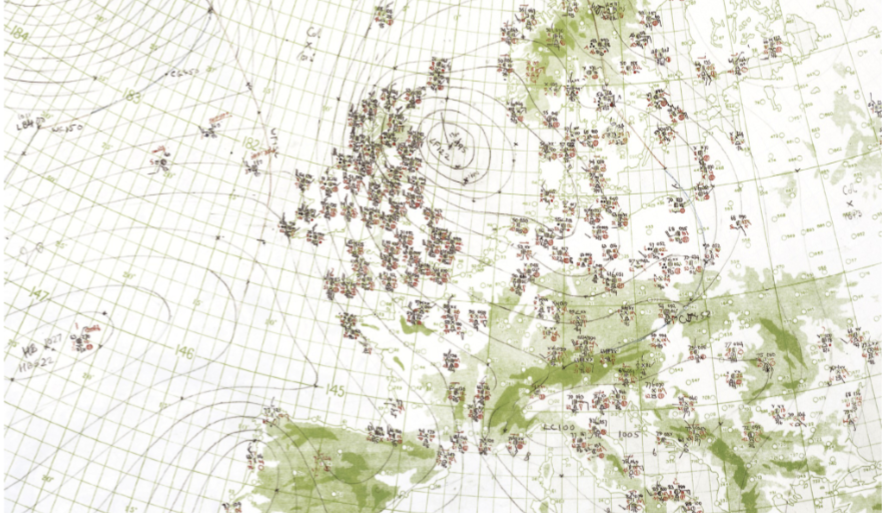
North Atlantic chart of weather for June 6th 1944. D Day. Showing occupied Europe with observations obtained from the enigma machine
In 2014 or thereabouts I went to a play by David Haig which was based on the true story of a weather forecaster’s role in D Day. James Stagg’s advice was that the weather on June 5th, the intended day, was too volatile. He suggested the 6th June 1944 instead.
The play was called Pressure and was great because it really conveyed the enormity of the decision that Ike, Churchill and others had to make. To go ahead in bad weather risked enormous casualties and the failure of the Landings. To postpone, might mean Hitler discovered the location of the invasions and might lead to disaster.
Major characters portrayed in the play included Ike and his driver, Kay Summersby with whom he was very close. Also depicted was an American forecaster who disagreed with the British meteorologist James Stagg. How much of the play was for dramatic effect and how much is true, I’m not entirely sure but it is a fascinating D Day story.
The maps were hand drawn and partially based on intercepted data decoded by the enigma machine. Stagg recommended postponing the landings one day from the 5th to the 6th of June, when it was hoped the ideal combination of calm seas, low water at first light and a full moon would occur.