The World’s Best Cities report makes London the top City followed closely by New York and Paris. London has had top spot for 11 years now. The Report is based on core statistics plus a survey of visitors and residents. It is created by Resonance, a consultancy group working in real estate, tourism, and economic development. They are based in Vancouver.
142026WORLD’S BEST CITIES “London is a city of constant reinvention. It is this remarkable commitment to ongoing growth that has seen us retain our crown as the World’s Best City. In 2025 we launched a 10-year plan for growth in the capital and celebrated a number of wins: record-breaking London-based scaleups going global, growing visitor numbers and an almost £10 billion planned investment in our experience economy over the next decade.” —LAURA CITRON, CEO, LONDON & PARTNERS
AFAR gives a good analysis of Resonance’s methods on its web site:
‘London’s magnetic appeal continues to draw a global audience, from students and entrepreneurs to tourists and corporate titans. The city’s robust recovery post- pandemic is reflected in its strong international traveler spending, which in 2024 reached almost $22 billion (up from $17.4 billion in 2023) and secured London the third-highest amount globally, outpacing destinations like New York and Dubai. Benefiting from a softer pound, London has remained a compelling bucket-list destination. Heathrow Airport recorded record-breaking arrivals, exceeding pre-pandemic passenger levels, and Gatwick Airport’s recent $320-million upgrade underscores London’s infrastructural excellence, enhancing the visitor experience with new concourses and improved amenities. The city’s airports, not surprisingly, rank #1 in our Top 100 cities.’
London No 1. Really?
Last year, I asked the question. Is it a fix? My thought below largely repeat what I said last year. It was a bit of a surprise to me given the hit Brexit has given to the City. But, London’s dominance for eleven years may be because of the consultancy’s focus on real estate as well as tourism and economic development. This gives London a head start as it has long been considered a very safe place to invest in property. London, New York, Paris, Tokyo, Singapore as 1-5 also suggests the report writers might have a bias to the big hitters. This year it notes that tax rises have hit the wealthy sector property prices but, the reduction in prices at the top end has made London very attractive, particularly to Americans. London seems a very sane City when compared to what is going on in America.
What London offers is its status as one of the world’s leading financial/business capitals. Supported by outstanding creative and services industries. At the same time, it has a superb cultural offering and, consequently, high figures for tourism. It is a City that seems to have a deep past behind it and an equally important future ahead.
The future might depend on the growing Knowledge Quarter around Kings Cross. (British Museum & Library, Wellcome Institute, Crick Institute, UCL, Central St. Martins, Google etc.) With Silicone Roundabout and the wealth of investments from the nearby City of London, providing London with a leading place in AI, the Knowledge economy, and Fintech. London also has a very high value on the internet as far as hashtags, and internet searches are concerned. Click here to see last year’s post.
On This Day
1889 The first ‘tabulating machine’ was patented by Dr Herman Hollerith in the US. It provided the beginnings of IBM, and the age of the Computer.
1923 The World’s first Outside Broadcast took place. The BBC broadcasted Mozart’s Magic Flute from the Royal Opera House Covent Garden. Early radios were called ‘Listening In’ devices. (see ‘Lucia in London’ by E. F. Benson).
1940 Rationing Introduced in the UK (initially Bacon, Butter and Sugar).
1947 David Bowie Born in Brixton as David Robert Jones
Today’s Link Rare Iron Age war trumpet and boar standard found in Norfolk. The Britons, and Celts on the continent, used a carnyx to provide the soundtrack to battle. A bit like the vuvuzela used at football matches, they make a horrible noise! This one is one of the most complete ever found. It is found with a Boar’s Head standard. For pictures and more information, look here: https://www.bbc.co.uk/news/articles/cr7jvj8d39eo
Created on January 8th 2026 based on a similar post for 2025.
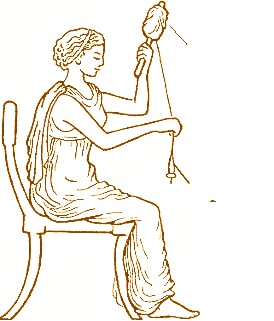
St Distaff Day. Spinning—showing the distaff in the left hand and the spindle or rock in the right hand
I’m not sure what the Three Kings were doing on the day after Epiphany. But, the shepherds, if they were like medieval English farmworkers, would still be on holiday. They went back to work, traditionally, next Monday, which is Plough Monday – (See my post here). This year, January 12th. By contrast, the women, according to folk customs, went back to work on St. Distaff Day, the day after Epiphany. Today, January 7th. In an ideal world, St Distaff’s Day is the Sunday after Epiphany (January 11th), and Plough Monday is the next day. Of course, it doesn’t always work out that way. I am not sure the woman going back to work on the 7th January, would be happy with the men lounging about until Plough Monday? An extra 4 days off! Maybe, St Distaff Day was normally on the Sunday before Plough Monday?
Distaffs and Women’s Work
A distaff is ‘a stick or spindle on to which wool or flax is wound for spinning’. Because of its importance in the medieval and early modern economy, it became a synecdoche for women. St Distaff is a ‘canonisation’ of this use of the word. So, a day to celebrate working women.
We know that medieval and early modern women were a vital part of the workforce, despite the demands of childcare. Many women took on apprenticeships, even more continued their husband’s work after he died. Some professions like silk became a female speciality. Many taverns were run by the Alewife. Plus, London was full of female servants and nurses. Many women had several jobs.
The exhibition at the British Library on Medieval Women. In Their Own Words, indicated that most of the sex workers had two or more other jobs. But even if a woman remained solely in the domestic realm, the wife had to be mistress of a formidable range of technologies. Baking, Brewing, Cooking, Laundry, Gardening, Dairy, Medicine (including distillation), horticulture, spinning, sewing and embroidery. Even, aristocratic women did embroidery of the finest quality, and it often made an important financial contribution to the household. They also ran the household, which means they had to have a formidable range of managerial skills. Dealing with servants, managing the accounts etc.
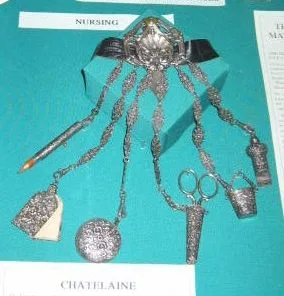
Chatelaine.
The other symbol of ‘women’s work’ was the Chatelaine. The word also means keeper of the Castle. But women who controlled households had a clasp that hung from the waist. It was a bit like a Swiss Knife as it had the keys, and all sorts of other useful items. Here is an old photo of the Chatelaine from the collection of the Old Operating Theatre Museum, of which I was the Director for 25 years. From left to right it has a pencil, a little notepad, a pill dispenser, a pair of scissors, a little bucket that held a dose of medicine, a whistle to summon urgent assistance. These were not only useful but a symbol of authority for the Matron. 19th Century.
St Distaff Day and Plough Monday
Robert Herrick (1591–1674), born in Cheapside, London, a Goldsmith, priest, Royalist and Poet wrote in ‘Hesperides’.
Partly work and partly play You must on St. Distaff’s Day: From the plough, soon free your team; Then come home and fother them; If the maids a-spinning go, Burn the flax and fire the tow. Bring in pails of water then, Let the maids bewash the men. Give St. Distaff all the right; Then bid Christmas sport good night, And next morrow every one To his own vocation.
Herrick, I think is suggesting fun and games are to be had. The men burning the flax and firing the tow, The women soaking the men with pails of water. In this piece, he links the plough team with St Distaff Day. This implies that the ploughs would be out on the next day. So as St Distaff’s Day is not always on a Sunday, perhaps Plough Monday is not always on a Monday? He certainly suggests everyone goes back to work either on St Distaff Day or on the day after,
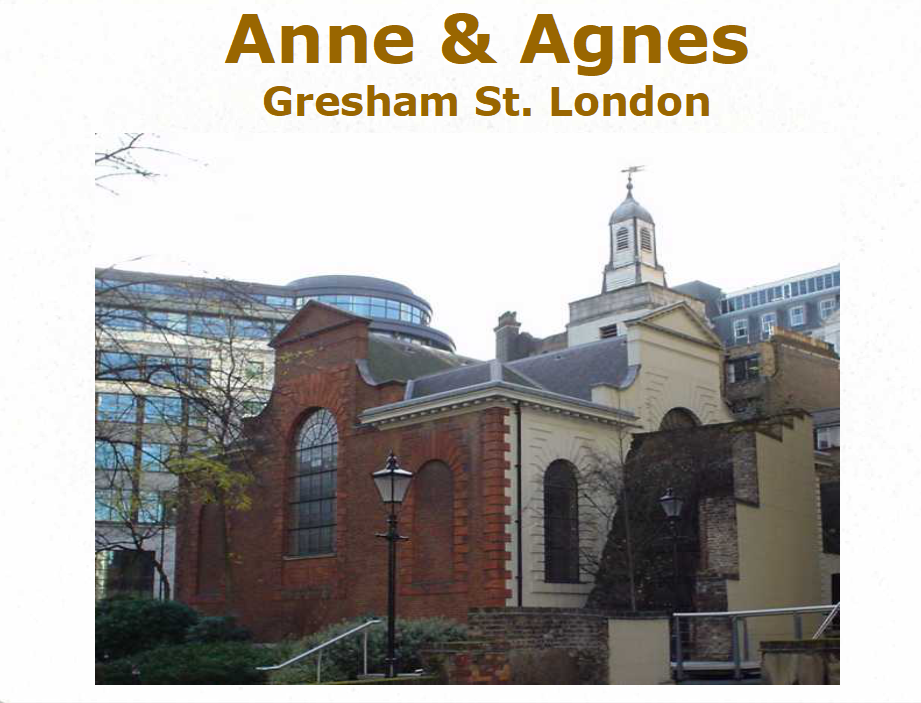
St Anne & St Agnes Church in London, Saints of the Distaff. Photo K Flude
Saints & Goddesses of the Distaff Side
In London, the Fraternity of St Anne and St Agnes met at the Church dedicated to the Saints. It is by a corner of the Roman Wall on the junction of Gresham Street and Noble Street. St Agnes is the patron saint of young girls, abused women and Girl Scouts. St Anne is the mother of the mother of the Son of God. So, together they represent the three generations of women: maidens, mothers, and grandmothers.
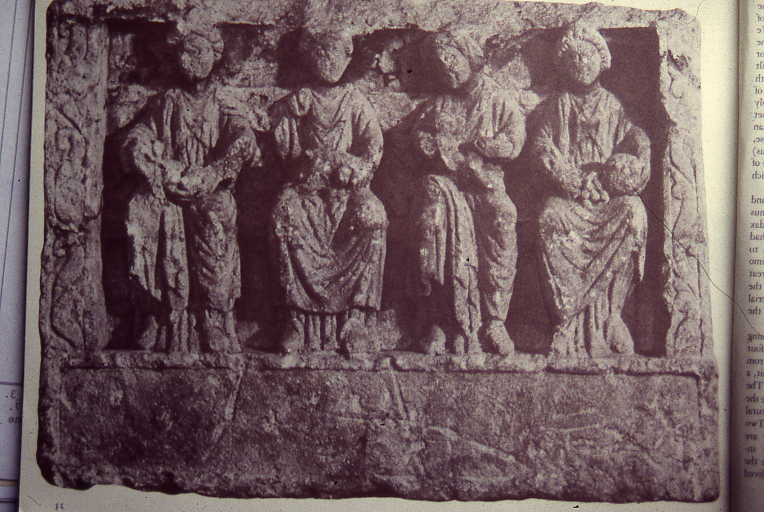
The Three Mother Goddesses (and someone else) “Limestone relief depicting four female figures sitting on a bench holding bread and fruit, a suckling baby, a dog and a basket of fruit’ the Museum of London
This trinity of women were worshipped by the Celts. Archaeologists discovered the sculpture above while investigating the Roman Wall a few hundred yards away at Blackfriars. Scholars believe it depicts the Celtic Three Mother Goddesses. The fourth person is a mystery, maybe the patron of a nearby temple? The relief sculpture was removed perhaps from a temple, or the temple was trashed at some point. Then the sculpture was used as rubble and became part of the defences of London.
The idea of triple goddesses is a common one. In Folklore and History they have been referred to as Maiden, Mother, and Crone, or even Maiden, Mother and Hag. They come in Roman, Greek, Celtic, Irish, and Germanic forms. Their names include the Norns, the Three Fates, the Weird Sisters, the Mórrígan and many more. The Three Fates, the Goddess Book of Days says, were celebrated during the Gamelia. This is the Greco/Roman January Festival to the marriage of Zeus and Juno. The Festival also gives its name to the Athenian month of January.
The Importance of the Grandma
The use of the terms Hag and Crone for the third Goddess is rare now, but was common. It does a great disservice to the importance of the Grandmother figure. (Although the original meaning of the words were less pejorative. For example, Hag may have meant diviner, soothsayer.) The three phases of womanhood are equally important to the continuation of the species. They provide love, support, and experience through the generations. Compare these three generations of supportive deities with Ouranos (Uranus), Cronus (Saturn) and Zeus (Jupiter). Saturn castrated and deposed his father, Uranus. Later, he tried to eat his son, Jupiter. But then, Jupiter is nobody’s idea of an ideal father. As one example, he eats his lover, Metis, to avoid her giving birth to his daughter, Athene. (See my post on the birth of Athena.)
Recent work on human evolution has suggested that the role of the Grandmother is crucial to our species’ ability to live beyond the age of fertility. Because, in evolutionary terms, once an individual cannot procreate, their usefulness for the survival of the genes is finished. So what’s the point of putting resources into grandma’s survival? The theory is the Grandmother has such an impact on the survival of the next generation, that longevity. for the female, beyond fertility makes evolutionary sense. Grandfathers less so.
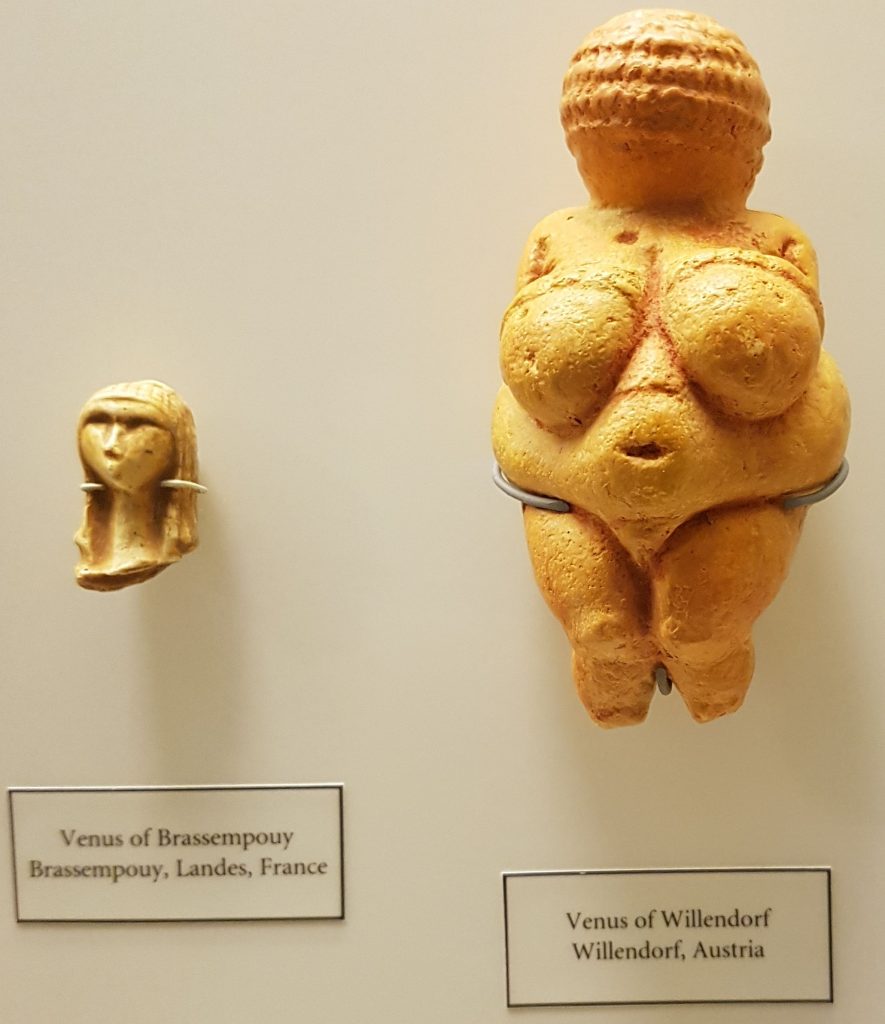
There was a theory widely held that the original Deities, dating before the spread of farming, were mother goddesses. The idea is that the hunter-gatherer goddesses (perhaps like the Venus of Willendorf) were overthrown by the coming of farmers. These patriarchal societies worshipped the male gods, which destroyed the ancient Matriarchy. Jane Ellen Harrison proposed an ancient matriarchal civilization. Robert Graves wrote some interesting, but no longer thought to be very scientific studies, on the idea. Neopaganism has taken these ideas forward.
1451 Glasgow University was founded (and you wonder why the Scots made such an impact on the world.)
1789 The USA held its first national presidential election. (Long may that fine democratic tradition survive and prosper!)
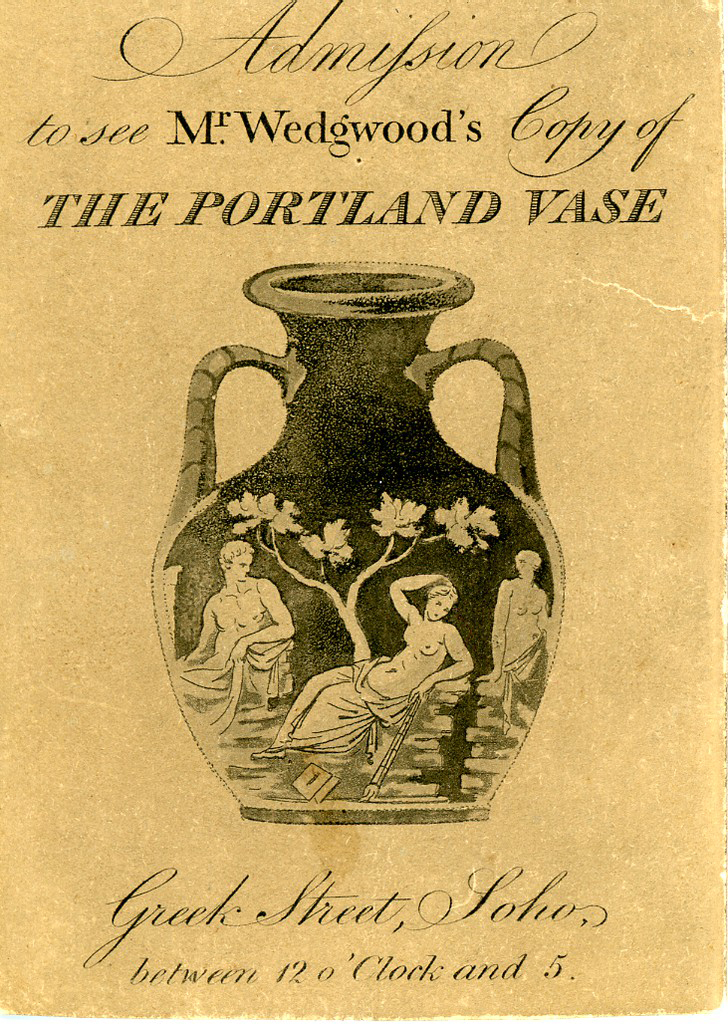
1845. Today is the anniversary of the breaking of the fabulous Portland Vase by a drunken visitor to the British Museum. It looks immaculate despite being smashed into myriad pieces, a wonder of the conservator’s art. To see the vase and read its story, go to the BM web site here:
Today in the orthodox church, дед Мороз (Ded Moroz= father of frost), accompanied by Cнегурочка (Snieguroshka= fairy of the snow) brings gifts on New Year’s Eve, (which is on January 7th). He travels with a horse-drawn troika.
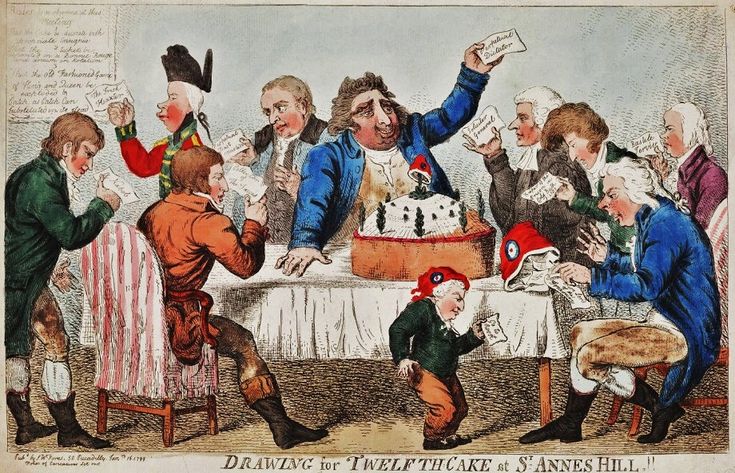
‘Drawing for Twelfth Cake’ at St. Annes Hill ’12th Night Cruikshank, Isaac, 1756-1811 printmaker. Published Janr. 10, 1807 by Thomas Tegg, 111 Cheapside’
Twelfth Night/Twelfth Day
Yesterday was Twelfth Night for the modern Church of England, but today is Twelfth Night for the Catholic Church and in England in former times ~(yesterday was Twelfth Day Eve. It is also Epiphany or Three Kings Day and because of calendrical differences, Christmas Eve for the Orthodox Church.
In Ireland, it is Nollaig na mBan. This is Women’s Little Christmas; when Women get to rest and let men do the work. This is a typical Saturnalia-style reversal of roles.
‘Drawing for Twelfth Cake’ at St. Annes Hill
I used the print above, three years ago for my post on New’s Day, then moved it to Twelfth Night. I also use it for lectures on Christmas and Jane Austen. But the focus of my presentation here is explaining the Twelfth Night Cake and the game that was played. But in fact, this is a very political satirical cartoon. More of that, later, let’s begin with the more trivial aspect of the print above.
Twelfth Night Performance, Party
It used to be the big party night, featuring the famous Twelfth Night Cake and theatrical entertainments; mumming and wassailing. Essentially, these terms mean wandering around the Town or Village dressed in costume and drinking beer, cider, or wine cups. The tradition of performance also was kept by the Royal Court and by institutions such as City Livery Companies and the Inns of Court in London.
These traditions saw someone chosen as the King for the night, and often someone else chosen as Queen. In 1606 Ben Jonson’s masque Hymen was performed before the Court. In 1613 Lord Bacon gave Gray’s Inn permission to a Twelfth Night Masque at Whitehall. During the performance, a character called Baby Cake brought in a ‘great cake with a bean and a pease’. On the Candlemas Feast of 2 February 1602 Middle Temple performed a play called Twelfth Night that the lawyers had commissioned from one William Shakespeare. Candlemas was the end of the Christmas Season. See my post on Candlemas here.
The cake has disappeared from current Christmas celebration, probably because it transmuted into our present Christmas Cake. This, I regret. I have had a lifetime when a very heavy Christmas Dinner is followed, first, by Christmas Pudding. Then, overloading with food, the Christmas Cake is brought out. No one, in their right mind, wants a slice of heavy Christmas Cake after a Christmas Dinner, and Christmas Pudding! Many of my American friends disparage fruit cake, but they are mistaken. Good Christmas Cake is something to be thoroughly enjoyed, but on the days following Christmas Day.
I gave a recipe for the Twelfth Night Cake in another post, (here it is). But the important point is that it had a bean and a pea in it. The one who got the bean was selected as King for night and the pea the Queen. The rest of the Christmas Party draw cards. Traditionally, the women draw a card from a ‘reticule’ (bag) and the men’s from a hat. But there are no women at this satirical party (pictured above).
The cards detailed a role the party goers were to play for the rest of the night. The card began with an introductory speech, or rhyme, for the person to speak. The King and Queen led the way, and for the rest of the evening the party members adopted their persona. They might be an aristocrat, a soldier, a cook, a parson, a dairy maid etc. The French do something similar with their Galette des Rois. The bean is called the feve, and may be replaced by a porcelain model. Other places have a King’s Cake for epiphany.
Twelfth Night Satire
So, as I was rushing to get the original Twelfth Night post done, I failed to examine it in any detail. I assumed the cards gave them satirical occupations which would be funny to the contemporary audience in 1807. But then, I noticed the title mentioned St Anne’s Hill. I looked it up and discovered myself down a deep and very enjoyable research rabbit hole.
St Anne’s Hill & Charles James Fox
Now, let’s go down that rabbit hole and look a little deeper.
The caption mentions St Anne’s Hill. I believe this refers to St Anne’s Hill, near Chertsey (SW of London on the River Thames). Here, there was a grand house which was owed by Charles James Fox. He was the leader of the Whigs, a persistent opponent of King George III. He was a supporter of the American and French Revolutions. This explains the red bonnet used to pull out the cards in the illustration.
The central figure is then, Fox. But he died in September,. 1806. The print is dated January 1807. Just before he died, his Foreign Slave Trade Bill of 1806 began the dismantling of this pernicious trade in the British Empire. He was Foreign Minister, who assumed a couple of civil chats with the French would end the long-standing war. But he soon discovered that Napoleon was not to be trusted in negotiations. The war went on for another 9 or so years.
Charles James Fox was a mercurial figure with many radical views. He was also a notorious gambler and loved the high life. One of his many lovers was Georgiana, Duchess of Devonshire. He eventually married, Elizabeth Armistead, an ex-mistress of the Prince of Wales. St Anne’s Hill was her house. I am pleased to report that she is credited with calming his life-style. He now spent more time at St Anne’s where they would ‘read, garden, explore the countryside and entertain friends’ (Wikipedia).
Isaac Cruikshank’s ‘Drawing for Twelfth Cake’ at St. Annes Hill
Cruikshank’s illustration is, of course, not designed to document quaint Twelfth Night customs but is a political satire and I discovered that the British Museum has the original version of this print, and. It is dated to 1799 which makes much more sense!
At the back right of the print is a notice which says:
‘Rules to be observed at this Meeting 1. That the Cake be decorated with appropriate insignia 2 That the tickets be deposited in a Bonnet Rouge and drawn in Rotation 3 That the Old Fashioned Game of King and Queen be exploded & Catch as Catch can Substituted in its stead.’
The bonnet rouge is a ‘redcap worn by ardent supporters of the French Revolution’ or ‘an extremist or revolutionary’. (defined by the Collins Dictionary as). Point 3 relates to Fox’s opposition to the King and the Republicanism of the French Revolution. The expression Catch as Catch Can refers to a free form of wrestling without rules, and presumably a satire on ideas of democracy.
Opponents of William Pitt
The characters in the scene (all men) are all political figures. They are associated with the opposition to the very right-wing Government of William Pitt. During the war with France, the opposition was led by a supporter of the French Revolution. For those on the right, which included Pitt’s government, supporting the French Revolution was tantamount to treason. Pitt suspended many civil liberties in ‘Pitt’s Reign of Terror’. He arrested and indeed executed leading members of those demanding political change. The Government even suspended Habeas Corpus to make it easier to arrest their opponents,
Fox is seen drawing a 12th Night Game ticket which is marked ‘Perpetual Dictator’. To his right is Frances Burdett. He was a radical politician, who supported universal male suffrage, equal electoral districts, vote by ballot, and annual parliaments. Note that this is well before these aims became the core of the Chartists campaign for electoral reform.
Frances Burdett
Burdett is shown holding a ticket saying ‘Keeper of the Prison in Cold Bath Fields’. This is a satirical reference to a serious political crisis. The Cold Baths Fields was the site of a medical spring in Clerkenwell, London. It was a prison where radicals were imprisoned. Conditions were very poor, despite the recent rebuilding under the aegis of the prison reformer, John Howard. Burdett exposed the scandalous conditions in the House of Commons. He began a campaign against the magistrates involved in the arrests. Francis Burdett married into the fabulously rich banking family the Coutts. His daughter was the famous Angela Burdett Coutts who was a philanthropist who collaborated extensively with Charles Dickens.
Edward and Catherine Despard
One of the prisoners was Edward Despard who had associations with many radical groups. These included the London Corresponding Society, the United Irishmen and United Britons. Despard married Catherine, the daughter of a free black woman from Jamaica. She, with Burdett, led the campaign against her husbands and other arrests without trial. Catherine wrote a letter to the Attorney General who replied in a demeaning manner:
‘it was a well-written letter, and the fair sex would pardon him, if he said it was a little beyond their style in general’
He did not comment on her colour. She described the imprisonment of her husband as being :
“in a dark cell, not seven feet square, without fire, or candle, chair, table, knife, fork, a glazed window, or even a book”
Despard was freed in 1802, went to Ireland. He returned to London. He was arrested again. And accused of a being the ringleader of a plot to assassinate the King. There was little real evidence. Horatio Nelson was a character witness, and appealed to the King for clemency. Clemency was granted. But only in so far as Despard was not disembowelled. Just ‘Hanged and Drawn’ at Horsemonger Lane Gaol in Southwark (1803). He was the last person to be drawn through the streets at the tail of a horse before execution for treason. These are his last words:
Fellow Citizens, I come here, as you see, after having served my Country faithfully, honourably and usefully, for thirty years and upwards, to suffer death upon a scaffold for a crime which I protest I am not guilty. I solemnly declare that I am no more guilty of it than any of you who may be now hearing me. But though His Majesty’s Ministers know as well as I do that I am not guilty, yet they avail themselves of a legal pretext to destroy a man because he has been a friend to truth, to liberty, and to justice
(a considerable huzzah from the crowd)
and because he has been a friend to the poor and to the oppressed. But, Citizens, I hope and trust, notwithstanding my fate, and the fate of those who no doubt will soon follow me, that the principles of freedom, of humanity, and of justice, will finally triumph over falsehood, tyranny and delusion, and every principle inimical to the interests of the human race.
(a warning from the Sheriff)
I have little more to add, except to wish you all health, happiness and freedom, which I have endeavoured, as far as was in my power, to procure for you, and for mankind in general.
https://en.wikipedia.org/wiki/Edward_Despard
After his death, his family denied that Catherine was his wife but merely his ‘house-keeper.’ I assume, this was because they wanted the inheritance rather than, or perhaps, as well as naked prejudice.
@Phew! This is what I love about what I do, you find things out that link disparate parts of your knowledge, creating an ever-interwining web of history.
On this Day
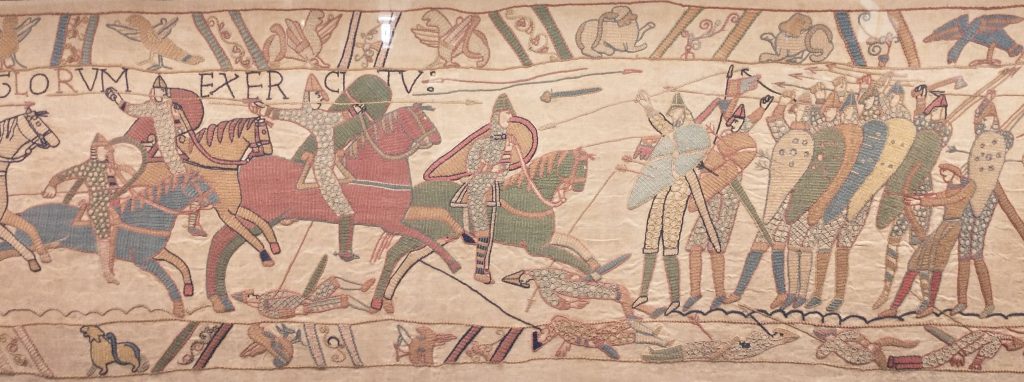
1066 Harold Godwinson crowned King of England on January 6, 1066, the same day as the funeral of the previous king, Edward the Confessor.
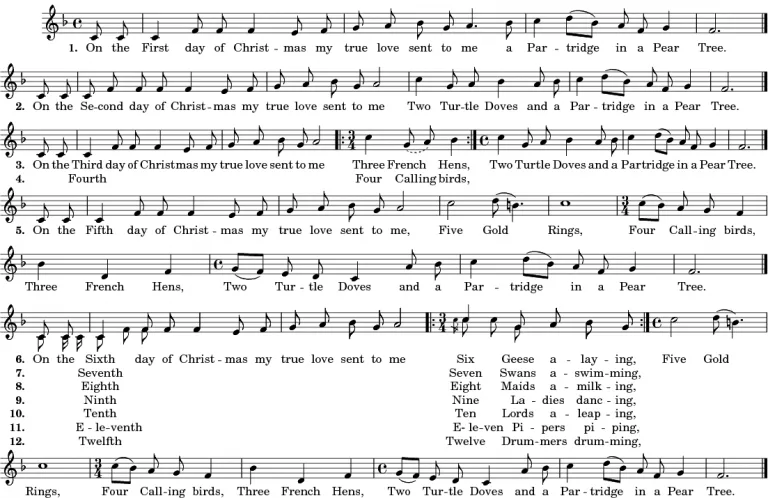
On the twelfth day of Christmas My true love gave to me Twelve drummers drumming, Eleven pipers piping, Ten lords a-leaping, Nine ladies dancing, Eight maids a-milking, Seven swans a-swimming, Six geese a-laying, Five golden rings, Four calling birds, Three French hens, Two turtle-doves And a partridge in a pear tree.
Twelfth Night
In 1775, William Snooke recorded in his diary, that he sat down to a fine dinner with:
‘Mr and Mrs William Clifford and their seven children (and maid), John Fox Snr. and Sally Twining, Mr and Mrs William Fox, and William Weale.’ To feed this crowd took “Ham, Greens, 3 fowls roasted, Soup, Leg of Mutton, potatoes, Boiled rump of beef (large)”
Dessert included pudding, mince pies and a forequarter of home lamb. For supper, the assembled party consumed tarts, stuffed beef, mince pies, cold mutton, oysters, cold sliced beef, cold lamb, apple pies and pears.
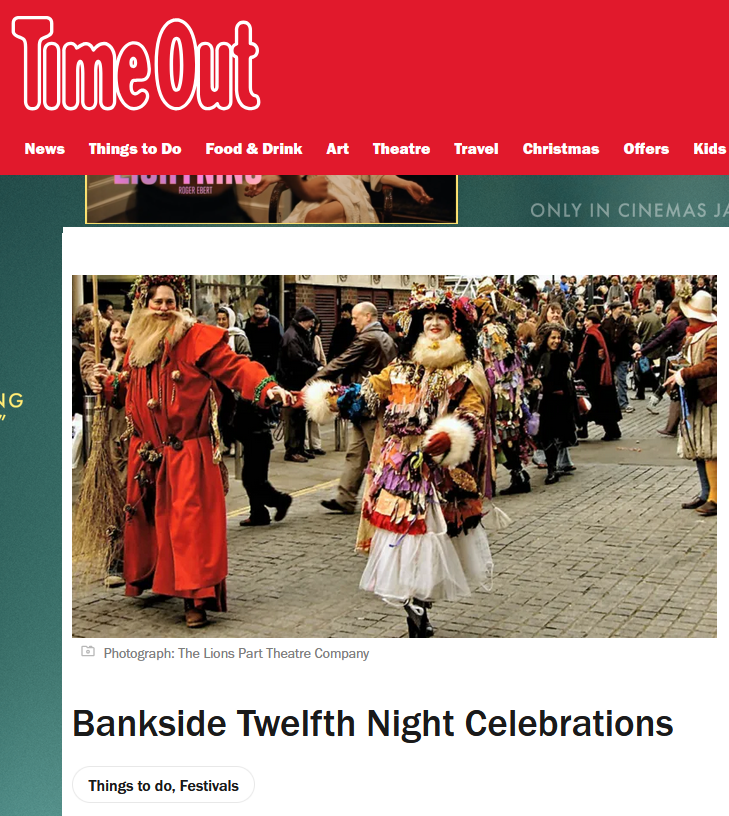
A recent ‘tradition’ for a Tweltfh Night procession has been established on the south side of the River Thames in London. The Lions Part Company begin their entertainments at the rebuilt Globe. The parade has all the traditional mummers characters, including the Green Man, and the Holly Man. They perform the Combat Play of St George. This involves the Old ‘Oss (which is the centre point of the May Day festivities at Padstow in Cornwall. They also have Twelth Night Cakes containing a bean and a pea. These are used to crown the King and Queen of the Day.
Photo of Twelfth Night Celebrations in Southwark, London on the South Bank
I’ve posted about this before but just to make sure those who find themselves on this page understand the issue:
Many people start their count of the Twelve Days of Christmas on the 25th December. But some folklore sources going back in time count from Boxing Day. For example, Gervase Markham’s ‘The English Husbandman of 1635 counts it from Boxing Day.
The Daily Express reveals that the Protestants count from Christmas Day and the Catholics from Boxing Day. That maybe it, but I wonder if the confusion more complicated than that? The religious festival really makes sense if it begins with Christmas Day, and ends with the Epiphany. This is the day the Three Kings from the Orient come to worship Jesus. But Epiphany is on the 6th January, which is 13 days from Christmas. 13 days of Christmas would be ill-omened. So two solutions: make the end of the Twelve Days the Eve of Epiphany, i.e. the 5th, or start the 12 days from Boxing Day.
I suspect there is a fudge going on here. Twelve is the magic number, twelve Apostles, 12 months in the year, so twelve Days of Christmas. But clearly, for Christians it stretches from Christmas Day to Epiphany. Two ways to square that 13 day difference. One is to begin the twelve days on Boxing Day. The other is to end with a Twelfth Night party on the Eve of Epiphany. Have a look at Notes&Queries for different viewpoints.
Time to take your decorations down- January 5th or Candlemas
However, we currently all seem to agree that January 5th is the day to take down your Christmas decorations. If you fail to do it now, you have to keep them until Candlemas, which is at the begining of February. See my Candlemas post to see the official end of Christmas.
Toss your unwanted Christmas Tree on the Pavement Day
In London, today and yesterday have seen people throw out their unwanted Christmas Streets out on the street, for someone else to pick up and throw away. This became a thing a few years ago not. But, no, people you are supposed to take them to a Recycling Centre, or arrange to have them picked up. Not just throw them on the street.
1753 People gathered around the Holy Thorn in Glastonbury. The Thorn normally blossomed on Christmas Day, but the Gregorian Calendar had been introduced the year before. Christmas Day was now 11 days earlier. on December 25th, it did not blossom. On the 5th, it blossomed, proving that the new Christmas Day was a fraud, From then on January 5th was called Christmas Day Old Style. Other festivals, and events thereafter kept their traditional slot in the year, by changing the date to the Old Style, and ignored the New Style.
Twelfth Night Cake at the Museum of the Home, photo Kevin Flude
Twelfth Night Cake
On the 11th day of Christmas My true love sent to me 11 pipers piping; Ten lords a-leaping; Nine ladies dancing Eight maids a-milking; Seven swans a-swimming Six geese a-laying Five golden rings (five golden rings) Four calling birds; Three French hens; Two turtle-doves And a partridge in a pear tree.
Now is your last chance to make your Twelfth Night cake, its the 11th hour after all! Of course, Stir Up Sunday would have been the best day. Here is a recipe from 1604 by Elinor Fettiplace:
Take a peck of flower, and fower pound of currance, one ounce of Cinamon, half an ounce of ginger, two nutmegs, of cloves and mace two peniworth, of butter one pound, mingle your spice and flower & fruit together, but as much barme [the yeasty froth from the top of fermenting beer barrels] as will make it light, then take good Ale, & put your butter in it, saving a little, which you must put in the milk, & let the milk boyle with the butter, then make a posset with it, & temper the Cakes with the posset drink, & curd & all together, & put some sugar in & so bake it.
The Quadrantid meteor shower appears from the point of the Plough’s handle. It continues to January 12th but peakon January 4th. At the peak there may be 100 meteors an hour. But, it will be low in the north-eastern sky and best seen from low light pollution areas. Twinkling above the Southern Horizon will be Sirius and this month’s brightest star. In the NE, the Plough can easily be seen. The Orion nebula south of Orion’s belt will be seen as a hazy patch with the naked eye. (from the Night Sky. Month by Month by Gater and Sparrow).
We are also seeing the Wolf Moon, as it moves closer than usual to the Earth and so feels bigger. It got its name as Wolves were said to Howl at the Moon more when the Moon came close.
On This Day
1642 Charles I marched on the House of Commons to arrest five Members of Parliament. It failed, the MPs fled to Guildhall in the City of London. Charles followed and was surrounded by citizens of the City of London shouting ‘Priviledge of Parliament. He fled London and the Civil began soon after. See my post charles-i-raises-the-standard-august-22nd-1642
Today: Sow alpine seeds. This give them the period of cold they get in the wild, which is essential for their germination in spring. Take root cuttings. Lift and divide overgrown clumps of herbaceous perennials. ‘Gardening through the Year’ by Ian Spence. RHS.
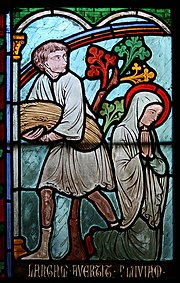
Saint Geneviève praying for the end of the rain. 19th Century by Alfred Gérente Notre-Dame de Paris.
St Genevieve of Nanterre (c. 419/422 AD – 502/512 AD) has her feast day today. Nanterre is an ancient settlement swallowed up by modern Paris. Genevieve was a most remarkable woman who met St Germanus of Auxerre on his way to Britain. She was only 7 when she met Germanus. He encouraged her piety. She became a consecrated virgin (someone who made vows of chastity to be a ‘bride of Christ’). Thereby living an aesthetic life of fasting and prayer. Hence, miracles soon became associated with her, (including changing the weather) and the ‘usual’ medical miracles. After moving to Paris, she encouraged the women of the City to stay in the City for prayer and fasting to prevent the Huns capturing the City in 451. Attila and the Huns abandoned the siege.
St Genevieve saved the City on other occasions too, helped build two large Church projects, including St Dennis. She intervened fearlessly in public affairs, and was a brave and resolute woman who challenged the male hierarchy with some success. And what makes me like her even more was that she is not a martyred teenager Saint tortured to death to gain her sainthood. But she did great works and lived to old age of 82 still ‘full of virtue’. In the medieval period, she became the Patron Saint of Paris. She is patron to: Paris, shepherds, winemakers, wax-chandlers, hatmakers; against eye complaints, fever, plagues, drought, and war.
St Germanus
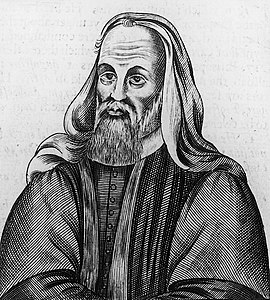
St Germanus played a significant role in Genevieve’s life, protecting her from slander and attack. He is one of the most significant figures in post Roman studies in Britain. Accounts of his visits to Britain in the early 5th Century are among the very few descriptions of post-Roman life. He was sent to Britain to counter the Pelagian Heresy, which was endangering the Catholic version of Christianity.
Incidentally, Nanterre has an interesting prehistory. The name in Celtic means ‘enduring sacred site’. A large cemetery has been found, which helps support the possibility that it is the original site of Paris. Julius Caesar attended an assembly with local Gallic leaders in the area. The topography of Nanterre fits as well for the location of the assembly as the island in the Seine (Île de la Cité) which is an alternative location.
In Their Own Words
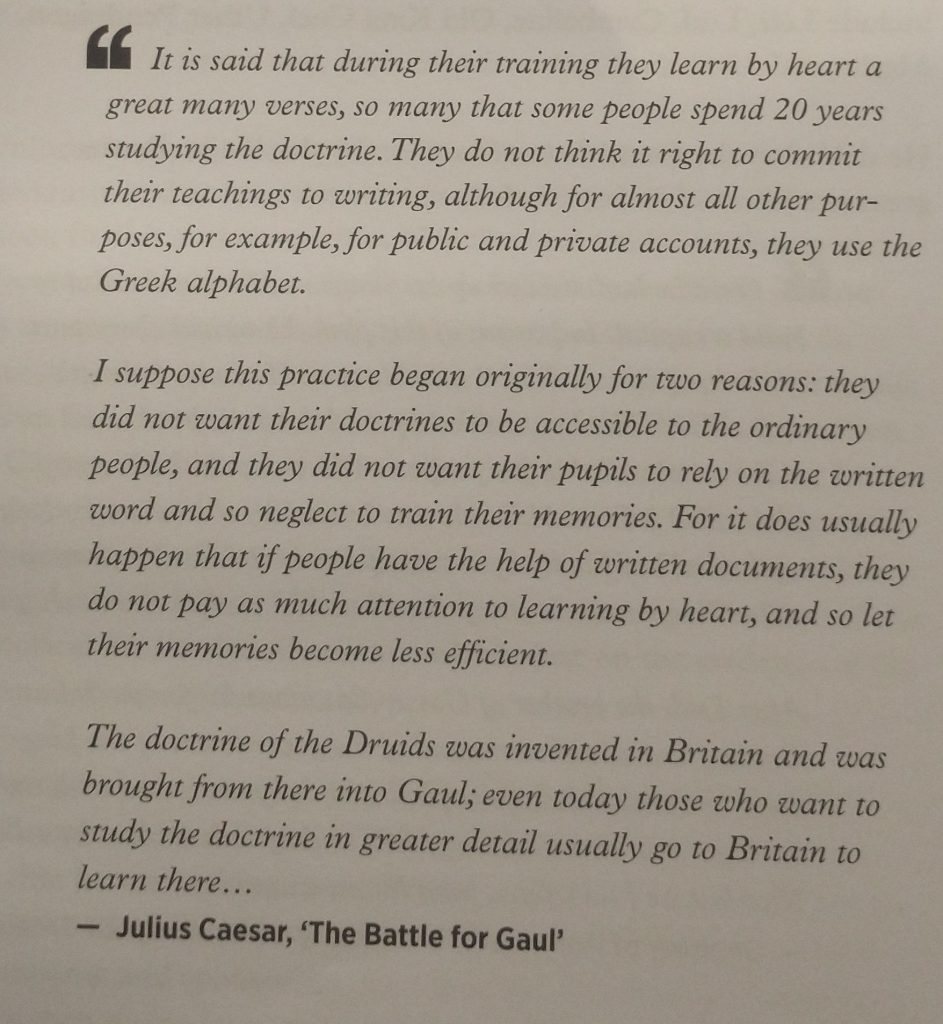
This is an excerpt from Julius’s Caesar book concerned with training druids. (It is photographed from my book ‘In Their Own Words- details below).
‘In Their Own Words – A Literary Companion To The Origins Of London‘ by Kevin Flude
It brings together contemporary quotations about the Prehistoric, Roman and Dark Ages with a commentary by the author. It’s an enjoyable read! To buy the Kindle (£2.40) or a paperback version (£5.99), click here.
If you have read it, please go here and write a review! It is sadly devoid of any!
On This Day
1521 Martin Luther excommunicated by Pope Leo X. (our present Pope is the XIV)
1661 Samuel Pepys saw the Beggar’s Bush at the Theatre in Gibbon’s Tennis Court, Vere Street, near Lincoln’s Inn Fields. He records it was ‘the first time that ever I saw women come upon the stage’. The Restoration of Charles II to the throne allowed, for the first time, women to appear on the professional stage.
1777 George Washington defeats Cornwallis at the Battle of Princeton
Today: keep bird feeders well stocked. Check houseplants for mealybugs, mites and other pests. (Gardeners’s Year The Metroplitan Museum of Art).
The Full Moon today falls in Cancer in a conjunction with Jupiter and an exact opposition to Mars and Venus. Thus, the mood of the times is divided between those supporters of individual liberties. And the Government’s right to control personal behaviours’. That, ast least is what Old Moore’s Almanack for 2026 says. And that’s probably enough Astrology for the year!
First written in January 2023, revised and republished January 2024, 2025, 2026
On the ninth day of Christmas, my true love sent to me Nine ladies dancing, Eight maids a-milking, Seven swans a-swimming, Six geese a-laying, Five gold rings, Four calling birds, Three French hens, Two turtle-doves, And a partridge in a pear tree.
On this day in 1793 the National Convention in Revolutionary France decreed that Year II of the Republic had begun the day before. That is on New Year’s Day, January 1st. But, by October, they decided that the French Revolutionary Calendar should not have begun on January 1st but on the Autumn Equinox. The point being, I imagine, that January 1st, chosen by Julius Caesar had become a random date, not fixed to any external, astronomical event of significance.
The Revolutionaries, wanted their calendar to be completely rational. So they, retrospectively, made 22 September 1792 the first day of Year I. The Equinox has the virtue of having equal days and nights, and with the Sun rising due east and setting due west. Why the Autumn one? I don’t know but, the traditional calendars in Northern Europe, the Celtic and the Northern European tradition had an autumnal start to the Year. The idea being that the harvest is in, the growing has been completed, plants are beginning to die. Seeds are in the ground. So it’s the end of the growing year, therefore the beginning of the next year. It also had the virtual that it was not the Spring Equinox. For, Christians believed that the world was created on the Equinox, and Adam and Jesus born 4 days after the Spring Equinox. (see my post on March 25th)
By choosing a radical and rational reform of the Calendar, the Revolutionaries were following Julius Caesar’s example. His Julian Calendar tidied up the old Roman Calendar. However, Caesar did kept many of the essentials in place. The French, by contrast, almost completely ripped up the calendrical rule book. For more on the Julian Calendar read my post here.
Slippy January
Let’s start with the names of the months. The concept of the month they kept but got rid of the irrational Latin-based names. They replaced them with neologisms derived from seasonal indicators, as you will see. But it’s more fun to begin with the names as reported, satirically, by John Brady. He published these in England in 1811. The list starts with ‘October’ as the year began at the Autumnal Equinox. The seasons are separated by semicolons.
Wheezy, Sneezy and Freezy; Slippy, Drippy and Nippy; Showery, Flowery and Bowery; Hoppy, Croppy and Poppy.
The historian Thomas Carlyle suggested somewhat more serious English names in his 1837 work ‘The French Revolution: A History’ namely:
Each month was a rational 30 days, (12*30 = 360) leaving 5 days of the solar year to be sorted out. These were given to the Sans Culottes as holidays and called complimentary days. The leap year was similarly given to the Sans Culottes; an extra day, every 4 years. It was a copy of the Egyptian year, which had inspired Caesar to make the Roman year rational.
Working flat out 10/10
And like the Egyptians, the 7-day week went out the window. The month was divided into three décades of 10 days. The tenth day, the décadi, being a day of rest. By my calculations, the ‘lucky’ Sans Culottes gained 5 days at the end of the year. But lost 16 Sundays, a net lost of 11 days over the year. I’m guessing they would have been compensated somewhere in the year? By time off to celebrate various revolutionary festivals, such as the 14th July (celebrating the storming of the Bastille)? The days were called primidi (first day) duodi (second day) tridi (third day) etc.
The hours of the day were decimalised. So each day was divided into 10 hours, rather than the 24 hours we use. The hours into 100 decimal minutes, and the minute into 100 decimal seconds. This meant that an hour was 144 conventional minutes; a minute 86.4 conventional seconds, and a second 0.864 conventional seconds.
The French Revolutionary Calendar did not survive Napoleon, who recalled the conventional calendar. Time keeping returned to the Gregorian standard on 1 January 1806.
I do like the idea of the 10-day week. But I would prefer it to be 6 days of work and 4 days of leisure, thank you. I do wish we could rename our months: Wheezy, Sneezy and Freezy; Slippy, Drippy and Nippy; Showery, Flowery and Bowery; Hoppy, Croppy and Poppy.
Notably, Napoleon did not reverse the Metric System. This was initiated in 1799, by the Revolutionary Government, shortly before it lost power in the Coup of 18 Brumaire which took place in Year VIII and installed Napoleon in power. Brumaire is November roughly?
The metric system not only survived, it prospered. Notably absent from the universally accepted system are English-speaking Countries, The UK, US and Canada being the main abstainers. Make of it what you will, but I think the main reason as that we don’t think we should be told what to do by foreigners who we rescued from the Germans. This is, of course, nonsense, given the contribution of the Russians, and all the others who fought to defeat fascism, but it is something that lingers as an idea. (Oh, how I hate you Brexit voters!).
Introducing a Rational System?
We made our coinage metric on 15 February 1971, and from 1962, stopped and started introducing the Metric System. The system was enshrined in UK law with the accession to the European Economic Community. We are now in a strange pickle where our children are mostly fully metric while we boomers are ambivalent. I buy my beer in pints (I’m lying I am the sort of wimp who orders beer in half pints). But petrol in Litres, although I only know how many miles my car does to the gallon. (I no longer have a car).
We measure long distances in miles, and short distances in a strange combination of both. I might go to ask a timber merchant for a couple of metres of 2 by 4. (2 inches by 4 inches is a standard size of wood). (I hate DIY!)
I buy butter in grams and fruit in a £1 container’s full. In summer, I use Fahrenheit as I spend a lot of time with Americans, telling them about our Quintessential country. In winter, I return to the universal world of Centigrade.
The exceptions that prove the Rule! The Blue countries have adopted the metric system. By Goran tek-en, CC BY-SA 4.0, https://commons.wikimedia.org/w/index.php?curid=96077271
On this Day
Today, is special for the Cybele, Isis, Aphrodite and Ishtar, and is the Vigil for St Genevieve of Nanterre. Paris. (more tomorrow). It is also a Bank Holiday in Scotland.
1492 Spain Conquered Al-Andalus, ending the Reconquista and Islamic rule in Spain with the fall of Granada.
1959 the Russians launch Luna 1, the first human-made object to escape Earth’s gravity.
In your Garden
Clean and repair gardening tools. Plan Spring Flower Beds. Check whether you need more evergreens or flowering heather to add interest to a winter garden.
First Published Jan 2nd 2023, republished Jan 2024, 2025 and 2026
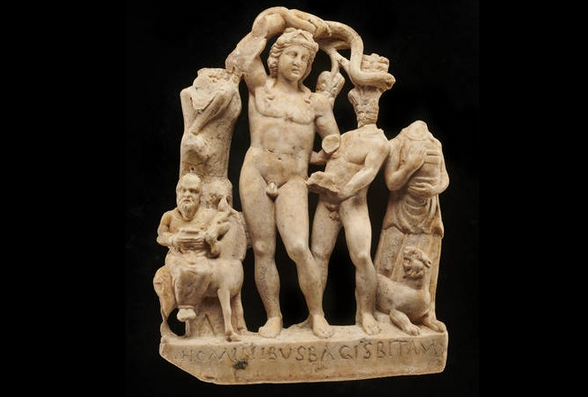
Marble statue of Bacchus from the Temple of Mithras London. The inscription reads ‘hominibus vagis vitam’ Translation … (give) life to men who wander. Bacchus is in the middle, the little old man on the left is Silenus. The drunken tutor to Bacchus.
On the eighth day of Christmas my true love sent to me: 8 Maids a Milking; 7 Swans a Swimming; 6 Geese a Laying 5 Golden Rings 4 Calling Birds; 3 French Hens; 2 Turtle Doves and a Partridge in a Pear Tree
Closing Time
The 8th day, New Years Day, is the day of the Throbbing Head. In ‘Closing Time’ Leonard Cohen wrote about drinking to excess. I like to think he refers to Christmas and New Year’s Day:
‘And the whole damn place goes crazy twice And it’s once for the devil and it’s once for Christ But the boss don’t like these dizzy heights We’re busted in the blinding lights of closing time.
Trouble is the song mentions summer. Oh well. You can enjoy the official video on YouTube below:
Hangover Cure
What you need is a hangover cure. Nature provides many plants that can soothe headaches. And in the midst of the season of excess, let’s start with a hangover cure.
Common ivy Photo by Zuriel Galindo from unsplash
Ivy and Bacchus
Ivy, ‘is a plant of Bacchus’…. ‘the berries taken before one be set to drink hard, preserve from drunkenness…. and if one hath got a surfeit by drinking of wine, the speediest cure is to drink a draft of the same wine, wherein a handful of ivy leaves (being first bruised) have been boiled.’
Culpeper Herbal 1653 quoted in ‘the Perpetual Almanac’ by Charles Kightly
Bacchus often wore an ivy crown around his head. Romans used Ivy to fend off hangovers.
Bacchus and Wine Making
The image of Bacchus, at the top of the post, is from a fascinating article by the Museum of London on wine making in Roman Britain. It suggests wine in Britain was first made in Brockley Hill, in South East London as little as 20 or 30 years after the Roman Conquest of AD43. The evidence was the discovery of Roman Wine Amphora made locally. This is taken as evidence that the amphorae were made to contain local wine. Direct evidence of a vineyard has been found in Northamptonshire but fron the 2nd Century AD.
Bacchus is the Roman version of the God Dionysus who was the God of ‘wine-making, orchards and fruit, vegetation, fertility, festivity, insanity, ritual madness, religious ecstasy, and theatre.’ Essentially anything that could make you loss your head, and escape your inhibitions. But he could also relieve pain, reduce anxiety, free you from subjugation and therefore he was subversive. The Roman State suppressed and regulated the Bacchanalian Festivals.
Skullache, and Willow,
Crack Willow Trees on the Oxford Canal, August 2021
Now, if that gives you a headache, one of the best documented folk hangover cures is willow bark, useful for headaches, earaches, and toothaches. Here is a record of how simple it was to use:
‘I am nearly 70 years old and was born and bred in Norfolk… My father, if he had a ‘skullache’ as he called it, would often chew a new growth willow twig, like a cigarette in the mouth.’
‘A Dictionary of Plant Lore by Roy Vickery (Pg 401)
In the 19th Century, they discovered that Willow contained salicylic aciacid, from which aspirin was derived. As a child, I remember chewing liquorice sticks in a similar way. We chewed, supposedly for the pleasure and the sweetness, not for the medicinal virtues of the plant.
Country Weather
January 1st’s weather on the 8th Day of Christmas was cold, but bright in the morning, a little bit of rain at lunch time, and a dry but cloudy afternoon. So, according to Gervase Markham, the 8th Month, August, will be sunny to begin with, with some rain in the middle, and cloudy end of the month. (source: ‘The English Husbandman’ of 1635.)
On this Day
Today, is the Day the Nymphs in Greece dedicated to Artemis, Andromeda, Ariadne, Ceres. (according to the Goddess Book of Days by Diane Stein.)
First Published in 2024, republished in 2025, 2026
Jane Austen’s London Walk 2.30pm Sun 31st May 2026 To Book The First Blitz – Zeppelin London New Walk! 6pm Sun 31 May 2026 To Book Roman London – Literary & Archaeology Walk 3pm Sat 6th June 2026 Tobook The Rebirth Of Saxon London Archaeology Walk 11am Sun 7th June 2026 To book Tudor London – The City of Wolf Hall 3pm 4th July 2026 To Book Jane Austen’s London Walk 2:30pm Sun 5th July 2026 To book London. 1066 and All That Walk 11.30am Sun 12th July 26 Tobook Bloody, Flaming, Poxy London 3pm Sun 12th July 26 To book Myths, Legends, Archaeology and the Origins of London 3pm Sat 1 Aug 2026 Tower Hill Underground To book The Decline And Fall Of Roman London Walk 11:15am 2nd Aug 26 To book Jane Austen’s London Walk 2:30pm Sun 2nd Aug 26 To book Chaucer’s Medieval London Guided Walk 11.00am Sat 5th Sept 2026 To book Jane Austen’s London Walk 2:30pm Sun 5th Sept 2026 To book Jane Austen’s London Walk 2:30pm Sat 24th Oct 2026 To book
For a complete list of my guided walks for London Walks in 2026 look here