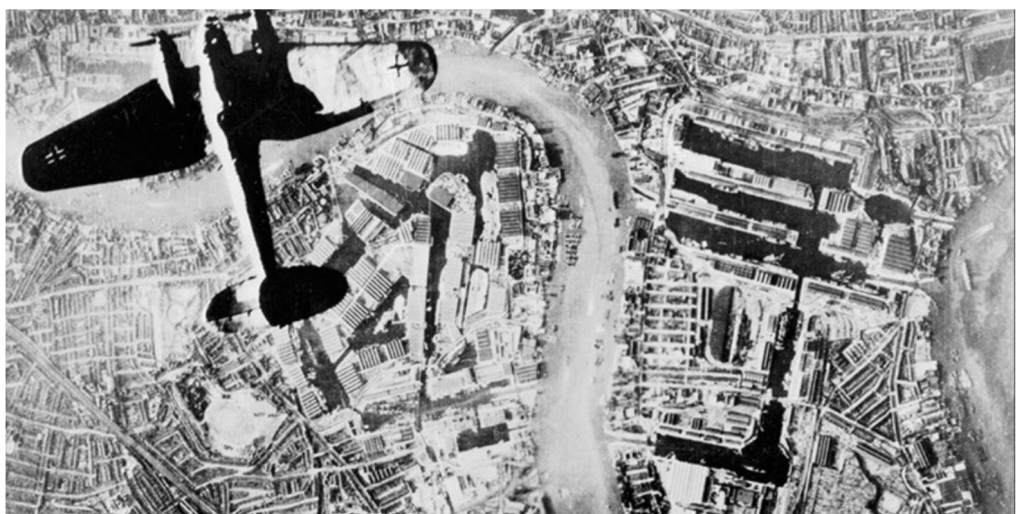
On September 15th 1940 Ray Holmes, World War 2 RAF Pilot, flying a Hurricane, took on three Luftwaffe Bombers over Central London. He shot one down, chased another off and engaged the third which seemed to be heading for Buckingham Palace.
Between the 8th and 13th of September 1940, the Palace had been hit 5 times. The London Blitz had only ‘begun’ on September 7th though the first raid on the City of London was on the 25th August on Fore Street.
Holmes, by now had ran out of bullets, but deliberately targeted the fin of the Dornier Bomber, and crashed into it causing the bomber to crash down into Victoria Station. Holmes’ Hurricane, spiralled down out of control, but he was able to bail out and landed in a dustbin, much to the bemusement of the locals. Holmes died aged 90 in 2005.
This post is heavily based on the story below, where it is told in full detail.
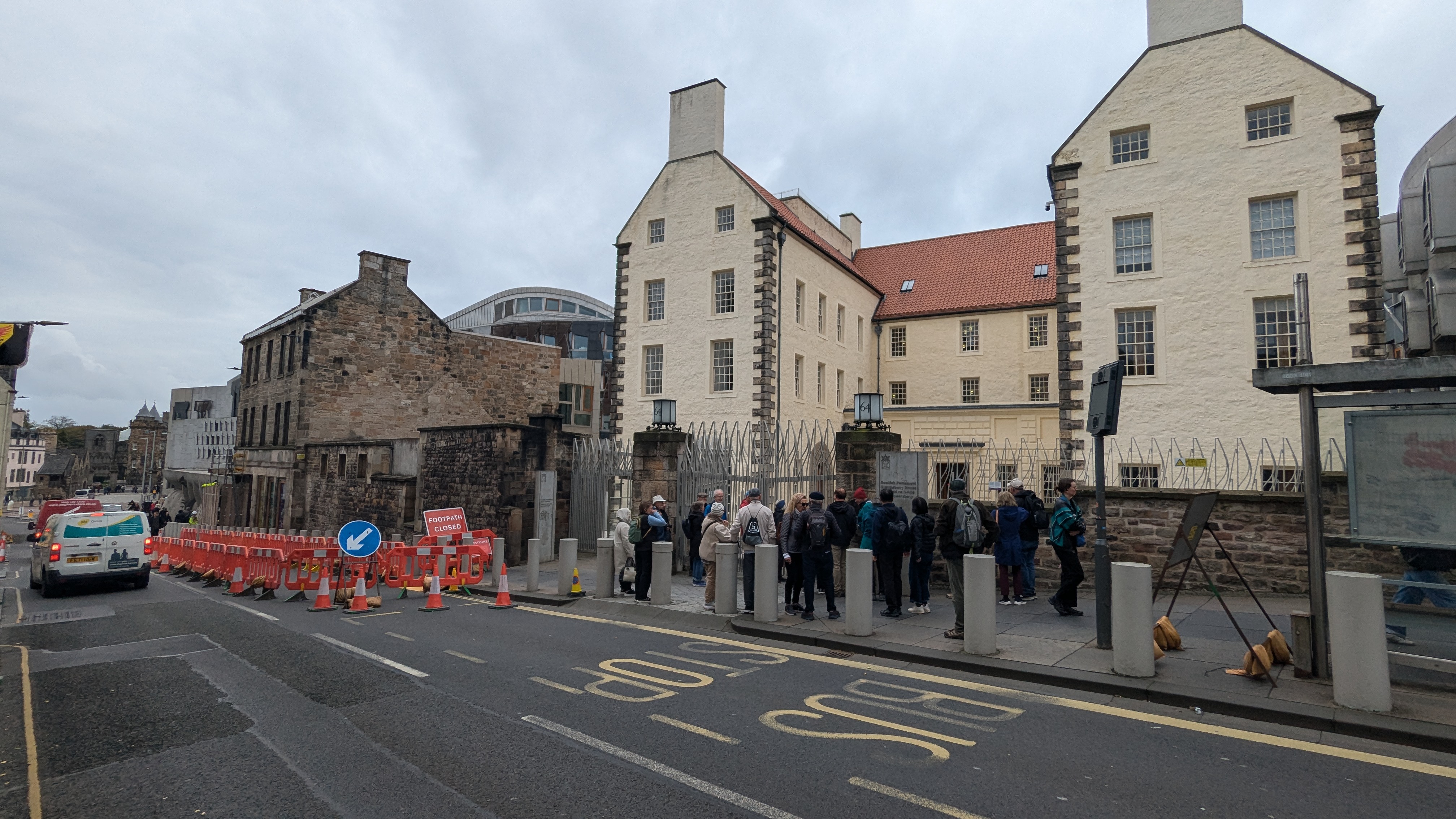
Queensberry House to the right, home of the The Queensberry House Cannibal. The Scottish Parliament in the background. Royal Mile, Cannongate in the foreground. (Photo: K. Flude)
Ian Rankin’s Edinburgh
One of my favourite books on Edinburgh is by Ian Rankin. It is one of the Inspector Rebus series. What makes Rankin a great crime writer is how the author makes Edinburgh central to the story. It adds realism to his stories. As you read the stories you enjoy learning about Edinburgh, its culture, history, people, streets and topography. And get insights into Edinburgh’s moods.
Model of the Scottish Parliament, with Queensberry House in the bottom right hand corner.
I haven’t read all the Rebus books but the one I want to feature is ‘Set in Darkness’ published in 2000. It is set in the period immediately after the success of the Scottish Referendum to set up a Scottish Parliament. The story also takes us back to 1979 when the first Scottish Referendum ‘failed’.
The Queensberry House Cannibal
The book begins with a body found in Queensbury House, which is being preserved and incorporated into the new Scottish Parliament buildings.
Scottish Parliament Building (photo by the author)
This setting was suggested by the well-known tale of the Queensberry House Cannibal; James Douglas the 3rd Marquess of Queensberry and, for a time, the Earl of Drumlanrig. The tale begins on the day, in 1707, that the Scottish Parliament agreed to disband itself. The Parliamentarians voted for an Act of Union with the United Kingdom.
On that day, the young Lord was left alone in Queensbury House with no one to look after him, except a kitchen boy. James had mental issues, and when the adults came home, they discovered that he had eaten the kitchen boy by spit-roasting him. The ghost of the boy is said to haunt the house. Or so the story goes. It’s always treated as a true story, but there is a suspicion it was a black calumny on those who agreed to the end of the Scottish Parliament.
The Restoration of the Scottish Parliament 11th September 1997
So, as today is the anniversary of the day the Scots voted Yes to a restoration of its Parliament (11th September 1997), let’s have a look at the long history of devolution. We will take the story backwards.
The referendum asked the Scots two questions. The first was: did they support a separate Parliament for Scotland? The second. Should it have the power to vary levels of taxation? 74.3% voted yes to the Parliament, and 63.5% voted yes for powers of taxation. On the 1st July 1999 the Scottish Parliament was set up by the Blair Government. The new Parliament was elected by the Additional Member system of proportional representation. The country is split into regions, the regions into constituencies, and each constituency elects a member of the Scottish Parliament by first part the post system. Each region has a party list of additional potential members, and the seats are allocated between the parties to make the final result as proportion as possible. This is said to combine the advantages of constituency MPs, and PR.
The ‘Failed’ 1979 Referendum
But this wasn’t the first vote for a measure of independence. In 1979, the Scottish Act set up a referendum for a Scottish assembly. James Callaghan was the Prime Minister, and the act followed a Royal Commision on the Constitution. The Referendum was won with a majority of 52%, but an amendment to the Act had a stipulation that there had to be a vote of at least 40% of the registered electorate for the vote to succeed. It won only 32% of the 62% turnout so the Act failed. (if only Cameron had done something similar for the Brexit Referendum!).
So it would be another almost 20 years before the Scots got their own debating chamber.
1707 Act of Union
The Scots lost their Parliament on the 1st May 1707 when the Act of Union with England was enacted. The Scottish Parliament had been in existence since the early 13th Century. The Scots had no House of Commons, but its unicameral Parliament had representatives from the Three Estates: prelates representing the Church; Aristocrats representing the nobility, and Burgh Commissioners representing the Towns. Later, Shire Commissioners were added to represent the countryside.
The decision to disband the Parliament of Scotland was very controversial, and blamed on the self-interest of the Nobility against the wishes of the people. Scotland had lost out on the huge profits being made by the Empire by England, excluded as the Scots were by the Navigation Acts from trading freely within the British Empire. So the Scots set up their own Company of Scotland Trading to Africa and the Indies which invested in the disastrous Darién scheme,
The idea was to build a colony on the Isthmus of Panama. 80% of the participants in the settlement died, and the 20% of Scottish wealth which was invested in the scheme was lost. Many of the Scottish members of Parliament lost money in the Scheme, and compensation and bribery offered by the English encouraged the Parliamentarians to accept the advantages of free trade within the British Empire and to join the Westminster Parliament.
Joint Monarchies
In 1603, the Scottish and English monarchies joined in the person of James VI of Scotland who became James 1st of England on the death of his childless aunt, Queen Elizabeth 1. But the Scots kept their own Parliament and legal system. There were attempts to bring a closer Union, but these all failed until 1707.
England Overlording it?
From the early beginnings of Scottish existence as an independent nation, the English Monarchy claimed to be the feudal overlord of Scotland. Scotland was normally able to deny this until the reign of Edward I. After the battle of Bannockburn the Scottish made a declaration of their complete independence from England at Arbroath. It was sent to the Pope who accepted it. This helped the Scots defy England until 1603 when the two monarchies joined.
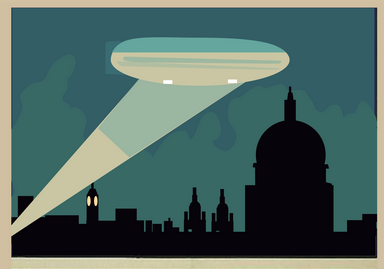
A silhouette of a Zeppelin caught in searchlights over the City of London
On the night of September 8th, 32 year old, Kapitanleutnant Heinrich Mathy piloted Zeppelin L 13 across Central London, dropping bombs as he went. This was the most damaging airship raid of the war.
Background to the War
Before World War One London was the centre of the largest Empire the world had ever known. It was the first great era of globalisation; international trade and finance was booming. London was full of the mega-rich, but poverty and substandard housing was extensive. Such extremes of rich and poor have only recently began to appear in our society.
Inner London was still the home of Industry, and home to large immigrant communities. Political dissent was widespread, with the Labour Party beginning to erode the Liberal Party’s power base. The issue of Female Suffrage was rocking society. Then, catastrophe struck as ‘the lights went out all over Europe’.
The Hague Convention in 1899 banned bombing from balloons or other aerial craft. But as the aircraft and air balloons developed, the threat moved from theoretical to actual. Zeppelins could undertake long flights at a speed of up to 47 mph. They could ascend and descend quicker than winged aircraft and achieve higher altitudes. The gas that held up the Zeppelins was held in over 200,000 bags of cattle intestines. The huge number needed in the war effort led to a shortage of sausages in Germany! But it also made them very difficult to be shot down with the technology available to Britain, France and Russia.
The Kaiser originally forbade bombing raids on London in deference to his relatives, the British Royal Family. But he progressively reduced restrictions until he allowed bombing of London itself. He first allowed bombing of the London docks on February 12th 1915, and on May 5th allowed London, East of the Tower of London to be bombed. The first Zeppelin raid on London took place on 31st May 1915. On July 20th, he allowed unrestricted bombing of London (albeit sparing historical and religious buildings).
On the 8th September, 1915 Mathy crossed the North Sea to the coast at King’s Lyne. He arrived at 8.45pm. The aircraft came South via Cambridge, Ware, circled to the North East of London and via Golders Green. Here he dropped 12 bombs at 10.40., and followed the Finchley Road to Primrose Hill, Regent’s Park. Over Euston he was at 8,500 ft, and slowed down to 37 mph.
The first incendiary bomb in Central London landed just north of Russell Square at Woburn Place. The next one landed in the garden in the middle of Russell Sq. He dropped his first Central London explosive bomb in the garden in the centre of Queen’s Square, near the Great Ormond St Hospital, where it is marked with a plaque. He was turning east along the Theobald’s Road where he dropped a number of bombs. One hitting the National Penny Bank killing a person standing outside. Another landed on the nearby Dolphin pub, blowing out the front of the pub and killing someone standing there. If you visit the Pub, on the wall you will see the clock that was stopped when the bomb exploded (10:40pm).
The next strike was on a cycle club, to the West of Gray’s inn. Then Gray’s Inn itself. At Portpool Lane his incendiary bombs killed three children and injured 25 others.
Maxim Gun
Near here are the workshops where Hiram Maxim developed the Maxim Gun that killed so many in the trenches in WW1. Unfortunately, the design was not kept as a state secret and in the War No Man’s Land was being strafed by British, French, German, Russian and later in American versions of the same gun. He had the idea for it when as a child his shoulder was broken by the recoil of a shotgun. He realised that the recoil could be used to load the next bullet. This created a machine gun that was far superior to the Gatling Gun.
A Bomb called the Love Gift
Hatton Garden and Farringdon were also hit, and the Zeppelin continued to Smithfield. The Zeppelin had one 660 lb bomb on board. Mathy’s ‘Love Gift’ fell on St Bartholomew’s Close. It shattered all the building fronts and killed 2 men running for cover when they emerged from a pub.
The Zeppelin kept north of St Paul’s and next bombed City workshops and warehouses in Wood St, Addle St, Basinghall St and Aldermanbury – just missing the historic Guildhall. He also failed to bomb the Bank of England which was a mere 300 yards south,
Searchlights were now scouring the sky and anti-aircraft guns were firing, but they were ;all firing too low’. An American reporter, William Shepherd wrote:
‘Among the autumn stars floats a long gaunt Zeppelin. It is dull yellow – the colour of the Harvest Moon. The long fingers of searchlights, reaching up from the roofs of the city are touching all sides of the death messenger with their white tips. Great, booming sounds shake the city. They are Zeppelin bombs falling- killing – burning. Lesser noises – of shooting – are nearer at hand, the noise of aerial guns sending shrapnel into the sky.’
The final bombs were released over Liverpool Street. Just by the station, an explosive bomb hit a No 35a bus, wounding the driver and killing the conductor and some of the passengers. Another bomb landed by a No 8 bus, killing the driver and 8 passengers.
Mathy turned north towards Edmonton and climbed to over 11,000 ft as an anti-aircraft gun on Parliament Hill put a shell uncomfortably close to the Zeppelin. He returned safely to Germany where he reported to the Kaiser. The raid killed 17 people, injured 78 and caused half a million pounds worth of damage. It was the most effective raid of the war.
The authorities in Britain were faced with a stark reality which was that a single German Airship could fly through the heart of Britain, into its Capital and bomb its people without any defensive measures capable of resisting attack. Although when we consider the horrors of civilian deaths in the 20th and 21st Centuries, the shock of random attacks on civilians should not be underestimated.
I will conclude Kapitanleutnant Heinrich Mathy’s story on October 1st, and add more images to this page.
Thanks to Ian Castle and his book ‘London 1914-17 ‘The Zeppelin Menace.
The Master of St Giles, National Gallery. ‘St Giles and the Hind’ This work is in the public domain in its country of origin and other countries and areas where the copyright term is the author’s life plus 100 years or fewer.
St Giles
Today, is St Giles’ Feast Day. His story is mostly unknown, but his legend holds that he was a hermit who had a pet Hind in the Arles District of France sometime after the fall of the Roman Empire. The hounds of King Wamba (a Visigothic King) were chasing the deer, and shot an arrow into the undergrowth. The King and his men followed to discover Giles wounded by the arrow, protecting the hind, who he held in his arms. The hounds were miraculously stayed motionless as they leaped towards the hind. Wamba, which apparently means ‘Big paunch’ in Gothic, also had a Roman name: Flavius. Giles was injured in the leg, although the image above shows the arrow hit his hand. Wamba set him up as an Abbot of a Benedictine Monastery.
St Giles is, therefore, the patron saint of disabled people. He is also also invoked for childhood fears, convulsions and depression. He was very popular in medieval Britain, with over 150 churches dedicated to him, including four in London. Perhaps the two most famous are St Giles Without Cripplegate in London and St Giles Cathedral in Edinburgh.
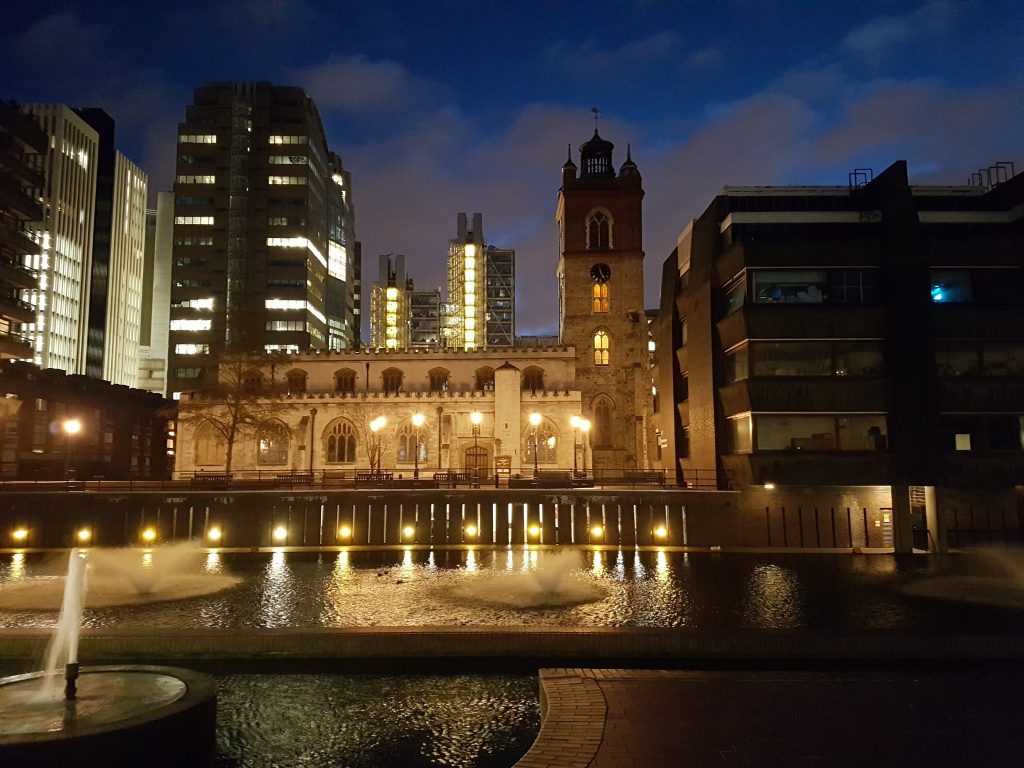
St Giles Cripplegate, photographed by the Author at night from the Barbican Centre.
St Giles Cripplegate
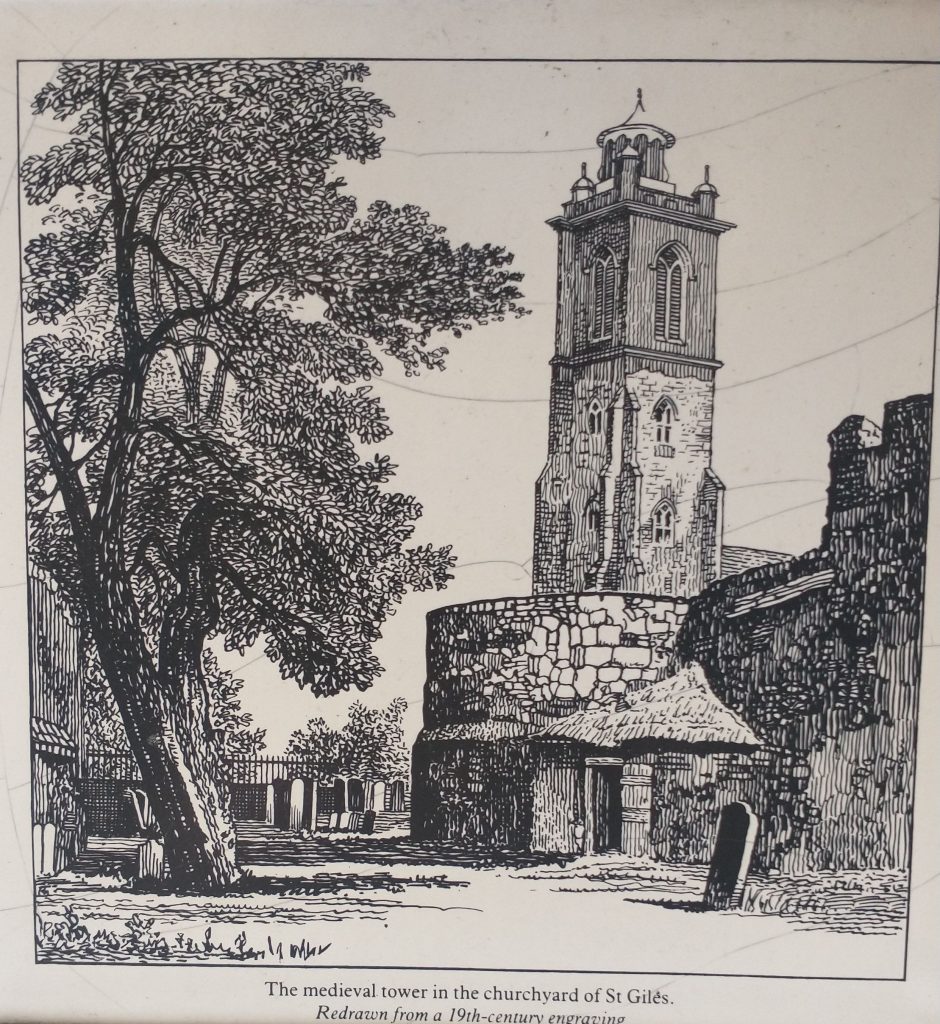
St Giles was built in the 11th Century, rebuilt in the 14th Century and again in 1545-50 after nearly being destroyed by fire. It survived the Great Fire of London, being just beyond the extent of the Fire. But it was badly damaged in the Blitz, although the Tower and the outer walls survived.
Oliver Cromwell married Elizabeth Bourchier here. John Foxe of the Book of Martyrs, John Speed, the Cartographer, Martin Frobisher, the explorer and John Milton, the Poet were buried here.
Shenanigans with Milton’s Coffin
Milton’s coffin was opened in 1793 and he was said to have looked as if he had just been buried. One of those present, then, had a go at pulling Milton’s teeth out. A bystander helped by hitting his jaw with a stone. The few teeth Milton had left in his head were divided between the men, who also took a rib bone and locks of his hair. The Caretaker then opened the coffin for anyone who wanted to see the corpse!
From the London City Wall Trail.
Cripplegate
St Giles is without Cripplegate. It is one of the Gates in the City Wall (originally the North Gate of the Roman Fort). It may be named because St Giles made it agood place to gather for those trying to beg alms for their disabilities. An alternative explanation it from the Anglo Saxon crepel, which is an underground tunnel which is said to have run from the Gate’s Barbican to the Gate. Or perhaps because of the cure of cripples when Edmund the Martyr’s remains passed through the Gate in 1010.
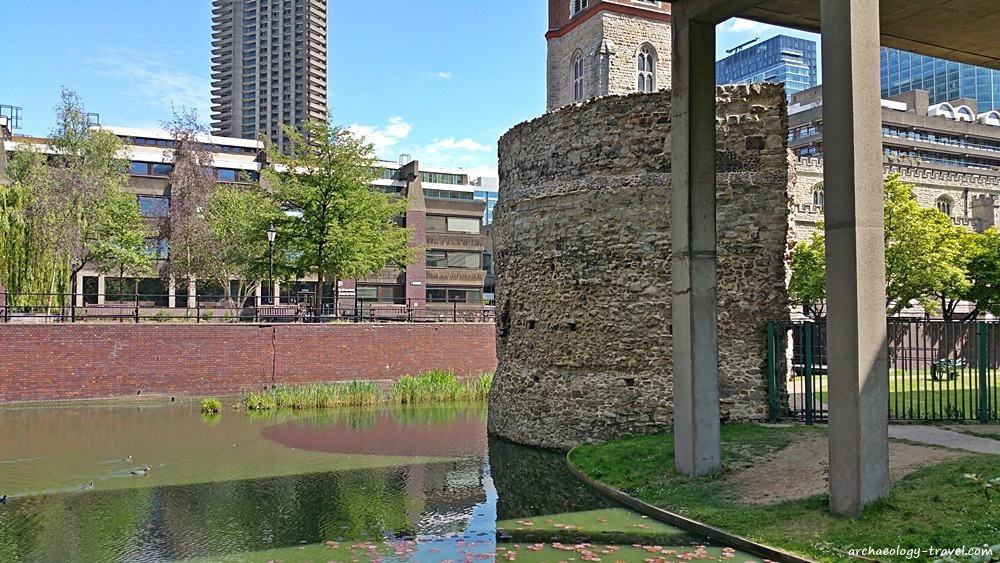
The Corner Tower of the London City Wall, the Barbican in the background, and the tower of St Giles’ Church behind the Tower. Photo by the author
First Published in September 2024, and revised in 2025.
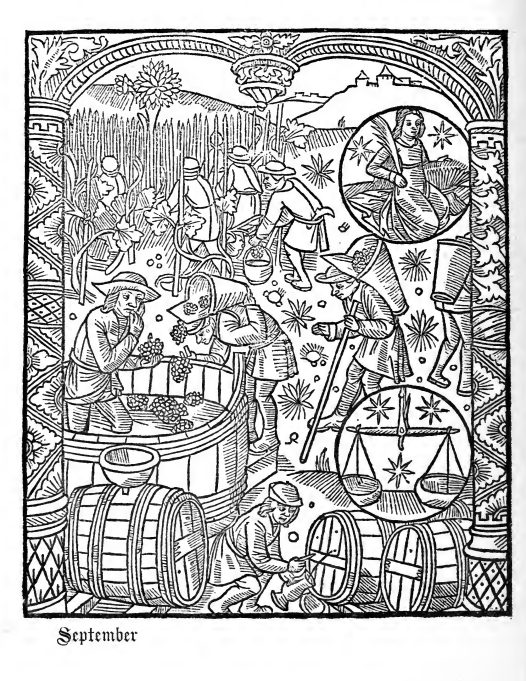
Kalendar of Shepherds illustration of September showing harvesting grapes and the astrological signs for Virgo (August 23 – September 22) and Libra (September 23 – October 22)
It is that time of the year when you say ‘Where has the Summer gone? It can’t be September already?’ But, meteorology, speaking, Autumn starts today. September 1st was chosen on a numerical basis for ease of measuring rather than any profound floral, agricultural or solar reason. So, there are three Gregorian Calendar months for each season, and each season starts on the first of the month. Autumn: September, November and December.
Autumn, Harvest, Fall
Autumn comes from Latin (autumnus) which went into French and then into English. The season was also called Harvest (which went into Dutch herfst, German Herbst, and Scots hairst -Wikipedia) or from the 16th Century: the ‘fall of the year’ or ‘fall of the leaf’ which spread to America as Fall.
Summer’s Ending
It still feels like summer. In England, we often have a glorious September, and what we can an ‘Indian’ Summer, an unexpectedly warm period in mid-September to October.
Solar Autumn
Of course, for the real Autumn, we have to wait for the Equinox, the beginning of Astronomical or Solar Autumn. This year, it is on Monday, September 22nd, 2025, 7:19 pm.
Astrological September
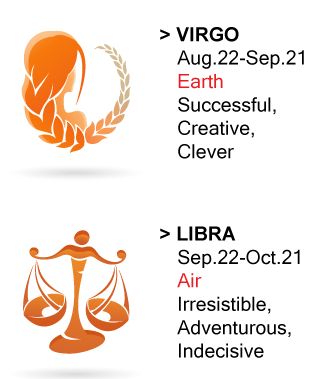
The star signs for astrological September are: Virgo which is linked to Aphrodite (Venus) the Goddess of Love and Libra which is linked to Artemis (Diana), virgin goddess of many things, including hunting, wild animals, children, and birth.
Star signs for September
September
September gets its name from the Romans, for whom it was the 7th Month of the year (septem is Latin for seven). Later, they added two new months so it became our 9th Month. (For more on the Roman year, look at my post here).
It is called Halegmonath in the early English language, or the holy month, named because it is the month of offerings, because of the harvest, and the mellow fruitfulness of September? Medi in Welsh is the month of reaping, and An Sultuine in Gaelic which means the month of plenty.
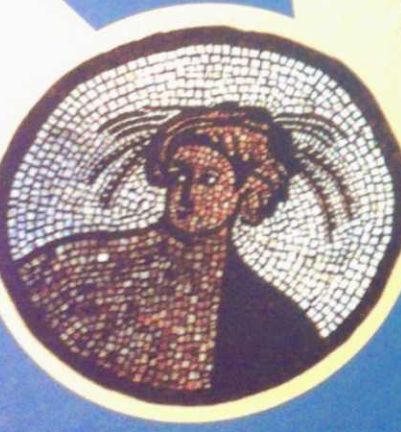
Roman personification of Autumn from Lullingstone mosaic
Early Modern September and the autumn of Life
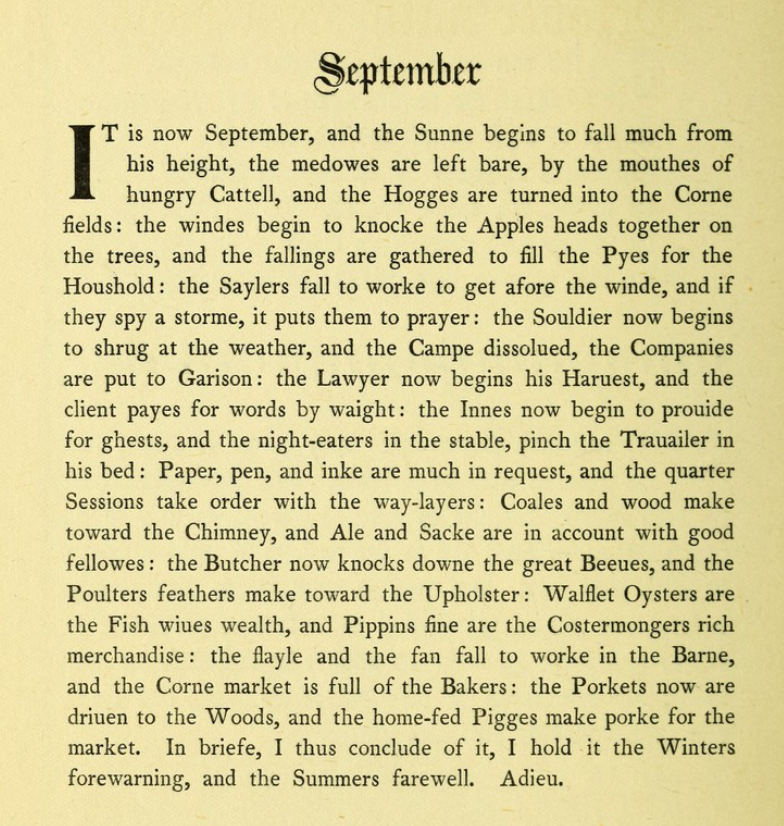
Here is an early 17th Century look at September from the Kalendar of Shepherds – for more on the Kalendar, look at my post here.
From the Kalendar of Shepherds
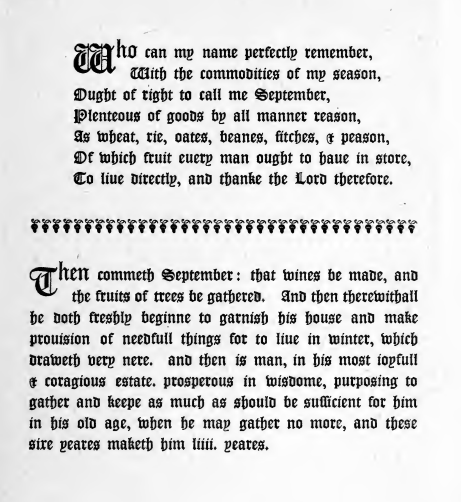
The Kalendar has an additional shorter look at September (see below). And it continues with its theme, linking the 12 months of the year with the lifespan of a man – 6 years for each month. So September is a metaphor for man at 56 years of age, in their prime and preparing for old age.
September from the Kalendar of Shepherds. The last sentence beginning ‘and then is man’ shows the link between September and the beginning of the autumn of life.
Season of ‘mists and mellow fruitfulness‘
John Keats (1795 – 1821) wrote a great poem called ‘To Autumn’:
Season of mists and mellow fruitfulness, Close bosom-friend of the maturing sun; Conspiring with him how to load and bless With fruit the vines that round the thatch-eves run; To bend with apples the moss’d cottage-trees, And fill all fruit with ripeness to the core; To swell the gourd, and plump the hazel shells With a sweet kernel; to set budding more, And still more, later flowers for the bees, Until they think warm days will never cease, For summer has o’er-brimm’d their clammy cells.
Who hath not seen thee oft amid thy store? Sometimes whoever seeks abroad may find Thee sitting careless on a granary floor, Thy hair soft-lifted by the winnowing wind; Or on a half-reap’d furrow sound asleep, Drowsed with the fume of poppies, while thy hook Spares the next swath and all its twined flowers: And sometimes like a gleaner thou dost keep Steady thy laden head across a brook; Or by a cider-press, with patient look, Thou watchest the last oozings, hours by hours.
Where are the songs of Spring? Ay, where are they? Think not of them, thou hast thy music too,— While barred clouds bloom the soft-dying day, And touch the stubble-plains with rosy hue; Then in a wailful choir the small gnats mourn Among the river sallows, borne aloft Or sinking as the light wind lives or dies; And full-grown lambs loud bleat from hilly bourn; Hedge-crickets sing; and now with treble soft The redbreast whistles from a garden-croft, And gathering swallows twitter in the skies.
Written September 19, 1819; first published in 1820. This poem is in the public domain and available here:
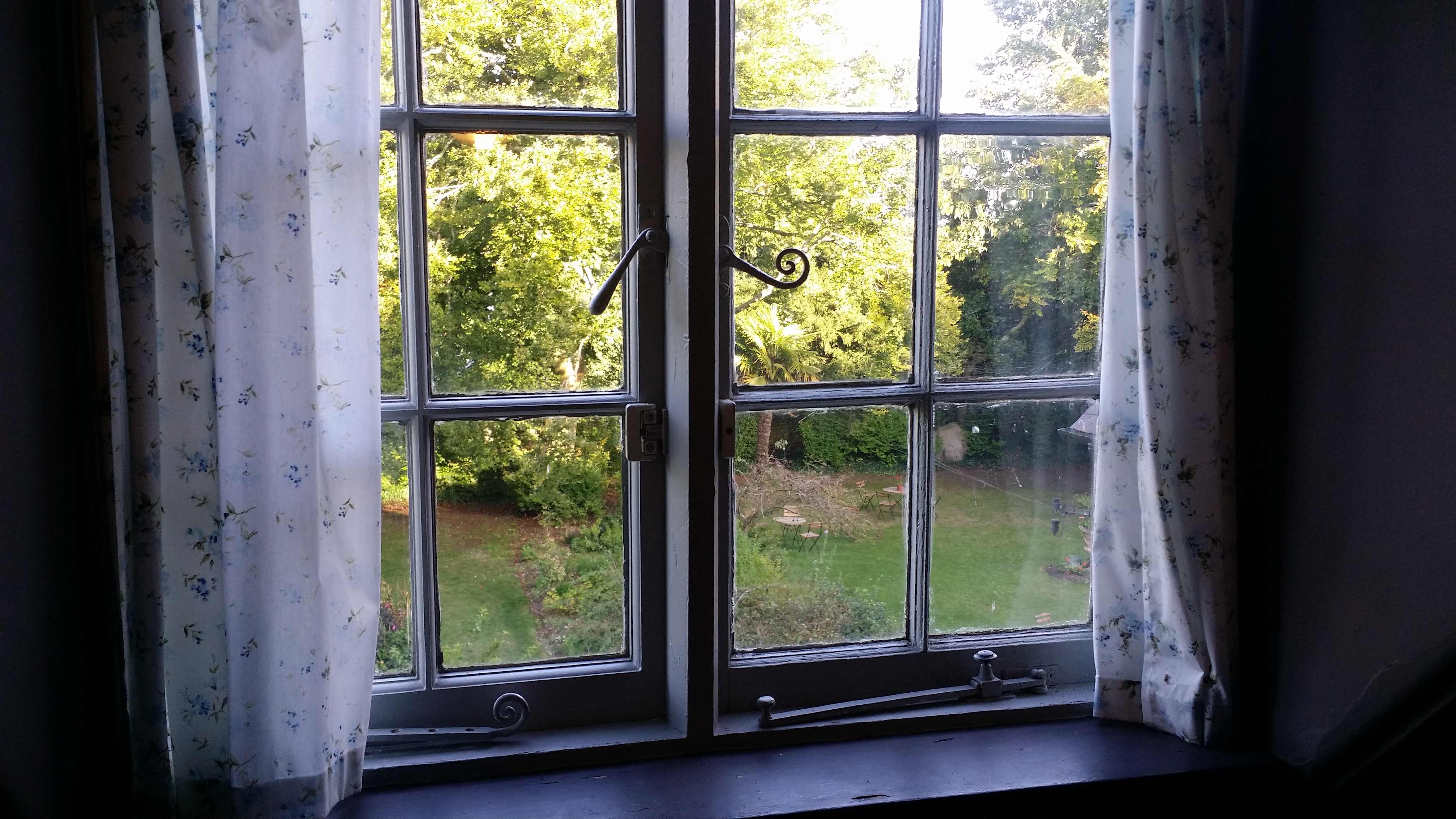
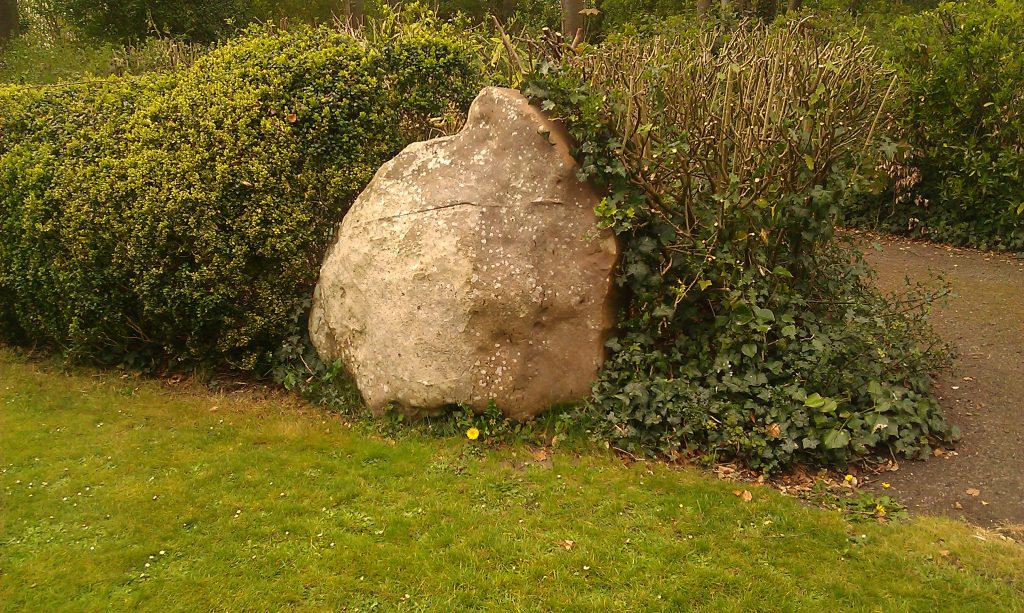
Through the window of Hardy’s Max Gate house, you can see a Prehistoric Sarsen Stone, originally part of a neolithic stone circle or henge. (bottom right window pane, top left corner). Photo: Kevin Flude of Hardy’s Henge
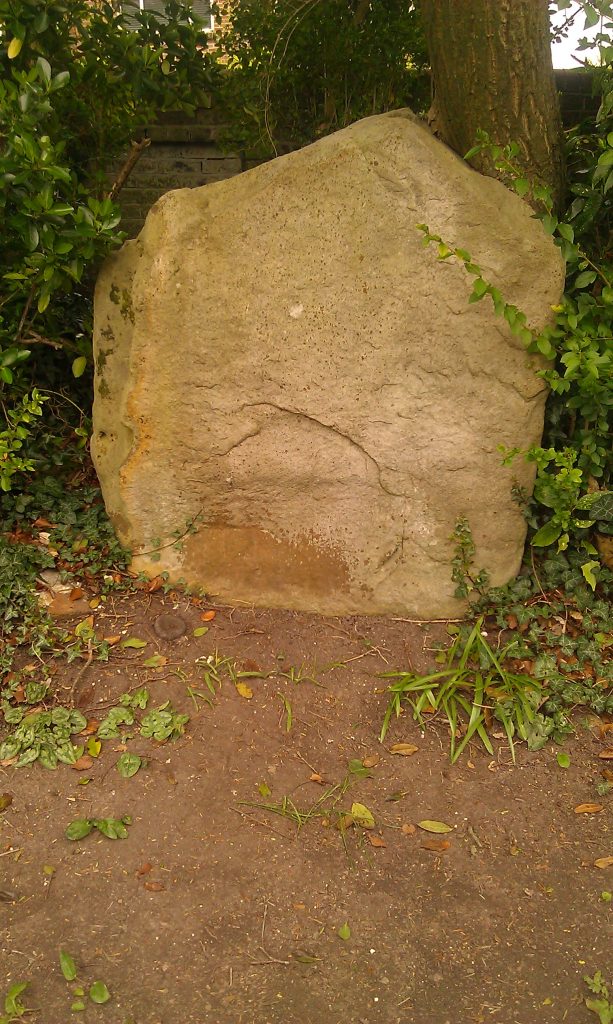
Author of ‘Tess of the d’Urbervilles’ Thomas Hardy was an architect and designed his own house. During the work on Max Gate, the builders came across a large block of sandstone. The stone is of a type called ‘Sarsen’ at Stonehenge. it is ‘a type of silcrete, a rock formed when sand is cemented by silica (quartz)‘. It is a hard sandstone.
Hardy, who loved history, had it relocated into his garden and called it his ‘druid stone’. This recalls one of the most famous scenes in ‘Tess’. She is sleeping on the Altar Stone at Stonehenge as the Police move in to arrest her for murder. Angel, her lover, persuades the Police to let her enjoy a few more minutes of peaceful sleep. After which they arrest her, try her, find her guilty and hang her at Winchester. Spoiler alert?
The Altar Stone at Stonehenge, by the way, has very recently been discovered to be from Scotland. A discovery that confirms that Stonehenge was an immensely important site in the Neolithic and Bronze Age.
Sarsen stone at Max Gate (photo Kevin Flude)Sarsen stone at Max Gate (Photo Kevin Flude
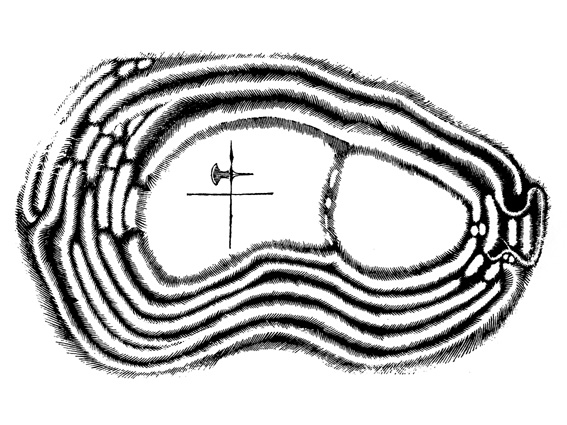
Hardy loved history. How glad he would have been to know his house was in the middle of an important Henge. Hardy’s Henge (aka Flagstones) turns out to be older than Stonehenge. In the 1982. a geophysical survey in advance of the Dorchester Bypass was undertaken. It found evidence of a circular enclosure outside Hardy’s house. This was followed by an excavation in 1987-8. This discovered a large circular bank 100m in diameter, from the Neolithic period.
Half of Flagstones, is largely preserved beneath Max Gate, and has now been officially listed and protected. The excavations suggested a date of construction of 3,000 BC, about the time of Stonehenge’s first construction. But it has just been redated to 3,200BC making Flagstones older than Stonehenge!
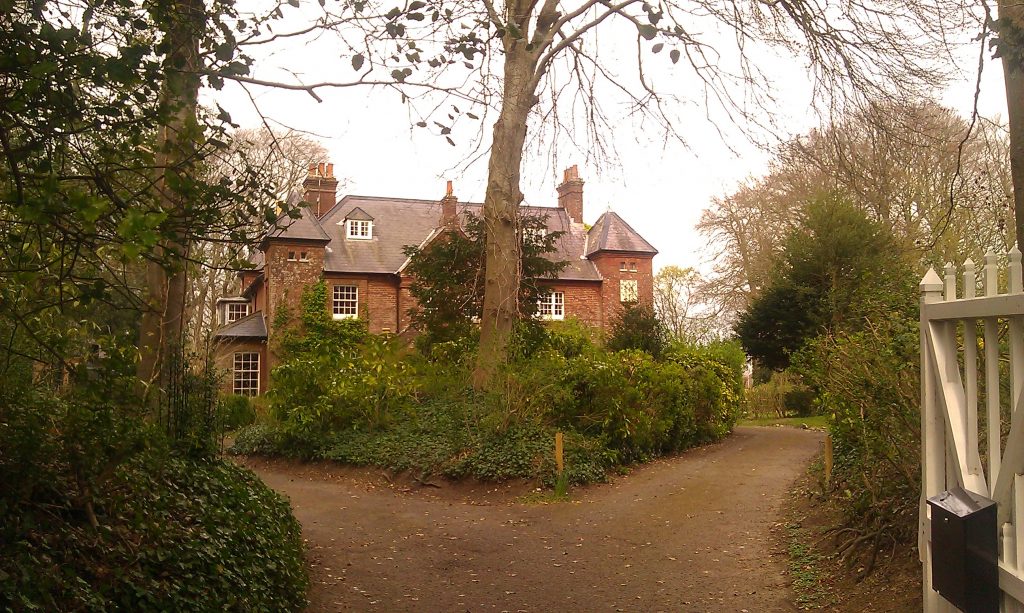
Max Gate, Hardy’s House on the outskirts of Dorchester, Dorset. Photo Kevin Flude
In 2022, targeted excavation designed to explore the other half of the circle revealed further dating evidence. This suggests it was built 500 years before Stonehenge, earlier than 3,500BC. The suggested date of 3650BC makes it one of the earliest in the South West. It was giving listed protection on the August 19th, 2024. (redated to 3650BC)
Susan Greaney – Greaney, S. et al. (2025) “Beginning of the circle? Revised chronologies for Flagstones and Alington Avenue, Dorchester, Dorset”. Antiquity, First View (28). Cambridge University Press: 1-17. (Source Wikipedia)
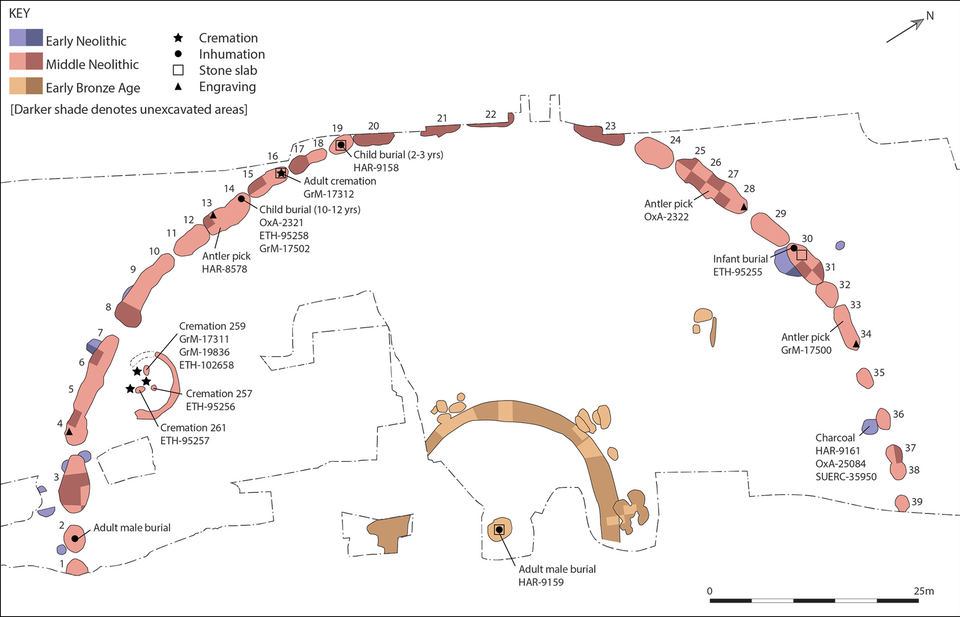
The enclosure consists of a single ring of unevenly spaced pits, forming an interrupted ditch system roughly circular. The dating evidence does not prove that this circuit was built before 3,500 BC. But it does show there was a neolithic presence on the site at this early date. Burials were found in the bottom of the pits forming the enclosure. Four of these pits were had markings on the lower pit walls. These were cut by flint forming pictograms of varying forms from curvilinear, to linear. There was little activity in the Late Neolithic. The site seems to have been reused for funerary and ‘other practices’ during the Bronze, Iron Ages and Roman period.
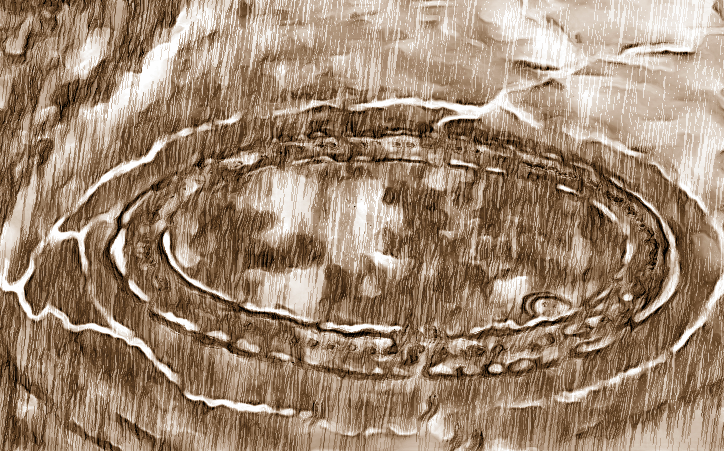
Flagstones sketchup sketch from original by Jennie Anderson (https://www.bbc.co.uk/news/articles/cge12yeqv43o)
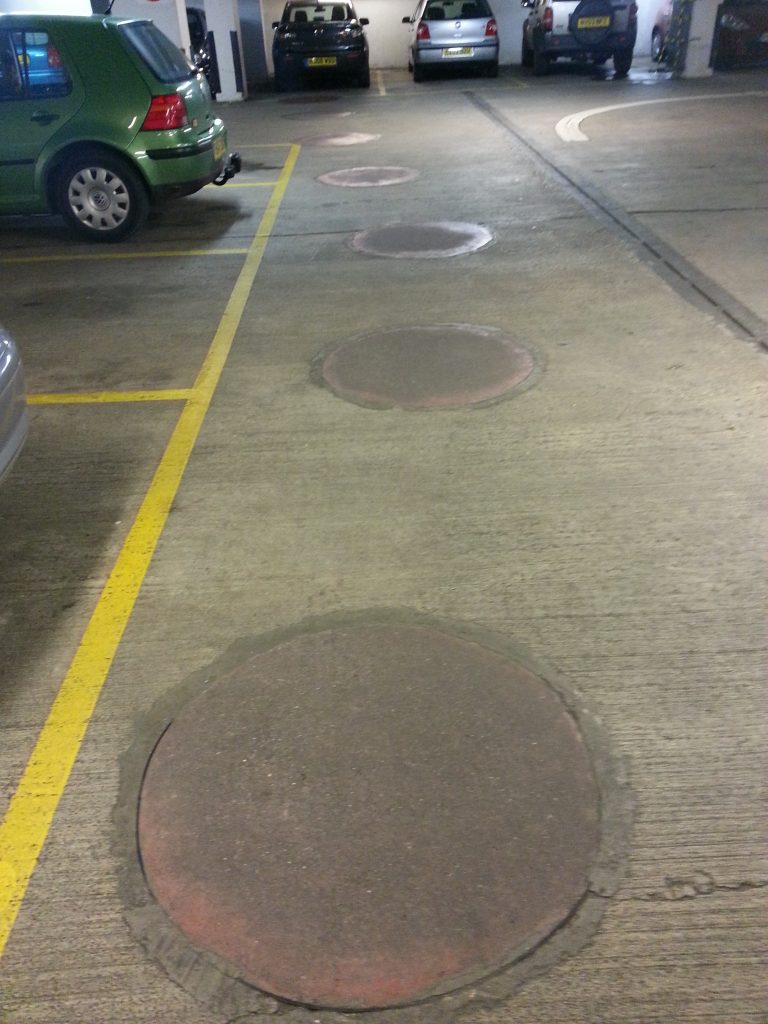
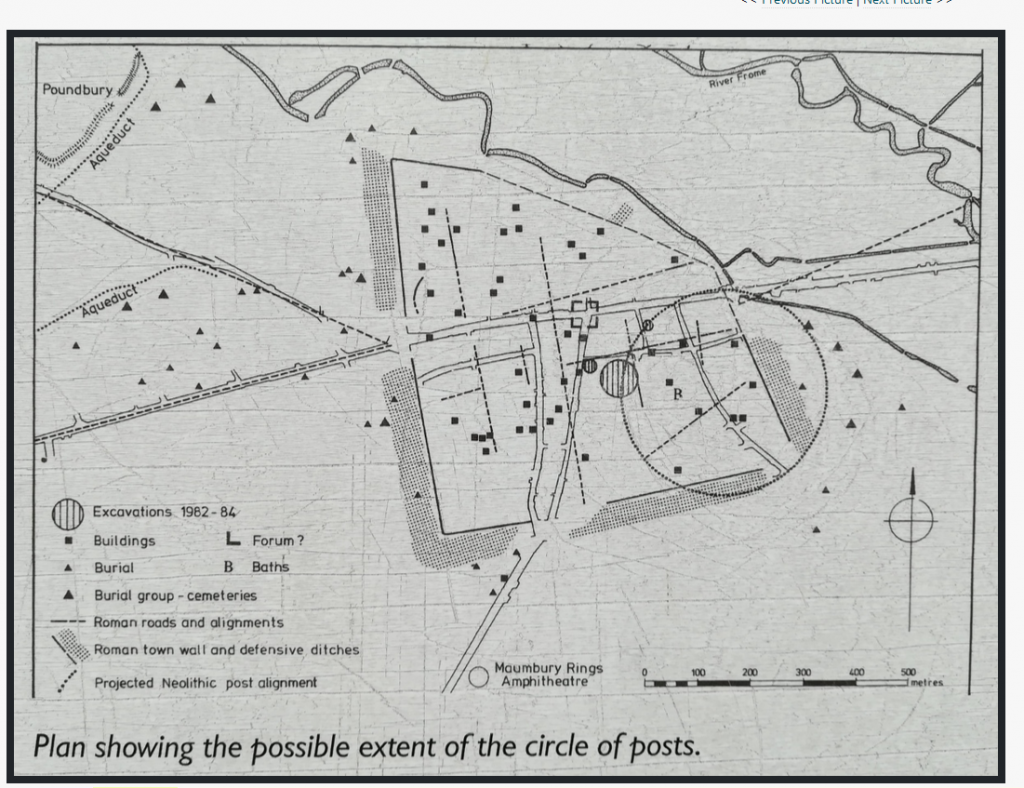
These recent finds make Hardy’s Henge an important precursor to Stonehenge. The site is built on a ridge parallel with the River Frome. Dorchester, a couple of miles from Max Gate, is another ‘ritual landscape’ like Stonehenge. Here are a cluster of important Neolithic and Bronze Age monuments. In the centre of the Town, was found evidence of a massive wooden circle. The postholes are found marked on the floor of the town centre car-park as shown below. The Great Henge is a massive 360m in diameter, covering much of the much later Town Centre. It was built in around 2100 BC.
Neolithic Circle in Dorcester (photo Kevin Flude)
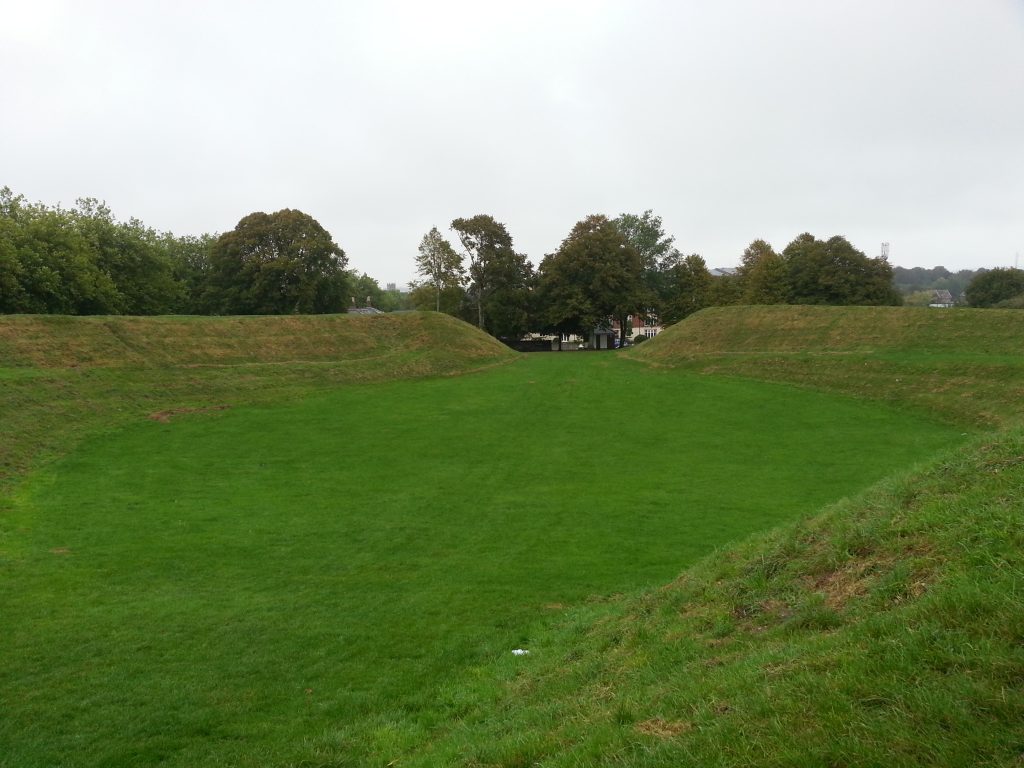
Just outside of Dorchester is a Roman Amphitheatre. This is where Hardy sets the reunion of the Mayor of Casterbridge and Susan Newson. She was the wife he sold at a county fair, years ago when he was a young man. But it began life as another Neolithic circular enclosure. This had an external bank, and an inner Ditch in which were dug 44 tapering pits, up to 10m in depth. Antler picks, chalk objects, including chalk phalluses, were found. The disused amphitheatre was used for executions in the early modern period.
Maumbury Rings – Neolithic Enclosure, Roman Amphitheatre, place of execution, Civil War defense, and fictional meeting place of the Mayor of Casterbridge and his estranged wife, Susan Newson (or Henchard!)
A few miles away, at the Iron Age Hill Fort of Maiden Castle, is a Neolithic Causewayed Enclosure. Hardy also wrote about Maiden Castle, and an excavation.
Maiden Castle. Iron Age Hillfort. the East End was originally a Neolithic Causewayed Enclosure
These ritual landscapes, such as Dorchester, Stonehenge, Avebury, Heathrow and elsewhere shows a clustering of ritual places in important landscapes. It suggests evidence of regional organisation. Stonehenge, however, continues to lead the way for evidence of not only regional but international importance. It drew people, and objects from not only England, Scotland and Wales, but also from the continent.
For further details of the Flagstones listing and excavation, here is the official listing document:
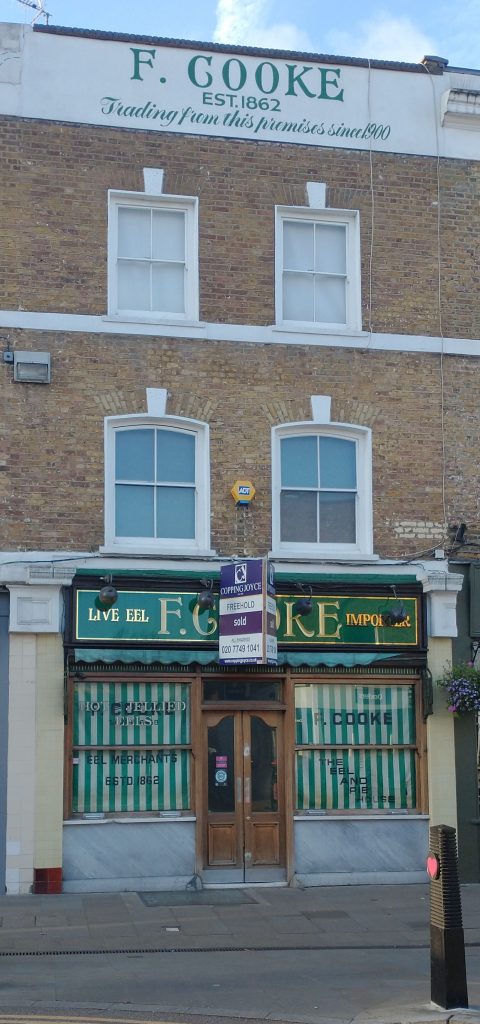
Summer is the best time to fish for Eels. Mid May to the end of July. But they can be caught all year around. Jellied Eels have been a staple of East End diets since the 18th Century. They were to be found in many stalls dotted around the East End, from vendors venturing into pubs and in Pie and Mash shops. Tubby Isaacs is perhaps, the most famous. Jellied eels are still sold in a diminishing number of places in the East End. Manze’s Eel, Pie, and Mash shop at 204 Deptford High Street, London was listed in December 2023. The shop opened in 1914 and was a pioneer of commercial branding. This is the fourth Manze’s shop to be listed: Tower Bridge Street, Chapel Market Islington, and Walthamstow High street. The current owner of the Deptford shop is retiring and so the shop will close.
There are three Pie and Mash shops near me in Hackney. The one in Dalston has become a bar. In Broadway Market it is now an optician. But the one in Hoxton Market is surviving, and all three have retained their distinctive interiors. On the River Lee Navigation is another piece of Eel history which is the excellent Fish and Eel Pub at Dobbs Weir.
Pie and Mash Shop. Established 1862, closed down 2021. Broadway Market, Hackney (photo, copyright the author)
My mum loved jellied eels. It took me until I was over 60 before I could bring myself to try them. And I have no wish to repeat, what for me, was a revolting experience.
By JanesDaddy (Ensglish User) – English Wikipedia – [1], CC BY-SA 3.0, https://commons.wikimedia.org/w/index.php?curid=1663124
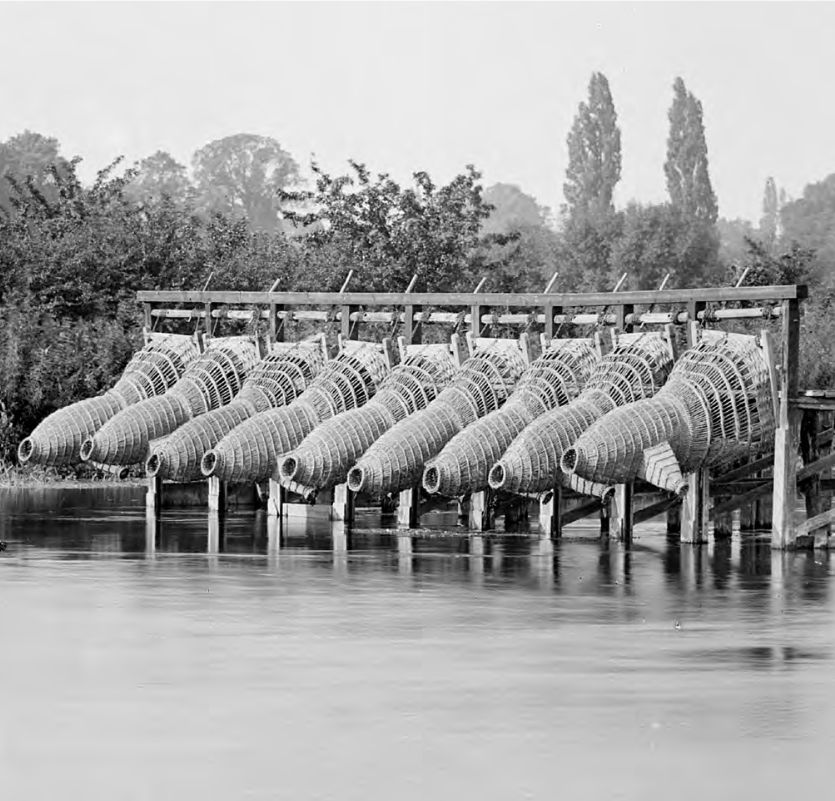
Gervase Markham in his ‘The English Husbandman’ of 1635 provides instructions on how:
To take Eels in Winter, Make a long bottle or tube of Hay, wrapped about Willow boughs, and having guts or garbage in the middles. Which being soaked in the deep water by the river side, after two or three days the eels will be in it and you may tread them out with your feet.
Eel traps at Bray, on the River Thames (Henry Taught 1885)
Romans, Saxons and Eels
Eels have been eaten for thousands of years. Apicius, author of a famous collection of Roman Recipes tells us of two sauces for eels:
Sauce for Eel Ius in anguillam
Eel will be made more palatable by a sauce which has pepper, celery seed, lovage, anise, Syrian sumach, figdate wine, honey, vinegar, broth, oil, mustard, reduced must.
Another Sauce for Eel Aliter ius in anguillam
Pepper, lovage, Syrian sumach, dry mint, rue berries, hard yolks, mead, vinegar, broth, oil; cook it.
Bede’s Historia Ecclesiastica, which tells of Britain as a land with “the greatest plenty of eel and fish.” Several fish traps have been found in and around the Thames, one for example in Chelsea.
Aristotle, Freud and the Deep Sargasso Sea
But eels had a great mystery no one knew where they came from or how they reproduced. Aristotle thought they spontaneously emerged from the mud. Sigmund Freud dissected hundreds of Eels, hoping to find male sex organs. It was only on 19th October 2022 that an article in the science journal Nature disclosed the truth. The article was ‘First direct evidence of adult European eels migrating to their breeding place in the Sargasso Sea‘. Ir proved beyond doubt that the theory that Eels go to the sea near Bermuda to spawn was, incredibly, true.
Eel Pie Island
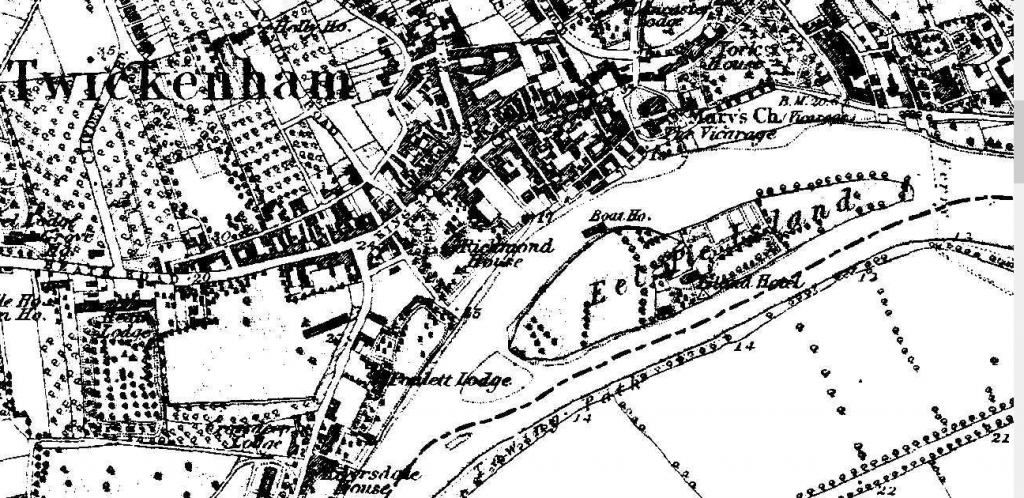
Eel Pie Island . Ordnance Survey In 1871 to 1882 map series (OS, 1st series at 1:10560: Surrey (Wikipedia)
But Eels also have their place in Rock and Roll History. Eel Pie island is on the Thames, near Twickenham and Richmond. It is famous for its Eels. But was home to an iconic music venue. The Eel Pie Hotel hosted most of the great English Bands of the 50s. 60s, and 70s. The roll call of bands here is awesome. The Stones, Cream, Rod Stewart, Pink Floyd, you name it, they were here:
David Bowie, Jeff Beck, Howlin’ Wolf, John Lee Hooker, Memphis Slim, Champion Jack Dupree. Buddy Guy, Geno Washington, Long John Baldry, Julie Driscoll and Brian Auger. John Mayall’s Bluesbreakers, Ten Years After, Chicken Shack, and one of my all-time favourite bands. the Savoy Brown Blues Band. And I have forgotten the Nice, the Crazy World of Arthur Brown, Joe Cocker, and the Who. And many more!
The Rolling Stones played at the Railway Tavern, Richmond on Sunday, February 24, 1963. Here they were spotted by people from the nearby Eel Pie Hotel. They were booked for a 6 month residency, which they began as virtually unknown and ended as famous.
This was first published as part of another post in 2022, and revised and republished on 28th November 2023, 2024.Moved from November 28th to July 23rd in 2025
(I moved it to make room for a post on Mrs Shakespeare. Also, because I cannot find anything to substantiate the opening statement that the Eel Season had its second day on November 28th. All evidence I find says the best fishing is in the Summer.
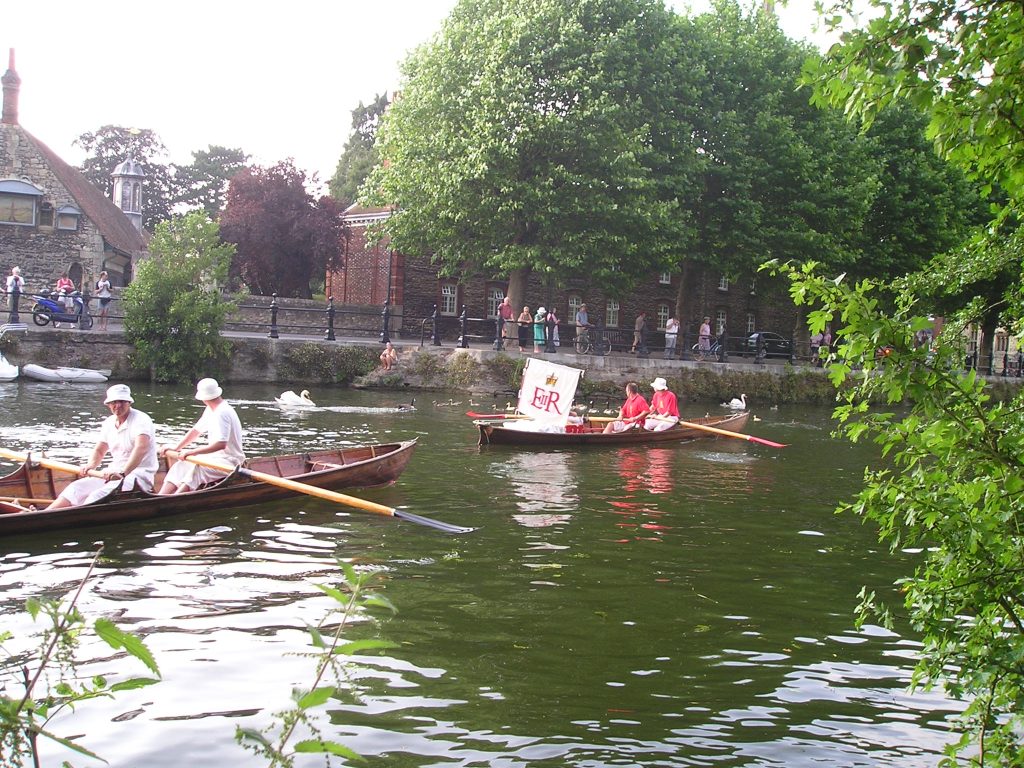
Swan Upping By Philip Allfrey Abingdon 2006 – CC BY-SA 3.0, https://commons.wikimedia.org/w/index.php?curid=2464315. The Royal Uppers are to the right and the Vintners’ Uppers on the left.
Swan upping takes place on the 3rd Week of July. It is an annual census of the Swans on the River Thames. This year it began on Monday, July 14th. It began in the 12th Century.
In theory, the King has the ownership of all unmarked Mute Swans on open water in the UK. Swan Upping is an ancient ceremony during which Swans are upped, checked for health and ringed if they do not belong to the King. In fact, it is the Cygnets which are upped. They are checked for weight and health. Their parents are checked for an ownership ring. If the parents are ringed then the young cygnets will be ringed accordingly. If the parents are not ringed, then they belong to the King and remain unringed.
This ceremony now only takes place on the Thames. It begins at Sunbury and progresses to Abingdon. The Swan Uppers have traditional wooden rowing skiffs and a scarlet Upping Shirt. They are managed by the Swan Marker. The Royal Uppers are accompanied by Swan Uppers from the two City Livery Companies that still have rights to ownership of Thames Mute Swans. These companies are the Dyers Company and the Vintners Company.
If you want to catch Swan Upping this year you will find them upping Swans at the following places:
Thursday 17th July 2025 Sonning-on-Thames 09.00 – Departure point Caversham Lock 10.15 Mapledurham Lock 12.30 Goring Lock 17.00 Moulsford 18.00
Swans moult in July and August, and this renders them flightless. This can last for a period of up to 6 weeks. So it makes them a lot easier to up!
The Swannery at Abbotsbury
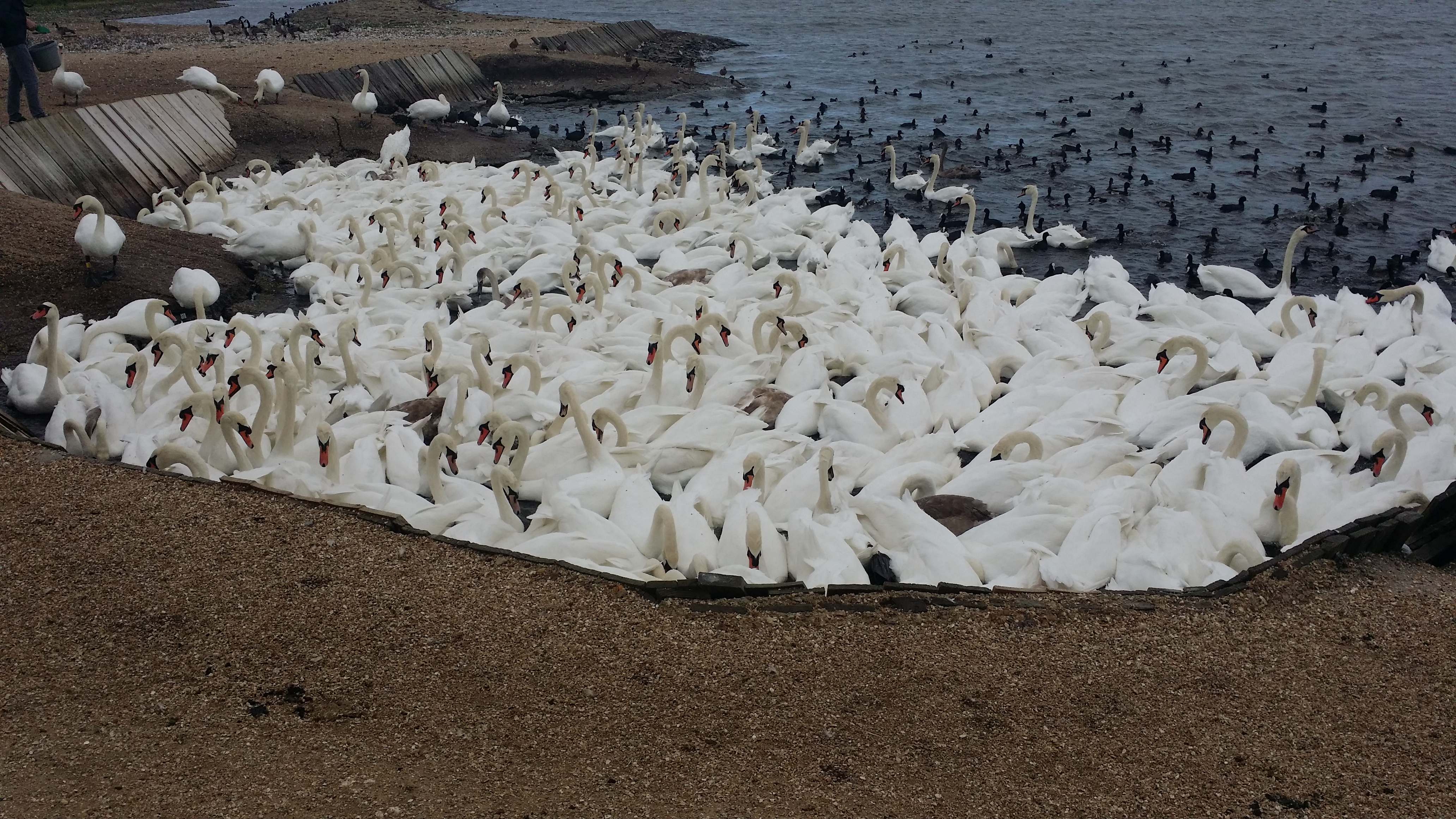
Now I didn’t find that fact on any of the web sites I consulted about Swan Upping. For many years I gave a wonderful programme called Literary Landscapes where we explored lanscapes associated with Jane Austen, Thomas Hardy, Agatha Christie, Conan-Doyle and Charles Dickens. On it, we went to the Swannery at Abbotsbury in Dorset. This was founded by Benedictine Monks in the time of King Cnut. The Strangeways family acquired the Monastery after the Dissolution and still own the Swannery. So they are the fourth authority in the UK who own Swans.
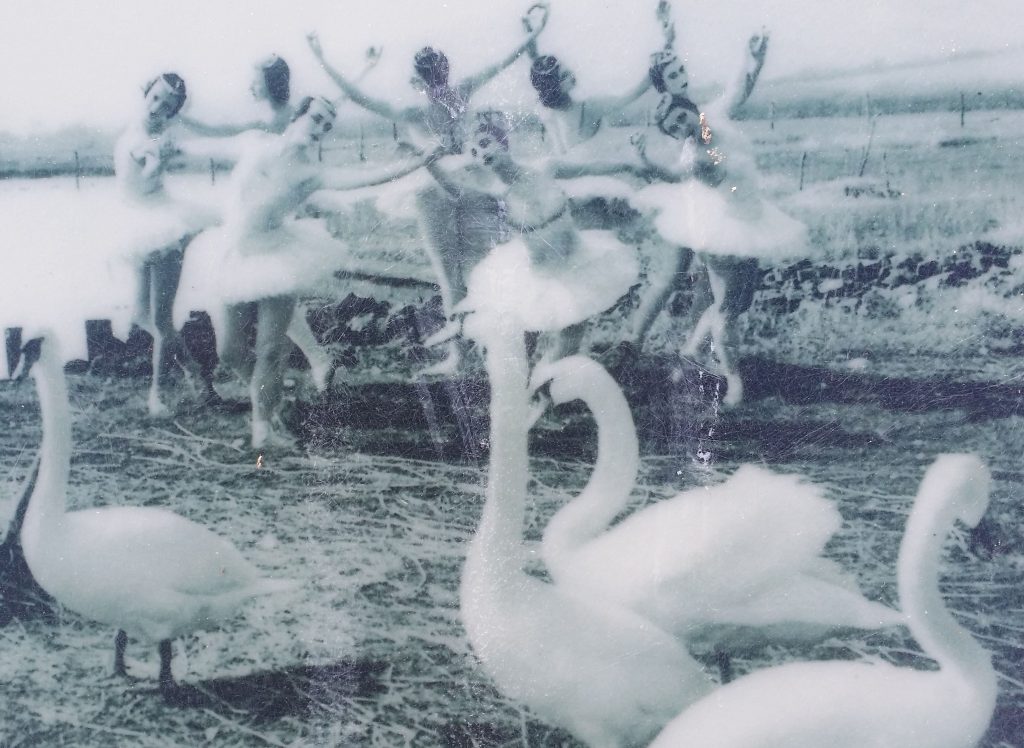
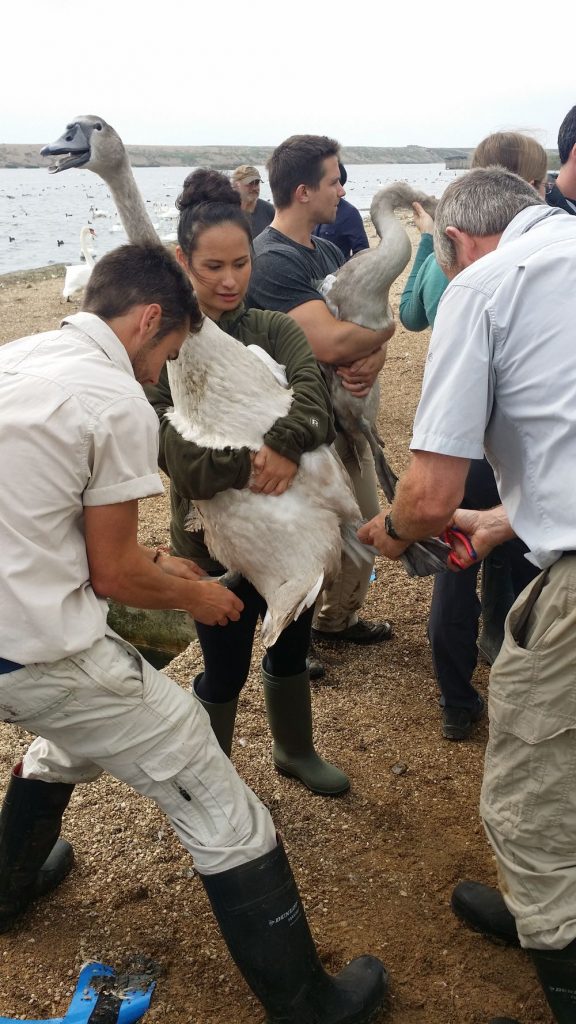
It is a remarkable place, in the heart of Hardy’s Wessex and by the glorious Chesil Beach. Every other year, the Mute Swans are checked and ringed during the flightless period. When Pavlova was working on Swan Lake, she took the dancers to Abbotsbury to observe the behaviour of the Swans.
Photo by the author of a panel at Abbotsbury showing Pavlova’s dancers posing by the Swans of Abbotsbury
Feathers are collected during the moulting season. They are used by Lloyds Registry, the Society of Calligraphers, illuminators, and other scribes for writing-quills. Other feathers are used by the Plummery to make headdresses for the Royal Bodyguard. They are also used for artists’ brushes, brushes for sweeping bees from honeycomb and arrow flights! (Source: panel at Abbotsbury).
Ringing the Swans at Abbotsbury 2018 Photo by Kevin Flude
The Ashwini kumaras twins, sons of the sun god Surya. Vedic gods representing the brightness of sunrise and sunset Wikipedia
The Divine Twins, aka the Dioscuri, were horsemen. Patrons of calvary, athletes and sailors, one of many Indo-European twin gods. They had many adventures including sailing with Jason and the Argonauts.
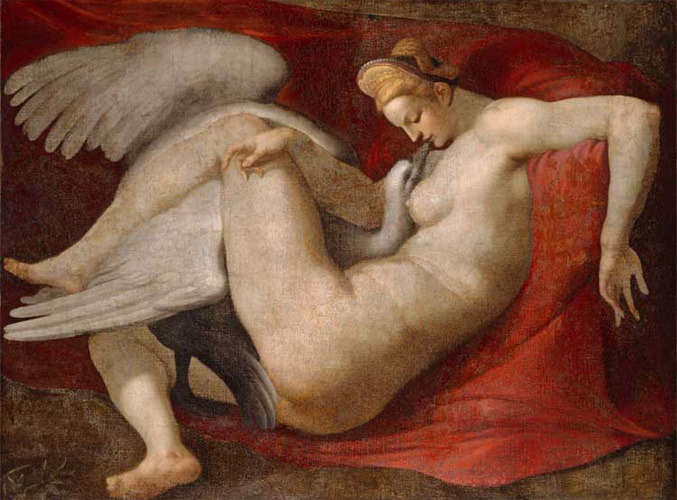
And are they well connected?! Pollux is the son of Zeus His twin brother has a different and mortal father, the King of Sparta. But the boys share the same mother, Leda. She was raped by Zeus in the guise of a swan.
This makes them examples of heteropaternal superfecundation as Mary Poppins didn’t sing. But their different paternity had consequences. The most important is that one was (is?) therefore immortal and the other wasn’t.
According to some version of the story, Castor (the mortal one) was mortally wounded. Zeus gave Pollux the option of letting his brother die while Pollux could spend eternity on Mount Olympus. The alternative was to share his immortality with his brother. Pollux did the good thing. So the twins spend half their year as the Constellation of Gemini and the rest, immortal, on Mount Olympus. Thus, they are the epitome of brotherly love.
Divine Twins or Sisters from Hell?
The Dioscuri’s sisters were no less than Helen of Troy and Clytemnestra. Never mind the Brothers, what Sisters! Helen of Troy you know. And Clytemnestra! They were also twins, Helen the divine daughter of Zeus, husband of Menelaus, lover of Paris. Sister, Clytemnestra, mortal daughter of the King of Sparta, husband of Agamemnon (brother of Menelaus).
It happened like this. The Swan was being pursued by an eagle, so Leda protected the Swan and took it to bed. On the same night she slept with her husband Tyndareus of Sparta. Two eggs were fertilised, each split in two to give two sets of twins.
She was the wife of Agamemnon, the arrogant leader of the Greeks. On the way to retrieve Helen from Troy, the Greek Fleet was becalmed. So, following his seers’ advice, Agamemnon sacrificed his own daughter, Iphigenia, on the island of Aulis. The Gods then set the winds fair to Troy. (Read Iphigenia at Aulis by Aeschylus, a great play which I studied in Classical Studies at University).
Meanwhile, Queen Clytemnestra, abandoned at home, broods on her husband’s heartless fillicide. She takes a lover. After 10 years of war, Agamemnon comes back, in triumph, from the destruction of Troy. He brings with him his prize, the Trojan Princess, Cassandra, sister of Hector.
Cassandra has been gifted with the ability of accurate prophecy. But, as often in the case of prophecy stories, the gift came with a sting in its tale. She was also cursed with the inability to get anyone to believe her! She prophesies disaster and that she too will be a victim.
Strutting with arrogance, Agamemnon demands Clytemnestra prepare him a bath. And, so she runs it for him, and she gives him the hottest bath possible. With the help of her lover, she hacks Agamemnon to pieces with an axe. Cassandra is butchered.
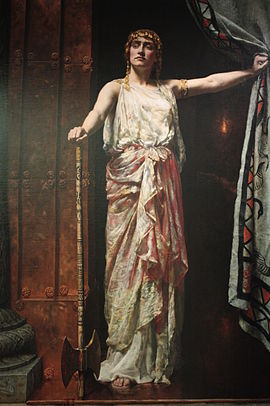
Clytemnestra by John Collier,_1882 (Wikipedia Guildhall Museum)
Attitudes
I visit John Collier’s painting of Clytemnestra at the Guildhall, in London, regularly. I am fascinated by her grim, yet satisfied, expression.
In the 18th/19th Century, rich people were into ‘attitudes’. For example, Emma Hart, later Lady Hamilton, would be invited to present an attitude in front of a dinner party of mostly male aristocrats. She would dress up in a flowing, revealing unstructured classical gown. Then she would stand on a table or pedestal, and present herself as Helen or Andromache or any other classical beauty guests might fancy an eyeful of. She would assume an appropriate facial expression and posture for everyone’s pleasure.
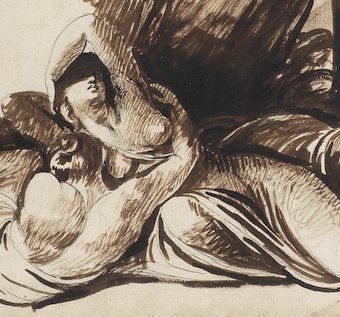
Detail of Emma Hart modelling as Iphigenia by George Romney in ‘Cimon and Iphigenia’
Being Clytemnestra is, surely, the most difficult? I imagine Collier’s model being prompted to look both sad at the loss of the daughter. Outraged at the arrogance of the husband. Horrified at the gore of the murder. But, overall, she has to portray a grim satisfaction that the bastard got exactly what he deserved.
Dorothy Dene
Lord Leighton had a famous model who was exceptionally skilled at adopting poses for his paintings. He determined to help her with an acting career. As part of the plan he helped improve her cockney accent. It is said this inspired Bernard Shaw’s story Pygmalion, which, in turn, inspired My Fair Lady and Eliza Doolittle.
Leighton’s model was Dorothy Dene. She became a famous actress, outstripping the fame of Ellen Terry and Lily Langtry. For more on Leighton and Dene look at my post here.
John Collier
Before we finish, do have a look at John Collier’s Wikipedia because he is the most ridiculously well-connected painter you can imagine! Related to half the Cabinet and married to TWO daughters of Darwin’s Bulldog, T.H. Huxley (grandfather of Aldous Huxley).
For more on Flaming June see my blog post of 12 July 2024
European Twin Gods
It is suggested that twin male gods are a feature of Indo-European religions. The divine Twins are associated with horses/chariots and are responsible for moving the Sun and the Moon. Their use of a horse above the water means that they can rescue people lost at sea.
St Elmo’s fire was said to be the way they manifested their divinity to sailors. Diodorus Siculus records that the Twins were Argonauts with Heracles, Telamon, and Orpheus. Further, he tells us, in the fourth book of Bibliotheca historica, that the Celts who dwelt along the ocean worshipped the Dioscuroi “more than the other gods”.
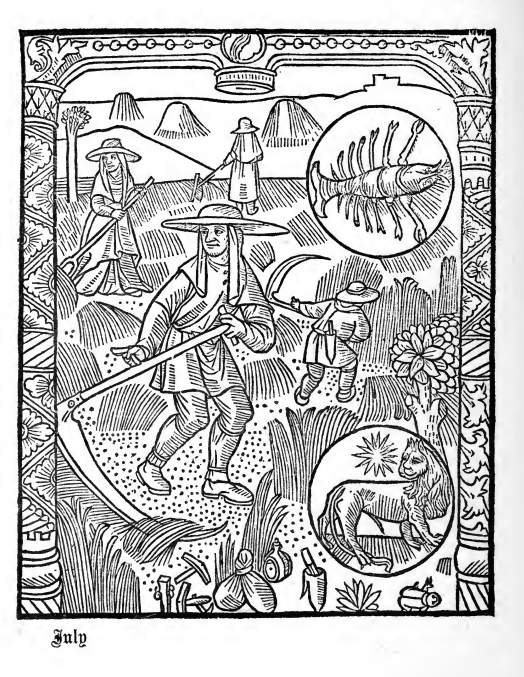
‘They that wive twixt sickle and scythe shall never thrive’
The time between haymaking and the corn harvest was such a busy period, that it was considered a bad time to marry. Haymaking was done by hand with a sickle, these were swung at an angle to cut the grass. It was easier if a good rhyme could be set up. The first man would step out in to the meadow but the next man had to leave a little gap to ensure he was safe from his fellows swinging sickle.
Apparently, the song ‘One Man went to mow, went to move a meadow’ gives the right gap, the second man would come in with the next line ‘Two Men went to mow, went to move a meadow’ and so on.
Once cut, the grass needed to be dried out in the fields, and turned every so often with a pitchfork. Once dried, it was taken to the farmyard and the hay built into a hayrick. The rick typically had a thatched roof. The hay, normally made of a mixture of grasses, was cut off from the rick by a hay knife to fed to animals in the winter.
Experiments at Rothamsted Park Grass, in Hertfordshire, have allowed scientists to study the effects of annual hay cutting. This study has been in continuous operation since 1856 which makes it the oldest continuous field experiment in the world. Among the many findings is the counterintuitive discovery that when fertiliser was evenly applied, the number of plant species declined from forty to fewer than five. Here is an article on Rothamsted Park Grass which gives interesting details.
If you wish to grow your lawn to increase biodiversity and to make it wildlife friendly, then read this is article. It is very important that we revive our battered wildlife. 97% of the UK’s semi-natural grassland has been destroyed over the last 80 years says ecologist Jack Marley.
July Haymaking from the Kalendar of Shepherds 15th Century
First published in June 2023, and republished in July 2024.





![By JanesDaddy (Ensglish User) - English Wikipedia - [1], CC BY-SA 3.0, https://commons.wikimedia.org/w/index.php?curid=1663124](https://www.chr.org.uk/anddidthosefeet/wp-content/uploads/2023/11/1280px-Eels_1385-1024x768.jpg)