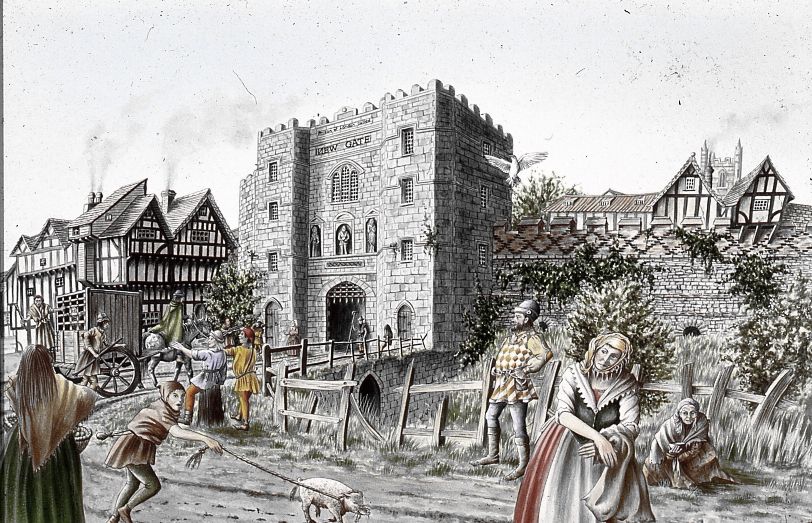
Every Thursday (from Jan 7th 2021) at 6.30pm Exit 2 Bank Underground Station
A walk which explores the City of London that was destroyed by the Great Fire of London in 1666. By 1400 London was dominating the affairs of the Kingdom in spectacular fashion and had grown into a sophisticated medieval Capital, competing against the great capitals of Europe.
We will walk in the footsteps of Geffrey Chaucer, in the muddy City Streets, exploring the unhealthy conditions and poverty amidst great riches and pageantry. It was a cosmopolitan City with colonies of Italians, Germans, Dutch, and French who lived cheek by jowl with native Londoners.
By the 16th Century despite repeated visitations of plague, the huge influx of newcomers created non-stop growth in London. There was a corresponding increase in trade, in crime, in violence, and in creativity.
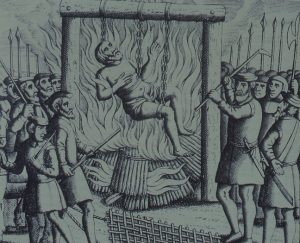
There were riots against foreigners, riots against May Revels, and burnings at the stake of both protestants and catholics as society struggled to cope with the impact of religious change.
With so many young people drawn into the City to work in its expanding industries, entertainment grew more sophisticated and poets could make a living penning entertainments to the masses. The London landscape changed dramatically as new renaissance inspired architecture began to replace the medieval timber framed buildings and the old medieval monasteries were pulled down.
We explore London in one of its greatest periods of change. The walk is given alternately by Kevin Flude & Leo Heaton
This is a walk for London Walks

 17th century it welcomed Jewish refugees particularly from Russian, and in the 19th Irish, and exiles joined in.
 on Saturday, November 30.
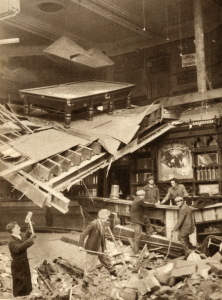 with the predicted catastrophe of Nazi terror bombing? Could London develop plans that reduced the predicted millions of casualties and thousands of people driven mad? On this walk, we look at London before the war and the measures taken to protect the City and its Citizens. We find out what it was like to come to work after a night in the shelters to find your work place in ruins. We visit the site of the earliest bomb raids on London, and explore the sequence of continuous bombing that followed the Battle of Britain, and on to the great City raid of 29th December 1940 which was centred on St Pauls. By May, 1941 the Luftwaffe had transferred to the Eastern Front, but the fear returned with the V1 and V2 secret weapons. Before the war was over London developed the Abercrombie Plan to direct the rebuilding of London after the war. We have a look at what happened to the plans for an optimistic modernist dream of a Corbusian City in the Sky.