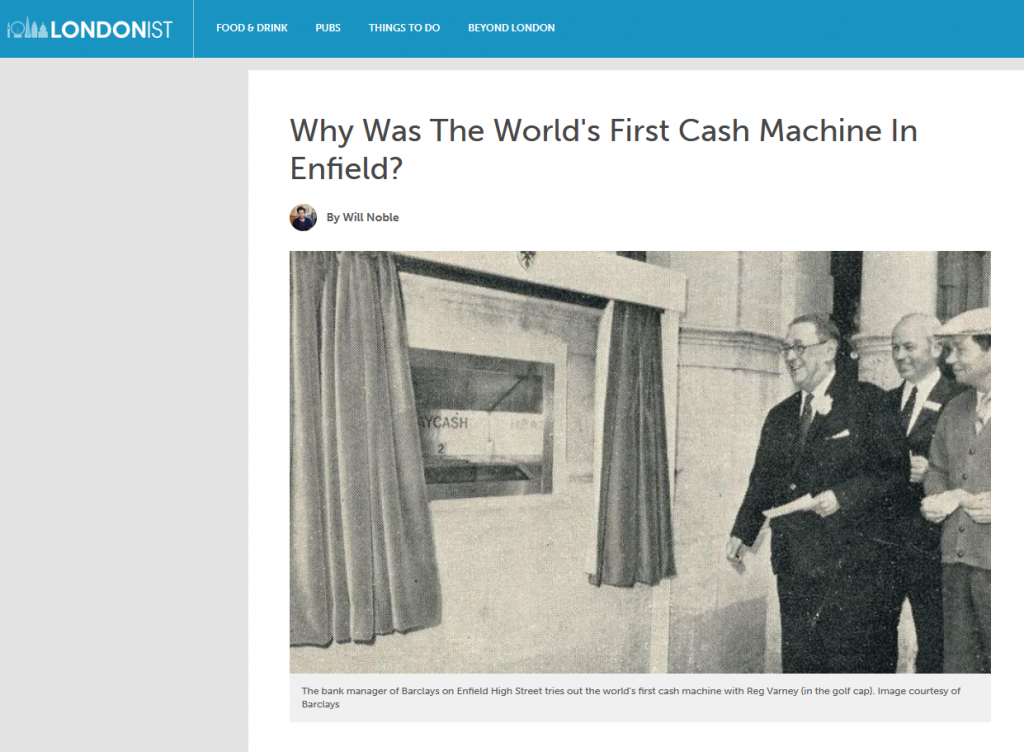
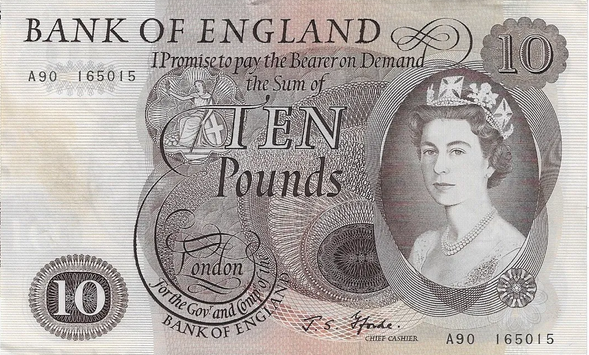
On the 10th April 2023, Heritage England announced on its webpage, that they had listed a Bank which contained the world’s first ATM Machine. On 27th June 1967 Barclays Bank open the first ATM at its Enfield Branch in London. Above, you will see local celebrity, Reg Varney (in hat), a star of a very popular and ‘corny’ sitcom called ‘On the Buses‘ opening the new machine. It miraculously delivered a £10 note without any human intervention, and offered access to money after banking hours.
1967 Ten pound note
Barclay’s had previously launched the UK’s first credit card, and selected Enfield to be the place where they launched an automatic machine to dispense money. They are nicknamed ‘money machines’ in the UK. The customer was issued a ‘punched card’ and had to enter a PIN for the magic to be initiated. Barclays were developing the idea of a magnetic strip on a card at the same time.
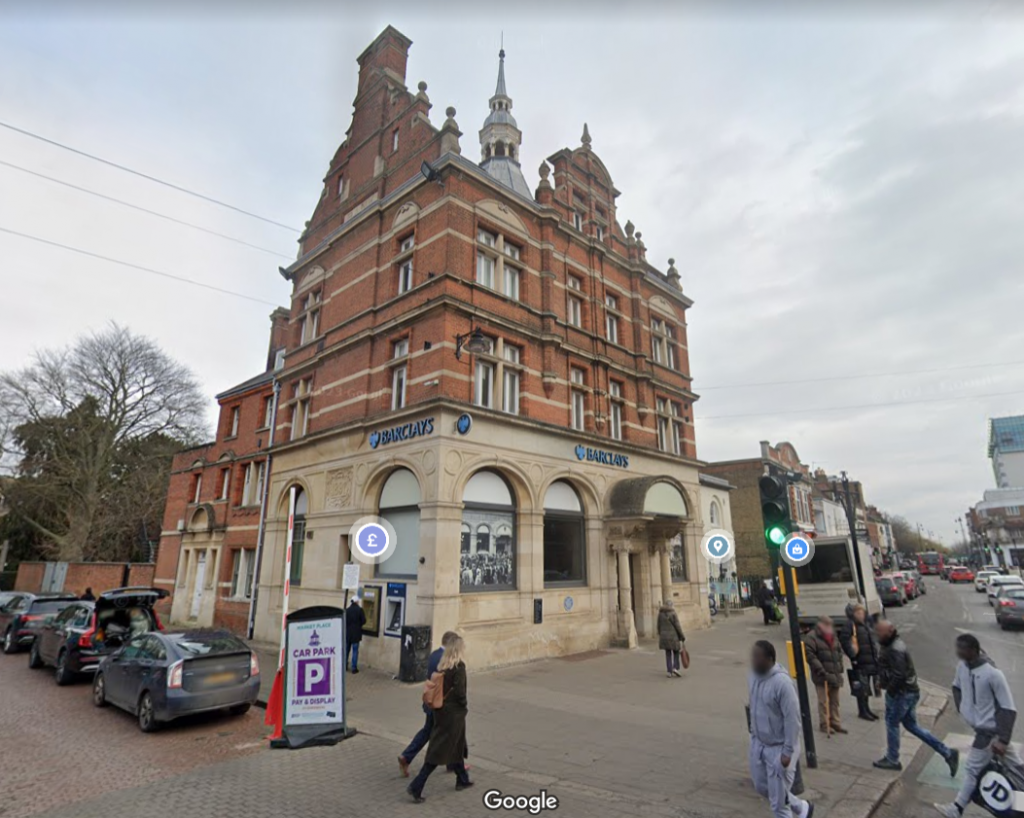
Google Street View image of the Enfield Barclays Bank (screenprinted 15/07/23)
The building, which now has a plaque and a gold-painted modern ATM, is Grade II listed and so should be protected from development in future. The building itself is an interesting, almost typical, late Victorian red brick commercial building, with fine details in the Flemish Renaissance style by William Gilbee Scott. Scott lived in Enfield.
I look forward to visiting it on my next visit to Enfield Lock on my narrow boat Mrs Towser.
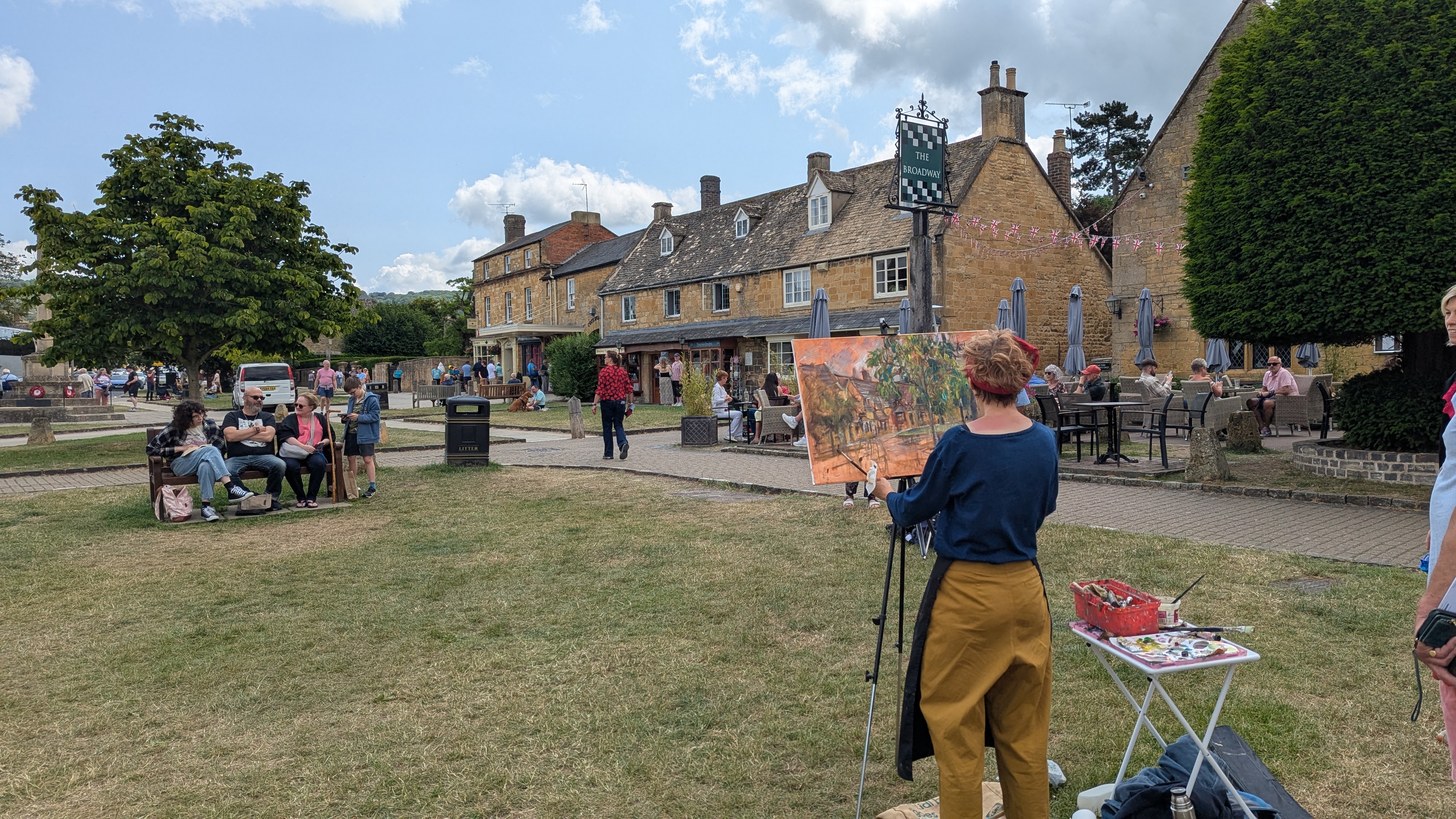
One of the joys of my Summer is revisiting places I know and love in my role as a Course Director for Road Scholar. I first came across the ‘en plein air’ in 2023. On Sunday, June 18th. I was in Broadway, once considered the most beautiful village in Britain. It was also the model for Riseholme in the wonderful Lucia books by E. F. Benson (made into a TV series by the BBC starring Prunella Scales, Geraldine McEwan and Nigel Hawthorne).
The day I visited, in 2025, was last Sunday, June 15th. I have added new photos and revised the texts.
How it Works
The artists register in the morning and have their paper or canvas stamped, or given a block of Maltese stone. This proves that they have done all the work on the day itself.
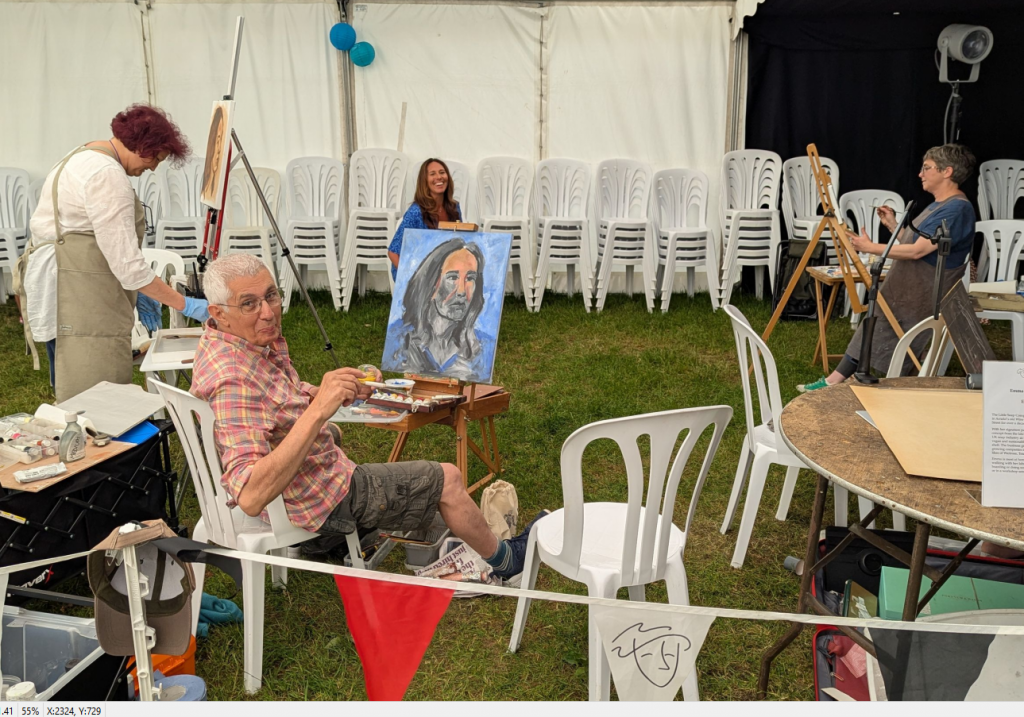
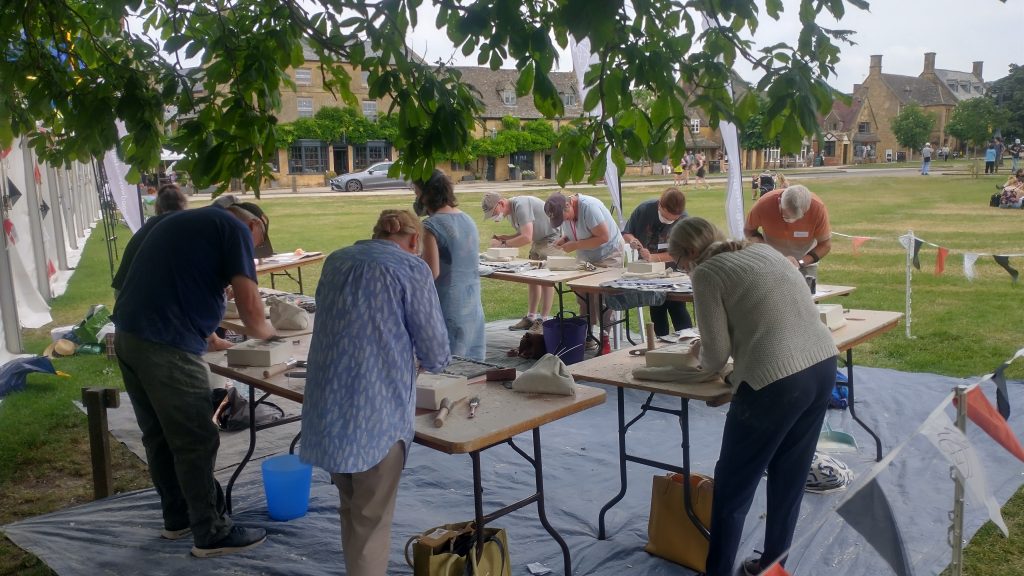
This year there were no sculptors. Instead, there were live models in the marquee being painted by portrait painters.
Broadway Paint off, Local Portraits. 2025 Photo K Flude
They take their blank canvases to create a work of art in the village. At 4pm or so, they are judged. At 5pm, the art works are exhibited and are on sale in the Marquee on the village green.
Broadway Arts Festival 2025, Photo K Flude
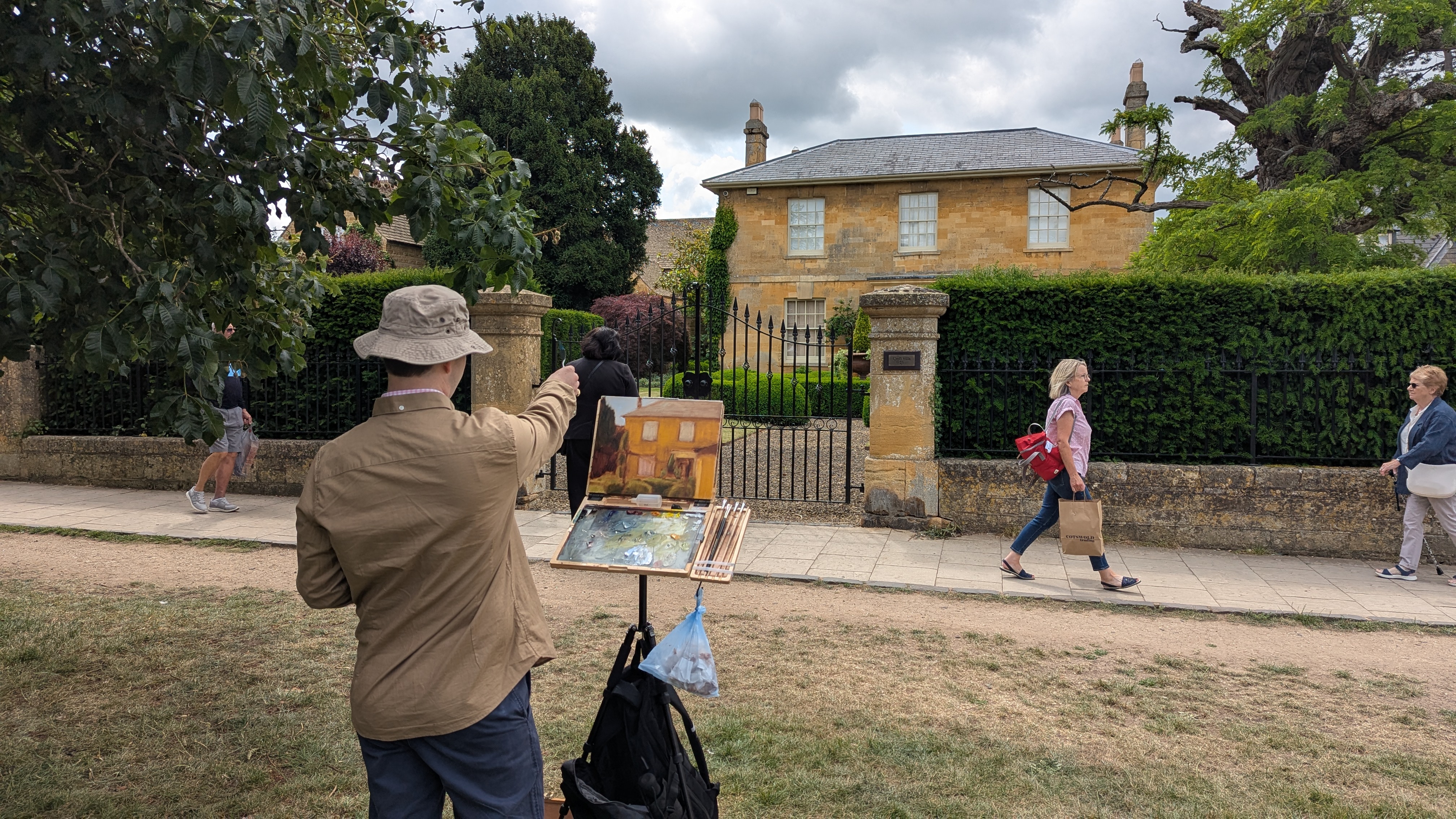
It’s always a delight walking around Broadway. Bun, but with an artist and easel every 50 yards or so even more enjoyable.
The Most Beautiful Village?
The appellation of most beautiful village, came in the late 19th Century. Broadway, once gained its wealth by selling wool. When that declined, the village became an important stop on the Toll Roads. It was on the stage coach route from Aberystwyth to Worcester, Oxford, and London. Fish Hill, nearly 1000 feet high, was an obstacle and coaches made a stop here to prepare or recover. Some coaches used up to 10 horses to get to the top. But with the arrival of Brunel’s Great Western Railway to the Cotswolds the village was nearly ruined. Half the village, the Broadway Museum says, moved away as their livelihood serving the coaching trade died.
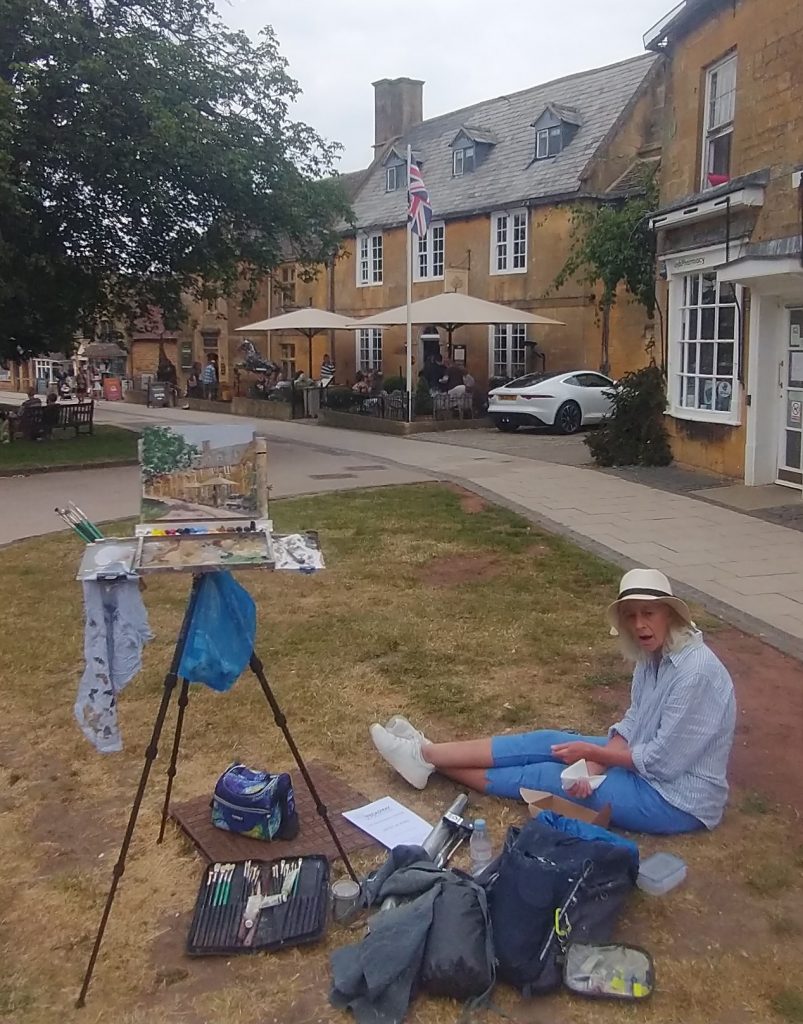
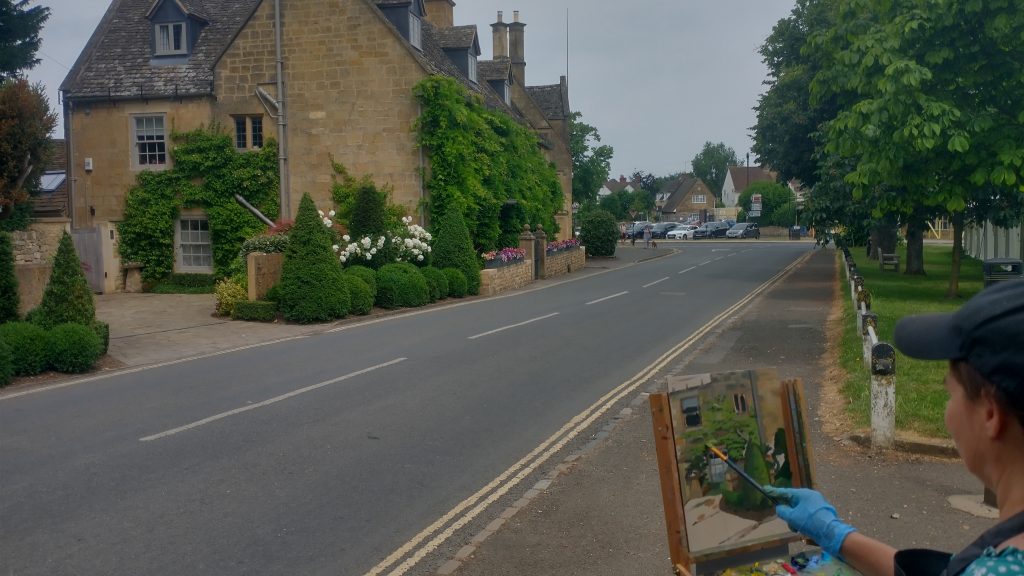
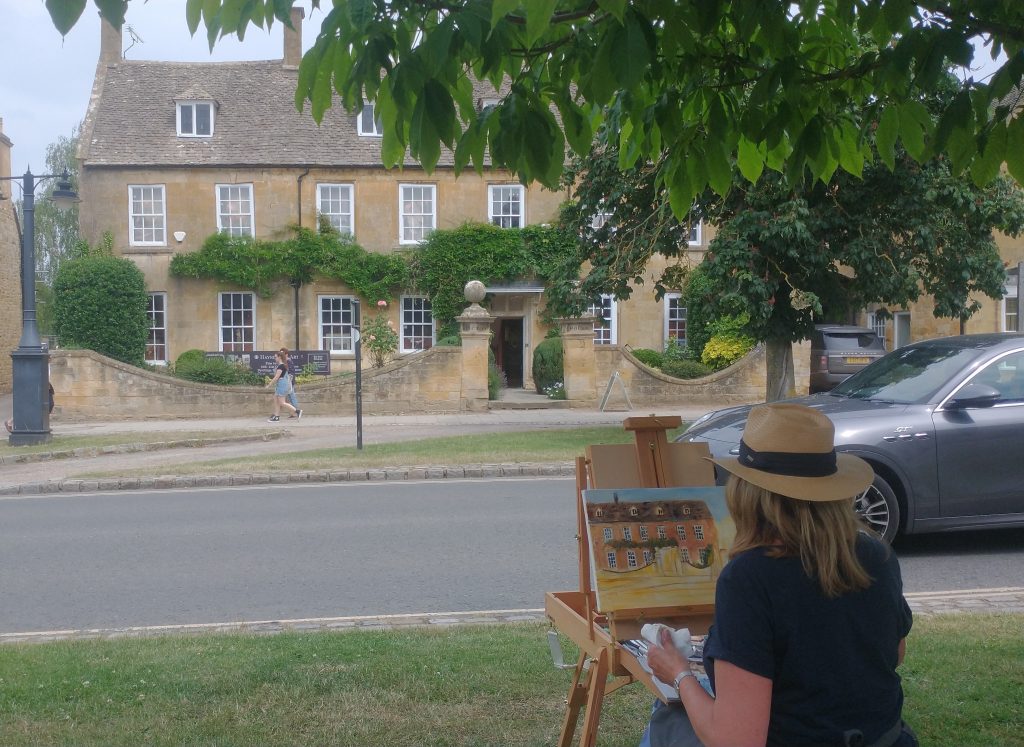
Artist painting in the ‘Great Broadway Paint off’ 2023 Photo K FludeAnother artist participating Artist in the ‘Great Broadway Paint off’ Photo K Flude 2023@dawnjordanart Great Broadway Paint off’ Photo K Flude 2023
But artists and writers, led by Americans Frances Millet and Edwin Abbey, turned Broadway into a much sort-after country retreat. Visitors included Oscar Wilde, J. M. Barrie, Singer-Sargeant, William Morris, Edward Burne-Jones, Gabriel Dante Rossetti, American actress, Mary Anderson, Edward Elgar, E. F, Benson. Mark Twain visited for Millet’s marriage.
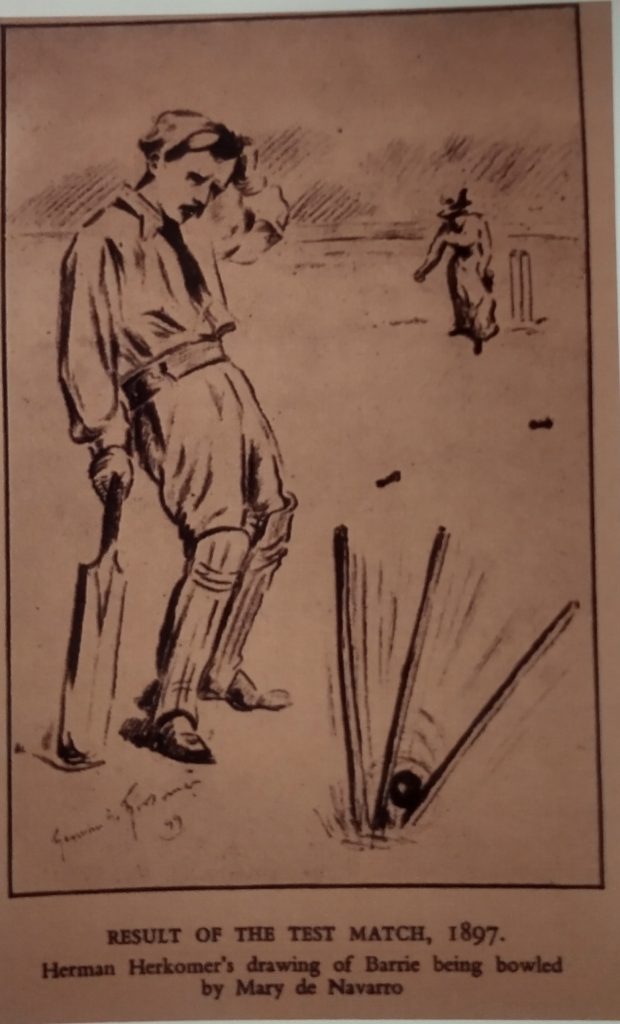
J.M. Barrie being bowled by Mary de Navarro. (aka Mary Anderson, who played many roles including Juliette at Stratford-on-Avon)
Gordon Russell & Henry T Ford
What made the visit particularly interesting was the story told by the volunteer at the Gordon Russell Museum in Broadway. This is the story as I understood it:
The Russells restored the Lygon Arms in Broadway using Arts And Crafts architects. They also restored antique furniture. The son, Gordon Russell, became a leading designer of modernist Furniture. He advertised to passengers on the Cunard Line in order to attract the attention of rich American visitors. One, Henry T Ford, was interested. He came to Broadway, staying at the Lygon arms. He was taken to nearby village Snowshill, where Ford bought a Cotswolds Farmhouse, complete with Blacksmith’s workshop. They were shipped stone by numbered stone to Brentford on the Thames. Then to the London Docks and across the Atlantic. Here. Ford set them up in a Museum in Michigan where they still are!
Sculptors at the Great Broadway Paint off (2023)
Research suggests it’s a little more complicated, in so far as Ford purchased his first Cottage before coming to Broadway. But it still leaves a delightful story about American ideas of Quintessential English village life. For pictures see my post here. And for another look at the story look at this web site here:
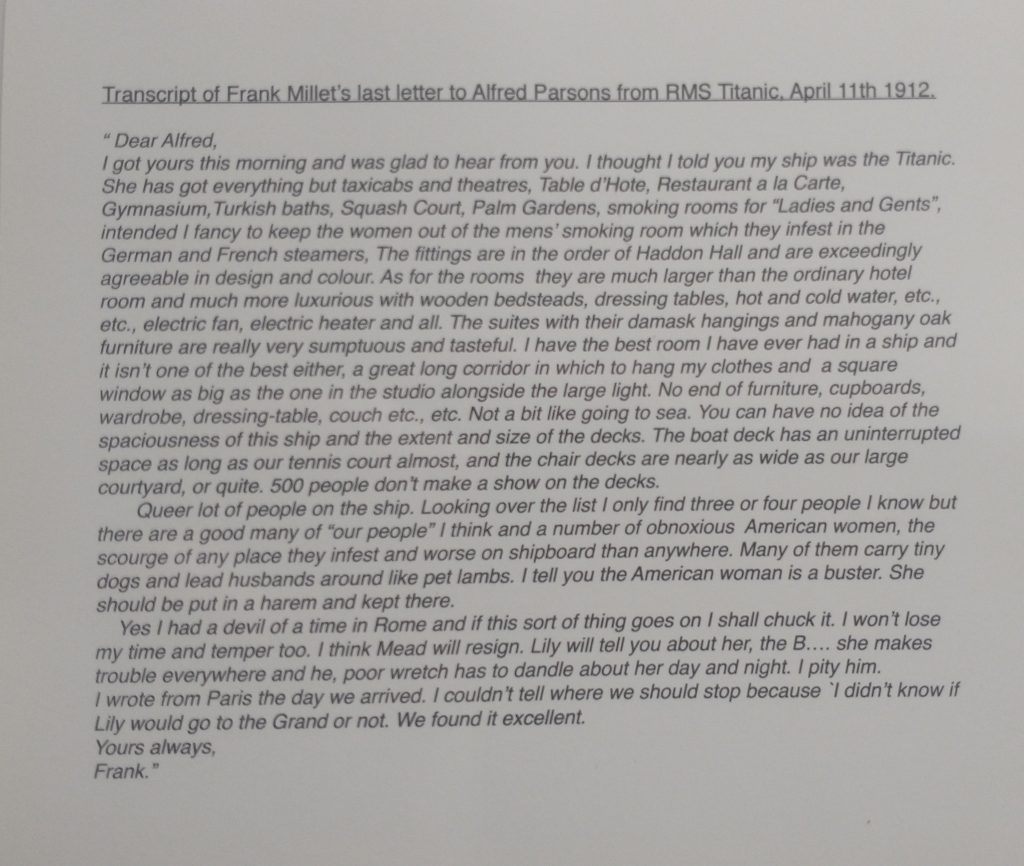
By the way, Frances Millet planned to return to the States on the Titanic. He was one of the 1500 who drowned. A letter he wrote while on the ship was posted, probably in France. It is on display in the Broadway Museum (2023).
Molly Bloomsday is a new festival, an offshoot in Derry of the Dublin based Bloomsday. Both are celebrated on 16th June which is the day on which the great book Ulysses by James Joyce is set (16 June 1904). It was published in 1922.
Bloomsday is named after Leopold Bloom and is an international festival celebrating Ulysses. Molly Bloom is her husband who has a soliloquy at the beginning of the book. The Molly Bloomsday concentrates on Molly and women’s literature. The Dublin version is a literary festival as well with people dressing up as characters from the famous book, readings, plays etc..
The Bloomsday Book
Joyce thought Odysseus was the only all-round character in literature. Not a one dimensional hero, but a man with a complex character, not always making the good choice. He based Ulysses, loosely, on Homer’s plot. The main characters, Leopold and Molly Bloom were based on Odysseus and Penelope. Stephen Daedalus was Telemachus, their son. Daedalus is Joyce’s alter-ego.
What makes the book so great is that Joyce was, with Virginia Wolfe, one of the first great Modernist writers. They used stream of consciousness from the characters’ points of view from deep in their heads. This is how Joyce describes Ulysses according to Djuna Barnes:
“The pity is … the public will demand and find a moral in my book—or worse they may take it in some more serious way, and on the honour of a gentleman, there is not one single serious line in it. … In Ulysses I have recorded, simultaneously, what a man says, sees, thinks, and what such seeing, thinking, saying does, to what you Freudians call the subconscious.”
Ulysses and I
My copy of Ulysses is very well travelled. I very often take it on holiday. I start on Chapter 1, and at some point before the end of the holiday I am still on Chapter. I stop reading. I’ve got past the beginning of Chapter 2 once.
Don’t get me wrong, I am fully convinced it is a brilliant book. It’s my best friend’s favourite book. So one day I WILL READ IT!
Modernism & the Steam of consciousness
When I first published this piece I made a terrible typo and talked about the ‘steam of consciousness’. So I republished it immediately so not to embarass myself for too long. But, actually, I quite like the sound of a steam of consciousness. But what could it mean?
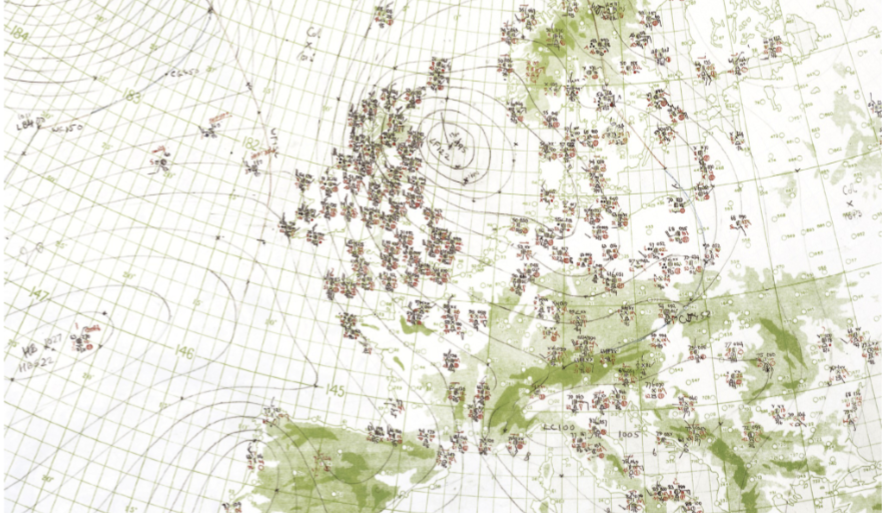
North Atlantic chart of weather for June 6th 1944. D Day. Showing occupied Europe with observations obtained from the enigma machine
In 2014 or thereabouts I went to a play by David Haig which was based on the true story of a weather forecaster’s role in D Day. James Stagg’s advice was that the weather on June 5th, the intended day, was too volatile. He suggested the 6th June 1944 instead.
The play was called Pressure and was great because it really conveyed the enormity of the decision that Ike, Churchill and others had to make. To go ahead in bad weather risked enormous casualties and the failure of the Landings. To postpone, might mean Hitler discovered the location of the invasions and might lead to disaster.
Major characters portrayed in the play included Ike and his driver, Kay Summersby with whom he was very close. Also depicted was an American forecaster who disagreed with the British meteorologist James Stagg. How much of the play was for dramatic effect and how much is true, I’m not entirely sure but it is a fascinating D Day story.
The maps were hand drawn and partially based on intercepted data decoded by the enigma machine. Stagg recommended postponing the landings one day from the 5th to the 6th of June, when it was hoped the ideal combination of calm seas, low water at first light and a full moon would occur.
Of course, the real news today is a new Pope and the 80th Anniversary of Victory in Europe Day. But, I can let other media covers those stories. (But more on VE Day below.)
Helston Furry Dance
At the end of the May Day/Beltane Festival, Helston in Cornwall holds its Furry (or Floral) Dance. It is normally on the 8th May. But it changes date if the 8th is a Sunday or a Monday (Helston’s market day). But it isn’t. So the Floral Dance was held asusual on the 8th May.
Padstow holds, perhaps, the most famous May Day festival on May 1st. Padstow feels more of a ‘pagan’ festival, while Helston is a more sedate, gentlemanly, dance. Padstow is more fuelled by a belly full of ale, while Helston by a Pims No 1, or a Gin and Tonic?
Do, have a look at both youtube videos and watch the Padstow one until at least you see the ‘obby ‘orse and the teaser dancing.
Children born between the two days, May 1st and May 8th are considered to have been ‘born with the skill of man and beast and power over both.’
On This Day
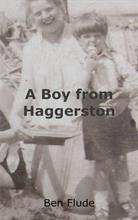
1945 – Victory in Europe Day. Official end of the War in Europe with the definitive surrender of Nazi Germany to the Allies, signed by Field Marshal Wilhelm Keitel in Eisenhowers HQ on 8 May 1945 (VE Day). Churchill broadcast the official end of the war at 3pm. In 2025, it was the 80th Anniversary of the defeat of Fascism. A truly significant date with a diminishing number of veterans and eye witnesses surviving to carry the torch. My 97 year old Father is one and he went to London to celebrate that magical day when the war in the west was over. this is what my dad wrote in his recently publish autobiography ‘A Boy from Haggerston:
At last, the War in Europe was over. This day would forever be known as VE day. Both my grandparents had survived the Blitz and only Uncle Charlie’s (my dad’s elder brother) two sons had lost their lives – Charlie died at Salerno and is buried near the beach in the war grave, and Jimmie died, aged 18, at the battle of Reichwald Forest, and is buried in the war grave in the forest. According to David Warren, who is now a battlefield tour guide, received information that Jimmie was reported by the Commanding Office as a typical bright Cockney lad.
Following the end of the war, we were then introduced to images of the emaciated prisoners in the recently freed concentration camps in the newspapers, and in the Pathé news broadcast at the cinema. The terrible news that the Nazis killed millions of Jews in an attempt to wipe out the Jewish race in occupied Europe, spread to a horrified world. This vile campaign is now known as the Holocaust, but is more precisely described as ethnic cleansing.
Jean and I went up to London for VE Day and later also for the VJ Celebrations, where there was singing and dancing in the streets. We went by train to Waterloo, and then walked to Piccadilly. We went with our friends Esther and Bob. It was a great time.
Front cover of ‘A Boy fomr Haggerston’ by Ben Flude
Now, it is up to us and the young to stop such a war ever starting again. What we know is that the vast majority of us don’t want war, but somehow we let it happen. That is our task how to create a world where war is unthinkable.
Sorry to send an additional post but coming up are a couple of fascinating Virtual Tours which I would like to remind you of!
Tonight is an exploration of early 19th Century London. It is based on the 1809 Picture of London Guide book. An original copy was given to me by someone grateful to have attended one of my lectures at the Old Operating Theatre Museum. It is a tour of what Jane Austen could have visited on her walks around London. There are Austen associations, but mainly we are looking at London in 1809.
Jane Austen’s ‘A Picture of London in 1809’ Virtual Walk Mon 7.30 27th Jan25 To book
Yesterday, I was asked to give a Cromwell’s London walk as a 75th Birthday present. I haven’t done one for at least 25 years. But I really enjoyed the research. So added a guided walk and a virtual tour to my programme. This is the first time I have done this VT and it is a cracking story.
The Civil War, Restoration and the Great Fire of London Virtual Tour 7:30pm Thurs 30th Jan25To book
Finally, April is the month we go on pilgrimages, as Chaucer said (in Old English). So, in addition to my Chaucer Walks, I have added a Virtual tour so we can go all the way to Canterbury.
Chaucer’s London To Canterbury Virtual Pilgrimage 7.30pm Friday 18th April 25 To book
I may add one or two more before the Sun comes back
This was 5 years after his death. It is now celebrated around the world, making clear the importance of Robert Burns.
Burns himself would have been astonished at the spread of Burn’s Night. He was modest about his attainments, saying, in his introduction to the Commonplace Book:
‘As he was but little indebted to scholastic education, and bred at a plough-tail, his performance must be strongly tinctured with his unpolished rustic way of life. ‘
Fair fa’ your honest, sonsie face, Great Chieftain o’ the Puddin-race! Aboon them a’ ye tak your place, Painch, tripe, or thairm: Weel are ye wordy of a grace As lang ‘s my arm.
The groaning trencher there ye fill, Your hurdies like a distant hill, Your pin wad help to mend a mill In time o’ need, While thro’ your pores the dews distil Like amber bead.
His knife see Rustic-labour dight, An’ cut ye up wi’ ready slight, Trenching your gushing entrails bright, Like onie ditch; And then, O what a glorious sight, Warm-reekin, rich!
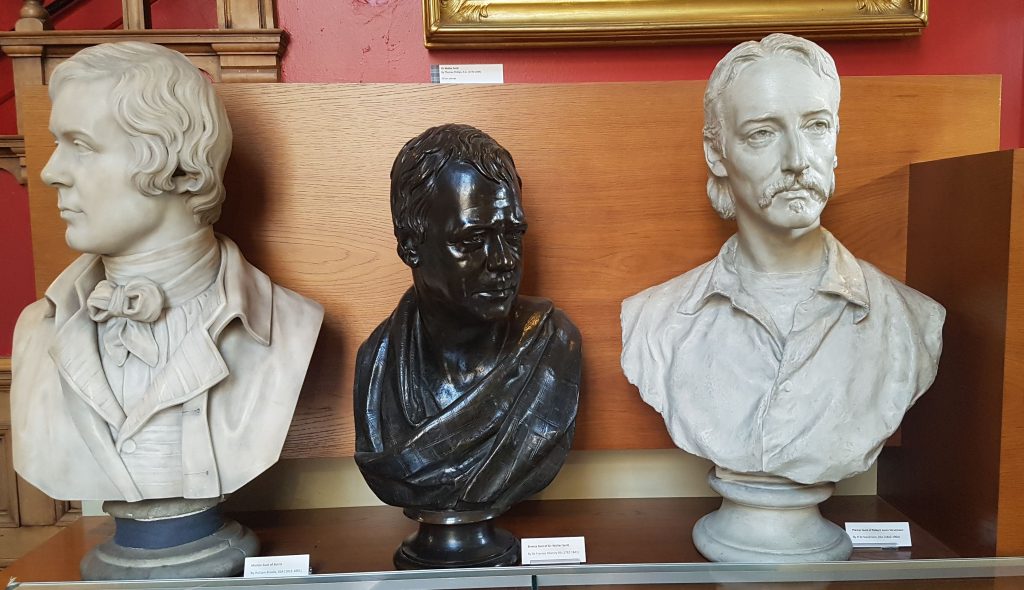
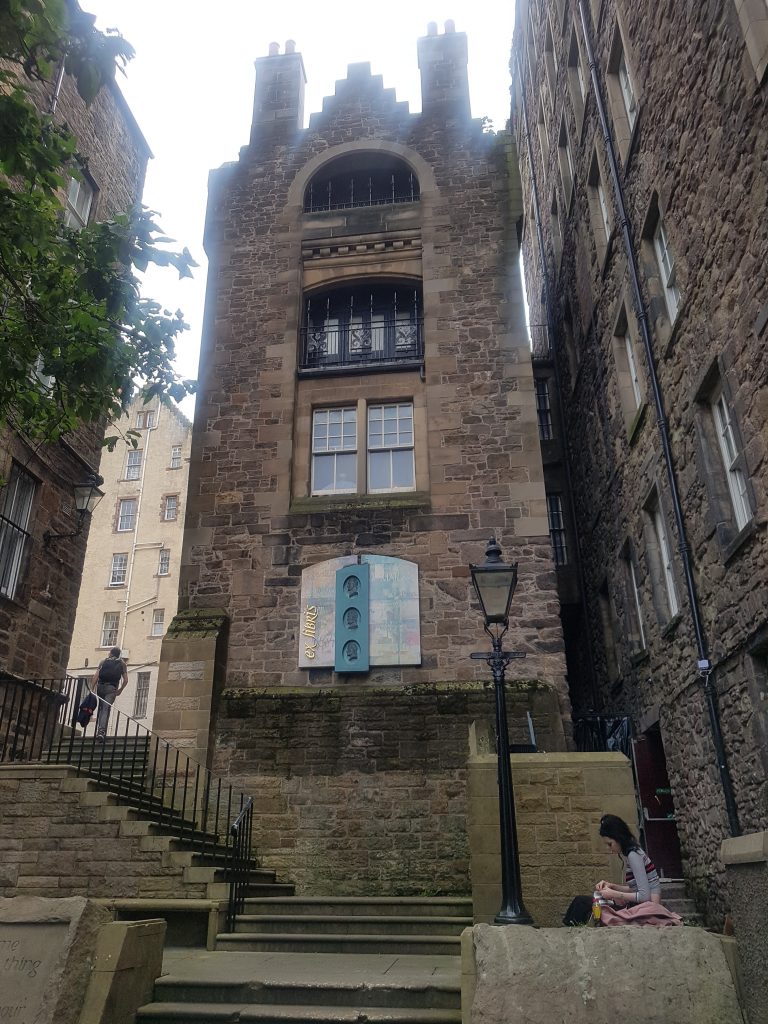
Often bypassed by the tourists on a visit to the wonderful City of Edinburgh is the Writer’s Museum. It is in one of those remarkable Tower houses which seem unique to the High Street in Edinburgh. Inside, it gives a great introduction to the great writers of Scotland.
‘Is it not strange’ wrote philosopher David Hume in 1757 ‘that a time when we have lost our Princes, our Parliament, Independent Government …..that we shou’d really be the people most distinguish’d for literature in Europe?’ (source: Museum display panel)
Edinburgh Writer’s Museum Burns, Scott, Stevenson.
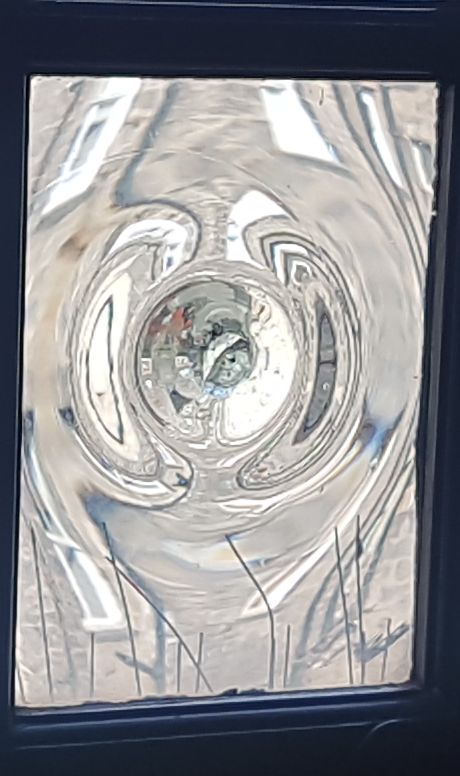
A Visual for Burn’s Night ‘Window in the Writer’s Museum, Edinburgh’ Photo by K Flude
Writer’s Museum photo K. Flude
First published Jan 2023, republished Jan 2024, 2025
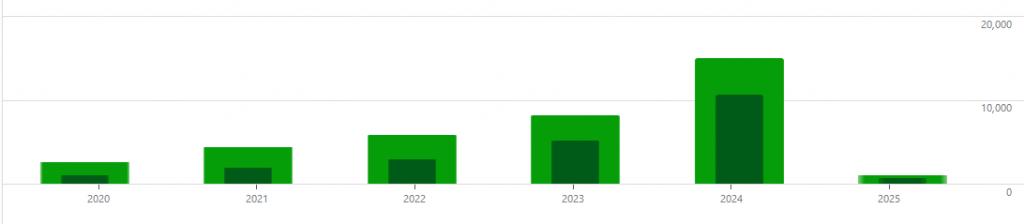
News from the Almanac showing readership/viewership of the site.
I have been waiting for a day when I haven’ t got a post to publish. Why? To update readers about the Almanac of the Past. And with a bit of manoeuvring today is the day.
What is the News from the Almanac of the Past?
The plan is to have a post for each day. I am virtually there for November to March, but a way away for the warmer months.
In the winter months, I have been revising, improving, developing and adding content to previously published pages. For those of you who have been here a while, you will have been receiving posts you have seen before. Next year, you might be seeing some for the third time. I’m not sure what to do about this except improve posts and add content. But I am considering stopping automatically posting repeated posts to subscribers. Maybe from next November? Feed back would be good – please email me at kpflude at chr . org . uk (I’ve slightly scrambled the email to stop the robots).
What is the planned content for the Almanac of the Past?
The nature of an almanac is to be a pot-pourri. They are about seasons, time, folklore, history, important events, and anniversaries. I also like to cover history, famous people and discoveries. Gods, Goddesses, Saints, sinners, and archaeology. What I want it to be is something that makes us more mindful about the passing of the year. How seasons and time change the way people see their world. My focus is mostly on the UK, but also on Rome and Greece. With occasional excursions to other places. I am trying to find more content that is London-based, but not to the exclusion of everything else. I also have an ambition to add more important news of discoveries that change our view of the past. If I get the formula right, I will attempt to get a publication from it, otherwise it will remain online.
Developments for the Almanac
It takes quite a lot of time for me to keep it up. You will see, from the graph above, that the readership is yearly making progress. Particularly, last year. But then it’s a steady progress from a small base, rather than Kardashian viral.
This is, at least, partially because I would rather not spend my time marketing. I want to be writing. But, I have decided I need to spend a little more time marketing the site. When I ran the Old Operating Theatre Museum, I had the skills to get our web site to first place on google searches. But this was in the pioneering days of the World Wide Web. Now, it’s more difficult, but I am taking a ‘Search Engine Optimisation’ (SEO) course. I have also loaded some ‘plugins’ to WordPress which help with SEO. I thought you might be interested in some of the consequences.
The plugins ‘parse’ the site and give recommendations for improvements. This should, get the site further up the Google landing page. I have no doubt that it involves or will involve AI. The ‘Yoast’ plugin I am using as I type this, tells me words like ‘however’ are a ‘complex’ word and so they down grade my ‘readability’ quotient. It also tells me that that last sentence was too long. So, it wants simple sentences, and words that join sentences together. And not too many sentences in a paragraph and a proper scattering of headings.
It also assesses the SEOness of the text. So I have to tell it what the main subject of the page is. And it wants that word or phrase in:
the title: the first paragraph the image the meta description tag and scattered, but not too densely (because Google will punish the site for playing the algorithm) through the text.
Hence, you will see the phrase ‘News from the Almanac’ scattered more than I would normally like through this text. Of course, I know no one really will be searching for ‘News from the Almanac. So I should change the SEO phrase just to Almanac. But, then I’m not really interested in attracting non-readers to this page. I see this as between me and my email subscribers!
After writing that paragraph I realised that I would want people to land up here if they typed in ‘Almanac of the Past’. So you will see, I’ve editing the text scattering that phrase here and thereabouts.
In effect, I am being trained by a slightly stupid tutor who has no particular understanding of the needs of a writer of history! And you can’t answer back, you just get downgraded!
And it seems to be working as my numbers are getting better more quickly.
Any problems for the Almanac of the Past?
Obviously, my terrible proofreading is a concern! Maybe that’s one-way republishing helps. A year later, it’s easier to see the typos, the ugly writing, and issues with the content.
But there is another issue with the emails, which I have been trying to solve for about 6 months. The links in the emailed posts don’t work. But they do work if you visit the almanac on the web. This is nuts as I always use the full URL. For example: https://www.chr.org.uk/anddidthosefeet/december-29th-st-thomas-wassailing/.
So, this is very much a technical issue, one might say a bug in the system. I think it stems from the fact that my blog was stored not in https:/public_html/ but in https://public_html/anddidthosefeet. This seemed a logical choice at the time, as the blog shared space with other things. I haven’t managed to convince the tech guys at either the internet provider or WordPress that this is a bug. So, the alternative is to move the blog. But I am reluctant to do this in case it completely messes everything up.
Change the content of the newsletter, you might think. But I can find nothing that allows me to alter or add anything to the email version of the post. As I write this, I think I will temporarily add a line at the bottom of the post which says:
if the links are not working, copy and paste this URL https://www.chr.org.uk/anddidthosefeet/whateverkevinsalmanacpageiscalled
to your browser. This, will get you to the Almanac of the Past on the web where all the links will work.
And this will allow you to easily copy or link to the webpage and send the Almanac of the Past to your friends and followers. (I’m hoping you are Taylor Swift). You willalso be able to comment easily and maybe even like the post?
Another advantage of visiting the web version is that you get a better version to read. This is because I often find howling typos when I read the emailed post. I correct them, with a red embarrassed face.
If you are reading this on the web, then all the above must have been very annoying to read! Maybe I will move it down to the bottom of the post! (which I did).
Trying new things on the Blog
Do you want to make a comment?
Please leave me a comment – its great to hear what you think.Cancel reply
In order to clear January 22nd I moved the previous January 22nd post to December 10th. As its all about Mulled Wine, Glugg, and Gluwein., its better at the beginning of the Christmas Season than in late January.
To see it click here: or cut and past this url https://www.chr.org.uk/anddidthosefeet/january-22-22-time-to-mull-it-over/
I also didn't tell you Monday was Blue Monday because I had already sent you one post on the 20th. So this is the Blue Monday Post. https://www.chr.org.uk/anddidthosefeet/january-13th-18th-blue-monday-wolf-moon-start-of-lambing-and-twelfth-night-old-style/
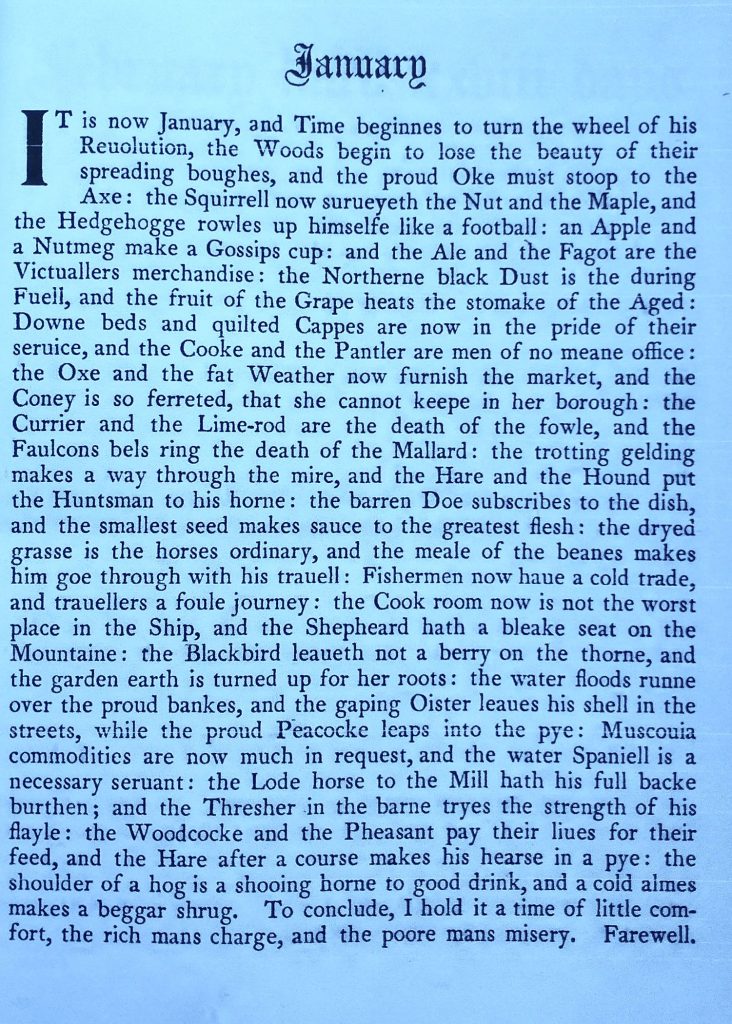
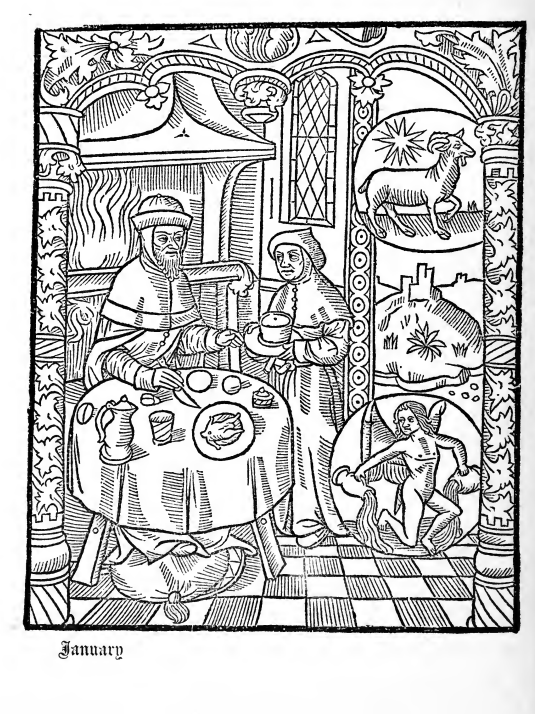
January from Nicholas Breton’s ‘Fantasticks 1626 from the Kalendar of Shepherds (digitised by Internet Archive)
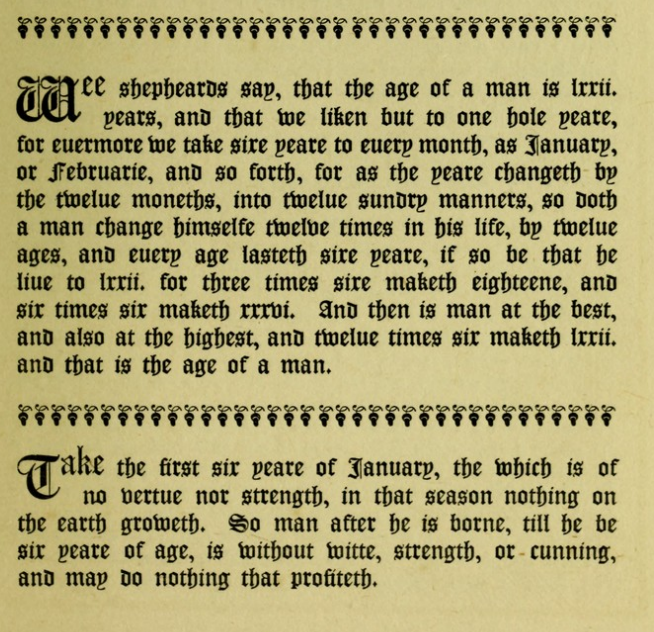
The Kalendar of Shepherds was printed in 1493 in Paris and provided ‘Devices for the 12 Months.’ I use a modern (1908) reconstruction of it using wood cuts from the original French and adding various text from English 16th and 17th Century sources. The text of the month (as shown above) is provided from a 17th Century source. It gives an interesting view of the countryside in January. To see the full Kalendar, look here:
Nicholas Breton, the writer of the text above, concludes that January:
‘is a time of little comfort, the rich man’s charge, and the poore man’s misery.’
The rich man is burdened by having to help out all the poor people who depending upon him to get through the shortages of winter. The image for January shows that January is best spent indoors by a roaring fire, eating pies.
The Kalendar introduces a ‘conceit’ which is that the year mirrors our lives, and we can forecast what will happen in our lives by looking at the months.
Kalendar of Shepherds, January text
So our lives, which are of 72 years, can be divided into 12 ages of man, each of 6 years. So, January represents the first 6 years of a person’s life. And as you can see, that during these first 6 years, the child is ‘without witte, strength, or cunning, and may do nothing that profiteth‘. As the year changes every month, so, ‘a man change himself twelve times in his life’. At three times 6 (18 or March) a child becomes a man, and 6 times 6 (36 or June) man is at his best and highest. And at 12 times 6 (72 or December) man is at the end of his allotted span.
Shakespeare numbered the Ages of Man as seven, in the great speech of Jacques in ‘As You Like it’ I dealt with this and other Ages of the World in my post:
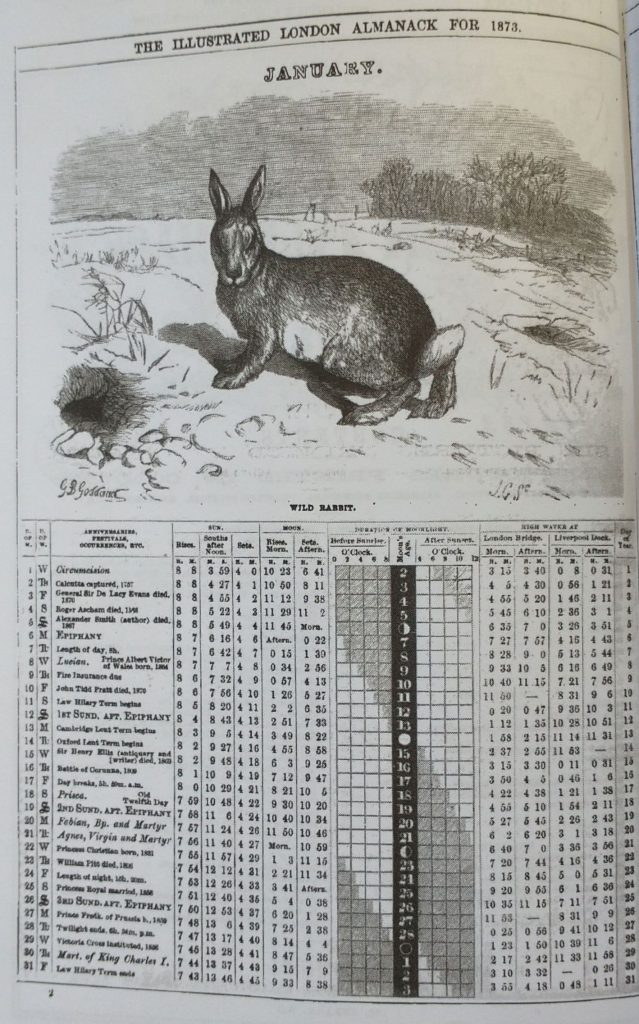
Bereton tells us that, in January, the ‘coney is so ferreted that she cannot keep in her borough’. To put that is modern speech, ‘the rabbit is so hunted with the aid of ferrets that she cannot keep in her burrow’. The London Illustrated Almanac of 1873 chose the Rabbit as its wild animal of the month.
January from London Illustrated Almanac of 1873
To have luck for a month, you are supposed to say ‘Rabbit, Rabbit’. No less a person than FD Roosevelt used to say this. No one knows why. Rabbit’s feet are lucky too. I remember some of my friends had them in our Surrey village in the early 60s. Some of Dad’s nieghbours kept ferrets, and I remember dead Rabbits hanging from walls. The history.com website gives an idea, possibly exaggerated view, of the merits of the feet which depended upon how they were collected:
“A 1908 British account reports rabbits’ feet imported from America being advertised as ‘the left hind foot of a rabbit killed in a country churchyard at midnight, during the dark of the moon, on Friday the 13th of the month, by a cross-eyed, left-handed, red-headed bow-legged Negro riding a white horse,’
As to why, no one really knows. But Pliny the Elder in 71AD reported that cutting off the foot of a live hare could cure gout. There are European traditions of rabbit and other animal’s feet amulets curing all sorts of ailments. There are associations with witches, who could shape-shift into a rabbit. So a rabbit’s foot would be witchy and therefore powerful. In March, I reported on the Hare, and their, similar, associations with witches:
For lovers of Music, Chas and Dave’s hit song ‘Rabbit’ has a chorus of ‘Rabbit, Rabbit’.According to the Cockney’s singers (they do love a Knee’s Up) it comes from the Cockney Rhyming Slang expression: Rabbit and Pork. This means ‘Talk’ because it rhymes with ‘Talk’. To hear the song, its gestation and Royal connections, click here.
Now, I must stop rabbiting on. Time to get things done.
First, published in 2023, revised in January 2024, 2025
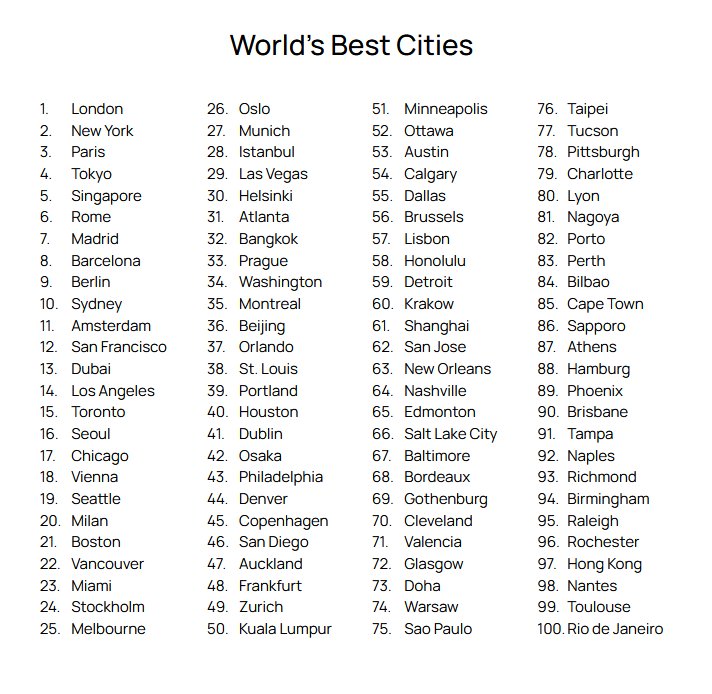
The World’s Best Cities report makes London the top City followed closing by New York and Paris. London has had top spot for 10 years. The Report is based on core statistics plus a survey of visitors and residents. It is created by Resonance, a consultancy group working in real estate, tourism, and economic development. They are based in Vancouver.
“Navigating the complexities of a post-Brexit era, geopolitical uncertainties and economic challenges, London’s resilient spirit and unmatched global appeal have solidified its place at the pinnacle of our annual ranking,“
AFAR gives a good analysis of Resonance’s methods on its web site:
‘England’s capital snagged the top spot for the 10th year in a row, continuing to draw students, investors, and tourists alike. A $305 million upgrade of the Gatwick Airport and new metro stops on the Elizabeth line are a few of the developments that indicate the city’s focus on improving infrastructure. Resonance particularly spotlights the building of the Camden Highline, a mile-long greenway inspired by New York’s High Line, as a project that demonstrates “London’s dedication to enhancing quality of life for both residents and visitors.”
London No 1. Really?
Or is it a fix? It was a bit of a surprise to me given the hit Brexit has given to the City. But, London’s dominance for ten years may be because of the consultancy’s focus on real estate as well as tourism and economic development. This gives London a head start as it has long been considered a very safe place to invest in property. London, New York, Paris, Tokyo, Singapore as 1-5 also suggests the report writers might have a bias to the big hitters.
What London offers is its status as one of the world’s leading financial/business capitals. Supported by outstanding creative and services industries. At the same time, it has a superb cultural offering and, consequently, high figures for tourism. It is a City that seems to have a deep past behind it and an equally important future ahead.
The future might depend on the growing Knowledge Quarter around Kings Cross. (British Museum & Library, Wellcome Institute, Crick Institute, UCL, Central St. Martins, Google etc.) With Silicone Roundabout and the wealth of investments from the nearby City of London, providing London with a leading place in AI, the Knowledge economy, and Fintech. London also has a very high value on the internet as far as hashtags, and internet searches are concerned.

Please leave me a comment – its great to hear what you think.