The Moon rules the months: this month’s span ends With the worship of the Moon on the Aventine Hill.
Fasti by Ovid
Cycle of the Moon, sketched from photo.
The Aventine Hill is one of the seven hills of Rome, named after a mythical King Aventinus. It is the hill where Hercules pastured his cattle. They were stolen by Cacus. According to Virgil in his Aeneid, the monstrous Cacus lived in a cave on a rocky slope near the River Tiber. Cacus was the son of Vulcan, the artificer God. He was, also, a fire breathing Giant who eat human flesh and stuck their skulls on the door of his house. When Hercules wrestled with him, Hercules hugged him so tight Cacus’ eyes popped out of his head.
The worship of Minerva also took place on the Hill. You can take a Google Earth fly past if you follow this link – also some nice photos.
The Aventine Hill & Romulus
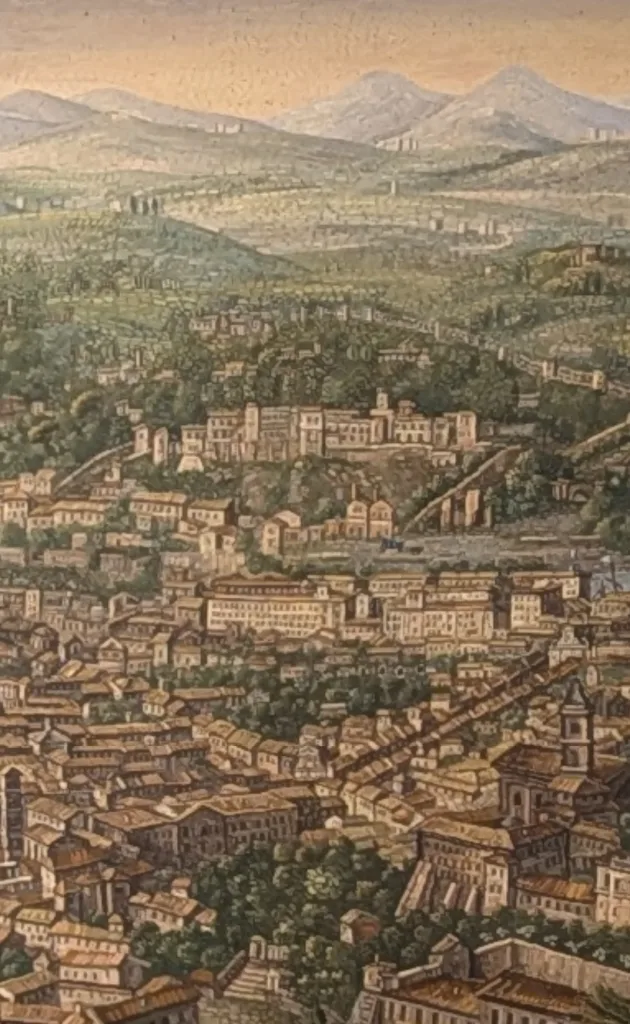
Aventine Hill in a detail of the ‘Panorama of Rome From the Janiculum Hill’ in miniature mosaics by Antonio Tesca 1800-25 , Gilbert Collection V&A Photo K Flude. You can see the Walls of Rome in the Background. The Tiber runs across the middle but is not clearly visible.
The Hill is famous in the mythology of Rome because it is associated with Romulus. He and his twin Brother Remus, were born to the vestal virgin, Rhea Silvia, in the pre-Roman City of Alba Longa, not far away. Rhea was the daughter of former King Numitor. Her uncle, killed Rhea’s brother and forced her to be a vestal Virgin. Thus ensuring Numitor’s line died out.
But, in her sacred grove she was put to sleep by Somnus dripping a sleeping draft into her eyes and then raped by the God Mars. This was a terrible breaking of the taboo for Vestal Virgins. Rhea gave birth to the twin boys. They had to be hidden from the wrath of their Granduncle.
The Palatine & the Lupercal
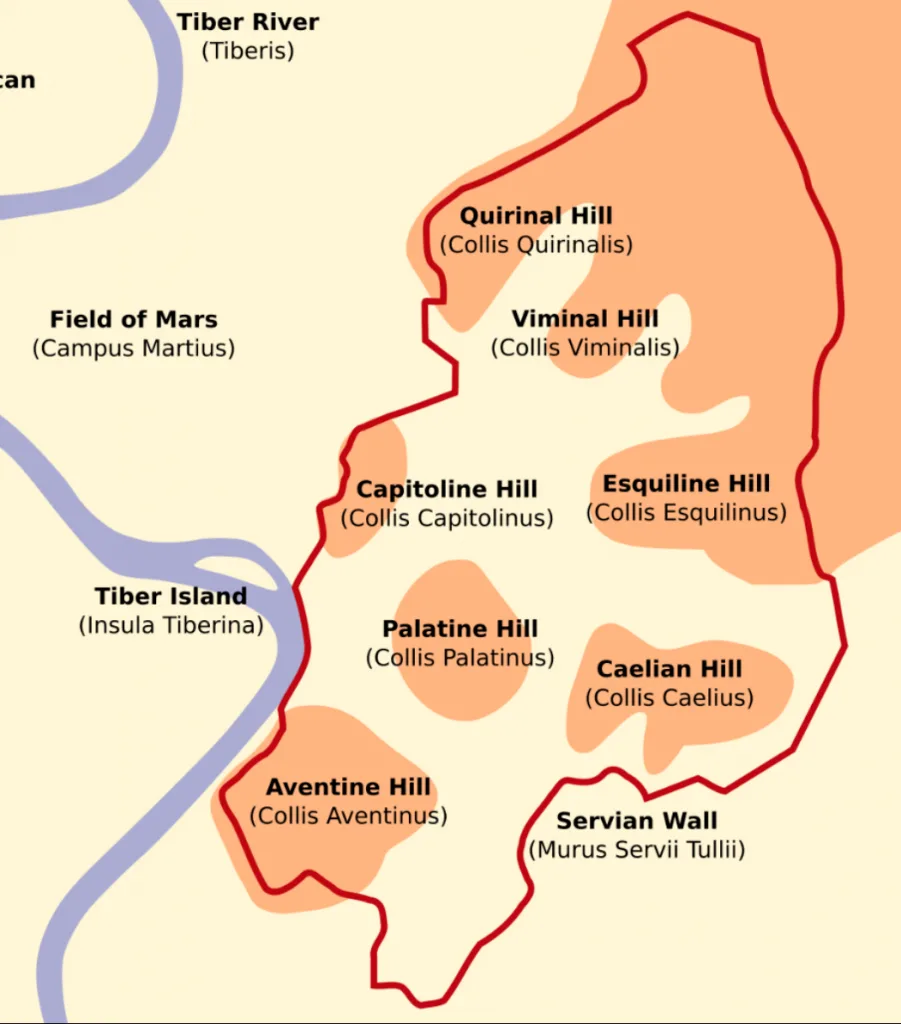
The Seven Hills of Room (Facebook)
The boys were saved by the River God Tiberinus and then by being suckled by a Wolf in a cave called the Lupercal, which is at the foot of the Palatine Hill in Rome. A ‘grotto’ under Augustus’ Palace on the Palatine, has been claimed as the original Lupercal, but it is disputed. (see www.digitalaugustanrome.org/records/lupercal/.
When the boys grew up, they helped their Grandfather (Numitor) reclaim the throne of Alba Longa. The boys, being the children of the War God, were obviously excellent at the art of war. Then they decided to found their own City, but they could not decide upon which hill to build it or whom to name it after (accounts vary!). Remus favoured the Aventine, Romulus the Palatine (some accounts say vice versa).
So they decided to let the Gods decide. Remus claimed to have won when he saw a flight of 6 auspicious birds. Romulus saw 12 and declared himself the winner. And Rome was named in his honour. It was on his choice of Hill – the Palatine Hill. The Aventine hill was, originally, outside the City boundary.
The two quarrelled. Remus was killed. This story was first written down in the Third Century BC. The traditional foundation date of Rome is 753BC. These mythical foundation stories continue are retold and celebrated. In Britain, we largely ignore our creation myths. Despite our legendary Founder, King Brutus, being a relative of Romulus and Remus.
The ‘Panorama of Rome From the Janiculum Hill’ in miniature mosaics by Antonio Tesca 1800-25 , Gilbert Collection V&A Photo K Flude. It took 20 years to make.
You didn’t think I’d leave you with just a detail of the superb map did you? And to see a much better photo of it look at the V&A’s photo. It is part of the Gilbert Collection which I introduced in this post.
First written in 2023 and revised March 30th 2024, 2025, Object of the Day added 2026
The expression ‘Mad as a March Hare’ comes from the displays of hare boxing that takes place as the Hare mating season begins. And no, it’s not the male March Hare fighting in the spirit of romantic rivalry. It is the female hares fighting off unwanted attention from the males. Hares are solitary creatures, and the mating season is, perhaps, particularly difficult for them. The Country File website has more on the subject. www.countryfile.com
Not only March Hares but March Kittens too
There are also March Kittens and March Chickens. Edward Topsell in his ‘History of Four-footed Beasts‘ 1607 says the best Kittens to keep are those born in March. ‘The Closet of Sir Kenelm Digby Opened‘ 1669 says:
‘Keep a black cock hatched in March as a protection against evil spirits: his crowing terrifies them.’
He also gives a recipe for Cock Ale:
Eight gallons of Ale, a boiled March Cock, four pounds of stoned Raisins, half a pound of dates, nutmegs, mace. Beat the ingredients in a mortar, add to two quarts of Sherry. Add to the ale. Stop it in a container for 6 or 7 days. Bottle it, drink after a month.
Very weird. I challenge my readers to try it and let me know how it goes?
Was the March Hare Sacred?
But it’s not only March Hares because the hare itself was a sacred animal. It was sacred to Aphrodite because of their prodigious ability to have offspring:
‘For you know, I imagine, what is said of the hare, that it possesses the gift of Aphrodite to an unusual degree. At any rate it is said of the female that while she suckles the young she has borne, she bears another litter to share the same milk; forthwith she conceives again, nor is there any time at all when she is not carrying young.’
Classical Texts Library. Philostratus the Elder, ‘Imagines’ Book 1.1-15 c 3rd Century AD. Translated by Arthur Fairbanks.
Divine Celtic & Neolithic Hares
Research reported by Exeter University suggests that hares were worshipped in pre-Roman Britain. Julius Caesar wrote:
“The Britons consider it contrary to divine law to eat the hare, the chicken, or the goose.”
‘The Battle for Gaul’ Translation by Wiseman, Anne, Wiseman, T. P. Published by Penguin Random House, 1980 ISBN 10: 0701125047 (TP Wiseman was my professor for Classical Studies at Leicester University).
Hares are thought to be the original Easter Bunny. But finding good evidence before Germany in the early modern period is difficult. There is a tradition that witches can be scared away at Easter. Exactly, how this works is not at all clear to me. But it has been said that witches could take on the form of a hare. So eating Hare Pie at Easter helps rid the land of the witches.
Jugged Hares
You could have a jugged hare. Jugging is cooking a whole animal in a container over water. Follow this link for a recipe for jugged wild hare. Remember, you are not allowed to shot or trap them on a Sunday or on Christmas Day! For a discussion of hares and folklore, click here:
Hare’s Feet Totems
A jointed hare’s foot was considered very lucky and a remedy against gout, stomach pains and insomnia. (The Perpetual Almanack of Folklore by Charles Kightly, which I have used several times in this piece.) You can buy one on eBay. (Don’t click the links, it’s not an advert but a picture of an advert). I remember friends having rabbit feet which they carried around with them for luck. The foot would often be on a key rings.
Georgiana, Duchess of Devonshire (Johann Heinrich Hurter after Angelica Kaufman). Photo by K Flude of the miniature at the Victoria and Albert Museum
The Gilbert Collection has been re-displayed in the V&A in London. It has just opened, and is one of the most opulent displays you could hope to see! But, I loved this miniature of Georgiana. She was one of the richest women in Britain, a compulsive gambler, and a powerful political force for the Whig Party. And despite the Georgian Hairstyle the artist has contrived to make a very down to earth portrait. I can imagine bumping into her at the local Overground Station! She became better known after the bio graphy by Amanda Foreman, followed by the Film starring Keira Knightly. The Museum label says the portrait is ‘after Angelica Kaufman’. But I cannot find a Kaufman of Georgiana, that has this charming informality.
I have just heard news that the Arts Council wants to charge overseas visitors to visit our wonderful free national Museums, while allowing British Citizens free entry. Now, there are lots of arguments to be made about it, particularly in a time where money is in short supply. But, one result will be longer waits to get into Museums and Galleries. I am not sure how we Brits, are going to be asked to prove our nationality. If they have to inspect our Electricity Bills, Drivers Licenses, Passports, Library Cards, or Bank Statements, expect chaos.
One more object from the Collection is made of minature mosaics, and the V&A has several, But I have chosen this fabulous image of the Colosseum in Rome:
Colosseum by Domenico Moglia c1851
First published March 28th 2023, revised 2024, 2025. 2026 Object of the Day added and post revised 2026
Study for Lady Lilith, by Rossetti. 1866, in red chalk. Now in the Tel Aviv Museum of Art (Wikipedia) Lilith born at The Beginning of the Universe
This is now my most popular post. March 25th is the Annunciation—the day that the Archangel Gabriel tells Mary she is pregnant. (to see some very fine paintings of this meeting, look at my other March 25th post march-25th-feast-of-the-annunciation/). When I first wrote this post I was discovering how it all fitted together as I wrote. So I’m leaving it the way it was, proof reading and clarifying if necessary, but keeping the thrill of the discovery of the the significance of March 25th as the day that saw the Beginning of the Universe.
March 25th is also the anniversary of the birth of Adam and Eve (and Lilith); the death of Jesus Christ; the anniversary of the Immolation of Isaac; the Parting of the Red Sea; the Fall of Lucifer; and, (until 1752 in the UK) the beginning of the Year.
Of course, it isn’t. Or to put it another way, no one can, or ever could, prove any of these dates except 1752. So what they speak to is the way the Church saw the world as logically structured by God. Christian thinking about the year, the world, the universe, creation, developed over many years and took influences from many cultures. It is also very complicated to work out the sequence, so I’m going to summarise what I know (or at least what I think I know).
Happy Birthday, Dear Jesus.
Christians chose Christmas Day as the Birthday of Jesus, probably partly because it was a prominent birthday already shared with several Gods. Particularly, Attis, Mithras, Saturn and the Unconquered Sun. It was approximately at Solstice, the beginning of the Solar Year, and close to one of the main festivals of the Roman World, the Saturnalia. So it made it easier for new converts who could retain elements of their festivals after conversion.
December 25th might have been selected by the pagan religions because it is the time when the Sun begins to rise further north each day. The days stop shortening and start lengthening, light increases with the promise of warmer weather and budding plants. It was considered a rebirth of the Sun.
Solstice Anniversaries
So, Jesus was born on/or around the Solstice, so he must have been conceived approx. 9 months earlier. This is approximately at the Spring Equinox.
Ah, you are thinking! But today isn’t the equinox. It’s a few days after the equinox. Surely, God doesn’t do approximately?
I have always thought that the 4 or 5 days difference between the Solstice, the Equinox and the Christian festivals was down to the fact that the Calendars were not well coordinated with the actual movements of the Sun (because the Sun does not circle the earth in 365 days, or in 365 and a quarter days, but 365 days, 6 hours, 9 minutes. Unless corrected for this means dates slip from their proper place in the Solar Year. It also makes lunar Calendars difficult to align with the Sun cycles, and vice versa.
But when I first wrote this a sudden revelation dawned upon me which will be revealed in the next few paragraphs.
So, God sends his Son to save the human race. God is a logical being, so she would send her Son at an appropriate time? If Jesus is born at or near the Solstice, which is an appropriate time for the Son of the Creator, then conception 9 months earlier, March 25th, is near the Equinox. This is the beginning of Spring. For many people, Spring is a new beginning, for example, the Anglo-Saxons saw Winter as the death of the year, and Spring as the young Year. It all makes sense.
The Creation
So to the Creation. God, having a free choice, would have created the world at the beginning of Spring. In fact, if you think about it, God creates everything necessary for life at the creation in 6 days. As soon as it has all been created and put together, it is bound to immediately spring into new life. The first season must, therefore, be Spring? Right? So March 25th?
This gives a nice symmetry with Jesus’s Life. Conceived on March 25th, born December 25th, and died 30–40 years later, according to the Church, at Easter, on March 25th. (the only other famous person I know, born and died on the same day is William Shakespeare).
Easter
Easter, when Jesus is martyred, isn’t March 25th I hear you saying. But remember, Easter is a lunar festival, so its date varies each year. In fact the next time is 2035. Births and deaths, on the other hand, are fixed to the Solar Calendar. Therefore, the Church chooses March 25th as the most appropriate day to pin the death of Jesus, on the anniversary of his conception and the anniversary of the creation of the Earth. I am guessing that this is also the preferred date for the Day of Judgement.
It is also the Birthday of Adam, and his first wife Lilith (or so some say), and Eve. More about Lilith below. I hope this is all making sense?
Why was Adam born on March 25th?
I had thought this date was just one of the parallels that the Church liked, Jesus and Adam born on the same day. But, I have just worked out why Adam is born on March 25th, and why these dates are not the Equinox, March 20th/21 but March 25th, which has been bugging me.
Let’s go back to the beginning of Creation as described in Genesis. It has the following sequence of Seven Days, beginning with the Equinox March 20th. I have added dates to the 6/7 day sequence of Creation:
Day 1: Light – March 20th
Day 2: Atmosphere / Firmament – March 21st
Day 3: Dry ground & plants – March 22nd
Day 4: Sun, moon & stars – March 23rd
Day 5: Birds & sea creatures – March 24th
Day 6: Land animals & Adam, Lilith and Eve – March 25th
So there you have it! Adam, Eve (and Lilith) were created on Day 6 with the Land Animals – March 25th. Jesus conceived, also on this date, and so 9 months later is born on December 25th. It all makes sense, and aligns the Jesus’s Life, the Christian year fully with the Solar Year and the Creation!
And that, dear Reader, is the very first time anyone has been able to explain to me why Christmas is not at the Solstice, and why the Annunciation was not at the Equinox. Maybe you all know this, but it is very exciting to work this out for myself. And believe me, I have done a lot of reading about calendars and not spotted an explanation.
When was the Creation?
The Anno Munda‘s is a Jewish Calendar which begins counting from a year before the Creation – the Year of Emptiness. This was 5500 years plus 2026 years ago so 7526 Before the Present. And it was supposed to have ended in 600AD, 6000 years after the Creation. So, they got that wrong.
Dionysius Exiguus replaced the Anno Mundo year with the AD/BC system in the 6th Century AD). This became popular when the Venerable Bede used it in his writings in the 8th Century.
Beginnings of the year
The Celts chose October 31st, Julius Caesar chose January 1st, other cultures have other dates, and the Spring Equinox is another choice sometimes made. The Church and Dionysius Exiguus choose March 25th, although secular society also recognised the claims of January 1st. Britain kept to March 25th until 1752 when we adopted the Gregorian Calendar. But people like Samuel Pepys celebrated New Year’s Eve on 31st December. So January 1st was the secular New Year, but the Christian year number did not change until March 25th. So King Charles I thought his head was being cut off on January 30th 1648; while history books will tell you it was cut off on January 30th 1649. Same day, same head, different reckonings.
January 1st, the New Moon and New Year
December 31st/January 1st is essentially a Solstice New Year Festival. And I have, previously, used the difficulty of keeping calendars as to why these days has slipped out of alignment with the Solstice. But, today I realised that it is as likely that the reason is the Solar/Lunar nature of our time keeping. The year, and its festivals, is largely arranged around the Solar Cycle. But our weekly and monthly cycles are orginally derived from the Moon.
The first of a month, was called the Kalends by the Romans, the Nones the half moon, and the Ides signified the New Moon. The kalends of January is then, originally, the First New Moon after the Winter Solstice. So, January 1st is not a slightly misdated Solstice Festival it is a Festival celebrating the first New Moon of the New Year! Sorry, to seem excited but this is the first time I have realised this.
Over time societies give up trying to sync the lunar and solar calendars. Roman and Christian cultures gave up and fixed the moon months, completely abandoning any attempt to keep the months to the actual lunar cycle. This is our current system, in which only Easter and festivals that depend on Easter remain true to the movements of the moon festival, much to our perennial confusion.
Maybe you all know this, but it’s put many things into perspective for me!
Lilith
The April 2023 Issue of ‘History Today’ had a short piece called ‘The Liberation of Lilith’ which suggests that the story of Lilith, a figure from Jewish Folklore, is first attested in a Medieval satirical text called ‘The Alphabet of Ben Sira’. The story goes that Lilith is created from the same clay as Adam. Adam then demands she lies below him during sex. She refuses, saying that they are both made from the same stuff and, therefore, equal. Adam refuses to accept this, and so Lilith leaves the Garden of Eden. So the story goes.
The story of Lilith, Sarah Clegg suggests, is one of a series of similar stories found around Europe and Asia. And Clegg assumes that it is gradually modified to make Lilith a demon who will kill babies unless the names of three angels are spoken out loud.
The story survived as a charm to keep babies safe, and perhaps to remind people of equality among the sexes. But this causes problems for, OK, let’s call them out, the Patriarchy. Lilith cannot be equal to Adam so she is made into a monster, not made from the same clay as Adam but from the scum and waste left over from Adam’s creation. I imagine the story then went on to propose that God creates Eve from Adam’s rib, and so she is created from Adam, and is, therefore, not equal, but subservient to him, although not as bad as Lilith. Lilith is now a significant figure in feminist folklore circles.
Attached to the watercolour of Lilith by Rossetti (at the top of the page), was a label with a verse from Goethe‘s Faust as translated by Shelley. (Wikipedia)
“Beware of her fair hair, for she excells All women in the magic of her locks, And when she twines them round a young man’s neck she will not ever set him free again.”
The model is Fanny Cornforth, Rossetti’s mistress. He painted another version a few years later, but the model in that is Alexa Wilding. His models are arguably more interesting than the man himself and include: Elizabeth Siddall, Jane Morris and Fanny Cornforth. Christina Rossetti, his poet sister, modelled for Rossetti’s painting, Ecce Ancilla Domini which you can see here.
For more on the Annunciation, look at my other March 25th post here.
I think I might have enough material to begin my own Cult.
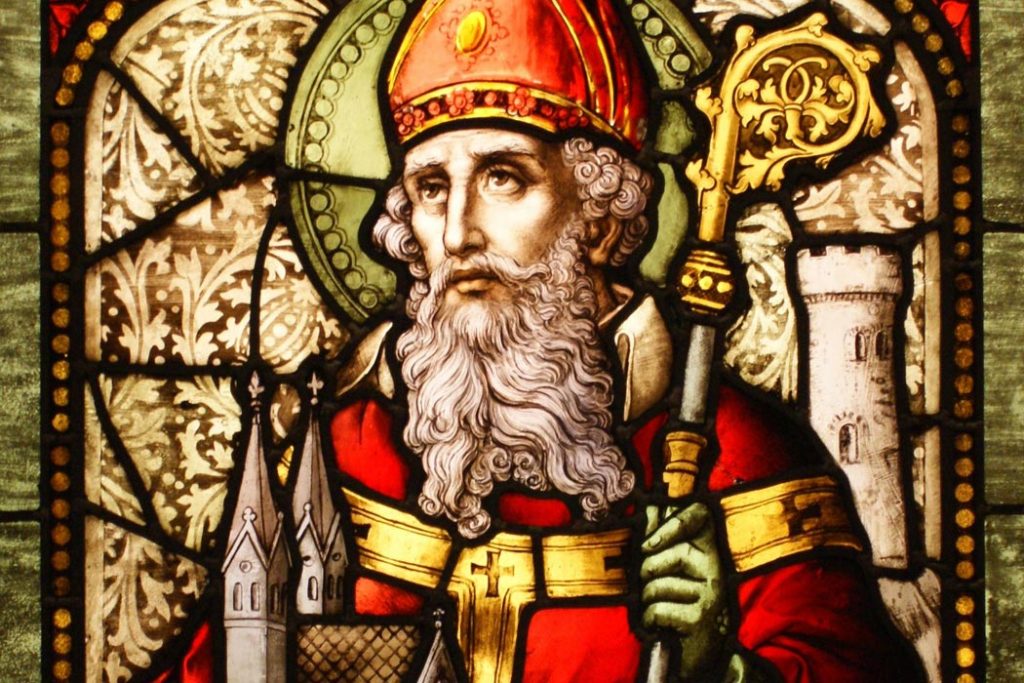
Stained Glass window depicting St Patrick (source of image, lost in the mists of time!)
St Patrick
St. Patrick has a very interesting autobiography (Confession), because it is one of the only personal reminisces of life in post-Roman Britain. He wrote in the form of a letter. In it, he explains that he was captured by Irish pirates while living in a Romano-British Town. His father we discover was a Decurion and a Deacon which suggests elements of Roman political organisation continued. No one knows the dates of St Patrick’s life, but he lived in the 5th Century. The use of Roman titles suggests, to some, an earlier rather than a later date. Perhaps in the early 400s. Unless, of course, you want to propose that Roman life continued later into the 5th Century than the first few decades. (which, increasingly, people are proposing.)
The town he lived in was called Bannavem Taburniae. Many places have been proposed for it. The closest linguistically is Bannaventa in Northamptonshire, but this seems a very unlikely place for Irish raiders to land, being about as far away from the sea as it is possible to get in Britain!
Nicholas Fuentes
Scholars have suggested South Wales and the Scottish borders most commonly. But my favourite suggestion, but about as unlikely as Northampton, is Battersea in London. This suggestion was made in the pages of the London Archaeologist by then editor Nicolas Fuentes.
Fuentes was one of a pioneering group of archaeologists when Rescue Archaeology first began a campaign to record the archaeology being destroyed by massive redevelopment of town centres in the 1970s.
He changed his name from the anglicised Nicholas Farrant back to its original Fuentes. He then wrote a magnificent series of papers, in London Archaeologist, which located St. Patrick in Battersea; St Alban’s execution in London and all 12 battles of King Arthur around Greater London.
St Albans Martyrdom in London
All were well argued, but as a set they do raise an eyebrow, being unsupported by any clear evidence. And, as far as I know, without much scholarly support. The one I really like is locating St Alban’s Martyrdom in London rather than in St Albans. It reminds everyone that the first reference to St Alban, which is by Gildas in the 6th Century, places the execution of the Saint firmly in London. It also makes sense of the story that Alban, keen for martyrdom, gets God to part the River so he can go quickly to the execution spot. The bridge it was said was full of people going to see the execution.
In Gildas’s case, the execution is in London, probably at the Amphitheatre, up a hill from the the mighty Thames. So God parted the Thames for Alban. Anglo-Saxon historian, the Venerable Bede places St Alban’s death firmly in St Albans, but the river that God needs to part there- the River Ver, is a piddle. Alban could have crossed it easily, hardly requiring even Wellington boots! Not much of a miracle compared with parting the Thames. The likely site of execution in both cases would have been the Amphitheatre, rather than the side of the hill where the St Albans execution site is located. But Gildas did mention the hill, which makes sense in the case of London and not in St Albans, as it is outside of the Roman City. away from the amphitheatre.
To my, unscholarly mind, when we worship people we tend to venerate them, at their birthplace and death place. So to me, it makes sense that St Alban’s main shrine was at Verulamium where he was born (now known as St Albans) and London where he died.
St Germanus
There is some supporting evidence from the hagiography of St Germanus of Auxerre. This tells us that Germanus came to an amphitheatre for a religious debate about 15 years after the end of the Roman occupation of Britain. After the debate, he went to a nearby shrine dedicated to St Alban. Unfortunately, the writer of the memoir is not really interested in post-Roman Britain, so does not tell us whether it was in London or St Albans. But there is an early church dedicated to St Alban just by the Roman Amphitheatre in London. For more on St Germanus follow this link to my post.
However, archaeology does not reveal any evidence early enough to support the idea that the Church is that early. Fuentes, argued that London as the Capital was likely to have been the place where capital punishments were carried out, particularly in the case of a Roman Citizen like Alban. I must note that in placing any credibility to Fuentes theory, I am standing largely alone.
Stained glass window of St Patrick and St Germanus
The Twelve London Battles of King Arthur
I’m not so convinced by the 12 Battles of King Arthur were fought in the London Area. They are more likely to have been spread throughout Britannia. But the place name evidence is never going to be identify most of the locations.
St Patrick From Battersea?
So, to the point – St Patrick in Battersea? The evidence, as I remember it, is really only place name evidence. the suggestion that Battersea was derived from: Badrices īeg, ‘Badric’s Island’ and later Old English: Patrisey (Wikipedia), So, Patrick’s Island. The word ‘sea’ is used in that sense along the River Thames. For example in Chelsea, Thorney, Putney derived from ey which is short for eyot (island). Also spelt ait.’
St Patrick lived as a teenage slave for 6 years, then escaped from captivity in Ireland and returned home. Trained as a priest, in perhaps Auxerre (home to St. Germanus who is another crucial witness to post Roman Britain. (See my post here.) and returned to Ireland to begin the conversion to Christianity. He is the Patron Saint of Ireland, with St. Brigitte and St. Colomba.
St Patrick from Banwell?
Another candidate for Bannavem Taburniae’ comes from Andrew Breeze FSA. I read about this in Salon IFA, the newsletter of the Society of Antiquaries. Also you can read more about it in this History First article. Breeze has revived a theory that the Saint comes from the West Country, and that the ‘Bannavem Taburniae’ is Banwell, near Weston-super-Mare in North Somerset. He suggests that ‘Bannaventa was a Latinisation of a Brittonic name that included banna, for a bend’, crook or peak. Venta is a well known word for an area of local administration or marketplace. For example, Venta Bulgarum, was the name for Winchester in the Roman period.) . He suggests that these ‘elements, as well as the Berniae element of ‘Taburniae’, can be found in the name Banwell, itself a compound name of the Brittonic ‘Banna’ and the Old English wylle, both meaning pool, or in the names of surrounding villages.’ I’m sure Fuentes did something similar for Battersea.
Image credit: Looking south from Winthill, near Banwell, Somerset, Colin S Pearson; Banwell in Somerset, Google Street View
What Banwell has over the London theory is that it is more likely to have been subject to Irish Raiders than London. But, for me, it is just another theory based on placename evidence that might or might not be true. I have read any number of Archaeology books where arguments about placenames are deployed to add some solidity to some theory about King Arthur, or a tale from Geoffrey of Monmouth. I therefore distrust them all. They essentially create circular arguments.
St Gertrude’s Day
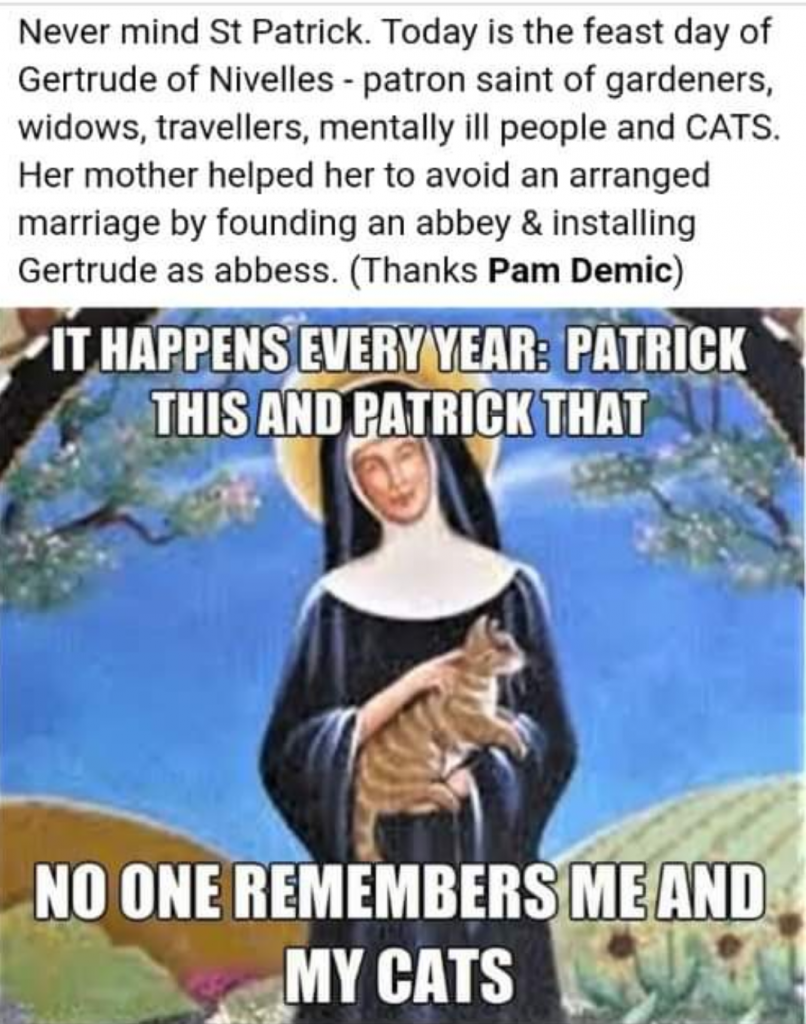
And least we forget, today is also St Gertrude’s Day, patron saint of Cats.
Facebook post, posted by a friend, and about St Gertude patron saint of cats.
On This Day
45 BC – Julius Caesar consolidated his power by defeating his main rival Pompey the Younger, and allies, at the the Battle of Munda. He went on to establish his Dictatorship, which led to his assassination on March 15th (see my post on the Ides of March)
1845 – The Rubber Band patented by Stephen Perry of St Johns Wood, London, for Messers Perry and Co,. Rubber Manufacturers of London.
Specification of the Patent granted to Stephen Perry, of Woodland’s-place, St. John’s-wood, in the County of Middlesex, Gentleman, and Thomas Barnabas Daft, of Birmingham, Manufacturer, for Improvements in Springs to be applied to Girths, Belts, and Bandages, and Improvements in the Manufacture of Elastic Bands. —Sealed March 17, 1845.
1861 – The Kingdom of Italy proclaimed with Victor Emmanuel as King. The unification of Italy was the culmination of the Risorgimento, led by Garibaldi, Cavour, Mazzini and Victor Emmanuel. It survived until 18 June 1946 when Italy became a Republic.
1951 – First Appearance of Dennis the Menace in the boy’s Comic the Beano. Published in Dundee, by DC Thomson. I read the Beano as a boy, along with the Robin, the Eagle, Topper, the Dandy, The Hotspur, and Whizzer and Chips. What made Dennis great was that he was a bad boy and didn’t get any better. Always at war with the ‘Softies’ – basically well-educated boys. And made us laugh with his antics. For more comic nostalgia read: nostalgiacentral.com/pop-culture/books-comics/british-comics-of-the-50s-60s-and-70s/
Dennis the Menace By DC Thomson – The Beano 3671, Fair use, https://en.wikipedia.org/w/index.php?curid=38472209
1973 – The Pulitzer Prize–winning photograph Burst of Joy is taken and symbolised the end of the US involvement in the Vietnam War
‘Burst of Joy’ By Slava “Sal” Veder”, Associated Press – https://www.columbiatribune.com/picture-gallery/news/2020/03/17/today-in-history-march-17/67299331007/, Public Domain, https://commons.wikimedia.org/w/index.php?curid=153972466
First Published in 2024, republished in 2025, On This Day augmented 2026
Beware the Ides of March – With Apologies.Image from Facebook
Beware the Ides of March
SOOTHSAYER: Caesar! CAESAR: Ha! Who calls? CASCA: Bid every noise be still; peace yet again! CAESAR: Who is it in the press that calls on me? I hear a tongue shriller than all the music Cry ‘ Caesar!’ Speak. Caesar is turned to hear. SOOTHSAYER: Beware the ides of March. CAESAR: What man is that? BRUTUS: A soothsayer bids you beware the ides of March. CAESAR: Set him before me; let me see his face. CASSIUS: Fellow, come from the throng; look upon Caesar. CAESAR: What sayst thou to me now? Speak once again. SOOTHSAYER: Beware the Ides of March. CAESAR: He is a dreamer. Let us leave him. Pass.
Julius Caesar by William Shakespeare
Julius Caesar and the Ides of March, 44 BC
The Ides of March is the 15th of March. The day Julius Caesar didn’t take the warning that might have saved his life. You might suggest he got what was coming to the first populist Dictator. But any study of Roman History will find many precursors to Caesar in Roman and Greek History. Among populists, I rank Caesar with Napoleon a Dictators who was, personally, an intelligent, rational man. They, in some ways, ruled ‘wisely’ but were nonetheless willing to sacrifice millions of people for their own personal ambition.
Warning from history – Assassination is not the Answer!
Today, the world is faced with the populists who are geniuses only in their own minds. I know, we as humans, might think, if only X would drop dead, how much better it would be? Brutus, being an honourable man, took action upon his thought. But, as often is the case, what seemed the ‘right thing’ to do, turned out to be a disaster. The plotters were trying to save the Roman Republic, but the murder destroyed the Republic.
So, still those assassinary thoughts, read this article in ‘History Today’ about the impact of Julius Caesar’s murder. Do everything you can but use democratic means to defeat egotists to whom truth means nothing. In my opinion this is the major problem for humanity, it seems we do not know how to stop homicidal maniacs (like Hitler) causing war without needing to fight a war to stop them. We do not have a method of peaceful mass rebellion. Perhaps Gandhi came closest but then he was working against a system that was not a dictatorship. (I mentioned Gandhi in ‘On This Day’ on my post here.
Ides of March
Now, what the heck are or indeed is the Ides of March?
A Roman month was divided into three, first the Kalends, then the Nones and finally the Ides. These three days were the important days of the month. The Kalends is the 1st of the Month. The Nones the 7th of the Month, And the Ides the Fifteenth. It is said to go back to the early days of Rome and a lunar calendar. The Kalends being the first tiny sliver of a crescent moon a couple of days after the New Moon. The Nones the first quarter of the Moon and the Ides was the full moon. To me, as a way of dividing a month it is very lopsided. The cycle of the moon is 29 days not 15. So the tripartite division divides up the first half of the month, and leave the second half undivided.
Debts were supposed to be paid on the Kalends and that is where we get our word calendar from. These public calendars were called Fasti. This is the name of Ovid’s great Almanac Poem, the Fasti, which I often quote from.
Kalendar
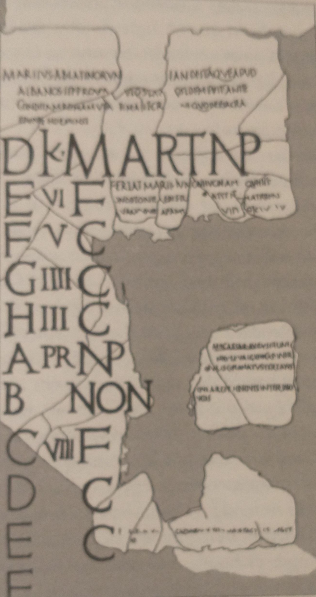
This is a very bad photograph of a drawing by Herbert E Duncan Jr of a 1st Century Calendar
How was it used? When talking about a day in the future month you might say I’ll meet you on the 5th day before the Kalends. I’ve never really understood this system, despite a few attempts, until I saw this drawing of a Roman Calendar. You’ll have to read this closely.
The first column, on the left, with the letters from D to H then A – H. This is a recurring cycle of 8 market days, running in tandem with Kalends, Nones etc.. This gives an 8 day week.
Now reading across the top line in capitals: DKMARTNP. So the D is the 4 day of the 8 day ‘market week’. The second column begins with the Letter K for Kalends, then MART for March. So it’s the Kalends of March. Then NP which means this day is a day for public festivals.
Back to the second column. Below the K for Kalends, the days are counted down to the upcoming Nones. So the next one after Kalends is VI, meaning the 6th day before the March Nones. Then V, IIII, III. There is no II because PR means the day before Nones. Below and to the right of the PR are the letters NON which is, as you might hope, is short for Nones.
In the second column below this is the number VIII which means the next day is the 8th day before the Ides of March. The fragment of stone from which this drawing comes does not continue down to the Ides, unfortunately.
Complicated, huh? It gets worse. The third column has a series of letters in it: F C C C NP NON F C C. We already know that the NON is short for Nones, The F means it’s a fastus, a permissible day when legal action can be taken. (the plural of Fastus is Fasti.) The C means Ccomitialis which on fasti days the Roman people could hold assemblies. (see my post for more on the curiae).
Market and Public Days
We have already seen that NP marks days for public festivals. An N would mean days when political and judicial actions were prohibited, although there is not one here. The small unreadable text to the right is information, I believe, about holidays and historic events to be marked in the calendar. This is, in fact, a Roman Stone Almanac.
This confusing system survived Caesar’s major calendrical reforms. He transformed the Roman calendar, which was rotten at the core. He re-aligned with an almost accurate calculation of the time the Sun takes to circle the earth. (or the other way around!) This is known as the Julian Calendar.
But the Kalends, Nones, and Ides he left intact and it survived until Constantine the Great got rid of them. They were replaced with the familiar 4 fold division of the month. So, for the first time, you could work 24/7.
493 – Odoacer, the first barbarian King of Italy after the fall of the Western Roman Empire, was slain by Theodoric the Great, king of the Ostrogoths, while the two kings were feasting together. Odoacer was a mercenary General for the Romans, but seized the Throne from the child Emperor Romulus Augustulus, who ruled for only 10 months. Theodoric took over and ruled an Empire centred on Italy from 496 to 526. Both Kings followed the Arian version of Christianity, although generally did not persecute the Catholic Tradition.
Theodoric was, more powerful than the later Roman Emperors and had good relations with the Roman Senate, which continued in operation. Later in his rule, that relationship broke down. This lead to Theodoric arresting Boethius for treason. While awaiting execution, Boethius wrote ‘On The Consolation of Philosophy’. Often called the last great literary work of the Western Roman Empire. Amongst many translations into English are those by King Alfred the Great, Geoffrey Chaucer and Queen Elizabeth I. Boethius was executed in 523
1493 – Christopher Columbus arrived in Castille, back from the journey that changed the world. He made landfall in the Bahamas on 12th October 1492, ending what became known as the pre-Columbian Age (aka pre-contact era). The voyage began the era of exploration that turned the world into a global entity, but also bringing in its wake horrific genocide of indigenous peoples.
1877 – First Cricket Test Match between England and Australia, held at Melbourne which the Aussies won by 45 runs.
1909 – Selfridge’s opened on Oxford Street
1927 – The first Oxford v Cambridge Women’s Boat Race took place in Oxford on the Isis. The Isis is what posh folk call the River Thames as it flows passed the University Town. In Latin the Thames is called the Tamesis. And a conceit grew up at the University that the River was called the Isis until it was joined by the River Thame at Dorchester, where the conjoined river was called the Tamesis.
The Boat Race was won by Oxford. Strangely, the boats did not row at the same time. On the first leg they were judged by the style of their rowing, and on the second by the speed. The judges could not agree on the style scores, so in the end the decision was given to Oxford on account of being the faster of the two boats.
Gregorius I is known as Saint Gregory the Great. Pope from 3 September 590 to his death on 12th March 604. So 12th March is traditionally his feast day. It was changed to September 3rd, the date of his elevation to Pope because 12th March was often in Lent.
His is the 2nd most popular name for Popes. This is the top 18. I guess St Peter was too hard an act to follow, but then there are only 6 Pauls? I can’t help feeling there should be six Sixtus’s?
St Gregory is the patron saint of musicians, singers, students, and teachers. It is traditionally believed he instituted the form of plainsong known as Gregorian Chant. However, he was also a formidable organiser and reformer. He made changes that helped the Catholic tradition survive Arian and Donatist challenges. To read more about the Arian Heresy look at my post on St. Hilary and the Arians. (St Gregory and the Angles – why do these all sound like 80’s post punk bands?)
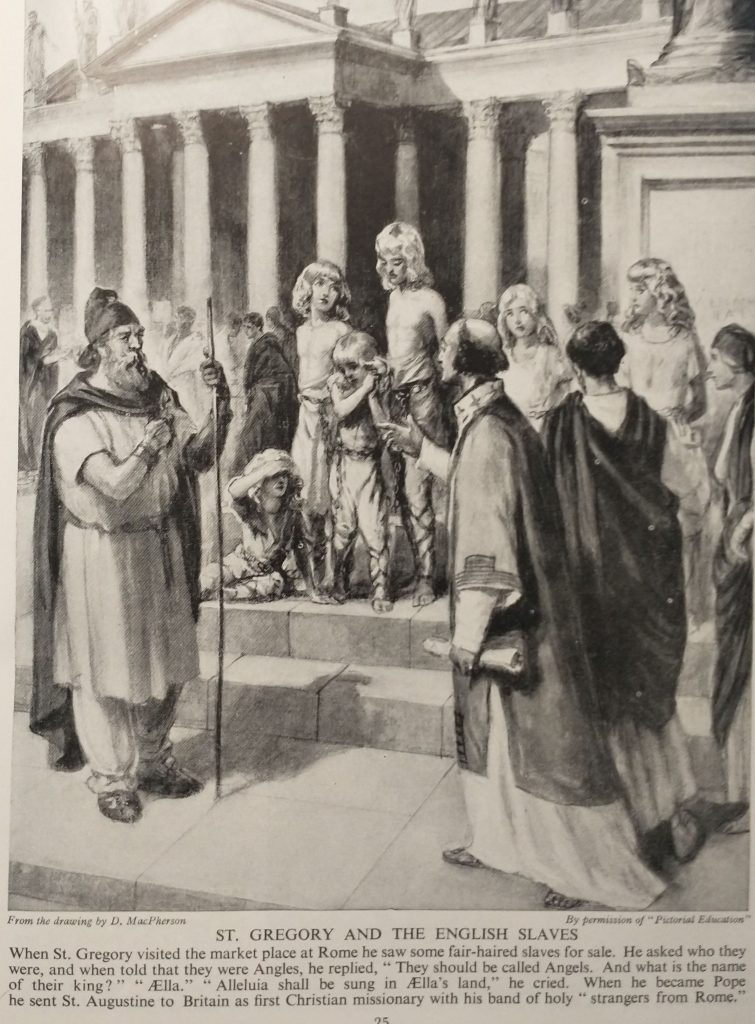
In the UK, St Gregory is venerated with St Augustine for bringing Christianity to the largely pagan Anglo-Saxons. The caption to the illustration above tells the story of how he came to send a mission to the pagan Angles in Briton. It includes his two most famous puns, riffing on the similarity of the words Angles/Angels and Aella/Alleluia. But in between these two he also punned on the name of Aella’s kingdom. This was called Deira which later joined with Bernicia to become the Kingdom of Northumbria. St Gregory said he would save them from the wroth of God which is ‘de ira’ in Latin. The ire of God. Deira. No? Not hitting your funny bone?
St Augustine’s Mission
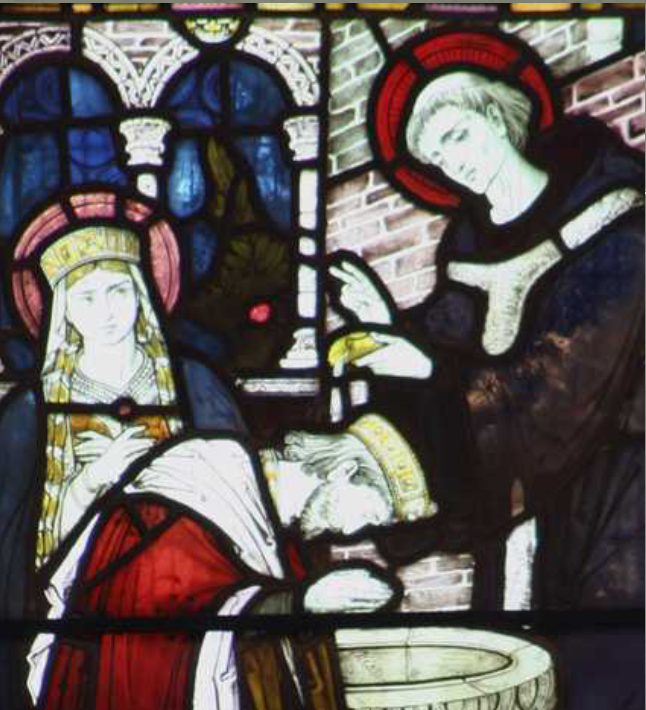
In 597AD St Gregory sent St Augustine to Canterbury. His mission to convert the Germanic peoples of the former Roman Province of Britannia. Canterbury was chosen because its King was the ‘Bretwalda’ of Britain. And he, was married to Bertha, a French Princess who was already a Christian. The enigmatic title of Bretwalda was given to Britain’s most powerful King. At the time, it was Ethelbert of Kent. So, it was a relatively safe haven for St Augustine’s mission. The King was baptised, shortly, after in Canterbury.
Stained glass window showing the Baptism of King Ethelbert of Kent by St Augustine watched by Queen Bertha. In St Martins Church, Canterbury
Archbishop of London?
The mission came with a plan to recreate the ecclesiastical arrangements set up in the Roman period. From the early 4th Century there were archbishops in the two main capitals at London and York. (We know because they attended the Synod of Arles in 314). After Kent was converted, St Augustine sent St Mellitus to London. London was part of the Kingdom of Essex, ruled by St Ethelbert’s nephew, Sæberht. Mellitus was the first Anglo-Saxon bishop of London and he established St Pauls Cathedral in 604. St Paulinus was sent to convert Northumbria and established a Cathedral in York.
Unfortunately, for the plan, Sæberht died. His sons returned to paganism and Mellitus was kicked out. He returned to Canterbury, where he, eventually, became Archbishop. Ever since we have had an Archbishop of Canterbury and York and never had an Archbishop of London.
St Martin’s Church, Canterbury – where the Church of England began. Note the Roman tiles in the wall.
St Gregory and England
It is possible to argue (and I do) that St Gregory’s encounter with the Angles is why we are called English, not Saxons, nor Wessexians. Gregory sent Augustine to set up the Church of the Angles, not the Church of the Saxons. Saxon was the normal name used by the Romans for Germanic barbarians. The old Roman province of Brittania was by now divided into 3 Saxon Kingdoms. Essex, Wessex, and Sussex. (East, West, and South Saxons). 3 Anglian Kingdom, Mercia, East Anglia and Northumbria. (Middle, East and North Angles). And Kent, which the Venerable Bede says was a Jutish King of Germans from Jutland. These Kingdoms were often at war., sometimes allied, or subjected.
The Vikings then conquered most of these Kingdoms, except parts of Wessex and Mercia. After the attacks of the Vikings were beaten back, Alfred and his son, daughter and grandson reconquered or ‘liberated’ the ex-Viking areas. Alfred renamed the united kingdoms of Wessex and Mercia, the Kingdom of the Anglo-saxons. Athelstan his son liberated Northumbria and other areas, and in joining it to the Kingdom of the Anglo-Saxons renamed it Angeland or England.
The Church of England had made the term Anglish/English became a unifying term to unite Angles, Saxons and Jutes. Otherwise, the ‘liberated’ Angles and Jutes would have to swallow being part of Greater Wessex, rubbing in their loss of independence. Of course, it was all a bit more complicated, but it gives a summary of the formation of England, which was created by the end of the 10th Century.
St Gregory in Amsterdam
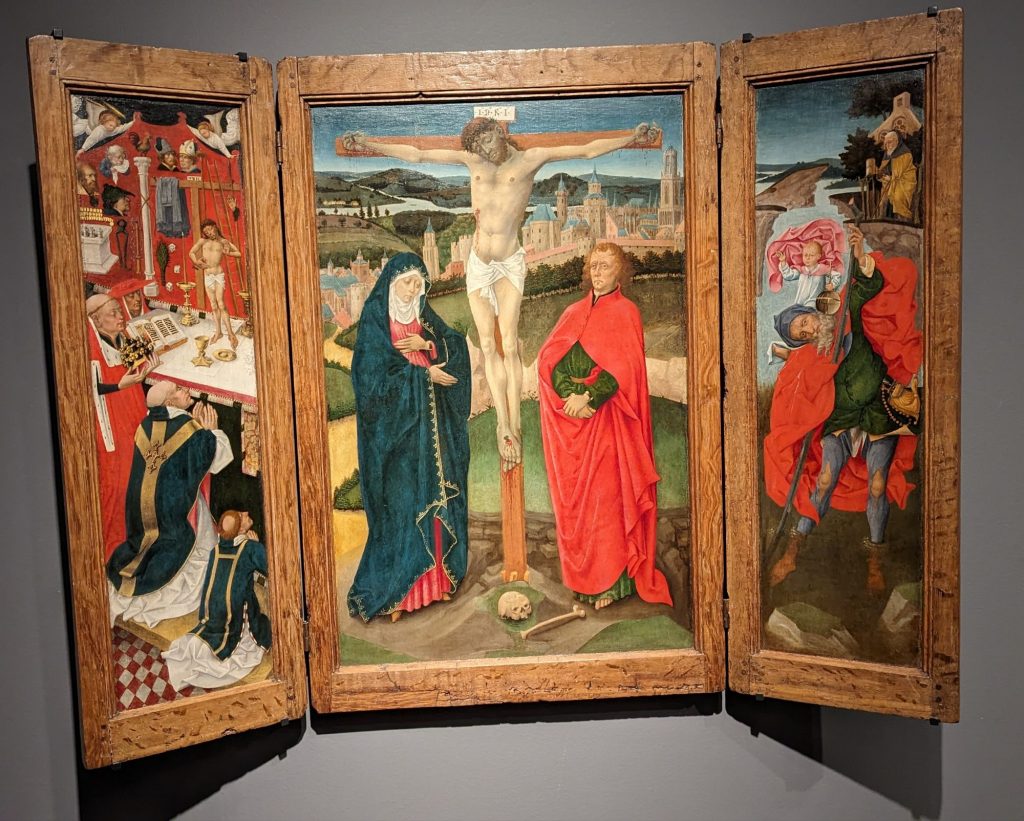
On a visit to Amsterdam and the Rijksmuseum I came across this painting which features Pope Gregory the Great. He is in the left hand part of the Triptych, shown in green kneeling at the altar. It shows Utrecht in the background.
Triptych of the Crucifixion. Showing the vision of the Crucifixion that St Gregory had while celebrating Mass (left). Crucifixion centre. St Christopher (right)
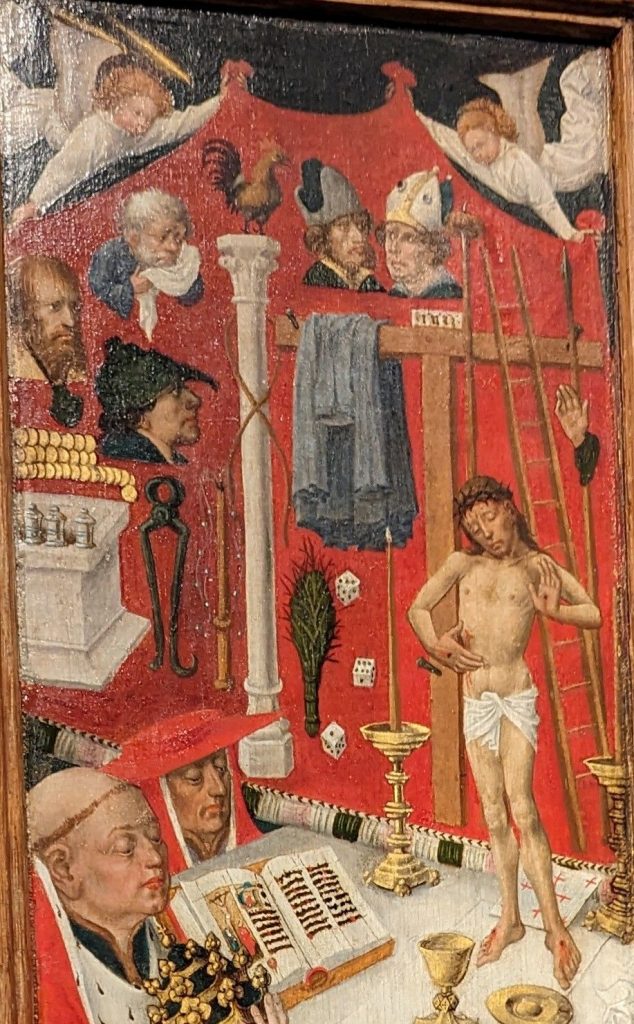
What is fascinating is all the paraphernalia of the Crucifixion above Gregory’s head. You’ll see 30 pieces of silver, dice to decide who gets Jesus’ robes, flails and torture devices, sponge and spear etc. Close up below.
Lazy Day in Anglo-Saxon Times. In the Laws of King Alfred the Great, this day was a day off for freemen. For more on Days off in the Anglo Saxon Calender see my post on August 15th.
1689 – Catholic King James II landed at Kinsale, County Cork, Ireland, in an attempt to regain the Kingdom from his daughter and son-in-law, William and Mary. James had fled to the continent following riots against his rule. William defeated James II at the Battle of the Boyne. James II returned to France never to return. Mary ruled jointly with her husband until she died of Smallpox, and he ruled alone until he fell off his horse.
1930 – Mahatma Gandhi begins the Salt March, a 200-mile march to protest the British monopoly on salt in India. One of the defining moments in non-violent civil disobedience. Offering the world a possible alternative to violent revolution, or military regime change.
1999 – Former Warsaw Pact countries, Czech Republic, Hungary and Poland join NATO. Bulgaria, Estonia, Latvia, Lithuania, Romania, Slovenia and Slovakia joined in March 2004; Croatia and Albania joined on 1 April 2009. Montenegro 2017. North Macedonia. 2020: (Ukraine) can forget about (NATO membership). That’s probably the reason the whole thing (war) started,” said U.S. President Donald Trump on February 26, 2026
First published in 2024, republished in 2025. On This Day added 2026
The store cupboards are getting denuded of the fruits, nuts, preserves, pickles, salted and dried foods saved from the summer and autumnal abundance. Of course, this is alleviated by the reduced consumption of the Lenten fast. (I’m continuing my lenten practice of giving up, giving up things for Lent). But nettles are budding. I take a regular cup of nettle tea. Normally, provided by the excellent Cowan’s tea emporium in the Covered Market in Oxford. But I’m running out and not due to visit Oxford for a month or so. So Charles Kightley in his Perpetual Almanac tells me that young stinging nettles are appearing and this is the time to collect own young, juicy nettles.
Here is a video about collecting them.
YouTube Video on making Nettle Tea
Nettle Beer
Or better still, change up the tea for a nettle beer:
Take a gallon measure of freshly gathered young nettles washed well dried and well packed down. Boil them in a gallon of water for at least a quarter of an hour. Then strain them, press them and put the juice in an earthenware pot with a pound of brown sugar and the juice and grated skin of a lemon. Stir well, and before it grows cool put in an ounce of yeast dissolved in some of the liquid. Cover with a cloth and leave in a warm place for four or five days and strain again and bottle it, stopping the bottles well. It’ll be ready after a week, but better if left longer.
Nettle Beer was brewed for old people against ‘gouty and rheumatic pains’.
Nettle: Detecting Virgins
A more sinister use is provided by William Coles who gives a method of detecting virginity.
‘Nettle tops are usually boiled in pottage in the Springtime, to consume the Phlegmatic superfluities in the body of man, that the coldness and moistness of the winter have left behind. And it is said that if the juice of the roots of nettles be mixed with ale and beer, and given to one that suspected to have lost her maidenhood, if it remain with her, she is a maid, But if she’s spews forth, she is not.‘
William Cole’s Adam in Eden 1657.
Flagellation with Nettles?
William Camden reported that Roman soldiers used nettles to heat up their legs in the cold of a British winter. (from Mrs Greaves’ ‘A Modern Herbal). Perhaps, I should have sent that idea to PM Keir Starmer? He might have suggested the method to Senior Citizens to alleviate the loss of their Winter Fuel Allowance? (which he has now restored). Flogging with nettles was a cure for rheumatism and the loss of muscle power in the early modern period. Nettles were also added to horse feed to make their coats shine. It was used as a hair tonic for humans.
Nettle Fabrics
The 18th century poet Thomas Campbell is quoted on the virtues of nettles:
“I have slept in nettle sheets, and I have dined off a nettle tablecloth. The young and tender nettle is an excellent potherb. The stalks of the old nettle are as good as flax for making cloth. I have heard my mother say that she thought nettle cloth more durable than any other linen.”
In 2012, a Danish Bronze Age Burial was found to be dressed in a shroud made of Nettle. Strangely, the nettle was not local, perhaps being made in Austria where other objects in the rich burial came from. However, the person was thought to be Scandinavian. For more have a look at this article on www.nbcnews.com.
In the Irong Age, also in Denmark, Huldremose Woman was found buried in a bog. She had a severed arm and was buried in elaborate sheep and goat skin clothes, but underneath:
‘she wore a white inner garment made from plant fibres that reached from the shoulders to below the knees. The type of plant fiber is unclear but other evidence from the time period suggests that it could have been made of nettle.’
Greaves tells us that the German and Austrians had a shortage of cotton during the blockade of World War 1. They turned to nettles to replace cotton production believing it to be the only effective substitute. It was also substituted for sugar, starch, protein, paper and ethyl alcohol.
YouTube Video on making fabric from nettles
Nettle Pudding
Pepys ate Nettle Pudding in February 1661 and pronounced it ‘very good’. Here is more on Nettles in history AND a recipe for Nettle Pudding! I can see I’m going to have to get out there and carefully pick myself some nettles! ( For Folklore of Nettles look here).
Remember, none of the above is necessarily good advice as far as medicine is concerned. For smoking herbs see my post coltsfoot-smoking-cholera
March Weather
In the early modern almanacs there is much weather and horticultural advice to be had (Weather Lore. Richard Inwards).
‘March damp and warm Will do farmer much harm‘
or
‘In March much snow to plants and trees much woe‘
On This Day
March 10th is St Kessog Day. He is associated with Luss on Loch Lomond, and was Robert the Bruce’s rallying cry. St Kessog and Scotland!
241 BC – The Battle of the Aegates in which the Carthaginian fleet is sunk, and the First Punic War ends. Carthage was destroyed in the Third Punic War in 146BC. Rebuilt as a Roman City 100 years later.
1629 – Parliament is dissolved by Charles I. This was followed by a Royal dictatorship which lasted 11 years, and then led to Civil War.
1906 – Bakerloo Line Opened. The name originated from the Baker Street and Waterloo Railway. It goes from Harrow &Wealdstone in the NW to Elephant & Castle in the South East, via the Central London section which goes from Bakers Street to Waterloo, Sherlock Holmes didn’t use the Tube very much (see this post here for those times he did). There is a proposed extension from Elephant & Castle to Lewisham.
1969 – James Earl Ray sentenced to 99 years in jail for murdering Martin Luther King. While Ray was a segrationalist and a supporter of George Wallace, he maintained he was set up as the scapegoat. He died in prison in 1998.
The Soviet Union 1949 CPA 1368 stamp (International Women’s Day, March 8. (Wikipedia)
Today, is International Women’s Day. It began, as an idea within Socialist organisations in 1909/1910. Following the February Revolution in Russia and women gaining the vote, March 8th was chosen as the day to celebrate. The wider feminist movement adopted it in the 1960s followed by the UN in 1977. Since when, it has been a day to celebrate women’s achievements and campaigns worldwide.
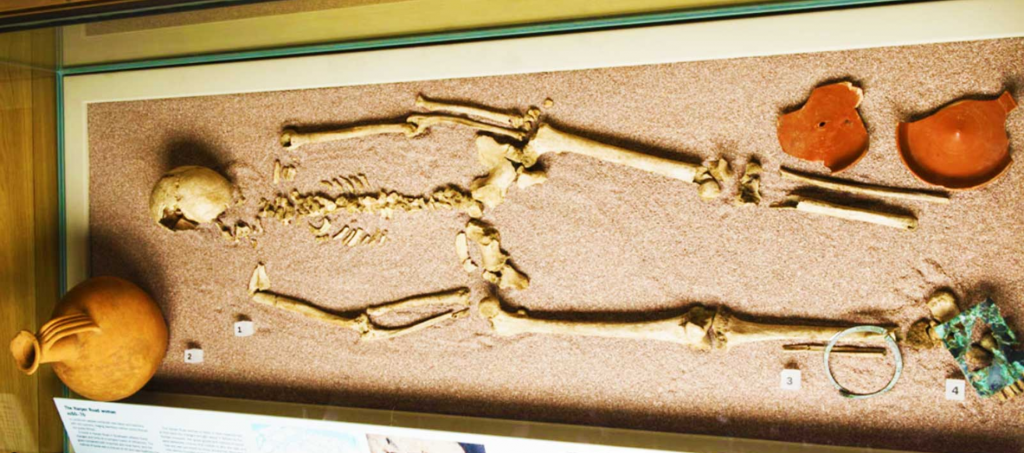
Harper’s Road burial
The Harper Road Burial Southwark (museum of London web site)
Another important historic female was found in an excavations at the Harper’s Road. . I was reminded about it by reading Dominic Perring’s new book ‘London in the Roman World.’ He uses it to establish that Southwark was a place where people lived both before and after the Roman Conquest in 43AD. The burial was found in the 1970s’ and dated to 50 – 70 AD (Roman Invasion of Britain was in 43 AD). Recent scientific analysis has shown that the burial was of a woman (21 – 38 years of age). She had brown eyes and black hair and was brought up in Britain. Her grave goods indicate she was wealthy. She had both imported Roman pottery but also typically British Iron Age objects. The combination shows some adaption between her native culture and the new Roman ways.
Her British objects included a bronze necklace (a torc possibly of Catevalaunian or Trinovantian origin) and a mirror. Dr Rebecca Redfern & Michael Marshall on the Museum of London’s website make a case for her being a:
‘Powerful women in late Iron Age London’.
Mirrors of Power?
They make a case for the mirror being
‘used by women for divination and magic, and were a source of knowledge that only women could command. Being able to use and read the mirror meant that the woman was highly regarded by her community.’
Iron age burials are often found either with a sword or a mirror and the thinking is that the mirror reflects an equivalent status to a sword. I think we can say that the finds do reflect someone of standing, but as to the use of the mirror that must be speculation. Divination using a mirror is called ‘scrying’ and the British Museum has John Dee’s scrying apparatus from the 16th Century. You can buy scrying mirrors on etsy. https://www.etsy.com/uk/market/scrying_mirror. But to make a case that Mirrors were not just utilitarian and prestige objects but also in use for supernatural/religious purposes is surely just speculation?
Melanie Giles & Jody Joy in ‘Mirrors in the British Iron Age: performance, revelation and power published in 2007 (and available to read here) concludes:
‘Iron Age mirrors, whether made of iron or bronze were beautiful, powerful, and potentially terrifying or dangerous objects. They were used in the preparation and presentation of the body and prestigious displays, but may also have been associated with powers of augury and insight into the past, or access to ancestral or spiritual worlds.’
Women in the Age of Iron
The evidence we have for iron communities is for a powerful role for women in contrast to the Romans. The Romans dismissed women when they wrote that Boudicca was ‘uncommonly intelligent for a women’. In fact, she nearly forced the Romans to abandon their conquest of Britain. We also know that Queen Cartimandua of the Brigantes had executive power in the North of Britain. The Britons also worshipped the three Mother Goddesses, which focussed on the value of woman as maidens, mothers, and grand-mothers.
A book to order for International Women’s Day is ‘Patriarchs’ in which Angela Saini investigates when the Patriarchy took over. I heard her talk about it and it seems an excellent introduction.
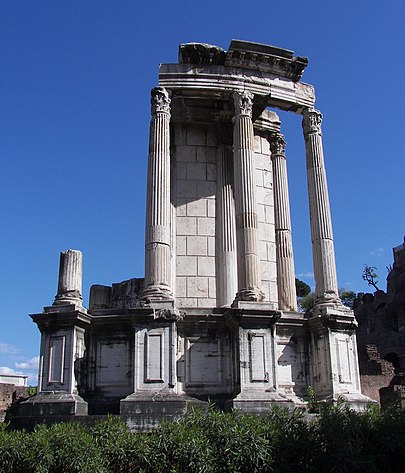
For March 6th, Ovid in his Almanac Poem called ‘Fasti’ (Book III: March 6) tells the story of Vesta. She is Hestria, in Greece and is depicted on the Parthenon Marbles, standing near Zeus and Athene. She was the Goddess of the Hearth, of the fire that keeps families warm, and fed. Vesta had 6 Virgins as her Priestesses. They had to remain 30 years, from before puberty, as a virgin. The punishment for breaking their vows was to be buried alive. Any partners in sin were beaten to death. At the end of their term they could marry, retire, or renew their vows. That suggests they would be late 30s, early 40s before they could be released
The Vestal Virgins tended Vesta’s hearth. It was not supposed to go out as it had, in theory, come from Troy with Aeneas. Vesta’s Temple also housed the Palladium. This was a wooden status of Pallas Athene, that kept Troy, then Rome free from invasion. Odysseus and Diomedes had stolen it just before the Trojan Horse episode ended the 10-year-long Trojan War. (To read more about palladiums, look at my post here.)
The Temple of Vesta was in Rome’s Forum, and it was a circular temple or a Tholos. Next to the Sacred Shrine at Bath was a circular Tholos, which may have been dedicated also to Vesta.
Ovid & Vesta
Here is what Ovid says in his March 6th entry:
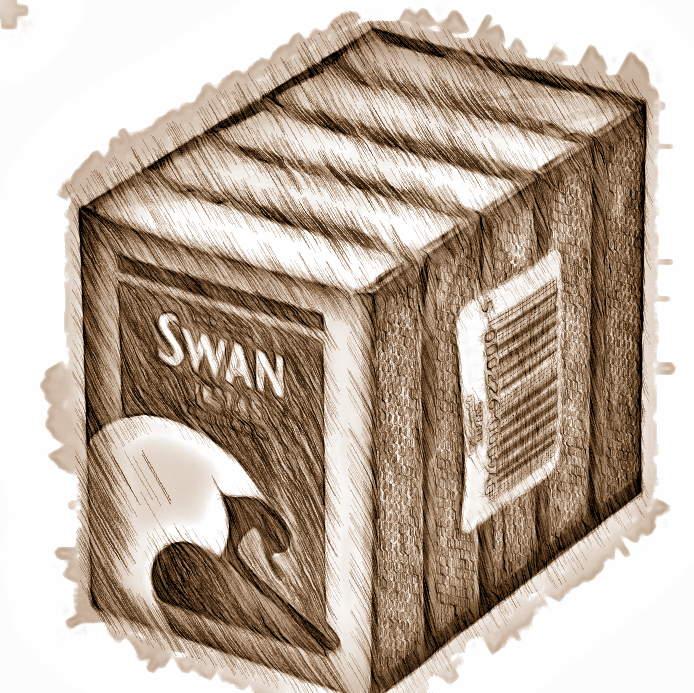
Sketch of Swan Vesta Matches
When the sixth sun climbs Olympus’ slopes from ocean, And takes his way through the sky behind winged horses, All you who worship at the shrine of chaste Vesta, Give thanks to her, and offer incense on the Trojan hearth. To the countless titles Caesar chose to earn, The honour of the High Priesthood was added. Caesar’s eternal godhead protects the eternal fire, You may see the pledges of empire conjoined. Gods of ancient Troy, worthiest prize for that Aeneas Who carried you, your burden saving him from the enemy, A priest of Aeneas’ line touches your divine kindred: Vesta in turn guard the life of your kin! You fires, burn on, nursed by his sacred hand: Live undying, our leader, and your flames, I pray.
Caesar is Julius Caesar. Aeneas was the last Trojan who survived the end of Troy. He came to Italy, founded a Kingdom (Latium) in which his descendant, Romulus, would found Rome. This is told in Virgil’s Aeneid.
Rhea Silvia the Vestal Virgin
At the beginning of Book 3 of Fasti. Ovid tells us the story of Rome’s foundation, and how Mars took Silvia the Vestal while she slept. She was descended from Aeneas. She later gave birth to Romulus and Remus. The betrayal displeased the Goddess Vesta. The holy fires went out, the altar shook and the eyes of Vesta’s statue shut. Venus was more forgiving. The children survived. But Silvia eventually drowned in the Tiber. (For more on the foundation of Rome see my post here)
Foundation Calendars
The new City chose Mars, the Roman God of War, father of their founder – as its patron God. He suited the Romans with their destiny to rule the world. So March was named after Mars, and 1st March was the beginning of the Roman year. (At least in Rome’s early days as I discussed in my post on March 1st). Ovid in the ‘Fasti’ makes the point, through Romulus’s voice, and explains something about the various Calendars run by different tribes/Cities:
‘And the founder of the eternal City said: ‘Arbiter of War, from whose blood I am thought to spring, (And to confirm that belief I shall give many proofs), I name the first month of the Roman year after you: The first month shall be called by my father’s name.’ The promise was kept: he called the month after his father. This piety is said to have pleased the god. And earlier, Mars was worshipped above all the gods:
A warlike people gave him their enthusiasm. Athens worshipped Pallas: Minoan Crete, Diana: Hypsipyleís island of Lemnos worshipped Vulcan: Juno was worshipped by Sparta and Pelopsí Mycenae, Pine-crowned Faunus by Maenalian Arcadia: Mars, who directs the sword, was revered by Latium: Arms gave a fierce people possessions and glory. If you have time examine various calendars. And you’ll find a month there named after Mars. It was third in the Alban, fifth in the Faliscan calendar, Sixth among your people, Hernican lands. The position’s the same in the Arician and Alban, And Tusculum’s whose walls Telegonus made. It’s fifth among the Laurentes, tenth for the tough Aequians,
First after the third the folk of Cures place it, And the Pelignian soldiers agree with their Sabine Ancestors: both make him the god of the fourth month. In order to take precedence over all these, at least, Romulus gave the first month to the father of his race. Nor did the ancients have as many Kalends as us: Their year was shorter than ours by two months.
The Sabine Women
This section mentions the Sabines, these were a neighbouring tribe. The Romans were short of women, so they kidnapped the Sabine Women. This became known as the Rape of the Sabine Women. People argue whether they were raped or kidnapped. Romulus worked to convince the women that it was done out of necessity for Rome’s future. The Women, or some of them, certainly tried to escape. Many became pregnant. The Sabine Army approached and entered Rome determined to free them and enact revenge on their neighbours. Ovid tells the story of Hersilia, Romulus’s wife trying to persuade the women to stay. The poem then returns to Mars’ viewpoint, and ends with a beautiful description of spring in March.
The battle prepares, but choose which side you will pray for: Your husbands on this side, your fathers are on that. The question is whether you choose to be widows or fatherless: I will give you dutiful and bold advice. She gave counsel: they obeyed and loosened their hair, And clothed their bodies in gloomy funeral dress. The ranks already stood to arms, preparing to die, The trumpets were about to sound the battle signal, When the ravished women stood between husband and father, Holding their infants, dear pledges of love, to their breasts. When, with streaming hair, they reached the centre of the field,
They knelt on the ground, their grandchildren, as if they understood, With sweet cries, stretching out their little arms to their grandfathers: Those who could, called to their grandfather, seen for the first time, And those who could barely speak yet, were encouraged to try. The arms and passions of the warriors fall: dropping their swords Fathers and sons-in-law grasp each other’s hands, They embrace the women, praising them, and the grandfather Bears his grandchild on his shield: a sweeter use for it.
Hence the Sabine mothers acquired the duty, no light one, To celebrate the first day, my Kalends. Either because they ended that war, by their tears, In boldly facing the naked blades, Or because Ilia happily became a mother through me, Mothers justly observe the rites on my day. Then winter, coated in frost, at last withdraws, And the snows vanish, melted by warm suns: Leaves, once lost to the cold, appear on the trees, And the moist bud swells in the tender shoot: And fertile grasses, long concealed, find out Hidden paths to lift themselves to the air.
Now the field’s fruitful, now ís the time for cattle breeding, Now the bird on the bough prepares a nest and home: It’s right that Roman mothers observe that fruitful season, Since in childbirth they both struggle and pray. Add that, where the Roman king kept watch, On the hill that now has the name of Esquiline, A temple was founded, as I recall, on this day, By the Roman women in honour of Juno. But why do I linger, and burden your thoughts with reasons? The answer you seek is plainly before your eyes. My mother, Juno, loves brides: crowds of mothers worship me: Such a virtuous reason above all befits her and me.í Bring the goddess flowers: the goddess loves flowering plants: Garland your heads with fresh flowers,
Sketch of scene from ‘Seven Brides for Seven Brothers’
My children’s favourite film in childhood was ‘Seven Brides for ‘Seven Brothers’. It was loosely based on the Rape of the Sabine Women, and very Hollywood.
On This Day
12 BC – Augustus named Pontifex Maximus, which is essentially ‘Chief Priest’ which is a bit like King Henry VIII being the Supreme Head of the Church of England.
1836 – The Alamo in Texas fell to Mexican General Santa Anna after a 13-day siege. (apologising to Texas for posting this yesterday on the wrong day)
1957 – Ghana becomes an Independent State, the first of the UK’s colonies in Sub-Saharan Africa to be independent. Ghana consists of four separate colonial territories: Gold Coast, Ashanti, the Northern Territories, and British Togoland. Ghana remained within the Commonwealth of Nations. Kwame Nkrumah was the first President. It ranks 7th (out of 54 African states) for good governance on the Ibrahim Index of African Governance (IIAG).
First published in 2024, republished in 2025. On This Day added 2026
Portrait of Saint Guénolé (St Winnold) after a bust in silver on a reliquary from the Church Saint-Guénolé in Locquénolé.Public Domain Abgrall Jean-Marie (1846-1926) – Bibliothèque nationale de France
Here is a weather poem in which St Winnold appears
First comes David, then comes Chad. And comes Winnold, roaring like mad. White or black. Or old house thack.
St David’s Day was March 1st. St Chad, the 2nd. St Winnold’s Day is the third of March. Winnold is his English name, and Winneral, or Winwaloe or Guénolé his Celtic names.
The poem suggests that snow, rain or wind is going to come on these three days. When the wind roars, it will threaten the thatch of houses. If the storms do not come in the first 3 days, then they will come on the last three days of March, which were called ‘the Borrowing Days’. Or so it is said.
St Winnold was around 50 years (460 – 3 March 532) after the end of Roman Britain. His family was from Cornwall. He was the son of a Prince Fragan of Dumnonia, and St Gwen the Three-Breasted, His mother’s Feast day is October 3rd. She is a Saint of fertility, because of God’s Gift of an extra breast. They moved to Brittany to escape a British Plague. Their son grew up to be holy and was the founder and first abbot of Landévennec Abbey (the Monastery of Winwaloe). It is south of Brest.
Winwaloe became what is known as a ‘phallic saint’ because he was associated with fertility. Wikipedia says this came about because of confusion about the origin of his name:
‘his name was thought to derive from gignere (French engendrer, “to beget”)’
St Winnold’s Breton name is Guénolé. How this etymology works is not clear to me! But surely, he as likely to have got a reputation for helping people with fertility problems from his mother? Supplicants would make a wax phallus to persuade the Saint to help them conceive. There are several churches/ chapels dedicated to him in Wales, and a Priory in East Anglia.