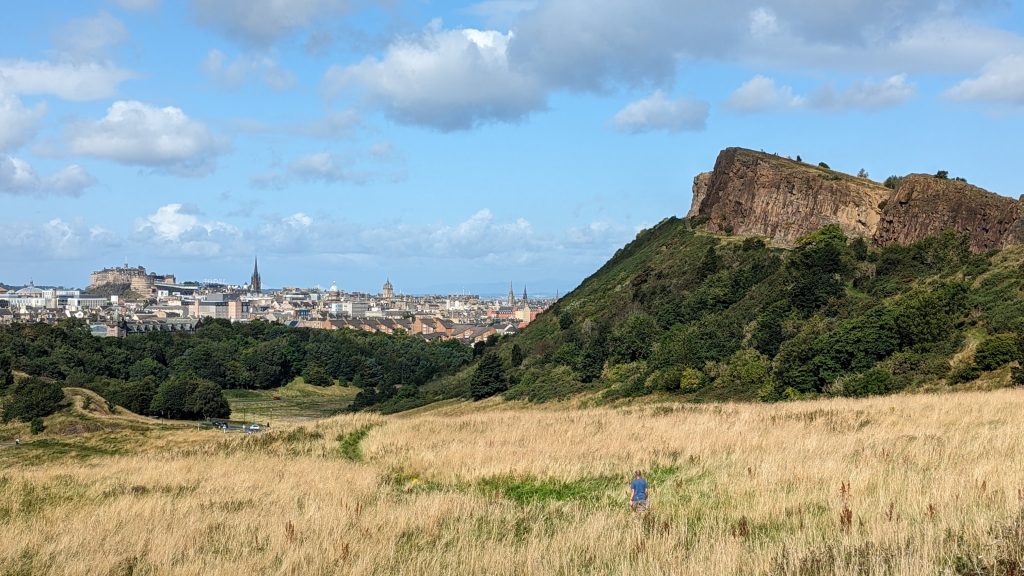
Edinburgh from Arthur’s Seat. Castle to the left, St Giles the ’rounded’ spire in the middle, and Salisbury Crags to the right
Strange Case of Dr Jekyll and Mr Hyde by Robert Louis Stevenson
This is my select booklist for Edinburgh, one of my favourite towns. Strangely, heading it up is a book based in London, and written in Bournemouth. However, Stephenson’s Strange Case of Dr Jekyll and Mr Hyde is a very Edinburgh book but published in London on January 9th 1886.
What makes it fit for an Edinburgh booklist? Firstly, Edinburgh is the best place for a science-based Gothic Horror Novella. A City made for Ghost Tours, but with a scientific legacy arguably second to none. One of the inspirations for the book was the story of Deacon Brodie. He was a cabinetmaker who rose to be Deacon (president) of the craft of cabinetmaking. Therefore, he had wealthy clients and was impeccably respectable. When he went to his clients houses, or made them locked cabinets, he would copy the locks using wax moulds. Then he and his team would rob the house. He hid a cache of keys underneath Salisbury Crags which you can see above.
To cut a long story short, he made an attempt on robbing the Excise Office in Canongate, Edinburgh, on March 5th 1788. The heist failed, one of the robbers turned King’s Evidence. So Brodie fled to one of his mistresses in London, then to the Continent. But he was relentlessly pursued and captured in Amsterdam. He was brought back to face trial, found guilty, and hanged on a new scaffold, which he may just have had a part in designing.
Stevenson had cabinets made by William Brodie and as a young man produced a play about him. He was intrigued by the idea of a wealthy man having a dual life. The idea itself, seems obvious but the expression a ‘Jekyll and Hyde’ character is still often used to describe someone with two opposing sides to their characters. The idea of duality provides many ways to look at the book. Edinburgh itself was a duality. There was the old, filthy, higgledy-piggledy Old Town on top of the Volcanic Ridge, with the spacious New Town in the Valley below, with modern wealthy houses providing healthy homes for the rich. The idea of Two Cities, of the rich and the poor; the good and the evil; rationality and sensuality; hetero and homosexual fits well with Victorian Britain, but perhaps best into Victorian Edinburgh, the City of Burke and Hare. These famous Edinburgh serial killers were working for one of Europe’s greatest medical centres, where debate about Darwinism, and the powers of the brain were hotly debated in a City with a strong Presbyterian background.
In Bournemouth, Stevenson befriended the former Reverend Walter Jekyll, younger brother of gardener Gertrude Jekyll. He was probably homosexual and the author borrowed the name for the rational part of Jekyll and Hyde. At a time when to be gay was a crime, most gay people had to live a Jekyll and Hyde existence. In fact, Sodomy was a capital offence in Scotland until the year after the publication of the ‘Strange Case of Dr. Jekyll and Mr. Hyde.
Strangely, in a book list I would encourage you to watch the 1920 silent film starring John Barrymore to enjoy its ghastly atmosphere. You can watch it for free on YouTube here.
Ian Rankin’s Rebus
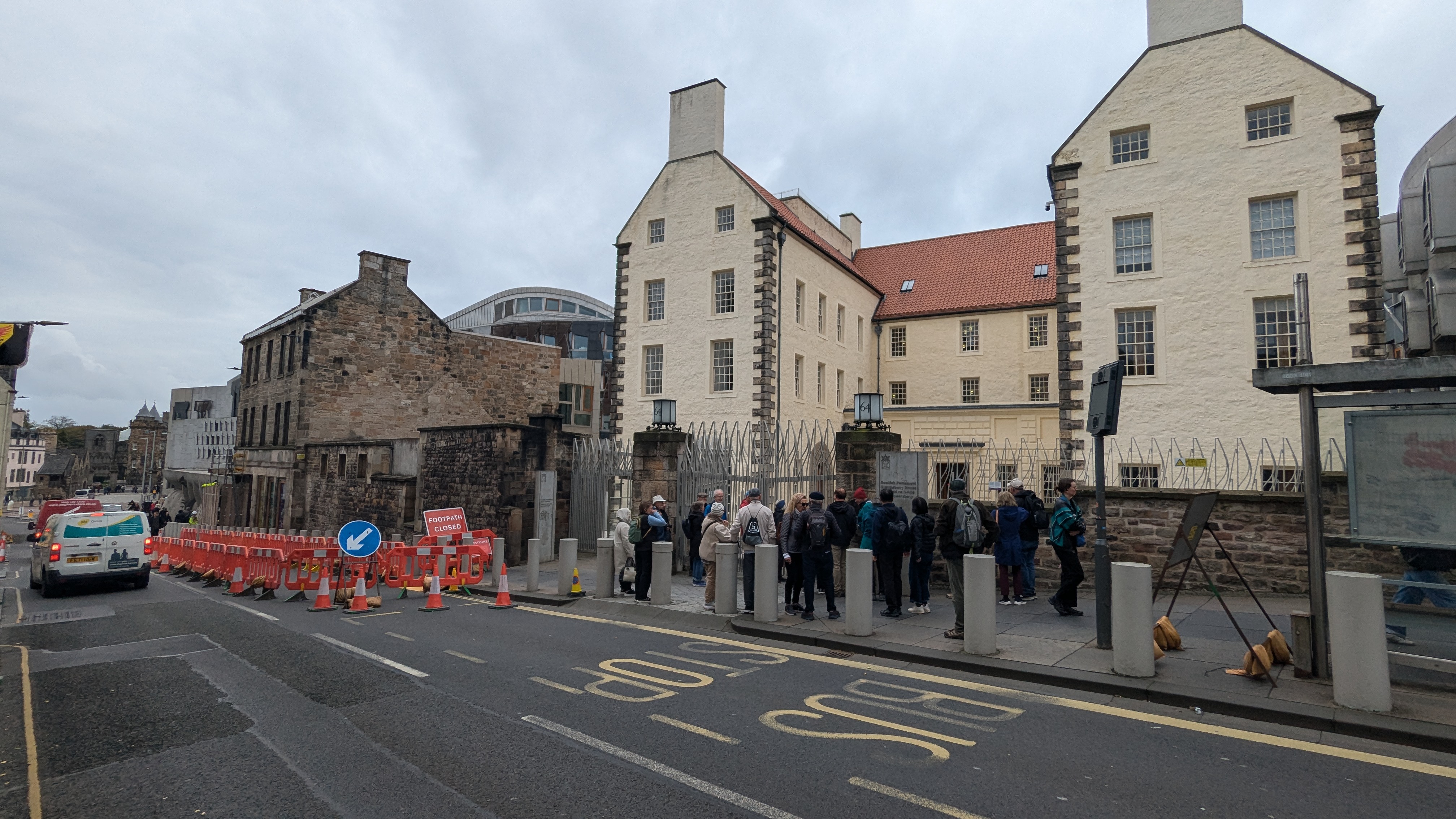
Ian Rankin is a typographical author of the highest rank. Every story brings Edinburgh, its people and its history to life. And yet set in a very readable crime fiction envelope. The Rebus I chose was ‘Set in Darkness‘ because it has the Scottish Parliament at its heart. It begins with a body found in Queensbury House, which is being preserved and incorporated into the new Scottish Parliament buildings. Please read my post on the book (link below).
Queensberry House to the right, with the Scottish Parliament in the background. Royal Mile, Cannongate in the foreground. (Photo: K. Flude)
Recently published is ‘Edinburgh a New History’ by Alistair Moffat. This is an excellent summary of Edinburgh’s History. He has written a large number of books about Scotland. I particularly liked ‘Reivers‘ which is a great book about the border raiders, both North English and Scottish who raided the borderlands between Edinburgh and York during the 13th to the 17th Centuries. They inspired the young Walter Scott, who collected Reivers ballads before inventing the Historical Novel.
As to Walter Scot, our Blue Badge Guide for Edinburgh, considers his long descriptive passages unreadable. But I’m not so convinced, having read Ivanhoe and Rob Roy as a boy. But if I were to recommend a Walter Scot, it would be Heart of Midlothian as it is set in Edinburgh and deals with crime, poverty, urban riots and other manifestations of life in Edinburgh in the 18th Century.
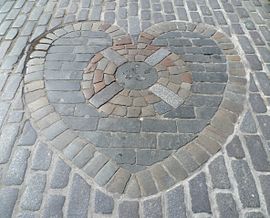
Midlothian is the country around Edinburgh, named after the legendary Celtic King Loth. The Heart of Midlothian, is Edinburgh or more precisely, a heart marked out in the cobbles. It is located outside of St Giles, on the Royal Mile, where the Tollboth (townhall and prison) and execution site for the City used to be. To this day, Edinburghers (or more correctly, Dunediners) are supposed to spit on the heart for good luck.
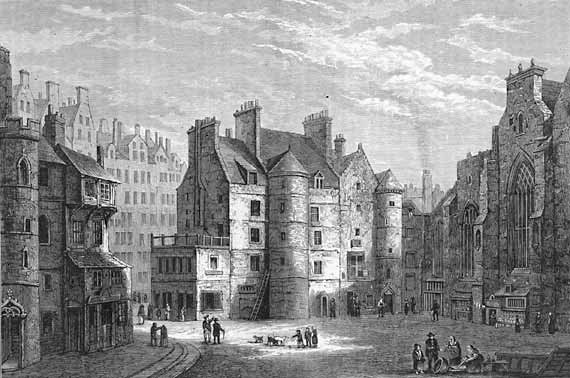
Old Print of the Tollbooth with St Giles to the right of the print.
It is hard to exaggerate the importance of Walter Scot. Byron said he had read his books 50 times, and never travelled without them. Goethe said ‘he was a genius who does not have an equal.’ Pushkin said his influence was ‘felt in every province of the literature of his age. Balzac described him as ‘one of the noblest geniuses of modern times’. Jane Austen and Dickens loved his books. The point is he invented the Historical Novel, and for the first time, as Carlyle wrote, he showed that history was made by people ‘with colour in their checks and passion in their stomachs.’ The only other person I can think of who was held in such universal regard was Tolstoy. There is also sense in which Scott invented our modern idea of Scotland, with its kilts and bagpipes.
The Scottish Enlightenment
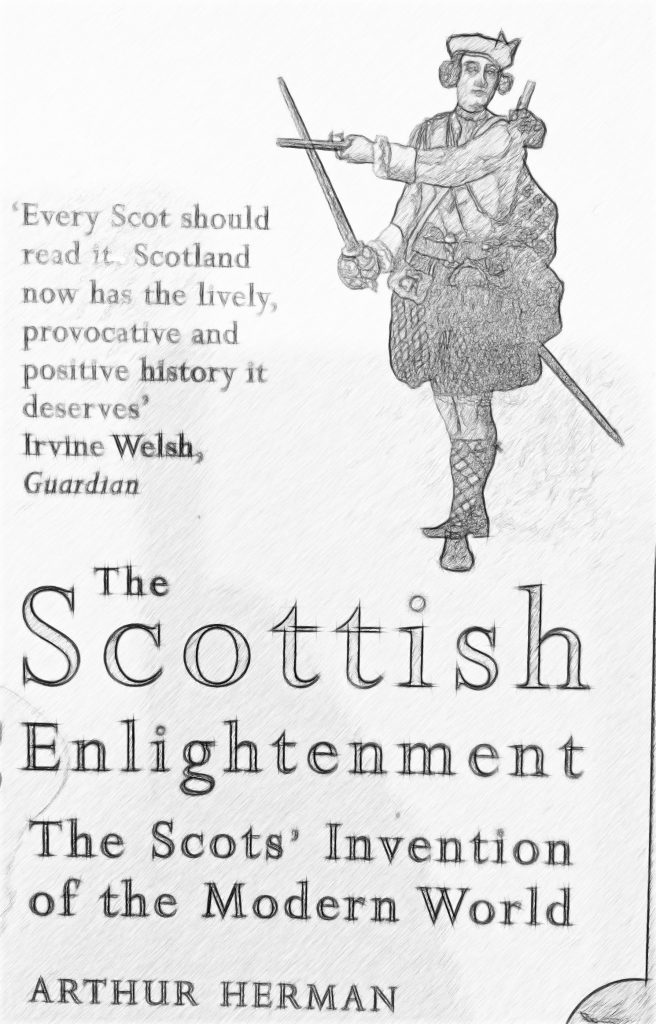
A walk through the centre of Edinburgh has so many statues of people who made the modern world it is astonishing. So you should read: ‘The Scottish Enlightenment – the Scots Invention of the modern world‘ by Arthur Herman.
Burke and Hare: The True Story Behind the Infamous Edinburgh Murderers by Owen Dudley-Edwards
The story of Burke and Hare is well known, but it shows how important Edinburgh was as a medical centre in the early 19th Century. Bodies were shipped to Edinburgh from the London docks, such was the demand for bodies for anatomy teaching. Arthur Conan Doyle got his medical training here from a man called Joseph Bell, whose logical mind was the model for Sherlock Holmes.
The Prime of Miss Jean Brodie
My last choice is Murial Spark’s The Prime of Miss Jean Brodie set in a school in Edinburgh where the teacher singles out 6 of her pupils for special education. She wants to give them a cultured outlook in life which includes her own fascistic views. Made into a wonderful film starring Maggie Smith, but also a great book. It also, in a strange way, reinforces the huge legacy of the Scottish Education system. It is said that the Reformation brought to the Scots the idea that everyone should be educated enough to read the Bible in their own language. But it seems to me the Scots had a particular understanding of the importance of Education before the Reformation. St Andrews University was founded in 1410, Glasgow in 1410, Aberdeen in 1495 and Edinburgh in 1510.
Of course, you should read some poetry by Burns, and I would begin with Tam O’Shanter the story of Tam, Maggie his horse and Nannie, the witch with the short skirt (Cutty Sark). The version above (see link) is read over a comic novel of the poem. But if you prefer the words, this is the one I read for my groups where I ruin the Scots dialect, and disgrace myself, but oh how I enjoy it! www.poetryfoundation.org tam-o-shanter
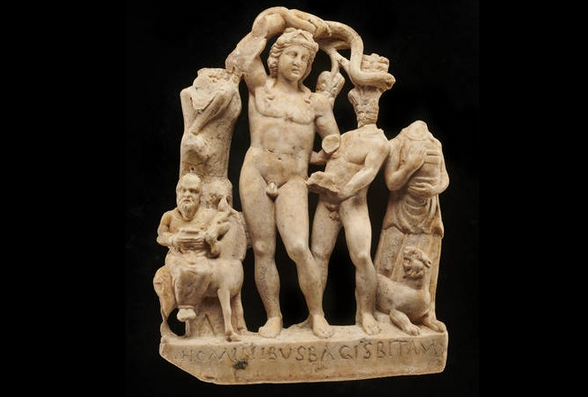
Marble statue of Bacchus from the Temple of Mithras London. The inscription reads ‘hominibus vagis vitam’ Translation … (give) life to men who wander. Bacchus is in the middle, the little old man on the left is Silenus. The drunken tutor to Bacchus.
On the eighth day of Christmas my true love sent to me: 8 Maids a Milking; 7 Swans a Swimming; 6 Geese a Laying 5 Golden Rings 4 Calling Birds; 3 French Hens; 2 Turtle Doves and a Partridge in a Pear Tree
Closing Time
The 8th day, New Years Day, is the day of the Throbbing Head. In ‘Closing Time’ Leonard Cohen wrote about drinking to excess. I like to think he refers to Christmas and New Year’s Day:
‘And the whole damn place goes crazy twice And it’s once for the devil and it’s once for Christ But the boss don’t like these dizzy heights We’re busted in the blinding lights of closing time.
Trouble is the song mentions summer. Oh well. You can enjoy the official video on YouTube below:
Hangover Cure
What you need is a hangover cure. Nature provides many plants that can soothe headaches. And in the midst of the season of excess, let’s start with a hangover cure.
Common ivy Photo by Zuriel Galindo from unsplash
Ivy and Bacchus
Ivy, ‘is a plant of Bacchus’…. ‘the berries taken before one be set to drink hard, preserve from drunkenness…. and if one hath got a surfeit by drinking of wine, the speediest cure is to drink a draft of the same wine, wherein a handful of ivy leaves (being first bruised) have been boiled.’
Culpeper Herbal 1653 quoted in ‘the Perpetual Almanac’ by Charles Kightly
Bacchus often wore an ivy crown around his head. Romans used Ivy to fend off hangovers.
Bacchus and Wine Making
The image of Bacchus, at the top of the post, is from a fascinating article by the Museum of London on wine making in Roman Britain. It suggests wine in Britain was first made in Brockley Hill, in South East London as little as 20 or 30 years after the Roman Conquest of AD43. The evidence was the discovery of Roman Wine Amphora made locally. This is taken as evidence that the amphorae were made to contain local wine. Direct evidence of a vineyard has been found in Northamptonshire but fron the 2nd Century AD.
Bacchus is the Roman version of the God Dionysus who was the God of ‘wine-making, orchards and fruit, vegetation, fertility, festivity, insanity, ritual madness, religious ecstasy, and theatre.’ Essentially anything that could make you loss your head, and escape your inhibitions. But he could also relieve pain, reduce anxiety, free you from subjugation and therefore he was subversive. The Roman State suppressed and regulated the Bacchanalian Festivals.
Skullache, and Willow,
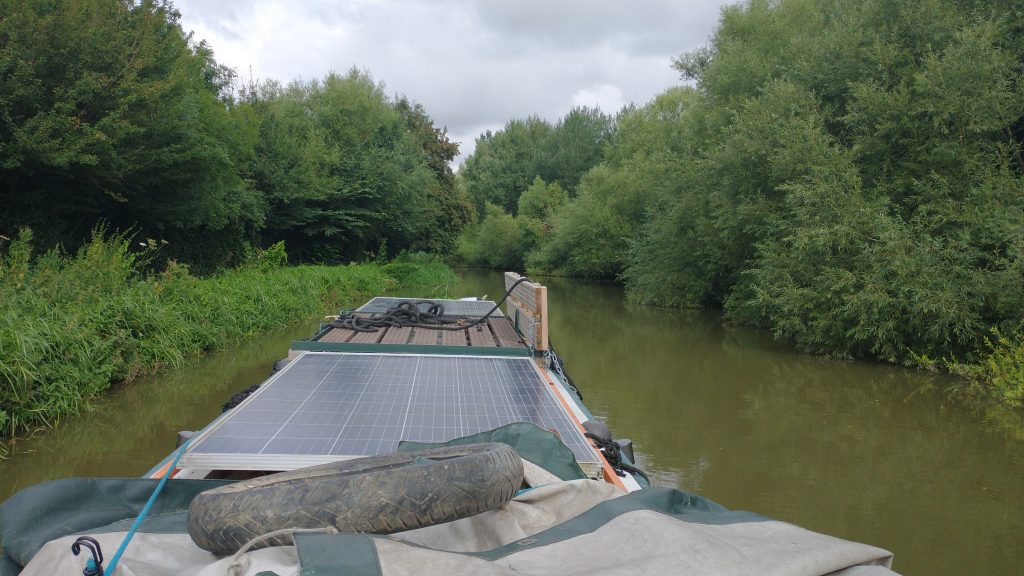
Crack Willow Trees on the Oxford Canal, August 2021
Now, if that gives you a headache, one of the best documented folk hangover cures is willow bark, useful for headaches, earaches, and toothaches. Here is a record of how simple it was to use:
‘I am nearly 70 years old and was born and bred in Norfolk… My father, if he had a ‘skullache’ as he called it, would often chew a new growth willow twig, like a cigarette in the mouth.’
‘A Dictionary of Plant Lore by Roy Vickery (Pg 401)
In the 19th Century, they discovered that Willow contained salicylic aciacid, from which aspirin was derived. As a child, I remember chewing liquorice sticks in a similar way. We chewed, supposedly for the pleasure and the sweetness, not for the medicinal virtues of the plant.
Country Weather
January 1st’s weather on the 8th Day of Christmas was cold, but bright in the morning, a little bit of rain at lunch time, and a dry but cloudy afternoon. So, according to Gervase Markham, the 8th Month, August, will be sunny to begin with, with some rain in the middle, and cloudy end of the month. (source: ‘The English Husbandman’ of 1635.)
On this Day
Today, is the Day the Nymphs in Greece dedicated to Artemis, Andromeda, Ariadne, Ceres. (according to the Goddess Book of Days by Diane Stein.)
First Published in 2024, republished in 2025, 2026
Monday 1st January 2025 7.00 pm On this Virtual Walk we look at how London has celebrated the New Year over the past 2000 years.
The New Year has been a time of review, renewal, and anticipation of the future from time immemorial. The Ancient Britons saw the Solstice as a symbol of a promise of renewal as the Sun was reborn. As the weather turns to bleak mid winter, a festival or reflection and renewal cheers everyone up. This idea of renewal was followed by the Romans, and presided over by a two headed God called Janus who looked both backwards and forwards. Dickens Christmas Carol was based on redemption and his second great Christmas Book ‘The Chimes’ on the renewal that the New Year encouraged.
We look at London’s past to see where and how the New Year was celebrated. We also explore the different New Years we use and their associated Calendars – the Pagan year, the Christian year, the Roman year, the Jewish year, the Financial year, the Academic year and we reveal how these began. We look at folk traditions, Medieval Christmas Festivals, Boy Bishops, Distaff Sunday and Plough Monday, and other Winter Festival and New Year London traditions and folklore.
At the end, we use ancient methods to divine what is in store for us in 2023.
The virtual walk finds interesting and historic places in the City of London to link to our stories of Past New Year’s Days. We begin, virtually, at the Barbican Underground and continue to the Museum of London, the Roman Fort; Noble Street, Goldsmiths Hall, Foster Lane, St Pauls, Doctors Commons, St. Nicholas Colechurch and on towards the River Thames.
The Civil War, Restoration and the Great Fire of London Virtual Tour
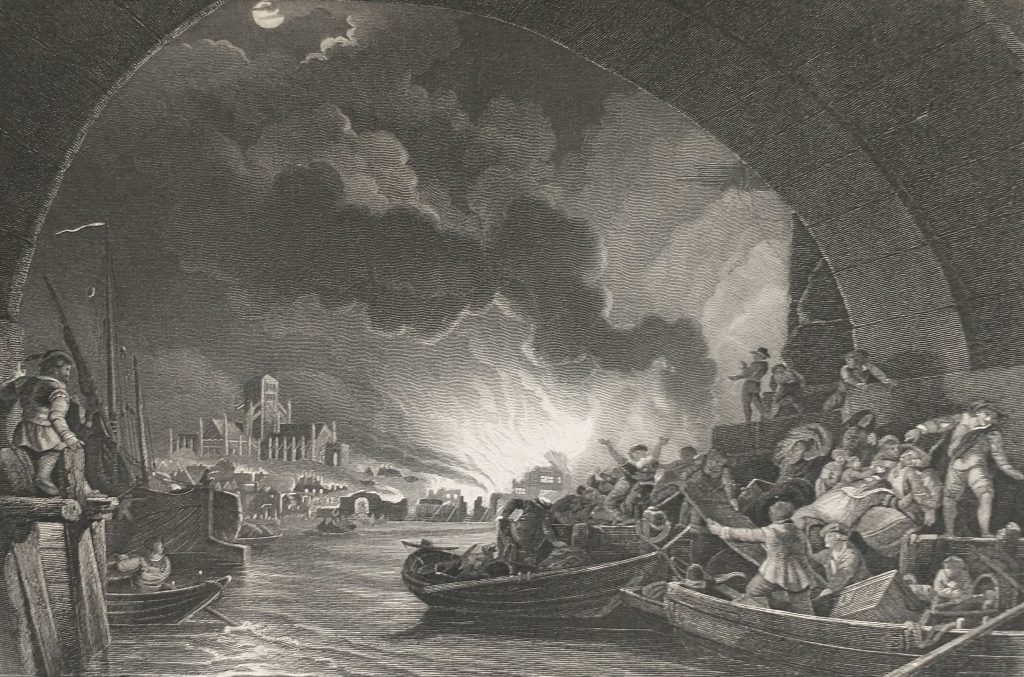
The Great Fire of London looking towards StPauls Cathedral from an old print
7:30pm Fri 30th January 2025
January 30th is the Anniversary of the execution of Charles I and to commemorate it we explore the events and the aftermath of the Civil War in London.
Along with the Norman Conquest of 1066 and winning the World Cup in 1966 the Great Fire in 1666 are the only dates the British can remember!
And we remember the Great Fire because it destroyed one of the great medieval Cities in an epic conflagration that shocked the world.
But it wasn’t just the Great Fire that made the 17th Century an epic period in English History. There was a Civil War, beheading of the King, a Republic, a peaceful Restoration of the Monarch, the last great plague outbreak in the UK, the Glorious Revolution and the Great Wind.
The Virtual Walk puts the Great Fire in the context of the time – Civil War, anti-catholicism, plague, and the commercial development of London. The walk brings to life 17th Century London. It starts with the events that lead up to the Civil War concentrating on Westminster and ends with a vivid recreation of the drama of the Fire as experienced by eye-witnesses. Route includes: Westminster, Fish Street Hill, Pudding Lane, Monument, Royal Exchange, Guildhall, Cheapside, St Pauls, Amen Corner, Newgate Street, Smithfield.
Roman London – Literary & Archaeology Walk
11.30 am Sun 9th Feb 2025 Monument Underground Station
also on 11.30am Sun 27th Apr 25 but starting from Moorgate
London Roman Riverside Wall o
This is a walking tour features the amazing archaeological discoveries of Roman London, and looks at life in the provincial Roman capital of Londinium.
This is a walking tour that features the amazing archaeological discoveries of Roman London, and looks at life in the provincial Roman capital of Londinium.
Our Guides will be Publius Ovidius Naso and Marcus Valerius Martialis who will be helped by Kevin Flude, former Museum of London Archaeologist, Museum Curator and Lecturer.
We disembark at the Roman Waterfront by the Roman Bridge, and then explore the lives of the citizens as we walk up to the site of the Roman Town Hall, and discuss Roman politics. We proceed through the streets of Roman London, with its vivid and cosmopolitan street life via the Temple of Mithras to finish with Bread and Circus at the Roman Amphitheatre.
Zinger Read: Talk about a high-quality one-two punch. This walk investigates the groundbreaking archaeological discoveries of Roman London. And then it reconstructs life in a provincial Roman capital using archaeological and literary sources. Discoveries – insights – like flashes of lightning in a cloud. We begin at the site of the Roman bridge. We might be decent young Roman citizens in togas, having this and that bit of explained to us as we make our way towards the Roman Town Hall. From there we head to the site of the excavation called ‘the Pompeii of the North.’ Followed by the Temple of Mithras. We finish with a walk along the Roman High Street in order to end at the site of the Roman Amphitheatre. So, yes, welcome to London as it was 2,000, 1,900, 1,800, 1,700 and 1,600 years ago. And, yes, the walk’s guided by a real expert, the distinguished emeritus Museum of London archaeologist Kevin Flude. That means you’ll see things other people don’t get to see, delve into London via fissures that aren’t visible, let alone accessible, to non-specialists.
REVIEWS “Kevin, I just wanted to drop you a quick email to thank you ever so much for your archaeological tours of London! I am so thrilled to have stumbled upon your tours! I look forward to them more than you can imagine! They’re the best 2 hours of my week! 🙂 Best, Sue
Jane Austen’s London Anniversary Guided Walk
2.30 pm Sunday 9th Feb 2025
Green Park underground station, Green Park exit, by the fountain To book
Also
9 February 2025
Sunday
2.30 pm
4.30 pm
8 March 2025
Saturday
2.30 pm
4.30 pm
6 April 2025
Sunday
11.30 am
1.30 pm
2025 is the 250th Anniversary of Jane Austen’s Birth in Steventon, Hampshire. We celebrate her fictional and real life visits to Mayfair, the centre of the London section of Sense & Sensibility and where Jane came to visit her brother
“It is a truth universally acknowledged, that a Jane Austen devotee in possession of the good fortune of a couple of free hours today must be in want of this walk.”
People associate Jane Austen and her characters with a rural setting. But London is central to both Jane Austen’s real life and her literary life. So, this tour will explore Jane’s connections with London and give the background to Sense and Sensibility, a good part of which is based in this very area. We begin with the place Jane’s coach would arrive from Hampshire, and then walk the streets haunted by Willougby; past shops visited by the Palmers, the Ferrars; visit the location of Jane Austen’s brother’s bank and see the publisher of Jane’s Books. The area around Old Bond Street was the home of the Regency elite and many buildings and a surprising number of the shops remain as they were in Jane Austen’s day.
Jane Austen’s ‘A Picture of London’ in 1809 Virtual Walk
With the help of a contemporary Guide Book, Jane Austen’s letters, and works we explore London in 1809.
‘The Picture of London for 1809 Being a CORRECT GUIDE to all the Curiosities, Amusements, Exhibitions, Public Establishments, and Remarkable Objects in and near London.’
This Guide Book to London might have been on Henry Austen’s shelf when his sister, Jane, came to visit him in London. But it enables us to tour the London that Jane Austen knew in some detail. We will look at the Curiosities as well as the shopping, residential, theatres areas as well as the Port, the Parks and the Palaces.
The guided walk is a thank you to Alix Gronau, who, having been to one of my lectures in 1994, wanted the book to come to me. I have had the book restored and am using it to explore London in 1809.
Jane Austen’s London Anniversary Walk
Jane Austen’s London Anniversary Walk 2.30 pm Sunday 9th February 25 To book
A Virtual Tour of Jane Austen’s Bath
7.30pm 10th February 2025
Tudor London – The City of Wolf Hall 11.30am Sat 22nd Feb 25
Myths, Legends, Archaeology and the Origins of London
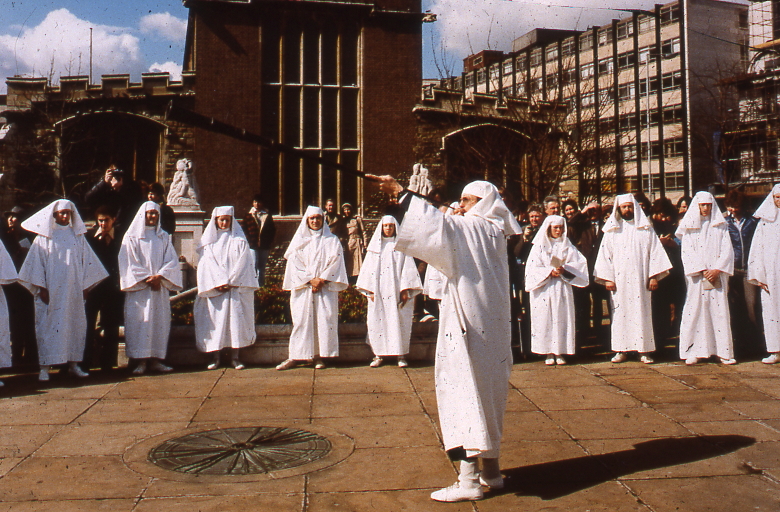
Druids at All Hallows, by the Tower
2.30pm Sat 22nd February 2025 Tower Hill Underground
The walk tells the stories of our changing ideas about the origins of London during the Prehistoric, Roman and Saxon periods.
The walk is led by Kevin Flude, a former archaeologist at the Museum of London, who has an interest both in myths, legends and London’s Archaeology.
The walk will tell the story of the legendary origins of London which record that it was founded in the Bronze Age by an exiled Trojan and was called New Troy, which became corrupted to Trinovantum. This name was recorded in the words of Julius Caesar; and, then, according to Legend, the town was renamed after King Ludd and called Lud’s Dun. Antiquarians and Archaeologists have taken centuries to demolish this idea, and became convinced London was founded by the Romans. Recently, dramatic evidence of a Bronze Age presence in London was found.
When the Roman system broke down in 410 AD, historical records were almost non-existent, until the Venerable Bede recorded the building of St Pauls Cathedral in 604 AD. The two hundred year gap, has another rich selection of legends. which the paucity of archaeological remains struggles to debunk.
The walk will explore these stories and compare the myths and legends with Archaeological discoveries.
The route starts at Tower Hill, then down to the River at Billingsgate, London Bridge, and into the centre of Roman London.
Roman London – Literary & Archaeology Walk 11.30am Sat Mar 8th 25 Jane Austen’s London Anniversary Walk 2.30pm Sat 8th Mar 25
The Decline And Fall Of Roman London Walk 11.30 Sat 22nd March 2025 London. 1066 and All That Walk Sat 2.30pm 22nd March 2025
Jane Austen’s London Anniversary Walk 11.30am Sun 6th Apr 25
Chaucer’s Medieval London Guided Walk 2:30pm Sun 6th Apr 25
and
Chaucer’s London To Canterbury Virtual Pilgrimage 7.30pm Friday 18th April 25 To book
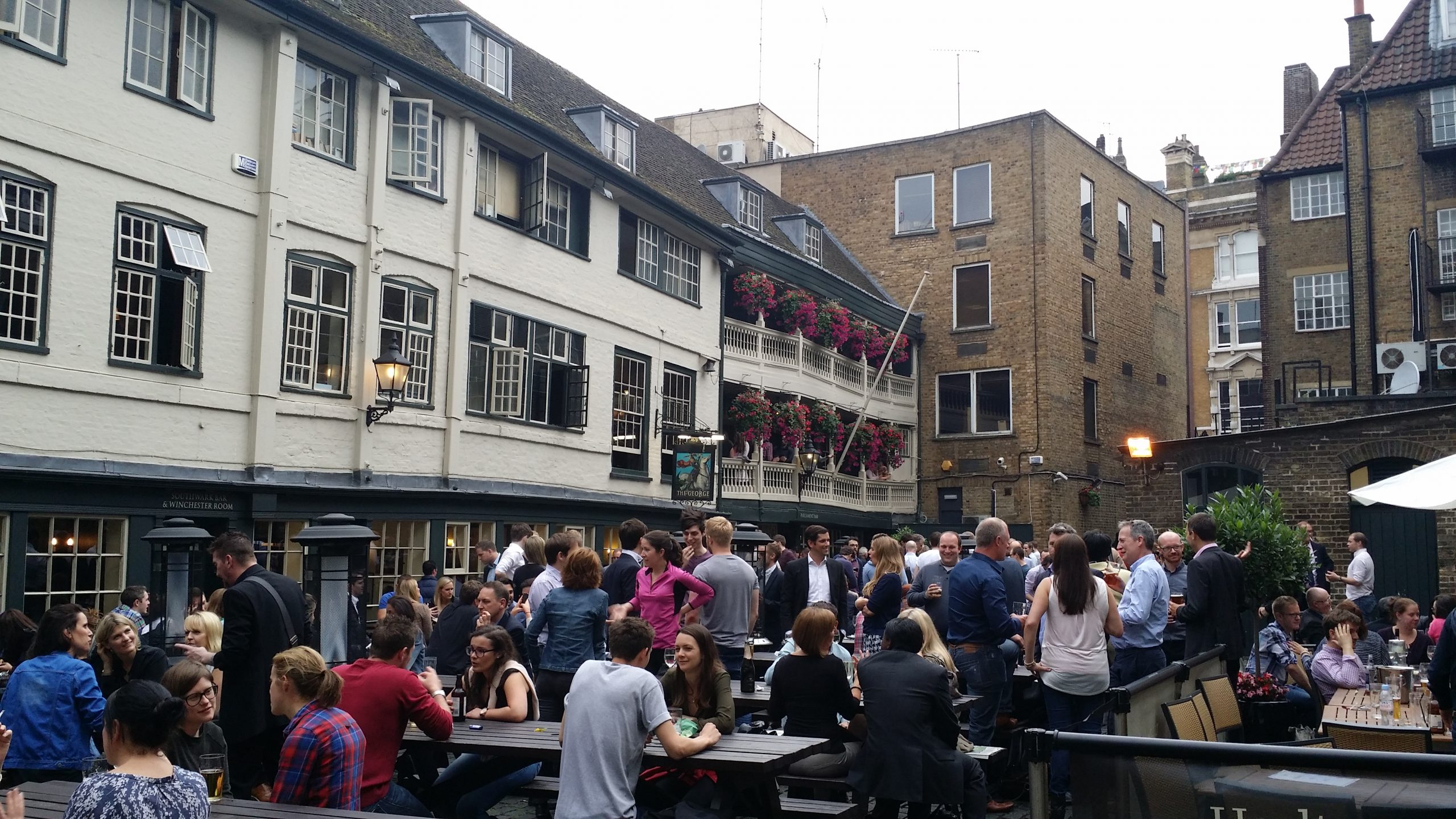
George Inn,Southwark
A Walk around Medieval London following in the footsteps of its resident medieval poet – Geoffrey Chaucer
One of the spectators at the Peasants Revolt was Geoffrey Chaucer, born in the Vintry area of London, who rose to be a diplomat, a Courtier and London’s Customs Officer. He lived with his wife in the Chamber above the Gate in the City Wall at Aldgate. His poetry shows a rugged, joyous medieval England including many scenes reflecting life in London. His stories document the ending of the feudal system, growing dissatisfaction with the corruption in the Church, and shows the robust independence with which the English led their lives.
His work helped change the fashion from poetry in French or Latin to acceptance of the English language as suitable literary language. This was helped by the growth of literacy in London as its Merchants and Guildsmen became increasingly successful. In 1422, for example, the Brewers decided to keep their records in English ‘as there are many of our craft who have the knowledge of reading and writing in the English idiom.’
Chaucer and other poets such as Langland give a vivid portrait of Medieval London which was dynamic, successful but also torn by crisis such as the Lollard challenge to Catholic hegemony, and the Peasants who revolted against oppression as the ruling classes struggled to resist the increased independence of the working people following the Black Death.
A walk which explores London in the Middle Ages, We begin at Aldgate, and follow Chaucer from his home to his place of work at the Customs House, and then to St Thomas Chapel on London Bridge, and across the River to where the Canterbury Tales start – at the Tabard Inn.
This is a London Walks event by Kevin Flude
Roman London – Literary & Archaeology Walk 11.30am Sun 27th Apr 25
Roman layer opus signinum,
Tudor London – The City of Wolf Hall 3:00pm Sun 27th Apr 25
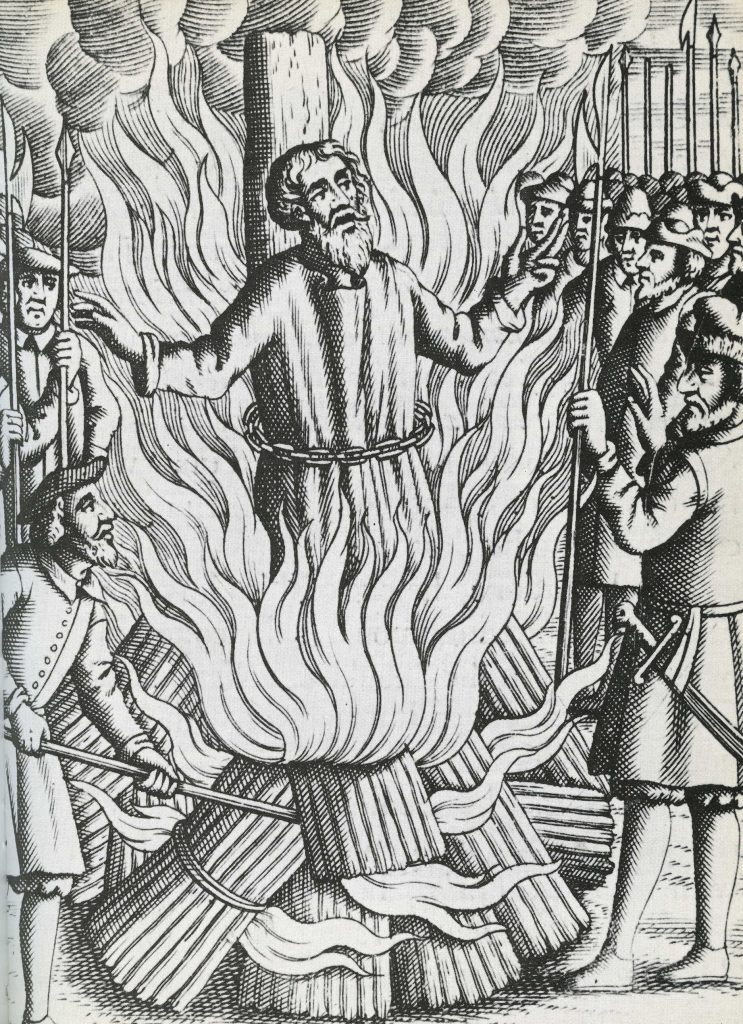
Thomas Bilney martyred in Smithfield.
The Walk creates a portrait of London in the early 16th Century, with particular emphasis on the life and times of Thomas Cromwell and Thomas More during the Anne Boleyn years.
More and Cromwell had much in common, both lawyers, commoners, who rose to be Lord Chancellor to Henry VIII, and ended their careers on the block at Tower Hill.
The walk starts with an exploration of Smithfield – site of the stake where heretics were burnt alive and of St Bartholomew’s Monastery – given to Richard Rich after his decisive role in the downfall of Thomas More. We continue to St Paul where Martin Luther’s books were burnt, and later, where Puritans preached against dancing round the Maypole.
We walk along the main markets streets of London, to Thomas More’s birthplace, and to the site of More’s and Cromwell’s townhouses before, if time allows, finishing at the site of the Scaffold where More and Cromwell met their ends, overlooking where Anne Boleyn was incarcerated in the Tower of London
To Book: https://www.walks.com/our-walks/tudor-london-the-city-of-wolf-hall/
A Boy From Haggerston before the War. 6pm 1st May 2025 Shoreditch Library.
Myths, Legends, Archaeology and the Origins of London 11.30am Sun 25th May 25 To book
The Decline And Fall Of Roman London Walk 3pm Sun May 25 To book
The Peasants Revolt Anniversary Guided Walk
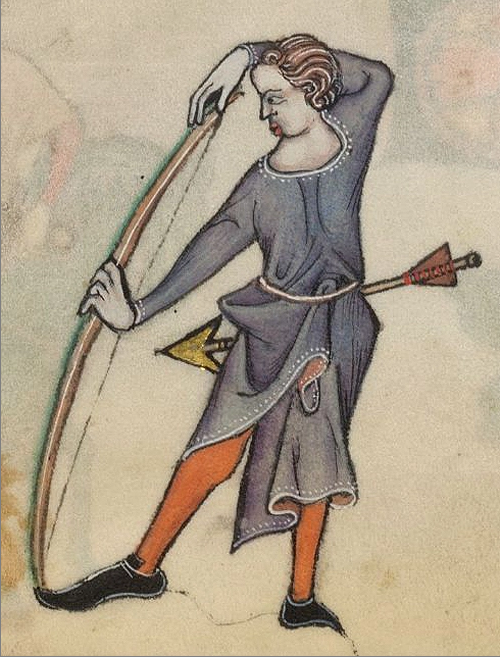
Medieval drawing of an archer
6.30pm Wed 11th June 2025 Aldgate Underground To book
An Anniversary Walk tracking the progress of the Peasants as they take control of London in June of 1381
Short read: The Summer of Blood
Long read: The Peasants’ Revolt. The greatest popular rising in English history. This is the anniversary walk. The London Walk that heads back to 1381, back to the Peasants’ Revolt. You want a metaphor, think stations of the cross. This is the stations of the Peasants’ Revolt walk. We go over the ground, literally and metaphorically. Where it took place. Why it took place. Why it took place at these places. What happened. The walk is guided by the distinguished Museum of London Archaeologist His expertise means you’ll see the invisible. And understand the inscrutable.
On the anniversary of the Peasants Revolt we reconstruct the events that shook the medieval world. In June 1381, following the introduction of the iniquitous Poll Tax, England’s government nearly fell, shaken to the core by a revolt led by working men. This dramatic tour follows the events of the Revolt as the Peasants move through London in June 1381.
We met up with the Peasants at Aldgate, force our way into the City. We march on the Tower of London as the King makes concessions by ending serfdom, at Mile End. But the leaders take the mighty Tower of London and behead the leaders of Richard’s government. Attacks follow on the lawyers in the Temple, the Prior at St. John’s of Jerusalem, Flemish Londoners, and on Lambeth and Savoy Palaces.
The climax of the Revolt comes at Smithfield where a small Royal party confront the 30,000 peasants.
Tudor London – The City of Wolf Hall 11.30am 13th July 2025 To Book Jane Austen’s London Anniversary Walk 3pm Sunday 13th July 25 To book Roman London – Literary & Archaeology Walk 11.30 am Sat 2nd Aug 2025 ToBook Chaucer’s Medieval London Guided Walk 2:30pm Sat 2nd Aug 2025 To Book Myths, Legends, Archaeology and the Origins of London 11.00am Sat 16th Aug25 to Book Roman London – Literary & Archaeology Walk 6:30pm Wed 24th Sept 2025 To book The Archaeology of London Walk 6.30pm Fri 3rd October 2025 To Book Chaucer’s Medieval London Guided Walk 11:30pm Sat 4th Oct 25 To book The Decline And Fall Of Roman London Walk 11.30pm Sat 8th Nov 25 To book Jane Austen’s London Anniversary Walk 2.00pm Sat 23rd Nov25 To book Rebirth of Saxon London 23rd Nov 25 Roman London – Literary & Archaeology Walk sat 11am 6th Dec 2025 To book Cromwell’s and More’s Tudor London Walk 2pm 7th Dec25 To book Jane Austen’s London Anniversary Walk 2.30pm Sun 14 Dec25 To book Christmas With Jane Austen Virtual London Tour 7.30pmTues 16 Dec25 To book The London Equinox and Solstice Walk 11:30pm Sun 21st Dec 25To book The London Winter Solstice Virtual Tour 7.30pm Sun 21 Dec 25 To book
Previous Years Archives
Here are previous archive of guided walks and events
Drink at a Georgian Christmas might well be port. Then the next favourites would brandy, claret, punch, rum, porter. So says my source Henry Jeffreys in his book ‘Empire of Booze’ and in this Guardian article:
Claret, probably, originally outsold port. But the wars against France and the difficulty of importing French wine, saw a transfer to wines from our ‘oldest ally’ Portugal. But the travel distance was longer, so the wine was fortified to help preserve it better. Hence, the British addiction to port. Sherry was also popular for similar reasons, being a fortified white wine. Shakespeare calls it ‘sack’ and sometimes ‘Canary’. (Toby Belch ‘says thou lack’st a cup of canary ‘ in ‘Twelfth Night’, which is a Christmas play.) See below for more on Sack and Shakespeare.
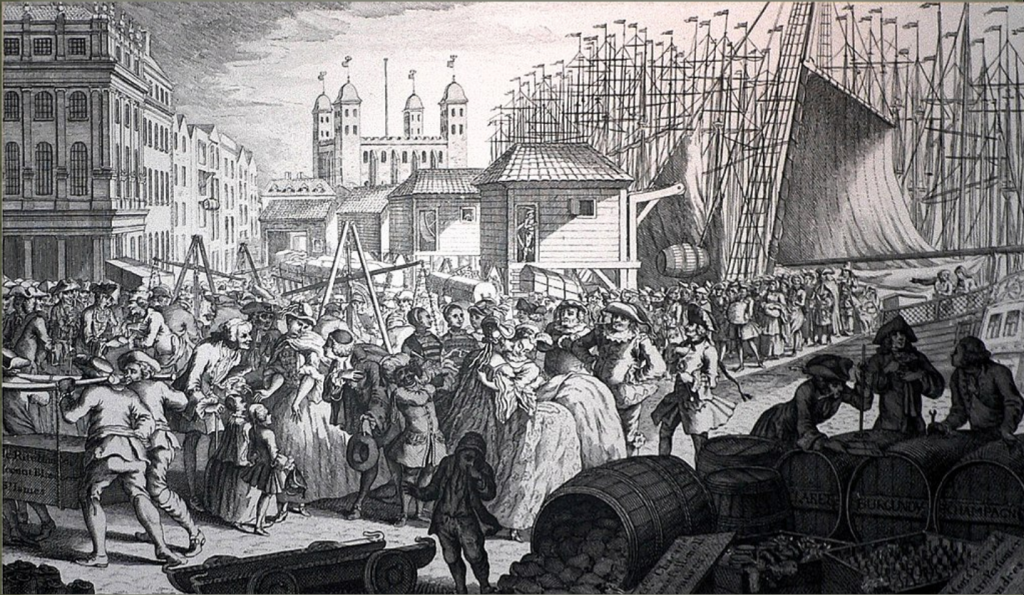
Louis Philippe Boitard‘s satirical engraving ‘Imports from France’ Looking east towards the Tower of London. Barrels at the front right are marked Claret, Burgundy and Champagne.
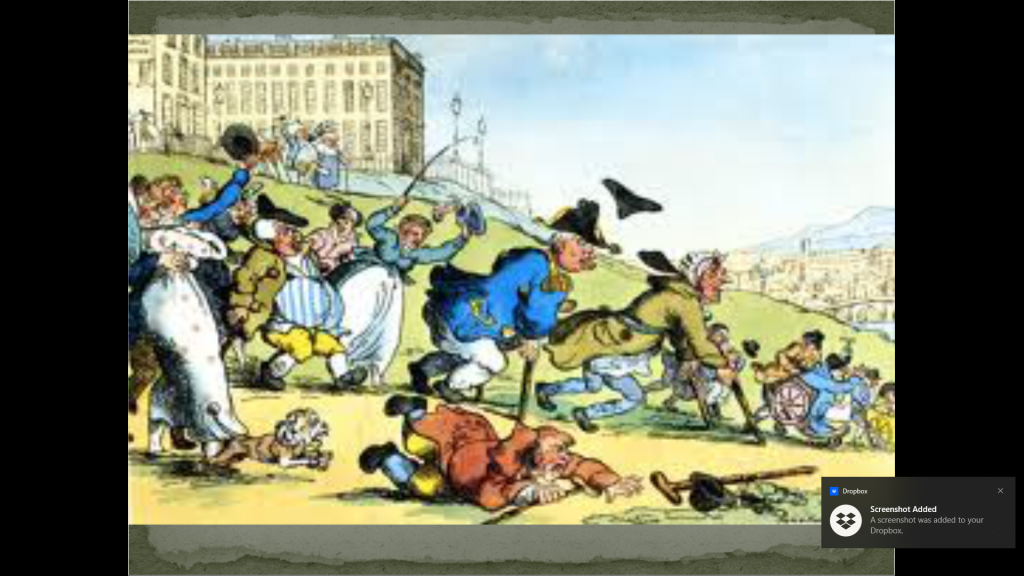
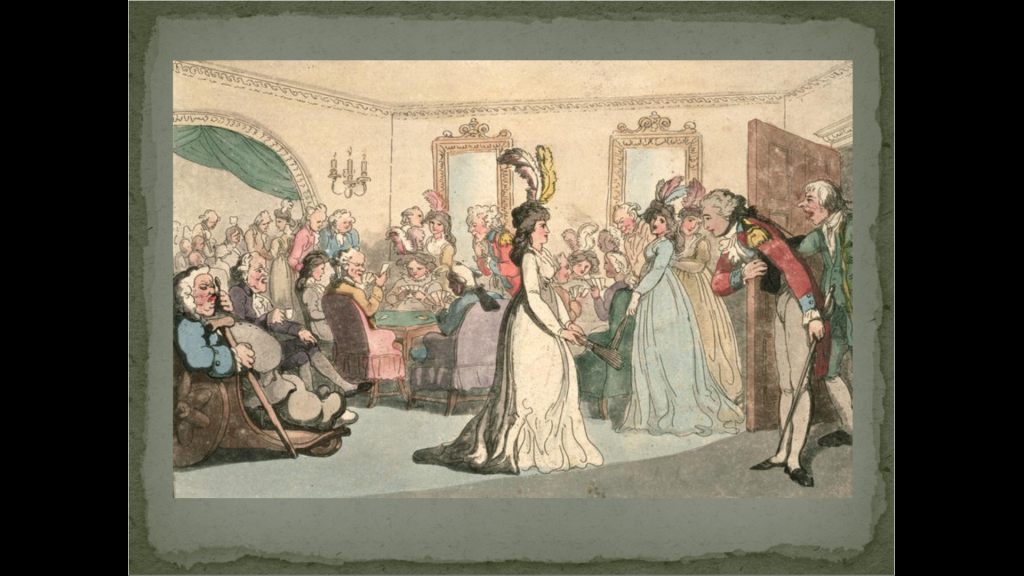
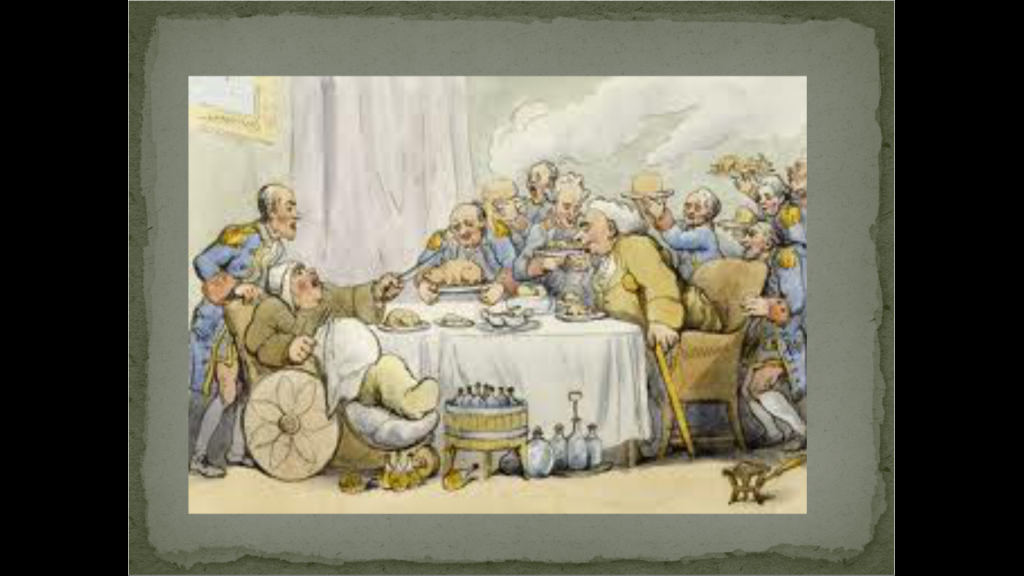
Georgian Alcohol consumption was prodigious. Samuel Johnson said, ‘All the decent people in Lichfield (where Johnson came from) got drunk every night and were not the worst thought of‘. The Prime Minister. William Pitt the Younger said, ‘I have drunk three bottles of port without being the worst for it. University College has witnessed this.’ He is referring to his college at the Oxford University. He might be considered to be another of our Prime Ministers who have first disgraced themselves at Oxbridge only to rise to rule the unfortunate British nation? However, in those days, Port was sold in pint measures (45cl) and was 16%, while now it is 20% and sold in 75cl bottles. So, maybe we are almost as bad?
Even so, three bottles is still a lot. A drunken population would have not only increased the death rate but also increased violence and abuse. Gout was one result of too much drinking and a rich diet.
Gout. 18th Century Bath
However, this is Christmas so let’s end on a high note, so here are a couple of recipes!
To make ye best punch
“Put 1½ a pound of sugar in a quart of water, stir it well yn put in a pint of Brandy, a quarter of a pint of Lime Juice, & a nutmeg grated, yn put in yr tosts or Biskets well toasted.”
And Gin? The cheap gin panic had calmed down by the 1770s after no less than eight Gin Acts of Parliament. Booths and Gordon’s Gins were established in London during this period and Gin almost a respectable drink.
There appears to have been a shortage of Gin punch recipes in the 18th Century, but by the end of that century this recipe survives from London’s Garrick Club
– half a pint of gin, lemon peel, lemon juice, sugar, maraschino, a pint and a quarter of water and two bottles of iced soda water.
You would not need many of these to become quite relaxed quite quickly!
Sack and Falstaff.
Sir John Falstaff in Henry IV eulogies on sack saying it not only makes for excellent wit but also the best soldiers:
“A good sherris sack hath a two-fold operation in it. It ascends me into the brain, dries me there all the dull and crudy vapors which environ it, makes it apprehensive, quick, forgetive, full of nimble, fiery, and delectable shapes, which, delivered o’er to the voice, the tongue, which is the birth, becomes excellent wit“.
The second your excellent sherris is the warming of the blood; which cold and settled, left the liver white and pale, which is the badge of pusillanimity and cowardice; but the sherris warms and makes it course from the inwards to the parts extremes. illumineth the face, which, as a beacon, gives warning to all rest of this little kingdom, man, to arm; and then the vital commoners and inland petty spirits muster me all to their captain, the heart, who, great and puff’d up with this doth any deed of courage—and this valour comes of sherris. that skill in the weapon is nothing without sack, for that it a-work; and learning, a mere hoard of gold kept by a devil till sack commences it and sets it in act and use. Hereof it that Prince Harry is valiant; for the cold blood he did naturally inherit of his father, he hath, like lean, sterile, bare land, manured, husbanded, and till’d, with excellent endeavour of drinking good and good store of fertile sherris, that he is become very hot and valiant. If I had a thousand the first humane principle I would teach them should be to forswear thin potations and to addict themselves to sack.
Merry Wives of Windsor
In the Merry wives of Windsor Falstaff is still always drinking sack. He asks Bardolph ‘Go fetch me a quart of sack; put a toast in’t.‘ Toast is thought to freshen up stale sack. Also, it could be drunk hot as suggested by Falstaff asking for:
‘Go brew me a pottle of sack finely.’
Bardolph asks if he wants the sack with eggs but Falstaff refuses asking for his sack to be a
‘Simple of itself; I’ll have no pullet-sperm in my brewage.’
A simple is the opposite of a compound, so pure with no additions (apart from the toast!). Pullet sperm is, in think, a dismissive reference to eggs. Sack posset was original a medicine but later a popular treat made with eggs, cream, spices and sack. Once concocted, the top would be a foamy or crusty cap, the middle a custard and the bottom a spicy hot alcohol.
First Published in 2022 and revised December 2023, 2024, 2025
So, the old Sun is dying, and if the Sun keeps going down we are all going to die. With all of nature dying or hibernating, evergreens are a symbol of a promise/proof that life will continue through the dark days. So, with its bright-green leaves and its luminous berries, Holly is the ideal evergreen for the Solstice. And as the prickles symbolise Christ’s Crown of Thorns, and the berries the red blood of Jesus, the symbolism works, too, for Christians.
Henry Mayhew (editor of Punch) in his ‘London Labour and London Poor’ (1851–62) talks of Christmasing for Laurel, Ivy, Holly, and Mistletoe. He calculated that 250,000 branches of Holly were purchased from street coster mongers every Christmas. He says that every housekeeper will expend something from 2d to 1s 6d, while the poor buy a pennyworth or halfpennyworth each. He says that every room will have the cheery decoration of holly. St Pauls Cathedral would take 50 to a 100 shillings worth.
He also calculates that 100,000 plum puddings are eaten. Mistletoe he believes is less often used than it used to be, and he hopes that ‘No Popery’ campaigners will not attack Christmassing again.
Hot plum pudding seller from Sam Syntax Cries of London, 1820s from the Gentle Author Spitalfields Life website
Culpeper on Ivy (1814 edition):
‘Ivy’ says Culpeper in his Herbal of 1653, its winter-ripening berries are useful to drink before you ‘set to drink hard’ because it will ‘preserve from drunkenness’. And, moreover, the leaves (bruised and boiled) and dropped into the same wine you had a ‘surfeit’ of the night before provides the ‘speediest cure’. (The Perpetual Almanac of Charles Kightly)
It is so well known to every child almost, to grow in woods upon the trees, and upon the stone walls of churches, houses, &c. and sometimes to grow alone of itself, though but seldom.
Time. It flowers not until July, and the berries are not ripe until Christmas, when they have felt Winter frosts.
Government and virtues. It is under the dominion of Saturn. A pugil of the flowers, which may be about a dram, (saith Dioscorides) drank twice a day in red wine, helps the lask, and bloody flux. It is an enemy to the nerves and sinews, being much taken inwardly, out very helpful to them, being outwardly applied. Pliny saith, the yellow berries are good against the jaundice; and taken before one be set to drink hard, preserves from drunkenness, and helps those that spit blood; and that the white berries being taken inwardly, or applied outwardly, kills the worms in the belly. The berries are a singular remedy to prevent the plague, as also to free them from it that have got it, by drinking the berries thereof made into a powder, for two or three days together. They being taken in wine, do certainly help to break the stone, provoke urine, and women’s courses. The fresh leaves of Ivy, boiled in vinegar, and applied warm to the sides of those that are troubled with the spleen, ache, or stitch in the sides, do give much ease. The same applied with some Rosewater, and oil of Roses, to the temples and forehead, eases the head-ache, though it be of long continuance. The fresh leaves boiled in wine, and old filthy ulcers hard to be cured washed therewith, do wonderfully help to cleanse them. It also quickly heals green wounds, and is effectual to heal all burnings and scaldings, and all kinds of exulcerations coming thereby, or by salt phlegm or humours in other parts of the body. The juice of the berries or leaves snuffed up into the nose, purges the head and brain of thin rheum that makes defluxions into the eyes and nose, and curing the ulcers and stench therein; the same dropped into the ears helps the old and running sores of them; those that are troubled with the spleen shall find much ease by continual drinking out of a cup made of Ivy, so as the drink may stand some small time therein before it be drank. Cato saith, That wine put into such a cup, will soak through it, by reason of the antipathy that is between them.
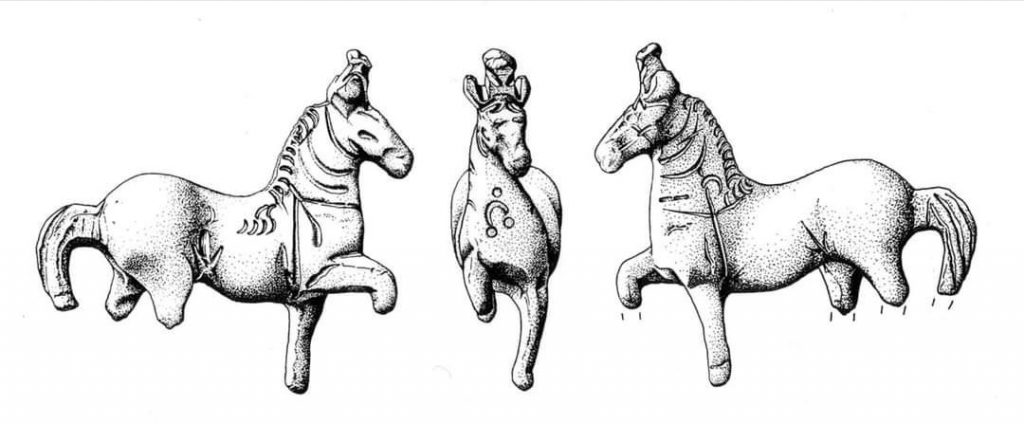
Roman Horse from Bunwell, Norfolk. Illustration by Sue Walker.
In 2021 I posted about Eponalia for the 18th Dec but I have now added the text to this page.
I’ve been too busy working on my Jane Austen and Christmas Virtual Tour ) to post over the last few days. And I have, therefore, shamelessly stolen this post off my Facebook friend Sue Walker, who is a talented archaeological illustrator, artist and a very good photographer.
She wrote: ‘the 18th December is the festival of the Celtic goddess Epona, the protector of horses, she was adopted by the Romans and became a favourite with the cavalry. This finely sculpted bronze horse with a head dress and symbol on its chest is 37mm high – found in Bunwell #Norfolk #Archaeology’
First published on December 17th 2022, Revised and republished December 2023
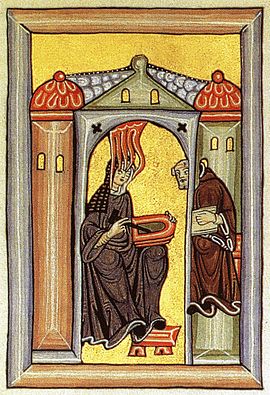
St Hildegard of Bingen receives a divine inspiration and passes it on to her scribe. From the Rupertsberg Codex of Liber Scivias.
What a relief! Here is a Saint who was not flayed alive, burnt on a griddle, scratched with wool combs, crucified upside down, beheaded, eyes gouged out, etc. etc. (consider identifying the Saints in this list as my Christmas Quiz). She died of illness, aged 81 and was famous not just for her visions but her erudition, her scientific writings, and her musical compositions. She came from the Rhineland area of Germany.
Before you proceed to read this post listen to this YouTube clip of her sublime music.
Hildegard of Bingen: De Spiritu Sancto (Holy Spirit, The Quickener Of Life)
Magistra Bingen, Monophony and Migraine
She was elected as Magistra (Mother Superior) of her Convent in 1136, and went on to found two other nunneries. But, was made famous by her writings on her visions. She was also a renowned composer of sacred monophony,
There has been speculation that her visions were caused by migraine. Read Mary Sharratt’s piece for more details, from which I took the following quotation.
‘When I was forty-two years and seven months old, Heaven was opened and a fiery light of exceeding brilliance came and permeated my whole brain, and inflamed my whole heart and my whole breast, not like a burning but like a warming flame, as the sun warms anything its rays touch.‘
Hildegard von Bingen, Scivias, translated by Mother Columba Hart, O.S.B., and Jane Bishop
Writings on Science and Medicine
Among the many books she wrote were two famous and early books on medicine and science. Her medical writing was highly practical although, of course, based on the humoural theories which had held sway since Hippocrates. However, she did think that the four humours had a hierarchy. She considered blood and phlegm the more superior humours, representing the celestial elements of fire and air. While black bile and yellow bile represented the earthly humours of earth and water.
Just as physicists today look to find a unifying theory of everything, Hildegard also tried to find unities within the body of classical knowledge. According to Wikipedia, she:
‘often focuses on interrelated patterns of four: “the four elements (fire, air, water, and earth), the four seasons, the four humours, the four zones of the earth, and the four major winds.” ‘
Linked also to the celestial bodies and to religion, she gave her world view in Causae et Curae c. 42:
It happens that certain men suffer diverse illnesses. This comes from the phlegm which is superabundant within them. For if man had remained in paradise, he would not have had the flegmata within his body, from which many evils proceed, but his flesh would have been whole and without dark humour [livor]. However, because he consented to evil and relinquished good, he was made into a likeness of the earth, which produces good and useful herbs, as well as bad and useless ones, and which has in itself both good and evil moistures. From tasting evil, the blood of the sons of Adam was turned into the poison of semen, out of which the sons of man are begotten. And therefore their flesh is ulcerated and permeable [to disease]. These sores and openings create a certain storm and smoky moisture in men, from which the flegmata arise and coagulate, which then introduce diverse infirmities to the human body. All this arose from the first evil, which man began at the start, because if Adam had remained in paradise, he would have had the sweetest health, and the best dwelling-place, just as the strongest balsam emits the best odour; but on the contrary, man now has within himself poison and phlegm and diverse illnesses.
And here I was hoping to find light and joy in a medieval Saint’s story! So we seem to be doomed by Adam’s Fall, and the poor quality of his semen. (Having recently watched Hugo Blick’s Wild West box set ‘The English’, I can quite understand the syphilitic underpinnings of Hildegard’s theory).
It also reminds me of Pandora’s Box. At least we know the Greco-Roman Gods were flawed divinities. While the Abrahamic God is omnipotent. Why then does he allow evil, cruel or unfair outcomes from his own creations?
Feverfew
Feverfew CC BY 2.5, https://commons.wikimedia.org/w/index.php?curid=216947
On the subject of headaches, Hildegard was a keen user of feverfew, which has been, since the 18th Century, a suggested cure for Migraine. I didn’t find it worked for me, being a sufferer since age 12. And it never occurred to me to think that the flashing lights, partial temporary blindness, tingling muscles and devastating headaches might be a gift from God.
Hildegard wrote the following about feverfew:
“If you suffer from a sick intestine, boil the Motherswort with water and butter or oil and add some spelt flour. Prepare a drink, for it helps the intestines.”
And so it became popular among women for gynaecological issues and abdominal pain. Feverfew has flowers like a daisy, ‘growing in every hedgerow’ according to Mrs Grieve’s English Herbal. Grieve’s says it is good for nervous and hysterical complaints; low-spirits; as a syrup good for coughs; as a tincture against swellings caused by bites of insects and vermin. However, https://www.drugs.com/npp/feverfew.html says the :
‘leaves possess emmenagogic activity (ejection of the placenta and fetal membranes) and may induce abortion. Use is not recommended during breastfeeding or in children younger than 2 years.‘
And there are also potential issues.
St Hildegard seems to have two special days – one is Dec 17th and the other is the day she died, September 17th 1179 which is her ‘Liturgical Feast’.
On This Day
1538 – The Pope, Paul III, finally passes a Bull of Excommunication against Henry VIII and declares his Kingdom forfeit. By which time it was far too late to have much impact. Pope Clement had first warned Henry of the risk of Excommunication at the end oof 1531. Henry was told to treat his Queen with ‘marital affection’ in all things. Had he taken decisive steps at this early stage would the outcome have been different?
First Published on December 18th, 2022, Revised and republished December 2023, 2024, 2025, On This Day added February 2026
Medieval Cataract Surgery – calling couching Eye Care through the Ages .
So, on St Lucy’s Day, you, being someone worried about your eyes, might have sought an altar dedicated to St Lucy, the patron saint of eye health. (see December 13th’s Post on St Lucy). Although you may be disappointed that there has been no miraculous cure for you, you might have been encouraged to do something about it. So that’s what this post is about.
There are only two churches in the UK dedicated to St Lucy or St Lucia. One run by the National Trust in Upton Magna, Shropshire, but there must have been a few chapels in Cathedrals and Abbeys dedicated to her. I have my eyes open for them!
For Redness of the Eye or Pink Eye
There are many household books still, existing. These show that much of medical practice was carried out in the home, by ordinary men and women. More often women, actively not only collected useful recipes and cures, but also tested them out and improved them. Here is an example:
For the redness of eyes, or bloodshot. Take red wine, rosewater, and women’s milk, and mingle all these together: and put a piece of wheaten bread leavened, as much as will cover the eye, and lay it in the mixture. When you go to bed, lay the bread upon your eyes calmer and it will help them.
Fairfax Household book, 17th/ 18th century. (Reported in The Perpetual Calendar of Folklore by Charles Kightly)
‘Pink eye’ is mentioned in a document unearthed at the Roman Fort of Vindolanda. It lists the troops of the Cohort in occupation. We read that of the garrison of 750, 474 are absent with 276 in the fort of which 38 are sick, 10 with ‘pink eye’. This is probably conjunctivitis.
Prevention is better than cure
Things hurtful to the eyes. Garlic, onions, radish, drunkenness, lechery, sweet wines, salt meats, coleworts, dust, smoke, and reading presently after supper.
Good for the eyes. fennel, celandine, eyebright, vervain, roses, cloves and cold water.
Whites Almanack 1627
Cataract operations
Cataract operations have been carried out since 800 BC using a method called ‘couching’.
This was a last resort when the cataract was opaque and the patients nearly blind. It would mean they would need very thick lenses to see well again but, crude as it seems, it worked.
But the operation, without anaesthetics must have been a considerable ordeal. The recovery (still required today for those suffering from a displaced retina) means that the patient has to lie on their back for a week with supports on either side of the head to prevent movement. Of course, there was a serious risk of infection, so prophylactic visits to a chapel of St Lucy might be called for.
The modern treatment for cataracts was established in the 1940s and offers a great solution in 15 minutes surgery. Currently, the NHS has been having trouble dealing with all the cases required, (6% of surgery is for cataract operations). Before COVID-19, there was some talk about cataracts being, in practice, not readily available on the NHS. The waiting time is supposed to be 18 weeks but, for example, at NHS Chesterfield Royal Hospital the waiting time approaches almost 10 months. But waiting times around the country vary from 10 weeks to over a year.
Patrick Brontë’s Eye
On 26th August 1846 Charlotte Brontë took her father to Manchester from Haworth for Cataract surgery. The operation took 15 minutes but without anaesthesia. He was very calm and said the pain was ‘a burning pain.’ It was vital he stay still through the pain. Then, he had to remain in bed for a month in the dark, minimising movement. Leeches were applied to his face, to reduce the inflammation of the wound. He was looked after by a nurse 24 hours a day, supervised by Charlotte. She used the time she spent waiting in writing Jane Eyre. Her Father’s vision was significantly improved and he was able to resume his Parish duties.
You will note, above, that it was considered bad for the eyes to read in low light. It is a myth and not true. Poor Samuel Pepys was continually worried about his reading and writing habits ruining his eyesight. This is an extract from the poignant last entry in his famous diary:
And thus ends all that I doubt I should ever be able to do with my own eyes in the keeping of my journal, I being not able to do it any longer, having done now so long as to undo my eyes almost every time that I take a pen in my hand; and therefore, whatever comes of it, I must forbear: and therefore resolve from this time forward to have it kept by my people in long-hand. I must be consented to sit down no more than is fit for them and all the world to know; or, if they be anything, which cannot be much now my amores are past and my eyes hindering me almost all other pleasures. I must endeavour to keep a margin in my book open, to add, here and there, a note in shorthand with my own hand.
Samuel Pepys Diary, May 31st
The sad thing is that Pepys had another 38 years before he went blind, and what glorious diary entries have we missed because of his false fears of the effect of eye strain?
First published in 2022, updates 2023, 2024 and 2025
St Lucy, by Francesco del Cossa (c. 1430 – c. 1477) (Wikipedia User:Postdlf)
I reposted my two posts on St Lucy, and the follow-up email on eye-care, on the appropriate days. But the email to subscribers was not sent. So here it is again. The name Lucy is from the same Latin origin (Lucidus) as lucent, lux, and lucid. It means to be bright, to shine or be clear. It is similar to the Ancient Greek λευκός (leukós, “white, blank, light, bright, clear”. Luke has the same origins (bright one, bringer of light and light of the sacred flame) and is very appropriate for the most literate of the evangelists.
St Lucy of Syracuse
St Lucy is from Syracuse in Sicily. She was a victim of the Diocletian Persecution of Christians in the early 4th Century. She is an authentic early martyr. But details of her story cannot be relied upon as true. She was a virgin, denounced as a Christian by her rejected suitor. Then, miraculously saved from serving in a brothel.; destruction by fire, but did not escape having her eyes gouged out. Finally, her throat was cut with a sword.
Her connection to light (and the eye gouging) makes her the protectress against eye disease. So she is depicted holding two eyes as you can see in the picture at the top of the page. Other symbols include a palm branch which represents martyrdom and victory over evil. Other symbols are lamp, dagger, sword or two oxen.
She appears in Dante’s Divine Comedy, as the messenger to Beatrice whose job is to get Virgil to help Dante explore Heaven, Hell and Heaven.
St. Aldhelm (died in 709) puts St Lucy in the list of the main venerated saints of the early English Church, confirmed by the Venerable Bede (died in 735). Her festival was an important celebration one in England. It was views ‘as a holy day of the second rank in which no work but tillage or the like was allowed’.
Dimming of the Light
This year is a glorious sunny St Lucy’s Day. But, the afternoons soon dim. So, at this time of the year, we are in need of a festival with bright lights to cheer us up! And St Lucy’s Day is the beginning of the winter festival that culminates with the Solstice, where the old sun dies, and the new one is born. December the 13th was the Solstice until Pope Gregory reformed the Calendar in the 16th Century, as nine days were lopped off the year of transition.
Sankta Lucia in Sweden
The festival of Sankta Lucia is particularly popular in Sweden, where December 13th is thought to be the darkest night. In recent years, the Swedish community in the UK has had a service to Lucia in St Pauls. But the last couple of years has been in Westminster Cathedral. This year on the 5th December. And a Santa Lucia Carol Concert on 12 December at St Paul’s. But every year it has either been and gone or sold out by the time I get around to thinking of going!
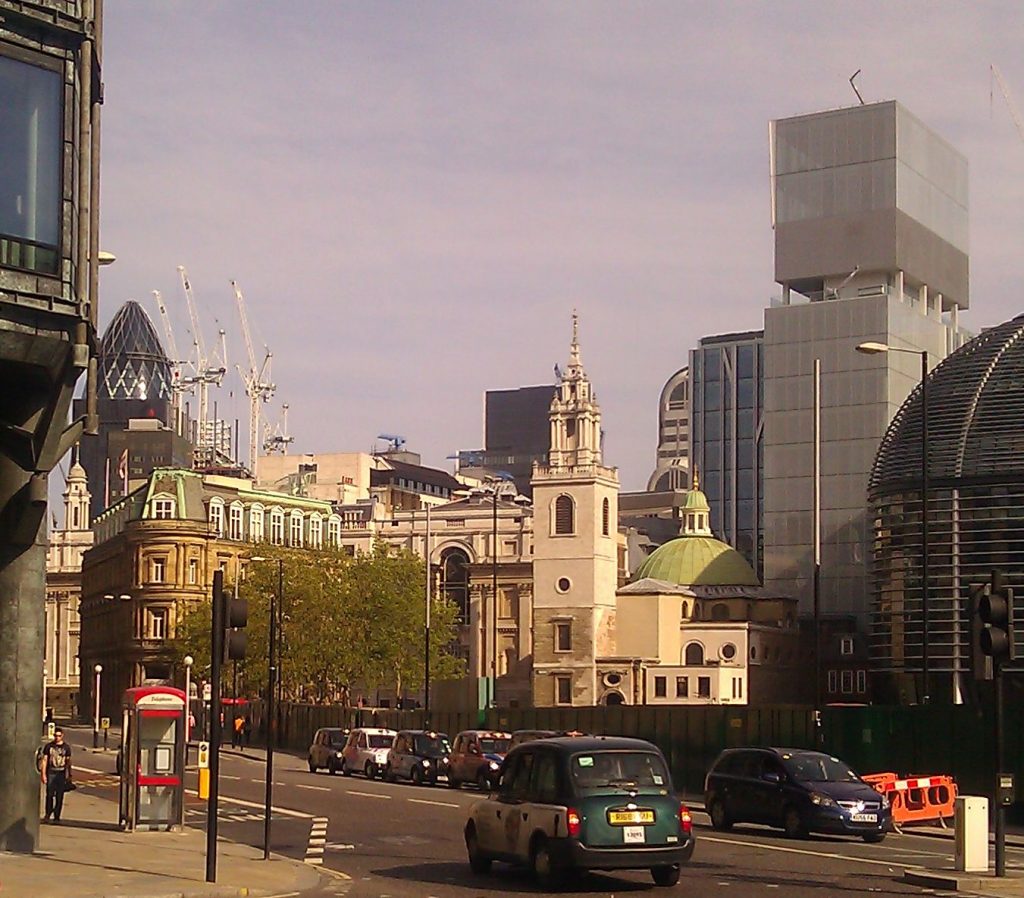
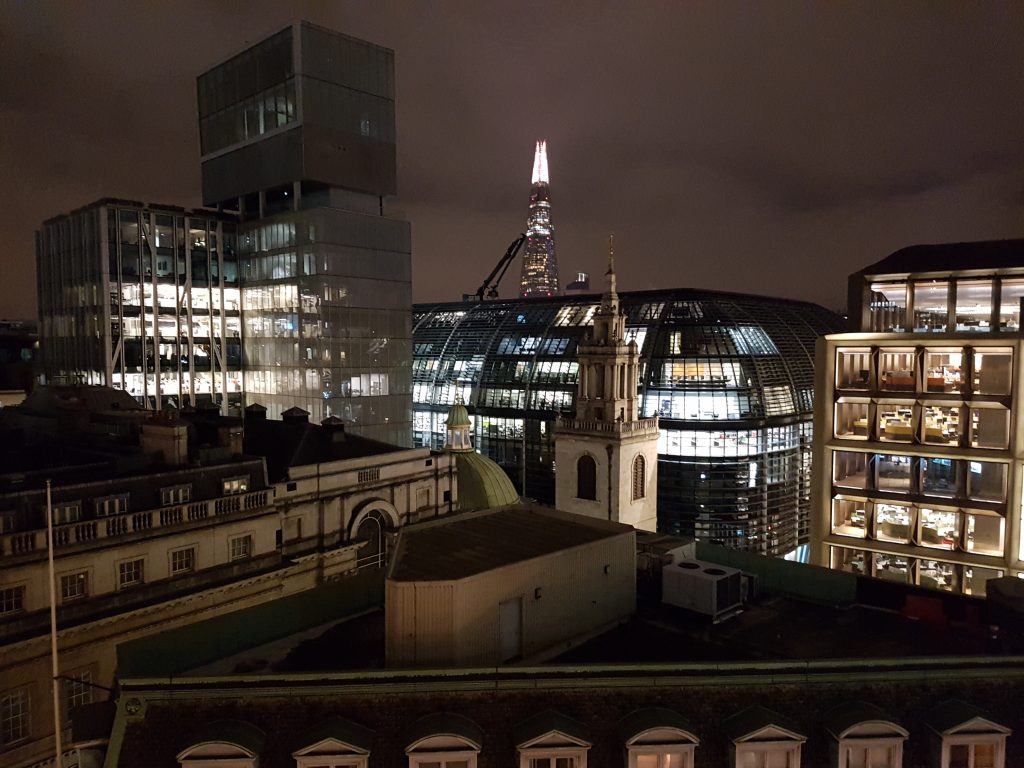
St Stephens Church by Christopher Wren (Photo K Flude) a rare view during building work.
I found out about Sankta Lucia from a Swedish choir who hired me to do a tour of the City of London some years ago. We went into Christopher Wren’s marvellous St Stephen’s Church. Under the magnificent Dome, the choir fancied the acoustics and spontaneously sang. I recorded a snatch of it, which you can hear below
Swedish Choir singing in St Stephen’s London St Stephens Church in the middle foreground of the photo. (Photo K Flude)
You can watch the Sankta Lucia service in Westminster Cathedral below:
The Importance of Light
Recent medical research has shown the importance of light, not only to our mental health but to our sleep health. Work places need to have a decent light level with ‘blue light’ as a component of the lighting. It is also an excellent idea to help your circadian rhymes by going for a morning walk, or morning sun bathing, even on cloudy days. This will help you sleep better. And so St Lucy remains relevant as an inspiration
According to the Perpetual Almanac by Charles Kightly, this is the time when Robins are much to be seen singing their winter song, and when it is time to protect plants, particularly Rosemary, against winter frosts.
In December, rosemary flowers with a delicate blue flower. Rosemary was one of the most important plants, metaphorically and medically. Mrs Grieve, in her ‘Modern Herbal’ says it is used in medicine for illnesses of the brain and was thought to strengthen the memory. And as rosemary helps the memory, they are symbolically/metaphorically associated with friendship, love, worship and mourning. A branch of Rosemary was given as a gift to wedding guests, so they would remember the love shown at the ceremony. It was also entwined in the Bride’s wreath.
Shakespeare uses Rosemary in his plant lore in Hamlet.
OPHELIA: There’s rosemary, that’s for remembrance. Pray you, love, remember. And there is pansies, that’s for thoughts.
LAERTES: A document in madness: thoughts and remembrance fitted.
OPHELIA: There’s fennel for you, and columbines. There’s rue for you, and here’s some for me. We may call it herb of grace o’ Sundays. O, you must wear your rue with a difference.
There’s a daisy. I would give you some violets, but they withered all when my father died. They say ‘a made a good end.
(sings) For bonny sweet Robin is all my joy.
Ham IV.v.176
Rue is the herb of grace and has the sense of ‘regret’. Pansies are also for remembrance, and their heart shaped flowers are for love and affection. Fennel represents infidelity and Columbines insincerity or flattery. Daisies are for innocence. Violets are associated with death, particularly of the young. As to how Orphelia means them all to be understood is not entirely clear, particularly Fennel and Columbine. Some think they are directed towards Claudius and/or Gertrude.
Being evergreen, Rosemary was associated with religion and everlasting life. It was called the rose of the Virgin Mary. Lying on a bed of rosemary, the Virgin’s cloak was said to have been dyed blue. Indeed, Mary is mostly depicted in a blue cloak in Renaissance paintings.
And so Rosemary is especially important for Christmas. At Christmas, it was used to bedeck the house and used at funerals to remember the dead.
The Virgin Mary Googled.
Its strong aroma means it was used as an incense and also used in magic spells
Thomas More let rosemary ‘runne all over my garden walls’ because bees love it and as sacred to remembrance, therefore to friendship.
Rosemary flowering in December
I mostly use Rosemary for the very rare occasions when I cook lamb, but it is much more versatile than that, or so the SpruceEats website tells me:
‘Rosemary is used as a seasoning in various dishes, such as soups, casseroles, salads, and stews. Use rosemary with chicken and other poultry, game, lamb, pork, steaks, and fish, especially oily fish. It also goes well with grains, mushrooms, onions, peas, potatoes, and spinach. ‘
1917- End of the Battle of Cambrai in which Tanks were first used. The tanks had initial success when over 400 hundred of them were used by the British on the first day of the battle. Because the British Army did not precede the attack with the usual artillery barrage, the attack was a complete surprise and the British penetrated deep into the German Lines. But the army had too few troops to exploit the breakthrough and by early December the Germans had mostly recaptured the territory the tanks had won. So the battle was indecisive, but successfully showed the role of the tank in future battles. Casualties amounted to about 45,000 on each side.
1941 – Pearl Harbour bombed. The Japanese attack killed more than 2,300 U.S. military personnel were killed. Another 1,100 at least were wounded, and eight battleships were damaged or destroyed.
On December 8th,Congress approved Roosevelt’s request for a declaration of war on Japan. In the Senate, the vote was 82 – 0 and 388–1 in the House.
On 11 December 1941. Germany declared war on the US, in line with the Tripartite Pact between the two countries and Italy. Later that same day, the US declared war on Germany, with no dissenters from the vote.
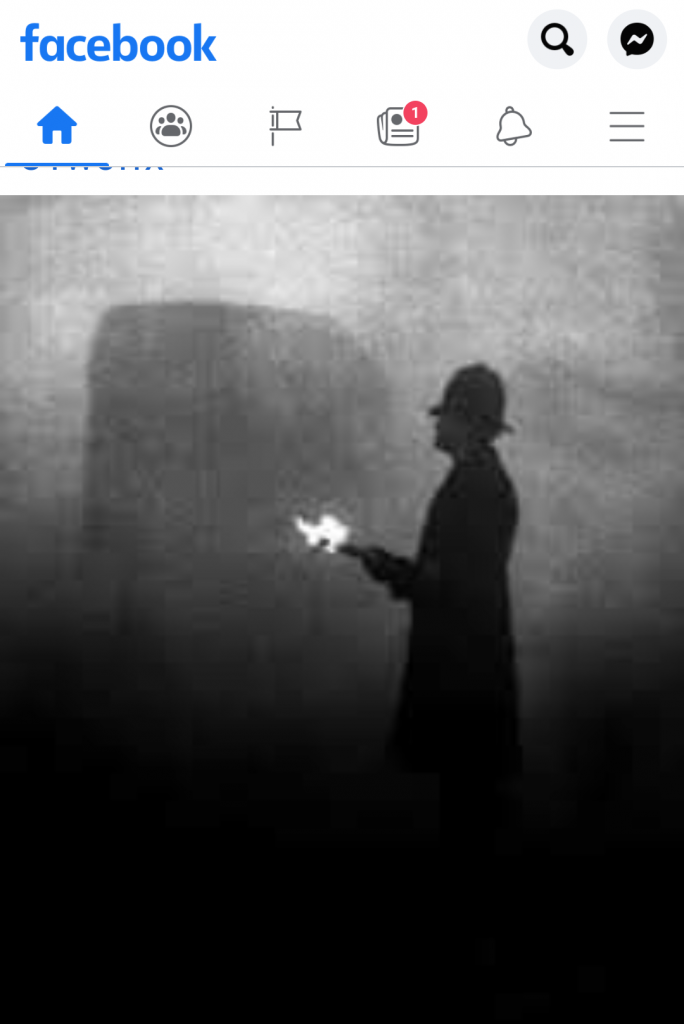
Today is the anniversary of the Great Smog. What happened in 1952 changed Britain forever. A terrible smog developed which lasted for a week, beginning on December 5th 1952. It killed probably 12,000 people. The hospitals, the emergency services, the mortuaries, the funeral parlours had more work to do than during the Blitz or the Cholera epidemics. Higher deaths than normal were still occurring as late as January 1953.
A temperature inversion kept a blanket of cold damp air over London. This stoped the pollutants being dispersed and blown away. But post-war austerity (this time introduced by the Labour Party) made it such a killer. Britain was exporting our top grade coals. And allowing domestic users to use terrible stuff called ‘nutty slack’. This was sludge, dust, and fragments of very low grade and therefore very smokey coal. 18% of the coal used was domestic, but it contributed 60% to the emissions. The fog was yellow and sulphuric. Public Transport had to be halted as no one could see beyond their hands in front of their faces. People had to leave cinemas because no one could see the screens.
What changed Britain was that it finally persuaded people that coal-polluted air was a killer. People had debated it since the Victorian period, but did very little about it, some even believing smoke was good for you. In World War II the government encouraged smog near Cities, to cloak the industrial areas from the Luftwaffe Bombers. After 1952, it was clear what a killer smog was. In 1956, the Clean Air Act established zones where only smokeless fuels could be used. Polluting industries were dispersed from the towns. Taller chimneys were used. This eventually cleared up the problem.
Pollution still killing people
Job done, or so we all thought. Dr Gary Fuller (see below) tells us that we are incapable of dealing with more than one pollution threat at a time. In 1962, another smog, created by sulphur dioxide pollution, killed perhaps 1,000 people in London. And London still has a lot of air pollution, not just from traffic fumes, and it is still killing people.
Traffic pollution in London is being dealt with more aggressively by the current Mayor. Partly as a response to a brave coroner who found that a 9-year-old girl, Ella Kissi-Debrah, died because of air pollution. (girls-death-contributed-to-by-air-pollution-coroner-rules-in-landmark-case). The London Mayor began addressing the issue by first creating and then expanding, the Ultra Low Emission Zone, to encompass all the London Boroughs. This has been very controversial as it has meant many people having to sell cars that do not meet the standard. This had the unfortunate byproduct which was that it enabled the unpopular Conservative Party hanging on, by the skin of their teeth, in Boris Johnson’s old constituency.
The creation of Local Traffic Neighbourhoods are another front against diesal pollution. They allow local authorities to introduce traffic reduction methods by blocking off many neighbourhood roads from through traffic. These have been fought tooth and nail by its opponents. But have been a success, cutting local pollution.
Freedom from Air Pollution?
But much less well known are other threats. For example, there is an increasing threat from trendy wood burning stoves which are very polluting. I very reluctantly decided to install a diesal heater in my narrowboat as it is less polluting that a cosy Wood Burning Stove. Yet their sales are soaring as people seek ways of mitigating soaring post-Ukraine war electricity prices.
Agriculture is very polluting too, with fertiliser, and manure mixing with urban pollution to create dangerous particulates. It turns out that the most polluting time of the year is not Autumn, nor Winter but Spring because of this agricultural activity.
Listen to the BBC’s excellent episode of ‘Inside Science: Killer Smog’. If you cannot use BBC Sounds, then go to the link to a Podcast at the bottom of the piece. These are both based on the work of Dr. Gary Fuller of King’s College, London, detailed in his book ‘Air Pollution: The Invisible Killer’.
We need to stop being short-sighted, not just ‘solving’ one problem before moving onto the next. We need a fundamental revision of our systems to allow us to enjoy the last two of the four freedoms so eloquently expressed by Roosevelt (the subject of the 2024 BBC Reith Lectures):