This post sprang from something that my grandson said to in the middle of the park. He was curious as to why I was concerned that the park toilets were out of action. He told me I could, like him, just pull down my trousers and wee, right here, right then, up against the tree in the park. My attempt at explanation drew a perplexed, ‘What?’ ‘What?’ is his new word. After an explanation, his next word is invariable another ‘What?’.Hopefully the relevance of this will become apparent.
May and June are the most prolific months for dandelions, which used to be known as ‘piss-a-beds’. They are diuretic and were often eaten, and so might well have consequences for the young trainee child.
John Hollybush in his 1561 ‘The Homish Apothecary’ says:
‘When a young body does piss in his bed either oft or seldom: if ye will help him take the bladder of a goat and dry it to powder, and get him to drink with wine, or else take the beans or hinder fallings of a goat, and give him of the powder in his meat morning and evening, a quarter ounce at every time.’
(quoted in ‘The Perpetual Almanac by Charles Kightley)
Hinder fallings are what falls out of the hind-quarters of a goat. I’m not sure even an indulgent Grandparent is allowed to give droppings and wine to the little ones. Nor can I find any mention of goat products in modern medical recommendations. So I won’t be recommending this as a practical aid.
Medically, dandelions were very well regarded. Mrs Grieve’s ‘Modern Herbal’ reports that it are diuretic and a general stimulant to the system but particularly the urinary system. They were good for liver and kidney complaints; gall-stones; and piles. They were considered excellent to eat and drink. Particularly, dandelion sandwiches using young leaves, with salt, pepper, and lemon juice. They were also taken in salads, teas, and beers.
We used to blow the seeds from the dandelion seed head saying ‘She loves me. She loves me not’ at each blow, until the truth was revealed.
First written in June 2023, revised june 2024,2025. Rewritten 2025
Screen shot from the Jorvik Viking Festival Site showing all the fun to be had if the Vikings invade your town!
The annual Jorvik Viking Festival is on from Monday 17th – Sunday 23rd February 2025 in York. The illustration above show there are Viking Trails, Feasts, Crafting, Berzerkering and encamping. And more! Visit the web site here.
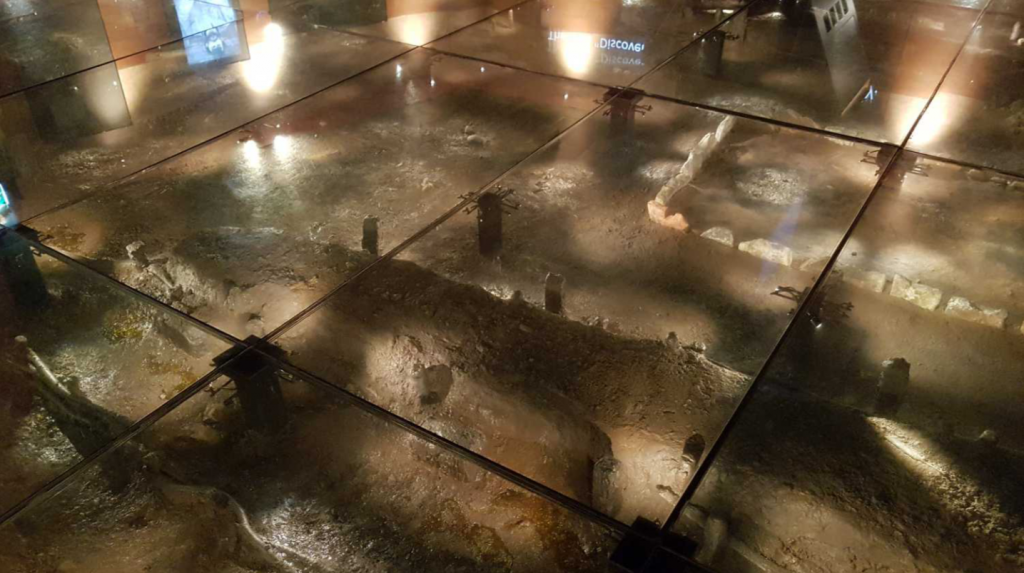
The excavations under the floor of the Jorvik Centre. Photo K. Flude
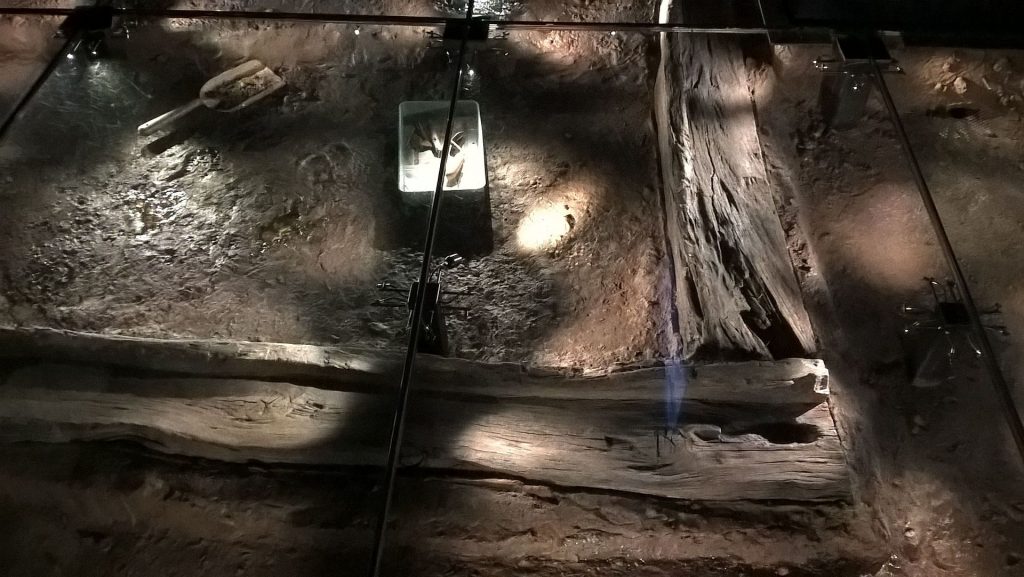
York or Jorvik as the Vikings knew it as, has become the centre of all things Viking in the UK. Viking York came to the fore with the Coppergate Excavations in the 1980s. Underneath what is now a shopping mall and Primark, were the streets of Viking York in all its waterlogged glory. The waterlogging allowed the survival of organic material that rarely survives.
Excavation of Jorvik visible under the floor of the Museum. Photo By Chemical Engineer – Own work, CC BY-SA 4.0, https://commons.wikimedia.org/w/index.php?curid=58524883
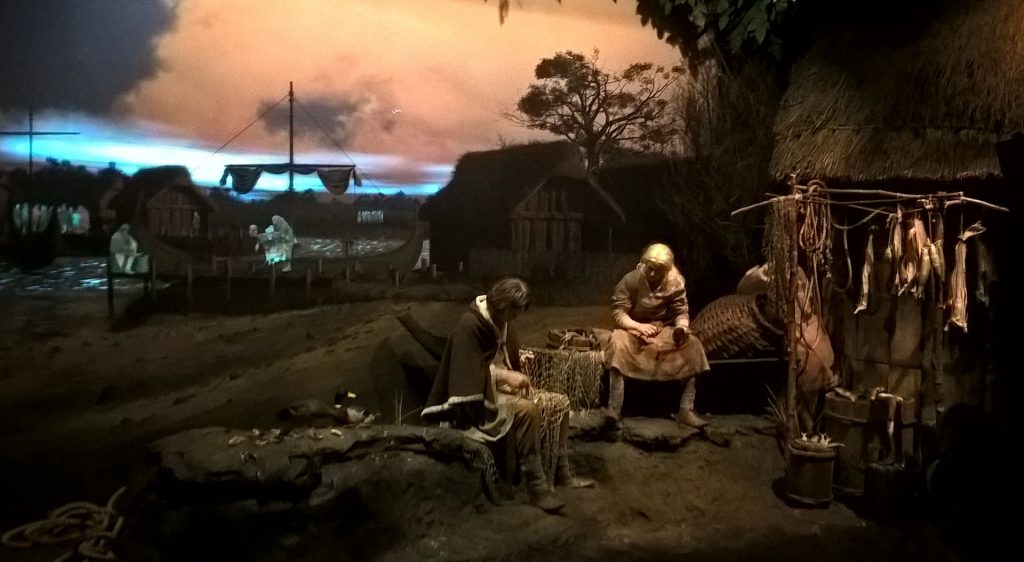
At the time, the excavations were a sensation. York Archaeological Trust made a bold decision to turn part of the site into a ‘Dark Ride Experience’. The remnants of the excavation were preserved under glass, and nearby a replica of the townscape was created. Tourists sat in ‘cars’ with an audio guide and given a guided tour. It was very successful. The extensive profits were used for other York Archaeological Trust projects such as the reconstruction of medieval Barley Hall. Other historic towns followed suit and soon there were Dark Rides in Canterbury, London, Oxford and others. All, as far as I know have died a death except for the Jorvik Centre which continues to enthral visitors to York.
Tableau from the Jorvik Centre with Fishermen working. Photo By Chemical Engineer – Own work, CC BY-SA 4.0, https://commons.wikimedia.org/w/index.php?curid=58524883
The next best thing about Vikings are their colourfull names. Jorvik history vibrates with the deeds of ‘Ivan the Boneless’, Sihtric ‘the Squinty-eyed’and Erik Bloodaxe. For more on nicknames read my post!
Sementivae, was a festival dedicated to seed and to Ceres. Ceres is an Earth Goddess who gives her name to our word cereal. The festival was also called. Paganalia. The Mediterranean world had many names for the Earth Goddess. Tellus, Demeter, Cybele, Gaia, Rhea etc..
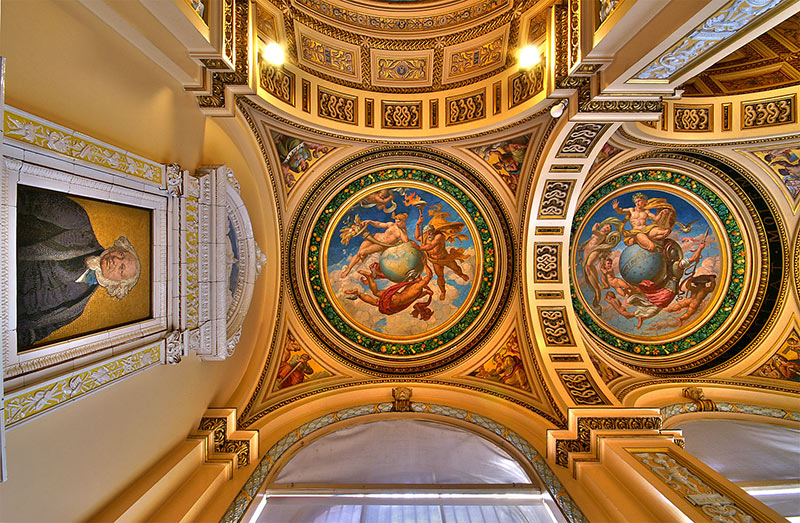
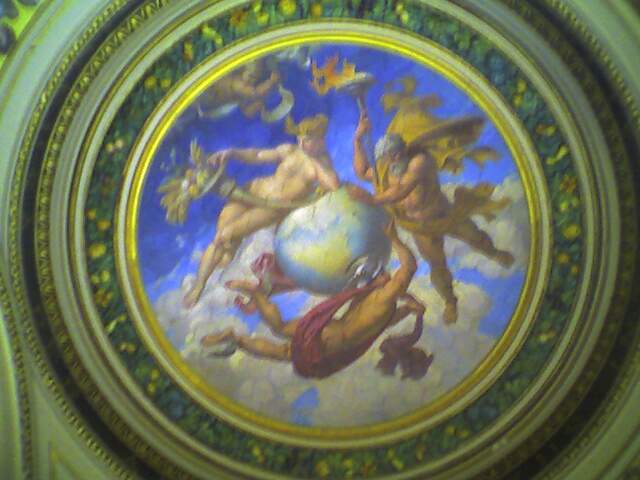
Ceres can be seen on the top left roundel resting on the Globe on the marvellous Ceramic Staircase at the V&A (photo above). And in my slightly out of focus photograph below. (To be honest, in real life, it looks a little more like my photo than the gorgeous photo above!)
Ceres represented Agriculture, Mercury Commerce, and Vulcan Industry. Old Photo by the Author.
Sementivae Dies – a moveable feast.
To create life, we need earth and water to nurture and seeds for fertility. And so into the cold dead world of January the Romans created a festival of sowing. It had two parts, one presided over by Mother Earth (Tellus) and the other by Ceres, the Goddess of Corn. The actual day of the festival was chosen not by rote on a set day of the calendar but by the priests, in accordance with the weather. This seems very sensible, as there is no point sowing seeds in terrible weather conditions. I’m assuming the Priests took professional advice!
On the 24th-26th January Tellus prepared the soil, and in early February seeds were sown under the aegis of Ceres. Tellus Mater (also Terra Mater) was known as Gaia to the Greeks.
Gaia
Gaia was selected by James Lovelock & Lynn Margulis in the 1970s as the face of their Gaia hypothesis. To me, the importance of the idea is not the scientific principle that environments co-evolve with the organisms within them. But, rather in Gaia as a personification of our world as a complex living ecosystem. One that we have to care for. Gaia exists as a series of feedback loops. Lovelock hypotheses that she will spit us out unless we can live in balance with our alma mater.
Ovid and Sementivae
This is what the Roman Poet Ovid has to say in his poetic Almanac known as ‘Fasti’ (www.poetryintranslation.com)
Book I: January 24
I have searched the calendar three or four times, But nowhere found the Day of Sowing: Seeing this, the Muse said: That day is set by the priests, Why are you looking for moveable days in the calendar? Though the day of the feast ís uncertain, its time is known, When the seed has been sown and the land ís productive. You bullocks, crowned with garlands, stand at the full trough, Your labour will return with the warmth of spring. Let the farmer hang the toil-worn plough on its post: The wintry earth dreaded its every wound.
Steward, let the soil rest when the sowing is done, And let the men who worked the soil rest too. Let the village keep festival: farmers, purify the village, And offer the yearly cakes on the village hearths. Propitiate Earth and Ceres, the mothers of the crops, With their own corn, and a pregnant sow ís entrails. Ceres and Earth fulfil a common function: One supplies the chance to bear, the other the soil. Partners in toil, you who improved on ancient days Replacing acorns with more useful foods, Satisfy the eager farmers with full harvest, So they reap a worthy prize from their efforts. Grant the tender seeds perpetual fruitfulness, Don’t let new shoots be scorched by cold snows. When we sow, let the sky be clear with calm breezes, Sprinkle the buried seed with heavenly rain. Forbid the birds, that prey on cultivated land, To ruin the cornfields in destructive crowds. You too, spare the sown seed, you ants, So you’ll win a greater prize from the harvest.
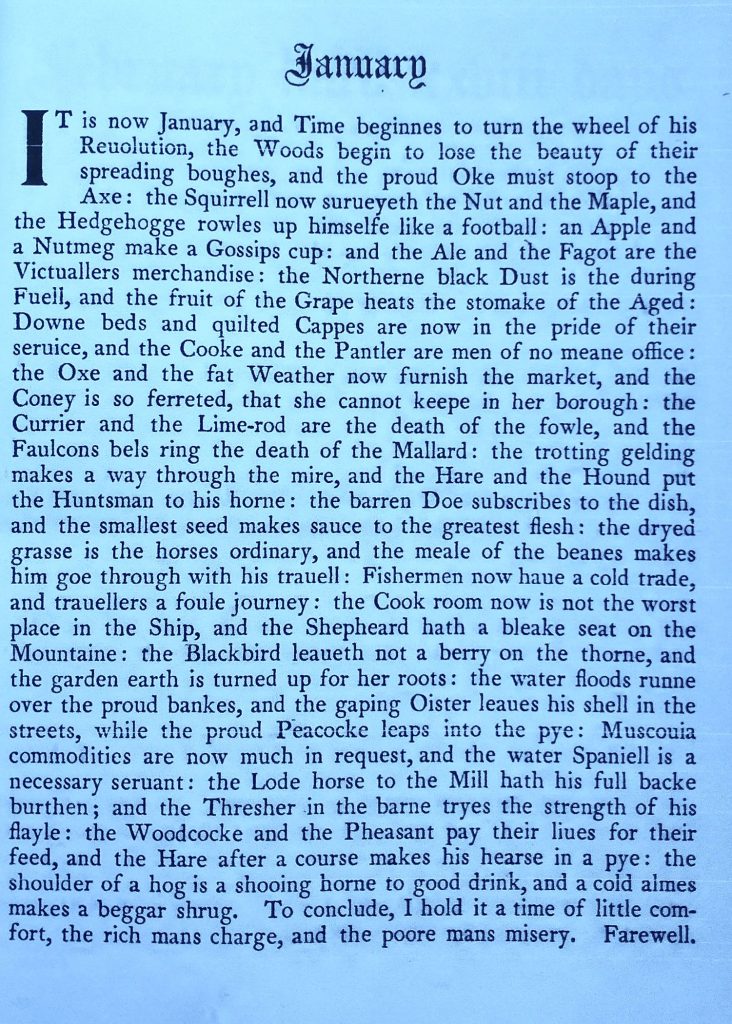
January from Nicholas Breton’s ‘Fantasticks 1626 from the Kalendar of Shepherds (digitised by Internet Archive)
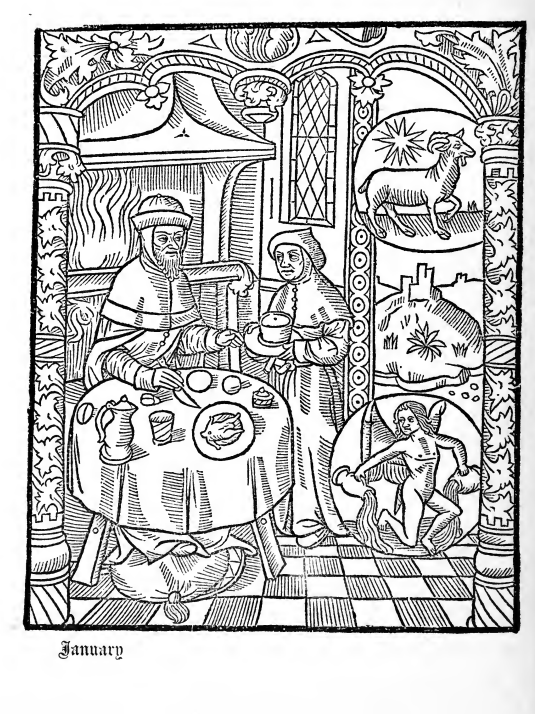
The Kalendar of Shepherds was printed in 1493 in Paris and provided ‘Devices for the 12 Months.’ I use a modern (1908) reconstruction of it using wood cuts from the original French and adding various text from English 16th and 17th Century sources. The text of the month (as shown above) is provided from a 17th Century source. It gives an interesting view of the countryside in January. To see the full Kalendar, look here:
Nicholas Breton, the writer of the text above, concludes that January:
‘is a time of little comfort, the rich man’s charge, and the poore man’s misery.’
The rich man is burdened by having to help out all the poor people who depending upon him to get through the shortages of winter. The image for January shows that January is best spent indoors by a roaring fire, eating pies.
The Kalendar introduces a ‘conceit’ which is that the year mirrors our lives, and we can forecast what will happen in our lives by looking at the months.
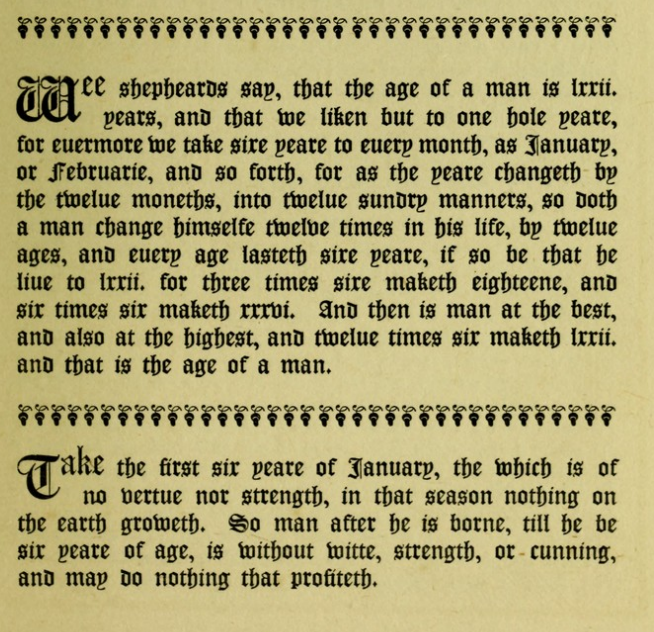
Kalendar of Shepherds, January text
So our lives, which are of 72 years, can be divided into 12 ages of man, each of 6 years. So, January represents the first 6 years of a person’s life. And as you can see, that during these first 6 years, the child is ‘without witte, strength, or cunning, and may do nothing that profiteth‘. As the year changes every month, so, ‘a man change himself twelve times in his life’. At three times 6 (18 or March) a child becomes a man, and 6 times 6 (36 or June) man is at his best and highest. And at 12 times 6 (72 or December) man is at the end of his allotted span.
Shakespeare numbered the Ages of Man as seven, in the great speech of Jacques in ‘As You Like it’ I dealt with this and other Ages of the World in my post:
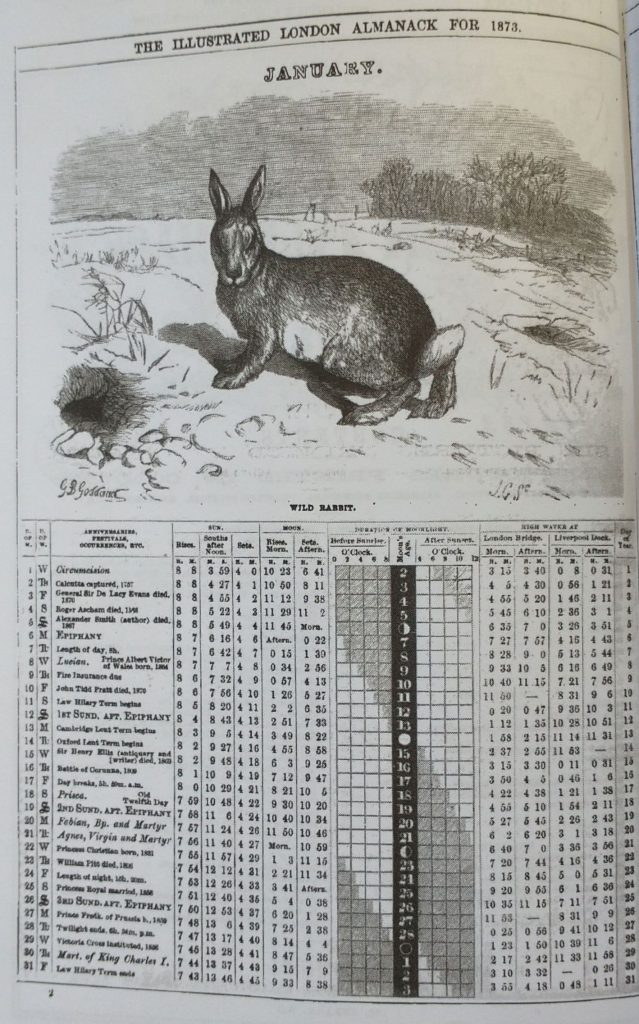
Bereton tells us that, in January, the ‘coney is so ferreted that she cannot keep in her borough’. To put that is modern speech, ‘the rabbit is so hunted with the aid of ferrets that she cannot keep in her burrow’. The London Illustrated Almanac of 1873 chose the Rabbit as its wild animal of the month.
January from London Illustrated Almanac of 1873
To have luck for a month, you are supposed to say ‘Rabbit, Rabbit’. No less a person than FD Roosevelt used to say this. No one knows why. Rabbit’s feet are lucky too. I remember some of my friends had them in our Surrey village in the early 60s. Some of Dad’s nieghbours kept ferrets, and I remember dead Rabbits hanging from walls. The history.com website gives an idea, possibly exaggerated view, of the merits of the feet which depended upon how they were collected:
“A 1908 British account reports rabbits’ feet imported from America being advertised as ‘the left hind foot of a rabbit killed in a country churchyard at midnight, during the dark of the moon, on Friday the 13th of the month, by a cross-eyed, left-handed, red-headed bow-legged Negro riding a white horse,’
As to why, no one really knows. But Pliny the Elder in 71AD reported that cutting off the foot of a live hare could cure gout. There are European traditions of rabbit and other animal’s feet amulets curing all sorts of ailments. There are associations with witches, who could shape-shift into a rabbit. So a rabbit’s foot would be witchy and therefore powerful. In March, I reported on the Hare, and their, similar, associations with witches:
For lovers of Music, Chas and Dave’s hit song ‘Rabbit’ has a chorus of ‘Rabbit, Rabbit’.According to the Cockney’s singers (they do love a Knee’s Up) it comes from the Cockney Rhyming Slang expression: Rabbit and Pork. This means ‘Talk’ because it rhymes with ‘Talk’. To hear the song, its gestation and Royal connections, click here.
Now, I must stop rabbiting on. Time to get things done.
First, published in 2023, revised in January 2024, 2025
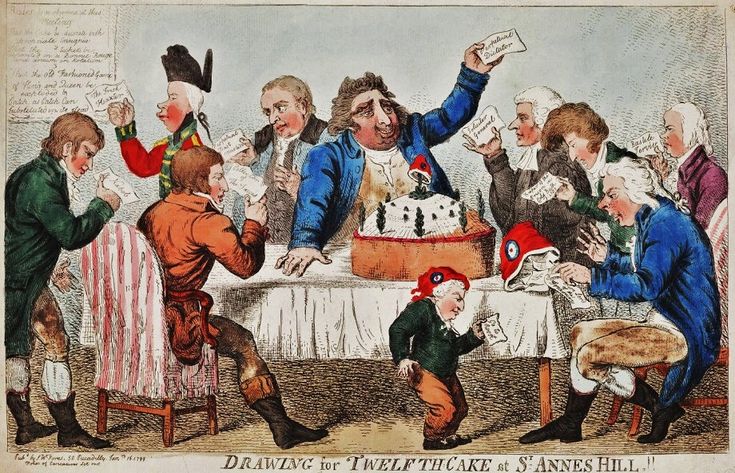
‘Drawing for Twelfth Cake’ at St. Annes Hill ’12th Night Cruikshank, Isaac, 1756-1811 printmaker. Published Janr. 10, 1807 by Thomas Tegg, 111 Cheapside’
Twelfth Night
Yesterday was Twelfth Night for the modern Church of England, but today is Twelfth Night for the Catholic Church and in England in former times. It is also Epiphany or Three Kings Day and because of calendrical differences, Christmas Eve for the Orthodox Church. In Ireland, it is Nollaig na mBan. This is Women’s Little Christmas; when Women get to rest and let men do the work. This is a typical Saturnalia-style reversal of roles.
I used the print above, three years ago for my post on New’s Day, then moved it to Twelth Night. I also use it for lectures on Christmas and Jane Austen. But the focus of my presentation is explaining the Twelfth Night Cake and the game that was played. But in fact, this is a very political satirical cartoon. More of that, later, let’s begin with the more trivial aspect of the print above.
Twelfth Night and Christmas Cake
It used to be the big party night, featuring the famous Twelfth Night Cake and theatrical entertainments; mumming and wassailing. The cake has disappeared from current Christmas celebration, probably because it transmuted into our present Christmas Cake. This, I regret. I have had a lifetime when a very heavy Christmas Dinner is followed first, by Christmas Pudding. Then, overloading with food, the Christmas Cake is brought out. No one, in their right mind, wants a slice of heavy Christmas Cake at that time. Many of my American friends disparage fruit cake, but they are mistaken. Good Christmas Cake is something to be thoroughly enjoyed, but on the days following Christmas Day.
I gave a recipe for the Twelfth Night Cake in another post, (here it is). But the important point is that it had a bean and a pea in it. The one who got the bean was selected as King for night and the pea the Queen. Traditionally, the women draw a card from a ‘reticule’ (bag) and the men’s from a hat. But there are no women at this satirical party. The cards detailed a role they were to play for the rest of the night. The card began with an introductory speech, or rhyme, for the person to speak. The King and Queen led the way, and for the rest of the evening the party members adopted their persona. They might be an aristocrat, a soldier, a cook, a parson, a dairy maid etc. The French do something similar with their Galette des Rois. The bean is called the feve, and may be replaced by a porcelain model. Other places have a King’s Cake for epiphany.
Twelfth Night Satire
So, as I was rushing to get the original Twelfth Night post done, I failed to examine it in any detail. I assumed the cards gave them satirical occupations which would be funny to the contemporary audience in 1807. But then, I noticed the title mentioned St Anne’s Hill. I looked it up and discovered myself down a deep and very enjoyable research rabbit hole.
St Anne’s Hill & Charles James Fox
Now, let’s go down that rabbit hole and look a little deeper.
The caption mentions St Anne’s Hill. I believe this refers to St Anne’s Hill, near Chertsey (SW of London on the River Thames). Here, there was a grand house which was owed by Charles James Fox. He was the leader of the Whigs, a persistent opponent of King George III. He was a supporter of the American and French Revolutions. This explains the red bonnet used to pull out the cards in the illustration.
The central figure is then, Fox. But he died in September,. 1806. The print is dated January 1807. Just before he died, his Foreign Slave Trade Bill of 1806 began the dismantling of this pernicious trade in the British Empire. He was Foreign Minister who assumed a couple of civil chats with the French would end the long-standing war. But he soon discovered that Napoleon was not to be trusted in negotiations. The war went on for another 9 or so years.
Charles James Fox was a mercurial figure with many radical views. He was also a notorious gambler and loved the high life. One of his many lovers was Georgiana, Duchess of Devonshire. He eventually married, Elizabeth Armistead, an ex-mistress of the Prince of Wales. St Anne’s Hill was her house. I am pleased to report that she is credited with calming his life-style. He now spent more time at St Anne’s where they would ‘read, garden, explore the countryside and entertain friends’ (Wikipedia).
Isaac Cruikshank’s ‘Drawing for Twelfth Cake’ at St. Annes Hill
Cruikshank’s illustration is, of course, not designed to document quaint Twelfth Night customs but is a political satire and I discovered that the British Museum has the original version of this print, and. It is dated to 1799 which makes much more sense!
At the back right of the print is a notice which says:
‘Rules to be observed at this Meeting 1. That the Cake be decorated with appropriate insignia 2 That the tickets be deposited in a Bonnet Rouge and drawn in Rotation 3 That the Old Fashioned Game of King and Queen be exploded & Catch as Catch can Substituted in its stead.’
The bonnet rouge is defined by the Collins Dictionary as a ‘redcap worn by ardent supporters of the French Revolution’ or ‘an extremist or revolutionary’. The last point relates to Fox’s opposition to the King, and the expression Catch as Catch Can refers to a free form of wrestling without rules.
The characters in the scene (all men) are all political figures. They are associated with the opposition to the very right-wing Government of William Pitt. During the war with France, the opposition was led by a supporter of the French Revolution. For those on the right, which included Pitt’s government, supporting the French Revolution was tantamount to treason. Pitt suspended many civil liberties in ‘Pitt’s Reign of Terror’. He arrested and indeed executed leading members of those demanding political change. The Government even suspended Habeas Corpus to make it easier to arrest their opponents,
Fox is seen drawing a 12th Night Game ticket which is marked ‘Perpetual Dictator’. To his right is Frances Burdett. He was a radical politician, who supported universal male suffrage, equal electoral districts, vote by ballot, and annual parliaments. Note that this is well before these aims became the core of the Chartists campaign for electoral reform. (for other people in the illustration look at the British Museum notes on the print. )
Frances Burdett, Edward and Catherine Despard
Burdett is shown holding a ticket saying ‘Keeper of the Prison in Cold Bath Fields’. This is a satirical reference to a serious political crisis. The Cold Baths Fields was the site of a medical spring in Clerkenwell, London. This was where a prison was situated where radicals were imprisoned. They were held in poor conditions despite the recent rebuilding under the aegis of the prison reformer, John Howard. Burdett exposed the scandalous conditions in the House of Commons. He began a campaign against the magistrates involved in the arrests.
One of the prisoners was Edward Despard who had associations with many radical groups. These included the London Corresponding Society, the United Irishmen and United Britons. Despard was married to Catherine, the daughter of a free black woman from Jamaica. She, with Burdett, led the campaign against these arrests without trial. Catherine wrote a letter to the Attorney General who replied in a demeaning manner:
‘it was a well-written letter, and the fair sex would pardon him, if he said it was a little beyond their style in general’
He did not comment on her colour. She described the imprisonment of her husband as being :
“in a dark cell, not seven feet square, without fire, or candle, chair, table, knife, fork, a glazed window, or even a book”
Execution of Edward Despard
Despard was freed in 1802, went to Ireland. But returned to London, where he was arrested again. But this time he was accused of a being the ringleader of a plot to assassinate the King. There was little real evidence. Horatio Nelson was a character witness, and appealed to the King for clemency. It was given. But only in so far as Despard was not disembowelled but ‘only ‘Hanged and Drawn’ at Horsemonger Lane Gaol (1803). This was the last time someone was drawn through the streets at the tail of a horse before execution for treason. These are his last words:
Fellow Citizens, I come here, as you see, after having served my Country faithfully, honourably and usefully, for thirty years and upwards, to suffer death upon a scaffold for a crime which I protest I am not guilty. I solemnly declare that I am no more guilty of it than any of you who may be now hearing me. But though His Majesty’s Ministers know as well as I do that I am not guilty, yet they avail themselves of a legal pretext to destroy a man because he has been a friend to truth, to liberty, and to justice
(a considerable huzzah from the crowd)
and because he has been a friend to the poor and to the oppressed. But, Citizens, I hope and trust, notwithstanding my fate, and the fate of those who no doubt will soon follow me, that the principles of freedom, of humanity, and of justice, will finally triumph over falsehood, tyranny and delusion, and every principle inimical to the interests of the human race.
(a warning from the Sheriff)
I have little more to add, except to wish you all health, happiness and freedom, which I have endeavoured, as far as was in my power, to procure for you, and for mankind in general.
https://en.wikipedia.org/wiki/Edward_Despard
After his death, his family denied that Catherine was his wife but merely his ‘house-keeper.’ I assume, was because they wanted the inheritance rather than, or perhaps, as well as naked prejudice.
Francis Burdett married into the fabulously rich banking family the Coutts. His daughter was the famous Angela Burdett Coutts who was a philanthropist who collaborated extensively with Charles Dickens.
@Phew! This is what I love about what I do, you find things out that link disparate parts of your knowledge, creating an ever-interwining web of history.
On this Day
Harold Godwinson was crowned King of England on January 6, 1066, the same day as the funeral of the previous king, Edward the Confessor. m.
I am finishing my post on September, and using the Kalendar of Shepherds. As you may have noticed, I often use the Kalendar of Shepherds to provide an insight into how the seasons were seen in the past. Mostly, I use it for the posts at the beginning of each month. I have created this page as a placeholder to put information on the Kalendar for anyone who is eager to explore it more or to make use of it. Each month I will link to it, so I do not have to repeat the basic information about the Kalendar. Much of this text was contained in the December post, and I have used this month as my example. Tomorrow, you will get the September version.
About the Kalendar of Shepherds.
The Kalendar was printed in 1493 in Paris and provided ‘Devices for the 12 Months.’ The version I’m using is a modern (1908) reconstruction of it. It uses wood cuts from the original 15th Century version and adds various texts from 16th and 17th Century sources. (Couplets by Tusser ‘Five Hundred Parts of Good Husbandrie 1599. Text descriptions of the month from Nicholas Breton’s ‘Fantasticks of 1626.) This provides an interesting view of what was going on in the countryside every month.
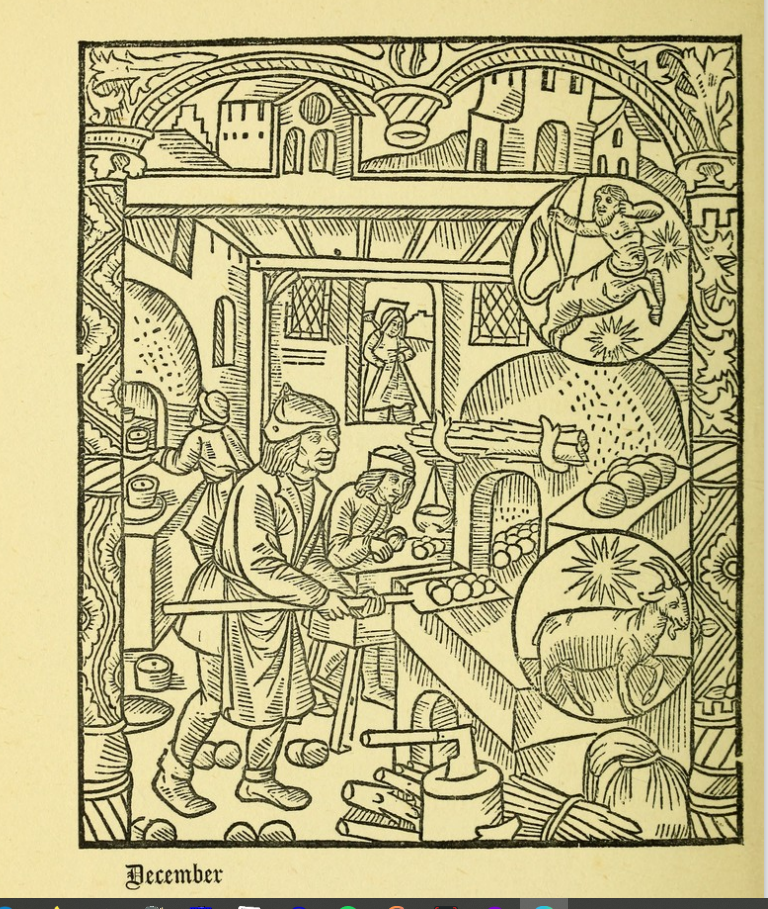
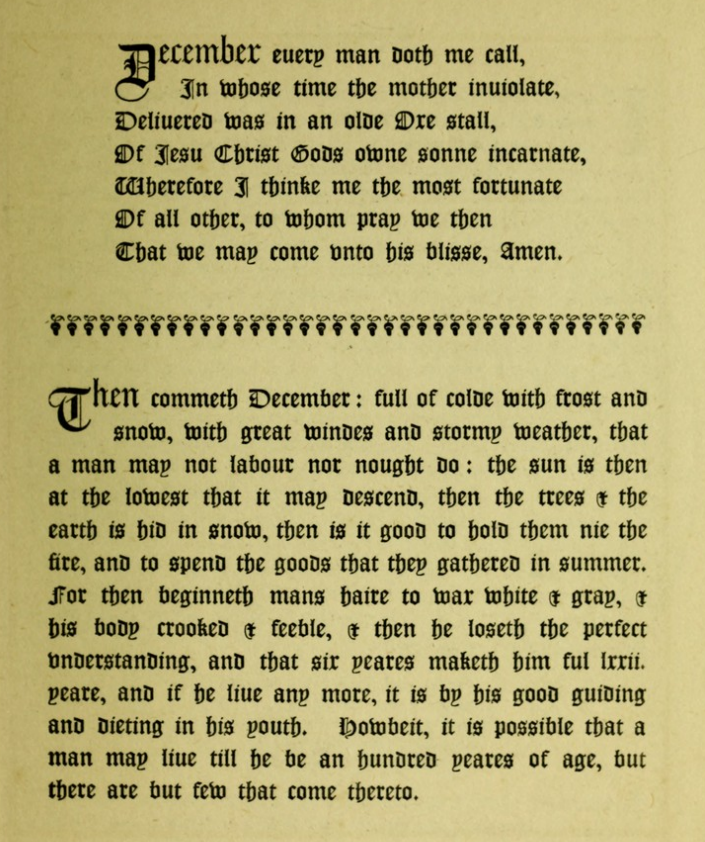
The Kalendar of Shepherds has an illustration for each month (December above) which shows typical activities for the time of year, and has inserts to identify the astrological signs of the month. So, in December they are baking and collecting firewood. The star signs are Sagittarius (November 22 – December 21) and Capricorn(December 22 – January 19).
The text below gives a vivid description of December weather and then elaborates on the last six years of a man’s life, with hair going white, body ‘crooked and feeble’. The conceit here is that there are twelve months of the year, and a man’s lot of ‘Six score years and ten’ is allocated six years to each month. So December is not just about the 12th months of the Year but also the last six years of a person’s allotted span. The piece allows the option of living beyond 72, ‘and if he lives any more, it is by his good guiding and dieting in his youth.’ Good advice, as we now know. But living to 100 is open to but few.
Kalendar of Shepherds
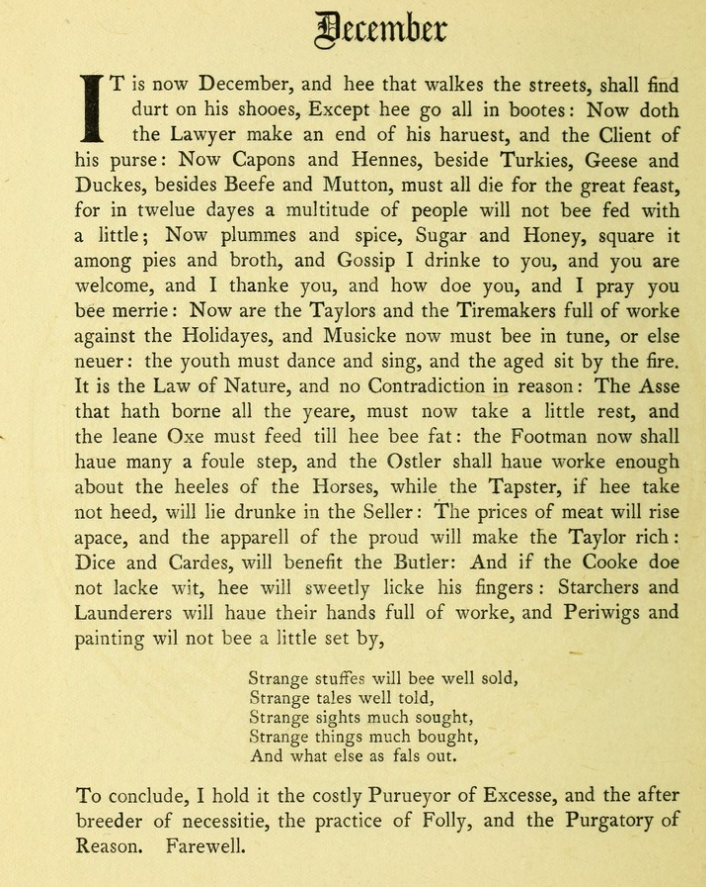
The longer description of December (shown below) is by Breton (1626) and gives a detailed look at the excesses of Christmas, who is on holiday, and who working particularly hard. But it concludes it is a costly month.
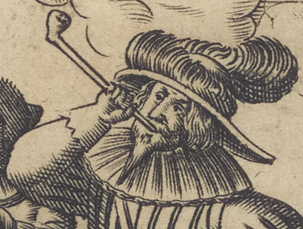
Coltsfoot is a daisy-like plant which is flowering about now. Gerard’s Herbal of 1633 suggests that the ‘fumes of the dried leaves taken through a funnel’ is good for those with coughs and shortness of breath. He suggests that it is smoked like tobacco and it ‘mightly prevaileth.’
This idea, Mrs Grieves says in her herbal (1931), is endorsed by ‘Dioscorides, Galen, Pliny, and Boyle’. And Coltsfoot is ‘nature’s best herb for the lungs’. (This is historic information re herbs and NOT current medical advice, as Coltsfoot can be very dangerous!).
Detail from Lobspruch deß edlen hochberühmten Krauts Petum oder Taback Nuremberg, 1658 New York Public Library Public Domain
My grandson and parents found a 19th Century pipe bowl, much like the one above, by the Thames where there were many fragments of clay pipe. For more on 17th Century smoking, have a look here.
Blossom is also coming out in London a little early. (2022 we had a false spring when Cherry Blossom came out, and I think we are now just getting used to it, so I don’t think it is being noted so much in 2024). Blackthorn (I think) is coming out in profusion in my local park. Photos below by the Author of Haggerston Park in East London. Left February 2022, Right Feb 23.
One thing I am trying to improve in my Almanac of the Past, is to include more specific London content. This can be difficult on a daily basis. But I think I have, by chance, found a solution. I was trying to glue the toe flap on a perfectly good pair of trainers so that it did not flap, and I needed a heavy weight to press the two edges together. I found a random couple of heavy books for the purpose. 24 hours later, I lifted the books to discover the failure of my project. But, as I returned the books to their place in the book case, I found the heaviest was called ‘A London Year. 365 Days of City Life in Diaries, Journals, and Letters.’ Compiled by Travis Elborough and Nick Bennison, published in 2013, and the price on it of £5.99 makes me feel I must have bought it second hand. Have I opened it before now? Indeed, I had forgotten its existence, but Cometh the Hour, Cometh the Book! What a timely rediscovery.
Cholera in London. The news of the Cholera being in London has been received abroad. According to the feelings of the different nations towards England, France, who wish to court us has ordered a quarantine in her ports of three days; Holland, who feels aggrieved by our conduct at the conference, one of 40 days. The fog so thick in London that the illuminations for the Queen’s Birthday were not visible.
24th February 1832 Thomas Raikes, Diary 1832 (from ‘A London Year’ Compiled by Travis Elborough and Nick Bennison, 2013,
I think the Conference mentioned above was the London Conference of May 1832, which aimed to establish a Kingdom of Greece with a King, It was set up by Foreign Secretary Lord Palmerston without discussion with the Greeks and ended up giving them a Bavarian King. King Otto. Otto was forced from the throne in a revolution in 1862, and replaced by a Danish King, from whom Prince Philip, Duke of Edinburgh was descended.
I keep an archive of the walks I have done each year.
Ring in the New Year Virtual Walk
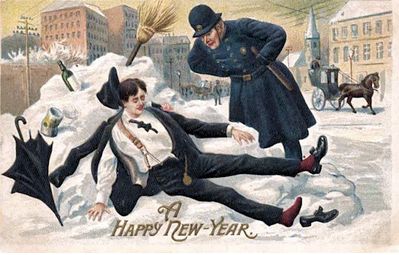
Old New Year Card
Monday 1st January 2024 7.00pm On this Virtual Walk we look at how London has celebrated the New Year over the past 2000 years.
The New Year has been a time of review, renewal and anticipation of the future from time immemorial. The Ancient Britons saw the Solstice as a symbol of a promise of renewal as the Sun was reborn. As the weather turns to bleak mid winter, a festival or reflection and renewal cheers everyone up. This idea of renewal was followed by the Romans, and presided over by a two headed God called Janus who looked both backwards and forwards. Dickens Christmas Carol was based on redemption and his second great Christmas Book ‘The Chimes’ on the renewal that the New Year encouraged.
We look at London’s past to see where and how the New Year was celebrated. We also explore the different New Years we use and their associated Calendars – the Pagan year, the Christian year, the Roman year, the Jewish year, the Financial year, the Academic year and we reveal how these began. We look at folk traditions, Medieval Christmas Festivals, Boy Bishops, Distaff Sunday and Plough Monday, and other Winter Festival and New Year London tradition and folklore.
At the end we use ancient methods to divine what is in store for us in 2024
ROMAN LONDON – A LITERARY & ARCHAEOLOGICAL WALK
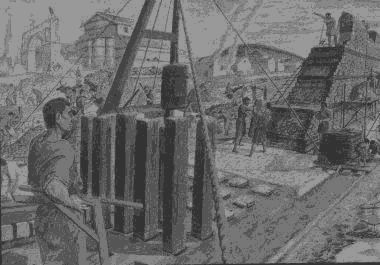
Reconstruction View of Roman Riverside Wall being built
Sunday 21st Jan & 3rd March 2023 11.30 am Monument Underground Station
Our Guides will be Publius Ovidius Naso and Marcus Valerius Martialis who will be helped by Kevin Flude, former Museum of London Archaeologist, Museum Curator and Lecturer.
We disembark at the Roman Waterfront by the Roman Bridge, and then explore the lives of the citizens as we walk up to the site of the Roman Town Hall, and discuss Roman politics. We proceed through the streets of Roman London, with its vivid and cosmopolitan street life via the Temple of Mithras to finish with Bread and Circus at the Roman Amphitheatre.
REVIEWS “Kevin, I just wanted to drop you a quick email to thank you ever so much for your archaeological tours of London! I am so thrilled to have stumbled upon your tours! I look forward to them more than you can imagine! They’re the best 2 hours of my week! 🙂 Best, Sue
Jane Austen’s London Sunday Jan 21st 2.30 pm Green Park underground station,
An exploration of Mayfair, the centre of the London section of Sense & Sensibility and where Jane came to visit her brother
“It is a truth universally acknowledged, that a Jane Austen devotee in possession of the good fortune of a couple of free hours today must be in want of this walk.”
People associate Jane Austen and her characters with a rural setting. But London is central to both Jane Austen’s real life and her literary life. So, this tour will explore Jane’s connections with London and give the background to Sense and Sensibility, a good part of which is based in this very area. We begin with the place Jane’s coach would arrive from Hampshire, and then walk the streets haunted by Willougby; past shops visited by the Palmers, the Ferrars; visit the location of Jane Austen’s brother’s bank and see the publisher of Jane’s Books. The area around Old Bond Street was the home of the Regency elite and many buildings and a surprising number of the shops remain as they were in Jane Austen’s day.
This is a London Walk Guided Walk lead by Kevin Flude
Sat 6pm 25th May 2024 Green Park Tube
Myths, Legends, Archaeology and the Origins of London
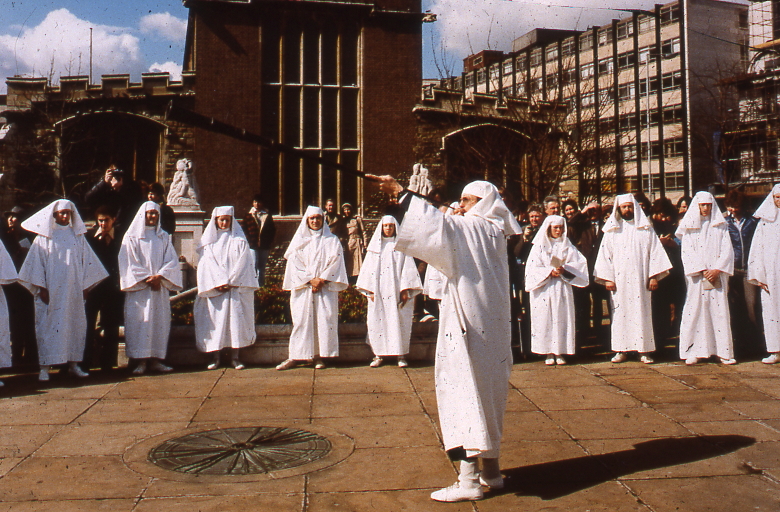
Druids at All Hallows, by the Tower
Sunday 4th February & Saturday 23 March 2024 11.30pm Tower Hill Underground
The walk tells the stories of our changing ideas about the origins of London during the Prehistoric, Roman and Saxon periods.
The walk is led by Kevin Flude, a former archaeologist at the Museum of London, who has an interest both in myths, legends and London’s Archaeology.
The walk will tell the story of the legendary origins of London which record that it was founded in the Bronze Age by an exiled Trojan and was called New Troy, which became corrupted to Trinovantum. This name was recorded in the words of Julius Caesar; and, then, according to Legend, the town was renamed after King Ludd and called Lud’s Dun. Antiquarians and Archaeologists have taken centuries to demolish this idea, and became convinced London was founded by the Romans. Recently, dramatic evidence of a Bronze Age presence in London was found.
When the Roman system broke down in 410 AD, historical records were almost non-existent, until the Venerable Bede recorded the building of St Pauls Cathedral in 604 AD. The two hundred year gap, has another rich selection of legends. which the paucity of archaeological remains struggles to debunk.
The walk will explore these stories and compare the myths and legends with Archaeological discoveries.
The route starts at Tower Hill, then down to the River at Billingsgate, London Bridge, and into the centre of Roman London
Tudor London – The City of Wolf Hall
Sunday 4th February 2024 2.15pm Barbican Underground Station
Tudor London – The City of Wolf Hall Virtual Tour Sunday 4th February 2024 7.30 pm To book
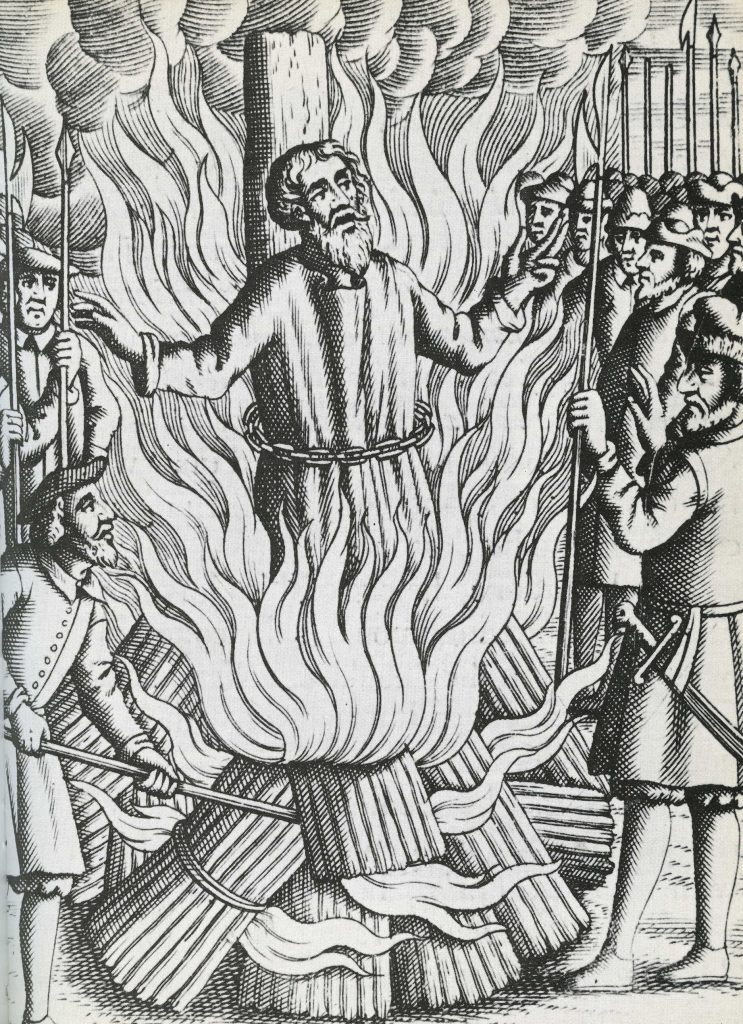
Thomas Bilney martyred in Smithfield.
The Walk creates a portrait of London in the early 16th Century, with particular emphasis on the life and times of Thomas Cromwell and Thomas More during the Anne Boleyn years.
More and Cromwell had much in common, both lawyers, commoners, who rose to be Lord Chancellor to Henry VIII, and ended their careers on the block at Tower Hill.
The walk starts with an exploration of Smithfield – site of the stake where heretics were burnt alive and of St Bartholomew’s Monastery – given to Richard Rich after his decisive role in the downfall of Thomas More. We continue to St Paul where Martin Luther’s books were burnt, and later, where Puritans preached against dancing round the Maypole.
We walk along the main markets streets of London, to Thomas More’s birthplace, and to the site of More’s and Cromwell’s townhouses before, if time allows, finishing at the site of the Scaffold where More and Cromwell met their ends, overlooking where Anne Boleyn was incarcerated in the Tower of London
The Leap Year Pub Walk Thurs 6pm 29 February 2024 Tower Hill Underground
Sketched from a photo by simple-aign on pixaby
Thurs, 29 February 2024, 6pm Tower Hill Underground
We explore London, the Leap Year and 29th February through history A strange amazing day – and walk – that comes only once every four years. For the rest of the time it does not “exist.” A day – and walk – of temporal tune-up. A day – and walk – of unlocked potential. A day – and a walk – of unlocked London.
As the Sun, Moon and Seasons have different cycles and don’t fit into a set number of days, Londoners have had to cope with fixes to their Calendars to align the Cosmos with everyday life. As we walk through the streets of the ancient City of London, we explore how Londoners organised and celebrated their year throughout history
One of the most popular forms of publication in London was the Almanac. It was full of seasonal advice, of prophecy, traditional wisdom, and important events past and future. We will look at Almanacs and Diaries to find how Londoners spent their Leap Year.
We start with the Romans at the City Wall, near the Tower of London, and walk through history until we reach a historic pub to celebrate the New Year.
The Leap Year Almanac of the Past Pub Walk is led by Kevin Flude, a lecturer, curator and former archaeologist at the Museum of London. Join him to explore London’s History through its celebrations, festivals, calendars and almanacs.
This is a London Walks Guided Walk.
Roman London – A Literary & Archaeological Walk Sun 11.30 am 3rd March 2024 Monument Underground Station To book Jane Austen’s London Sun 2.30 pm 3rd March 2024 Green Park Underground station (Green Park Exit. Fountain in Green Park), To book Myths, Legends, Archaeology and the Origins of London Sunday 11.30am 23rd March 2024 Tower Hill Underground
London. 1066 and All That Walk
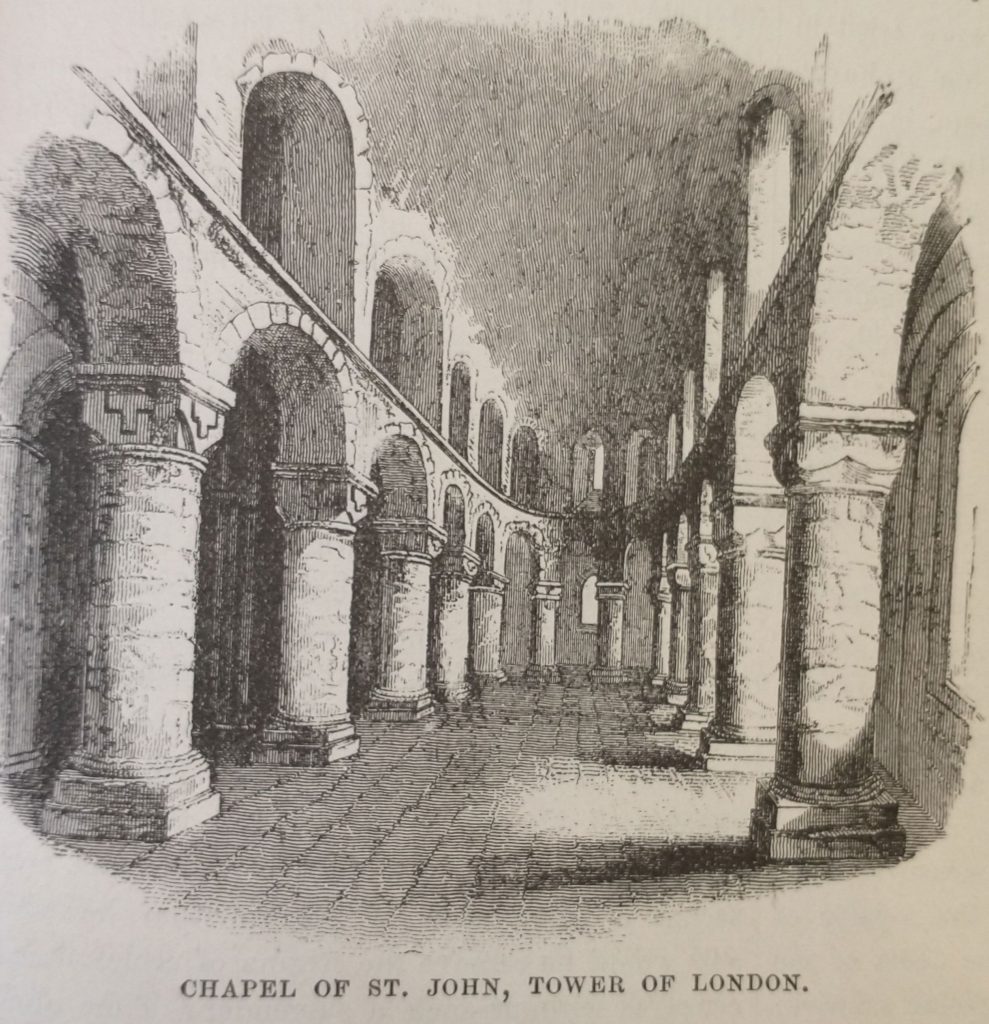
Old illustration Chapel of St Johns Tower of London
Sunday 2.30pm 23rd March 2024 Blackfriars Underground Station The Archaeological Walk that explores the City of London at the end of the Saxon period and at the beginning of the Norman.
The Norman Conquest of 1066 defines Britain in a way unmatched by any other event. And on this walk we explore the London that William conquered and how he changed England for all time.
London was England’s most important City, but not yet the capital. It was crucial to William in his attempt to conquer the realm. But his army could not fight their way across the heavily defended London Bridge after the defeat of the English King, Harold, at the Battle of Hastings.
The future of England was in the balance as he ravaged the country seeking a way across the river and to persuade the English that resistance was hopeless.
Once across the river, the English leaders sued for peace, and William was crowned at the newly built Westminster Abbey. The English hoped for a strong King who would rule with the people. But William began by building Castles to oppress the Citizens, and soon swept aside the English Aristocracy and establishment and replaced them with the Conquerors.
This was a death blow to Anglo-Saxon culture, but the City made an accommodation with the new regime and the first Lord Mayor of London was an Englishman.
So, on the walk we explore the Late Saxon City of London, and how it changed in the last 11th and 12th Centuries.
Walk is by Kevin Flude, former Archaeologist at the Museum of London Kevin
Chaucer’s Medieval London Guided Walk
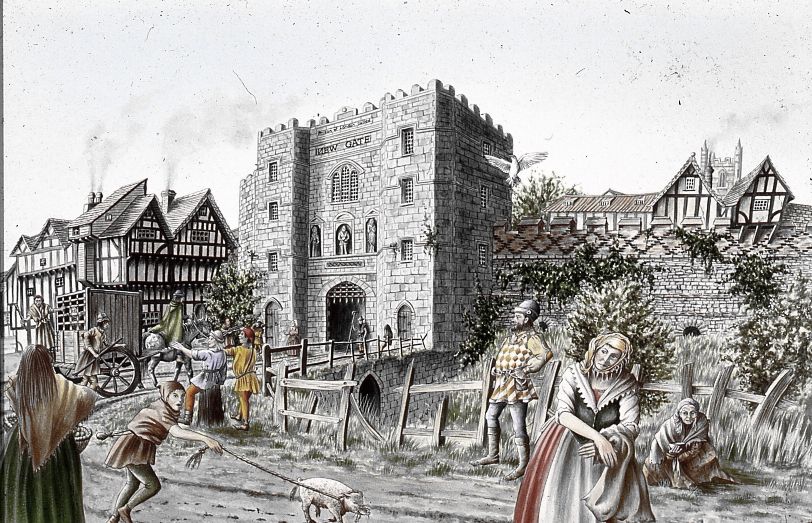
Medieval Newgate
Sunday 7th April 2024 11.30pm & Saturday 6th July 2.30 Aldgate Underground
A Walk around Medieval London following in the footsteps of its resident medieval poet – Geoffrey Chaucer One of the spectators at the Peasants Revolt was Geoffrey Chaucer, born in the Vintry area of London, who rose to be a diplomat, a Courtier and London’s Customs Officer. He lived with his wife in the Chamber above the Gate in the City Wall at Aldgate. His poetry shows a rugged, joyous medieval England including many scenes reflecting life in London. His stories document the ending of the feudal system, growing dissatisfaction with the corruption in the Church, and shows the robust independence with which the English led their lives.
His work helped change the fashion from poetry in French or Latin to acceptance of the English language as suitable literary language. This was helped by the growth of literacy in London as its Merchants and Guildsmen became increasingly successful. In 1422, for example, the Brewers decided to keep their records in English ‘as there are many of our craft who have the knowledge of reading and writing in the English idiom.’
Chaucer and other poets such as Langland give a vivid portrait of Medieval London which was dynamic, successful but also torn by crisis such as the Lollard challenge to Catholic hegemony, and the Peasants who revolted against oppression as the ruling classes struggled to resist the increased independence of the working people following the Black Death.
A walk which explores London in the Middle Ages, We begin at Aldgate, and follow Chaucer from his home to his place of work at the Customs House, and then to St Thomas Chapel on London Bridge, and across the River to where the Canterbury Tales start – at the Tabard Inn.
This is a London Walks event by Kevin Flude
The Decline And Fall Of Roman London Walk
London in the 5th Century Reconstruction painting.
Sat 1.30pm 25th May 2024Exit 2 St Pauls Underground Station
An exploration of what happened at the end of the Roman Period, and how the City became deserted, and then, reborn as an English City
The first British Brexit? The Roman Britons kicked out the Romans in 407AD, and, soon, asked them to come back after a catastrophic collapse. Faced with plague, civil war, invasion, mass immigration, industrial decline, reversion to barter; the authorities struggled against anarchy and descent into a dark age.
But was that how it was? Wasn’t it a rather a transition into the Late Antique period in which life for most people went on much as before except paying taxes to local rulers rather than distant Romans?
The walk investigates why the Roman system in London broke down, and what really was the impact of the end of the Roman system in London? What is the evidence? and can we trust it? Or can we really do nothing much more than guess?
We tramp the streets of London in search of light to shine on the dark age of London.
This is a London Walks event by Kevin Flude, ex Museum of London Archaeology and Museum Curator.
Jane Austen’s London Walk
Saturday 25th May 6pm 2024 Green Park underground station (Green Park exit, by the fountain)
An exploration of Mayfair, the centre of the London section of Sense & Sensibility and where Jane came to visit her brother
“It is a truth universally acknowledged, that a Jane Austen devotee in possession of the good fortune of a couple of free hours today must be in want of this walk.”
People associate Jane Austen and her characters with a rural setting. But London is central to both Jane Austen’s real life and her literary life. So, this tour will explore Jane’s connections with London and give the background to Sense and Sensibility, a good part of which is based in this very area. We begin with the place Jane’s coach would arrive from Hampshire, and then walk the streets haunted by Willougby; past shops visited by the Palmers, the Ferrars; visit the location of Jane Austen’s brother’s bank and see the publisher of Jane’s Books. The area around Old Bond Street was the home of the Regency elite and many buildings and a surprising number of the shops remain as they were in Jane Austen’s day.
This is a London Walk Guided Walk lead by Kevin Flude
The Peasants Revolt Anniversary Guided Walk
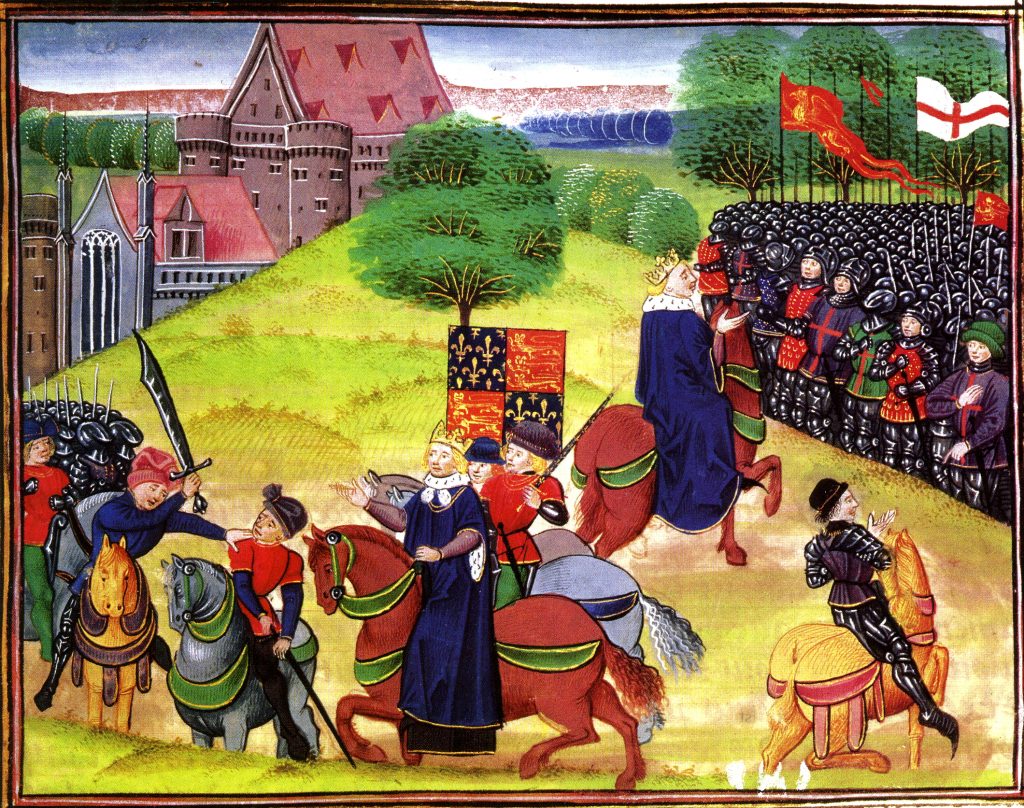
Medieval Manuscript of Peasants Revolt at Smithfield
Aldgate Underground Thursday 6.30 13th June 2024
An Anniversary Walk tracking the progress of the Peasants as they take control of London in June of 1381
The Summer of Blood
The Peasants’ Revolt. The greatest popular rising in English history. This is the anniversary walk. The London Walk that heads back to 1381, back to the Peasants’ Revolt. You want a metaphor, think stations of the cross. This is the stations of the Peasants’ Revolt walk. We go over the ground, literally and metaphorically. Where it took place. Why it took place. Why it took place at these places. What happened. The walk is guided by the distinguished Museum of London Archaeologist His expertise means you’ll see the invisible. And understand the inscrutable.
On the anniversary of the Peasants Revolt we reconstruct the events that shook the medieval world. In June 1381, following the introduction of the iniquitous Poll Tax, England’s government nearly fell, shaken to the core by a revolt led by working men. This dramatic tour follows the events of the Revolt as the Peasants move through London in June 1381.
We met up with the Peasants at Aldgate, force our way into the City. We march on the Tower of London as the King makes concessions by ending serfdom, at Mile End. But the leaders take the mighty Tower of London and behead the leaders of Richard’s government. Attacks follow on the lawyers in the Temple, the Prior at St. John’s of Jerusalem, Flemish Londoners, and on Lambeth and Savoy Palaces.
The climax of the Revolt comes at Smithfield where a small Royal party confront the 30,000 peasants.
Chaucer’s Medieval London Guided Walk
Medieval Newgate
Sat 2.30 6th July 2024 Aldgate Underground
A Walk around Medieval London following in the footsteps of its resident medieval poet – Geoffrey Chaucer
One of the spectators at the Peasants Revolt was Geoffrey Chaucer, born in the Vintry area of London, who rose to be a diplomat, a Courtier and London’s Customs Officer. He lived with his wife in the Chamber above the Gate in the City Wall at Aldgate. His poetry shows a rugged, joyous medieval England including many scenes reflecting life in London. His stories document the ending of the feudal system, growing dissatisfaction with the corruption in the Church, and shows the robust independence with which the English led their lives.
His work helped change the fashion from poetry in French or Latin to acceptance of the English language as suitable literary language. This was helped by the growth of literacy in London as its Merchants and Guildsmen became increasingly successful. In 1422, for example, the Brewers decided to keep their records in English ‘as there are many of our craft who have the knowledge of reading and writing in the English idiom.’
Chaucer and other poets such as Langland give a vivid portrait of Medieval London which was dynamic, successful but also torn by crisis such as the Lollard challenge to Catholic hegemony, and the Peasants who revolted against oppression as the ruling classes struggled to resist the increased independence of the working people following the Black Death.
A walk which explores London in the Middle Ages, We begin at Aldgate, and follow Chaucer from his home to his place of work at the Customs House, and then to St Thomas Chapel on London Bridge, and across the River to where the Canterbury Tales start – at the Tabard Inn.
This is a London Walks event by Kevin Flude
Myths, Legends, Archaeology and the Origins of London
King Bran’s head buried at Tower Hill
Sat 6pm 6th July 2024 Tower Hill Underground
The walk tells the stories of our changing ideas about the origins of London during the Prehistoric, Roman and Saxon periods.
The walk is led by Kevin Flude, a former archaeologist at the Museum of London, who has an interest both in myths, legends and London’s Archaeology.
The walk will tell the story of the legendary origins of London which record that it was founded in the Bronze Age by an exiled Trojan and was called New Troy, which became corrupted to Trinovantum. This name was recorded in the words of Julius Caesar; and, then, according to Legend, the town was renamed after King Ludd and called Lud’s Dun. Antiquarians and Archaeologists have taken centuries to demolish this idea, and became convinced London was founded by the Romans. Recently, dramatic evidence of a Bronze Age presence in London was found.
When the Roman system broke down in 410 AD, historical records were almost non-existent, until the Venerable Bede recorded the building of St Pauls Cathedral in 604 AD. The two hundred year gap, has another rich selection of legends. which the paucity of archaeological remains struggles to debunk.
The walk will explore these stories and compare the myths and legends with Archaeological discoveries.
The route starts at Tower Hill, then down to the River at Billingsgate, London Bridge, and into the centre of Roman London.
Roman London – A Literary & Archaeological Walk
Reconstruction View of Roman Riverside Wall being built
Sat 11.30 am 21st August 2024 Monument Underground Station To book
This is a walking tour that features the amazing archaeological discoveries of Roman London, and looks at life in the provincial Roman capital of Londinium.
Our Guides will be Publius Ovidius Naso and Marcus Valerius Martialis who will be helped by Kevin Flude, former Museum of London Archaeologist, Museum Curator and Lecturer.
We disembark at the Roman Waterfront by the Roman Bridge, and then explore the lives of the citizens as we walk up to the site of the Roman Town Hall, and discuss Roman politics. We proceed through the streets of Roman London, with its vivid and cosmopolitan street life via the Temple of Mithras to finish with Bread and Circus at the Roman Amphitheatre.
Zinger Read: Talk about a high-quality one-two punch. This walk investigates the groundbreaking archaeological discoveries of Roman London. And then it reconstructs life in a provincial Roman capital using archaeological and literary sources. Discoveries – insights – like flashes of lightning in a cloud. We begin at the site of the Roman bridge. We might be decent young Roman citizens in togas, having this and that bit of explained to us as we make our way towards the Roman Town Hall. From there we head to the site of the excavation called ‘the Pompeii of the North.’ Followed by the Temple of Mithras. We finish with a walk along the Roman High Street in order to end at the site of the Roman Amphitheatre. So, yes, welcome to London as it was 2,000, 1,900, 1,800, 1,700 and 1,600 years ago. And, yes, the walk’s guided by a real expert, the distinguished emeritus Museum of London archaeologist Kevin Flude. That means you’ll see things other people don’t get to see, delve into London via fissures that aren’t visible, let alone accessible, to non-specialists.
REVIEWS “Kevin, I just wanted to drop you a quick email to thank you ever so much for your archaeological tours of London! I am so thrilled to have stumbled upon your tours! I look forward to them more than you can imagine! They’re the best 2 hours of my week! 🙂 Best, Sue
The Walk creates a portrait of London in the early 16th Century, with particular emphasis on the life and times of Thomas Cromwell and Thomas More during the Anne Boleyn years
More and Cromwell had much in common, both lawyers, commoners, who rose to be Lord Chancellor to Henry VIII, and ended their careers on the block at Tower Hill.
The walk starts with an exploration of Smithfield – site of the stake where heretics were burnt alive and of St Bartholomew’s Monastery – given to Richard Rich after his decisive role in the downfall of Thomas More. We continue to St Paul where Martin Luther’s books were burnt, and later, where Puritans preached against dancing round the Maypole.
We walk along the main markets streets of London, to Thomas More’s birthplace, and to the site of More’s and Cromwell’s townhouses before, if time allows, finishing at the site of the Scaffold where More and Cromwell met their ends, overlooking where Anne Boleyn was incarcerated in the Tower of London
Sunday 6pm 8th September 2024 Green Park underground station (Green Park exit, by the fountain) To Book:
An exploration of Mayfair, the centre of the London section of Sense & Sensibility and where Jane came to visit her brother
“It is a truth universally acknowledged, that a Jane Austen devotee in possession of the good fortune of a couple of free hours today must be in want of this walk.”
People associate Jane Austen and her characters with a rural setting. But London is central to both Jane Austen’s real life and her literary life. So, this tour will explore Jane’s connections with London and give the background to Sense and Sensibility, a good part of which is based in this very area. We begin with the place Jane’s coach would arrive from Hampshire, and then walk the streets haunted by Willougby; past shops visited by the Palmers, the Ferrars; visit the location of Jane Austen’s brother’s bank and see the publisher of Jane’s Books. The area around Old Bond Street was the home of the Regency elite and many buildings and a surprising number of the shops remain as they were in Jane Austen’s day.
This is a London Walk Guided Walk lead by Kevin Flude
Chaucer’s Medieval London Walk Sat 11.30 5th October 24 Aldgate Underground
London Before And After The Roman Invasion 3pm Saturday 5th October 2024 Tower Hill Underground
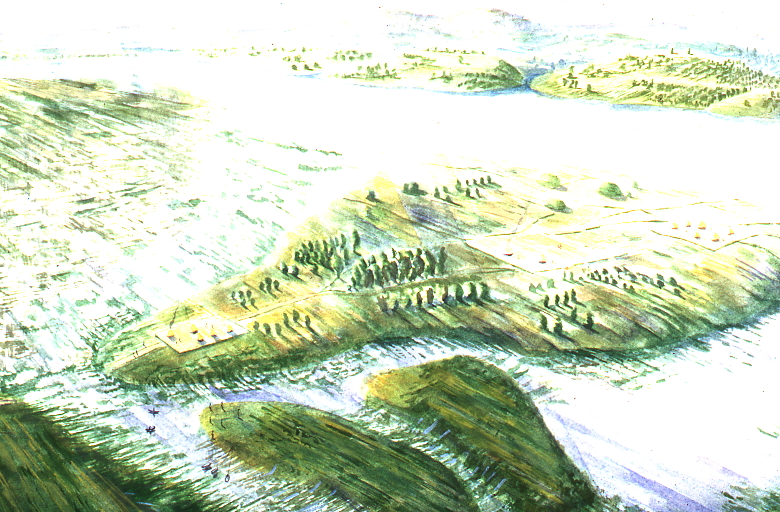
View of London from the SE as it might have looked before the Roman Invasion
Tower Hill Underground 3pm Saturday 5th October 2024
The walk looks into the evidence for a prehistoric London and tells the story of the coming of the Romans in AD43
The walk is led by Kevin Flude, a former archaeologist at the Museum of London.
The walk investigates the City of London before and after the the Roman Conquest. What is the evidence for settlement before the Romans set up town of Londinium? Why did the Romans establish the town on this spot? Who were the early Roman Londoners and what made their choice of site so successful?
The fledgling Town was then burnt down by Queen Boudiccan and her Icenian rebels. We look at the evidence for the Revolt and London’s recovery to became the capital of Britain.
This is a London Walks Guided Walk. Look at their web site for a list of other of their amazing walks.
REVIEWS (from London Walks website) “Kevin, I just wanted to drop you a quick email to thank you ever so much for your archaeological tours of London! I am so thrilled to have stumbled upon your tours! I look forward to them more than you can imagine! They’re the best 2 hours of my week! 🙂 Best, Sue
Myths, Legends & Halloween Virtual Walk Thu 8.00pm 31st October 2024
The walk tells the story of London’s myths and legends and the Celtic origins of Halloween. The virtual walk is led by Kevin Flude, a former archaeologist at the Museum of London, who has an interest both in the archaeological evidence as well as the myths and legends of London’s origin.
The virtual walk will tell the story of a selection of London’s Myths and Legends, beginning with the tale of London’s legendary origins in the Bronze Age by an exiled Trojan called Brutus. Stories of Bladud, Bellinus, Bran and Arthur will be interspersed with how they fit in with archaeological discoveries.
As we explore the City we also look at the origins of Halloween celebrations and how they may have been celebrated in early London.
The virtual route starts at Tower Hill, then down to the River Thames at Billingsgate, to London Bridge and Southwark Cathedral, to the Roman Forum at the top of Cornhill, into the valley of the River Walbrook, passed the Temple of Mithras, along Cheapside to the Roman Amphitheatre, and finishing up in the shadow of St Pauls.
This is a London Walks Guided Walk. Look at their web site for a list of other of their amazing walks.
REVIEWS (from London Walks website) “Kevin, I just wanted to drop you a quick email to thank you ever so much for your archaeological tours of London! I am so thrilled to have stumbled upon your tours! I have wanted to be an archaeologist since 1978 at the ripe old age of 8 years,… I was told for years that I could not be an archaeologist [for any number of reasons, which I now realise are completely ridiculous!], so I ended up on a different course of study. And now at the age of 50, it is my one great regret in life. So, I am thoroughly enjoying living vicariously through you, the digs you’ve been on, and the history you bring to life for us! British archaeology would have been my specific area of study had I pursued it. ?? Thank you SO MUCH for these! I look forward to them more than you can imagine, and honestly, I’ll be sad if you get them down to 1.5 hours! They’re the best 2 hours of my week! 🙂 Best, Sue
Roman London – Literary & Archaeology Walk Sat 11.30 am,9th November 2024
London: 1066 and All That Walk Sat 2.30pm 9th Nov 24
Old illustration Chapel of St Johns Tower of London
Sat 2.30pm 9th November 2024 Blackfriars Underground Station The Archaeological Walk that explores the City of London at the end of the Saxon period and at the beginning of the Norman.
The Norman Conquest of 1066 defines Britain in a way unmatched by any other event. And on this walk we explore the London that William conquered and how he changed England for all time.
London was England’s most important City, but not yet the capital. It was crucial to William in his attempt to conquer the realm. But his army could not fight their way across the heavily defended London Bridge after the defeat of the English King, Harold, at the Battle of Hastings.
The future of England was in the balance as he ravaged the country seeking a way across the river and to persuade the English that resistance was hopeless.
Once across the river, the English leaders sued for peace, and William was crowned at the newly built Westminster Abbey. The English hoped for a strong King who would rule with the people. But William began by building Castles to oppress the Citizens, and soon swept aside the English Aristocracy and establishment and replaced them with the Conquerors.
This was a death blow to Anglo-Saxon culture, but the City made an accommodation with the new regime and the first Lord Mayor of London was an Englishman.
So, on the walk we explore the Late Saxon City of London, and how it changed in the last 11th and 12th Centuries.
Walk is by Kevin Flude, former Archaeologist at the Museum of London Kevin
London Before London – Prehistoric London Virtual Walk
Sat 7.30pm 9th November 2024
View of London from the SE as it might have looked before the Roman Invasion
An exploration of London before the foundation of Londinium
It was long thought that London was founded by a Trojan Exile in the Late Bronze Age. But historical analysis and archaeological excavation gradually demoted the idea to a myth.
On this tour we explore what was in the London area before the Romans. We begin at Heathrow and tour Greater London for evidence from the Paleolithic to the invasion of the Emperor Claudius.
We concentrate on the period since the introduction of farming, and bring together evidence for the prehistoric Kingdoms that controlled the area on the eve of the Invasion. We look for henges, barrows, hill forts, hut circles and look at genetic evidence for identity of prehistoric Londoners. The tour will end in the City.
This is a London Walks event by Kevin Flude, ex Museum of London Archaeology and Museum Curator
The Decline And Fall Of Roman London Walk Sat 11.30am 23rd November 24 Jane Austen’s London Sat 3.00 pm 23rd November
Christmas With Jane Austen Virtual London Tour Mon 9 Dec 24 7.30pm
We look at how Jane Austen spent Christmas and at Georgian Christmas traditions and amusements.
“It is a truth universally acknowledged, that a Jane Austen devotee in possession of the good fortune of a couple of free hours must be in want of this virtual walk.”
This is a special walk, which looks at the traditions of Christmas during the Regency period and how Jane Austen might have celebrated it. It will give some background to Jane Austen’s life and her knowledge of London. We used her novels and her letters to find out what she might have done at Christmas, but also at how Christmas was kept in this period, and the range of ‘Curiosities, Amusements, Exhibitions, Public Establishments, and Remarkable Objects in and near London available to enjoy.
This is a London Walks Guided Walk by Kevin Flude, Museum Curator and Lecturer.
Reviews: ‘Thanks, again, Kevin. These talks are magnificent!’ “1 am glad to see there are a few more virtual presentations scheduled, they are wonderful!
Dickens London. Life, Work and Christmas Virtual Tour Mon 16 Dec 24 7.30pm
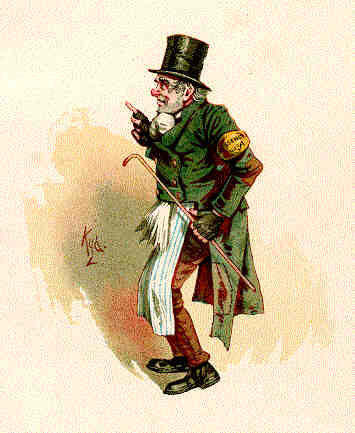
Trotty Veck 1889 Dickens The Chimes by Kyd (Joseph Clayton Clarke)
A Virtual Tour of Dickens London with a dash of Dickensian Christmas
The Virtual Tour weaves an exploration of Victorian London with Dickens London Life and writing. On the tour we have a look at London at Christmas and the contribution Dickens made to it by his Christmas Books
Dickens writing always has a moral element as exemplified by his Christmas Books. ‘Christmas Carol’ was based on redemption and his second great Christmas Book ‘The Chimes’ on the renewal that the New Year encouraged.
We start in Southwark, visit sites associated with the Christmas Books and others and end at Staple Inn with the Christmas Book ‘The Haunted Man’.
The London Winter Solstice Virtual Tour Sat 7:30pm 21 Dec 24
We explore London’s History through its celebrations, festivals, calendars, and almanacs of the Winter Solstice
Winter Solstice festivals have been a time of review, renewal and anticipation of the future from time immemorial. The Ancient Britons saw the Solstice as a symbol of a promise of renewal as the world entered bleak mid winter. The Roman season was presided over by Janus, a two headed God who looked both backwards and forwards, and Dickens based his second great Christmas Book on the renewal that the New Year encouraged.
We look at London’s past to see where and how the Solstice might be celebrated. We also explore the different Calendars – the Pagan year, the Christian year, the Roman year, the Jewish year, the Financial year, the Academic year and we reveal how these began. We look at folk traditions, Medieval Christmas Festivals, Boy Bishops, Distaff Sunday and Plough Monday, and other London winter traditions and folklore.
At the end we use ancient methods to divine what is in store for us in 2023.
Below, I give links to the Late November and early December Posts I have revised and republished. But, first, I would like to tell you about a great lecture I heard at the British Museum, this evening. It was given by Dr Emma Southon on her book about women in the Roman Empire. Her viewpoint was that a study of women in the Roman Empire gives a radically different insight into the Roman world than the traditional. One full of humanity rather than normal evidence which is, generally, about wars, and Empires and bravery and horrific cruelty and ambition and honour. She started with the story of Turia, whose extraordinary epitaph on her tombstone miraculous survived and gave her husband’s view of his extraordinary wife, and his utter sorrow at his loss on her death. Below, is a review of the book and a link to a podcast with the Author.
So, here are the December posts. December 1st and 2nd give an overview of December and the meaning of Winter. December 3rd is about Advent and the fact that you were not allowed to marry during Advent. December 4 gives a Shakespearean view of a cold winter’s day, and a composition by Vaughan Williams.
And late November posts, November 28th tells some interesting tales, both ancient and modern, about Eels, Pies, Rock ‘n’ Roll and my horror of Jellied Eels. November 29th, tells you how to make a ‘dish of snow’ and introduces Ice Houses. November 30th is about Scotland and St Andrews. Like them if you like them! And share them if you want to share them.
In Lia Leendertz’ lovely ‘The Almanac – A Seasonal Guide to 2022’ she lists the following as in season for foraging:
Crab Apples and sweet chestnuts Roots: Dandelion, horseradish, Jerusalem Artichokes, and wild garlic Wild Greens: chickweed, dandelion, and wintercress Game: Hare, rabbit, pheasant, and venison
Sweet Chestnuts were introduced by the Romans and have long been a feature of Christmas. They can be ‘baked, roasted, boiled or microwaved’. You need to prepare them by scoring a cross in them; otherwise they will explode when cooked. They are often sold by street vendors (there is often a seller on the Millennium Bridge on the way to Tate Modern in London) and, in my family, are always a part of the stuffing for the Turkey. They can also be candied, puréed or stored in syrup. (The Woodland Trust Foraging in November and December).
John Evelyn, the 17th Century Diarist and author of a book on trees (Sylva, or A Discourse of Forest-Trees and the Propagation of Timber) wrote that the nuts were:
‘delicacies for princes and a lusty and masculine food for rusticks, and able to make women well-complexioned’
He complained that in England they are chiefly given to pigs to eat.
Chestnut meal was also used for whitening linen and for making starch. Marones, imported from Italy, France, Switzerland, and S. Germany contain 15% sugar and so were used to make a thick syrup and a ‘very usable’ sugar, from which Marons Glacés are made.
The wood of the chestnut is very useful and is/was used for building, pit props, furniture, poles for hops etc. but is nowhere near as long-lasting as oak.
Medically, they were used for treating convulsive coughs such as whooping-cough, where the leaves were infused in a pint of boiling water. (A Modern Herbal by Mrs M Grieve)
First Published on 3rd December 2022, Revised and republished in December 2023