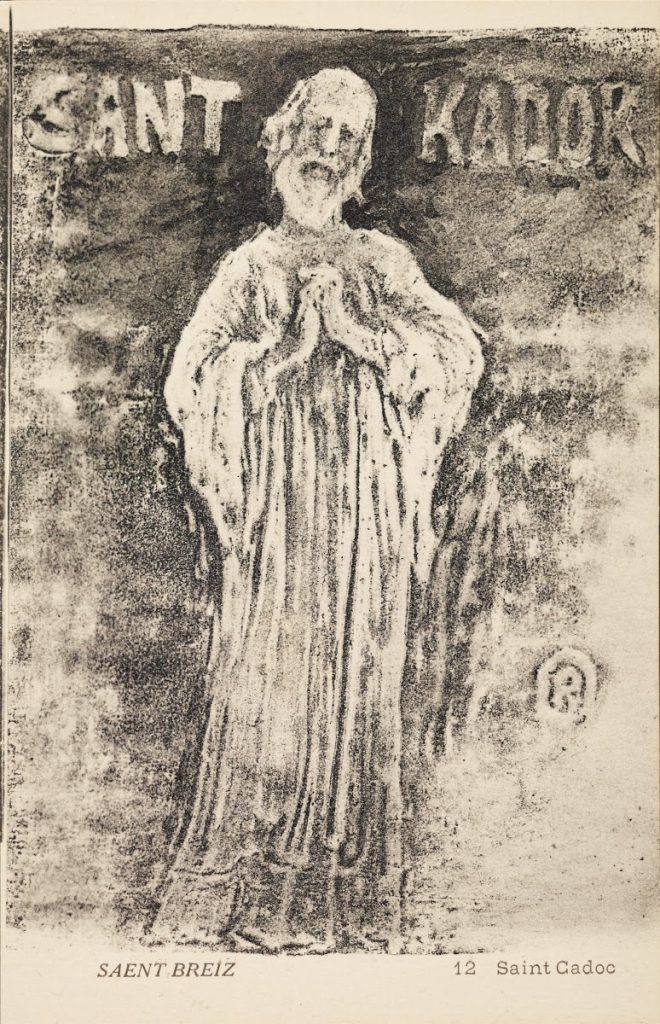
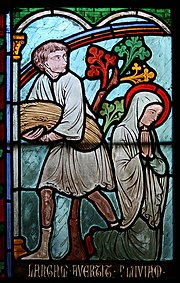
St Cadoc was born in 497 AD, a Saint, and Martyr, who founded a monastery at Llancarfan, near Cowbridge, Glamorgan, Wales. He also has associations with Scotland, Brittany, and England. His story is not written down until the 11th Century. But it is fascinating and, in its own way, a charming story. The gentle son of a savage, robber King, he was educated in Latin under an Irish priest, and refused his father’s orders to fight. But he lived to convert his parents . He is known as Cattwg Ddoeth, “the Wise”, although his sayings are mired in the forgeries of Iolo Morganwg. (aka Edward Williams, collector of Medieval Welsh literature and forger.)
Cadoc comes into conflict with King Arthur. In Welsh literature, King Arthur is a brave but wilful King. He demanded Cadoc give him compensation after the Saint sheltered a man who had killed three of Arthur’s men. The compensation was delivered as a herd of cows, but as soon as Arthur took charge of them they turned into ferns.
Cadoc and the Saxons
Cadoc was forced out of Britain by the pagan Anglo-Saxons, but eventually, he felt he had to return despite the grave danger he would face. He wanted to obey his own maxim:
Would you find glory? Then march to the grave.
He therefore moved to the Saxon settlements to give spiritual succour to the native British Christians, survivors of Saxon massacres. His martyrdom took place at Weedon in Northamptonshire. Here his Service was interrupted by Saxon horsemen, and Cadoc was slain as he served the Eucharist. He lived, probably, in the later 5th Century/Early 6th Century.
The Catholic Church celebrates him in September, elsewhere on the 24th January.
For more, look at https://celticsaints.org or Wikipedia.
On This Day
41 – Claudius found hiding behind a curtain and proclaimed Emperor after Caligula assassinated
1536 -Henry VIII falls off his horse while jousting, sustains brain injuries that some say explain his worsening behaviour? Or what is just that he was a narcissistic, privileged individual with too much power?
1972 – Japanese Sgt. Shoichi Yokoi discovered in a Guam jungle, where he had been hiding since the end of World War II.
1984 – Macintosh personal computer put on sale by Apple in the United States.
First published in January 2023, republished in January 2024, 2026
Many plants can be used for hedges, but hawthorn is the most common. It can be planted as bare-root from Autumn to Spring, so January is as good a time as any. It can also be grown from the seeds from its red berries. But this takes 18 months to achieve. Interspersed along the hedge line are often other trees—either trees for timber, or fruit trees perhaps crab-apples or pear-stocks. Trees were also useful as markers. Before modern surveys, property would be delineated by ancient trees. Hedges could be removed. Trees were more difficult to eradicate.
Hawthorn hedges are an oasis for insects, mammals and migrating birds (who eat the berries). It is a lovely plant for May. In fact, it is also called May, or the May Flower or May Tree and also whitethorn. The berries are called ‘haws’ hence hawthorn. For more on this, look at https://whisperingearth.co.uk.
Hawthorns & Folklore
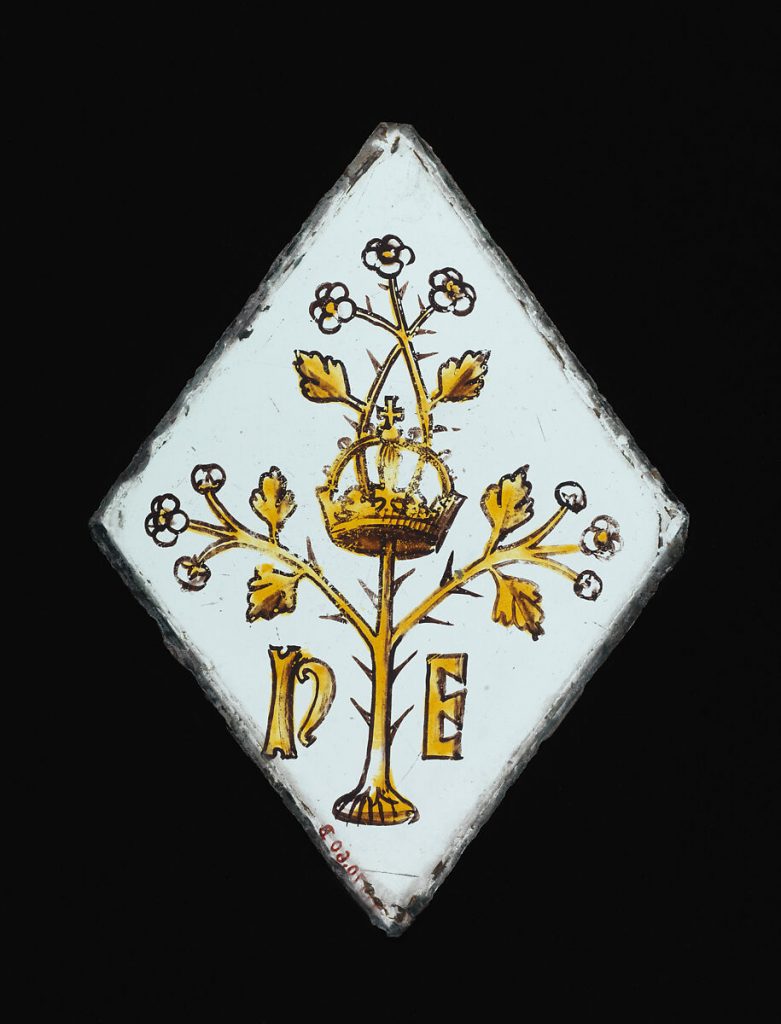
A ‘Quarry’ of Stained Glass showing the Crown, a hawthorn Bush and initials representing Henry VII and his, Queen, Elizabeth of York. Possibly from Surrey. Early 16th Century and from the Metropolitan Museum of Art (Public Domain).
Hawthorn produces white flowers in Spring. So, it is one of the great pagan fertility plants, its flowers forming the garlands on May Eve. One of the chemicals in the plant is the same as one given out in decay of flesh. It is, therefore, associated with death in folklore, and not to be brought into the house.
It was also said to be the thorn in the Crown of Thorns, so sacred. A crown from the helmet of the dead King Richard III was found on a hawthorn bush at the Battle of Bosworth Field. The victorious Henry VII adopted it for a symbol. . For more on the plant, https://www.woodlandtrust.org.uk
The virtues of Hawthorn
John Worlidge, wrote in 1697
‘And first, the White-thorn is esteemed the best for fencing; it is raised either of Seeds or Plants; by Plants is the speediest way, but by Seeds where the place will admit of delay, is less charge, and as successful, though it require longer time, they being till the Spring come twelvemonth ere they spring out of the Earth; but when they have past two or three years, they flourish to admiration.’
Hawthorn is an excellent wood for burning, better than oak. It has the hottest fire so that its charcoal could melt pig-iron without the need of a blast. It is also good for making small objects such as boxes, combs, and tool-handles. The wood takes a fine polish, so also used for veneers and cabinets. For advice on the best wood to burn read my post here.
Hawthorn has many medicinal benefits according to herbalists. Mrs Grieve’s Herbal suggests it was used as a cardiac tonic, to cure sore throats and as a diuretic. (But don’t try any of these ancient remedies without medical advice!)
What to plant in late January
This is the time, according to Moon Gardeners, to plant and sow plants that develop below ground. So rhubarb and garlic, fruit trees, bushes, bare-root plants and hedging plants.
On This Day
1571 – The Royal Exchange opens in London. London first Business centre since the Roman Forum, creating the first Bourse in the UK
1785 – ‘Boys play on the Plestor at marbles & peg-top. Thrushes sing in the Coppices. Thrushes & blackbirds are much reduced.’ From the Garden Calendar in Gilbert White’s Year. the Plestor is the village green; peg-top is a spinning top game. For more on Gilbert White,the inspirer of Darwin, see my post.
This has become the day in which I update readers on the purpose and future plans for the Almanac of the Past.
What is the Almanac of the Past?
The nature of an almanac is to be a pot-pourri. They are about seasons, time, folklore, history, important events, and anniversaries. I also like to cover history, famous people and discoveries. Gods, Goddesses, Saints, sinners, and archaeology. What I want it to be is something that makes us more mindful about the passing of the year. How seasons and time change the way people see their world. My focus is mostly on the UK, but also on Rome and Greece. With occasional excursions to other ages, places and universes. I am also trying to find more content that is London-based.
What is the plan for the Almanac of the Past?
I plan to have one entry for each day. The problem with this, is that as I fill in the empty days, I will be republishing the already filled days. So subscribers will be seeing content they have seen before. Currently, I am trying to improve and extend existing content so it is worth reading again. And I am groping towards a final format for each day.
This is what I think it is. Each page will have the following sections:
Seasonal content: folklore about the day in question. Including historic texts about gardening, farming, cooking, witchcraft superstitions etc.
Saint or God/Goddess of the day
Calendar content: about epochs, ages, years, months, days, hours, and everything calendrical
Major article about something that happened on this day in history
On This Day section where other things that have happened on this day have happened.
I guess rather than a post it will be more like a newsletter of the day?
The almanac of the Past Publication
If I get the formula right, I will attempt to get a publication from it. Otherwise, it will remain online. So:
How’s it doin’?
The first graph, above, shows a steady growth from 2,000 views in 2020 to 26,000 views for 2025. Although encouraging, it has not gone ‘Kardashian viral’ as yet. 75% increase last year. This was partly achieved by taking more care of SEO – search engine optimisation. I’ve been doing a lot more of this. But if you are interested in this read last year’s ‘News from the Almanac of the Past’.
Screenshot from Jetpack showing the geographic reach of the Almanac of the Past from 2020 – 2025
The second graphic shows where the readers come from: mostly from the UK and the US, followed by France and Germany. It shows vast stretches of the world not registering as converts to the Almanac of the Past, including Greenland (or do I mean Iceland?).
Next up ‘Favourite pages, and referrers
Screenshot from Jetpack showing the most viewed pages (left and Referrers (Right)
The Skimmity Ride is way out ahead, the most popular post. The page is about a procession ‘designed to humiliate a member of the community.’ Why is it top? I think because hardly anyone else posts about it, so if you want to know what Thomas Hardy was writing about in the Mayor of Casterbridge my site is the go-to place.
Next is the ‘Beginning of the Universe‘ Post. This pleases me because it is something I discovered myself while writing the blog. It explains the beginning of the universe, the beginning of the year, the beginning of spring, and the Birthdays of Adam, Lilith, & Eve; the conception of Jesus, and why the year began in the medieval period on March 25th. So again, you won’t find this information easily in any one other place. The Almanac of the Past explains it all.
Queen Elisabeth I’s Nicknamesare third. She is always popular and the nicknames she gave to her advisers are fun, and either flattering or rude.
Then we have the post on Antarctic explorer Lawrence Oates. It is an interesting post, of course, but why it rates highly I have no idea. Maybe people know this expression ‘I am just going outside and may be some time’ and want to track it down?
The last one I shall mention is the ‘Miracle of the Testicles‘. This is one of my favourite posts! (I just typed: ‘because it’s nuts’ without realising the pun, so please forgive me!) But, really, it shows the often risible ways the early Saints became famous. And yet beneath that there is a real need in the community for spiritual help which the origin stories touch. Its high ranking must be down to the word ‘testicles?’ No?
The other side of the graphic shows referrers, which are mostly the obvious ones like search engines and facebook. But there is also a fansite for Damien Lewis, the actor who was in Band of Brothers and Henry VIII in Wolf Hall. One of his pages mentioned my page.
Screenshot from Jetpack showing the posting ativity for the past year. Grey means no posts, Dark green 2 or more, light green one post a day.
Posting Activity shows you how far I am from achieving one Almanac post a day. Not far in the winter, more to do in the summer.
So how can you help?
If you have a website or a blog or a social media page, post a reference to one of my pages, and encourage people to have a look. If you receive the email as a subscriber, occasionally visit the site, and like it? Send a WhatApp group a link to my page. Help me go properly viral, then, I can get a publishing deal, publish my Almanac and then my novels …… do it before you forget!
Any problems for the Almanac of the Past?
Please continue to forgive my wretched proofreading.
‘The man born under Aquarius shall be lonely and ireful; he shall have silver at 32 years; he shall win wherever he goeth, or he shall be sore sick. He shall have fear on the water, and afterwards have good fortune, and shall go into divers strange countries. He shall live to be 75 years after nature.’
‘The woman shall be delicious, and have many noises for her children; she shall be in great peril at 24 years and thereafter in felicity. She shall have damage by beasts with four feet and shall live 77 years after nature.
The Kalendar of Shepherds, 1604 (quoted in the Perpetual Almanac by Charles Kightly)
Resolutions & Predictions
the Author sporting a Betsy Trotwood aphorism ‘Never be mean, never be false, never be cruel’
The Kalendar of Shepherds predictions for those born in Aquarius, (see above) are so specific they cannot help but be wrong for most people. Surely, the art of the prophecy, is to be vague, be general and to know human nature.
By the 21st of January, we should have an idea of whether we are going to keep to your resolutions or not. And perhaps we should now be tuning them or adapting them to fit our lives as actually lived, rather than on our pious hopes. (for more on prophecy, see my post here).
Wisdom in a Taxi Ride
In 2023, on January 21st after my Uncle Brian’s Funeral. I had a chat with a taxi driver on the way to the railway station . He told me that funerals make him wonder how his behaviour might influence those the people who will, one day, make that special effort to turn up at his funeral. As a young Asian guy, he was thinking ahead quite some way.
I replied that ‘Funerals make me reflect on how much time I have spoiled by not being fully engaged in the moment’. All those conversations where my mind wandered. Those radio programmes I only half heard as I tried to read a book at the same time. All those train journeys, walks in the woods or along the canal while listening to headphones. My visits to relatives where I rushed back to get home as quickly as possible. Being present in the moment was, maybe, the key to improving the quality of life and interactions with others.
Dickens’ solution to the woes of the world
We continued chatting through the short journey. As we arrived in the forecourt of the station he suggested we exchange a final word of wisdom. As we had been talking about history, I turned to Charles Dickens. I told him Betsy Trotwood’s words to David Copperfield:
“Never,” said my aunt, “be mean in anything; never be false; never be cruel. Avoid those three vices, Trot, and I can always be hopeful of you.”
I said that Betsy’s words stem from Charles Dickens’ belief that the key to progress in the world was to ignore the dogma of religion but to live by just one tenet.
‘Treat people as you want to be treated by others.’
In return, he told me of an Islamic teacher who responded to his enquiry. ‘How to ensure salvation given all the many (possibly conflicting) moral teachings and texts there were’. The answer was, if he lived wisely and considered his impact on others, he could be sure of salvation.
By this time, I had missed my train. But the two of us had had a moment of connection. There are plenty of trains from Guildford to Waterloo.
Dickens Philosophy
Dickens was a brilliant propagandist against the evils that are endemic in society. And yet, he was no socialist. He wrote ‘Hard Times’ which is a virulently anti-trade union story. But his recipe for improvement in society was based on implementing the broad understanding of religion, as expressed in these two quotations:
“Thou shalt love thy neighbour as thyself” (Matthew 22:37–39).
“Do to others as you would have them do to you” (Luke 6:31).
T-shirts & the Rolling Stones
Philosophy for life as told to St Patrick by a Druid
I have a lot of t-shirts with quotations from history on them. I suspect I am one of the very few people who store his t-shirts in chronological order. The selfie shows chronologically, the first, and the last is:
“You can’t always get what you want But if you try sometime you’ll find You get what you need”
by Mick Jagger and Keith Richards of The Rolling Stones.
As the Rolling Stones have a big part to play in the musical history of Lindon, here are the lyrics in full and a youtube video.
You can’t always get what you want
I saw her today at the reception A glass of wine in her hand I knew she would meet her connection At her feet was her footloose man
No, you can’t always get what you want You can’t always get what you want You can’t always get what you want But if you try sometime you’ll find You get what you need
repeat above
And I went down to the demonstration To get my fair share of abuse Singing, “We’re gonna vent our frustration If we don’t we’re gonna blow a fifty-amp fuse” Sing it to me, honey
You can’t always get what you want You can’t always get what you want You can’t always get what you want But if you try sometimes, well, you just might find You get what you need Ah baby, yeah Ah
I went down to the Chelsea drugstore To get your prescription filled I was standing in line with Mr. Jimmy And, man, did he look pretty ill We decided that we would have a soda My favorite flavor, cherry red I sung my song to Mr. Jimmy Yeah, and he said one word to me, and that was “dead” I said to him
You can’t always get what you want, well no You can’t always get what you want. I tell you, baby You can’t always get what you want, no But if you try sometimes you just might find, uh, mm You get what you need, oh yeah, woo! Ah, woo! You get what you need, yeah, oh baby Ah yeah
I saw her today at the reception In her glass was a bleeding man She was practiced at the art of deception Well, I could tell by her blood-stained hands, sing it
You can’t always get what you want, yeah You can’t always get what you want, ooh yeah, child You can’t always get what you want But if you try sometimes you just might find You just might find You get what you need, ah yeah Ah baby, woo!
Ah, you can’t always get what you want, no, no, baby You can’t always get what you want, you can’t now, now You can’t always get what you want But if you try sometimes you just might find You just might find that you You get what you need, oh yeah
And here is an early video of the band, with Brian Jones, playing the song. Sadly, it doesn’t have the sublime choir singing the chorus. Youtube will probably play an ad. I don’t make any money from that by the way!
First written on 21st January 2023, revised January 2024, and republished 2026
On this day
1793 Louis XVI of France was guillotined at the Place de la Révolution in Paris. The National Convention convicted him of high treason 4 days earlier
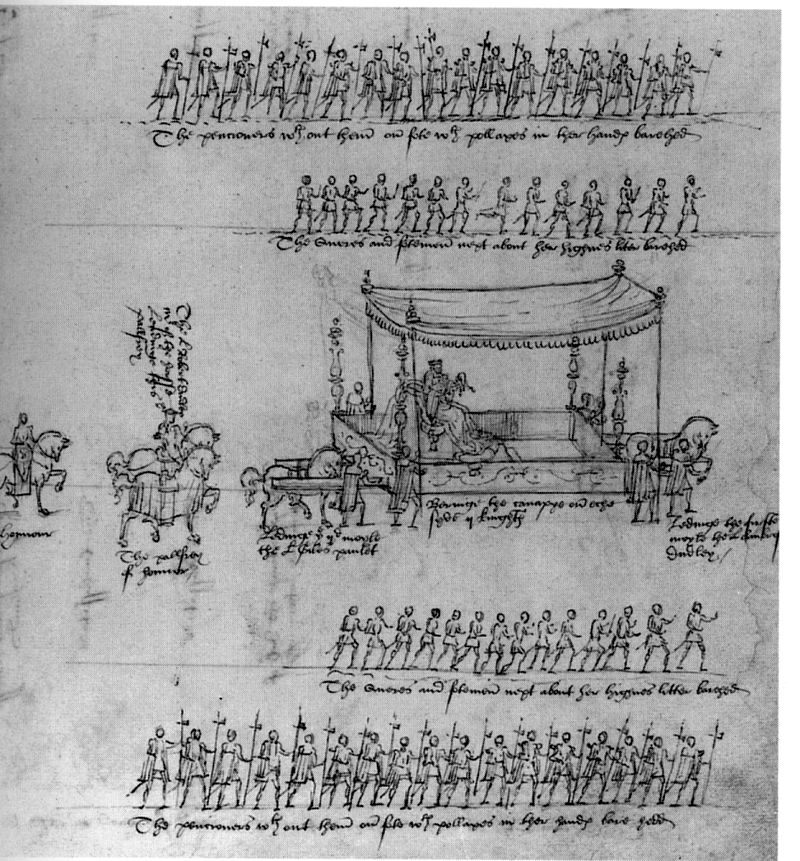
Queen Elizabeth 1 Coronation. Litter at her royal entry, accompanied by footmen and Gentlemen Pensioners. Unidentified engraver. (Wikipedia)
Queen Elizabeth 1 Accession
Queen Elizabeth 1 ascended the throne on 17 Nov 1558. Her accession was greeted with an outbreak of joy by the Protestant population. But the supporters of her dead sister Mary 1 did not want a Protestant monarch. On hearing the news of the death, Elizabeth rushed to occupy the Tower of London. She even risked shooting London Bridge, such was her haste. (see my post of the accession of Queen Elizabeth I)
She consulted lawyers about the legal position. Elizabeth, and her sister Mary, were declared bastards by two Succession Acts passed during Henry VIII’s ‘troubled’ married life. The Third Succession Act of 1543/44, following Henry’s marriage to Katherine Parr, restored Mary and Elizabeth to the Royal line. But it did not restore their legitimacy. Rather than tackle the complex legislation, Sir Nicholas Bacon, the Lord Keeper of the Great Seal, advised:
“the English laws have long since pronounced, that the Crown once worn quite taketh away all Defects whatsoever“. (Wikipedia)
Which, when you think about it, basically legitimises any successful ‘coup’! And, from a legal perspective, she was still, arguably, illegitimate.
Queen Elizabeth 1 Coronation
Her courtiers immediately began work on the Coronation, scheduled for January 15th 1559. In terms of Coronations, this was rushed. The precise date was, in fact, chosen by the Royal Astrologer. John Dee, a famous mathematician and credulous astrologer,. He found a date that the celestial bodies deemed propitious. But it needed to be sooner rather than later because Elizabeth’s position was so insecure.
Queen Elizabeth 1 Coronation Procession
The Coronation began with a procession from the Whitehall Palace in Westminster. Then back to the Tower of London for the Vigil. Followed by a Royal Procession through the City of London to Westminster Abbey for the Coronation service. After the Coronation, there was the traditional Coronation Banquet at Westminster Hall.
The Vigil Procession was on the Thames where she was escorted to the Tower by ‘ships, galleys, brigantines‘ sumptuously decorated. The Royal Entry consisted of 5 Pageants and 11 Triumphal Arches.
The first pageant showed the Queen’s descent from Henry VII and his marriage to Elizabeth of York. This marriage effectively ended the Wars of the Roses by linking the House of York and the House of Lancaster. The pageant also emphasised her ‘Englishness’ as opposed to the Spanish affiliations of Mary. The second pageant demonstrated that the Queen would rule by the four virtues of True Religion, Love of Subjects, Wisdom and Justice. At the same time she was shown trampling on Superstition, Ignorance and other vices.
The Procession at Cheapside
The third pageant, at the upper end of Cheapside near the Guildhall, provided the opportunity for the City to give Elizabeth a handsome present. This was a crimson purse with 1000 marks of gold, showing the closeness of the City and the Crown. The fourth pageant, contrasted a decaying country during the time of Mary with a thriving one under Elizabeth. It featured the figure of Truth, who was carrying a Bible written in English and entitled ‘the Word of Truth’. The Bible was lowered on a silken thread to the Queen. The Queen kissed it and laid it on her breast to the cheers of the crowd. She promised to read it diligently. The final pageant was Elizabeth portrayed as Deborah, the Old Testament prophet. Deborah rescued Israel and ruled for 40 years. So she was an ideal role model for Elizabeth. (For more details, look here.)
‘All the houses in Cheapside were dressed with banners and streamers, and the richest carpets, stuffs and cloth of gold tapestried the streets’.
British History.ac.uk Vol 1 pp315 -332
Queen Elizabeth 1 Coronation in Westminster Abbey
The Coronation was traditional – in Latin and presided by a Catholic Bishop, but there were significant innovations. Important passages were read both in Latin and in English. The Queen added to the Coronation Oath the promise that she would rule according to the:
‘true profession of the Gospel established in this Kingdom.’
This showed the path Queen Elizabeth was going to take. She would introduce innovation gradually into tradition, but emphasizing that the fundamentals had indeed changed. This was going to be a Protestant reign.
Can I remind you that I wrote a best-selling book on the Kings and Queens of Britain? It has sold over 130,000 copies, has been reprinted several times and in several editions. Further details here.
On This Day
1535 King Henry VIII became Supreme Head of the Church of England
1759 The British Museum opened to the Public.
1867 Ice breaks on the boating lake at Regent’s Park, London, Forty people die.
2001 Wikipedia Day. The free wiki content encyclopedia launched. (Other days are possible but this one is the earliest recovered wikipedia page. I begin editing pages on November 28th, 2003.
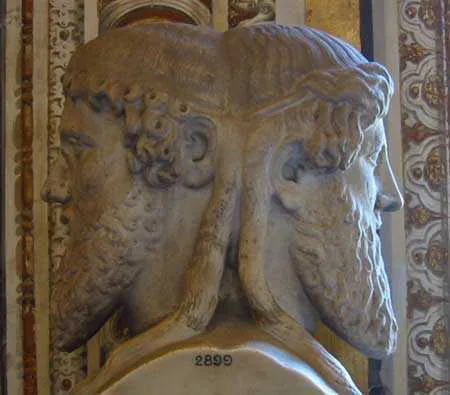
January is when people buy diaries, calendars and almanacs. January is named after the Roman God Janus. He faces both ways, to the old year and forward to the New Year. January is Ionawr in Welsh. An ceud Mhios Biadhna in Gaelic meaning ‘the first month of the year’.
This is a Roman Barrel from Scotland is shown on the Trimontium Web Site with the name Januarius on it.
Almanacs
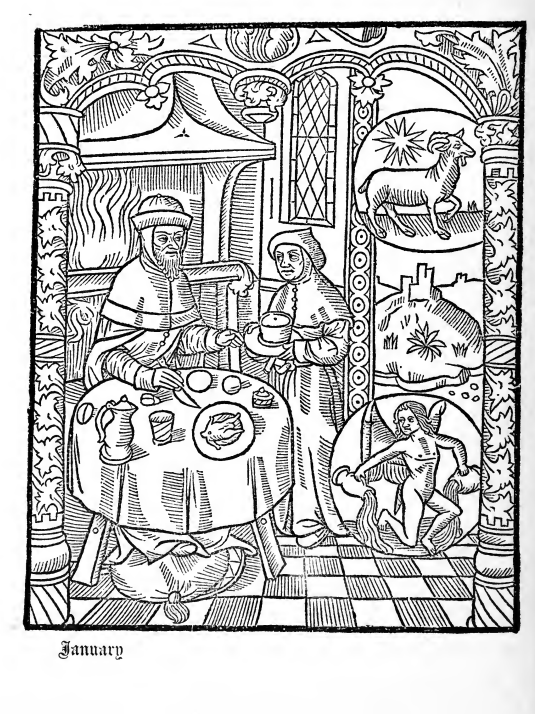
Arguably, they grew from medieval manuscript Books of Hours. The 1493 Kalendar of Shepherds, published in Paris, was particularly important. Each month has a succinct description of the activity. Moreover, there was important information for farmers and others. Eventually, a British version was made.
From the Kalendar of Shepherdes (illus. 1529)
Kalendar of Shepherds
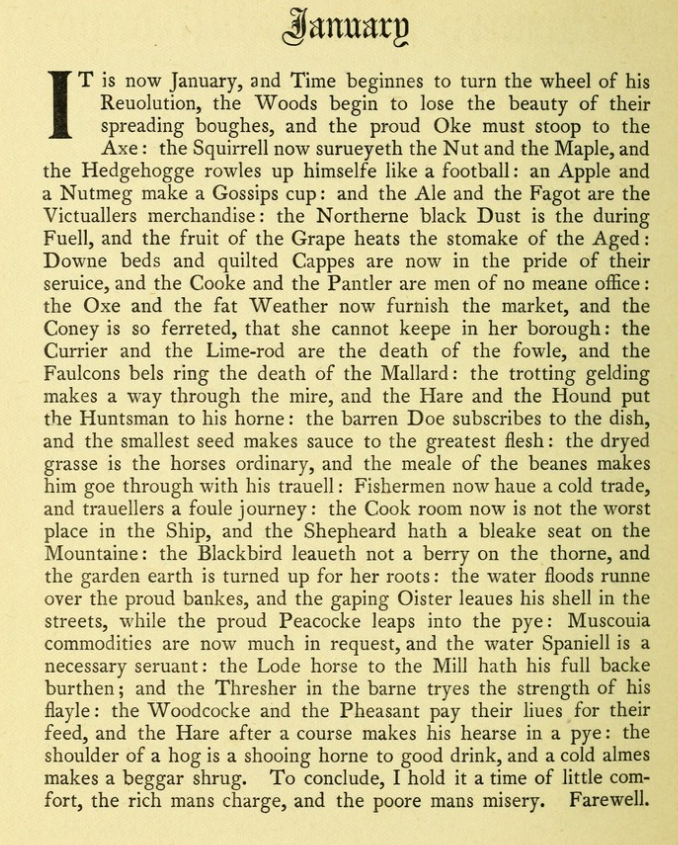
The Kalendar of Shepherds was printed in 1493 in Paris and provided ‘Devices for the 12 Months.’ I use a modern (1908) reconstruction of it using wood cuts from the original French and adding various text from English 16th and 17th Century sources. The text of the month (as shown above) is provided from a 17th Century source. It gives an interesting view of the countryside in January. To see the full Kalendar, look here:
Nicholas Breton, the writer of the text above, concludes that January:
‘is a time of little comfort, the rich man’s charge, and the poore man’s misery.’
The rich man is burdened by having to help out all the poor people who depending upon him to get through the shortages of winter. The image for January shows that January is best spent indoors by a roaring fire, eating pies.
Months of Your Life
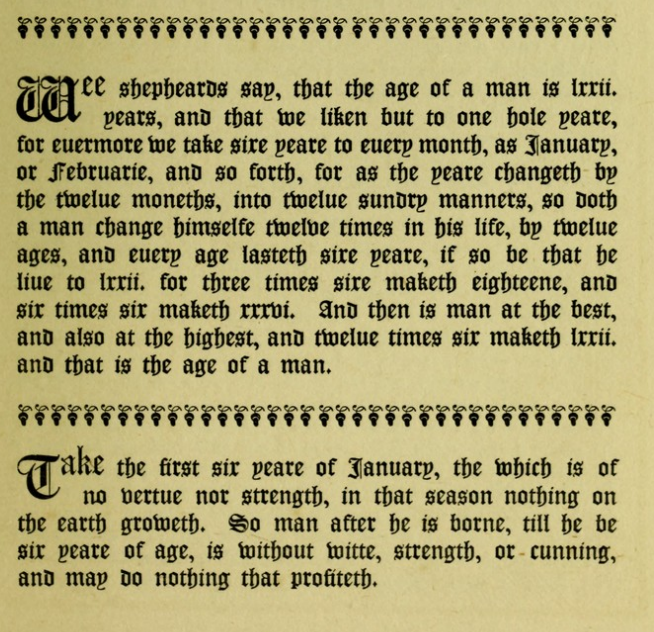
The Kalendar introduces a ‘conceit’ which is that the year mirrors our lives, and we can forecast what will happen in our lives by looking at the months.
Kalendar of Shepherds, January text
So our lives, which are of 72 years, can be divided into 12 ages of man, each of 6 years. So, January represents the first 6 years of a person’s life. And as you can see, that during these first 6 years, the child is ‘without witte, strength, or cunning, and may do nothing that profiteth‘. As the year changes every month, so, ‘a man change himself twelve times in his life’. At three times 6 (18 or March) a child becomes a man, and 6 times 6 (36 or June) man is at his best and highest. And at 12 times 6 (72 or December) man is at the end of his allotted span.
Shakespeare numbered the Ages of Man as seven, in the great speech of Jacques in ‘As You Like it’ I dealt with this and other Ages of the World in my post:
By the 1600s almanacs were the most published form of book apart from the Bible. Lauren Kassell in ‘Almanacs and Prognostications’ reports estimates that by 1660 one third of every household had one.
Originally, they had a Calendar for each month, and information about the phases of the month, the tides. They gave predictions of the weather, and health issues likely to occur at that time of the year. Astrology was an important element. London Almanacs contained further information about the year, its ceremonies and elections of officials. As this informational side to the almanac grew, they included lists of monarchs, interesting stories, verse foretelling the weather, recipes and cures.
As the New Year dawns, we might turn to an almanac to see what the year has ahead. Newspapers and the web have now taken over largely from almanacs. They print articles about the upcoming highlights of the Political, Sporting, Gardening or the Musical year. But almanacs are still produced. One of the most popular is Old Moore’s which has been in production since 1697. For more on Old Moore’s see my post here. As you can see, they promise to help with your gambling, gardening, fishing and help you through the year with predictions and horoscopes.
Originally published in 2024, republished in 2025. Content moved to new page and expanded 2026.
Winter at Abney Park Cemetery photo by Harriet Salisbury
Or so says the Shepherd’s Almanac for 1676. Until the 12th Night we were predicting that the weather on each of the 12 days will match the month of the same number. But having past Twelfth Night we have to find turn to other methods of weather lore.
Weather lore seems convinced of the undesirability of a warm January
‘January warm, the Lord have mercy’.
‘January commits the fault and May bears the blame.’
‘If Birds begin to Whistle in January, frosts to come’
‘When gnats swarm in January, the peasant become a beggar’
Most of the sayings about January quoted in Richard Inwards ‘Weather Lore’ first published in 1893, have this as their main focus. And the contrary (cold January good growing season) also generally holds:
‘When oak trees bend with snow in January, good crops may be expected.’
‘A cold January, a feverish February, a dusty March, a weeping April , and a windy May presage a good year and gay.’
The Weather according to Animals
So much for long range forecasts. Let’s see how Weather Lore helps us use animals to determine whether it will rain today.
‘If animals crowd together, rain will follow.’
‘When dogs eat grass it will be rainy‘
‘When a cat sneezes, it is a sign of rain‘
‘If young horses do rub their backs against the ground, if is a sign of great drops of rain to follow.’
The only weather lore repeated in my family was ‘Cows sitting down means it will rain.’ (And of course ‘red sky at night, shepherd’s delight’).
Meteorology Office on weather lore.
A survey by the Met Office in 2017 found that a surprisingly large number of people (75%) use ‘folklore’ to predict weather, and 55% think they are useful methods of predictions. Here is a quote from their post.
Red sky at night, shepherd’s delight – used by 70% of UK adults – CORRECT
It can be too cold to snow – used by 49% – PROBABLY NOT IN THE UK
Cows lie down when it is about to rain – used by 44% – NOT CORRECT
Pine cones open up when good weather is coming – used by 26% CORRECT
If it rains on St Swithin’s day, it will rain on each of the next 40 days – used by 22% Not Correct. In fact since records began in 1861, there has never been a record of 40 dry or 40 wet days following St Swithin’s Day
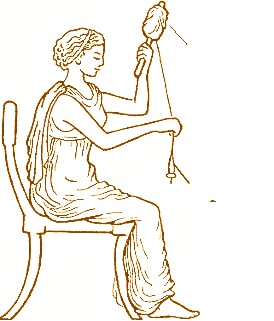
St Distaff Day. Spinning—showing the distaff in the left hand and the spindle or rock in the right hand
I’m not sure what the Three Kings were doing on the day after Epiphany. But, the shepherds, if they were like medieval English farmworkers, would still be on holiday. They went back to work, traditionally, next Monday, which is Plough Monday – (See my post here). This year, January 12th. By contrast, the women, according to folk customs, went back to work on St. Distaff Day, the day after Epiphany. Today, January 7th. In an ideal world, St Distaff’s Day is the Sunday after Epiphany (January 11th), and Plough Monday is the next day. Of course, it doesn’t always work out that way. I am not sure the woman going back to work on the 7th January, would be happy with the men lounging about until Plough Monday? An extra 4 days off! Maybe, St Distaff Day was normally on the Sunday before Plough Monday?
Distaffs and Women’s Work
A distaff is ‘a stick or spindle on to which wool or flax is wound for spinning’. Because of its importance in the medieval and early modern economy, it became a synecdoche for women. St Distaff is a ‘canonisation’ of this use of the word. So, a day to celebrate working women.
We know that medieval and early modern women were a vital part of the workforce, despite the demands of childcare. Many women took on apprenticeships, even more continued their husband’s work after he died. Some professions like silk became a female speciality. Many taverns were run by the Alewife. Plus, London was full of female servants and nurses. Many women had several jobs.
The exhibition at the British Library on Medieval Women. In Their Own Words, indicated that most of the sex workers had two or more other jobs. But even if a woman remained solely in the domestic realm, the wife had to be mistress of a formidable range of technologies. Baking, Brewing, Cooking, Laundry, Gardening, Dairy, Medicine (including distillation), horticulture, spinning, sewing and embroidery. Even, aristocratic women did embroidery of the finest quality, and it often made an important financial contribution to the household. They also ran the household, which means they had to have a formidable range of managerial skills. Dealing with servants, managing the accounts etc.
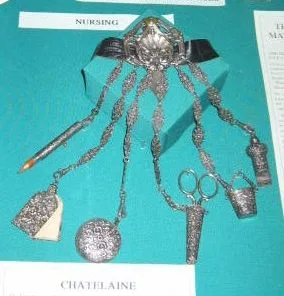
Chatelaine.
The other symbol of ‘women’s work’ was the Chatelaine. The word also means keeper of the Castle. But women who controlled households had a clasp that hung from the waist. It was a bit like a Swiss Knife as it had the keys, and all sorts of other useful items. Here is an old photo of the Chatelaine from the collection of the Old Operating Theatre Museum, of which I was the Director for 25 years. From left to right it has a pencil, a little notepad, a pill dispenser, a pair of scissors, a little bucket that held a dose of medicine, a whistle to summon urgent assistance. These were not only useful but a symbol of authority for the Matron. 19th Century.
St Distaff Day and Plough Monday
Robert Herrick (1591–1674), born in Cheapside, London, a Goldsmith, priest, Royalist and Poet wrote in ‘Hesperides’.
Partly work and partly play You must on St. Distaff’s Day: From the plough, soon free your team; Then come home and fother them; If the maids a-spinning go, Burn the flax and fire the tow. Bring in pails of water then, Let the maids bewash the men. Give St. Distaff all the right; Then bid Christmas sport good night, And next morrow every one To his own vocation.
Herrick, I think is suggesting fun and games are to be had. The men burning the flax and firing the tow, The women soaking the men with pails of water. In this piece, he links the plough team with St Distaff Day. This implies that the ploughs would be out on the next day. So as St Distaff’s Day is not always on a Sunday, perhaps Plough Monday is not always on a Monday? He certainly suggests everyone goes back to work either on St Distaff Day or on the day after,
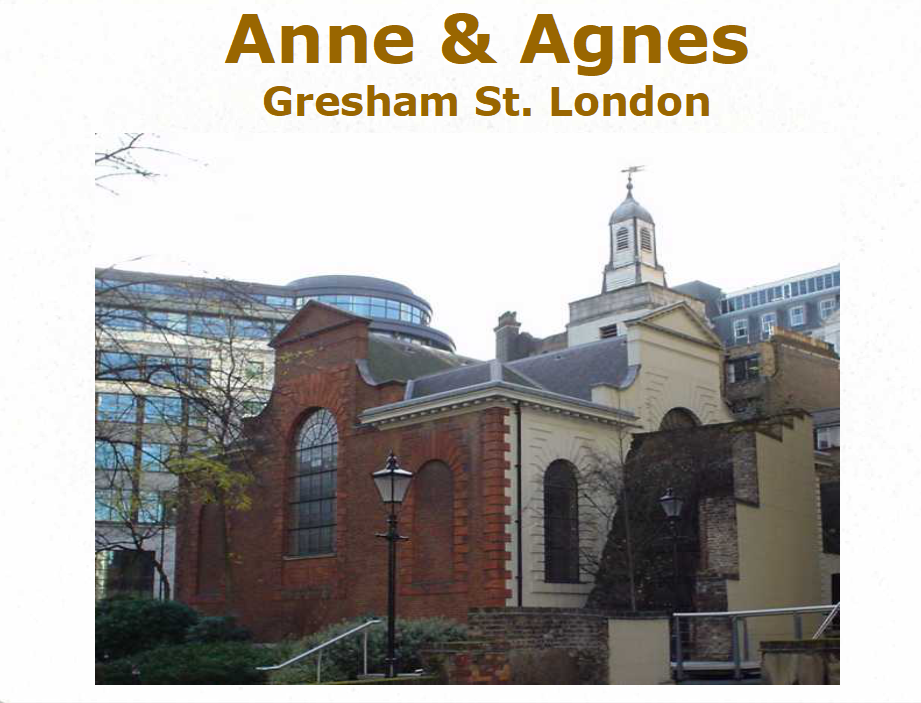
St Anne & St Agnes Church in London, Saints of the Distaff. Photo K Flude
Saints & Goddesses of the Distaff Side
In London, the Fraternity of St Anne and St Agnes met at the Church dedicated to the Saints. It is by a corner of the Roman Wall on the junction of Gresham Street and Noble Street. St Agnes is the patron saint of young girls, abused women and Girl Scouts. St Anne is the mother of the mother of the Son of God. So, together they represent the three generations of women: maidens, mothers, and grandmothers.
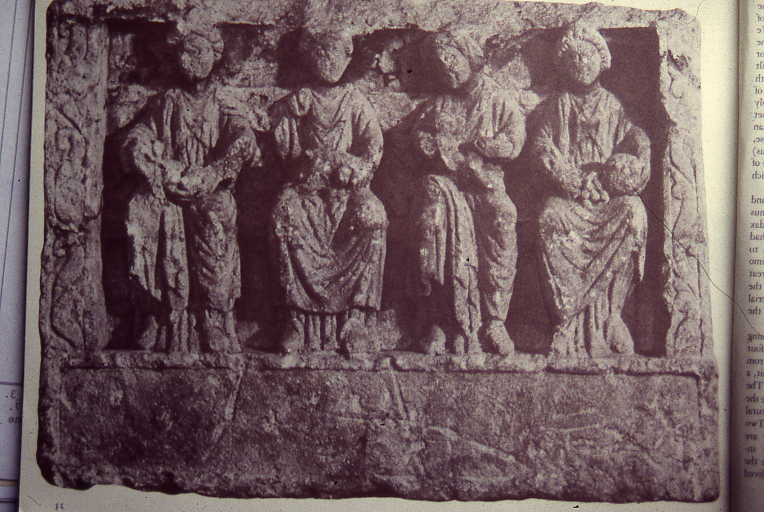
The Three Mother Goddesses (and someone else) “Limestone relief depicting four female figures sitting on a bench holding bread and fruit, a suckling baby, a dog and a basket of fruit’ the Museum of London
This trinity of women were worshipped by the Celts. Archaeologists discovered the sculpture above while investigating the Roman Wall a few hundred yards away at Blackfriars. Scholars believe it depicts the Celtic Three Mother Goddesses. The fourth person is a mystery, maybe the patron of a nearby temple? The relief sculpture was removed perhaps from a temple, or the temple was trashed at some point. Then the sculpture was used as rubble and became part of the defences of London.
The idea of triple goddesses is a common one. In Folklore and History they have been referred to as Maiden, Mother, and Crone, or even Maiden, Mother and Hag. They come in Roman, Greek, Celtic, Irish, and Germanic forms. Their names include the Norns, the Three Fates, the Weird Sisters, the Mórrígan and many more. The Three Fates, the Goddess Book of Days says, were celebrated during the Gamelia. This is the Greco/Roman January Festival to the marriage of Zeus and Juno. The Festival also gives its name to the Athenian month of January.
The Importance of the Grandma
The use of the terms Hag and Crone for the third Goddess is rare now, but was common. It does a great disservice to the importance of the Grandmother figure. (Although the original meaning of the words were less pejorative. For example, Hag may have meant diviner, soothsayer.) The three phases of womanhood are equally important to the continuation of the species. They provide love, support, and experience through the generations. Compare these three generations of supportive deities with Ouranos (Uranus), Cronus (Saturn) and Zeus (Jupiter). Saturn castrated and deposed his father, Uranus. Later, he tried to eat his son, Jupiter. But then, Jupiter is nobody’s idea of an ideal father. As one example, he eats his lover, Metis, to avoid her giving birth to his daughter, Athene. (See my post on the birth of Athena.)
Recent work on human evolution has suggested that the role of the Grandmother is crucial to our species’ ability to live beyond the age of fertility. Because, in evolutionary terms, once an individual cannot procreate, their usefulness for the survival of the genes is finished. So what’s the point of putting resources into grandma’s survival? The theory is the Grandmother has such an impact on the survival of the next generation, that longevity. for the female, beyond fertility makes evolutionary sense. Grandfathers less so.
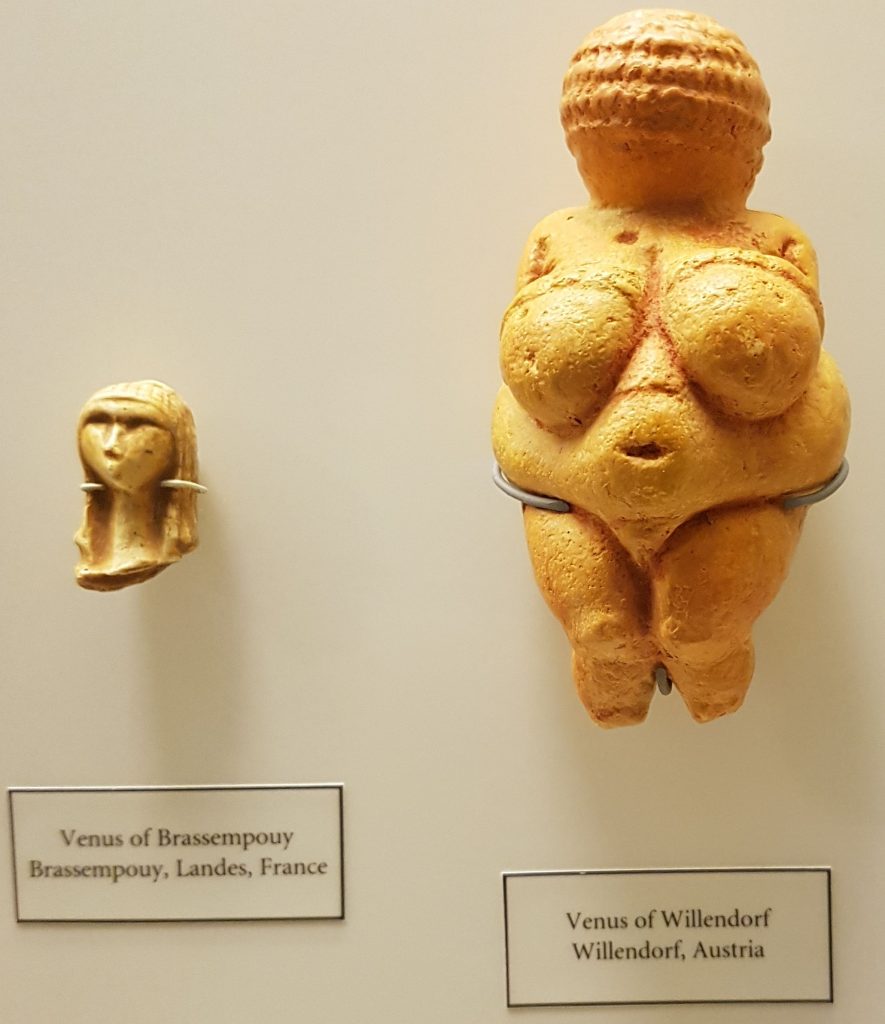
There was a theory widely held that the original Deities, dating before the spread of farming, were mother goddesses. The idea is that the hunter-gatherer goddesses (perhaps like the Venus of Willendorf) were overthrown by the coming of farmers. These patriarchal societies worshipped the male gods, which destroyed the ancient Matriarchy. Jane Ellen Harrison proposed an ancient matriarchal civilization. Robert Graves wrote some interesting, but no longer thought to be very scientific studies, on the idea. Neopaganism has taken these ideas forward.
1451 Glasgow University was founded (and you wonder why the Scots made such an impact on the world.)
1789 The USA held its first national presidential election. (Long may that fine democratic tradition survive and prosper!)
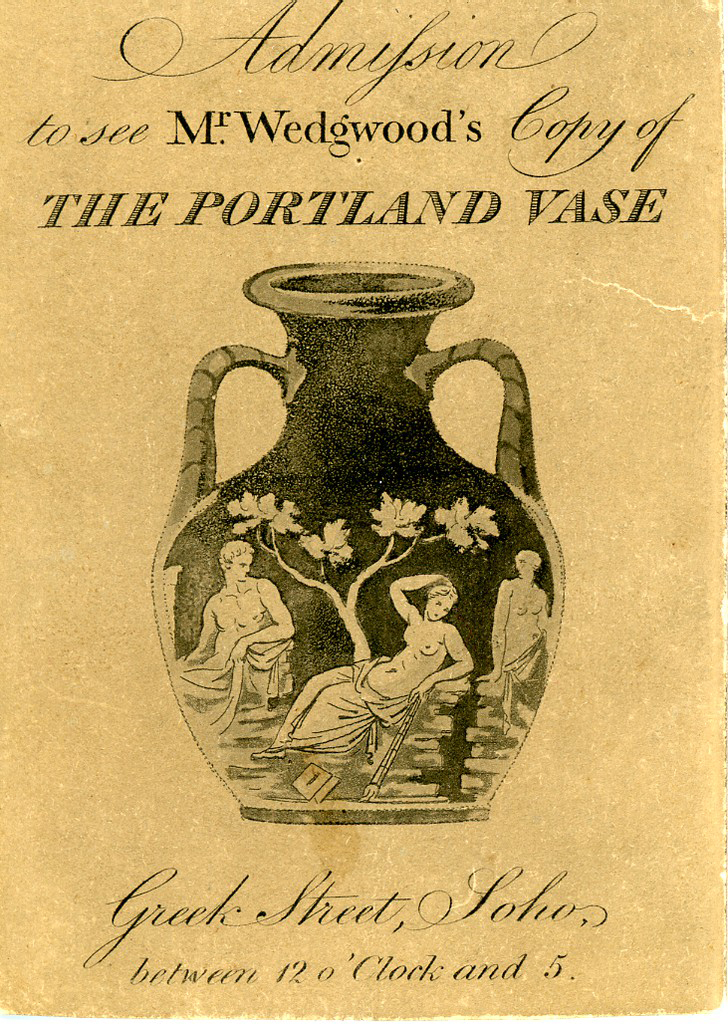
1845. Today is the anniversary of the breaking of the fabulous Portland Vase by a drunken visitor to the British Museum. It looks immaculate despite being smashed into myriad pieces, a wonder of the conservator’s art. To see the vase and read its story, go to the BM web site here:
Today in the orthodox church, дед Мороз (Ded Moroz= father of frost), accompanied by Cнегурочка (Snieguroshka= fairy of the snow) brings gifts on New Year’s Eve, (which is on January 7th). He travels with a horse-drawn troika.
On the twelfth day of Christmas My true love gave to me Twelve drummers drumming, Eleven pipers piping, Ten lords a-leaping, Nine ladies dancing, Eight maids a-milking, Seven swans a-swimming, Six geese a-laying, Five golden rings, Four calling birds, Three French hens, Two turtle-doves And a partridge in a pear tree.
Twelfth Night
In 1775, William Snooke recorded in his diary, that he sat down to a fine dinner with:
‘Mr and Mrs William Clifford and their seven children (and maid), John Fox Snr. and Sally Twining, Mr and Mrs William Fox, and William Weale.’ To feed this crowd took “Ham, Greens, 3 fowls roasted, Soup, Leg of Mutton, potatoes, Boiled rump of beef (large)”
Dessert included pudding, mince pies and a forequarter of home lamb. For supper, the assembled party consumed tarts, stuffed beef, mince pies, cold mutton, oysters, cold sliced beef, cold lamb, apple pies and pears.
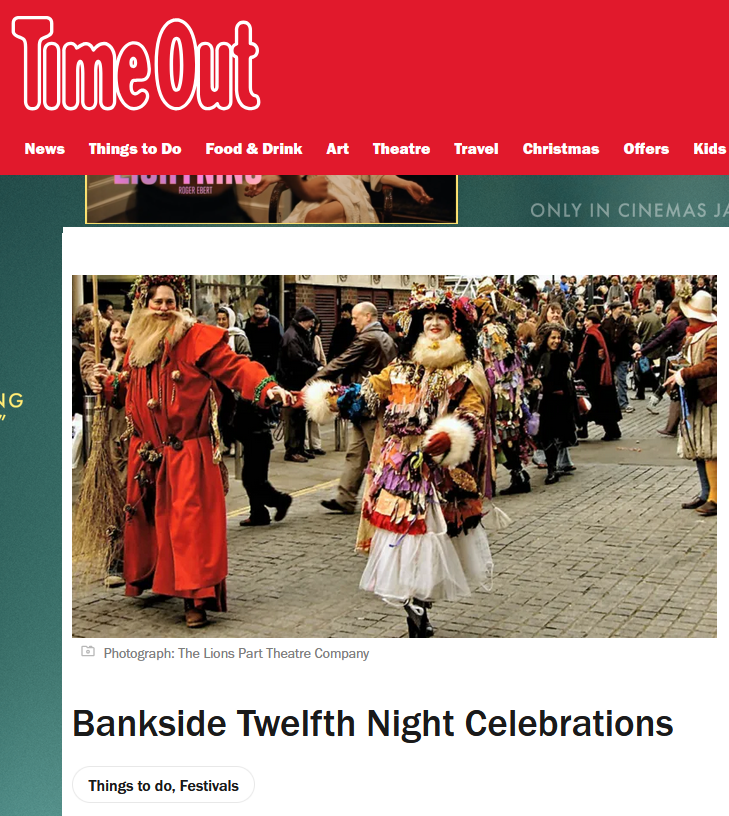
A recent ‘tradition’ for a Tweltfh Night procession has been established on the south side of the River Thames in London. The Lions Part Company begin their entertainments at the rebuilt Globe. The parade has all the traditional mummers characters, including the Green Man, and the Holly Man. They perform the Combat Play of St George. This involves the Old ‘Oss (which is the centre point of the May Day festivities at Padstow in Cornwall. They also have Twelth Night Cakes containing a bean and a pea. These are used to crown the King and Queen of the Day.
Photo of Twelfth Night Celebrations in Southwark, London on the South Bank
I’ve posted about this before but just to make sure those who find themselves on this page understand the issue:
Many people start their count of the Twelve Days of Christmas on the 25th December. But some folklore sources going back in time count from Boxing Day. For example, Gervase Markham’s ‘The English Husbandman of 1635 counts it from Boxing Day.
The Daily Express reveals that the Protestants count from Christmas Day and the Catholics from Boxing Day. That maybe it, but I wonder if the confusion more complicated than that? The religious festival really makes sense if it begins with Christmas Day, and ends with the Epiphany. This is the day the Three Kings from the Orient come to worship Jesus. But Epiphany is on the 6th January, which is 13 days from Christmas. 13 days of Christmas would be ill-omened. So two solutions: make the end of the Twelve Days the Eve of Epiphany, i.e. the 5th, or start the 12 days from Boxing Day.
I suspect there is a fudge going on here. Twelve is the magic number, twelve Apostles, 12 months in the year, so twelve Days of Christmas. But clearly, for Christians it stretches from Christmas Day to Epiphany. Two ways to square that 13 day difference. One is to begin the twelve days on Boxing Day. The other is to end with a Twelfth Night party on the Eve of Epiphany. Have a look at Notes&Queries for different viewpoints.
Time to take your decorations down- January 5th or Candlemas
However, we currently all seem to agree that January 5th is the day to take down your Christmas decorations. If you fail to do it now, you have to keep them until Candlemas, which is at the begining of February. See my Candlemas post to see the official end of Christmas.
Toss your unwanted Christmas Tree on the Pavement Day
In London, today and yesterday have seen people throw out their unwanted Christmas Streets out on the street, for someone else to pick up and throw away. This became a thing a few years ago not. But, no, people you are supposed to take them to a Recycling Centre, or arrange to have them picked up. Not just throw them on the street.
1753 People gathered around the Holy Thorn in Glastonbury. The Thorn normally blossomed on Christmas Day, but the Gregorian Calendar had been introduced the year before. Christmas Day was now 11 days earlier. on December 25th, it did not blossom. On the 5th, it blossomed, proving that the new Christmas Day was a fraud, From then on January 5th was called Christmas Day Old Style. Other festivals, and events thereafter kept their traditional slot in the year, by changing the date to the Old Style, and ignored the New Style.
Saint Geneviève praying for the end of the rain. 19th Century by Alfred Gérente Notre-Dame de Paris.
St Genevieve of Nanterre (c. 419/422 AD – 502/512 AD) has her feast day today. Nanterre is an ancient settlement swallowed up by modern Paris. Genevieve was a most remarkable woman who met St Germanus of Auxerre on his way to Britain. She was only 7 when she met Germanus. He encouraged her piety. She became a consecrated virgin (someone who made vows of chastity to be a ‘bride of Christ’). Thereby living an aesthetic life of fasting and prayer. Hence, miracles soon became associated with her, (including changing the weather) and the ‘usual’ medical miracles. After moving to Paris, she encouraged the women of the City to stay in the City for prayer and fasting to prevent the Huns capturing the City in 451. Attila and the Huns abandoned the siege.
St Genevieve saved the City on other occasions too, helped build two large Church projects, including St Dennis. She intervened fearlessly in public affairs, and was a brave and resolute woman who challenged the male hierarchy with some success. And what makes me like her even more was that she is not a martyred teenager Saint tortured to death to gain her sainthood. But she did great works and lived to old age of 82 still ‘full of virtue’. In the medieval period, she became the Patron Saint of Paris. She is patron to: Paris, shepherds, winemakers, wax-chandlers, hatmakers; against eye complaints, fever, plagues, drought, and war.
St Germanus
St Germanus played a significant role in Genevieve’s life, protecting her from slander and attack. He is one of the most significant figures in post Roman studies in Britain. Accounts of his visits to Britain in the early 5th Century are among the very few descriptions of post-Roman life. He was sent to Britain to counter the Pelagian Heresy, which was endangering the Catholic version of Christianity.
Incidentally, Nanterre has an interesting prehistory. The name in Celtic means ‘enduring sacred site’. A large cemetery has been found, which helps support the possibility that it is the original site of Paris. Julius Caesar attended an assembly with local Gallic leaders in the area. The topography of Nanterre fits as well for the location of the assembly as the island in the Seine (Île de la Cité) which is an alternative location.
In Their Own Words
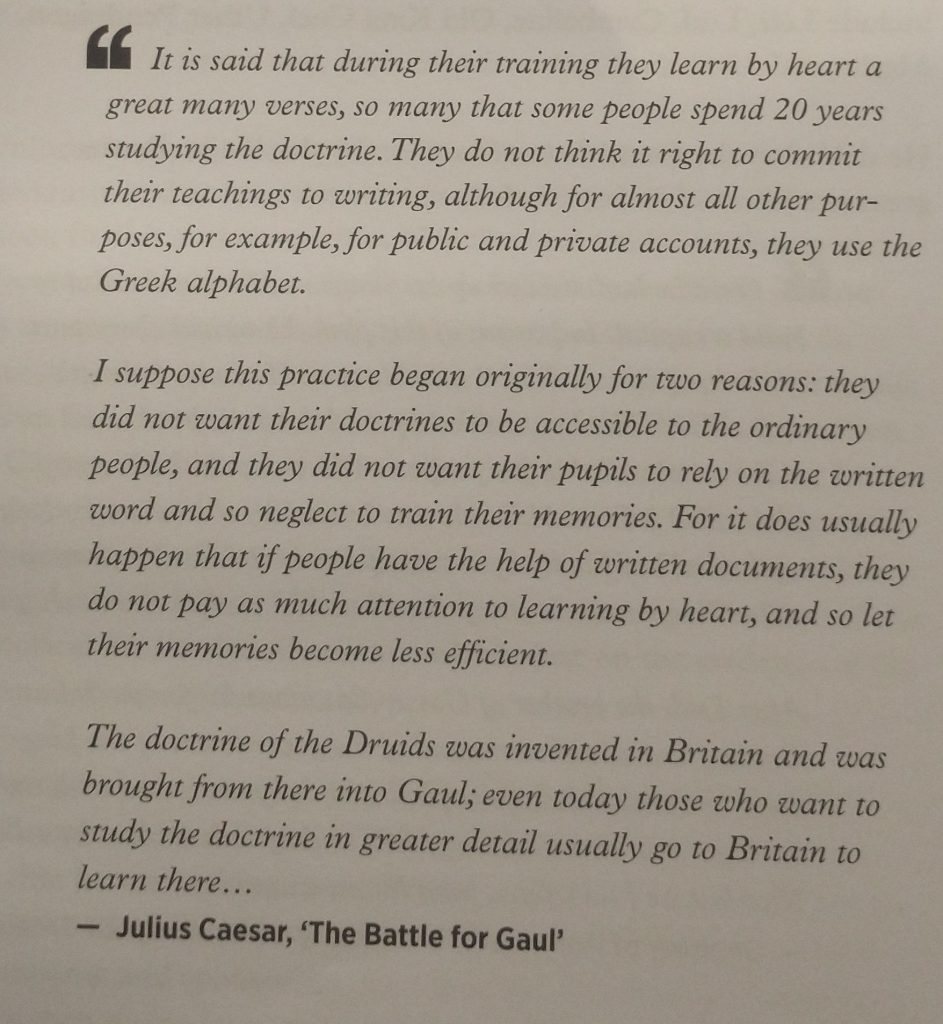
This is an excerpt from Julius’s Caesar book concerned with training druids. (It is photographed from my book ‘In Their Own Words- details below).
‘In Their Own Words – A Literary Companion To The Origins Of London‘ by Kevin Flude
It brings together contemporary quotations about the Prehistoric, Roman and Dark Ages with a commentary by the author. It’s an enjoyable read! To buy the Kindle (£2.40) or a paperback version (£5.99), click here.
If you have read it, please go here and write a review! It is sadly devoid of any!
On This Day
1521 Martin Luther excommunicated by Pope Leo X. (our present Pope is the XIV)
1661 Samuel Pepys saw the Beggar’s Bush at the Theatre in Gibbon’s Tennis Court, Vere Street, near Lincoln’s Inn Fields. He records it was ‘the first time that ever I saw women come upon the stage’. The Restoration of Charles II to the throne allowed, for the first time, women to appear on the professional stage.
1777 George Washington defeats Cornwallis at the Battle of Princeton
Today: keep bird feeders well stocked. Check houseplants for mealybugs, mites and other pests. (Gardeners’s Year The Metroplitan Museum of Art).
The Full Moon today falls in Cancer in a conjunction with Jupiter and an exact opposition to Mars and Venus. Thus, the mood of the times is divided between those supporters of individual liberties. And the Government’s right to control personal behaviours’. That, ast least is what Old Moore’s Almanack for 2026 says. And that’s probably enough Astrology for the year!
First written in January 2023, revised and republished January 2024, 2025, 2026