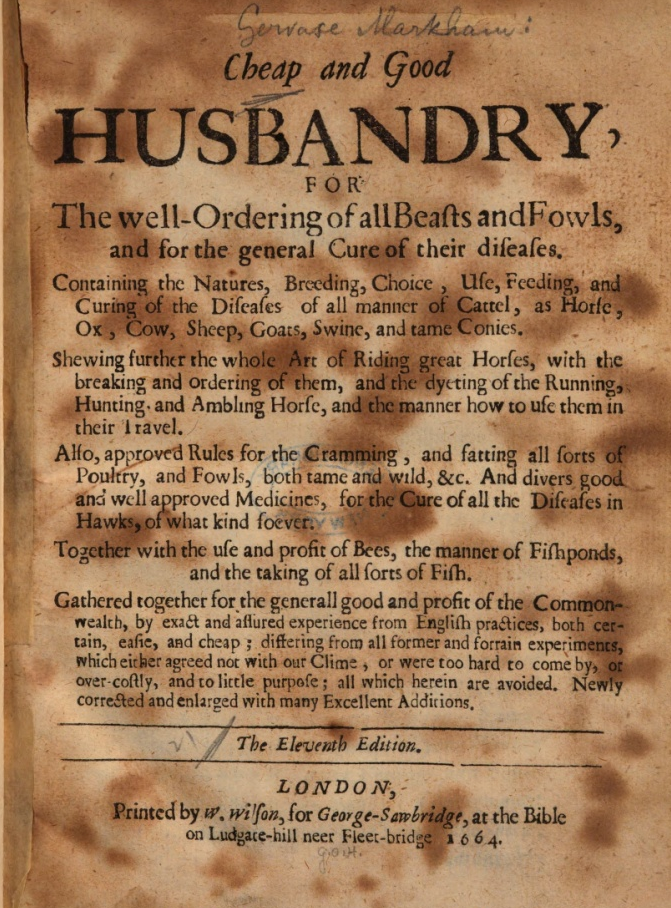
Spring Chickens appear in Cheap and Good Husbandry by Gervaise Markham London 1664
Of Setting Hens (and Spring Chickens)
Gervase Markham wrote a heap of farming and horticulture books in the 17th Century. In ‘Cheap and Good Husbandry’ he wrote about ‘Spring Chickens’. Spring Chickens are essentially March Chickens, March Hares and even March Cats are all special. Markham starts by suggesting this is the time to impregnate them for birth in March:
The best time to set Hens to have the best, largest, and most kindly Chickens;, is in February, in the increase of the Moon, so that they may hatch or disclose her Chickens; in the increase of the next new Moon, being in March; for one brood of March Chickens; is worth three broods of any other: You may set Hens from March; till October, and have good Chickens;, but not after by any means, for the Winter is a great enemy to their breeding….
The expression comes from the 17th Century when Spring/March Chickens were more profitable than old chickens that had gone through the winter. Commonly, it is used in the negative, as in ‘Kevin ain’t no spring chicken.’
Egyptian Book of the Dead goes on display at the Brooklyn Museum
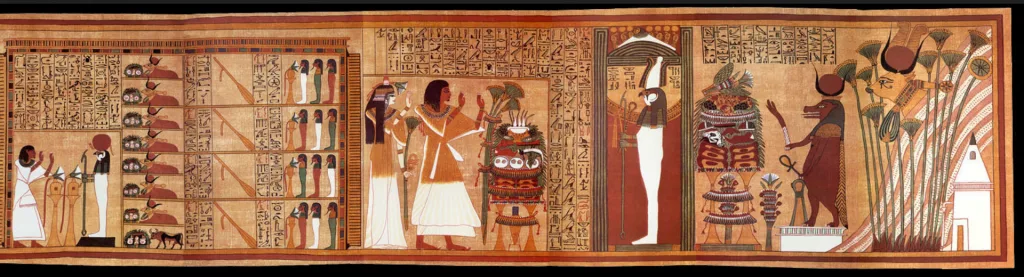
After three years of conservation, the world’s most complete gilded Book of the Dead goes on display at the Brooklyn Museum. Have a look at their post here. The Book of the Dead was prepared to accompany the deceased on their journey in the afterlife. It is full of spells, prayers and incantations. There was no one fixed format, but some are incredibly complex and beautiful. My own feeling is that they confirm my opinion that the Egyptian way of death is totally OCD. There is so much an Egyptian has to do to get a good afterlife. Not only embalming but having models of food, slaves, boats, mummies of dead cats, anything you want to have. It feels like they must have been terrified of death.
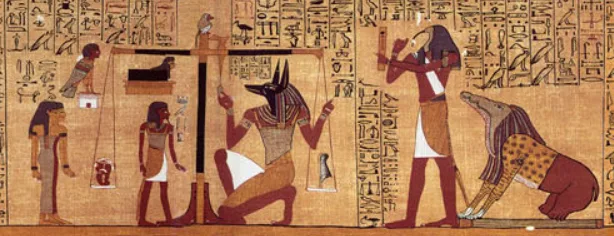
A scene from the Papyrus of Ani (British Museum) It shows the heart being weighed on the scale of Maat against the feather of truth. Doing the weighing is the jackal-headed Anubis The ibis-headed Thoth records the result. Behind Toth is Ammit part crocodile, lion, and hippopotamus. The facsimiles were produced by E. A. Wallis Budge; original artist unknown. Public Domain
One of the issues is that the deceased had to have their heart weighed against the feather of Truth (belonging to the Goddess of Truth, balance, law, morality, and justice, Maat) . If it was found deficient, the deceased would be eaten by Ammit who has the head of a crocodile, the shoulders of a lion, and the legs of a hippo.
Wikipedia has a tremendous scan of the facsimile of the Papyrus of Ani, it is a 78ft long scroll and wonderful to look at To see it click on the first picture and zoom in and look left and right! https://en.wikipedia.org/wiki/Papyrus_of_Ani.
The story of its acquisition is also gob-smacking. Budge acquired in it Luxor in 1888. The Egyptian Police came to investigate the house of the illegal dealers. Budge distracted the police while his people tunnelled into the house from the rear, and retrieved ‘his’purchases. He took them to the British Museum and was paid a gratuity of £150 for them!
On this day
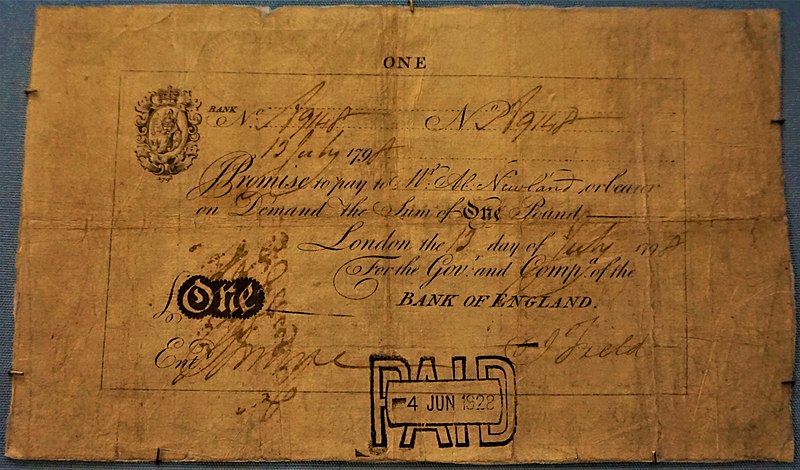
First £1 note of the Bank of England Museum 1797 Source Joy_of_Museums Public Domain (CC by sa 4.0)
February 26th 1797 First Pound Note:
The Bank of England issued it’s first ever one pound note (although some sources say March 1797). The Bank had been issuing paper notes since the late 17th Century, but this was the first £1 note. They still had to be signed by hand and allocated to a specific person. The hand signed white paper notes were withdrawn in 1820, and the pound note was, finally, withdrawn in 1988. The £1 in 1797 was worth the equivalent of £157.46 today, so quite a big note! (see here for the calculator.)
1815 – Bonaparte escapes from exile on the island of Elba. War begins all over again.
1995 – Barings Bank collapses after a rogue securities broker Nick Leeson loses $1.4 billion by speculating on futures contracts. Barings is the UK’s oldest investment banking institute,
Pound note first published 2024, Spring Chicken added February 26th 2025 Egyptian book of the Dead added February 26th 2026
Today is the Feast day of two significant Saints, St. Walpurga and St. Ethelbert.
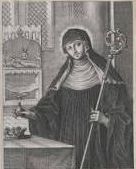
St. Walpurga
St. Walpurga was a nun at Wimborne in Dorset. She, and her brothers St Willibald and St Winebald, accompanied their uncle, St Boniface of Crediton (in Devon) on his mission to convert the Germans to Christianity. They all became leading figures in the new German Church. Willibald set up the Monastery at Heidenheim, which was a duel monastery housing both Monks and Nuns. His sister, St Walpurga, became Abbess of the Monastery in 761. She died on 25 February 777 or 779 (the records are unclear),
In 870, St. Walpurga remains were ‘translated’ to Eichstätt, which St Willibald had set up as the Diocesan centre of this part of Bavaria. The date of the transfer was the night of April 30th/May 1st. This was her feast day. But the Church moved it to February 25th, to commemorate her death. However, May Eve is now ‘notorious’ as Walpurgis Night. This is the night of May Eve when witches are abroad up to all sorts of mischief, May Day being one of the main pagan festival days. Her body was placed in a rock-cut niche and her bones started exuding an oil called Walpurgis Oil which was said to have medical properties. She was also involved in a miracle of a boat saved in a storm-tossed sea.
For these reasons, Walpurgis is the Saint for battling pests, rabies, whooping cough, storms and sailors. She is also associated with witchcraft but not because of any actual association with it. Her remains were moved again in 1035 when she was enshrined at the Benedictine Abbey of St. Walburga which was named after her.
Walpurgis Nacht
Terrible things happen on Walpurgis Night in Dracula by Bram Stoker. So, the night has now become a trope for Heavy Metal Bands, doyens of horror stories and the Satanic. For more on this read my piece on Walpurgis Nacht.
Coincidently, I was reading about the fuss made about a Heavy Metal Band, called a Plague of Angels, playing in the glorious York Minster. A member of the band tried to calm down the controversy, saying people should just chill out. But other group members used to be in a band called ‘The Cradle of Filth’. Among their claims for Heavy Metal Fame is that they wore the most controversial t-shirt in heavy metal history. This has a visual of a nun in a compromising position and a slogan saying ‘Jesus is a ……..’ (add your favourite swear word here). All very silly. But it struck a cord with me, as I have a scene in my novel (unpublished) which is based on extreme forms of Heavy Metal Bands. I thought I might have gone over the top, but this story reassures me that extreme Metal can be extremely offensive!
Ethelbert is responsible for welcoming the Augustinian Mission to the Angles sent by the Pope, St Gregory. This re-established Christianity in Eastern Britain, and set up the Anglican Church or the Church of England as it became known.
1308 – Edward II crowned King of England. His reign ended disastrously, with his Queen having an affair with Lord Mortimer and Edward losing control of the country (and Scotland). He was forced to abdicate, and died/was murdered/killed with red-hot pokers/or escaped to live a life as a hermit on the continent. Choose your favourite or read my History of the Kings and Queens of Britain.
1507 – Queen Elizabeth I excommunicated by Pope Pius and declared usurper of the throne, leading to the Spanish Armada and various plots against her life. (my post on Queen Elizabeth’s nicknames is here)
1836 – The Colt Revolver awarded a United States patent. Previously, he had obtained a UK Patent. It created the classic ‘Western’ Revolver’, much later called the Colt 45. It was a revolving-breech loading, folding trigger hand gun.
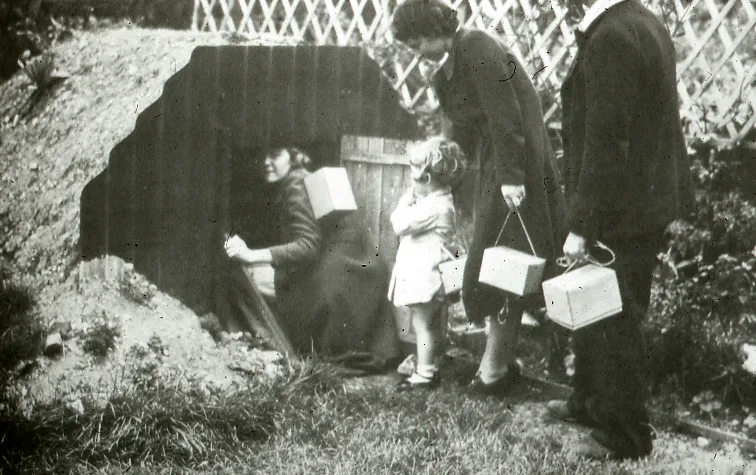
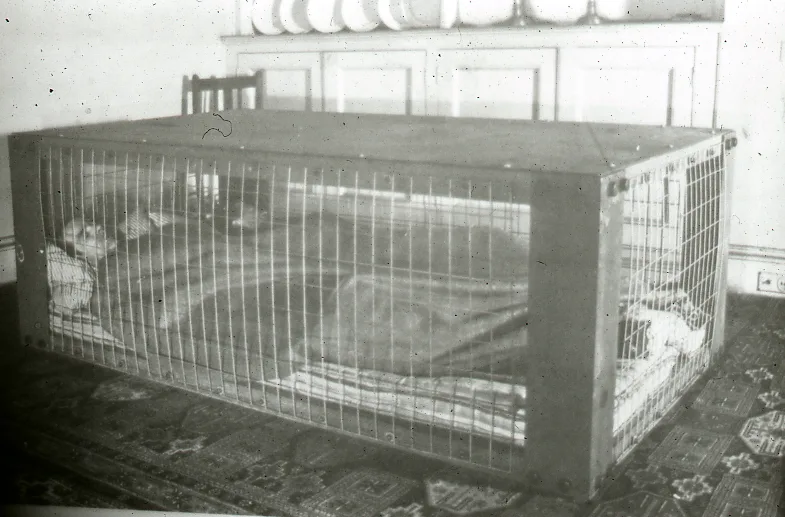
1939 – The first Anderson shelter built in a garden in Islington, London. They were named after the Home Secretary, and were dug in a trench with soil piled over the corrugated iron domed roof. Inside were bunks for the occupants to sleep in. They were 6 ft high, 4.5 ft wide, and 6.5 ft long. 2.5 million were built. The next shelter was the Morrison Shelter named after Herbert Morrison, who succeeded Anderson as Home Secretary. The Morrison Shelter was like a massive table that would protect the shelterers if the house collapsed above it. It allowed the family to sleep inside. London also had public shelters made of brick in many streets, or used cellars and brick arches as shelters. A small proportion of the population preferred to sleep in the Underground. Many stayed in their beds, unless planes were directly overhead. Photos from ‘The British People at War’ published during the war.
Anderson ShelterMorrison ShelterConcrete Public Shelter in London Museum Docklands (Photo C. Mossie)
1956 – Nikita Khrushchev denounces Stalin.
First Written February 2024, revised February 2025. On This Day added in 2026
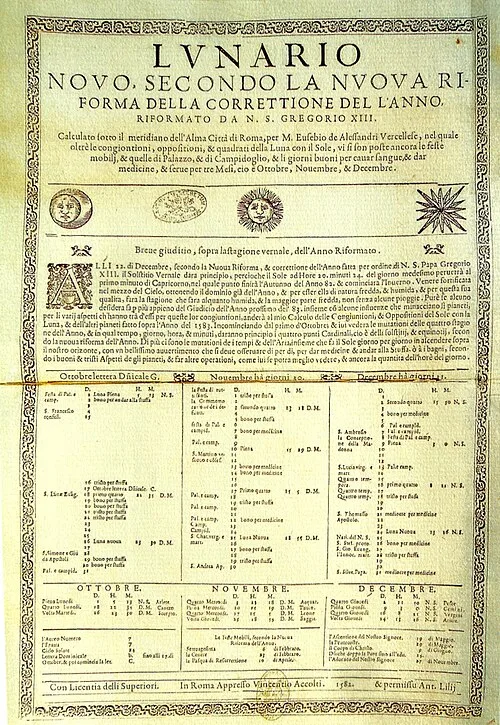
Gregorian Calendar, Lunario Novo, Secondo la Nuova Riforma della Correttione del l’Anno Riformato da N.S. Gregorio XIII,[k] printed in Rome by Vincenzo Accolti in 1582, one of the first printed editions of the new calendar
On February 24th 1582 – Pope Gregory XIII published the papal bull Inter gravissimas. This announced amendments to the Julian Calendar created by Julius Caesar and created the Gregorian Calender. Caesar had realigned the Roman Calendar with the Solar Year, creating a ‘Year of Confusion’. The year was 445 days long but it resynced the days to their proper season.
The Julian Calendar
The Julian Calendar used leap years to align the Calendar Year with the Solar Year. But the earth does not cycle the Sun in 365.25 days. This is an overestimate of 1 day every century. So, since the time of Caesar, the year had got 10 days out of kilter. Gregory chopped those 10 days out of the Calendar. The 4th of October 1582, was to be followed by the 15th October 1582. This might seem simple, but imagine you are receiving your salary for October, and you find it 10 days short? Or you have a month to pay your debt and find it called in 10 days early? So the Pope ordered that these 10 missing days shouldn’t be used in calculating financial matters.
Computus
One of the main reasons for the reform was the ‘Computus’. This was the method of calculating Easter. Easter was a festival that followed the movements of the Moon but was synced into the Vernal Equinox. (The timing of Easter is the first full moon after the Vernal Equinox.). So the chopping of 10 days meant that the vernal equinox was set back to its proper place on March 21st. Arguments over the correct calculations of Easter had, in the 7th Century been a major stumbling block in uniting the Celtic Church in Britain with the Roman Catholic Church. (See my post on Easter here).
But this still left the drift caused by Caesar’s faulty leap year system. Gregory’s reforms stopped future drift by fine-tuning the leap years. From 1582 there would not be a leap year in those centurial years which were not divisible by 400. So 2000 was a leap year, but 2100 is not. This skips ‘three Julian leap days in every 400 years, giving an average year of 365.2425 mean solar days long.’ (Wikipedia). This keeps us aligned, although there is still a small error.
If you enjoy this sort of calendrical detail, you will love ‘The Calendar’ by David Ewing Duncan.
British Exceptionalism
Of course, Britain refused to join a Catholic innovation for nearly 200 years. But, religious prejudice at last gave way to reason, when we adopted the Gregorian Calendar in 1752. In the process, we lost 11 days, much to the horror of the London mob, who rioted against their loss.
Greece was the last European state to join in 1923. Japan joined in 1873, China in 1912, and Saudi Arabia in 2016. Ethiopia, Iran, Afghanistan, and Nepal keep distinct calendrical traditions. (see seasia.co for more details.) Strictly, we are using the Gregorian amendment to the Julian Calendar because it has all the elements of the Julian Calendar except a couple of adjustments.
Coltsfoot is a daisy-like plant which is flowering about now. Gerard’s Herbal of 1633 suggests that the ‘fumes of the dried leaves taken through a funnel’ is good for those with coughs and shortness of breath. He suggests that it is smoked like tobacco and it ‘mightly prevaileth.’
This idea, Mrs Grieves says in her herbal (1931), is endorsed by ‘Dioscorides, Galen, Pliny, and Boyle’. And Coltsfoot is ‘nature’s best herb for the lungs’. (This is historic information re herbs and NOT current medical advice, as Coltsfoot can be very dangerous!).
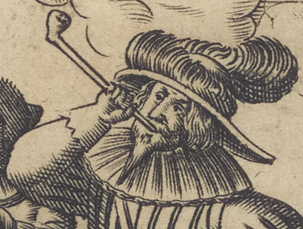
Detail from Lobspruch deß edlen hochberühmten Krauts Petum oder Taback Nuremberg, 1658 New York Public Library Public Domain
My grandson and parents found a 19th Century pipe bowl, much like the one pictured here, by the Thames where there were many fragments of clay pipe. For more on 17th Century smoking, have a look here.
On This Day
In Rome February 24th was the day of the 4 yearly leap day. The way they did it was to have two days called February 24th! It was the sixth day before the Calendars (March 1). This practice gradually got replaced by adding a new day, February 29th, at the end of the Month. In England, February 29th starts appearing in the 15th Century. But Wikipedia tells me:
‘the proceedings of the House of Commons of England continued to use the old system until the middle of the sixteenth century. It was not until passage of the Calendar (New Style) Act 1750 that 29 February was formally recognised in British law.’
It is said that the owner and playwright Richard Brinsley Sheridan replied to someone who was surprised to see him sitting quietly having a drink while his theatre burnt down: “A man may surely be allowed to take a glass of wine by his own fireside?” londonist.com
1832 – Cholera in London
‘The news of the Cholera being in London has been received abroad. According to the feelings of the different nations towards England, France, who wish to court us has ordered a quarantine in her ports of three days; Holland, who feels aggrieved by our conduct at the conference, one of 40 days. The fog so thick in London that the illuminations for the Queen’s Birthday were not visible. ‘
24th February 1832 Thomas Raikes, Diary 1832 (from ‘A London Year’ Compiled by Travis Elborough and Nick Bennison, 2013,
This was the second Cholera Pandemic, but the first to reach the UK. The second landed in Sunderland in October 1831. Cholera killed over 6,000 in London. It was called the Asiatic Cholera based on its origin. The Cholera came more virulently in subsequent decades. It was thought to be spread by a miasma in the air. But, John Snow proved it was caused by polluted water, but I will tell that story in another post.
I think the Conference mentioned above was the London Conference of May 1832, which aimed to establish a Kingdom of Greece with King. It was set up by Foreign Secretary Lord Palmerston without discussion with the Greeks and ended up giving them a Bavarian King. King Otto. Otto was forced from the throne in a revolution in 1862, and replaced by a Danish King, from whom Prince Philip, Duke of Edinburgh was descended.
1920 –The Conservative MP, Nancy Astor becomes the first woman to speak in the House of Commons. Constance Markievicz was the first woman elected as an MP in 1918, but she was a member of Siin Fein and did not take her seat.
First published in February 2024, republished in 2025, The Gregorian Calendar added in 2026, and On This Day also added. And Retitled too.
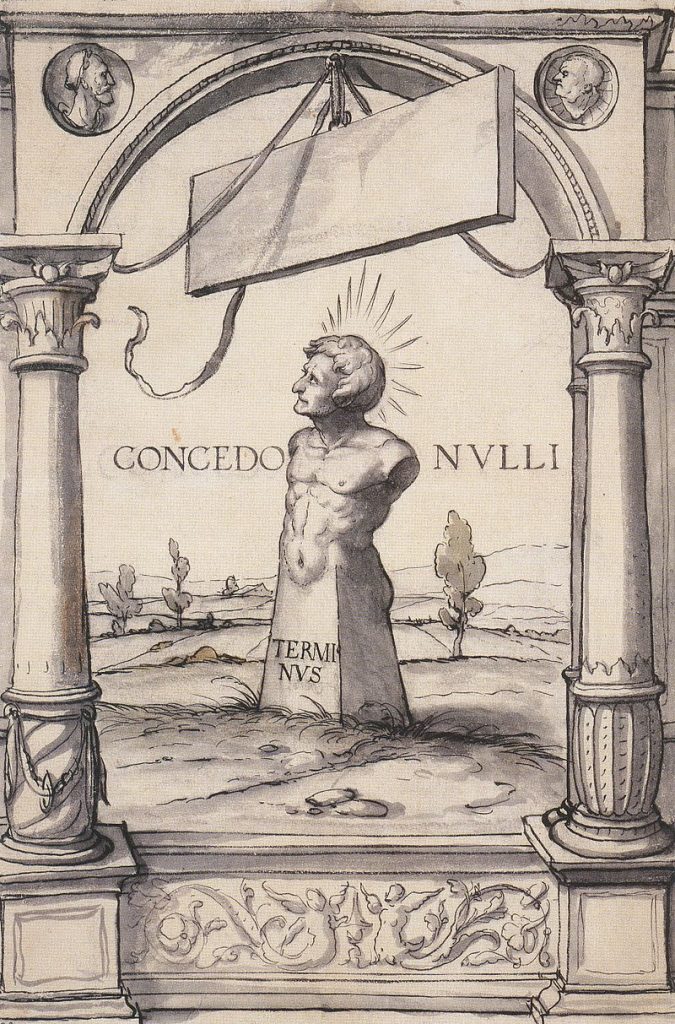
Hans Holbein the YoungerDesign for a Stained Glass Window with Terminus. Pen and ink and brush, grey wash, watercolour, over preliminary chalk drawing, 31.5 × 25 cm, Kunstmuseum Basel. ‘Terminus is often pictured as a bust on a boundary stone, His festival is ‘Terminalia’
Today is Terminalia, the Roman day for setting land boundaries. The festival of Terminus was a pastoral outdoor festival marking the boundaries of towns and villages. It resembles the Beating the Bounds tradition that we have in Britain. This is recorded, in the UK, from Anglo-Saxon times, and still continues in some parishes. I will talk about this on Ascension Day in May.
Terminus was an old ancient God who was the God of the boundary, the border, the edge, the liminal God. Ovid says King Tarquinus swept away the old Gods on the Capital Hill and Jupiter became the Great God. All the old temples were taken down, except for that of Terminus. Instead, Jupiter’s Temple was built around Terminus’ temple. They put a hole in the roof because Terminus had to be worshipped in the open air.
Terminus’s motto was “concedo nulli” which means “I yield to no one”. This was adopted by Erasmus as his personal motto in 1509.
Terminalia and the Roman Year
The Terminalia was celebrated on the last day of the old Roman year. February was the last month of the year. The rulers of Rome added an intercalary month called Mercedonius in an attempt to keep the Solar year in tune with the seasons. And when the intercalary month was added, the last five days of February were given to the month Mercedonius. The resulting ‘leap year‘ was either 377 or 378 days long. So, in those years, the 23rd of February was the Terminus of the year.
The intercalary months were added at the direction of the Pontiffs, supposedly every two or three years. But the Pontiffs were often swayed by political of financial advantage and delayed the decision. By the time of Julius Caesar, the seasons were wildly out of sync with the calendar year. The Dictator, responded by instituting a reform of the Calendar. It began with ‘the Year of Confusion’, over 400 days long.
The reforms introduced the Julian Calendar which realigned the calendar back in line with the seasons. It resolved the problem by adding leap day every four years. This was based on the almost correct calculation of a solar year being 365.25 days. It took another 1500 years before that inaccuracy was corrected. Then the year was another 11 days out of kilter, and the Julian Year was replaced by the Gregorian Year,
Here is what Ovid, in ‘Fasti’ says about Terminalis
When night has passed, let the god be celebrated With customary honour, who separates the fields with his sign. Terminus, whether a stone or a stump buried in the earth, You have been a god since ancient times. You are crowned from either side by two landowners, Who bring two garlands and two cakes in offering. An altar’s made: here the farmer’s wife herself Brings coals from the warm hearth on a broken pot. The old man cuts wood and piles the logs with skill, And works at setting branches in the solid earth. Then he nurses the first flames with dry bark, While a boy stands by and holds the wide basket. When he’s thrown grain three times into the fire
The little daughter offers the sliced honeycombs. Others carry wine: part of each is offered to the flames: The crowd, dressed in white, watch silently. Terminus, at the boundary, is sprinkled with lamb’s blood, And doesn’t grumble when a sucking pig is granted him. Neighbours gather sincerely, and hold a feast, And sing your praises, sacred Terminus: You set bounds to peoples, cities, great kingdoms: Without you every field would be disputed. You curry no favour: you aren’t bribed with gold, Guarding the land entrusted to you in good faith. If you’d once marked the bounds of Thyrean lands, Three hundred men would not have died, Nor Othryadesí name be seen on the pile of weapons. O how he made his fatherland bleed! What happened when the new Capitol was built? The whole throng of gods yielded to Jupiter and made room:
But as the ancients tell, Terminus remained in the shrine Where he was found, and shares the temple with great Jupiter. Even now there’s a small hole in the temple roof, So he can see nothing above him but stars. Since then, Terminus, you’ve not been free to wander: Stay there, in the place where you’ve been put, And yield not an inch to your neighbour’s prayers, Lest you seem to set men above Jupiter: And whether they beat you with rakes, or ploughshares, Call out: This is your field, and that is his! There’s a track that takes people to the Laurentine fields, The kingdom once sought by Aeneas, the Trojan leader: The sixth milestone from the City, there, bears witness To the sacrifice of a sheep’s entrails to you, Terminus. The lands of other races have fixed boundaries: The extent of the City of Rome and the world is one
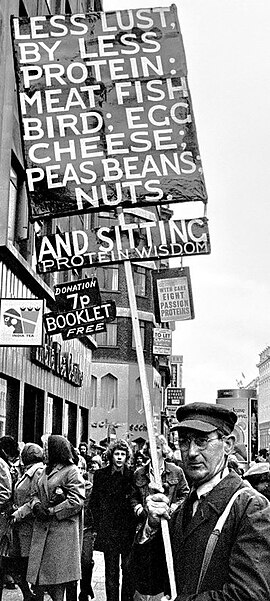
I was failing to find anything of significance to post when I came across a London Walks post about Stanley Green. Green was born on February 22nd in 1915. Most people who lived in London at the time, knew of him. He was always to be seen patrolling Oxford Street and other Central London Streets with his placard. He mounted a one-man campaign against too much protein. He thought it was a factor in promoting Lust. Lust was a bad thing. He campaigned, religiously, from 1969 to 1993, when he died.
Whether you agree with his views or not it is doesn’t diminish the impact an ordinary person had on an entire City. For more about him, including a podcast, have a look at the London Walks page here:
This post is dedicated to those people who are prepared to give up their normal lives to campaign for something they really believe in. If move of us did, the world would be a better but perhaps more eccentric world.
Mr Stop Brexit
Steve Bray, also known as Stop Brexit Man. (Wikipedia CC0)
Another one man campaigner, Mr Stop Brexit, Steve Bray, was to be seen outside Parliament, most days in the run up to Brexit. He perfected photobombing techniques, appearing in the background of interviews of prominent Brexit campaigners, or was heard over his megaphone. He is from Splott in Wales, and said he lost all his friends because they supported Brexit. He continues to campaign.
I must admit, I briefly considered dedicating my life to going to events Jacob Rees-Mogg attended, shouting ‘Brexit Opportunities!’ and collapsing in ironic laughter.
On this day contains items I come across. But more often from looking at Chambers Book of Days, or Wikipedia’s page for the date (today February 22nd). Occasionally I use the Perpetual Almanac of Folklore by Charles Kightley, or other almanacs, and random websites.
Sadly, i cannot find very much that interests me to day!
In Ancient Rome, today, was the Caristia, the day of family peace and household accord, dedicated to Concordia. The previous days have been dedicated to the dead. Today is for the living family members. Ovid seems pleased to return to the living but makes it clear the day is best enjoyed without the really annoying members of the family!
Ovid writes of the day as follows:
Book II: February 22 The next day has its name, Caristia from our dear ‘cari’ (kin), When a throng of relations gathers to the family gods. It ís surely pleasant to turn our faces to the living, Once away from our relatives who have perished, And after so many lost, to see those of our blood Who remain, and count the degrees of kinship. Let the innocent come: let the impious brother be far, Far from here, and the mother harsh to her children, He whose father ís too long-lived, who weighs his mother’s years, The cruel mother-in-law who crushes the daughter-in-law she hates. Be absent Tantalides, Atreus, Thyestes: and Medea, Jason’s wife: Ino who gave parched seeds to the farmers: And Procne, her sister, Philomela, and Tereus cruel to both, And whoever has gathered wealth by wickedness. Virtuous ones, burn incense to the gods of the family, (Gentle Concord is said to be there on this day above all) And offer food, so the robed Lares may feed from the dish Granted to them as a mark of esteem, that pleases them. Then when moist night invites us to calm slumber, Fill the wine-cup full, for the prayer, and say: Health, health to you, worthy Caesar, Father of the Country! And let there be pleasant speech at the pouring of wine.
From A S Kline’s translation of Fasti which can be found here.
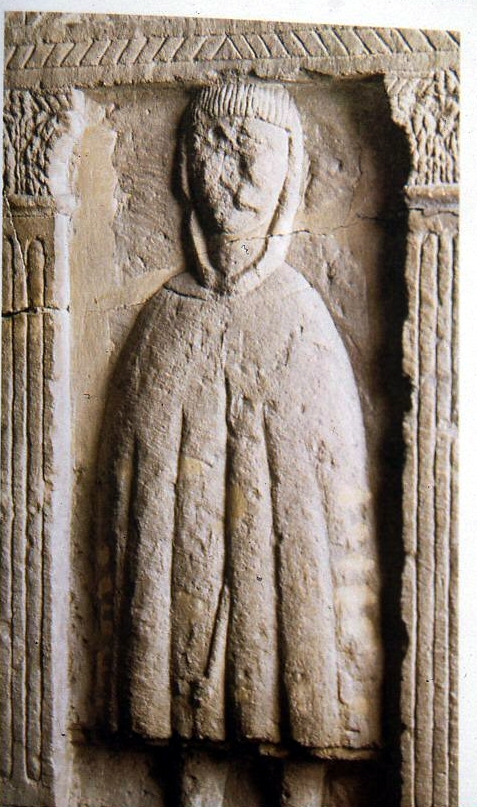
Tombstone of Philus from Cirencester (Corinium Dobunnorum) showing his rain cloak
Feralia & Parentalia
Feralia is the last day of Parentalia a 9-Day Festival for the spirits of the Dead. It is described in some detail by the Roman Poet, Ovid, in his Almanac of the year called the ‘Fasti’. Here, he describes how to honour a parent:
And the grave must be honoured. Appease your father’s Spirits, and bring little gifts to the tombs you built. Their shades ask little, piety they prefer to costly Offerings: no greedy deities haunt the Stygian depths. A tile wreathed round with garlands offered is enough, A scattering of meal, and a few grains of salt, And bread soaked in wine, and loose violets: Set them on a brick left in the middle of the path. Not that I veto larger gifts, but these please the shades: Add prayers and proper words to the fixed fires.
There is much more Ovid says about Feralia, and you can read it for free, in translation by A. S. Kline (which I used above, at www.poetryintranslation.com)
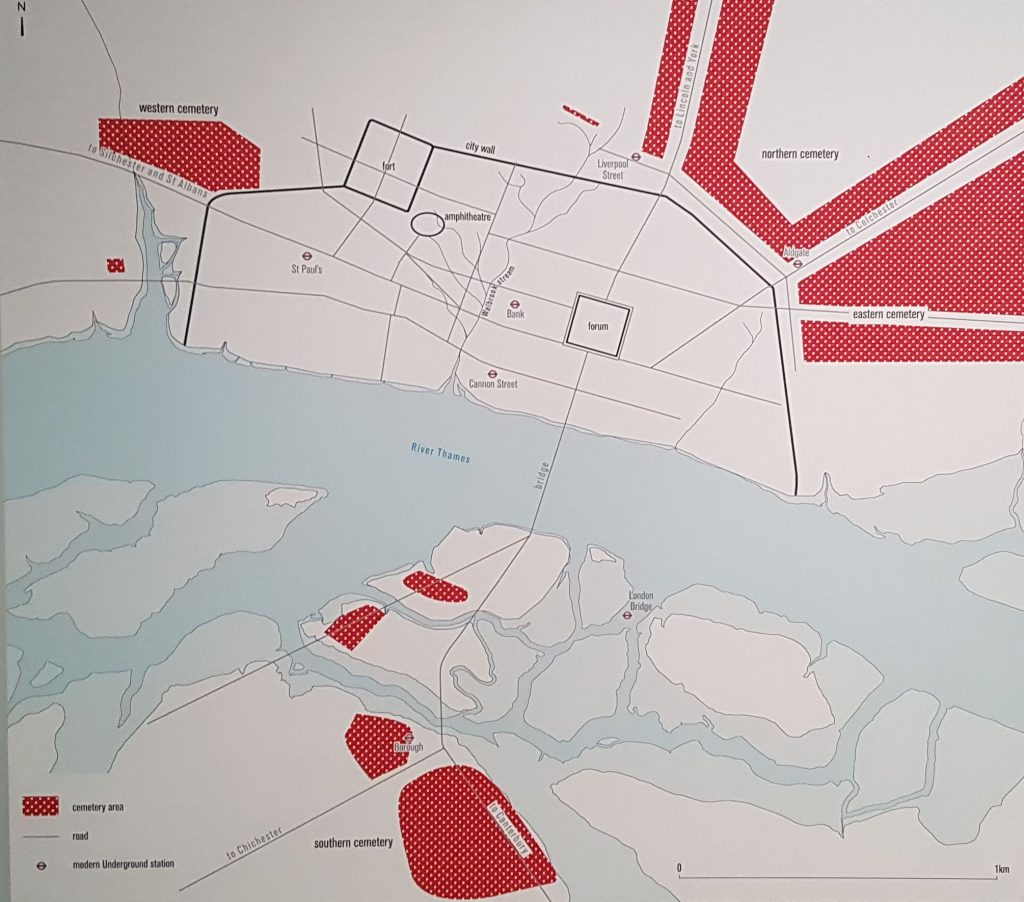
In London, archaeologists have found many Roman cemeteries around the City of London. The Romans forbade burial inside the City limits. So, the dead were buried alongside the main roads out of the City Gates. Aldgate towards Colchester, Bishopsgate to the North. Ludgate along Fleet Street to the West. Newgate to Holborn and the North West. From London Bridge to Southwark and the South. These are the places that parents would be remembered at Feralia.
Map of Roman Cemeteries from the Museum of London exhibition on the Roman Dead, showing the River Thames and River Fleet. Holborn is to the left, marked ‘Western Cemetery’.
Roman Burials
Roman Mortaria
Various rites have been observed. Both inhumation and cremation were practised. I remember excavating a Roman mortaria with a hole in the bottom with the ashes of the dead in it. These large bowls were used as a mortar for grinding foodstuffs. The bottom was deliberated gritted, but they often wore through, and sometimes were reused to hold cremation ashes. I like to imagine, granny being buried in her favourite cooking vessel (or maybe a grandad who baked?).
Many bodies were covered in chalk, perhaps to help preserve the body. A surprising number of bodies are found with the head by the knees. The large number of cases fuels speculation that this was a burial rite, of whom only a percentage were beheaded as a punishment. In York, near Micklegate archaeologists found a large number of beheaded graves in a cemetery thought to be of gladiators. Other graves shown signs of a funeral pyre.
Author’s photograph of a skeleton displayed at the Roman Dead Exhibition, Museum of London, She was between 26 and 35 years old, who lived a hard life, and possibly had anaemia. Her head was severed either: before and causing death, or shortly after death, and placed between her legs as shown.
Procurator Classicianus.
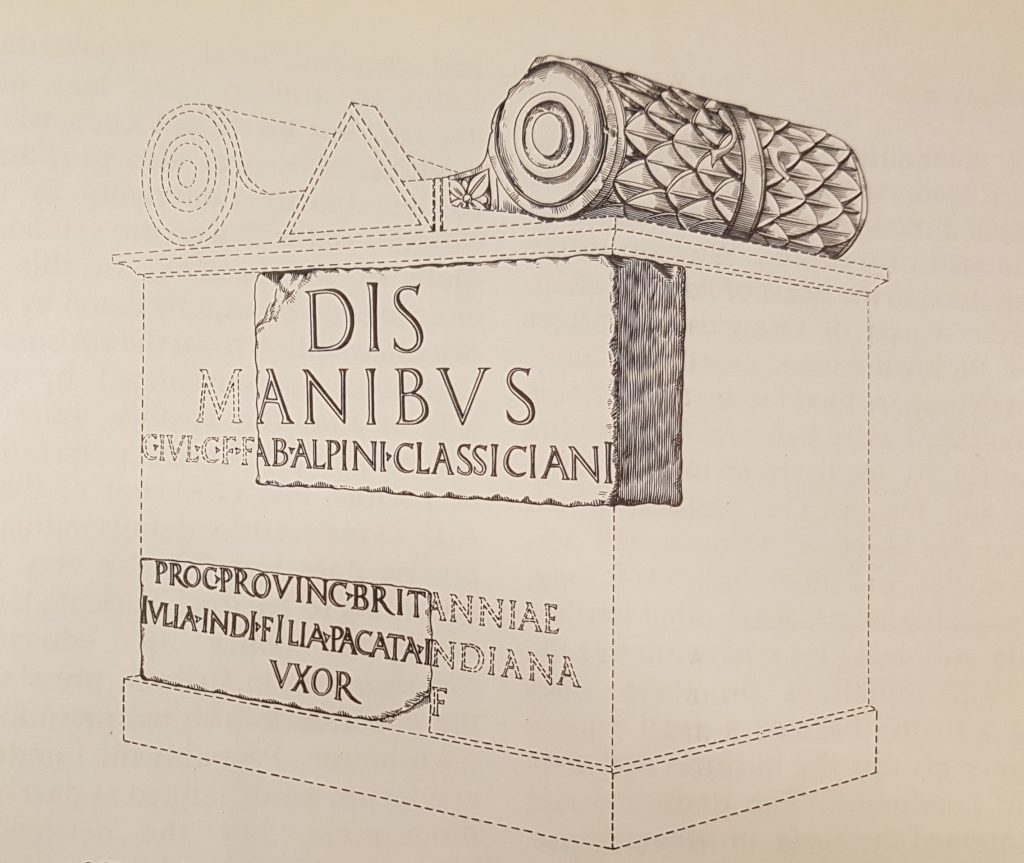
The rich and powerful were remembered with huge monuments, prominently sited along the main roads. The most famous are the burial stones found at Tower Hill of the Procurator Classicianus. What makes this special is that he is mentioned in Roman accounts of the Boudiccan Revolt of AD 60-61. He suggested to Nero that the Province would only be saved if the revenge against the British was de-escalated. Nero wisely withdrew the vengeful Roman Governor Suetonius Paulinus and replaced him with someone ready to conciliate. The Romans held the province successfully for 350 years or so more.
Reconstruction drawing of two stones found while building Tower Hill Underground Station. They read, something like, ‘To the Spirits of the Dear Departed Fabius Alpini Classicianius, Procurator of the Province of Britannia.Julia, Indi (his wife) Daughter of Pacata of the Indiana voting tribe. Had This Set up.
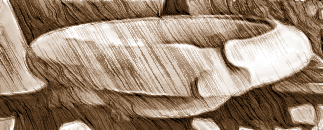
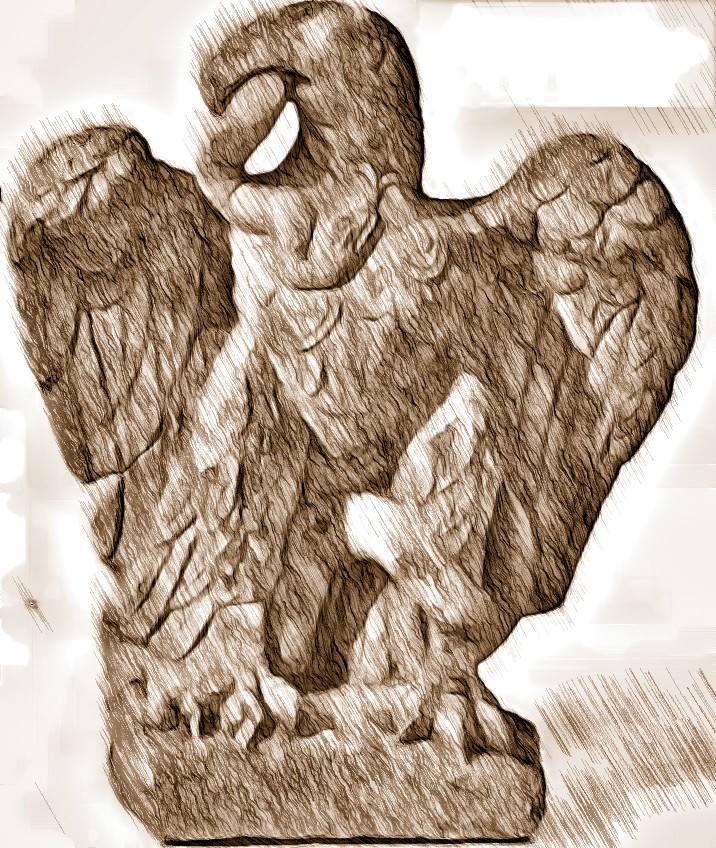
Sketch of a stone Eagle found in 2013 at an excavation at the Minories just outside the eastern side of the Roman Wall in the City of London.
A beautiful carved eagle which adorned a tombstone was found in the Cemetery in Tower Hamlets. Recently, a very grand mausoleum was excavated in Southwark. To find out more, have a look at the BBC website here:
Funerary Bed in Holborn
Finally, a couple of years ago an excavation ran by MOLA discovered a ‘funerary bed’ just outside Newgate in Holborn. It was on the banks of the River Fleet, a tributary to the River Thames. The fluvial location meant that there were extraordinary levels of preservation, which included this bed. It was dismantled and buried in the grave. It may have been a bed used as a grave good, perhaps for use in the hereafter. Or it might have been the bed upon which the deceased was carried to the funeral. (Or both?)
Reconstruction of a Roman ‘Funerary’ Bed found dismantled in Holborn, London (Sketch from a MOLA reconstruction drawing)
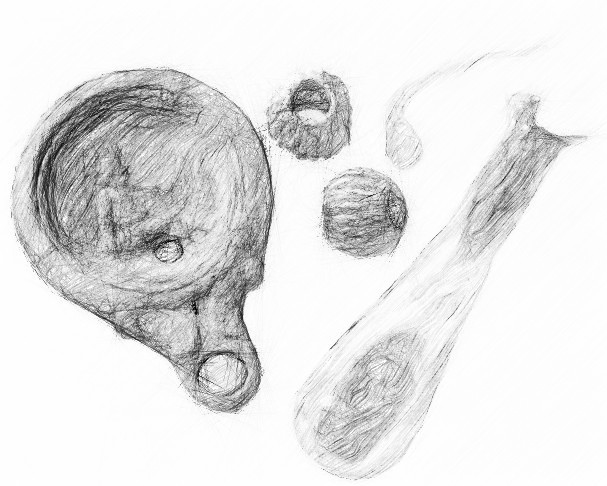
They found other grave goods. These included an olive oil lamp decorated with an image of a gladiator; jet and amber beads and a glass phial.
1804 – Richard Trevithick‘s steam locomotive is put on wheels at the Pen-y-Darren Ironworks in Wales. and shows its capability for pulling heavy loads. Unfortunately, the Engine weighs so much it breaks the rails, so the wheels are taken off.
Toad, Frogs & Newts Migration – as the weather warms up a little, later in February is when the amphibians wake up from hibernation, and begin their annual migration to their home pond for spawning. They may walk/hop/slither up to 2 kilometres. The kind people at www,froglife.org coordinate Toad Patrols to help toads across the roads that have sprung up along their traditional migration paths.
In the Garden – prune deciduous shrubs such as Buddleia and Spiraea. Sow seeds indoors. Order lots of compost.
First Published in February 2024, revised 2025, On this Day added 2026
A man born in Pisces shall be a great goer, a fornicator, a mocker and covetous: he will say one thing and do another. He shall trust is his sapience, he shall have good fortune: He will be a defender of widows and orphans. He shall be fearful on water: he shall soon pass all adversities and live 72 years after nature.
The woman shall be delicious, familiar in jests, pleasant of courage, fervent, a great drinker. She shall have sickness of her eyes and be sorrowful by shame, needlessly. Her husband will leave her and she shall have much trouble with strangers. She shall travel much, have pain in his stomach and live seventy-seven years.
Both man and woman shall live faithfully.
Kalendar of Shepherds, 1604 (from the Perpetual Almanac by Charles Kightly)
What surprises me about the fortune-telling above is that it has to be nearly always wrong as the predictions are way too specific. The art of the fortune-telling is about being vague, with subtle predictions that can be interpreted in different ways.
Here is Old Moore’s Prediction for Pisceans this week:
‘Innovation and originality flow freely as your unique perspective solves problems that stump others. Social consciousness drives you toward meaningful causes or community involvement. While your independent streak is strong, collaboration with like-minded individuals amplifies your impact. An unexpected insight arrives through friendship.‘
Now, the Old Moore’s 2023 Almanac had a page on Liz Truss of all people, written before she became Prime Minister. It is clear they thought she had a real chance of being PM. They say she has ‘an almost steely determination and plenty of apparent ambition. …. She has every astrological requirement necessary to keep her nose clean and at this moment in time is certainly among the main contenders.‘. So yes, they are right about her being among the main contenders, but absolutely no hint of the epic disaster that her PMship was.
London Stone as a Palladium
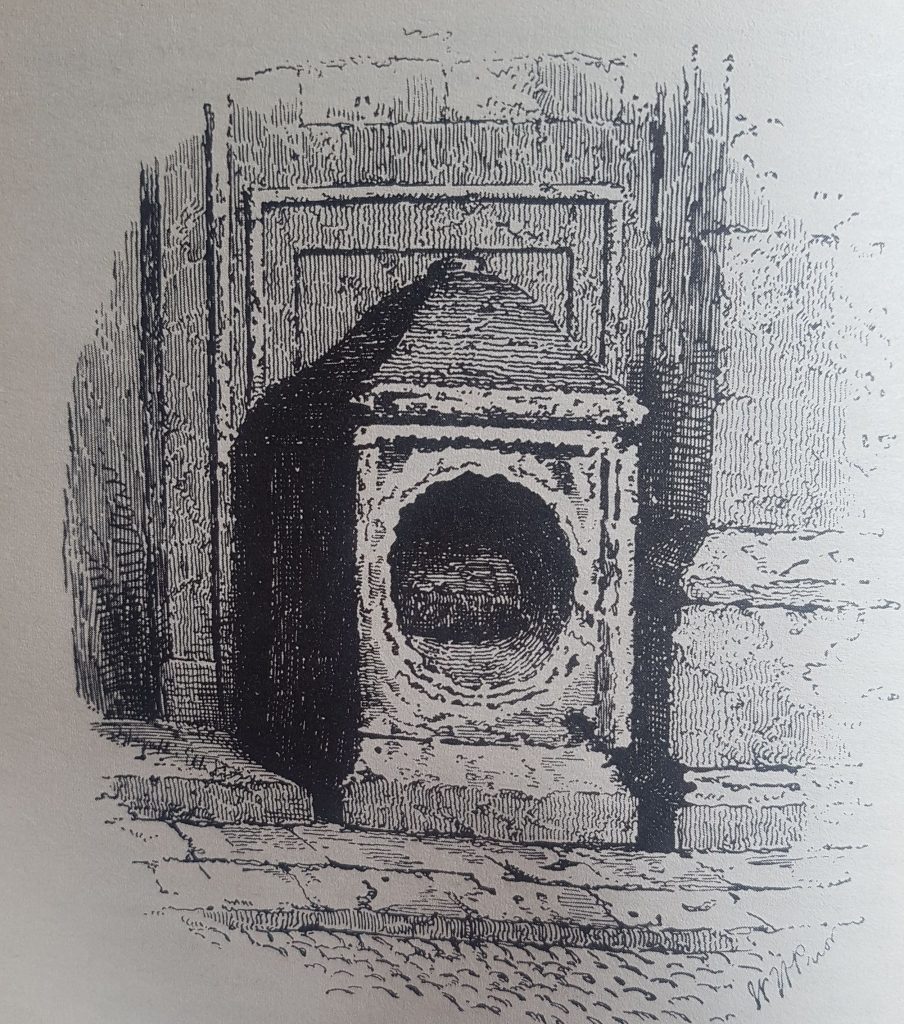
Old Engraving of London Stone, Cannon Street
On February 18th, I revised a post about Ravens, King Bran’s Head and other Palladiums that protected Britain (or London) from invasion. If you missed it, look here. A possible palladium I missed out is London Stone. To remind you, a palladium is something that stops your country or City being harmed or invaded.
London Stone is an eponymous stone found in Cannon Street, in the heart of the City of London, It is first mentioned in the 12th Century, and no one knows why it was famous. In 1862, an ‘ancient proverb’ surfaced:
“So long as the Stone of Brutus is safe, so long shall London flourish”
It was made anonymously in the journal Notes and Queries. In Welsh, it was “Tra maen Prydain, Tra lled Llyndain’. This verse, if genuine, would link the Stone to Brutus of Troy, the legendary founder of London. To be precise: by genuine, I don’t mean it would prove the stone was linked to King Brutus, or that Brutus was a real person. I mean, if genuine, it would prove that in the medieval period the stone was linked to Brutus.
However, the writer has been identified as Richard Williams Morgan, who was a passionate Welsh Nationalist and prolific author. He was, also, not very scrupulous with his analysis of sources. As no earlier source can be found, it is thought Morgan made it up.
He lived in London in the 1850s and was very struck by the London Stone. Archaeologists prefer the idea that London Stone is, likely, a milestone from which the Romans measured distance. For Shakespeare, it was the stone on which rebel Jack Cade claimed lordship of London. For the romantic, it was a coronation stone; a stone of power; the sword in the stone, stone; or an ancient megalith. The truth is, we have no idea. But it has been called the London Stone since the 12th Century. Why was it so named, and what was it ‘for’ or symbolic of?
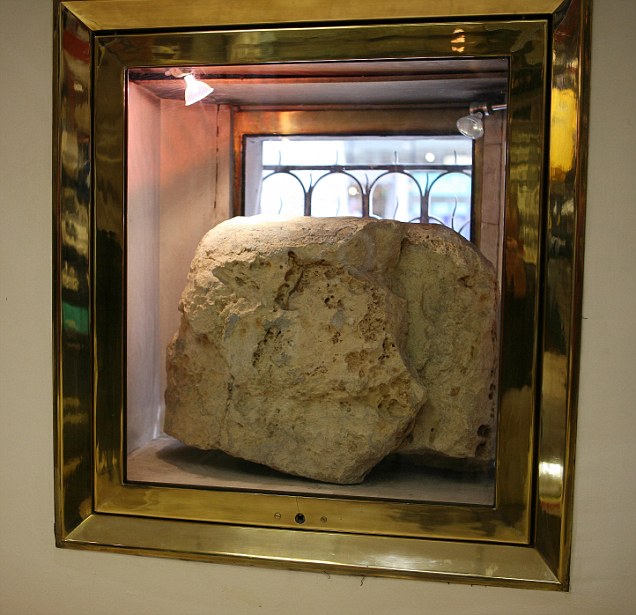
Pic by Graham Hussey pic shows the LONDON STONE which is in Canon Street, London .pic taken inside the Tech Sports shop
Morgan came to the conclusion it was the stone plinth on which the original Trojan palladium had stood. This was a wooden statue of Pallas Athene, that protected Troy from invasion. It was stolen by Odysseus and Diomedes shortly before the successful Trojan Horse plot. It was then taken to Italy.
Morgan’s idea was that King Brutus brought it from Rome when he sailed into Exile in Britain. Brutus, was a descendant of Aeneas. Aeneas was the only Trojan leader to escape from the destruction of Troy. He found his way to Rome, after leaving Dido in Carthage. He was the ancestor of Romulus who founded Rome, and the ancestor of King Brutus.
According to legend, Brutus gathered all the Trojan slaves and exiles in the Mediterranean. He then sailed to found a new Troy in our green and pleasant lands. His new capital he called Troia Nova (New Troy), which became Trinovantum, then Lud’s Dun, and finally London. Or so the Myths say.
Morgan’s theory held that the Stone was used as the altar stone of the Temple of Diana. Folklorist contend that the temple was originally on the site of St Pauls Cathedral. Morgan (in the 19th Century) was the first person to link London Stone with Brutus, or so people thought and still think (see Wikipedia). That was until 2018.
London Stone as recently rehoused.(Photo K Flude)
John Clark
John Clark, Emeritus Curator at the Museum of London, found a reference to a narrative poem of the 14th Century. This links London Stone to Brutus and to the future prosperity of London. Just as Morgan did. So, it makes it possible, at least, that Morgan did not just make the connection but drew on a medieval ‘tradition.’
Brutus set up London Stone And these words he said anon: ‘If each king that comes after me Makes this city wide and roomy As I have in my day, Still hereafter men may say That Troy was never so fair a city As this city shall be.’
From Burnley & Wiggins 2003b, lines 457–64(John Clark’s modern English version)
Recent archaeological discoveries reveal that London was the site of Late Neolithic feasting on a possibly large scale (discussed here:). This increases the possibility that the London stone is a ‘ritual’ stone from prehistory. But, of course, there is still no evidence that London Stone is prehistoric, and even less that Brutus actually existed.
On This Day
1472 – Orkney and Shetland are given to Scotland by Norway in lieu of dowry for Margaret of Denmark.
1933 – Adolf Hitler meets with German industrialists to arrange for financing of the Nazi Party’s election campaign. Democracy is doomed.
Written in 2023 and revised in February 2024 and 2025 Pisces and London Stone joined into one page 2026
Photo Mohammad Amiri from unsplash. Notice the crimson stigma and styles, called threads, Crocus is one of the characters in Ovid’s Metamorphoses
The story of Crocus and Smilax is in Ovid’s Metamorphoses. The book tells the story of myths which involve the metamorphosis of a person to a flower, or to a constellation, or to an echo or some supernatural change in being. This poem is one of the most famous in the world, written in about 6 AD. It influenced Dante, Bocaccio, Chaucer, Shakespeare, Keats, Bernard Shaw, and me. Seamus Heaney and Ted Hughes have translated modern versions of some of the tales.
The mechanicals in ‘The Midsummers Night Dream’ perform Ovid’s story of Pyramus and Thisbe, Titian painted Diana and Actaeon. Shaw wrote about Pygmalion, and we all know the story of Arachne. She claimed to be better than Athene at weaving. And then was turned into a spider.
The poem is about love, beauty, change, arrogance and is largely an Arcadian/rural poem. This is a contrast to Ovid’s ‘Art of Love’ which I use for illustrations of life in a Roman town. The stories are all about metamorphoses, mostly changes happening because of love. But it is also an epic as it tells the classical story of the universe from creation to Julius Caesar.
Ovid’s Metamorphoses and the Crocus
‘Crocus and his beloved Smilax were changed into tiny flowers.’ Ovid tell us, but chooses to give us no more details. So we have to look elsewhere. There are various versions. In the first, Crocus is a handsome mortal youth, beloved of the God Hermes (Mercury). They are playing with a discus which hits Crocus on the head and kills him. Hermes, distraught, turns the youth into a beautiful flower. Three drops of his blood form the stigma of the flower. In another version, Crocus and the nymph Smilax, fall in love. And are rewarded by immortality as a flower. One tale has Smilax turned into the Bindweed.
Morning Glory or Field Bindweed photo Leslie Saunders unsplash
Ovid’s Metamorphoses and Bindweed
It turns out that Smilax means ‘bindweed’ in Latin. Bindweed is from the Convolvulus family, and I have grown one very successfully in a pot for many years. But they have long roots. According to the RHS ‘Bindweed‘ refers to two similar trumpet-flowered weeds. Both of which twine around other plant stems, smothering them in the process. They are difficult to remove. This, could suggest that Smilax is either punished for spurning Crocus, or that she smothered him with love. Medically, Mrs Grieve’s Modern Herbal says all the bindweeds have strong purgative virtues, perhaps another insight into Smilax’s psychology?
The Metamorphosis of Data and the correct use of the plural
Apparently, in the UK some say crocuses and others use the correct Latin plural, croci. On an earlier version of this post I used the incorrect plural crocii.
On the subject of Roman plurals, the Financial Times editorial department made an earth-shattering decision, a couple of years ago. They updated their style guide to make the plural word data (datum is the singular form) metamorphise into the singular form.
So it is now wrong to say ‘data are’ but right to say ‘data is’. For example, it was correct to say: ‘the data are showing us that 63% of British speakers use crocuses as the plural’ but now, it is better to write ‘the data is showing us that 37% of British people prefer the correct Latin form of croci’.
Violets and Crocuses
Violets and crocuses are coming out. They often come out for St Valentine’s Day, and so obviously associated with Love. White croci usually represented truth, innocence, and purity. The purple variety imply success, pride and dignity. The yellow type is joy.’ according to www.icysedgwick.com/, which gives a fairly comprehensive look at the Crocus.
Crocus & Saffron
The autumn-flowering perennial plant Crocus sativus, is the one whose stigma gives us saffron. Roman civilisation spread the plants around Europe. They used it for medicine, as a dye, and a perfume. It was much sought after as a protection against the plague, and extensively grown in the UK. Saffron Walden was a particularly important production area in the 16th and 17th Centuries.
Saffron in London
Snowdrop, Crocus, Violet and Silver Birch circle in Haggerston Park. (Photo Kevin Flude, 2022)
The Bishop of Ely grew Saffrom in his beautiful Gardens just outside of the City of London. The area remembered by the London street name: Saffron Hill. It is home to the fictional Scrooge. This area became the London home of Christopher Hatton, the favourite of Queen Elizabeth 1. His garden was on the west bank of the River Fleet, in London EC1, in the area now known as Hatton Garden. (For more on Christopher Hatton see my post on nicknames Queen Elizabeth I gave to her favourites).
I found out more about Saffron from listening to BBC Radio 4’s Gardener’s Question time and James Wong.
Croydon (on the outskirts of London) means Crocus Valley. A place where Saffron was grown. The Saffron crops in Britain failed eventually because of the cost of harvesting, and it became cheaper to import it. So, we now import it from Spain, Iran, and India amongst other places. But it is being reintroduced in Norfolk, Suffolk, Kent, and Sussex. These are – the hot and dry counties. The plant enjoys a South-facing aspect. But it needs protection from squirrels and sparrows who love it. To grow it, look at this post from the Garden Doctor.
Saffron Photo by Vera De on Unsplash
Violets
Viola odorata CC BY-SA 2.5 Wikipedia
The Celts used Violets as cosmetics; the Athenians to moderate anger; the Iranians for insomnia, and are loved by all because of their beauty and fragrance. They have been symbols of death for the young, and used as garlands, nosegays posies, which Gerard says are ‘delightful’.
For more on Ovid, use the search facility (click on menu) or read my post here.
On This Day
197 – The Battle of Lugdunum sees the victory of Septimius Severus over Clodius Albinus reputedly the bloodiest battle between Roman armies. The previous emperor Pertinax died in 193 during the Year of the Five Emperors. Three main contenders emerged Severus who was African, Niger was from Central Italy, Albinus was the Governor of Britain.
1800 – Napoleon proclaims himself First Consul making him the dictator of France.
1846 – The Republic of Texas officially transfers power to the State of Texas government and becomes part of the United States.
1878 – Thomas Edison patents the phonograph.
1945 – Battle of Iwo Jima began with the landing of 30,000 US troops.
Ash Wednesday this year is early and on 18th February. It is the First Day of Lent, the solemn time which runs up to Easter, and is symbolic of Jesus’ 40 days in the wilderness.
In Anglo Saxon the name for the season of Spring was ‘lencthen’. It is thought to derive from the idea of the lengthening days. Days do suddenly seem to have got longer. These are the official times for the evening:
Sunset: 17:21
Dusk (Civil twilight ends) : 17:55
Nightfall (Nautical twilight ends) :18:34
Full Darkness starts (Astronomical twilight ends) : 19:13
So strictly, Lent means Spring. The Romance languages use the term which derives from the Latin ‘Quadragesima’ which means the 40 days of Fast. Spanish (Cuaresma), French (Carême), and Italian Quaresima). For Germans, it is the fasting time: fastenzeit. In England, Lent became a specialised word for the fast period. And Spring took over as the name of the season.
A time of fasting? Time for reflection? Maybe once upon a time. When I was young, it was 40 days when you were supposed to give something up. Smoking, or drinking, or chocolate. An idea taken up by a new generation, as, for example, Dry January? A time of reflection? No, never did that.
Dust to Dust and Stardust
Ash Wednesday is named after the ashes smeared on the heads of worshippers to remind us that we are dust. I’ve never seen this done either. My footballing Vicar friend Andrew missed our Wednesday Game so that he could mark foreheads with ash crosses. The ashes were traditionally made from palms used for Palm Sunday decorations, which is indeed what Andrew did. Look here to see my post on Palm Sunday.
On the subject of dust, here are some spiritual lyrics by Joni Mitchell. Something profound in the true idea that we are all stardust.
We are stardust We are golden And we’ve got to get ourselves Back to the garden
Woodstock by Joni Mitchell
40 Days
We all know that there are 40 days in Lent, except there are not. It’s 46 this year. This was pointed out by Tim Harford who presents a BBC radio programme called ‘More or Less’. It is a programe about statistics, or more widely about Fact Checking statistics in the news. Last year he discussed the 40 days. One answer proposed was to take away Sunday. But, my mathematics tells me this still leaves 42. The answer Tim Harford came up with is that 40 days just means a long time.
It is the length of time of Lent, but also:
The duration of the Great Flood The time Moses was on Mt Sinai The time the Israelites spy on Canaan Goliath trails Saul Elijah Walks Jesus is tempted n the Desert The time from Resurrection to Ascension
In other words, a long time to be doing any one thing. As Hartford says, it’s like our word ‘umpteenth’. As in ‘Kevin this is the umpteenth time I’ve told you to tidy your bedroom’. That’s what my mother said to me as she threw my clothes out of the window.
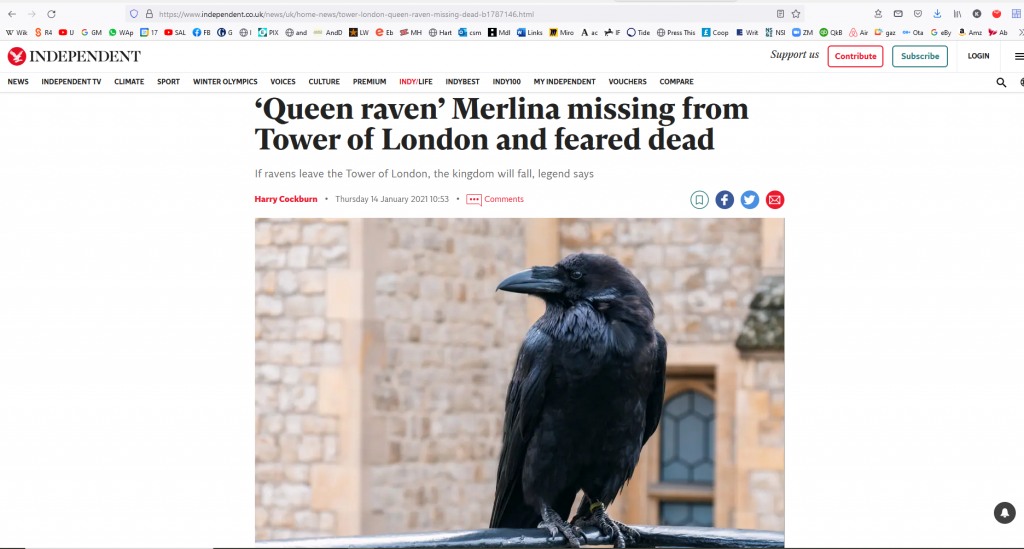
The Independent January 2021 The Raven the Palladium of Britain
The Raven – the Palladium of Britain
Corvus corax is hatching. An early nesting bird, the Raven is the biggest of the Corvids. They were pushed to the west and north by farmers and game keepers but are making a comeback. Ravens are finding towns convenient for their scavenging habits. So they, again, cover most of the UK except the eastern areas. The Raven is one of the Palladiums of Britain.
A Palladium is something that keeps a city or country safe, They are named after a wooden statue of Pallas Athene, which protected Troy. Perceiving this, Odysseus and Diomedes stole the Palladium from Troy shortly before the Trojan Horse episode. Troy fell and the palladium went to Italy (I’m guessing with Diomedes who is said to have founded several cities in Italy). It ended up in Rome.
The Romans claimed to be descendants of Trojan exiles led by Aeneas. So it was back with its rightful owners. It protected Rome until it was transferred to the new Roman capital at Constantinople. It then disappeared, presumably allowing the Ottoman Turks to conquer the City of Caesar? To read of London Stone as a Palladium see my post here.
The Ravens habits (it is said they know where the battlefields are before they are fought) and their black plumage have made them harbingers of death. In poetry, Ravens glut on blood like the warriors whose emblem they are. Here is a very famous quotation from Y Gododdin, a medieval poem but thought to derive from a poem by the great poet Aneirin from the 7th Century.
‘He glutted black ravens on the rampart of the stronghold, though he was no Arthur.’
This is one of the much argued-about references to King Arthur in the ‘Was he a real person’ trope. The point being, it doesn’t make sense to mention Arthur if King Arthur wasn’t a real person. The story at the Tower of London is that the Ravens kept in the Tower, with clipped wings, keep Britain safe from Invasion. (But see below).
Bran’s Head – the original Palladium of Britain?
By Sonny Mauricio from Unsplash
The Raven was also the symbol of the God-King Bran. Bran was one of the legendary Kings of Britain. His sister, Branwen, was married to the King of Ireland. To cut a long story short, Branwen was exiled by her Irish husband to the scullery. She trained a starling to smuggle a message to her brother, to tell of her abuse.
So Bran took an army over the Irish Sea to restore her to her rightful state. But the ships were becalmed. Mighty Bran blew the boats across the sea – he was that much a hero. Bran was mortality wounded in the fighting that followed. This was a problem because he had previously given away his cauldron of immortality. He gave it to the Irish King in recompense for the insults given to the Irish by Bran’s brother, who hated anyone not British.
Bran’s Head Returns to London
So, the dying Bran, told his companions to cut off his own head and take it back to the White Hill in London. His head was as good a companion on the way back as it was on the way out, and the journey home took 90 years.
At last, they got to London, where Bran told his men to bury his head on the White Hill. As long as it stays here, he said, Britain would be safe from foreign invasion. The White Hill is said to be Tower Hill with its summit at Trinity Gardens, although Primrose Hill is sometimes offered as an alternative.
This was one of the Three Fortunate Concealments and is found in ‘the Triads of the Island of Britain.’ The Triads are from medieval manuscripts which preserve fragments of folklore, mythology and history. They are grouped in groups of three.
Arthur and Bran’s Head
But many years later, King Arthur saw no need for anybody or anything other than himself to protect the realm. So he had the head dug up. Calamity followed in the shapes of Sir Lancelot and Mordred which led to the end of the golden age of Camelot and conquest of Britain by the Saxons. This was one of the Three Unfortunate Disclosures.
If we want a rational explanation for the story, there is evidence that Celtic cultures venerated the skull, and palladiums play a part in Celtic Tales.
So what was Arthur doing destroying the palladium that kept Britain safe? Vanity is the answer the story gives. But, perhaps, it’s a memory of Christian rites taking over from pagan rituals? God, Arthur might have thought, would prefer to protect his people himself rather than Christians having to rely on a pagan cult object.
Ravens in the Tower of London
The story of Bran’s head is inevitably linked to the Ravens in the Tower who, it is still said, keep us safe from invasion. As you can see from the photo at the top we still get in a tizz when one goes missing.
Sadly, and I am probably sadder about this than most, the link between the Tower, Bran, and the Ravens cannot be substantiated. Geoffrey Parnell, who is a friend of mine, told me that while working at the Tower of London he searched the records assiduously for the story of the ravens. He found no evidence of the Raven myth & the Tower before the 19th Century, and concluded that it was most likely a Victorian invention. IanVisits has a 2025 story about the Ravens, and also concurs that the Ravens are a recent myth.
The Welsh Triads give a total of two palladiums for Britain, a couple of nationalistic fighting dragons.
The Head of Bran the Blessed, son of Llyr, which was concealed in the White Hill in London, with its face towards France. And as long as it was in the position in which it was put there, no Saxon Oppression would ever come to this Island; The second Fortunate Concealment: the Dragons in Dinas Emrys, which llud son of Beli concealed; And the third: the Bones of Gwerthefyr the Blessed, in the Chief Ports of this Island. And as long as they remained in that concealment, no Saxon Oppression would ever come to this Island.
All good but then came:
The Three Unfortunate Disclosures:
And there were the Three Unfortunate Disclosures when these were disclosed. And Gwrtheyrn the Thin disclosed the bones of Gwerthefyr the Blessed for the love of a woman: that was Ronnwen the pagan woman; And it was he who disclosed the Dragons; And Arthur disclosed the head of Bran the Blessed from the White Hill, because it did not seem right to him that this Island should be defended by the strength of anyone, but by his own.
Gwrtheyrn is Vortigen, the leader of the Britons after the fall of the Roman Empire in Britain, one or two leaders before Arthur. Vortigern, which means something like strong leader in Welsh was a real person in so far as he, unlike Arthur, is mentioned by Gildas a near contemporary source.
The story of the dragons is supposedly from the pre-Roman Iron Age. Every May Day, the Dragons made a terrible noise, causing miscarriages and other misfortunes. So, King Ludd, whom legends says gave his name to London (Ludd’s Dun or Ludd’s walled City), drugged the dragons. He had them buried in a cavern at Dinas Emrys in Eryri (Snowdonia). The Red Dragon represented the Britons (also called the Welsh) and White Dragons the Saxons.
Vortigern, Merlin and Vortimer
Hundreds of years later, (five hundred?) after the Romans had come and gone. Vortigern was trying to build a castle in Eryri at Dinas Emrys. But the walls keep falling down. ‘You need the blood of a boy born not of man’, his necromancers say. They find a boy called Ambrosius aka Merlin whose mother had lain with an incubus. Merlin accused the necromancers of ignorance and explains the wall collapse is caused by two dragons. They find the cavern and let the dragons go. The walls now stand undisturbed. But the Welsh Red Dragon and the Saxon White Dragon can not now be at peace, and the Britons are defeated by the Saxons.
Vortigern betrayed his own people for the lust of Rowena the daughter of Hengist, the Saxon. Hengist was given the province of Kent as his reward, and thus began the Anglo-Saxon take over.
Vortigern’s son is Gwerthefyr (or Vortimer). He was a better man than his dad and fought to keep the Saxons out. After Vortimer’s death his bones were buried at the chief ports on the South Coast. Here they acted as a palladian and they kept the country safe. But they were moved to Billingsgate, in London and put in a Tower. The loss of the palladium allowed the Saxons to land safely on the Kent coast and consolidate their increasing hold over Britain and turning it into England.
Birds in Love
Here is a lovely little medieval poem. It was found in 1931 in the end leaf of a manuscript where someone had been testing their goose quill and scribbled these three lines:
Why it is so wet in the UK at the moment (February 18th)? The answer seems to be that there is a block of cold weather over the States that is moving the Jet Stream south, bringing lots of wet weather. But there is also another block of cold weather over Scandinavia. This means that the low pressures being driven by the Jet Stream, have no where to go and are stopping and dumping their rain all over the UK.
3102 BC – the death of Krishna starts Kali Yuga, the fourth and final yuga of Hinduism.
1478 – George, Duke of Clarence, traitor to his Brother, Edward IV, was executed in private at the Tower of London. It is said he was drowned in a vat of Malmsey Wine.
1678 – First Part of Pilgrim’s Progress by John Bunyan published.
1991 – The IRA plant bombs at Paddington station and Victoria station in London. The IRA gave warnings, and the Victoria bomb went off at 4.20am and caused no casualties. At or just before 7am, the IRA warned that all London Stations were to be bombed in 45 minutes time. The Authorities were slow to clear the stations and at Paddington a bomb went off at 7:40am. 1 person was killed and 38 people were injured. 11 days earlier, the IRA attacked Downing St with a mortar bomb attack.
Written on February 21 revised in February 18th 23, 24, 25, Birds in Love, Wet Weather and On This Day added in 2026