How to make a Dish of Snow & Ice Houses November 29th

Photo Zdenek Machacek -unsplash

Yesterday, I posted about the exciting discovery that Ann Shakespeare might have stayed in London with her husband. Here you can read the academic article about the research. Really worth reading!

A Dish of Snow

There is a 0% chance of snow, in London and 90% chance of snow in Glen Shee, Scotland, according to the Snow Risk Forecast. And here is an appropriate medieval recipe:

To make a dish of Snowe

Take a potte of sweete thicke creme and the white of eight egges and beate them altogether with a spoone then putte them into your creame with a dish full of Rose Water and a dishfull of Sugar withall then take a sticke and make it cleane and then cutt it in the ende fowre square and therewith beate all the aforesayd thinges together and ever as it ariseth take it of and putte it into a Cullander thys done take a platter and set an aple in the middest of it and sticke a thicke bush of Rosemarye in the apple then cast your snowe upon the rosemarye and fill your platter therewith and if you have wafers cast some withall and thus serve them forth

From Medieval Manuscripts, British Library. Blog. https://blogs.bl.uk/digitisedmanuscripts/medieval-history/page/2/

BF – Before Fridges

Before fridges, snow gave the chance for ice cream and other cold desserts. The problem was keeping it for longer than the cold spell. So many Stately Homes had ice-houses. The V&A had an ice-house just outside their glorious, Henry Cole commissioned restaurant. There is an ice house preserved at the Canal Museum, in Kings Cross. It was set up by Carlo Gatti in 1857 to store ice shipped in from Norway. Another one, in Holland Park, dates from 1770 and served the infamous Fox family (PM Charles James Fox etc).

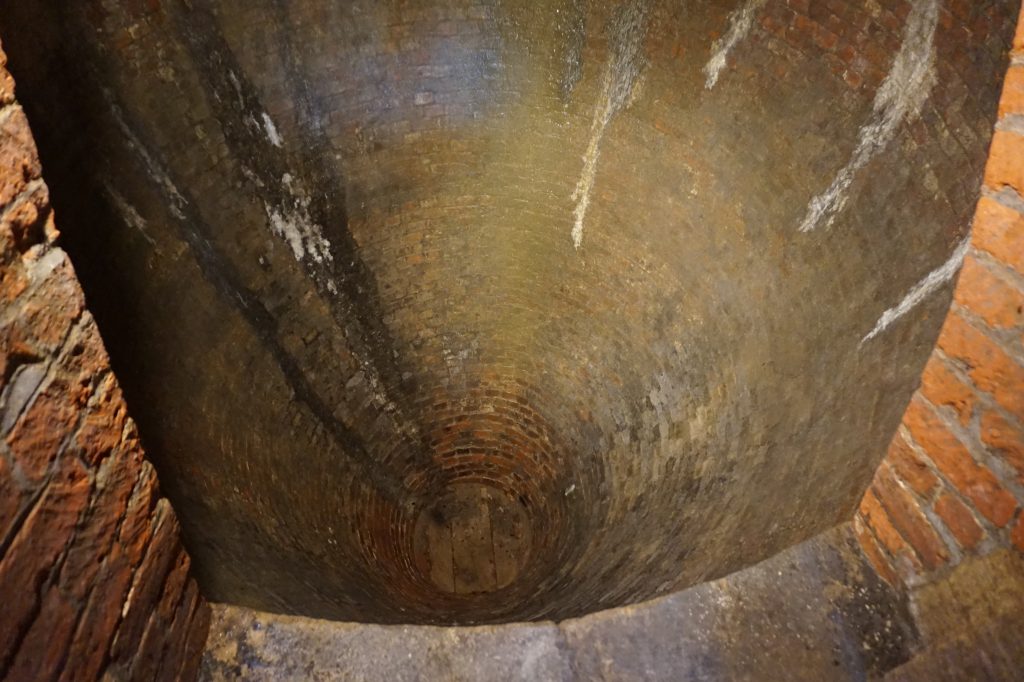
The first ice house was in Mesopotamian, but in the UK they were introduced by James 1 at his palaces in, first, Greenwich Park, and then Hampton Court. An ice house generally consists of a pit in the ground, brick lined, which tapered to a point. Above was a circular, often domed building. The ice was protected by insulation such as straw, and this structure would allow ice to be available all through the summer.

Ice House Dillington, Somerset
Ice House Dillington, Somerset, photo K Flude

My great-grandmother hung a basket outside the window in winter to keep things cold. On my fridge-less narrow boat, I have been known to keep milk and butter outside the door on the front deck. And to suspend and submerge wine in a plastic bag in the canal in high summer. Butteries and Pantries were typically cut into the ground to make them cooler. A Roman Warehouse in Southwark, of which the wooden floor still survived, had a ramp down to the floor which was cut into the ground surface. The ramp suggests it was used for storing barrels, where they were kept cool.

Sketch of Roman Warehouse found in Southwark.

For more on Icehouses (and an Icehouse in York) and the history of ice cream, see my post from August.

Written November 28th 2022, revised and republished 2023, 2024,2025

Jimi Hendrix in London November 27th

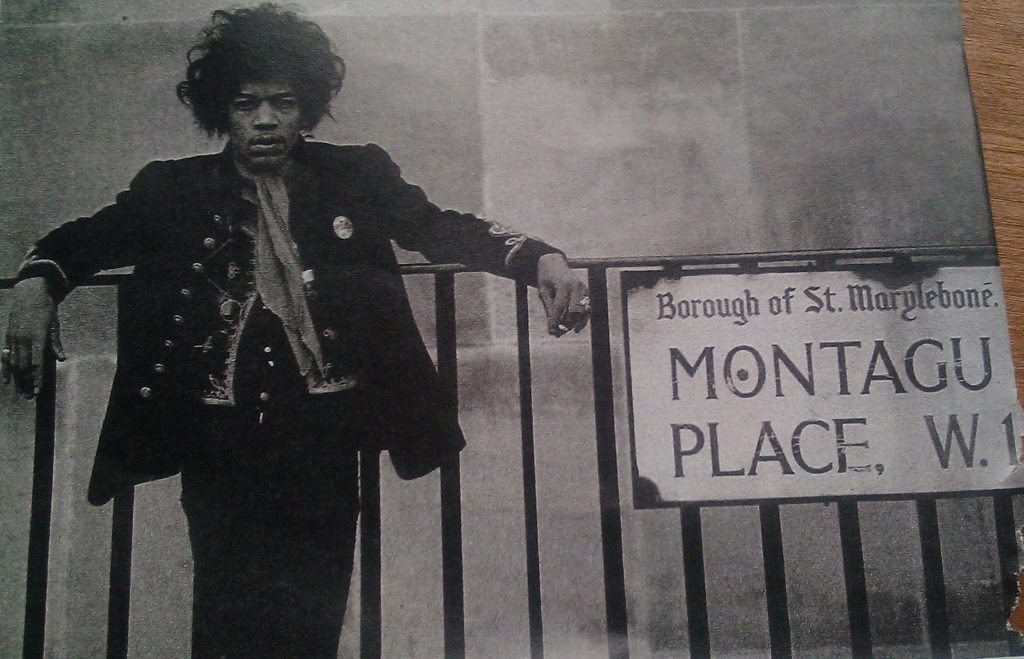
Jimi Hendrix in London at Montague Place

To my mind, THE genius of the electric guitar, and a great singer and songwriter.

Born Johnny Allen Hendrix in Seattle on 27th November 1942. He was spotted by ex-Animals Chas Chandler (bassist) when performing in small cafés In New York as Jimmy James. Chandler suggested he came to England. On the flight, they decided to change his name to Jimi. He arrived on September 24, 1966.

“It’s a different kind of atmosphere here. People are more mild-mannered. I like all the little streets and the boutiques. It’s like a kind of fairyland”

https://www.independent.co.uk Jimi Hendrix’s London.

On his first day in London, he met Kathy Etchingham,. She found them a flat on the upper floors of 23 Brook Street, which is now part of Handel&Hendrix in London. This is a a small museum to the two musical giants who lived next door to each other (if they were time travellers that is!).

For the English middle class, it’s comforting to know that Jimi bought the furnishings of the flat from their favourite, the nearby John Lewis Department store. However, he got his swinging 60s look from Carnaby Street and Portobello Road Market.

The Blues and London

London wasn’t an arbitrary choice for a young American Bluesman. The wave of British Bands that came to international prominence in 1964, was based on the almost forgotten (by the mainstream media) Black American Blues legends such as Woody Guthrie and Ledbelly. Bands like the Rolling Stones, the Beatles, and the Animals loved this music, and began their careers playing cover versions in Clubs in London. (For more on the British Blues Revival, look here🙂

Hendrix’s younger brother, Leon, spoke about the importance of London to Hendrix

“He loved England ‘cos it was like Seattle. It was like home. It was the same climate, y’know? And this is where all the music was. This is where all of his friends were – Eric Clapton, The Beatles, the Rolling Stones, Brian Jones, everybody…”

He concluded: “After people played, they all went and jammed together. Like, when Jimi played a concert that was only the warm-up… After the concert, he was out and about lookin’ for somebody to play with and somebody’s studio to jam at. They’d just be jammin’ all night ’til, like, seven or eight in the morning. It was awesome.”

Reported in Mouth Magazine 2018 and quoted in https://faroutmagazine.co.uk

Hendrix and Hey Joe

Chas Chandler was interested in managing bands, and thought Hey Joe, which he heard Hendrix play, could be a hit single. Hey Joe got to no 6, in January 1967 in the UK Top Ten, but failed to make an impression in the US.

Here is a YouTube film of Hendrix playing ‘Hey Joe’.

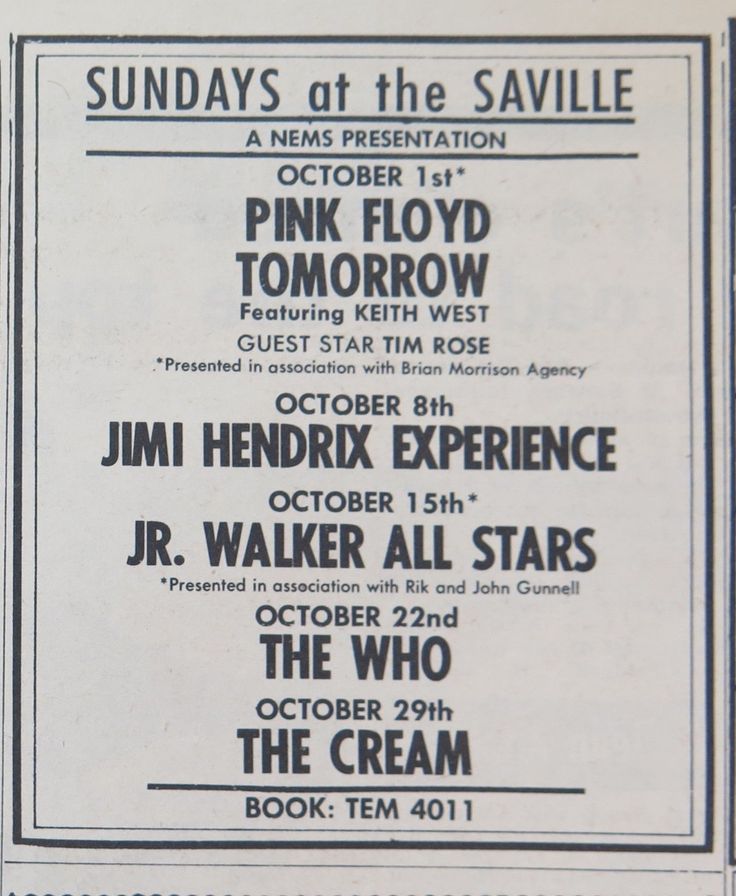
Finally, have a look at this bill for bands on at the Saville Theatre.

One month in 60s London!

For details of Hendix Gigs look at the Set list Web site, which shows he performed at the Saville Theatre in Jan,May and June 1967 on his First European Tour, and again in Aug and Oct on his 2nd European Tour.

The Independent website above gives a good guide to Hendrix in London. An excellent documentary on Hendrix was recently aired on BBC Sounds, Everything but the Guitar.

On this Day:

Eels are now in Season. (for Eels, Eel Pie Island, and its amazing musical heritage click here🙂

1703The Great Storm

About one this morning, the terrible storm arose, which continued till past seven, the wind southwest, the light not known in the memory of man; blew down a vast number of the tops of houses, Chimneys, etc.; the damage incredible., the lady Nicholas and a great many people killed and many wounded: most of the boats and barges forced ashore; an East India ship cast away near Blackwall, besides several merchant ships and colliers; divers of the great trees in St James’s Park, Temple Grayes Inn, etc, blown down; and we are apprehensive we shall hear of great losses at sea.

From Narcissus Luttrell, diary, 1703, quoted from ‘A London Year’ compiled by Travis Elborough and Nick Rennison.

First published on Nov 27th 2022, as part of Stir Up Sunday! And revised onto its own page on the same day, 2023, and updated 2024 and 2025

Stir Up Sunday! Late November

1803 Christmas Cartoon of Napoleon and Mr and Mrs John Bull
By William Holland, 1803 showing plum pudding probably stirred-up on Stir-up Sunday.

Stir-up Sunday is the last Sunday before advent and the day for stirring the Christmas Pudding. And I missed it! Last year it was on the 24th November. This year, November 23rd. Stir-up Sunday gets its name from the Book of Common Prayer, which has a verse:

“Stir-up, we beseech thee, O Lord, the wills of thy faithful people;
that they, plenteously bringing forth the fruit of good works,
may of thee be plenteously rewarded, through Jesus Christ, our Lord. Amen.’

So, the Christmas pudding was made with dried fruit and had 13 ingredients for Jesus and the Disciples. It is stirred from west to east, in honour of the Three Wise Men, and stirred by every member of the household who get to make a secret wish.

These are the ingredients, and here is the recipe.

Ingredients
225g/8oz golden caster sugar
225g/8oz vegetarian suet
340g/12oz sultanas
340g/12oz raisins
225g/8oz currants
120g/4oz chopped candied peel
120g/4oz plain flour
120g/4oz fresh white breadcrumbs
60g/2oz flaked almonds
Zest of 1 lemon
5 eggs, beaten
1level tsp ground cinnamon
1level tsp mixed spice
1 level tsp freshly grated nutmeg
Pinch of salt
150ml/5fl oz brandy or rum

Add a Silver Joey to Stir-up Sunday Christmas Pudding.

Normally, a coin in put in the pudding for the lucky one to get. My grandma, a Londoner, used to put in a couple of ‘silver joeys’, long out of legal tender even when I was young. She would watch us like a hawk while we ate, and claim the coins back as soon as we found them! She would then put them in an old folded brown envelope and put them away for next year.

MJ Hughes Coins website gives the following excellent history of the Silver Joey:

Originally a Joey was the nickname given to a groat (4 pence) but when that went out of circulation in 1855 the silver 3 pence inherited the name. The name came about due to the reintroduction of 4 pence coins in the 1830s by the politician Joseph Hume, MP (1777-1855).

For some great, coin-based facts! Look no further.

https://mjhughescoins.com/how-quids-bobs-florins-tanners-and-joeys-got-their-names

A Digression on Nicknames: Toad Testicles, Foul-Beard and Broad-Arse’

Joey is a nickname. This digression is prompted by my ‘rediscovery’ of a History Today essay from March 2023. It is by PhD student Tristan Alphey. entitled ‘Toad Testicles, Foul-Beard and Broad-Arse’ Tristan is researching nicknames before 1000. It’s a tough gig but someone had to do it!

I have long had an interest in nicknames, since a school bully, when I was about 7, decided he was going to call me Acid. He explained his logic. Flude sounds like fluid and acid is a fluid. It never caught on perhaps because chanting ‘Fludey is a rudey’ in the playground was more fun! In my dad’s day, anyone called Clarke was nicknamed Nobby, and anyone small ‘Lofty’. Why Clerks are ‘nobby’ no one really knows. But the best bet is because clerks were well educated, and with a public facing role had to be smarter that the average member of the public. So clerks were posh. Posh people were called ‘nobs’. Hence, Nobby Clark. (for more on nobby look here.

Generally, only a few people got themselves primarily identified by nicknames. This will, of course, be the meat of Tristan’s PhD. The social significance of the nicknames.

The Border Reivers

My interest was revived when reading a book about the Border Reivers, (by Allistair Moffet). These clans terrorised the borders between Northumberland and Scotland, particularly in the 13th – 17th Century. The people were controlled by a clan leader of ‘Heidsman’ and all his followers being in the same clan had the same surname. And the Names were many Armstrongs, Batesons, Bells, Croziers, Elliots, Glendinnings, Hendersons, Irvines, Johnstones, Scots, Moffets, Nixons, Routledges, Thomsons, Maxwells, Kers, And not to forget the Carletons, Fenwicks, Forsters, Robsons, Turnballs, Selbys, Storeys, Guthries.

The problem arose because there were so many with the same surname, and with the restricted use of a small number of first names (John being by far the most popular) a way of differentiating people was necessary. As I am short of time, I will cut and past from the Wikipedia page:

Some Border Reiver nicknames referred to physical injuries or impairments, such as “Fingerless,” “Gleyed” (blind in one eye), “Burnt Hand,” “Half-Lugs,” or “Lugless” (missing ears). Others followed a tradition similar to Highland naming customs, where the father’s (and occasionally the mother’s) name was added to the son. Many nicknames described physical appearance, such as “Black Heid,” “Hen-Heid,” “Sweet Milk” (meaning beautiful), or “Fergus the Plump.” Some appear to reference mental health or emotional states, including “Unhappy Anthone” and “Jock Unhappy.”‘

A number of nicknames seem metonymic or ironic, reflecting professions or roles, such as “The Sheriff,” “The Lawyer,” or “The Priest.” Intriguingly, certain names may hint at queer or LGBT identities, including “Buggerback,” “The Lady Elliot,” “The Lady Scott,” “The Lady Kerr,” “Bang-tail,”[108] and “Sym ‘the Lady’.” Other nicknames defy easy interpretation, such as “Hob-Wait-About-Him,” “Laird-Give-Me-Little,” “Bide Him Jock,” “the Pleg,” “Dog-Pyntle” (Dog Penis),[109] “Geordie Go Wi Him,” and “Cheesebelly,” illustrating the creative and often enigmatic nature of Border Reiver culture.’ Wikipedia entry

By the way ‘Buggerback’ Elliot was related to ‘the Lady Elliot’, and also, if I recall correctly, to Dog pyntle.

Tristan Alphey’s study takes the study back before 1100, wwhere wecan find King’s nicknames such as

Edward the Confessor, Alfred the Great, Edmund Ironsides, and Aethelred the Ill-advised (redeless). Further down the scale he presents: Alfred ‘Toad-Testicles from Winchester, where were also Alwin ‘Pebbles, Aelfstan ‘Broad-Arse’, Aelfstan ‘the Bald’, Thurstand ‘Buttock’, Aethelstan ‘The fat’, Osferth ‘Blackbeard’, Aelfstan ‘Limping’. Elsewhere we have Alvin ‘Sardine’, Wulfric ‘Large Pole’, Eadwig ‘the Wholly Drunk’, Wulfwiug ‘Wild’, Aelfric ‘Foul-Beard’.

Women are less frequently given nicknames, but we have Athelgifu ‘the Good’ and King Harold’s first wife, the beautiful Edith ‘Swan-Neck’.

To finish my look at nicknames, we go to Viking York among whom are the peerless warriors: ‘Ivarr the Boneless’, Sihtric ‘the Squinty-eyed’and Erik Bloodaxe. Other Vikings include Thorkell the Tall and Thorkell Thorfinn. An archaeologist believes he has found the burial place of Ivar the Boneless – have a look here for more details.

First Published Nov 27th 2022. The Jimi Hendrix content transferred to its own page, and this post republished Nov 26th 2023, revised with a section on nicknames in 2024,2025

St Catherine, Torture Victim & Patroness of the Catherine Wheel, November 25th

Icon of Saint Catherine of Alexandria, with scenes from her martyrdom (Wikipedia)

In the pantheon of horror that is the Saints’ martyrs’ calendar, St Catherine of Alexandria is very appropriate for, today, the UN’s International Day for the Elimination of Violence against Women.

Catherine was high-born, beautiful and learned. She disputed with pagan learned men against the worship of idols. She wiped the floor with them, and Emperor Maxentius had 50 of the learned men burnt alive for their failure to answer adequately.

Catherine was imprisoned, where many people came to visit her and were converted to Christianity. The most illustrious visitor was the Emperor’s wife, Valeria Maximilla who was, herself, martyred. Then, the Emperor offered to marry Catherine, but she refused to abandon her faith. So he had her tortured. In prison, she was fed by the holy dove and had visions of Christ.

Her gaolers then tried to break her on a wheel, although the wheel broke, killing spectators with the splinters, she stood steadfast. Two hundred soldiers were converted to the faith on the spot. They were then beheaded, followed by Catherine herself. Milk, not blood, flowed from her severed veins.

The persecution in the early 4th Century was real, but it wasn’t driven by Maxentius, who came to power promising religious tolerance. But, following the accession of Constantine the Great, Maxentius’s reputation was blackened. There is no contemporary evidence for the events of Catherine’s life. There is a modern theory that her tale was conflated with the remarkable story of Hypatia of Alexandria (d. 415), a pagan and a real learned woman; The first female Mathematician we know any facts about. She was murdered by a rampaging mob of xenophobic Christians.

Catherine is remembered by the firework: the Catherine Wheel and is, of course, the patron of Philosophers, Theologians, and Royal women; young women, students, spinsters, and anyone who lives by working with a wheel: carters, potters, wheelwrights, spinners, millers. And, I imagine, Formula 1 drivers.

St Catherine in London

St Catherine Coleman
(Wikipedia: Robert William Billings and John Le Keux: The Churches of London by George Godwin (1839))

There are several Churches in London dedicated to St Catherine or St Katherine, dedicated to St Catherine of Alexandria. The one in Coleman Street, rebuilt by Christopher Wren and his team, was demolished in the 1920s. There was a Chapel to St Catherine at Westminster Abbey (c1160), the ruins of which are visible in St Catherine’s Garden. I am sure that St Katherine’s Dock and St Katherine’s Cree Church are also so dedicated, but cannot as yet find a dedication for either. Katherine of Aragorn was patron of the Royal Foundation of St Katherines’ which gives its name to the Dock.

Ruins of Chapel of St Catherine, Westminster Abbey

There are customs that have attached themselves to St Catherine including the baking and eating of Catten Cakes. These are really a biscuit (or cookie) made of dough, and cinnamon and dried fruit. Carraway seeds are also suggested. Here is a recipe.

It’s considered a good day for rituals and prayers to summon a husband. Katherine of Aragorn was also commemorated on this day. Lace makers would play ‘jump the candlestick’. If they put the candle out they had bad luck. Katherine of Aragorn is said to have introduced lace making to England.

Finally, for my thoughts why female saints martydrom stories are so violent, extreme and often downright bizarre. Have a look at my post on St Margaret. She is the Saint who suffered probably the most torture in her convoluted route to Martyrdom.

My post which includes a link to an article about medieval attitudes to these terrifying stories of martyrdom, illustrated by a reredos on display at the V&A, in Kensington, London here.

Gladiators Exhibition Touring Britain

Exhibition post of the British Museum Exhibition ‘Gladiators of Britain’

I was just reading an article about the British Museum touring exhibition: ‘Gladiators of Britain’ exhibition. And so updated my August 12th post on St Lawrence who is remembered in a Church in London on the site of the Roman Amphitheatre. But the Exhibition will be closed by August, so here is what I wrote, in time to go to see the Exhibition.

The exhibition is currently at the Grosvenor Museum in Chester – until 25th January 2026.It then moves to Tullie House Museum & Art Gallery, Carlisle from 7th February to 19th April 2026. Recent research has shown that a young man buried in what seems to be a Gladiators Cemetary near Michelgate in York has lion’s teeth marks on his pelvis. When talking about Gladiators I was always reticent about whether animals as exotic as Lions would have been used in the distance province of Britannia. Now we know they were. The Exhibition has a marble relief from Ephesus showing a venetor (beast fighter), taking on a lion. We also know one Roman legionary in Britain had the title of Bear Keeper.

Displayed on the poster above is the Colchester vase which shows an actual gladiatorial combat. The gladiators are named as Secundus, Marius, Memnon, and Valentinus. Secundus and Marius are fighting a bear, while Memmon is fighting Valentinus. Memmon is a secutor and Valentinus, a retiarius. The secutor is the chaser and lightly armed with a heavy shield and short sword. The retiarius has a net and trident. Memmon is described as a 9th time victor, and Valentinus, a legionary of the Legio XXX Ulpia Victrix raises his finger to acknowledge defeat.

Although death and life threatening injuries were often the result, the competition was also not, necessarily, a fight to the death, it was a fight until one or other was defeated. So they could be ended by surrender. Gladiators tombstones, often announce the number of fights a gladiator was involved in such as fighting 25 fights of which he was victorious in 22. The chairman of the show would be given the duty of deciding whether the defeated deserved to be spared, or hit over the head with a big hammer, or decapitated. The Gladiatorial cemetery in Driffield Terrace, York has a high proportion of decapitated corpses. The normal ratio of normal burials is 5% or less of decapitated skulls. Of the 80 burials in Driffield Street 46 were decapitated. Many of the young men in the cemetery have healed wounds. One had leg irons one which showed evidence of being put on while still red hot from the blacksmiths forge. For more on the Cemetery follow this link.

On this Day

1471 – the Thames froze over strongly enough to hold a Frost Fair upon it.

In the year 1434 a great frost began on the 24th of November, and held till the 10th of February, following ; whereby the River Thames was so strongly frozen, that all sorts of merchandizes and provisions brought into the mouth of the said river were unladen, and brought by land to the city.’

1715 – the Thames froze again 281 years later

‘The Thames seems now a solid rock of ice; and booths for sale of brandy, wine, ale, and other exhilarating liquors, have been for some time fixed thereon; but now it is in a manner like a town; thousands of people cross it, and with wonder view the mountainous heaps of water that now lie congealed into ice. On Thursday, a great cook’s-shop was erected, and gentlemen went as frequently to dine there as at any ordinary. Over against Westminster, Whitehall, and Whitefriars, printing presses are kept on the ice.(description of 14th January 1716 of the remaining ice by Dawkes’ News Letter.

Both quotes are from a list of times the Thames froze you can see here: https://thames.me.uk/s00051.htm. I have no idea where the evidence comes from for the Roman and Saxon era freezing, but the author says the source of it is:

The earliest chronology is given by Charles Mackay in “The Thames and its Tributaries”, 1840. He omits to mention how he knows!

1952 Agatha Christie’s the ‘Mousetrap’ opened in London, so it has now been continuously running for 73 years if my maths are correct.

First published on 25th November 2022. Revised and republished 25th November 23, 24, 25

Sagittarius, Martinmas Old Style and Pack-Rag Day November 22nd

November 22nd is the dawning of Sagittarius.

According to the Kalendar of Shepherds 1604, women born on this day should marry at age 13, shall have many sons and live to 72 years old. Men born on November 22nd will be merciful, far-travelled, prosperous after early dangers and live to 72 years and 8 months. Can’t help feeling that prophecy this precise is heading for a fall. (see my post sliding-ducks-and-the-equivocation-of-prophecy/).

Martinmas Old Style and Pack-Rag Day

Pack-Rag Day, hiring of farm workers

Martinmas was the Festival of Winter’s Beginning and is celebrated on November 11. It was one of the most famous medieval festivals. In 1752, the calendar was transformed when Britain transferred from the Julian to the Gregorian Calendar, 11 days were lost from the Calendar, so the original date of the festival would be what we know as November 22nd. So this is Martinmas Old Style.

In the East Riding of Yorkshire, hiring fairs were held around this time. It was also called Pack-Rag Day as servants carried their clothes to their new place of work.

A hiring fair is how Gabriel Oak is hired by Batheseba Everdene in ‘Far From the Madding Crowd’ by Thomas Hardy. They were often also held at Michaelmas, and in Warwickshire are called Mops. See my post on the Mop here.

On this Day

As you may have noticed, I have been adding a section called ‘On this Day’ which highlights some notable events that have happened on this day in history. In my quest to create an almanac of the past with a reasonable post for every day, my loyal subscribers will be getting a post they read last year. So, I am trying to add extra content to make it worthwhile. Hence, this ‘new’ section (one year old today).

So, I will either republish a previously published post. It should be better proofread (although I’m perfectly capable of adding extra embarrassing typos). The content should be improved or expanded. Or with an added ‘On this Day’ section. Therefore, if you find you have read the post before, just scroll down to the new content at the bottom.

One of my sources for the ‘On this Day’ section is Chambers’ ‘Book of Days A Miscellany of Popular Antiquities’in connection with the Calendar’. The original was published, in 1864, by Robert Chambers one of the original founders of Chambers Publishing. The new one takes is inspiration from the original. I found out about it from Sir Roy Strong and Julia Trevelyan Oman’s ‘The English Year, which is itself a personal selection from the Chambers Book of Days. Sir Roy was my boss when I was an Assistant Keeper at the V&A.

1963 President Kennedy and Governor John Connally were shot while part of a motorcade in Dallas.

1968 The Beatles White Album was released

1990 British Prime Minister Mrs Thatcher resigned.

Originally published as two separated posts on 22nd November 2022, republished on 22nd November 2023, merged 2024, and expanded 2025

Beginning of the Month of Frimaire November 21st

The frosty month of the French Revolutionary calendar.

The rational calendar divided the year into twelve 30-day months, plus 5 days for end of year festivities. And a leap year every 4 years.

Weeks were 10 days long, 3 per month. Days were named first day, second day, third day up to tenth day. There were ten hours in a day, 100 minutes per hour, and 100 seconds per minute. But this last part didn’t last very long, French people really objected to their day and hours being mucked up.

Revolutionary period pocket watch

The Revolutionary Year was adopted in 1793 but began retrospectively from September 22nd, 1792 commemorating when the Republic was proclaimed. Thereafter, the First Republic started on: Le premier Vendémiaire de l’an 1.

Napoleon gave it up as a bad job in 1806, and restored the Gregorian Calendar.

For my fuller explanation of the French Revolutionary Calendar click here).

On this Day

1847 James Young Simpson wrote an account of his testing of Chloroform for use as an anaesthetic. It was published in the medical journal, the Lancet. Chloroform was invented in 1831, used on animals successfully in 1842. But it was considered too dangerous for humans.

Simpson and his two assistants were in the habit of meeting in his Edinburgh house, at 52 Queen Street, in the New Town. There they tested new chemicals. He obtained some Chloroform, for the three of them to try. They found themselves merry, and the next thing they remember was waking up to a new dawn.

Chloroform is more effective than Ether, but the margin of error is tighter. Simpson and his friends were lucky the chosen dose didn’t kill them. Nor did the sudden unconsciousness  knock them out or injure them.

They then tried it on his niece, Miss Petrie.  Success meant it was set to become the anaesthetic of choice, particularly for childbirth, for the next 100 years.

1877 Thomas Edison announced the invention of the phonograph.  This ushered in a new age of inexpensive recordings of music. Musicians feared it meant the end of the careers of most musicians.  And indeed, it had profound effects, but live music survived.  And so we hope it will also survive AI.

Wikipedia describes the process that produces the music for the gramophone, as:

The sound vibration waveforms are recorded as corresponding physical deviations of a helical or spiral groove engraved, etched, incised, or impressed into the surface of a rotating cylinder or disc, called a record.

First published on November 21st 2022, republished on November 21st 2023, 2024, 2025
Night Fowling November 19th

Gervase Markham Hungers Prevention: or, the Whole Art of Fowling by Water and Land. (Printed, London: for Francis Grove, 1655).

This was the period of the year for ‘Night-fowling’. Gervase Markham wrote a whole book about it in the 17th Century. It was called Hungers Prevention: or, the Whole Art of Fowling by Water and Land. (Printed London: for Francis Grove, 1655).

In it, he tells the reader to go to ‘a stubble field in November when the air is mild and the moon not shining. There take a dolorous low bell, and net. Spread the net over the stubble where there may be fowl, ring the bell, light fires of dry straw, and the fowl will fly and become entangled in the net.

Title illustration from Gervase Markham Hungers Prevention: or, the Whole Art of Fowling by Water and Land. (Printed London: for Francis Grove, 1655).

In Britain today, the Wild fowling season is from 1 September – to 20th February and largely takes place on the marshes and foreshore.

Duck, Geese, waders and other birds are the quarry. Species involved include:
Gadwall goose, Canada goose, Common snipe, Coot, Goldeneye duck, Greylag goose, Golden plover, Moorhen, Mallard, Pink-footed goose, Jack snipe, Pintail, European Woodcock, white-fronted goose, Pochard, Scaup1, Shoveler, Teal, Tufted duck, Wigeon

(from https://basc.org.uk/wildfowling/advice/wildfowling-code-of-practice/)

For more Gervase Markham books see my post here:

On this Day

On this day, in 1660, Charles I was born.

In 1863. President Abraham Lincoln gave the Gettysburg Address.

World Toilet Day

Today is the United Nations’s World Toilet Day. It is ‘Sustainable Development Goal 6 Safe toilets for all by 2030’. It is astonishing that we, as a species, have:

3.5 billion people (who) still live without safely managed sanitation, including 419 million who practise open defecation.’

That is a third of the world’s population if my figures are correct. It also impacts particularly badly on women in those areas where decent hygiene cannot be guaranteed.

These are the ‘Key messages you should know on World Toilet Day’

  1. Toilets are a place for peace. This essential space, at the centre of our lives, should be safe and secure. But for billions of people, sanitation is under threat from conflict, climate change, disasters and neglect.
  2. Toilets are a place for protection. By creating a barrier between us and our waste, sanitation services are essential for public and environmental health. But when toilet systems are inadequate, damaged or broken, pollution spreads and deadly diseases get unleashed.
  3. Toilets are a place for progress. Sanitation is a human right. It protects everyone’s dignity, and especially transforms the lives of women and girls. More investment and better governance of sanitation are critical for a fairer, more peaceful world.

First published Nov 19th 2022. Republished Nov 19th 2023, 2024, 2025

Time to make Sausages November 18th

Hackney City Farm. Photo K Flude

Following Martinmas, farmers used to slaughter a good many of their animals because of the difficulty of feeding them during the winter. So this was the time to make sausages from all that meat and guts. Follow this link for a Tudor Sausage recipe.

Pigs were a very productive part of the Medieval and Early modern farmers’ economy. Almost as much pork was eaten as lamb. The upper classes, of course, preferred beef. But even the lowliest family would keep a pig. They would be pastured in forests, commons and fallow fields around the village, foraging for themselves on whatever they could get. In Autumn, they would be taken to specially grown copses of pollarded oak groves. The farmers pollarded the trees to keep them short and bushy. They could use the wood they pruned for wood working projects, or for firewood. When the acorn season came, they would hit the low branches with cudgels to release a lovely torrent of acorns on the floor for the pigs to feast themselves upon. So they grew fat for Martinmas when they were slaughtered.

Another benefit for a community of peasants living on the margin was that the sow might have 6 – 14 piglets. When the time came to slaughter the pig, the small holder could swap piglets with others, and share the bounty of the slaughtered animal. This would be reciprocated, and help made good food available more of the time.

Window of Edinburgh Royal Mile Cafe. Photo KFlude

For more on the benefits of pigs to agroecolog, have a read of this fascinating site: forests-of-pork-the-agroecology-of.

Random Sausage Fact

A silhouette of a Zeppelin caught in searchlights over the City of London. Zeppelins

Sausages were severely rationed in Germany in World War 1 because they used nearly 200,000 cattle guts to make gasbags for each of the Zeppelins that bombed London. This made them very difficult to shoot down as the gas was held in so many separate bags.

To read my Zeppelin post look here:

On this Day

1477 – Caxton Prints 1st Book in England. Westminster

https://information-britain.co.uk/linkunit.htm

‘The Dictes or Sayingis of the Philosophres’, dated 18th November 1477. was from the French by Anthony Woodville, the 2nd Earl River brother-in-law of King Edward IV,

However, some people say the first book he published in Englandwas an edition of Chaucer‘s The Canterbury Tales. See https://www.merton.ox.ac.uk/library-and-archives/exhibitions/caxtons-first-edition-of-canterbury-tales for more/

First published November 2024, revised 2025

St Cecilia’s Day, Henry Wood and the BBC Proms November 17th

St Sepulchre-without-Newgate, Musician’s Chapel, St Cecilia window. 17 August 2022, Andy Scott

November 17th is St Cecilia’s Day She is the patron saint of musicians and was martyred in Rome in the Second or Third Century AD. The story goes that she was married to a non-believer. During her marriage ceremony she sang to God in her heart (hence her affiliation with musicians). She then told her husband that she was a professed Virgin. So, if he violated her, he would be punished by God. Cecilia told him she was being protected by an Angel of the Lord who was watching over her. Valerian, her husband, asked to see the Angel. ‘Go to the Third Milestone along the Appian Way’ he was told where he would be baptised by Pope Urban 1. Only then would he see the Angel. He followed her advice, was converted and he and his wife were, later on, martyred.

The Church in Rome, Santa Cecilia in Trastevere, is said to be built on the site of her house, and has 5th Century origins. My friend, Derek Gadd, recently visited and let me use these photographs:

St Cecilia in London

There is a window dedicated to her in the Holy Sepulchre Church-without-Newgate, In London, opposite the site of the infamous Newgate Prison.  Henry Wood, one of our most famous conductors and the founder of the Promenade Concerts, played organ here when he was 14. In 1944, his ashes were placed beneath the window dedicated to St Cecilia and, later, the Church became the National Musician’s Church.

This window is dedicated to the memory of
Sir Henry Wood, C.H.,
Founder and for fifty years Conductor of
THE PROMENADE CONCERTS
1895-1944.
He opened the door to a new world
Of sense and feeling to millions of
his fellows. He gave life to Music
and he brought Music to the People.
His ashes rest beneath.

The Concerts are now called the BBC Proms and continue an 18th and 19th Century tradition of, originally, outdoor concerts, and then indoor promenade concerts. At the end of the 19th Century, the inexpensive Promenade Concerts were put on to help broaden the interest in classical music. Henry Wood was the sole conductor.

Wikipedia reports :

Czech conductor Jiří Bělohlávek described the Proms as “the world’s largest and most democratic musical festival”.

The Eight-week Festival is held at the Royal Albert Hall. It moved here during World War 2 after the original venue, the Queen’s Hall, was destroyed in the Blitz in May 1941.

On This Day

1278 Edward 1 had over 600 Jews imprisoned in the Tower of London for coining, clipping and other counterfeiting. Of these, 269 Jews, along with 29 Christians, were executed. They were hanged at the Guildhall in the City of London. By 1290, the King had squeezed all the money he could from the Jews, and they were expelled, not to be let back into the Kingdom until the reign of Oliver Cromwell in the 17th Century. This ended a long period of savage state run antisemitism. Click here for further information.

First Published on November 17th 2023 and revised in November 2024, 2025.

Time to Tup your Sheep – November 7th

City Farm, Hackney. Small flock of Bluefaced Leicester Sheep, the big golden one is the Ram, the others are the ewes he has tupped. Photo K Flude

The old Shepherd’s saw is:

‘In with a bang and out with the fools’.

The bang is Guy Fawkes Day on November 5th, and the fools are a reference to All Fools Day on April 1st. The gestation period of a ewe is 147 days (on average). (sheep-farmers-year). So farmers introduce the Ram into a field of Ewes on or around November 5th. This means the lambs will be born around the beginning of the traditional lambing season.

(see my posts on Guy Fawkes Day and All fools Day)

Tupping Times

The Ewes have been enjoying themselves in the fields, The flocks have been thinned out, with the young ones being sent to market, mostly for meat. The grass has been growing at the end of the summer, with the wetter weather. The ewes will be in excellent condition, and will have been thoroughly checked by the shepherd.

The chosen ram will be dressed with a harness on his chest, which will have a sheep’s crayon on it. The crayon is known as raddle or reddle. The ram, also know as a tup, will mate with whichever of the ewe(s) that catch his eye. Each one he tups (mounts or covers) will be left with a paint mark, from the reddle on his chest, on her back. The farmer will inspect the ewes periodically. A ewe with two or more reddle marks on her back, will be taken out of the field. This will force the ram to spread his attentions to the, as yet, untupped, ewes. He will continue until all ewes have been tupped. And then onto the next field full of ewes. Diggory Veen is the Reddleman in Hardy’s ‘Return of the Native’. I talk about him, lambing and reddle in my post here.

Some of the young ewes will be kept to reinforce the flock. Males will only be kept if they will be sold to another farmer as a tupping ram. They cannot breed on the farm as this will lead to inbreeding. So, a ram will be purchased or swapped from another farm. The farmer will want to choose one that fits into his/her idea of what the ideal sheep is. whether it is grown for meat, or to be hardy, or for its wool etc.

Raddled

To be raddled is to be flushed, red with drink, or over made up. It has a sense of dissipation about it. One might have more sexual encounters than is normal. Just like the ewe with too many raddle marks on her back? Or the Raddle man with a red face and hands from all the raddle he handles?

Bluefaced Leicester Sheep and my Hat!

I was delighted to see my local City Farm had a small herd of Bluefaced Leicester Sheep. I was visiting with my Grandson when I took the photograph at the top of the page. The sherderdess told me the blue-marking in this case was not a result of mating. She thought 2 or more of them were already pregnant, however.

My association with the breed comes from a lovely yarn shop in Conwy (Ewe Felty Thing) which had a rail of clothes marked ‘wearable art’. I bought a woolly beanie which they told me was:

‘Hand-spun, hand knitted from a bluefaced leicester sheep.

Hand-spun, hand knitted Beanie from a Bluefaced Leicester sheep. purchased at (Ewe Felty Thing) Photo K Flude

I still have it. It cost a small fortune, but worth every penny!

A bluefaced Leicester Ram, might cost £1000 if a bought as a lamb, £4,000 if bought as a shearling, or up to £40,000 if a prize lamb. It is one of the biggest lambs with a long back, and longwool with ringlets. There is no wool on the face and neck so you can see its blue-grey skin, below the white hair – hence its name. It is often bred with hill sheep ewes, which combines the prolificacy of the ram with the mothering abilities of the ewes.

Generally, nowadays the wool from a shearing will only be worth about 80p in today’s market. This will not pay for the cost of the shearing, but it is necessary for health and hygiene reasons.

Posted on 7th November 2025