Annual Grimaldi Memorial Service, All Saints, Haggerston. First Sunday in February

Annual Grimaldi Memorial Service at All Saints Church, Haggerston.

Today, was the Annual Grimaldi Memorial Service in Haggerston, Hackney, London. It began as a memorial service for the famous Regency Clown Joseph Grimaldi. But it has become a service to celebrate Clowns. The service takes place on the first Sunday in February. The service used to be at Holy Trinity Church, but has switched to Haggerston.

Joseph Grimaldi

Grimaldi as Clown, showing his own make-up design. George Cruikshankhttp://www.vam.ac.uk/content/people-pages/grimaldi-the-clown/ Public Domain

Grimaldi was born on 18 December 1778. He died in poverty on 31 May 1837. In between, he was the most famous clown. He transformed the Harlequin role and made the white-faced clown the central part of the British Pantomime. The part became known as a Joey after Grimaldi. He performed at the Theatre Royal, Drury Lane, the Sadler’s Wells and Covent Garden theatres.

All Saints Church, Haggerston

Video by K Flude of Annual Grimaldi Clown Service in Haggerston

All Saints Church, Haggerston is 5 minutes walk from where I live and 2 minutes from where my Dad was born. (see my post here). So I popped in today and took this video. The service, which has been held since the 1940s, attracts clown performers from all over the world who attend the service in full clown costume. The Spitalfield’s Life blog has a very full description of the service, and lots of very good pictures. Follow the link below:

First Published February 1st 2026

Gilbert White & The Cold of January 1776 January 28th

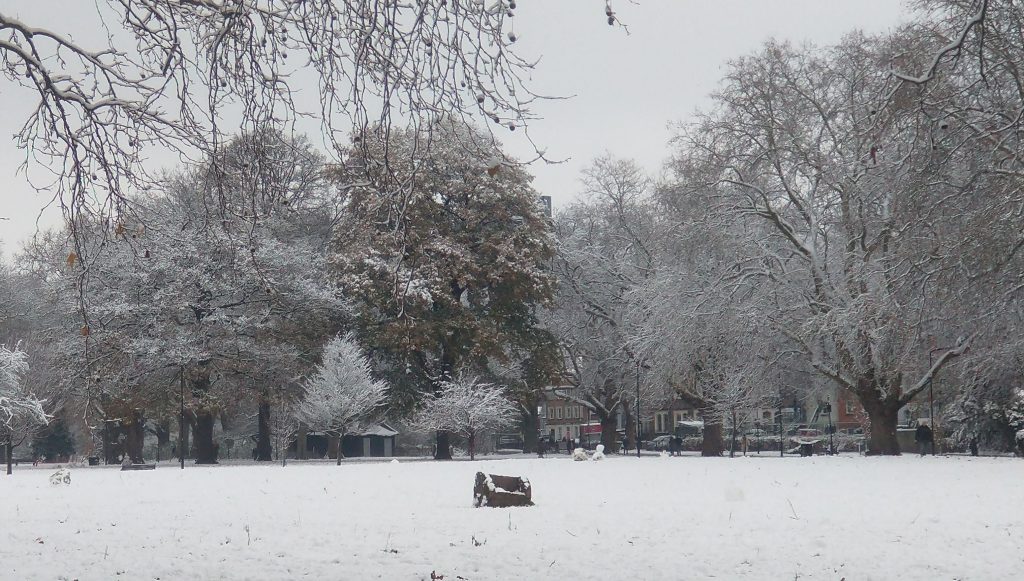
Photo of London Fields in the snow of 2022
Photo of London Fields in the snow of 2022 by Kevin Flude

January 1776:

‘On the 27th much snow fell all day, and in the evening the frost became very intense. At South Lambeth, for the four following nights, the thermometer fell to 7, 6, 6, and at Selborne to 7, 6, 10, and on the 3ist of January , just before sunrise, with rime on the trees and on the tube of the glass, the quicksilver sunk exactly to zero, being 32 degrees below the freezing point’ Gilbert White

Gilbert White and Darwin

He, of course, is talking Fahrenheit, so well below zero. If there was a Giant upon whose shoulders Charles Darwin climbed, then Gilbert White owned one pair.. He was one of many churchmen of the 18th and 19th Century who spent their extensive leisure time, on observing God’s wonderful creation in their gardens and parishes. What made White so important was that his practice was ‘observing narrowly’ and regularly. For example, his observations of the importance of earth worms were fundamental to Charles Darwin’s own studies. When Darwin came back from his travels on the Beagle, he settled in a country property in Orpington. Like White, he used his garden and the local area as his laboratory. Here he worked to prove his theory of evolution.

Gilbert White and Earth worms

Earth worms were one of Darwin’s passions. This is what Gilbert White wrote about their contribution to nature:

“Earth-worms, though in appearance a small and despicable link in the chain of Nature, yet, if lost, would make a lamentable chasm. For, to say nothing of half the birds, and some quadrupeds which are almost entirely supported by them, worms seem to be the great promoters of vegetation, by boring, perforating, and loosening the soil, and rendering it pervious to rains and the fibres of plants, and, most of all, by throwing up such infinite numbers of lumps of earth called worm-casts, which, being their excrement, is a fine manure for grain and grass.”

(Quoted from https://gilbertwhiteshouse.org.uk)

By such minute and repeated observations, Gilbert White investigated the food chain, and the migration of birds (which was at the time disputed). He laid the foundations of what we now call ecology.

Gilbert White’s Career

He became Dean of Oriel College in Oxford. But chose to spend his career in the relatively humble occupation of Curate. A Curate is the bottom-feeder in the Anglican Church food chain. A Curate hardly earned enough to maintain a position in the Gentry (£50 p.a.). Although, White was upgraded to the title of Perpetual Curate. He still would only be pulling in, I guess, something like £200 p.a. (Patrick Bronte was also a Perpetual Curate). Essentially, it is Vicar looking after a part of a too large Parish.

Financially, White didn’t need much, he inherited his father’s property at Shelborne, Hampshire. White’s grandfather was the Vicar at Shelborne. But Gilbert could not inherit the title because he went to Oriel College. The ‘living’ of the Parish of Shelborne was ‘in the gift of’ Magdalen College. And they were not going to give the role to an alumnus of a rival college.

Gilbert White & The Austen Family

The house, now open to the public, is just around the corner from Chawton. This is where Jane Austen spent her last years. He was born in 1720; was 55 when Austen was born, and he died in 1793, when she was 18. He lived 4 miles away, so the families knew of each other. We know Jane Austen’s brother wrote a poem about Gilbert White and his natural history observations, particularly on birds.

From ‘Selbourne Hanger’ by James Austen

Who talks of rational delight }
When Selbourne’s Hill appears in sight }
And does not think of Gilbert White? }
Such sure he was – by Nature grac’d
With her best gift of genuine taste;
And Providence – which cast his lot
Within this calm, secluded spot,
Plac’d him where best th’enquiring mind
Might study Nature’s works, and find
Within her ever open book
Beauties which others overlook.
Enthusiast sweet! Your vivid style
The attentive reader can beguile
Through many a page, and still excite
An Interest in what you write!
For whilst observant you describe
The habits of the feathery tribe
Their Loves and Wars – their nest and Song,
We never think the tale too long.

For more information on White and Austen, go to Gilbert White’s House’s web page here:

More Snow!

Here is more of that epic cold January 1776

‘… but by eleven in the morning, though in the shade, it sprang up to I6J,1 — a most unusual degree of cold this for the south of England. During these four nights the cold was so penetrating that it occasioned ice in warm chambers and under beds ; and in the day the wind was so keen that persons of robust constitutions could scarcely endure to face it. The Thames was at once so frozen over both above and below bridge that crowds ran about on the ice. The streets were now strangely encumbered with snow, which crumbled and trod dusty ; and, turning grey, resembled bay-salt : what had fallen on the roofs was so perfectly dry that, from first to last, it lay twenty-six days on the houses in the city ; a longer time than had been remembered by the oldest housekeepers living…..’

‘The consequences of this severity were, that in Hampshire, at the melting of the snow, the wheat looked well, and the turnips came forth little injured. The laurels and laurustines were somewhat damaged, but only in hot aspects. No evergreens were quite destroyed ; and not half the damage sustained that befell in January, 1768. Those laurels that were a little scorched on the south-sides were perfectly untouched on their north-sides. The care taken to shake the snow day by day from the branches seemed greatly to avail the author’s evergreens. A neighbour’s laurel-hedge, in a high situation, and facing to the north, was perfectly green and vigorous ; and the Portugal laurels remained unhurt.’

More Frost!

‘We had steady frost on to the 25th, when the thermometer in the morning was down to 10 with us, and at Newton only to 21. Strong frost continued till the 31st, when some tendency to thaw was observed ; and, by January the 3d, 1785, the thaw was confirmed, and some rain fell.’

Rosemary flowering in december
Rosemary flowering in my garden, photo by Kevin Flude

Gilbert White’s House is open to the public and also contains a display on Lawrence Oates, who died on Scots Antarctic expedition. For more information look at my post here.

There is another mention of Gilbert White in the Almanac of the Past here.

Foods in Season

Here are food stuffs that are in season now.

Wild Greens: Chickweed, hairy bittercress, dandelion leaves, sow thistle, winter cress

Vegetables: Forced Rhubarb, purple sprouting broccoli, carrots, brussels sprouts, turnips, beetroot, spinach, kale, chard, leeks, Jerusalem artichokes, lettuces, chicory, cauliflowers, cabbages, celeriac, swedes

Herbs: Winter savory, parsley, chervil, coriander, rosemary, bay, sage

Cheeses: Stilton, Lanark Blue

(from the Almanac by Lia Leendertz)

On This Day

1754 – Horace Walpole coined the new word ‘serendipity’ from the ‘Three Princes of Serendip’ fairy tale. The Princes ‘ere always making discoveries, by accidents and sagacity, of things they were not in quest of.’

1898 – Walter Arnold became the first motorist to be fined for speeding. He was going 8 miles an hour in a 2 mile an hour area in Kent

1986 – Explosion of US Space Shuttle Challenger. All 7 astronauts killed, including teacher Christa McAuliffe who would have been the first civilian in space.

The food section posted originally in 2023, the part on Gilbert White written on 28th January 2024, revised 2025, On This Day added 2026

Holocaust Memorial Day & Montaillou January 27th

photo of The Kindertransport statue, Liverpool Street Station, London 2006 by Frank Meisler and Arie Oviada.
Holocaust Memorial Day photo fo The Kindertransport statue, Liverpool Street Station, London 2006 Statue by Frank Meisler and Arie Oviada Photo by K Flude

Statue for Holocaust Memorial Day

The statue commemorates the arrival of Jewish children by train at Liverpool St Station, In London. This was 1938/9 in the Kindertransport. They were sent by parents desperate to save their children from fascist genocide in Germany and Austria. The children were unaccompanied and, as depicted in the statue, stand proud as they arrive in a strange country. They are tagged. And the train track represents both the trains to the death camps, and the train to safety. There are some great photos and more information on the statue in: talkingbeautifulstuff.com

Holocaust Memorial Day and Montaillou

My copy of Montaillou by Emmanual Le Roy Ladurie

On the subject of prejudice, genocide and abuse of power. I was reminded of one of the formative reads of my life. The great Emmanuel Le Roy Ladurie was at dinner at my father-in-law’s house in the 1980s. I was awestruck. Because Montaillou was one of the early histories ‘from below’. The focus was not on kings, queens nor on the flux of states and empires. No, the focus was on the lives (and deaths) of ordinary people. Something that has continued as a focus of my historical interest.

Nor, before Ladurie, had I imagined that medieval lives could be so minutely brought to life. The book was a sensation, selling over a quarter of a million copies. Professor Ladurie became a media star, and, it remains one of the great historical reads. (Of course, the book and the historiography now attracts some criticism, but do read it!)

The context of the story is appalling. In 1208, the Pope decided to launch a crusade against heretics in the South of France. This is about the genocide of the Cathars. The lives of the persecuted are revealed under interrogation by the Cathodic Inquisition. Cathars had many unorthodox and ‘heretical’ ideas. They believed in a Good God and an Evil God. We, humans, are all angels trapped in this terrible world by the Evil God. Women and men were equal and could be reincarnated into each other’s bodies. Our lives are spent awaiting the time we became ‘perfect’ and released to our spiritual form for eternity.

“Kill them all, the Lord will recognise His own”

From the 21st Century, these ideas seem no more nor less irrational than mainstream religions. But these opinions ‘justified’ a Crusade and Inquisition that followed which were truly savage, with many thousand slaughtered. For example, on 22 July 1209, the Catholic forces were led by Arnaud-Amaury. He was not only the Commander of the army but also a Cistercian Abbot. Many of the citizens of Béziers were seeking refuge in St Mary Magdalene. The abbot ordered the doors to be battered down to get at the refugees inside. When asked how the soldiers could separate the Catholics from the Cathars. He replied:

Caedite eos. Novit enim Dominus qui sunt eius“—”Kill them all, the Lord will recognise His own”.

All 7,000 men, women, and children were killed. Thousands more in the town were mutilated, blinded, dragged behind horses, used for target practice and massacred. Arnaud-Amaury, remember an Abbot, wrote to Pope Innocent III:

“Today your Holiness, twenty thousand heretics were put to the sword, regardless of rank, age, or sex.”

But, despite this savagery in the name of religious purity, reading Montaillou is a pleasure. It brings those persecuted souls back to life in all their human glory.

We are all equally human

The Cathar Crusade is another reminder that it is by intolerance and ‘othering’ of normal homo sapiens which allows the conditions for evil to flourish. Massacres of the innocents becomes possible when sets of people are ‘othered’. Put in a category which, of itself, justifies their treatment. We have a very recent example with the Press Secretary at the White House. She has now referred to US citizens shot by ICE as ‘domestic terrorists’. These statements were made before due consideration of the facts. She may or may not be right, I’m not in a position to be definitive.

But we know that when the Press Secretary made them, no one could know whether she was right, or wrong. She is, in effect, saying: ‘Don’t worry about it. These are bad people who have been killed. No need to look into it too deeply. ‘ (for more on this story look here). We have to treat all human life as equal and sacred. And bring to bear our human empathy before passing judgement. Anything less allows the slaughter of the innocent.

Lessons from the Past

Holocaust Memorial Day offers a chance to remember and it is only by remembering that we can learn from the past. Sadly, more and more school are not marking the day any more. Perhaps as the survivors become fewer? However, other new sources claim that the massacres in Gaza are a cause. This is short-sighted.

Hitler’s rise to power is studied by historians who show how a functioning democracy can be taken down in a series of easy stages. Discrediting new sources, telling lies as if they were fact, subverting the legal system, making use of new media, creating a para-military force not bound by normal restraints. But the one that I think we most need to be aware of is the fact that honest, moral conservatives supported Hitler, despite their qualms about his more extreme policies. It is vital that people speak up before it is too late and too dangerous to oppose the tyranny.

On This Day

Today is also the Roman Festival of Castor and Pollux. (more on the divine twins on my post on the 15th July at the other festival of the Dioscuri).

98 – Trajan succeeds his adoptive Father Nerva

417 – Pope Innocent I declares Pelagius, a British Priest who held opposing views to Augustine of Hippo, excommunicated. For more see my post on Pelagius and Original Sin here.

1606 – The trial of Guy Fawkes and other conspirators begins, ending with their execution on January 31st. See my post on Guy Fawkes and his lantern here.

1880 – Edison received a patent for his electric incandescent lamp.

1910 – Death of Thomas Crapper,in Bromley

1945 – Auschwitz & Birkenau Liberated by Soviet Troops

1973 – Vietnam War cease fire came into effect.

First written in January 2023 and revised Jan 2024, 2025,2026

Civil War Parade through Westminster Last Sunday in January

Photos by Kevin Flude, Charles I, Martyr Parade

Every year the English Civil War Society commemorates the execution of King Charles I, Martyr, on the last Sunday in January. Charles was executed on January 30th. Please look at my post about the execution here.

This year, I went to the Parade for the second time, and include some photos below. The reenactors met at St James Palace and marched along the Mall to Horseguards Parade. There they assembled, and then a detachment went to the Banqueting House where Charles was lawfully executed/murdered/martyred, depending upon your attitude. Here they lay a wreath.

Charles I Martyr?

He was a tyrant who tried to subvert the rule of Magna Carta and undermined Parliament. Then started a Civil War which killed 85,000. For the numbers behind the Civil War look here. So I’m going for lawfully executed, and I might say good riddance, but I don’t believe in the death penalty. By the way, the legal arrangements made for the unprecedented trial of the Head of State, laid the foundations for trials such as those at Nuremberg, and Kosovo. The Prosecutor was a lawyer called John Cook. Please read about him in this excellent book . The Tyrannicide Brief: The story of the man who sent Charles I to the scaffold. By Robertson, Geoffrey (2005). Chatto & Windus/Vintage. ISBN 978-0-09-945919-4. Cook is remembered on Wikipedia as ‘Regicide’. But he was a pioneer of legal action against Tyranny. Another hero.

Here is the official publicity for Sunday’s Parade, followed by some of my photos.

January 25th 2026 Reenactors commemorating the execution of Charles I in Westminster

If you are interested, then you must either come to my walk, this Friday or attend my Virtual Tour, on Friday 30th January, evening. And you will find I am far more even-handed that this post suggests!

Kevin Flude’s walks to commemorate the Martyrdom of Charles I

Charles I and the Civil War. Martyrdom Anniversary Walk 2.30pm Jan 30th 26 To book

The Civil War, Restoration, and the Great Fire of London Virtual Tour 7:30pm Fri 30th Jan26 To book

First written on January 26th January 2026

Burn’s Night January 25th

Edinburgh Writer’s’ Museum ‘Burn’s Monument from Campbell’s Close Canongate’ by John Bell. The Burn’s Monument is is on the hill in the background.

Burn’s Night is an increasingly important date on the calendar of Scotland’s Cultural Heritage. Wikipedia says it began:

at Burn’s Cottage in Ayrshire by Burns’s friends, on 21 July 1801

This was 5 years after his death. It is now celebrated around the world, making clear the importance of Robert Burns. Burns himself would have been astonished at the spread of Burn’s Night. He was modest about his attainments, saying, in his introduction to the Commonplace Book:

‘As he was but little indebted to scholastic education, and bred at a plough-tail, his performance must be strongly tinctured with his unpolished rustic way of life. ‘

To celebrate Burn’s Night here is one of his most famous works. Also have a look at my post on his great narrative poem, Tam O’Shanter and the Cutty Shark.

Address to a Haggis

Fair fa’ your honest, sonsie face,
Great Chieftain o’ the Puddin-race!
Aboon them a’ ye tak your place,
Painch, tripe, or thairm:
Weel are ye wordy of a grace
As lang ‘s my arm.

The groaning trencher there ye fill,
Your hurdies like a distant hill,
Your pin wad help to mend a mill
In time o’ need,
While thro’ your pores the dews distil
Like amber bead.

His knife see Rustic-labour dight,
An’ cut ye up wi’ ready slight,
Trenching your gushing entrails bright,
Like onie ditch;
And then, O what a glorious sight,
Warm-reekin, rich!

(for the other five verses have a wee lookie here)

Lost Burns Portrait

Recently, a long lost portrait of Burns turned up and it provides an image of the poet as a young man. The story is interesting and worth reading here:

Screenshot of BBC web page on the lost portrait of Robert Burns.

The Writer’s Museum

Writers’ Museum photo K. Flude

Often bypassed by the tourists on a visit to the wonderful City of Edinburgh is the Writer’s Museum. It is in one of those remarkable Tower houses which seem unique to the High Street in Edinburgh. Inside, it gives a great introduction to the great writers of Scotland.

Is it not strange’ wrote philosopher David Hume in 1757 ‘that a time when we have lost our Princes, our Parliament, Independent Government …..that we shou’d really be the people most distinguish’d for literature in Europe?’ (source: Museum display panel)

Edinburgh Writer’s Museum Burns, Scott, Stevenson.
A Visual for Burn’s Night ‘Window in the Writer’s Museum, Edinburgh’ Photo by K Flude

See my post on Literary Edinburgh here

On This Day in Scotland

1759 – The birth of Robert Burns.

1784 – The death in Edinburgh of Alexander Webster, a writer and church minister who is best remembered for the country’s first census. The first UK census was in 1801.

1817 – The Scotsman newspaper publishes its first edition in Edinburgh.

2012 – First Minister Alex Salmond launches a consultation on the SNP Government’s proposals for a referendum on Scottish independence. on the question “Should Scotland be an independent country?”. The voters answered “No” 55.3% and 44.7% voting in favour. (for more on Scottish Independence, see my post here.)

Source www.undiscoveredscotland.co.uk/

First published Jan 2023, republished Jan 2024, 2025, 2026

News from the Almanac of the Past January 22nd 2026

May Day Bedfordshire

This has become the day in which I update readers on the purpose and future plans for the Almanac of the Past.

What is the Almanac of the Past?

The nature of an almanac is to be a pot-pourri. They are about seasons, time, folklore, history, important events, and anniversaries. I also like to cover history, famous people and discoveries. Gods, Goddesses, Saints, sinners, and archaeology. What I want it to be is something that makes us more mindful about the passing of the year. How seasons and time change the way people see their world. My focus is mostly on the UK, but also on Rome and Greece. With occasional excursions to other ages, places and universes. I am also trying to find more content that is London-based.

What is the plan for the Almanac of the Past?

I plan to have one entry for each day. The problem with this, is that as I fill in the empty days, I will be republishing the already filled days. So subscribers will be seeing content they have seen before. Currently, I am trying to improve and extend existing content so it is worth reading again. And I am groping towards a final format for each day.

This is what I think it is. Each page will have the following sections:

Seasonal content: folklore about the day in question. Including historic texts about gardening, farming, cooking, witchcraft superstitions etc.

Saint or God/Goddess of the day

Calendar content: about epochs, ages, years, months, days, hours, and everything calendrical

Major article about something that happened on this day in history

On This Day section where other things that have happened on this day have happened.

I guess rather than a post it will be more like a newsletter of the day?

The almanac of the Past Publication

If I get the formula right, I will attempt to get a publication from it. Otherwise, it will remain online. So:

How’s it doin’?

The first graph, above, shows a steady growth from 2,000 views in 2020 to 26,000 views for 2025. Although encouraging, it has not gone ‘Kardashian viral’ as yet. 75% increase last year. This was partly achieved by taking more care of SEO – search engine optimisation. I’ve been doing a lot more of this. But if you are interested in this read last year’s ‘News from the Almanac of the Past’.

Screenshot from Jetpack showing the geographic reach of the Almanac of the Past from 2020 – 2025

The second graphic shows where the readers come from: mostly from the UK and the US, followed by France and Germany. It shows vast stretches of the world not registering as converts to the Almanac of the Past, including Greenland (or do I mean Iceland?).

Next up ‘Favourite pages, and referrers

Screenshot from Jetpack showing the most viewed pages (left and Referrers (Right)

The Skimmity Ride is way out ahead, the most popular post. The page is about a procession ‘designed to humiliate a member of the community.’ Why is it top? I think because hardly anyone else posts about it, so if you want to know what Thomas Hardy was writing about in the Mayor of Casterbridge my site is the go-to place.

Next is the ‘Beginning of the Universe‘ Post. This pleases me because it is something I discovered myself while writing the blog. It explains the beginning of the universe, the beginning of the year, the beginning of spring, and the Birthdays of Adam, Lilith, & Eve; the conception of Jesus, and why the year began in the medieval period on March 25th. So again, you won’t find this information easily in any one other place. The Almanac of the Past explains it all.

Queen Elisabeth I’s Nicknames are third. She is always popular and the nicknames she gave to her advisers are fun, and either flattering or rude.

Then we have the post on Antarctic explorer Lawrence Oates. It is an interesting post, of course, but why it rates highly I have no idea. Maybe people know this expression ‘I am just going outside and may be some time’ and want to track it down?

The last one I shall mention is the Miracle of the Testicles. This is one of my favourite posts! (I just typed: ‘because it’s nuts’ without realising the pun, so please forgive me!) But, really, it shows the often risible ways the early Saints became famous. And yet beneath that there is a real need in the community for spiritual help which the origin stories touch. Its high ranking must be down to the word ‘testicles?’ No?

The other side of the graphic shows referrers, which are mostly the obvious ones like search engines and facebook. But there is also a fansite for Damien Lewis, the actor who was in Band of Brothers and Henry VIII in Wolf Hall. One of his pages mentioned my page.

Screenshot from Jetpack showing the posting ativity for the past year. Grey means no posts, Dark green 2 or more, light green one post a day.

Posting Activity shows you how far I am from achieving one Almanac post a day. Not far in the winter, more to do in the summer.

So how can you help?

If you have a website or a blog or a social media page, post a reference to one of my pages, and encourage people to have a look. If you receive the email as a subscriber, occasionally visit the site, and like it? Send a WhatApp group a link to my page. Help me go properly viral, then, I can get a publishing deal, publish my Almanac and then my novels …… do it before you forget!

Any problems for the Almanac of the Past?

Please continue to forgive my wretched proofreading.

First Published in 2026

On Resolutions. Aquarius & T-Shirts January 21st St Agnes Day

black and ehite engraving Aquarius (detail from Kalendar of the Shepherds)
Aquarius (detail from Kalendar of the Shepherds)

The Sun enters the house of Aquarius

The man born under Aquarius shall be lonely and ireful; he shall have silver at 32 years; he shall win wherever he goeth, or he shall be sore sick. He shall have fear on the water, and afterwards have good fortune, and shall go into divers strange countries. He shall live to be 75 years after nature.’

‘The woman shall be delicious, and have many noises for her children; she shall be in great peril at 24 years and thereafter in felicity. She shall have damage by beasts with four feet and shall live 77 years after nature.

The Kalendar of Shepherds, 1604 (quoted in the Perpetual Almanac by Charles Kightly)

Resolutions & Predictions

the Author sporting a Betsy Trotwood aphorism ‘Never be mean, never be false, never be cruel’

The Kalendar of Shepherds predictions for those born in Aquarius, (see above) are so specific they cannot help but be wrong for most people. Surely, the art of the prophecy, is to be vague, be general and to know human nature.

By the 21st of January, we should have an idea of whether we are going to keep to your resolutions or not. And perhaps we should now be tuning them or adapting them to fit our lives as actually lived, rather than on our pious hopes. (for more on prophecy, see my post here).

Wisdom in a Taxi Ride

In 2023, on January 21st after my Uncle Brian’s Funeral. I had a chat with a taxi driver on the way to the railway station . He told me that funerals make him wonder how his behaviour might influence those the people who will, one day, make that special effort to turn up at his funeral. As a young Asian guy, he was thinking ahead quite some way.

I replied that ‘Funerals make me reflect on how much time I have spoiled by not being fully engaged in the moment’. All those conversations where my mind wandered. Those radio programmes I only half heard as I tried to read a book at the same time. All those train journeys, walks in the woods or along the canal while listening to headphones. My visits to relatives where I rushed back to get home as quickly as possible. Being present in the moment was, maybe, the key to improving the quality of life and interactions with others.

Dickens’ solution to the woes of the world

We continued chatting through the short journey. As we arrived in the forecourt of the station he suggested we exchange a final word of wisdom. As we had been talking about history, I turned to Charles Dickens. I told him Betsy Trotwood’s words to David Copperfield:

“Never,” said my aunt, “be mean in anything; never be false; never be cruel. Avoid those three vices, Trot, and I can always be hopeful of you.”

Charles Dickens, David Copperfield

I said that Betsy’s words stem from Charles Dickens’ belief that the key to progress in the world was to ignore the dogma of religion but to live by just one tenet.

Treat people as you want to be treated by others.’

In return, he told me of an Islamic teacher who responded to his enquiry. ‘How to ensure salvation given all the many (possibly conflicting) moral teachings and texts there were’. The answer was, if he lived wisely and considered his impact on others, he could be sure of salvation.

By this time, I had missed my train. But the two of us had had a moment of connection. There are plenty of trains from Guildford to Waterloo.

Dickens Philosophy

Dickens was a brilliant propagandist against the evils that are endemic in society. And yet, he was no socialist. He wrote ‘Hard Times’ which is a virulently anti-trade union story. But his recipe for improvement in society was based on implementing the broad understanding of religion, as expressed in these two quotations:

Thou shalt love thy neighbour as thyself” (Matthew 22:37–39).

“Do to others as you would have them do to you” (Luke 6:31).

T-shirts & the Rolling Stones

Philosophy for life as told to St Patrick by a Druid

I have a lot of t-shirts with quotations from history on them. I suspect I am one of the very few people who store his t-shirts in chronological order. The selfie shows chronologically, the first, and the last is:

“You can’t always get what you want
But if you try sometime you’ll find
You get what you need”

by Mick Jagger and Keith Richards of The Rolling Stones.

As the Rolling Stones have a big part to play in the musical history of Lindon, here are the lyrics in full and a youtube video.

You can’t always get what you want

I saw her today at the reception
A glass of wine in her hand
I knew she would meet her connection
At her feet was her footloose man


No, you can’t always get what you want
You can’t always get what you want
But if you try sometime you’ll find
You get what you need

repeat above

And I went down to the demonstration
To get my fair share of abuse
Singing, “We’re gonna vent our frustration
If we don’t we’re gonna blow a fifty-amp fuse”
Sing it to me, honey


You can’t always get what you want
But if you try sometimes, well, you just might find
You get what you need
Ah baby, yeah
Ah


I went down to the Chelsea drugstore
To get your prescription filled
I was standing in line with Mr. Jimmy
And, man, did he look pretty ill
We decided that we would have a soda
My favorite flavor, cherry red
I sung my song to Mr. Jimmy
Yeah, and he said one word to me, and that was “dead”
I said to him


You can’t always get what you want, well no
You can’t always get what you want. I tell you, baby
You can’t always get what you want, no
But if you try sometimes you just might find, uh, mm
You get what you need, oh yeah, woo!
Ah, woo!
You get what you need, yeah, oh baby
Ah yeah


I saw her today at the reception
In her glass was a bleeding man
She was practiced at the art of deception
Well, I could tell by her blood-stained hands, sing it


You can’t always get what you want, yeah
You can’t always get what you want, ooh yeah, child
You can’t always get what you want
But if you try sometimes you just might find
You just might find
You get what you need, ah yeah
Ah baby, woo!


Ah, you can’t always get what you want, no, no, baby
You can’t always get what you want, you can’t now, now
You can’t always get what you want
But if you try sometimes you just might find
You just might find that you
You get what you need, oh yeah

Ah yeah, do that

source: https://www.lyricsondemand.com/rolling_stones/you_cant_always_get_what_you_want

YouTube Video

And here is an early video of the band, with Brian Jones, playing the song. Sadly, it doesn’t have the sublime choir singing the chorus. Youtube will probably play an ad. I don’t make any money from that by the way!

First written on 21st January 2023, revised January 2024, and republished 2026

On this day

1793 Louis XVI of France was guillotined at the Place de la Révolution in Paris. The National Convention convicted him of high treason 4 days earlier

The Eve of St Agnes & Keats January 20th

Porphyro looking at the sleeping Madeline by  Edward Henry Wehnert (1813-68)
Scanned image and text by Simon Cooke https://victorianweb.org/art/illustration/wehnert/8.htm
Scene from the Eve of St Agnes & Keats poem. Porphyro looking at the sleeping Madeline by Edward Henry Wehnert (1813-68)
Scanned image and text by Simon Cooke https://victorianweb.org/art/illustration/wehnert/8.html

January 20th is the Eve of St Agnes & Keats wrote a poem on the subject. The poem is one of his most important and was written in 1819, published in 1820. Folklore held that a maid would dream of her future lover on St Agnes Eve if she took certain precautions. In particular, they had to go to bed without supper, and transfers pins from a pincushion to their sleeve while reciting the Lord’s Prayer. John Keats used this tradition in his epic poem.

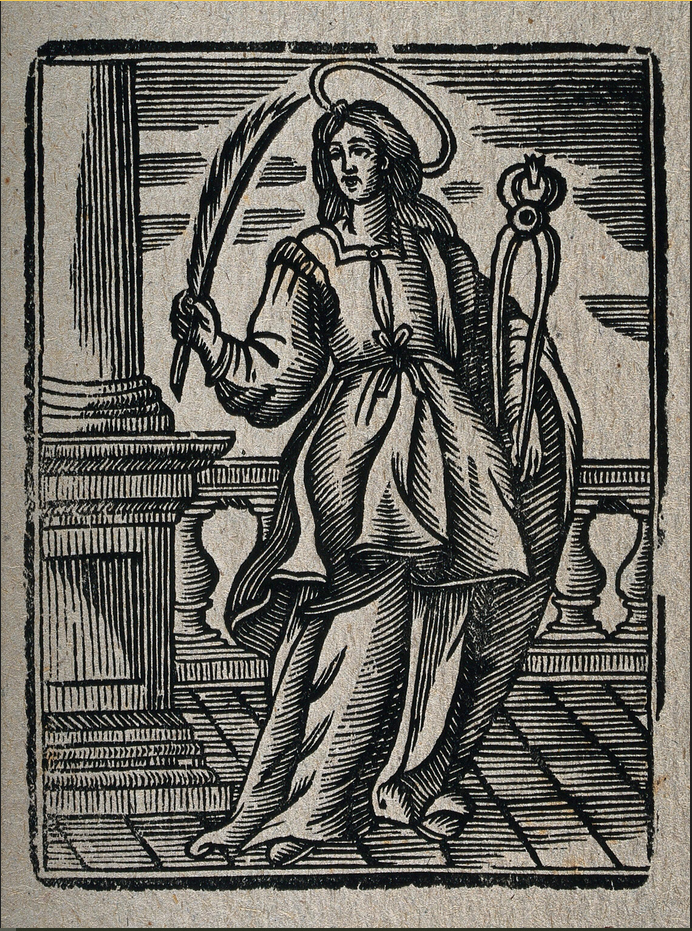
St Agnes was a martyr who, at 13 years old, refused to marry a pagan. She was martyred by being stabbed in the throat. Agnes is well attested and on a list of martyrs dating to AD345. She is the patroness of young women and of chastity. Her feast day is January 21st. I wrote about St Agnes and the Fraternity of St Anne and St Agnes on Distaff Sunday.

The Eve of St. Agnes by John Keats

The poem begins with a great description of winter.

St. Agnes’ Eve—Ah, bitter chill it was!
       The owl, for all his feathers, was a-cold;
       The hare limp’d trembling through the frozen grass,
       And silent was the flock in woolly fold:
       Numb were the Beadsman’s fingers, while he told
       His rosary, and while his frosted breath,
       Like pious incense from a censer old,
       Seem’d taking flight for heaven, without a death,
Past the sweet Virgin’s picture, while his prayer he saith.

Keats sets up the drama with a poetic description of the folklore:

They told her how, upon St. Agnes’ Eve,
       Young virgins might have visions of delight,
       And soft adorings from their loves receive
       Upon the honey’d middle of the night,
       If ceremonies due they did aright;
       As, supperless to bed they must retire,
       And couch supine their beauties, lily white;
       Nor look behind, nor sideways, but require
Of Heaven with upward eyes for all that they desire.

https://www.poetryfoundation.org

In the poem, the maid Madelaine goes to sleep to dream of her love Porphyro. He risks everything to visit the young girl, and watches her while she sleeps. She dreams of him. Waking up and seeing him, Madelaine lets him into her bed thinking she is still dreaming.

She realises her mistake and tells him she cannot blame him for taking advantage as she loves him so much. But if he leaves her, she will be like “A dove forlorn and lost / With sick unpruned wing”.

The two lovers escape and run away together.

Keats & TB

Keats was born in a livery inn in Moorgate, in the City of London. He lived in Cheapside, later in Hampstead, and was published in Welbeck Street in the West End. As a young man he trained as a surgeon at Guys Hospital, Southwark. But he never practised, although he did consider a post as a Ship’s Surgeon.

One wet, cold February he went home to Hampstead on the roof of a stage coach.  But. he had forgotten his coat, so he got soaked and chilled to the bone.  That night, he coughed up blood. His medical and family experience led him to believe it was a fatal sign of consumption. He had lived in a small house with his brother and mother, who both died of TB. Keats had helped nurse them. 

Later on, however, he consulted a doctor. He was told his illness was psychosomatic. And his thwarted love for his next door neighbour, Fanny Brawne, was contributing to his illness. As his consumption advanced, he was advised to go to a warmer climate.  So, he embarked at Tower Pier by the Tower of London. He transferred to a small sailing ship at Gravesend called the Maria Crowther. On the ship to Italy, he shared a cabin with another consumptive.  The two consumptives, had opposite ideas as to whether the portholes needed to be open or closed for their health. Letters he wrote makes it clear he was desperate to stop himself thinking about Fanny Brawne. He got to Rome where he died, achieving, he felt, nothing worthwhile in his life.  His memorial stone proclaimed:

“Here lies One Whose Name was writ in Water.”

On This Day

1265 – The first English parliament to include not only Lords but also representatives of the Commons holds its first meeting in the Palace of Westminster.

1649 – The High Court of Justice for the trial of Charles I begins its proceedings. The Solicitor General John Cook was appointed prosecutor, presided over by John Bradshaw

Today is also St Sebastian’s Feast Day. He has become a gay icon, and was celebrated in a Latin language film by Derek Jarman from 1976. (https://en.wikipedia.org/wiki/Sebastiane)

StSebastian by Marco Zoppo, Courtauld Gallery photo K Flude

A full version of the film is available on Youtube, but here are some scenes:

Events Coming up!

January 25th 2026 Reenactors commemorating the execution of Charles I in Westminster

Kevin Flude’s walks to commemorate the Martyrdom of Charles I

Charles I and the Civil War. Martyrdom Anniversary Walk 2.30pm Jan 30th 26 To book

The Civil War, Restoration, and the Great Fire of London Virtual Tour 7:30pm Fri 30th Jan26 To book

First written on January 23, republished on January 20th 2024, 2025,2026

Rabbiting January 19th

London Illustrated Almanac of 1873
January from London Illustrated Almanac of 1873

January & Rabbits

In January, the ‘coney is so ferreted that she cannot keep in her borough’ says Nicholas Breton. He wrote in the January entry of the Kalendar of Shepherds. (See my post here). In modern speech he means, ‘the rabbit is so hunted with the aid of ferrets that she cannot keep to her burrow’. The London Illustrated Almanac of 1873 chose the Rabbit as its wild animal of the month.

Good Luck Rabbits!

If you need good luck say ‘Rabbit, Rabbit’. No less a person than FD Roosevelt used to say this. No one knows why. Rabbits’ feet are lucky too. I remember some of my friends had them in our Surrey village in the early 60s. Some of Dad’s neighbours kept ferrets, and I remember dead Rabbits hanging from walls. The merits of the feet are given by the history.com website:

“A 1908 British account reports rabbits’ feet imported from America being advertised as ‘the left hind foot of a rabbit killed in a country churchyard at midnight, during the dark of the moon, on Friday the 13th of the month, by a cross-eyed, left-handed, red-headed bow-legged Negro riding a white horse,’

https://www.history.com/news/

As to why, no one really knows. But Pliny the Elder in 71AD reported that cutting off the foot of a live hare could cure gout. There are European traditions of rabbit and other animal’s feet amulets curing all sorts of ailments. There are associations with witches, who could shape-shift into a rabbit. So a rabbit’s foot would be witchy and therefore powerful. In March, I reported on the Hare, and their, similar, associations with witches:

To find out about Rabbit welfare have a look at Rabbiting On Magazine.

Rabbit, Rabbit

For lovers (?) of music, Chas and Dave’s hit song ‘Rabbit’ has a chorus of ‘Rabbit, Rabbit’. According to the Cockney singers (they do love a Knee’s Up) it comes from the Cockney Rhyming Slang expression: Rabbit and Pork. This means ‘Talk’ because it rhymes with ‘Pork’. But, according to the rules of Cockney, you can shorten the phrase to Rabbit. To hear about the origins of the song, and royal connections, click here. To watch the official video. (It is misogynistic and of its day. Also, you may have to listen to an advert, but I don’t make any money from the ad!)

Now, I must stop rabbiting on. Time to get things done.

On This Day

1915 – German Zeppelins bomb the towns of Great Yarmouth and King’s Lynn. 20 people killed in the first major aerial bombardment of a civilian target. See my post on the September 8th Zeppelin attack on London.

Today the V&A ‘celebrated’ Blue Monday with an article on China’s Blue and White Ceramics.

First, published, as January and Rabbiting in 2023, revised in January 2024, 2025, January moved to its page and page revised and retitled 2026

St Hilary & the Arians. The Coldest Day of the Year? January 13th

Hackney Marshes, Jan 2022, Chris Sansom

St Hilary’s Day is traditionally the coldest day in the year. It is normally in January, or February. This is because although the Sun is at its lowest at the Solstice, the earth and the sea retains heat. But, even so, sometimes the coldest day is in December and occasionally as early as November, or as late as March.

In 2024 the coldest day, was at Dalwhinnie, 17th January at -14.0C. In 2023, it was -16.0C, recorded at Altnaharra on the 9th of March. The coldest day in 2025 was -18.9C Altnaharra 11 January. Both places are in the Scottish Highlands.

At the bottom of the post are the coldest days in the UK since 2000.

St Hilary & the Arians

I can’t help think that this heading sounds like a very good 1980s post-punk band?

St Hilary (born 315) was the Bishop of Poitiers in France, where he died around 367 AD. He was a vigorous opponent of the Arian Heresy, which swept through the Catholic world in the late Roman period. Catholic doctrine was that God – the Father, Son and Holy Ghost was a Trinity. Arius took the view that: “If the Father begat the Son, then he who was begotten had a beginning in existence, and from this it follows there was a time when the Son was not.” Seems like solid logic, doesn’t it? But this means that for Arians, Jesus was not equal with God. Another question at the time was, ‘Was Jesus divine?’

Eventually, the ecumenical First Council of Nicaea of 325, declared Arianism to be a heresy. This was during the reign of Constantine the Great. Arianism was strong in the Eastern Empire and was accepted by Constantine’s son. It continued as a major influence, especially among the Goths and Vandals who were an increasingly important force in the Late Roman Empire.

The Church takes the position that there is one God existing in three coequal, coeternal, consubstantial divine persons (wikipedia). It’s sobering to think how many people were martyred over these arcane attempts to maintain a coherent monotheism despite this difficult idea of three entities being one God. For more heresy please look at my post on the Pelagian Heresy and St Germanus.

Hilary Term

St Hilary was a scholar and is one of those rare early Saints not to be horrifically martyred. We remember him in the UK with the dedication of a few Churches, particularly in Wales. He has also given his name to one of the terms of the academic year. At least for Oxford. There, Hilary Term is their name for the ‘spring term’ and this year Hilary began on the 12th January.

Oxford names its terms Michaelmas, Hilary and Trinity. Cambridge and London School of Economics share Michaelmas but call the next term ‘Lent term’ and then ‘Summer Term’. Most other universities split the academic year into three terms (autumn, spring and summer) across two academic semesters. 

For most of us ‘terms’ are a thing of our youth. For the rest of our lives we participate in the hard slog of ‘real life’. Real life is not split into terms. It is work, work, work, separated by a few short breaks. But not for the High Court and the Court of Appeal. No! They have stuck to the idea of the term. The legal establishment also uses ‘Hilary.’ This year the legal year is:

2026

Hilary: Monday 12 January to Wednesday 1 April
Easter: Tuesday 14 April to Friday 22 May
Trinity: Tuesday 2 June to Friday 31 July
Michaelmas: Thursday 1 October to Monday 21 December

Too much like hard work, for the lords of Justice! Although to do them credit they have four terms.

As I travel around Britain I find there are a lot of historic ‘Stately Homes’ which were bought by eminent Judges or lawyers. The legal establishment is based at the four Inns of Court: Lincoln’s Inn, Grey’s Inn, Inner Temple and Middle Temple. These were founded in London in the medieval period. They provided homes and well as offices (chambers) for the lawyers. The lawyers stayed in them during the legal terms. About 30 weeks out of the 52 available in the year. Then they would go off to their country estates to recuperate and enjoy the fruits of their privileged position.

Coldest days in the UK

(according to https://www.trevorharley.com/coldest-days-of-each-year-from-1875.html and in centigrade.)

2000 -15.0 Dalmally (Argyll) 30 December

2001 -21.7 Kinbrace (Sutherland) 3 March

2002 -16.1 Grantown 2 January

2003 -18.3 Aviemore 7 January

2004 -15.2 Kinbrace (Sutherland) 19 December

2005 -13.2 Ravensworth (North Yorks.) 29 December

2006 -16.4 Altnaharra 2 March

2007 -13.0 Aboyne 22 December

2008 -12.9 Aviemore 30 December

2009 -18.4 Aviemore 9 February, Braemar 29 December

2010 -22.3 Altnaharra 8 January

2011 -13.0 Althnaharra 8 January

2012 -18.3 Chesham (Bucks.) 11 February

2013 -13.4 Marham (near Norwich, Norfolk) 16 January

2014 -9.0 Cromdale (Morayshire) 27 December

2015 -12.5 Tulloch Bridge, Glascarnoch 19 January

2016 -14.1 Braemar 14 February

2017 -13.0 Shawbury (Shropshire) 12 December

2018 -14.2 Faversham (Kent) 28 February

2019 -15.4 Braemar 1 February

2020 -10.2 Braemar 13 February and Dalwhinnie (30 December)

2021 -23.0 Braemar 11 February

2022 -17.3 Braemar 13 December

2023 -16.0 Altnaharra 9 March

2024 -14.0 Dalwhinnie 17 January

2025 -18.9 Altnaharra 11 January (so far – it hasn’t been finalised as of St Hilary’s Day)

If you look at the long list you will see that Braemar and Althnaharra, both in the Scottish Highlands are the most common places to host the coldest day in the UK.

On This Day

1404 King Henry IV banned alchemy. In fact, he banned transmutation of base metals into gold. Had someone succeeded, they could have turned upside down the basis of the medieval economy.

1893 The Independent Labour Party formed, led by Keir Hardie

1968 Johnny Cash performs live at Folsom State Prison

2021 – Outgoing President Donald Trump is impeached for a second time on a charge of incitement of insurrection following the January 6 United States Capitol attack one week prior. (Wikipedia)

First Published Jan 13th 2024, revised 2025, 2026