St Apollonia Day. A Day to Cure the Toothache February 9th

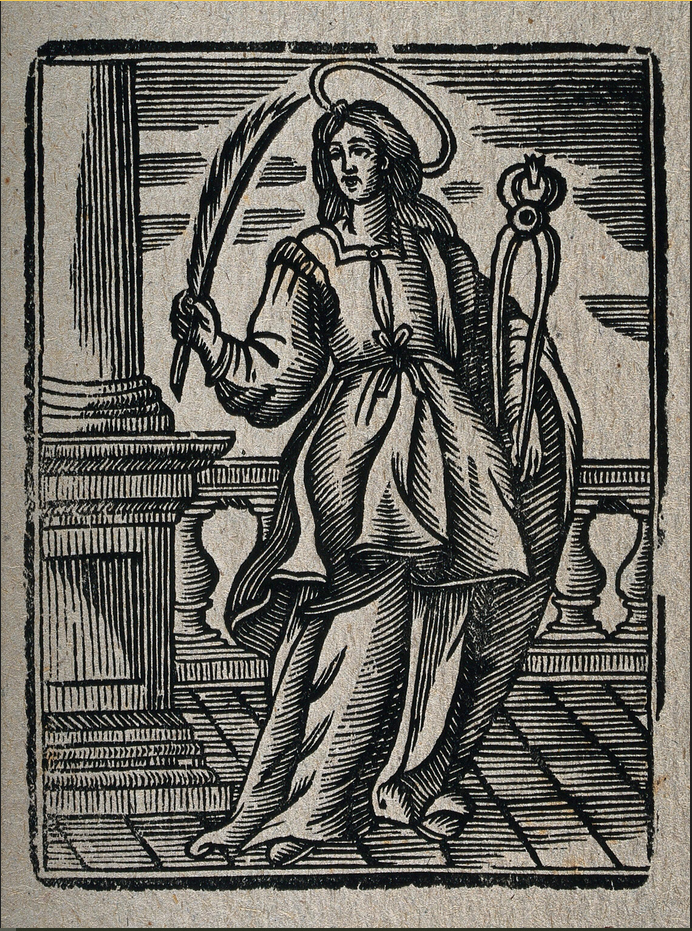
Saint Apollonia. Woodcut. Saint of Toothache Wellcome Collection. Public Domain Mark. She is shown with forceps, extracted tooth and the martyr’s palm.

The 9th of February is the Feast of St Apollonia. She was martyred at Alexandria in 249 AD during the persecution of Emperor Decius. (see also my post on St Agatha) She was attacked during an anti-Christian riot and struck around the face knocking her teeth out. Then, she was taken to a bonfire and told they would throw her in if she did not renounce her faith. So, without waiting, she spoke a prayer and walked into the fire. This information is recorded in a near-contemporary letter from St Dionysius of Alexandria. This is rare well documented martyrdom. Because her teeth were knocked out she is, therefore, Saint of Toothache.

Suicide or Martyrdom?

St Augustine of Hippo touches on this spat of martyrs, often young women, killing themselves rather than losing their virginity, or like St Apollonia embracing death in the face of violent persecution. His answer is that like Samson, they are commanded by God to take their own lives, which is ok. Elsewhere, he condemns suicide as it is against the commandment ‘Thou shalt not kill’. He explains that God did not add ‘thy neighbour’ to it so it also forbids killing oneself. By contrast, it was added to ‘Thou shalt not bear false witness against thy neighbour’. The rest of St Augustine’s argument comes from Plato’s Phaedo. The introduction to the book on the Project Gutenberg web site sums up the arguments:

According to one explanation, because man is a prisoner, who must not open the door of his prison and run away—this is the truth in a ‘mystery.’ Or (2) rather, because he is not his own property, but a possession of the gods, and has no right to make away with that which does not belong to him.

The Project Gutenberg EBook of Phaedo, by Plato translated by  Benjamin Jowett 

Cloves for Toothache

I can remember my Grandmother prescribing cloves for me when I had toothache. And this was, and is, a common remedy. In my case, we would keep a clove or two in the mouth close to the site of the pain. According to Natural Ways to Sooth an Toothache cloves contain

‘Eugenol, a natural form of anaesthetic and antiseptic that helps get rid of germs. Eugenol is still used in dental materials today’

Dr John Hall, Shakespeare’s son-in-law, tended to use a pill to soothe sore gums. He also used an oil from a wood called ‘Ol. Lig. Heraclei’ which may be oil from the Bay Tree. (‘John Hall and his Patients’ by Joan Lane). Most of his tooth cases seem to be sore gums. This suggests to me Dr John Hall did not generally do dental work.

Death by Toothache

To get a tooth drawn you could go to a Barber Surgeon, a Blacksmiths or specialist Tooth Drawer. It would be terrifyingly painful. Probably only done when the pain was unbearable. Just think what a premium you would pay for a really competent drawer? The drawers would not have any formal training, but the skills would be passed on by the drawer to his apprentice or assistant. ‘Teeth’ was a common cause of death – most likely from infection or an abscess.

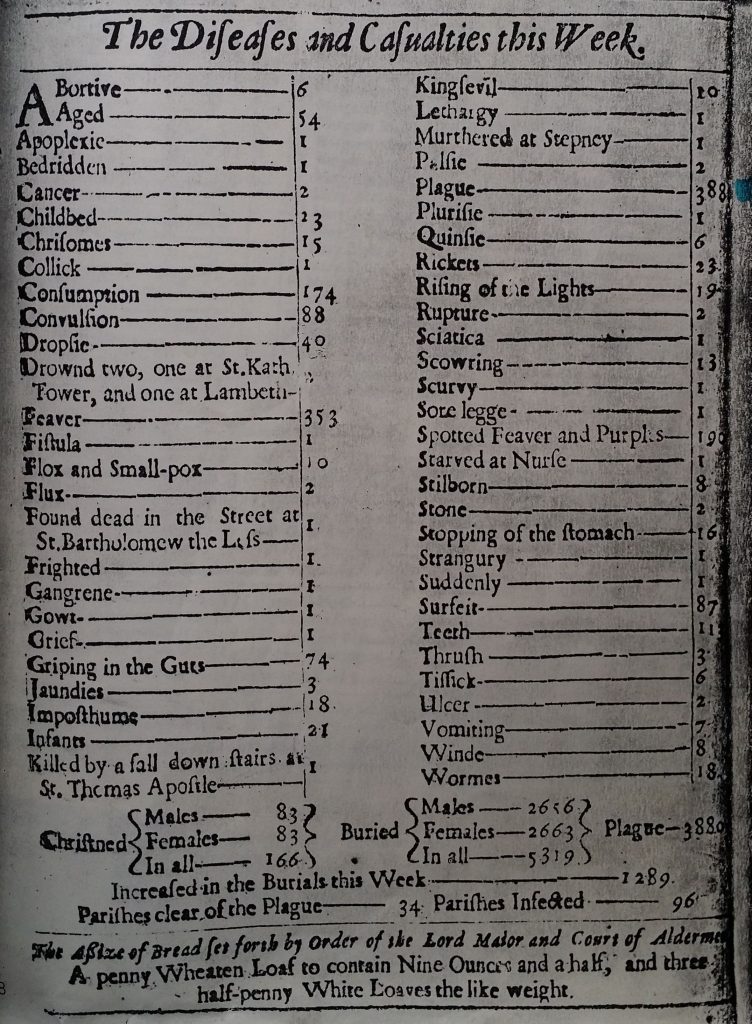
A bill of mortality for London 1665, showing 11 deaths caused by 'teeth' (as opposed to 353 for 'feaver'
List of causes of death, London during the plague of 1665. Teeth killed 11 people

Magic and Toothache

John Aubrey, an erudite and educated 17th Century writer, reports on the use of Magick for tooth care. When he relates these unlikely cures he often provides information that the person who told him the story is worthy of belief. So he seems to give some credence to the efficacy of these magical ‘cures’. But, judge for yourself; this is what he wrote:

To Cure the Tooth-ach.

Take a new Nail, and make the Gum bleed with it, and then drive it into an Oak. This did Cure William Neal, Sir William Neal’s Son, a very stout Gentleman, when he was almost Mad with the Pain, and had a mind to have Pistoll’d himself.

To Cure the Tooth-ach, out of Mr. Ashmole’s Manuscript Writ with his own Hand.

Mars, hur, abursa, aburse.
Iesu Christ for Marys sake,
Take away this Tooth-ach.

Write the words, Three times; and as you say the Words, let the Party burn one Paper, then another, and then the last.

He says, he saw it experimented, and the Party immediately Cured

John Aubrey’s Miscellanies 1695

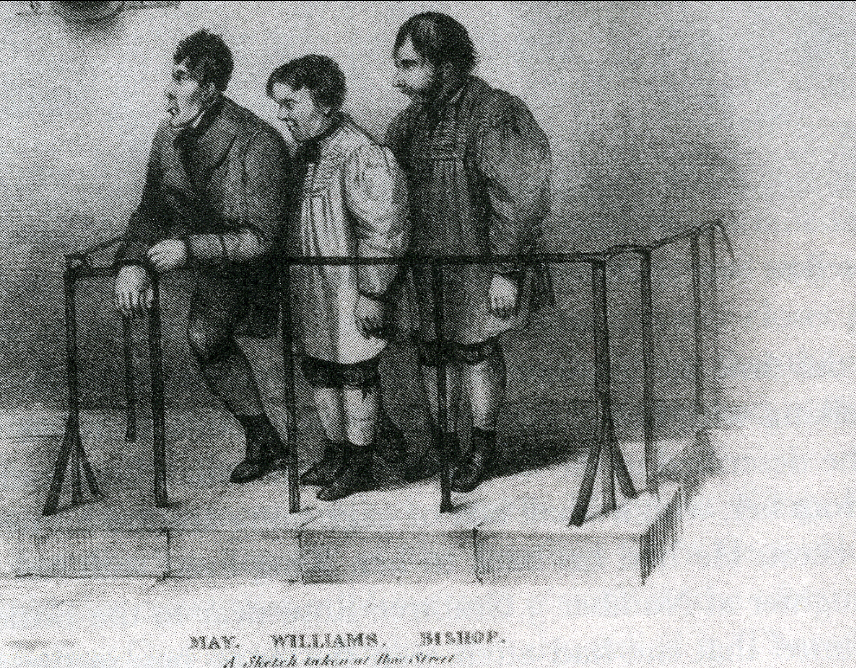
May, Williams and Bishop at the Old Bailey accused of murder in pursuit of bodysnatching

Teeth and the Body-Snatchers

In 1832, in London Bishop, Williams, and May were accused of body snatching. After killing the Italian Boy (wonderful book by Sarah Wise ‘The Italian Boy‘) they jemmied out his teeth. Then, took the teeth to a South London Dentist. with whom they bargained for a good price. (They used the term ‘cheapened’ – I cheap, you cheap, we are cheapening: meaning to barter). The dentist wanted to use the dead boy’s teeth for false teeth for his patients. If memory serves, he paid £1 for them.

The teeth were used as evidence in the trial of the murderers. When the trial was over and the accused punished, the dentist asked for the teeth back! Two of the murderers were hanged but the third freed for turning King’s Evidence. Thereafter, the teeth were released back to the Dentist. He promptly put them in the window of his surgery as an advert for his professional skills!

Earlier, one of the Borough Boys Resurrectionist gang (based in Southwark, London) toured the battlefields of the Peninsular Wars collecting teeth. He made a substantial sum selling them to dentists as false teeth. They became known as Waterloo Teeth.

When I first wrote this in I added ‘How things have changed!’ But in recent years there have been reports of people undertaking their own dental work, if they cannot get access to an NHS dentist. Effectively, it seems that the Conservative Government was allowing dentistry to slip out of the NHS just like it did with eye health. For a study in what has happened to Dentistry in the UK in recent years, please look at this report here.

On This Day

1907 – the National Union of Women’s Suffrage Societies (NUWSS or Suffragists) organised the so-called the Mud March. This was the ‘first large procession’ in support of votes for women. It was called the Mud March because of the downpour of rain on the day.

1916 – Conscription started in World War 1 with the call-up of unmarried men aged between 18 – 41.

1933 – The Oxford Union passed the resolution ‘the House will in no circumstances fight for King and Country.’

Bird of the Month The Blackbird. The common Blackbird is a true Thrush. The male is black with a yellow beak and the female is dark brown with a yellow beak. The Blackbird begins to sing as early as January, and is one of the birds who sing first early in the morning. British Blackbirds do not migrate, but Northern European Blackbirds often migrate to the UK in the winter for warmer weather. Viruses have put the species under some threat and they need help to get through the winter. ArkWildlife suggests this is what you should feed blackbirds:

For more bird advice see https://www.arkwildlife.co.uk/ from which the above feeding advice is taken.

Here is a blackbird song, royalty free, from https://creazilla.com/search/audio/blackbird.

Four and Twenty Blackbirds backed in a pie

Is an 18th Century nursery rhyme which refers to the medieval habit of baking a pie crust, and putting it over a bowlful of live birds. When it was opened all the birds, well sing the song to remind yourself what they do?

Sing a song of sixpence
A pocket full of rye
Four and twenty blackbirds
Baked in a pie
When the pie was opened
The birds began to sing
Wasn’t that a dainty dish
To set before the king?

The king was in his counting house
Counting out his money
The queen was in the parlor
Eating bread and honey
The maid was in the garden
Hanging out the clothes
When down came a blackbird
And pecked off her nose

Sing a song of sixpence
A pocket full of rye
Four and twenty blackbirds
Baked in a pie
When the pie was opened
The birds began to sing
Wasn’t that a dainty dish
To set before the king?

A stinging Cure for Lust

Another story told of the Blackbird is a similar tale I have told before about holymen and temptation. So St Benedict was pecked on the cheek by a Blackbird. Next day he finds himself assailed with lust. It was the Devil disguised as the Blackbird he decides that infected the Monk. Then Benedict did what a number of saints did in similar circumstances. He threw himself, naked, in a patch of nettles and brambles and rolled around, until his body was sore afflicted. But he had overcome his lust.

Then St Kevin held out his hand and a blackbird laid her eggs in it. So he stayed still for the two weeks it took the fledglings to hatch! (for more on St Kevin see my post here)

Icy Sedgwick has an excellent website on the folklore of Birds, containing a nice podcast, which for those who love a north-east accent will enjoy.

For my post on Robins and Wrens look here.

First written February 2023, revised February 2024, 2025. On This Day, Bird of the Month were added 2026

St Agatha Feast Day February 5th

Saint Agatha, detail from a painting of Francisco de Zurbarán FROM wikipedia
Saint Agatha, detail from a painting of Francisco de Zurbarán – she is carrying her severed breasts

She is a Sicilian Saint, who refused to sleep with a powerful Roman (Quintianus) in the third Century. St Agatha was imprisoned, tortured, had her breasts pincered off, and still refused to sleep with him and died in prison. She is remembered in Sicily by cakes shaped as breasts eaten on her feast day (I kid you not).

breast shaped cakes called Minne di Sant'Agata, a typical Sicilian sweet
Minne di Sant’Agata, Sicilian (Wikipedia)

St Agatha Patronage

Her patronage springs from the usual mixture of deep and simplistic identifications. So she is ‘the patron saint of rape victims, breast cancer patients, martyrs, wet nurses, bell-founders, and bakers.’ As she is from Sicily ‘she is invoked against eruptions of Mount Etna.’ And therefore also against fire and earthquakes.’ (Wikipedia).

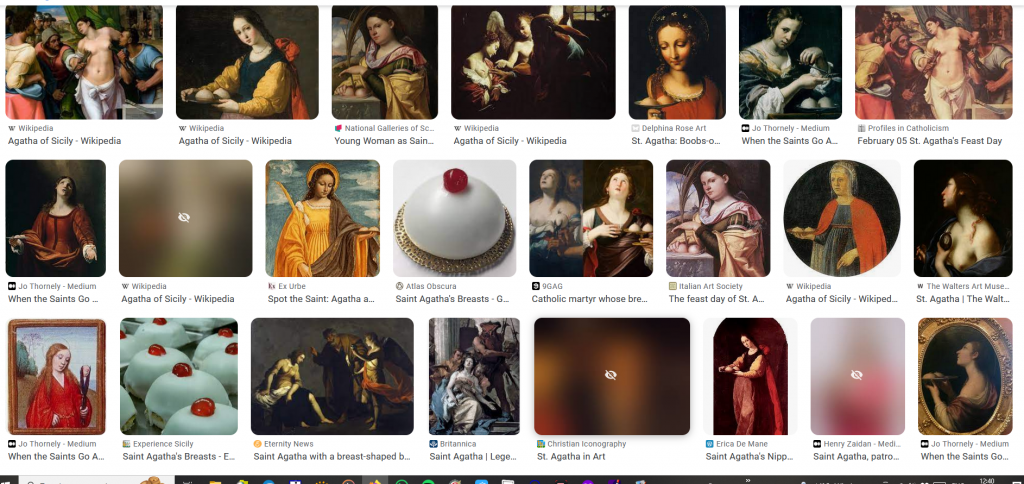
Bell Founders and Bakers? So, the bakers and bell founders, it is suggested, may have mistaken the trays of breasts as bells or loaves? Unlikely in my opinion, as Google image search shows they look clearly like breasts. They are cakes, of course, so that can help explain the Bakers, but the Bell Founders?

She was martyred, at the age of 20 (231-251AD), in the last year of the reign of Emperor Decius (Emperor 249 to June 251 AD). Thus, she is an early martyr whose cult was established in antiquity. But many of the details of her life and death are, as usual, apocryphal and from later traditions.

Results of a search for images of St Agatha in Google
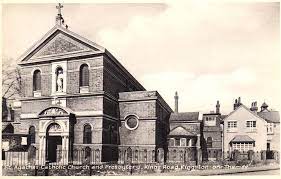
St Agatha's Church, Kingston on Thames
black and white illustration
St Agatha’s Church, Kingston on Thames

St Agatha and Etna

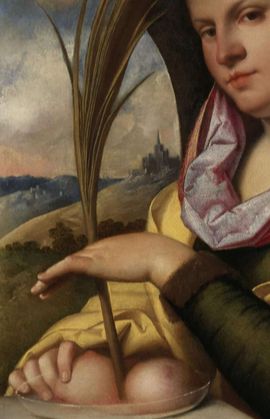
Detail of a Portrait of St Agatha by Cariana (Paintedin 1516-17). In the backgrouns is Catania

A year after her death, Mount Etna erupted. According to the story, the Christians of her home town of Catania lifted the Martyr’s veil towards the flowing lava. And the City was saved as the lava flow stopped. Hence, she protects against eruptions and by extension, earthquakes, and fire. This part of the story I got from my friend Derek who sent me the link to a piece written by Father Patrick van der Vorst. This also has the full image of the detail of painting by Cariani I show here.

For an explanation of gory matrydom’s please read my post on St Blaise.

For more on St Agatha, Ravenna, and a story about my motorcycling days please look at this post.

On This Day

2 BC – Caesar Augustus is granted the title Father of the Country (pater patriae) by the Roman Senate. Ovid celebrated this day in his alamanac poet Fasti. He seems to be praising Augustus mentioning him with the divine Julius Caesar, and Romulus and Reamus, founders of Rome.

Book II: February 5: Nones

Now I wish for a thousand tongues, and that spirit
Of yours, Homer, you who celebrated Achilles,
While I sing the sacred Nones in alternating verse.
This is the greatest honour granted to the calendar.
My wit deserts me: the burden ís beyond my strength,
This special day above all I am to sing.
Why did I wish, foolishly, to lay so great a task
On elegiac verse? This was a theme for the heroic stanza.
Sacred Father of the Country, this title has been conferred
On you, by the senate, the people, and by us, the knights.
Events had already granted it. Tardily you received
Your true title, you’d long been Father of the World.
You have on earth the name that Jupiter owns to
In high heaven: you are father of men, he of gods.
Romulus, give way: Caesar by his care makes your walls
Mighty: you made such as Remus could leap across.
Tatius, and the little towns of Cures and Caenina,
Knew you: under this Leader all the sun sees is Roman.

But suddenly the verse turns dark, and the references to Augustus are now slights and accusations. He continues:


You owned a little patch of conquered land:
Caesar possesses all beneath Jupiter’s heavens.
You raped married women: under Caesar they are ordered
To be chaste: you permitted the guilty your grove: he
forbids them.
Force was acceptable to you: under Caesar the laws
flourish.
You had the title Master: he bears the name of Prince.
Remus accused you, while he pardons his enemies.
Your father deified you: he deified his father.
Already Aquarius shows himself to the waist,
And pours the gods flowing nectar mixed with water,
And you who shrink from the north wind, be pleased,
A softer breeze is blowing from the West.

Ovid only finished the first 5 chapters of his calendar poem. He was exiled from Rome by Augustus, we don’t know why. But perhaps this is why he was exiled, because he was willing to defame the Godly Tyrant, Augustus, who had destroyed the Roman Republic. Dictators demand flattery, not criticism. Ovid paid the price. For more on Ovid’s exile please read my post on his abandonment of the Fasti here.

1811 – The Prince of Wales appointed Prince Regent during his dad’s, George III, mental incapacity

1924 – The famous pips, the time signal, first broadcasted by the BBC from Greenwich

1944 – War time diarist, Joan Wyndham receives letter from Norwegian lover Hans Gundersen. It confirms he is still alive and that she loves him. Follow the link to read his drunken letter and Joan’s reaction.

See my post here for another Joan Wyndham diary entry.

1953 – Last foodstuffs taken off Rationing in the UK. From this day forward, people could eat as many sweets and as much chocolate as they wanted. In the War they were limited to 2oz per person, and post war 6oz per person per week.

1990 – the last pips broadcasted from Greenwich by the BBC, henceforth the BBC generated their own pips.

First published in 2024, and republished in 2025, Ovid section added 2026

St Blaise Day & The Tadpole Revels February 3rd

19th Century illustration of St Blaise’s Chapel, Westminster Abbey

The Blessing of St Blaise helps protect the throat. The way it is works is that blessed candles are made into a cross. These are then touched against the throat of the afflicted one. Why? Because a story was told that Blaise, on his way to martyrdom, cured a boy who had a fish bone stuck in his throat. So, he is the patron Saint of Sores Throats.

Blaise is thought to have been an Armenian Bishop of Sebaste, martyred (316AD) in the persecution of the Emperor Licinius.

Sage Advice for Sore Throats:

Salvia officinalis. Lamiaceae By Kurt Stüber [1] – caliban.mpiz-koeln.mpg.de/mavica/index.html part of www.biolib.de, CC BY-SA 3.0, https://commons.wikimedia.org/w/index.php?curid=8109

In the spirit of St Blaise, here is advice for care of your throats.

Sage Tea is said to be excellent for many things, including dental hygiene and alleviating sore throats. The Kalendar of Shepherds tells us how to treat our throats:

Good for the throat honey, sugar, butter with a little salt, liquorice, to sup soft eggs, hyssop, a mean manner of eating and drinking and sugar candy. Evil for the throat: mustard, much lying on the breast, pepper, anger, things roasted, lechery, much working, too much rest, much drink, smoke of incense, old cheese and all sour things are naughty for the throat.

The Kalendar of Shepherds 1604

The Martyrdom of St Blaise

Wool combs black and white illustration
Internet Archive book illustrations collection on Flickr. (from wovember see below)

So far, an uplifting, healing story. However, the Medieval Church’s propensity for the gruesome and its peculiar need to allocate a unique method of martyrdom to each early saint leads us to Blaise being pulled apart by wool-combers irons.  Then he was beheaded.

Hence, he is also the patron saint of wool-combers, and by extension, sheep. Wikipedia tells me that ‘Combing: was a regular form of torture.

Combing, sometimes known as carding (despite carding being a completely different process) is a sometimes-fatal form of torture in which iron combs designed to prepare wool and other fibres for woollen spinning are used to scrape, tear, and flay the victim’s flesh.

https://en.wikipedia.org/wiki/Combing_(torture)

Gory Martyrdoms Explained?

I am horrified by the goriness of these martyrdoms, and it needs some explanation. If we believe in Richard Dawkins idea of the meme we can find an explanation. Allocating a different and gory death to each and every saint has advantages for the survival of the cult. It brings a uniqueness to the story of the Saint. Particular details of death suggests authenticity. The extreme death creates an example of stoicism in the face of challenge to faith, and provokes empathy and piety. There is, also, we have to accept, a very human attraction in the bloodthirstiness of stories.

But, there is, I suspect, a financial interest too. In order for these cults to survive, they need adherents, acolytes, worshippers, donors, patrons. They require income streams that can help support the expensive clergy and the fabric of the Church or chapel. One source of income is from the wealthy, but in the medieval town, urban wealth was held within the booming guild structure. If the martyred Saint, could attract a particular Guild then (the sponsoring Priests, or Church) were quids in.

Wool was the mainstay of the economy in the medieval period. A martyr like St Blaise would prosper wherever there were people working with wool, cloth or sheep. So, is it too cynical to suggest someone with an eye for the main chance added the detail of the wool combing death to attract donations from rich wool merchants? As a successful meme, it spread throughout Europe.

Also, there were any number of endemic diseases and occupational hazards for which there was no clear cure. So if the Saint can become the Saint of common,  preferably chronic, illnesses, he/she can attract all those who suffer from that or similar diseases.

Of course, it may not always be a cynical drive for more income. In exchange, the Church offered the sufferer comfort in the face of suffering. This quality is not only of great use on its own, but it would have maximised the placebo effect. The effect has been scientifically measured. And would often be more effective a cure as than the available, often bizarre, medieval remedies.

Blaise’s hagiography suggests he was a physician. The cult was able to grow into being not only the Saint for Sore Throats and Sheep but one of the go-to saints for diseases in both humans and animals.

For a female tortured Saint see my post of St Margaret of Antioch here.

Blaise in Britain

His cult came to Britain when King Richard I was ship wrecked on Crusade. Richard was helped by Bishop Bernard of Ragusa where Richard was washed up. When the Bishop was deposed he sought sanctuary in Britain and was made Bishop of Carlisle where he promoted the cult of Blaise. Several churches in the UK founded churches named for him.

St Blazey in Cornwall is named after his Church and celebrates him by a procession of a ram and a wicker effigy of the Saint. Milton, in Berkshire, dedicated its Church to St Blaise, probably because the village’s wealth depended on sheep. The village held a feast on the third Sunday after Trinity, and the day after held the Tadpole Revels at Milton Hall. Tadpole is thought to be a corruption from the word ‘Tod’ which means cleaned wool.

Blaise in London

Westminster Abbey has a chapel dedicated to Blaise (see image at top of page). In the Bishop’s Palace at Bromley is St Blaise’s Well. It is thought to have begun as a spring when the Palace ‘was granted to Bishop Eardwulf by King Ethelbert II of Kent around 750 AD.’ A well near the spring became a place of pilgrimage and an Oratory to St Blaise was set up. In the 18th Century, the chalybeate waters of the well were considered to be useful for health. It still exists today.

On February 3rd, St Etheldreda’s Church in London holds the Blessing of the Throats ceremony. It was a Catholic Church in the medieval period, then, in Reformation was used for various purposes until returned to the Catholic Church in 1876. It has memorials for Catholic Martyrs killed in the reign of Queen Elizabeth I

Elisa Rolle – Own work
CC BY-SA 4.0 Wikipedia St Etheldreda’s Church

One of London’s oldest guilds is the Worshipful Company of Woolmen, first mentioned in 1180, when fined, for operating without a license, by Richard 1’s dad, Henry II.

Sources: The Perpetual Almanac by Charles Kightly, Woolly Saints, Britannica, Wovember, wikipedia.

On This Day

1637Tulip Mania dramatic collapse of the soaring price of Tulip Bulbs within the Dutch Republic.

1761 – At the age of 87 Beau Nash, Master of Ceremonies at Bath died. To see my post on 18th Century Bath please look at March 14th

1870 – The 15th Amendment to the US Constitution was ratified. It prohibits the federal government or any state from denying or abridging a citizen’s right to vote “on account of race, colour, or previous condition of servitude”. What I don’t understand is how this is compatible with all the many ‘abridgements’ of a citizen’s right to vote which seem to flourish. In particular, Gerrymandering. Isn’t it effectively an abridgement of the right to vote, if the electoral districts are so artificially engineered as to make that vote meaningless? Maybe it’s ok if the abridgement is not about race, colour etc.? (OK as in ‘get away with subverting democracy’.

1917 – World War I: The USA enters the War (unrestricted submarine warfare being one of the causes)

1933 – The policy of Lebensraum announced by Adolf Hitler. This might be explained as one powerful country saying it is entitled to take over less powerful countries because they can?

Revised 2025, and 2026

February – ‘the enemy to pleasure and the time of patience’

February Title page from Kalendar of Shepherds.

The 15th Century French illustration, above, shows February as a time to cut firewood, dress warmly and stay by the fire. Food on the table is a nutritious pie and the fish are there to remind us it is the month of Pisces. In the other roundel is the other February star sign the Water Carrier, Aquarius.

Star signs of February
February in the Kalendar of Shepherds

The poem above is a reference to the Candlemas celebration of the presentation of the child Jesus at the Temple. The paragraph below the line (above) gives a summary of February. It ends with the idea that runs through the Kalendar. There are twelve apostles, twelve days of Christmas, twelve months in the year. So, there are twelve blocks of six years in a person’s allotted 72 years of life. In the January entry the Kalendar suggests the essential uselessness of 0-6 year old children. But for February, it allows that 6-12 years old children are beginning to ‘serve and learn’.

The Kalendar’s View of February

pisces from the zodiac from kalendar of shepherds
Pisces From the zodiac from kalendar of shepherds

Below, is the text for February. This gives a rural view of life in winter. It ends with the line that February:

is the poor man’s pick-purse, the miser’s cut-throat, the enemy to pleasure and the time of patience.’

Description of February in the Kalendar of Shepherds

About the Kalendar of Shepherds.

The Kalendar was printed in 1493 in Paris and provided ‘Devices for the 12 Months.’ The version I’m using is a modern (1908) reconstruction of it. It uses wood cuts from the original 15th Century version and adds various texts from 16th and 17th Century sources. (Couplets by Tusser ‘Five Hundred Parts of Good Husbandrie 1599. Text descriptions of the month from Nicholas Breton’s ‘Fantasticks of 1626.) This provides an interesting view of what was going on in the countryside every month.

For more on the Kalendar look at my post here.

The original Kalendar can be read here: https://wellcomecollection.org/works/f4824s6t

Hesiod and February

Hesiod, in his ‘Works and Days’ describes February as a merciless cold, windy time. Hesiod was writing around 700BC. He gave us ‘the story of Prometheus and Pandora, and the so-called Myth of Five Ages.’ (Links are to Wikipedia.)

Avoid the month Lenaeon, (February) wretched days, all of them fit to skin an ox, and the frosts which are cruel when Boreas blows over the earth.
He blows across horse-breeding Thrace upon the wide sea and stirs it up, while earth and the forest howl.
On many a high-leafed oak and thick pine he falls and brings them to the bounteous earth in mountain glens: then all the immense wood roars and the beasts shudder and put their tails between their legs, even those whose hide is covered with fur; for with his bitter blast he blows even through them, although they are shaggy-breasted.
He goes even through an ox’s hide; it does not stop him. Also he blows through the goat’s fine hair.
But through the fleeces of sheep because their wool is abundant, the keen wind Boreas pierces not at all; but it makes the old man curved as a wheel.
And it does not blow through the tender maiden who stays indoors with her dear mother, unlearned as yet in the works of golden Aphrodite, and who washes her soft body and anoints herself with oil and lies down in an inner room within the house,
on a winter’s day when the Boneless One (an Octopus or a cuttle?) gnaws his foot in his fireless house and wretched home; for the sun shows him no pastures to make for, but goes to and fro over the land and city of dusky men, and shines more sluggishly upon the whole race of the Hellenes.
Then the horned and unhorned denizens of the wood,] with teeth chattering pitifully, flee through the copses and glades, and all, as they seek shelter, have this one care, to gain thick coverts or some hollow rock.
Then, like the Three-legged One (an old man with a stick) whose back is broken and whose head looks down upon the ground, like him, I say, they wander to escape the white snow.

Original text available here. and for more on Hesiod see my post here.

Februarius

The Roman month Februarius was the month of purification. Februa was the name of the purification ritual held on February 15 (full moon) in the old lunar Roman calendar. The Romans originally considered winter a monthless period of the year. So they only had 10 months to the year. Later they added January and February. March was the first month, so September was the 7th month, October the 8th, November 9th and December the 10th and final month. Names derived from the Latin for 7th, 8th, 9th, 10th.

For more on the Roman Calendar look at my posts

https://chr.org.uk/anddidthosefeet/march-1st-the-month-of-new-life/

https://chr.org.uk/anddidthosefeet/leap-day-february-29th/

First Published February 4th 2024, revised 2025, 2026

Civil War Parade through Westminster Last Sunday in January

Photos by Kevin Flude, Charles I, Martyr Parade

Every year the English Civil War Society commemorates the execution of King Charles I, Martyr, on the last Sunday in January. Charles was executed on January 30th. Please look at my post about the execution here.

This year, I went to the Parade for the second time, and include some photos below. The reenactors met at St James Palace and marched along the Mall to Horseguards Parade. There they assembled, and then a detachment went to the Banqueting House where Charles was lawfully executed/murdered/martyred, depending upon your attitude. Here they lay a wreath.

Charles I Martyr?

He was a tyrant who tried to subvert the rule of Magna Carta and undermined Parliament. Then started a Civil War which killed 85,000. For the numbers behind the Civil War look here. So I’m going for lawfully executed, and I might say good riddance, but I don’t believe in the death penalty. By the way, the legal arrangements made for the unprecedented trial of the Head of State, laid the foundations for trials such as those at Nuremberg, and Kosovo. The Prosecutor was a lawyer called John Cook. Please read about him in this excellent book . The Tyrannicide Brief: The story of the man who sent Charles I to the scaffold. By Robertson, Geoffrey (2005). Chatto & Windus/Vintage. ISBN 978-0-09-945919-4. Cook is remembered on Wikipedia as ‘Regicide’. But he was a pioneer of legal action against Tyranny. Another hero.

Here is the official publicity for Sunday’s Parade, followed by some of my photos.

January 25th 2026 Reenactors commemorating the execution of Charles I in Westminster

If you are interested, then you must either come to my walk, this Friday or attend my Virtual Tour, on Friday 30th January, evening. And you will find I am far more even-handed that this post suggests!

Kevin Flude’s walks to commemorate the Martyrdom of Charles I

Charles I and the Civil War. Martyrdom Anniversary Walk 2.30pm Jan 30th 26 To book

The Civil War, Restoration, and the Great Fire of London Virtual Tour 7:30pm Fri 30th Jan26 To book

First written on January 26th January 2026

News from the Almanac of the Past January 22nd 2026

May Day Bedfordshire

This has become the day in which I update readers on the purpose and future plans for the Almanac of the Past.

What is the Almanac of the Past?

The nature of an almanac is to be a pot-pourri. They are about seasons, time, folklore, history, important events, and anniversaries. I also like to cover history, famous people and discoveries. Gods, Goddesses, Saints, sinners, and archaeology. What I want it to be is something that makes us more mindful about the passing of the year. How seasons and time change the way people see their world. My focus is mostly on the UK, but also on Rome and Greece. With occasional excursions to other ages, places and universes. I am also trying to find more content that is London-based.

What is the plan for the Almanac of the Past?

I plan to have one entry for each day. The problem with this, is that as I fill in the empty days, I will be republishing the already filled days. So subscribers will be seeing content they have seen before. Currently, I am trying to improve and extend existing content so it is worth reading again. And I am groping towards a final format for each day.

This is what I think it is. Each page will have the following sections:

Seasonal content: folklore about the day in question. Including historic texts about gardening, farming, cooking, witchcraft superstitions etc.

Saint or God/Goddess of the day

Calendar content: about epochs, ages, years, months, days, hours, and everything calendrical

Major article about something that happened on this day in history

On This Day section where other things that have happened on this day have happened.

I guess rather than a post it will be more like a newsletter of the day?

The almanac of the Past Publication

If I get the formula right, I will attempt to get a publication from it. Otherwise, it will remain online. So:

How’s it doin’?

The first graph, above, shows a steady growth from 2,000 views in 2020 to 26,000 views for 2025. Although encouraging, it has not gone ‘Kardashian viral’ as yet. 75% increase last year. This was partly achieved by taking more care of SEO – search engine optimisation. I’ve been doing a lot more of this. But if you are interested in this read last year’s ‘News from the Almanac of the Past’.

Screenshot from Jetpack showing the geographic reach of the Almanac of the Past from 2020 – 2025

The second graphic shows where the readers come from: mostly from the UK and the US, followed by France and Germany. It shows vast stretches of the world not registering as converts to the Almanac of the Past, including Greenland (or do I mean Iceland?).

Next up ‘Favourite pages, and referrers

Screenshot from Jetpack showing the most viewed pages (left and Referrers (Right)

The Skimmity Ride is way out ahead, the most popular post. The page is about a procession ‘designed to humiliate a member of the community.’ Why is it top? I think because hardly anyone else posts about it, so if you want to know what Thomas Hardy was writing about in the Mayor of Casterbridge my site is the go-to place.

Next is the ‘Beginning of the Universe‘ Post. This pleases me because it is something I discovered myself while writing the blog. It explains the beginning of the universe, the beginning of the year, the beginning of spring, and the Birthdays of Adam, Lilith, & Eve; the conception of Jesus, and why the year began in the medieval period on March 25th. So again, you won’t find this information easily in any one other place. The Almanac of the Past explains it all.

Queen Elisabeth I’s Nicknames are third. She is always popular and the nicknames she gave to her advisers are fun, and either flattering or rude.

Then we have the post on Antarctic explorer Lawrence Oates. It is an interesting post, of course, but why it rates highly I have no idea. Maybe people know this expression ‘I am just going outside and may be some time’ and want to track it down?

The last one I shall mention is the Miracle of the Testicles. This is one of my favourite posts! (I just typed: ‘because it’s nuts’ without realising the pun, so please forgive me!) But, really, it shows the often risible ways the early Saints became famous. And yet beneath that there is a real need in the community for spiritual help which the origin stories touch. Its high ranking must be down to the word ‘testicles?’ No?

The other side of the graphic shows referrers, which are mostly the obvious ones like search engines and facebook. But there is also a fansite for Damien Lewis, the actor who was in Band of Brothers and Henry VIII in Wolf Hall. One of his pages mentioned my page.

Screenshot from Jetpack showing the posting ativity for the past year. Grey means no posts, Dark green 2 or more, light green one post a day.

Posting Activity shows you how far I am from achieving one Almanac post a day. Not far in the winter, more to do in the summer.

So how can you help?

If you have a website or a blog or a social media page, post a reference to one of my pages, and encourage people to have a look. If you receive the email as a subscriber, occasionally visit the site, and like it? Send a WhatApp group a link to my page. Help me go properly viral, then, I can get a publishing deal, publish my Almanac and then my novels …… do it before you forget!

Any problems for the Almanac of the Past?

Please continue to forgive my wretched proofreading.

First Published in 2026

The Eve of St Agnes & Keats January 20th

Porphyro looking at the sleeping Madeline by  Edward Henry Wehnert (1813-68)
Scanned image and text by Simon Cooke https://victorianweb.org/art/illustration/wehnert/8.htm
Scene from the Eve of St Agnes & Keats poem. Porphyro looking at the sleeping Madeline by Edward Henry Wehnert (1813-68)
Scanned image and text by Simon Cooke https://victorianweb.org/art/illustration/wehnert/8.html

January 20th is the Eve of St Agnes & Keats wrote a poem on the subject. The poem is one of his most important and was written in 1819, published in 1820. Folklore held that a maid would dream of her future lover on St Agnes Eve if she took certain precautions. In particular, they had to go to bed without supper, and transfers pins from a pincushion to their sleeve while reciting the Lord’s Prayer. John Keats used this tradition in his epic poem.

St Agnes was a martyr who, at 13 years old, refused to marry a pagan. She was martyred by being stabbed in the throat. Agnes is well attested and on a list of martyrs dating to AD345. She is the patroness of young women and of chastity. Her feast day is January 21st. I wrote about St Agnes and the Fraternity of St Anne and St Agnes on Distaff Sunday.

The Eve of St. Agnes by John Keats

The poem begins with a great description of winter.

St. Agnes’ Eve—Ah, bitter chill it was!
       The owl, for all his feathers, was a-cold;
       The hare limp’d trembling through the frozen grass,
       And silent was the flock in woolly fold:
       Numb were the Beadsman’s fingers, while he told
       His rosary, and while his frosted breath,
       Like pious incense from a censer old,
       Seem’d taking flight for heaven, without a death,
Past the sweet Virgin’s picture, while his prayer he saith.

Keats sets up the drama with a poetic description of the folklore:

They told her how, upon St. Agnes’ Eve,
       Young virgins might have visions of delight,
       And soft adorings from their loves receive
       Upon the honey’d middle of the night,
       If ceremonies due they did aright;
       As, supperless to bed they must retire,
       And couch supine their beauties, lily white;
       Nor look behind, nor sideways, but require
Of Heaven with upward eyes for all that they desire.

https://www.poetryfoundation.org

In the poem, the maid Madelaine goes to sleep to dream of her love Porphyro. He risks everything to visit the young girl, and watches her while she sleeps. She dreams of him. Waking up and seeing him, Madelaine lets him into her bed thinking she is still dreaming.

She realises her mistake and tells him she cannot blame him for taking advantage as she loves him so much. But if he leaves her, she will be like “A dove forlorn and lost / With sick unpruned wing”.

The two lovers escape and run away together.

Keats & TB

Keats was born in a livery inn in Moorgate, in the City of London. He lived in Cheapside, later in Hampstead, and was published in Welbeck Street in the West End. As a young man he trained as a surgeon at Guys Hospital, Southwark. But he never practised, although he did consider a post as a Ship’s Surgeon.

One wet, cold February he went home to Hampstead on the roof of a stage coach.  But. he had forgotten his coat, so he got soaked and chilled to the bone.  That night, he coughed up blood. His medical and family experience led him to believe it was a fatal sign of consumption. He had lived in a small house with his brother and mother, who both died of TB. Keats had helped nurse them. 

Later on, however, he consulted a doctor. He was told his illness was psychosomatic. And his thwarted love for his next door neighbour, Fanny Brawne, was contributing to his illness. As his consumption advanced, he was advised to go to a warmer climate.  So, he embarked at Tower Pier by the Tower of London. He transferred to a small sailing ship at Gravesend called the Maria Crowther. On the ship to Italy, he shared a cabin with another consumptive.  The two consumptives, had opposite ideas as to whether the portholes needed to be open or closed for their health. Letters he wrote makes it clear he was desperate to stop himself thinking about Fanny Brawne. He got to Rome where he died, achieving, he felt, nothing worthwhile in his life.  His memorial stone proclaimed:

“Here lies One Whose Name was writ in Water.”

On This Day

1265 – The first English parliament to include not only Lords but also representatives of the Commons holds its first meeting in the Palace of Westminster.

1649 – The High Court of Justice for the trial of Charles I begins its proceedings. The Solicitor General John Cook was appointed prosecutor, presided over by John Bradshaw

Today is also St Sebastian’s Feast Day. He has become a gay icon, and was celebrated in a Latin language film by Derek Jarman from 1976. (https://en.wikipedia.org/wiki/Sebastiane)

StSebastian by Marco Zoppo, Courtauld Gallery photo K Flude

A full version of the film is available on Youtube, but here are some scenes:

Events Coming up!

January 25th 2026 Reenactors commemorating the execution of Charles I in Westminster

Kevin Flude’s walks to commemorate the Martyrdom of Charles I

Charles I and the Civil War. Martyrdom Anniversary Walk 2.30pm Jan 30th 26 To book

The Civil War, Restoration, and the Great Fire of London Virtual Tour 7:30pm Fri 30th Jan26 To book

First written on January 23, republished on January 20th 2024, 2025,2026

Rabbiting January 19th

London Illustrated Almanac of 1873
January from London Illustrated Almanac of 1873

January & Rabbits

In January, the ‘coney is so ferreted that she cannot keep in her borough’ says Nicholas Breton. He wrote in the January entry of the Kalendar of Shepherds. (See my post here). In modern speech he means, ‘the rabbit is so hunted with the aid of ferrets that she cannot keep to her burrow’. The London Illustrated Almanac of 1873 chose the Rabbit as its wild animal of the month.

Good Luck Rabbits!

If you need good luck say ‘Rabbit, Rabbit’. No less a person than FD Roosevelt used to say this. No one knows why. Rabbits’ feet are lucky too. I remember some of my friends had them in our Surrey village in the early 60s. Some of Dad’s neighbours kept ferrets, and I remember dead Rabbits hanging from walls. The merits of the feet are given by the history.com website:

“A 1908 British account reports rabbits’ feet imported from America being advertised as ‘the left hind foot of a rabbit killed in a country churchyard at midnight, during the dark of the moon, on Friday the 13th of the month, by a cross-eyed, left-handed, red-headed bow-legged Negro riding a white horse,’

https://www.history.com/news/

As to why, no one really knows. But Pliny the Elder in 71AD reported that cutting off the foot of a live hare could cure gout. There are European traditions of rabbit and other animal’s feet amulets curing all sorts of ailments. There are associations with witches, who could shape-shift into a rabbit. So a rabbit’s foot would be witchy and therefore powerful. In March, I reported on the Hare, and their, similar, associations with witches:

To find out about Rabbit welfare have a look at Rabbiting On Magazine.

Rabbit, Rabbit

For lovers (?) of music, Chas and Dave’s hit song ‘Rabbit’ has a chorus of ‘Rabbit, Rabbit’. According to the Cockney singers (they do love a Knee’s Up) it comes from the Cockney Rhyming Slang expression: Rabbit and Pork. This means ‘Talk’ because it rhymes with ‘Pork’. But, according to the rules of Cockney, you can shorten the phrase to Rabbit. To hear about the origins of the song, and royal connections, click here. To watch the official video. (It is misogynistic and of its day. Also, you may have to listen to an advert, but I don’t make any money from the ad!)

Now, I must stop rabbiting on. Time to get things done.

On This Day

1915 – German Zeppelins bomb the towns of Great Yarmouth and King’s Lynn. 20 people killed in the first major aerial bombardment of a civilian target. See my post on the September 8th Zeppelin attack on London.

Today the V&A ‘celebrated’ Blue Monday with an article on China’s Blue and White Ceramics.

First, published, as January and Rabbiting in 2023, revised in January 2024, 2025, January moved to its page and page revised and retitled 2026

Ice age Lunar Calendar in the Palaeolithic (20,000 years ago) 14th January

The Moon over 28 days, sketch from photo.

This page is about the discovery of evidence for an Ice age Lunar Calendar. The alignment of Neolithic and Bronze Age monuments shows that there was a calendar of the year in use. But in 2023, evidence of a Palaeolithic Calendar was discovered by an ‘amateur’. Furniture maker Ben Bacon studied markings in cave paintings at Lascaux, Altamira and other caves.

Sketch of 23,000 year old cave painting, below the head of the animal are  dots which arethought to be lunar months of the mating season
Sketch of 23,000 year old cave painting, below the head of the animal are 4 dots which are thought to be lunar months of the mating season

He collaborated with Professors at UCL and Durham. They interpreted markings showing the use of an Ice age Lunar Calendar to mark the mating season of particular animals. A Y shaped mark he interpreted as meaning ‘giving birth’. The number of dots or dashes drawn by or in the outline of the creature coincided with their mating season. They determined this by studying the mating season of modern animals, which corresponded with the palaeolithic markings.

For further details, read the article in Cambridge Archaeology here.

At Stonehenge, there are suggestions that the alignments to Midsummer and Midwinter Solstices stretch further back into the Mesolithic period. (For more about Stonehenge see my post).

On this Day! A Whopping, whopping mallard!

1437 – Workmen discovered a giant Mallard which inaugurated ‘Mallard Day’ at All Souls, College, Oxford. It must have been colossal, as they celebrated with an annual torch lit duck hunt on the nearby River Thames.

Sadly, it is no longer annual and has been relegated to a once-a-century event. Each year, however, all they do is sing the song:

Griffin, Bustard, Turkey, Capon,
Let other hungry mortals gape on,
And on the bones their stomach fall hard,
But let All Souls men have their Mallard.
Oh! by the blood of King Edward.
It was a whopping, whopping mallard.

Therefore, let us sing and dance a galliard,
To the remembrance of the mallard.
And as the mallard dives in pool,
Let us dabble, dive and duck in bowl.
Oh! by the blood of King Edward.
It was a whopping, whopping mallard

Chambers. Book of Days, 1864

1872 Greyfriars Bobby died. Bobby was a Skye Terrier or Dandie Dinmont Terrier. When his master died, he spent 14 years guarding his owner’s grave in the famous Greyfriars’ graveyard in Edinburgh. There are books, there are films, there are statues. But facts are in short supply. One claim is that stray dogs have been known to find their way into graveyards, people feed them. The dog makes it their home. So Bobby may not have been related to anyone buried there, and was devoted to the food he was given. But then that ruins a good story.

Photos K Flude

1896 – First public screening of a motion picture was given in London at the Royal Photographic Society. But was it, as with most inventions, much more complex than that? So read WHO? WHAT? WHEN? WHERE? A mini chronology of the start of cinema to see how it really was.

Finale

All together now What was it? ‘A Whopping, whopping mallard!.’

First published 2023, Whopping Mallard! Introduced, 2025, Greyfriars Bobby developed 2026

St Hilary & the Arians. The Coldest Day of the Year? January 13th

Hackney Marshes, Jan 2022, Chris Sansom

St Hilary’s Day is traditionally the coldest day in the year. It is normally in January, or February. This is because although the Sun is at its lowest at the Solstice, the earth and the sea retains heat. But, even so, sometimes the coldest day is in December and occasionally as early as November, or as late as March.

In 2024 the coldest day, was at Dalwhinnie, 17th January at -14.0C. In 2023, it was -16.0C, recorded at Altnaharra on the 9th of March. The coldest day in 2025 was -18.9C Altnaharra 11 January. Both places are in the Scottish Highlands.

At the bottom of the post are the coldest days in the UK since 2000.

St Hilary & the Arians

I can’t help think that this heading sounds like a very good 1980s post-punk band?

St Hilary (born 315) was the Bishop of Poitiers in France, where he died around 367 AD. He was a vigorous opponent of the Arian Heresy, which swept through the Catholic world in the late Roman period. Catholic doctrine was that God – the Father, Son and Holy Ghost was a Trinity. Arius took the view that: “If the Father begat the Son, then he who was begotten had a beginning in existence, and from this it follows there was a time when the Son was not.” Seems like solid logic, doesn’t it? But this means that for Arians, Jesus was not equal with God. Another question at the time was, ‘Was Jesus divine?’

Eventually, the ecumenical First Council of Nicaea of 325, declared Arianism to be a heresy. This was during the reign of Constantine the Great. Arianism was strong in the Eastern Empire and was accepted by Constantine’s son. It continued as a major influence, especially among the Goths and Vandals who were an increasingly important force in the Late Roman Empire.

The Church takes the position that there is one God existing in three coequal, coeternal, consubstantial divine persons (wikipedia). It’s sobering to think how many people were martyred over these arcane attempts to maintain a coherent monotheism despite this difficult idea of three entities being one God. For more heresy please look at my post on the Pelagian Heresy and St Germanus.

Hilary Term

St Hilary was a scholar and is one of those rare early Saints not to be horrifically martyred. We remember him in the UK with the dedication of a few Churches, particularly in Wales. He has also given his name to one of the terms of the academic year. At least for Oxford. There, Hilary Term is their name for the ‘spring term’ and this year Hilary began on the 12th January.

Oxford names its terms Michaelmas, Hilary and Trinity. Cambridge and London School of Economics share Michaelmas but call the next term ‘Lent term’ and then ‘Summer Term’. Most other universities split the academic year into three terms (autumn, spring and summer) across two academic semesters. 

For most of us ‘terms’ are a thing of our youth. For the rest of our lives we participate in the hard slog of ‘real life’. Real life is not split into terms. It is work, work, work, separated by a few short breaks. But not for the High Court and the Court of Appeal. No! They have stuck to the idea of the term. The legal establishment also uses ‘Hilary.’ This year the legal year is:

2026

Hilary: Monday 12 January to Wednesday 1 April
Easter: Tuesday 14 April to Friday 22 May
Trinity: Tuesday 2 June to Friday 31 July
Michaelmas: Thursday 1 October to Monday 21 December

Too much like hard work, for the lords of Justice! Although to do them credit they have four terms.

As I travel around Britain I find there are a lot of historic ‘Stately Homes’ which were bought by eminent Judges or lawyers. The legal establishment is based at the four Inns of Court: Lincoln’s Inn, Grey’s Inn, Inner Temple and Middle Temple. These were founded in London in the medieval period. They provided homes and well as offices (chambers) for the lawyers. The lawyers stayed in them during the legal terms. About 30 weeks out of the 52 available in the year. Then they would go off to their country estates to recuperate and enjoy the fruits of their privileged position.

Coldest days in the UK

(according to https://www.trevorharley.com/coldest-days-of-each-year-from-1875.html and in centigrade.)

2000 -15.0 Dalmally (Argyll) 30 December

2001 -21.7 Kinbrace (Sutherland) 3 March

2002 -16.1 Grantown 2 January

2003 -18.3 Aviemore 7 January

2004 -15.2 Kinbrace (Sutherland) 19 December

2005 -13.2 Ravensworth (North Yorks.) 29 December

2006 -16.4 Altnaharra 2 March

2007 -13.0 Aboyne 22 December

2008 -12.9 Aviemore 30 December

2009 -18.4 Aviemore 9 February, Braemar 29 December

2010 -22.3 Altnaharra 8 January

2011 -13.0 Althnaharra 8 January

2012 -18.3 Chesham (Bucks.) 11 February

2013 -13.4 Marham (near Norwich, Norfolk) 16 January

2014 -9.0 Cromdale (Morayshire) 27 December

2015 -12.5 Tulloch Bridge, Glascarnoch 19 January

2016 -14.1 Braemar 14 February

2017 -13.0 Shawbury (Shropshire) 12 December

2018 -14.2 Faversham (Kent) 28 February

2019 -15.4 Braemar 1 February

2020 -10.2 Braemar 13 February and Dalwhinnie (30 December)

2021 -23.0 Braemar 11 February

2022 -17.3 Braemar 13 December

2023 -16.0 Altnaharra 9 March

2024 -14.0 Dalwhinnie 17 January

2025 -18.9 Altnaharra 11 January (so far – it hasn’t been finalised as of St Hilary’s Day)

If you look at the long list you will see that Braemar and Althnaharra, both in the Scottish Highlands are the most common places to host the coldest day in the UK.

On This Day

1404 King Henry IV banned alchemy. In fact, he banned transmutation of base metals into gold. Had someone succeeded, they could have turned upside down the basis of the medieval economy.

1893 The Independent Labour Party formed, led by Keir Hardie

1968 Johnny Cash performs live at Folsom State Prison

2021 – Outgoing President Donald Trump is impeached for a second time on a charge of incitement of insurrection following the January 6 United States Capitol attack one week prior. (Wikipedia)

First Published Jan 13th 2024, revised 2025, 2026