
March 25th Feast of the Annunciation

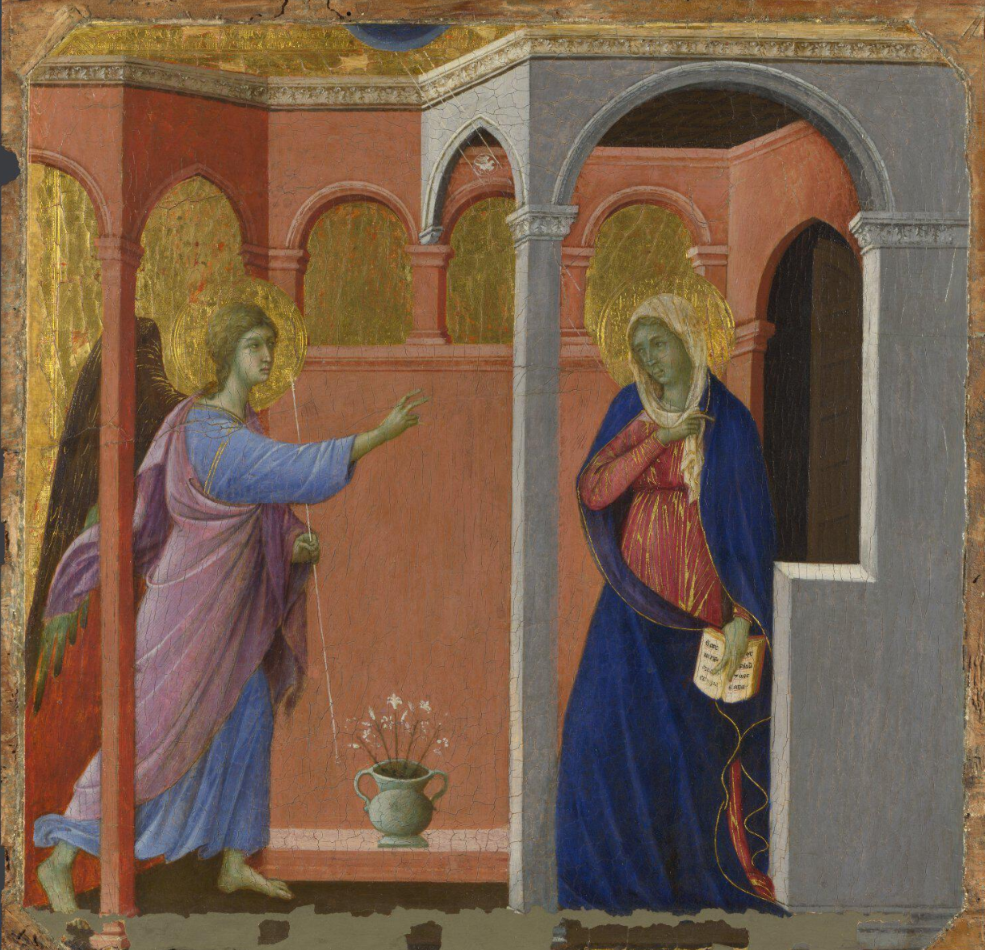
Duccio's painting of the Archangel Gabriel bringing the news to Mary that she is to be the Mother of the Son of God.
Duccio’s The Annunciation. Egg Tempera on Wood c 1307-11

The Annunciation by Duccio

Today, is the anniversary of the conception of Jesus Christ, called the Annunciation. I told some of this story yesterday which was St Gabriel’s Day. So, sorry for any repetition but I think the extra detail makes it worthwhile! There is a third post in my Annuciation series where I go into the wider implications of the date March 25th, and how it has a fundamental place in Christian Theology.

The picture above is by Duccio, from Sienna in Italy. It shows the Archangel Gabriel bringing Mary the news that she is to give birth to the Son of God. It is in the Sainsbury Wing of the National Gallery. This was the second painting on the National Gallery tour I used to give. The Tour told the story of the development of perspective. I had been reading a book on the subject by David Hockney.

The painting shows that Duccio does not understand single-point perspective. But then, no one could do perspective at that time in Europe. This skill was lost following the Roman Period. But at the beginning of the 14th Century, painters like Duccio from Sienna, and Giotto from Florence, were groping towards more realistic representation.

You might say they wanted a more human depiction, in which events are shown in spaces that are trying to look real. Filled with more realistic looking people and beginning to show on their faces real emotions. Previously, the Byzantine style produced iconic, storytelling images, that were somewhat cartoon-like rather than realistic. Here, is a detail from one such. 

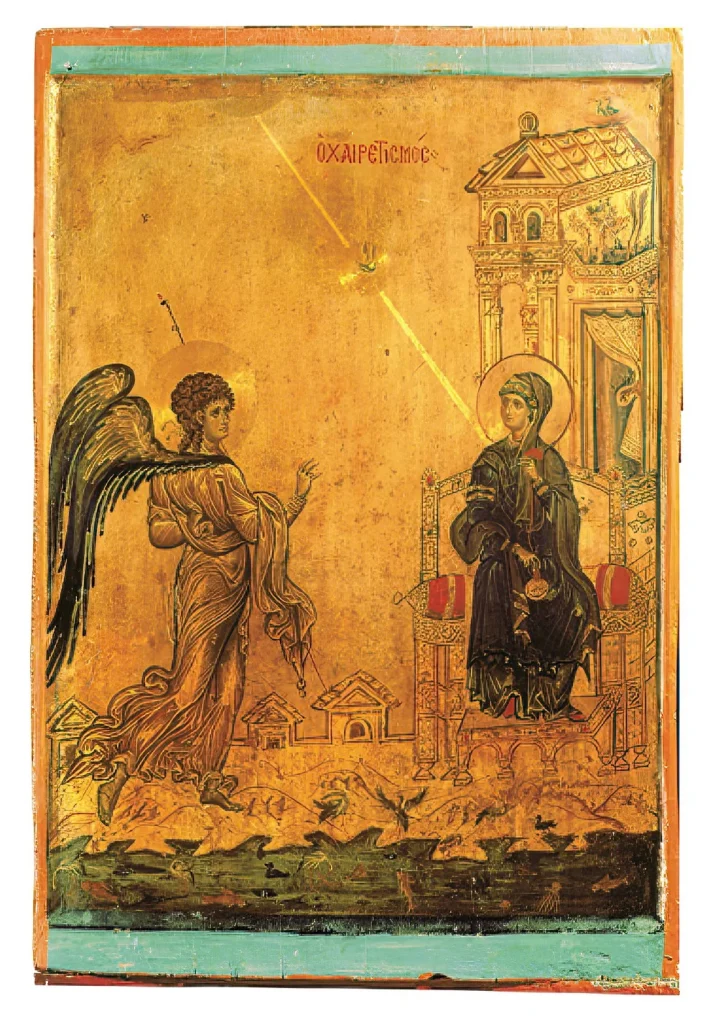
The Annunciation, St Catherine's Monastery,   12th Century. showing the archangel gabriel telling Mary about the conception of jesus
The Annunciation, St Catherine’s Monastery, 12th Century.

The encounter takes place in a space that is not very real. But it does tell the story effectively.

Moving towards Perspective

Now, look at the Duccio, he uses the arcading at the top of the painting to give an impression of this being an encounter in a real space. The Archangel Gabriel is moving through that space decisively. This is not just a picture with a story, it shows Duccio’s interest in capturing a fleeting but incredibly emotional moment. It happens to be the most important moment in the history of the world (from a Christian view point), the moment that the son of God is conceived as a human.

Gabriel is striding purposefully towards Mary, who has come out of her house to see him. He saying ‘Hey, you are going to give birth to the Son of God.’

She looks overwhelmed, (as you would) holding her arm protectively towards her. ‘What me?’ she might be saying. But she is also pointing at the Bible where this moment in time is predicted by Isaiah. Their faces are quite realistic, Mary is clearly emotional.

Also, if you look at Gabriel’s feet he is quite well grounded unlike many other medieval paintings, where people often seem to be floating above the ground. Mary, too is firmly, anchored, although you cannot see her feet.

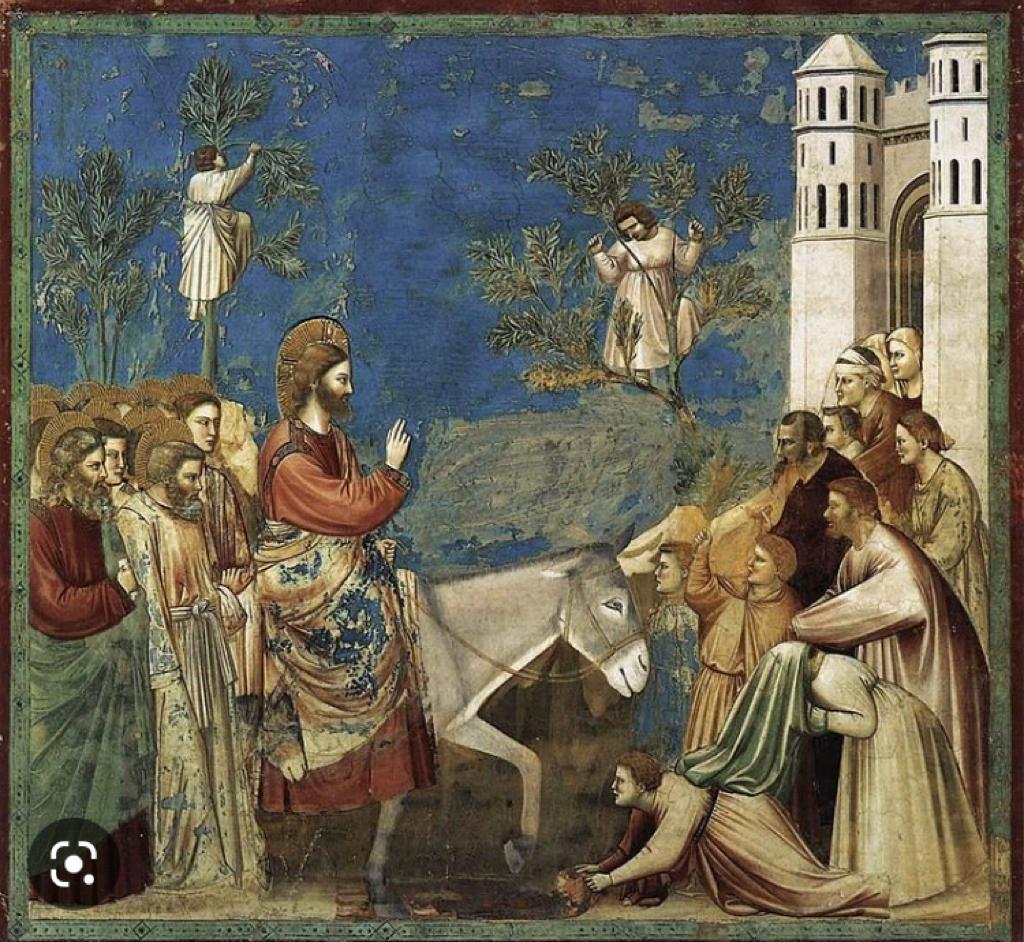
It is by no means ‘perfect’ because they don’t yet know the rules of perspective.  Neither have they discovered they could use lenses to create ‘photorealistic’ portraits. But they are searching for methods that can bring spaces and people towards realistic life. It mirrors a humanistic trend to see Mary not as a sort of Goddess, but as a real mother. A key point in the Renaissance. (For more on perspective, see my post on Giotto and Palm Sunday. )

The Moment of Conception

Above the arcading can be seen a small sphere of blue sky from which emanates several ‘rays’ and a tiny Holy Dove. As I told the story, yesterday, the rays are coming from Heaven to her womb which is hinted at by the red of her dress. The National Gallery commentary, which you can read here, suggests ‘The conception takes place at the moment she hears the words, which is why a tiny white dove, representing the Holy Ghost, flies towards her ear‘.

This made me stop and think – the tiny dove is heading to her ear is it? Really? Why? Gabriel is the messenger saying the words, the words head to the ear. The Holy Dove is a symbol of the Holy Spirit, part of the Trinity of Father, Son and Holy Ghost. Its role, in the painting, is to show that God is the Father. So why, would the Holy Spirit enter by the ear?

I have been using a ruler to try to see if the National Gallery are right! It’s difficult to be sure with a reproduction. but my ruler says the rays from Heaven are neither heading to the ear nor directly to the womb but in the general direction of her body. If they are right that the rays from heaven are heading for her ear, then is this rather the moment she is being told she will conceive rather than the moment of conception?

The Conception in St Luke

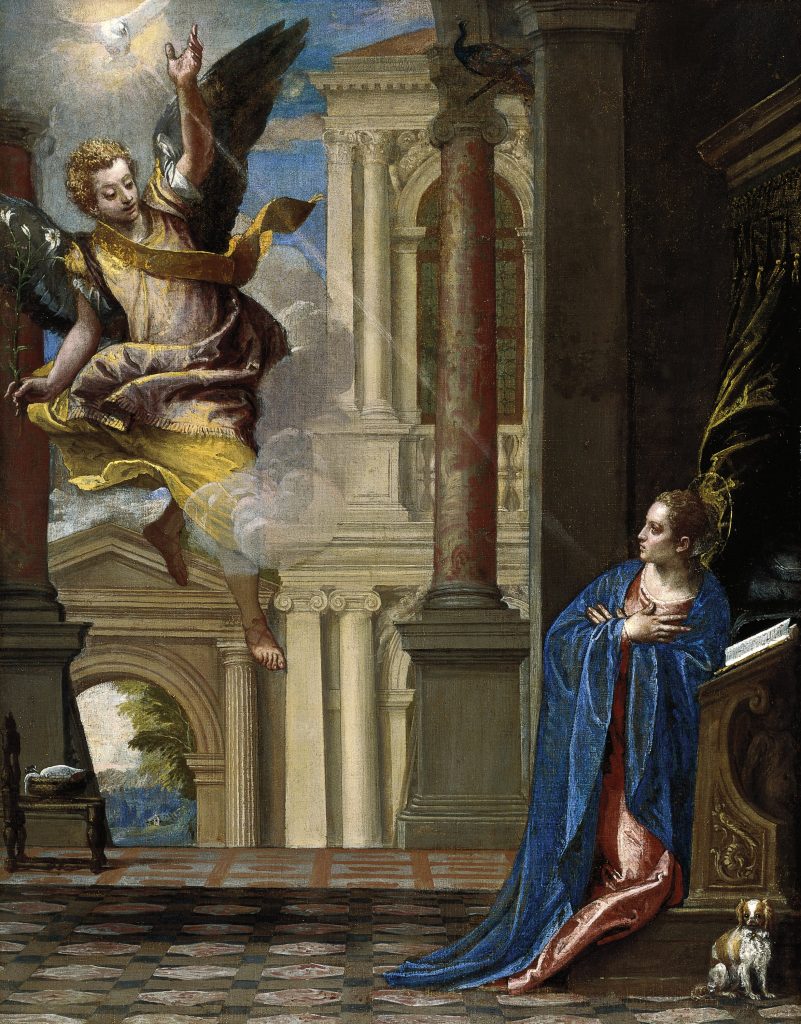
Veronese ‘The Annunciation’

But the National Gallery text accepts that it is the moment of conception that is shown. So, I’ve looked at Luke 1:26-38:

Do not be afraid, Mary, for you have found favour with God. And now, you will conceive in your womb and bear a son, and you will name him Jesus.

On first reading he is telling her she will conceive, but reading it more carefully he is saying ‘now, you will conceive’. So Duccio is paying very careful attention to the Gospel. By the time Gabriel finishes his sentence, she will have been impregnated by the Holy Dove. Looking at other paintings of the Annunciation the rays from heaven head generally towards the virgin, sometimes to her head, nothing suggesting the ear. In the St Catherine’s Monastery’s Annunciation, above, the ray is going to Mary’s back. Veronese’s ‘The Annunciation’ is similarly going towards Mary’s Back, shoulder, or breast. The Annunciation by the Master of the Judgement of Paris which I showed yesterday has the ray heading to Mary’s lap.

Rossetti’s Annunciation

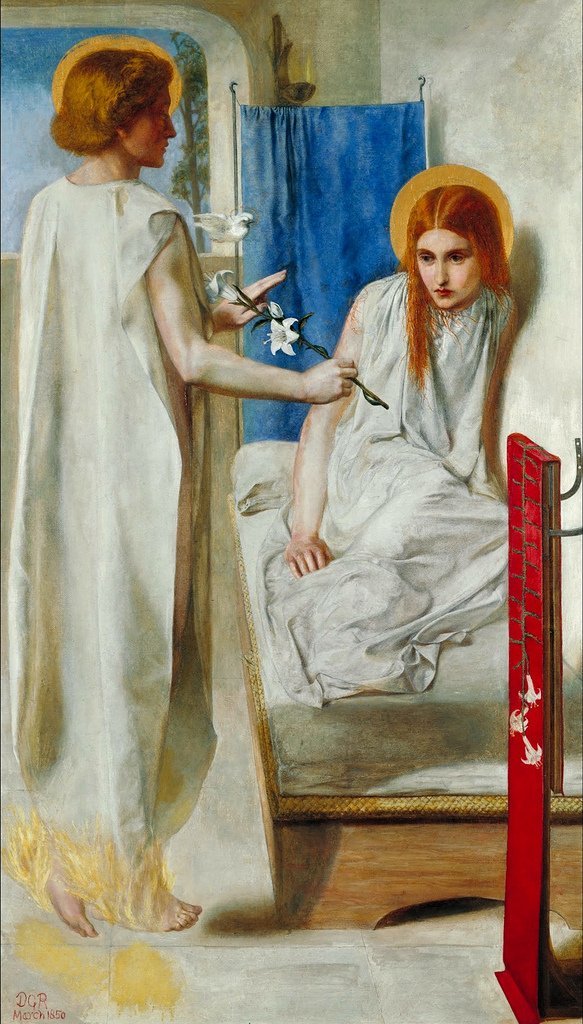
The Annunciation by Rossetti originally known as Ecce Ancilla Domini! 1849 - 1850
The Annunciation by Rossetti originally known as Ecce Ancilla Domini! 1849 – 1850

I’ve included a 19th Century Rossetti painting because it is so beautiful. It shows a lilly representing purity, instead of the rays, pointing to Mary’s womb. The use of white throughout also represents Mary’s ‘purity’. While the Blue is the traditional colour for Mary. The use of the primary colours red and blue with the predominant White, gives a vivid clarity to the picture. At the time, showing the Virgin as a red-head was quite controversial.

By the way, look at the feet in the Rossetti’s painting. This is an early Rossetti painting, who was a poet and I’m not sure he yet had the skills to ground feet. But he takes advantage of it in this case and confirms Gabriel’s supernatural status by giving Gabriel fiery feet but no wings. Subsequently, Rossetti concentrated on paintings of women from the waist up. Since, first writing this, I have visited an exhibition of Rossetti’s drawings, and they show a very capable draughtsman.

For more on March 25th and the Universe and everything, see my post here (which will be revised later today).

On This Day

If Easter fell on March 25th it was thought to be bad news, particularly if on Good Friday. As the world was created, according to Christians, round about March 25th, God being a logical being, would end it on its anniversary. And all those people who went to the top of the hill, to see out the Day of Judgement, had to trudge down again, murmuring ‘Maybe next time.’ Hampstead Heath was a popular place for Apocalyptaphiles to go in London, the Green next to White Stone Pond, to be precise.

1306 – Robert the Bruce crowned King of Scotland.

1807 – The Abolition of the Slave Trade Act became law.

1843 – the first Tunnel built under a River was opened at Rotherhithe designed by Marc Isambard Brunel, and helped by his son Isambard Kingdom Brunel. I managed the Brunel Engine House for a few years, which was the steam engine house to pump out the water from the tunnel. In fact, a Babylonian (?) Queen built the first tunnel under a River, but what she did was divert the river, build the tunnel, redirect the River back to its original course. So strictly, the Brunels built the first tunnel constructed under a River while the River was still flowing above. I find that most firsts are much more complicated that you think!

1949 – Hamlet became the first British Film to win the Oscar for Best Film. Lawrence Olivier also won the Best Actor Oscar and he was the Director of the Film too. Olivier was the first person to achieve this double feat, and the only one until 1998, when Roberto Benigni won both Oscars in Life Is Beautiful.

Source: Chambers Book of Days

First published 2024, revised 2025, Revised and On This Day added 2026
Aries, the Nose and the King’s Evil March 22nd

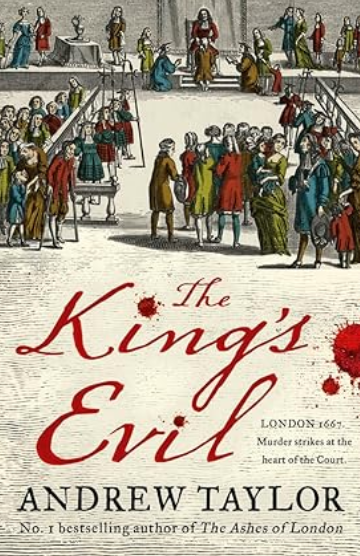
Fascinating read about the King’s Evil by Andrew Taylor

Aries & Noses

aries star sign

We have just entered Aries. Now according to astrology, Aries is associated with health issues of the face. This, according to ‘Skin and Astrology Signs‘ is because of the “level of heat in their bodies”. So Arians tend to have problems such as “flushing, heat rashes, skin eruptions, and rosacea”. They suggest using chilled cucumber for the eyes and forehead, and using beauty products with soothing aloe vera in them. ‘Touching’ by the King could also cure certain nose conditions, particularly if caused by ‘The King’s Evil’.

Charles Kightly, in his Perpetual Almanac enjoins us to ‘Observe the features of the face which are ruled by Aries and seek cures for ills of the nose’.

The first example, Kightly gives, is from The Shepherd’s Prognostication of 1729 which explains how to understand people by studying their noses:

Nose round with a sharpness at the end signifies one to be wavering of mind; the nose wholly crooked, to be sure unshamefaced and unstable; crooked like an eagle’s beak, to be bold. The nose flat, to be lecherous and hasty in wrath; the nostrils large, to be ireful.’

A Fungous Nose & the King’s Evil

The second rather revolting tale is from John Aubrey.

Arise Evans had a fungous Nose and said, it was revealed to him, that the King’s hand would cure him. At the first coming of Charles II into St James Park he kissed the king’s hand and rubbed his nose with it: which disturbed the king, but cured him.

John Aubrey Miscellanies 1695. (for more miscellany from Aubrey read my post here.

Etiquette and Handkerchiefs

Now, on the subject of revolting nose conditions, I have just been reading a review of a book ‘Civility and the Theatre in Early Modern England’. The author, Indira Ghose, is studying early self-help books of manners and conduct, and how they influence or appear in contemporary plays. One such manual by Giovanni Della Casa has the following advice:

‘when thou hast blowne thy nose, use not to open thy handkerchief, to glare uppon thy snot, as if thou hadst pearles and Rubies fallen from thy braynes’.

Galateo: The Rules of Polite Behaviour published in Venice in 1558. It was translated into French (1562), English (1576), Latin (1580), Spanish (1585), and German (1587), (Wikipedia). Galateo translates as etiquette.

There is no need to thank me for passing on such good advice! I bet “Miss Manners” Judith Martin didn’t pass this particular gem on, but Wikipedia claims that modern books of manners are influenced by Galateo.

Scofula and the King’s Touch

Sketch of Dr Johnson from a portrait.

People believed that Scrofula, could be cured by touching the Monarch. Tuberculous cervical lymphadenitis was, thus, known as the King’s Evil. So, the King or Queen would make herself, very reluctantly, available for his sick public to touch her. Dr Samuel Johnson suffered from Scofula and received the “royal touch” from Queen Anne on 30 March 1712 at St James’s Palace. He was given a ribbon, which he wore around his neck for the rest of his life (with a coin strung on it, I think see below). But it did not cure the disease, and he had to have an operation.

The Touching took place in the winter, between Michaelmas and Easter, when cold weather provoked the disease. The lucky few, who were allowed the Touch, would be touched or stroked by the King or Queen on the face or neck. Then a special gold coin, touched by the Monarch, was put around their neck. Readings from the bible and prayer finished the ceremony. Before Queen Elizabeth I, the Touch was said to cure many diseases such as Rheumatism, convulsions, fever and blindness, but after it was reserved for Scrofula.

Who Started touching for the King’s Evil?

It was only the French and the English who believed the King’s touch could cure people. The French claimed it began with Philip 1 in the 11th Century. The English claimed Edward the Confessor as the first. But this was denied by the French who claimed that the French King of England, Henry 1 introduced it to the English. The practice lasted until George 1 who resolutely refused to have anything to do with it.

For more on the King’s Evil have a look at this blogpost. Or read the book pictured at the top of the post.

On This Day

1312 – The Knights Templars are abolished by Pope Clement. King Philip of France had a massive debt owed to the Templars, following his war with England. He chose to avoid payment by accusing the Templars of impious acts, and homosexuality. Evidence was collected by torture and thus unreliable.

1622 – Jamestown massacre: 347 English settlers killed by Powhatan People of Tsenacommacah. This is estimated as a third of the colony’s population, during the Second Anglo-Powhatan War. Powhatan (Chief Wahunsunacawh) was the father of Pocahontas (aka Amonute, or Matoaka and Rebecca Rolfe). But it was Powhatan’s son, Opechancanough, who was in charge during the massacre. They were of the Algonquian peoples.

1888 – The English Football League was founded at Anderton’s Hotel, Fleet Street. Representatives from Aston Villa, Blackburn Rovers, Bolton Wanderers, Preston North End and West Bromwich Albion met. They discussed other teams that might join. Another meeting was called at the Royal Hotel in Manchester on 17 April 1888 to establish the league. The 12 founding members were: Accrington, Aston Villa, Blackburn Rovers, Bolton Wanderers, Burnley, Derby County, Everton, Notts County, Preston, Stoke City, West Bromwich Albion, Wolverhampton Wanderers. None from London. In season 1894–95 Woolwich Arsenal joined the 2nd Division of the Football League as the first London Team. For more information see: the-football-league-conceived-in-fleet-street-born-in-manchester/

First published in 2024, revised in 2025, Etiquette and On This Day added 2026

Mothering Sunday & Simnel Cake

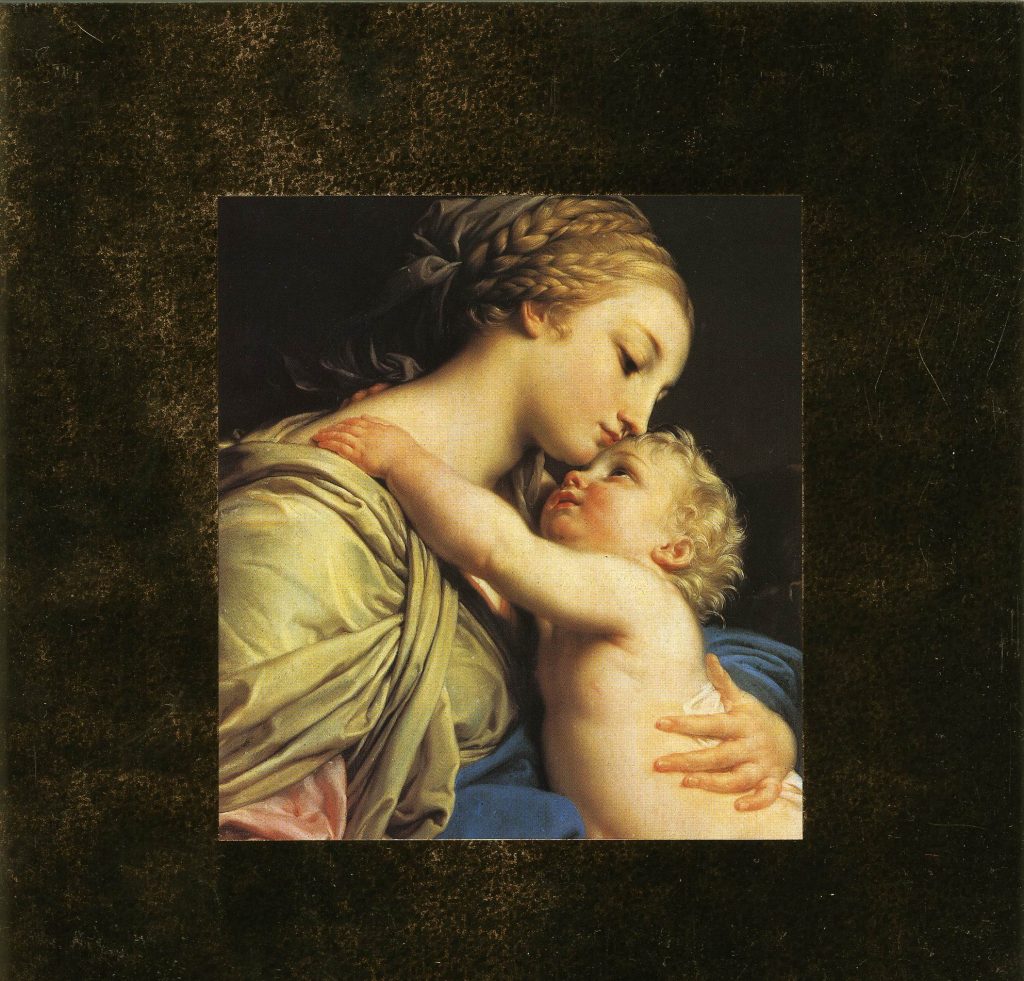
Virgin and Child (Image on a card of unknown origin) to illustrate Mothering Sunday or Mother’s Day

In 2026 Mothering Sunday is on March 15th. In 2027 it will be on March 7th. Strangely, originally not about Mothers! Mothering Sunday is the 4th Sunday in Lent. It is, in fact the day in which we are enjoined to visit our Mother Churches. It, therefore, became a day when people made processions to their Churches.  Servants and workers could go to their home parishes. But not only go to the Mother Church but also to say hello to their mothers. So, it became increasingly about Mothers. It was called Mothering Sunday when I was little and has morphed into the Americanism that is Mother’s Day.

In Church the Reading is often Isaiah 66:10–11

‘Rejoice ye with Jerusalem; and be ye glad for her, all ye that delight in her: exult and sing for joy with her, all ye that in sadness mourn for her; that ye may suck, and be satisfied with the breasts of her consolations.

Jerusalem is personified, here, as the Mother. Further associations with motherhood came from the Gospel for the day which is John 6:1–14, the story of the Feeding of the Five Thousand, which led to associations with the bounty of Mother Earth.

In the medieval period visits to the Mother Church seem to have become fiercely competitive. The Bishop of Lincoln, Robert Grosseteste decreed:

In each and every church you should strictly prohibit one parish from fighting with another over whose banners should come first in processions at the time of the annual visitation and veneration of the mother church. […] Those who dishonour their spiritual mother should not at all escape punishment, when those who dishonour their fleshly mothers are, in accordance with God’s law, cursed and punished with death.

(Letter 22.7 – Wikipedia)

Simnel Cake

It was also the Sunday in the fasting period of Lent in which the restrictions were relaxed. So a special cake called Simnel Cake was made for the purpose.

I’ll to thee a Simnel bring
‘Gainst thou goest a-Mothering
So that, when she blesseth thee
Half that blessing thou’lt give me.

Herrick Hesperides 1647

Photo: James Petts from London, England – Simnel cake (wikipedia
Easter 2012

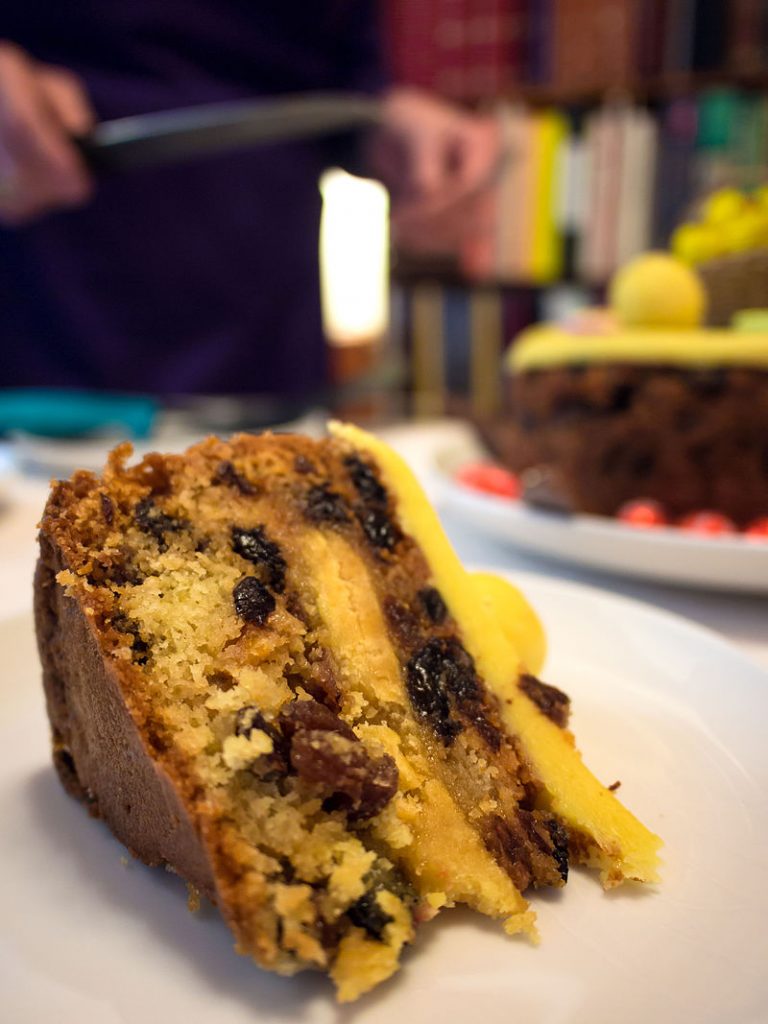
The Simnel cake is a fine flour light fruit cake (Latin simila, fine flour), with layers of marzipan in it. It often has 11 balls of marzipan on the top, representing the 11 (not Judas) apostles. The cake is first boiled for two hours and then baked. Now, I know 95% of my American readers hate fruit cake. But believe me when I tell you – change your ways – iI’s delicious. Try this BBC’s recipe: https://www.bbcgoodfood.com/recipes/easter-simnel-cake

And I’m beginning to see that cake is an emerging theme of this Almanac of the Past.

See my post on Chelsea Buns here; Lardy Cake and Doughnuts here.

Written in March 23, slightly revised in March 24, and 25, Revised 26

Spring & the Month of New Life March 1st

March from the Kalendar of Shepherds – French 15th Century

Spring & March

This is the beginning of Spring, meteorologically speaking. There is nothing magical about this day that makes it in any sense actually the start of Spring. It is a convenience determined by meteorologists. They divide the year up into 4 blocks of three months based on average temperature, and the convenience of keeping statistics to months. It could be that spring starts on 2nd March. 14th February.  Or the 1st of February as the Celts favoured.

The Venerable Bede in his ‘The Reckoning of Time’, written in 725 AD, quotes more diversity of dates:

However, different people place the beginnings of the seasons at
different times. Bishop Isidore the Spaniard said …, spring [starts] on the 8th kalends of
March [22 February],…

But the Greeks and Romans, whose authority on these matters, rather than that of the
Spaniards, it is generally preferable to follow, deem that spring [begins] on the 7th ides of February [7 February],…

Noting that summer and winter begin with
the evening or morning rising and setting of the Pleiades, they place the
commencement of spring and autumn when the Pleiades rise and set
around the middle of the night.

There is nothing that says we have to have 4 seasons. Egypt had three seasons, the tropics have two. Celts divided the year into 8. Plants have been blooming, sprouting and budding since January, and some will wait until later in the year. Lambs have been born since January. But scientists and society find it easiest to keep statistics on a monthly basis so March 1st it is.

Astronomically, the seasons are more rationally divided by the movement of the Sun. So Spring begins on the spring or vernal equinox, 20th or 21st of March. For my Spring Equinox post go here.

Anglo-Saxon March

In Anglo-Saxon ‘Hrethamonath’ is the month of the Goddess Hretha. Bede gives no further information on who she was and nothing else is known about her. Her name is Latinised to Rheda. J R. R. Tolkein used the Anglo-Saxon calendar as the calendar for the Shire where the third month is called Rethe.

For the Anglo-Saxon, spring was looked forward to with great joy after the bleakness of winter. Christian Anglo-Saxons also saw this as the pivotal month in the year. It was in March that the world was created, and the Messiah conceived, revealed, executed, and ascended to heaven. See my post:

In Welsh the month is called Mawrth, (derived it is thought from the Latin Martius). Gaelic Mart or Earrach Geamraidth – which means the ‘winter spring’.

Medieval/Early Modern March

The illustration (above), from the Kalendar of Shepherds, shows that in Pisces and early Ares preparation was still the main order of the farming day, clearing out the moats, and preparing the fruit trees. Lambing is also increasing in number. And the early modern text below from the Kalendar gives a fine description of the joys of spring.

Kalendary of Shepherds- Description of March.
March in the Kalendar of Shepherds.

For more details of the Kalendar of Shepherds look at my post on December.

Roman March

March the 1st was the beginning of the Roman year in Rome’s early days. The Month was named after Mars, the God of War, as Mars was the patron God of the Rome. March was also the beginning of the campaign season, and the army was prepared, and ceremonies held to Mars. The Salii, twelve youths dressed in archaic fighting costumes led a procession singing the Carmen Saliare. March 1 was also the Matronalia a festival celebrating childbirth motherhood. Dedicated to the Mother Juno Lucina,

Ovid & March & Kalends, Nones & Ides

Ovid says the year started on the Kalends of March. Here is what Britannica says about their strange system of dividing months:

‘In a 31-day month such as March, the Kalends was day 1, with days 2–6 being counted as simply “before the Nones.” The Nones fell on day 7, with days 8–14 “before the Ides” and the 15th as the Ides. After this the days were counted as “before the Kalends” of the next month’.

More about this if you read my post on the Ides of March and Julius Caesar.

At the beginning of his book, Fasti, Ovid provides the story of Rome’s foundation. Mars took Silvia the Vestal while she slept. She later gave birth to Romulus and Remus. He also gives details of how Rome was organised. In the piece of the long text I have chosen below he discusses Romulus’ arrangement of the year. It is a year that began on the 1st March, and had only 10 months. 10 is the number of digits we have and the length of pregnancy (so Ovid says).

Ovid wrote in his almanac poem the Fasti:

So, untaught and lacking in science, each five-year lustre
That they calculated was short by two whole months.
A year was when the moon returned to full for the tenth
time:
And that was a number that was held in high honour:
Because it’s the number of fingers we usually count with,
Or because a woman produces in ten months,
Or because the numerals ascend from one to ten,
And from that point we begin a fresh interval.

So Romulus divided the hundred Senators into ten groups,
And instituted ten companies of men with spears,
And as many front-rank and javelin men,
And also those who officially merited horses.
He even divided the tribes the same way, the Titienses,
The Ramnes, as they are called, and the Luceres.
And so he reserved the same number for his year,

It ís the time for which the sad widow mourns her man.
If you doubt that the Kalends of March began the year,
You can refer to the following evidence.
The priest’s laurel branch that remained all year,
Was removed then, and fresh leaves honoured.
Then the king’s door is green with Phoebus’ bough,
Set there, and at your doors too, ancient wards.
And the withered laurel is taken from the Trojan hearth,
So Vesta may be brightly dressed with new leaves.
Also, it’s said, a new fire is lit at her secret shrine,
And the rekindled flame acquires new strength.
And to me it’s no less a sign that past years began so,
That in this month worship of Anna Perenna begins.
Then too it’s recorded public offices commenced,
Until the time of your wars, faithless Carthaginian.

Lastly Quintilis is the fifth (TXLQWXV) month from March,
And begins those that take their names from numerals.
Numa Pompilius, led to Rome from the lands of olives,
Was the first to realise the year lacked two months,
Learning it from Pythagoras of Samos, who believed
We could be reborn, or was taught it by his own Egeria.
But the calendar was still erratic down to the time
When Caesar took it, and many other things, in hand.
That god, the founder of a mighty house, did not
Regard the matter as beneath his attention,
And wished to have prescience of those heavens
Promised him, not be an unknown god entering a strange
house.

He is said to have drawn up an exact table
Of the periods in which the sun returns to its previous
signs.
He added sixty-five days to three hundred,
And then added a fifth part of a whole day.
That’s the measure of the year: one day
The sum of the five part-days is added to each lustre.

Translated by A. S. Kline online here:

For much more about the Roman Year (and leap years) look at my post here.

On This Day

St David’s Day – It is also the Feast of St David, (or Dewi) the patron saint of Wales, who lived in the sixth century AD. Little that is known about him is contemporary but he was an abbot-bishop. His hagiography was written in the 11th Century and not very trustworthy, but the aim was to show the independence of the Welsh Church from Canterbury. His association with the leek is unexplained.

293 – Inauguration of the Tetrarchy

Diocletian reorganises the Roman Empire to be a Tetrarchy with himself and Maximian the Augusti, one in the East the other in the West. Below them were Constantius Chlorus and Galerius the Caesars.

Coppermine Photo Gallery - Coppermine Photo Gallery; Bishop, Aubrey. Imperial Imagery of the Tetrarchy. Rhodes College. Archived from the original on 15 September 2024.

Historic map of Roman Empire during the first tetrarchy
Coppermine Photo Gallery – Coppermine Photo Gallery; Bishop, Aubrey. Imperial Imagery of the Tetrarchy. Rhodes College. Archived from the original on 15 September 2024. Historic map of Roman Empire during the first tetrarchy CC BY-SA 3.0

Below them were Prefectures run by Prefects, who controlled officials called the Vicarious. Britannia, was a Diocese ruled by the Vicarious in London. The Diocese was divided into 4 Provinces,. In charge of those were the Governors, who were now civilians rather than military figures.

Later dioceses of the Roman Empire, around 400 AD By Mandrak – Own work, Public Domain, https://commons.wikimedia.org/w/index.php?curid=6088363

The reorganisation was designed to provide a peaceful career path for ambitious men, but in that it failed.

1562 – Massacre in Wassy France, when sixty-three Huguenots were killed and the French Wars of Religion began. Many Huguenots came to Britain, and many settled in Spitalfields, London. My family believe we are Huguenots from the East End.

1628 – Charles I decrees that the ship tax should be extended to every county. This was not put to a Parliament, and illegal impositions like this eventually lead to the English Civil War in 1642. (see my post on the beginning of the Civil War here:

First Published in 2024, and revised in 2025


Ovid’s Metamorphoses, Crocus and Saffron February 19th

Photo Mohammad Amiri from unsplash. Notice the crimson stigma and styles, called threads, Crocus is one of the characters in Ovid’s Metamorphoses

The story of Crocus and Smilax is in Ovid’s Metamorphoses. The book tells the  story of myths which involve the metamorphosis of a person to a flower, or to a constellation, or to an echo or some supernatural change in being. This poem is one of the most famous in the world, written in about 6 AD. It influenced Dante, Bocaccio, Chaucer, Shakespeare, Keats, Bernard Shaw, and me.  Seamus Heaney and Ted Hughes have translated modern versions of some of the tales.

The mechanicals in ‘The Midsummers Night Dream’ perform Ovid’s story of Pyramus and Thisbe, Titian painted Diana and Actaeon. Shaw wrote about Pygmalion, and we all know the story of Arachne. She claimed to be better than Athene at weaving. And then was turned into a spider.

The poem is about love, beauty, change, arrogance and is largely an Arcadian/rural poem. This is a contrast to Ovid’s ‘Art of Love’ which I use for illustrations of life in a Roman town. The stories are all about metamorphoses, mostly changes happening because of love. But it is also an epic as it tells the classical story of the universe from creation to Julius Caesar.

Ovid’s Metamorphoses and the Crocus

Crocus and his beloved Smilax were changed into tiny flowers.’ Ovid tell us, but chooses to give us no more details. So we have to look elsewhere. There are various versions. In the first, Crocus is a handsome mortal youth, beloved of the God Hermes (Mercury). They are playing with a discus which hits Crocus on the head and kills him. Hermes, distraught, turns the youth into a beautiful flower. Three drops of his blood form the stigma of the flower.  In another version, Crocus and the nymph Smilax, fall in love. And are rewarded by immortality as a flower. One tale has Smilax turned into the Bindweed. 

Morning Glory or Field Bindweed photo Leslie Saunders unsplash

Ovid’s Metamorphoses and Bindweed

It turns out that Smilax means ‘bindweed’ in Latin. Bindweed is from the Convolvulus family, and I have grown one very successfully in a pot for many years. But they have long roots. According to the RHS ‘Bindweed‘ refers to two similar trumpet-flowered weeds. Both of which twine around other plant stems, smothering them in the process. They are difficult to remove. This, could suggest that Smilax is either punished for spurning Crocus, or that she smothered him with love. Medically, Mrs Grieve’s Modern Herbal says all the bindweeds have strong purgative virtues, perhaps another insight into Smilax’s psychology?

The Metamorphosis of Data and the correct use of the plural

Apparently, in the UK some say crocuses and others use the correct Latin plural, croci. On an earlier version of this post I used the incorrect plural crocii.

On the subject of Roman plurals, the Financial Times editorial department made an earth-shattering decision, a couple of years ago. They updated their style guide to make the plural word data (datum is the singular form) metamorphise into the singular form.

So it is now wrong to say ‘data are’ but right to say ‘data is’. For example, it was correct to say:  ‘the data are showing us that 63% of British speakers use crocuses as the plural’ but now, it is better to write ‘the data is showing us that 37% of British people prefer the correct Latin form of croci’.

Violets and Crocuses

Violets and crocuses are coming out. They often come out for St Valentine’s Day, and so obviously associated with Love. White croci usually represented truth, innocence, and purity. The purple variety imply success, pride and dignity. The yellow type is joy.’ according to www.icysedgwick.com/, which gives a fairly comprehensive look at the Crocus.

Crocus & Saffron

The autumn-flowering perennial plant Crocus sativus, is the one whose stigma gives us saffron. Roman civilisation spread the plants around Europe.   They used it for medicine, as a dye, and a perfume. It was much sought after as a protection against the plague, and extensively grown in the UK.  Saffron Walden was a particularly important production area in the 16th and 17th Centuries.

Saffron in London

Snowdrop, Crocus, Violet and Silver Birch circle in Haggerston Park. (Photo Kevin Flude, 2022)

The Bishop of Ely grew Saffrom in his beautiful Gardens just outside of the City of London. The area remembered by the London street name: Saffron Hill.  It is home to the fictional Scrooge. This area became the London home of Christopher Hatton, the favourite of Queen Elizabeth 1. His garden was on the west bank of the River Fleet, in London EC1, in the area now known as Hatton Garden. (For more on Christopher Hatton see my post on nicknames Queen Elizabeth I gave to her favourites).

I found out more about Saffron from listening to BBC Radio 4’s Gardener’s Question time and James Wong.

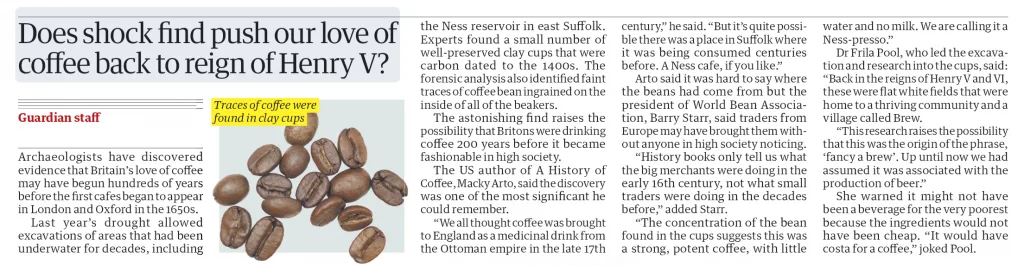
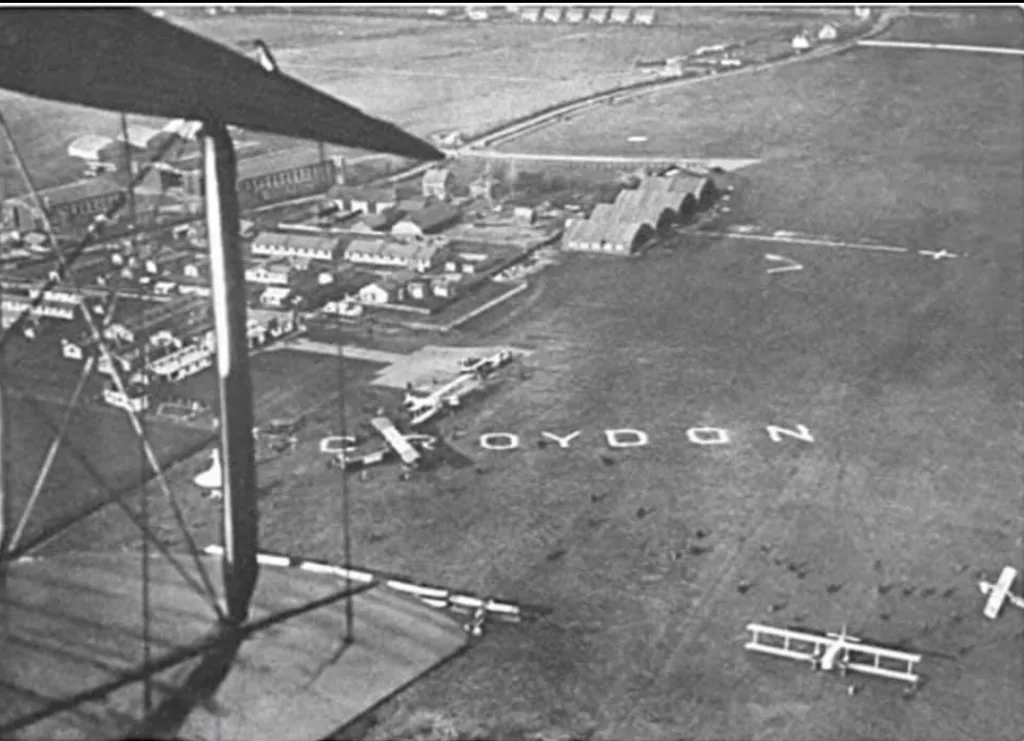
Croydon (on the outskirts of London) means Crocus Valley. A place where Saffron was grown. The Saffron crops in Britain failed eventually because of the cost of harvesting, and it became cheaper to import it. So, we now import it from Spain, Iran, and India amongst other places. But it is being reintroduced in Norfolk, Suffolk, Kent, and Sussex. These are – the hot and dry counties. The plant enjoys a South-facing aspect. But it needs protection from squirrels and sparrows who love it. To grow it, look at this post from the Garden Doctor.

Saffron Photo by Vera De on Unsplash

Violets

Viola odorata CC BY-SA 2.5 Wikipedia

The Celts used Violets as cosmetics; the Athenians to moderate anger; the Iranians for insomnia, and are loved by all because of their beauty and fragrance. They have been symbols of death for the young, and used as garlands, nosegays posies, which Gerard says are ‘delightful’.

For more on Ovid, use the search facility (click on menu) or read my post here.

On This Day

197 – The Battle of Lugdunum sees the victory of Septimius Severus over Clodius Albinus reputedly the bloodiest battle between Roman armies. The previous emperor Pertinax died in 193 during the Year of the Five Emperors. Three main contenders emerged Severus who was African, Niger was from Central Italy, Albinus was the Governor of Britain.

1800 – Napoleon proclaims himself First Consul making him the dictator of France.

1846 – The Republic of Texas officially transfers power to the State of Texas government and becomes part of the United States.

1878 – Thomas Edison patents the phonograph.

1945 – Battle of Iwo Jima began with the landing of 30,000 US troops.

First written 2023, revised 2024, 2025 and 2026

The Raven, the Palladium and the White Hill of London February 18th

Shows a photo of a missing Raven at the Tower of London
The Independent January 2021 The Raven the Palladium of Britain

The Raven – the Palladium of Britain

Corvus corax is hatching. An early nesting bird, the Raven is the biggest of the Corvids. They were pushed to the west and north by farmers and game keepers but are making a comeback. Ravens are finding towns convenient for their scavenging habits. So they, again, cover most of the UK except the eastern areas. The Raven is one of the Palladiums of Britain.

A Palladium is something that keeps a city or country safe, They are named after a wooden statue of Pallas Athene, which protected Troy. Perceiving this, Odysseus and Diomedes stole the Palladium from Troy shortly before the Trojan Horse episode. Troy fell and the palladium went to Italy (I’m guessing with Diomedes who is said to have founded several cities in Italy). It ended up in Rome.

The Romans claimed to be descendants of Trojan exiles led by Aeneas. So it was back with its rightful owners. It protected Rome until it was transferred to the new Roman capital at Constantinople. It then disappeared, presumably allowing the Ottoman Turks to conquer the City of Caesar? To read of London Stone as a Palladium see my post here.

The Raven, Aneirin & Arthur

The Ravens habits (it is said they know where the battlefields are before they are fought) and their black plumage have made them harbingers of death. In poetry, Ravens glut on blood like the warriors whose emblem they are. Here is a very famous quotation from Y Gododdin, a medieval poem but thought to derive from a poem by the great poet Aneirin from the 7th Century.

He glutted black ravens on the rampart of the stronghold, though he was no Arthur.’

This is one of the much argued-about references to King Arthur in the ‘Was he a real person’ trope. The point being, it doesn’t make sense to mention Arthur if King Arthur wasn’t a real person. The story at the Tower of London is that the Ravens kept in the Tower, with clipped wings, keep Britain safe from Invasion. (But see below).

Bran’s Head – the original Palladium of Britain?

A raven landing with a brown background
By Sonny Mauricio from Unsplash

The Raven was also the symbol of the God-King Bran. Bran was one of the legendary Kings of Britain. His sister, Branwen, was married to the King of Ireland. To cut a long story short, Branwen was exiled by her Irish husband to the scullery. She trained a starling to smuggle a message to her brother, to tell of her abuse.

So Bran took an army over the Irish Sea to restore her to her rightful state. But the ships were becalmed. Mighty Bran blew the boats across the sea – he was that much a hero. Bran was mortality wounded in the fighting that followed. This was a problem because he had previously given away his cauldron of immortality.  He gave it to the Irish King in recompense for the insults given to the Irish by Bran’s brother, who hated anyone not British.

Bran’s Head Returns to London

So, the dying Bran, told his companions to cut off his own head and take it back to the White Hill in London. His head was as good a companion on the way back as it was on the way out, and the journey home took 90 years.

At last, they got to London, where Bran told his men to bury his head on the White Hill. As long as it stays here, he said, Britain would be safe from foreign invasion. The White Hill is said to be Tower Hill with its summit at Trinity Gardens, although Primrose Hill is sometimes offered as an alternative.

This was one of the Three Fortunate Concealments and is found in ‘the Triads of the Island of Britain.’ The Triads are from medieval manuscripts which preserve fragments of folklore, mythology and history. They are grouped in groups of three.

Arthur and Bran’s Head

But many years later, King Arthur saw no need for anybody or anything other than himself to protect the realm. So he had the head dug up. Calamity followed in the shapes of Sir Lancelot and Mordred which led to the end of the golden age of Camelot and conquest of Britain by the Saxons. This was one of the Three Unfortunate Disclosures.

If we want a rational explanation for the story, there is evidence that Celtic cultures venerated the skull, and palladiums play a part in Celtic Tales.

So what was Arthur doing destroying the palladium that kept Britain safe? Vanity is the answer the story gives. But, perhaps, it’s a memory of Christian rites taking over from pagan rituals? God, Arthur might have thought, would prefer to protect his people himself rather than Christians having to rely on a pagan cult object.

Ravens in the Tower of London

The story of Bran’s head is inevitably linked to the Ravens in the Tower who, it is still said, keep us safe from invasion.  As you can see from the photo at the top we still get in a tizz when one goes missing.

Sadly, and I am probably sadder about this than most, the link between the Tower, Bran, and the Ravens cannot be substantiated. Geoffrey Parnell, who is a friend of mine, told me that while working at the Tower of London he searched the records assiduously for the story of the ravens.  He found no evidence of the Raven myth & the Tower before the 19th Century, and concluded that it was most likely a Victorian invention. IanVisits has a 2025 story about the Ravens, and also concurs that the Ravens are a recent myth.

The Welsh Triads give a total of two palladiums for Britain, a couple of nationalistic fighting dragons.

Three Fortunate Concealments of the Island of Britain

The Head of Bran the Blessed, son of Llyr, which was concealed in the White Hill in London, with its face towards France. And as long as it was in the position in which it was put there, no Saxon Oppression would ever come to this Island;
The second Fortunate Concealment: the Dragons in Dinas Emrys, which llud son of Beli concealed;
And the third: the Bones of Gwerthefyr the Blessed, in the Chief Ports of this Island. And as long as they remained in that concealment, no Saxon Oppression would ever come to this Island.

All good but then came:

The Three Unfortunate Disclosures:

And there were the Three Unfortunate Disclosures when these were disclosed.
And Gwrtheyrn the Thin disclosed the bones of Gwerthefyr the Blessed for the love of a woman: that was Ronnwen the pagan woman;
And it was he who disclosed the Dragons;
And Arthur disclosed the head of Bran the Blessed from the White Hill, because it did not seem right to him that this Island should be defended by the strength of anyone, but by his own.

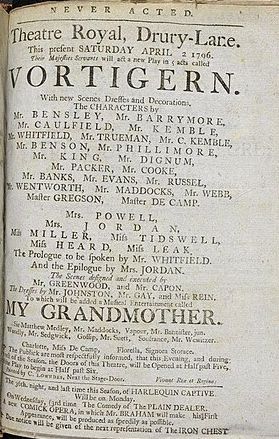
Gwrtheyrn is Vortigen, the leader of the Britons after the fall of the Roman Empire in Britain, one or two leaders before Arthur. Vortigern, which means something like strong leader in Welsh was a real person in so far as he, unlike Arthur, is mentioned by Gildas a near contemporary source.

The story of the dragons is supposedly from the pre-Roman Iron Age.  Every May Day, the Dragons made a terrible noise, causing miscarriages and other misfortunes. So, King Ludd, whom legends says gave his name to London (Ludd’s Dun or Ludd’s walled City), drugged the dragons.  He had them buried in a cavern at Dinas Emrys in Eryri (Snowdonia). The Red Dragon represented the Britons (also called the Welsh) and White Dragons the Saxons.

Vortigern, Merlin and Vortimer

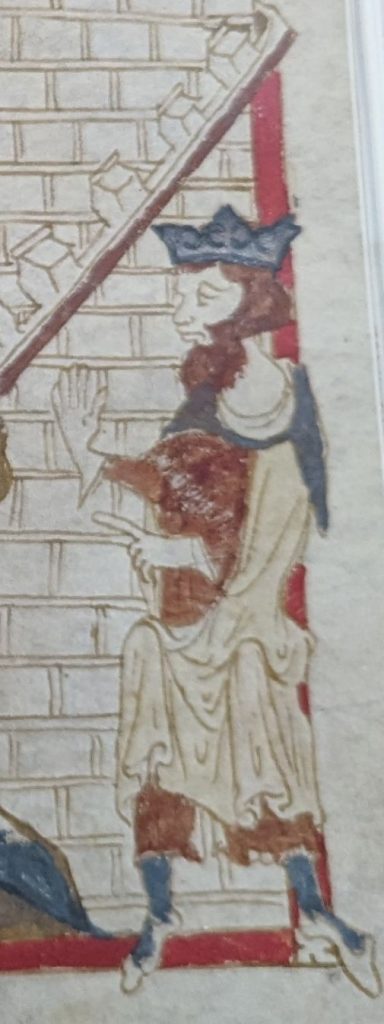
Hundreds of years later, (five hundred?) after the Romans had come and gone.  Vortigern was trying to build a castle in Eryri at Dinas Emrys.  But the walls keep falling down. ‘You need the blood of a boy born not of man’, his necromancers say.  They find a boy called Ambrosius aka Merlin whose mother had lain with an incubus.  Merlin accused the necromancers of ignorance and explains the wall collapse is caused by two dragons.  They find the cavern and let the dragons go.  The walls now stand undisturbed. But the Welsh Red Dragon and the Saxon White Dragon can not now be at peace, and the Britons are defeated by the Saxons.

Vortigern betrayed his own people for the lust of Rowena the daughter of Hengist, the Saxon. Hengist was given the province of Kent as his reward, and thus began the Anglo-Saxon take over.

Vortigern’s son is Gwerthefyr (or Vortimer). He was a better man than his dad and fought to keep the Saxons out. After Vortimer’s death his bones were buried at the chief ports on the South Coast. Here they acted as a palladian and they kept the country safe.  But they were moved to Billingsgate, in London and put in a Tower. The loss of the palladium allowed the Saxons to land safely on the Kent coast and consolidate their increasing hold over Britain and turning it into England.

Birds in Love

Here is a lovely little medieval poem. It was found in 1931 in the end leaf of a manuscript where someone had been testing their goose quill and scribbled these three lines:

All the birds have begun their nests

Except for me and you

What are we waiting for now?

This is from Dr Florence H.R.Scott’s lovely medieval substack here:

Wet Weather

Why it is so wet in the UK at the moment (February 18th)? The answer seems to be that there is a block of cold weather over the States that is moving the Jet Stream south, bringing lots of wet weather. But there is also another block of cold weather over Scandinavia. This means that the low pressures being driven by the Jet Stream, have no where to go and are stopping and dumping their rain all over the UK.

To hear the Observer’s explanation listen here.

On This Day

3102 BC – the death of Krishna starts Kali Yuga, the fourth and final yuga of Hinduism.

1478 – George, Duke of Clarence, traitor to his Brother, Edward IV, was executed in private at the Tower of London. It is said he was drowned in a vat of Malmsey Wine.

1678 – First Part of Pilgrim’s Progress by John Bunyan published.

1991 – The IRA plant bombs at Paddington station and Victoria station in London. The IRA gave warnings, and the Victoria bomb went off at 4.20am and caused no casualties. At or just before 7am, the IRA warned that all London Stations were to be bombed in 45 minutes time. The Authorities were slow to clear the stations and at Paddington a bomb went off at 7:40am. 1 person was killed and 38 people were injured. 11 days earlier, the IRA attacked Downing St with a mortar bomb attack.

Written on February 21 revised in February 18th 23, 24, 25, Birds in Love, Wet Weather and On This Day added in 2026

Shrove Tuesday – Pancake Day – Mardi Gras – End of the Carnival

Les_Très Riches Heures du Duc de Berry February (Detail)  The people inside are warming their legs and their hands in front of a roaring fire.
Les Très Riches Heures du Duc de Berry February (Detail) The people inside are warming their legs and their hands in front of a roaring fire.

Shrove Tuesday & Carnival

This year, February 17th is Shrove Tuesday, the end of the Carnival. Etymology-on line says the origins of the term Carnival are:

1540s, “time of merrymaking before Lent,” from French carnaval, from Italian carnevale “Shrove Tuesday,” from older Italian forms such as Milanese *carnelevale, Old Pisan carnelevare “to remove meat,” literally “raising flesh,” from Latin caro “flesh” (originally “a piece of flesh,” from PIE root *sker- (1) “to cut”) + levare “lighten, raise, remove” (from PIE root *legwh- “not heavy, having little weight”).

Folk etymology has it from Medieval Latin carne vale ” ‘flesh, farewell!’ ” Attested from 1590s in the figurative sense of “feasting or revelry in general.” The meaning “a circus or amusement fair” is attested by 1926 in American English.Related entries & more 

www.etymonline.com

Pancake Day/Shrove Tuesday

Pancake Day is another name for Shrove Tuesday. It is the day we eat up all our surplus food. Then on Ash Wednesday we must begin our lenten fast and turn our mind to repentance. Pancake Day, in the UK, is celebrated with a simple pancake with lemon and sugar. Here is a recipe from the BBC. On the other hand, Shrove Tuesday can be a day of excess before the 40 days of restraint. Shrovetide was normally three days from the Sunday before Lent to Ash Wednesday, the beginning of Lent. (Here is my post on Ash Wednesday).

Mardi Gras

In France, it’s called Mardi Gras which means Fatty Tuesday, in Italy Martedi Grasso. In New Orleans it stretches from Twelfth Night to Shrove Tuesday. But as we saw, in my post on Fat or Lardy Thursday‘ the Carnival period was more normally a week. In most other places it is one to three days. In Anglo-Saxon times there was ‘Cheese Week’, ‘Butter Week’, ‘Cheesefare Sunday’ and ‘Collop Monday’, preceding Ash Wednesday.

Shrove Tuesday the Day to be Shriven

Shrove Tuesday is the day we should be ‘shriven’ which means to make confession. The Church has been leading up to Easter since Advent – before Christmas. (See more on Advent Sunday here). Easter is the date of the conception and, also, the date of the execution and apotheosis of Jesus Christ. So the pious should confess their sins, then undertake their lenten fast before entering the Holy Week purged and sin-free.

In the Anglo-Saxon Church, there was a custom called ‘locking the Alleluia.’ The Church stopped using the word Alleluia from 70 days before Easter. Alleluia represented the return from exile in Babylon. So, with the approach of the death of Christ it was not felt appropriate to be celebratory.

The sombre nature of this block of time was highlighted by Ælfric of Eynsham (c. 955 – c. 1010).

Now a pure and holy time draws near, in which we should atone for our neglect. Every Christian, therefore, should come to his confession and confess his hidden sins, and make amends according to the guidance of his teachers; and let everyone encourage each other to do good by good example.

Ælfric, Catholic Homilies Text Ed. Peter Clemoes quoted in ‘Winters in the World’ Eleanor Parker

Time for Football!

Shrove Tuesday was the traditional time for football games, in the days before football had any rules to speak of. It was a wild game. Teams tried to get a bladder from one end of town to the other, or one side of a field to the other. In Chester, the Shrove Tuesday football game was held on the Roodee island. It was so rowdy that the Mayor created the Chester Races specifically to provide a more sedate alterative to the violence of the ‘beautiful game.’

Here is a youtube video of Shrovetide Football at Royal Asbourne in Derbyshire. You will notice it seems chaotic but if you look at the participants directed the action you can see how involved they are in it.

Royal Asbourne Shrove Tueday Football

In London, Henry Fitzstephen wrote about Shrove Tuesday Games in London in the late 12th Century:

‘Every year also at Shrove Tuesday, that we may begin with children’s sport, seeing we all have been children, the school boys do bring cocks of the game to their master, and all the forenoon they delight themselves in cockfighting. After dinner all the youths go into the fields to play at the ball. The scholars of every school have their ball, or baston in their hands. The ancient and wealthy men of the City come forth on horseback to see the sport of the young men and to take part of the pleasure in beholding their agility.’

Fitzstephen was the first biographer of Thomas Becket.

Pancake Race

The City of London has an annual pancake race at the Guildhall Yard. It is an inter-livery company competition. The Livery Companies also known as medieval Guilds, have to run across the Guildhall while holding a frying pan and pancake. There is a zone marked out where they have to toss the pancake. Here is a youtube video of the 2023 race.

Pancake Day/Shrove Tuesday Pancake Race

First published on February 21st, 2023 republished on February 13th 2024, and March 4th 2025, February 17th 2026

British Recapture trenches near St Eloi February 15th 1915

The Prioress with her Rosary Beads from the Canterbury Tales by Geoffrey Chaucer from the Ellesmere manuscript
The Prioress from the Canterbury Tales by Geoffrey Chaucer from the Ellesmere manuscript. Her only oath is ‘By St Eloi’

When I read a reference to a Battle at St Eloi, it struck a chord as he is mentioned in the Canterbury Tales. It is an oath sworn by the delicate Prioress:

There was also a nun, a prioress,
Who, in her smiling, modest was and coy;
Her greatest oath was but “By Saint Eloy!”
And she was known as Madam Eglantine.
Full well she sang the services divine(5)
Intoning through her nose, becomingly;
And fair she spoke her French, and fluently.
At table she had been well taught withal,
And never from her lips let morsels fall,
Nor dipped her fingers deep in sauce, but ate(10)
With so much care the food upon her plate
That never driblet fell upon her breast.

General Prologue Canterbury Tales. Full Text here.

The reason is sticks in my mind is that the Prioress is shown as a cultured, well-mannered, delicate woman. And yet, she tells the most tremendously anti-Semitic tale. I hope that Chaucer meant this contrast. Someone who knows the forms of good behaviour without a clue in her hand that the most important of the Commandments is ‘Love Thy Neighbour like thyself.’ Another irony is that St Eloy was noted for refusing to swear an oath, and yet, the Prioress swears, by St Eloy.

St Eloi

Anyway, St Eloi was a very popular saint in the medieval period. According to legend, he was was having trouble shoeing a horse, which he thought was possessed. So he cut the horse’s leg off, re-shoed the amputated leg and then reattached the leg back on the horse. The horse trotted off, none the worse for the experience.

Properly called St. Eligius he is the patron saint of horses and cattle, farriers, blacksmiths, metalworkers, goldsmiths. The Saint was also responsible for converting Flanders to Christianity in the 7th Century. His Saint’s Day is 1 December. To look at the charge of rape against Chaucer look at my post here.

St Eloy in London

I have just discovered that there is a Holy Well dedicated to St Eloy in Tottenham London! To find out more look at this page.

Trenches at St Eloi

The Ypres Salient. St Eloi is just behind the ‘line’ above HOLLEBEKE
. Downloaded from http://www.gutenberg.org/ebooks/15480 wikipedia

St Eloi is also the patron saint of mechanics in general (including the Royal Electrical and Mechanical Engineers, (forerunners of whom fought at Ypres). This brings me to what happened on this day in 1915, the British retook trenches at St Eloi. St Eloi was just behind the Southern edge of the Ypres Salient, a bulge of allied territory surrounded on three sides by German forces and the site of the five battles of Ypres. St Eloi had a mound which provided a perfect position for machine-guns to dominate the area and so became the focus of fierce fighting from 1914 through into 1918 when the Germans were finally pushed out of the Salient.

World War I destruction in Ypres (wikipedia)

Bravery at St Eloi

Here is a citation from a medal for bravery:

´For gallant behaviour on the morning of the 15th February 1915 at St. Eloi. A party of six stretcher bearers carrying wounded men from the firing line came under a heavy and sustained rifle fire. The bearers left their stretchers and ran to cover leaving Private Wright, D.C.L.I. (shot through the knee) and Private A. Stevenson, D.C.L.I. (shot through stomach) lying in open under heavy fire.

7679 Lance Sergeant T. Spanton, 6170 Rifleman E. Largen, and 1126 Company Sergeant Major S.M. Clay [together with Captain Brady] rushed some 50 yards across the exposed fire zone and carried in to cover the stretcher bearing Private Wright, whilst under heavy rifle fire. Private Stevenson, who was lying beside Wright, was found to be dead, and so was not carried in until dark. Lance Sergeant Spanton, Company Sergeant Major Clay, and Rifleman Largen have on several occasions done noticeably good work, showing fearlessness, resource, and devotion to duty.´

For details of the medals follow this link.

Fighting continued here from 1914 through into 1918 when the Germans were finally pushed out of the Salient.

War in Winter

I wanted to find something about the winter as experienced in World War 1. Why? Because I watched a very moving film about World War 1 by Derek Jarman called ‘War Requiem’. It put images to the requiem by Benjamin Britten. I also listened to a radio piece on ‘Spring Offensives’ to give a long view on what was happening in Ukraine.

I found this war poem which vividly sets a winter war scene:

Searchlight
F. S. Flint

There has been no sound of guns,
No roar of exploding bombs;
But the darkness has an edge
That grits the nerves of the sleeper.

He awakens;
Nothing disturbs the stillness,
Save perhaps the light, slow flap,
Once only, of the curtain
Dim in the darkness.

Yet there is something else
That drags him from his bed;
And he stands in the darkness
With his feet cold against the floor
And the cold air round his ankles.
He does not know why,
But he goes to the window and sees
A beam of light, miles high,
Dividing the night into two before him,
Still, stark and throbbing.

The houses and gardens beneath
Lie under the snow
Quiet and tinged with purple.

There has been no sound of guns,
No roar of exploding bombs;
Only that watchfulness hidden among the snow-covered houses,
And that great beam thrusting back into heaven
The light taken from it.

Published 2025, Revised February 2026

St Valentine’s Day & Magpies February 14th

Picture of a magpie in a field.  Photo by Rossano D'Angelo on Unsplash
Magpie – A Bird for St Valentine’s Day? Photo by Rossano D’Angelo on Unsplash

St Valentine’s Day in a Poem by Chaucer

For this was on Seynt Valentynes day,
Whan every foul cometh ther to chese his make,
Of every kinde, that men thynke may;
And that so huge a noyse gan they make,
That erthe and see, and tree, and every lake
So ful was, that unnethe was ther space
For me to stonde, so ful was al the place.
Parliament of Fowls, Geoffrey Chaucer

This is my ‘translation’

For this was St. Valentine’s Day
When every bird came there to chose their mate.
Of every type, that men think may
And that so huge a noise did they make
That earth and sea and tree and every lake
So full was, that hardly was there space
For to stand so full was the place.

St Valentine’s Patronage

This is the first reference to St Valentine’s as a romantic day. And some people charge Chaucer with making the whole thing up! St Valentine, is supposed to have been martyred in the 3rd Century (290AD) on the Via Flaminia on February 14. He refused to stop marrying people in the Christian rites. Therefore, he is the patron Saint of lovers. Valentine is also the patron Saint of epileptics, fainting and beekeepers. According to legend, he taught a young blind girl how to look after Bees, and, sometime later, her eyesight was restored. He also is said to have treated a young man of epilepsy. Epilepsy was sometimes called the Falling Sickness, and so he is also the Saint of Fainting.

But until Chaucer, there was no particular link with romance. In fact, there are at least three Saint Valentines who were martyred in the Roman period. Their relics are scattered around Europe (have a look at this National Geographic article for the full S.P.). These include bones in Glasgow and his heart in Dublin. There are in total 11 Saints called Valentine in the list of Catholic Saints.

Another theory is that St Valentine has taken over the aspect of the God Cupid, as a Christian attempt to create a holy festival to replace the Lupercalia. See my post on the Lupercalia here.

St Valentine’s Day and Birds

Chaucer’s poem suggests one possible route to the link with romance. Early February is about the time when birds pair off. If they want to have their chicks at the optimal time, then they need to get going before spring has really sprung.

When I think of love, I don’t think of birds. Maybe, this is because I live by a Canal. Outside my garden, I frequently see and hear a Coot chasing his pair across the water before violently mounting her. But then they are fiercely monogamous and defend their nest, fearlessly, against much bigger birds. And swans glide by in beautiful family groups. But Magpies are my favourite lovebird because you see one, and then look around, and you very often see the partner. I have adopted an old tradition that you are supposed to say:

‘Hello, Mr Magpie! Where’s Mrs Magpie?’

And look for the mate. It is good luck if you see her and bad luck if you don’t. (Please feel free to assign your own favourite gender!)

‘One for Sorrow’ is a well-known nursery rhyme found in many variations, and is an example of ‘ornithomancy superstition’ whereby the number of Magpies you see determines some aspect of your future. Magpies normally mate for life, and are not gregarious during the nesting season, but thereafter, they ‘join together in large wintering flocks of more than 20 or so birds.‘. So, perhaps we need at least another seven lines for the rhyme? So, far I have never seen a flock of them. If you have a photo of a flock, please send it to me!

One for sorrow,
Two for joy,
Three for a girl,
Four for a boy,
Five for silver,
Six for gold,
Seven for a secret,
Never to be told.
Eight for a wish,
Nine for a kiss,
Ten a surprise you should be careful not to miss,
Eleven for health,
Twelve for wealth,
Thirteen beware it’s the devil himself.

As to the likelihood of seeing thirteen magpies together – well I have seen them often in pairs, occasionally in threes and often alone.

Here is another, more dangerous version of the rhyme (you are more likely to see the Devil)

One for sorrow,
Two for mirth
Three for a funeral,
Four for birth
Five for heaven
Six for hell
Seven for the devil, his own self

For details of the history of versions of this poem, click here:

Bad Birds

Magpies don’t have a good reputation, traditionally being regarded as thieves and scavengers with untidy nests and eating habits. They are supposed to be attracted to shiny things, but Exeter University did some research which found that they have the normal Corvid’s curiosity for objects. But they are as happy to snatch a dull object as a shiny one. So, we can see they are very intelligent as well as faithful lovers. For me, a good-omened bird (as long as I see the two of them).

More on Chaucer in my post for April 18th. For my post on Blackbirds see here.

On This Day

44BC – Julius Caesar was appointed dictator in perpetuum. Or perpetual dictator of the Roman Republic. Coins were issued with the phrase DICT PERPETVO.

1400 -Richard II died shortly after Epiphany Rising, a failed plot to restore him to the throne. Some think he was starved to death in captivity in Pontefract Castle. Or he starved himself. His body was taken to London and put on display in St Paul’s Cathedral on 17 February. His remains were taken to one of his favourite palaces at King’s Langley Priory on 6 March. Henry V had his remains ‘translated’ to Westminster Abbey. King’s Langley was a Royal Palace lived in by Eleanor of Aquitaine and Edward II, as well as Richard II. It is near Slough.

Jan-Marie Knights author of The Plantagenet Socialite lists possible scenarios:

‘The accepted tale of the king’s death is that in despair and grief at the death of his friends, King Richard refused to eat or drink, although a few say he was purposely starved to ensure he died as if from a natural death. Another rumour is that when an esquire mentioned the words ‘King Henry’ while he was eating dinner, Richard struck him with the knife he was using. Guards charged in and the king, pushing the table away, took a bill out of one man’s hand and managed to slay four of them but one leapt onto the chair he had vacated and felled him with a stroke of his poleaxe.’

1876 – Alexander Graham Bell applies for a patent for the telephone

1895 – The Importance of Being Earnest, first produced at the St James’s Theatre, London

1918 – Russia finally adopts the Gregorian calendar. see my post here.

First Published in February 2023, revised and updated in February 2024, 2025 On This Day added 2026

Friday the Thirteenth

Photo by Polina M on Unsplash illustrating Friday the Thirteenth

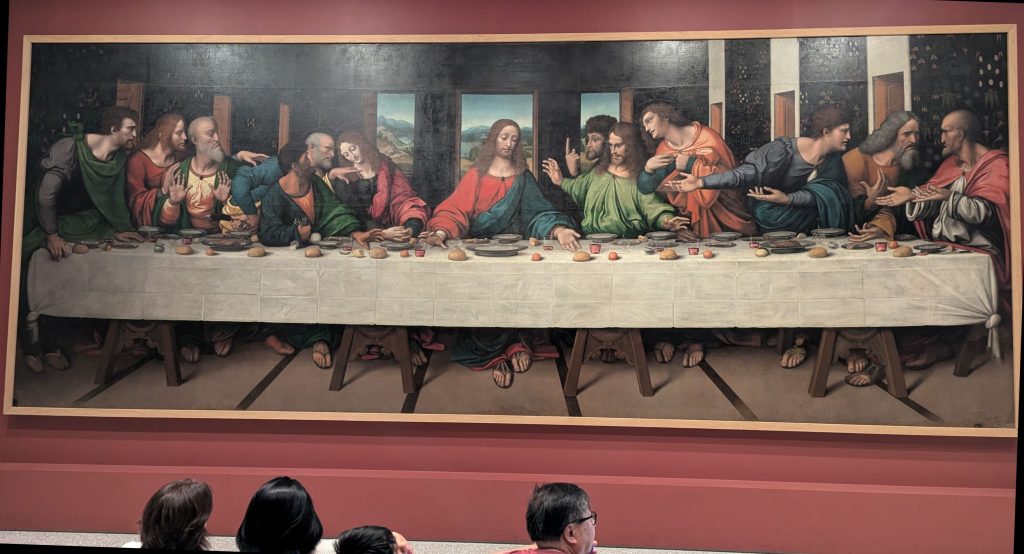
On the other hand, ‘Thank God It’s Friday!’. In fact, the belief that Friday the Thirteenth is a very bad luck days is not that old. Researchers can only trace it back to the 19th Century in France. Have a look at this BBC site for details. However, 13 has long been an ill-omened number. Judas Iscariot was the 13th to arrive at the Last Supper, And that didn’t turn out well. 13 was an unlucky day for the Romans too.

Copy of the Last Supper at the Royal Academy
Copy of the Last Supper at the Royal Academy showing 13 participlants

Baldur and Loki

In Norse Mythology, Baldur, the son of Odin who was a bright and cheerful God, was having premonitions of doom. Odin sought the advice of a dead seer who told him, Baldur was doomed. Baldur’s mother, the Goddess Frigg, was determined to save him. So got every entity in the cosmos live or dead to swear they would not harm Baldur.

Thereafter, the Gods enjoyed themselves at banquets by throwing missiles at Baldur who was now immune to all threats. The mischievous God, Loki, saw an opportunity for his evil skills. He spoke, in disguise, to Frigg asking if she had really got every single entity to swear? She said yes except the Mistletoe as it was so innocuous. So, ofcourse, Loki went to make a spear out of the mistletoe.

With the weapon, Loki attended a Banquet of twelve gods to which he was not invited, being therefore the 13th. When the Gods began their now customary game of throwing things at Baldur, Loki asked the slayer God Hodr to throw the mistletoe spear. It killed Baldur, and despite many attempts the Gods could not get Baldur out of Hell, Much of the joy of the world died with him. For more detail see norse-mythology.org.

By Jakob Sigurðsson[2] – SÁM 66, 75v. Digitized version available from http://sagnanet.is/saganet/?MIval=/SinglePage&Manuscript=1109&Page=150&language=english. Image processing (crop, rotate, color-levels) by Skadinaujo (talk · contribs)ou Jakob Sigurðsson. The Death of Baldr. From: Reykjavik: Stofnun Árna Magnússonar í íslenskum fræðum. SÁM 66. 1765. 75v. Hand copied paper manuscript. MyNDIR: My Norse Digital Image Repository. Ed. P. A. Baer. 2023. Edition 2.5.1. Victoria, B. C.: Humanities Computing and Media Centre, University of Victoria. 2023., Public Domain, https://commons.wikimedia.org/w/index.php?curid=6029049

Unlucky Friday?

Friday was often an unlucky day in the Bible. In particular, it was the day Adam and Eve ate of the Tree of Knowledge. Below you can see the human-headed snake beguiling Eve who hands the fruit of knowledge to Adam.

Detail from The Creation and Fall of Man by Mariotto Albertinelli Courtauld Institute photo by KFlude

It was the day when Noah’s premonition was proven correct. In the Canterbury Tales, Chaucer writes that “And on a Friday fell all this mischance. O Venus, sweet goddess of love’s chance”. (Nun’s Priest’s Tale). And Friday was the normal Hangman’s Day in England.

But no one seems to have put the two together until the 19th Century. In 1834 a French play had a line

“I was born on a Friday, December 13th, 1813 from which come all of my misfortunes.”

There is one Friday 13th a year, and often three. They insist on appearing only in a month that starts on a Sunday. The compound word for fear of Friday 13th is paraskevidekatriaphobia.

On This Day (Friday 13th)

1307 – On Friday 13 October, King Philip IV of France arrested leading members of the Knight’s Templars. One of the most powerful monastic orders in Europe to whom many of the leading Knights belonged. They had basically become the bankers to the Royalty of Europe, But they had become too powerful, and were destroyed very violently.

First Published on Friday the 13th of February 2026