
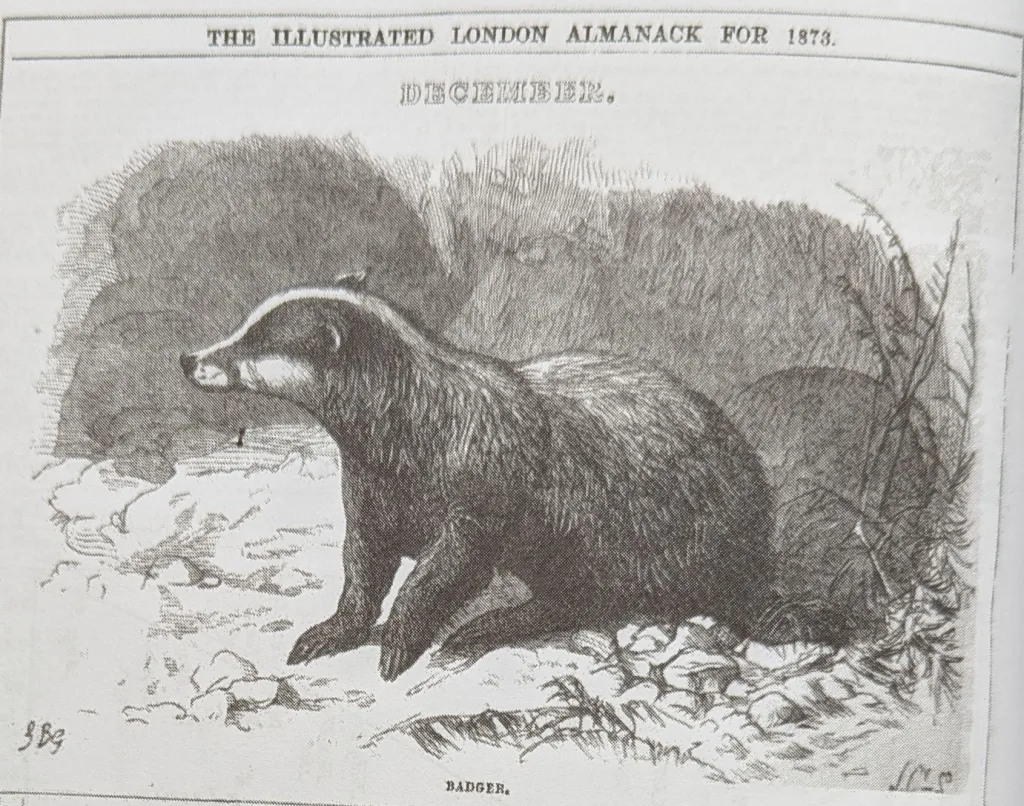
‘The Badger diggeth her a den or cave in the earth, and there liveth, never coming forth, but for meat or easement, which she maketh out of her den. When they dig their den, after they have entered a good depth, one of them falleth on the back, and the other layeth all the earth on his belly, and so taketh his hinder feet in his mouth, and draweth the belly-laden badger out of the cave. He hath very sharp teeth, and is therefore accounted a deep, biting beast. His legs (as some say) are longer on the right side than the left, and therefore he runneth best when he getteth to the side of an hill. ‘
Edward Topsell, History of Four-footed beasts, 1607. (quoted in the Perpetual Calendar of Charles Kightly.
Setts of Badgers
The Badger is Britain’s biggest surviving wild carnivore (although they are actually omnivores. Badgers live in setts, which can be extensive multi-chambered underground dwellings. Several families will share and sometime other animals too. Badgers can live in their sett for decades. They are very clean, removing soiled bedding and replacing it with clean. They are nocturnal and have a winter sleep.
Conservationists want to help preserve the badger population, but farmers blame badgers for spreading bovine tuberculosis. A recent Government survey suggests that there are ‘approximately 485,000 individuals across 71,600 social groups.’ which I make on average 7 badgers per social group.
The Badger Trust says: ‘badgers are among the most legally protected British wildlife …. badgers are recognised as one of the most persecuted British wildlife species. From rising rates of badger crime to a decade of the controversial badger cull and increasing rates of housing and road development, badger populations continue to be threatened.‘ A 1992 report estimated that 50,000 were killed each year on the roads.
On This Day
1296 – Berwick-upon-Tweed, sacked brutally by Edward I in his attempt to subjugate Scotland to English rule. Bower’s Scotichronicon reports:
‘When the town had been taken in this way and its citizens had submitted, Edward spared no one, whatever the age or sex, and for two days streams of blood flowed from the bodies of the slain, for in his tyrannous rage he ordered 7,500 souls of both sexes to be massacred…. So that mills could be turned by the flow of their blood.’
Account of the Massacre of Berwick.
Edward forbade the removal of the corpses from the streets.
1842 – Ether anaesthesia used for the first time. In Georgia Dr. Crawford Long experimented on the effects of ether by giving it to 3 enslaved people. He then removed a tumor from the neck of a patient. Sulfuric ether administered on a towel for the patient to inhale. He didn’t publish his work so the first public demonstration of Anaesthesia was on October 16, 1846, (now known as Ether Day) at the Ether Dome Massachusetts General Hospital.
1944 – From the British point of view, the worst day of the Nuremberg Raids. 795 Lancasters, Halifaxes and Mosquitos went on the Nuremberg raid. 95 bombers did not return. The worst day in RAF Bomber Command existence. And thousands of civilians died..
Object of the Day
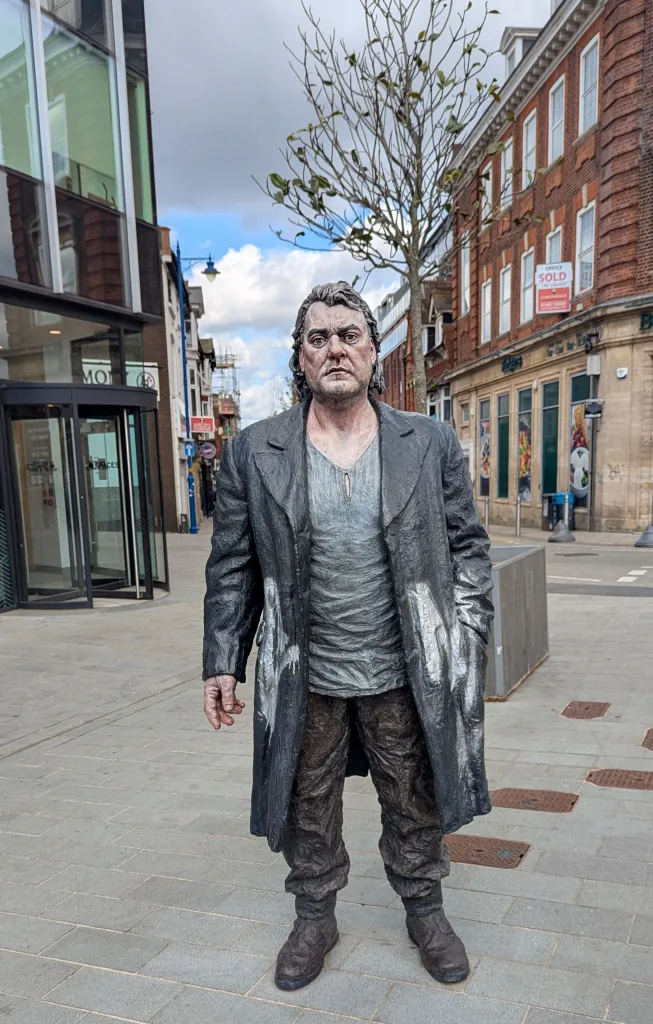
As I go to visit my father in Woking (where I went to school) I see statues by Sean Henry, which are larger than life and vivid. (the opposite of Woking itself!). Sean Henry is a pioneer of polychromic statues. By 2020 Henry had 7 statues in Woking.
First Published on March 30th 2026
Discover more from And Did Those Feet
Subscribe to get the latest posts sent to your email.