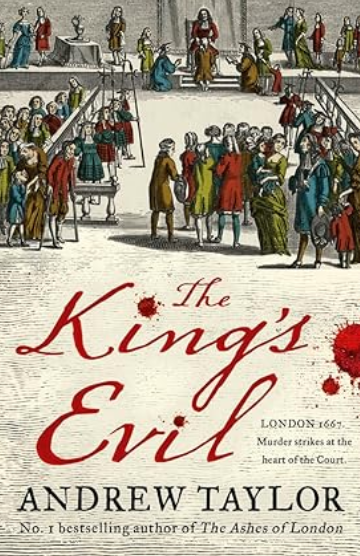
Fascinating read about the King’s Evil by Andrew Taylor
Aries & Noses
We have just entered Aries. Now according to astrology, Aries is associated with health issues of the face. This, according to ‘Skin and Astrology Signs‘ is because of the “level of heat in their bodies”. So Arians tend to have problems such as “flushing, heat rashes, skin eruptions, and rosacea”. They suggest using chilled cucumber for the eyes and forehead, and using beauty products with soothing aloe vera in them. ‘Touching’ by the King could also cure certain nose conditions, particularly if caused by ‘The King’s Evil’.
Charles Kightly, in his Perpetual Almanac enjoins us to ‘Observe the features of the face which are ruled by Aries and seek cures for ills of the nose’.
The first example, Kightly gives, is from The Shepherd’s Prognostication of 1729 which explains how to understand people by studying their noses:
Nose round with a sharpness at the end signifies one to be wavering of mind; the nose wholly crooked, to be sure unshamefaced and unstable; crooked like an eagle’s beak, to be bold. The nose flat, to be lecherous and hasty in wrath; the nostrils large, to be ireful.’
A Fungous Nose & the King’s Evil
The second rather revolting tale is from John Aubrey.
Arise Evans had a fungous Nose and said, it was revealed to him, that the King’s hand would cure him. At the first coming of Charles II into St James Park he kissed the king’s hand and rubbed his nose with it: which disturbed the king, but cured him.
Now, on the subject of revolting nose conditions, I have just been reading a review of a book ‘Civility and the Theatre in Early Modern England’. The author, Indira Ghose, is studying early self-help books of manners and conduct, and how they influence or appear in contemporary plays. One such manual by Giovanni Della Casa has the following advice:
‘when thou hast blowne thy nose, use not to open thy handkerchief, to glare uppon thy snot, as if thou hadst pearles and Rubies fallen from thy braynes’.
Galateo: The Rules of Polite Behaviour published in Venice in 1558. It was translated into French (1562), English (1576), Latin (1580), Spanish (1585), and German (1587), (Wikipedia). Galateo translates as etiquette.
There is no need to thank me for passing on such good advice! I bet “Miss Manners” Judith Martin didn’t pass this particular gem on, but Wikipedia claims that modern books of manners are influenced by Galateo.
Scofula and the King’s Touch
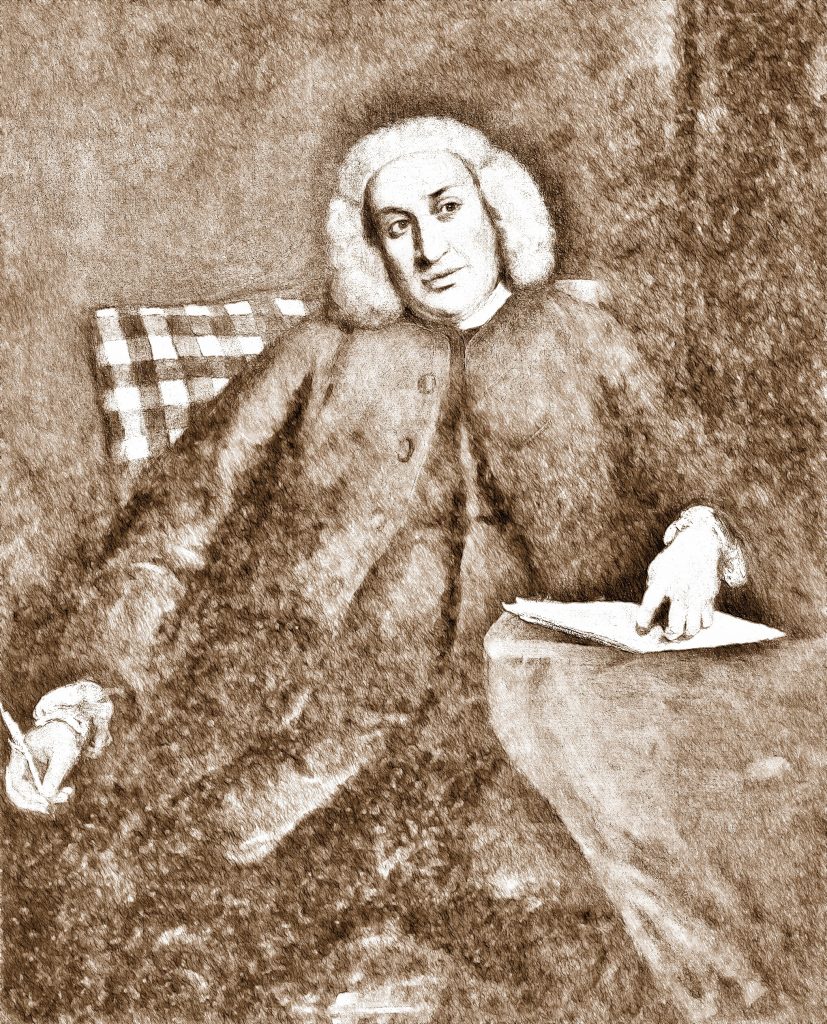
Sketch of Dr Johnson from a portrait.
People believed that Scrofula, could be cured by touching the Monarch. Tuberculous cervical lymphadenitis was, thus, known as the King’s Evil. So, the King or Queen would make herself, very reluctantly, available for his sick public to touch her. Dr Samuel Johnson suffered from Scofula and received the “royal touch” from Queen Anne on 30 March 1712 at St James’s Palace. He was given a ribbon, which he wore around his neck for the rest of his life (with a coin strung on it, I think see below). But it did not cure the disease, and he had to have an operation.
The Touching took place in the winter, between Michaelmas and Easter, when cold weather provoked the disease. The lucky few, who were allowed the Touch, would be touched or stroked by the King or Queen on the face or neck. Then a special gold coin, touched by the Monarch, was put around their neck. Readings from the bible and prayer finished the ceremony. Before Queen Elizabeth I, the Touch was said to cure many diseases such as Rheumatism, convulsions, fever and blindness, but after it was reserved for Scrofula.
Who Started touching for the King’s Evil?
It was only the French and the English who believed the King’s touch could cure people. The French claimed it began with Philip 1 in the 11th Century. The English claimed Edward the Confessor as the first. But this was denied by the French who claimed that the French King of England, Henry 1 introduced it to the English. The practice lasted until George 1 who resolutely refused to have anything to do with it.
For more on the King’s Evil have a look at this blogpost. Or read the book pictured at the top of the post.
On This Day
1312 – The Knights Templars are abolished by Pope Clement. King Philip of France had a massive debt owed to the Templars, following his war with England. He chose to avoid payment by accusing the Templars of impious acts, and homosexuality. Evidence was collected by torture and thus unreliable.
1622 – Jamestown massacre: 347 English settlers killed by Powhatan People of Tsenacommacah. This is estimated as a third of the colony’s population, during the Second Anglo-Powhatan War. Powhatan (Chief Wahunsunacawh) was the father of Pocahontas (aka Amonute, or Matoaka and Rebecca Rolfe). But it was Powhatan’s son, Opechancanough, who was in charge during the massacre. They were of the Algonquian peoples.
1888 – The English Football League was founded at Anderton’s Hotel, Fleet Street. Representatives from Aston Villa, Blackburn Rovers, Bolton Wanderers, Preston North End and West Bromwich Albion met. They discussed other teams that might join. Another meeting was called at the Royal Hotel in Manchester on 17 April 1888 to establish the league. The 12 founding members were: Accrington, Aston Villa, Blackburn Rovers, Bolton Wanderers, Burnley, Derby County, Everton, Notts County, Preston, Stoke City, West Bromwich Albion, Wolverhampton Wanderers. None from London. In season 1894–95 Woolwich Arsenal joined the 2nd Division of the Football League as the first London Team. For more information see: the-football-league-conceived-in-fleet-street-born-in-manchester/
First published in 2024, revised in 2025, Etiquette and On This Day added 2026
The day after the Equinox we look at the cardinal points of the compass:
“chief, pivotal,” early 14c., from Latin cardinalis “principal, chief, essential,” (online etymological dictionary).
The Importance of South
On its annual cycle, the Sun is always on the move. At the Equinox the Sun now rises due East, and sets due West. It then rises every day further towards the north and sets further to the South until the Solstice. The Solstices mark the extreme Northerly and Southerly rising and settings. Dawn and Dusk vary accordingly.
So, the only real fixed point in the Sun’s entire journey (as seen from Earth) is Noon. Every day of the year, every day of our lives, the Sun is at the highest point at Noon. And this is the definition of South. But the Sun never strays into the North. So the North is the polar opposite of the South- cold, remote, more mysterious.
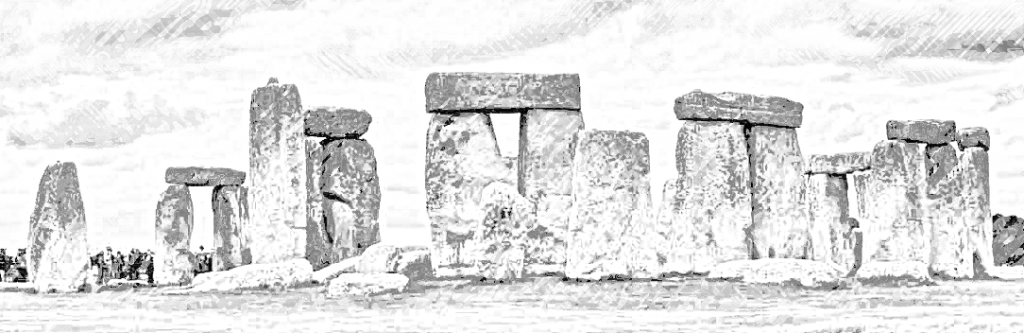
To my mind, it makes, of the Cardinal Points, the South very special. At Stonehenge, there are two exits. The biggest is aligned to the Midsummer Sunrise and Midwinter Sunset axis. But there is a smaller second entrance and this aligned due South. There is also a uniquely small standing stone in the main circle of Sarsens, which is aligned to the South. (Although we don’t know if this stone is original). However, there was some sort of corridor heading South through the mysterious wooden phase which precedent the stone Stonehenge. So, we can be sure South was important at Stonehenge.
Sketch of Stonehenge showing the smallest Sarsen stone near the Southern Entrance
Noon, derives from ‘nona hora’ in Latin and is ‘one of the seven fixed prayer times in traditional Christian denominations.’ (Wikipedia)
The Predominance of the North?
And yet, North, has come to be the principal of the cardinal points. It is shown on virtually all modern maps. It is the direction that people of my generation and hemisphere think of as being ‘up’.
The Google generation sees things differently. There are countless tourist maps on walls or plinths where North is no longer at the top. Up is shown as being the way you are facing. Users have to fight with Google Maps to put North at the top of the map. My children mock me when I say ‘Out of the Tube station, turn up the High street northwards.’ Their view of maps is completely contextual. They do not see any reason to know where the cardinal points are. I point out that the Tube probably has two exits on either side of the road. So, it doesn’t work to say ‘turn left out of the tube’.
There may also be an element of sexual difference, with men more likely to have a cardinal point view while women navigate more by landmarks. ‘Walk past the M&S, turn left to the Park and straight on’. One paper says: ‘during spatial navigation, women typically navigate an environment using a landmark strategy, whereas men typically use an orientation strategy.’
Although I see this decline of the north as being part of the Decline of the West. I also ‘things were better in my day’. But in fact it is simply returning to the way maps were produced in the past. Here is an example below, which has East at the top.
Representation of a Roman Map with the top being roughly East.
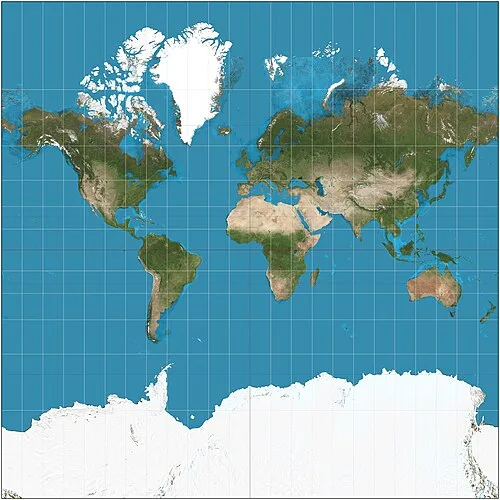
I have since looked further on this subject of North and Maps, particularly finding my answers on this web site: why-is-north-up-on-maps. It tells me that the earliest map the Turin Papyrus, has South at the top. This is probably because the Nile was the fount of all things in Egypt so it is in pride of place at the top of the Map. Other maps tend to have East at the top. The thinking is that the North was cold and who would want to go there?, The West was where the Sun went down, so the Sunrise direction should be at the Top. Often Jerusalem was in the middle with the East at the top. To this day, we talk about orienting ourselves, which means literally means finding your direction eastwards. But the 16th Century things flipped, and North became the top of the map. Was this because the Age of Exploration depended on the North Star? Maybe not because it was used for navigation for a long time before the 16th Century. Was it because of the use of the compass which pointed North? Perhaps not because the compass was first used in the 10th Century. The answer seems to be that Flemish geographer and mapmaker Gerardus Mercator in 1569 put North on top of the map. His projection became the most used map, and everyone started to follow suit.
Mercator projection of the world between 85°S and 85°N. Note the size comparison of Greenland and Africa, and the massive inflation of Antarctica’s landmass. CC BY-SA 3.0
The Magnetic Poles
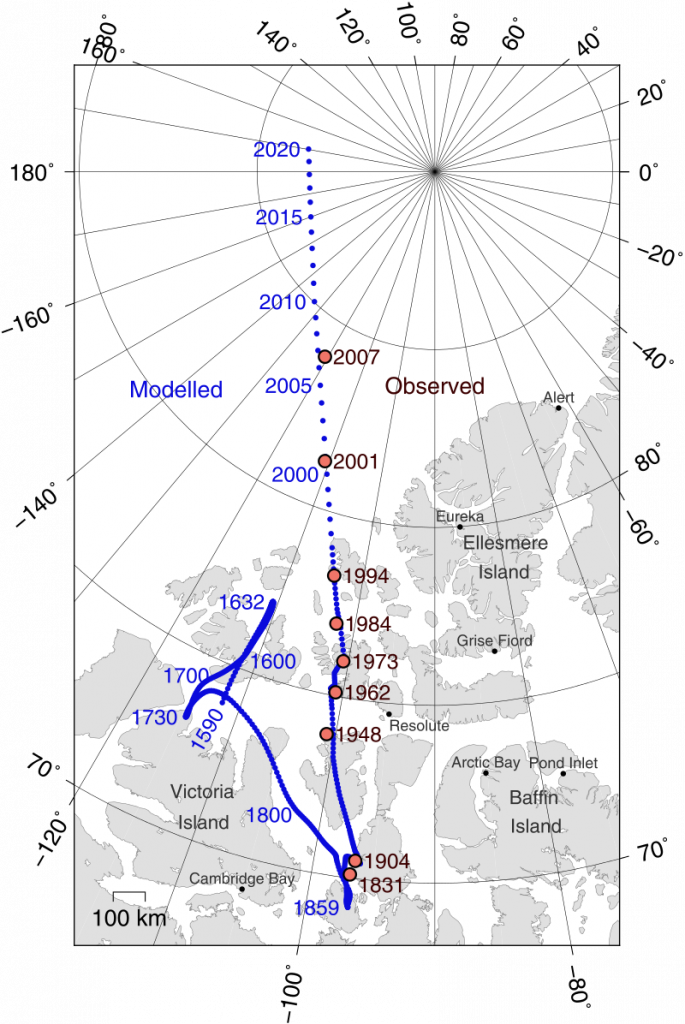
Of course, there is another version of the cardinal points: the magnetic cardinal points. The magnetic North wanders over time. It does not necessarily coincide with geographic north. In recent times they are close enough. But in the past there have been huge variations. Occasionally, the earth has had geomagnetic reversals when the North Pole has pointed in different directions, including south. The last one was 780,000 years ago. On average, they take place very roughly every 500,000 years.
The magnetic pole is caused by the molten iron in the earth’s core and mantle, which creates a dipole. Fluctuations in the dynamo flow of the molten iron cause occasional reverses. The science is very complicated and, even now, not entirely understood. Is it a random consequence of flow dynamics? Or do external events, like sinking continents, or meteor strikes cause the reversal?
Since the first use of compasses for navigation in the 11th/12th Centuries, the magnetic pole hasn’t wandered enough to be of concern to navigation. It has wondered a few hundred miles over the last 500 years. Now, it is speeding up, from 9km a year to 52km (since 1970). This Wikipedia page is pretty good at an explanation.
My Job Tracking the Cardinal Points
My first proper job after university was as a technician then research assistant at Oxford University studying these phenomena. I say ‘proper’ because when I left University, I became an itinerant archaeologist. This led me to digs in Switzerland, Northampton, East Anglia and Nottingham. Then, I got the job at the Research Laboratory for Archaeology and the History of Art, at Keble College, Oxford.
I worked for Dr. Mike Barbetti who was an expert on the wanderings of the Magnetic Pole. His interest was firstly in the pure science of the subject. But he was keen to explore the applied uses in Archaeology as well. So, after being appointed as a Research Fellow at Oxford, he set up an epic journey from his native Australia to Oxford. It went via some of the iconic sites of Palaeolithic Archaeology, including Olduvai Gorge, Tanzania. The site of excavations by Mary and Louis Leakey.
To plot the movements of the magnetic north, scientists needed dated samples. Early human sites provided dated sites over a long time span. Also, archaeomagnetism, as the discipline became known, offered the possibility of dating sites. Another application was to determine whether deposits were fired or not. One of the sites Mike sampled was a candidate for the first evidence of fire in human existence.
Cutting up Samples
As I said, Mike’s interest was discovering how the magnetic field of the earth changed over time. And, more importantly, what was the mechanism. He shipped back to Oxford samples of soil cast in Plaster of Paris. My job was to cut the samples up. I cut them up with an electric saw in a shed in the backyard of the Laboratory. Then we measured the direction and intensity of the magnetic field in the samples.
Soil contains particles of iron, and they align randomly. So a sample of soil has a low magnetic intensity and a random direction of magnetic field. But once heated up, the iron particles align to the current direction of the magnetic pole. Its intensity is proportional to the intensity of the Earth’s magnetic field. These measurements provide a method of plotting the changes of the magnetic field over time. And from these data, models can be constructed explaining how the iron in the earth’s core worked as a giant magnet.
Once we had built a reference curve for the movements and intensity of the magnetic pole over time, we hoped to develop another dating method. Other methods such as radio carbon, thermoluminescence, and tree ring dating, were being developed at the Research Laboratory in Oxford at the same time.
My part in Digital Heritage Part 1
Having got the results, I took them to the Oxford University Computer Centre. There, I typed them up onto machine-readable cards. Added a copy on cards of our computer programme written in Fortran, and gave them to the Computing Staff. The program and data were run through the Centre’s mainframe computer. (probably an IBM or ICL computer, the size of a house!) 24 hours later, I received a print-out to proofread.
I located mistakes, ran an editing run of punched cards, essentially instructing the computer: ‘on card two replace 2.5 with 2.6, and run the programme again’. I would pick up the results 24 hours later. It seems extraordinarily primitive now, but then it was an enormous saving of time.
And that, patient reader, was my early contribution to Digital Heritage and pure science. Mike published many articles of which I was joint author of three articles, two in the prestigious Science Journal Nature. And it is annoying that my citations in the groves of academia are still dominated by articles I co-wrote in the late 1970s/80s!
Mike’s work was important in the development of the study of the earth’s magnetic field. However, the use of archaeomagnetism has never risen above strictly limited. Occasionally, in specific circumstances, it can be useful. But those circumstances tend to be times when no other methods have worked. Most often, it is used in attempting to date kilns.
These are the papers:
Barbetti. M and K. Flude, ‘Palaeomagnetic Field Strengths from Sediments baked by Lava flows of the Chaine des Puys, France.’ Nature, Vol. 278 No 5700. 1979
Barbetti M., Y. Taborin, B. Schmider and K. Flude ‘Archaeomagnetic Results from Late Pleistocene Hearths at Etoilles and Marsangy, France’. Archaeometry 22. 1980
More on my contribution to Digital Heritage in posts to come.
OnThis Day
630 – Emperor Heraclius returns the True Cross, one of the holiest Christian relics, to Jerusalem. (see my post on the True Cross and Roodmas)
1152 – Annulment of the marriage of King Louis VII of France and Queen Eleanor of Aquitaine. She went on to marry Henry II of England which makes this one of the most amazing events of the medieval period. The transfer of lands from French control to English control as a result was huge. She eventually was imprisoned by her new husband for supporting their children’s rebellion.
1556 – Former archbishop of Canterbury Thomas Cranmer executed for heresy in Oxford. He had recanted, but recanted his recantation when he discovered there were still going to burn him. By rights, he should have been reprieved, but Queen Mary was determined to make an example of the man who help Henry VIII and Thomas Cromwell make England a Protestant state. The fire was on Broad Street, and he is said to have thrust his arm that signed the recantation into the fire, calling it ‘that unworthy hand.’
1829 – Duel Day is celebrated at Kings College when the Duke of Wellington fought a duel against George Finch-Hatton, 10th Earl of Winchilsea, because of disagreement about Roman Catholic Emancipation. The duel took place in an asparagus fields which would later become Battersea Fields. Wellington shot first and either missed or deliberately shot wide, and Winchilsea aimed high. He then apologised to Wellington. For more details see www.kcl.ac.uk/duel-day.
First written March 2023, revised 21st March 2024, Revised and Mercator added 2026
Video by Heike Herbert of Druids at the Spring Equinox at Tower Hill, London
New content will be found at the bottom in the ‘On This Day section.’ So, Spring has sprung, not only meteorologically speaking but also astronomically. We are 20 days into the meteorological Spring which started on 1 March (see my post here.) Today, we are starting the astronomical or solar Spring.
The 20th of March is the Spring Equinox, or Vernal Equinox, midway between the Winter Solstice and the Summer Solstice. The sun has been rising further north each day since December 21st. Today it rises due East, and sets due West. The day and night are roughly equal in length (although by no means exactly). At 14:45 today, the Sun is directly overhead at the Equator.
The term vernal comes from the Latin for Spring, and today is the Primavera, the first day of Spring. The Anglo-Saxons originally used the word lencthen (Lent) for Spring. But later adopted the idea of the ‘springing’ of the year when the plants bud. In Middle English, the word Spring is also used for sunrise, the waxing of the moon and the rising tides. These are called spring tides. But also for the sprouting of the beard and the first appearance of pubic hair! Happy Spring Time!
Printemps
Up to the 15th Century, the English also used the French term ‘prime-temps’ in the sense of ‘first times’. This follows the idea that the year is young, while Winter represents old age. As we shall see, on March 25th, there was also a belief that the world was created in Spring at the Equinox. Jesus was also conceived at this point of the annual cycle. (see my post /march-25th-the-beginning-of-the-universe-as-we-know-it-birthday-of-adam-lilith-eve-conception-of-jesus-start-of-the-year)
Zodiacally, if that is a word, Spring is Aries (brave and impulsive); Taurus (sensual and stubborn), and Gemini (dynamic and talented).
Druids at Tower Hill
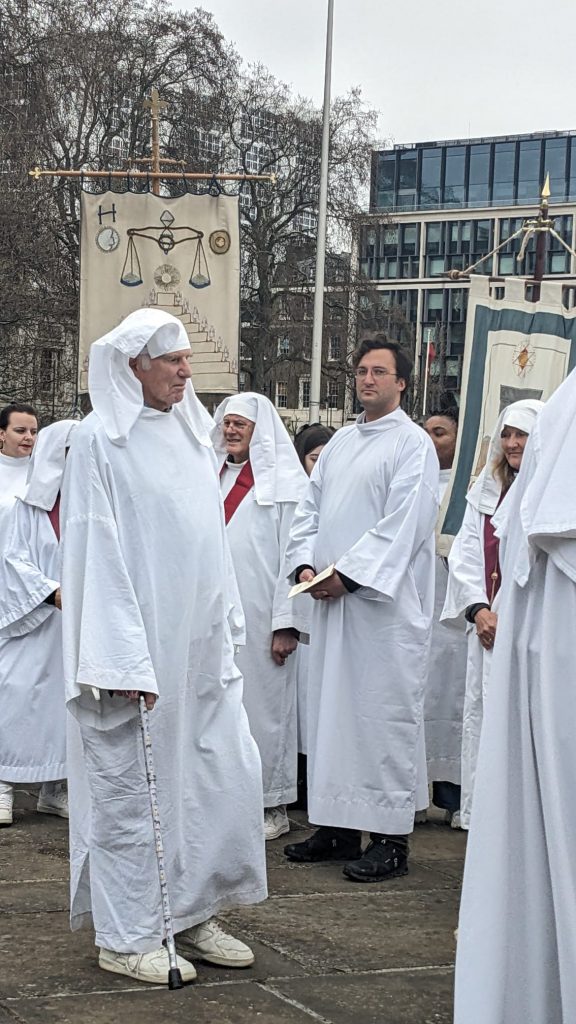
Druids at the Spring Equinox Tower Hill London, Photo by Heike Herbert
The Druids have a ceremony at Tower Hill every year on the Spring Equinox. When I last attended I remember the druid costumes were often made with nylon sheets, and their footware was mostly tennis shoes. I see from the photos the nylon has at least been replaced with cotton, and the plimsolls with trainers. Not quite sure what that pair of black trainers are doing in the picture!
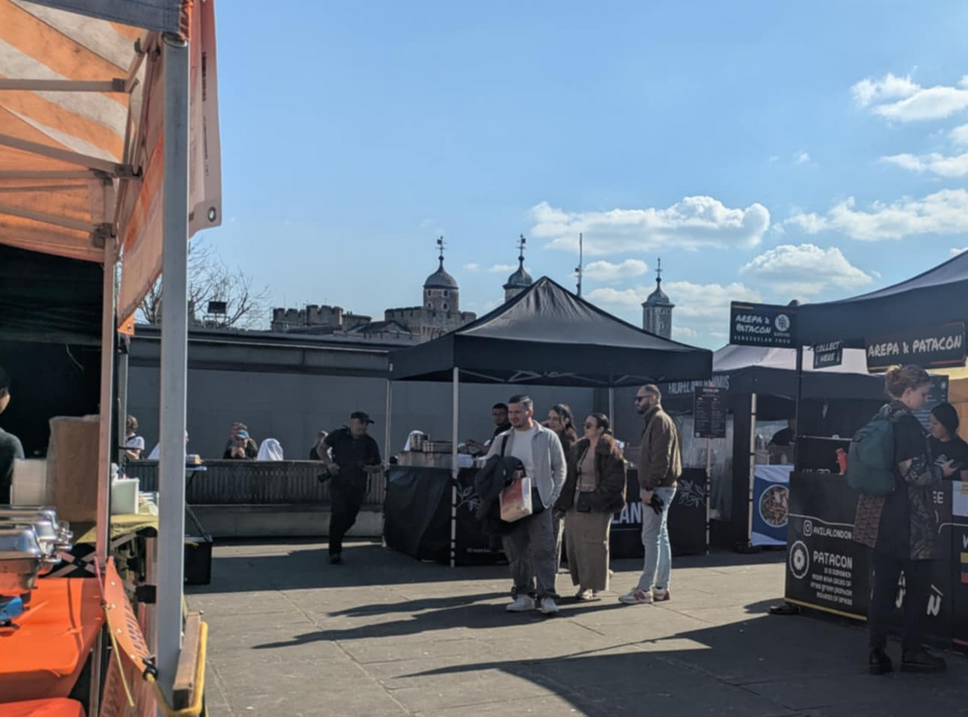
As my photos are getting long in the teeth, I have used photos by Heike Herbert. She attends most years. The ones above from 3 years ago. In 2025, she reported that the atmosphere has been affected by a street food market,. This restricted the space for the Druid Circle. The food stalls are there every Thursday, so it only impacts the Druid assembly once every 7 years! In 2026 the Druids meet at Tower Hill at 12 noon.
Tower Hill, Spring Equinox, 2025 and street food, Photo by Heike Herbert
Modern Druids
I say modern druids because there is no convincing evidence that the modern fellowships of Druids can trace their origins back to prehistory. Druidry was reinvented in the 18th Century — for example, the Ancient Order of Druids was formed in 1781. They were set up as societies in the tradition of the Freemasons. They held to belief in the fundamental importance of nature. However, one group, the British Circle of the Universal Bond, claim descent from a group persecuted by the Bishop of Oxford in 1166. Look at their website for more details and for an idea of their beliefs.
Prehistoric Spring Equinox
When did the Equinox first had importance for human society? The answer is, probably, at least as long as we have been reasoning creatures. On January 14th, I draw attention to a recent discovery by an amateur ‘citizen scientist’. He suggested there was evidence in Cave Painting for the use of a Palaeolithic Calendar. Follow this link to see the post.
Stonehenge and the Sun
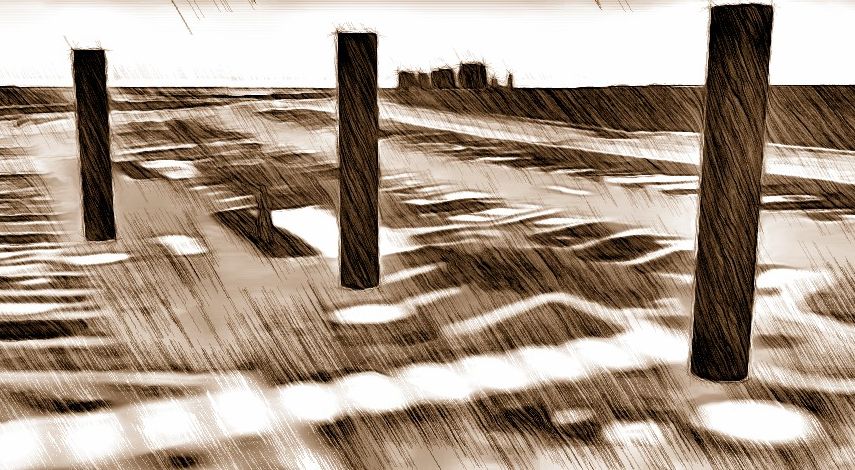
At Stonehenge, in the old Car Park, they found three huge Pine post-holes in a line. Dating evidence shows they were erected in the Mesolithic period, thousand of years before Stonehenge. They align to the direction of the Mid-Summer Sunrise and Mid-Winter Sunset (NNE/SSW). If, and it’s a big if, you were sighting from Stonehenge itself, which was built some 5000 years in the future.
Imaginary reconstruction of the Carpark Postholes
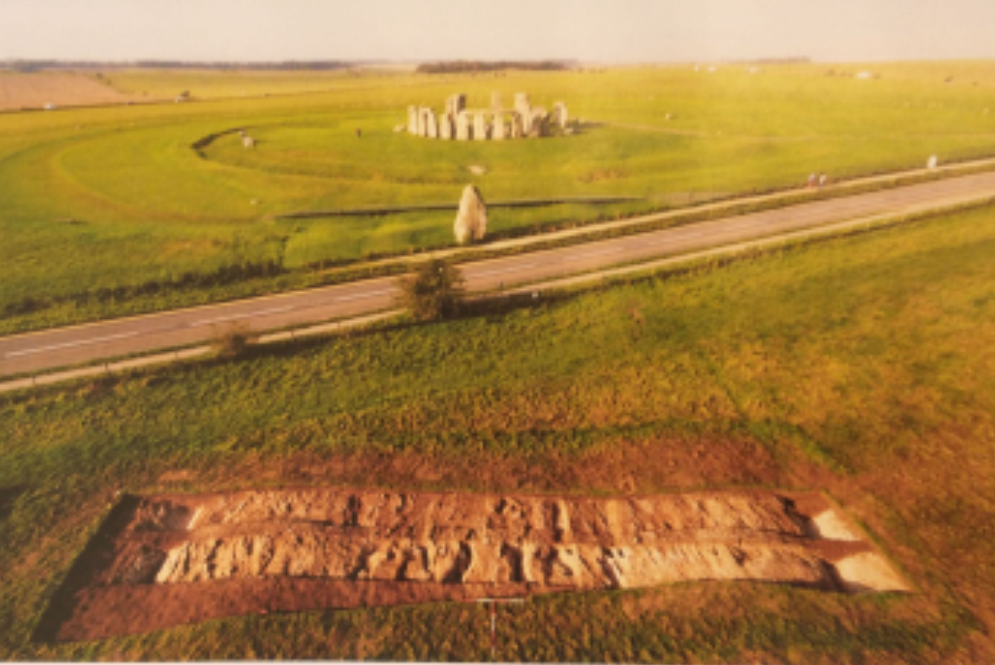
It is a bit of a stretch using two pieces of evidence so far apart in time. But recent excavations have revealed that there are natural periglacial striations in the soft chalk bedrock at Stonehenge. These lines point to the Solstices. They not only predate Stonehenge but also the three post holes. The striations may well have been visible from the time they were created when the glaciers melted.
Around 12,000 years ago (date from my memory so approximate), the climate changed and the glaciers melted. This left a lot of water rushing around the landscape. At Stonehenge, it gouged out striations in the chalk. By chance, or as ordered by the Gods/Goddesses/Divine Nature, the striations pointed to the Solstice Axis. Richard Jacques excavations in the Stonehenge area revealed that the aurochs came to the Stonehenge area for grazing and water. Aurochs are huge wild cows with enough meat on them to feed 200 people. So, the solar axis is near a place where the Gods/Goddesses/Divine Nature provided super-abundance in the guise of herds of Aurochs.
Foreground shows the periglacial striations aligned on the Solstice. Source Current Archaeology?
Burial Mounds aligned to the Equinox
That the major movements of the Sun were of interest to Neolithic and Bronze Age society is confirmed by the alignment of many megalithic monuments dating from 3,600 BC onwards, including, of course, Stonehenge. All around the UK are long barrows and other burial mounds, many of which are indeed sited/sited E-W to the Equinoxes. Many are fairly approximate. But at Loughcrew, County Meath in Ireland the Vernal Equinox shines right into the burial chamber. The sun’s light shines onto a stone marked by stone carvings. Similar alignments exist at Knowth and Dowth in the Boyne Valley. More about Loughcrew in my post here)
Harmony & the Spring Equinox.
The Equinox also has another role, which is to be the anchor of the cardinal points. The world is orientated to North, South, East, West. The Equinox is a time when there is a harmony, a balance in the universe. Therefore, it is a fortunate, a lucky time, a time to fall in love or undertake notable undertakings. But, in the Christian world marriage traditionally had to wait a little longer, until after the commemoration of the death of the Messiah,
On This Day
Today, is The International Day of Happiness. This was set up by the UN on 28 June 2012. This year’s theme:
‘explores the relationship between social media and happiness, highlighting thepotential challenges for our wellbeing as well as ways we can all use tech for good.‘
Go to the web site for more information. But these are the three steps they suggest: (I’ve cut and pasted them from the site)
Step 1: Choose
Be mindful of if, when and how much you are on social media.
Pause and ask yourself, “What do I really want to do right now?” Keep a list of analogue activities you can do instead, like playing music, drawing, gardening or going outside for a walk.
Set a timer so scrolling is a short snack rather than a wormhole.
Give your mind space to think, keep the bedroom phone free, try a ‘digital sabbath’.
Step 2: Connect
Don’t let scrolling be a substitute for real connection.
Phone a friend for a chat, or send some voice notes, instead of scrolling.
Make plans offline, get excited about your next adventure with loved ones.
Use social media to connect with supportive friends and communities that are meaningful to you.
Step 3: Curate
Personalise your experience to support your wellbeing.
Share and amplify uplifting stories, messages and ideas, be aware of misinformation.
Be kind in the comments, it matters more than you think.
If you have found this useful, spread the word and encourage others to do the same. Use the hashtag #InternationalDayOfHappiness.
The World Happiness Report
This is published annually by the Wellbeing Research Centre at the University of Oxford. More details here. Finland is top for the 9th year in a row. US is 23rd, UK is 29th. These are the top 25 happy countries:
Peak Cherry Blossom Photos by Natalie Tobert (to see her fantastic sculptures, look here:)
This year, I don’t think it is yet Peak Blossom. Last week of March, first weeks of April, my best bet. But I’m going to keep this post here to encourage you to get out there and take joy from the Blossom season. Or Sakura as the Japanese call it.
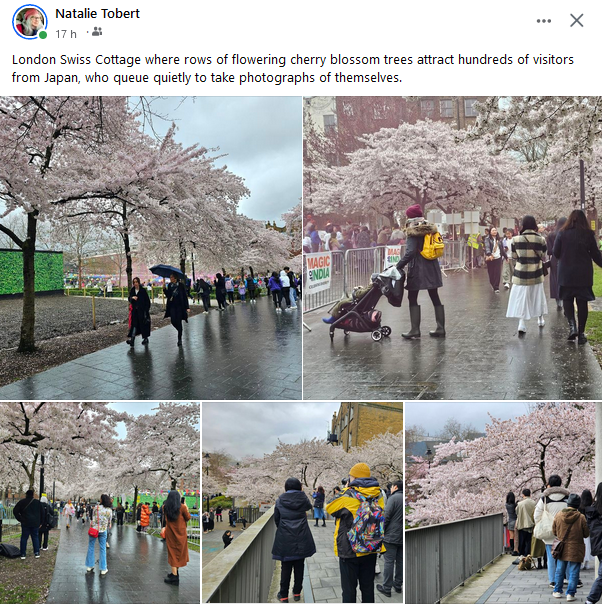
In 2024, it was early, around March 19th, 2025, two weeks later. There are many suggested places, and I enclose a couple of web links with more details. But my friend, Natalie Tobert, posted in 2024 about Japanese people queuing up to photo cherry blossom in Swiss Cottage, which you can see above.
Sakura and Peak Cherry Blossom
For the Japanese Cherry Blossom represents both the beauty of life and its brevity. Sakura are honoured by the Samurai, and were on the badges of KamiKazi Pilots in World War 2. The Japanese began their blossom time with Plum Blossom. They can be difficult to tell apart from Cherry but it is much more fragrant. It blossoms earlier can also be white!).
Cherry trees consist of 430 species in the genus Prunus. Wild Cherry and Bird Cherry are native to the UK. Normal blossom time is April. In mild winters and sheltered places like London they can blossom as soon as February. The flowers are known as Sakura in Japan, and viewing them is ‘Hanami’. Bird Cherry usually flowers in May. Recent blossoming is over 7 days earlier than the average for the previous 1,200 years.
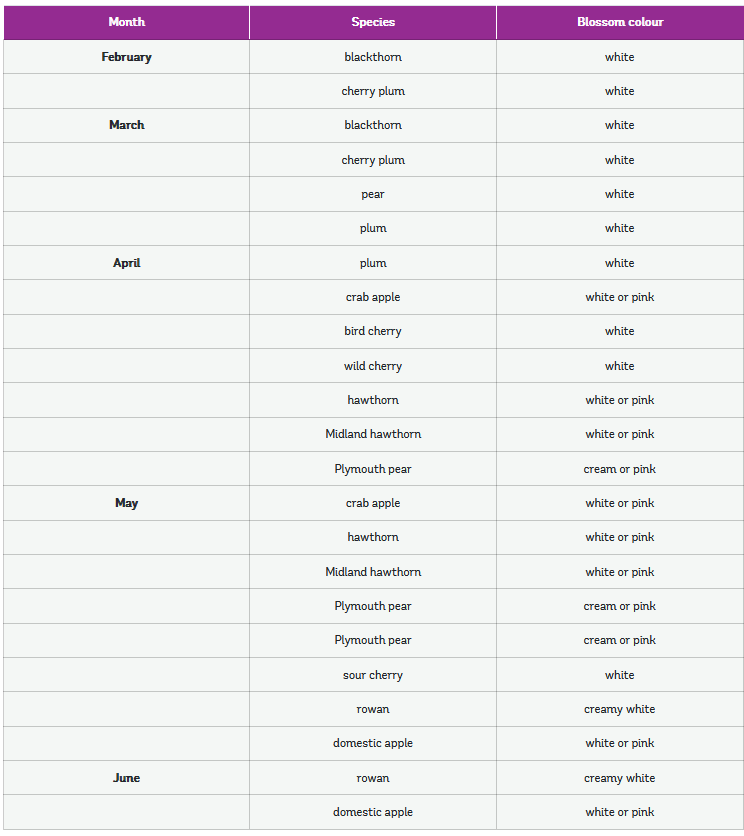
The Woodland Trust has a great web page about blossom in general and I include their useful table of blossom time, below. www.woodlandtrust.org.uk
The Trust also have a ‘nature’s calendar’ program. ‘Citizen Scientists’ can participate in projects to track the progress of the sessions in nature. https://naturescalendar.woodlandtrust.org.uk.
Feast day of St Joseph. Father? Step-Father? Guardian? of Jesus. I see that religious sites like to use the expression ‘Earthly father’. Images of the Annunciation, suggest a divine impregnation at the time that the Archangel Gabriel turned up to tell Mary what was going to happen. See my post on the Annuciation. Joseph is for fairly obvious reasons, patron saint of carpenters, working men, fathers, families and virgins. Emigrants, travellers and house hunters. But also pastry cooks, attorneys and barristers, for reasons I know not.
In Medieval Mystery plays, the scene where Joseph is told by Mary she is pregnant was played strictly for laughs. When Mary gives him the news that he is carrying ‘Gods and his (Joseph’s) child’. He warns all old men not to take young wives, and laments that his name is ruined. Nor is he very impressed when Mary tells him an angel told her the news. Below is a Middle English version of a section of the N-Town Plays, Play 12 Joseph’s Doubt. (these 15th Century Passion Plays are not linked to any particular town or author, hence their name). It is in middle english but just give it a go, don’t worry about the words you cannot understand. You will be able to guess enough of them to make sense of what is going on. If you follow the link below you will get help with particularly difficult words. y’s are often i’s. O’s can be a’s.
N-Town Plays, Play 12 Joseph’s Doubt
MARIA Sekyr, sere, beth nowth dysmayde, Ryth aftyr the wyl of Goddys sonde.
JOSEPH That semyth evyl, I am afrayd: Thi wombe to hyghe doth stonde! I drede me sore I am betrayd. Sum other man thee had in honde Hens sythe that I went. Thy wombe is gret; it gynnyth to ryse! Than has thu begownne a synful gyse! Telle me now in what wyse Thyself thu ast thus schent! Ow, dame, what thinge menyth this? With childe, thu gynnyst ryth gret to gon? Sey me, Mary — this childys fadyr, ho is? I pray thee, telle me and that anon!
MARIA The Fadyr of Hevyn and ye it is; Other fadyr hath he non. I dede nevyr forfete with man, iwys. Wherfore I pray yow, amende youre mon: This childe is Goddys and youre!
JOSEPH Goddys childe — thu lyist, in fay! God dede nevyr jape so with may! And I cam nevyr ther, I dare wel say, Yitt so nyh thi boure.
But yit I sey: Mary, whoos childe is this? MARIA Goddys and youre, I sey, iwys!
JOSEPH Ya, ya, all olde men to me take tent And weddyth no wyff, in no kynnys wyse, That is a yonge wench, be myn asent, For doute and drede and swych servyse! Alas, alas, my name is shent! All men may me now dyspyse And seyn: “Olde cokwold, thi bow is bent Newly now after the Frensche gyse!” Alas, and welaway! Alas, dame, why dedyst thu so? For this synne that thu hast do, I thee forsake and from thee go For onys evyr and ay!
Blosson in Haggerston Park on 9th March 2025, photo by K Flude
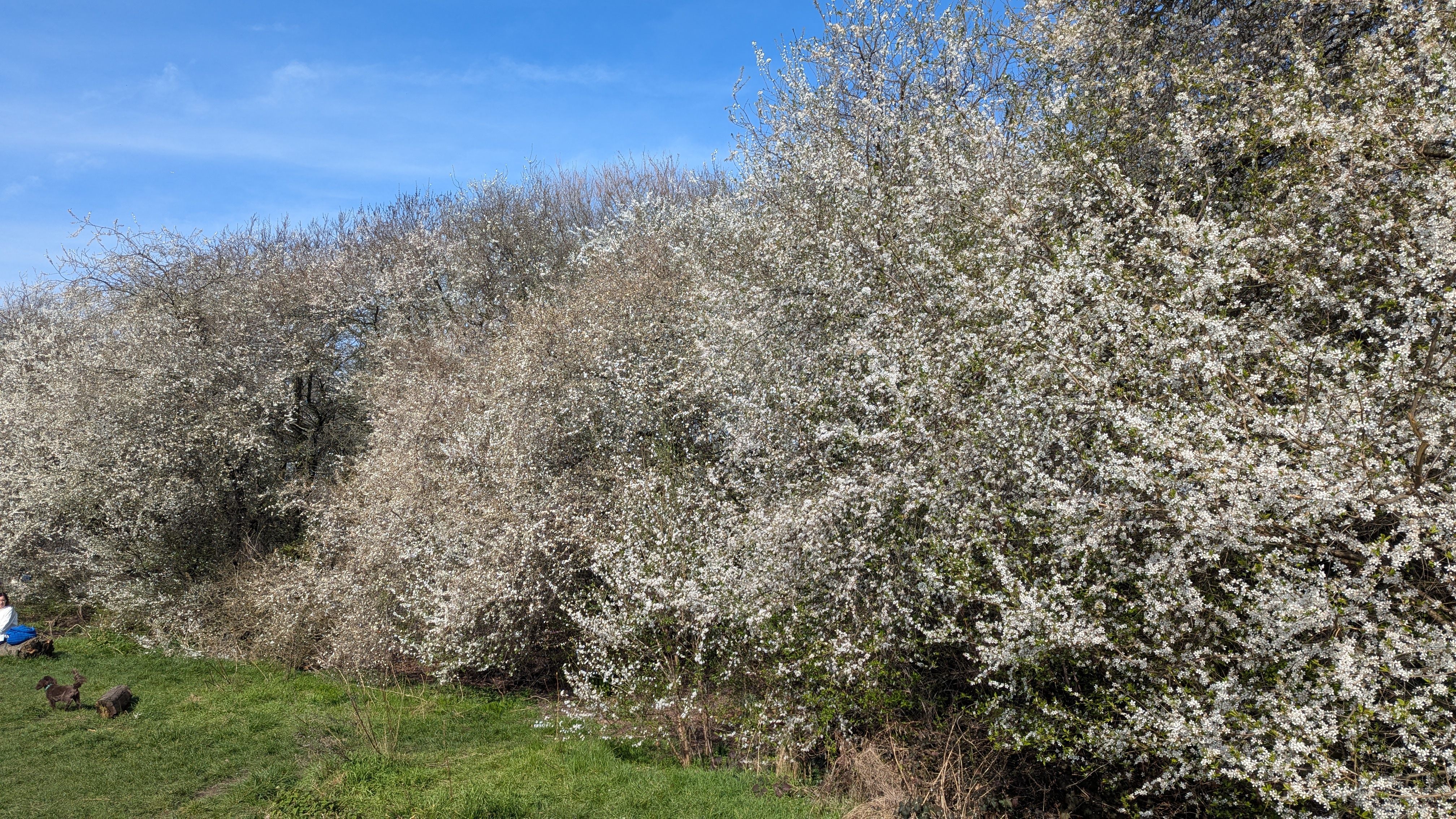
Peak Blossom varies year by year. Two years ago, I declared it on March 19th, last year it was later. Normally, it is late March – Early April.However, walking around my local Park Haggerston Park today, Haggerston is whitewashed with amazing blossom. I thought it was Blackthorn, until I read that Blackthorn was the tree from which Sloes are grown.
My ‘Flora Incognita’ app tells me that it is Cherry Plum, Prunus cerasifera. This makes sense as in the summer, there were people collecting the small plums that were growing on the trees. The pink variety of cherry are not yet at peak blossom. I will post about peak blossom, later today.. To read about Cherry Blossom read my post here.
Local magnolia’s are beginning to come out, although I noticed a lot more in my Dad’s area which is 40 miles south. I bought a magnolia about 18 months ago, had quite a fine show in its first year, but this year the scaffolders managed to destroy all the buds, and the squirrels did further damage. So keeping my fingers crossed.
Haggerston Park
I am using this occasion to write about my local park which I have been saving up for a ‘vacant day’. (see my post of Ovid and Vacant days)
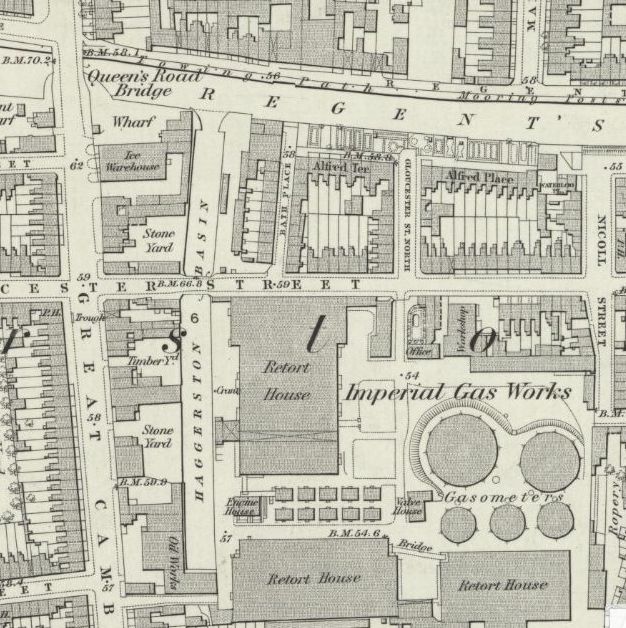
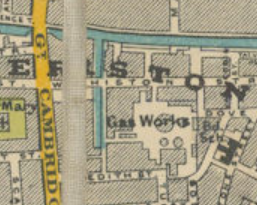
Haggerston Park was built on the site of derelict houses, a tile manufacturer and a Gas Works in the post war years. The Gas works was situated by the Regent’s Canal with its own basin for loading supplies. In the 80s the Park expanded to take in some areas which were formerly residential streets. All that really remains of the Gas works are the perimeter walls, and the outline of the canal basin.
The park is a well-loved local facility with green lawns, trees and flowers. It also has a great new playground for kids; astroturf football pitches; tennis courts, toilets, cafe, City farm, and a wild wooded area. This is dominated by the Cherry Plum trees and is a haven for squirrels. Rats loved it too, but I haven’t seen one for 2 years or so. I think they have been successfully ‘controlled’.
There are some strange parts of the design which, I hoped, were traces or inspired by industrial archaeology, but it turns out the designer wanted a maritime theme. So there are flagpoles, tripods and brick structures which are supposedly somewhat maritime.
Park Henges
The Gardeners obviously like the hengiform design because the Park has a lot of henges, and circles. I have my own name for most of them.
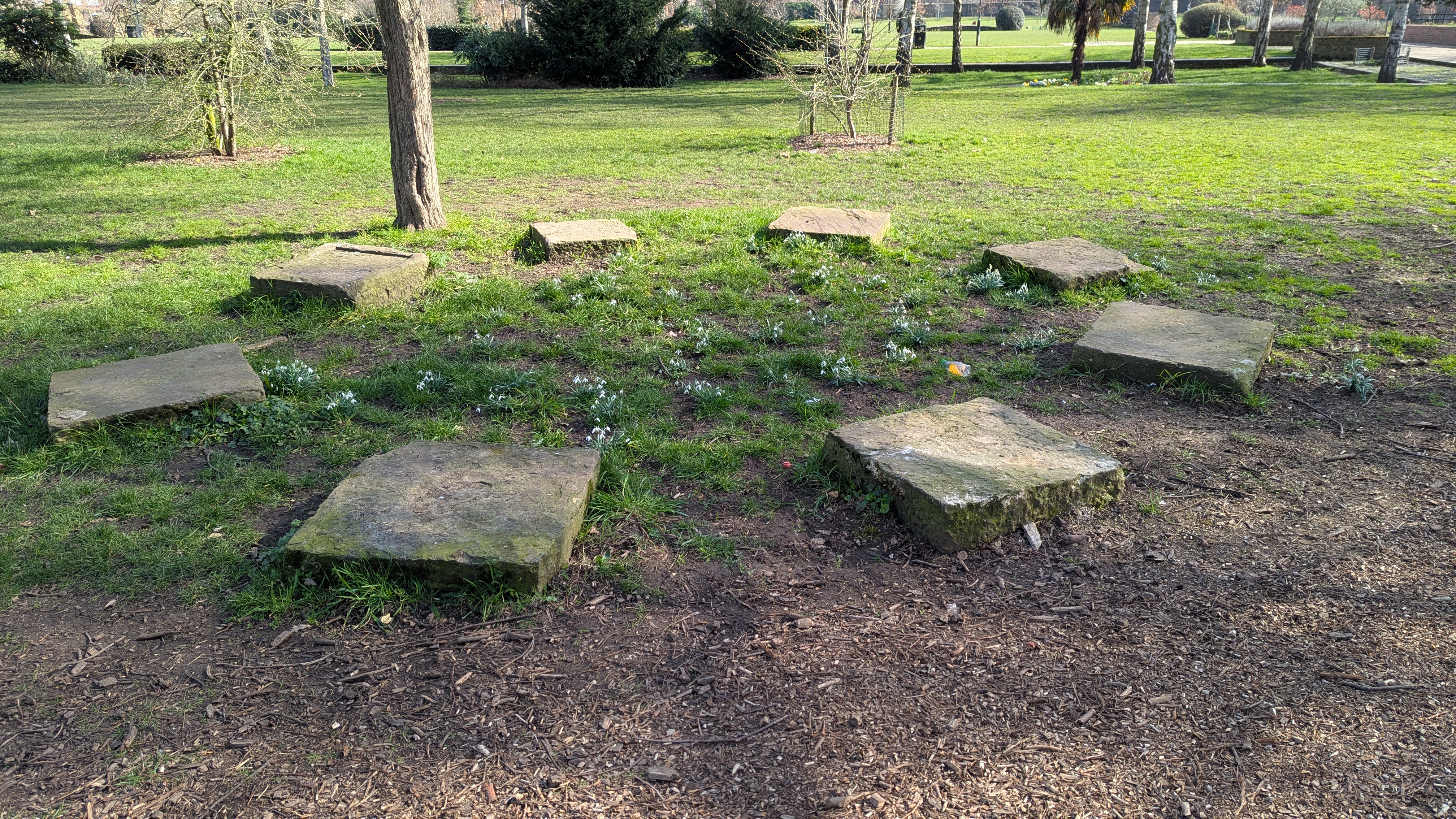
Snowdrop Henge
Snowdrop henge Haggerston Park, photo K Flude
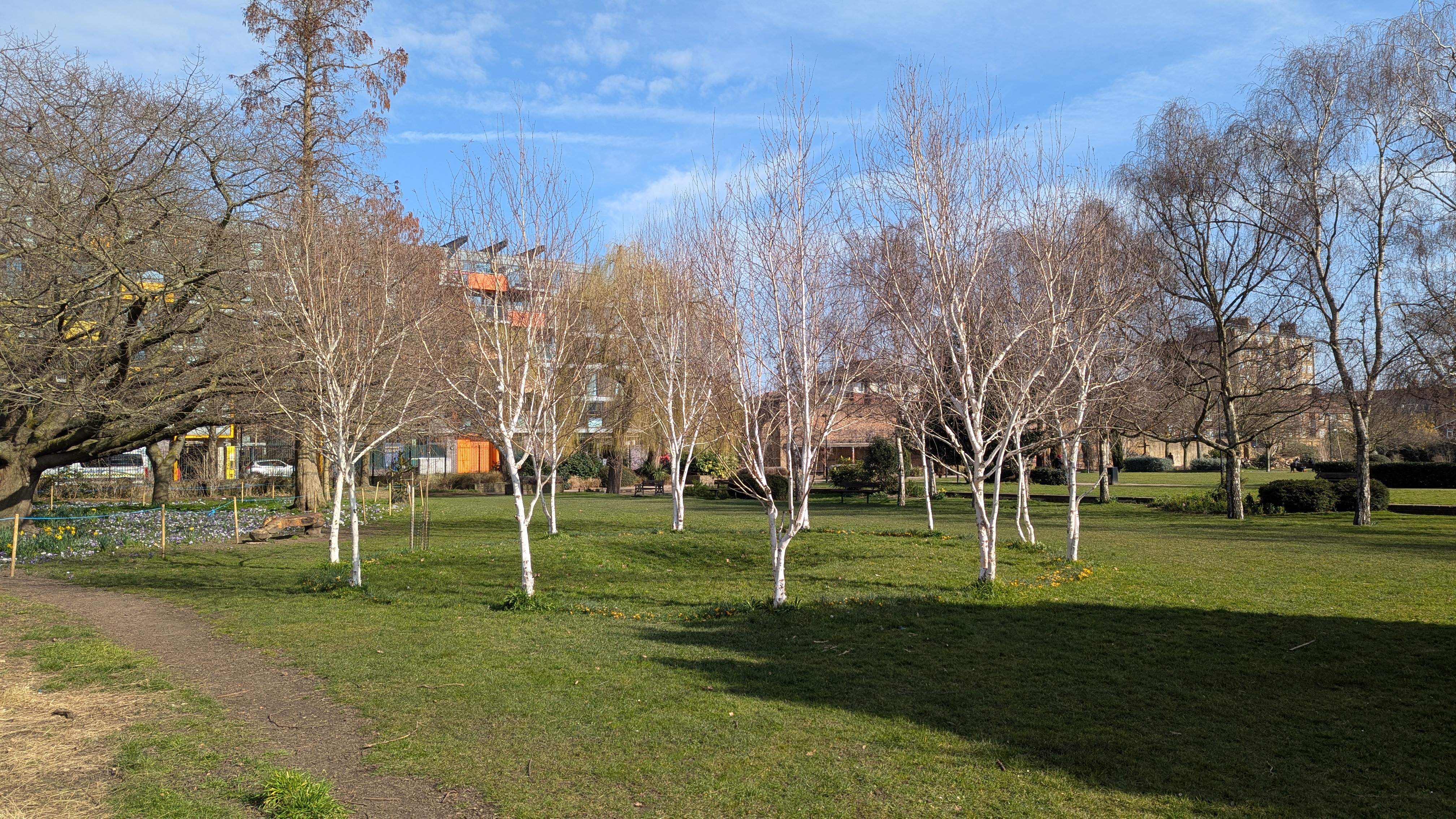
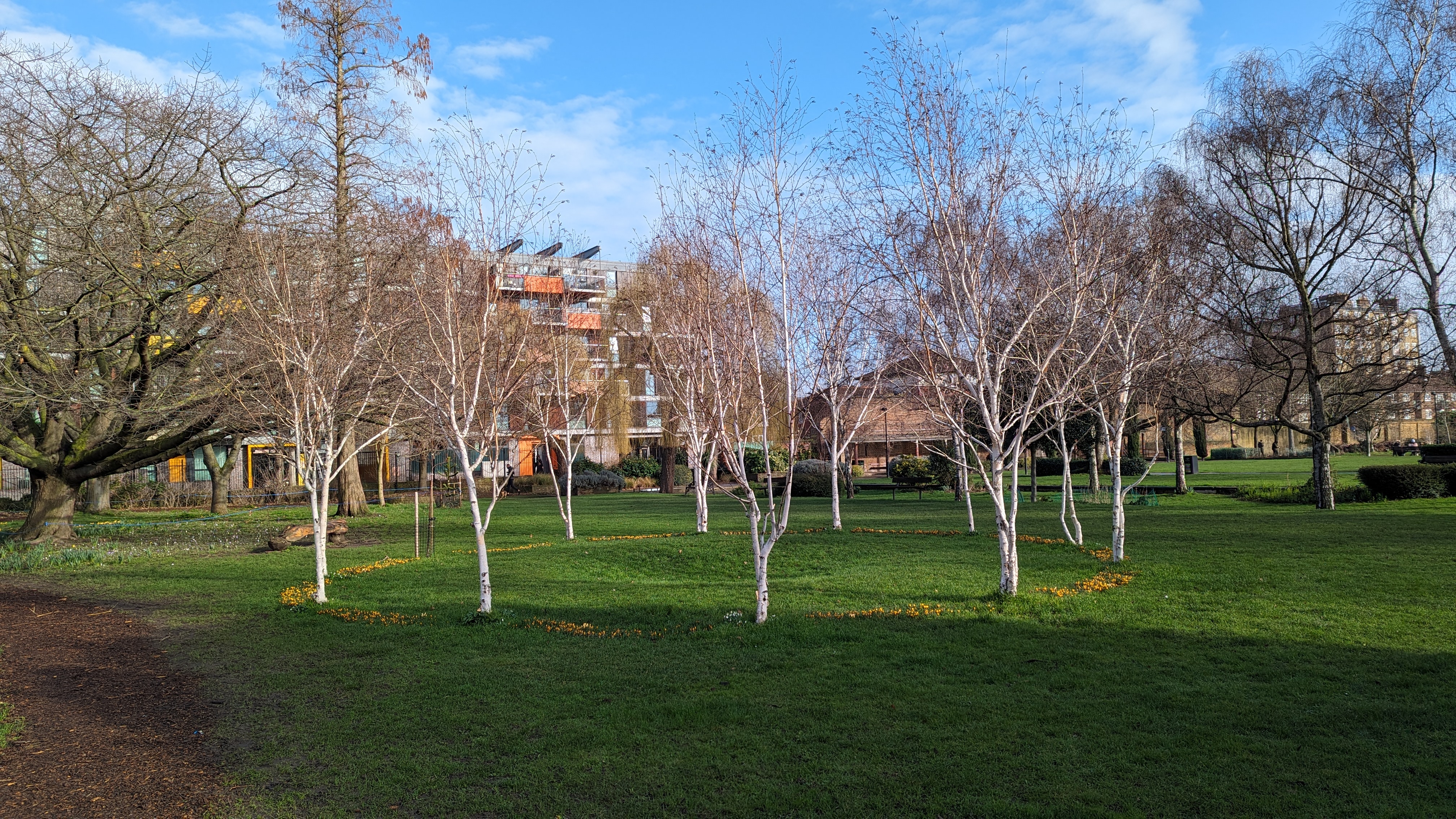
Silver Birch & Crocus Circle
Silver Birch Circle Haggerston Park, Photo Kevin Flude
The beautiful crocuses are not so clear in this picture, but they are really lovely! (See my post on Croci here). Last year I got a better photo of the croci.
Haggerston Park, 2024 Photo K Flude
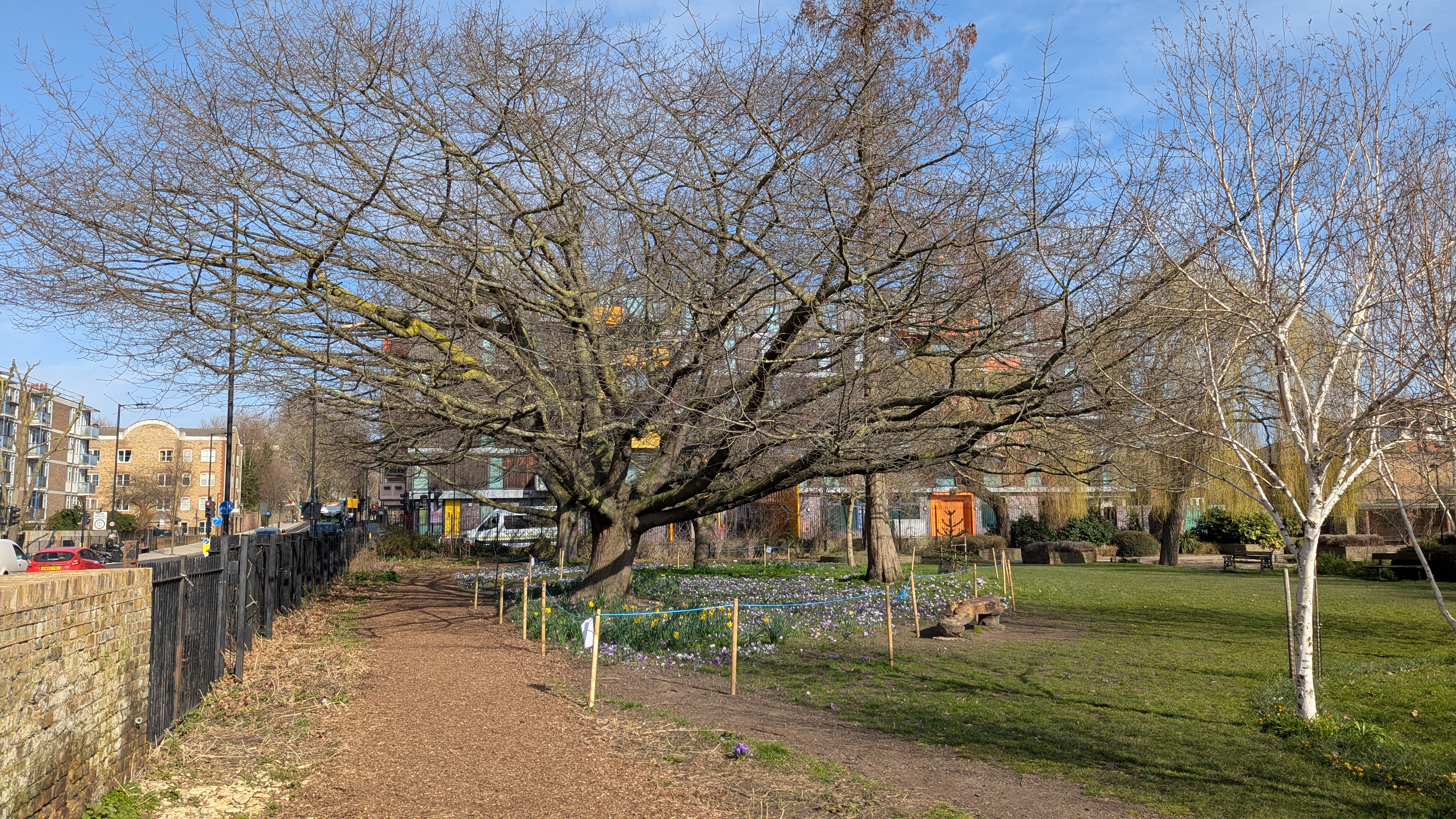
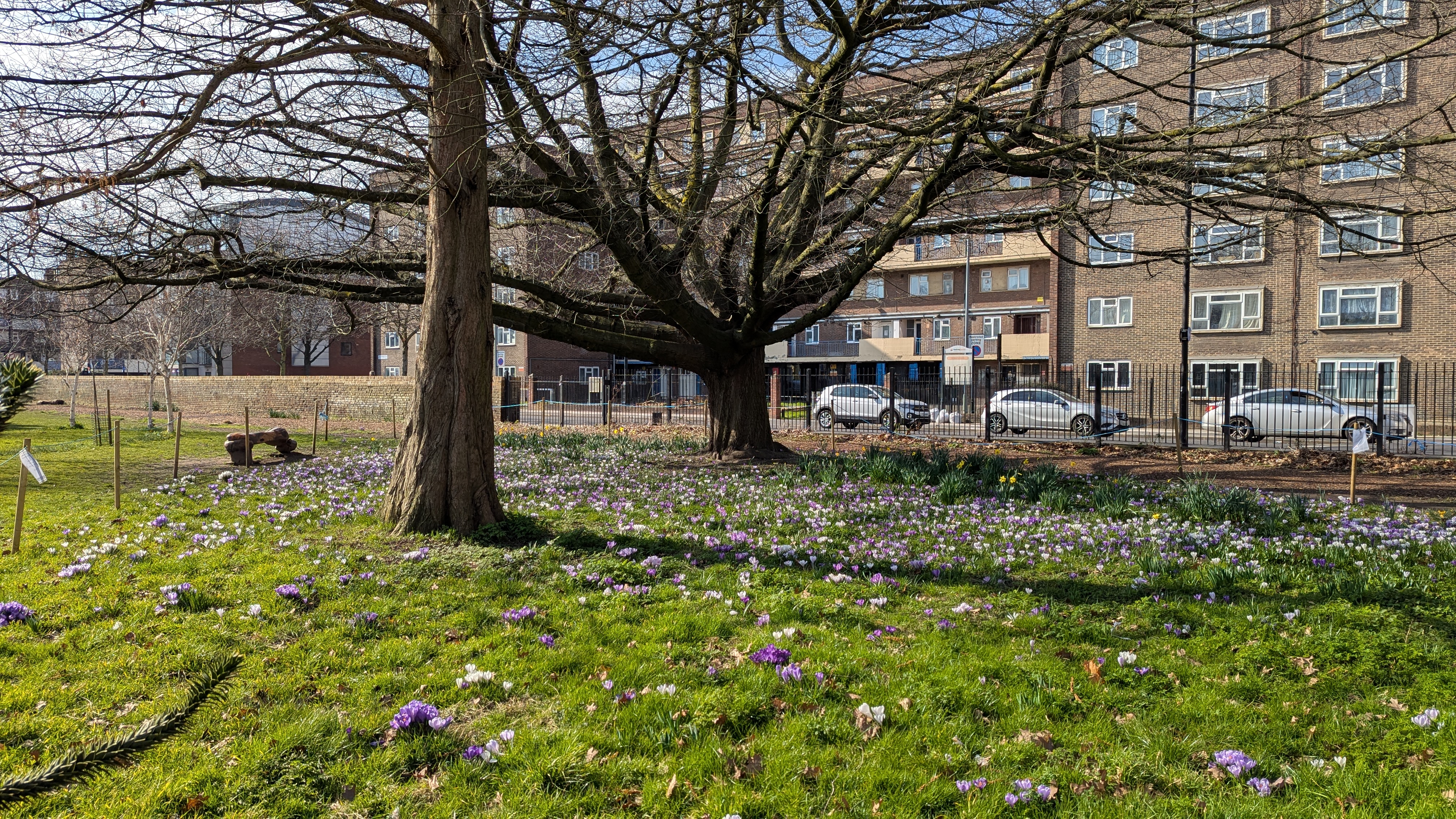
Oak Tree Cluster
Oak Tree Cluster, Haggerston Park photo by Kevin Flude
This wonderful Oak tree is surrounded by daffodils and crocuses.
Oak Tree and flowers, Haggerston Park Photo K Flude
Primula Patch
Primula Patch, Haggerston Park, Photo K Flude
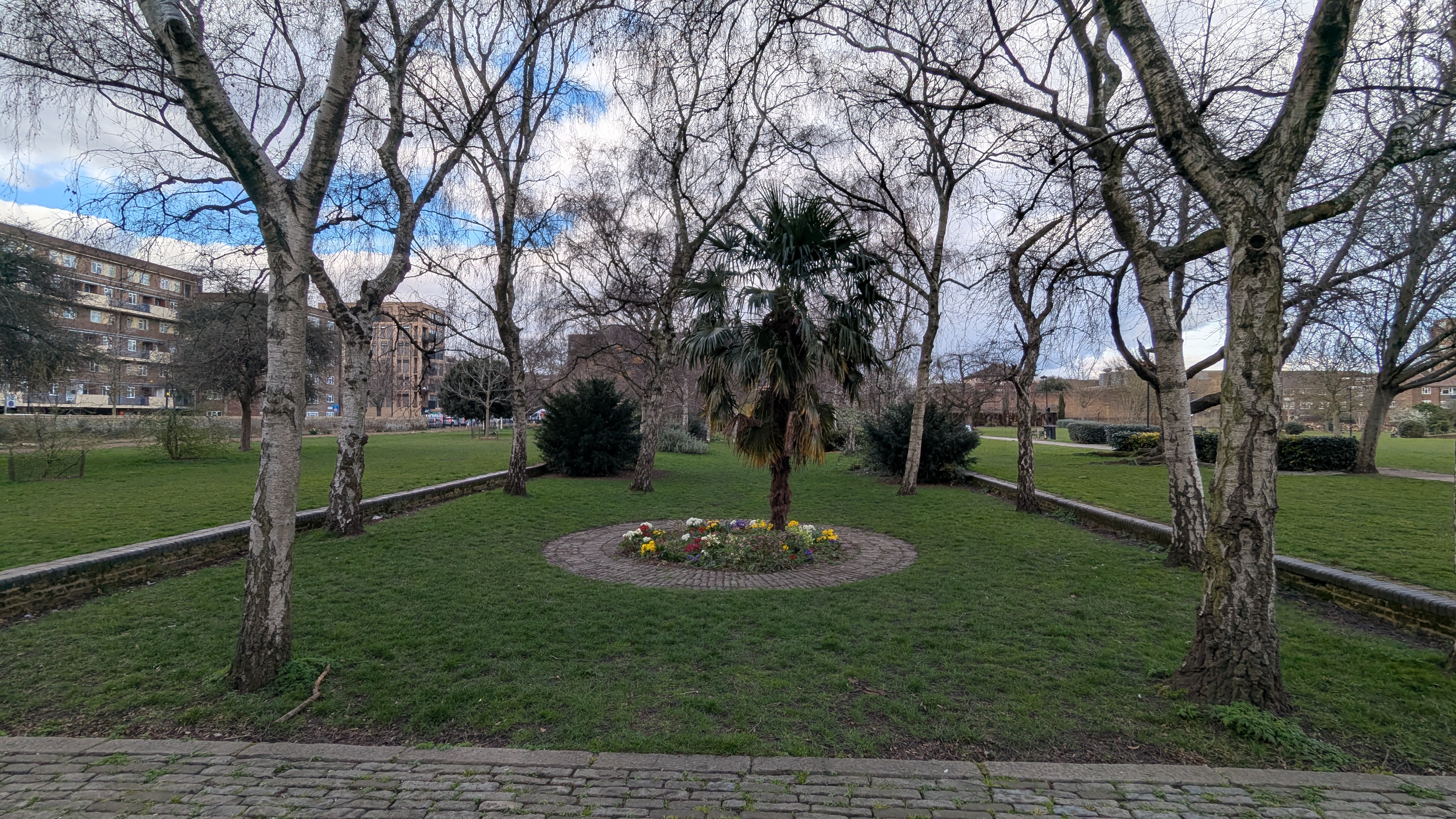
The circle is in the middle of the Basin that connected the Gas Works to the Regent’s Canal. Theh patch would have been in the middle of the water, and the stone and brick walls, are the edge of the Basin. See the map below. I do hope they flowers are primulas. If not viola’s, primroses or other winter, spring flowering plants.
Rose and Tripod Circle
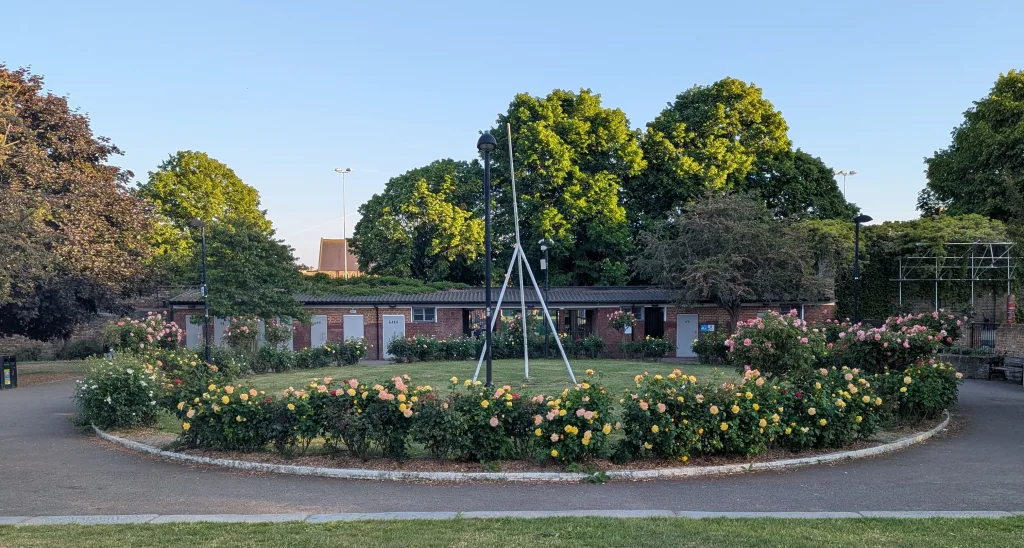
Rose and Tripod Circle. This becomes particularly beautiful at the height of summer.
The Avenue
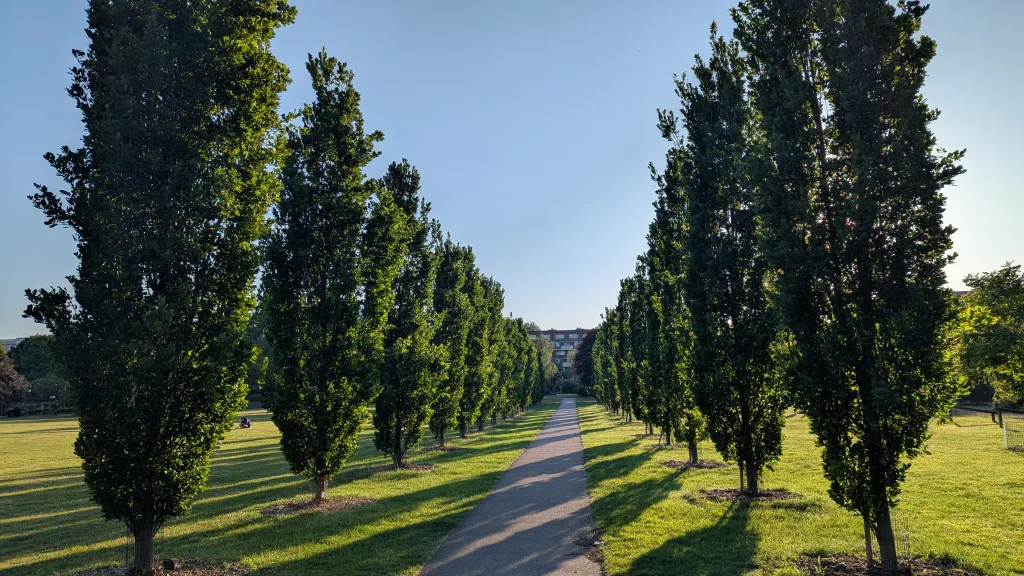
The Avenue, Haggerston Park, photo Kevin Flude
City Farm
The City Farm was set up in 1984 on a site that was once a brewery. It provides a community and educational resource to give people experience of animals and growing plants. It has poultry, ducks, geese, sheep, pigs, goats, donkeys and bees. There is also a lovely cafe callled Frizzante and a shop that sells groceries without packaging. For more on the bluefaced Leicester Sheep at the farm see my post here, and on City Farm piglets here.
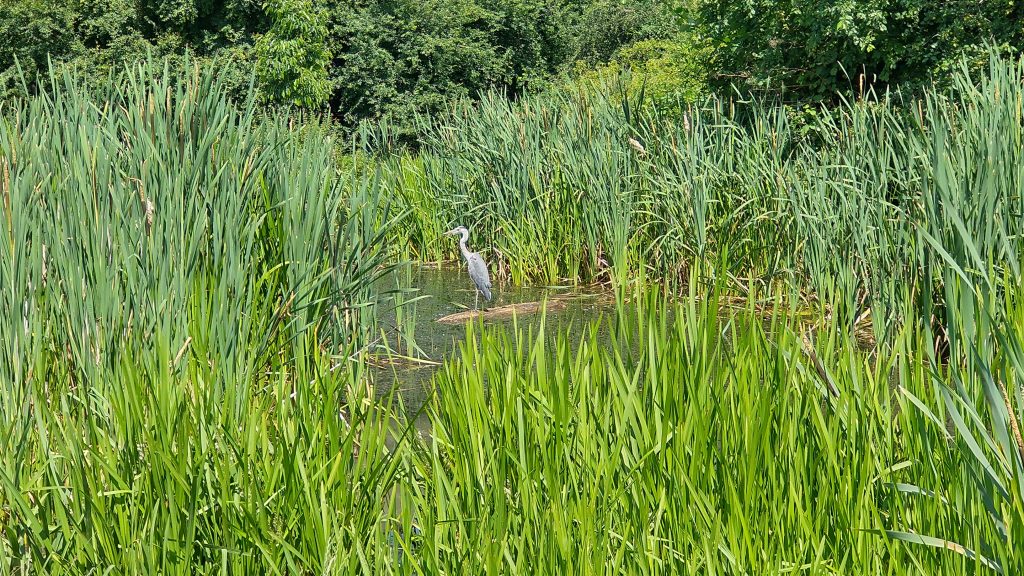
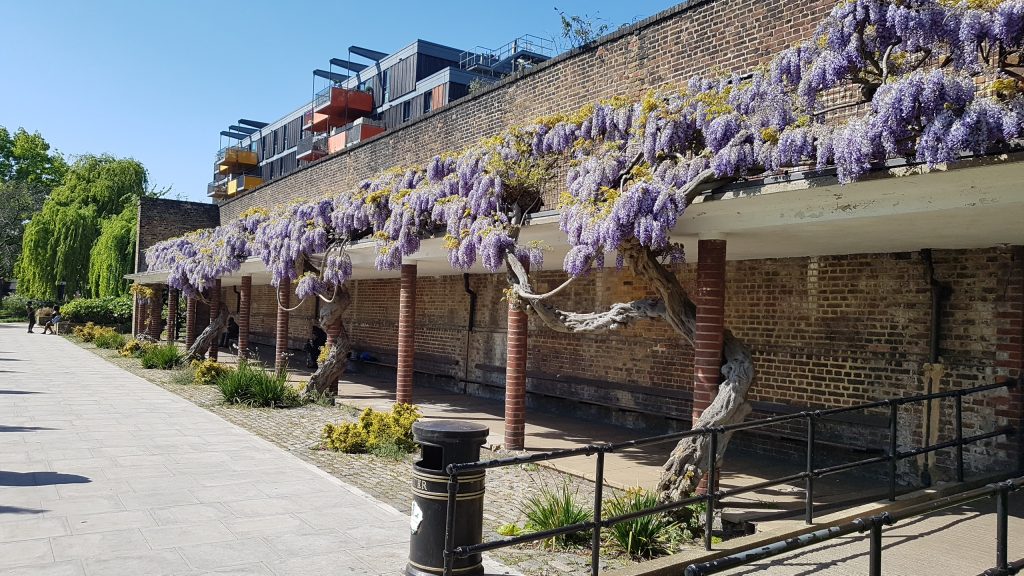
Heron in the Pond, Ancient Wisteria
HeronWisteria
Gas Works
Haggerston Park 1877 Ordance Survey Map
The Park covers the area of the Imperial Gas Works shown above. The photos above are in the area of the old Retort House (top left of the Gas works). The Haggerston Basin is to the left of that. To the left of the Basin are a series of Factories and Yards: Stone Yard, Timber Yard. North of the second Stone Yard is the Ice Warehouse. Near the top left. (for my post on Ice Houses please look here). The Regent’s Canal is just below the top of the map. It was constructed in 1820 or so. This stretch is now the ‘Haggerston Riviera’, and is trendy!). The Canal is the reason for the concentration of 19th Century Industry here. There were brick works, cigarette, breweries, gun, gunpowder, chemical, furniture and many other industries strung along the canal and connecting roads.
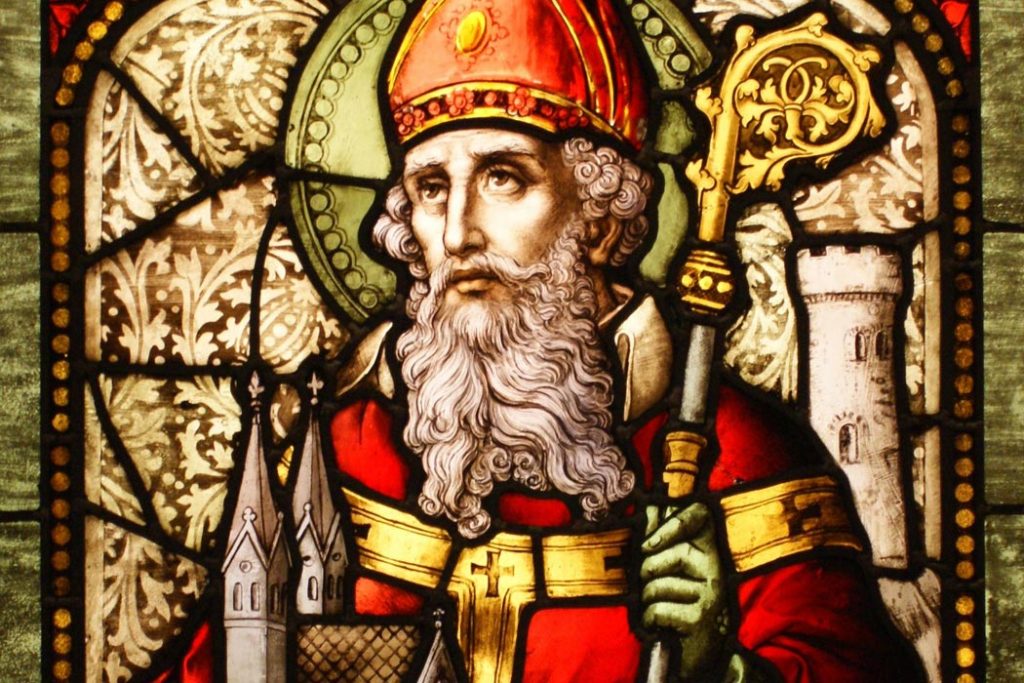
Stained Glass window depicting St Patrick (source of image, lost in the mists of time!)
St Patrick
St. Patrick has a very interesting autobiography (Confession), because it is one of the only personal reminisces of life in post-Roman Britain. He wrote in the form of a letter. In it, he explains that he was captured by Irish pirates while living in a Romano-British Town. His father we discover was a Decurion and a Deacon which suggests elements of Roman political organisation continued. No one knows the dates of St Patrick’s life, but he lived in the 5th Century. The use of Roman titles suggests, to some, an earlier rather than a later date. Perhaps in the early 400s. Unless, of course, you want to propose that Roman life continued later into the 5th Century than the first few decades. (which, increasingly, people are proposing.)
The town he lived in was called Bannavem Taburniae. Many places have been proposed for it. The closest linguistically is Bannaventa in Northamptonshire, but this seems a very unlikely place for Irish raiders to land, being about as far away from the sea as it is possible to get in Britain!
Nicholas Fuentes
Scholars have suggested South Wales and the Scottish borders most commonly. But my favourite suggestion, but about as unlikely as Northampton, is Battersea in London. This suggestion was made in the pages of the London Archaeologist by then editor Nicolas Fuentes.
Fuentes was one of a pioneering group of archaeologists when Rescue Archaeology first began a campaign to record the archaeology being destroyed by massive redevelopment of town centres in the 1970s.
He changed his name from the anglicised Nicholas Farrant back to its original Fuentes. He then wrote a magnificent series of papers, in London Archaeologist, which located St. Patrick in Battersea; St Alban’s execution in London and all 12 battles of King Arthur around Greater London.
St Albans Martyrdom in London
All were well argued, but as a set they do raise an eyebrow, being unsupported by any clear evidence. And, as far as I know, without much scholarly support. The one I really like is locating St Alban’s Martyrdom in London rather than in St Albans. It reminds everyone that the first reference to St Alban, which is by Gildas in the 6th Century, places the execution of the Saint firmly in London. It also makes sense of the story that Alban, keen for martyrdom, gets God to part the River so he can go quickly to the execution spot. The bridge it was said was full of people going to see the execution.
In Gildas’s case, the execution is in London, probably at the Amphitheatre, up a hill from the the mighty Thames. So God parted the Thames for Alban. Anglo-Saxon historian, the Venerable Bede places St Alban’s death firmly in St Albans, but the river that God needs to part there- the River Ver, is a piddle. Alban could have crossed it easily, hardly requiring even Wellington boots! Not much of a miracle compared with parting the Thames. The likely site of execution in both cases would have been the Amphitheatre, rather than the side of the hill where the St Albans execution site is located. But Gildas did mention the hill, which makes sense in the case of London and not in St Albans, as it is outside of the Roman City. away from the amphitheatre.
To my, unscholarly mind, when we worship people we tend to venerate them, at their birthplace and death place. So to me, it makes sense that St Alban’s main shrine was at Verulamium where he was born (now known as St Albans) and London where he died.
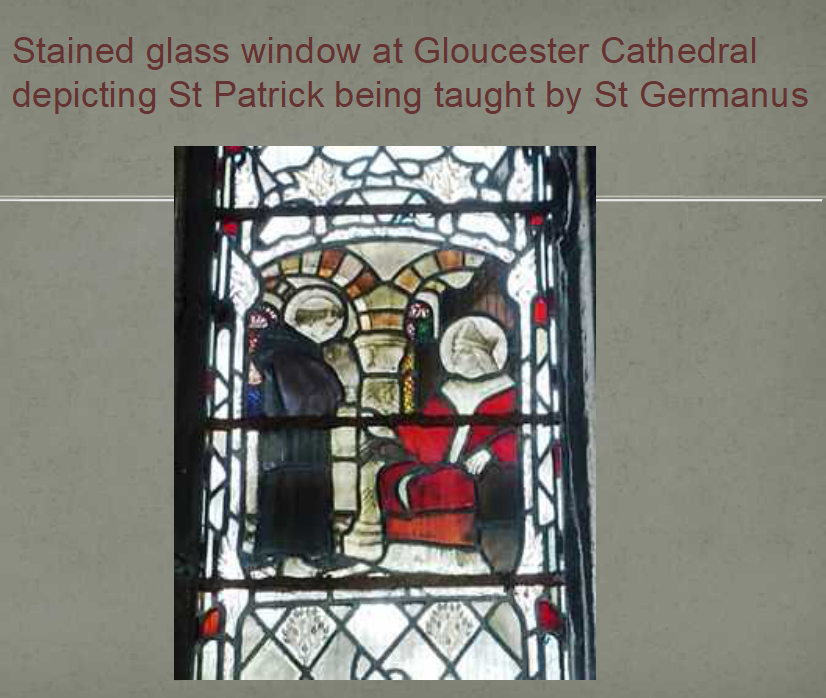
St Germanus
There is some supporting evidence from the hagiography of St Germanus of Auxerre. This tells us that Germanus came to an amphitheatre for a religious debate about 15 years after the end of the Roman occupation of Britain. After the debate, he went to a nearby shrine dedicated to St Alban. Unfortunately, the writer of the memoir is not really interested in post-Roman Britain, so does not tell us whether it was in London or St Albans. But there is an early church dedicated to St Alban just by the Roman Amphitheatre in London. For more on St Germanus follow this link to my post.
However, archaeology does not reveal any evidence early enough to support the idea that the Church is that early. Fuentes, argued that London as the Capital was likely to have been the place where capital punishments were carried out, particularly in the case of a Roman Citizen like Alban. I must note that in placing any credibility to Fuentes theory, I am standing largely alone.
Stained glass window of St Patrick and St Germanus
The Twelve London Battles of King Arthur
I’m not so convinced by the 12 Battles of King Arthur were fought in the London Area. They are more likely to have been spread throughout Britannia. But the place name evidence is never going to be identify most of the locations.
St Patrick From Battersea?
So, to the point – St Patrick in Battersea? The evidence, as I remember it, is really only place name evidence. the suggestion that Battersea was derived from: Badrices īeg, ‘Badric’s Island’ and later Old English: Patrisey (Wikipedia), So, Patrick’s Island. The word ‘sea’ is used in that sense along the River Thames. For example in Chelsea, Thorney, Putney derived from ey which is short for eyot (island). Also spelt ait.’
St Patrick lived as a teenage slave for 6 years, then escaped from captivity in Ireland and returned home. Trained as a priest, in perhaps Auxerre (home to St. Germanus who is another crucial witness to post Roman Britain. (See my post here.) and returned to Ireland to begin the conversion to Christianity. He is the Patron Saint of Ireland, with St. Brigitte and St. Colomba.
St Patrick from Banwell?
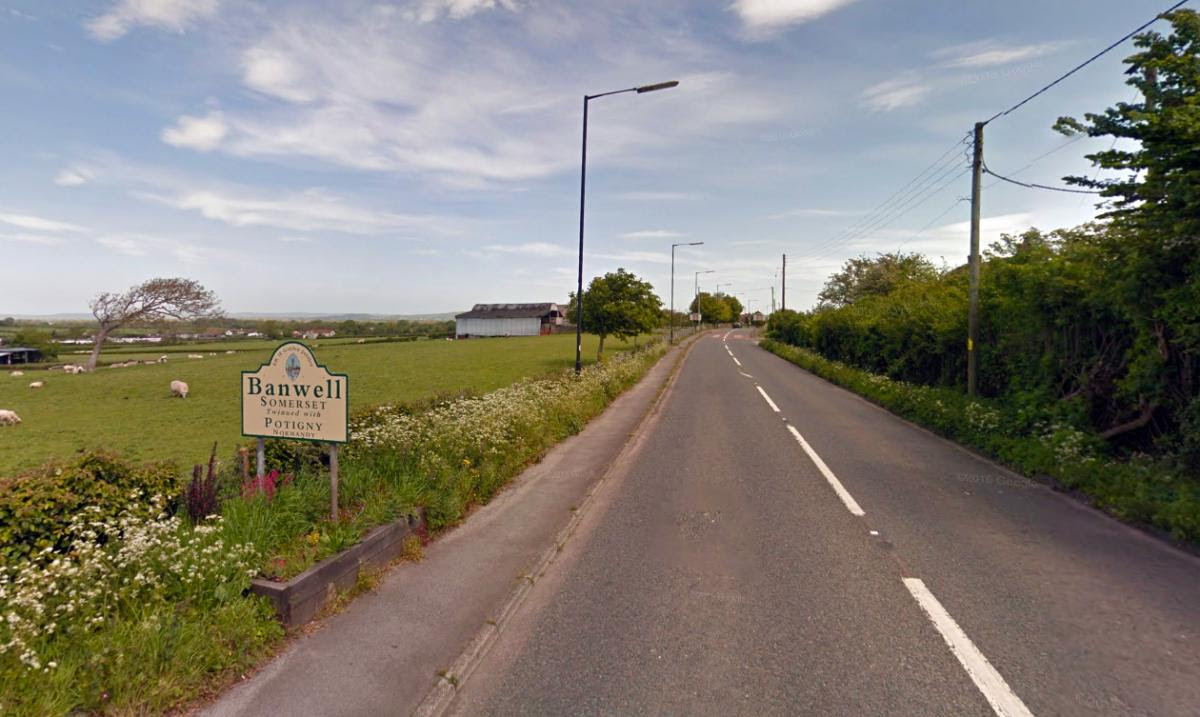
Another candidate for Bannavem Taburniae’ comes from Andrew Breeze FSA. I read about this in Salon IFA, the newsletter of the Society of Antiquaries. Also you can read more about it in this History First article. Breeze has revived a theory that the Saint comes from the West Country, and that the ‘Bannavem Taburniae’ is Banwell, near Weston-super-Mare in North Somerset. He suggests that ‘Bannaventa was a Latinisation of a Brittonic name that included banna, for a bend’, crook or peak. Venta is a well known word for an area of local administration or marketplace. For example, Venta Bulgarum, was the name for Winchester in the Roman period.) . He suggests that these ‘elements, as well as the Berniae element of ‘Taburniae’, can be found in the name Banwell, itself a compound name of the Brittonic ‘Banna’ and the Old English wylle, both meaning pool, or in the names of surrounding villages.’ I’m sure Fuentes did something similar for Battersea.
Image credit: Looking south from Winthill, near Banwell, Somerset, Colin S Pearson; Banwell in Somerset, Google Street View
What Banwell has over the London theory is that it is more likely to have been subject to Irish Raiders than London. But, for me, it is just another theory based on placename evidence that might or might not be true. I have read any number of Archaeology books where arguments about placenames are deployed to add some solidity to some theory about King Arthur, or a tale from Geoffrey of Monmouth. I therefore distrust them all. They essentially create circular arguments.
St Gertrude’s Day
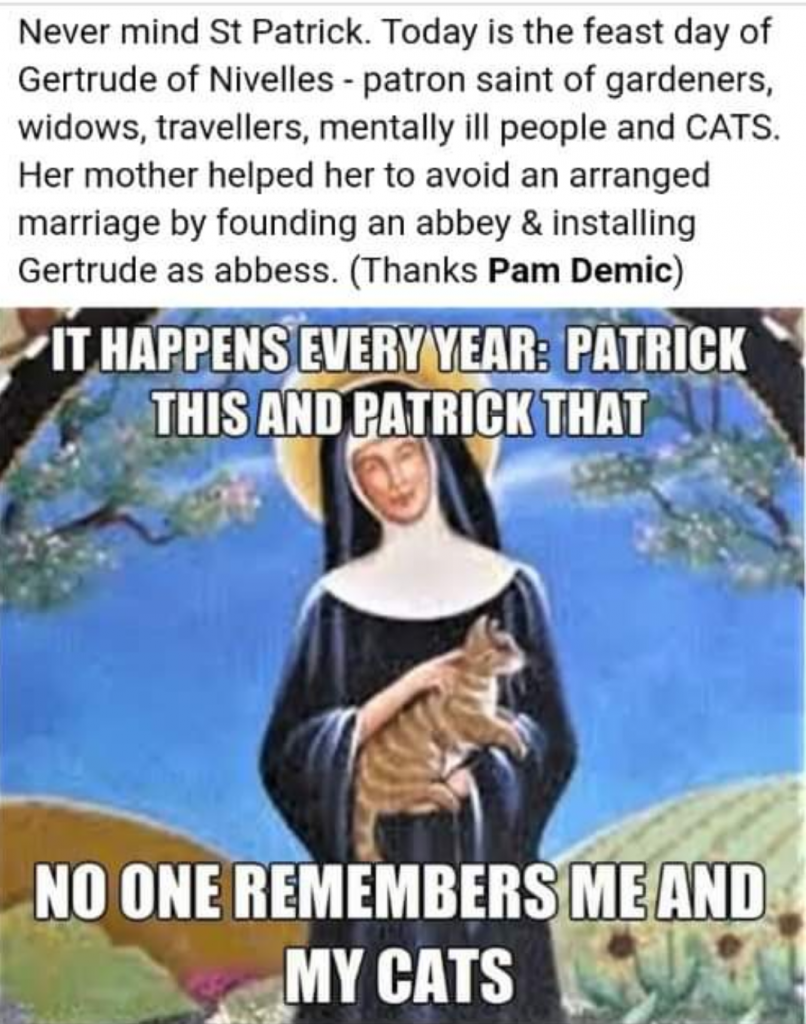
And least we forget, today is also St Gertrude’s Day, patron saint of Cats.
Facebook post, posted by a friend, and about St Gertude patron saint of cats.
On This Day
45 BC – Julius Caesar consolidated his power by defeating his main rival Pompey the Younger, and allies, at the the Battle of Munda. He went on to establish his Dictatorship, which led to his assassination on March 15th (see my post on the Ides of March)
1845 – The Rubber Band patented by Stephen Perry of St Johns Wood, London, for Messers Perry and Co,. Rubber Manufacturers of London.
Specification of the Patent granted to Stephen Perry, of Woodland’s-place, St. John’s-wood, in the County of Middlesex, Gentleman, and Thomas Barnabas Daft, of Birmingham, Manufacturer, for Improvements in Springs to be applied to Girths, Belts, and Bandages, and Improvements in the Manufacture of Elastic Bands. —Sealed March 17, 1845.
1861 – The Kingdom of Italy proclaimed with Victor Emmanuel as King. The unification of Italy was the culmination of the Risorgimento, led by Garibaldi, Cavour, Mazzini and Victor Emmanuel. It survived until 18 June 1946 when Italy became a Republic.
1951 – First Appearance of Dennis the Menace in the boy’s Comic the Beano. Published in Dundee, by DC Thomson. I read the Beano as a boy, along with the Robin, the Eagle, Topper, the Dandy, The Hotspur, and Whizzer and Chips. What made Dennis great was that he was a bad boy and didn’t get any better. Always at war with the ‘Softies’ – basically well-educated boys. And made us laugh with his antics. For more comic nostalgia read: nostalgiacentral.com/pop-culture/books-comics/british-comics-of-the-50s-60s-and-70s/
Dennis the Menace By DC Thomson – The Beano 3671, Fair use, https://en.wikipedia.org/w/index.php?curid=38472209
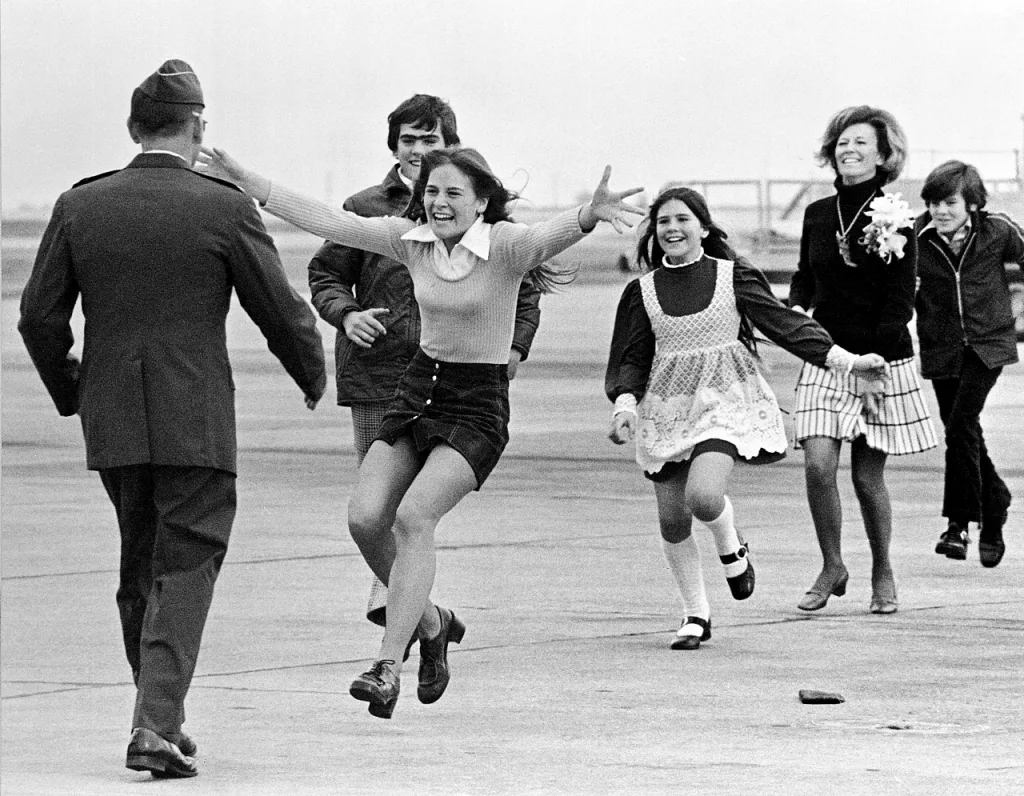
1973 – The Pulitzer Prize–winning photograph Burst of Joy is taken and symbolised the end of the US involvement in the Vietnam War
‘Burst of Joy’ By Slava “Sal” Veder”, Associated Press – https://www.columbiatribune.com/picture-gallery/news/2020/03/17/today-in-history-march-17/67299331007/, Public Domain, https://commons.wikimedia.org/w/index.php?curid=153972466
First Published in 2024, republished in 2025, On This Day augmented 2026
Display of Antarctic Explorer’s Kit 1912 (reconstruction) at Gilbert White’s House in Hampshire {Photo K Flude). To illustrate Lawrence Oates self-sacrifice
This post is about Lawrence ‘Titus’ Oates and his self-sacrifice, on going out to his death to give the other members of the Antarctic Expedition a chance of survival. ‘I am just going outside and may be some time.’ he famously said . But first, for subscribers to the email, the new section ‘On This Day.’
On This Day
1190 – The Jewish Massacre at York. From 1189, anti-Jewish riots broke out as preparations for the Third Crusade were made. The rioters attempted to steal Jewish wealth, burn down their house, and forced conversion to Christianity. The unrest spread from Old Jewry in London to Ospringe., King’s Lynn, Colchester,, Stamford, Bury St Edmunds., and Thetford,. The Jews of Lincoln took refuge in the Castle and survived.
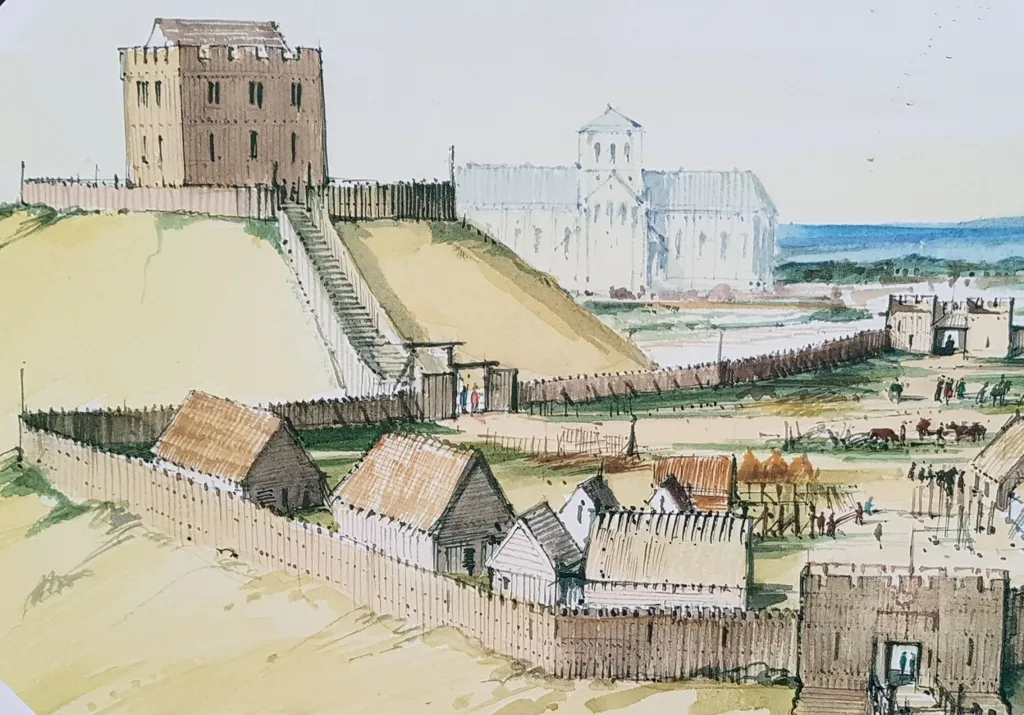
Reconstruction of York Castle, with Clifford’s Tower, originally made of wood, shown on the top of the Hill (photgraphed by KFlude from plaques on the displays nearby)
On March 16th, the Jews of York were attacked in their houses, and sought sanctuary in the Timber Keep of York Castle, known as Clifford’s Tower. Fearful of the willingness of the Sheriff of the County to ensure their survival, the community decided on mass suicide. Fathers, killed their children and wives, then killed themselves. The two leaders, then burnt down Clifford’s Tower and died.
1660 – The Long Parliament finally dissolved. It was elected in 1642 called by Charles I, before the English Civil War, and survived to be revived to usher in the restored monarchy under Charles II.
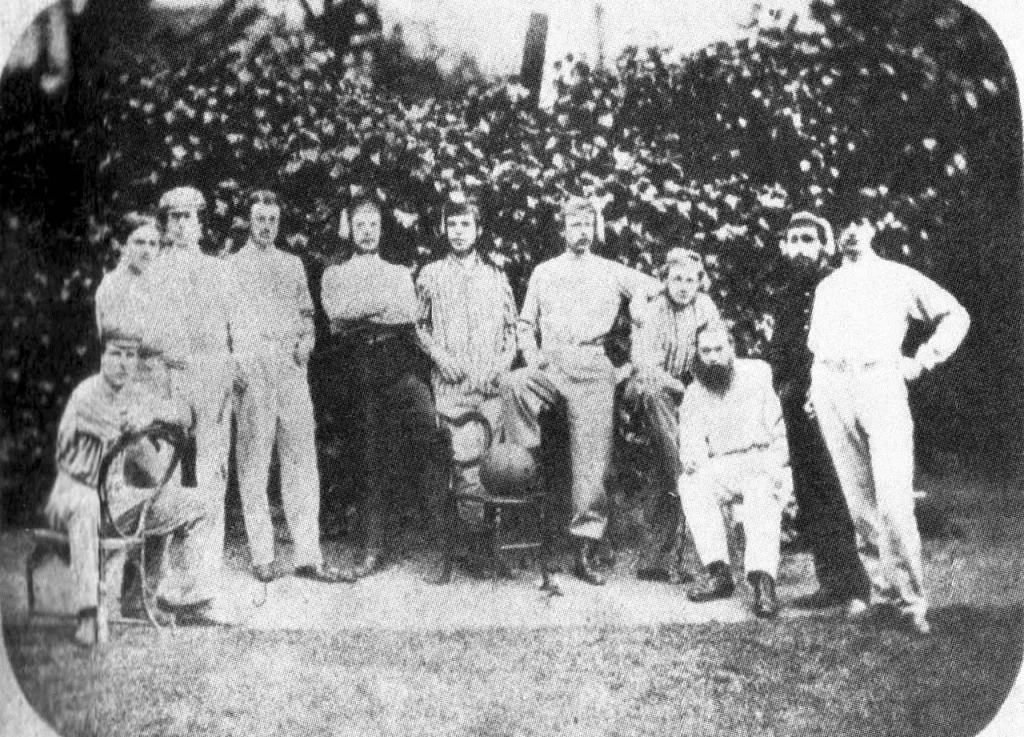
1872 – the first Football Association Cup Final took place on the Cricket Ground, the Kennington Oval. The Wanderers beat the Royal Engineers 1:0. The Wanderers were founded by Public School Old boys from Harrow. It began in Leytonstone, in East London 1859, originally known as the “Forest Football Club”. But then wandered around a number of grounds until they made the Oval their semi-permanent home. The Club’s last game was against Clapton Pilgrims in March 1872.
The only known Photo of the Wanderers from 1863. Public Domain, Wikipedia
The Royal Engineers were soldiers from Chatham, Kent and according to Wikipedia were: ‘the first club to play a passing game of cooperation and organisation with both their forwards and their defence’. Also the first club to have the word ‘beautiful’ applied to their game.
1956 – Fake Finnish Saint St Urho invented as a rival to St Patrick’s Day. Just as Patrick banished snakes from Ireland, Urho (which means ‘hero’) banished frogs (or grasshoppers) saving the grape crop. He was invented in the States but is celebrated by a bar in Helsinki.
1968 – the My Lai massacre, Sơn Mỹ village, Quảng Ngãi province, perpetrated by US Troops, slaughtering over 300 unarmed villages. 26 soldiers faced charges but only Lieutenant William Calley Jr. was convicted. He only served three and a half years of a life sentence (and that was served under house arrest).
Main Source Chambers Book of Days & Wikipedia
The Oates Museum in Gilbert White’s House
Last year, I went to Gilbert White’s House in Selborne. The naturalist’s House also houses the Oates Museum for Lawrence ‘Titus Oates’ and his uncle Frank. Oates was one of the ‘heroes’ I read about as a child. He epitomised what was sold as the British virtues of pluck, self-sacrifice, restraint.
Here is part of the story of Oates self-sacrifice over the days from February 29th to March 16th. 1912 as told in the diary of the commander of the expedition, Captain Scott:
Wednesday, February 29th 1912
Lunch. Cold night. Minimum Temp. -37.5°; -30° with north-west wind, force 4, when we got up. Frightfully cold starting; luckily Bowers and Oates in their last new finnesko; keeping my old ones for present. Expected awful march and for first hour got it. Then things improved and we camped after 5 1/2 hours marching close to lunch camp—22 1/2. Next camp is our depot and it is exactly 13 miles. It ought not to take more than 1 1/2 days; we pray for another fine one. The oil will just about spin out in that event, and we arrive 3 clear days’ food in hand. The increase of ration has had an enormously beneficial result. Mountains now looking small. Wind still very light from west—cannot understand this wind.
A finnesko is ‘a boot of tannedreindeer skin with the hair on the outside’.
Monday, March 5th 1912
Lunch. Regret to say going from bad to worse. We got a slant of wind yesterday afternoon, and going on 5 hours we converted our wretched morning run of 3 1/2 miles into something over 9. We went to bed on a cup of cocoa and pemmican solid with the chill off. (R. 47.) The result is telling on all, but mainly on Oates, whose feet are in a wretched condition. One swelled up tremendously last night and he is very lame this morning. We started march on tea and pemmican as last night—we pretend to prefer the pemmican this way. Marched for 5 hours this morning over a slightly better surface covered with high moundy sastrugi.
Sledge capsized twice; we pulled on foot, covering about 5 1/2 miles. We are two pony marches and 4 miles about from our depot. Our fuel dreadfully low and the poor Soldier nearly done. It is pathetic enough because we can do nothing for him; more hot food might do a little, but only a little, I fear. We none of us expected these terribly low temperatures, and of the rest of us Wilson is feeling them most; mainly, I fear, from his self-sacrificing devotion in doctoring Oates’ feet. We cannot help each other, each has enough to do to take care of himself. We get cold on the march when the trudging is heavy, and the wind pierces our warm garments.
The others, all of them, are unendingly cheerful when in the tent. We mean to see the game through with a proper spirit, but it’s tough work to be pulling harder than we ever pulled in our lives for long hours, and to feel that the progress is so slow. One can only say ‘God help us!’ and plod on our weary way, cold and very miserable, though outwardly cheerful. We talk of all sorts of subjects in the tent, not much of food now, since we decided to take the risk of running a full ration. We simply couldn’t go hungry at this time.
Pemmican is made of tallow, dried meat and dried berries. It is a calorie rich food stuff created by native American groups and used by expedition like Scotts. The name says Wikipedia ‘comes from the Cree word ᐱᒦᐦᑳᓐ (pimîhkân), which and adopted is derived from the word ᐱᒥᕀ (pimî), ‘fat, grease”. Sastrugi is a Russian word which are ripples or craters in the surface of the snow caused by strong winds. They make progressing through the terrain much more difficult.
Scott begins his March 16th entry unsure what the actual date is.
Friday March 16th
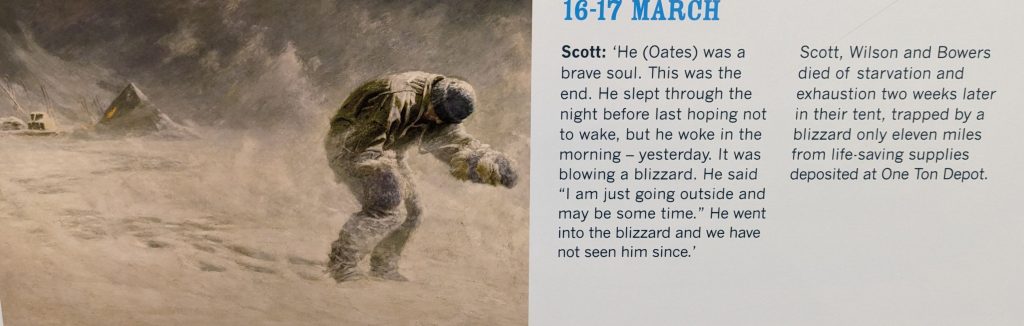
Lost track of dates, but think the last correct. Tragedy all along the line. At lunch, the day before yesterday, poor Titus Oates said he couldn’t go on; he proposed we should leave him in his sleeping-bag. That we could not do, and induced him to come on, on the afternoon march. In spite of its awful nature for him he struggled on and we made a few miles. At night he was worse and we knew the end had come.
Should this be found I want these facts recorded. Oates’ last thoughts were of his Mother, but immediately before he took pride in thinking that his regiment would be pleased with the bold way in which he met his death. We can testify to his bravery. He has borne intense suffering for weeks without complaint, and to the very last was able and willing to discuss outside subjects. He did not – would not – give up hope to the very end. He was a brave soul. This was the end. He slept through the night before last, hoping not to wake; but he woke in the morning – yesterday. It was blowing a blizzard. He said, ‘I am just going outside and may be some time.’ He went out into the blizzard and we have not seen him since.
I take this opportunity of saying that we have stuck to our sick companions to the last. In case of Edgar Evans, when absolutely out of food and he lay insensible, the safety of the remainder seemed to demand his abandonment, but Providence mercifully removed him at this critical moment. He died a natural death, and we did not leave him till two hours after his death. We knew that poor Oates was walking to his death, but though we tried to dissuade him, we knew it was the act of a brave man and an English gentleman. We all hope to meet the end with a similar spirit, and assuredly the end is not far.
I can only write at lunch and then only occasionally. The cold is intense, -40º at midday. My companions are unendingly cheerful, but we are all on the verge of serious frostbites, and though we constantly talk of fetching through I don’t think anyone of us believes it in his heart.
We are cold on the march now, and at all times except meals. Yesterday we had to lay up for a blizzard and to-day we move dreadfully slowly. We are at No. 14 pony camp, only two pony marches from One Ton Depot. We leave here our theodolite, a camera, and Oates’ sleeping-bags. Diaries, &c., and geological specimens carried at Wilson’s special request, will be found with us or on our sledge.
From the display at Gilbert White’s House, in Selborne Hampshire, (Photo K Flude)
How much Oates story is tarnished by discoveries, published in 2002, that he fathered a child to a 12-year-old girl, I will leave to you to read here.
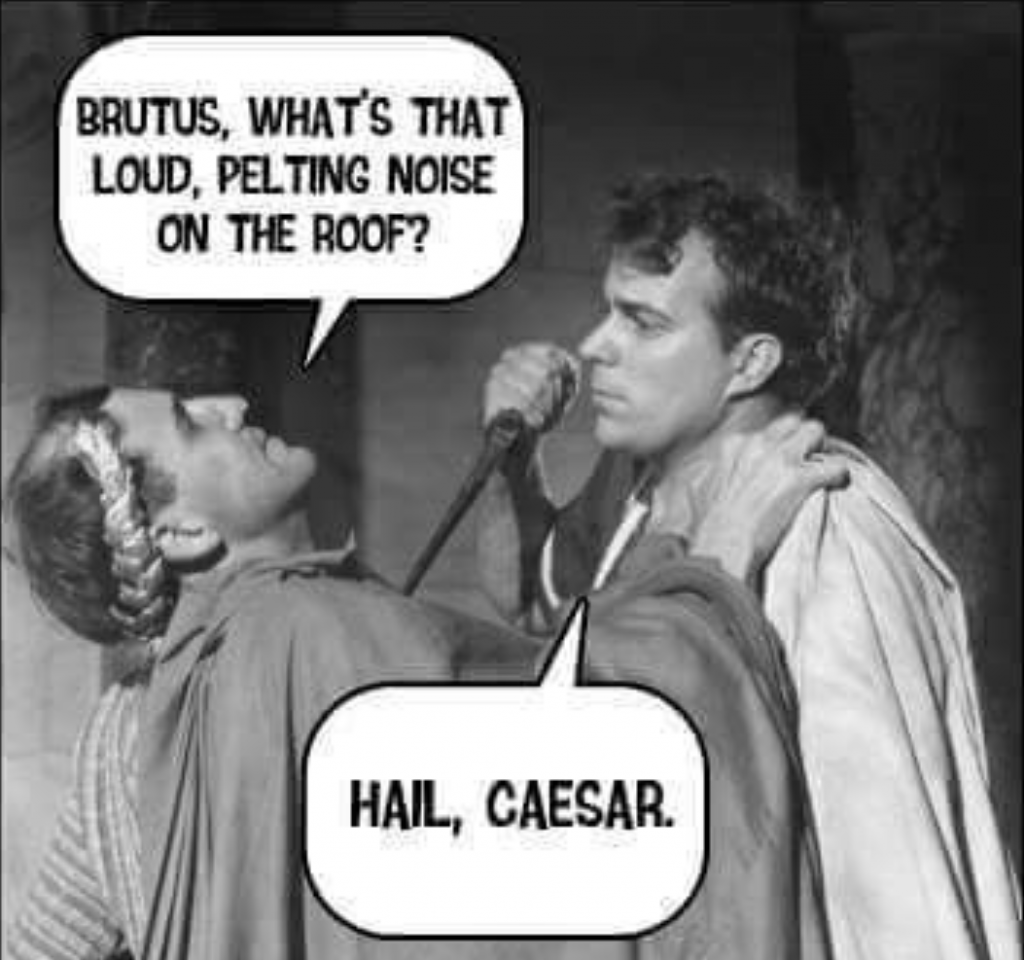
Beware the Ides of March – With Apologies.Image from Facebook
Beware the Ides of March
SOOTHSAYER: Caesar! CAESAR: Ha! Who calls? CASCA: Bid every noise be still; peace yet again! CAESAR: Who is it in the press that calls on me? I hear a tongue shriller than all the music Cry ‘ Caesar!’ Speak. Caesar is turned to hear. SOOTHSAYER: Beware the ides of March. CAESAR: What man is that? BRUTUS: A soothsayer bids you beware the ides of March. CAESAR: Set him before me; let me see his face. CASSIUS: Fellow, come from the throng; look upon Caesar. CAESAR: What sayst thou to me now? Speak once again. SOOTHSAYER: Beware the Ides of March. CAESAR: He is a dreamer. Let us leave him. Pass.
Julius Caesar by William Shakespeare
Julius Caesar and the Ides of March, 44 BC
The Ides of March is the 15th of March. The day Julius Caesar didn’t take the warning that might have saved his life. You might suggest he got what was coming to the first populist Dictator. But any study of Roman History will find many precursors to Caesar in Roman and Greek History. Among populists, I rank Caesar with Napoleon a Dictators who was, personally, an intelligent, rational man. They, in some ways, ruled ‘wisely’ but were nonetheless willing to sacrifice millions of people for their own personal ambition.
Warning from history – Assassination is not the Answer!
Today, the world is faced with the populists who are geniuses only in their own minds. I know, we as humans, might think, if only X would drop dead, how much better it would be? Brutus, being an honourable man, took action upon his thought. But, as often is the case, what seemed the ‘right thing’ to do, turned out to be a disaster. The plotters were trying to save the Roman Republic, but the murder destroyed the Republic.
So, still those assassinary thoughts, read this article in ‘History Today’ about the impact of Julius Caesar’s murder. Do everything you can but use democratic means to defeat egotists to whom truth means nothing. In my opinion this is the major problem for humanity, it seems we do not know how to stop homicidal maniacs (like Hitler) causing war without needing to fight a war to stop them. We do not have a method of peaceful mass rebellion. Perhaps Gandhi came closest but then he was working against a system that was not a dictatorship. (I mentioned Gandhi in ‘On This Day’ on my post here.
Ides of March
Now, what the heck are or indeed is the Ides of March?
A Roman month was divided into three, first the Kalends, then the Nones and finally the Ides. These three days were the important days of the month. The Kalends is the 1st of the Month. The Nones the 7th of the Month, And the Ides the Fifteenth. It is said to go back to the early days of Rome and a lunar calendar. The Kalends being the first tiny sliver of a crescent moon a couple of days after the New Moon. The Nones the first quarter of the Moon and the Ides was the full moon. To me, as a way of dividing a month it is very lopsided. The cycle of the moon is 29 days not 15. So the tripartite division divides up the first half of the month, and leave the second half undivided.
Debts were supposed to be paid on the Kalends and that is where we get our word calendar from. These public calendars were called Fasti. This is the name of Ovid’s great Almanac Poem, the Fasti, which I often quote from.
Kalendar
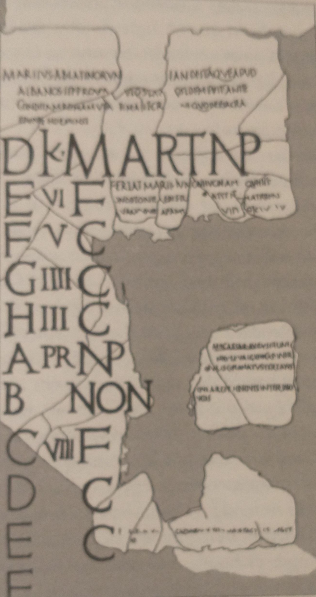
This is a very bad photograph of a drawing by Herbert E Duncan Jr of a 1st Century Calendar
How was it used? When talking about a day in the future month you might say I’ll meet you on the 5th day before the Kalends. I’ve never really understood this system, despite a few attempts, until I saw this drawing of a Roman Calendar. You’ll have to read this closely.
The first column, on the left, with the letters from D to H then A – H. This is a recurring cycle of 8 market days, running in tandem with Kalends, Nones etc.. This gives an 8 day week.
Now reading across the top line in capitals: DKMARTNP. So the D is the 4 day of the 8 day ‘market week’. The second column begins with the Letter K for Kalends, then MART for March. So it’s the Kalends of March. Then NP which means this day is a day for public festivals.
Back to the second column. Below the K for Kalends, the days are counted down to the upcoming Nones. So the next one after Kalends is VI, meaning the 6th day before the March Nones. Then V, IIII, III. There is no II because PR means the day before Nones. Below and to the right of the PR are the letters NON which is, as you might hope, is short for Nones.
In the second column below this is the number VIII which means the next day is the 8th day before the Ides of March. The fragment of stone from which this drawing comes does not continue down to the Ides, unfortunately.
Complicated, huh? It gets worse. The third column has a series of letters in it: F C C C NP NON F C C. We already know that the NON is short for Nones, The F means it’s a fastus, a permissible day when legal action can be taken. (the plural of Fastus is Fasti.) The C means Ccomitialis which on fasti days the Roman people could hold assemblies. (see my post for more on the curiae).
Market and Public Days
We have already seen that NP marks days for public festivals. An N would mean days when political and judicial actions were prohibited, although there is not one here. The small unreadable text to the right is information, I believe, about holidays and historic events to be marked in the calendar. This is, in fact, a Roman Stone Almanac.
This confusing system survived Caesar’s major calendrical reforms. He transformed the Roman calendar, which was rotten at the core. He re-aligned with an almost accurate calculation of the time the Sun takes to circle the earth. (or the other way around!) This is known as the Julian Calendar.
But the Kalends, Nones, and Ides he left intact and it survived until Constantine the Great got rid of them. They were replaced with the familiar 4 fold division of the month. So, for the first time, you could work 24/7.
493 – Odoacer, the first barbarian King of Italy after the fall of the Western Roman Empire, was slain by Theodoric the Great, king of the Ostrogoths, while the two kings were feasting together. Odoacer was a mercenary General for the Romans, but seized the Throne from the child Emperor Romulus Augustulus, who ruled for only 10 months. Theodoric took over and ruled an Empire centred on Italy from 496 to 526. Both Kings followed the Arian version of Christianity, although generally did not persecute the Catholic Tradition.
Theodoric was, more powerful than the later Roman Emperors and had good relations with the Roman Senate, which continued in operation. Later in his rule, that relationship broke down. This lead to Theodoric arresting Boethius for treason. While awaiting execution, Boethius wrote ‘On The Consolation of Philosophy’. Often called the last great literary work of the Western Roman Empire. Amongst many translations into English are those by King Alfred the Great, Geoffrey Chaucer and Queen Elizabeth I. Boethius was executed in 523
1493 – Christopher Columbus arrived in Castille, back from the journey that changed the world. He made landfall in the Bahamas on 12th October 1492, ending what became known as the pre-Columbian Age (aka pre-contact era). The voyage began the era of exploration that turned the world into a global entity, but also bringing in its wake horrific genocide of indigenous peoples.
1877 – First Cricket Test Match between England and Australia, held at Melbourne which the Aussies won by 45 runs.
1909 – Selfridge’s opened on Oxford Street
1927 – The first Oxford v Cambridge Women’s Boat Race took place in Oxford on the Isis. The Isis is what posh folk call the River Thames as it flows passed the University Town. In Latin the Thames is called the Tamesis. And a conceit grew up at the University that the River was called the Isis until it was joined by the River Thame at Dorchester, where the conjoined river was called the Tamesis.
The Boat Race was won by Oxford. Strangely, the boats did not row at the same time. On the first leg they were judged by the style of their rowing, and on the second by the speed. The judges could not agree on the style scores, so in the end the decision was given to Oxford on account of being the faster of the two boats.
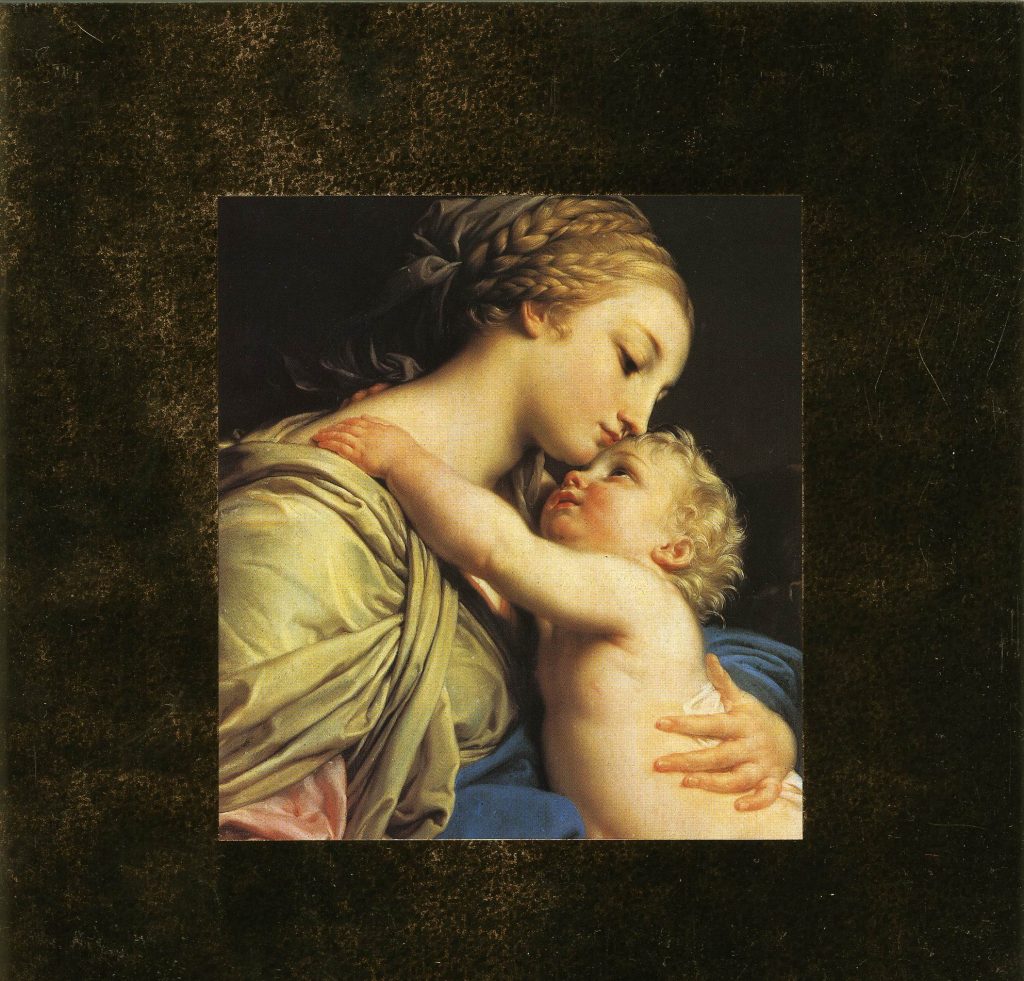
Virgin and Child (Image on a card of unknown origin) to illustrate Mothering Sunday or Mother’s Day
In 2026 Mothering Sunday is on March 15th. In 2027 it will be on March 7th. Strangely, originally not about Mothers! Mothering Sunday is the 4th Sunday in Lent. It is, in fact the day in which we are enjoined to visit our Mother Churches. It, therefore, became a day when people made processions to their Churches. Servants and workers could go to their home parishes. But not only go to the Mother Church but also to say hello to their mothers. So, it became increasingly about Mothers. It was called Mothering Sunday when I was little and has morphed into the Americanism that is Mother’s Day.
‘Rejoice ye with Jerusalem; and be ye glad for her, all ye that delight in her: exult and sing for joy with her, all ye that in sadness mourn for her; that ye may suck, and be satisfied with the breasts of her consolations.‘
Jerusalem is personified, here, as the Mother. Further associations with motherhood came from the Gospel for the day which is John 6:1–14, the story of the Feeding of the Five Thousand, which led to associations with the bounty of Mother Earth.
In the medieval period visits to the Mother Church seem to have become fiercely competitive. The Bishop of Lincoln, Robert Grosseteste decreed:
‘In each and every church you should strictly prohibit one parish from fighting with another over whose banners should come first in processions at the time of the annual visitation and veneration of the mother church. […] Those who dishonour their spiritual mother should not at all escape punishment, when those who dishonour their fleshly mothers are, in accordance with God’s law, cursed and punished with death.‘
(Letter 22.7 – Wikipedia)
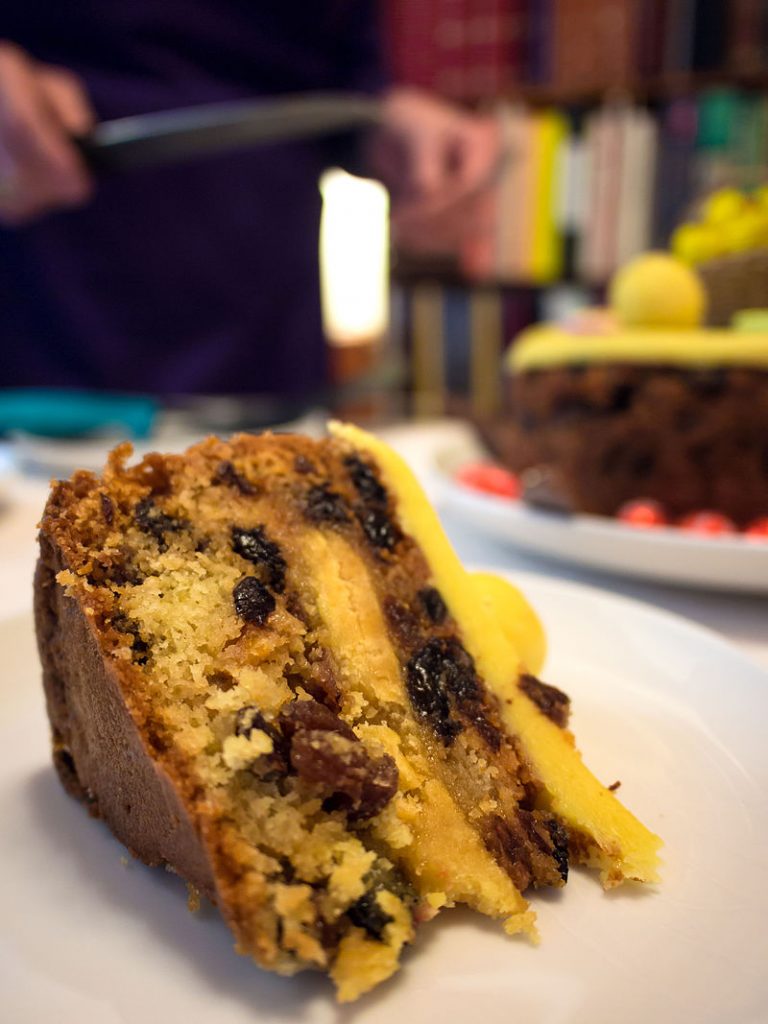
Simnel Cake
It was also the Sunday in the fasting period of Lent in which the restrictions were relaxed. So a special cake called Simnel Cake was made for the purpose.
I’ll to thee a Simnel bring ‘Gainst thou goest a-Mothering So that, when she blesseth thee Half that blessing thou’lt give me.
The Simnel cake is a fine flour light fruit cake (Latin simila, fine flour), with layers of marzipan in it. It often has 11 balls of marzipan on the top, representing the 11 (not Judas) apostles. The cake is first boiled for two hours and then baked. Now, I know 95% of my American readers hate fruit cake. But believe me when I tell you – change your ways – iI’s delicious. Try this BBC’s recipe: https://www.bbcgoodfood.com/recipes/easter-simnel-cake
And I’m beginning to see that cake is an emerging theme of this Almanac of the Past.
See my post on Chelsea Buns here; Lardy Cake and Doughnuts here.
Written in March 23, slightly revised in March 24, and 25, Revised 26
The house of General Wade, Bath (photo Kevin Flude, 2007, Pentax)
General Wade Died March 14th 1748
General Wade was one of the generals who saved Britain from the Jacobite threat in the 18th Century. He is one of those people that you have never heard of. But once you have he keeps cropping up. In my case, I came across him when I researched my Guided Walk around Bath. I got my information from a guidebook Then drop his name in on the tour for the next 20 years only really knowing his relevance for my walk. But really having little idea who he really was.
General Wade was the owner of the rather wonderful early 18th Century town house in Bath, pictured above. The house sits opposite the Georgian entry to the famous Roman Baths. Most Georgian buildings in Bath are Palladian, Classical Revival architecture as influenced by Andrea Palladio (1508–1580). First implemented, in Bath by John Wood, but followed by most 18th/19th and many 20th Century architects.
General Wade (Wikipedia)
General Wade’s House is wonderfully not Palladian. It displays its classical influence by the pilasters between the windows and the swags above. But it doesn’t have the solidity of the Palladian style. It is special because it illustrates a type that has largely disappeared in Bath, and indeed around the country. It was built around 1700 and is a Grade 1 listed.
General Wade & Bath
General Wade, I would tell people, was the MP for Bath (after 1722, retaining the seat for 25 years). He was a Field-Marshall in charge of the defences of the area during the Jacobite Revolt of 1715. However, his part in my tour was to introduce the story of one of the three men who made Bath famous in the 18th Century. The first of these men was Ralph Allen, Post Master. At the beginning of the Jacobite Revolt, he abused his position as Post Master by opening letters between known rebels. By this means he found out where the armaments were stored, and what the plans were and provided the information to General Wade. Thereby helping Wade prevent the pro-Catholic, pro the Old Pretender, pro Stuart, anti Hanoverian uprising in the West Country. He rewarded Ralph Allen by letting him marry his daughter.
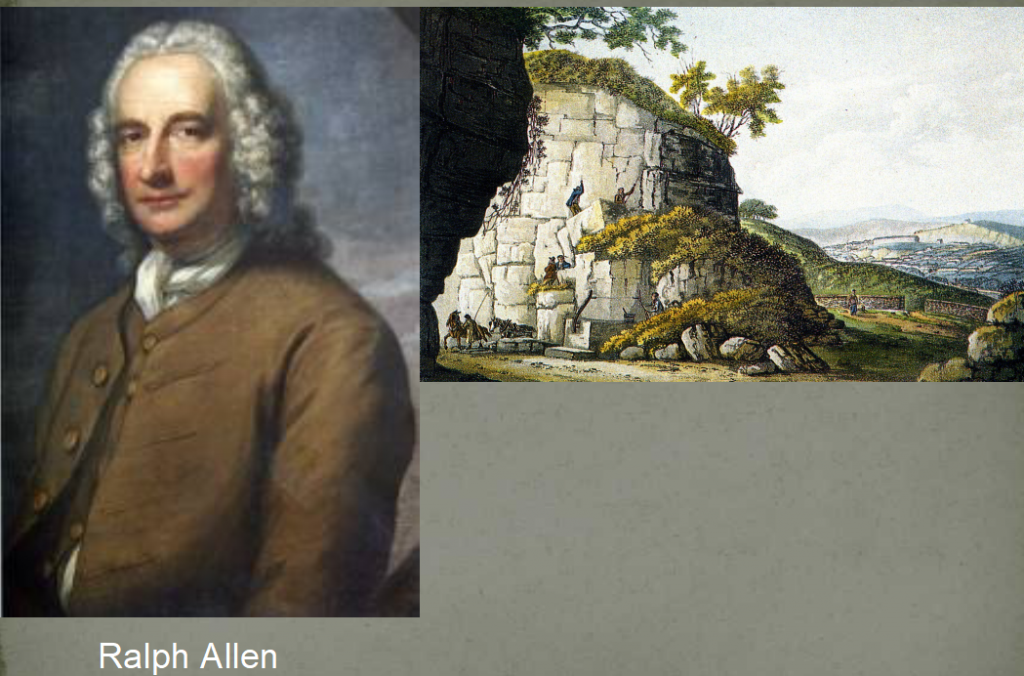
Ralph Allen and his quarry with Bath in the Background (screenshot of lecture slide from my Jane Austen and Bath Virtual Tour)
Ralph Allen
Allen made a small fortune as Post Master by implementing so-called ‘cross posts’. The original postal system sent posts from the regions to London to be sent out to the destination region. Allen realised he could make a lot of money linking regional centres directly and not going via London. Rising in society and in wealth, he reinvested his profits in the purchase of the limestone quarries above Bath.
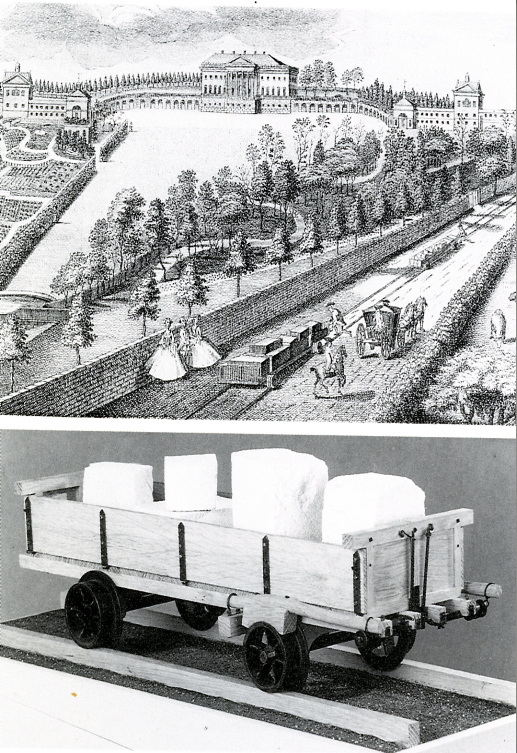
18th Century Railway for moving Bath Stone, old print and model from Museum display.
Being a great entrepreneur, he used a gravity railway (this is in the 18th Century remember!) to bring the stone down cheaply from the quarry. He also invested in a canal scheme to reduce transport costs for his highly prized limestone. It could now be transported and used in the bigger town of Bristol. He thereby made his stone cheaper, and increased potential customers.
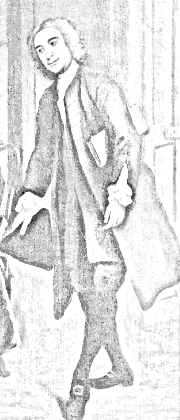
Sketch from painting of John Wood
He worked with visionary architect, John Wood, who used his stone to design amazing buildings in the Palladian style. This made Bath stone fashionable. Reducing costs while increasing demand at the same time. Clever Man! But Wood, made Bath itself fashionable, and one of the most beautiful towns in Europe. So he is the second of the triumvirate who made Bath famous
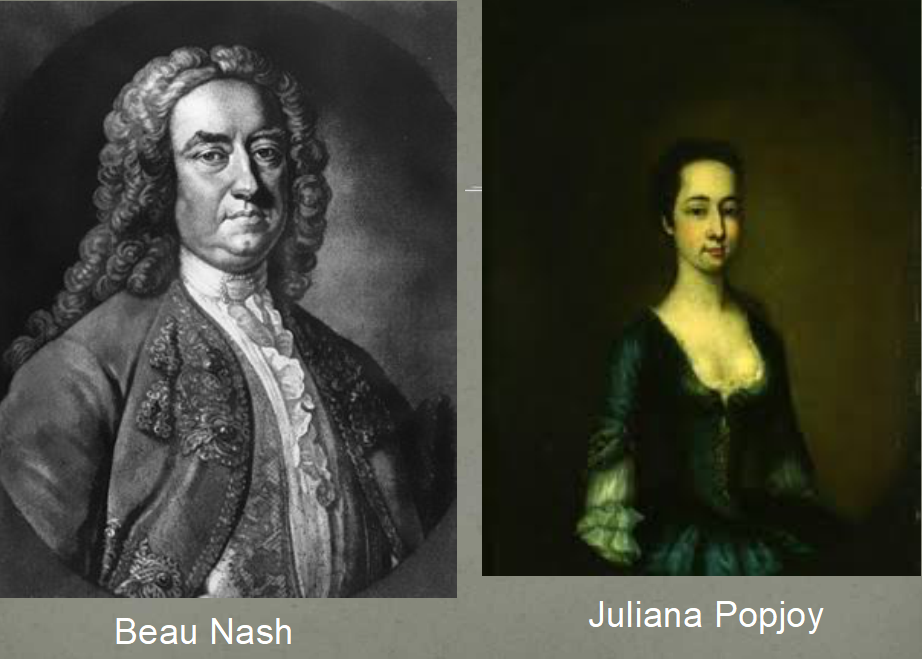
Beau Nash
The third man was Beau Nash. He earned his informal title as the ‘King of Bath’. He made Bath a cultured centre of entertainment. Nash established a top notch musical ensemble. Set up a programme of Balls, lectures, walks and other cultural improvements. He ensured good manners were the order of the day. So, people could be sure of having a good and safe time in the beautiful town of Bath with its cultural offerings. But I will say more about Nash and his girlfriend on another occasion! Its time we got back to General Wade.
Beau Nash and his mistress Juliana Popjoy
General Wade and the Jacobites
So, I used General Wade to point out a missing era of architecture in Bath. But also as a way into the story of the three men who surfed the wave of Bath’s amazing growth. They, it is said, made it the most fashionable place to visit in Britain.
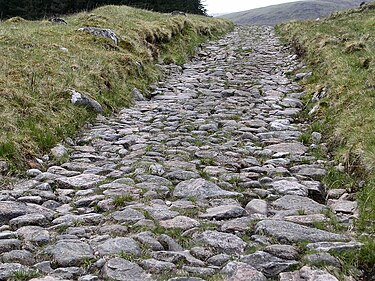
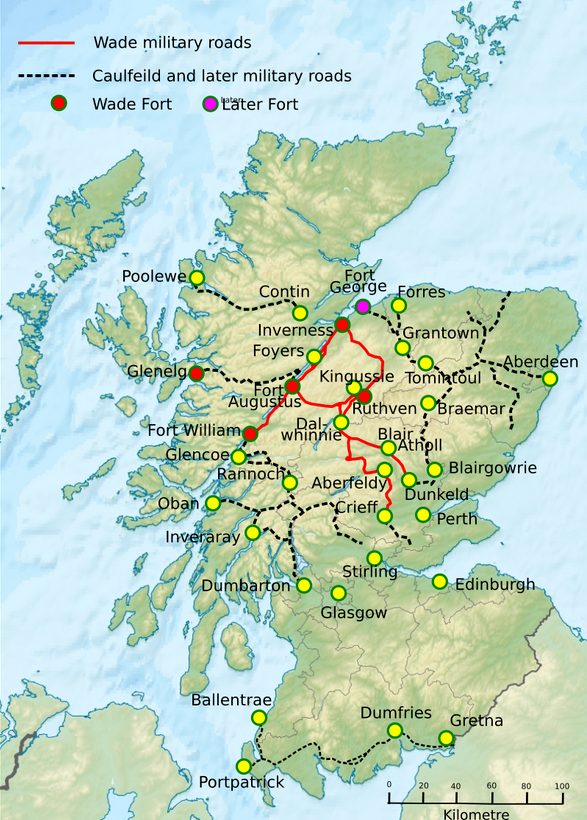
I next came across the name of General Wade, when I began to take groups along Hadrian’s wall. We were travelling on the military way. Running south of the wall, it was built by General Wade in the 18th Century. It roughly follows the Roman Military Way. Wade built 240 miles of military roads and 30 bridges. A further encounter with Wade, came when a particularly erudite Boat captain told us about the road that runs North alongside Loch Lomond. This was another military road built by Wade. Now, I do not know the names of any other General famous for building military roads. So this man was clearly something special. In Scotland, he essentially put in the military framework that was used to subdue the Highlanders in the Jacobite Wars. I thought I should know more about him. Hence, this post!
General Wade’s Military Road near Melgarve below Corrieyairack Pass (Wikipedia)
General Wade: Military Career
He began his military career in 1690 when he was commissioned into the Earl of Bath’s regiment. This led to a stellar military career, including fighting under the great General Marlborough. Wade was made a Brigadier General in 1708. After his success in keeping the West Country secure he was made Commander in Chief of His Majesty’s Forces, Castles, Forts, and Barracks in North Britain. The term ‘North Britain’ was used following the union of England and Scotland. For a while Scotland was known as North Britain.
He became a Field Marshall in 1743 in the War of the Austrian Succession. In the ’45 (Jacobite Revolt), he based his strategy on concentrating his forces on Newcastle. But Bonnie Prince Charlie, outfoxed him by taking the West Coast route out of Scotland via Carlisle into Lancashire. The Scots got as far south as Derby. Then retreated as the hoped for support from English Jacobites, nor the French invasion, materialised. Wade resigned from his command in 1745 and was replaced by Prince William, Duke of Cumberland. Cumberland was known as the Butcher of Culloden. The 1745 Jacobite Rebellion is known in Scottish Gaelic: as the Bliadhna Theàrlaich, [ˈpliən̪ˠə ˈhjaːrˠl̪ˠɪç], or ‘The Year of Charles’). (to read about Bonny Prince Charlie’s Sword, Stone of Scone read my post here stone-of-destiny-on-display-in-perth
General Wade’s Road and the Sycamore Tree
In 1746 Wade helped plan the East West road by Hadrian’s Wall to prevent in future any invasion of Britain. It allowed troops to travel from one side of Scotland to the other quickly. He died before construction was begun. He can’t therefore be entirely blamed for the destruction of parts of Hadrian’s Wall by the building of the road. (Click here to see my post on the piece-of-hadrians-wall-found.
The road is still in use today. It was used by many people to see the famous Sycamore Tree, in Sycamore Gap, before it was brutally chopped down.
‘Daniel Graham, 39, and Adam Carruthers, 32, both from Cumbria, are charged with causing £622,191 worth of criminal damage to the famous Northumberland tree‘. https://www.bbc.co.uk/news/articles/ckg0dyk9mvno. They were found gulty, given 4 years custodial sentences. Graham said the motive was nothing more than ‘drunken stupidity.’ To that we can all agree.