
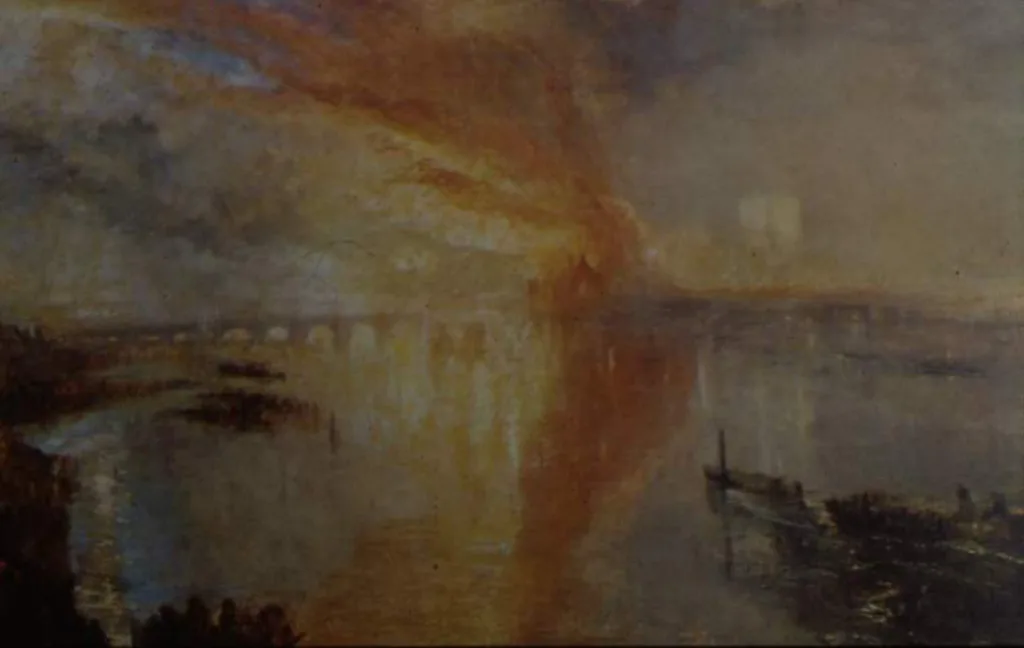
In 1834, the Government decided to end the use of Tally Sticks by the Exchequer and replace them with paper ledgers. They decided to burn the sticks that had been used to record financial transactions for six hundred years. Richard Weobley, the Clerk of Works decided not to give the Tallies to staff as firewood, but to burn them in two stoves below the House of Lords. The chimney was designed for coal not for wood, and it started a fire that destroyed virtually the entire Houses of Parliament and most of the ancient Palace of Westminster.

Architects including Sir John Soane and Robert Adams warned about the dangers of a fire at the complex which were built before modern fire prevention methods, such as fire walls, and fire doors. But they were ignored. There was no Fire Brigade just a few antiquated old Parish Engines. but, the Insurance companies had created the London Fire Engine Establishment (LFEE) led by the charismatic James Braidwood. However, the Palace was not covered by insurance.
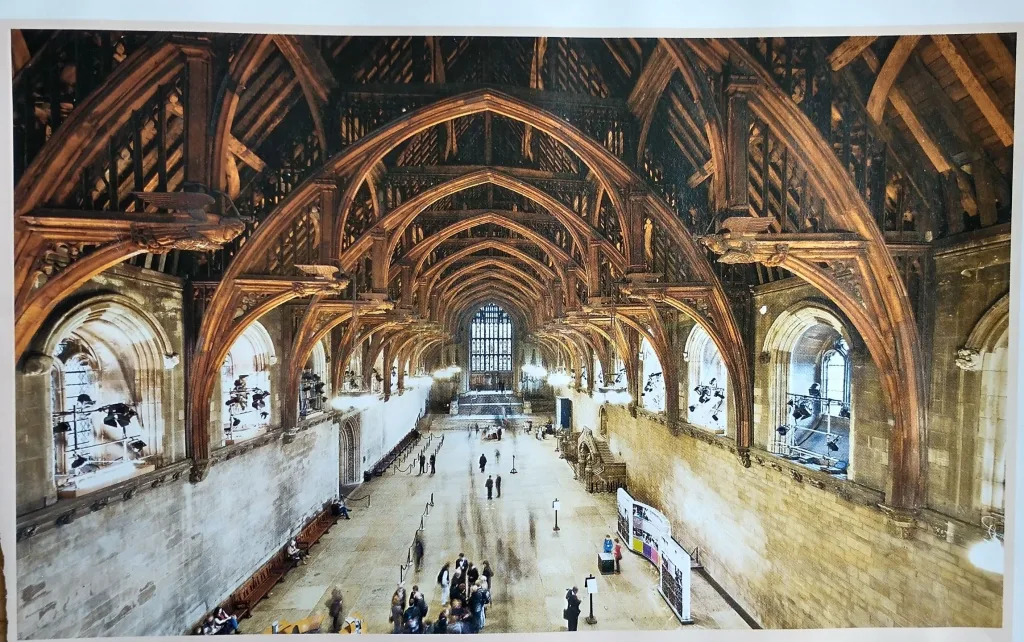
None the less the LFEE turned up. Initially they could do little as the Thames was low and they could not get enough water to help stop the fire. But later as the Tide rose, the water supply improved. Also, the LFEE could now bring up its LFEE’s floating fire engine from storage in Rotherhithe. Braidwood got his men to spray the famous Hammer beam roof with water, and the 11th Century, Westminster Hall survived. The roof was installed by Master Carpenter, Hugh Herland in the 14th Century when the Hall was reroofed. The timber came from the Farnham area of Surrey. (for more on the Fire look here).
The fire was such a conflagration that thousands of Londoners came to see it. It was not long after very unpopular Acts of Parliament including the Great Reform Bill of 1832, which failed to give the vote to the working class, and the Poor Law Amendment which Dickens attacks in Oliver Twist. (see my post of the Chimes for more on Dickens’s Social Journalism).
It is said the Londoners cheered as the Palace burnt down. Thomas Carlyle, remembered: ‘the crowd was quiet, rather pleased than otherwise; whew’d and whistled when the breeze came as if to encourage it: “there’s a flare-up (what we call shine) for the House o’ Lords.”—”A judgment for the Poor-Law Bill!”—”There go their hacts” (acts)! Such exclamations seemed to be the prevailing ones. A man sorry I did not anywhere see. (reported in Wikipedia.
Tally Sticks
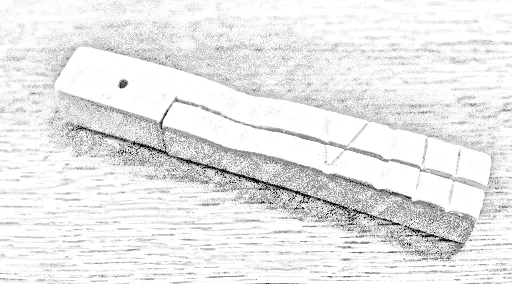
From the Medieval period, England used Tally Stick for public finances. These were held by the Exchequer. The Government’s financial division gets this name from a chequered cloth which was used to help reckoning up revenues. They used 6 inch lengths of Willow cut on the banks of the Thames, to keep records of transactions. The willow would be marked with lines to represent the amount of money involved in transactions – say a sale of a farm. The willow tally would be split longways about 5 inches of its length. One piece the foil would be given to the debtor, and the other piece, the stock, would be kept by the creditor ~(usually the Government). Each part of the Tally also had the details of the transaction in ink. The pieces could also be used to transfer the debt, and could act almost like currency.
But the genius of the ideas is that it is effective against fraud. The two parts of the stick, would not only have to match with the lines which were cut across them but also the natural grain of the wood, which would provide a unique fingerprint, proof against fraud.
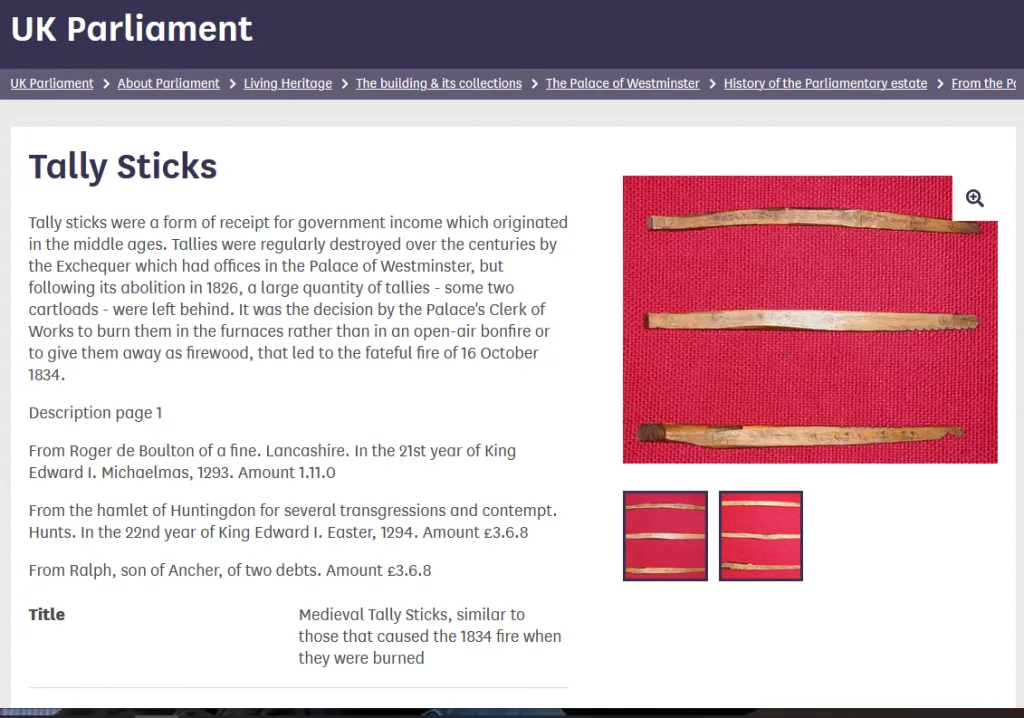
To read more about Tally Sticks, please read:
https://www.geoffreymhodgson.uk/secret-history-of-tally-stick
Or BBC’sTim Harford https://www.bbc.co.uk/news/business-40189959
Exchequer, in British history, the government department that was responsible for receiving and dispersing the public revenue. The word derives from the Latin scaccarium, “chessboard,” in reference to the checkered cloth on which the reckoning of revenues took place. (https://www.britannica.com/money/Exchequer)
First Published on October 16th, 2025
Discover more from And Did Those Feet
Subscribe to get the latest posts sent to your email.