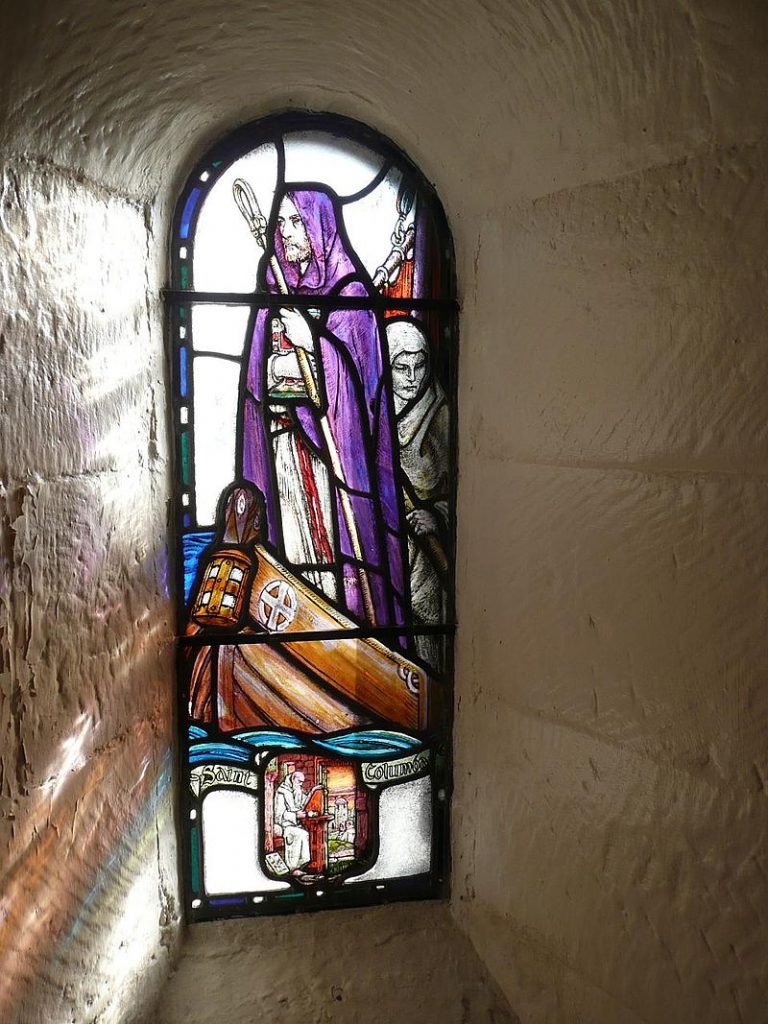
St Columba Stained Glass window in St Margaret’s Chapel Edinburgh Castle Photo by Graham van der Wielen Wikipedia CC BY 2.0
St Columba, or Colmcille is one of the most important saints for the early transmission of Christianity. He was born in 521 and said to be a descendant of the possibly legendary Irish King Niall of the Nine Hostages. (The Hostages were a token of Niall’s power over Ireland as they came from the five provinces of Ireland. These are Ulster, Connacht, Leinster, Munster, andMeath. The other four hostages represented Scotland, the Saxons, the Britons, and the Franks.)
St. Columba was sent at an early age to be brought up as a Monk, and went on to set up Monasteries in Ireland at Derry and Durrow. In 563, he left Ireland, possibly because he got involved in a dispute that had a deadly outcome. He went into exile to Scotland and set up the famous Monastery on the island of Iona, Inner Hebrides. This is off the coast of what would one day be called Scotland. At the time, it was under the control of the Kingdom of Dál Riata, which was, Gaelic, nominally Christian, and controlled parts of Ulster and Western Scotland.
From Iona, Columba led the conversion of the Picts to Christianity. The Picts were Britons, speaking a different dialect of Celtic than the Gaels of Ireland and Dál Riata. Their name is said to have been given by the Romans and meant Painted Men. A shared religion, which St Columba brought from Ireland, helped towards the eventual union of the Gaels, the Picts and other British groups into the Kingdom of Alba. Alba is the Gaelic name for Scotland – meaning white, and from which we also get Albion. Alba became Scotland, which is derived from the Roman word for the area which in Latin was “Scotia”. Iona became the traditional burial place of early Scottish Kings such as Macbeth (Mac Bethad mac Findlaích). These Kings were crowned at Scone and buried in Iona. Alba was also able to take territory from the Anglian Kingdom of Northumbria, namely, the Scots-speaking areas South of the Firth of Forth. (Scots being a dialect of English). There were also Norse settlers in the Ireland so Scotland was made of a coalition of Gaelic, Brittonic, Norse and English speakers.
St Columba and the Loch Ness Monster
Much of the events of this part of Columba’s life are recorded by St. Adamnan in The Life of Saint Columba. This was written in the 7th Century, much of which is apocryphal. One notable story tells how he came across a group of pagan Picts who were mourning a child killed by a monster in the River Ness. St Columba revived the child. He then sent one of the Brothers to swim across the Loch to fetch a boat. The “water beast” pursued the Monk and was about to attack him when St Columba told the monster to stop. So it did, retreating to the depths of Loch Ness. Thus began the legend of the Loch Ness monster.
St Columba died in 597AD. Iona continued to prosper and in, 634 sent St Aidan from Iona to found the Monastery at Lindisfarne. The island is on the Eastern coast of Britain in the Anglo-Saxon Kingdom of Northumbria. This Kingdom of the North Angles, was one of the most powerful at the time and Lindisfarne was instrumental in its conversion. The tradition of evangelism took hold in the British Isles, and it was from here that much of the German-speaking world was converted to Christianity.
This is St Columba’s legacy.
Northumbria’s Contribution to the development of Christianity
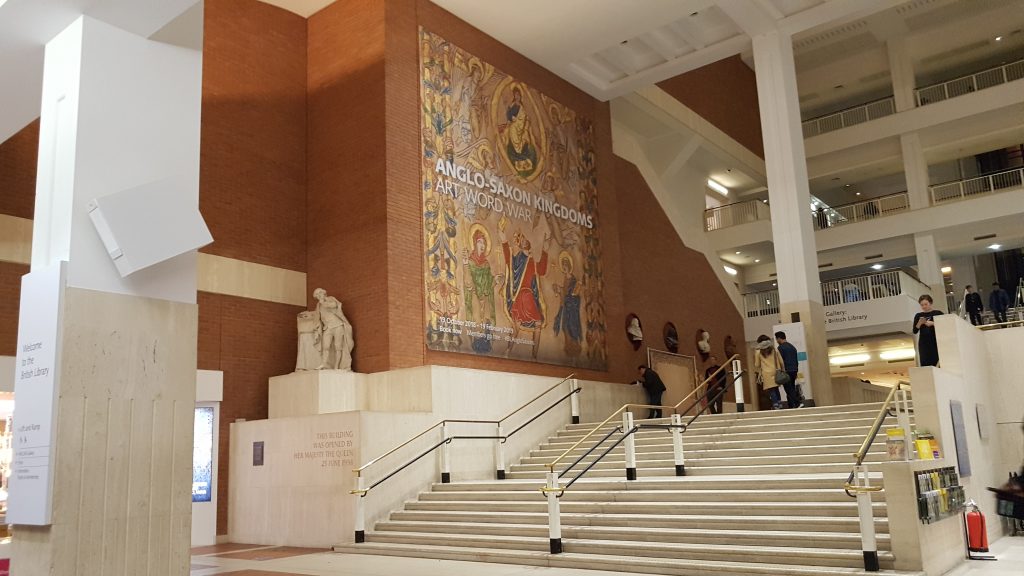
There is a developing understanding among scholars that this Irish inspired form of Christianity, fused with the Anglo-Saxon Northumbria took a leading role in ritual, art, scholarship in the Roman Catholic world. Just stop and think about that sentence for a moment. The northern parts of an out of the way set of islands off the edge of Europe took a leading role in the development of Western Christianity. This was highlighted in a recent exhibition of Anglo-Saxon art at the British Library.
British Library with Poster for Anglo-Saxons Kingdoms Exhibition, Photo K Flude
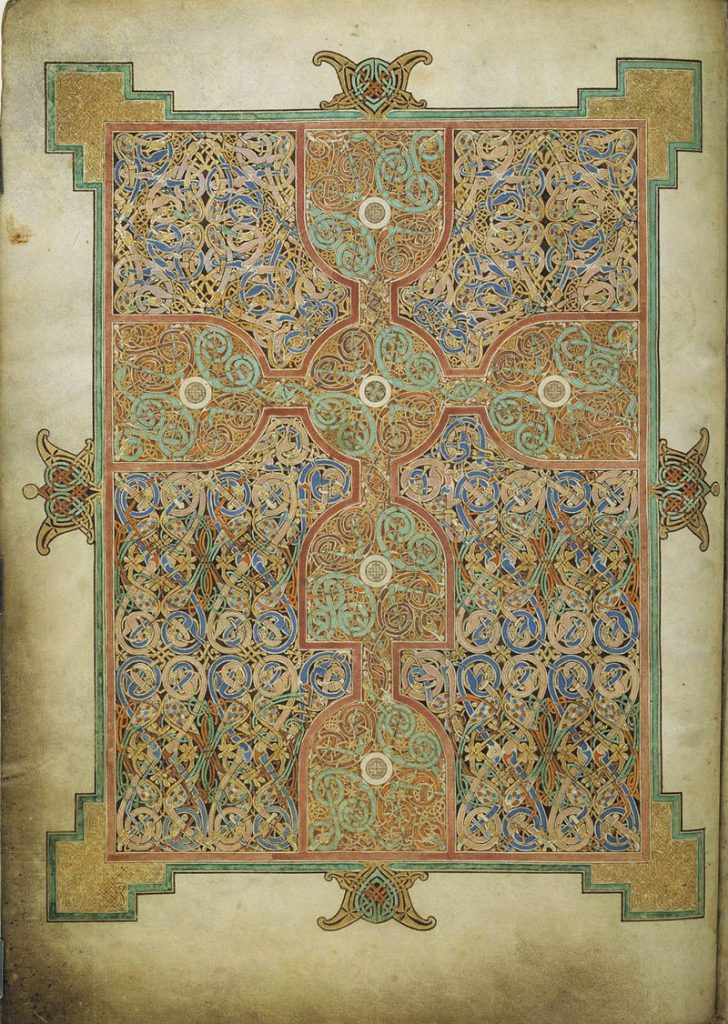
A look at the Lindisfarne Gospel and the Book of Kells showcases the amazing art of this period. For a real treat, look through this scrollable virtual copy of the Lindisfarne Gospel. (Currently this is unavailable, I suspect since the BL was hacked. So instead, here is a slightly breathless online introductory video of the Gospel.)
The Book itself has been missing from the displays of the British Library for a couple of years, but was on display in Northumberland in 2022. I’m not sure whether it is yet back on display at the British Library. I think not. You can see the Book of Kells at Trinity College, Dublin or look at their online offering here: Not quite as joyous an experience as the online Lindisfarne but beautiful enough.
Carpet Page from the Lindisfarne Gospel Photo Wikiepedia Eadfrith – Lindisfarne evangeliarium, tapijtbladzijde op f26v, Matteüsevangelie
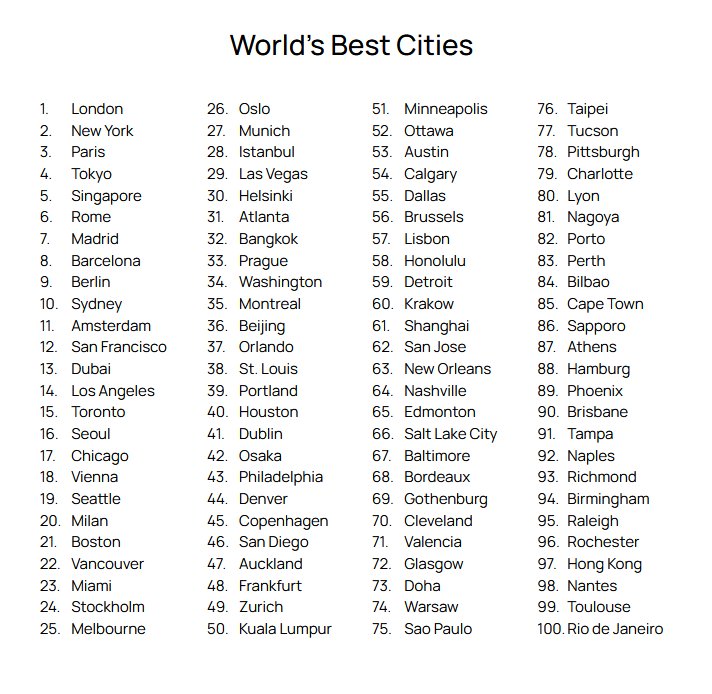
The World’s Best Cities report makes London the top City followed closing by New York and Paris. London has had top spot for 10 years. The Report is based on core statistics plus a survey of visitors and residents. It is created by Resonance, a consultancy group working in real estate, tourism, and economic development. They are based in Vancouver.
“Navigating the complexities of a post-Brexit era, geopolitical uncertainties and economic challenges, London’s resilient spirit and unmatched global appeal have solidified its place at the pinnacle of our annual ranking,“
AFAR gives a good analysis of Resonance’s methods on its web site:
‘England’s capital snagged the top spot for the 10th year in a row, continuing to draw students, investors, and tourists alike. A $305 million upgrade of the Gatwick Airport and new metro stops on the Elizabeth line are a few of the developments that indicate the city’s focus on improving infrastructure. Resonance particularly spotlights the building of the Camden Highline, a mile-long greenway inspired by New York’s High Line, as a project that demonstrates “London’s dedication to enhancing quality of life for both residents and visitors.”
London No 1. Really?
Or is it a fix? It was a bit of a surprise to me given the hit Brexit has given to the City. But, London’s dominance for ten years may be because of the consultancy’s focus on real estate as well as tourism and economic development. This gives London a head start as it has long been considered a very safe place to invest in property. London, New York, Paris, Tokyo, Singapore as 1-5 also suggests the report writers might have a bias to the big hitters.
What London offers is its status as one of the world’s leading financial/business capitals. Supported by outstanding creative and services industries. At the same time, it has a superb cultural offering and, consequently, high figures for tourism. It is a City that seems to have a deep past behind it and an equally important future ahead.
The future might depend on the growing Knowledge Quarter around Kings Cross. (British Museum & Library, Wellcome Institute, Crick Institute, UCL, Central St. Martins, Google etc.) With Silicone Roundabout and the wealth of investments from the nearby City of London, providing London with a leading place in AI, the Knowledge economy, and Fintech. London also has a very high value on the internet as far as hashtags, and internet searches are concerned.
I keep an archive of the walks I have done each year.
Ring in the New Year Virtual Walk
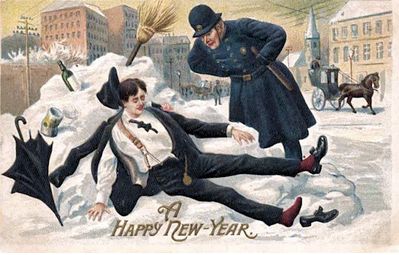
Old New Year Card
Monday 1st January 2024 7.00pm On this Virtual Walk we look at how London has celebrated the New Year over the past 2000 years.
The New Year has been a time of review, renewal and anticipation of the future from time immemorial. The Ancient Britons saw the Solstice as a symbol of a promise of renewal as the Sun was reborn. As the weather turns to bleak mid winter, a festival or reflection and renewal cheers everyone up. This idea of renewal was followed by the Romans, and presided over by a two headed God called Janus who looked both backwards and forwards. Dickens Christmas Carol was based on redemption and his second great Christmas Book ‘The Chimes’ on the renewal that the New Year encouraged.
We look at London’s past to see where and how the New Year was celebrated. We also explore the different New Years we use and their associated Calendars – the Pagan year, the Christian year, the Roman year, the Jewish year, the Financial year, the Academic year and we reveal how these began. We look at folk traditions, Medieval Christmas Festivals, Boy Bishops, Distaff Sunday and Plough Monday, and other Winter Festival and New Year London tradition and folklore.
At the end we use ancient methods to divine what is in store for us in 2024
ROMAN LONDON – A LITERARY & ARCHAEOLOGICAL WALK
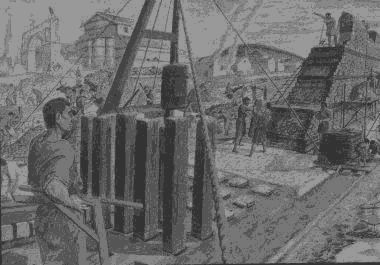
Reconstruction View of Roman Riverside Wall being built
Sunday 21st Jan & 3rd March 2023 11.30 am Monument Underground Station
Our Guides will be Publius Ovidius Naso and Marcus Valerius Martialis who will be helped by Kevin Flude, former Museum of London Archaeologist, Museum Curator and Lecturer.
We disembark at the Roman Waterfront by the Roman Bridge, and then explore the lives of the citizens as we walk up to the site of the Roman Town Hall, and discuss Roman politics. We proceed through the streets of Roman London, with its vivid and cosmopolitan street life via the Temple of Mithras to finish with Bread and Circus at the Roman Amphitheatre.
REVIEWS “Kevin, I just wanted to drop you a quick email to thank you ever so much for your archaeological tours of London! I am so thrilled to have stumbled upon your tours! I look forward to them more than you can imagine! They’re the best 2 hours of my week! 🙂 Best, Sue
Jane Austen’s London Sunday Jan 21st 2.30 pm Green Park underground station,
An exploration of Mayfair, the centre of the London section of Sense & Sensibility and where Jane came to visit her brother
“It is a truth universally acknowledged, that a Jane Austen devotee in possession of the good fortune of a couple of free hours today must be in want of this walk.”
People associate Jane Austen and her characters with a rural setting. But London is central to both Jane Austen’s real life and her literary life. So, this tour will explore Jane’s connections with London and give the background to Sense and Sensibility, a good part of which is based in this very area. We begin with the place Jane’s coach would arrive from Hampshire, and then walk the streets haunted by Willougby; past shops visited by the Palmers, the Ferrars; visit the location of Jane Austen’s brother’s bank and see the publisher of Jane’s Books. The area around Old Bond Street was the home of the Regency elite and many buildings and a surprising number of the shops remain as they were in Jane Austen’s day.
This is a London Walk Guided Walk lead by Kevin Flude
Sat 6pm 25th May 2024 Green Park Tube
Myths, Legends, Archaeology and the Origins of London
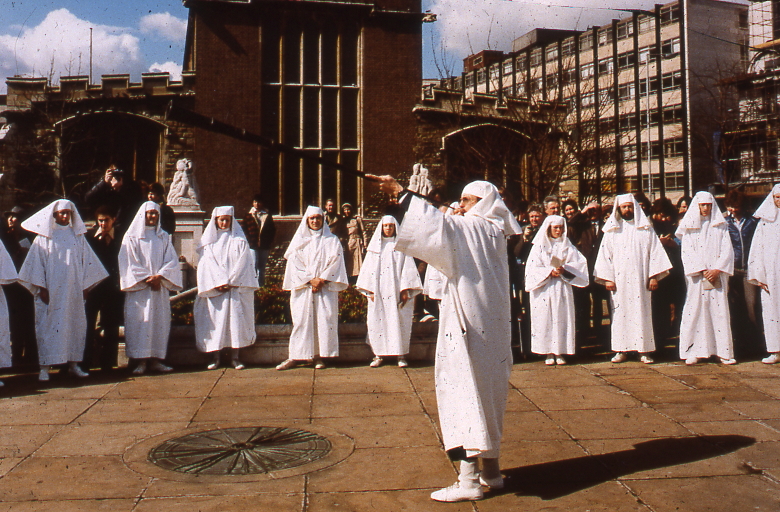
Druids at All Hallows, by the Tower
Sunday 4th February & Saturday 23 March 2024 11.30pm Tower Hill Underground
The walk tells the stories of our changing ideas about the origins of London during the Prehistoric, Roman and Saxon periods.
The walk is led by Kevin Flude, a former archaeologist at the Museum of London, who has an interest both in myths, legends and London’s Archaeology.
The walk will tell the story of the legendary origins of London which record that it was founded in the Bronze Age by an exiled Trojan and was called New Troy, which became corrupted to Trinovantum. This name was recorded in the words of Julius Caesar; and, then, according to Legend, the town was renamed after King Ludd and called Lud’s Dun. Antiquarians and Archaeologists have taken centuries to demolish this idea, and became convinced London was founded by the Romans. Recently, dramatic evidence of a Bronze Age presence in London was found.
When the Roman system broke down in 410 AD, historical records were almost non-existent, until the Venerable Bede recorded the building of St Pauls Cathedral in 604 AD. The two hundred year gap, has another rich selection of legends. which the paucity of archaeological remains struggles to debunk.
The walk will explore these stories and compare the myths and legends with Archaeological discoveries.
The route starts at Tower Hill, then down to the River at Billingsgate, London Bridge, and into the centre of Roman London
Tudor London – The City of Wolf Hall
Sunday 4th February 2024 2.15pm Barbican Underground Station
Tudor London – The City of Wolf Hall Virtual Tour Sunday 4th February 2024 7.30 pm To book
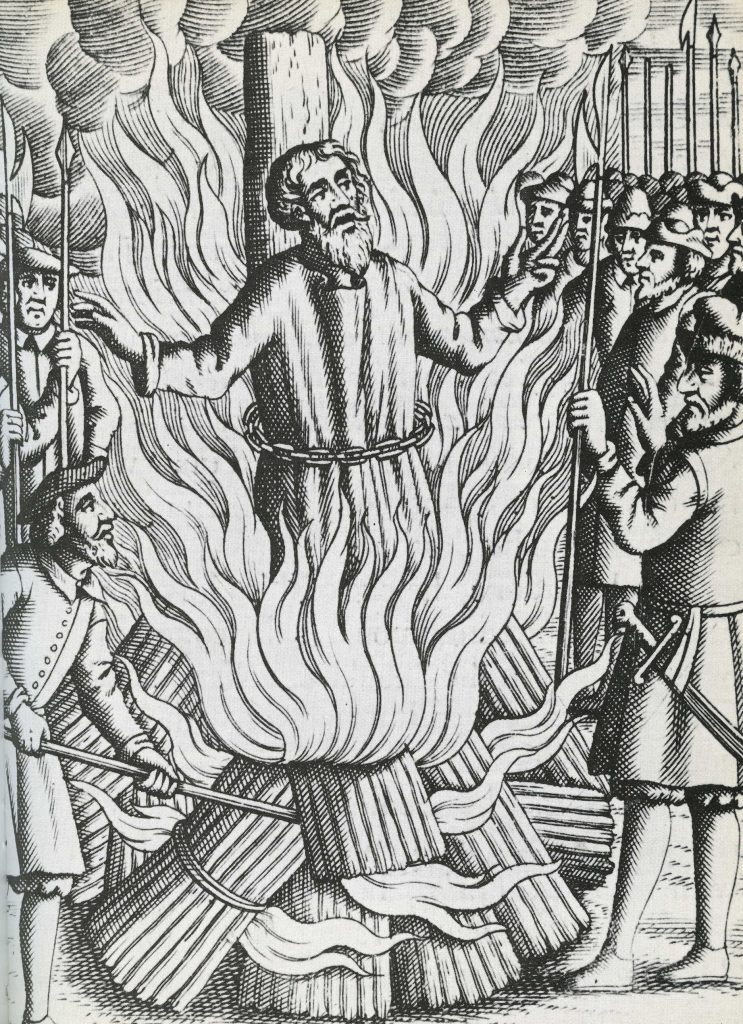
Thomas Bilney martyred in Smithfield.
The Walk creates a portrait of London in the early 16th Century, with particular emphasis on the life and times of Thomas Cromwell and Thomas More during the Anne Boleyn years.
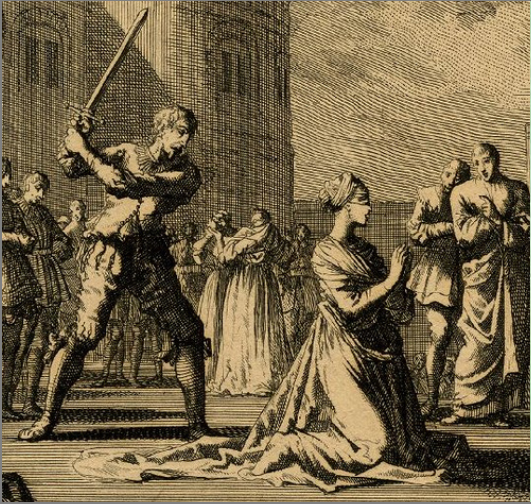
More and Cromwell had much in common, both lawyers, commoners, who rose to be Lord Chancellor to Henry VIII, and ended their careers on the block at Tower Hill.
The walk starts with an exploration of Smithfield – site of the stake where heretics were burnt alive and of St Bartholomew’s Monastery – given to Richard Rich after his decisive role in the downfall of Thomas More. We continue to St Paul where Martin Luther’s books were burnt, and later, where Puritans preached against dancing round the Maypole.
We walk along the main markets streets of London, to Thomas More’s birthplace, and to the site of More’s and Cromwell’s townhouses before, if time allows, finishing at the site of the Scaffold where More and Cromwell met their ends, overlooking where Anne Boleyn was incarcerated in the Tower of London
The Leap Year Pub Walk Thurs 6pm 29 February 2024 Tower Hill Underground
Sketched from a photo by simple-aign on pixaby
Thurs, 29 February 2024, 6pm Tower Hill Underground
We explore London, the Leap Year and 29th February through history A strange amazing day – and walk – that comes only once every four years. For the rest of the time it does not “exist.” A day – and walk – of temporal tune-up. A day – and walk – of unlocked potential. A day – and a walk – of unlocked London.
As the Sun, Moon and Seasons have different cycles and don’t fit into a set number of days, Londoners have had to cope with fixes to their Calendars to align the Cosmos with everyday life. As we walk through the streets of the ancient City of London, we explore how Londoners organised and celebrated their year throughout history
One of the most popular forms of publication in London was the Almanac. It was full of seasonal advice, of prophecy, traditional wisdom, and important events past and future. We will look at Almanacs and Diaries to find how Londoners spent their Leap Year.
We start with the Romans at the City Wall, near the Tower of London, and walk through history until we reach a historic pub to celebrate the New Year.
The Leap Year Almanac of the Past Pub Walk is led by Kevin Flude, a lecturer, curator and former archaeologist at the Museum of London. Join him to explore London’s History through its celebrations, festivals, calendars and almanacs.
This is a London Walks Guided Walk.
Roman London – A Literary & Archaeological Walk Sun 11.30 am 3rd March 2024 Monument Underground Station To book Jane Austen’s London Sun 2.30 pm 3rd March 2024 Green Park Underground station (Green Park Exit. Fountain in Green Park), To book Myths, Legends, Archaeology and the Origins of London Sunday 11.30am 23rd March 2024 Tower Hill Underground
London. 1066 and All That Walk
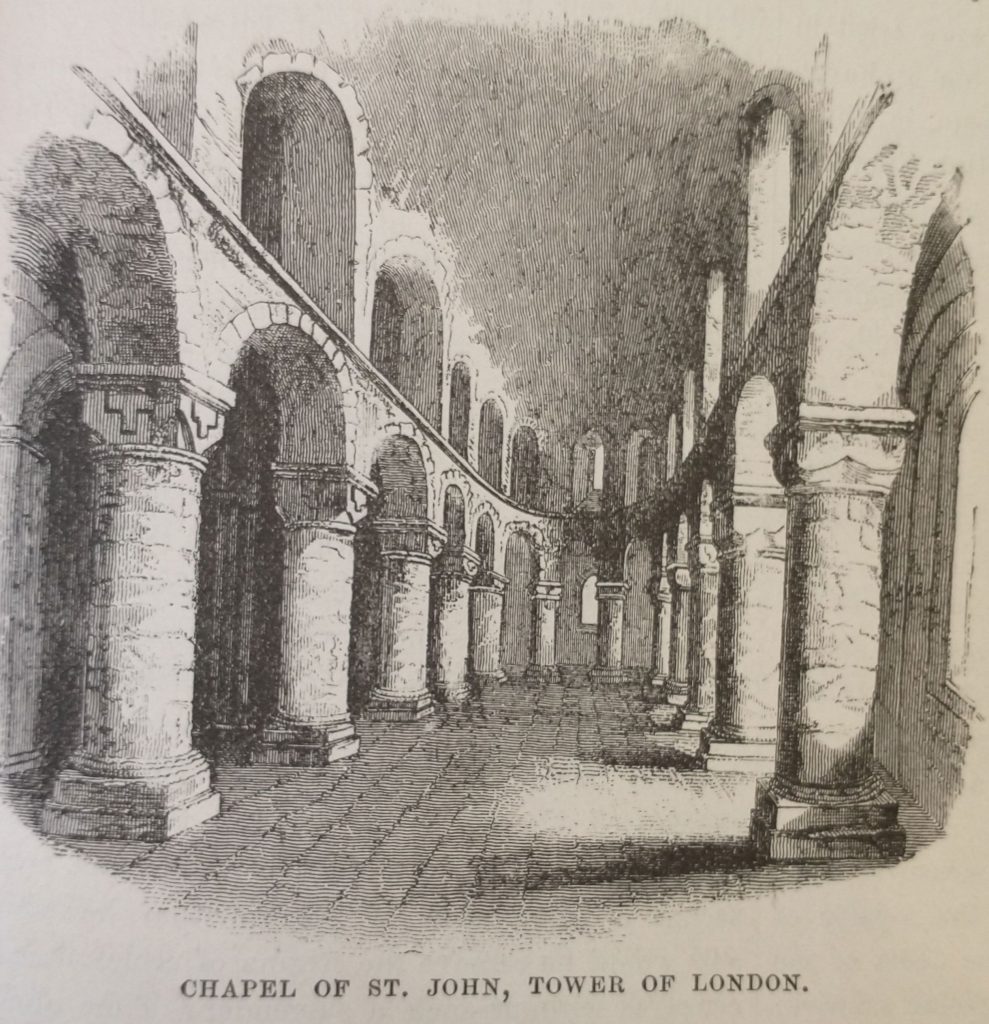
Old illustration Chapel of St Johns Tower of London
Sunday 2.30pm 23rd March 2024 Blackfriars Underground Station The Archaeological Walk that explores the City of London at the end of the Saxon period and at the beginning of the Norman.
The Norman Conquest of 1066 defines Britain in a way unmatched by any other event. And on this walk we explore the London that William conquered and how he changed England for all time.
London was England’s most important City, but not yet the capital. It was crucial to William in his attempt to conquer the realm. But his army could not fight their way across the heavily defended London Bridge after the defeat of the English King, Harold, at the Battle of Hastings.
The future of England was in the balance as he ravaged the country seeking a way across the river and to persuade the English that resistance was hopeless.
Once across the river, the English leaders sued for peace, and William was crowned at the newly built Westminster Abbey. The English hoped for a strong King who would rule with the people. But William began by building Castles to oppress the Citizens, and soon swept aside the English Aristocracy and establishment and replaced them with the Conquerors.
This was a death blow to Anglo-Saxon culture, but the City made an accommodation with the new regime and the first Lord Mayor of London was an Englishman.
So, on the walk we explore the Late Saxon City of London, and how it changed in the last 11th and 12th Centuries.
Walk is by Kevin Flude, former Archaeologist at the Museum of London Kevin
Chaucer’s Medieval London Guided Walk
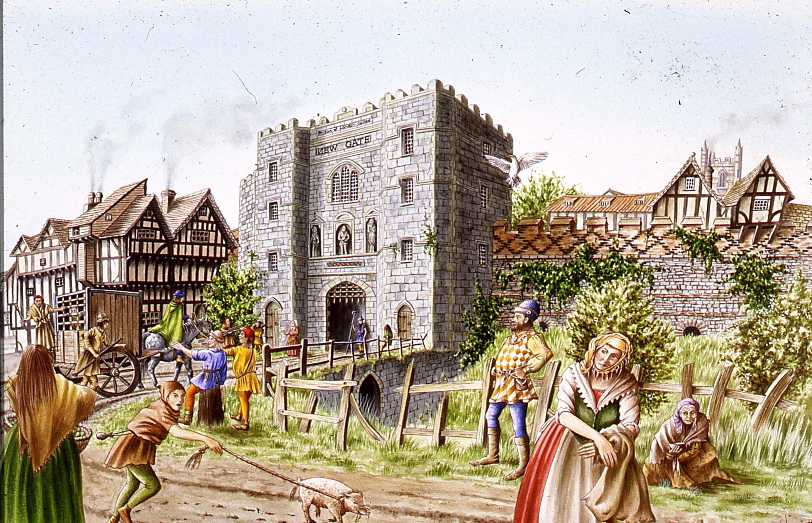
Medieval Newgate
Sunday 7th April 2024 11.30pm & Saturday 6th July 2.30 Aldgate Underground
A Walk around Medieval London following in the footsteps of its resident medieval poet – Geoffrey Chaucer One of the spectators at the Peasants Revolt was Geoffrey Chaucer, born in the Vintry area of London, who rose to be a diplomat, a Courtier and London’s Customs Officer. He lived with his wife in the Chamber above the Gate in the City Wall at Aldgate. His poetry shows a rugged, joyous medieval England including many scenes reflecting life in London. His stories document the ending of the feudal system, growing dissatisfaction with the corruption in the Church, and shows the robust independence with which the English led their lives.
His work helped change the fashion from poetry in French or Latin to acceptance of the English language as suitable literary language. This was helped by the growth of literacy in London as its Merchants and Guildsmen became increasingly successful. In 1422, for example, the Brewers decided to keep their records in English ‘as there are many of our craft who have the knowledge of reading and writing in the English idiom.’
Chaucer and other poets such as Langland give a vivid portrait of Medieval London which was dynamic, successful but also torn by crisis such as the Lollard challenge to Catholic hegemony, and the Peasants who revolted against oppression as the ruling classes struggled to resist the increased independence of the working people following the Black Death.
A walk which explores London in the Middle Ages, We begin at Aldgate, and follow Chaucer from his home to his place of work at the Customs House, and then to St Thomas Chapel on London Bridge, and across the River to where the Canterbury Tales start – at the Tabard Inn.
This is a London Walks event by Kevin Flude
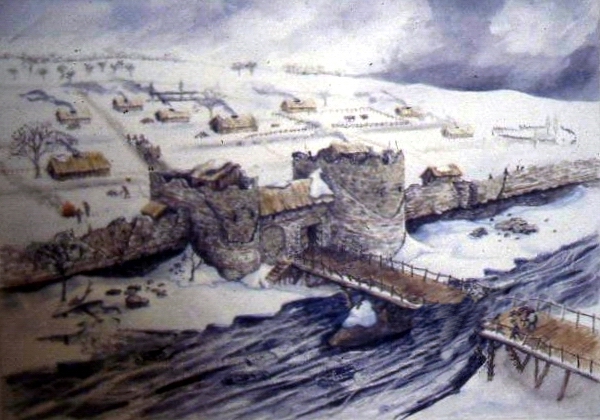
The Decline And Fall Of Roman London Walk
London in the 5th Century Reconstruction painting.
Sat 1.30pm 25th May 2024Exit 2 St Pauls Underground Station
An exploration of what happened at the end of the Roman Period, and how the City became deserted, and then, reborn as an English City
The first British Brexit? The Roman Britons kicked out the Romans in 407AD, and, soon, asked them to come back after a catastrophic collapse. Faced with plague, civil war, invasion, mass immigration, industrial decline, reversion to barter; the authorities struggled against anarchy and descent into a dark age.
But was that how it was? Wasn’t it a rather a transition into the Late Antique period in which life for most people went on much as before except paying taxes to local rulers rather than distant Romans?
The walk investigates why the Roman system in London broke down, and what really was the impact of the end of the Roman system in London? What is the evidence? and can we trust it? Or can we really do nothing much more than guess?
We tramp the streets of London in search of light to shine on the dark age of London.
This is a London Walks event by Kevin Flude, ex Museum of London Archaeology and Museum Curator.
Jane Austen’s London Walk
Saturday 25th May 6pm 2024 Green Park underground station (Green Park exit, by the fountain)
An exploration of Mayfair, the centre of the London section of Sense & Sensibility and where Jane came to visit her brother
“It is a truth universally acknowledged, that a Jane Austen devotee in possession of the good fortune of a couple of free hours today must be in want of this walk.”
People associate Jane Austen and her characters with a rural setting. But London is central to both Jane Austen’s real life and her literary life. So, this tour will explore Jane’s connections with London and give the background to Sense and Sensibility, a good part of which is based in this very area. We begin with the place Jane’s coach would arrive from Hampshire, and then walk the streets haunted by Willougby; past shops visited by the Palmers, the Ferrars; visit the location of Jane Austen’s brother’s bank and see the publisher of Jane’s Books. The area around Old Bond Street was the home of the Regency elite and many buildings and a surprising number of the shops remain as they were in Jane Austen’s day.
This is a London Walk Guided Walk lead by Kevin Flude
The Peasants Revolt Anniversary Guided Walk
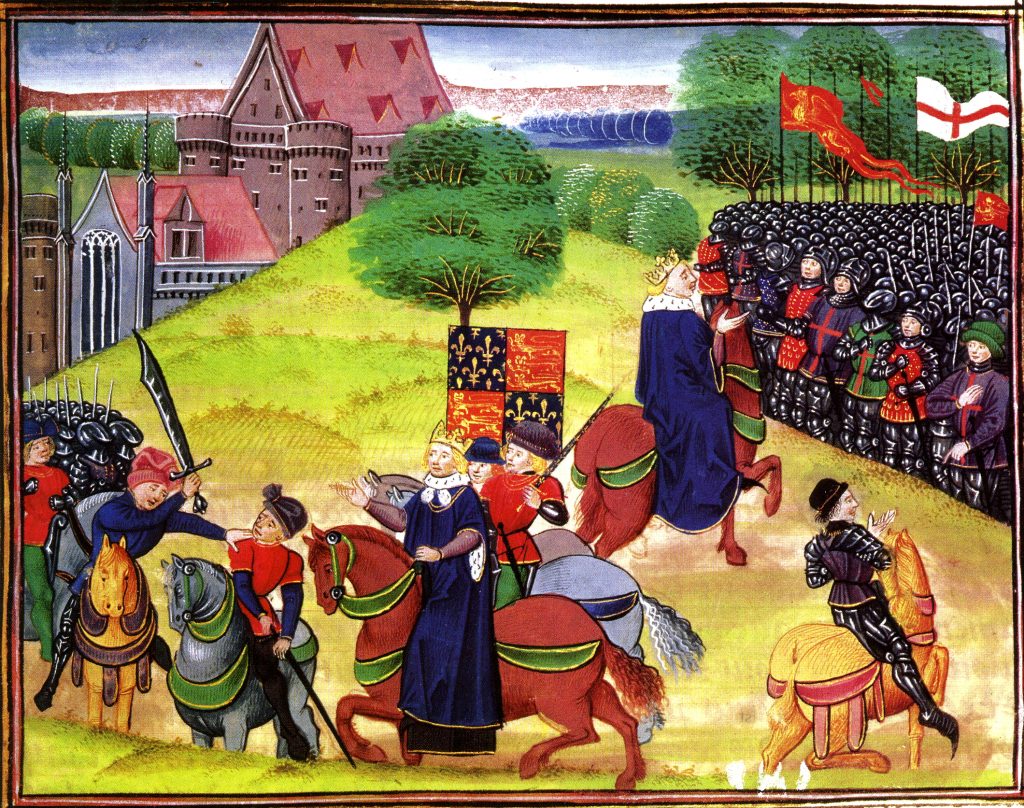
Medieval Manuscript of Peasants Revolt at Smithfield
Aldgate Underground Thursday 6.30 13th June 2024
An Anniversary Walk tracking the progress of the Peasants as they take control of London in June of 1381
The Summer of Blood
The Peasants’ Revolt. The greatest popular rising in English history. This is the anniversary walk. The London Walk that heads back to 1381, back to the Peasants’ Revolt. You want a metaphor, think stations of the cross. This is the stations of the Peasants’ Revolt walk. We go over the ground, literally and metaphorically. Where it took place. Why it took place. Why it took place at these places. What happened. The walk is guided by the distinguished Museum of London Archaeologist His expertise means you’ll see the invisible. And understand the inscrutable.
On the anniversary of the Peasants Revolt we reconstruct the events that shook the medieval world. In June 1381, following the introduction of the iniquitous Poll Tax, England’s government nearly fell, shaken to the core by a revolt led by working men. This dramatic tour follows the events of the Revolt as the Peasants move through London in June 1381.
We met up with the Peasants at Aldgate, force our way into the City. We march on the Tower of London as the King makes concessions by ending serfdom, at Mile End. But the leaders take the mighty Tower of London and behead the leaders of Richard’s government. Attacks follow on the lawyers in the Temple, the Prior at St. John’s of Jerusalem, Flemish Londoners, and on Lambeth and Savoy Palaces.
The climax of the Revolt comes at Smithfield where a small Royal party confront the 30,000 peasants.
Chaucer’s Medieval London Guided Walk
Medieval Newgate
Sat 2.30 6th July 2024 Aldgate Underground
A Walk around Medieval London following in the footsteps of its resident medieval poet – Geoffrey Chaucer
One of the spectators at the Peasants Revolt was Geoffrey Chaucer, born in the Vintry area of London, who rose to be a diplomat, a Courtier and London’s Customs Officer. He lived with his wife in the Chamber above the Gate in the City Wall at Aldgate. His poetry shows a rugged, joyous medieval England including many scenes reflecting life in London. His stories document the ending of the feudal system, growing dissatisfaction with the corruption in the Church, and shows the robust independence with which the English led their lives.
His work helped change the fashion from poetry in French or Latin to acceptance of the English language as suitable literary language. This was helped by the growth of literacy in London as its Merchants and Guildsmen became increasingly successful. In 1422, for example, the Brewers decided to keep their records in English ‘as there are many of our craft who have the knowledge of reading and writing in the English idiom.’
Chaucer and other poets such as Langland give a vivid portrait of Medieval London which was dynamic, successful but also torn by crisis such as the Lollard challenge to Catholic hegemony, and the Peasants who revolted against oppression as the ruling classes struggled to resist the increased independence of the working people following the Black Death.
A walk which explores London in the Middle Ages, We begin at Aldgate, and follow Chaucer from his home to his place of work at the Customs House, and then to St Thomas Chapel on London Bridge, and across the River to where the Canterbury Tales start – at the Tabard Inn.
This is a London Walks event by Kevin Flude
Myths, Legends, Archaeology and the Origins of London
King Bran’s head buried at Tower Hill
Sat 6pm 6th July 2024 Tower Hill Underground
The walk tells the stories of our changing ideas about the origins of London during the Prehistoric, Roman and Saxon periods.
The walk is led by Kevin Flude, a former archaeologist at the Museum of London, who has an interest both in myths, legends and London’s Archaeology.
The walk will tell the story of the legendary origins of London which record that it was founded in the Bronze Age by an exiled Trojan and was called New Troy, which became corrupted to Trinovantum. This name was recorded in the words of Julius Caesar; and, then, according to Legend, the town was renamed after King Ludd and called Lud’s Dun. Antiquarians and Archaeologists have taken centuries to demolish this idea, and became convinced London was founded by the Romans. Recently, dramatic evidence of a Bronze Age presence in London was found.
When the Roman system broke down in 410 AD, historical records were almost non-existent, until the Venerable Bede recorded the building of St Pauls Cathedral in 604 AD. The two hundred year gap, has another rich selection of legends. which the paucity of archaeological remains struggles to debunk.
The walk will explore these stories and compare the myths and legends with Archaeological discoveries.
The route starts at Tower Hill, then down to the River at Billingsgate, London Bridge, and into the centre of Roman London.
Roman London – A Literary & Archaeological Walk
Reconstruction View of Roman Riverside Wall being built
Sat 11.30 am 21st August 2024 Monument Underground Station To book
This is a walking tour that features the amazing archaeological discoveries of Roman London, and looks at life in the provincial Roman capital of Londinium.
Our Guides will be Publius Ovidius Naso and Marcus Valerius Martialis who will be helped by Kevin Flude, former Museum of London Archaeologist, Museum Curator and Lecturer.
We disembark at the Roman Waterfront by the Roman Bridge, and then explore the lives of the citizens as we walk up to the site of the Roman Town Hall, and discuss Roman politics. We proceed through the streets of Roman London, with its vivid and cosmopolitan street life via the Temple of Mithras to finish with Bread and Circus at the Roman Amphitheatre.
Zinger Read: Talk about a high-quality one-two punch. This walk investigates the groundbreaking archaeological discoveries of Roman London. And then it reconstructs life in a provincial Roman capital using archaeological and literary sources. Discoveries – insights – like flashes of lightning in a cloud. We begin at the site of the Roman bridge. We might be decent young Roman citizens in togas, having this and that bit of explained to us as we make our way towards the Roman Town Hall. From there we head to the site of the excavation called ‘the Pompeii of the North.’ Followed by the Temple of Mithras. We finish with a walk along the Roman High Street in order to end at the site of the Roman Amphitheatre. So, yes, welcome to London as it was 2,000, 1,900, 1,800, 1,700 and 1,600 years ago. And, yes, the walk’s guided by a real expert, the distinguished emeritus Museum of London archaeologist Kevin Flude. That means you’ll see things other people don’t get to see, delve into London via fissures that aren’t visible, let alone accessible, to non-specialists.
REVIEWS “Kevin, I just wanted to drop you a quick email to thank you ever so much for your archaeological tours of London! I am so thrilled to have stumbled upon your tours! I look forward to them more than you can imagine! They’re the best 2 hours of my week! 🙂 Best, Sue
The Walk creates a portrait of London in the early 16th Century, with particular emphasis on the life and times of Thomas Cromwell and Thomas More during the Anne Boleyn years
More and Cromwell had much in common, both lawyers, commoners, who rose to be Lord Chancellor to Henry VIII, and ended their careers on the block at Tower Hill.
The walk starts with an exploration of Smithfield – site of the stake where heretics were burnt alive and of St Bartholomew’s Monastery – given to Richard Rich after his decisive role in the downfall of Thomas More. We continue to St Paul where Martin Luther’s books were burnt, and later, where Puritans preached against dancing round the Maypole.
We walk along the main markets streets of London, to Thomas More’s birthplace, and to the site of More’s and Cromwell’s townhouses before, if time allows, finishing at the site of the Scaffold where More and Cromwell met their ends, overlooking where Anne Boleyn was incarcerated in the Tower of London
Sunday 6pm 8th September 2024 Green Park underground station (Green Park exit, by the fountain) To Book:
An exploration of Mayfair, the centre of the London section of Sense & Sensibility and where Jane came to visit her brother
“It is a truth universally acknowledged, that a Jane Austen devotee in possession of the good fortune of a couple of free hours today must be in want of this walk.”
People associate Jane Austen and her characters with a rural setting. But London is central to both Jane Austen’s real life and her literary life. So, this tour will explore Jane’s connections with London and give the background to Sense and Sensibility, a good part of which is based in this very area. We begin with the place Jane’s coach would arrive from Hampshire, and then walk the streets haunted by Willougby; past shops visited by the Palmers, the Ferrars; visit the location of Jane Austen’s brother’s bank and see the publisher of Jane’s Books. The area around Old Bond Street was the home of the Regency elite and many buildings and a surprising number of the shops remain as they were in Jane Austen’s day.
This is a London Walk Guided Walk lead by Kevin Flude
Chaucer’s Medieval London Walk Sat 11.30 5th October 24 Aldgate Underground
London Before And After The Roman Invasion 3pm Saturday 5th October 2024 Tower Hill Underground
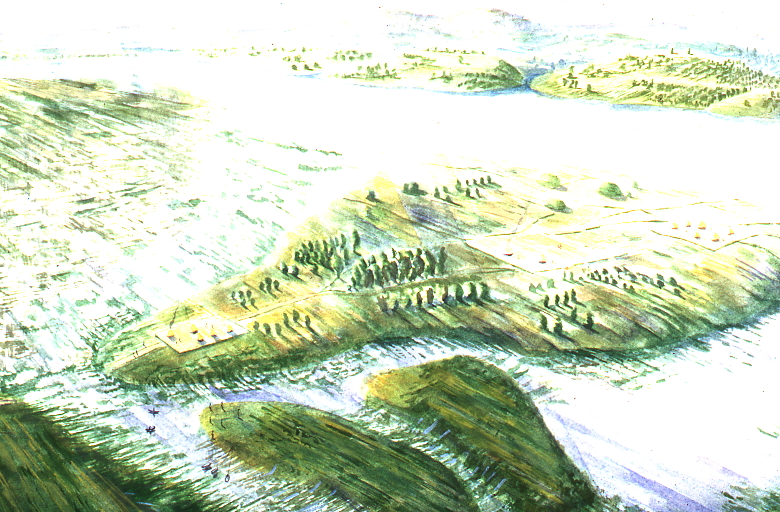
View of London from the SE as it might have looked before the Roman Invasion
Tower Hill Underground 3pm Saturday 5th October 2024
The walk looks into the evidence for a prehistoric London and tells the story of the coming of the Romans in AD43
The walk is led by Kevin Flude, a former archaeologist at the Museum of London.
The walk investigates the City of London before and after the the Roman Conquest. What is the evidence for settlement before the Romans set up town of Londinium? Why did the Romans establish the town on this spot? Who were the early Roman Londoners and what made their choice of site so successful?
The fledgling Town was then burnt down by Queen Boudiccan and her Icenian rebels. We look at the evidence for the Revolt and London’s recovery to became the capital of Britain.
This is a London Walks Guided Walk. Look at their web site for a list of other of their amazing walks.
REVIEWS (from London Walks website) “Kevin, I just wanted to drop you a quick email to thank you ever so much for your archaeological tours of London! I am so thrilled to have stumbled upon your tours! I look forward to them more than you can imagine! They’re the best 2 hours of my week! 🙂 Best, Sue
Myths, Legends & Halloween Virtual Walk Thu 8.00pm 31st October 2024
The walk tells the story of London’s myths and legends and the Celtic origins of Halloween. The virtual walk is led by Kevin Flude, a former archaeologist at the Museum of London, who has an interest both in the archaeological evidence as well as the myths and legends of London’s origin.
The virtual walk will tell the story of a selection of London’s Myths and Legends, beginning with the tale of London’s legendary origins in the Bronze Age by an exiled Trojan called Brutus. Stories of Bladud, Bellinus, Bran and Arthur will be interspersed with how they fit in with archaeological discoveries.
As we explore the City we also look at the origins of Halloween celebrations and how they may have been celebrated in early London.
The virtual route starts at Tower Hill, then down to the River Thames at Billingsgate, to London Bridge and Southwark Cathedral, to the Roman Forum at the top of Cornhill, into the valley of the River Walbrook, passed the Temple of Mithras, along Cheapside to the Roman Amphitheatre, and finishing up in the shadow of St Pauls.
This is a London Walks Guided Walk. Look at their web site for a list of other of their amazing walks.
REVIEWS (from London Walks website) “Kevin, I just wanted to drop you a quick email to thank you ever so much for your archaeological tours of London! I am so thrilled to have stumbled upon your tours! I have wanted to be an archaeologist since 1978 at the ripe old age of 8 years,… I was told for years that I could not be an archaeologist [for any number of reasons, which I now realise are completely ridiculous!], so I ended up on a different course of study. And now at the age of 50, it is my one great regret in life. So, I am thoroughly enjoying living vicariously through you, the digs you’ve been on, and the history you bring to life for us! British archaeology would have been my specific area of study had I pursued it. ?? Thank you SO MUCH for these! I look forward to them more than you can imagine, and honestly, I’ll be sad if you get them down to 1.5 hours! They’re the best 2 hours of my week! 🙂 Best, Sue
Roman London – Literary & Archaeology Walk Sat 11.30 am,9th November 2024
London: 1066 and All That Walk Sat 2.30pm 9th Nov 24
Old illustration Chapel of St Johns Tower of London
Sat 2.30pm 9th November 2024 Blackfriars Underground Station The Archaeological Walk that explores the City of London at the end of the Saxon period and at the beginning of the Norman.
The Norman Conquest of 1066 defines Britain in a way unmatched by any other event. And on this walk we explore the London that William conquered and how he changed England for all time.
London was England’s most important City, but not yet the capital. It was crucial to William in his attempt to conquer the realm. But his army could not fight their way across the heavily defended London Bridge after the defeat of the English King, Harold, at the Battle of Hastings.
The future of England was in the balance as he ravaged the country seeking a way across the river and to persuade the English that resistance was hopeless.
Once across the river, the English leaders sued for peace, and William was crowned at the newly built Westminster Abbey. The English hoped for a strong King who would rule with the people. But William began by building Castles to oppress the Citizens, and soon swept aside the English Aristocracy and establishment and replaced them with the Conquerors.
This was a death blow to Anglo-Saxon culture, but the City made an accommodation with the new regime and the first Lord Mayor of London was an Englishman.
So, on the walk we explore the Late Saxon City of London, and how it changed in the last 11th and 12th Centuries.
Walk is by Kevin Flude, former Archaeologist at the Museum of London Kevin
London Before London – Prehistoric London Virtual Walk
Sat 7.30pm 9th November 2024
View of London from the SE as it might have looked before the Roman Invasion
An exploration of London before the foundation of Londinium
It was long thought that London was founded by a Trojan Exile in the Late Bronze Age. But historical analysis and archaeological excavation gradually demoted the idea to a myth.
On this tour we explore what was in the London area before the Romans. We begin at Heathrow and tour Greater London for evidence from the Paleolithic to the invasion of the Emperor Claudius.
We concentrate on the period since the introduction of farming, and bring together evidence for the prehistoric Kingdoms that controlled the area on the eve of the Invasion. We look for henges, barrows, hill forts, hut circles and look at genetic evidence for identity of prehistoric Londoners. The tour will end in the City.
This is a London Walks event by Kevin Flude, ex Museum of London Archaeology and Museum Curator
The Decline And Fall Of Roman London Walk Sat 11.30am 23rd November 24 Jane Austen’s London Sat 3.00 pm 23rd November
Christmas With Jane Austen Virtual London Tour Mon 9 Dec 24 7.30pm
We look at how Jane Austen spent Christmas and at Georgian Christmas traditions and amusements.
“It is a truth universally acknowledged, that a Jane Austen devotee in possession of the good fortune of a couple of free hours must be in want of this virtual walk.”
This is a special walk, which looks at the traditions of Christmas during the Regency period and how Jane Austen might have celebrated it. It will give some background to Jane Austen’s life and her knowledge of London. We used her novels and her letters to find out what she might have done at Christmas, but also at how Christmas was kept in this period, and the range of ‘Curiosities, Amusements, Exhibitions, Public Establishments, and Remarkable Objects in and near London available to enjoy.
This is a London Walks Guided Walk by Kevin Flude, Museum Curator and Lecturer.
Reviews: ‘Thanks, again, Kevin. These talks are magnificent!’ “1 am glad to see there are a few more virtual presentations scheduled, they are wonderful!
Dickens London. Life, Work and Christmas Virtual Tour Mon 16 Dec 24 7.30pm
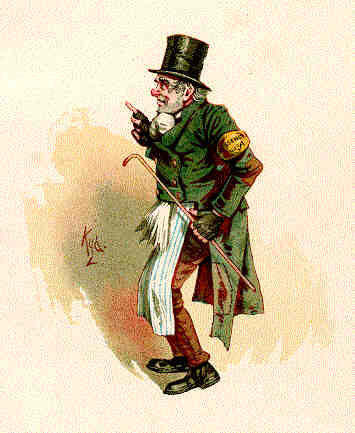
Trotty Veck 1889 Dickens The Chimes by Kyd (Joseph Clayton Clarke)
A Virtual Tour of Dickens London with a dash of Dickensian Christmas
The Virtual Tour weaves an exploration of Victorian London with Dickens London Life and writing. On the tour we have a look at London at Christmas and the contribution Dickens made to it by his Christmas Books
Dickens writing always has a moral element as exemplified by his Christmas Books. ‘Christmas Carol’ was based on redemption and his second great Christmas Book ‘The Chimes’ on the renewal that the New Year encouraged.
We start in Southwark, visit sites associated with the Christmas Books and others and end at Staple Inn with the Christmas Book ‘The Haunted Man’.
The London Winter Solstice Virtual Tour Sat 7:30pm 21 Dec 24
We explore London’s History through its celebrations, festivals, calendars, and almanacs of the Winter Solstice
Winter Solstice festivals have been a time of review, renewal and anticipation of the future from time immemorial. The Ancient Britons saw the Solstice as a symbol of a promise of renewal as the world entered bleak mid winter. The Roman season was presided over by Janus, a two headed God who looked both backwards and forwards, and Dickens based his second great Christmas Book on the renewal that the New Year encouraged.
We look at London’s past to see where and how the Solstice might be celebrated. We also explore the different Calendars – the Pagan year, the Christian year, the Roman year, the Jewish year, the Financial year, the Academic year and we reveal how these began. We look at folk traditions, Medieval Christmas Festivals, Boy Bishops, Distaff Sunday and Plough Monday, and other London winter traditions and folklore.
At the end we use ancient methods to divine what is in store for us in 2023.
Here are some fascinating links with a seasonal theme, and at the end of the post the December posts I have reviewed, revised and reposted. And to remind you, I have a Winter Solstice Virtual Tour on Friday, and a Jane Austen Virtual Tour taking place on Saturday.. Follow the links on the www.chr.org.uk to find out more or book.
The wintery landscapes of Utagawa Hiroshige | with Alfred Haft |
This is a short video of an event held for British Museum members. It’s on YouTube, so it should be available for non-members. It shows, with some animation, beautiful snowy landscapes by the great Hiroshige. It is 12 minutes long.
Santa Claus’ Elitist Origins
I came across Ben Tumin’s conversation with Professor Stephen Nissenbaum on Santa Claus’ Elitist Origins in Tumin’s Skipped History Substack posts. Nissebnaum wrote a highly rated book called the ‘Battle for Christmas’, which pointed out that, before the 19th Century, Christmas was largely outdoors, and a riotous time of debauchery, gluttony, and drunkenness. The ruling classes managed in the 19th Century to change this for a quieter, indoor, family-based experience. Well worth a listen.
Saturday 23rd December. Walk at 2.30pm, Virtual Tour at 7.30pm
We look at London Austen’s London and at how Jane Austen spent Christmas and at Georgian Christmas traditions and amusements.
Here is a short podcast about the walk and Regency Christmas traditions.
“It is a truth universally acknowledged, that a Jane Austen devotee in possession of the good fortune of a couple of free hours must be in want of this virtual walk.”
This is a special walk, which looks at the traditions of Christmas during the Regency period and how Jane Austen might have celebrated it. It will give some background to Jane Austen’s life and her knowledge of London. We used her novels and her letters to find out what she might have done at Christmas, but also at how Christmas was kept in this period, and the range of ‘Curiosities, Amusements, Exhibitions, Public Establishments, and Remarkable Objects in and near London available to enjoy.
This is a London Walks Guided Walk by Kevin Flude, Museum Curator and Lecturer.
Review: ‘Thanks, again, Kevin. These talks are magnificent!’
You may have been following my ramblings on my attempts to work out Amsterdam’s history from maps and tramping the streets. But you might want to find out more about the History of Amsterdam from your armchair. So, this is my exploration of virtual Amsterdam. But bear in mind the ideas here can be used in any town exploration.
But if you have only a little time, here are my best tips for exploring Amsterdam online.
First, below is a very good 15 minute introduction to Amsterdam history on YouTube.
Encyclopedia Britannica | Britannica – https://www.britannica.com/place/Amsterdam
I quite often edit Wikipedia pages when I come across entries which are out of date or wrong. The quality of information can be variable but mostly its good. And reading the Amsterdam Page, as long as you are prepared to follow up some of the hypertext links, such as to the ‘Canals of Amsterdam’ or the ‘Defence Line of Amsterdam’ you can get a good idea of the history. But Wikipedia, however great for humanity, is none-the-less aspiring to be an encyclopedia, and not either literature, travel-writing, non-fiction nor entertainment. It is certainly not a virtual tour, and it takes quite a lot of timeto get a good overview of the City and it is not really something I ever do for ‘enjoyment’.
Encyclopedia Britannica has been published exclusively online since 2016 and it is a better read than Wikipedia, less rambling and more to the point. Definitely a better starting point, but still a long read, and, again, something I can’t remember reading with pleasure.
YouTube
There are a number of video lectures/talks/tours on YouTube for free and I will just mention a few – please let me know if you find anything else interesting and I will add it here.
I’ve already linked to the 15 minute ‘A Quick History of Amsterdam (That Dam Guide), which is well put together and gives a good summary. Not enough about the walls in my opinion, and probably a little too much about the major drivers of historical change and not enough about the specific details of what made Amsterdam the town. That is probably asking too much for a 15 minute introduction. And, in effect, this guide is an advert for ‘That Dam Guide’ and the author’s guided virtual tours. He does live streamed 1 hour Amsterdam Tours (none on in March) Very good production values too.
Searching for ‘Amsterdam Virtual Tour’ brings me to the: The Amsterdam Drone Tour which gives a largely drone-eye view of Amsterdam, with slightly annoying music and not enough captions to really feel you are getting to know streets, areas and districts, but it does give an interesting ‘overview’. It is 9 minutes long.
A Free Virtual Tours Amsterdam is an interesting intro to Amsterdam in two 5 minute videos. It does give you some more of, what I would call, ‘structural’ analysis of the history and development of Holland/Amsterdam. It is, to an extent, complimentary to ‘That Dam Guide’. I should not be mentioning it as the ‘Free Walks’ groups are deadly rivals to ‘London Walks’, who I do my walks for. We have a fixed fee for a professional guide, while the Free Walks say they are free but put a lot of pressure on to get customers to pay up a reasonable amount (or so we think!).
Another ‘Tips based’ guide on YouTube is Tim, who gives a 20 minute free walking tour. This one is more of a real virtual walk, as it is a filmed guided walk, with all its imperfections. But, very good in terms of authenticity.
Google Earth
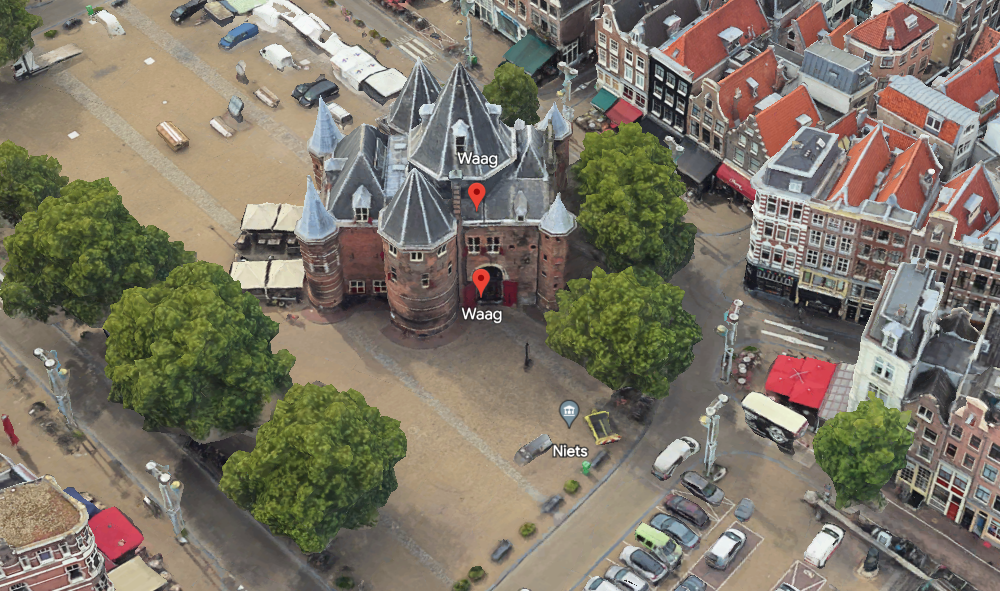
This uses the Google Earth satellite view of Amsterdam, with pins marking many, but by no means all, places of interest. Each place has a little information, and often, a link to Wikipedia. Clicking on the ‘more information’ tab brings up further, and sometimes an extensive number of pictures. There is also a paper aeroplane tab, and this brings up a virtual fly-past which is fun. I was looking for a tab for the Waag, which is one of the remaining gates of old Amsterdam, but I cannot find a tab for it. Nor a search button, which hinders the usefulness of the system. But it is definitely fun!
I have just gone back to Google Earth, found the search icon on the left of the screen, overflown my house, and then searched for the Waag, which I found and here it is! Follow the link to do the fly-past.
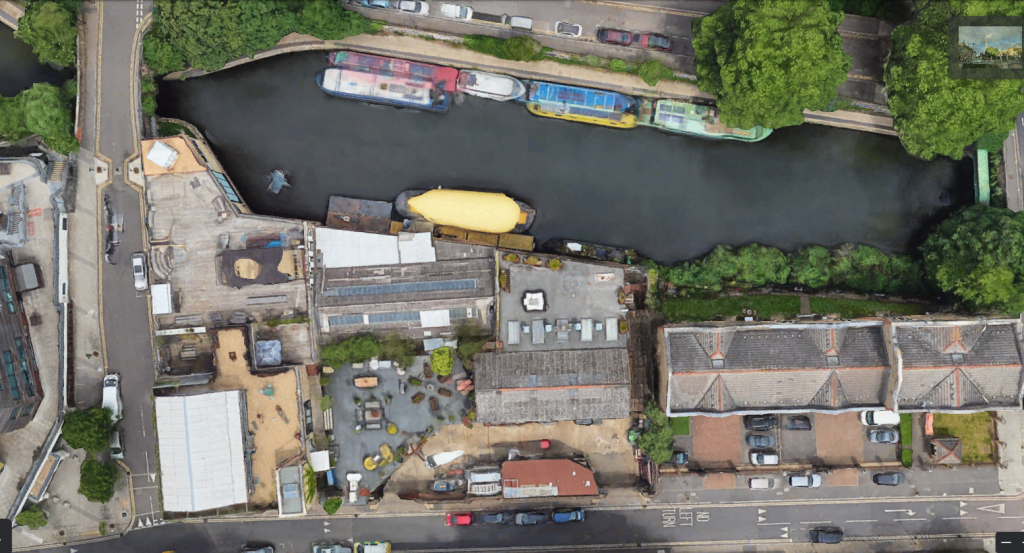
Google Earth view of the Waag, City Gate, Dissection Theatre, and now a Restaurant.My house, on google-earth, to the south of the Canal is a strip of Grass, I live at the extreme left of that strip of grass.
I would definitely use this to explore, and, if I were to be giving a guided tour of Amsterdam I would, indeed, use it in advance to consolidate my knowledge. It has the advantage that it brings to your attention things you would otherwise not know about, and gives a really clear idea of what the place is and what its environment looks like. For example it brought to my attention the houseboat museum, which is now on my must-see bucket list, previously unknown to me.
By the way, I found the Google Earth tour on this blog: www.asthebirdfliesblog.com which has other interesting tips for exploring virtual Amsterdam.
Guided Walks Apps
I thought these didn’t really count as they are designed to give a smart-phone based on location walking tour and not an armchair guide. GPSmycity.com is linked to GPS and the user can either access other people’s guided walks, or create their own. I tried it out in Stratford-on-Avon and found it remarkably easy to do. You find the places you want on the tour, and the app ‘sucks in’ the data and pictures from Wikipedia. So within a few minutes you have, a credible, guided tour and a GPS route around the City. In fact, I found it most useful just for creating my own walking routes – much easier than Google, or CityMapper, Just put in the stops and soon your SmartPhone will be dictating your route to you!
But you don’t have to access it via an app, in fact, if you are not going to Amsterdam, its better to visit the web site, and you can go to this link gpsmycity.com, scroll down and you will see a map, and the text for all the stops on the tour. Quite a good introduction, although not inspired. (Its possible you might need to login but I’m not sure as I do have a login.)
Another example is izi-travel, but this provides free and paid for audio guides. Again designed for a smart-phone app to guide around the location, but it can also be accessed on a computer at home. So here is the link to the Amsterdam tour – there are several to choose from.
I would definitely use gpsmycity on tour – I didn’t because I dropped my phone in the oily bilge of my boat, and it went insane for about 2 hours, and reset a lot of my settings, and deleted a few of my apps, including gpsmycity, before deciding to stage a recovery. Izi-travel I have had loaded for several years, and never used, but now listening to it I might have used it like a radio show to introduce me to Amsterdam. I’m also wondering about making my very many guided walks into virtual guided walks on apps like this.
Museum On Line Tours
The Amsterdam Museum should be the museum I would be pointing to for a great on line tour about Amsterdam’s History but it has a temporary Web Site while it works on opening a new Museum. The web has interesting stuff on it, and has the collection online, but nothing that pulls it together like an exhibition, or really gives you much of an introduction to the history of Amsterdam which is very disappointing.
The Van Gogh Museum, by contrast, has an excellent online collection which can be seen, as if a virtual exhibition. But this is much easier for an art museum than a history museum, for two main reasons: the art works are more immediately visually appealing that many objects in Museum Collections which often require context to understand; and art collections are much smaller than history museum collections and so easier to see as a ‘tour’.
Summary
There is nothing to beat walking around a City in the real world. There is nothing, yet, that even comes close to it. Smart Phone tours offer an easy way to tour the physical city, but its difficult to find content on line which provides a really enjoyable armchair online substitute.
The way I explore a City, after finding the walls of course(!), is to read a good guide book. Then buy a good non-fiction history of the city, and search the second hand bookshops for histories/guides/maps and that very special book that noone has heard of and no one knows about which gives unique insights/information that a good guided tour needs. Finally, I try to read a famous novel set in the City, or if in need of light relief, find a local fictional detective.
360 degree Image of the Herb Garret (4th December 2000) at the Old Operating Theatre Museum. Click on the VR label to go full screen, and use the mouse to navigate.
Digital Heritage Is a subject I had a very early interest in. My, very minor claim to fame, is that I set up the Museum of London’s and the Victoria and Albert’s first computer systems. I then co-authored one of the earliest hyperlinked digital histories (on the history of London), and set up the first web sites for various museums and organisations such as the Old Operating Theatre Museum, Brunel Engine House, Garden History Museum, Royal Bethlem Museum etc..
But that was a long time ago so long that most of the Museums have changed their names! Despite the desire to do so, I have not had the time to keep up with developments.
So, I’m going to spend a little time investigating online heritage sites, and at the same time, maybe, look back at my part in the history of digital heritage.
Firstly, the principles of the study. Early on I came to the conclusion that the Internet should allow access to Museums for all those people who could not afford, or did not have the time, to visit in person. So, I’m looking for online/virtual visits that have something about them almost as good as a physical visit. Secondly, I’m looking for online exhibitions that provide an enjoyable experience that works in a similar way to a real exhibition. This means for me that the technology does not get in the way, and is not too complex to access and use. I also have an interested in digital guided walking tours.
I must admit that 40 years after I began to see the potential in digital I rarely see virtual visits or exhibitions that I want to spend time with. When I use websites for data and information, which I do all the time. I search, I find, I read but I don’t often linger for pleasure and. I rarely go back.
Yes we have Virtual Reality, Augmented Reality and the Metaverse, but they don’t really impact positively on my experience of heritage, history and museums. This might well be because I haven’t looked very hard, or spent much time on the subject in recent years, or because I don’t enjoy digital experiences that much, But, I’m going to have a good look around to see what is on offer, and I hope you will join me.
My starting point is the Old Operating Theatre Museum web site. I was in charge of the Museum for 30 years from the mid 80s onwards. In the early days of my management of the Museum I set up a very early web site designed to give those who could not visit a real idea of the Museum. This was achieved by the usual set of information pages but also with 360 degree annotated panoramic photos of the museum spaces linked together. This gave a simple and informative tour of the museum. which was easy to use, did not take long to see and did not depend on complicated technology on the part of the user. Later we added an online database of the collection to give access to the collection.
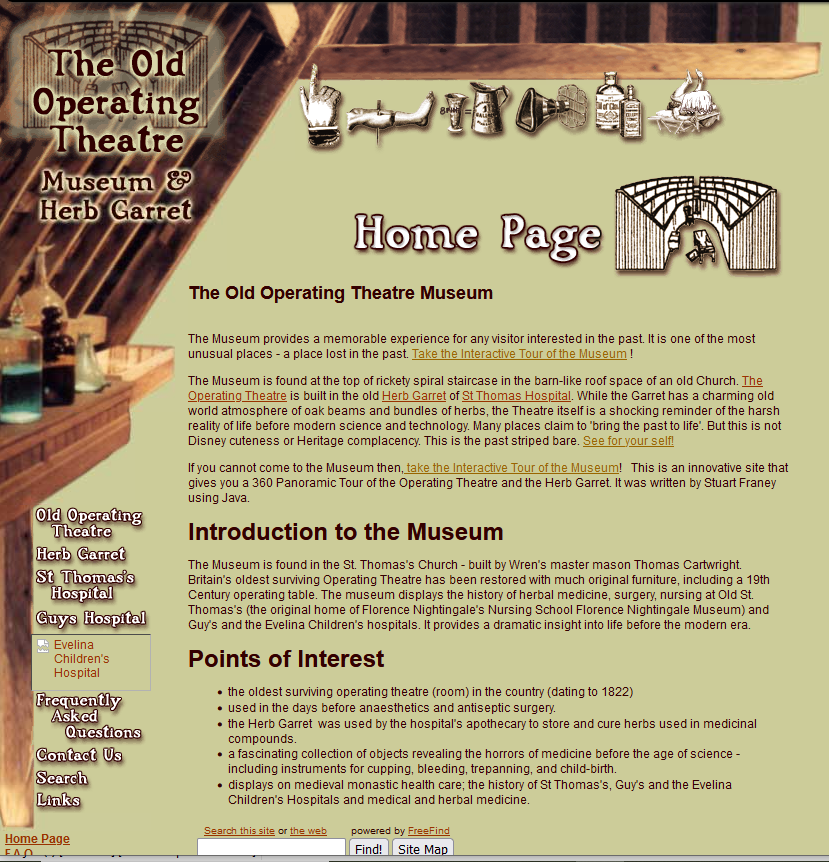
Thanks to the Wayback Machine – which is an amazing internet archive, no the internet archive, which archives old web sites, I have been able to retrieve a version of the site, dated to 2000AD so you can have a look at it. As you will see below it is very wordy but I think a really nice design by Highway 57 and Chris Sansom, who is also a composer, and now heading up an innovative jazz band called ‘Perfect Stranger’ .
Unfortunately, good though the Wayback Machine might be it does not have the technology to show the 360degree panoramas. So to get an idea of how they worked please have a look at the image at the top of the page, and imagine the addition of ‘hotspots’ which you could click to see further information or click through to the next panoramic view. Please note this is the second iteration of the site and so far I have been unable to find my original self-designed site.
The Old Operating Theatre Museum – www.thegarret.org.uk in 2000, retrieved from the Wayback Machine
So, I think the interactive tour of the museum gave a pretty good, simple and enjoyable tour of the Museum. I should say that the Old Operating Theatre Museum is one of the most amazing Museums. It is in the roof space of a Church and was a store for herbal medicines, and an operating theatre/emergency room for female surgical patients used before anaesthesia and antiseptic surgery.
Its now 23 years later. The website has been completely redesigned since I left, and it opens with a very good video that gives an excellent introduction to the museum. Click on the link to have a look at the video on the home page @ https://oldoperatingtheatre.com/
Inside the website is a huge amount of information, some very good videos, there is a ‘virtual tour’ which does not work on my browser for some reason, interactive games and a clickable image to explore the Old Operating Theatre itself. Its use of media is much, much better than in the 2000s, and the information is composed now into interesting stories rather than dry information. So a pretty good job of putting the Museum’s stories to the public in an engaging way. I would say however, that perhaps it was a little easier to find out the basic information about the Museum, the Operating Theatre, and the Herb Garret before than it now is. But you can ignore that as my vanity.
I have chosen one of the stories to include here and this is an object that I bought at an auction for the Museum. I remember the excitement well, and the great interest in the medicines that were included in the medical chest.
I am working on a new season, and these are the walks for the first six months – but more to come.
The Archaeology Of London Walk Sunday 2nd April 2023 11:15 Exit 3 Bank Underground Station To book Jane Austen’s London Sat 2.30 pm 2nd April 2023 Green Park underground station, London (north exit, on the corner). To book Chaucer’s Medieval London Guided Walk Aldgate Tube Sunday 16 April 2023 11.30pm To book Chaucer’s London To Canterbury Virtual Pilgrimage Sunday 16th April 2023 7.30pm To book The Peasants Revolt Anniversary Guided Walk Aldgate Underground Sunday 11th June 2023 10.45am. To book The Peasants Revolt Anniversary Virtual Tour Sunday 11th June 2023 7.30pm To book
View of London from the SE as it might have looked before the Roman Invasion
I have just finished a Guided Walk called ‘London Before And After The Roman Invasion’. Its the first time I’ve done this particular walk and it was very interesting because it focussed a lot of recent changes in ideas about early London. I decided to do the walk as wanted to refresh my knowledge of prehistoric London and the early Roman period.
So, when I first came to London as a young Archaeologist, we were engaged in a series of ground breaking archaeological excavations that completely revolutionised ideas about London.
So, old ideas were:
There was a prehistoric London
The City came into being as a Legionary Fortress built when the Roman Army was waiting for the Emperor Claudius to join them for the attack on the capital at Colchester.
A formal road system was set up on Cornhill, with the North/South spine being the road north from London Bridge
Southwark was a suburb on the other side of the bridge
The town grew steadily and eventually spread over to the western hill – Ludgate Hill
A fort was built in AD 120 then, c200AD, the Walls were built covering a large area because of the expanding City
The Romans left and everything went to hell in a hand cart.
The new set of ideas were:
People began to doubt the prehistoric London town in the early 20th Century, but it was completely dismissed by the 1970s and London was founded here simply because it was the best/only place for the Bridge and a superb site for the road junctions and Port.
By the late 1970s evidence showed that London did not really get started till about 50AD, so the idea that London was a military foundation following on from a Legionary Fortress was dismissed. Instead, it was a town of civilians established by merchants taking advantage of the Bridge, the Road Junctions, and the Port.
The formal road system was later than 43AD and Londinium was soon on both hills
Southwark was rather more like South Londinium than a secondary suburb.
Londinium had spread all the way to the later site of St Pauls by AD60 and its growth was very rapid. But decline set in as early as the 2nd Century. It struggled in the 4th Century and at the end of the Roman period there were not many people in it.
The area inside the 200AD wall was not densely crowded, and the large size of the walled area was provably due to military decisions about the best defensive alignment for the wall.
Roman London was already shrunken well before the end of the Roman presence in Britain.
Continued excavations created more data and the following discoveries were made
The foundation of London was dated to 48AD after dendrochronology dating of a wooden drain next to the main East West road through Roman London.
A Fort was built soon after the Boudica’s destruction of London in AD 60, just East of London Bridge
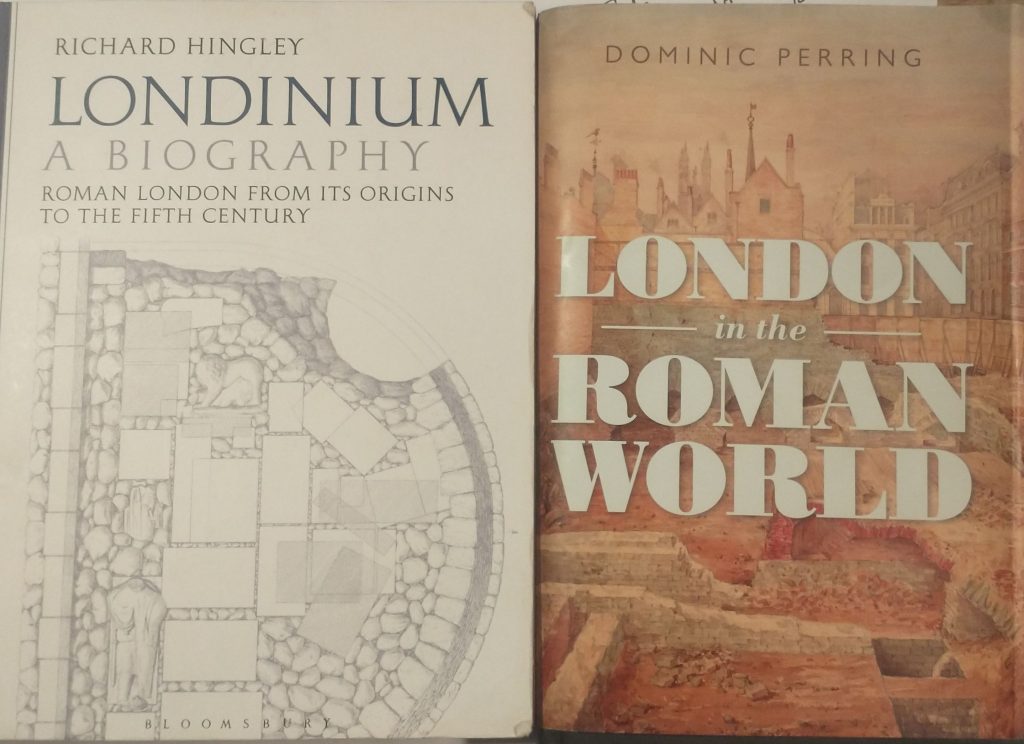
These two books were published and the new certainties about Roman London began to dissolve or resolve. Not yet sure which!
Lets have a look at those 7 points again:
‘There was a prehistoric London’ – Richard Coates in 1998 draw attention to the fact that the name Londinium is pre-Roman in origin and suggested it meant ‘Settlement by the flowing River’ Richard Hingley drew attention to the large amount of fine metal work in the river, and suggested a conclusion that , although there may not have been a prehistoric town before the Roman, the area was very important in the Iron Age, and suggest it was a ‘ritual landscape’ possibly associated with burial. Maybe, this might have been a factor in the Romans choosing the site to establish the crossing/town? Last year an excavation north of Liverpool Street found evidence of large scale feasting in the Late Neolithic leading some people to suggest London was an important ritual site before the coming of the Romans Dominic Perring dismisses ideas that it was an important area before the Roman period, and notes that most of the metal work is found further to the West. More about these discoveries in my post here:
Dominic Perring cites evidence at three sites on Cornhill which suggests that London was indeed set up as a temporary Legionary Fortress in AD43, and suggests the first Bridge was a Pontoon Bridge. And therefore indeed built when the Roman Army was waiting for the Emperor Claudius to join them for the attack on the capital at Colchester. It was immediately dismantled.
A formal road system was indeed set up on Cornhill, with the North South spine being the road north from London Bridge. This was set up in AD48, possibly still a supply base but began its transformation into a proper town c 52AD.
Southwark was much more than a suburb on the other side of the bridge and had important formal buildings, possibly including the residence of the Procurator, after the Governor the most important person in Britain.
The town grew quickly and soon spread over to the western hill – Ludgate Hill and the phases in this spread are detailed in Perring’s book.
A fort was built in AD 62 which continued to about AD 85, and was possibly replaced immediately by a precursor to the Fort in the NW corner of the City near the old Museum of London and replaced in stone in AD 120 then, in c200AD, the Walls were built covering a large area because of the military requirements.
I haven’t yet read the later London part of Perrings book, but he suggests that London develops when the Governor and the Emperor is involved in conquest, passification or development, and without government intervention London declines, so it develops in fits and starts and eventually the fits are more important than the starts and so it declines to virtually nothing.
Any way, congratulations to Dominc Perring who has created a really detailed description of the development of London. I’ve had to rethink quite a lot of my ‘old’ ideas and this is a great synthesis of the archaeology of London particularly over the last 50 years.
I’m sure I won’t agree with it all but I love the detail!
Sat 2.30 pm Green Park underground station, London (north exit, on the corner)
on the following dates in 2023: 2 April. 11 June. 9 September. 12 November.
And a Special Christmas version on 23 December 2023
An exploration of Mayfair, the centre of the London section of Sense & Sensibility and where Jane came to visit her brother
“It is a truth universally acknowledged, that a Jane Austen devotee in possession of the good fortune of a couple of free hours today must be in want of this walk.”
People associate Jane Austen and her characters with a rural setting. But London is central to both Jane Austen’s real life and her literary life. So, this tour will explore Jane’s connections with London and give the background to Sense and Sensibility, a good part of which is based in this very area. We begin with the place Jane’s coach would arrive from Hampshire, and then walk the streets haunted by Willougby; past shops visited by the Palmers, the Ferrars; visit the location of Jane Austen’s brother’s bank and see the publisher of Jane’s Books. The area around Old Bond Street was the home of the Regency elite and many buildings and a surprising number of the shops remain as they were in Jane Austen’s day.
This is a London Walk Guided Walk lead by Kevin Flude
We look at how Jane Austen spent Christmas and at Georgian Christmas traditions and amusements.
“It is a truth universally acknowledged, that a Jane Austen devotee in possession of the good fortune of a couple of free hours must be in want of this virtual walk.”
This is a special walk, which looks at the traditions of Christmas during the Regency period and how Jane Austen might have celebrated it. It will give some background to Jane Austen’s life and her knowledge of London. We used her novels and her letters to find out what she might have done at Christmas, but also at how Christmas was kept in this period, and the range of ‘Curiosities, Amusements, Exhibitions, Public Establishments, and Remarkable Objects in and near London available to enjoy.
This is a London Walks Guided Walk by Kevin Flude, Museum Curator and Lecturer.
Review: ‘Thanks, again, Kevin. These talks are magnificent!’