William Shakespeare by Martin Droeshout from the 1st Folio
By tradition, Shakespeare was born on St George’s Day April 23rd 1564. He died on the same day in 1616 at age 52. Cervantes died on the same day.
Shakespeare’s death date is given by the burial register at the Holy Trinity Church, Stratford on Avon where he was buried. His baptismal record also survives at the same church and is on April 26th 1564. So, we don’t actually know when he was born, but christening were held soon after birth for fear of the high infant mortality rates, so 23rd April has been assigned to be Shakespeare’s birthday.
Taken to the chamber
Anne Shakespeare would have ‘taken to her chamber’ about four weeks before the due date. The windows or shutters were fastened, as fresh air was thought to be bad for the birthing process. Female friends and relatives came to visit; the room would be decorated with fine carpets, hangings, silver plates and fine ornaments. It was held that external events could influence the birth, any shocks or horrors might cause deformities and anomalies, so a calm lying-in room was clearly a good idea.
When labour began, female friends, relatives, and the midwife were called to help out. A caudle of spiced wine or beer was given to the mother to strengthen her through the process. Today, the maternal mortality rate is 7 per 100,000. An estimate for the 16th Century is 1500 per 100,000. So most women would have heard of or attended the birth of a women who had died during or following children birth. There were also no forceps. So if a baby were stuck and could not be manually manipulated out, then the only way forward was to get a surgeon to use hooks to dismember the baby. This was the only way to save the life of the mother. Doctors were not normally in attendance, but could be called in emergency,
Swaddling
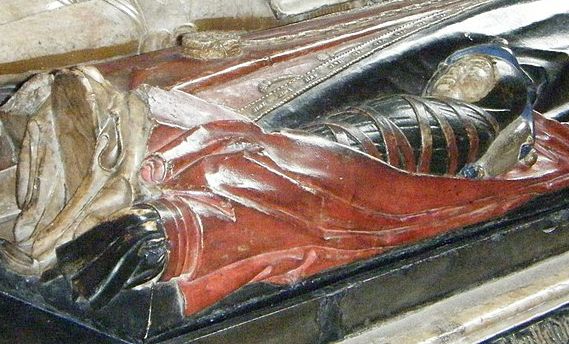
Detail of tomb of Alexander Denton and his first wife Anne Willison, and her baby dressed in swaddling clothes Photo Wikipedia Hugh Llewelyn
Immediately after washing, the baby was swaddled. The swaddling was often very tight and could affect the baby’s growth. Also, it might have affected the learning process. The free movemenb of hands and feet are now considered important in the early learning process. Swaddling lasted eight to nine months, and only went out of fashion after Jean Jacques Rousseau wrote against the practice.
Christening & Registration
Puerperal fever killed many women even after successful childbirth, for example Queen Jane Seymour who died after 5 days. During these dangerous early days, the mother was kept in a dark room. Perhaps three days after birth, friends were invited to celebrate ‘upsitting’ when the mother was no longer confined to bed. This is when christening would take place. Edward VI was christened to a huge audience in the chapel at Hampton Court three days after his birth.
Licensed midwives could baptise newborn babies provided they used the correct wording and informed the Church. This allowed the registration of the birth to be properly reported. Thomas Cromwell was responsible for the law in 1538 which insisted on a parish register to record weddings, christenings, and funerals. The law was reaffirmed by Queen Elizabeth in 1558. Registers had to be stored in a locked chest in the Church. In 1597, the records had to be on parchment not paper. In 1603 the chest had to have three locks! Since writing this I have realised the significance of the three locks. In St Eadburga’s Church in Broadway in there is a locked box for alms, and it has three locks too. This was so that it could only be opened when all 3 Church Wardens were present.
If the christening were in the church, the mother might not be there as she was expected to stay in her chamber for another week or so. A week or a few weeks later, the mother would be ‘churched.’ This was a thanks-giving ceremony. Puritans did not like the idea as it might be confused with a purification ceremony.
Breastfeeding
Breastfeeding would last a year or so but, buty high status women choose to use a wet-nurse. They went to some effort to find a suitable wet nurse. It was believed that the quality of the breast milk was important for the babies’ development both physically and temperamentally. Poor children who lost their mothers were unlikely to survive. For without breast milk, the baby would be fed pap – bread soaked in cow’s milk.
1016 – Edmund Ironside succeeded his father Æthelred the Unready as King of England. Unfortunately, Edmund dies soon after dividing England with Danish King Cnut. Subsequently, Cnut takes over the entire country.
1661 – King Charles II crowned in Westminster Abbey. Read my post on John Evelyn’s reaction to the restoration of Monarchy after the the Commonwealth period of Republican Government.
1942 – World War II: German bombers hit Exeter, in what became known as the Baedeker Raids. They were in retaliation for the success of the British bombing of Lübeck, and of Rostock. In the following days the Luftwaffe bombed Bath, Norwich and York. A German official said they would bomb every building with three stars in the Baedeker Tourist Guide. Hitler said the English were: ‘beings with whom you can only talk after you have first knocked out their teeth‘
First published in 2023 and republished in April 2024. On This day added 2026
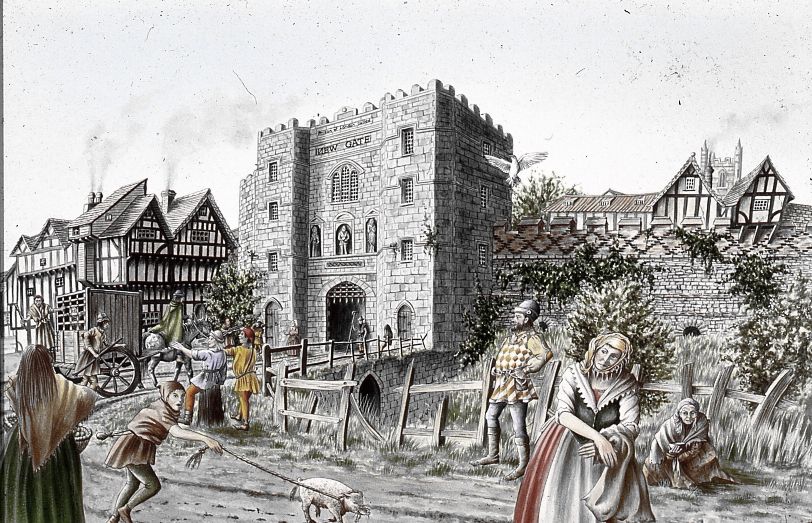
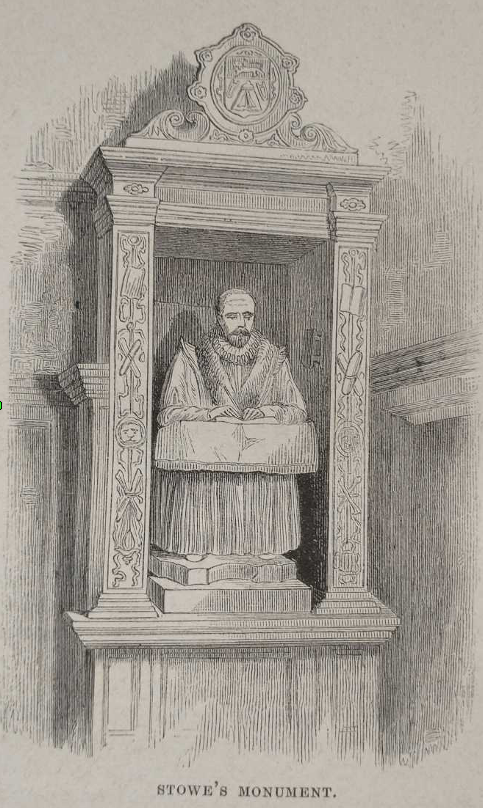
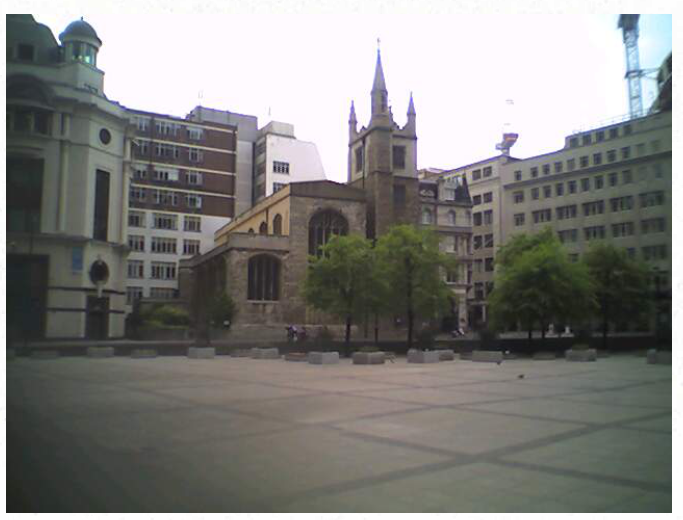
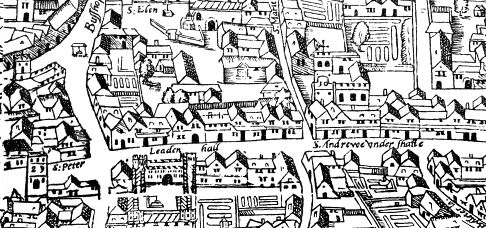
On the corner of Leadenhall Street and St Mary Axe in the City of London is one of the very few medieval Churches that survived the Great Fire of London is 1666. It was sheltered by the firebreak that was the Leadenhall, a big market building made of stone. This is where the great London historian John Stow is buried. His Survey of London is one of the best sources for Medieval and Tudor London. Every three years, there is a commemorative service and his quill is changed. Last year it was on the 22nd April. The next is due in 2027, date yet to be announced. The Lord Mayor attends, and it is organised by Stow’s Guild – the Merchant Taylors.
John Stow records that his father returned to his home at Austin Friars one day to find his house had been moved. He had no warning, nor payment for the loss of land. He had the misfortune to live adjourning the property of Thomas Cromwell. This is what Stow wrote:
‘My father had a garden there, and a house standing close to his south pale; this house they loosed from the ground, and bare upon rollers into my father’s garden twenty-two feet, ere my father heard thereof; no warning was given him, nor other answer, when he spake to the surveyors of that work, but that their master Sir Thomas commanded them so to do; no man durst go to argue the matter, but each man lost his land, and my father paid his whole rent, which was 6s. 6d. the year, for that half which was left. Thus much of mine own knowledge have I thought good to note, that the sudden rising of some men causeth them to forget themselves.’
St Andrew Undershaft
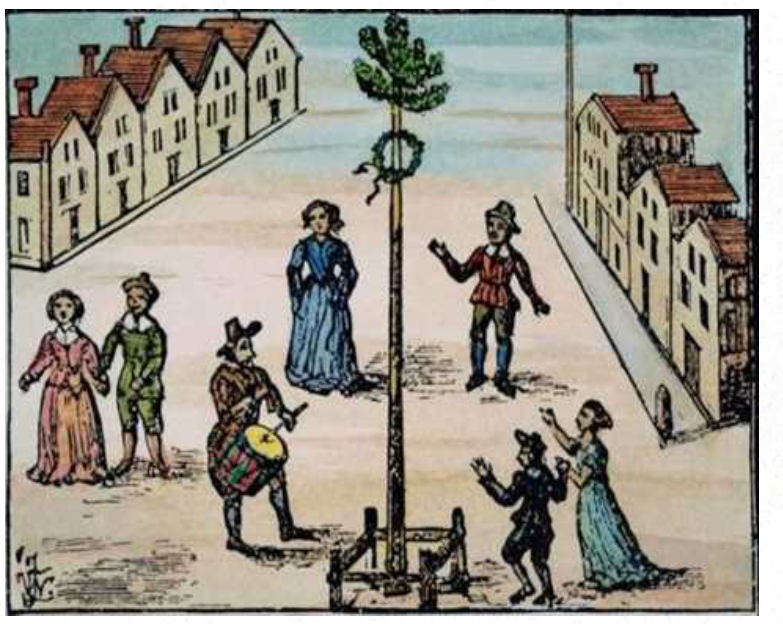
The Church is London’s Maypole Church as it was here the Maypole or the shaft was stored under the eves of the Church. Hence, St Andrew’s sobriquet of ‘Undershaft’. The May Day riot of 1517 put an end to the dancing around the Maypole but the pole itself survived until 1547. Then, in a Puritan riot, the ‘stynking idol’ was destroyed. (see my May Day blog post here for more more details.)
There is also a plaque to Hans Holbein, but no one knows for sure where he is buried. He died in London in 1543, possibly of plague. The present church was built in 1532, but it is first recorded in the 12th Century.
Today is Earth Day. It was set up in 1970. For more information click here.
2016 – On Earth Day the landmark Paris Agreement was signed by 123 countries including the United States, the United Kingdom, and China. The USA is the World’s the second largest emitter. They withdrew from the agreement in 2020, rejoined in 2021, and withdrew again in 2026. Iran has signed it but not ratified it.
First Published on 30th November 2022, Revised 2023, moved to April in 2024, and revised 2025, On This Day added 2026
St Alphage. Church Tower on right, City Wall to left. Photo K Flude
I first came across St Alphage when I was working at the Museum of London. The Museum was built on the High Walk at London Wall. The raised Courbusian Walkway looked down on a ruin of a Gothic Church Tower, almost destroyed during the Blitz. This was St Alphage, a Church dedicated to the Saxon Archbishop of Canterbury. (Alphage is also spelt Alphege or Alfege or Ælfheah.)
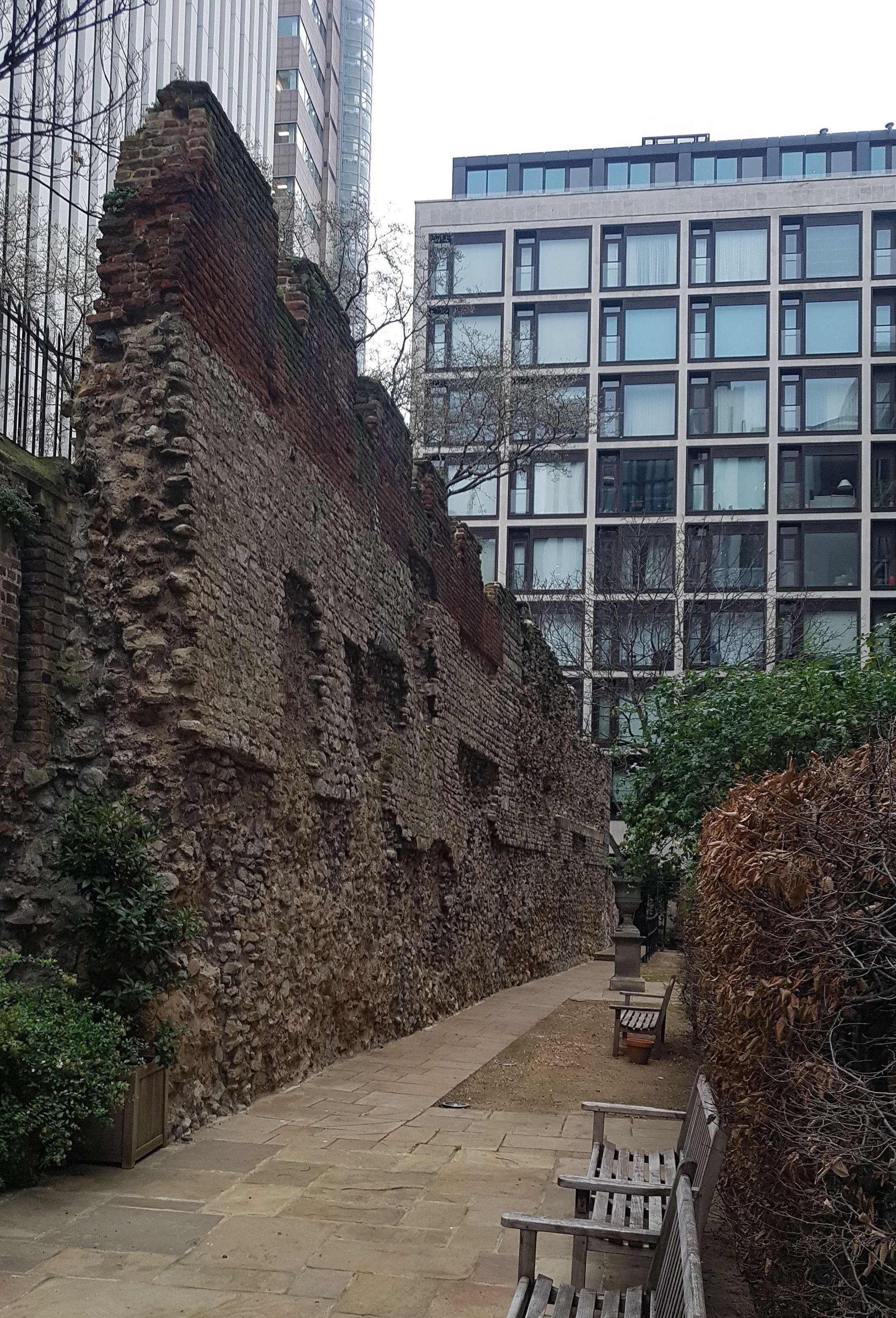
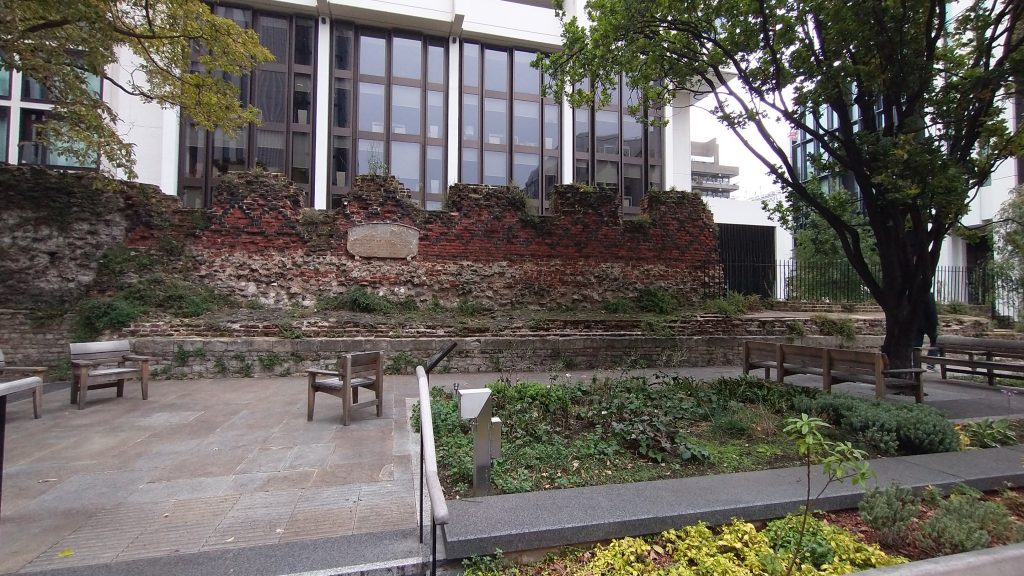
On the other side of the Walkway was the old graveyard of the Church. This preserved one of the very best sections of the old London Wall. Special because on one side its full height was displayed. On the other, the only crenelated bit of the City Wall survived. And the only surviving part of the Wall dating to the War of the Roses.
St Alphage Roman and Medieval WallThe Crennelated Red Brick Section dates to 1477, during the War of the RosesSt Alphage Wall explained on an information plaque.
In the 1980s fellow Museum of London Archaeologist, Paul Herbert and I set up a Guided Walks company (Citisights of London). Our walks started from outside the Museum of London, and so St Alphage formed a big part of our success. It led to Guided Walks and tours being a big part of my life. So, St Alphage, thank you!
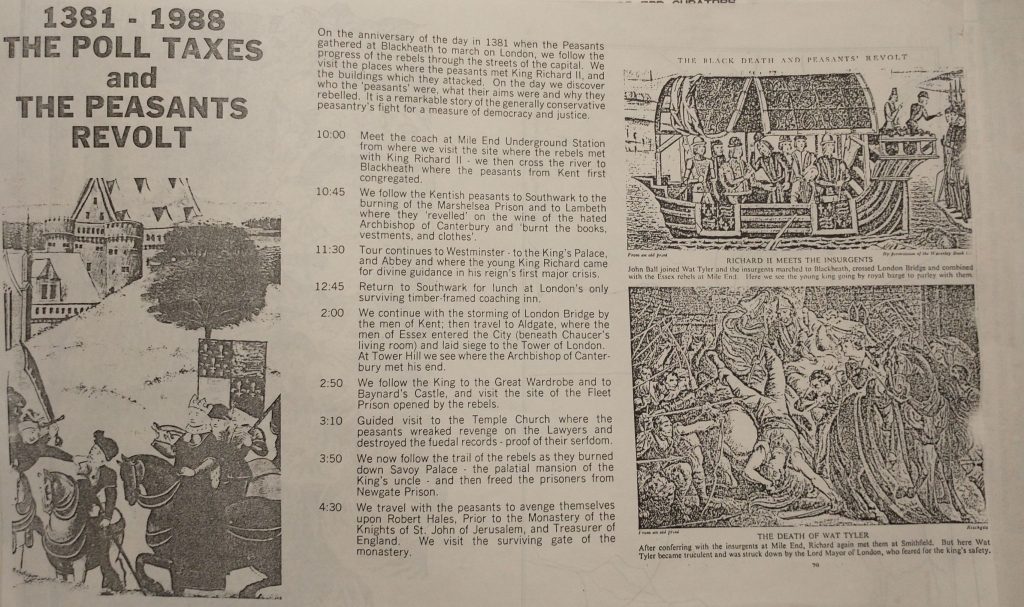
A Citisights Day Tour the Peasants Revolt (1980s)
St Alphage, Elsyng Spittle and St Mary
The Church was previously a monastic settlement called Elsyng Spittle (aka St Mary within Cripplegate). The Augustinian Canons looked after 100 blind men. It was refounded by Williain Elsing, and dissolved by Henry VIII in 1536. The Church was kept for a Parish Church. But the Puritans were not keen on dedications to St Mary. So, they renamed it after a London based Christian Martyr.
It remained a Parish Church until damaged in an air raid in World War One. (possibly on 8th September 1916 in a Zeppelin Raid – but I am speculating). The Church was partly demolished in 1923, leaving the Tower. The lower part of the Medieval Tower survived bombing in the Blitz. At 12.15 am on 25th Aug 1940, the first bombs on the City of London fell nearby in Fore Street. But the tower was hit in 1940. It was listed Grade 1 in 1950. Kept by the rebuilding of London Wall, and the Barbican area. Then substantially benefitting from a remodelling of the area in an excellent scheme of 2022.
St Ælfheah of Canterbury and Greenwich
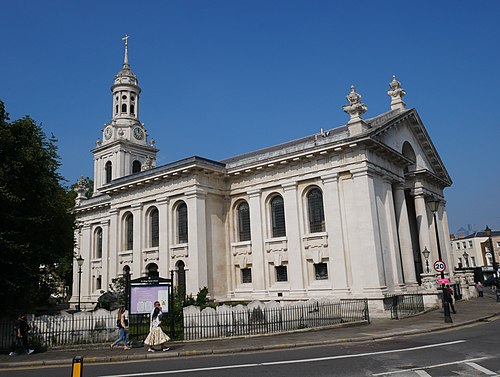
StAlfege Greewich – Doyle own work Wikipedia CC BY-SA 4.0
St Ælfheah was captured during a Viking attack on Canterbury. The Viking hoard relocated to Greenwich where they tried to negotiate a fat ransom for him. He was one of the richest men in the Kingdom. This is what the Anglo Saxon Chronicle says:
.. the raiding-army became much stirred up against the bishop because he did not want to offer them any money, and forbade that anything might be granted in return for him. Also they were very drunk, because there was wine brought from the south. Then they seized the bishop, led him to their “hustings” on the Saturday in the octave of Easter, and then pelted him there with bones and the heads of cattle; and one of them struck him on the head with the butt of an axe, so that with the blow he sank down and his holy blood fell on the earth, and sent forth his holy soul to God’s kingdom.
St Alfege Greenwich, which is now a lovely Hawksmoor Church is said to be on the site of St Ælfheah‘s death. Thorkell the Tall tried to save the Archbishop, but failed and subsequently changed sides and joined the English King. Thrum, who was converted by Alphage, ended his agony by hitting him on the head with the butt of an axe. This seems like a strangely Viking form of mercy!
St Alphage’s body was taken to St Pauls Cathedral where it became venerated and brought income to St Pauls. His remains were removed in suspicious and violent circumstances by soldiers of King Cnut who translated the Saint’s bones to Greenwich. It is suggested King Cnut was punishing London for their opposition to him.
The Minotaur by Michael Ayrton
Also, part of the experience of visiting St Alphage from the High Walk was the statue of the Minotaur. I first came across this phallic Bull in Postman’s Park and am very fond of him. Then it disappeared and reappeared on the High Walk. Now it is on the ground level near the garden of St Alphage.
I understand that Michael Ayrton wanted to make a point about the destruction of London. He felt that the developers were more destructive than the Luftwaffe. They were like a Bull in a China Shop! So he created this statue of a very vigorous Bull (represented by the Minotaur). It is a very unusual work of art in that it sports a fully erect penis. Art History is full of naked women, but the erect male organ has largely not been seen to be a fit subject for art. For more about Ayrton follow this link.
The Minotaur in its present positionThe Minotaur on the High Walk
On This Day
1775 – Battles of Lexington and Concorde begin the American Revolutionary War.
Magnolia and Cherry blossom in Weymouth Terrace Haggerston London. Photo K Flude
It might already have peaked in London, but there are lots of lovely magnolias still flowering. This year, last week was very hot and plant experts feared it would lead to a brief spring. However, the shirt-sleeve warmth was soon followed by a cold spell, dropping in some places to 0 degrees C. This may have saved the situation and prolonged the spring flowering.
Magnolias, Earnest ‘Chinese’ Wilson, said were the most esteemed of all flowers. He introduced new species from the Himalayas. Magnolias are among the oldest flowers and have their origins in the Cretaceous period. They evolved 100 million years ago before the evolution of bees. So they are pollinated by beetles, which is one reason for the size of the flowers.
The first magnolias to come to Britain were from America. John Banister sent Magnolia Virginiana to Henry Compton Bishop of London, who was also highly involved in the colony in Virginia. Compton sent Banister out as a missionary, but both loved flowers. Banister wrote the first flora of N. America which was included in John Ray‘s Historia Plantarum. Sadly, he was accidently shot while exploring.
Magnolias were named after the French botanist Pierre Magnol (1638-1715) ‘Professor of Botany and Director of the Royal Botanic Garden of Montpellier’. Magnol invented the idea of plant families, which Linnaeus developed.
Herbal uses
Mrs Grieve’s ‘A Modern Herbal’ suggests Magnolia was used for rheumatism and malaria. A warm infusion was thought to be laxative, sudorific (induces ‘sweating so that the sweat runs down the body in rills!’), If cold. If warm was antiperiodic (useful against diseases like malaria which keep coming back) and mildly tonic.
Where to see Magnolias
In London, they can be seen everywhere but Google suggests:
Kensington (Phillimore Gardens, The Boltons), Chelsea (Carlyle Square), and Notting Hill (Lancaster Road). And of course Kensington Gardens and Kew Gardens. My favourites ones are in the roads around my house, often in the most unprepossessing of places.
Magnolias and Camelias in Albion Square, Haggerston,. London. Photo by K Flude
But it is a delight to go to Hidecote the National Trust Property in Mickleton just off the edge of the Cotswolds. In April, it has spectacular magnolias. Unfortunately, I don’t have any good photos except this one which shows all the magnolia petals on the ground!
Hdcote in Magnolia time. Photo K Flude
Ernest ‘Chinese’ Wilson 1876 – 1930
Prunus Serrula, (aka Tibetan Cherry) brought to England by Ernest Wilson. My favourite tree because of its bark which feels like copper. Photo K Flude
He was born in Chipping Camden where there is a lovely memorial garden which contains my favourite tree, and many plants he introduced. He brought back over 2000 species into the West of which 60 are named after him. One of his expeditions took place during the Boxer revolution. So he adopted a native disguise and risked execution.
At 16, he was apprenticed at the Birmingham Botanical Gardens. Then he worked at the Royal Botanic Gardens, Kew. His next adventure was to be hired as the Chinese plant collector with James Veitch & Sons (originally based in Chelsea). He eventually moved to America, where he became keeper of the Arnold Arboretum in Boston. Unfortunately, he and his wife died in a car accident in 1930.
1116 (or 1117) – St Magnus the Martyr Executed. He was executed because of dynastic disputes amongst Vikings in the Orkneys. Magnus lived a pious life refusing, for example, to fight in the Battle of Menai Straits in Wales, and various miracles took place after his death. He is remembered by the Church of St Magnus at the foot of London Bridge in London. But that was, before the 18th Century, thought to be dedicated one or other of the other many St Magnus’s (6). The Church is by Christopher Wren, and very high Church Protestant. On the occasion I visited on his feast day I felt like I was in a Roman Temple.
Sketch from an old print. Francis Drake being knighted by Queen Elizabeth I. In fact, the Queen delegated the dubbing to a French Diplomat
The Queen’s half share in the profits of the Golden Hind’s circumnavigation of the world, amounted to more than her normal annual income. So it is no wonder she knighted the Captain, Sir Francis Drake. The ceremony took place in the dock in what is now South East London at Deptford.
The Spanish were furious that a Pirate should be so honoured. The Queen may have given a French man the honour of dubbing Sir Francis. She did this, perhaps to encourage the French to support the English against the Spanish?
The annual Royal Income for King Charles III is £86.3 million. This is paid in the Sovereign’s Grant. It gives you an idea of Drake’s booty. But I imagine she had a greater share of the nation’s wealth than Charles, as she was the Government not just a honorific cutter of ribbons.
Francis Drake. Hero or Bloodthirsty Pirate?
Francis Drake was one of the British heroes I read about as a child. I had a thick book with stories about people King Alfred the Great, Hereward the Wake, Robin Hood, Drake, Charles II, Bonny Prince Charlie, Flora MacDonald, Florence Nightingale, David Livingstone etc. Some of them horrifically Imperialist and racist!
Drake is remembered for being the first English person to sail around the world. And his exploits in ‘singeing the beard of the King of Spain’ on his piratical raids on the Spanish Main.
In the books I read, the Spanish were the bad guys, and we were on the side of the Angels. Drake was one of the swash-buckling heroes who turned Britain from a not very important country on the edge of Europe, to one of the World’s Great Powers.
Portrait of Francis Drake with Drake Jewel given to him by Queen Elizabeth I
On the other hand, he was also a pioneer of the Slave Trade, was involved in atrocities in Ireland and in the Spanish Territories. He summarily executed one of his crew in dubious circumstances. Perhaps more significantly, his contemporaries did not entirely trust him.
Francis Drake and the Spanish Armada
As the Spanish Armada sailed along the southern coast of England, the English Navy sniped at the heels of the Spanish ships. Drake was tasked with leading the nighttime harrying of the Armada up the Channel. The idea was to stop them landing and to drive them away and into the hostile waters of the North Sea. Drake in the Revenge was leading the pursuit, and the other ships were told to follow. He was to keep a single lantern alight in the stern of his ship. But the Lantern went out, and the British pursuit was disrupted.
The next morning, Drake comes back having captured the Spanish galleon Nuestra Señora del Rosario, flagship of Admiral Pedro de Valdés. The ship contained the gold to pay the Spanish Armada, which Drake seized. Was this a fortuitous accident which rebounded to Drake’s considerable financial advantage or something more deliberate?
In the end, the lantern incident did not stop the British forcing the Spanish to flee around the North of Scotland. On this perilous voyage only about 60 of their ships returned to Spain out of about 130. And Britain was saved from the Spanish Armada.
Nuestra Señora del Rosario and Agatha Christie
I used to lead an Agatha Christie program which included a visit to Torre Abbey in Devon. And it was here that the Spanish ship’s crew were imprisoned after Francis Drake took the ship.
The Abbey was a Premonstratensian Abbey. Its tithe barn was used to hold the prisoners of war from the ship of whom there were 397.
The Spanish Barn, Torre Abbey. Photo 2012 Kevin Flude
Sir John Gilbert, who was Sheriff of Devon at the time, used 160 Spanish Prisoners of War to develop his estate above the River Dart. The Estate is in a magnificent position, overlooking the drowned valley of the Dart. It is now enjoyed by those millions of visitors to what became the summer home of Agatha Christie (Greenway). The Poison Garden in the Garden of the Abbey is themed around poisons used in Agatha Christie’s books.
View of the River Dart from Greenway, photo KFludeView of Greenway from the River Dart. Photo KFlude
The Golden Hind & Deptford
Queen Elizabeth I decided that the Golden Hind should be permanently docked in Deptford. So the ship was placed in a ‘dry’ dock filled with soil. The ship decayed and by 1660 nothing much was left.
I remember as a young archaeologist that some of our team took time out to work with Peter Marsden. He is one of the great experts in Naval archaeology, and he led a search to find Drake’s ship. There was a huge fanfare in the London newspapers. ‘Find the Hind’ I think must have been the hopeful Headlines. But, rather embarrassingly, given the build up, they failed to find anything of significance.
Further exploratory excavations took place in 2012, with no greater success.
Panorama biew of the Spanish Army from an old history book
Golden Hind souvenirs
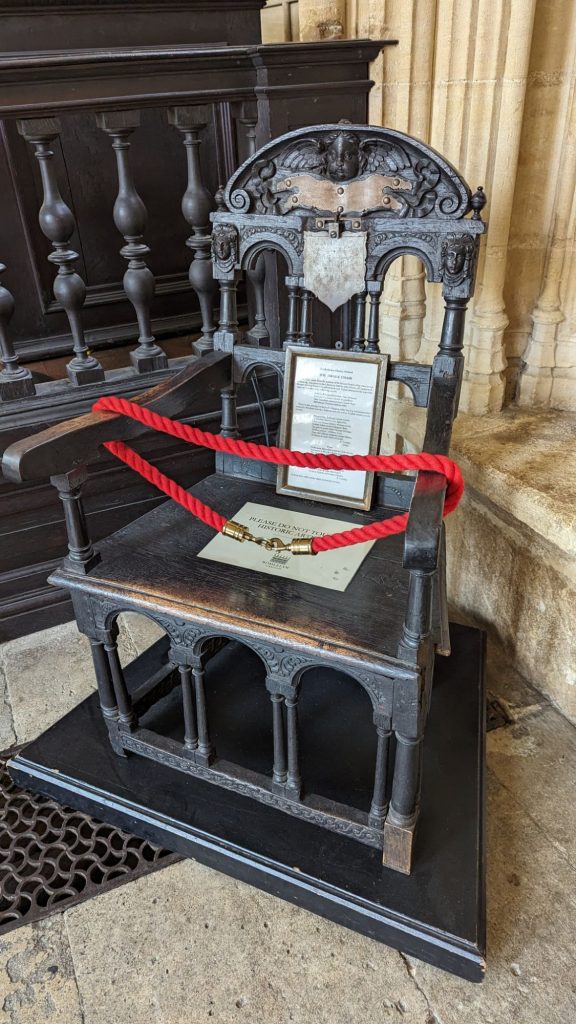
Chair made from timbers of the Golden Hind in the Dinity Hall, Oxford, photo K Flude
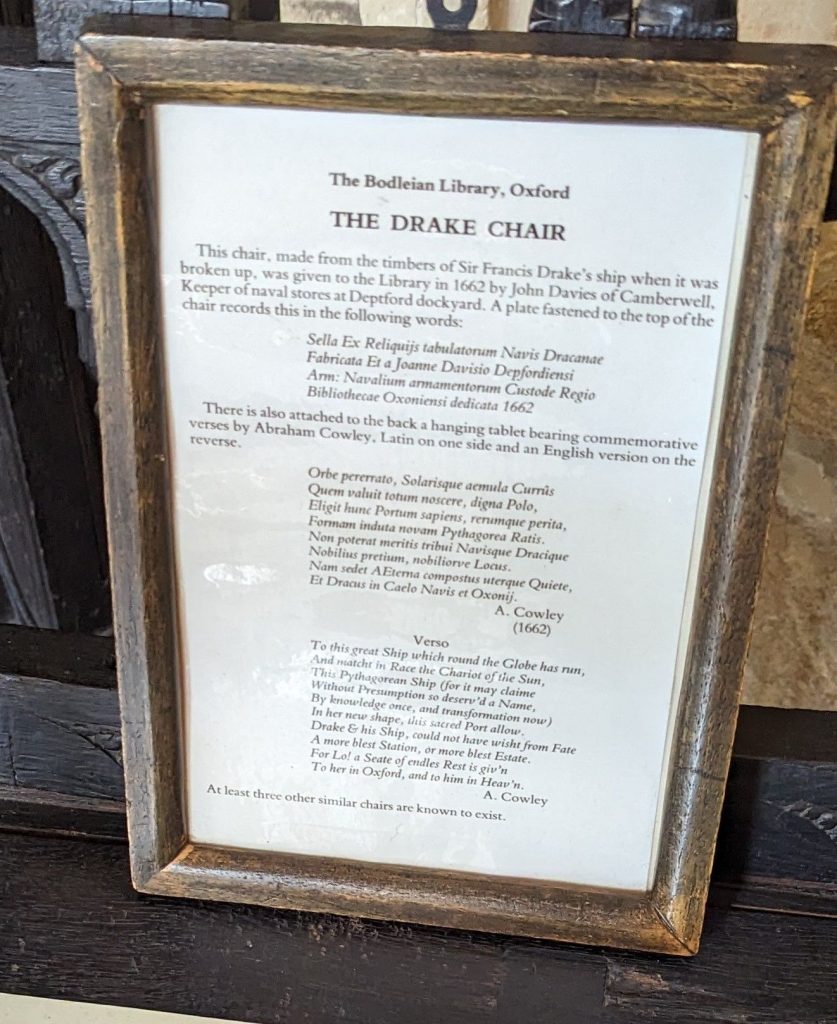
The Keeper of the Naval Stores at Deptford made chairs from the ruins of Drake’s ship, and one of them is on display at the Divinity Hall, Oxford.
Information panel on the Chair made from the ruins of the Golden Hind, photo K Flude
Sir Francis Drake and Middle Temple Hall
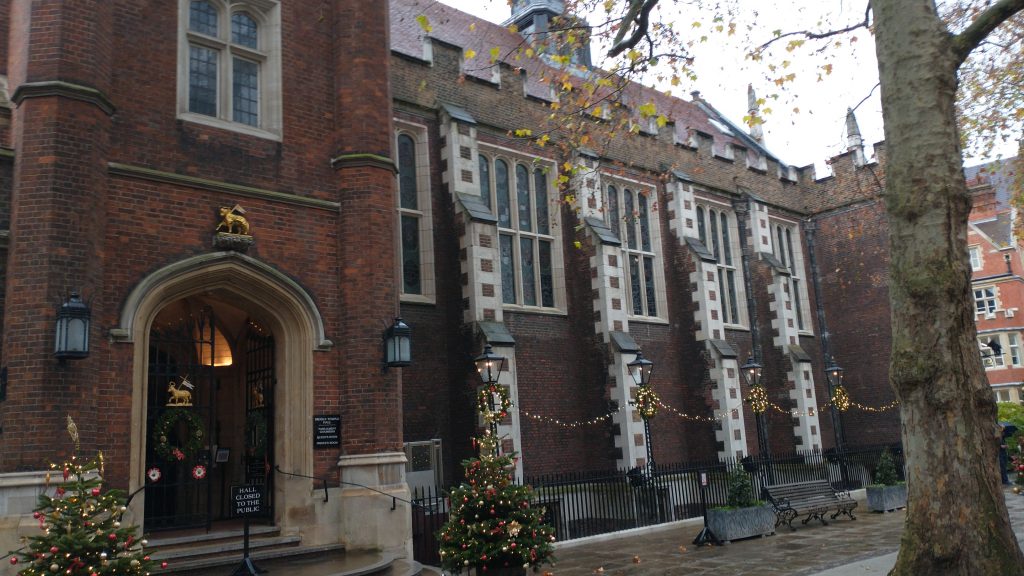
In London, Sir Francis Drake visited Middle Temple Hall, off of Fleet St regularly. A table (called the cupboard) is reputedly made from the hatch cover of the Golden Hind. This is where the newly qualified barristers stood to have their registration entered into the Inn’s books. Sadly, it did not survive the bombing of 1941.
Middle Temple Hall. Photo K Flude 2021
The lantern which hung in the entrance Hall allegedly came from the ship’s poop deck (so not the one he failed to keep lit!). Other famous mariners associated with the Middle Temple include Sir Martin Frobisher and Sir Walter Raleigh. Shakespeare’s company performed Twelfth Night in the Middle Temple Hall
The Romans celebrated the Great Mother, the Cybele in the festival of the Megalesia. To celebrate bringing a meteorite of Cybele to her temple in Rome in 204BC. Celebrated by the Games of the Great Mother
1660 – Declaration of Breda by King Charles II promises a general pardon to all royalists and opponents of the monarchy for crimes committed during the English Civil War. Excluded were the Regicides who signed Charles I’s death warrant.
1814 – Napoleon abdicated and on April 11 ordered into exile in Elbe.
1949 Twelve nations sign the North Atlantic Treaty creating NATO. They were the Western Union – ( France, UK, Belgium, Netherlands, and Luxembourg) and the United States, Canada, Portugal, Italy, Norway, Denmark, and Iceland
1968 – Martin Luther King Jr. assassinated by James Earl Ray in Memphis, Tennessee
First published 2024, revised 2025, On This Day added 2026
Regent’s Canal, London in the Month of April. Photo K Flude
The name of the Month of April comes from Latin. From Aperilis from aperio meaning ‘to open’. This is the month when the Earth opens up, the blossoms bloom, buds budding, the flowers flowering.
In Anglo-Saxon times, the Venerable Bede mentioned that they called the month Eostremonath. But there really is no other evidence for the Goddess Eostre. But it is from her that we get our word ‘Easter’. In Gaelic it’s the Cuckoo’s month ‘Ceitein na h-oinsich’. In Welsh it is Ebrill which comes from the Latin.
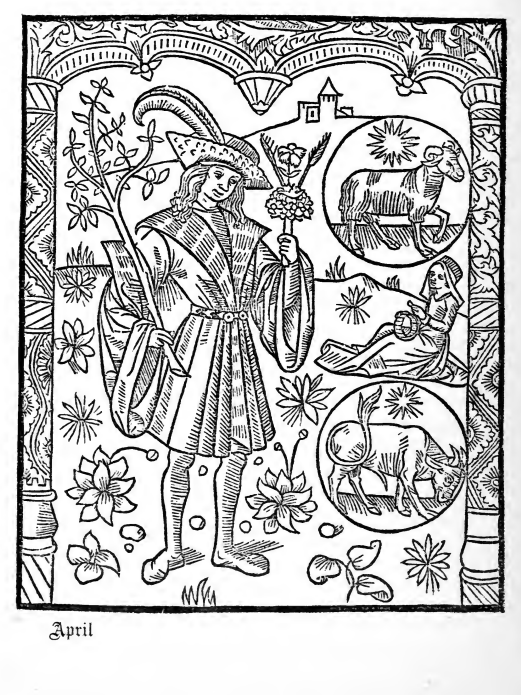
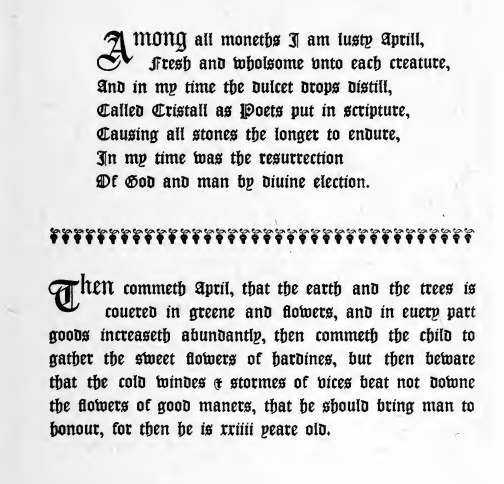
Title Page of the Kalendar of Shepherds for the Month of April
The image from the medieval Kalendar of Shepherds shows all the beautiful flowers blooming. The central figure is a rich man bearing bows of tree and flowers. Behind him is a female sitting on the grass embroidering. Love is in the air, and a castle on the hill. The star signs of the month are shown in the roundels.
Aries sign of the ZodiacTaurus sign of the zodiac
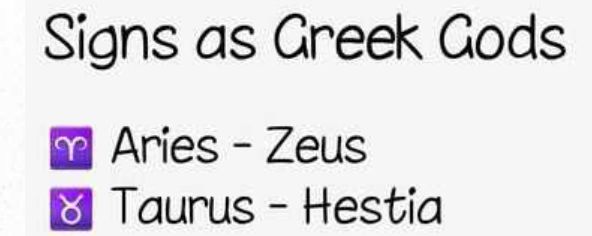
Star Signs as Greek Deities
Astrological signs and their associated Dieties.
I can’t remember where I found this illustration nor its justification. But, is it strange that the Greek God Ares is not the patron of the Star sign Aries? Of course, Ares/Mars has March named after him. Ares is a fire sign, its colour is red, and ruled by the planet Mars.
Aries is no ordinary Ram, he has wings and is called Chrysomallos. Ino the step-mother of Phrixus and Helle, wife of the King of Boeotia, hated her step-children, and plotted their death. But they were rescued by the flying Ram which had a Golden Fleece. Unfortunately, Helles fell off and drowned in what became known as the Hellespont, Phrixus came to safety in Colchis, and in an act of terrible piety, sacrificed the poor lamb to Zeus as a “Thank You”! The fleece was later taken by Jason and the Argonauts. (So, now we know why Zeus is the patron God of Aries!)
Hestia is the Goddess of the Heath. In other words, she is the Goddess of all those wonderful things that are encompassed by the word ‘Home’. (You’ll find more on Hestia in my reflections-on-the-solstice/)
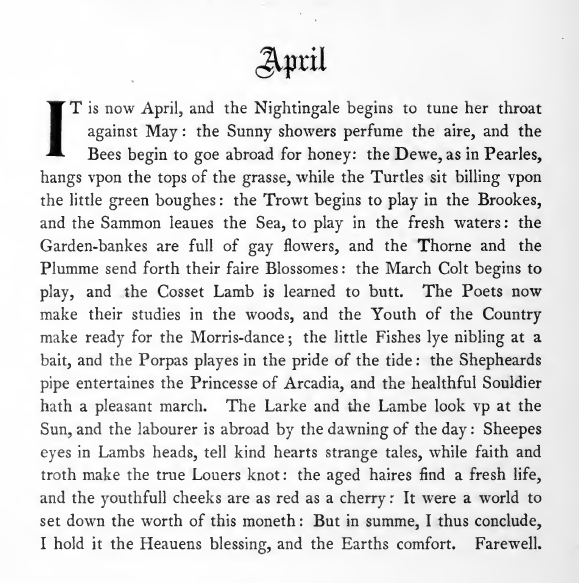
The Month of April in the Kalendar of Shepherds
The Kalendar of Shepherds as usual gives a lyrical insight into the countryside in the month of April:
Kalendar of Shepherds description of nature and farming in April
It continues with a poem. Beneath the poem is text which describes what happens to the child in the fourth set of 6 years. January represents a child’s life from 0 – 6, February 6 – 12. So April represents the ages 18 – 24 – the spring time of Man. But also a time when the struggle between vice and virtue in the young mind.
For more about the Kalendar of Shepherds read my post.
First written on 7th April 2025, (some content was moved from its original April Fools Day post home). Revised and section on Aries added 2026
The Famous Spaghetti Tree April Fool’s Joke (from facebook)
First Reference to April Fools Day
The first unambiguous British reference to April Fools Day is by diarist John Aubrey’s “Fooles holy day” in 1686 – although he might have been referring to Germany.
‘We observe it on ye first of April… And so it is kept in Germany everywhere.’ For more details read hoaxes.org.
Chaucer and April Fools Day
But there is a possible earlier reference in Chaucer in the Nun’s Priest’s Tale. This I find quite compelling but most Chaucer scholars don’t. This is the text:
When that the monthe in which the world bigan That highte March, whan God first maked man, Was complet, and passed were also Syn March bigan thritty dayes and two
So, if you have been keeping up with me, you will know that the first lines are referring to March 25th. This was the day Adam and Eve were created. The day when the Church started the New Year and the year number moved one on. This was a major Church festival, usually followed by a week of holiness. The Roman New Year, January 1st, ended with a light-hearted festival called Saturnalia, and it is suggested that April 1st was, similarly, a day of release after the festival of the official Church ceremony of the New Year.
Chaucer’s last line says ‘Since March began thirty-two days have passed.’ A foolish person would not realise this is a reference to April 1st. Hence, this suggests a Fool’s Day already existed. Some scholars think that Chaucer was referring to May 2nd, counting the 32 days not from the beginning of March but from the end of March. I think they look at the second and third lines which read ‘That high March…. was complete’ and so add the 32 days to the end of March. Foolish in my opinion and not reading what actually Chaucer wrote which is ‘Since March began….’
Hunting the Gowk
Generally, in Britain, we play a prank and say ‘April Fool’ with great delight. But we are not allowed to continue beyond midday. The Scots used to call it ‘Hunting the Gowk’ and the main prank was to give someone a letter to deliver, and the person who opened the letter would read:
“Dinna laugh, dinna smile. Hunt the gowk another mile” and send the fool onto another leg of his or her’s fool’s errand. In Ireland the letter would read ‘send the fool further’.
April Fools Day and Spaghetti Growing on Trees
I nearly always forget to honour April Fool’s Day (or April Fish Day as the French call it). But in Britain, somewhere in our newspaper or TV station there is an April Fools Joke slipped in. The most remembered is the BBC piece showing film of Italian Farmers picking spaghetti from trees.
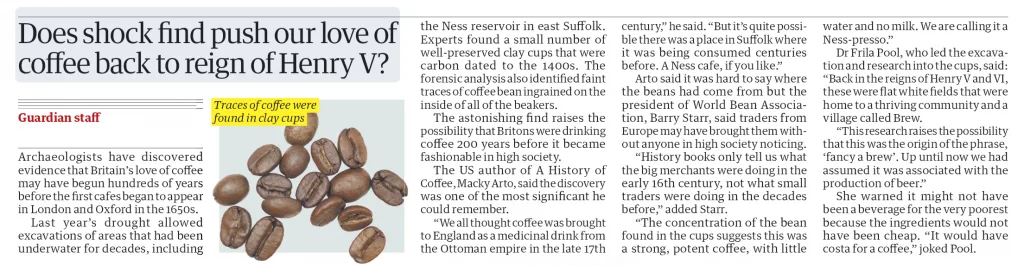
2026 – Introduction of Coffee to England 200 years earlier than previously thought!
I have had a quick look at the Guardian for their 2026 April Fools Day Story and I think it is this one:
Guardian April Fools Joke for 2026
The clues are the expert is called Macky Arto. The find was in Ness, allowing them to say ‘Ness Cafe’, and ‘Ness-presso’, and the use of a pun ‘It would have costa for a coffee.’ The final confirmation is this sentence: ‘Back in the reigns of Henry V and VI, these were flat white fields …. and a village called Brew.’ Allowing the journalist to make up an origin for the expression ‘Fancy a Brew?’ it goes on to say.
2025 – Coffee Cups as Haut Courture?
Guardian April Fools Day Joke article or the world gone mad?
‘Meghan Markle was criticised after it was revealed that when you put her lifestyle brand name – American Riviera Orchard – into the What3words location service, it points to a statue of Oliver Cromwell, who famously had a King Charles executed‘
2023 – “Megxit: Call of Duke-y”
In 2023, Harry and Megan proved irresistible and the Guardian reported that:
‘The Sun published a piece announcing the launch of Prince Harry and Meghan’s new video game “Megxit: Call of Duke-y” in which the royal couple try to reach California while dodging obstacles, including rival royals and the media, along the way.‘
This post is about April Fools Day. But it is also the anniversary of the formation of the RAF.
On This Day
1649 – Diggers Occupy St George’s Hill Chertsey. For More details look here.
1854 – Hard Times by Charles Dickens Serialised in Household Words. A recent study of Victorian Grave yards in Yorkshire highlights the grim reality for young children. For the article see: https://core.ac.uk/reader/220156990
1918 – Near the end of World War 1 the Royal Flying Corps (RFC) and the Royal Naval Air Service were merged to create the Royal Air Force (RAF). It was the world’s biggest air force, and went on to secure Britain from invasion by Hitler.
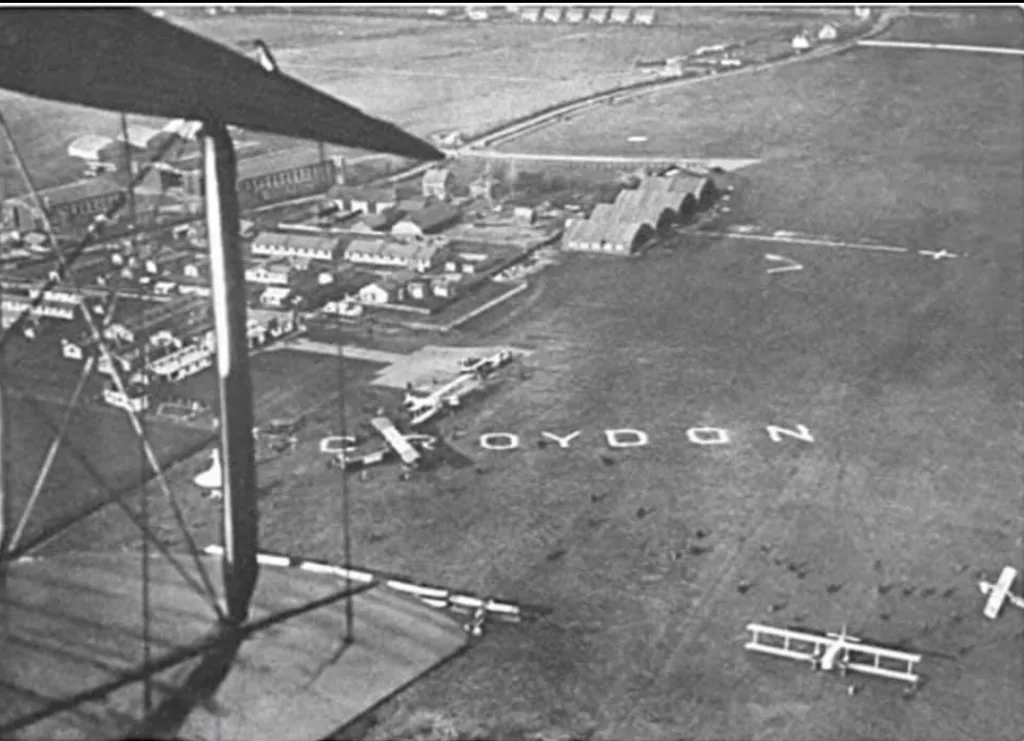
Croydon RFC/RAF base for anti-Zeppelin Raids in WW1 and one of the world’s first international airports.
RAF Rigger, Benjamin Flude
My Grandfather was in the RAF as a fitter. My father tells some of his story in his autobiography ‘A Boy from Haggerston’:
Benjamin Flude in RFC Uniform. My father, Ben Flude remembers a small model biplane hanging from the portrait.
‘I was 9 months old when he died, and he was just 28 years old. Everyone seemed to like him, and as a child, he was always my hero. In my imagination, I promoted him to being a brilliant and brave Ace RAF Pilot. But he was, in fact, a mechanic rather than a pilot in World War I. Following the war, he worked with Imperial Airways in Purley, Croydon. I don’t know the exact details and so have to piece the story together from the little information I have at my disposal.
My friend, Roy, tells me that the badge on his uniform in the oval picture is of the Royal Flying Corp. (RFC). But they were disbanded in 1916/17, and replaced by the RAF thereafter. As my dad was born in 1900, he must have joined up to fight in the war while underage at 16 or 17 as a volunteer. ‘
How a London lad became a Rigger for the RFC we don’t know, but the Fludes at that time were all employed as umbrella or walking stick makers in the East End of London. I think it is a case of transferable skills. WWI aeroplanes were made of wood, metal wire and fabric, which is precisely what an umbrella is made of.
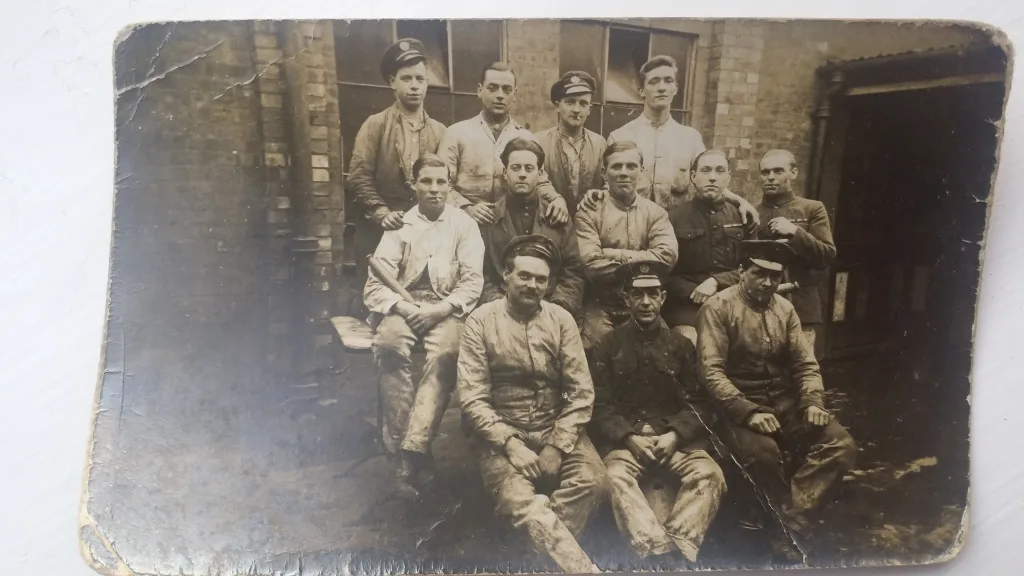
RAF/RFC mecanics c 1917 . My grandfather is the handsome man standing tall in the back row extreme right
RAF Mechanic Ben Flude
My father went on to serve in the RAF during his national service: He writes:
Ben Flude RAF Metfield. (dad is lying down at the bottom right. he is now 98)
‘Early in 1946 I received my call-up papers for the RAF. I was to report to the Recruitment Centre at Padgate in Lancashire. This is where I received my uniform after a medical examination, and then there were a number of intelligence/aptitude tests when they decided what trade I would join. I tried to get Air Crew and while there were no vacancies, I did have a wide group of trade offers open to me. The group that I was interested in was aircraft maintenance and repair, following in my Dad’s footsteps.’
‘However, before I could start, I had to do my basic training. This was designed to get you fit, and we did plenty of square-bashing or parade drills. For this, they sent me to Metfield in Suffolk, which had only very recently been made available to the RAF by the American Army Air Force. In fact, it was so recent a hand-over that whilst on picket duty, a coach rolled up packed with girls who were so disappointed by the lack of Americans that they got straight back on and returned to Ipswich! The motto of ‘overpaid, oversexed, over here’ certainly applied to these Americans in Suffolk.’
‘We found out that Metfield had been a US Army Air Force Base, where two squadrons of Flying Fortresses operated from. In all the Nissen Huts, those with the semicircular roofs, the ceilings were completely covered with pin-up pictures. My bed was just feet away from the huge Crocodile Stove, round which every evening we all clustered – as it was warm.‘
Interior of Nissan Hut 1944, Lasham
Dad specialised in the recovery of instruments from crashed planes, and was complimented by Air Chief Marshal Hugh Caswall Tremenheere Dowding, 1st Baron Dowding, GCB, GCVO, CMG on his ability to fix an instrument he had never seen before.
First published March 25th 4004 BC and republished yearly on every April Fool’s Day. The section on the meaning of April moved to my post on April 2025. On This Day added in 2026
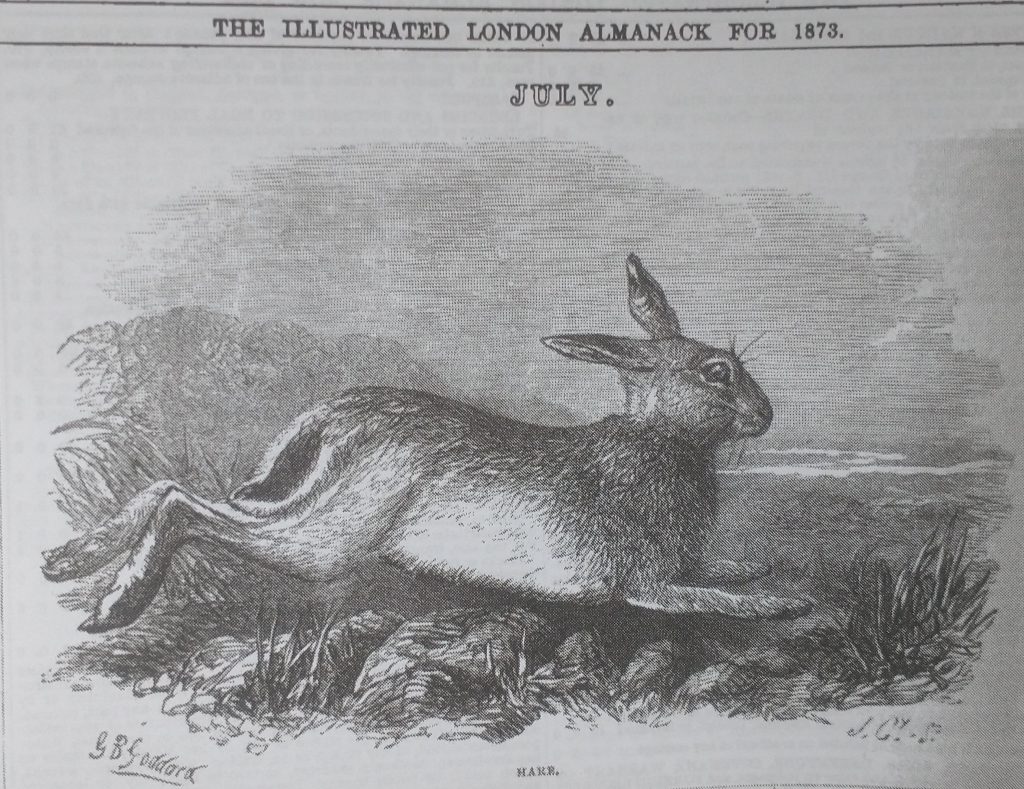
The expression ‘Mad as a March Hare’ comes from the displays of hare boxing that takes place as the Hare mating season begins. And no, it’s not the male March Hare fighting in the spirit of romantic rivalry. It is the female hares fighting off unwanted attention from the males. Hares are solitary creatures, and the mating season is, perhaps, particularly difficult for them. The Country File website has more on the subject. www.countryfile.com
Not only March Hares but March Kittens too
There are also March Kittens and March Chickens. Edward Topsell in his ‘History of Four-footed Beasts‘ 1607 says the best Kittens to keep are those born in March. ‘The Closet of Sir Kenelm Digby Opened‘ 1669 says:
‘Keep a black cock hatched in March as a protection against evil spirits: his crowing terrifies them.’
He also gives a recipe for Cock Ale:
Eight gallons of Ale, a boiled March Cock, four pounds of stoned Raisins, half a pound of dates, nutmegs, mace. Beat the ingredients in a mortar, add to two quarts of Sherry. Add to the ale. Stop it in a container for 6 or 7 days. Bottle it, drink after a month.
Very weird. I challenge my readers to try it and let me know how it goes?
Was the March Hare Sacred?
But it’s not only March Hares because the hare itself was a sacred animal. It was sacred to Aphrodite because of their prodigious ability to have offspring:
‘For you know, I imagine, what is said of the hare, that it possesses the gift of Aphrodite to an unusual degree. At any rate it is said of the female that while she suckles the young she has borne, she bears another litter to share the same milk; forthwith she conceives again, nor is there any time at all when she is not carrying young.’
Classical Texts Library. Philostratus the Elder, ‘Imagines’ Book 1.1-15 c 3rd Century AD. Translated by Arthur Fairbanks.
Divine Celtic & Neolithic Hares
Research reported by Exeter University suggests that hares were worshipped in pre-Roman Britain. Julius Caesar wrote:
“The Britons consider it contrary to divine law to eat the hare, the chicken, or the goose.”
‘The Battle for Gaul’ Translation by Wiseman, Anne, Wiseman, T. P. Published by Penguin Random House, 1980 ISBN 10: 0701125047 (TP Wiseman was my professor for Classical Studies at Leicester University).
Hares are thought to be the original Easter Bunny. But finding good evidence before Germany in the early modern period is difficult. There is a tradition that witches can be scared away at Easter. Exactly, how this works is not at all clear to me. But it has been said that witches could take on the form of a hare. So eating Hare Pie at Easter helps rid the land of the witches.
Jugged Hares
You could have a jugged hare. Jugging is cooking a whole animal in a container over water. Follow this link for a recipe for jugged wild hare. Remember, you are not allowed to shot or trap them on a Sunday or on Christmas Day! For a discussion of hares and folklore, click here:
Hare’s Feet Totems
A jointed hare’s foot was considered very lucky and a remedy against gout, stomach pains and insomnia. (The Perpetual Almanack of Folklore by Charles Kightly, which I have used several times in this piece.) You can buy one on eBay. (Don’t click the links, it’s not an advert but a picture of an advert). I remember friends having rabbit feet which they carried around with them for luck. The foot would often be on a key rings.
Georgiana, Duchess of Devonshire (Johann Heinrich Hurter after Angelica Kaufman). Photo by K Flude of the miniature at the Victoria and Albert Museum
The Gilbert Collection has been re-displayed in the V&A in London. It has just opened, and is one of the most opulent displays you could hope to see! But, I loved this miniature of Georgiana. She was one of the richest women in Britain, a compulsive gambler, and a powerful political force for the Whig Party. And despite the Georgian Hairstyle the artist has contrived to make a very down to earth portrait. I can imagine bumping into her at the local Overground Station! She became better known after the bio graphy by Amanda Foreman, followed by the Film starring Keira Knightly. The Museum label says the portrait is ‘after Angelica Kaufman’. But I cannot find a Kaufman of Georgiana, that has this charming informality.
I have just heard news that the Arts Council wants to charge overseas visitors to visit our wonderful free national Museums, while allowing British Citizens free entry. Now, there are lots of arguments to be made about it, particularly in a time where money is in short supply. But, one result will be longer waits to get into Museums and Galleries. I am not sure how we Brits, are going to be asked to prove our nationality. If they have to inspect our Electricity Bills, Drivers Licenses, Passports, Library Cards, or Bank Statements, expect chaos.
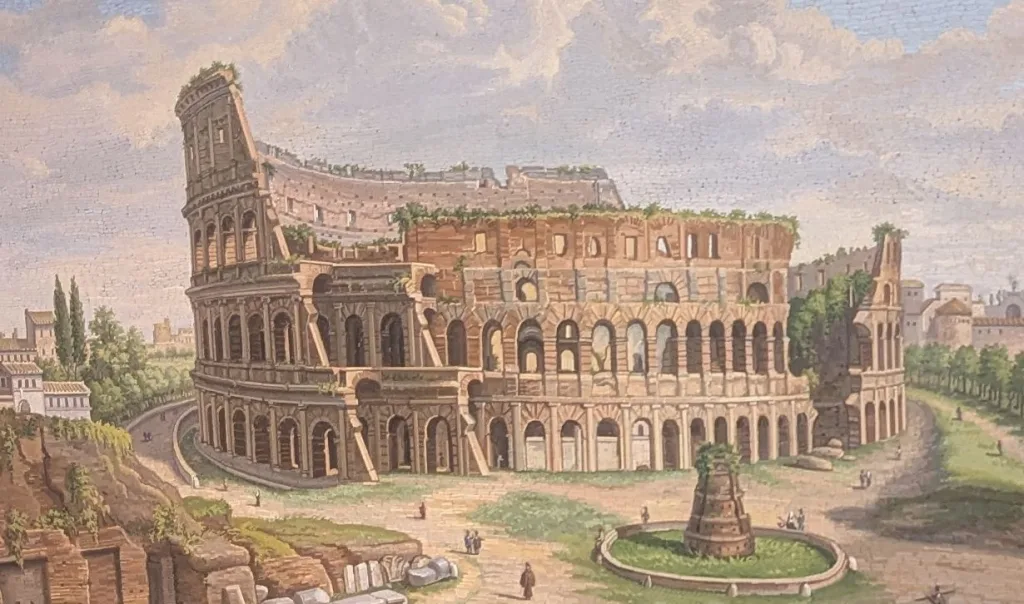
One more object from the Collection is made of minature mosaics, and the V&A has several, But I have chosen this fabulous image of the Colosseum in Rome:
Colosseum by Domenico Moglia c1851
First published March 28th 2023, revised 2024, 2025. 2026 Object of the Day added and post revised 2026
Study for Lady Lilith, by Rossetti. 1866, in red chalk. Now in the Tel Aviv Museum of Art (Wikipedia) Lilith born at The Beginning of the Universe
This is now my most popular post. March 25th is the Annunciation—the day that the Archangel Gabriel tells Mary she is pregnant. (to see some very fine paintings of this meeting, look at my other March 25th post march-25th-feast-of-the-annunciation/). When I first wrote this post I was discovering how it all fitted together as I wrote. So I’m leaving it the way it was, proof reading and clarifying if necessary, but keeping the thrill of the discovery of the the significance of March 25th as the day that saw the Beginning of the Universe.
March 25th is also the anniversary of the birth of Adam and Eve (and Lilith); the death of Jesus Christ; the anniversary of the Immolation of Isaac; the Parting of the Red Sea; the Fall of Lucifer; and, (until 1752 in the UK) the beginning of the Year.
Of course, it isn’t. Or to put it another way, no one can, or ever could, prove any of these dates except 1752. So what they speak to is the way the Church saw the world as logically structured by God. Christian thinking about the year, the world, the universe, creation, developed over many years and took influences from many cultures. It is also very complicated to work out the sequence, so I’m going to summarise what I know (or at least what I think I know).
Happy Birthday, Dear Jesus.
Christians chose Christmas Day as the Birthday of Jesus, probably partly because it was a prominent birthday already shared with several Gods. Particularly, Attis, Mithras, Saturn and the Unconquered Sun. It was approximately at Solstice, the beginning of the Solar Year, and close to one of the main festivals of the Roman World, the Saturnalia. So it made it easier for new converts who could retain elements of their festivals after conversion.
December 25th might have been selected by the pagan religions because it is the time when the Sun begins to rise further north each day. The days stop shortening and start lengthening, light increases with the promise of warmer weather and budding plants. It was considered a rebirth of the Sun.
Solstice Anniversaries
So, Jesus was born on/or around the Solstice, so he must have been conceived approx. 9 months earlier. This is approximately at the Spring Equinox.
Ah, you are thinking! But today isn’t the equinox. It’s a few days after the equinox. Surely, God doesn’t do approximately?
I have always thought that the 4 or 5 days difference between the Solstice, the Equinox and the Christian festivals was down to the fact that the Calendars were not well coordinated with the actual movements of the Sun (because the Sun does not circle the earth in 365 days, or in 365 and a quarter days, but 365 days, 6 hours, 9 minutes. Unless corrected for this means dates slip from their proper place in the Solar Year. It also makes lunar Calendars difficult to align with the Sun cycles, and vice versa.
But when I first wrote this a sudden revelation dawned upon me which will be revealed in the next few paragraphs.
So, God sends his Son to save the human race. God is a logical being, so she would send her Son at an appropriate time? If Jesus is born at or near the Solstice, which is an appropriate time for the Son of the Creator, then conception 9 months earlier, March 25th, is near the Equinox. This is the beginning of Spring. For many people, Spring is a new beginning, for example, the Anglo-Saxons saw Winter as the death of the year, and Spring as the young Year. It all makes sense.
The Creation
So to the Creation. God, having a free choice, would have created the world at the beginning of Spring. In fact, if you think about it, God creates everything necessary for life at the creation in 6 days. As soon as it has all been created and put together, it is bound to immediately spring into new life. The first season must, therefore, be Spring? Right? So March 25th?
This gives a nice symmetry with Jesus’s Life. Conceived on March 25th, born December 25th, and died 30–40 years later, according to the Church, at Easter, on March 25th. (the only other famous person I know, born and died on the same day is William Shakespeare).
Easter
Easter, when Jesus is martyred, isn’t March 25th I hear you saying. But remember, Easter is a lunar festival, so its date varies each year. In fact the next time is 2035. Births and deaths, on the other hand, are fixed to the Solar Calendar. Therefore, the Church chooses March 25th as the most appropriate day to pin the death of Jesus, on the anniversary of his conception and the anniversary of the creation of the Earth. I am guessing that this is also the preferred date for the Day of Judgement.
It is also the Birthday of Adam, and his first wife Lilith (or so some say), and Eve. More about Lilith below. I hope this is all making sense?
Why was Adam born on March 25th?
I had thought this date was just one of the parallels that the Church liked, Jesus and Adam born on the same day. But, I have just worked out why Adam is born on March 25th, and why these dates are not the Equinox, March 20th/21 but March 25th, which has been bugging me.
Let’s go back to the beginning of Creation as described in Genesis. It has the following sequence of Seven Days, beginning with the Equinox March 20th. I have added dates to the 6/7 day sequence of Creation:
Day 1: Light – March 20th
Day 2: Atmosphere / Firmament – March 21st
Day 3: Dry ground & plants – March 22nd
Day 4: Sun, moon & stars – March 23rd
Day 5: Birds & sea creatures – March 24th
Day 6: Land animals & Adam, Lilith and Eve – March 25th
So there you have it! Adam, Eve (and Lilith) were created on Day 6 with the Land Animals – March 25th. Jesus conceived, also on this date, and so 9 months later is born on December 25th. It all makes sense, and aligns the Jesus’s Life, the Christian year fully with the Solar Year and the Creation!
And that, dear Reader, is the very first time anyone has been able to explain to me why Christmas is not at the Solstice, and why the Annunciation was not at the Equinox. Maybe you all know this, but it is very exciting to work this out for myself. And believe me, I have done a lot of reading about calendars and not spotted an explanation.
When was the Creation?
The Anno Munda‘s is a Jewish Calendar which begins counting from a year before the Creation – the Year of Emptiness. This was 5500 years plus 2026 years ago so 7526 Before the Present. And it was supposed to have ended in 600AD, 6000 years after the Creation. So, they got that wrong.
Dionysius Exiguus replaced the Anno Mundo year with the AD/BC system in the 6th Century AD). This became popular when the Venerable Bede used it in his writings in the 8th Century.
Beginnings of the year
The Celts chose October 31st, Julius Caesar chose January 1st, other cultures have other dates, and the Spring Equinox is another choice sometimes made. The Church and Dionysius Exiguus choose March 25th, although secular society also recognised the claims of January 1st. Britain kept to March 25th until 1752 when we adopted the Gregorian Calendar. But people like Samuel Pepys celebrated New Year’s Eve on 31st December. So January 1st was the secular New Year, but the Christian year number did not change until March 25th. So King Charles I thought his head was being cut off on January 30th 1648; while history books will tell you it was cut off on January 30th 1649. Same day, same head, different reckonings.
January 1st, the New Moon and New Year
December 31st/January 1st is essentially a Solstice New Year Festival. And I have, previously, used the difficulty of keeping calendars as to why these days has slipped out of alignment with the Solstice. But, today I realised that it is as likely that the reason is the Solar/Lunar nature of our time keeping. The year, and its festivals, is largely arranged around the Solar Cycle. But our weekly and monthly cycles are orginally derived from the Moon.
The first of a month, was called the Kalends by the Romans, the Nones the half moon, and the Ides signified the New Moon. The kalends of January is then, originally, the First New Moon after the Winter Solstice. So, January 1st is not a slightly misdated Solstice Festival it is a Festival celebrating the first New Moon of the New Year! Sorry, to seem excited but this is the first time I have realised this.
Over time societies give up trying to sync the lunar and solar calendars. Roman and Christian cultures gave up and fixed the moon months, completely abandoning any attempt to keep the months to the actual lunar cycle. This is our current system, in which only Easter and festivals that depend on Easter remain true to the movements of the moon festival, much to our perennial confusion.
Maybe you all know this, but it’s put many things into perspective for me!
Lilith
The April 2023 Issue of ‘History Today’ had a short piece called ‘The Liberation of Lilith’ which suggests that the story of Lilith, a figure from Jewish Folklore, is first attested in a Medieval satirical text called ‘The Alphabet of Ben Sira’. The story goes that Lilith is created from the same clay as Adam. Adam then demands she lies below him during sex. She refuses, saying that they are both made from the same stuff and, therefore, equal. Adam refuses to accept this, and so Lilith leaves the Garden of Eden. So the story goes.
The story of Lilith, Sarah Clegg suggests, is one of a series of similar stories found around Europe and Asia. And Clegg assumes that it is gradually modified to make Lilith a demon who will kill babies unless the names of three angels are spoken out loud.
The story survived as a charm to keep babies safe, and perhaps to remind people of equality among the sexes. But this causes problems for, OK, let’s call them out, the Patriarchy. Lilith cannot be equal to Adam so she is made into a monster, not made from the same clay as Adam but from the scum and waste left over from Adam’s creation. I imagine the story then went on to propose that God creates Eve from Adam’s rib, and so she is created from Adam, and is, therefore, not equal, but subservient to him, although not as bad as Lilith. Lilith is now a significant figure in feminist folklore circles.
Attached to the watercolour of Lilith by Rossetti (at the top of the page), was a label with a verse from Goethe‘s Faust as translated by Shelley. (Wikipedia)
“Beware of her fair hair, for she excells All women in the magic of her locks, And when she twines them round a young man’s neck she will not ever set him free again.”
The model is Fanny Cornforth, Rossetti’s mistress. He painted another version a few years later, but the model in that is Alexa Wilding. His models are arguably more interesting than the man himself and include: Elizabeth Siddall, Jane Morris and Fanny Cornforth. Christina Rossetti, his poet sister, modelled for Rossetti’s painting, Ecce Ancilla Domini which you can see here.
For more on the Annunciation, look at my other March 25th post here.
I think I might have enough material to begin my own Cult.
Baptist Hicks and his, wife, Elizabeth in their Chapel at St James Church, Chipping Campden (Photo Kevin Flude)
This anniversary commanded my attention because I spend a few weekends each summer in the Cotswolds. There I see the ruins of Campden House in Chipping Campden. This was burnt down in 1645. So, when I read about the burning down of Campden House in the 19th Century, it had to be another one. And it turns out this one is in Kensington, London, Both Campden Houses were built for Sir Baptist Hicks, Viscount Campden.
Baptist Hicks Rise to Aristocracy
Baptist Hicks is an example of the flexibility of the British system of aristocracy. Hicks was a commoner, the son of a wealthy Mercer from Cheapside in the City of London. A mercer traded in prestige clothes imported into England. When Hicks’ Father died, his mother, who is said to have been a moneylender, was resourceful enough to take over their mercery business. She made a success of it and eventually passed it on to her son.
The family shop was on the corner of Cheapside and Soper Lane. Soper Lane is where Queens Street is. Their shop was signposted by the sign of the White Bear. Soper Lane was in the Cordwainers Ward. It was the haunt of soap makers and shoemakers (cordwainers got their name from their use of Spanish Cordovan leather). But Cheapside, itself, was the home of Goldsmiths and generally a wealthy area.
Hicks was educated at Trinity College, Cambridge and at the Inner Temple in London. But despite the education as a lawyer, he chose to continue in the family business. He supplied members of the Aristocracy with silk, velvet, taffeta, and other expensive fabrics. He rose to be Mercer to Queen Elizabeth I in 1598, and supplied James VI of Scotland. Indeed, he provided velvet, damask, and satin for the coronation of James 1st on 25 July, 1603.
As his business grew, he was able to lend large sums of money to the aristocracy and the King. He was duly knighted in 1603. He was still running his shop but was elected as an MP. Now, Hicks needed a country estate to further his transition to the aristocracy. So, in 1608, purchased the manor in Chipping Campden. Here he built a splendid new Mansion.
Baptist Hicks and Campden House, Kensington
At about the same time, he won a game of cards with Sir Walter Cope of the Strand. Cope was engaged in building himself a mansion (Holland House) on top of the Hill in Kensington. Hicks won a few acres of the Estate at cards. And he asked Cope’s architect John Thorpe to design him a house, which Hicks called Campden House after his Cotswold estate. Thus, Kensington became fashionable, and Campden Hill got its name. Campden Hill runs into Notting Hill.
After Baptist Hicks death there were many tenants of the house. One was Princess Anne before she became Queen Anne. Also Lady Burlington and her son, Richard Boyle, who became Britain’s first Palladian Architect.
Hicks was made a Baron in 1620 and Viscount of Campden in 1628. (a viscount is 4th in the ranks of aristocracy, being below an Earl and above a Baron). He died in 1629. He was buried in a very impressive marble monument in St James Church, Chipping Campden shown above.
Campden House, Chipping Campden
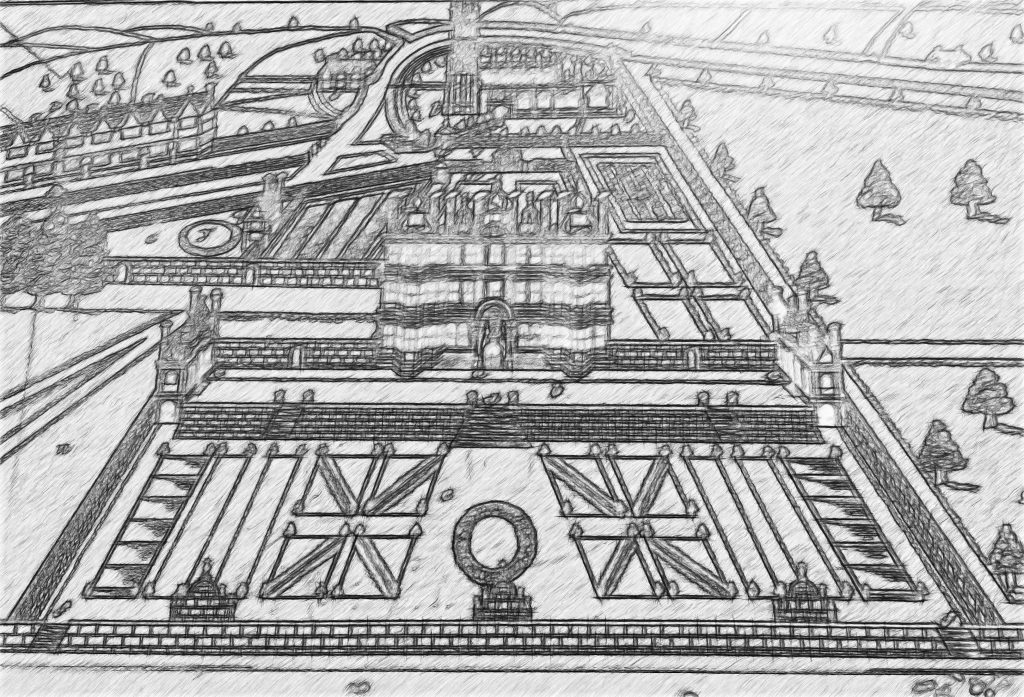
Sketch from a display of Campden House, Chippping Campden. St James Church at the back, House in the Centre, Banqueting Houses in front of, and other side of the house. (A Banqueting House was originally where you had your pudding.)
After his death, the house in Chipping Campden was held by the Royalists in the Civil War. But the Parliamentary Army forced the King’s men to retreat towards Oxford. Prince Maurice ordered the house to be burned down. All that survives of the property are two banqueting houses, and the entrance. All show what a fine building it was.
Sketch from photo of the entrance to Campden House, Chipping Camden.
Behind the wall can be seen the fire reddened ruin of the Banqueting House of Campden House, Chipping Campden. Photo of the other Banqueting House to follow in April
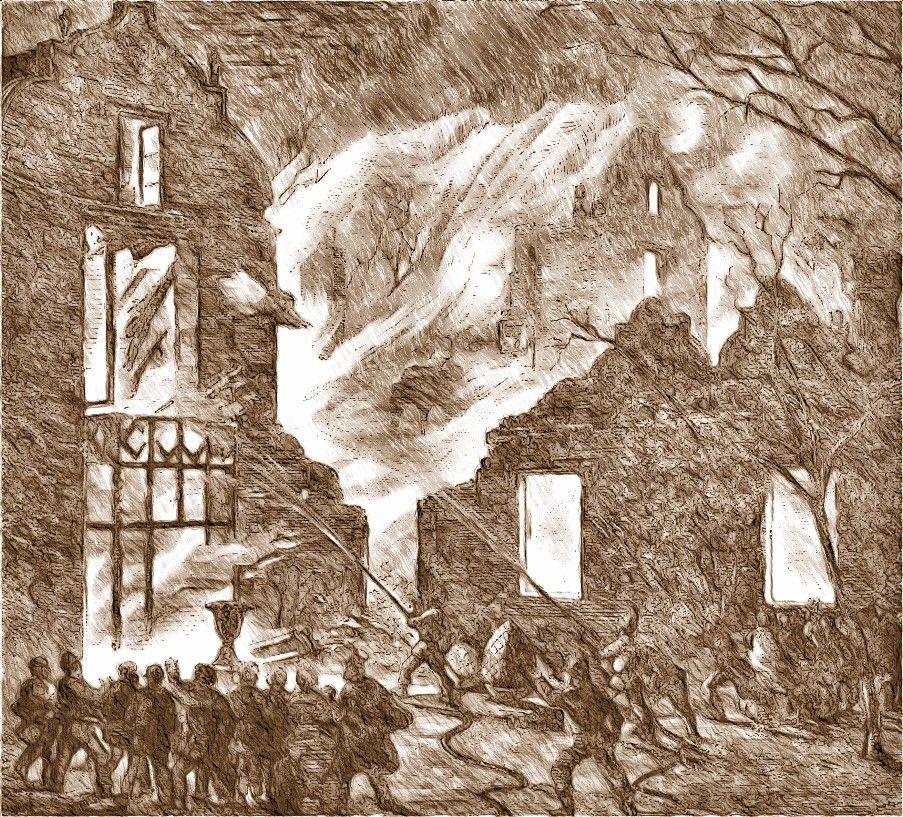
The fire at Campden House on 23rd March, 1862 gutted the building. It is really well described in this post. Briefly, a neighbour saw the fire. A fire engine was summoned. But before it could arrive, a servant appeared at a window. Her son tried to push past her, and she fell out of the window but survived. When the fire engine arrived, it was too late. So the house and its wonderful contents were destroyed. The owner was sued by the Insurance Company for fraud, but they lost the case.
Sketch from contemporary Magazine,showing the servant dropping out of the window. )In reality it was a first floor window.)
The English Year Almanac
I came across the anniversary of the fire in a secondhand book I picked up. It is by my old boss, Sir Roy Strong. The book is called ‘The English Year’. It is co-written by Julia Trevelyan Oman. The contents are ‘A Personal Selection from Chambers’ Book of Days’. Last year I also purchased the Chambers book on Abebooks for £2.10!) Both have been a useful source of information for my Almanac of the Past.
Sir Roy Strong was the Director of the V&A. Sir Roy is a dapper dresser you might almost call him a neo-Georgian. Certainly, a bit of a dandy. I always thought he resembled Charles 1, one of our most ineffectual Kings. I didn’t really have much contact with him, being a lowly Assistant Keeper at the V&A. But at the one Keepers’ Meeting I did attend he seemed rather ineffectual as the chairman of the meeting. But this is mere gossip! And I mention it to show how wrong one can be, in judging people.
Because, when I consider the revival of the V&A under his tenure, my judgement was facile. Sir Roy transformed the V&A. The Museum had been damaged by years of under-investment in the building since WW2. Sir Roy began a campaign to restore the rich and very beautiful old Victorian interior design. The original Victorian Restaurant was transformed. The shop turned into a retail paradise. Generally, the V&A ceased to be dusty and old under his tenure. The wonders of the Victorian Museum shone again with rich and vibrant colours. It reminds me that good leadership is allowing beneficial change to happen. It’s not about the leader being a dynamic leader. It’s about moving an institution positively forward, which Sir Roy certainly did.
1769 – William ‘Strata’ Smith was born. (died 28 August 1839) Smith is known as the Father of English Geology. He was a Canal and Mining Engineer and created ‘the first detailed, nationwide geological map of any country’. (Wikipedia). He worked in a town just down the road from Chipping Camden, and there is a plaque to him in Stow-on-the-Wold which I will write up at some point.
1839 – OK, this is the anniversary of the first appearance in print of the word OK! OK? OK, so, I see you want more of an explanation. The editor of the Boston Morning post had an interest in abbreviations. Charles Gordon Greene in a satirical article about the editorial practices of the rival Providence Journal coined OK as an abbreviation for “oll korrect,” or “all correct”. The rest is history. For more on this story, go to the Smithsonian here. OK?
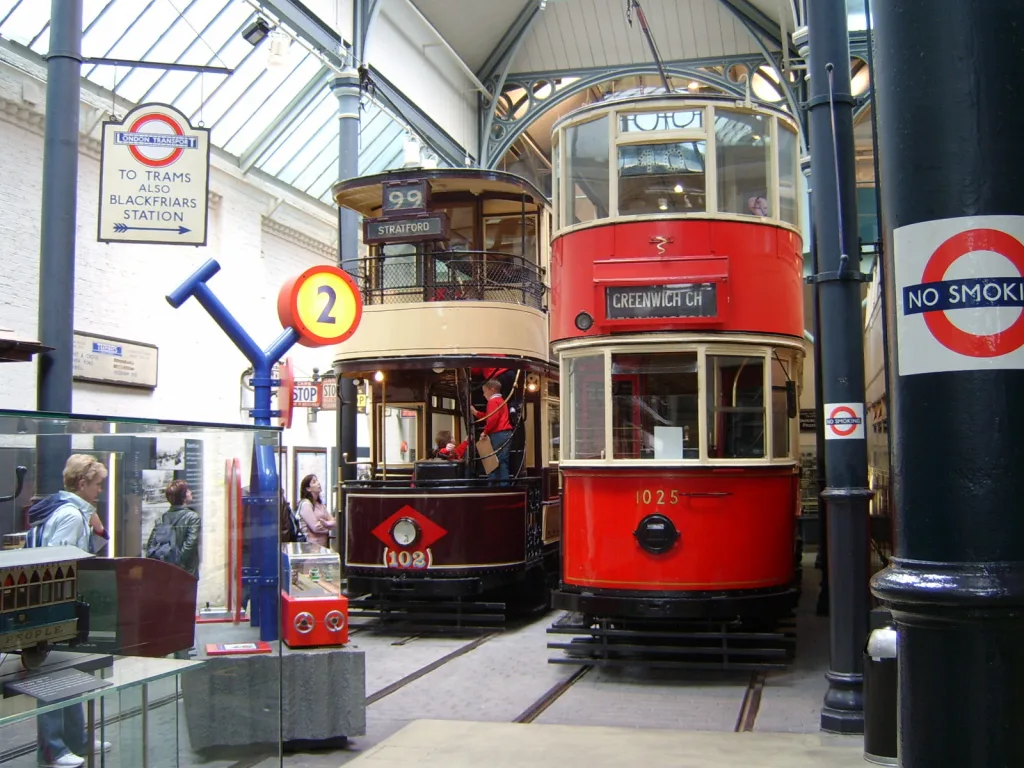
1861 – The first Trams plied London’s Streets.
London Trams, London Transport Museum (Photo KFlude)
1919 – Fascism invented when Mussolini founded the Italian Fascist Party. The repercussions of which led to World War II and the estimated deaths of 65 – 75 million people.
2020 – The UK’s first Covid-19 national lockdown ordered by Boris Johnson.