
October – Winterfylleth, Hydref, or Deireadh Fómhair

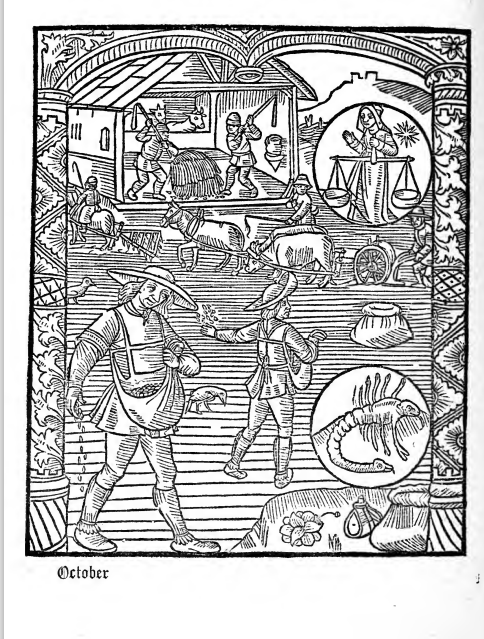
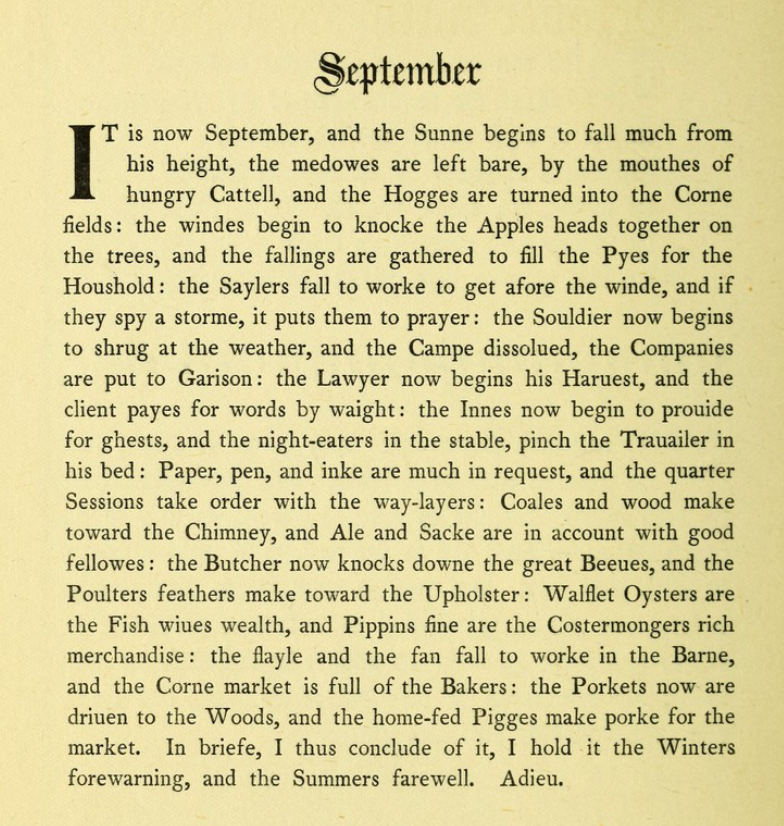
October from the Kalendar of Shepherds

Kalendar of Shepherds

The 15th Century French illustration in the Kalendar of Shepherds shows October as a busy month. It is the time when the cereals are being flailed, the fields ploughed and sown. Perhaps winter wheat or barley or peas and beans?

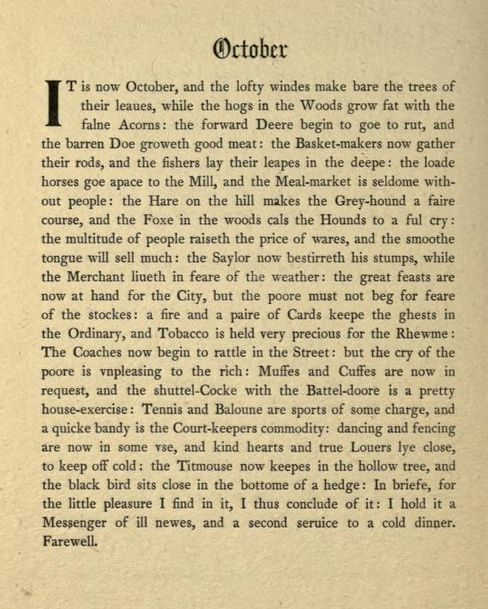
The 16th Century English text of the Kalendar of Shepherds (read the illustration) shows what a busy month it was, but the writer comes down hard against the month as ‘a messenger of ill news’ the harbinger of cold dark nights.

About the Kalendar of Shepherds.

The Kalendar was printed in 1493 in Paris and provided ‘Devices for the 12 Months.’ I’m using a modern (1908) reconstruction of it using wood cuts from the original 15th Century version. It includes various text from 16th and 17th Century sources. (Couplets by Tusser ‘Five Hundred Parts of Good Husbandrie 1599. Text descriptions of the month from Nicholas Breton’s ‘Fantasticks of 1626. This provides an interesting view of what was going on in the countryside every month.

https://wellcomecollection.org/works/f4824s6t To see the full Kalendar, go here:

Astrological October

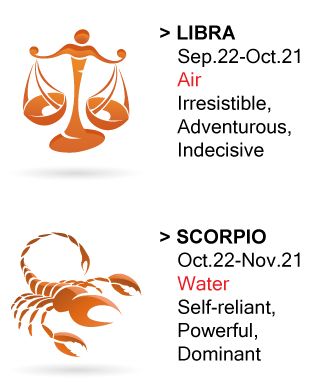
The star signs of October are the Scales of Libra and the Scorpion of Scorpio.

The star signs of October

Angelic October

Michael is the Angel of Autumn, the Angel of Judgement Day, and the Weigher of Souls. Uriel is the Angel of Libra and was sent by God sent to warn Noah. So the protector against, floods, fire and natural disasters. Scorpio’s Angel is Barbiel, he looks over health, genitalia and doubtful things. (‘An Angel Treasury’, Jacky Newcomb).

You might like to look at my post on Michaelmas here.

Roman October

In the Roman world it was, originally, the 8th Month (octo=8) but then they added January and February to the year. So it became the 10th Month. It was their time to celebrate the new wines of the Harvest. In Britain, the wine harvest is late September to October, but in hotter climes can be from July. But the grapes need to be processed, and the Romans thought that new wine was health giving and celebrated it in October.

Rustic October

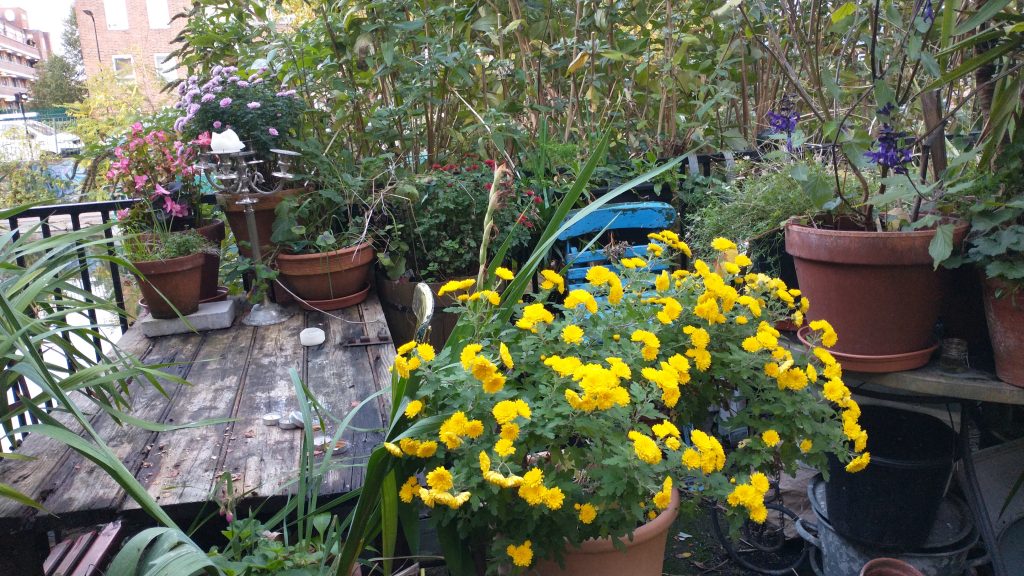
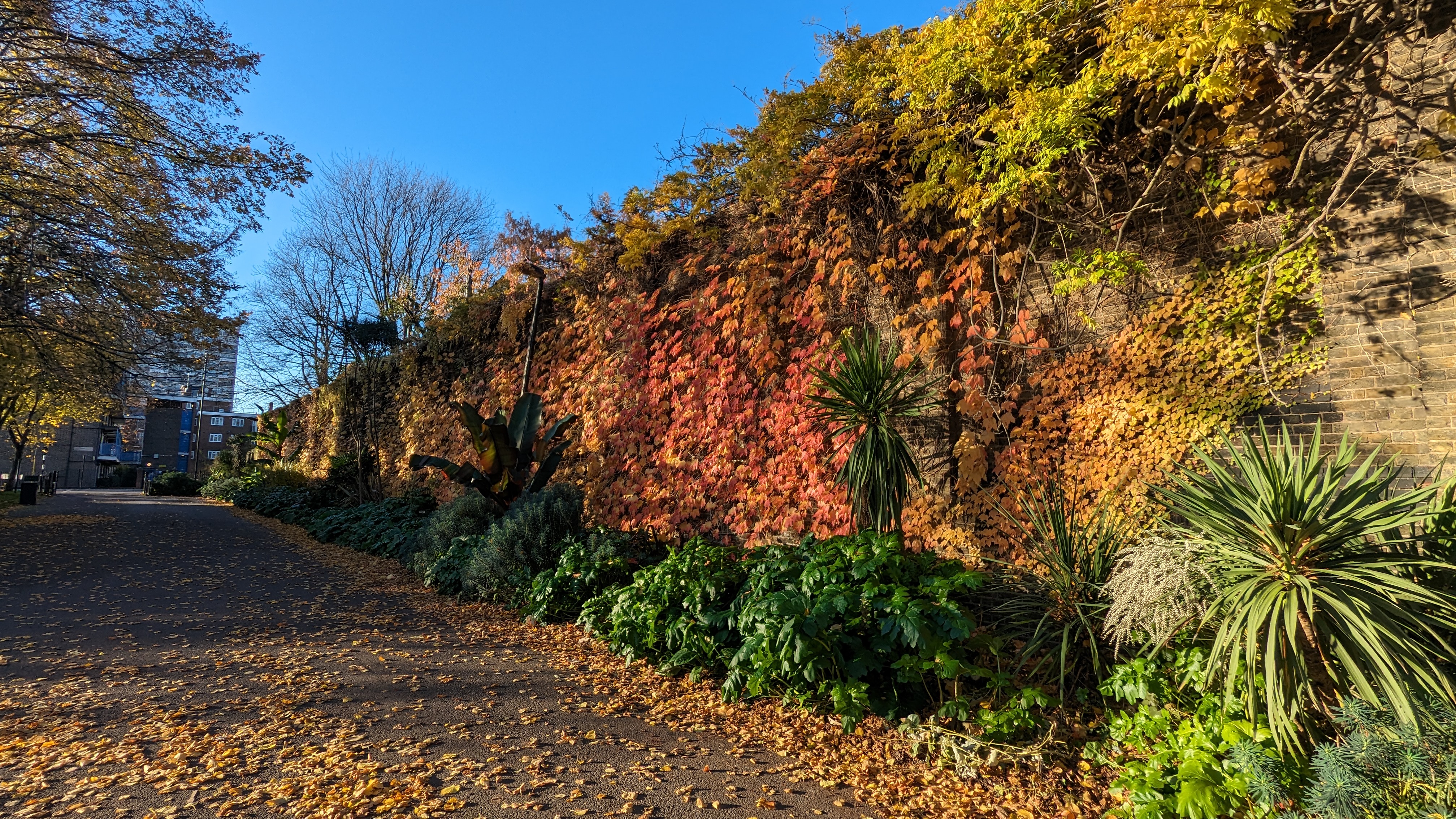
But for many people, October is a beautiful month. The dying leaves bring a sophisticated array of rustic colours, which makes the wooded countryside exceptionally beautiful.

Autumn in Haggerston Park, London (photo Kevin Flude)

It can still be warm enough to go for pleasant walks. And the surfeit of the harvest and the culling of animals meant there was plenty to eat before winter austerity begins.

Anglo-Saxon Winter Fall

The Venerable Bede tells us that the month was called Winterfylleth, in the 8th Century. The English divided the year into Summer and Winter. And Winter began for the Anglo-Saxons on the first full moon of October. This means that this year winter begins on 7th October. This is the Harvest or Hunter’s Moon, which is also a supermoon, the first of 3 ending the year.

Celtic October

In Welsh, it is Hydref, which also means Autumn. For the Welsh it was the last month of Autumn and the last month of the year. The Celtic new year, and winter starts on 1st November. The same is true of the Irish Calendar. Autumn is called Fómhair, and October Deireadh Fómhair which means ‘End of Autumn’.

Astronomical & Meteorological Autumn

Astronomically, autumn ends at the Winter Solstice and meteorologically at the end of November. So the Celtic Autumn ends a whole month or more earlier than the other measures. My very personal view is that Winter begins on November 5th more often than not. This is an evening we often spend outside watching the fireworks displays to celebrate Guy Fawkes’ Night. It always seems to be the first time that you feel cold enough to need hat, gloves, and scarves.

First Published in Autumn 2024, revised 2025

The Archaeology of London Walk

Roman layer opus signinum,

This is Kevin Flude’s Walk for London Walks. It normally starts in the early evening and from Exit 3 Bank Underground Station To See if the walk is running soon follow this link.

Legend says that London was founded as New Troy. Historians believed it was founded as Londinium after the Bridge was built by the legionaries of the Emperor Claudius in AD 43.   Archaeologists in the 1970s and 1980s discovered that London was refounded as Lundenwic in the 7th Century and again in the 9th Century when it was called Lundeburg.

This walk tells the epic tale of the uncovering of London’s past by Archaeologists. And provides an insight into the dramatic history of the Capital of Britannia, and how it survived revolts, fires, plagues, and reacted to the decline and fall of the Roman Empire.  It became the foremost English City but with periods under Viking and Norman control.

We tell the story in the streets of the City of London, beginning in the valley of the River Walbrook by the Temple of Mithras, and visit many sites where important archaeological discoveries were made.

See my Roman London

Updated 7th October

September – ‘Winter’s Forewarning and Summer’s Farewell’

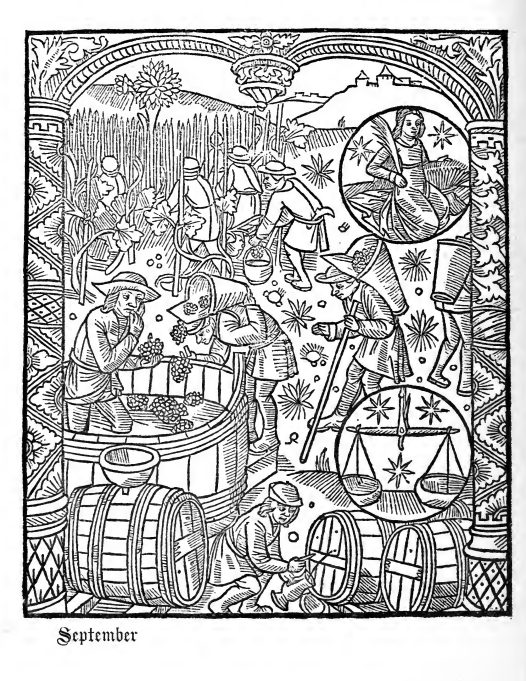
Kalendar of Shepherds illustration of September showing harvesting grapes and the astrological signs for Virgo (August 23 – September 22) and Libra (September 23 – October 22)

It is that time of the year when you say ‘Where has the Summer gone? It can’t be September already?’ But, meteorology, speaking, Autumn starts today. September 1st was chosen on a numerical basis for ease of measuring rather than any profound floral, agricultural or solar reason. So, there are three Gregorian Calendar months for each season, and each season starts on the first of the month. Autumn: September, November and December.

Autumn, Harvest, Fall

Autumn comes from Latin (autumnus) which went into French and then into English. The season was also called Harvest (which went into Dutch herfst, German Herbst, and Scots hairst -Wikipedia) or from the 16th Century: the ‘fall of the year’ or ‘fall of the leaf’ which spread to America as Fall.

Summer’s Ending

It still feels like summer. In England, we often have a glorious September, and what we can an ‘Indian’ Summer, an unexpectedly warm period in mid-September to October.

Solar Autumn

Of course, for the real Autumn, we have to wait for the Equinox, the beginning of Astronomical or Solar Autumn. This year, it is on Monday, September 22nd, 2025, 7:19 pm.

Astrological September

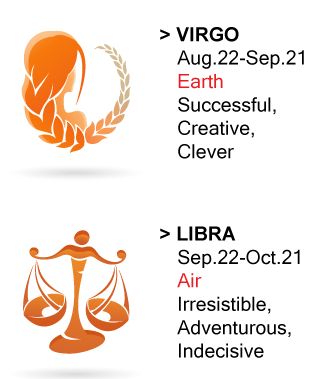
The star signs for astrological September are: Virgo which is linked to Aphrodite (Venus) the Goddess of Love and Libra which is linked to Artemis (Diana), virgin goddess of many things, including hunting, wild animals, children, and birth.

Star signs for September

September

September gets its name from the Romans, for whom it was the 7th Month of the year (septem is Latin for seven). Later, they added two new months so it became our 9th Month. (For more on the Roman year, look at my post here).

It is called Halegmonath in the early English language, or the holy month, named because it is the month of offerings, because of the harvest, and the mellow fruitfulness of September? Medi in Welsh is the month of reaping, and An Sultuine in Gaelic which means the month of plenty.

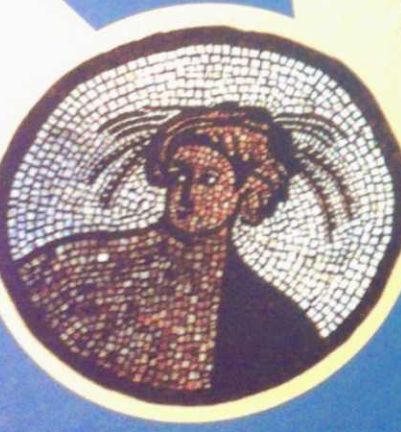
Roman personification of Autumn from Lullingstone mosaic

Early Modern September and the autumn of Life

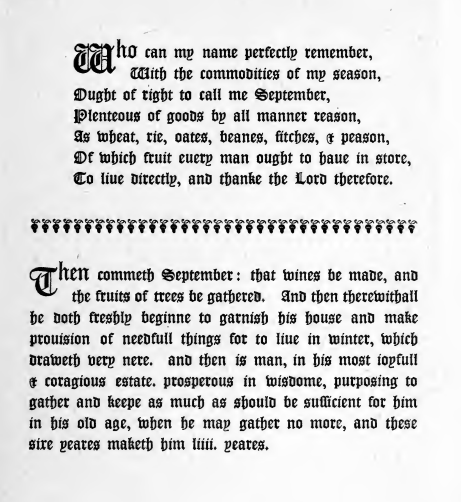
Here is an early 17th Century look at September from the Kalendar of Shepherds – for more on the Kalendar, look at my post here.

From the Kalendar of Shepherds

The Kalendar has an additional shorter look at September (see below). And it continues with its theme, linking the 12 months of the year with the lifespan of a man – 6 years for each month. So September is a metaphor for man at 56 years of age, in their prime and preparing for old age.

September from the Kalendar of Shepherds. The last sentence beginning ‘and then is man’ shows the link between September and the beginning of the autumn of life.

Season of ‘mists and mellow fruitfulness

John Keats (1795 – 1821) wrote a great poem called ‘To Autumn’:

Season of mists and mellow fruitfulness,
  Close bosom-friend of the maturing sun;
Conspiring with him how to load and bless
  With fruit the vines that round the thatch-eves run;
To bend with apples the moss’d cottage-trees,
  And fill all fruit with ripeness to the core;
    To swell the gourd, and plump the hazel shells
  With a sweet kernel; to set budding more,
And still more, later flowers for the bees,
Until they think warm days will never cease,
    For summer has o’er-brimm’d their clammy cells.

Who hath not seen thee oft amid thy store?
  Sometimes whoever seeks abroad may find
Thee sitting careless on a granary floor,
  Thy hair soft-lifted by the winnowing wind;
Or on a half-reap’d furrow sound asleep,
  Drowsed with the fume of poppies, while thy hook
    Spares the next swath and all its twined flowers:
And sometimes like a gleaner thou dost keep
  Steady thy laden head across a brook;
  Or by a cider-press, with patient look,
    Thou watchest the last oozings, hours by hours.

Where are the songs of Spring? Ay, where are they?
  Think not of them, thou hast thy music too,—
While barred clouds bloom the soft-dying day,
  And touch the stubble-plains with rosy hue;
Then in a wailful choir the small gnats mourn
  Among the river sallows, borne aloft
    Or sinking as the light wind lives or dies;
And full-grown lambs loud bleat from hilly bourn;
  Hedge-crickets sing; and now with treble soft
  The redbreast whistles from a garden-croft,
    And gathering swallows twitter in the skies.

Written September 19, 1819; first published in 1820. This poem is in the public domain and available here:

First published September 2024, revised 2025

St Germanus Day & Original Sin July 31st

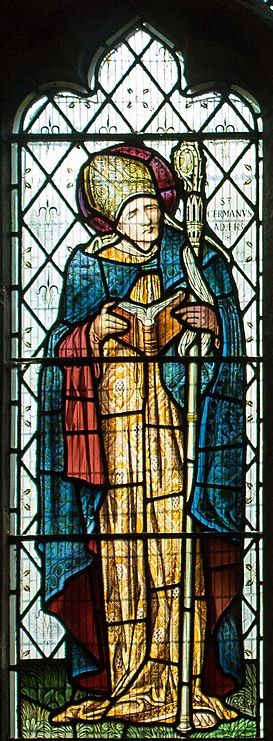
St Germanus of Auxerre, Window in St Paul’s parish church, Morton, Lincolnshire, made by Sir Edward Burne-Jones and William Morris in 1914. Photo by Jenny of Jules & Jenny from Lincoln, UK (CC BY 2.0 Wikimedia Photo by Jenny of Jules & Jenny from Lincoln, UK)

St Germanus is the source of one of the few contemporary references to Britain in the 5th Century (the Dark Ages). One of his followers wrote his life story. The Saint, a Bishop in France, was sent to Britain because the Pelagian Heresy was endangering the Catholic version of Christianity. Pelagius was a highly educated British (or possibly Irish) priest who moved to Rome in the late 4th Century. He lived by a strict moral code, attacking Catholic laxity and opposing St Augustine of Hippo’s theory of Divine Grace. By contrast, Pelagius promoted human choice in salvation and denied the doctrine of original sin. Wikipedia tells us that he:

considered it an insult to God that humans could be born inherently sinful or biased towards sin, and Pelagius believed that the soul was created by God at conception, and therefore could not be imbued with sin as it was solely the product of God’s creative agency.

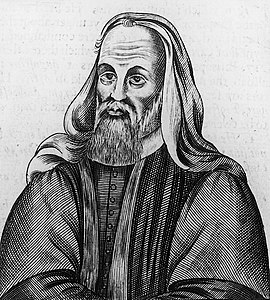
17th Century print of Pelagius

Germanus was sent to Britain, where he confronted Pelagian converts in a public debate which is thought to have taken place in a disused Roman amphitheatre. The author is not interested in Britain, per se, so does not tell us which town it was, but, it is mostly assumed to be St Albans, although London is possible.

In the stadium, the Saint and his acolytes confound the heretics and, so, convert the town’s people sitting watching the debate. St Germanus goes to a nearby shrine of St Alban to thank God, falls asleep in a hut, and is miraculously saved from a fire. He then comes across a man called a Tribune, and helps defeat a Saxon army in the ‘Alleluia’ victory. The importance of all this is that it gives us a few glimpses of Britain, in about 429AD, two decades after the Romans have left.

The British Bishops were led in their heresy by someone called Agricola. The writer describes these bishops as ‘conspicuous for riches, brilliant in dress and surrounded by a fawning multitude’. The use of the title ‘Tribune’ in the story suggests Roman administrative titles are still in use 19 years after the date of the ‘formal’ end of Roman Britain, 410AD. The Alleluia victory over the Saxons also gives us an early date for Saxon presence in the country as an enemy.

St Albans is the favoured choice for the location of the event because, Bede tells us St Albans was born, martyred and commemorated in Verulamium, now called St Albans. Archaeology shows possible post Roman occupation of the town. And it has a famous Amphitheatre.

However, Gildas, who is writing 200 years or more before Bede, tells us St Alban was born in Verulamium but martyred in London. This makes sense as London was the late Roman Capital and more likely to be the site of a martyrdom. There is also a church dedicated to St Albans close to the Roman Amphitheatre, where Gildas tells us the execution took place. Unfortunately, the Church cannot be, archaeologically dated back to 429AD.

Bede’s account of the martyrdom of St Albans is also somewhat farcical, as God divides the waters of the River Ver for Alban to get to his martyrdom more quickly. The bridge was said to be full of people walking to witness Alban’s execution, and blocking Alban’s path to Heaven. But the Ver is but a piddle, and it would be easy to walk across without even needing wellington boats, let along a miracle. This story is much more impressive, in Gildas’ version who has the miraculous crossing over the River Thames.

Had Pelegius won, and the Roman Church had a more optimistic view of the human spirit, would it have made any difference? It’s a big question, but maybe it would have left less room for pessimism and guilt?

Frances Marsden on Quora wrote:

What were the effects of original sin? …. it damaged our relationship with God. He seemed distant, we became mistrustful. We lost sanctifying grace. The weakening of the will, making us more prone to temptation. The darkening of the intellect. Increased vulnerability to sickness and disease. Spiritual death.

Germanus died in Ravenna. The story of his life by The Life of St. Germanus, Bishop of Auxerre by Constantius of Lyon written shortly after his death is a crucial source for the study of the 5th Century in Western Europe. It is an epic period where Imperial and Barbarian groups are fighting for control of Britain, France, Spain, Africa and Italy. There are competing views of what Christianity is and should be. not only the heresy of Pelagians but also the Arian Heresy which the German people tended to support. There were also the Nestorian and Eutychian heresy. I’ve just read a 2020 article about the Life of St Germanus by Leon Mintz which you can read here:

For more on Nick Fuentes and his theories on St Germanus, St Patrick and King Arthur read my post here:

For St Germanus and St Genevieve click here:

First written in January 2023, copied to its own page in July 2024, and republished 2025

July Julius Caesar’s Month

July – Kalendar of Shepherds 15th Century

July is named for Julius Caesar. Originally, the Roman Month was called Quintilis, as it was the fifth month of the Roman calendar, which originally started in March. Caesar reformed the calendar in 44BC and the Senate renamed the month after him. For more on Roman Months, see my post here.

The 7th month is called Lúil in Irish and Gorffennaf in Welsh. In Anglo Saxon it was Æfteraliða, or “after-mild;”, Liða, means “mild” or “gentle,” or the period of warm weather around Midsummer. June is Arraliða, or “before-mild”.

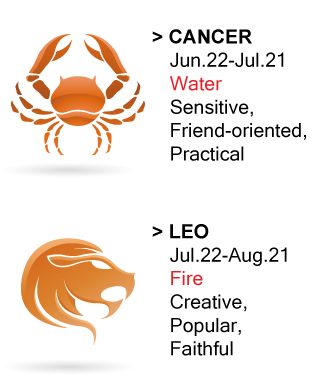
It is on average the warmest month in most of the Northern Hemisphere, where it is the second month of summer. The star signs are: Cancer (until July 22) and Leo (July 23 onwards),

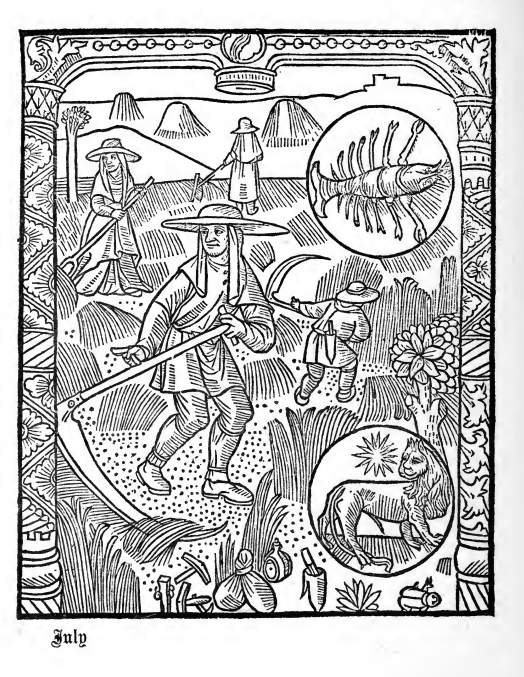
July is the month of Haymaking, as you can see from the image (above from Kalendar of Shepherds). To find out more about haymaking, wait for the next post.

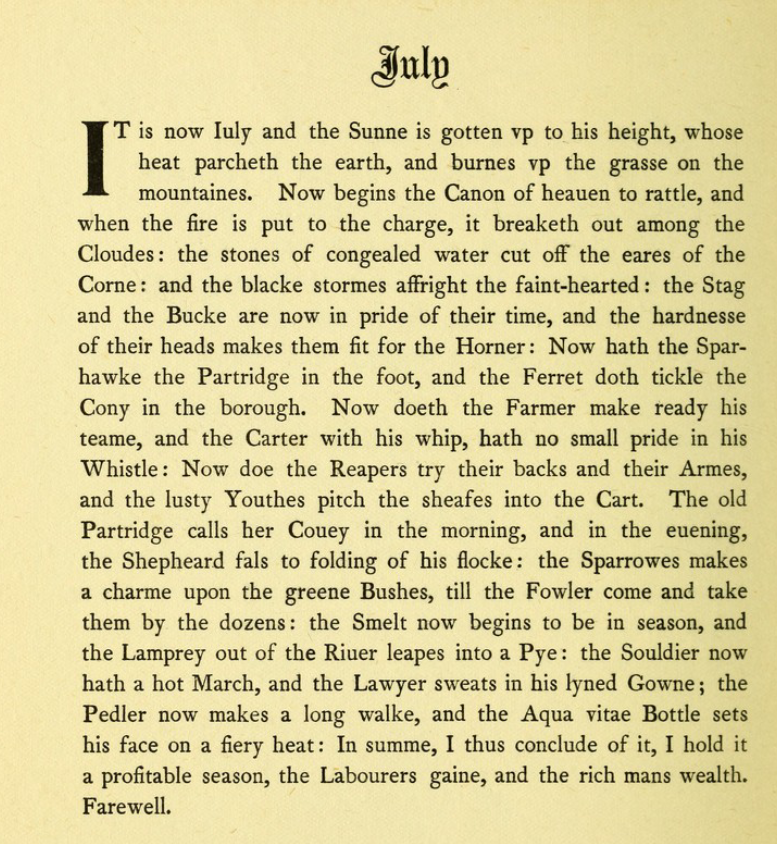
From the Kalendar of Shepherds comes this description of the month.

First published, in 2023 and republished in 2024, 2025

Ovid abandons the ‘Fasti’ June 30th

OVID 19TH CENTURY ENGRAVING BY j w cOK
OVID 19TH CENTURY ENGRAVING BY J W COOK

If you want to read Ovid’s almanac of the year, the ‘Fasti’, for yourself, this is the translation I am using. Fasti is very valuable because it tells the stories of the main religious and folk festivals of the Roman year. It also tells the story of the Gods and Goddesses behind the festivals,

Fasti is sadly unfinished because Pūblius Ovidius Nāsō was exiled by the Emperor Augustus. The last entry is for 30th June where Ovid writes: ‘put the last touches to my undertaking’. It suggests he knew he was finished, despite only being halfway through the year.

He was exiled to the Black Sea at Tomis where he died ten years later. It is not clear exactly why he was exiled. Ostensibly it was for the immorality of his book ‘The Art of Love’. But that was published almost a decade earlier. So, it seems a strange, delayed, cause for exile.

Was he involved with a plot against Augustus that saw the Emperor’s own daughter exiled? Her lover was Lullus Antonius, son of Mark Antony. Unlike Julia’s other lovers, he was forced to commit suicide.

Sculpture of Julia the Elder, daughter of Augustus, divorced wife of Tiberius Public Domain . Musée Saint-Raymond in Béziers

But this also happened years before Ovid’s exile. Julia’s daughter, Julia the Younger, was herself exiled closer to the time of Ovid’s exile. Her husband, Lucius Aemilius Paullus, was executed for treason. So, might this be the context of his exile? No one knows. Ovid said the reason for his exile was a ‘poem and a mistake’. The nature of that mistake is not recorded, but he said the crime was worse than murder and more harmful than poetry.

Here is one of my favourite Ovid quotations. Here he recommends how the aspiring male should dress for a night out on the town:

Don’t torture your hair, though, with curling-iron: don’t pumice
Your legs into smoothness. Leave that
To Mother Cybele’s votaries, ululating in chorus
With their Phrygian modes. Real men
Shouldn’t primp their good looks

… Keep pleasantly clean, take exercise, work up an outdoor
Tan; make quite sure that your toga fits
And doesn’t show spots; don’t lace your shoes too tightly,
Or ignore any rusty buckles, or slop
Around in too large a fitting. Don’t let some incompetent barber
Ruin you looks: both hair and beard demand
Expert attention. Keep your nails pared, and dirt-free;
Don’t let those long hairs sprout
In your nostrils, make sure your breath is never offensive.

Avoid the rank male stench
That wrinkles noses. Beyond this is for wanton women –
Or any half-man who wants to attract men.

Ovid, The Art of Love i

The translation is from Green, Peter (Trans) ‘Ovid The Erotic Poems’ Penguin Classics, London 1982‘

Mother Cybele’s votaries were castrati, hence their high-pitched voices. The Cybele, the Mother Goddess, fell in love with Attys, who made her jealous. She made him mad, whereupon he castrated himself and bled to death. The Goddess had him resurrected body and soul. They enjoyed divine bliss ever after. A Cybelian castration device, dredged out of the Thames, can be seen in the Roman Gallery of the British Museum.

photo of  Castration Device from the River Thames at London Bridge British Museum Photo kevin flude
British Museum Castration Device from the River Thames at London Bridge Photo: K Flude

The paragraph above is a quotation from In Their Own Words – A Literary Companion To The Origins Of London‘ D A Horizons, 2009.  by Kevin Flude. To buy the Kindle or Paperback version click here.

To read my post on Ovid’s Metamorphosis-crocus-and-saffron/

On This Day

1381 – King revokes abolition of Serfdom. This had been ‘forced’ upon the Government at Mile End during the Peasants Revolt. The royal charter was revoked July 2nd

First Published in 2024 and revised in 2025

St Columba (St Colmcille) Day June 9th

St Columba st margarets chapel by Graham van der Wielen  Edinburgh  Lead glass
St Columba Stained Glass window in St Margaret’s Chapel Edinburgh Castle Photo by Graham van der Wielen Wikipedia CC BY 2.0

St Columba, or Colmcille is one of the most important saints for the early transmission of Christianity. He was born in 521 and said to be a descendant of the possibly legendary Irish King Niall of the Nine Hostages. (The Hostages were a token of Niall’s power over Ireland as they came from the five provinces of Ireland. These are Ulster, Connacht, Leinster, Munster, and Meath. The other four hostages represented Scotland, the Saxons, the Britons, and the Franks.)

St. Columba was sent at an early age to be brought up as a Monk, and went on to set up Monasteries in Ireland at Derry and Durrow. In 563, he left Ireland, possibly because he got involved in a dispute that had a deadly outcome. He went into exile to Scotland and set up the famous Monastery on the island of Iona, Inner Hebrides. This is off the coast of what would one day be called Scotland. At the time, it was under the control of the Kingdom of Dál Riata, which was, Gaelic, nominally Christian, and controlled parts of Ulster and Western Scotland.

From Iona, Columba led the conversion of the Picts to Christianity. The Picts were Britons, speaking a different dialect of Celtic than the Gaels of Ireland and Dál Riata. Their name is said to have been given by the Romans and meant Painted Men. A shared religion, which St Columba brought from Ireland, helped towards the eventual union of the Gaels, the Picts and other British groups into the Kingdom of Alba. Alba is the Gaelic name for Scotland – meaning white, and from which we also get Albion. Alba became Scotland, which is derived from the Roman word for the area which in Latin was “Scotia”. Iona became the traditional burial place of early Scottish Kings such as Macbeth (Mac Bethad mac Findlaích). These Kings were crowned at Scone and buried in Iona. Alba was also able to take territory from the Anglian Kingdom of Northumbria, namely, the Scots-speaking areas South of the Firth of Forth. (Scots being a dialect of English). There were also Norse settlers in the Ireland so Scotland was made of a coalition of Gaelic, Brittonic, Norse and English speakers.

St Columba and the Loch Ness Monster

Much of the events of this part of Columba’s life are recorded by St. Adamnan in The Life of Saint Columba. This was written in the 7th Century, much of which is apocryphal. One notable story tells how he came across a group of pagan Picts who were mourning a child killed by a monster in the River Ness. St Columba revived the child. He then sent one of the Brothers to swim across the Loch to fetch a boat. The “water beast” pursued the Monk and was about to attack him when St Columba told the monster to stop. So it did, retreating to the depths of Loch Ness. Thus began the legend of the Loch Ness monster.

St Columba died in 597AD. Iona continued to prosper and in, 634 sent St Aidan from Iona to found the Monastery at Lindisfarne. The island is on the Eastern coast of Britain in the Anglo-Saxon Kingdom of Northumbria. This Kingdom of the North Angles, was one of the most powerful at the time and Lindisfarne was instrumental in its conversion. The tradition of evangelism took hold in the British Isles, and it was from here that much of the German-speaking world was converted to Christianity.

This is St Columba’s legacy.

Northumbria’s Contribution to the development of Christianity

There is a developing understanding among scholars that this Irish inspired form of Christianity, fused with the Anglo-Saxon Northumbria took a leading role in ritual, art, scholarship in the Roman Catholic world. Just stop and think about that sentence for a moment. The northern parts of an out of the way set of islands off the edge of Europe took a leading role in the development of Western Christianity. This was highlighted in a recent exhibition of Anglo-Saxon art at the British Library.

British Library with Poster for Anglo-Saxons Kingdoms Exhibition, Photo K Flude

A look at the Lindisfarne Gospel and the Book of Kells showcases the amazing art of this period. For a real treat, look through this scrollable virtual copy of the Lindisfarne Gospel. (Currently this is unavailable, I suspect since the BL was hacked. So instead, here is a slightly breathless online introductory video of the Gospel.)

The Book itself has been missing from the displays of the British Library for a couple of years, but was on display in Northumberland in 2022. I’m not sure whether it is yet back on display at the British Library. I think not. You can see the Book of Kells at Trinity College, Dublin or look at their online offering here: Not quite as joyous an experience as the online Lindisfarne but beautiful enough.

Carpet Page from the Lindisfarne Gospel
Carpet Page from the Lindisfarne Gospel Photo Wikiepedia Eadfrith –
Lindisfarne evangeliarium, tapijtbladzijde op f26v, Matteüsevangelie

Click here to read my post on Scone and the emergence of Alba.

Here is a virtual tour of Iona

Here is a 360-degree panoramic photo tour of Lindisfarne Abbey

First Published in 2023, revised, 2024 and improved 2025

St Pancras May 12th

Ruins of St Pancras, Canterbury Photo: K Flude (note the reused Roman Bricks.)

Pancras means ‘all-powerful’ in Greek. St Pancras was a 14 year old who refused to give up his Christian Faith during the persecution of Christians by the Emperor Diocletian. He was beheaded on the Via Aurelia, traditionally, on 12 May 303 AD. His youth makes him the Patron Saint of children, but he is also the patron saint of jobs and health. He is ‘invoked’ against cramps, false witnesses, headaches, and perjury. His body was buried in the Catacombs, but his head is kept in a reliquary in the Church of Saint Pancras in Rome, where he was buried.

Ice Saints

He is also one of the Ice Saints.  These are saints with feast days from May 11th to May 14th.  They are: St. Mamertus, St. Pancras, and St. Servatius (and in some countries, Saint Boniface of Tarsus – Wikipedia). They represent a belief that there was often a cold snap in early May.  Although modern statistics disprove this, it is however true that a late frost can cause havoc with crops.  So  the Ice Saints help persuade farmers to delay sowing.

In England, we have a saving ‘never cast  a clout while may is out’.  Which suggest you keep a coat at hand while the May flowers (Hawthorn) are still out, as it can be cold even in May. For more on the Folklore of Hawthorn -see my post here.

St Pancras in England

St Pancras, Old Church, London (Photo: Kevin Flude)

Pope Gregory is said to have given St Augustine relics from St Pancras when his mission came to Kent in 597AD. They built a church dedicated to St Pancras. The ruins still survive in the grounds of what is now St Augustine’s, Canterbury (see picture at tope of post).

This story is partly responsible for the claims that St Pancras Old Church, in Camden (pictured above) is a very old foundation. The idea being that there was a late Roman place of worship here. But there is very little solid evidence for this. It is also argued that, if it isn’t late Roman, then it dates to just after 604AD. This is when St Mellitus, sent by St Augustine, established St Pauls Cathedral. It is suggested that he also founded St Pancras Church. St Pancras’ Church was a Prebend of St Pauls Cathedral (a Prebend provides the stipend (pay) to support a Canon of a Cathedral). But this is not evidence it was established as early as the Cathedral was, and there really isn’t any other credible evidence for a 604 date.

When the Church was restored, the architects said it was mostly Tudor work with traces of Norman architecture. However, the suggested finding of a Roman tile or two, reused in the fabric, is used as evidence to keep the legend going.

If you read the Wikipedia page, you will see evidence of two strands to the contributions. One is playing down the legends of its early foundation. The other trying to keep hold of its place as among the ‘earliest sites of Christian worship’. Read the wikipedia page here: https://en.wikipedia.org/wiki/St_Pancras_Old_Church to make up your own mind.

It is a lovely Church, on an impressive site, with links to Thomas Hardy, and Sir John Soane whose tomb is the design inspiration for the iconic Red Telephone Box.

Headaches

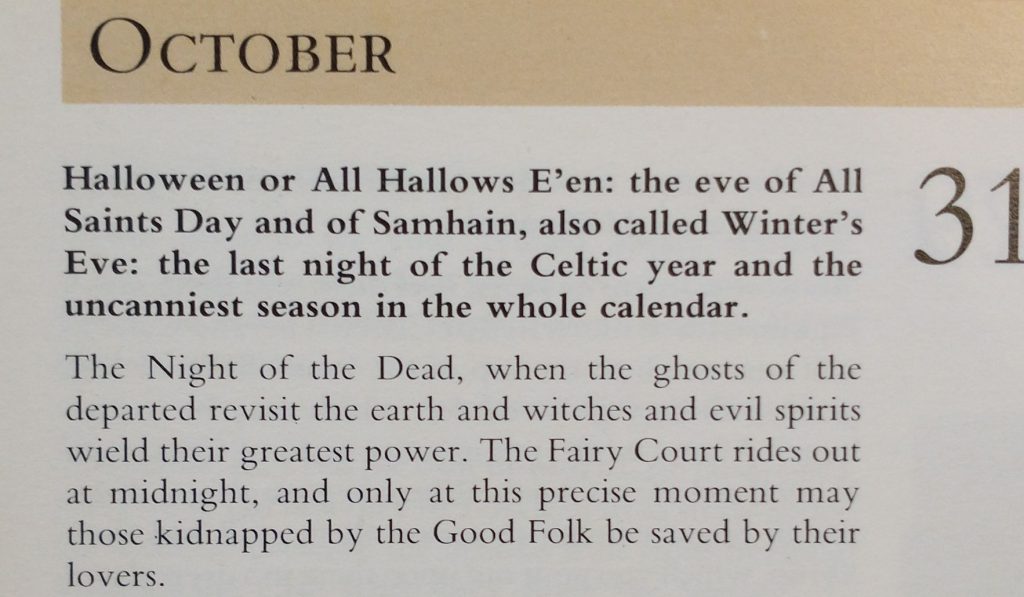
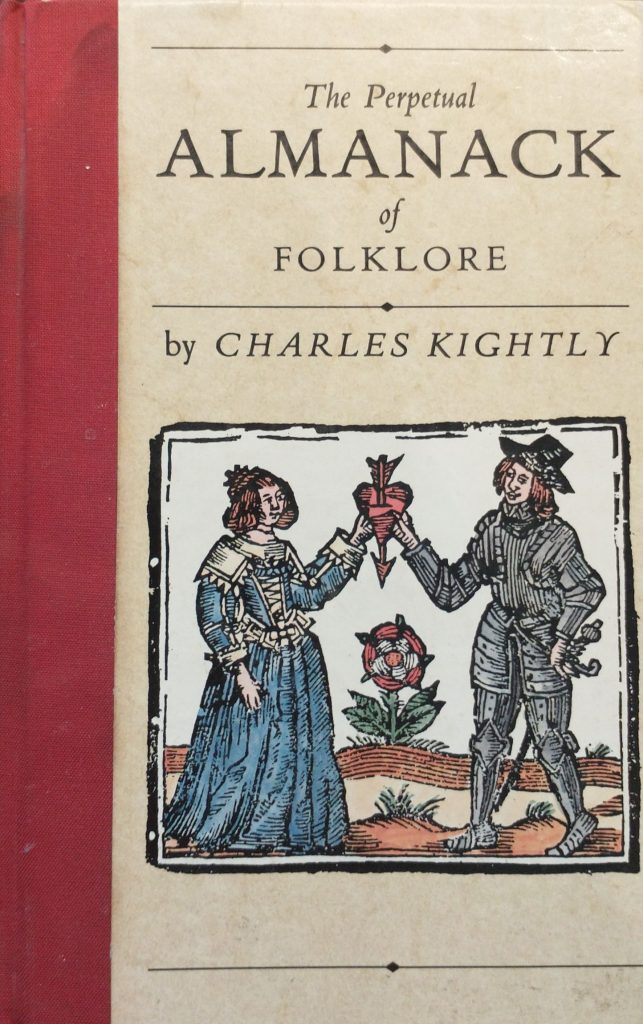
As Patron Saint of Headaches, St Pancras Day is a good day to make worms come out of your head. Or so say the Fairfax Household Book of the 17th/18th Century as quoted in Charles Kightly’s ‘The Perpetual Almanac’:

‘To make a worm come out of the head. Take, in May, the marrow of a bull or cow, and put it warm into the ear, and the worm will come forth for sweetness of the marrow.’

Generally, willowbark was used for headaches. We know this would have worked as the bark contains salicin, which is converted by the body into salicylic acid. This is a precursor to aspirin (acetylsalicylic acid). But it is not as effective.

First Published in 2024, revised 2025

Floralia. Old Goats and an extraordinary Elephant April 28th

Flora (Floralia festival named after her) on a gold aureus of 43–39 BC Wikipedia photot by АНО Международный нумизматический клуб

This post got forgotten because April 28th was unexpectedly St George’s Day.  But it’s still relevant as the Roman festival of Floralia continued to May 15th.

On the 28th of April began the Floralia.  It continued to the Kalends (15th) of May. According to Ovid in the ‘Fasti’ Book IV, the Romans celebrated Flora, the Goddess of Spring.  The Floralia celebrated flowering, blossoming, budding, planting and fertility.

Flora was one of the 15 Roman Deities offered a state-financed Priest. Her home in Rome, was on the lower slopes of the Aventine Hill near the Circus Maximus.

The Circus Maximus is the large long arena in the middle of Rome. Model Musee Arte et Histoire, Brussels, photo Kevin Flude

Celebrations began with theatrical performances, at the end of which the audience were pelted with beans and lupins. Then there were competitive games, and spectacles. The latter, in the reign of Galba, including a tight-rope walking animal. A monkey you might guess but no, it was a tight-rope walking elephant!

The Year of the Four Emperors

Incidentally, Galba only survived for 7 months as Emperor.  A little longer than our Liz Truss’s 44 days. But then she was not murdered by a rampaging mob at the end of her reign. It was the year known to history as the year of the 4 Emperors. (great description by Tacitus here:)

Spectacles and Battles

Juvenal records that prostitutes were included in the celebration of Floralia by dancing naked, and fighting in mock gladiatorial battles. There is a raging debate about the existence of female gladiators. A burial in Southwark has been said to be one such.  To hear what Natalie Haynes has to say on the subject look here🙂

Fauns, Satyrs, Goats and Hares

Hares and goats were released as part of the ceremonies. These animals were both considered to be very fertile and have a ‘salacious’ reputation! (Satyrs or Fawns were, famously, obsessed with sex and were half man half goat. A man can still be referred to, normally behind his back, as an ‘old goat’). Fauns were Roman, Satyrs Greek. The one half man half goat, the other half man half horse. It all got a little mixed up and fauns became very similar to satyrs.

To read about the myths of hare see my post march-28th-as-mad-as-a-march-hare/

Written in 2023 revised April 2024, 2025

Roodmas, the True Cross and the Coronation May 3rd

Rodmas – Rood screen in St. Helen’s church, Ranworth, Norfolk by Maria CC BY-SA 3.0

Rood is another word for the Cross. Parish Churches used to have a Rood Screen separating the holy Choir from the more secular Nave. This screen was topped with a statue of the Crucified Jesus nailed to a Rood. So, Roodmas, is the festival of the Holy Cross. Roodmas is celebrated on May 3rd and September 14th, although the Church of England aligned has itself with the Catholic Church’s main celebration on September 14th.

See my post on September 14th here for more on the True Cross.

King Charles III and the True Cross

cutting from the Shropshire News article on the True Cross and the Coronation
Shropshire News article on the True Cross and the Coronation

The Shropshire News reported that two pieces of the True Cross were given to Charles III by the Pope! They have been put into a cross called the Welsh Cross. This was part of the Coronation Procession. The King gave the Cross (I assume with the pieces of the Holy Cross) to the Church in Wales. Let the Shropshire News tell the story:

Shropshire News article on the True Cross and the Coronation
Part 2 Shropshire News article on the True Cross and the Coronation

This is quite extraordinarily medieval, and fits in with the news that we were encouraged to take an oath of allegiance to the new King.

I, (Insert full name), do swear that I will be faithful and bear true allegiance to His Majesty King Charles, his heirs and successors, according to law. So help me God.

https://www.mirror.co.uk/news/royals/swearing-allegiance-king-charles-its-29861318

It is a clear reminder that we are subjects not citizens and news, as a nation, we still set store by superstitions.

The Duke of Buckingham and the True Cross

The Duke of Buckingham had a piece in his collection, which he kept at York House in the early 17th Century. How he got it, I don’t know. But I think he must have acquired it from the aftermath of the destruction of the Reformation. John Tradescant, who looked after the Duke’s collection until Buckingham was murdered, had a piece of the True Cross. Tradecant created Britain’s first Museum, Tradescant’s Ark. Again, I suspect (without any evidence) that he got the fragments from Buckingham. Did he acquire it after the murder? Or shiver off a timber fragment hoping no one would notice?

First Written on May 3rd 2023, revised May 3rd 2024, and 2025