Feast Day Of King Lucius – First Christian King Of Britain? December 3rd

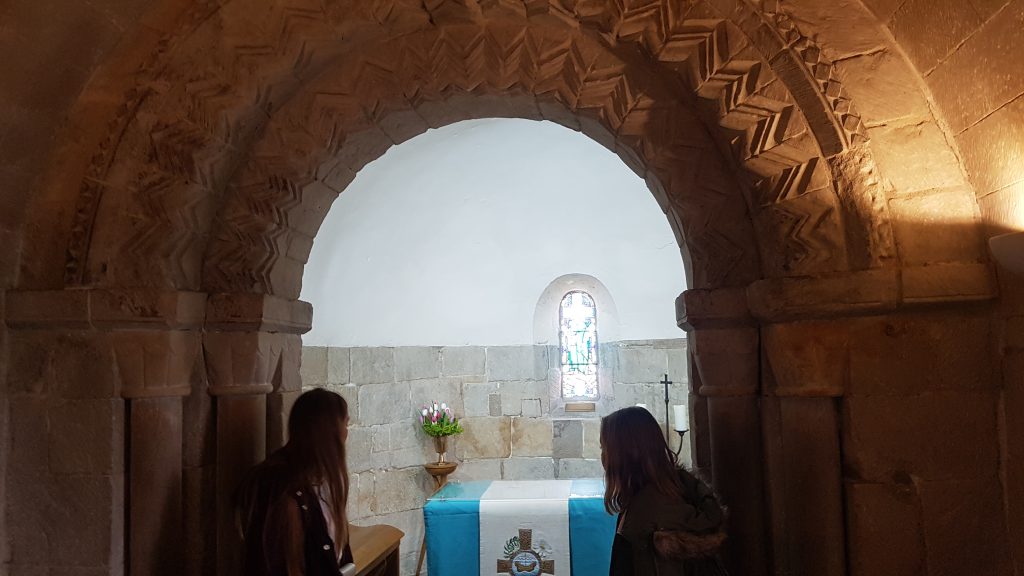
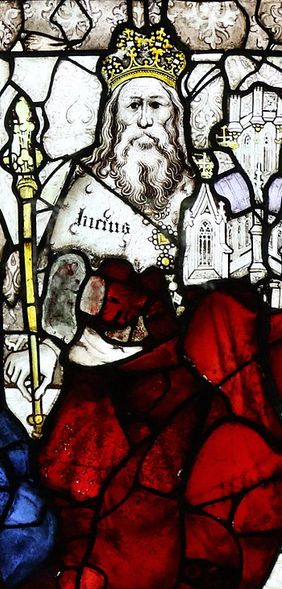
King Lucius York Minster Window

The Venerable Bede tells us that King Lucius converted to Christianity in around 180AD. He says that the King asked Pope Eleutherius to send teachers to instruct him. The Venerable Bede (died 735 AD) got this from the Liber Pontificalis of c 590. There is also a tradition that St Peter’s Cornhill in London was set up by King Lucius, and that St Peter’s is the oldest Church in London.
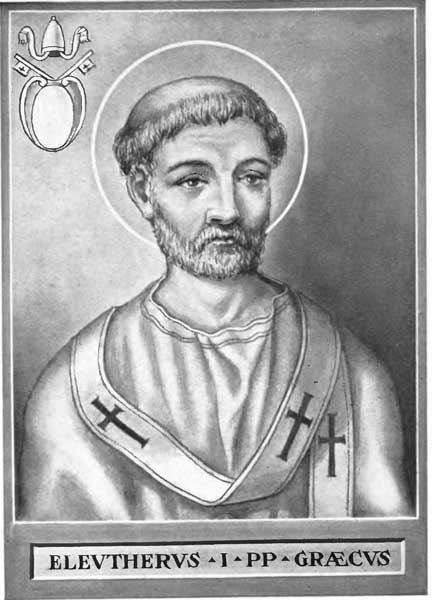
13th Pope Eleutherius

What to make of this? Bede is considered to be a reliable historian and got his information, in this case, from the Vatican. Pope Eleutherius is held to be a real Pope. He reigned at the right time, from perhaps as early as c. 171, and to his death which may be as late as AD 193. (Wikipedia). But the tradition of Lucius has been written off as a legend.

But to my mind there are questions that need asking. Not the least of the questions to ask about the veracity of this legend is: ‘What does it mean to be called the King of Britain in the middle of the Roman occupation?’

St Peters Church First Cathedral in Britain?

As to the early origin of St Peters Church, archaeologists dismissed the tradition of a Roman St Peters Church because it is built over the Roman Forum. So how can it have been the site of a Christian Church?
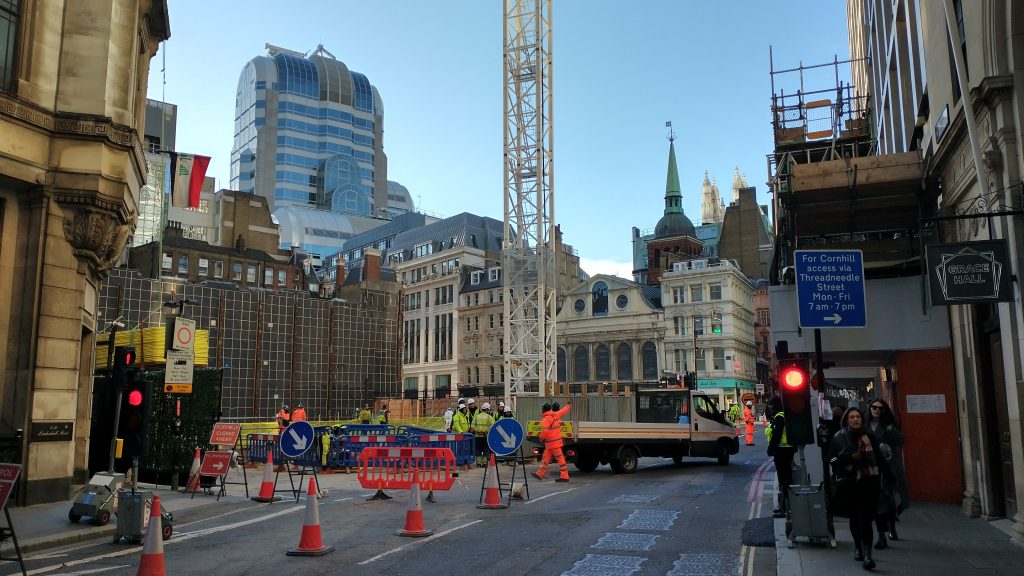
St. Peter’s seen from Cornhill in a rarely seen view as there is normally a building in the way. (Photo K Flude)

But the balance of possibilities, arguably, changed in the 1980s, when archaeologists led by Gustav Milne showed that the Basilica of the Forum was pulled down in about 300AD. So from being practically an impossibility, there is now a possibility that this subsequently became the site of a Roman Church. It doesn’t make it true but it makes it more of a possibility.

We know London sent at least one Bishop to Constantine the Great’s Council of Arles in AD 314. So a Christian community in London must have predated this time. There must have been Churches, here. And a site at the prestigious centre of the Capital of Londinium, makes a lot of sense. There are, in fact, three Churches on the site of the Roman Forum: St Peters, St Michael and St Edmund the Martyr.

Constantine the Great

In AD 306, Constantine was acclaimed Emperor on the death of his Father, Constantius Chlorus. Constantius’s wife was Helena, a Christian. He and his mother were in York when his father died. He was recognised as Caesar, (but not Augustus) by Emperor Galerius and ruled the province for a while. Then he moved to Trier, then moved on Rome, where he accepted the Christian God’s help to win the Battle of Milvian Bridge. This led him to supreme power in the Roman Empire. And might give a context for the demolished Basilica to be replaced by a Church.

There is, however, no archaeological evidence for St Peters being Roman in origin apart from the demolition of the Basilica and the legends. And there is certainly no evidence of the Basilica being turned into a Church as early as the 2nd Century.

Early Christianity in Britain

Where does that leave King Lucius? There are well attested Christian traditions that Britain was an early convert to Christianity. (The following quotes are from my book ‘In Their Own Words – A Literary Companion To The Origins Of London‘ D A Horizons, 2009 by Kevin Flude and available here.)
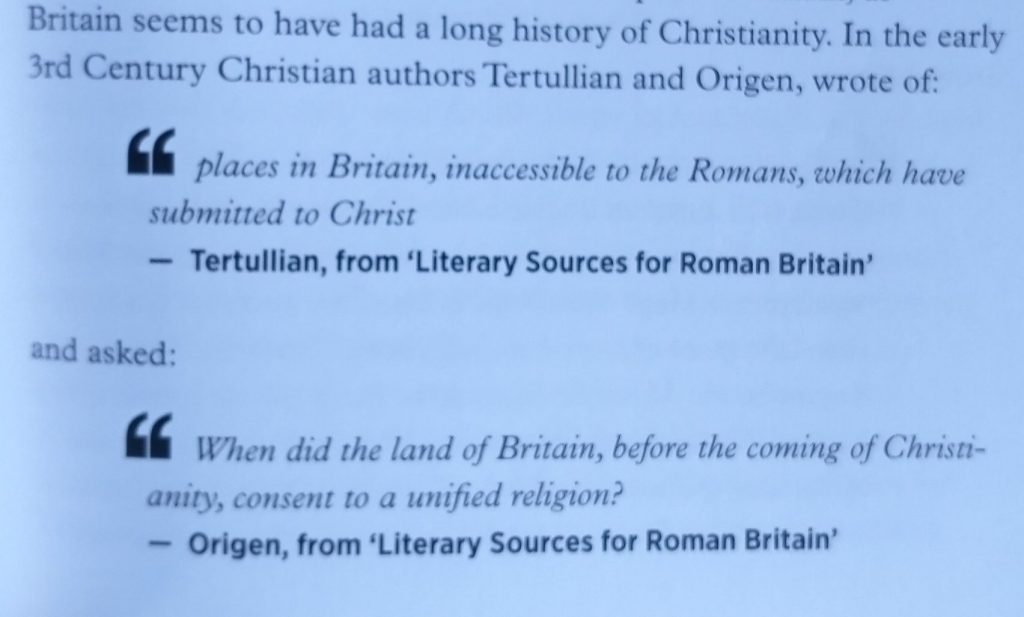
In Their Own Words – A Literary Companion To The Origins Of London‘ D A Horizons, 2009

So, an early date for an active Christian community is likely. A Church, replacing the Basilica, is plausible, particularly, after Constantine the Great probably passed through London on his way to seize the Roman Empire. So an early date for St Peters in possible. But there is no evidence for its origin as early as the late 2nd Century, the time of King Lucius.

A King of Britain in the Roman Era?

And could anyone, claim to be the ‘King of Britain’ at this date? We do know that King Togidubnus was called Great King of Britain in a Roman Temple inscription in Chichester in the First Century.
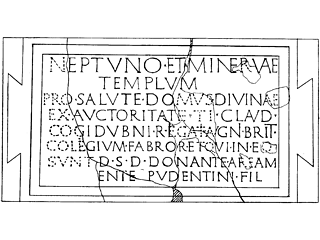
Altar Dedication, Chichester

To Neptune and Minerva, for the welfare of the Divine House by the authority of Tiberius Claudius Togidubnus, Great King of Britain, the Guild of Smiths and those therein gave this Temple from their resources, Pudens, son of Pudentinus, presenting the site.

https://romaninscriptionsofbritain.org/inscriptions/91

Togidubnos seems to have been placed in control of a large part of Southern England, centred around Chichester, after the invasion of 43AD. He is thought to have been the successor to Verica, who was exiled and called on the Romans to restore his throne. Tactitus says that Togidubnos remained loyal down ‘to our own times’ that is to the 70s AD. So he presumably held the line for the Romans against the Boudiccan revolt in 60AD.

The Romans had used Verica’s fall as their excuse for invasion, and so an honorific of Great King to him and his successors makes sense. It is assumed that after Togidubnos’s death after 80AD, the title lapsed. But it might have stayed with the family as an empty honour? Furthermore, we know that Britain had a plethora of Kings and Queens before the Roman period. Also, the Romans never conquered the whole of Britain. There were, therefore, many British Kings all the way through the period of Roman control, not least beyond Hadrian’s Wall.

So, it is possible there was someone in Britain who had, or made, a claim to be ‘King’. Whether he was ‘a’ or ‘the’ or merely descended from a King of Britain, we don’t know. And that that someone, perhaps converted to Christianity, possibly in the time of Pope Eleutherius. He may have taken the Roman name Lucius. Who knows? Its possible.

Confusing Luci?

It has been suggested that King Lucius of Britain was confused with King Lucius of Edessa, but this is considered unsatisfactory. Also, the link to London and St Peters, need not be a contemporary one. It might be two traditions that are linked together at a later period. But, of course, there is a faint possibility that the Basilica shrine room, above which St Peter’s is built, was converted for Christian use at the earlier time necessary to make sense of the King Lucius story.

King Lucius may not be a proper saint, but he has a feast day. This is because of his connections to Chur in Switzerland. There is a tradition that Lucius was martyred here. This got him an entry in the Roman Martyrology. David Knight proposes that the Chur connection comes from the transplanting of rebellious Brigantes to the Raetia frontier in the 2nd Century AD. He suggests that the Brigantes brought the story of Lucius to Chur. At the end of the King’s life, is it possible he travelled to join his people in exile in Switzerland. Here he met his unknown end. If true, this would base the story of Lucius in the North rather than London. For further reading, see ‘King Lucius of Britain’ by David J Knight.

Early Bishops of London

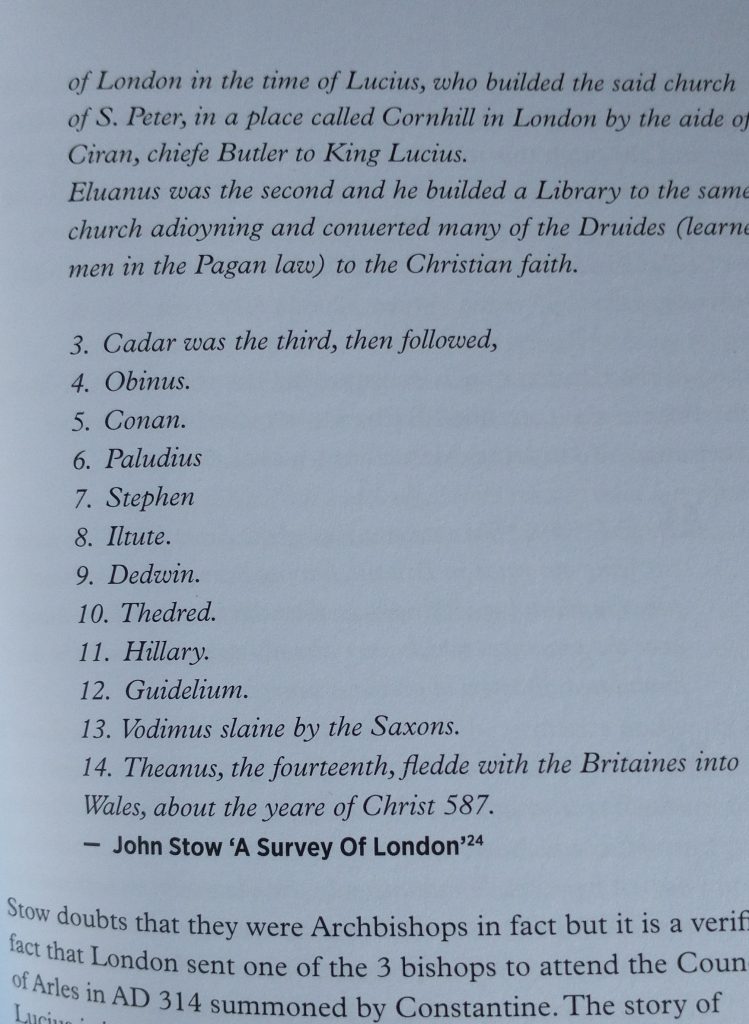
John Stow in the 16th Century records the tradition of King Lucius, which comes with a list of early British Bishops of London. These he finds are recorded in Jocelin of Furness’s ‘Book of British Bishops’. This book is discussed by Helen Birkett ‘Plausible Fictions: John Stow, Jocelin of Furness and the Book of British Bishops’. In Downham C (ed) /Medieval Furness: Texts and Contexts/, Stamford: Paul Watkins, 2013.

Her analysis concludes that the book is a ’12th-century confection in support of moving the archbishopric from Canterbury ‘back’ to its proper place in London. (This information was included in a comment to the original post by John Clark, Emeritus Curator of the Museum of London.)

To sum up. We can’t bring King Lucius out of legend, nor find any credible source linking him him with St Peters Cornhill. But the site of St Peters is a plausible, though unproven, location for a Roman Church from the 4th Century onwards. It also makes sense of the choice of the Saxons, to name their Church St Pauls. St Peter is more common as a dedication for important Churches and perhaps they chose St Paul as they knew of the ruins of St Peters the old Cathedral.
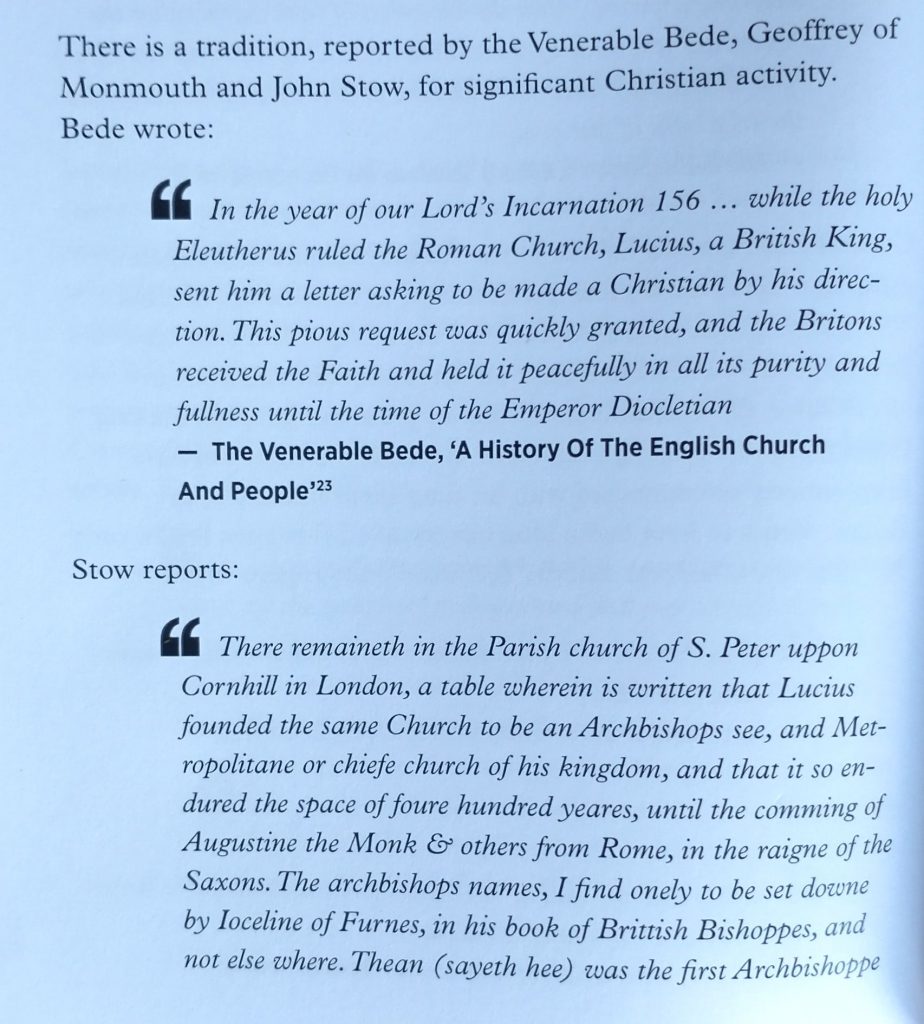
Any other early Cathedrals?

Archaeologists have also tentatively identified a masonry building in Pepys Street on Tower Hill as the Episcopal Church of late Roman London. The foundations suggest a large aisled building. Its identification as a Cathedral springs from multiplying the found foundations symmetrically by a factor of four and comparing the result to Santa Tecla in Milan. The discovery of Marble and window glass doesn’t sit so well with the alternative suggestion that it is a granary. But, to my mind, it’s not very convincing, although Dominic Perring in his recent book ”London in the Roman World’ makes the most of the case for it being a Cathedral.

And Finally?

If you look at the two maps above. The one on the left shows the Forum, the white lines are the Roman Road system. You might just be able to see the modern road system super-imposed. What this shows is that the Forum is on a different axis than the modern day road system. Cornhill cuts right across the North Western corner of the Forum. Where the letter L is, and to the left is under the modern road. So, that shows that this part of the Forum must have been knocked down before Cornhill was built. On the right hand side you can see the dark grey east-west road which is Cornhill. To the South of it you can see a dark area (above the green of St Peter’s Churchyard). This grey area is St Peters. What the Google map shows clearly, is that the orientation of St Peters, is clearly on a different orientation to that of the modern road of Cornhill. And that orientation is closer to the orientation of the Roman Forum. This makes it more likely that the axis upon which St Peters was originally built (assuming Wren followed the original axis when he rebuilt it after the Great Fire) conformed to the Roman grid pattern. This is by no means proof, and can only be proved by excavation. But, its interesting.

On This Day

1660 – Margaret Hughes became the first woman (we know about) to act on the English Stage. She played Desdemona in Shakespeare’s Othello. It was staged in a converted tennis court called the Vere Street Theatre, which was in Lincoln’s Inn Fields. In 1660 Charles II was restored to the throne, and had got used to watching female actors perform while he was in exile in France. So when he returned, he licensed two theatre managers, Thomas Killigrew and Sir William Davenant to run theatre. Davenant claimed to be the natural son of William Shakespeare, suggesting that Shakespeare stayed in his parents’ Inn, the Crown, in Cornmarket, Oxford on his way home to Stratford-upon-Avon.

First Published on December 3rd, 2022. Revised in December, 2023, 2024 and 2025
Winter December 2nd

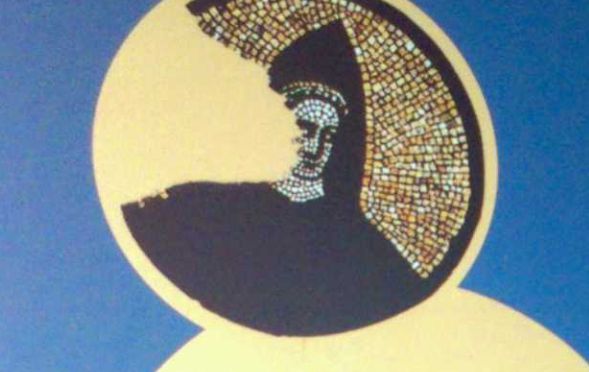
lullingstone mosaic for winter
Roman Mosaic from Lullingstone Villa, Kent representing winter

This is the second day of Winter. Winter is hiems in Latin; Gaeaf in Welsh. Geimhreadh in Old Irish; Wintar in Anglo-Saxon. The Anglo-Saxons counted years by winters, so a child might be said to be 4 winters old.

Winter, meteorologically speaking, is described in the Northern Hemisphere as being December, January, and February, which is, of course, a convention rather than a fact. There is nothing about December 1st that makes it more ‘wintery’ than November 30th or December 2nd. Astronomically, winter starts with the Winter Solstice when the sun is at its lowest and so stretches from around December 21st to the Equinox around March 21st.

Logically, the solstice, when the Sun is at its weakest, should be the coldest day, and a midpoint of winter rather than the beginning of it. With 6 weeks of winter on either side of it. This is roughly what the Celtic year does, winter starts at dusk on 31st October (Halloween/Samhain) and continues to the evening of 31st January (Candlemas/Imbolc). So a Celtic Winter is November, December, and January.

As far as the Sun goes, this is logically correct. In fact, because of the presence of the oceans (and to a lesser extent) the earth, the coldest time is not the Solstice when the Sun is at its weakest. But a few weeks later in January. Heat is retained by oceans (and the landmass), and so the coldest (and the warmest) periods are offset. Therefore, January 13th is probably the coldest day, not December 21st.

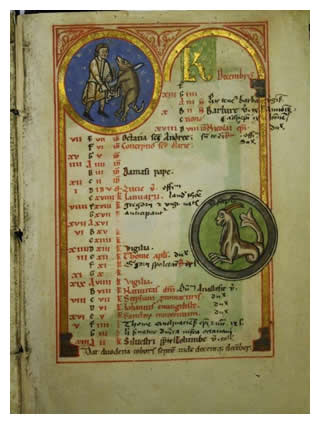
Medieval Liturgical Calendar for December. Note the image at the top which suggests this is the month for hunting bears.

My Own Winter

My personal calendar suggests that winter begins on November 5th because this is the day I generally notice how cold it has suddenly become. The house smart meter also identifies the week of November 4th being the day when the heating bill goes through the roof. However, this was not true this year, where in the London area we had a warm spell.

A final thought about Winter. Isn’t it strange that a small change in the axis of the planet should create such opposites? Cold and little growth, then hot and an explosion of flowers. Opposites just with a little tilt of the Globe towards the Sun. This, in the vastness of space, with unimaginably cold and unbelievable hot places and spaces. These make tiny the little difference between Summer and Winter seem insignificant. And yet to us, they are opposites and central facts to our existence as a species. In places, temperature ‘extremes’ make it hard to survive in. Some think this is because God made the Universe just for us. But, just think, we are completely adapted to our lives on our very own, blue planet.

A Roman View of Winter

Ovid, the great Roman poet wrote this poem on his exile from Rome to Tomis, on the Black Sea in what is now Romania. We don’t know why he was exiled, but he felt it bitterly. And winter is used to effect to show his pain.

Winter in Tomis

Harsh lands lie before him
As he struggles to keep his wit
Malicious thoughts infecting-
Crippling the morale of his spirit
Shattered visions of the fallen begin to transpire..
An awful nostalgia consumes him.
A crooked smile forms..exalting the dead

So began the fall of a mastermind.

Realizing as his mind falls to pieces
They are but catalysts – parts of a puzzle to a different plan
As the images surfaced, his virtue descends
Living amongst those barbarians
Though a fierce complication
Their tact was that of a wounded creature
And they were overrun

“I remain in exile
My bones grow weak like the sun
Descending into the trees
To end this daily affliction
As winter shows its pallid face
And the earth veiled with marbled frost
Forsaken –  this gradual madness consumes my mind
Perdition in Tomis

Undead armies of Tomis
Commanded only by the presence of my absense
Brought to life by the death of myself
Risen to ease this torment
Sacrilege; The second chance to formulate a reason
The relapse crucifixion forthwith to go into effect
Casting him away; instead insuring their demise.

I remain in exile
My bones grow weak like the sun
Descending into the trees
To end this daily affliction
As winter shows its pallid face
And the earth veiled with marbled frost
Forsaken –  this gradual madness consumes my mind
Perdition in Tomis

Each day passing now I beg for some remorse
Desperately grasping at what I feel to be my last bit of life
But unlike the cycle of the attic
I feel as though there is no recourse
I’ve withered to nothing.”

“Save me from drowning, and death will be a blessing.”
Hope for his designed tomb
“Rescue my weary spirit from annihilation
If one already lost may be un-lost”

Ovid abandoned writing his almanac poem because of his exile, so it never got beyond the Summer. To read about this see my post here or search for Ovid from the menu.

On this day

1859 – John Brown was hanged, following his raid on Harpers Ferry, violently opposing slavery.

1954 – Joseph McCarthy was formally censured by the Senate for the methods used in his anti-communist campaigns.

Published in 2024, and revised adding Ovid in 2025

St Clements Day, the Blacksmith’s Holiday, the Early Church, Lydia and Wickham November 23rd

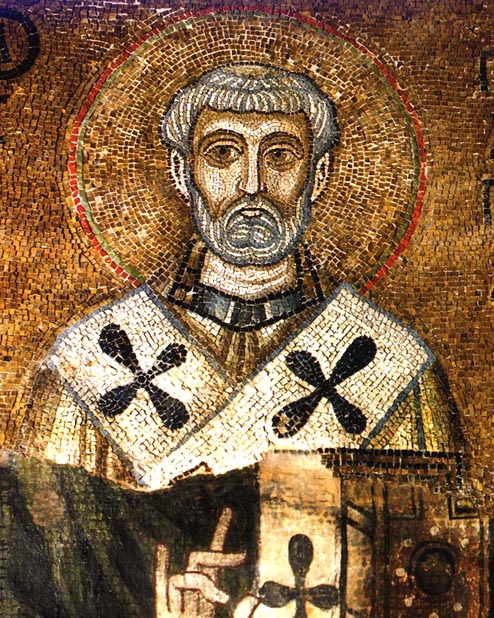
Clemens I, the Pope of Rome. Mosaic from St. Sophia of Kyiv, 11th c. In places of loss (lower part of the composition) — oil painting of the 18th c. (Wikipedia) for St Clements Day

St Clement was a very early Bishop of Rome, shortly after St Peter. Although thought to be a historical and therefore a very important peron in the history of Christianity, his mode of martyrdom is a matter of legend. He is supposed to have been tied to an anchor and thrown in the Black Sea in around AD 99. He is, therefore, particularly venerated by Blacksmiths and Sailors. Some believe he is earlier than AD99 and place his letter as early as AD60.

St Clements and the Early Church

A letter of St Clements survives and is addressed to the Christians of Corinth. This letter is of fundamental importance, as it appears to have been written when the martyrdoms of St Peter and St Paul were relatively recent memories. The letter is also important as a counterargument to the Protestant view that there is no evidence that Peter was ‘Pope’. In this letter, St Clement is giving advice to the Church of Corinth as a Pope would. This can be used as early proof of Papal supervision of the early Church.

The letter is therefore worth reading, and you can read a version of it here. . I have chosen two extracts from a long letter. The first illustrates how close to the deaths of Peter and Paul it was. The second extract gives a great insight into an early Christian World view. I think there is also very little here that a Pagan would object to? The main message of the letter is to follow the example of Jesus and adopt humility.

Chapter 5. No Less Evils Have Arisen from the Same Source in the Most Recent Times. The Martyrdom of Peter and Paul.

But not to dwell upon ancient examples, let us come to the most recent spiritual heroes. Let us take the noble examples furnished in our own generation. Through envy and jealousy the greatest and most righteous pillars [of the church] have been persecuted and put to death. Let us set before our eyes the illustrious apostles. Peter, through unrighteous envy, endured not one or two, but numerous labours; and when he had at length suffered martyrdom, departed to the place of glory due to him. Owing to envy, Paul also obtained the reward of patient endurance, after being seven times thrown into captivity, compelled to flee, and stoned. After preaching both in the east and west, he gained the illustrious reputation due to his faith, having taught righteousness to the whole world, and come to the extreme limit of the west, and suffered martyrdom under the prefects. Thus was he removed from the world, and went into the holy place, having proved himself a striking example of patience.

Chapter 20. The Peace and Harmony of the Universe.

The heavens, revolving under His government, are subject to Him in peace. Day and night run the course appointed by Him, in no wise hindering each other. The sun and moon, with the companies of the stars, roll on in harmony according to His command, within their prescribed limits, and without any deviation. The fruitful earth, according to His will, brings forth food in abundance, at the proper seasons, for man and beast and all the living beings upon it, never hesitating, nor changing any of the ordinances which He has fixed. The unsearchable places of abysses, and the indescribable arrangements of the lower world, are restrained by the same laws. The vast unmeasurable sea, gathered together by His working into various basins, never passes beyond the bounds placed around it, but does as He has commanded. For He said, Thus far shall you come, and your waves shall be broken within you. Job 38:11 The ocean, impassable to man and the worlds beyond it, are regulated by the same enactments of the Lord. The seasons of spring, summer, autumn, and winter, peacefully give place to one another. The winds in their several quarters fulfil, at the proper time, their service without hindrance. The ever-flowing fountains, formed both for enjoyment and health, furnish without fail their breasts for the life of men. The very smallest of living beings meet together in peace and concord. All these the great Creator and Lord of all has appointed to exist in peace and harmony; while He does good to all, but most abundantly to us who have fled for refuge to His compassions through Jesus Christ our Lord, to whom be glory and majesty for ever and ever. Amen.

https://www.newadvent.org/fathers/1010.htm (Translated by John Keith. From Ante-Nicene Fathers, Vol. 9. Edited by Allan Menzies. Revised and edited for New Advent by Kevin Knight. )

Towards the bottom of this post you will find out more about St Clements place in Christian History, but first, lets find out his associations with London.

London & St Clements

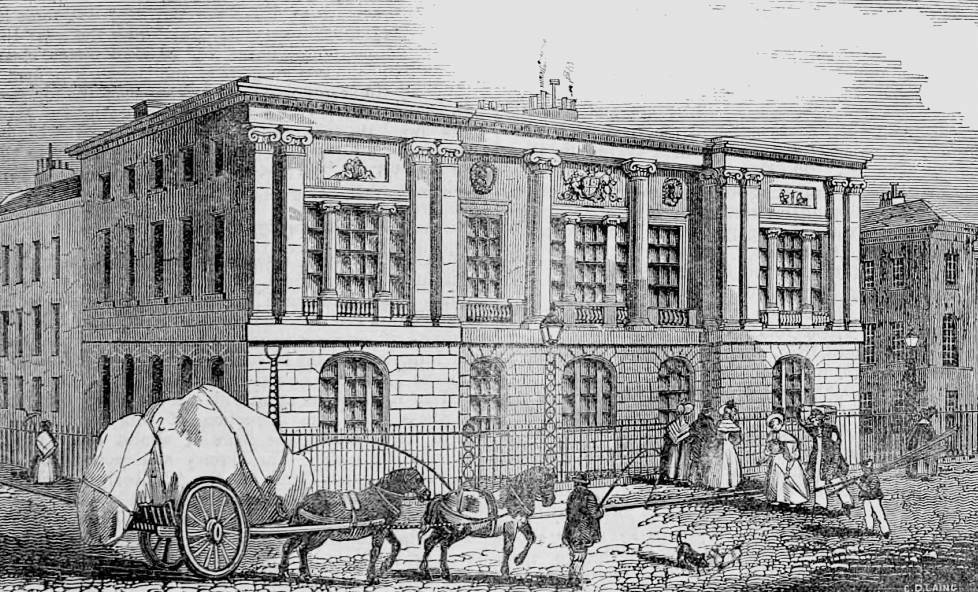
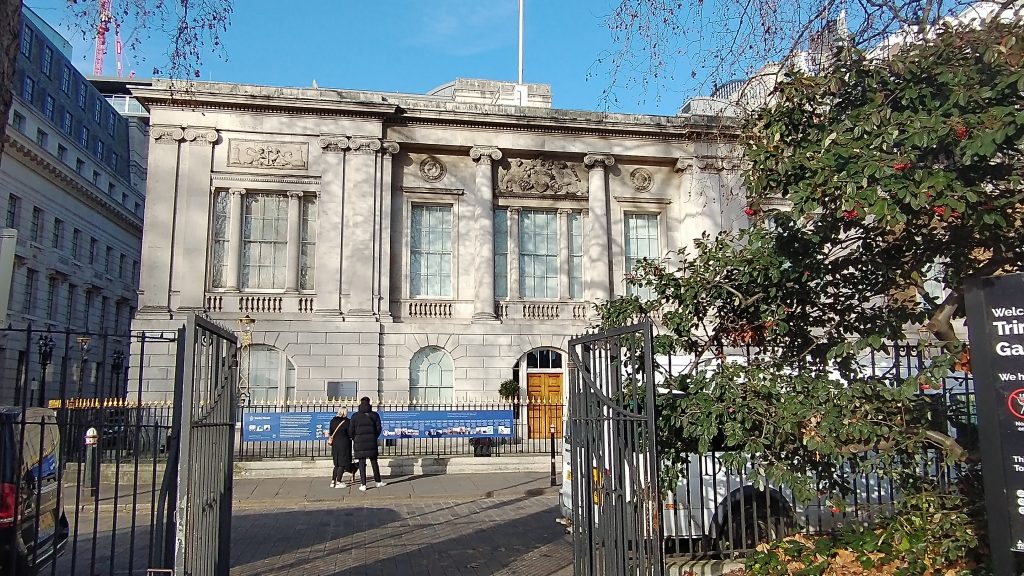
The maritime connection may explain the three St Clements connections in London. Trinity House On Tower Hill has been working to keep shipping safe since being founded in Deptford in the 16th Century as:

The Master, Wardens and Assistants of the Guild Fraternity or Brotherhood of the most glorious and undivided Trinity and of St Clement in the Parish of Deptford Strond in the County of Kent.

They look after light ships, lighthouses, navigation buoys and licence Deep Sea Pilots. The HQ moved to Tower Hill in 1796.

London has two churches dedicated to St Clements. Both are by early London waterfronts and rebuilt by Christopher Wren and his team.

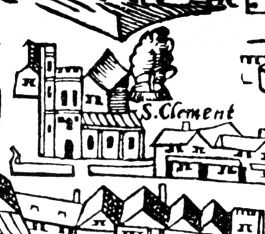
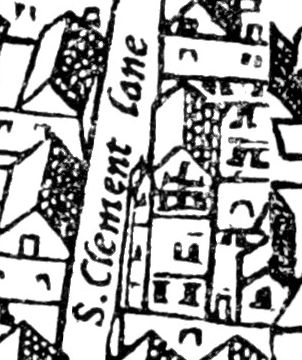
St Clement’s Eastcheap is on the terrace above the Roman port of London, near London Bridge (which leads to Wikipedia speculation that it might have been an early Roman foundation). And St Clements Danes is where the Strand meets Fleet Street on the terrace above the Lundenwic Saxon waterfront.

Lydia and Wickham get married

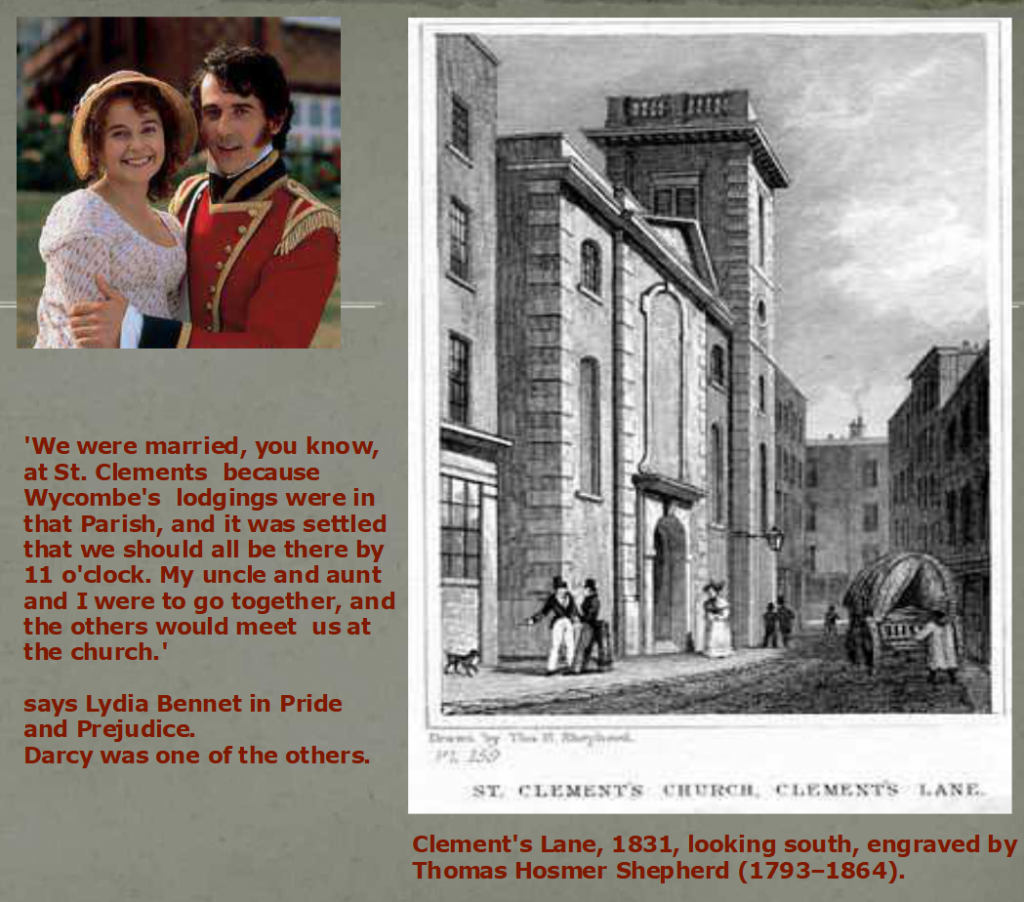
St Clements is where Lydia and Wickham finally get married in Jane Austen’s Pride and Prejudice. But which of the two St Clements? Wickham had lodgings in the East Cheap area. The Gardiners, Lydia’sUncle and Aunt were the only people at the wedding except Darcy. They lived in nearby Gracechurch Street. But perhaps St Clements Dane was more fashionable and might be more the raffish Mr Wickham’s cup of tea? (Jane Austen bought her family’s tea from Twinings, just off Fleet Street, where you can still buy it today )

Slide from my ‘Jane Austen’s 1809 Virtual Tour of London’

Oranges & Lemons

St Clements appears in the nursery rhyme/game Oranges and Lemons and both churches claim it refers to them, but as both are by the waterfront, either will do.

Oranges and lemons,
Say the bells of St. Clement’s.

You owe me five farthings,
Say the bells of St. Martin’s.

When will you pay me?
Say the bells at Old Bailey.

When I grow rich,
Say the bells at Shoreditch.

When will that be?
Say the bells of Stepney.

I do not know,
Says the great bell at Bow.

Here comes a candle to light you to bed,
And here comes a chopper to chop off your head!
  Chip chop chip chop the last man is dead

I remember playing this as a child. Two children form an arch with their hands. The other children go through the arch reciting the rhyme until the chopper comes down when the hands forming the arch traps one of the children. The trapped child then whispers which side they want to be join, and they leave the procession to stand behind one or other of the arch-makers. I seem to remember we ended it off by having a tug of war between the two teams.

Alternatively, the trapped/chopped children make an additional arch and the remaining kids have to rush through a large space, fearing the chop.

On this day:

1963 the first episode of Dr Who was broadcast on the BBC, starring William Hartnell and his assistants played by William Russell;Jacqueline Hill; and Carole Ann Ford. The ‘An Unearthly Child’ episode may be responsible for me becoming an archaeologist. It begins in London and the Tardis is transported 100,000 years into the past where stone-age humans are fighting over lost fire-lighting skills. I don’t remember hiding behind a sofa but I do remember being gripped by it. This is now 62 years of Doctor Who.

Originally published Nov 23rd, 2022. Revised & Rewritten on Nov 23rd 2023, 2024 and 2025

November ‘the month of immolations’

Kalendar of Shepherds November

This post slipped through the editorial net.  So, I need to get it out there before November is a cold memory.

November is the 9th Month of the Roman Calendar. Novem coming from the Latin for nine. But the Romans added two months to the calendar during the time of the Dictator, Julius Caesar (for his reforms click here). So 9th month is now the 11th.

In Welsh it is ‘Tachwedd’ which means the month of slaughtering. Blōtmōnaþ (Blotmonath) in Anglo -Saxon – the month of blood. These reference the fact that this was the month when the surplus animals were slaughtered or as the historian, Venerable Bede has it, ‘the month of immolations’. In Irish the month of November is called sawhain. It is also the name of the festival marking the beginning of winter which starts at dusk on 31st October. We call it Halloween, the celts Sawhain or words similar. (see my post on Halloween).

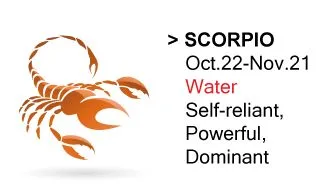
The image, at the top of the page, from the Kalendar of Shepherds shows some aspects of November – star signs Scorpio and Sagittarius; Pigs are fattening up on the acorns in the forest and then being slaughtered, smoked or dried to preserve them through the hard winter. The text of the Kalendar (read it below) gives a good summary of what early modern life in November was like. In summary, the day when the ‘poore die through want of Charitie’.

Kalendar of Sherherds – November

For more details on the Kalendar of Shepherds see my post here.

Time to see the Pleiades

They can be seen from Autumn to Spring, but they are visible all night in the Northern Hemisphere in November and December.

Nebra Sun disc from Stonehenge Exhibition British Museum
Nebra Sun disc from Stonehenge Exhibition British Museum. The Pleiades is thought to be represented by the 7 stars in the cluster above and between the Sun and the Cresent Moon, on this bronze age copper and gold disc

First published in 2024, revised in 2025
Feast of St Edmund of East Anglia November 20th

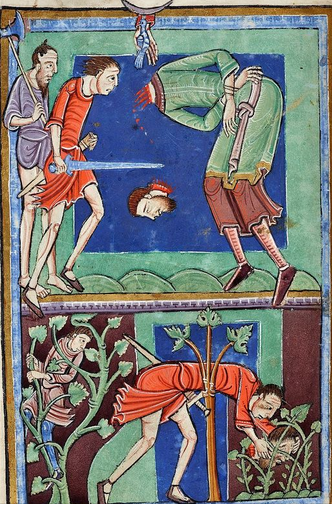
The Martyrdom of St Edmund.

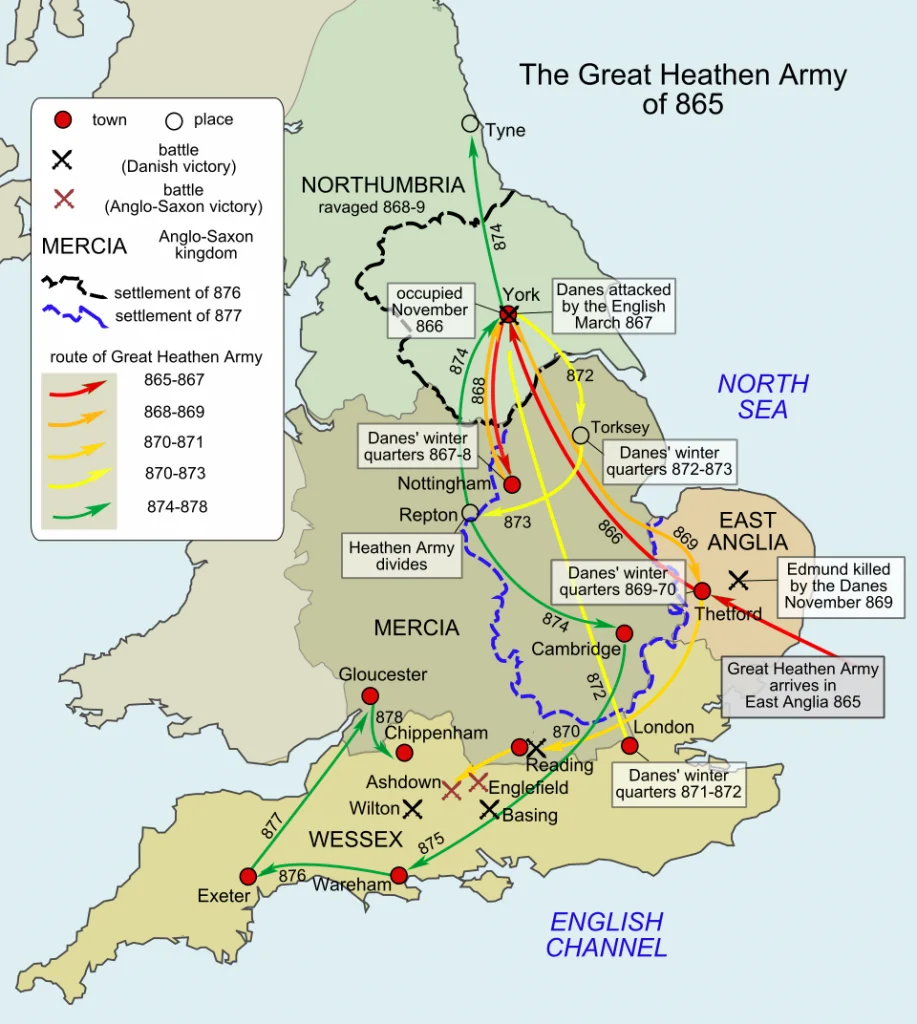
He was killed with an arrow by Vikings from the Great Heathen Army in 869. He was trying to convert them to Christianity, and they were trying to do the opposite. So, fed up, they tied him to a tree, shot him full of arrows and then beheaded him.

Based on Stenton ‘Anglo-Saxon England’ chapter 8 and Hill ‘ An Atlas of Anglo-Saxon England’ pp. 40-41By Hel-hama – Own work, CC BY-SA 3.0, https://commons.wikimedia.org/w/index.php?curid=20042870

Afterwards, the English set up a search party to find their King. As they passed nearby, his head shouted ‘Here! Here! Here!’ So they were able to retrieve his head. His remains were eventually taken to Bury which was renamed Bury St Edmunds. It became one of the most famous places of pilgrimage in England.

As a Royal martyr he was, with St Edward the Confessor, the saint of the monarchy. Being Kings themselves, they could explain to St Peter how difficult it was to be a King. Kings, they would explain, have to undertake actions which might be strictly against the Ten Commandments. King Edmund and King Edward could thus speed the King through to heaven from purgatory.

To hear about life after a beheading please read my post on St Winifred and her head.

St Edmund, King & Martyr Church

St Edmund Lombard Street (church at bottom left) Agas Map 16th Century

The City of London has a church dedicated to St Edmund, King, and Martyr. It is in Lombard Street, coincidentally, right above the South West corner of the Roman Forum. St Peter’s (29) top right corner is above the NE corner of the Forum, and St Michael’s which I think is no 27, above the North West corner. It is entirely possible their positioning original owed something to the masonry of the original Roman building. (click here to read my post about St Lucius and St Peter’s Church.)

St Edmunds is first mentioned in 1292, and rebuilt by Christopher Wren after the Great Fire of London. It was hit by bombs dropped from a German Gotha bombing on On 7 July 1917. It was also damaged in World War 2.

November 20th the day to Grow Garlic

Set garlic and beans, at St Edmund the King
The moon in the wane, therefore hangeth a thing.

Quoted in Perpetual Almanac of Folklore Charles Kightly

Garlic is either a wondrous ‘healall’ for the rustics as Galen said. Or a foul herb detested by right-thinking people, (such as Horace and Shakespeare; ‘The breath of Garlic-eaters’ Coriolanus). In 1916, the British Government called for as much Garlic as could be produced at a good price for use as antiseptic for wounds. (Mrs Grieve’ A Modern Herbal’).

Garlic ….. mingled with soft cheese ‘stauncheth’ the falling down of humours called catarrh and so is good against hoarseness’.

William Turner Herbal 1568

On this Day

1917 Tanks were used effectively for the first time in warfare at the Battle of Cambrai. For more on Cambrai read my post here🙂

1947 Princess Elizabeth married her distant cousin Philip Mountbatten (He was created the Duke of Edinburgh on the evening before the wedding) Philip was renowned for his gaffes: ‘Do you still throw spears at each other?‘ he said to native Australians. And of himself he said: As so often happens, I discovered that it would have been better to keep my mouth shut.’ For more of Philip’s gaffes please look at The BBC’s page here.

1945 The Nuremberg Trials began. (Fascinating new film called Nuremberg currently showing! I ‘can recommend it. And it has clear lessons for future generations in how to deal with totalitarian evil).

2024 the Cambridge Dictionary announced that ‘manifest’ was the word of the year. The reason is that the word has been used in a very different way, and acquired a whole new definition and receiving many more mentions on the internet.

The new definition of the word is:

“To manifest” in the sense of “to imagine achieving something you want, in the belief doing so will make it more likely to happen”.

As in:

I’m manifesting my belief that this blog will go viral next year with the help of all my loyal readers who will recommend it to all their friends and, particularly, their acquaintances, and social media contacts!

For more information on the word of the year, have a look at this page on the BBC.

2025 This year the Cambridge Dictionary word of the year is ‘Parasocial’. They define it as:
‘involving or relating to a connection that someone feels between themselves and a famous person they do not know, a character in a book, film, TV series, etc, or an artificial intelligence’.

First Published Nov 20th 2022. Republished Nov 20th 2023, 2024,2025
Feast Day of St Margaret of Scotland November 16th

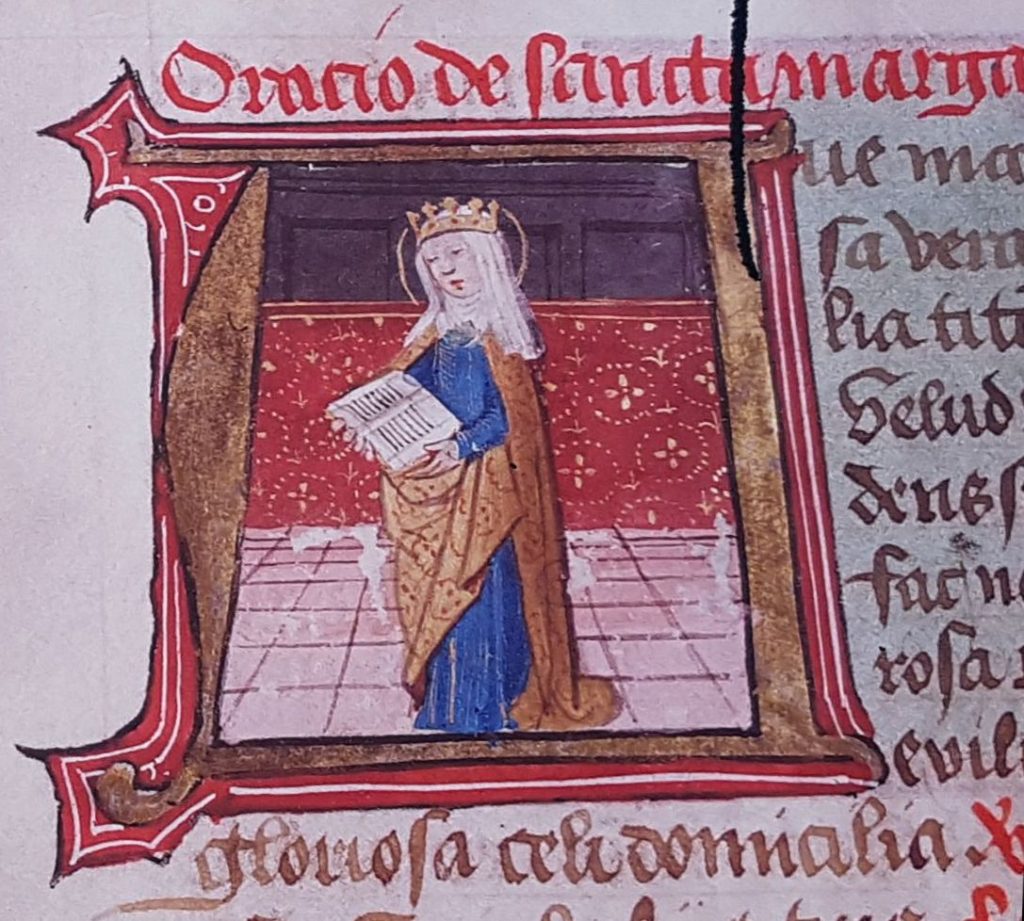
St Margaret (15th Century Prayer Book)

St Margaret should be better known in England because of her important rule in the bloodline of the English Monarchy. Her story is also of interest as it intertwines with the events of 1066 and of Macbeth.

She was the granddaughter of King Edmund Ironside. He was the last English King before the Danish Kings took over. He died after a peace treaty dividing England into an English and a Danish half.

This is what a draft of the text for my book on the Kings of Britain says about him:

Margaret’s Grandfather – King Edmund II 1016

Edmund was born in around 988AD and nicknamed Ironside. He was a formidable warrior who spent his short life fighting the Danes. In 1016, he was crowned in St Pauls Cathedral. Although he was defeated in battle by King Canute, the son of King Swein of Denmark, Edmund’s prowess won him a peace treaty in which England was divided between the two Kings. Unfortunately, Edmund died unexpectedly and Canute inherited the Kingdom. Edmund was buried in Glastonbury Abbey.

To buy ‘Divorced, Beheaded, Died – the history of the Kings of Britain in Bite-size Chunks’. click here.

Edmund’s wife Edith and her 2 children were exiled to Sweden and then, somehow, got to Hungary. Edmund’s eldest son was called Edward the Exile and was married to Agatha. Margaret was their third child. In 1056 Edward the Confessor invited the family back to England and soon made Margaret’s father the heir to the throne. Unfortunately, he died in 1057. He was buried in St Paul’s Cathedral.

Margaret’s Brother – Edgar the Atheling

The rest, as they say, is history. Edward the Exile’s son, Edgar the Atheling was only 6 or 7 and the throne was disputed between William of Normandy, Harald Hadarada of Norway, and Harold Godwinson.

In short, Margaret’s brother Edgar the Atheling was briefly chosen as King after the death of Harold. He was then forced to cede the throne to William the Conqueror. William was crowned King in December 1066.

Margaret’s brother Edgar the Atheling had an extraordinary life, living into his 70s. He continued to fight against the Norman rule of England, mostly from Scotland. Eventually, he reconciled with the Norman dynasty but was involved in any number of disputes, rebellions and dynastic fights.

Margaret’s Husband

Margaret was forced to flee and went to Scotland. In 1070, Margaret married the Scottish King Malcolm III ( Mael Column Mac Donnchada). Malcolm was the son of King Duncan (murdered by Macbeth – see my book Divorced, Beheaded, Died for a short biography!). In 1040, Malcolm fled to England, but returned with English help to defeat Macbeth at Dunsinane. (see my post on Macbeth and Equivocation of Phrophecy). After his first wife’s death he married the deeply pious Margaret. Their court was very influenced by Saxon and Norman ways. She helped aligned the Church more closely with the rest of Christendom, and brought up her children piously.

Margaret’s Son – David

The Royal couple had 6 sons and two daughters. Her son David became one of the most influential Kings of Scotland. He introduced Norman ideas of feudalism, and created Boroughs to strengthen the Scottish economy. He also encouraged ‘modern’ forms of monasticism, encouraging the Cistercians to come to Scotland. By these means, he hoped to turn Scotland a Feudal society with a thriving market economy based on towns and monasteries.

Margaret – the Moderniser?

So, in many ways, Margaret had an influential role in ‘modernising’ the Scottish Monarchy from its Gaelic clan-based structure to a more European style that was ruled from the Lowlands and spoke the Scots version of English, rather than the Gaelic version of the Celtic branch of languages.

She died on 16th November 1093 AD and is ‘particularly noted’ for concern for orphans and poor people. There is an annual procession to her altar, followed by Evensong at Durham Cathedral on the following day. She was buried at Dunfermline following the violent death of her husband. The Abbey has recently celebrated the 950th anniversary of Queen Margaret consecrating the site.

Margaret’s Daughter

Margaret’s daughter, Matilda, married the son of William the Conqueror, King Henry I. This marriage was important for the Normans because it added a strong dose of English Royal blood to the French Norman Royal line. Their daughter was the formidable Empress Matilda, designated heir to the throne of England and founder of the Plantagenet line of English Kings. She was an uncrowned monarch of England and mother of Henry II. She was never crowned because of the disruption caused by the usurpation of the throne by King Stephen.

To read my posts on the events of 1066:

You can read what happened, in my detail, in my posts on the three battles that decided England’s fate in 1066.

Battle-of-fulford-september-20th-1066/
Battle-of-stamford-bridge-september-25th-1066/
William-the-bastard-invades-england-september-28th-1066/
Battle-of-hastings-october-14th-1066/

Also around this time in November

Foul privies are now to be cleansed and fide,
let night be appointed such baggage to hide:
Which buried in garden,in trenches alowe,
shall make very many things better to growe.

The chimney all sootie should now be made cleene,
for feare of mischances, too oftentimes seene:
Old chimney and sootie, if fier once take,
by burning and breaking, soone mischeefe will make.

Five Hundred Points of Good Husbandry. 1573 by Thomas Tusser

Full copy of 1580 edition available online.

First Published on November 19th 2021. Revised on Nov 15th, 2023, 2024, 2025

Martinmas – Festival of Winter’s Beginning November 11th

Martinmas. Statue of St Martin at Ligugé

So, this is All Saints Day, Old style, also known as Martinmas, St Martin’s Day, one of the most important Christian festivals of the medieval world.

Father Francis Weiser in the Handbook of Christian Feasts and Customs suggests this was the Thanksgiving of Medieval Europe:

It was a holiday in Germany, France, Holland, England and in Central Europe. People first went to Mass and observed the rest of the day with games, dances, parades, and a festive dinner, the main feature of the meal being the traditional roast goose (Martin’s goose). With the goose dinner, they drank “Saint Martin’s wine,” which was the first lot of wine made from the grapes of the recent harvest. Martinmas was the festival commemorating filled barns and stocked larders.

It was celebrated with Bonfires in Germany, and with St Martin’s Beef and Mumming plays in England. Following the Reformation, its place in the Calendar has been taken by  Halloween and Bonfire Night.

St. Martin of Tours

St Martin of Tours, 20th Century Stained Glass, St James Church. Chipping Camden.Window 1925 Commemorating World War 1. St Martin’s Feast Day is Armistice Day.Photo K Flude

Martin was a soldier in the Roman Army who would not fight because of his Christian beliefs. When he met a beggar, he cut his cloak in half and shared his cloak. He rose in the hierarchy of the Gallic Church and became Bishop of Tours. According to legend, his funeral barge on the River Loire was accompanied by flowers and birds. He died in AD397. He is one of the few early saints not to be martyred. Martin is the saint of soldiers, beggars and the oppressed. Furthermore, he stands for holding beliefs steadfastly and helping those in need.

St Martin’s in the fields

Early 20th Century Image of Trafalgar Sq. St Martin’s is in the top right-hand corner.

There are two famous Churches dedicated to St Martin in Central London with possible early origins. St Martin’s in the Fields, near Trafalgar Square, has been the site of excavations where finds show a very early settlement, with early sarcophagi. It is the one place where a convincing case can be made for continuity between the Roman and the Anglo-Saxon period. It is possible, that the Church was founded soon after St Martin’s death (397AD). A kiln making Roman-style bricks was found. A settlement grew up near the Church and this expanded to become Lundenwic, the successor settlement to Londinium.

St Martin’s Within

Old Print of London c1540 showing St Pauls, with St Martin's by the wall to the left of the photo
Old Print of London c1540 showing St Pauls, with St Martin’s by the wall to the left of the photo

The other St Martins is St Martins Within, just inside the Roman Gate at Ludgate. Many early churches are found at or indeed above Gates. This one also has legendary links to burial places for King Lud, and for King Cadwallo. He. Cadwallon ap Cadfan, was the last British Kings to have any chance of recovering Britain from the Anglo-Saxons. Geoffrey of Monmouth says that Cadwallo was buried here in a statue of a Bronze Horseman. This was thereby a ‘Palladium’ – something which protects a place from invasion. (See my post about Palladiums of London). It has been suggested by John Clark, Emeritus Curator at the Museum of London, that Geoffrey of Monmouth might have used the discovery of a Roman Equestrian Statue as an inspiration for the story.

St Martin was also the saint of Travellers, and this might explain the location of the Church near the gate. Although there is nothing but legendary ‘evidence’, it would make sense for an early church to be built near Ludgate,. This is the Gate that leads to St Pauls which was founded in 604AD from Lundenwic which was booming in AD650.

Although the City seems to have mostly devoid of inhabitants from the end of the Roman period to the 9th Century, the presence of St Pauls Cathedral means that Ludgate was most likely still in use or at least restored around this period. It leads via Fleet Street and Whitehall, almost directly to the other St Martin.

St Martin and lime plaster

Michaelmas was also the time of year when lime plaster was renewed because lime needs to be kept moist when renewed. It takes three to four days to form the calcite crystals that make it waterproof. Lime plaster was used on most timber framed buildings.

On This Day

1100 – Matilda married King Henry I, thus united the English and Norman Royal Blood lines. The marriage nearly didn’t happen because she, originally called Edith, sheltered in Wilton Nunnery, as a teenager, fearful of kidnap and rape by Normans. Was she a Bride of Christ? or a visitor free to resume a normal life?

(Originally, posted 11 Nov 2021, revised 2022, 2023, 2024, 2025)

Sliding Ducks & the Equivocation of Prophecy – November 3rd

Ducks in Winter 
Photo by <a href="https://unsplash.com/@timromanov?utm_content=creditCopyText&utm_medium=referral&utm_source=unsplash">Timur Romanov</a> on <a href="https://unsplash.com/photos/ducks-on-water-a5U8v7Pm-yg?utm_content=creditCopyText&utm_medium=referral&utm_source=unsplash">Unsplash</a>
Sliding Ducks? or Swimming Ducks? Timur Romanov, Photo from Unsplash

Folklore is full of ways of predicting the future – mostly about the weather or love. The Perpetual Almanac by Charles Kightly features many of these in rhyme form of the ‘Sky at Night Shepherd’s Delight’ type. Here is a seasonal one.

If ducks do slide at Hallowentide
At Christmas they will swim
If ducks do swim at Hallowentide
At Christmas they will slide

From my experience, in the south of the UK, this is simply not true as we very rarely get ice in early November. Nor do we get snow at Christmas that often. But maybe, the further north you go, the truer this becomes.

Macbeth & Prophecy

But, as far as taking prophecy seriously, it’s good to remember what Macbeth said on seeing the wood moving to Dunsinane.

‘(I) begin to doubt the equivocation of the fiend, that lies like truth.’

He has just realised that prophecy is a double-edged sword which has led him to his doom. He had been told by the Three Witches that he:

‘shall never vanquish’d be until Great Birnam Wood to high Dunsinane Hill shall come against him’

Still, as he heads to the final battle, Macbeth knows he is invincible and that

‘none of woman born shall harm Macbeth’.

But in his savage fight with Macduff, he is told that Macduff was not of woman born, but was:

from his mother’s womb / Untimely ripped’.

So Macbeth is killed.

Google Map showing Birnam (Scotland), top left, and Dunsinane Hillwith red markers in the middle. Note Scone is where Macbeth is Macbeth was crowned

King Macbeth (Mac Bethad mac Findlaích) 1040 – 1057

In reality, Macbeth, was a successful King who reigned for 17 years. He was one of the last Gaelic Kings as Scottish society was changing with contact with England.

This is a draft of the text that (edited) forms part of my best-selling book ‘Divorced, Beheaded, Died’ The Kings and Queens of Britain in Bite-sized Chunks’

Macbeth was nicknamed the Red King. He was a Gaelic speaker, descended from the Kings of Dal Riata. Macbeth’s father, Finlay MacRory, was Mormaer (Grand Steward) of Moray and was was murdered by Gillacomgain. He took MacRory’s title. Gillacomgain was burnt to death with 50 of his followers, probably by Macbeth, who thus not only regained the title as ruler of Moray but married his dead rival’s widow, Gruoch. She was the granddaughter of Kenneth II. Macbeth was also himself descended from the Kings of Scotland via his mother Donada probably daughter of Malcolm II.

His claim to the throne was therefore strong, and following the disasters of King Duncan’s reign, Macbeth seized the opportunity to take the throne for himself.

He ruled well for nearly 2 decades imposing a strong sense of law and order, encouraging Christianity and leading successful raids across the border into England. In 1050 he went on pilgrimage to Rome. Exiled Normans, supporters of Edward the Confessor were settled in Scotland in Macbeth’s reign. There is no evidence that Macbeth was any more evil then the rest of the early Scottish Kings.

In 1057 Macbeth was killed in battle against Duncan I’s son who became Malcolm III. Macbeth is buried on Iona. He and Gruoch had no children but Guoch’s son, Lulach, son of Gillacomgain briefly followed Macbeth as king before being assassinated by Malcolm III

‘Divorced, Beheaded, Died’ The Kings and Queens of Britain in Bite-sized Chunks’ for more details look here.

Prophecy ‘lies like the truth’ a trope that is used in many ancient tales such as Oedipus Rex.

On this Day

Hilaria

The 3rd of November is also the Hilaria, the last day of the festival of Isis/Osiris. This is the day of the rebirth of Osiris. He was ‘the god of fertility, agriculture, the afterlife, the dead, resurrection, life, and vegetation.’ Isis was the wife (and sister) of Osiris God-King of Egypt. Osiris was killed by his brother. Set. Isis restored his body to life for long enough to conceive their son Horus.

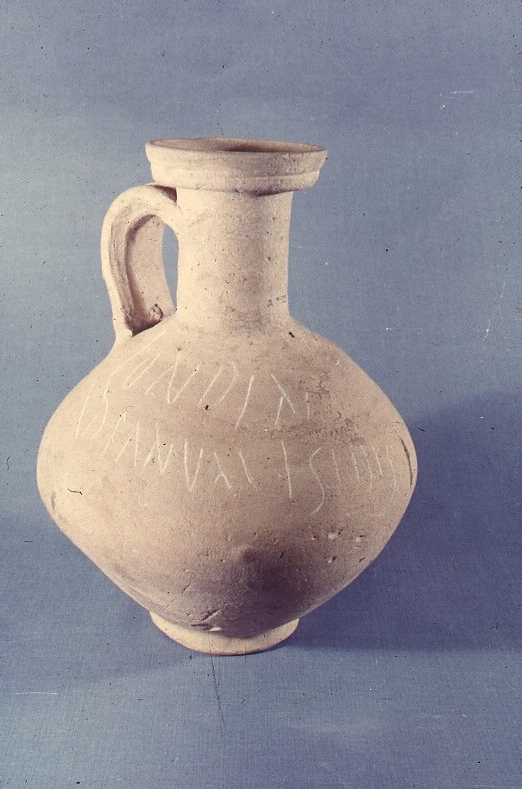
Horus revenged his father, regained the throne, restored Cosmic Order and completed the resurrection of Osiris. Isis is normally shown holding the baby Horus in a pose that may have influenced images of the Virgin Mary. Londinium would have had a celebration on this day as there is a pot found near London Bridge inscribed ‘At London, at the Temple of Isis).

Roman pot with Isis inscription, London

Head Graft and St Winifred

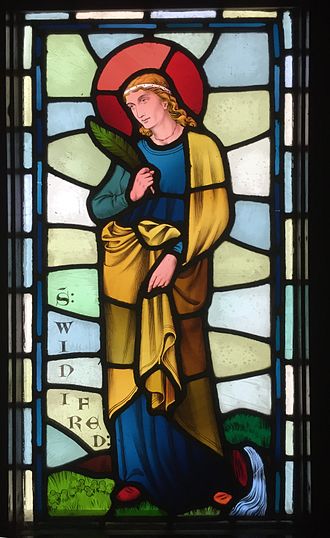
Stained glass depiction of St Winifred, designed by William Burges, at Castell Coch, Cardiff. Wikipedia Hchc2009 – Own work

St Winifred’s Day She was beheaded by Caradog who would not accept her refusal to have him because of her religious views. She was restored to life by St Beuno, or St Bono. Head and all. Where her head fell their slowed a spring. This is on the North Welsh Coast, and called Holywell. It was one of the Seven Wonders of Wales, and called the Lourdes of Wales.

First Posted on 3 November 2021. Revised 3 November 2023 & 2024 & 2025

All Hallows Day – November 1st

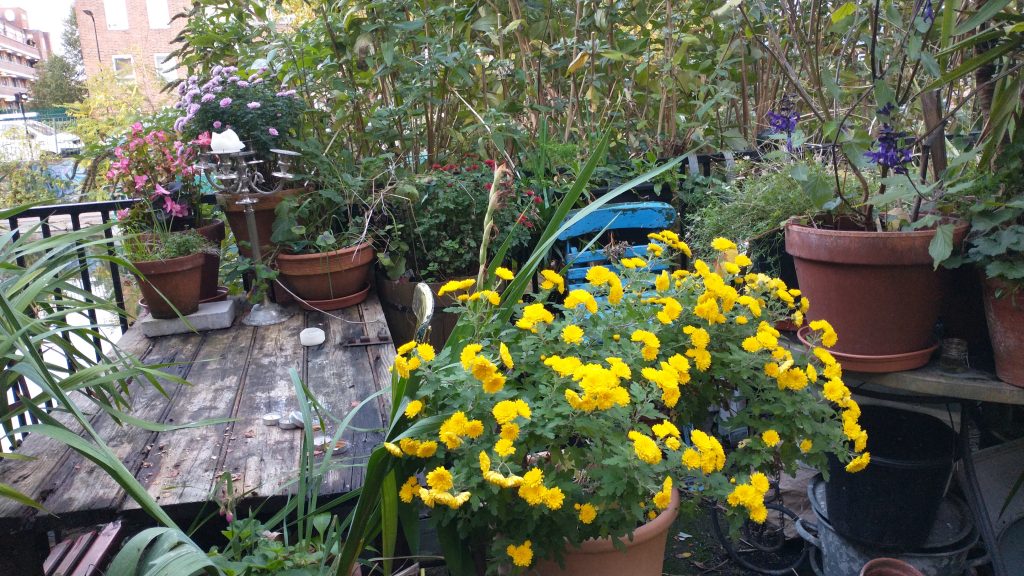
 chrysanthemums
Chrysanthemums Flowers for the Dead (the author’s back garden)

How the Celtic festival that marked the beginning of Winter became All Hallows is not clear. Some say the Church set up its own festival independent of the Northern European traditions. But it is as likely that the Church adopted existing pagan festivals, and gave them a Christian spin.

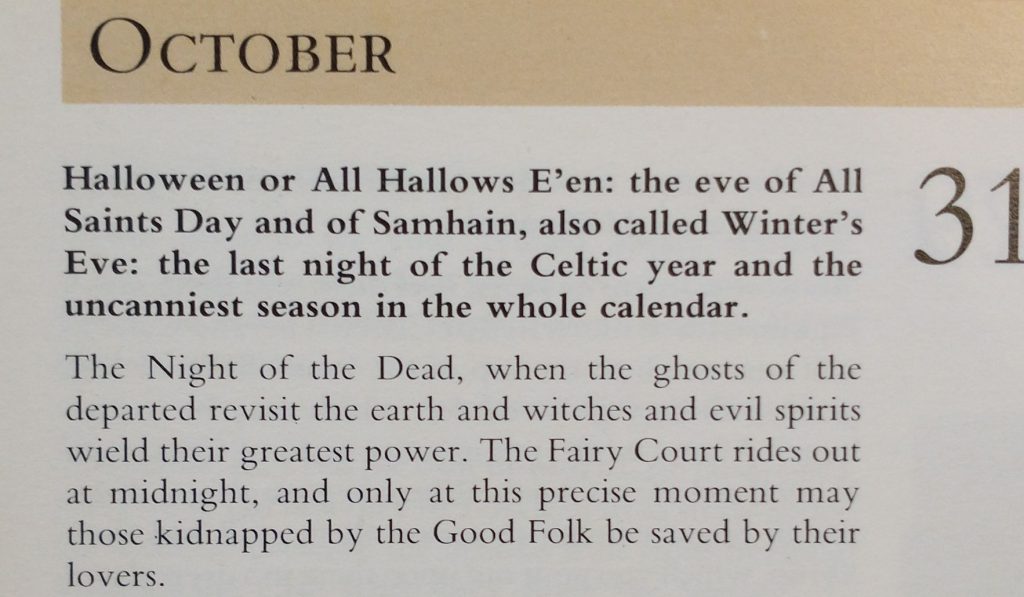
Samhain, on October 31st, was, for Celtic religions, not only the beginning of Winter but also the beginning of the Year. As I noted on my Halloween post the Festivities began in the evening before the day because Celtic and Germanic traditions began their day at Dusk. So Halloween is not, in fact, the evening before, it is the start of the day of the festival.

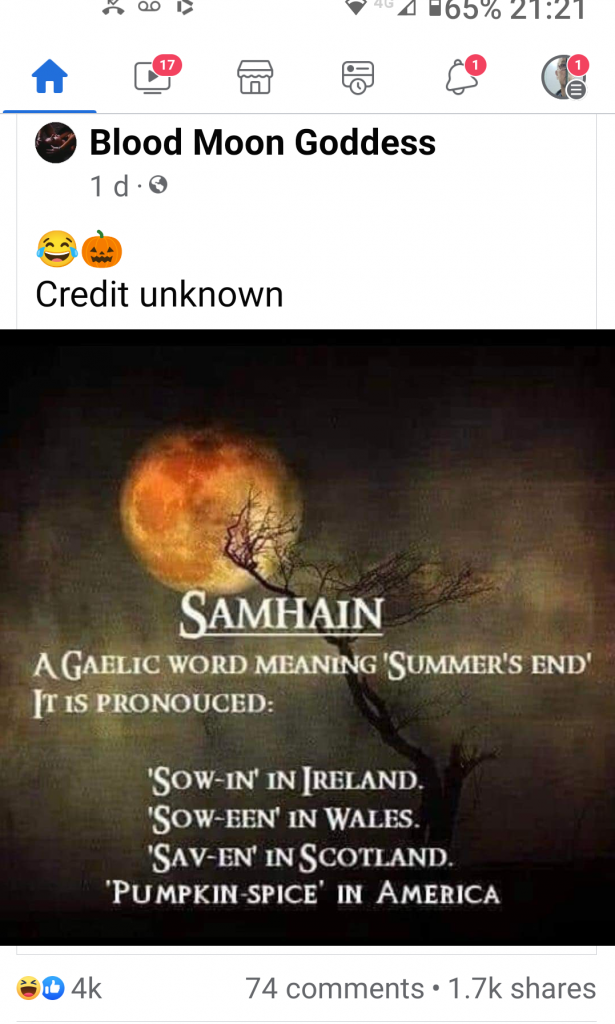
Facebook Image giving the words for Samhain in Celtic languages

The Church adopted the Roman tradition of the day beginning not at Dusk but at Midnight. So the festival of All Hallows is on November 1st not October 31st. But the Church mimicked the old ways of doing things by celebrating the evening before as the Vigil of All Hallows’ Day. This was called All Hallows Evening or Halloween.

All Hallows by the Tower, London

Engraving of All Hallows Barking

In London, there is a Church called All Hallows, on Tower Hill. It is associated with Barking Abbey, founded in the 9th Century. Therefore, it is known as All Hallows Barking or All Hallows by the Tower. The Church has a prominent position on Tower Hill, which would have been visible from boats coming up the Thames. Also in the Church is the earliest Post-Roman arch in a Church in the City of London. This is made of reused Roman bricks. Moreover, in the crypt are Roman tessellated floors.

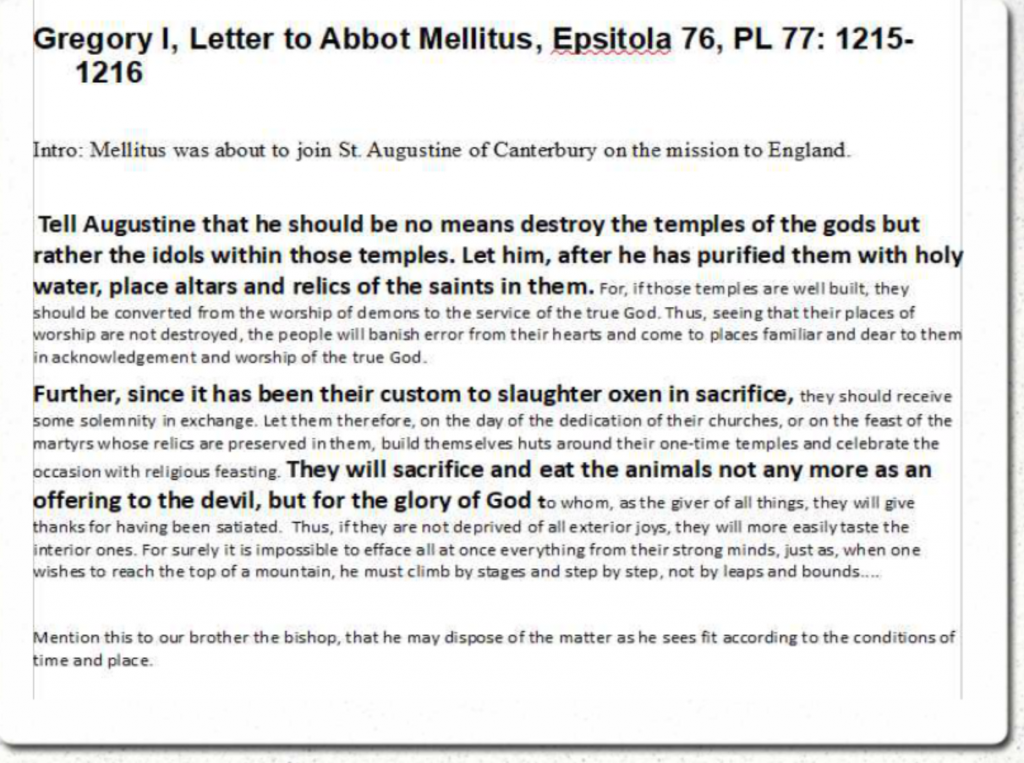
Letter from Pope Gregory to St Augustine

Now, I don’t want to be shot down in flames because there is no evidence that there was a Roman Temple here. Nor indeed a Roman or immediately Post-Roman Church. But it is one of the earliest Churches in the City of London. There must have been Christian Churches in Roman London, and this would be on my list of candidates. It is simply that the attribution to All Hallows provides a possible link to Celtic festivals. So speculation rather than anything else. The letter above, gives a context for the conversion of a pagan Temple to a Christian Place of Worship.

An Uncanny Day to Hallowed Day

For the Celts, Samhain was an uncanny day when all the sprites and spirits are alive and in the world. The Church took that, and span in on its head. So it became a ‘hallowed’ holy day when all Saints are celebrated and alive to us. Celebrated on October 31st and November 1st.

A celebration of All Saints was originally in May in the Church but was changed to the 1st November in the 7th Century by Pope Boniface. Later it was swapped back to May. But fixed again on the 1st November in the 9th Century. It is followed on the 2nd by All Souls’ Day. (see my post on All Souls Day here.

So on the 1st November, those celebrating the pagan festival would be in full swing after a hard night of celebration. The embers of the Fire would be still burning, stones left around the fire would be inspected for the prophecy they told of the future. Each person had a stone, and if it was still intact it was good luck, if it had disappeared the future was not good.

La Toussaint et Dia de Todo Los Santos

In France, All Hallows or All Saints is called La Toussaint, and flowers such as Chrysanthemums, which blossom in late October, were put on the graves. In Spain, it is Dia de Todo Los Santos and is a national holiday upon which people put flowers on the graves of the dead.

In Mexico, Dia de los Muertos celebrates Holy Innocents on the 1st. People create altars to the lost ones, with their favourite flowers, toys, food stuffs,, photographs. People argue about the pre-colombian aspects of the festival as there are similarities to European All Saints Days celebrations. But Quecholli, was a celebration of the dead that honoured Mixcóatl – the god of war. It was celebrated between October 20th and November 8th.

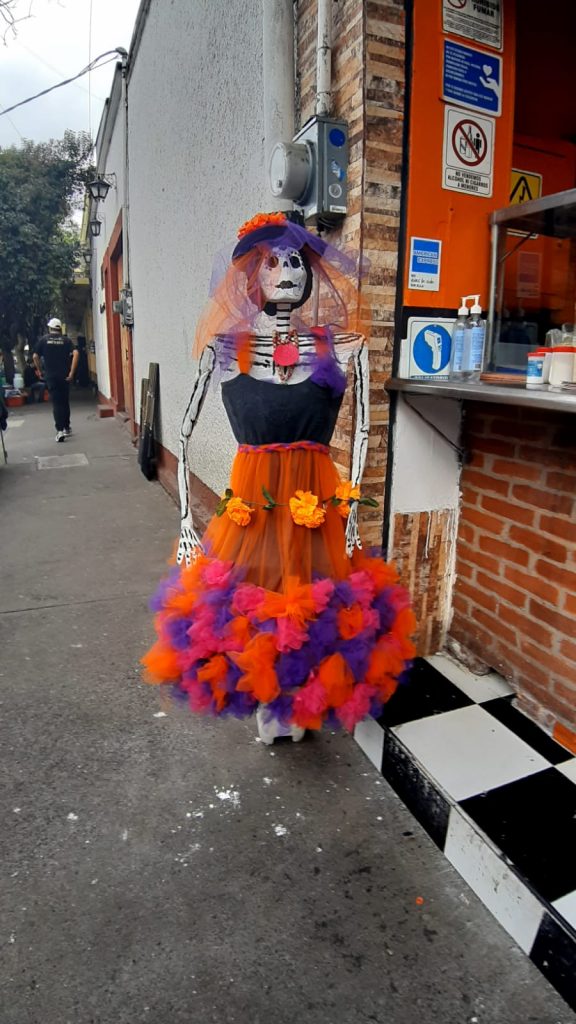
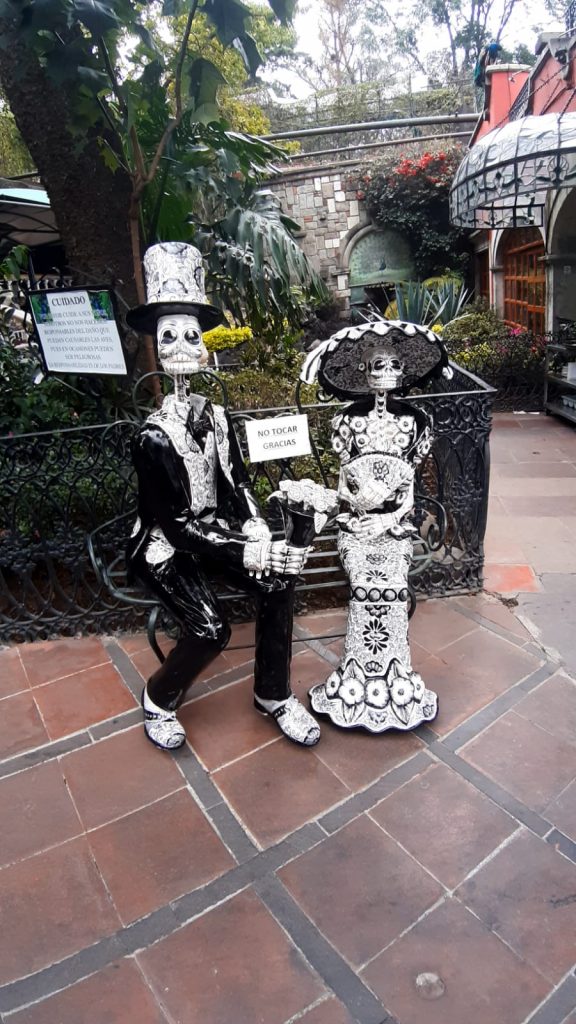
A correspondent in Mexico has sent back these pictures of the festivities in Mexico.

The female figure to the left is La Catrina. This image was popularised by an early 20th Century design by José Guadalupe Posada and developed in a mural by Diego Rivera. For more details click here.

A Day Off for the English

In the Laws of King Alfred the Great, this day was a day off for freemen. See my post on Days off in the Anglo Saxon Calender on August 15th.

First published in 2022, revised in 2023, 2024, 2025

Halloween October 31st

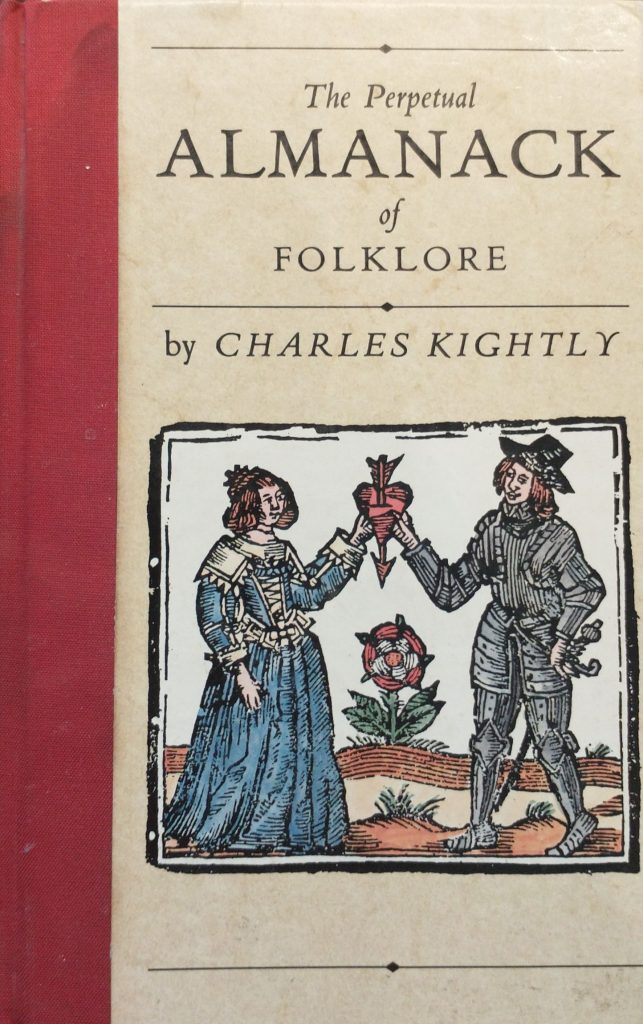
From the Perpetual Almanack of Folklore by Charles Kightly

I began my perpetual Almanac of the Past four years ago on the 31st October 2021. This was the first line:

‘This blog is to celebrate the Year. I will post, hopefully, once a day, so we can follow the seasons, as they happen naturally, and as people in Britain and Ireland have responded to the changes in the year.’

It was inspired by Charles Kightly’s book, which is a pot-pourri of folklore taken mostly from old Almanacs. I haven’t managed, yet to create a post for every day of the year, nearly managed it in the winter but falling behind in the Summer when I take Road Scholar groups around the UK. My plan is to fill in the gaps, improve posts and get rid of typos. Another aim is to add more London-specific content.

Cover of Charles Knightly's Perpetual Almanac
Cover of Charles Kightly’s Perpetual Almanac

I started on Halloween because Samhain (pronounced Sow-in) was the beginning of the year for the Celtic world. It may mean Summer’s End. In Wales, it is Calan Gaeaf (first day of winter) and Kala Goafiv (beginning of November in Brittany).

Why did the Celts start their year at such an unlikely time? A clue is that they began the next day at dusk. The Sun dies at dusk so it is the end of the day, and the next day begins with the death of the old day. 

So the New Year begins with the Death of the Old Year. Now that might suggest the Winter Solstice as the best time to start the year as this celebrates the death of the old Sun. (see my winter solstice post here :) But, the end of October has, perhaps a better claim. The harvest is in, the fruits in the trees and the nuts are harvested, all the growth of the Summer is over and collected.  Plants are mostly dead or dormant, except some evergreens. It is the end of the growing year. The seeds have fallen from the trees and shrubs and are nestling in the soil, ready to begin their cycle again. All is over and all is ready for the new year. Makes sense?

The Celtic way also explains eves; Christmas Eve, New Year’s Eve, May Eve, All Hallow’s Eve.  They are not the night before the day, they are the beginning of the day.  This is when you begin the celebration.

For the Romans, today is the day that Adonis is injured hunting a wild boar. Against his lover’s (Venus)  advice, he descends to the underworld. Nature withers and dies until he returns from the underworld. His blood stains a flower and was transformed into the Crimson Anemone. There is a similar story in Babylon of Ishtar and Tammuz.

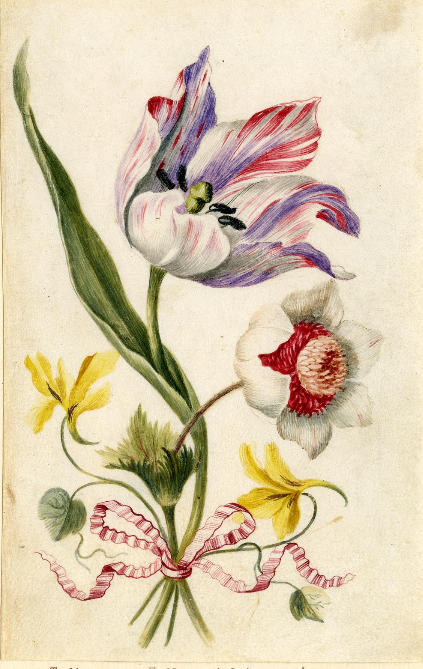
By Alexander Marshall, crimson and other anemones
Binyon 1898-1907 / Catalogue of drawings by British artists, and artists of foreign origin working in Great Britain (5(c))

Adonis comes back on May Day when he meets Venus again, so the world flourishes and is bright and warm.

Julius Caesar says the Gauls venerated the God Dis Pater on this day – an aspect of Pluto, the God of the Underworld, ruler of the Dead. There was a Roman Festival on the Kalends of November dedicated to Pomona, the goddess of the fruit of trees. This may influence the use of Apples, which are prominent in Halloween festivities.

For more about the origins of Halloween, please look at my post on All Hallows Day here:

First written in 2021, and revised 2023, 4 and 5.