This year, Good Friday is on Friday 3rd of April, and the day we eat Hot Cross Buns. The Hot Cross Bun is a simpler sort of bun than the Chelsea Bun, which was the bun to have at Easter in London in the 18th Century.
Hot Cross Buns Good Friday Traditions
There seem to be all sorts of dubious traditions around the origins of the Hot Cross Bun. It has been suggested that the Greeks knew how to put a cross on a bun. Also, that the Anglo-Saxons celebrated the Goddess Eostre with the crossed bun. It is suggested that the cross represents, not the cross, but the four quarters of the moon, the four seasons and the Wheel of the Year. But there is very little evidence for Eostre other than the Venerable Bede’s mentioning her name. Bede says:
‘‘Eosturmonath has a name which is now translated ‘Paschal month’, and which was once called after a goddess of [the English people] named Eostre, in whose honour feasts were celebrated in that month’ (quoted from florencehrs.substack.com/p/eostre-pagan-fertility-goddess)
So nothing is known about Eostra herself nor her rituals and customs. So her association with Hot Cross Buns cannot be known. However, the cross, and the association with Easter, makes the bun powerful, so there are many superstitions on record. A piece of an Easter Hot Cross Bun given to the sick may promote a cure. It was said that a bun cooked and served at Easter will not go off for a year. This might help explain the traditions that hanging them up on a string or ribbon is a good thing. One hung in a kitchen prevents fire. On a ship prevents sinking. In East London, the Widow’s Son Pub in East London has an old bun. This remembers a sailor-son who never returned to eat it on Good Friday.
Making and Eating Hot Cross Buns
The technology of putting a cross on a Bun requires nothing more complicated than a flour and water paste so it might well be an ancient tradition. A more impressive cross can be made with shortcrust pastry. The bun itself is simply flour, milk, butter, egg, salt, spices and mixed fruit. Here is a recipe from the BBC www.bbcgoodfood.com
In my opinion, they need to be purchased from a shop. Home-made Hot Cross Bun might be better but would be strangely disappointing. It’s normally eaten toasted and buttered although I prefer the soft doughy untoasted and unbuttered bun. But then I can get carried away and eat the entire pack of four.
‘RRRRRare Chelsea Buns’ as Jonathan Swift called them in a letter to Stella in 1711.
Fragrant as honey and sweeter in taste As flaky and white as if baked by the light As the flesh of an infant soft, doughy and slight.
The buns were made from eggs, butter, sugar, lemon and spices. The tradition was that, on Good Friday, 18th and 19th Century Londoners would go to Chelsea to buy Chelsea Buns. Thousands of people would turn up at the Five Fields. These stretched from Belgravia to what is now Royal Hospital Street. There were swings, drinking booths, nine pins and ‘vicious events that disgraced the metropolis’. The Bun House was on Jew’s Row as Royal Hospital Street was then called. As several King Georges visited the Bun House it became known as the Royal Chelsea Bun House. It was run by the Hands family. They were said to sell 50,000 Buns on the day. Stromboli tea garden was nearby.
Chelsea Cabinets of Curiosity
Inside the Chelsea Bun House was a collection of curiosities. Chelsea became known for its collection of curiosities in the 18th Century. Of course, there was the great Hans Sloane’s collection which was the founding collection of the British Museum. And then there was Don Saltero’s which was a coffee house that had curiosities on the wall. The Bun House displayed clocks, curiosities, models, paintings, and statues on display to attract a discerning Public.
Find me a Chelsea Bun! (Or make one yourself!)
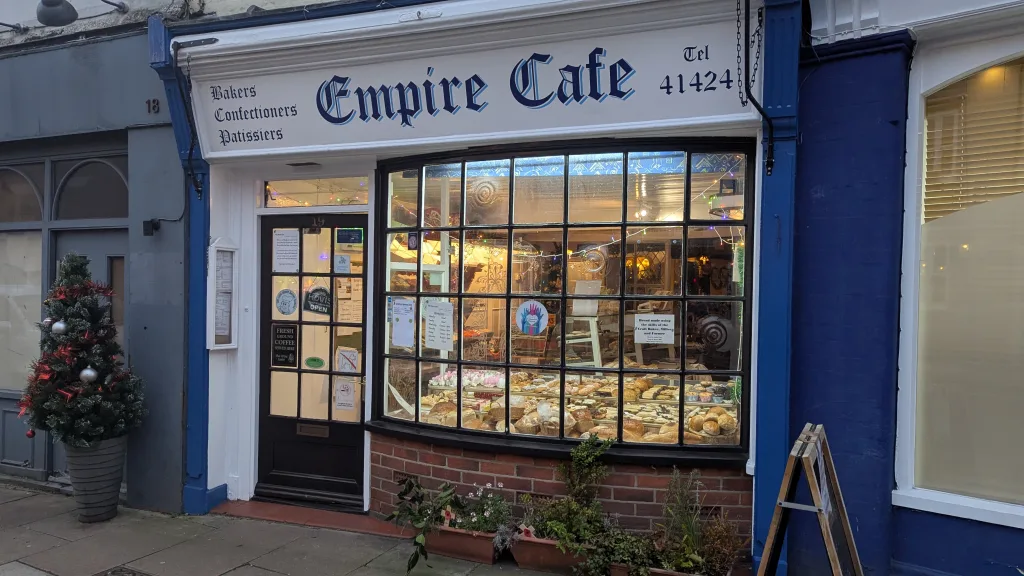
Me. I love a Chelsea Bun above all buns, But can you get them any more? The British Library Cafe was the last place I found that sold them. And that was 7 years ago. I did Chelsea Buns on sale in the Empire Cafe in Newbury but apart from that nada. Their place has been taken first by Danish Pastries and more recently the ubiquitous Cinnamon Bun. If you see any Chelsea Buns on sale please let me know.
Chelsea Buns, middle top row, next to the white cakesEmpire Cafe baking in Newbury since 1874
There is a tradition of Skipping on Good Friday. I can’t say I ever saw it – in my school skipping was a perennial activity, mostly enjoyed by the girls, but the boys would sometimes be intrigued enough to join in.
Study for Lady Lilith, by Rossetti. 1866, in red chalk. Now in the Tel Aviv Museum of Art (Wikipedia) Lilith born at The Beginning of the Universe
This is now my most popular post. March 25th is the Annunciation—the day that the Archangel Gabriel tells Mary she is pregnant. (to see some very fine paintings of this meeting, look at my other March 25th post march-25th-feast-of-the-annunciation/). When I first wrote this post I was discovering how it all fitted together as I wrote. So I’m leaving it the way it was, proof reading and clarifying if necessary, but keeping the thrill of the discovery of the the significance of March 25th as the day that saw the Beginning of the Universe.
March 25th is also the anniversary of the birth of Adam and Eve (and Lilith); the death of Jesus Christ; the anniversary of the Immolation of Isaac; the Parting of the Red Sea; the Fall of Lucifer; and, (until 1752 in the UK) the beginning of the Year.
Of course, it isn’t. Or to put it another way, no one can, or ever could, prove any of these dates except 1752. So what they speak to is the way the Church saw the world as logically structured by God. Christian thinking about the year, the world, the universe, creation, developed over many years and took influences from many cultures. It is also very complicated to work out the sequence, so I’m going to summarise what I know (or at least what I think I know).
Happy Birthday, Dear Jesus.
Christians chose Christmas Day as the Birthday of Jesus, probably partly because it was a prominent birthday already shared with several Gods. Particularly, Attis, Mithras, Saturn and the Unconquered Sun. It was approximately at Solstice, the beginning of the Solar Year, and close to one of the main festivals of the Roman World, the Saturnalia. So it made it easier for new converts who could retain elements of their festivals after conversion.
December 25th might have been selected by the pagan religions because it is the time when the Sun begins to rise further north each day. The days stop shortening and start lengthening, light increases with the promise of warmer weather and budding plants. It was considered a rebirth of the Sun.
Solstice Anniversaries
So, Jesus was born on/or around the Solstice, so he must have been conceived approx. 9 months earlier. This is approximately at the Spring Equinox.
Ah, you are thinking! But today isn’t the equinox. It’s a few days after the equinox. Surely, God doesn’t do approximately?
I have always thought that the 4 or 5 days difference between the Solstice, the Equinox and the Christian festivals was down to the fact that the Calendars were not well coordinated with the actual movements of the Sun (because the Sun does not circle the earth in 365 days, or in 365 and a quarter days, but 365 days, 6 hours, 9 minutes. Unless corrected for this means dates slip from their proper place in the Solar Year. It also makes lunar Calendars difficult to align with the Sun cycles, and vice versa.
But when I first wrote this a sudden revelation dawned upon me which will be revealed in the next few paragraphs.
So, God sends his Son to save the human race. God is a logical being, so she would send her Son at an appropriate time? If Jesus is born at or near the Solstice, which is an appropriate time for the Son of the Creator, then conception 9 months earlier, March 25th, is near the Equinox. This is the beginning of Spring. For many people, Spring is a new beginning, for example, the Anglo-Saxons saw Winter as the death of the year, and Spring as the young Year. It all makes sense.
The Creation
So to the Creation. God, having a free choice, would have created the world at the beginning of Spring. In fact, if you think about it, God creates everything necessary for life at the creation in 6 days. As soon as it has all been created and put together, it is bound to immediately spring into new life. The first season must, therefore, be Spring? Right? So March 25th?
This gives a nice symmetry with Jesus’s Life. Conceived on March 25th, born December 25th, and died 30–40 years later, according to the Church, at Easter, on March 25th. (the only other famous person I know, born and died on the same day is William Shakespeare).
Easter
Easter, when Jesus is martyred, isn’t March 25th I hear you saying. But remember, Easter is a lunar festival, so its date varies each year. In fact the next time is 2035. Births and deaths, on the other hand, are fixed to the Solar Calendar. Therefore, the Church chooses March 25th as the most appropriate day to pin the death of Jesus, on the anniversary of his conception and the anniversary of the creation of the Earth. I am guessing that this is also the preferred date for the Day of Judgement.
It is also the Birthday of Adam, and his first wife Lilith (or so some say), and Eve. More about Lilith below. I hope this is all making sense?
Why was Adam born on March 25th?
I had thought this date was just one of the parallels that the Church liked, Jesus and Adam born on the same day. But, I have just worked out why Adam is born on March 25th, and why these dates are not the Equinox, March 20th/21 but March 25th, which has been bugging me.
Let’s go back to the beginning of Creation as described in Genesis. It has the following sequence of Seven Days, beginning with the Equinox March 20th. I have added dates to the 6/7 day sequence of Creation:
Day 1: Light – March 20th
Day 2: Atmosphere / Firmament – March 21st
Day 3: Dry ground & plants – March 22nd
Day 4: Sun, moon & stars – March 23rd
Day 5: Birds & sea creatures – March 24th
Day 6: Land animals & Adam, Lilith and Eve – March 25th
So there you have it! Adam, Eve (and Lilith) were created on Day 6 with the Land Animals – March 25th. Jesus conceived, also on this date, and so 9 months later is born on December 25th. It all makes sense, and aligns the Jesus’s Life, the Christian year fully with the Solar Year and the Creation!
And that, dear Reader, is the very first time anyone has been able to explain to me why Christmas is not at the Solstice, and why the Annunciation was not at the Equinox. Maybe you all know this, but it is very exciting to work this out for myself. And believe me, I have done a lot of reading about calendars and not spotted an explanation.
When was the Creation?
The Anno Munda‘s is a Jewish Calendar which begins counting from a year before the Creation – the Year of Emptiness. This was 5500 years plus 2026 years ago so 7526 Before the Present. And it was supposed to have ended in 600AD, 6000 years after the Creation. So, they got that wrong.
Dionysius Exiguus replaced the Anno Mundo year with the AD/BC system in the 6th Century AD). This became popular when the Venerable Bede used it in his writings in the 8th Century.
Beginnings of the year
The Celts chose October 31st, Julius Caesar chose January 1st, other cultures have other dates, and the Spring Equinox is another choice sometimes made. The Church and Dionysius Exiguus choose March 25th, although secular society also recognised the claims of January 1st. Britain kept to March 25th until 1752 when we adopted the Gregorian Calendar. But people like Samuel Pepys celebrated New Year’s Eve on 31st December. So January 1st was the secular New Year, but the Christian year number did not change until March 25th. So King Charles I thought his head was being cut off on January 30th 1648; while history books will tell you it was cut off on January 30th 1649. Same day, same head, different reckonings.
January 1st, the New Moon and New Year
December 31st/January 1st is essentially a Solstice New Year Festival. And I have, previously, used the difficulty of keeping calendars as to why these days has slipped out of alignment with the Solstice. But, today I realised that it is as likely that the reason is the Solar/Lunar nature of our time keeping. The year, and its festivals, is largely arranged around the Solar Cycle. But our weekly and monthly cycles are orginally derived from the Moon.
The first of a month, was called the Kalends by the Romans, the Nones the half moon, and the Ides signified the New Moon. The kalends of January is then, originally, the First New Moon after the Winter Solstice. So, January 1st is not a slightly misdated Solstice Festival it is a Festival celebrating the first New Moon of the New Year! Sorry, to seem excited but this is the first time I have realised this.
Over time societies give up trying to sync the lunar and solar calendars. Roman and Christian cultures gave up and fixed the moon months, completely abandoning any attempt to keep the months to the actual lunar cycle. This is our current system, in which only Easter and festivals that depend on Easter remain true to the movements of the moon festival, much to our perennial confusion.
Maybe you all know this, but it’s put many things into perspective for me!
Lilith
The April 2023 Issue of ‘History Today’ had a short piece called ‘The Liberation of Lilith’ which suggests that the story of Lilith, a figure from Jewish Folklore, is first attested in a Medieval satirical text called ‘The Alphabet of Ben Sira’. The story goes that Lilith is created from the same clay as Adam. Adam then demands she lies below him during sex. She refuses, saying that they are both made from the same stuff and, therefore, equal. Adam refuses to accept this, and so Lilith leaves the Garden of Eden. So the story goes.
The story of Lilith, Sarah Clegg suggests, is one of a series of similar stories found around Europe and Asia. And Clegg assumes that it is gradually modified to make Lilith a demon who will kill babies unless the names of three angels are spoken out loud.
The story survived as a charm to keep babies safe, and perhaps to remind people of equality among the sexes. But this causes problems for, OK, let’s call them out, the Patriarchy. Lilith cannot be equal to Adam so she is made into a monster, not made from the same clay as Adam but from the scum and waste left over from Adam’s creation. I imagine the story then went on to propose that God creates Eve from Adam’s rib, and so she is created from Adam, and is, therefore, not equal, but subservient to him, although not as bad as Lilith. Lilith is now a significant figure in feminist folklore circles.
Attached to the watercolour of Lilith by Rossetti (at the top of the page), was a label with a verse from Goethe‘s Faust as translated by Shelley. (Wikipedia)
“Beware of her fair hair, for she excells All women in the magic of her locks, And when she twines them round a young man’s neck she will not ever set him free again.”
The model is Fanny Cornforth, Rossetti’s mistress. He painted another version a few years later, but the model in that is Alexa Wilding. His models are arguably more interesting than the man himself and include: Elizabeth Siddall, Jane Morris and Fanny Cornforth. Christina Rossetti, his poet sister, modelled for Rossetti’s painting, Ecce Ancilla Domini which you can see here.
For more on the Annunciation, look at my other March 25th post here.
I think I might have enough material to begin my own Cult.
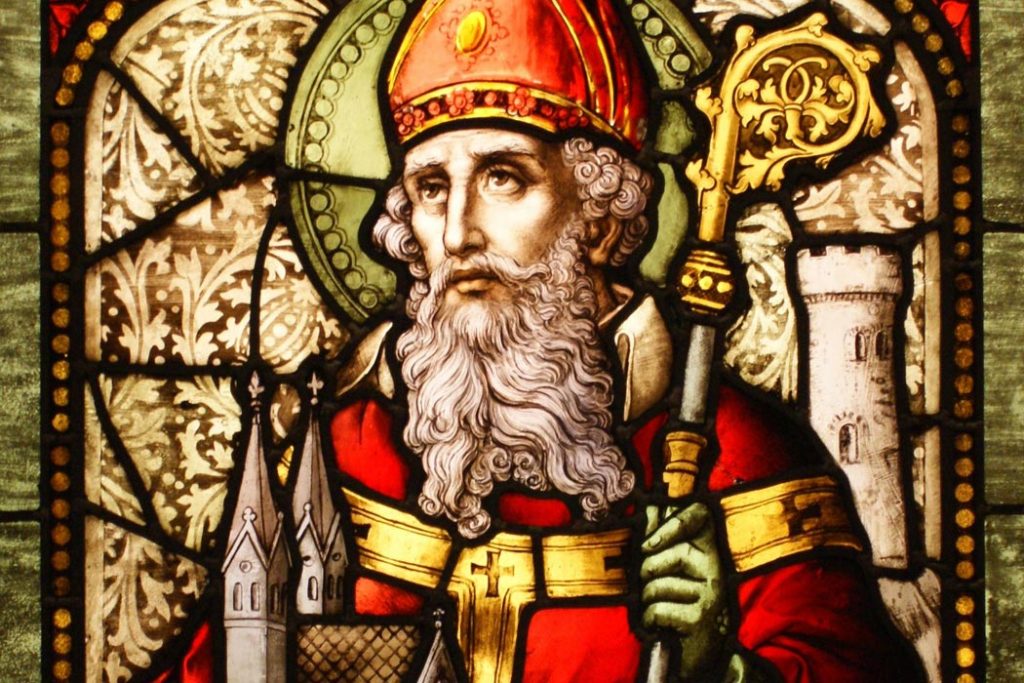
Stained Glass window depicting St Patrick (source of image, lost in the mists of time!)
St Patrick
St. Patrick has a very interesting autobiography (Confession), because it is one of the only personal reminisces of life in post-Roman Britain. He wrote in the form of a letter. In it, he explains that he was captured by Irish pirates while living in a Romano-British Town. His father we discover was a Decurion and a Deacon which suggests elements of Roman political organisation continued. No one knows the dates of St Patrick’s life, but he lived in the 5th Century. The use of Roman titles suggests, to some, an earlier rather than a later date. Perhaps in the early 400s. Unless, of course, you want to propose that Roman life continued later into the 5th Century than the first few decades. (which, increasingly, people are proposing.)
The town he lived in was called Bannavem Taburniae. Many places have been proposed for it. The closest linguistically is Bannaventa in Northamptonshire, but this seems a very unlikely place for Irish raiders to land, being about as far away from the sea as it is possible to get in Britain!
Nicholas Fuentes
Scholars have suggested South Wales and the Scottish borders most commonly. But my favourite suggestion, but about as unlikely as Northampton, is Battersea in London. This suggestion was made in the pages of the London Archaeologist by then editor Nicolas Fuentes.
Fuentes was one of a pioneering group of archaeologists when Rescue Archaeology first began a campaign to record the archaeology being destroyed by massive redevelopment of town centres in the 1970s.
He changed his name from the anglicised Nicholas Farrant back to its original Fuentes. He then wrote a magnificent series of papers, in London Archaeologist, which located St. Patrick in Battersea; St Alban’s execution in London and all 12 battles of King Arthur around Greater London.
St Albans Martyrdom in London
All were well argued, but as a set they do raise an eyebrow, being unsupported by any clear evidence. And, as far as I know, without much scholarly support. The one I really like is locating St Alban’s Martyrdom in London rather than in St Albans. It reminds everyone that the first reference to St Alban, which is by Gildas in the 6th Century, places the execution of the Saint firmly in London. It also makes sense of the story that Alban, keen for martyrdom, gets God to part the River so he can go quickly to the execution spot. The bridge it was said was full of people going to see the execution.
In Gildas’s case, the execution is in London, probably at the Amphitheatre, up a hill from the the mighty Thames. So God parted the Thames for Alban. Anglo-Saxon historian, the Venerable Bede places St Alban’s death firmly in St Albans, but the river that God needs to part there- the River Ver, is a piddle. Alban could have crossed it easily, hardly requiring even Wellington boots! Not much of a miracle compared with parting the Thames. The likely site of execution in both cases would have been the Amphitheatre, rather than the side of the hill where the St Albans execution site is located. But Gildas did mention the hill, which makes sense in the case of London and not in St Albans, as it is outside of the Roman City. away from the amphitheatre.
To my, unscholarly mind, when we worship people we tend to venerate them, at their birthplace and death place. So to me, it makes sense that St Alban’s main shrine was at Verulamium where he was born (now known as St Albans) and London where he died.
St Germanus
There is some supporting evidence from the hagiography of St Germanus of Auxerre. This tells us that Germanus came to an amphitheatre for a religious debate about 15 years after the end of the Roman occupation of Britain. After the debate, he went to a nearby shrine dedicated to St Alban. Unfortunately, the writer of the memoir is not really interested in post-Roman Britain, so does not tell us whether it was in London or St Albans. But there is an early church dedicated to St Alban just by the Roman Amphitheatre in London. For more on St Germanus follow this link to my post.
However, archaeology does not reveal any evidence early enough to support the idea that the Church is that early. Fuentes, argued that London as the Capital was likely to have been the place where capital punishments were carried out, particularly in the case of a Roman Citizen like Alban. I must note that in placing any credibility to Fuentes theory, I am standing largely alone.
Stained glass window of St Patrick and St Germanus
The Twelve London Battles of King Arthur
I’m not so convinced by the 12 Battles of King Arthur were fought in the London Area. They are more likely to have been spread throughout Britannia. But the place name evidence is never going to be identify most of the locations.
St Patrick From Battersea?
So, to the point – St Patrick in Battersea? The evidence, as I remember it, is really only place name evidence. the suggestion that Battersea was derived from: Badrices īeg, ‘Badric’s Island’ and later Old English: Patrisey (Wikipedia), So, Patrick’s Island. The word ‘sea’ is used in that sense along the River Thames. For example in Chelsea, Thorney, Putney derived from ey which is short for eyot (island). Also spelt ait.’
St Patrick lived as a teenage slave for 6 years, then escaped from captivity in Ireland and returned home. Trained as a priest, in perhaps Auxerre (home to St. Germanus who is another crucial witness to post Roman Britain. (See my post here.) and returned to Ireland to begin the conversion to Christianity. He is the Patron Saint of Ireland, with St. Brigitte and St. Colomba.
St Patrick from Banwell?
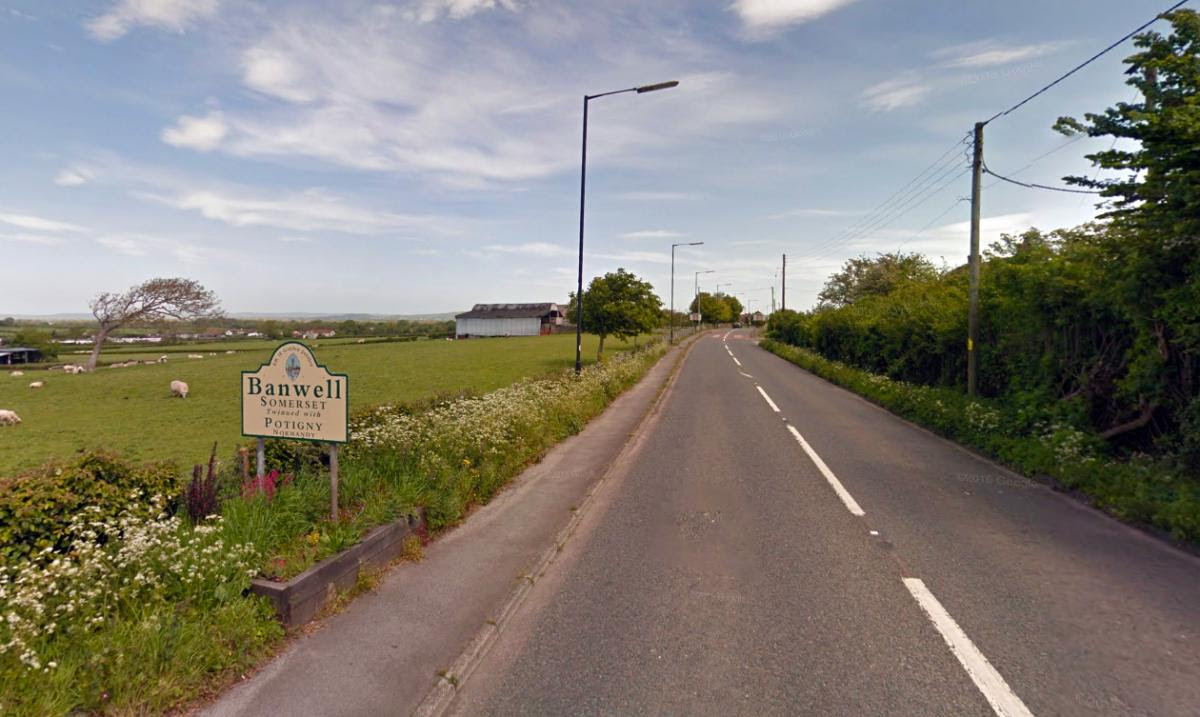
Another candidate for Bannavem Taburniae’ comes from Andrew Breeze FSA. I read about this in Salon IFA, the newsletter of the Society of Antiquaries. Also you can read more about it in this History First article. Breeze has revived a theory that the Saint comes from the West Country, and that the ‘Bannavem Taburniae’ is Banwell, near Weston-super-Mare in North Somerset. He suggests that ‘Bannaventa was a Latinisation of a Brittonic name that included banna, for a bend’, crook or peak. Venta is a well known word for an area of local administration or marketplace. For example, Venta Bulgarum, was the name for Winchester in the Roman period.) . He suggests that these ‘elements, as well as the Berniae element of ‘Taburniae’, can be found in the name Banwell, itself a compound name of the Brittonic ‘Banna’ and the Old English wylle, both meaning pool, or in the names of surrounding villages.’ I’m sure Fuentes did something similar for Battersea.
Image credit: Looking south from Winthill, near Banwell, Somerset, Colin S Pearson; Banwell in Somerset, Google Street View
What Banwell has over the London theory is that it is more likely to have been subject to Irish Raiders than London. But, for me, it is just another theory based on placename evidence that might or might not be true. I have read any number of Archaeology books where arguments about placenames are deployed to add some solidity to some theory about King Arthur, or a tale from Geoffrey of Monmouth. I therefore distrust them all. They essentially create circular arguments.
St Gertrude’s Day
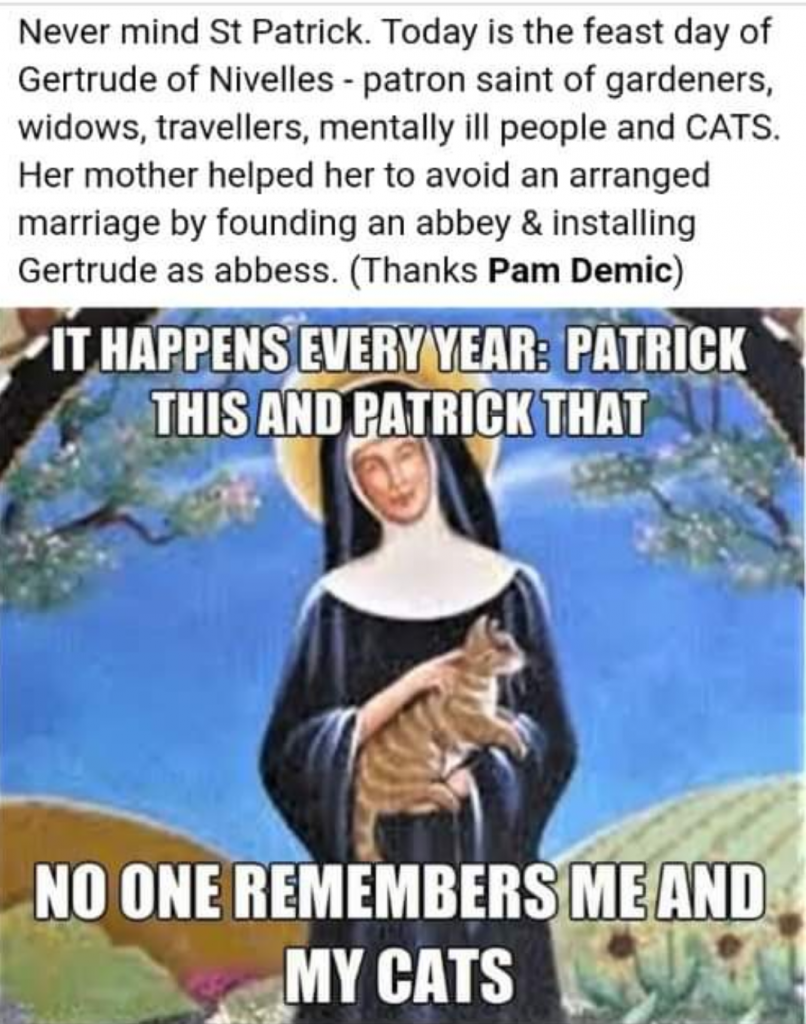
And least we forget, today is also St Gertrude’s Day, patron saint of Cats.
Facebook post, posted by a friend, and about St Gertude patron saint of cats.
On This Day
45 BC – Julius Caesar consolidated his power by defeating his main rival Pompey the Younger, and allies, at the the Battle of Munda. He went on to establish his Dictatorship, which led to his assassination on March 15th (see my post on the Ides of March)
1845 – The Rubber Band patented by Stephen Perry of St Johns Wood, London, for Messers Perry and Co,. Rubber Manufacturers of London.
Specification of the Patent granted to Stephen Perry, of Woodland’s-place, St. John’s-wood, in the County of Middlesex, Gentleman, and Thomas Barnabas Daft, of Birmingham, Manufacturer, for Improvements in Springs to be applied to Girths, Belts, and Bandages, and Improvements in the Manufacture of Elastic Bands. —Sealed March 17, 1845.
1861 – The Kingdom of Italy proclaimed with Victor Emmanuel as King. The unification of Italy was the culmination of the Risorgimento, led by Garibaldi, Cavour, Mazzini and Victor Emmanuel. It survived until 18 June 1946 when Italy became a Republic.
1951 – First Appearance of Dennis the Menace in the boy’s Comic the Beano. Published in Dundee, by DC Thomson. I read the Beano as a boy, along with the Robin, the Eagle, Topper, the Dandy, The Hotspur, and Whizzer and Chips. What made Dennis great was that he was a bad boy and didn’t get any better. Always at war with the ‘Softies’ – basically well-educated boys. And made us laugh with his antics. For more comic nostalgia read: nostalgiacentral.com/pop-culture/books-comics/british-comics-of-the-50s-60s-and-70s/
Dennis the Menace By DC Thomson – The Beano 3671, Fair use, https://en.wikipedia.org/w/index.php?curid=38472209
1973 – The Pulitzer Prize–winning photograph Burst of Joy is taken and symbolised the end of the US involvement in the Vietnam War
‘Burst of Joy’ By Slava “Sal” Veder”, Associated Press – https://www.columbiatribune.com/picture-gallery/news/2020/03/17/today-in-history-march-17/67299331007/, Public Domain, https://commons.wikimedia.org/w/index.php?curid=153972466
First Published in 2024, republished in 2025, On This Day augmented 2026
Gregorius I is known as Saint Gregory the Great. Pope from 3 September 590 to his death on 12th March 604. So 12th March is traditionally his feast day. It was changed to September 3rd, the date of his elevation to Pope because 12th March was often in Lent.
His is the 2nd most popular name for Popes. This is the top 18. I guess St Peter was too hard an act to follow, but then there are only 6 Pauls? I can’t help feeling there should be six Sixtus’s?
St Gregory is the patron saint of musicians, singers, students, and teachers. It is traditionally believed he instituted the form of plainsong known as Gregorian Chant. However, he was also a formidable organiser and reformer. He made changes that helped the Catholic tradition survive Arian and Donatist challenges. To read more about the Arian Heresy look at my post on St. Hilary and the Arians. (St Gregory and the Angles – why do these all sound like 80’s post punk bands?)
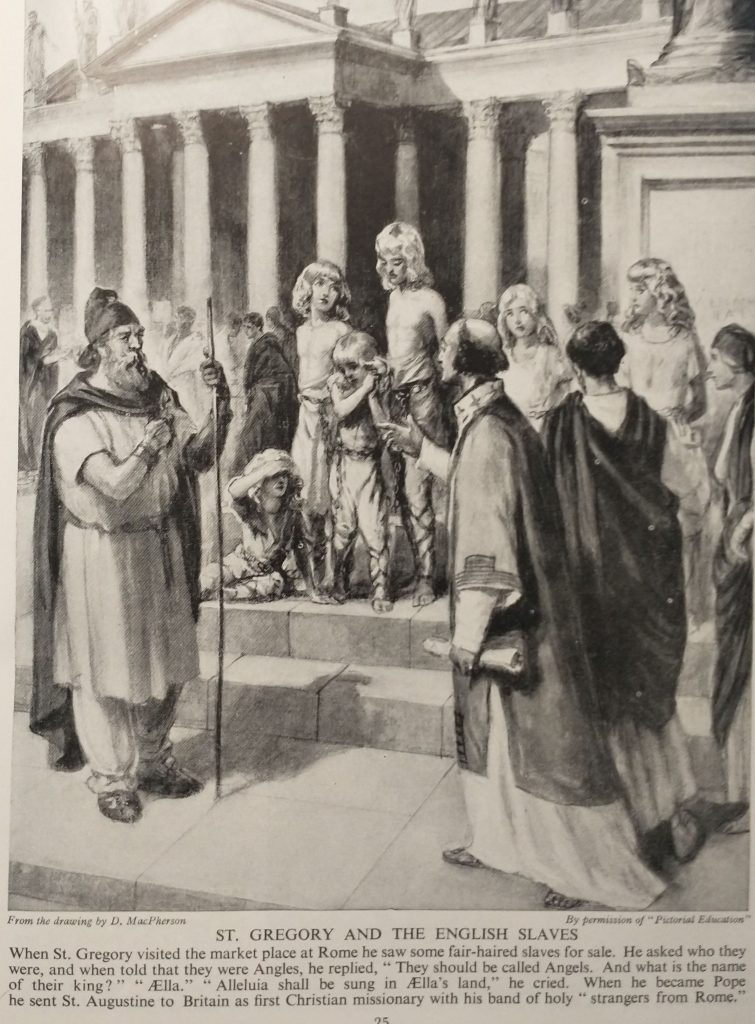
In the UK, St Gregory is venerated with St Augustine for bringing Christianity to the largely pagan Anglo-Saxons. The caption to the illustration above tells the story of how he came to send a mission to the pagan Angles in Briton. It includes his two most famous puns, riffing on the similarity of the words Angles/Angels and Aella/Alleluia. But in between these two he also punned on the name of Aella’s kingdom. This was called Deira which later joined with Bernicia to become the Kingdom of Northumbria. St Gregory said he would save them from the wroth of God which is ‘de ira’ in Latin. The ire of God. Deira. No? Not hitting your funny bone?
St Augustine’s Mission
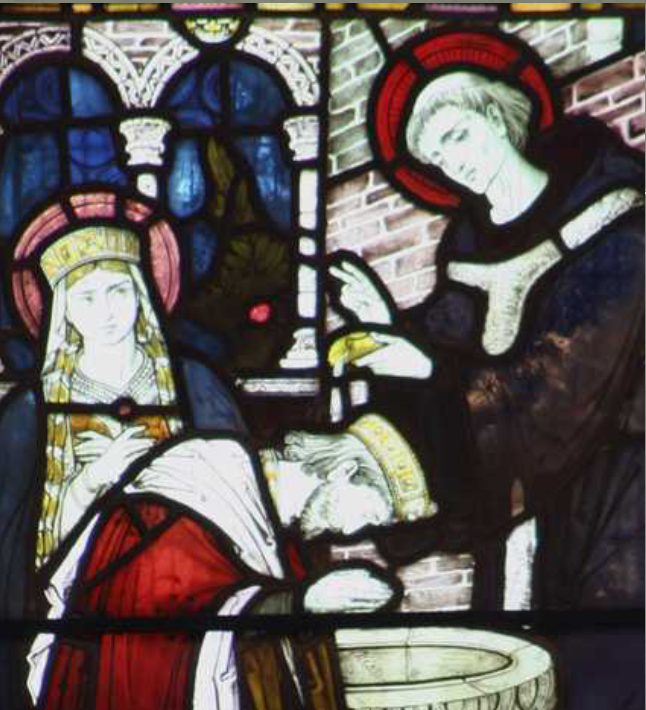
In 597AD St Gregory sent St Augustine to Canterbury. His mission to convert the Germanic peoples of the former Roman Province of Britannia. Canterbury was chosen because its King was the ‘Bretwalda’ of Britain. And he, was married to Bertha, a French Princess who was already a Christian. The enigmatic title of Bretwalda was given to Britain’s most powerful King. At the time, it was Ethelbert of Kent. So, it was a relatively safe haven for St Augustine’s mission. The King was baptised, shortly, after in Canterbury.
Stained glass window showing the Baptism of King Ethelbert of Kent by St Augustine watched by Queen Bertha. In St Martins Church, Canterbury
Archbishop of London?
The mission came with a plan to recreate the ecclesiastical arrangements set up in the Roman period. From the early 4th Century there were archbishops in the two main capitals at London and York. (We know because they attended the Synod of Arles in 314). After Kent was converted, St Augustine sent St Mellitus to London. London was part of the Kingdom of Essex, ruled by St Ethelbert’s nephew, Sæberht. Mellitus was the first Anglo-Saxon bishop of London and he established St Pauls Cathedral in 604. St Paulinus was sent to convert Northumbria and established a Cathedral in York.
Unfortunately, for the plan, Sæberht died. His sons returned to paganism and Mellitus was kicked out. He returned to Canterbury, where he, eventually, became Archbishop. Ever since we have had an Archbishop of Canterbury and York and never had an Archbishop of London.
St Martin’s Church, Canterbury – where the Church of England began. Note the Roman tiles in the wall.
St Gregory and England
It is possible to argue (and I do) that St Gregory’s encounter with the Angles is why we are called English, not Saxons, nor Wessexians. Gregory sent Augustine to set up the Church of the Angles, not the Church of the Saxons. Saxon was the normal name used by the Romans for Germanic barbarians. The old Roman province of Brittania was by now divided into 3 Saxon Kingdoms. Essex, Wessex, and Sussex. (East, West, and South Saxons). 3 Anglian Kingdom, Mercia, East Anglia and Northumbria. (Middle, East and North Angles). And Kent, which the Venerable Bede says was a Jutish King of Germans from Jutland. These Kingdoms were often at war., sometimes allied, or subjected.
The Vikings then conquered most of these Kingdoms, except parts of Wessex and Mercia. After the attacks of the Vikings were beaten back, Alfred and his son, daughter and grandson reconquered or ‘liberated’ the ex-Viking areas. Alfred renamed the united kingdoms of Wessex and Mercia, the Kingdom of the Anglo-saxons. Athelstan his son liberated Northumbria and other areas, and in joining it to the Kingdom of the Anglo-Saxons renamed it Angeland or England.
The Church of England had made the term Anglish/English became a unifying term to unite Angles, Saxons and Jutes. Otherwise, the ‘liberated’ Angles and Jutes would have to swallow being part of Greater Wessex, rubbing in their loss of independence. Of course, it was all a bit more complicated, but it gives a summary of the formation of England, which was created by the end of the 10th Century.
St Gregory in Amsterdam
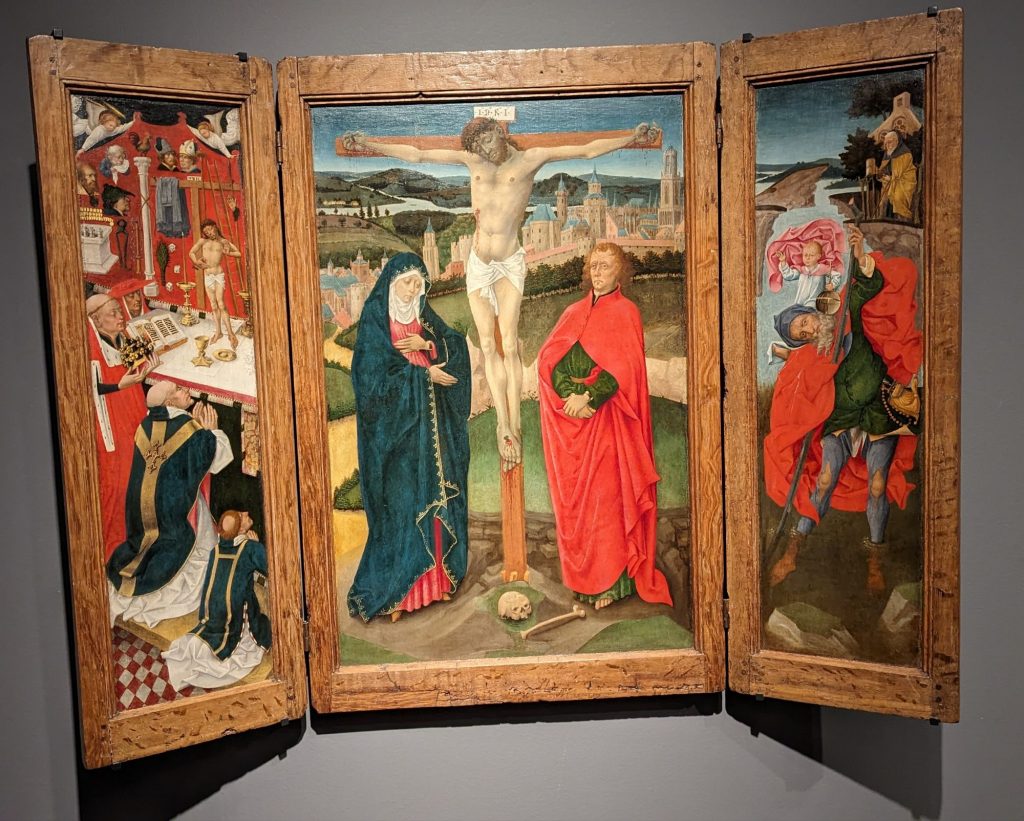
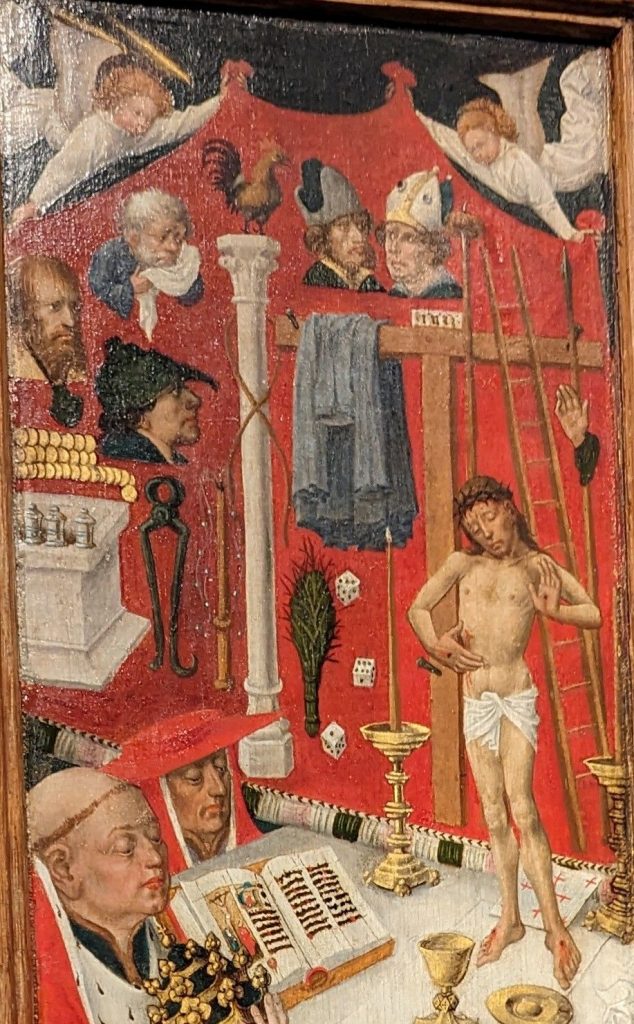
On a visit to Amsterdam and the Rijksmuseum I came across this painting which features Pope Gregory the Great. He is in the left hand part of the Triptych, shown in green kneeling at the altar. It shows Utrecht in the background.
Triptych of the Crucifixion. Showing the vision of the Crucifixion that St Gregory had while celebrating Mass (left). Crucifixion centre. St Christopher (right)
What is fascinating is all the paraphernalia of the Crucifixion above Gregory’s head. You’ll see 30 pieces of silver, dice to decide who gets Jesus’ robes, flails and torture devices, sponge and spear etc. Close up below.
Lazy Day in Anglo-Saxon Times. In the Laws of King Alfred the Great, this day was a day off for freemen. For more on Days off in the Anglo Saxon Calender see my post on August 15th.
1689 – Catholic King James II landed at Kinsale, County Cork, Ireland, in an attempt to regain the Kingdom from his daughter and son-in-law, William and Mary. James had fled to the continent following riots against his rule. William defeated James II at the Battle of the Boyne. James II returned to France never to return. Mary ruled jointly with her husband until she died of Smallpox, and he ruled alone until he fell off his horse.
1930 – Mahatma Gandhi begins the Salt March, a 200-mile march to protest the British monopoly on salt in India. One of the defining moments in non-violent civil disobedience. Offering the world a possible alternative to violent revolution, or military regime change.
1999 – Former Warsaw Pact countries, Czech Republic, Hungary and Poland join NATO. Bulgaria, Estonia, Latvia, Lithuania, Romania, Slovenia and Slovakia joined in March 2004; Croatia and Albania joined on 1 April 2009. Montenegro 2017. North Macedonia. 2020: (Ukraine) can forget about (NATO membership). That’s probably the reason the whole thing (war) started,” said U.S. President Donald Trump on February 26, 2026
First published in 2024, republished in 2025. On This Day added 2026
The store cupboards are getting denuded of the fruits, nuts, preserves, pickles, salted and dried foods saved from the summer and autumnal abundance. Of course, this is alleviated by the reduced consumption of the Lenten fast. (I’m continuing my lenten practice of giving up, giving up things for Lent). But nettles are budding. I take a regular cup of nettle tea. Normally, provided by the excellent Cowan’s tea emporium in the Covered Market in Oxford. But I’m running out and not due to visit Oxford for a month or so. So Charles Kightley in his Perpetual Almanac tells me that young stinging nettles are appearing and this is the time to collect own young, juicy nettles.
Here is a video about collecting them.
YouTube Video on making Nettle Tea
Nettle Beer
Or better still, change up the tea for a nettle beer:
Take a gallon measure of freshly gathered young nettles washed well dried and well packed down. Boil them in a gallon of water for at least a quarter of an hour. Then strain them, press them and put the juice in an earthenware pot with a pound of brown sugar and the juice and grated skin of a lemon. Stir well, and before it grows cool put in an ounce of yeast dissolved in some of the liquid. Cover with a cloth and leave in a warm place for four or five days and strain again and bottle it, stopping the bottles well. It’ll be ready after a week, but better if left longer.
Nettle Beer was brewed for old people against ‘gouty and rheumatic pains’.
Nettle: Detecting Virgins
A more sinister use is provided by William Coles who gives a method of detecting virginity.
‘Nettle tops are usually boiled in pottage in the Springtime, to consume the Phlegmatic superfluities in the body of man, that the coldness and moistness of the winter have left behind. And it is said that if the juice of the roots of nettles be mixed with ale and beer, and given to one that suspected to have lost her maidenhood, if it remain with her, she is a maid, But if she’s spews forth, she is not.‘
William Cole’s Adam in Eden 1657.
Flagellation with Nettles?
William Camden reported that Roman soldiers used nettles to heat up their legs in the cold of a British winter. (from Mrs Greaves’ ‘A Modern Herbal). Perhaps, I should have sent that idea to PM Keir Starmer? He might have suggested the method to Senior Citizens to alleviate the loss of their Winter Fuel Allowance? (which he has now restored). Flogging with nettles was a cure for rheumatism and the loss of muscle power in the early modern period. Nettles were also added to horse feed to make their coats shine. It was used as a hair tonic for humans.
Nettle Fabrics
The 18th century poet Thomas Campbell is quoted on the virtues of nettles:
“I have slept in nettle sheets, and I have dined off a nettle tablecloth. The young and tender nettle is an excellent potherb. The stalks of the old nettle are as good as flax for making cloth. I have heard my mother say that she thought nettle cloth more durable than any other linen.”
In 2012, a Danish Bronze Age Burial was found to be dressed in a shroud made of Nettle. Strangely, the nettle was not local, perhaps being made in Austria where other objects in the rich burial came from. However, the person was thought to be Scandinavian. For more have a look at this article on www.nbcnews.com.
In the Irong Age, also in Denmark, Huldremose Woman was found buried in a bog. She had a severed arm and was buried in elaborate sheep and goat skin clothes, but underneath:
‘she wore a white inner garment made from plant fibres that reached from the shoulders to below the knees. The type of plant fiber is unclear but other evidence from the time period suggests that it could have been made of nettle.’
Greaves tells us that the German and Austrians had a shortage of cotton during the blockade of World War 1. They turned to nettles to replace cotton production believing it to be the only effective substitute. It was also substituted for sugar, starch, protein, paper and ethyl alcohol.
YouTube Video on making fabric from nettles
Nettle Pudding
Pepys ate Nettle Pudding in February 1661 and pronounced it ‘very good’. Here is more on Nettles in history AND a recipe for Nettle Pudding! I can see I’m going to have to get out there and carefully pick myself some nettles! ( For Folklore of Nettles look here).
Remember, none of the above is necessarily good advice as far as medicine is concerned. For smoking herbs see my post coltsfoot-smoking-cholera
March Weather
In the early modern almanacs there is much weather and horticultural advice to be had (Weather Lore. Richard Inwards).
‘March damp and warm Will do farmer much harm‘
or
‘In March much snow to plants and trees much woe‘
On This Day
March 10th is St Kessog Day. He is associated with Luss on Loch Lomond, and was Robert the Bruce’s rallying cry. St Kessog and Scotland!
241 BC – The Battle of the Aegates in which the Carthaginian fleet is sunk, and the First Punic War ends. Carthage was destroyed in the Third Punic War in 146BC. Rebuilt as a Roman City 100 years later.
1629 – Parliament is dissolved by Charles I. This was followed by a Royal dictatorship which lasted 11 years, and then led to Civil War.
1906 – Bakerloo Line Opened. The name originated from the Baker Street and Waterloo Railway. It goes from Harrow &Wealdstone in the NW to Elephant & Castle in the South East, via the Central London section which goes from Bakers Street to Waterloo, Sherlock Holmes didn’t use the Tube very much (see this post here for those times he did). There is a proposed extension from Elephant & Castle to Lewisham.
1969 – James Earl Ray sentenced to 99 years in jail for murdering Martin Luther King. While Ray was a segrationalist and a supporter of George Wallace, he maintained he was set up as the scapegoat. He died in prison in 1998.
Lide 5th is St Piran’s Day. Photo of St Piran’s Oratory at Trézilidé, Finistère (wikipedia) By Kieffer92 – Own work, CC BY-SA 4.0,
March is named after the Roman War God Mars, whose Month it was. But in England it had, until recent times, a dialect name which survived in the South west of England. This was ‘Lide’.
Lide was still used in the 17th Century, and then survived into the 19th Century only in Cornwall. The Cornish named the first Friday in March ‘Friday in Lide’. They had a proverb.
‘Ducks won’t lay till they’ve drunk Lide water’.
Daffodils were called Lide-lillies. Eleanor Parker, who is a Lecturer in Medieval Literature at Brasenose College, Oxford, wrote an interesting article in History Today. She called March the loudest month of the year. The early English names for March were Hlyda or Lide monath meaning stormy or loud month. Other names include Hraed monath (rugged month) and Lentmonath (month of lent).
March brings breezes loud and shrill, Stirs the dancing daffodil.
Sara Coleridge (1802–1852), “The Months,” Pretty Lessons In Verse, For Good Children; With Some Lessons in Latin, In Easy Rhyme, 1834
There are many references to the changeable weather in March. Sometimes lovely spring days, and at others raging storms, and frosts. Parker quotes a proverb which says that March comes in:
‘like a lion and goes out like a lamb’.
In 2026, the 5th of Lide has been a beautiful spring like day, with, over the last few days a outburst of Hawthorn and Plum blossom.
St Piran
Lide 5th was a holiday for Miners, probably because it was St Piran’s Day. Very little is clear about St Piran. But he is thought to have been an Irish Missionary who founded an Abbey in Cornwall in the 5th Century. His legend says he was tied to a millstone by the Irish, who rolled the stone over a cliff. The sea was stormy, but calmed as soon as he fell into it. He floated on his stone to Perranzabuloe in Cornwall. Here he landed and got his first converts: a badger, a fox, and a bear. Then, he founded the Abbey of Llanpirran.
He is said to have reintroduced smelting to Cornwall, hence his attribution as patron Saint of Miners. Piran was martyred by Theodoric or Tador, King of Cornwall in 480. His bones scattered in reliquaries in the South West and in Brittany. He is the patron saint of Cornwall, so the week before the 5th of March is known as Pirrantide. And there are events and parades to commemorate him. People dress in black white and gold, carrying daffodils and walk across the dunes to St Piran’s Cross.
1702 – Queen Anne becomes Queen – the last of the Stuarts. She had 18 pregnancies. The eldest survived to 11 and then died. Of the other 17, 8 miscarried, 5 were stillborn. 4 were born alive but died soon after. She had poor health, gout and drank a lot, but she might well have had an autoimmune deficiency and her body rejected the offspring. The fact that the eldest was the only one to survive might suggest rhesus disease, which can now be prevented with an injection of a medication called anti-D immunoglobulin. The problem occurs when a woman with RhD negative blood is exposed to RhD positive blood and develops an immune response to it. The first child is not affected, subsequent ones risk miscarriage.
1936 – The Spitfire makes its maiden test flight. By 1947 over 20,000 had been made and it had been in continuous production throughout the war, unlike most other aircraft.
1946 – Churchill makes his”Sinews of Peace” Speech in which he coins the phrase ‘Iron Curtain. President Trueman invited the unemployed Statesman to Fulton Missouri to make the speech. In 1961, the proposal was made to commemorate the speech by reconstructing the blitzed City Christopher Wren Church, St Mary Aldermanbury in Fulton, Missouri. The Church was shipped to the States, rebuilt and rededicated on the 7 May 1969.
First published in 2024, rewritten March 2025 Revised, On This Day added 2026.
Portrait of Saint Guénolé (St Winnold) after a bust in silver on a reliquary from the Church Saint-Guénolé in Locquénolé.Public Domain Abgrall Jean-Marie (1846-1926) – Bibliothèque nationale de France
Here is a weather poem in which St Winnold appears
First comes David, then comes Chad. And comes Winnold, roaring like mad. White or black. Or old house thack.
St David’s Day was March 1st. St Chad, the 2nd. St Winnold’s Day is the third of March. Winnold is his English name, and Winneral, or Winwaloe or Guénolé his Celtic names.
The poem suggests that snow, rain or wind is going to come on these three days. When the wind roars, it will threaten the thatch of houses. If the storms do not come in the first 3 days, then they will come on the last three days of March, which were called ‘the Borrowing Days’. Or so it is said.
St Winnold was around 50 years (460 – 3 March 532) after the end of Roman Britain. His family was from Cornwall. He was the son of a Prince Fragan of Dumnonia, and St Gwen the Three-Breasted, His mother’s Feast day is October 3rd. She is a Saint of fertility, because of God’s Gift of an extra breast. They moved to Brittany to escape a British Plague. Their son grew up to be holy and was the founder and first abbot of Landévennec Abbey (the Monastery of Winwaloe). It is south of Brest.
Winwaloe became what is known as a ‘phallic saint’ because he was associated with fertility. Wikipedia says this came about because of confusion about the origin of his name:
‘his name was thought to derive from gignere (French engendrer, “to beget”)’
St Winnold’s Breton name is Guénolé. How this etymology works is not clear to me! But surely, he as likely to have got a reputation for helping people with fertility problems from his mother? Supplicants would make a wax phallus to persuade the Saint to help them conceive. There are several churches/ chapels dedicated to him in Wales, and a Priory in East Anglia.
Today is the Feast day of two significant Saints, St. Walpurga and St. Ethelbert.
St. Walpurga
St. Walpurga was a nun at Wimborne in Dorset. She, and her brothers St Willibald and St Winebald, accompanied their uncle, St Boniface of Crediton (in Devon) on his mission to convert the Germans to Christianity. They all became leading figures in the new German Church. Willibald set up the Monastery at Heidenheim, which was a duel monastery housing both Monks and Nuns. His sister, St Walpurga, became Abbess of the Monastery in 761. She died on 25 February 777 or 779 (the records are unclear),
In 870, St. Walpurga remains were ‘translated’ to Eichstätt, which St Willibald had set up as the Diocesan centre of this part of Bavaria. The date of the transfer was the night of April 30th/May 1st. This was her feast day. But the Church moved it to February 25th, to commemorate her death. However, May Eve is now ‘notorious’ as Walpurgis Night. This is the night of May Eve when witches are abroad up to all sorts of mischief, May Day being one of the main pagan festival days. Her body was placed in a rock-cut niche and her bones started exuding an oil called Walpurgis Oil which was said to have medical properties. She was also involved in a miracle of a boat saved in a storm-tossed sea.
For these reasons, Walpurgis is the Saint for battling pests, rabies, whooping cough, storms and sailors. She is also associated with witchcraft but not because of any actual association with it. Her remains were moved again in 1035 when she was enshrined at the Benedictine Abbey of St. Walburga which was named after her.
Walpurgis Nacht
Terrible things happen on Walpurgis Night in Dracula by Bram Stoker. So, the night has now become a trope for Heavy Metal Bands, doyens of horror stories and the Satanic. For more on this read my piece on Walpurgis Nacht.
Coincidently, I was reading about the fuss made about a Heavy Metal Band, called a Plague of Angels, playing in the glorious York Minster. A member of the band tried to calm down the controversy, saying people should just chill out. But other group members used to be in a band called ‘The Cradle of Filth’. Among their claims for Heavy Metal Fame is that they wore the most controversial t-shirt in heavy metal history. This has a visual of a nun in a compromising position and a slogan saying ‘Jesus is a ……..’ (add your favourite swear word here). All very silly. But it struck a cord with me, as I have a scene in my novel (unpublished) which is based on extreme forms of Heavy Metal Bands. I thought I might have gone over the top, but this story reassures me that extreme Metal can be extremely offensive!
Ethelbert is responsible for welcoming the Augustinian Mission to the Angles sent by the Pope, St Gregory. This re-established Christianity in Eastern Britain, and set up the Anglican Church or the Church of England as it became known.
1308 – Edward II crowned King of England. His reign ended disastrously, with his Queen having an affair with Lord Mortimer and Edward losing control of the country (and Scotland). He was forced to abdicate, and died/was murdered/killed with red-hot pokers/or escaped to live a life as a hermit on the continent. Choose your favourite or read my History of the Kings and Queens of Britain.
1507 – Queen Elizabeth I excommunicated by Pope Pius and declared usurper of the throne, leading to the Spanish Armada and various plots against her life. (my post on Queen Elizabeth’s nicknames is here)
1836 – The Colt Revolver awarded a United States patent. Previously, he had obtained a UK Patent. It created the classic ‘Western’ Revolver’, much later called the Colt 45. It was a revolving-breech loading, folding trigger hand gun.
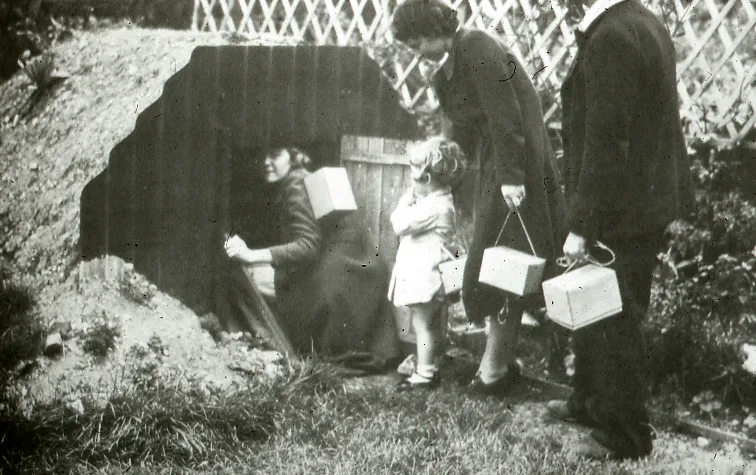
1939 – The first Anderson shelter built in a garden in Islington, London. They were named after the Home Secretary, and were dug in a trench with soil piled over the corrugated iron domed roof. Inside were bunks for the occupants to sleep in. They were 6 ft high, 4.5 ft wide, and 6.5 ft long. 2.5 million were built. The next shelter was the Morrison Shelter named after Herbert Morrison, who succeeded Anderson as Home Secretary. The Morrison Shelter was like a massive table that would protect the shelterers if the house collapsed above it. It allowed the family to sleep inside. London also had public shelters made of brick in many streets, or used cellars and brick arches as shelters. A small proportion of the population preferred to sleep in the Underground. Many stayed in their beds, unless planes were directly overhead. Photos from ‘The British People at War’ published during the war.
Anderson ShelterMorrison ShelterConcrete Public Shelter in London Museum Docklands (Photo C. Mossie)
1956 – Nikita Khrushchev denounces Stalin.
First Written February 2024, revised February 2025. On This Day added in 2026
Ash Wednesday this year is early and on 18th February. It is the First Day of Lent, the solemn time which runs up to Easter, and is symbolic of Jesus’ 40 days in the wilderness.
In Anglo Saxon the name for the season of Spring was ‘lencthen’. It is thought to derive from the idea of the lengthening days. Days do suddenly seem to have got longer. These are the official times for the evening:
Sunset: 17:21
Dusk (Civil twilight ends) : 17:55
Nightfall (Nautical twilight ends) :18:34
Full Darkness starts (Astronomical twilight ends) : 19:13
So strictly, Lent means Spring. The Romance languages use the term which derives from the Latin ‘Quadragesima’ which means the 40 days of Fast. Spanish (Cuaresma), French (Carême), and Italian Quaresima). For Germans, it is the fasting time: fastenzeit. In England, Lent became a specialised word for the fast period. And Spring took over as the name of the season.
A time of fasting? Time for reflection? Maybe once upon a time. When I was young, it was 40 days when you were supposed to give something up. Smoking, or drinking, or chocolate. An idea taken up by a new generation, as, for example, Dry January? A time of reflection? No, never did that.
Dust to Dust and Stardust
Ash Wednesday is named after the ashes smeared on the heads of worshippers to remind us that we are dust. I’ve never seen this done either. My footballing Vicar friend Andrew missed our Wednesday Game so that he could mark foreheads with ash crosses. The ashes were traditionally made from palms used for Palm Sunday decorations, which is indeed what Andrew did. Look here to see my post on Palm Sunday.
On the subject of dust, here are some spiritual lyrics by Joni Mitchell. Something profound in the true idea that we are all stardust.
We are stardust We are golden And we’ve got to get ourselves Back to the garden
Woodstock by Joni Mitchell
40 Days
We all know that there are 40 days in Lent, except there are not. It’s 46 this year. This was pointed out by Tim Harford who presents a BBC radio programme called ‘More or Less’. It is a programe about statistics, or more widely about Fact Checking statistics in the news. Last year he discussed the 40 days. One answer proposed was to take away Sunday. But, my mathematics tells me this still leaves 42. The answer Tim Harford came up with is that 40 days just means a long time.
It is the length of time of Lent, but also:
The duration of the Great Flood The time Moses was on Mt Sinai The time the Israelites spy on Canaan Goliath trails Saul Elijah Walks Jesus is tempted n the Desert The time from Resurrection to Ascension
In other words, a long time to be doing any one thing. As Hartford says, it’s like our word ‘umpteenth’. As in ‘Kevin this is the umpteenth time I’ve told you to tidy your bedroom’. That’s what my mother said to me as she threw my clothes out of the window.
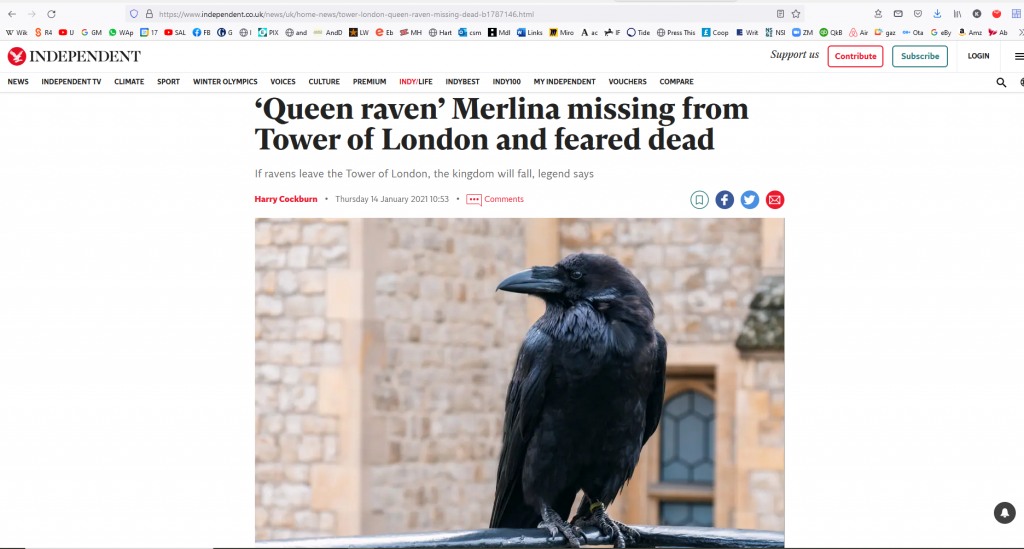
The Independent January 2021 The Raven the Palladium of Britain
The Raven – the Palladium of Britain
Corvus corax is hatching. An early nesting bird, the Raven is the biggest of the Corvids. They were pushed to the west and north by farmers and game keepers but are making a comeback. Ravens are finding towns convenient for their scavenging habits. So they, again, cover most of the UK except the eastern areas. The Raven is one of the Palladiums of Britain.
A Palladium is something that keeps a city or country safe, They are named after a wooden statue of Pallas Athene, which protected Troy. Perceiving this, Odysseus and Diomedes stole the Palladium from Troy shortly before the Trojan Horse episode. Troy fell and the palladium went to Italy (I’m guessing with Diomedes who is said to have founded several cities in Italy). It ended up in Rome.
The Romans claimed to be descendants of Trojan exiles led by Aeneas. So it was back with its rightful owners. It protected Rome until it was transferred to the new Roman capital at Constantinople. It then disappeared, presumably allowing the Ottoman Turks to conquer the City of Caesar? To read of London Stone as a Palladium see my post here.
The Ravens habits (it is said they know where the battlefields are before they are fought) and their black plumage have made them harbingers of death. In poetry, Ravens glut on blood like the warriors whose emblem they are. Here is a very famous quotation from Y Gododdin, a medieval poem but thought to derive from a poem by the great poet Aneirin from the 7th Century.
‘He glutted black ravens on the rampart of the stronghold, though he was no Arthur.’
This is one of the much argued-about references to King Arthur in the ‘Was he a real person’ trope. The point being, it doesn’t make sense to mention Arthur if King Arthur wasn’t a real person. The story at the Tower of London is that the Ravens kept in the Tower, with clipped wings, keep Britain safe from Invasion. (But see below).
Bran’s Head – the original Palladium of Britain?
By Sonny Mauricio from Unsplash
The Raven was also the symbol of the God-King Bran. Bran was one of the legendary Kings of Britain. His sister, Branwen, was married to the King of Ireland. To cut a long story short, Branwen was exiled by her Irish husband to the scullery. She trained a starling to smuggle a message to her brother, to tell of her abuse.
So Bran took an army over the Irish Sea to restore her to her rightful state. But the ships were becalmed. Mighty Bran blew the boats across the sea – he was that much a hero. Bran was mortality wounded in the fighting that followed. This was a problem because he had previously given away his cauldron of immortality. He gave it to the Irish King in recompense for the insults given to the Irish by Bran’s brother, who hated anyone not British.
Bran’s Head Returns to London
So, the dying Bran, told his companions to cut off his own head and take it back to the White Hill in London. His head was as good a companion on the way back as it was on the way out, and the journey home took 90 years.
At last, they got to London, where Bran told his men to bury his head on the White Hill. As long as it stays here, he said, Britain would be safe from foreign invasion. The White Hill is said to be Tower Hill with its summit at Trinity Gardens, although Primrose Hill is sometimes offered as an alternative.
This was one of the Three Fortunate Concealments and is found in ‘the Triads of the Island of Britain.’ The Triads are from medieval manuscripts which preserve fragments of folklore, mythology and history. They are grouped in groups of three.
Arthur and Bran’s Head
But many years later, King Arthur saw no need for anybody or anything other than himself to protect the realm. So he had the head dug up. Calamity followed in the shapes of Sir Lancelot and Mordred which led to the end of the golden age of Camelot and conquest of Britain by the Saxons. This was one of the Three Unfortunate Disclosures.
If we want a rational explanation for the story, there is evidence that Celtic cultures venerated the skull, and palladiums play a part in Celtic Tales.
So what was Arthur doing destroying the palladium that kept Britain safe? Vanity is the answer the story gives. But, perhaps, it’s a memory of Christian rites taking over from pagan rituals? God, Arthur might have thought, would prefer to protect his people himself rather than Christians having to rely on a pagan cult object.
Ravens in the Tower of London
The story of Bran’s head is inevitably linked to the Ravens in the Tower who, it is still said, keep us safe from invasion. As you can see from the photo at the top we still get in a tizz when one goes missing.
Sadly, and I am probably sadder about this than most, the link between the Tower, Bran, and the Ravens cannot be substantiated. Geoffrey Parnell, who is a friend of mine, told me that while working at the Tower of London he searched the records assiduously for the story of the ravens. He found no evidence of the Raven myth & the Tower before the 19th Century, and concluded that it was most likely a Victorian invention. IanVisits has a 2025 story about the Ravens, and also concurs that the Ravens are a recent myth.
The Welsh Triads give a total of two palladiums for Britain, a couple of nationalistic fighting dragons.
The Head of Bran the Blessed, son of Llyr, which was concealed in the White Hill in London, with its face towards France. And as long as it was in the position in which it was put there, no Saxon Oppression would ever come to this Island; The second Fortunate Concealment: the Dragons in Dinas Emrys, which llud son of Beli concealed; And the third: the Bones of Gwerthefyr the Blessed, in the Chief Ports of this Island. And as long as they remained in that concealment, no Saxon Oppression would ever come to this Island.
All good but then came:
The Three Unfortunate Disclosures:
And there were the Three Unfortunate Disclosures when these were disclosed. And Gwrtheyrn the Thin disclosed the bones of Gwerthefyr the Blessed for the love of a woman: that was Ronnwen the pagan woman; And it was he who disclosed the Dragons; And Arthur disclosed the head of Bran the Blessed from the White Hill, because it did not seem right to him that this Island should be defended by the strength of anyone, but by his own.
Gwrtheyrn is Vortigen, the leader of the Britons after the fall of the Roman Empire in Britain, one or two leaders before Arthur. Vortigern, which means something like strong leader in Welsh was a real person in so far as he, unlike Arthur, is mentioned by Gildas a near contemporary source.
The story of the dragons is supposedly from the pre-Roman Iron Age. Every May Day, the Dragons made a terrible noise, causing miscarriages and other misfortunes. So, King Ludd, whom legends says gave his name to London (Ludd’s Dun or Ludd’s walled City), drugged the dragons. He had them buried in a cavern at Dinas Emrys in Eryri (Snowdonia). The Red Dragon represented the Britons (also called the Welsh) and White Dragons the Saxons.
Vortigern, Merlin and Vortimer
Hundreds of years later, (five hundred?) after the Romans had come and gone. Vortigern was trying to build a castle in Eryri at Dinas Emrys. But the walls keep falling down. ‘You need the blood of a boy born not of man’, his necromancers say. They find a boy called Ambrosius aka Merlin whose mother had lain with an incubus. Merlin accused the necromancers of ignorance and explains the wall collapse is caused by two dragons. They find the cavern and let the dragons go. The walls now stand undisturbed. But the Welsh Red Dragon and the Saxon White Dragon can not now be at peace, and the Britons are defeated by the Saxons.
Vortigern betrayed his own people for the lust of Rowena the daughter of Hengist, the Saxon. Hengist was given the province of Kent as his reward, and thus began the Anglo-Saxon take over.
Vortigern’s son is Gwerthefyr (or Vortimer). He was a better man than his dad and fought to keep the Saxons out. After Vortimer’s death his bones were buried at the chief ports on the South Coast. Here they acted as a palladian and they kept the country safe. But they were moved to Billingsgate, in London and put in a Tower. The loss of the palladium allowed the Saxons to land safely on the Kent coast and consolidate their increasing hold over Britain and turning it into England.
Birds in Love
Here is a lovely little medieval poem. It was found in 1931 in the end leaf of a manuscript where someone had been testing their goose quill and scribbled these three lines:
Why it is so wet in the UK at the moment (February 18th)? The answer seems to be that there is a block of cold weather over the States that is moving the Jet Stream south, bringing lots of wet weather. But there is also another block of cold weather over Scandinavia. This means that the low pressures being driven by the Jet Stream, have no where to go and are stopping and dumping their rain all over the UK.
3102 BC – the death of Krishna starts Kali Yuga, the fourth and final yuga of Hinduism.
1478 – George, Duke of Clarence, traitor to his Brother, Edward IV, was executed in private at the Tower of London. It is said he was drowned in a vat of Malmsey Wine.
1678 – First Part of Pilgrim’s Progress by John Bunyan published.
1991 – The IRA plant bombs at Paddington station and Victoria station in London. The IRA gave warnings, and the Victoria bomb went off at 4.20am and caused no casualties. At or just before 7am, the IRA warned that all London Stations were to be bombed in 45 minutes time. The Authorities were slow to clear the stations and at Paddington a bomb went off at 7:40am. 1 person was killed and 38 people were injured. 11 days earlier, the IRA attacked Downing St with a mortar bomb attack.
Written on February 21 revised in February 18th 23, 24, 25, Birds in Love, Wet Weather and On This Day added in 2026