For this was St. Valentine’s Day When every bird came there to chose their mate. Of every type, that men think may And that so huge a noise did they make That earth and sea and tree and every lake So full was, that hardly was there space For to stand so full was the place.
St Valentine’s Patronage
This is the first reference to St Valentine’s as a romantic day. And some people charge Chaucer with making the whole thing up! St Valentine, is supposed to have been martyred in the 3rd Century (290AD) on the Via Flaminia on February 14. He refused to stop marrying people in the Christian rites. Therefore, he is the patron Saint of lovers. Valentine is also the patron Saint of epileptics, fainting and beekeepers. According to legend, he taught a young blind girl how to look after Bees, and, sometime later, her eyesight was restored. He also is said to have treated a young man of epilepsy. Epilepsy was sometimes called the Falling Sickness, and so he is also the Saint of Fainting.
But until Chaucer, there was no particular link with romance. In fact, there are at least three Saint Valentines who were martyred in the Roman period. Their relics are scattered around Europe (have a look at this National Geographic article for the full S.P.). These include bones in Glasgow and his heart in Dublin. There are in total 11 Saints called Valentine in the list of Catholic Saints.
Another theory is that St Valentine has taken over the aspect of the God Cupid, as a Christian attempt to create a holy festival to replace the Lupercalia. See my post on the Lupercalia here.
St Valentine’s Day and Birds
Chaucer’s poem suggests one possible route to the link with romance. Early February is about the time when birds pair off. If they want to have their chicks at the optimal time, then they need to get going before spring has really sprung.
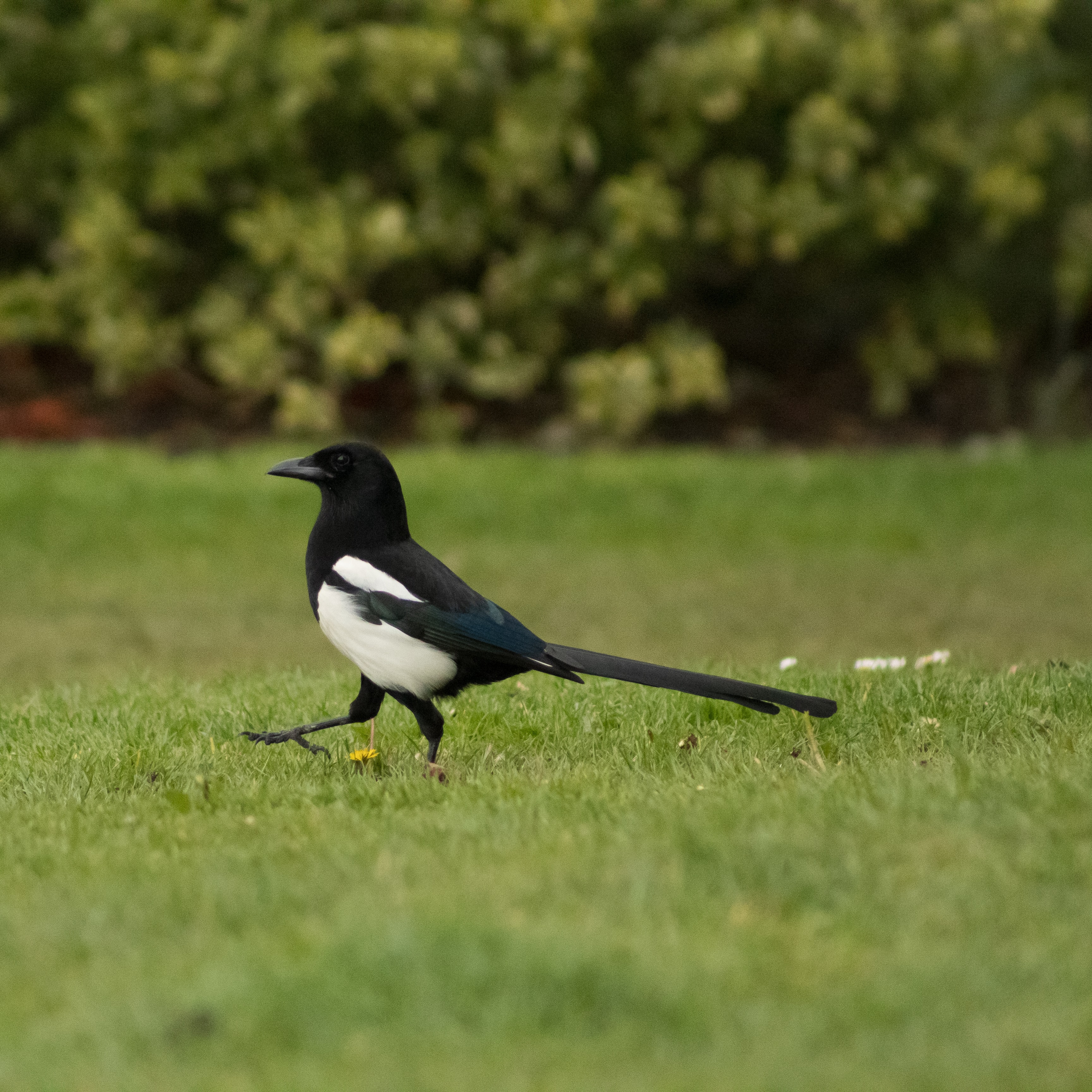
When I think of love, I don’t think of birds. Maybe, this is because I live by a Canal. Outside my garden, I frequently see and hear a Coot chasing his pair across the water before violently mounting her. But then they are fiercely monogamous and defend their nest, fearlessly, against much bigger birds. And swans glide by in beautiful family groups. But Magpies are my favourite lovebird because you see one, and then look around, and you very often see the partner. I have adopted an old tradition that you are supposed to say:
‘Hello, Mr Magpie! Where’s Mrs Magpie?’
And look for the mate. It is good luck if you see her and bad luck if you don’t. (Please feel free to assign your own favourite gender!)
‘One for Sorrow’ is a well-known nursery rhyme found in many variations, and is an example of ‘ornithomancy superstition’ whereby the number of Magpies you see determines some aspect of your future. Magpies normally mate for life, and are not gregarious during the nesting season, but thereafter, they ‘join together in large wintering flocks of more than 20 or so birds.‘. So, perhaps we need at least another seven lines for the rhyme? So, far I have never seen a flock of them. If you have a photo of a flock, please send it to me!
One for sorrow, Two for joy, Three for a girl, Four for a boy, Five for silver, Six for gold, Seven for a secret, Never to be told. Eight for a wish, Nine for a kiss, Ten a surprise you should be careful not to miss, Eleven for health, Twelve for wealth, Thirteen beware it’s the devil himself.
As to the likelihood of seeing thirteen magpies together – well I have seen them often in pairs, occasionally in threes and often alone.
Here is another, more dangerous version of the rhyme (you are more likely to see the Devil)
One for sorrow, Two for mirth Three for a funeral, Four for birth Five for heaven Six for hell Seven for the devil, his own self
For details of the history of versions of this poem, click here:
Bad Birds
Magpies don’t have a good reputation, traditionally being regarded as thieves and scavengers with untidy nests and eating habits. They are supposed to be attracted to shiny things, but Exeter University did some research which found that they have the normal Corvid’s curiosity for objects. But they are as happy to snatch a dull object as a shiny one. So, we can see they are very intelligent as well as faithful lovers. For me, a good-omened bird (as long as I see the two of them).
44BC – Julius Caesar was appointed dictator in perpetuum. Or perpetual dictator of the Roman Republic. Coins were issued with the phrase DICT PERPETVO.
1400 -Richard II died shortly after Epiphany Rising, a failed plot to restore him to the throne. Some think he was starved to death in captivity in Pontefract Castle. Or he starved himself. His body was taken to London and put on display in St Paul’s Cathedral on 17 February. His remains were taken to one of his favourite palaces at King’s Langley Priory on 6 March. Henry V had his remains ‘translated’ to Westminster Abbey. King’s Langley was a Royal Palace lived in by Eleanor of Aquitaine and Edward II, as well as Richard II. It is near Slough.
‘The accepted tale of the king’s death is that in despair and grief at the death of his friends, King Richard refused to eat or drink, although a few say he was purposely starved to ensure he died as if from a natural death. Another rumour is that when an esquire mentioned the words ‘King Henry’ while he was eating dinner, Richard struck him with the knife he was using. Guards charged in and the king, pushing the table away, took a bill out of one man’s hand and managed to slay four of them but one leapt onto the chair he had vacated and felled him with a stroke of his poleaxe.’
1876 – Alexander Graham Bell applies for a patent for the telephone
1895 – The Importance of Being Earnest, first produced at the St James’s Theatre, London
1918 – Russia finally adopts the Gregorian calendar. see my post here.
First Published in February 2023, revised and updated in February 2024, 2025 On This Day added 2026
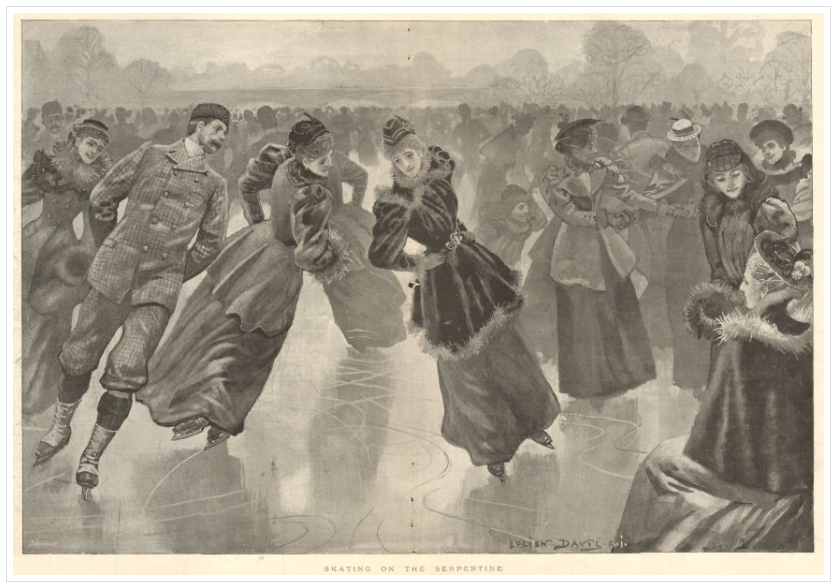
The Greeat Freeze. ‘Skating on the Serpentine’ by Lucien Davis Antique wood-engraved print. Illustrated London News double page from 2 March 1895 (print owned by K Flude)
The Great Freeze
London, February 12, (1895). There is no abatement of the abnormally cold weather which has prevailed in northern Europe for the last week. The Upper Thames is frozen over, and huge blocks of ice breaking away from the mass are floating down the river, causing much damage to the smaller shipping craft. Water traffic is consequently at a complete standstill.
Many cases of death from cold and exposure are reported, the privation and distress in the East End of the city being particularly severe. The cold is so intense that birds are found frozen to death on the branches of the trees, and thousands are perishing. The severe weather has also directly caused considerable mortality, a number of deaths from exposure having been reported among postmen, omnibus drivers, cabmen, and labourers.
Winter of 1895 Limehouse to left, Tower of London to right. Images from Isle of Dogs blog.
The year 1895 was the culmination of a decade of particularly cold winters (and for some the end of the so-called Little Ice Age). On the 11th February, the coldest day in British History was recorded at Braemar at −27.2 °C. February 1895 was the second coldest on record, with the lowest minimum temperatures on record. Shipping in the biggest port in the world was stopped. Therefore, many workers were laid off, and had to resort to what were then called ‘soup kitchens’ and now ‘food banks’. Winter death rates were said to be doubled, with people dying in the street and in unheated homes.
Record minima were set for these dates in February 1895:
7th: −21.7 °C or −7.1 °F
8th: −25.0 °C or −13.0 °F
9th: −23.9 °C or −11.0 °F
10th: −25.6 °C or −14.1 °F
11th: −27.2 °C or −17.0 °F
12th: −20.6 °C or −5.1 °F
13th: −21.9 °C or −7.4 °F
14th: −21.7 °C or −7.1 °F
16th: −23.9 °C or −11.0 °F
17th: −23.9 °C or −11.0 °F
18th: −23.9 °C or −11.0 °F
19th: −22.2 °C or −8.0 °F
Source Wikipedia.
On the flip side people resorted to ponds around London particularly the Serpentine which had 6 inches of ice and 50,000 skaters, with speed skating competitions.
1554 – Lady Jane Grey was executed after a trial at the Guildhall. Her husband was executed on the same day. Her adoption as heir to the throne was ordered by her cousin Edward VI. His minister, John Dudley, Duke of Northumberland, (and Jane’s Father-in-Law) arranged for the Privy Council to accept Jane as the next monarch. They were trying to prevent Henry VIII’s Catholic daughter, Mary taking the throne. Jane was Queen for 9 Days. The Privy Council swapped sides as support for Jane collapsed. Jane was the Great-granddaughter of Henry VII and cousins to Mary, Elizabeth and Edward VI.
1993 – The South African Government agrees with the African National Congress to form an elected interim government comprised of both black and white members.
Published February 12th 2024, and republished 2025, 2026
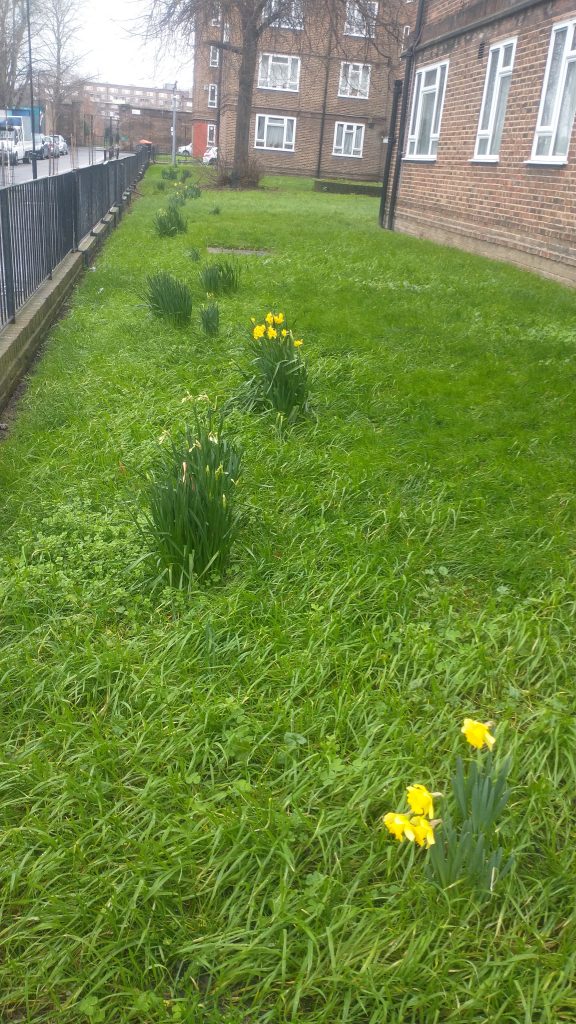
Daffodils & Narcissus. In 2023, I saw my first Daffodil in Hackney in a Council Estate on 12 January. My first daffodil in 2024 was outside my first floor window in early February. On February 11th, 2025, I saw the shoots of Daffodils in my garden but nothing blooming. However, there were daffodils on another Council Estate. In 2026, my first daffodil came out in early January. And the Estates and Parks around have been showing daffodils since late January. They bring such joy and hope for the return of the Sun.
12 Jan 2023. Hackney, London, the first Daffodil.
Narcissus the Flower
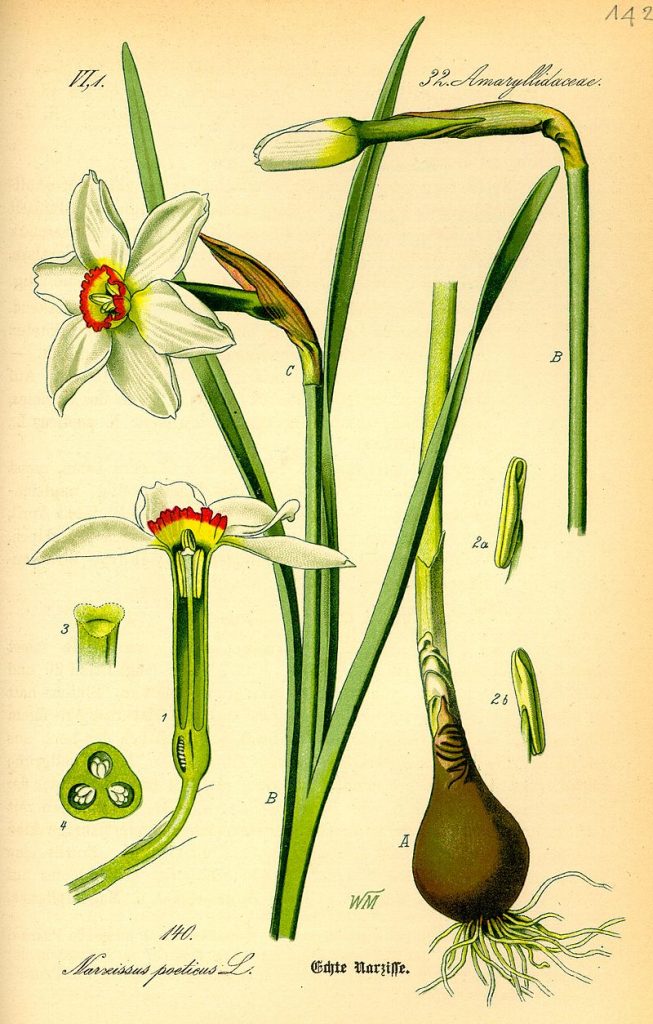
Their formal name is Narcissus. The Roman natural historian, Pliny tells us that the plant was:
‘named Narcissus from narkē not from the fabulous boy.’
Narkē is the Greek word from which we derive the word narcotic. It is a reference to the narcotic properties of the narcissus. An extract of the bulb applied to open wounds produced numbness of the whole nervous system and paralysis of the heart. The flowers are also slightly poisonous. So, they were used as an emetic. They brought on vomiting when it was felt necessary that the stomach be emptied. It was used to treat hysteria and epilepsy. They treated children with bronchial catarrh or epidemic dysentery. Among Arabian doctors, it was used to cure baldness and as an aphrodisiac. (Source: A Modern Herbal by Mrs M Grieve.) Please remember these are not recommendations for use medicinally, but are historic uses and may be dangerous.
The Fabulous Boy
The fabulous boy, mentioned by Pliny, was Narcissus. He, according to the Roman Poet Ovid, met the nymph Echo, and she fell in love with the beautiful boy. He spurned her, and she faded until all that remained of her was her voice – the echo we hear.
Nemesis, the Goddess of Revenge (the one with the fiery sword) decided on revenge upon the handsome boy. She lured the thirsty youth to a fountain, where, in the pool around the fountain, he saw an image of a breathtakingly handsome boy. He fell instantly in love with such beauty. But it was an image of himself. Realising he would never meet anyone as fabulous as himself, he faded from life. He eventually metamorphised into a white and yellow flower, which was named after him.
Nemesis, with her fiery sword, from the painting on the Staircase at Hampton Court by Antonio Verrio, Photo K Flude
Daffodils & Shakespeare
Daffodils are mentioned in a list of Spring Flowers by Shakespeare in the pastoral play The Winter’s Tale:
(Please note that as you read Shakespeare’s words below that Prosperpina is the wife of Pluto, the God of the Underworld, Dis, is another name for him, Cytherea is the Goddess of Beauty and Love. Phoebus is the Sun God. And the Spring Flowers are Daffodils, violets, primroses, oxlips (primula), Crown Imperial (Fritillaria imperialis), Lilies, flower-De-luce (Iris)
Perdita to Camillo
Out, alas! You’d be so lean that blasts of January Would blow you through and through. (To Florizel) I would I had some flowers o’th’ spring, that might Become your time of day – (to the Shepherdesses) That wear upon your virgin branches yet Your maidenheads growing. O Proserpina, For the flowers now that, frighted, thou let’st fall From Dis’s waggon! Daffodils, That come before the swallow dares, and take The winds of March with beauty; violets, dim, But sweeter than the lids of Juno’s eyes Or Cytherea’s breath; pale primroses, That die unmarried ere they can behold Bright Phoebus in his strength – a malady Most incident to maids; bold oxlips and The crown imperial; lilies of all kinds, The flower-de-luce being one: O, these I lack To make you garlands of, and my sweet friend To strew him o’er and o’er!
WT IV.iv.110.2
The reference to Daffodils suggests that for Shakespeare they are around to withstand the March Winds before the Swallows arrive in April. With selective breeding, early flowering species have been developed. Now February and even January are within the scope of the glorious bulb. (here is a post on winter flowering varieties). For my post on Shakespeare & Winter see here.
Once a noisy Nymph, (who never held her tongue when others spoke, who never spoke till others had begun) mocking Echo, spied him as he drove, in his delusive nets, some timid stags.—For Echo was a Nymph, in olden time,—and, more than vapid sound,—possessed a form: and she was then deprived the use of speech, except to babble and repeat the words, once spoken, over and over. Juno confused her silly tongue, because she often held that glorious goddess with her endless tales, till many a hapless Nymph, from Jove’s embrace, had made escape adown a mountain.
But for this, the goddess might have caught them. Thus the glorious Juno, when she knew her guile; “Your tongue, so freely wagged at my expense, shall be of little use; your endless voice, much shorter than your tongue.” At once the Nymph was stricken as the goddess had decreed;—and, ever since, she only mocks the sounds of others’ voices, or, perchance, returns their final words.
One day, when she observed Narcissus wandering in the pathless woods, she loved him and she followed him, with soft and stealthy tread.—The more she followed him the hotter did she burn, as when the flame flares upward from the sulphur on the torch. Oh, how she longed to make her passion known! To plead in soft entreaty! to implore his love! But now, till others have begun, a mute of Nature she must be. She cannot choose but wait the moment when his voice may give to her an answer. Presently the youth, by chance divided from his trusted friends, cries loudly, “Who is here?” and Echo, “Here!” Replies. Amazed, he casts his eyes around, and calls with louder voice, “Come here!” “Come here!” She calls the youth who calls.—He turns to see who calls him and, beholding naught exclaims, “Avoid me not!” “Avoid me not!” returns. He tries again, again, and is deceived by this alternate voice, and calls aloud; “Oh let us come together!” Echo cries, “Oh let us come together!” Never sound seemed sweeter to the Nymph, and from the woods she hastens in accordance with her words, and strives to wind her arms around his neck.
He flies from her and as he leaves her says, “Take off your hands! you shall not fold your arms around me. Better death than such a one should ever caress me!” Naught she answers save, “Caress me!” Thus rejected she lies hid in the deep woods, hiding her blushing face with the green leaves; and ever after lives concealed in lonely caverns in the hills. But her great love increases with neglect; her miserable body wastes away, wakeful with sorrows; leanness shrivels up her skin, and all her lovely features melt, as if dissolved upon the wafting winds—nothing remains except her bones and voice—her voice continues, in the wilderness; her bones have turned to stone. She lies concealed in the wild woods, nor is she ever seen on lonely mountain range; for, though we hear her calling in the hills, ’tis but a voice, a voice that lives, that lives among the hills.
Thus he deceived the Nymph and many more, sprung from the mountains or the sparkling waves; and thus he slighted many an amorous youth.—and therefore, some one whom he once despised, lifting his hands to Heaven, implored the Gods, “If he should love deny him what he loves!” and as the prayer was uttered it was heard by Nemesis, who granted her assent.
There was a fountain silver-clear and bright, which neither shepherds nor the wild she-goats, that range the hills, nor any cattle’s mouth had touched—its waters were unsullied—birds disturbed it not; nor animals, nor boughs that fall so often from the trees. Around sweet grasses nourished by the stream grew; trees that shaded from the sun let balmy airs temper its waters. Here Narcissus, tired of hunting and the heated noon, lay down, attracted by the peaceful solitudes and by the glassy spring.
There as he stooped to quench his thirst another thirst increased. While he is drinking he beholds himself reflected in the mirrored pool—and loves; loves an imagined body which contains no substance, for he deems the mirrored shade a thing of life to love. He cannot move, for so he marvels at himself, and lies with countenance unchanged, as if indeed a statue carved of Parian marble. Long, supine upon the bank, his gaze is fixed on his own eyes, twin stars; his fingers shaped as Bacchus might desire, his flowing hair as glorious as Apollo’s, and his cheeks youthful and smooth; his ivory neck, his mouth dreaming in sweetness, his complexion fair and blushing as the rose in snow-drift white. All that is lovely in himself he loves, and in his witless way he wants himself:—he who approves is equally approved; he seeks, is sought, he burns and he is burnt.
And how he kisses the deceitful fount; and how he thrusts his arms to catch the neck that’s pictured in the middle of the stream! Yet never may he wreathe his arms around that image of himself. He knows not what he there beholds, but what he sees inflames his longing, and the error that deceives allures his eyes. But why, O foolish boy, so vainly catching at this flitting form? The cheat that you are seeking has no place. Avert your gaze and you will lose your love, for this that holds your eyes is nothing save the image of yourself reflected back to you. It comes and waits with you; it has no life; it will depart if you will only go.
Nor food nor rest can draw him thence—outstretched upon the overshadowed green, his eyes fixed on the mirrored image never may know their longings satisfied, and by their sight he is himself undone. Raising himself a moment, he extends his arms around, and, beckoning to the murmuring forest; “Oh, ye aisled wood was ever man in love more fatally than I? Your silent paths have sheltered many a one whose love was told, and ye have heard their voices. Ages vast have rolled away since your forgotten birth, but who is he through all those weary years that ever pined away as I?
Alas, this fatal image wins my love, as I behold it. But I cannot press my arms around the form I see, the form that gives me joy. What strange mistake has intervened betwixt us and our love? It grieves me more that neither lands nor seas nor mountains, no, nor walls with closed gates deny our loves, but only a little water keeps us far asunder. Surely he desires my love and my embraces, for as oft I strive to kiss him, bending to the limpid stream my lips, so often does he hold his face fondly to me, and vainly struggles up. It seems that I could touch him. ‘Tis a strange delusion that is keeping us apart. Whoever thou art, Come up! Deceive me not! Oh, whither when I fain pursue art thou? Ah, surely I am young and fair, the Nymphs have loved me; and when I behold thy smiles I cannot tell thee what sweet hopes arise. When I extend my loving arms to thee thine also are extended me—thy smiles return my own.
When I was weeping, I have seen thy tears, and every sign I make thou cost return; and often thy sweet lips have seemed to move, that, peradventure words, which I have never heard, thou hast returned. No more my shade deceives me, I perceive ‘Tis I in thee—I love myself—the flame arises in my breast and burns my heart—what shall I do? Shall I at once implore? Or should I linger till my love is sought? What is it I implore? The thing that I desire is mine—abundance makes me poor. Oh, I am tortured by a strange desire unknown to me before, for I would fain put off this mortal form; which only means I wish the object of my love away. Grief saps my strength, the sands of life are run, and in my early youth am I cut off; but death is not my bane—it ends my woe.—I would not death for this that is my love, as two united in a single soul would die as one.”
He spoke; and crazed with love, returned to view the same face in the pool; and as he grieved his tears disturbed the stream, and ripples on the surface, glassy clear, defaced his mirrored form. And thus the youth, when he beheld that lovely shadow go; “Ah whither cost thou fly? Oh, I entreat thee leave me not. Alas, thou cruel boy thus to forsake thy lover. Stay with me that I may see thy lovely form, for though I may not touch thee I shall feed my eyes and soothe my wretched pains.” And while he spoke he rent his garment from the upper edge, and beating on his naked breast, all white as marble, every stroke produced a tint as lovely as the apple streaked with red, or as the glowing grape when purple bloom touches the ripening clusters.
When as glass again the rippling waters smoothed, and when such beauty in the stream the youth observed, no more could he endure. As in the flame the yellow wax, or as the hoar-frost melts in early morning ‘neath the genial sun; so did he pine away, by love consumed, and slowly wasted by a hidden flame. No vermeil bloom now mingled in the white of his complexion fair; no strength has he, no vigor, nor the comeliness that wrought for love so long: alas, that handsome form by Echo fondly loved may please no more.
But when she saw him in his hapless plight, though angry at his scorn, she only grieved. As often as the love-lore boy complained, “Alas!” “Alas!” her echoing voice returned; and as he struck his hands against his arms, she ever answered with her echoing sounds. And as he gazed upon the mirrored pool he said at last, “Ah, youth beloved in vain!” “In vain, in vain!” the spot returned his words; and when he breathed a sad “farewell!” “Farewell!” sighed Echo too. He laid his wearied head, and rested on the verdant grass; and those bright eyes, which had so loved to gaze, entranced, on their own master’s beauty, sad Night closed. And now although among the nether shades his sad sprite roams, he ever loves to gaze on his reflection in the Stygian wave. His Naiad sisters mourned, and having clipped their shining tresses laid them on his corpse: and all the Dryads mourned: and Echo made lament anew. And these would have upraised his funeral pyre, and waved the flaming torch, and made his bier; but as they turned their eyes where he had been, alas he was not there! And in his body’s place a sweet flower grew, golden and white, the white around the gold.
Elbridge signed a bill which created a voting district packed with voters for the Democratric-Republican Party. It was said to be shaped like a salamander, and so by joining his name to the last part of salamander the name gerrymandering was created. Gerry was Vice-President under Madison. Please, could someone tell me how gerrymandering is at all compatible with Democracy and the Constitution of the United States? And why it is tolerated in so brazen a fashion?
1826 – University College London was founded.
It was originally called London University. Until this time, England only had Oxford and Cambridge as Universities. In order to attend or teach, the candidates had to belong to the Church of England. ‘No Catholics, No Jews, no Hindus’. But UCL was created to be open to all faiths. This alarmed conservatives so much that they founded King’s College in London as a counterweight. This created a collegiate University of London, which now has 17 constituent colleges. Imperial College left the federation to become a separate University in 2007. It now brands itself as ‘A world-leading university. 2nd in the world, 1st in the UK and Europe’. Here is a promo for the 200th Anniversary of UCL. I’m proud to have been an honorary lecturer for a few years.
1945 – Yalta Conference agrees to set up the United Nations to help prevent future World Wars.
1975 – Mrs Thatcher defeats Ted Heath to become leader of the Conservative Party.
First published in February 2023, revise and republished in February 2024, 2025, 2026
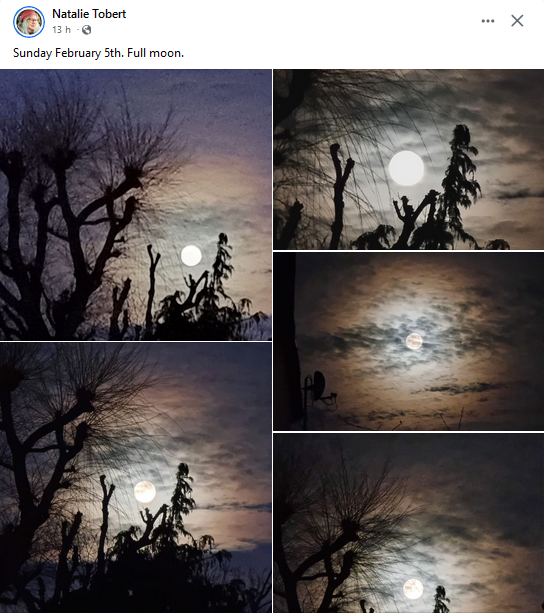
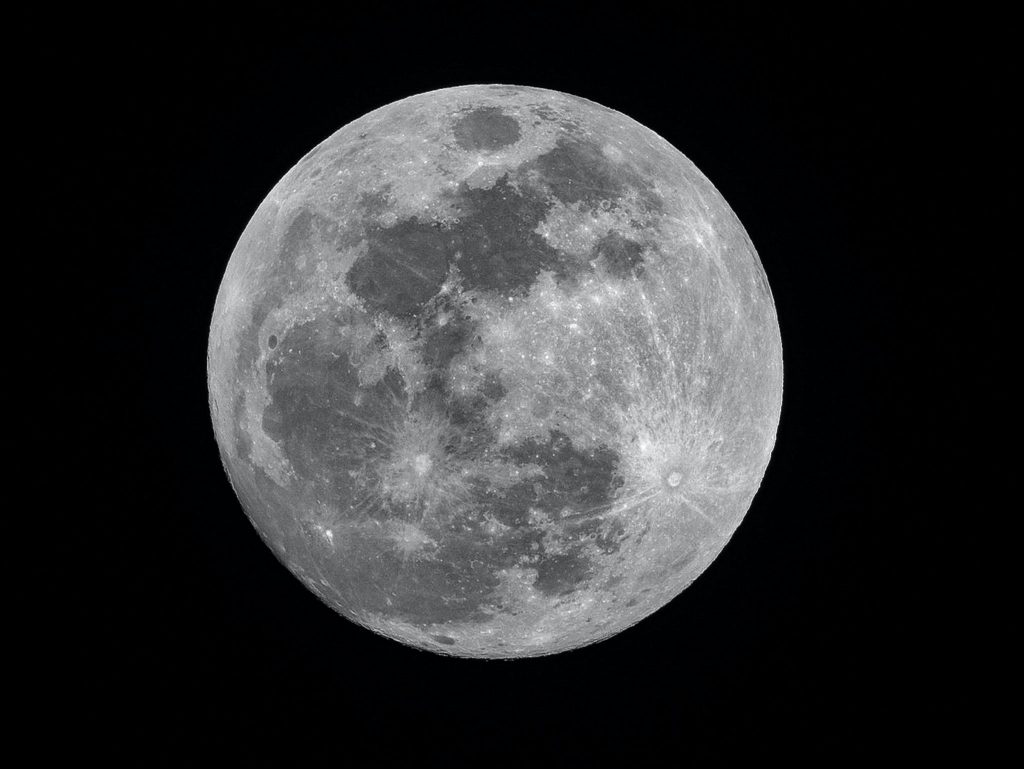
The Goddess Book of Days’ has the 7th as the Day of Selene and other Moon Goddesses. Of course the Full Moon is the proper time to celebrate her.
Selene is one of the most beguiling of Goddesses as she is the epitome of the Moon (Romans knew her as Luna). She, who gives that silvery, ethereal light to dark days. And appears and disappears to a routine few of us really understand. Selen is therefore beautiful, beguiling, unknowable. The Goddess of Intuition. The bringer of tides and the monthly periods. A Goddess of power as well as fertility, pregnancy and so love, and mothers, and babies.
Selene and the Parthenon
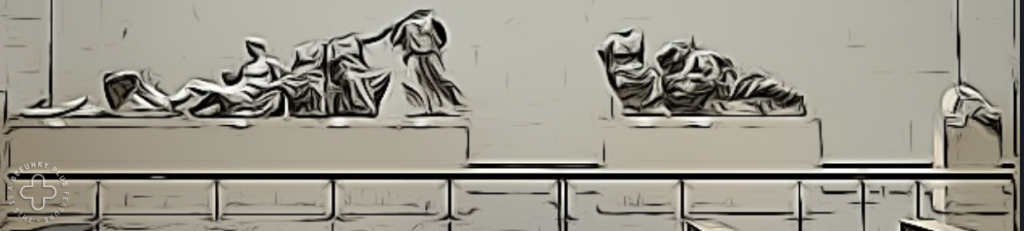
To my mind, far more powerful than Aphrodite, Selene seems much more independent. On the Parthenon Marbles at the British Museum she is shown with her brother Helios, the Sun God; with Hercules – the epitome of male strength. Demeter and Persephone, representing the earth and underworld (or life and death). Athene and her father, Zeus; Iris, the messenger Goddess. Hestia, the Goddess of the home, and Dione with her daughter ,Aphrodite, representing love. At one end, Helios brings up the sun with his Chariot and Horse. While at the other, Selene’s horse sinks exhausted in Oceanus after a glorious night of moon shine. It’s a wonderful arrangement, which suggests the scheme was to show a balanced cosmos between female and male forces, framed by the Sun and the Moon.
Cartoon of Elgin Marble, showing Selene’s Horse at the right hand end
I did a longer piece on this pediment of the Parthenon Marbles here
Selene – Moon Goddess by Mike Petrucci -unsplash
I have used several of Natalie Tobert’s photos in my post which I pluck from Natalie’s face facebook feed which is a veritable visual feast. She worked, as an archaeologist, at the Museum of London at the same time as me. She is an excellent potter, photographer and artist. Natalie was a Fellow of the Royal Society of Arts, and a member of Society of Designer Craftsmen. You can see more of her pictures here.
First published in 2022, and revised February 2024, 2026
Winter’s End in ‘Winters in the World’ by Eleanor Parker
Eleanor Parker’s book, on the Anglo-Saxon Year, is a wonderful book. It has a poetry about it, that also provides an insight into how Anglo-Saxon thought the world works. For a non-Old-English speaker, it, also, really gives some understanding of the language. It reveals that for the Anglo-Saxons, Winter’s End was on the 7th February. We are now in the season of ‘lencten’. This probably comes from ‘lenghtening days’ or Spring as we call it. The word eventually got absorbed into the Christian calendar, giving us the name of the fasting season, which is ‘Lent’.
So Winter began, for the Anglo-Saxon, on 7th October and ended on the 7th February. January was called ‘Gēola‘ the month of Yule. February ‘Sol-mōnaþ‘ which is Mud month. The Venerable Bede in the 8th Century calls this the:
‘month of cakes which they offered to their gods in that month’.
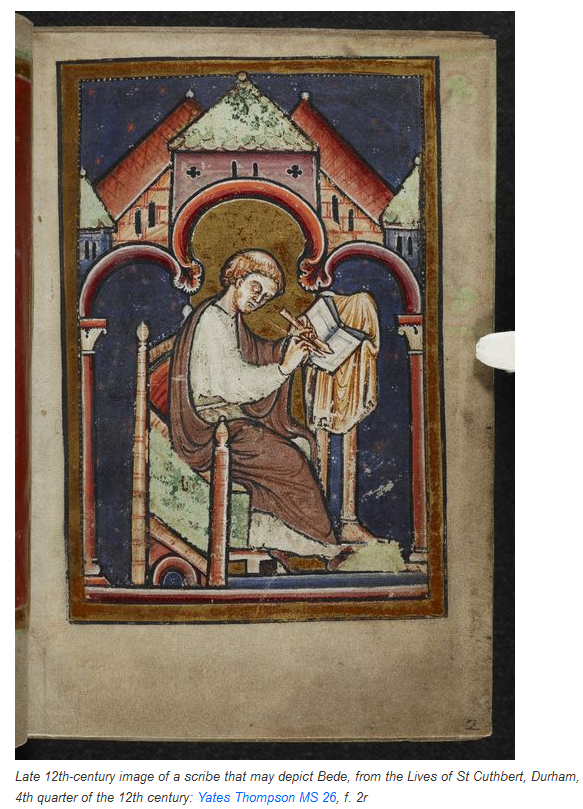
Thought to be the Venerable Bede, the first historian of the English
Bede tells us that before conversion to Christianity, the Anglo-Saxons had two seasons – Winter and Summer. Winter began on the first full moon of October, which they called Winterfylleth. The summer was called ‘sumor’ or ‘gear’ which developed into our word ‘year’. As in: ‘he was a boy of 10 summers.’
Roman, Celtic and Saxon Winter’s End
There is some sense in Winter’s End on February 7th. Lambs are being born; buds and shoot are appearing on branches and poking up from the cold earth. So, their winter is essentially, the time when nothing is growing, while ours is more aligned to the coldest period.
The Roman author Marcus Terentius Varro divided the Roman Year into 8 phrases and his Winter/Spring divide is also on 7th February. This is when, in Italy, the west winds began to blow warmer weather. So farmers ‘purged’ the fields, readying them for planting. They would be cleared of old growth and debris. Then blessed, weeded, pruned with particular attention given to preparing the grain fields, the vineyards, olive trees and fruit trees.
The Celtic year began at Halloween, and the spring begins with Imbolc, a week earlier than the Saxon on the 1st of February.
Anglo-Saxon Winter
In the section on Winter, Eleanor Parker gives a poetic description of winter. What seems particularly interesting about it is that the harshness of winter is often paired with descriptions of the ruins of Roman Civilisation. So, the despair of winter, the barren soil, the fight for survival is made more melancholic by the comparison to failed civilisation. Nature battering away at the useless ruins, and the destruction of people’s dreams.
Here, is a flavour of the juxtaposition of the bleakness of winter and the sadness of lost society. It is from ‘The Wanderer’ an alliterative poem from the Exeter Book, dating from the late 10th century. I have presumed to change a couple of words to make it a little more accessible.
Who’s wise must see how ghostly it has been when the world and its things stand wasted — like you find, here and there, in this middle space now — there walls totter, wailed around by winds, gnashed by frost, the buildings snow-lapt. The winehalls molder, their Lord lies washed clean of joys, his people all perished, proud by the wall. War ravaged a bunch ferried along the forth-way, others a raptor ravished over lofty seas, this one the hoary wolf broke in its banes, the last a brother graveled in the ground, tears as war-mask.
“That’s the way it goes— the Shaper mills middle-earth to waste until they stand empty, the giants’ work and ancient, drained of the dreams and joys of its dwellers.”
As I read this, I wonder if it is a tradition that began in the cold of Scandinavia? England, at least Southern England, can often have mild, rather than ferocious winters?
However, there is also an idea about the circularity of life and the interconnectedness of everything. There are 4 Seasons, 4 Ages of Man, and the cycle was from childhood to old age, from Spring to Winter. We start young, and become vigorous, and then we decline and eventually die. And so does the world of the Anglo-Saxons. The world of Adam was young, restored to vigour by the coming of Jesus. Now the World was in its old age awaiting the Apocalypse, before the Day of Judgement. So Winter was connected with Old Age and Death.
Bede’s Metaphor for Winter
Parker recounts a beautiful image of Bede’s. The King of Northumberland is thinking of taking his wife’s religion. He, therefore, invites the Christian evangelist, Paulinus to his court. Inclined to convert. He asks the opinion of one of his pagan advisers, who answers to the effect.
‘We are in the Great Hall, gathered warm with friends and family around the roaring fire, with Winter raging outside. A sparrow comes in from a hole in the end wall, flies through the warm of the Hall, and flies out through the other side. Such is life. The Hall is this world, we are the Sparrow, and as pagans we have no idea what happens before we enter the Hall, nor what happens after we leave. How much better it is to embrace a religion that can give us certainty as to what happens when we leave the hall.’
Lovely image, although, the pagan adviser does seem to have made his mind up to try Christianity? . What I like about it is that it echoes feelings I have. We as a species worry about what happens after death. It seems to many so final, to others unknowable. But I think ‘I don’t worry about what happened before I was born, so why should I worry about what happens after I die?’ It’s the same state of non-being. It gives me some comfort that I’m going back where I came from.
1812 – Dickens born in Portsmouth. His father was the son of a Butler and a clerk in the Royal Navy Pay Board. He has much in common with Mr Micawber. His mother, Elizabeth Dickens was a source for the character of Mrs Nickleby. Dickens told a friend that his mother came to him exasperated by the stupidity of Mrs Nickelby. Dickens said words to the effect: ‘Little did she know that Mrs Nickleby was based on her’. Here is a section of Nicholas Nickleby that makes the point.
Nicholas Nickelby From Chapter 1
‘Mr Nickleby looked about him for the means of repairing his capital, now sadly reduced by this increase in his family, and the expenses of their education.
`Speculate with it,’ said Mrs Nickleby.
`Spec—u—late, my dear?’ said Mr Nickleby, as though in doubt.
`Why not?’ asked Mrs Nickleby.
`Because, my dear, if we should lose it,’ rejoined Mr Nickleby, who was a slow and time-taking speaker, `if we should lose it, we shall no longer be able to live, my dear.’
`Fiddle,’ said Mrs Nickleby.
`I am not altogether sure of that, my dear,’ said Mr Nickleby.
`There’s Nicholas,’ pursued the lady, `quite a young man—it’s time he was in the way of doing something for himself; and Kate too, poor girl, without a penny in the world. Think of your brother! Would he be what he is, if he hadn’t speculated?’
`That’s true,’ replied Mr Nickleby. `Very good, my dear. Yes. I will speculate, my dear.’
Speculation is a round game; the players see little or nothing of their cards at first starting; gains may be great—and so may losses. The run of luck went against Mr Nickleby. A mania prevailed, a bubble burst, four stock-brokers took villa residences at Florence, four hundred nobodies were ruined, and among them Mr Nickleby.’
Mr Nickleby ends up dead having falling 202 ft from the top of the Monument. In 1810 Elizabeth’s father, Chief Conductor of Monies in the Navy Pay Office was found guilty of embezzling £5,689 3s 3d.
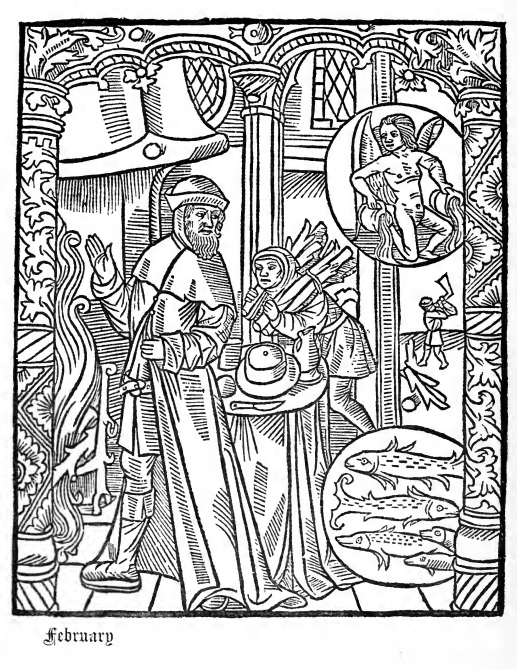
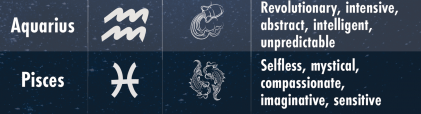
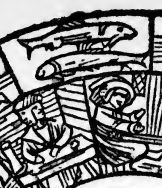
The 15th Century French illustration, above, shows February as a time to cut firewood, dress warmly and stay by the fire. Food on the table is a nutritious pie and the fish are there to remind us it is the month of Pisces. In the other roundel is the other February star sign the Water Carrier, Aquarius.
Star signs of February
February in the Kalendar of Shepherds
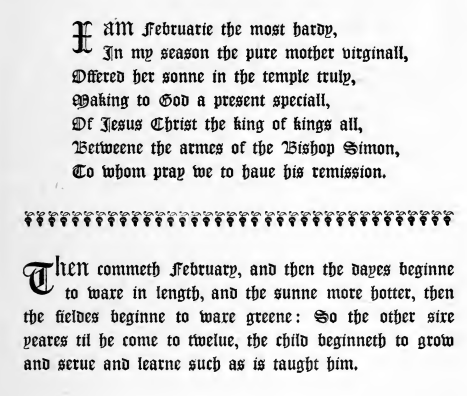
The poem above is a reference to the Candlemas celebration of the presentation of the child Jesus at the Temple. The paragraph below the line (above) gives a summary of February. It ends with the idea that runs through the Kalendar. There are twelve apostles, twelve days of Christmas, twelve months in the year. So, there are twelve blocks of six years in a person’s allotted 72 years of life. In the January entry the Kalendar suggests the essential uselessness of 0-6 year old children. But for February, it allows that 6-12 years old children are beginning to ‘serve and learn’.
The Kalendar’s View of February
Pisces From the zodiac from kalendar of shepherds
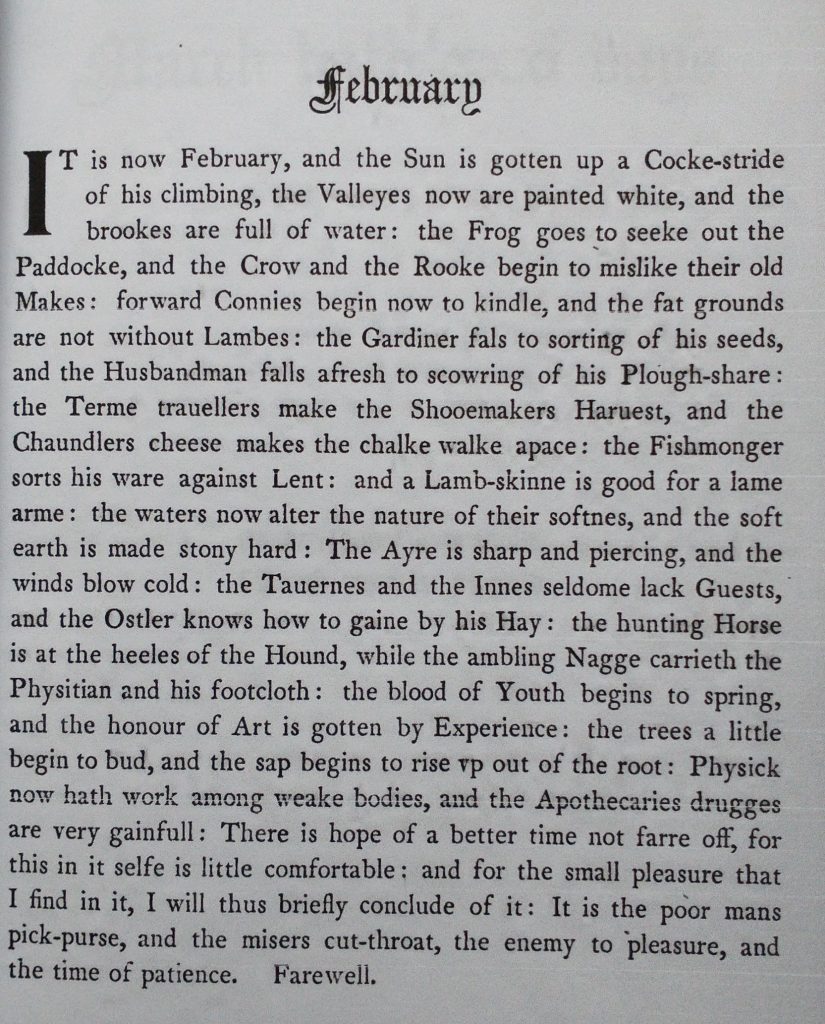
Below, is the text for February. This gives a rural view of life in winter. It ends with the line that February:
‘is the poor man’s pick-purse, the miser’s cut-throat, the enemy to pleasure and the time of patience.’
Description of February in the Kalendar of Shepherds
About the Kalendar of Shepherds.
The Kalendar was printed in 1493 in Paris and provided ‘Devices for the 12 Months.’ The version I’m using is a modern (1908) reconstruction of it. It uses wood cuts from the original 15th Century version and adds various texts from 16th and 17th Century sources. (Couplets by Tusser ‘Five Hundred Parts of Good Husbandrie 1599. Text descriptions of the month from Nicholas Breton’s ‘Fantasticks of 1626.) This provides an interesting view of what was going on in the countryside every month.
Hesiod, in his ‘Works and Days’ describes February as a merciless cold, windy time. Hesiod was writing around 700BC. He gave us ‘the story of Prometheus and Pandora, and the so-called Myth of Five Ages.’ (Links are to Wikipedia.)
Avoid the month Lenaeon, (February) wretched days, all of them fit to skin an ox, and the frosts which are cruel when Boreas blows over the earth. He blows across horse-breeding Thrace upon the wide sea and stirs it up, while earth and the forest howl. On many a high-leafed oak and thick pine he falls and brings them to the bounteous earth in mountain glens: then all the immense wood roars and the beasts shudder and put their tails between their legs, even those whose hide is covered with fur; for with his bitter blast he blows even through them, although they are shaggy-breasted. He goes even through an ox’s hide; it does not stop him. Also he blows through the goat’s fine hair. But through the fleeces of sheep because their wool is abundant, the keen wind Boreas pierces not at all; but it makes the old man curved as a wheel. And it does not blow through the tender maiden who stays indoors with her dear mother, unlearned as yet in the works of golden Aphrodite, and who washes her soft body and anoints herself with oil and lies down in an inner room within the house, on a winter’s day when the Boneless One (an Octopus or a cuttle?) gnaws his foot in his fireless house and wretched home; for the sun shows him no pastures to make for, but goes to and fro over the land and city of dusky men, and shines more sluggishly upon the whole race of the Hellenes. Then the horned and unhorned denizens of the wood,] with teeth chattering pitifully, flee through the copses and glades, and all, as they seek shelter, have this one care, to gain thick coverts or some hollow rock. Then, like the Three-legged One (an old man with a stick) whose back is broken and whose head looks down upon the ground, like him, I say, they wander to escape the white snow.
The Roman month Februarius was the month of purification. Februa was the name of the purification ritual held on February 15 (full moon) in the old lunar Roman calendar. The Romans originally considered winter a monthless period of the year. So they only had 10 months to the year. Later they added January and February. March was the first month, so September was the 7th month, October the 8th, November 9th and December the 10th and final month. Names derived from the Latin for 7th, 8th, 9th, 10th.
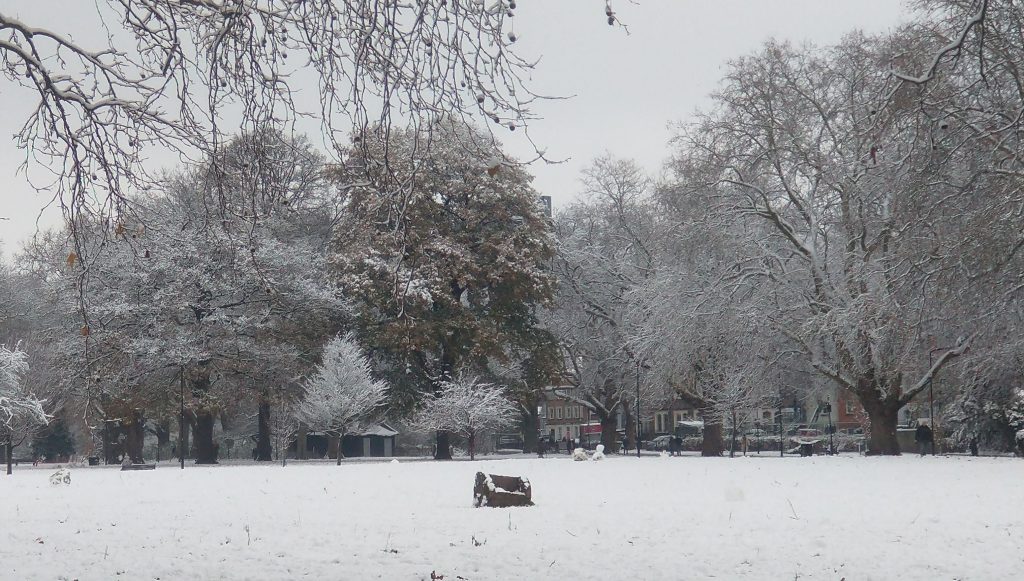
Photo of London Fields in the snow of 2022 by Kevin Flude
January 1776:
‘On the 27th much snow fell all day, and in the evening the frost became very intense. At South Lambeth, for the four following nights, the thermometer fell to 7, 6, 6, and at Selborne to 7, 6, 10, and on the 3ist of January , just before sunrise, with rime on the trees and on the tube of the glass, the quicksilver sunk exactly to zero, being 32 degrees below the freezing point’ Gilbert White
Gilbert White and Darwin
He, of course, is talking Fahrenheit, so well below zero. If there was a Giant upon whose shoulders Charles Darwin climbed, then Gilbert White owned one pair.. He was one of many churchmen of the 18th and 19th Century who spent their extensive leisure time, on observing God’s wonderful creation in their gardens and parishes. What made White so important was that his practice was ‘observing narrowly’ and regularly. For example, his observations of the importance of earth worms were fundamental to Charles Darwin’s own studies. When Darwin came back from his travels on the Beagle, he settled in a country property in Orpington. Like White, he used his garden and the local area as his laboratory. Here he worked to prove his theory of evolution.
Gilbert White and Earth worms
Earth worms were one of Darwin’s passions. This is what Gilbert White wrote about their contribution to nature:
“Earth-worms, though in appearance a small and despicable link in the chain of Nature, yet, if lost, would make a lamentable chasm. For, to say nothing of half the birds, and some quadrupeds which are almost entirely supported by them, worms seem to be the great promoters of vegetation, by boring, perforating, and loosening the soil, and rendering it pervious to rains and the fibres of plants, and, most of all, by throwing up such infinite numbers of lumps of earth called worm-casts, which, being their excrement, is a fine manure for grain and grass.”
By such minute and repeated observations, Gilbert White investigated the food chain, and the migration of birds (which was at the time disputed). He laid the foundations of what we now call ecology.
Gilbert White’s Career
He became Dean of Oriel College in Oxford. But chose to spend his career in the relatively humble occupation of Curate. A Curate is the bottom-feeder in the Anglican Church food chain. A Curate hardly earned enough to maintain a position in the Gentry (£50 p.a.). Although, White was upgraded to the title of Perpetual Curate. He still would only be pulling in, I guess, something like £200 p.a. (Patrick Bronte was also a Perpetual Curate). Essentially, it is Vicar looking after a part of a too large Parish.
Financially, White didn’t need much, he inherited his father’s property at Shelborne, Hampshire. White’s grandfather was the Vicar at Shelborne. But Gilbert could not inherit the title because he went to Oriel College. The ‘living’ of the Parish of Shelborne was ‘in the gift of’ Magdalen College. And they were not going to give the role to an alumnus of a rival college.
Gilbert White & The Austen Family
The house, now open to the public, is just around the corner from Chawton. This is where Jane Austen spent her last years. He was born in 1720; was 55 when Austen was born, and he died in 1793, when she was 18. He lived 4 miles away, so the families knew of each other. We know Jane Austen’s brother wrote a poem about Gilbert White and his natural history observations, particularly on birds.
From ‘Selbourne Hanger’ by James Austen
Who talks of rational delight } When Selbourne’s Hill appears in sight } And does not think of Gilbert White? } Such sure he was – by Nature grac’d With her best gift of genuine taste; And Providence – which cast his lot Within this calm, secluded spot, Plac’d him where best th’enquiring mind Might study Nature’s works, and find Within her ever open book Beauties which others overlook. Enthusiast sweet! Your vivid style The attentive reader can beguile Through many a page, and still excite An Interest in what you write! For whilst observant you describe The habits of the feathery tribe Their Loves and Wars – their nest and Song, We never think the tale too long.
For more information on White and Austen, go to Gilbert White’s House’s web page here:
More Snow!
Here is more of that epic cold January 1776
‘… but by eleven in the morning, though in the shade, it sprang up to I6J,1 — a most unusual degree of cold this for the south of England. During these four nights the cold was so penetrating that it occasioned ice in warm chambers and under beds ; and in the day the wind was so keen that persons of robust constitutions could scarcely endure to face it. The Thames was at once so frozen over both above and below bridge that crowds ran about on the ice. The streets were now strangely encumbered with snow, which crumbled and trod dusty ; and, turning grey, resembled bay-salt : what had fallen on the roofs was so perfectly dry that, from first to last, it lay twenty-six days on the houses in the city ; a longer time than had been remembered by the oldest housekeepers living…..’
‘The consequences of this severity were, that in Hampshire, at the melting of the snow, the wheat looked well, and the turnips came forth little injured. The laurels and laurustines were somewhat damaged, but only in hot aspects. No evergreens were quite destroyed ; and not half the damage sustained that befell in January, 1768. Those laurels that were a little scorched on the south-sides were perfectly untouched on their north-sides. The care taken to shake the snow day by day from the branches seemed greatly to avail the author’s evergreens. A neighbour’s laurel-hedge, in a high situation, and facing to the north, was perfectly green and vigorous ; and the Portugal laurels remained unhurt.’
More Frost!
‘We had steady frost on to the 25th, when the thermometer in the morning was down to 10 with us, and at Newton only to 21. Strong frost continued till the 31st, when some tendency to thaw was observed ; and, by January the 3d, 1785, the thaw was confirmed, and some rain fell.’
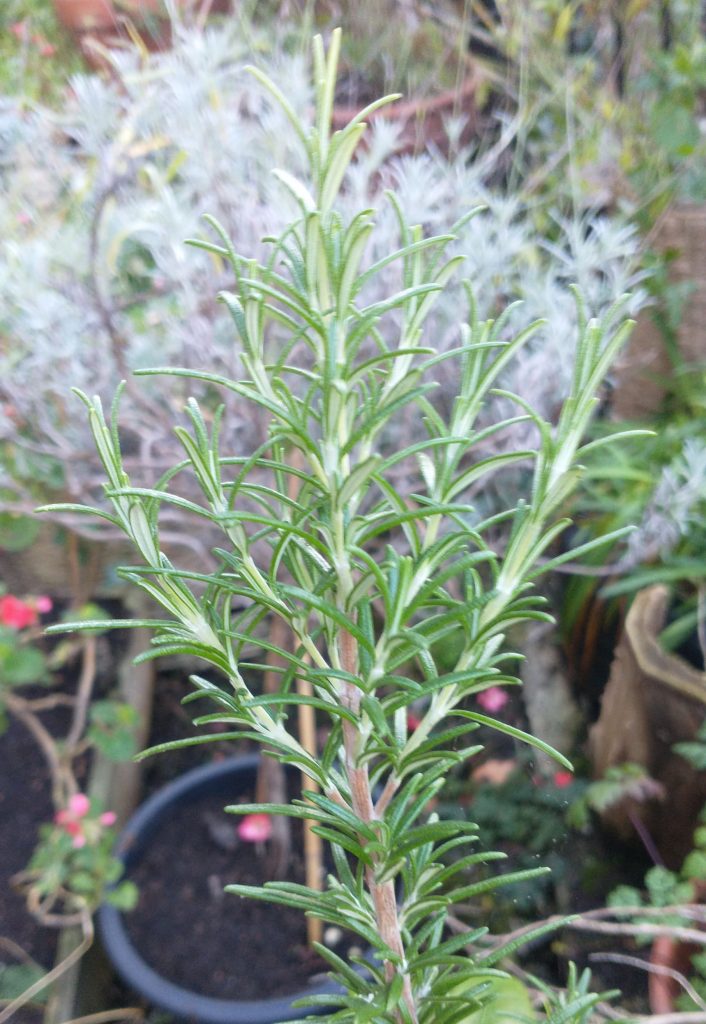
Rosemary flowering in my garden, photo by Kevin Flude
Gilbert White’s House is open to the public and also contains a display on Lawrence Oates, who died on Scots Antarctic expedition. For more information look at my post here.
There is another mention of Gilbert White in the Almanac of the Past here.
Herbs: Winter savory, parsley, chervil, coriander, rosemary, bay, sage
Cheeses: Stilton, Lanark Blue
(from the Almanac by Lia Leendertz)
On This Day
1754 – Horace Walpole coined the new word ‘serendipity’ from the ‘Three Princes of Serendip’ fairy tale. The Princes ‘ere always making discoveries, by accidents and sagacity, of things they were not in quest of.’
1898 – Walter Arnold became the first motorist to be fined for speeding. He was going 8 miles an hour in a 2 mile an hour area in Kent
1986 – Explosion of US Space Shuttle Challenger. All 7 astronauts killed, including teacher Christa McAuliffe who would have been the first civilian in space.
The food section posted originally in 2023, the part on Gilbert White written on 28th January 2024, revised 2025, On This Day added 2026
Sementivae, was a festival dedicated to seed and to Ceres. Ceres is the Corn Goddess who gives her name to our word cereal. The festival was also called. Paganalia. The Mediterranean world had many names for the Earth Goddess. Tellus, Demeter, Cybele, Gaia, Rhea etc. who is celebrated around this time of the year with Ceres.
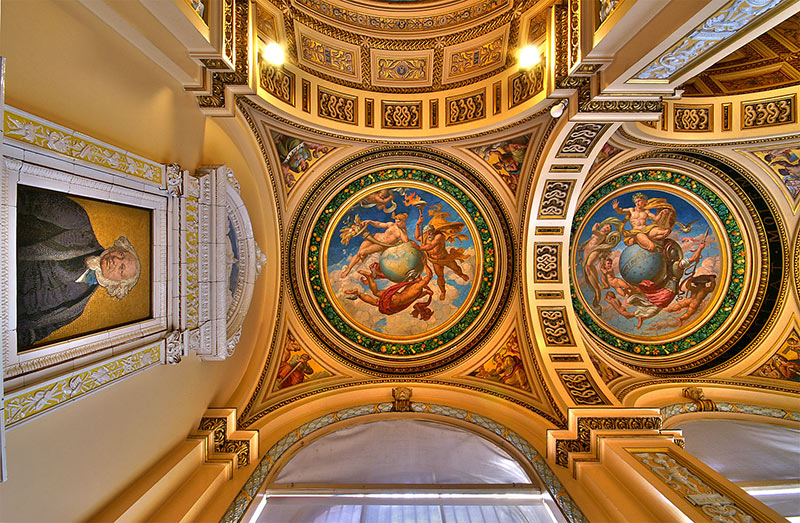
Ceres can be seen on the top left roundel resting on the Globe on the marvellous Ceramic Staircase at the V&A (photo above). And in my slightly out of focus photograph below. (To be honest, in real life, it looks a little more like my photo than the gorgeous photo above!)
Ceres represented Agriculture, Mercury Commerce, and Vulcan Industry. Old Photo by the Author.
Sementivae Dies – a moveable feast.
To create life, we need earth and water to nurture and seeds for their fertility. And so into the cold dead world of January the Romans created a festival of sowing. It had two parts, one presided over by Mother Earth (Tellus) and the other by Ceres, the Goddess of Corn. The actual day of the festival was chosen not by rote on a set day of the calendar but by the priests, in accordance with the weather. This seems very sensible, as there is no point sowing seeds in terrible weather conditions. I’m assuming the Priests took professional advice!
On the 24th-26th January Tellus prepared the soil, and in early February seeds were sown under the aegis of Ceres. Tellus Mater (also Terra Mater) was known as Gaia to the Greeks.
Gaia
Gaia was selected by James Lovelock & Lynn Margulis in the 1970s as the face of their Gaia hypothesis. To me, the importance of the idea is not the scientific principle that environments co-evolve with the organisms within them. But, rather in Gaia as a personification of our world as a complex living ecosystem. One that we have to care for. Gaia exists as a series of feedback loops. Lovelock hypotheses is that she will spit us out unless we can live in balance with our alma mater. I cannot believe he was not knighted. However, he is one of my heros.
James Lovelock. The original uploader was Bruno Comby at English Wikipedia. – Transferred from en.wikipedia to Commons., CC BY-SA 1.0, https://commons.wikimedia.org/w/index.php?curid=3873472. I hope the Goddess in the background is Gaia
Here is a tribute to Lovelock by his friend Bryan Appleyard. In it. He claims that work done by Lovelock ‘saved the world’. Lovelock invented a device that enabled the detection (and eventual eradication) of DDT and CFCs. If you remember, CFCs were destroying the Ozone layer until international agreement phased them out. Lovelock also worked for MI5. Appleyard, writing in The Sunday Times, described Lovelock as “basically Q in the James Bond films”.
Ovid and Sementivae
Ovid allocated January 24th to Sementivae but explains it is a variable date. But let’s let the Roman Poet Ovid has to say in his poetic Almanac known as ‘Fasti’ (www.poetryintranslation.com)
Book I: January 24
I have searched the calendar three or four times, But nowhere found the Day of Sowing: Seeing this, the Muse said: That day is set by the priests, Why are you looking for moveable days in the calendar? Though the day of the feast ís uncertain, its time is known, When the seed has been sown and the land ís productive. You bullocks, crowned with garlands, stand at the full trough, Your labour will return with the warmth of spring. Let the farmer hang the toil-worn plough on its post: The wintry earth dreaded its every wound.
Steward, let the soil rest when the sowing is done, And let the men who worked the soil rest too. Let the village keep festival: farmers, purify the village, And offer the yearly cakes on the village hearths. Propitiate Earth and Ceres, the mothers of the crops, With their own corn, and a pregnant sow ís entrails. Ceres and Earth fulfil a common function: One supplies the chance to bear, the other the soil. Partners in toil, you who improved on ancient days Replacing acorns with more useful foods, Satisfy the eager farmers with full harvest, So they reap a worthy prize from their efforts. Grant the tender seeds perpetual fruitfulness, Don’t let new shoots be scorched by cold snows. When we sow, let the sky be clear with calm breezes, Sprinkle the buried seed with heavenly rain. Forbid the birds, that prey on cultivated land, To ruin the cornfields in destructive crowds. You too, spare the sown seed, you ants, So you’ll win a greater prize from the harvest.
For more on Ovid look at my post on Ovid and Juno here. Or you can search for Ovid in the Search box for other my posts on the Roman poet.
On This Day
1788 – Foundation of the first colony of European Settlers at Port Jackson, now Sydney. It is now Australia Day, a public holiday.
1841 – Hong Kong became a British Sovereign Territory
1998 – ‘I did not have sexual relations with that woman’ or so said Bill Clinton, lying through his teeth. (although I guess it depends on your definition of lying?) For more, look at the Time article here.
First Published in January 2023, republished in January 2024, 2025, 2026
Many plants can be used for hedges, but hawthorn is the most common. It can be planted as bare-root from Autumn to Spring, so January is as good a time as any. It can also be grown from the seeds from its red berries. But this takes 18 months to achieve. Interspersed along the hedge line are often other trees—either trees for timber, or fruit trees perhaps crab-apples or pear-stocks. Trees were also useful as markers. Before modern surveys, property would be delineated by ancient trees. Hedges could be removed. Trees were more difficult to eradicate.
Hawthorn hedges are an oasis for insects, mammals and migrating birds (who eat the berries). It is a lovely plant for May. In fact, it is also called May, or the May Flower or May Tree and also whitethorn. The berries are called ‘haws’ hence hawthorn. For more on this, look at https://whisperingearth.co.uk.
Hawthorns & Folklore
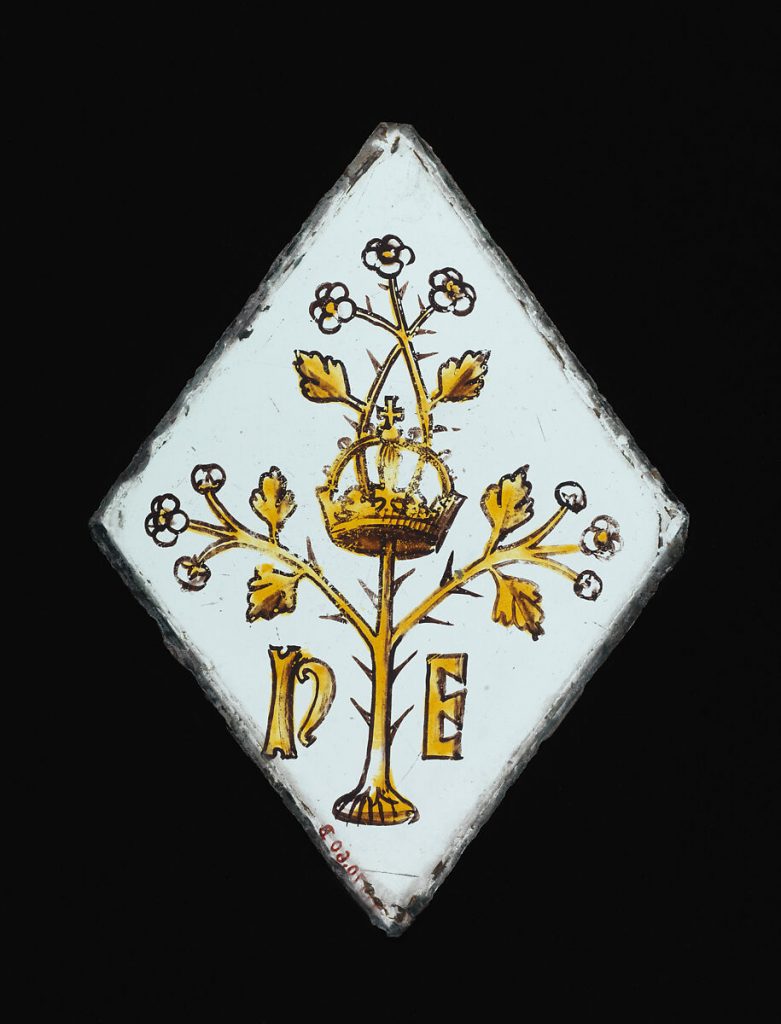
A ‘Quarry’ of Stained Glass showing the Crown, a hawthorn Bush and initials representing Henry VII and his, Queen, Elizabeth of York. Possibly from Surrey. Early 16th Century and from the Metropolitan Museum of Art (Public Domain).
Hawthorn produces white flowers in Spring. So, it is one of the great pagan fertility plants, its flowers forming the garlands on May Eve. One of the chemicals in the plant is the same as one given out in decay of flesh. It is, therefore, associated with death in folklore, and not to be brought into the house.
It was also said to be the thorn in the Crown of Thorns, so sacred. A crown from the helmet of the dead King Richard III was found on a hawthorn bush at the Battle of Bosworth Field. The victorious Henry VII adopted it for a symbol. . For more on the plant, https://www.woodlandtrust.org.uk
The virtues of Hawthorn
John Worlidge, wrote in 1697
‘And first, the White-thorn is esteemed the best for fencing; it is raised either of Seeds or Plants; by Plants is the speediest way, but by Seeds where the place will admit of delay, is less charge, and as successful, though it require longer time, they being till the Spring come twelvemonth ere they spring out of the Earth; but when they have past two or three years, they flourish to admiration.’
Hawthorn is an excellent wood for burning, better than oak. It has the hottest fire so that its charcoal could melt pig-iron without the need of a blast. It is also good for making small objects such as boxes, combs, and tool-handles. The wood takes a fine polish, so also used for veneers and cabinets. For advice on the best wood to burn read my post here.
Hawthorn has many medicinal benefits according to herbalists. Mrs Grieve’s Herbal suggests it was used as a cardiac tonic, to cure sore throats and as a diuretic. (But don’t try any of these ancient remedies without medical advice!)
What to plant in late January
This is the time, according to Moon Gardeners, to plant and sow plants that develop below ground. So rhubarb and garlic, fruit trees, bushes, bare-root plants and hedging plants.
On This Day
1571 – The Royal Exchange opens in London. London first Business centre since the Roman Forum, creating the first Bourse in the UK
1785 – ‘Boys play on the Plestor at marbles & peg-top. Thrushes sing in the Coppices. Thrushes & blackbirds are much reduced.’ From the Garden Calendar in Gilbert White’s Year. the Plestor is the village green; peg-top is a spinning top game. For more on Gilbert White,the inspirer of Darwin, see my post.
This has become the day in which I update readers on the purpose and future plans for the Almanac of the Past.
What is the Almanac of the Past?
The nature of an almanac is to be a pot-pourri. They are about seasons, time, folklore, history, important events, and anniversaries. I also like to cover history, famous people and discoveries. Gods, Goddesses, Saints, sinners, and archaeology. What I want it to be is something that makes us more mindful about the passing of the year. How seasons and time change the way people see their world. My focus is mostly on the UK, but also on Rome and Greece. With occasional excursions to other ages, places and universes. I am also trying to find more content that is London-based.
What is the plan for the Almanac of the Past?
I plan to have one entry for each day. The problem with this, is that as I fill in the empty days, I will be republishing the already filled days. So subscribers will be seeing content they have seen before. Currently, I am trying to improve and extend existing content so it is worth reading again. And I am groping towards a final format for each day.
This is what I think it is. Each page will have the following sections:
Seasonal content: folklore about the day in question. Including historic texts about gardening, farming, cooking, witchcraft superstitions etc.
Saint or God/Goddess of the day
Calendar content: about epochs, ages, years, months, days, hours, and everything calendrical
Major article about something that happened on this day in history
On This Day section where other things that have happened on this day have happened.
I guess rather than a post it will be more like a newsletter of the day?
The almanac of the Past Publication
If I get the formula right, I will attempt to get a publication from it. Otherwise, it will remain online. So:
How’s it doin’?
The first graph, above, shows a steady growth from 2,000 views in 2020 to 26,000 views for 2025. Although encouraging, it has not gone ‘Kardashian viral’ as yet. 75% increase last year. This was partly achieved by taking more care of SEO – search engine optimisation. I’ve been doing a lot more of this. But if you are interested in this read last year’s ‘News from the Almanac of the Past’.
Screenshot from Jetpack showing the geographic reach of the Almanac of the Past from 2020 – 2025
The second graphic shows where the readers come from: mostly from the UK and the US, followed by France and Germany. It shows vast stretches of the world not registering as converts to the Almanac of the Past, including Greenland (or do I mean Iceland?).
Next up ‘Favourite pages, and referrers
Screenshot from Jetpack showing the most viewed pages (left and Referrers (Right)
The Skimmity Ride is way out ahead, the most popular post. The page is about a procession ‘designed to humiliate a member of the community.’ Why is it top? I think because hardly anyone else posts about it, so if you want to know what Thomas Hardy was writing about in the Mayor of Casterbridge my site is the go-to place.
Next is the ‘Beginning of the Universe‘ Post. This pleases me because it is something I discovered myself while writing the blog. It explains the beginning of the universe, the beginning of the year, the beginning of spring, and the Birthdays of Adam, Lilith, & Eve; the conception of Jesus, and why the year began in the medieval period on March 25th. So again, you won’t find this information easily in any one other place. The Almanac of the Past explains it all.
Queen Elisabeth I’s Nicknamesare third. She is always popular and the nicknames she gave to her advisers are fun, and either flattering or rude.
Then we have the post on Antarctic explorer Lawrence Oates. It is an interesting post, of course, but why it rates highly I have no idea. Maybe people know this expression ‘I am just going outside and may be some time’ and want to track it down?
The last one I shall mention is the ‘Miracle of the Testicles‘. This is one of my favourite posts! (I just typed: ‘because it’s nuts’ without realising the pun, so please forgive me!) But, really, it shows the often risible ways the early Saints became famous. And yet beneath that there is a real need in the community for spiritual help which the origin stories touch. Its high ranking must be down to the word ‘testicles?’ No?
The other side of the graphic shows referrers, which are mostly the obvious ones like search engines and facebook. But there is also a fansite for Damien Lewis, the actor who was in Band of Brothers and Henry VIII in Wolf Hall. One of his pages mentioned my page.
Screenshot from Jetpack showing the posting ativity for the past year. Grey means no posts, Dark green 2 or more, light green one post a day.
Posting Activity shows you how far I am from achieving one Almanac post a day. Not far in the winter, more to do in the summer.
So how can you help?
If you have a website or a blog or a social media page, post a reference to one of my pages, and encourage people to have a look. If you receive the email as a subscriber, occasionally visit the site, and like it? Send a WhatApp group a link to my page. Help me go properly viral, then, I can get a publishing deal, publish my Almanac and then my novels …… do it before you forget!
Any problems for the Almanac of the Past?
Please continue to forgive my wretched proofreading.