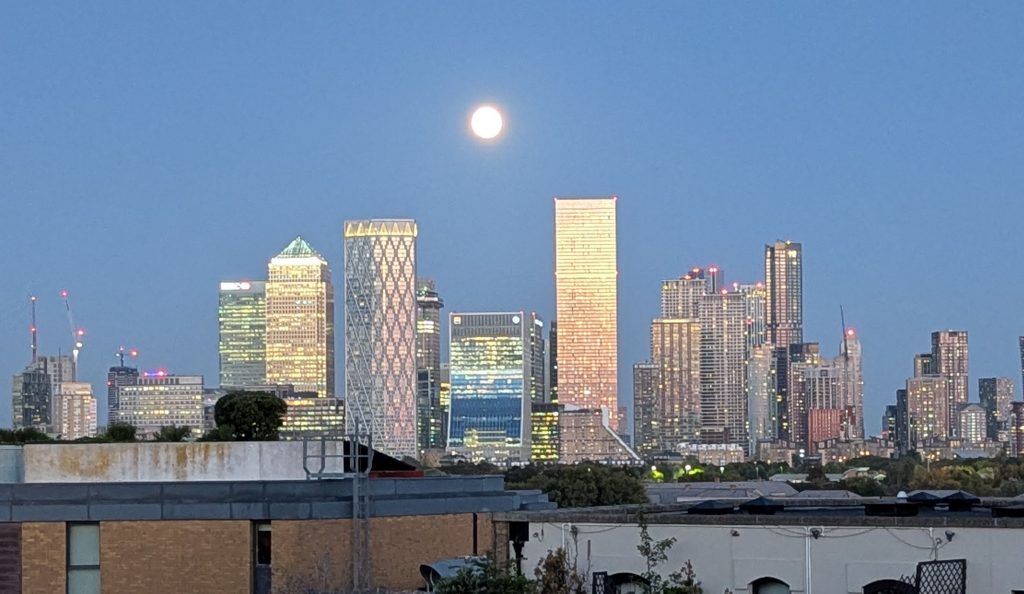
Harvest Moon (Oct 6th 25) over Canary Wharf from Wapping. (Photo K Flude).
The Harvest supermoon will rise at 6.20pm, today on October 7th 2025. It looked pretty full last night from my vantage point in a penthouse flat in Wapping. A supermoon is a full moon that occurs when the distance between the Earth and the Moon are at their minimum. So it is bigger and brighter and even more magical.
This one is known as the Harvest Moon or the Hunter’s moon for fairly obvious reasons.
It is definitely the time to play my favourite song.
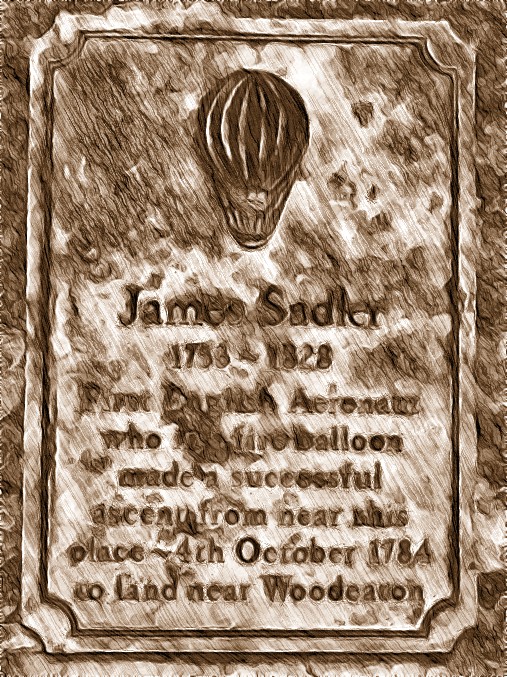
Sketch of plaque to James Sadler, Balloonist. On wall of Deadman’s Walk, Merton College, the Meadows in Oxford
On February 9th, 1784 James Sadler launched an unmanned Hot Air Balloon, from what is now St Hilda’s College. The Balloon travelled all the way to Kent, 79 miles away. James Sadler was the son of a cook, but worked at the Ashmolean Museum, in Oxford. The launch place is an area of green which is bounded to the North by Merton College. To the South by the Meadows. To the West by Christ Church, and to the East the Oxford Botanical Garden, the first in Britain. Also a lovely place.
Later the same year, he hazarded his own life for the first Hot-air Balloon ascent by an Englishman. On the morning of October 4th, he lit the stove in the Balloon basket to create the hot air. He rose an estimated 3600 ft. On board he had a barometer and a thermometer. He used the Barometer to estimate height. The thermometer was not very useful because of the heat of the stove.
He reported that his elevated position caused no inconvenience, except that it was colder than on the ground. A wind drove him towards a wood as he put out the stove. He had ‘recourse to the Oars’ which he exercised with great Success’. I think the oars were used to poke the air out of the balloon to help his descent. He landed safely 6 miles away in Woodeaton.
Further Flights by Sadler
On the 17th November he ascended in a Hydrogen Balloon, which was also successful. He made further ascents, including one at Mermaid Theatre in Hackney. He survived into his 70s and died in 1828. Sadly, one of his sons died in a ballooning accident in 1824.
Note on the Hackney Balloon Ascent
I found no reference to the Mermaid Theatre in Hackney. But there was a Mermaid Tavern in Mare Street, originally just north of St Augustine’s Church. It was then rebuilt on the other side of the road in the 1740s. And this is where the Hackney flight ascended from.
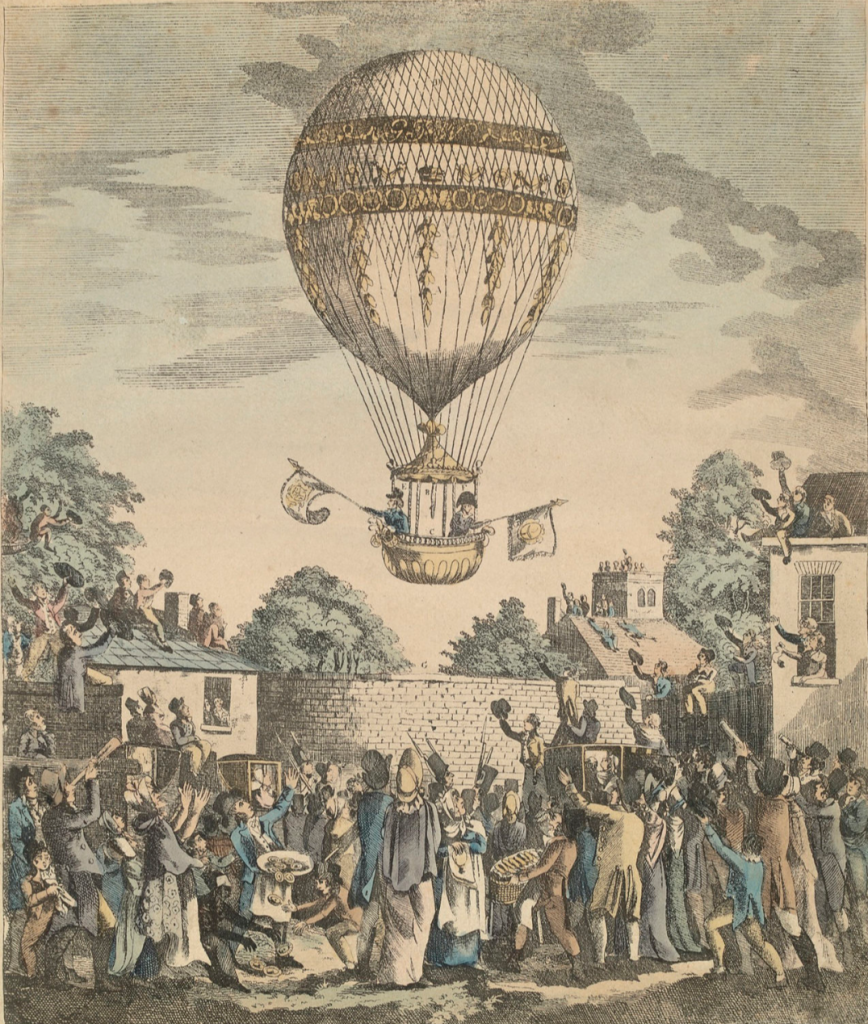
‘View of Balloon of Mr Sadler’s ascending with him and Captain Paget of the Royal Navy from the Gardens of the Mermaid Theatre’ source Facebook post.
Flights but not by the English!
When it comes to ‘firsts’, there is a lot of jiggery-pokery as to who really has the precedence. The actual first balloon ascent was on November 21st, 1783 by de Rozier and d’Arlandes. Their hot-air balloon was designed by the Montgolfier Brothers.
The first ascent in England was Vincent Lunardi. His flight was a couple of weeks before Sadler’s on September 15th. But then he was from Tuscany. It took off from the Honourable Artillery Company grounds at Moorfields in London.
So Sadler wasn’t the first, but was the first Englishman to ascend in a hot-air balloon. But my antennae is twitched by the use of the term ‘Englishman’. Because, since 1707, and the Act of Union, England was now in the Kingdom: ‘The United Kingdom of Great Britain’. Something was wrong. So yes, I discovered that the British (and Scottish) first ascent was by James Tytler. This took place from Edinburgh on August 25th 1784. To see more on Tytler who was an Apothecary and the editor of the Second Edition of the Encyclopedia Brittania go here:
To read about Zeppelin attacks on Britain see my post here.
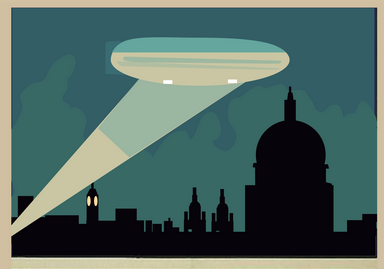
A silhouette of a Zeppelin caught in searchlights over the City of London
On October 1 1916, Kapitanleutnant HeinrichMathy’s L31 Zeppelin burst into flames after an attack by the Royal Flying Corp. Near Potters Bar he decided to jump out. He was found by farmers still alive and lying face up but died soon after. All 19 Crew died.
Mathy was one of the most experienced Zeppelin Captains. He began his attacks on London on the night of September 8th 1915. Mathy piloted Zeppelin L 13 across Central London, dropping bombs as they went, from University College London to Liverpool Street Station. See my post here.
The early raids were almost immune from attack. The height the Zeppelins could reach was often beyond the height the defenses could reach. Also RFC’s weapons were mostly unable to badly damage the Zeppelins. The problem was that machine gun fire could not puncture enough holes to shot down the Zeppelins or to set the hydrogen alight. Also Bombs proved ineffective.
But this was to change in the summer of 1916. In June 1915 the RFC tried out John Pomeroy’s explosive bullets. They did not, immediately, convince the authorities they were the answer. Then Flight Lieutenant Brock (from the fireworks family) designed a .303 explosive bullet. Pomeroy continued develping his bullets and in May of 1916, the RFC ordered batches of both bullets. Then followed the development of phosphorous incendiary bullets. And the ‘Sparkler’ a new tracer bullet developed by the Sparkler Soda Siphon Company. Successes against Zeppelins increased. Zeppelin SL.11 was shot down by William Leefe Robinson on 2/3 September 1916. The Zeppelin came to earth at Cuffley. Thousands of London came to see the wreckage on ‘Zepp Sunday’. Robinson won the Victoria Cross.
Later in September other Zeppelins were forced down, and on 1st October, L31 was shot down. Mathy came in via the Suffolk coast, Chelmsford, Harlow and Enfield Lock in North London. The Anti-Aircraft shelling alerted the RFC Fighters. 4 fighters zoned in on Mathy’s Zeppelin. Lt Wulfstan Tempest, strafed the Zeppelin several times to no effect. Then approaching towards the tail of the Airship, he noticed it was glowing red from inside. Then she started to fall. She crashed in Hertfordshire in Potters Bar, not far from the previous downing at Cuffley.
Here, is a podcast originally written for a Zeppelin Walk for London Walks. It includes an eyewitness account by Hugh Turpin of the shooting down of the Zeppelin (SL.11). Please ignore the dates of walks, as this was a couple of years ago. But I am planning to repeat the virtual tour during the winter of 2025/6.
Legend says that London was founded as New Troy. Historians believed it was founded as Londinium after the Bridge was built by the legionaries of the Emperor Claudius in AD 43. Archaeologists in the 1970s and 1980s discovered that London was refounded as Lundenwic in the 7th Century and again in the 9th Century when it was called Lundeburg.
This walk tells the epic tale of the uncovering of London’s past by Archaeologists. And provides an insight into the dramatic history of the Capital of Britannia, and how it survived revolts, fires, plagues, and reacted to the decline and fall of the Roman Empire. It became the foremost English City but with periods under Viking and Norman control.
We tell the story in the streets of the City of London, beginning in the valley of the River Walbrook by the Temple of Mithras, and visit many sites where important archaeological discoveries were made.
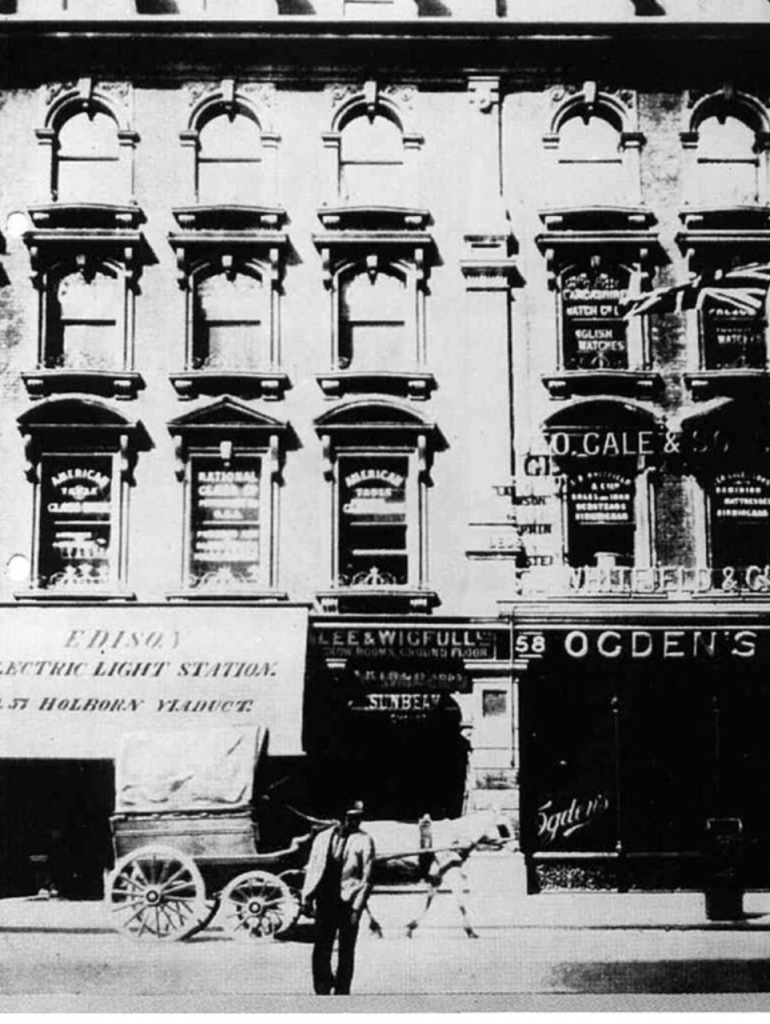
Holborn Edison Electric Light Station First & Last Coal-fired Power Stations
On this day, last year, Britain’s last coal-powered power station generated its final watt of electricity. Ratcliffe-on-Stour’s closure means Britain is the first country to meet its target of phasing out coal.
The Nottingham power station opened in 1968, and once employed over 3000 people.
The first coal-fired power station in Britain was at Holborn Viaduct in London, opened as the Edison Electric Light Station on 12th January 1882.
The power was generated by a steam engine powered by coal. The electricity powered incandescent electric carbon-filament lights which lit up 986 lights to illuminate the road from Holborn Viaduct to St Martin’s-le-Grande. The light bulb was invented 3 years previously.
The number of lights was soon increased to 3,000. But the Station made a loss and was closed down 2 years later. The lights converted to gas. Sadly, the building was destroyed in the Blitz.
Shoreditch Electric Light Station
A couple of miles to the East, in 1895, the Shoreditch Electric Light Station was established. It used waste to produce electricity and steam for the local public baths. The generating and combustion chambers, now houses a Circus School which my children attended.
It was officially opened by Lord Kelvin, the famous physicist in 1897. The Consulting Engineer was Edward Manville who came up with a scheme for a ‘dust destructor’. This comprised: an electricity generating station; a public bath heated by the waste heat from the generator; a library and museum. It cost 200,000 pounds. In 1899, in nearby Nile Street, the Shoreditch Vestry Council set up the first municipal housing scheme powered by electricity.
This level of enterprise by a local council seems like a fantasy of a distant past but also, given the sustainability of the project, unbelievably modern.
The motto on the side of the Power Station was ‘Light and Power from Dust’. The scheme was run by the local vestry council which adopted the motto ‘More Light, More Power’. This was also adopted by the new municipal Borough of Shoreditch when it was formed as part of the new London County Council. The Power Station was renamed as the rather wonderful: Shoreditch Borough Refuse Destructor and Generating Station and adorned with the motto: PULVERE LUX ET VIS ‘Out of the dust, light and power’.
The story of the dust destructor and the generating station is told in some detail here and well worth a read.
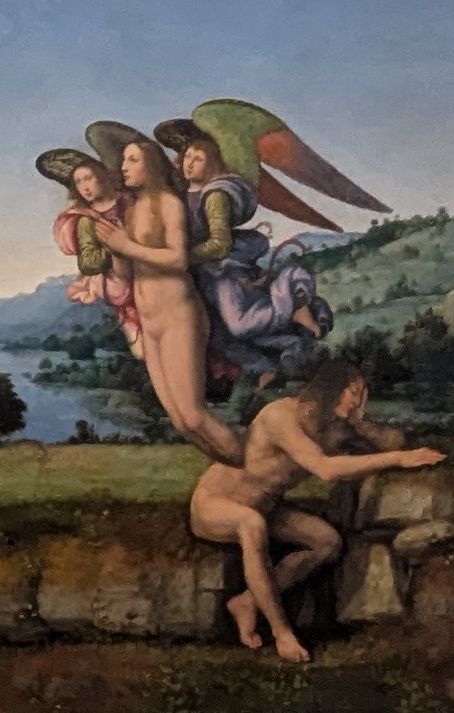
Detail from ‘The Creation and the Fall of Man’ by Mariotta Alberinelli 1513-14 showing Archangels helping in the creation of Eve from Adam’s Rib’
September 29th used to be St Michael’s Day, or Michaelmas. But in the 20th Century, the Catholic Church made it the day to celebrate the three chief Archangels and all Angels. Previously, September 29th was for St Michael, March 24th for St Gabriel, and October 24th for St Raphael.
It was an important day in the medieval civil calendar and was the date on which Oxford, Cambridge and the Legal system started their autumn terms. It is also the date the Lord Mayor of London is elected at Guildhall in the City of London.
About this time, the Michaelmas Daisy (an Aster) comes out in profusion. They have been out in my Father’s garden since August, but have only been flowering for a few weeks in my own garden. Here is an old rhyme:
“The Michaelmas daisies, among dead weeds, Bloom for St Michael’s valorous deeds …
The Angelic Host
Personally, I don’t understand what Archangels are doing in a monotheistic religion. They seem to be supernatural demigods which seems odd. The Book of Revelations is one of the most important sources, but they are scattered around the Bible. Perhaps the most famous is the visitation of Gabriel to the Virgin Mary, (see my post here)They are 15 Archangels:Adabiel, Azrael, Chamuel, Gabriel, Haniel, Jeremiel, Jophiel, Melatron, Michael, Raguel, Raphael, Raziel, Sandalphon, Uriel, and Zadkiel.
Melatron has to be my favourite, given his name which sounds like something from a kids superheros cartoon! He is made from the human Enoch and Keeper of the Book of Life so perhaps the most powerful of the Archangels. He is good for relationship, career, and parenting advice!
The Book of Enoch mentions 200 Fallen Angels including Satan, but Alphonso di Spina a 15th Century Monk calculated there were 133 million fallen angels, one third of the original Angelic Host.
What are Angels for? Something to give us hope that somewhere, somehow something might be looking out for us? As Sir Antony Gormley says of the Angel of the North ;“People are always asking, why an angel? The only response I can give is that no-one has ever seen one and we need to keep imagining them.”
On This Day
1564 – Lord Dudley Created Earl of Leicester
‘After the service at St James on Michaelmas Day, Lord Robert Dudley was led by the earls of Sussex and Huntingdon into the queen’s presence chamber. He wore a black gown edged with lace with nineteen pairs of gold aglets on the sleeves. Before him, his brother Ambrose, Earl of Warwick bore his sword, Garter bore his patent and Lord Clinton, Lord Admiral, his cap and coronal. All made obeisance to the queen three times. Lord Robert knelt before her.
Garter gave the patent to Cecil, who read it out aloud. The Earl of Warwick presented the sword to the queen, who put it about the neck of her new Earl of Leicester, putting the point under his left arm and then, while putting his cap and coronal on his head, with a mischievous smile, tickled his neck. Solemn-faced, the new earl gave the queen his humble thanks and arose and went to the council chamber to dinner, trumpets sounding before him.’
From The Progresses and Public Processions of Queen Elizabeth by John Nichols (London, John Nichols & Son, 1823) with thanks to Jan Knights for the information.
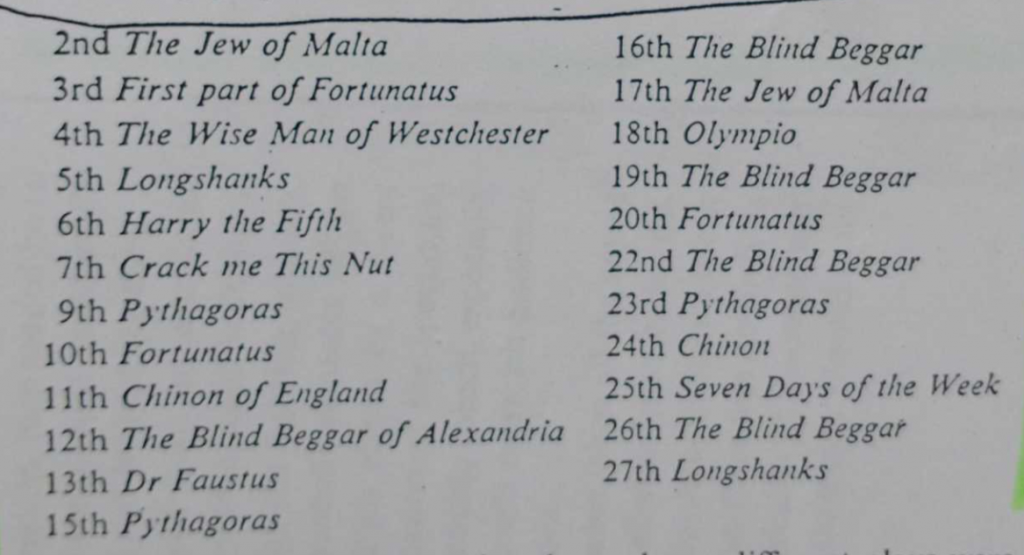
List of plays performed in February 1596 by the Admiral’s Men
‘Crack me this Nut’ was performed by the Admiral’s Men at the Rose Theatre in Southwark, London. One of the dates it was performed was on September 25th 1595. As you can see, above, it was also performed on February 7th 1596. You can find the other dates it was performed, and the income generated in this blog from Henslowe’s papers. In fact, the play was performed 16 times in all, then sold by Edward Alleyn. Sadly, no one knows what it was about. It might relate to the sense of our phrase ‘a tough nut to crack.’
The list of February dates for the Admiral’s Men is from my dossier for my Shakespeare’s London walks. I’m not entirely sure of the book I photocopied it from, but it derives from the wonderful archive of Philip Henslowe and his leading actor, Edward Alleyn. Henslowe’s records were stored in a locked trunk for 260 years.
2023 marked the completion of the project to bring this archive to the public. And here is the Henslowe-Alleyn Digitisation project. As well as digitising the Archive, elements that had been separated from the original archive have been brought back, so the greatest archive of information on the Shakespearean theatre is now unified and available. It is an immense benefit for the Shakespeare industry.
I searched the archive for ‘Crack me this nut’ but their search engine searches for anything that mentions ANY of the words, and as the word ‘this’ is in virtually everything in the archive, the search is effectively useless. Putting ‘Crack me this nut’ in quotes does not help. I have emailed them!
A subscriber sent me another link which has various speculations, and the following entry.
Master Ponsonby. Entred for his copie vnder the hands of the Wardens A booke Intitled The Paragon of pleasaunt histories . . . vjd Or this Nutt was neuer Cracked Contayninge a Discourse of a nobl[e] kinge and his Three sonnes (S.R.1, 3.57 / Fol. 7)
I often use this list of plays performed in February 1596 in the walks and lectures I give on Shakespeare. It shows you how hard-working Shakespeare’s contemporaries were. The actors’ companies were essentially small repertory companies. This list shows that the Admiral’s Men performed 14 different plays, on 23 days, if I count correctly, in the short month of February. This is in a winter month. Now, the guides at the rebuilt Globe tell you the Shakespearian Playhouses were used in the Summer. No! This was deep winter and 23 performances in an outdoor theatre in February! Imagine what a modern actor would think of that work load.
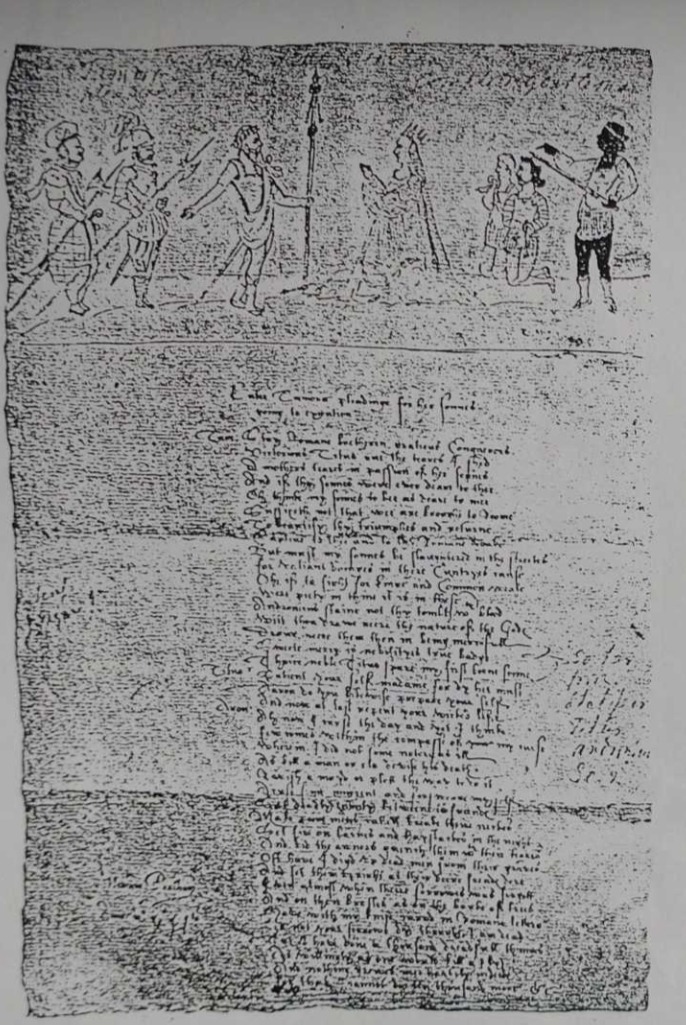
A badly photocopied page of the archive.
First published on February 7th 2023, and revised and republished on September 25th 2024, and 2025
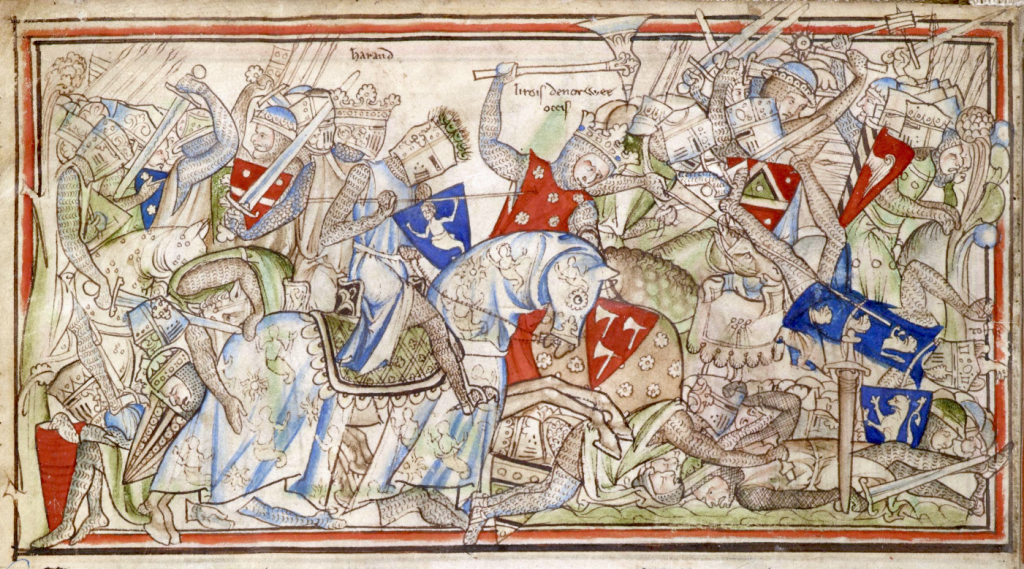
Following the Viking victory at the Battle of Fulford Bridge, York, on September 20th the Viking army camped at Stamford Bridge.This was on the River Derwent. Here they intended to rest and celebrate the defeat of the English Earls of Mercia and Northumbria. They were unaware that King Harold I of England had left London for the north on September 18th. (See my post on the Battle of Fulford Bridge here.)
Five days later, on September 25th, Harold’s army surprised the Vikings by marching towards the bridge over the Derwent. It is said that Harold’s army marched 185 miles from London in 4 days which is a scarcely believable 46 miles a day. But if they left on 18th and battle was 25th that’s as much as 7 days. This still means 26 miles a day which is still very quick for an army carrying weapons and armour. So no wonder the Vikings were surprised!
According to tradition, a large Viking held the English army as he blocked the narrow wooden bridge across the river. No one could defeat him. But an enterprising English soldier found a boat, floated under the bridge and killed the Viking by pushing his spear through the bridge timbers, killing the Viking.
According to the 13th Century Icelandic historian, Snorri Sturlson, the fight began only after a rider approached the Viking Army. He offered Harold’s Brother, Tostig back his Earldom if he would withdraw from the fight. Tostig asked what would be in it for his ally, the King of Norway? The reply was ‘Seven feet of English ground, as he is taller than other men’. The offer was refused. It was said that the rider was King Harold himself.
Once over the Bridge, the English found the Vikings had formed a defensive formation. However, they had left their armour behind at their boats. The battle lasted all day but ended with the slaughter of most of the Vikings. King Harold Hardrada, one of the greatest warriors of his age and Tostig were both killed. The extent of the slaughter is shown by the fact that of the 300 boats of the Viking army, only 24 returned to Norway.
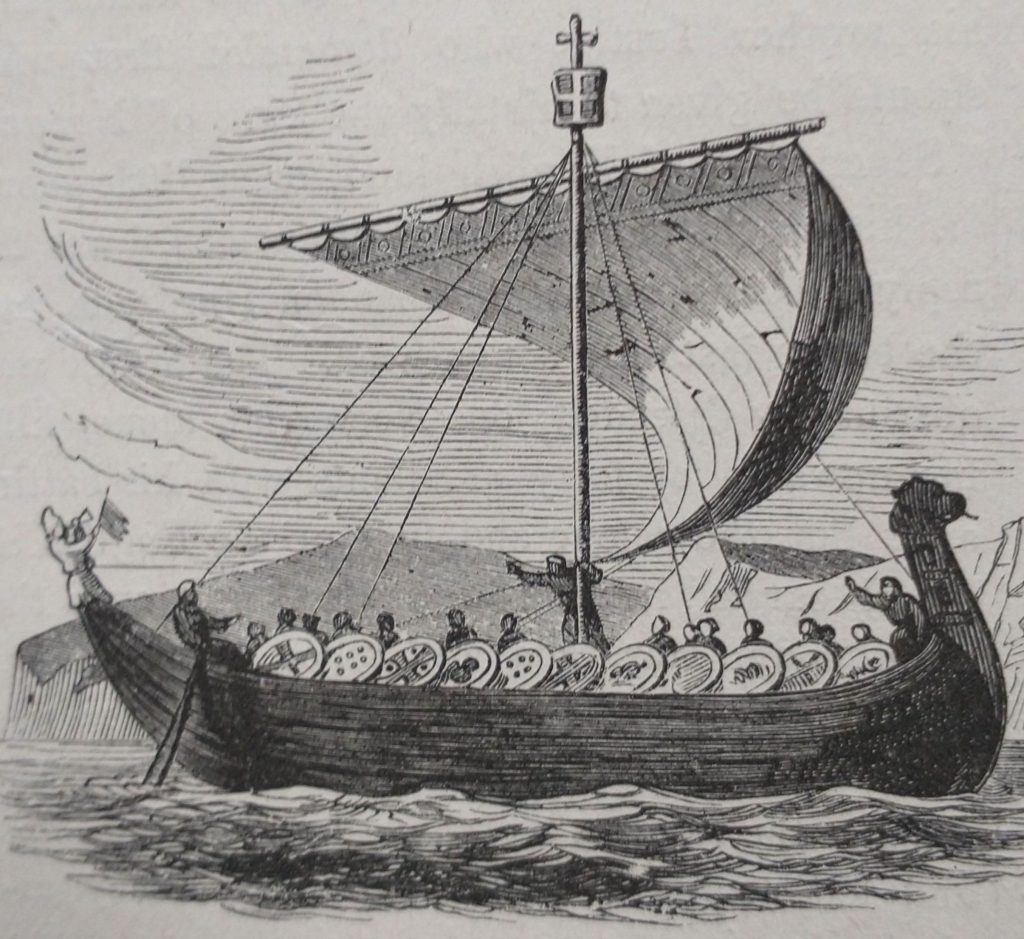
A boat of the period, derived from the Bayeaux Tapestry
A stunning victory for Harold I. But, the English had suffered terrible losses at the battle of Fulford. Harold had also left the South Coast unguarded And three days later, on September 28th, William, Duke of Normandy landed with his army at Pevensey. 256 miles south.
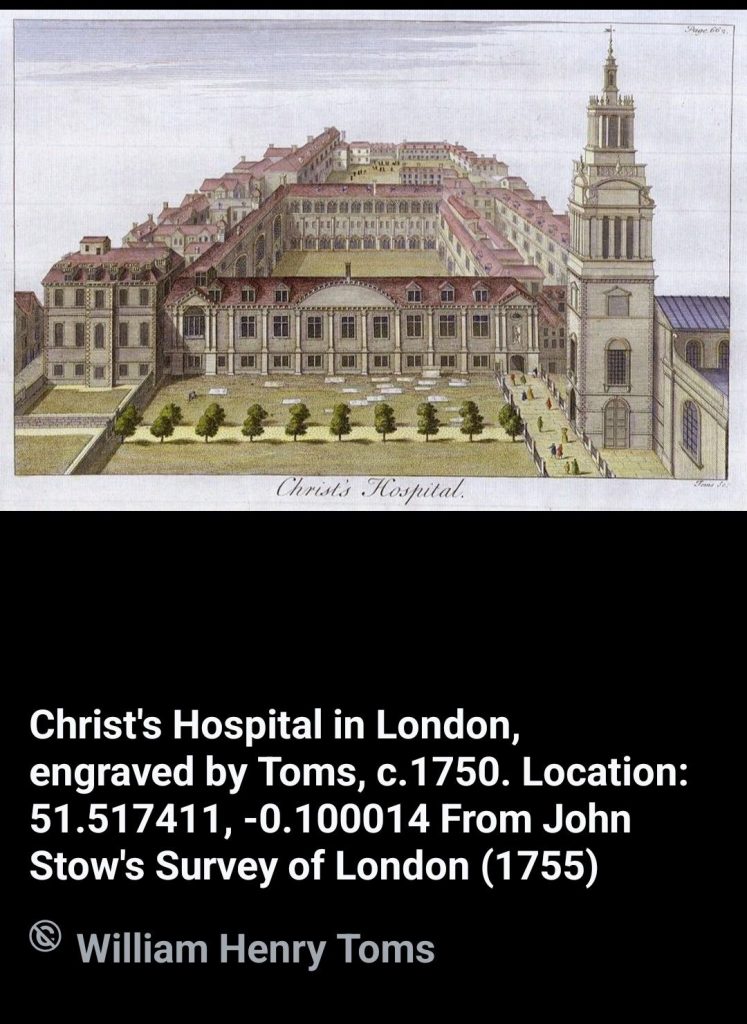
In the City of London, St Matthew’s Day was the day that they elected Governors to Christ’s Hospital, it was followed by a service at Christchurch attended by Aldermen, Sheriffs, the Lord Mayor and a procession of the children attending the school.
Dissolution of the Monasteries
Christ’s Hospital was founded in 1552 by a settlement arranged by Edward VI after the Reformation. The abolition of the Monasteries by Henry VIII caused a huge problem for the City of London, with the destruction of education and social services managed by monks and nuns. Henry VIII had already re-established St Bartholomew’s to look after the Poor Sick in the City. To complete the post dissolution, Edward IV established three Royal Hospitals to sort out additional problems. Bridewell Hospital became an orphanage and place of correction for wayward women. St Thomas Hospital for the homeless and poor sick of South London. Christ’s Hospital was to provide schooling. The school was originally near Newgate and Christchurch Church, which was originally the Choir of the Greyfriars Church.
The school was set up in 1552 and was for boys and girls. The Mathematical School was added in the late 17th Century to provide navigation skills for sailors.
Flogging the boys
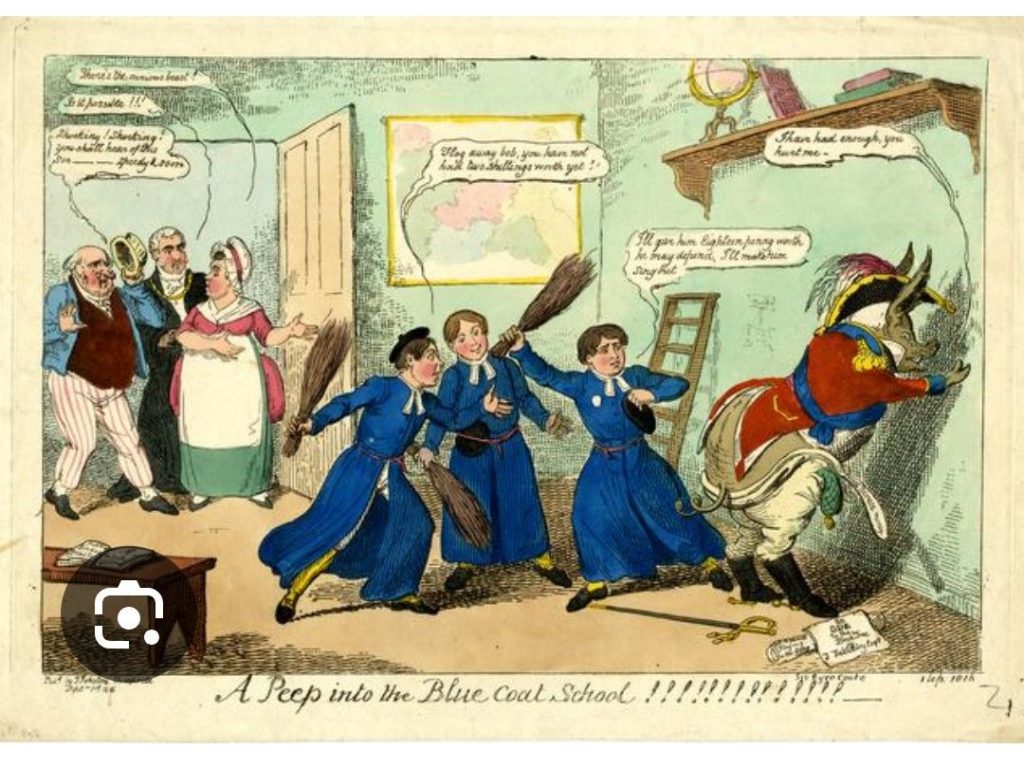
In 1815, a shocking event took place. An MP named Sir Eyre Coote entered the Mathematical school. He shooed the younger boys away but paid the older ones to participate in mutual flogging. He was discovered by the school nurse doing up his breeches. George Cruikshank, a vaunted caricaturist, created a cartoon of the occasion, and it is extraordinary how it was treated far from seriously.
Cruikshank Cartoon
The blue-coated boys of Christ’s Hospital, eventually moved to Hertford but are now in Horsham. They maintain their City affiliation and still come to the City on or around St Matthews Day and take part in the Lord Mayor’s Show. The school is a public school, but has a large percentage of its students funded by bursaries. In 2016 former pupils opened up about historic sexual abuse leading to the prosecution of 6 teachers of Christchurch.
Also on St Matthews Day, the historic Bush Hotel in Farnham distributed bread to the poor. This began in 1660 a local benefactor bequeathed one pound annually to pay for the bread.
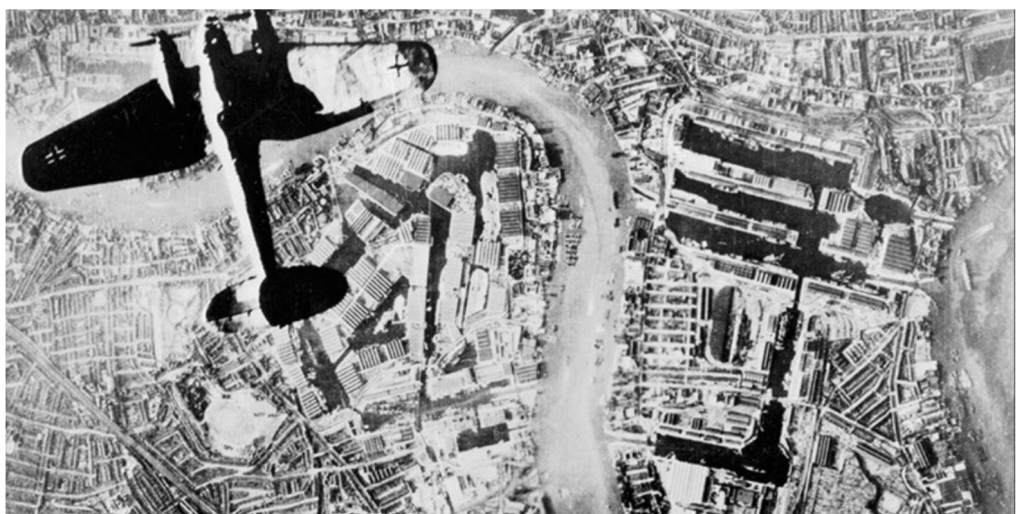
On September 15th 1940 Ray Holmes, World War 2 RAF Pilot, flying a Hurricane, took on three Luftwaffe Bombers over Central London. He shot one down, chased another off and engaged the third which seemed to be heading for Buckingham Palace.
Between the 8th and 13th of September 1940, the Palace had been hit 5 times. The London Blitz had only ‘begun’ on September 7th though the first raid on the City of London was on the 25th August on Fore Street.
Holmes, by now had ran out of bullets, but deliberately targeted the fin of the Dornier Bomber, and crashed into it causing the bomber to crash down into Victoria Station. Holmes’ Hurricane, spiralled down out of control, but he was able to bail out and landed in a dustbin, much to the bemusement of the locals. Holmes died aged 90 in 2005.
This post is heavily based on the story below, where it is told in full detail.