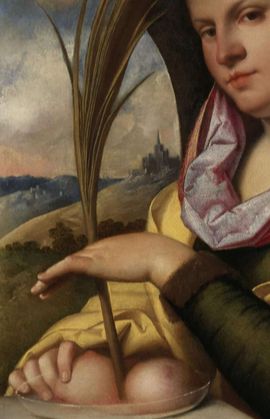
Ash Wednesday this year is early and on 18th February. It is the First Day of Lent, the solemn time which runs up to Easter, and is symbolic of Jesus’ 40 days in the wilderness.
In Anglo Saxon the name for the season of Spring was ‘lencthen’. It is thought to derive from the idea of the lengthening days. Days do suddenly seem to have got longer. These are the official times for the evening:
Sunset: 17:21
Dusk (Civil twilight ends) : 17:55
Nightfall (Nautical twilight ends) :18:34
Full Darkness starts (Astronomical twilight ends) : 19:13
So strictly, Lent means Spring. The Romance languages use the term which derives from the Latin ‘Quadragesima’ which means the 40 days of Fast. Spanish (Cuaresma), French (Carême), and Italian Quaresima). For Germans, it is the fasting time: fastenzeit. In England, Lent became a specialised word for the fast period. And Spring took over as the name of the season.
A time of fasting? Time for reflection? Maybe once upon a time. When I was young, it was 40 days when you were supposed to give something up. Smoking, or drinking, or chocolate. An idea taken up by a new generation, as, for example, Dry January? A time of reflection? No, never did that.
Dust to Dust and Stardust
Ash Wednesday is named after the ashes smeared on the heads of worshippers to remind us that we are dust. I’ve never seen this done either. My footballing Vicar friend Andrew missed our Wednesday Game so that he could mark foreheads with ash crosses. The ashes were traditionally made from palms used for Palm Sunday decorations, which is indeed what Andrew did. Look here to see my post on Palm Sunday.
On the subject of dust, here are some spiritual lyrics by Joni Mitchell. Something profound in the true idea that we are all stardust.
We are stardust We are golden And we’ve got to get ourselves Back to the garden
Woodstock by Joni Mitchell
40 Days
We all know that there are 40 days in Lent, except there are not. It’s 46 this year. This was pointed out by Tim Harford who presents a BBC radio programme called ‘More or Less’. It is a programe about statistics, or more widely about Fact Checking statistics in the news. Last year he discussed the 40 days. One answer proposed was to take away Sunday. But, my mathematics tells me this still leaves 42. The answer Tim Harford came up with is that 40 days just means a long time.
It is the length of time of Lent, but also:
The duration of the Great Flood The time Moses was on Mt Sinai The time the Israelites spy on Canaan Goliath trails Saul Elijah Walks Jesus is tempted n the Desert The time from Resurrection to Ascension
In other words, a long time to be doing any one thing. As Hartford says, it’s like our word ‘umpteenth’. As in ‘Kevin this is the umpteenth time I’ve told you to tidy your bedroom’. That’s what my mother said to me as she threw my clothes out of the window.
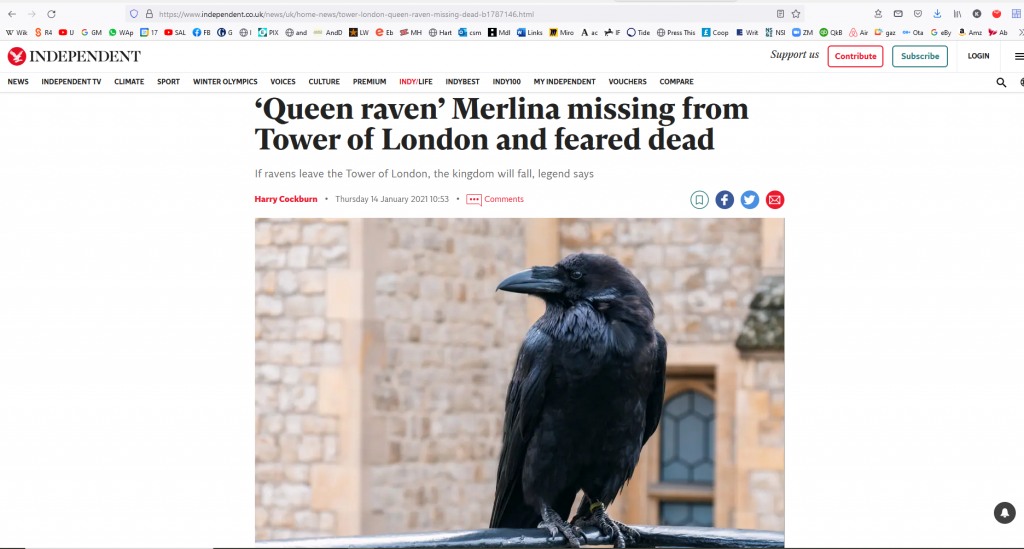
The Independent January 2021 The Raven the Palladium of Britain
The Raven – the Palladium of Britain
Corvus corax is hatching. An early nesting bird, the Raven is the biggest of the Corvids. They were pushed to the west and north by farmers and game keepers but are making a comeback. Ravens are finding towns convenient for their scavenging habits. So they, again, cover most of the UK except the eastern areas. The Raven is one of the Palladiums of Britain.
A Palladium is something that keeps a city or country safe, They are named after a wooden statue of Pallas Athene, which protected Troy. Perceiving this, Odysseus and Diomedes stole the Palladium from Troy shortly before the Trojan Horse episode. Troy fell and the palladium went to Italy (I’m guessing with Diomedes who is said to have founded several cities in Italy). It ended up in Rome.
The Romans claimed to be descendants of Trojan exiles led by Aeneas. So it was back with its rightful owners. It protected Rome until it was transferred to the new Roman capital at Constantinople. It then disappeared, presumably allowing the Ottoman Turks to conquer the City of Caesar? To read of London Stone as a Palladium see my post here.
The Ravens habits (it is said they know where the battlefields are before they are fought) and their black plumage have made them harbingers of death. In poetry, Ravens glut on blood like the warriors whose emblem they are. Here is a very famous quotation from Y Gododdin, a medieval poem but thought to derive from a poem by the great poet Aneirin from the 7th Century.
‘He glutted black ravens on the rampart of the stronghold, though he was no Arthur.’
This is one of the much argued-about references to King Arthur in the ‘Was he a real person’ trope. The point being, it doesn’t make sense to mention Arthur if King Arthur wasn’t a real person. The story at the Tower of London is that the Ravens kept in the Tower, with clipped wings, keep Britain safe from Invasion. (But see below).
Bran’s Head – the original Palladium of Britain?
By Sonny Mauricio from Unsplash
The Raven was also the symbol of the God-King Bran. Bran was one of the legendary Kings of Britain. His sister, Branwen, was married to the King of Ireland. To cut a long story short, Branwen was exiled by her Irish husband to the scullery. She trained a starling to smuggle a message to her brother, to tell of her abuse.
So Bran took an army over the Irish Sea to restore her to her rightful state. But the ships were becalmed. Mighty Bran blew the boats across the sea – he was that much a hero. Bran was mortality wounded in the fighting that followed. This was a problem because he had previously given away his cauldron of immortality. He gave it to the Irish King in recompense for the insults given to the Irish by Bran’s brother, who hated anyone not British.
Bran’s Head Returns to London
So, the dying Bran, told his companions to cut off his own head and take it back to the White Hill in London. His head was as good a companion on the way back as it was on the way out, and the journey home took 90 years.
At last, they got to London, where Bran told his men to bury his head on the White Hill. As long as it stays here, he said, Britain would be safe from foreign invasion. The White Hill is said to be Tower Hill with its summit at Trinity Gardens, although Primrose Hill is sometimes offered as an alternative.
This was one of the Three Fortunate Concealments and is found in ‘the Triads of the Island of Britain.’ The Triads are from medieval manuscripts which preserve fragments of folklore, mythology and history. They are grouped in groups of three.
Arthur and Bran’s Head
But many years later, King Arthur saw no need for anybody or anything other than himself to protect the realm. So he had the head dug up. Calamity followed in the shapes of Sir Lancelot and Mordred which led to the end of the golden age of Camelot and conquest of Britain by the Saxons. This was one of the Three Unfortunate Disclosures.
If we want a rational explanation for the story, there is evidence that Celtic cultures venerated the skull, and palladiums play a part in Celtic Tales.
So what was Arthur doing destroying the palladium that kept Britain safe? Vanity is the answer the story gives. But, perhaps, it’s a memory of Christian rites taking over from pagan rituals? God, Arthur might have thought, would prefer to protect his people himself rather than Christians having to rely on a pagan cult object.
Ravens in the Tower of London
The story of Bran’s head is inevitably linked to the Ravens in the Tower who, it is still said, keep us safe from invasion. As you can see from the photo at the top we still get in a tizz when one goes missing.
Sadly, and I am probably sadder about this than most, the link between the Tower, Bran, and the Ravens cannot be substantiated. Geoffrey Parnell, who is a friend of mine, told me that while working at the Tower of London he searched the records assiduously for the story of the ravens. He found no evidence of the Raven myth & the Tower before the 19th Century, and concluded that it was most likely a Victorian invention. IanVisits has a 2025 story about the Ravens, and also concurs that the Ravens are a recent myth.
The Welsh Triads give a total of two palladiums for Britain, a couple of nationalistic fighting dragons.
The Head of Bran the Blessed, son of Llyr, which was concealed in the White Hill in London, with its face towards France. And as long as it was in the position in which it was put there, no Saxon Oppression would ever come to this Island; The second Fortunate Concealment: the Dragons in Dinas Emrys, which llud son of Beli concealed; And the third: the Bones of Gwerthefyr the Blessed, in the Chief Ports of this Island. And as long as they remained in that concealment, no Saxon Oppression would ever come to this Island.
All good but then came:
The Three Unfortunate Disclosures:
And there were the Three Unfortunate Disclosures when these were disclosed. And Gwrtheyrn the Thin disclosed the bones of Gwerthefyr the Blessed for the love of a woman: that was Ronnwen the pagan woman; And it was he who disclosed the Dragons; And Arthur disclosed the head of Bran the Blessed from the White Hill, because it did not seem right to him that this Island should be defended by the strength of anyone, but by his own.
Gwrtheyrn is Vortigen, the leader of the Britons after the fall of the Roman Empire in Britain, one or two leaders before Arthur. Vortigern, which means something like strong leader in Welsh was a real person in so far as he, unlike Arthur, is mentioned by Gildas a near contemporary source.
The story of the dragons is supposedly from the pre-Roman Iron Age. Every May Day, the Dragons made a terrible noise, causing miscarriages and other misfortunes. So, King Ludd, whom legends says gave his name to London (Ludd’s Dun or Ludd’s walled City), drugged the dragons. He had them buried in a cavern at Dinas Emrys in Eryri (Snowdonia). The Red Dragon represented the Britons (also called the Welsh) and White Dragons the Saxons.
Vortigern, Merlin and Vortimer
Hundreds of years later, (five hundred?) after the Romans had come and gone. Vortigern was trying to build a castle in Eryri at Dinas Emrys. But the walls keep falling down. ‘You need the blood of a boy born not of man’, his necromancers say. They find a boy called Ambrosius aka Merlin whose mother had lain with an incubus. Merlin accused the necromancers of ignorance and explains the wall collapse is caused by two dragons. They find the cavern and let the dragons go. The walls now stand undisturbed. But the Welsh Red Dragon and the Saxon White Dragon can not now be at peace, and the Britons are defeated by the Saxons.
Vortigern betrayed his own people for the lust of Rowena the daughter of Hengist, the Saxon. Hengist was given the province of Kent as his reward, and thus began the Anglo-Saxon take over.
Vortigern’s son is Gwerthefyr (or Vortimer). He was a better man than his dad and fought to keep the Saxons out. After Vortimer’s death his bones were buried at the chief ports on the South Coast. Here they acted as a palladian and they kept the country safe. But they were moved to Billingsgate, in London and put in a Tower. The loss of the palladium allowed the Saxons to land safely on the Kent coast and consolidate their increasing hold over Britain and turning it into England.
Birds in Love
Here is a lovely little medieval poem. It was found in 1931 in the end leaf of a manuscript where someone had been testing their goose quill and scribbled these three lines:
Why it is so wet in the UK at the moment (February 18th)? The answer seems to be that there is a block of cold weather over the States that is moving the Jet Stream south, bringing lots of wet weather. But there is also another block of cold weather over Scandinavia. This means that the low pressures being driven by the Jet Stream, have no where to go and are stopping and dumping their rain all over the UK.
3102 BC – the death of Krishna starts Kali Yuga, the fourth and final yuga of Hinduism.
1478 – George, Duke of Clarence, traitor to his Brother, Edward IV, was executed in private at the Tower of London. It is said he was drowned in a vat of Malmsey Wine.
1678 – First Part of Pilgrim’s Progress by John Bunyan published.
1991 – The IRA plant bombs at Paddington station and Victoria station in London. The IRA gave warnings, and the Victoria bomb went off at 4.20am and caused no casualties. At or just before 7am, the IRA warned that all London Stations were to be bombed in 45 minutes time. The Authorities were slow to clear the stations and at Paddington a bomb went off at 7:40am. 1 person was killed and 38 people were injured. 11 days earlier, the IRA attacked Downing St with a mortar bomb attack.
Written on February 21 revised in February 18th 23, 24, 25, Birds in Love, Wet Weather and On This Day added in 2026
This year, February 17th is Shrove Tuesday, the end of the Carnival. Etymology-on line says the origins of the term Carnival are:
1540s, “time of merrymaking before Lent,” from French carnaval, from Italian carnevale “Shrove Tuesday,” from older Italian forms such as Milanese *carnelevale, Old Pisan carnelevare “to remove meat,” literally “raising flesh,” from Latin caro “flesh” (originally “a piece of flesh,” from PIE root *sker- (1) “to cut”) + levare “lighten, raise, remove” (from PIE root *legwh- “not heavy, having little weight”).
Folk etymology has it from Medieval Latin carne vale ” ‘flesh, farewell!’ ” Attested from 1590s in the figurative sense of “feasting or revelry in general.” The meaning “a circus or amusement fair” is attested by 1926 in American English.Related entries & more
Pancake Day is another name for Shrove Tuesday. It is the day we eat up all our surplus food. Then on Ash Wednesday we must begin our lenten fast and turn our mind to repentance. Pancake Day, in the UK, is celebrated with a simple pancake with lemon and sugar. Here is a recipe from the BBC. On the other hand, Shrove Tuesday can be a day of excess before the 40 days of restraint. Shrovetide was normally three days from the Sunday before Lent to Ash Wednesday, the beginning of Lent. (Here is my post on Ash Wednesday).
Mardi Gras
In France, it’s called Mardi Gras which means Fatty Tuesday, in Italy Martedi Grasso. In New Orleans it stretches from Twelfth Night to Shrove Tuesday. But as we saw, in my post on Fat or Lardy Thursday‘ the Carnival period was more normally a week. In most other places it is one to three days. In Anglo-Saxon times there was ‘Cheese Week’, ‘Butter Week’, ‘Cheesefare Sunday’ and ‘Collop Monday’, preceding Ash Wednesday.
Shrove Tuesday the Day to be Shriven
Shrove Tuesday is the day we should be ‘shriven’ which means to make confession. The Church has been leading up to Easter since Advent – before Christmas. (See more on Advent Sunday here). Easter is the date of the conception and, also, the date of the execution and apotheosis of Jesus Christ. So the pious should confess their sins, then undertake their lenten fast before entering the Holy Week purged and sin-free.
In the Anglo-Saxon Church, there was a custom called ‘locking the Alleluia.’ The Church stopped using the word Alleluia from 70 days before Easter. Alleluia represented the return from exile in Babylon. So, with the approach of the death of Christ it was not felt appropriate to be celebratory.
The sombre nature of this block of time was highlighted by Ælfric of Eynsham (c. 955 – c. 1010).
Now a pure and holy time draws near, in which we should atone for our neglect. Every Christian, therefore, should come to his confession and confess his hidden sins, and make amends according to the guidance of his teachers; and let everyone encourage each other to do good by good example.
Ælfric, Catholic Homilies Text Ed. Peter Clemoes quoted in ‘Winters in the World’ Eleanor Parker
Time for Football!
Shrove Tuesday was the traditional time for football games, in the days before football had any rules to speak of. It was a wild game. Teams tried to get a bladder from one end of town to the other, or one side of a field to the other. In Chester, the Shrove Tuesday football game was held on the Roodee island. It was so rowdy that the Mayor created the Chester Races specifically to provide a more sedate alterative to the violence of the ‘beautiful game.’
Here is a youtube video of Shrovetide Football at Royal Asbourne in Derbyshire. You will notice it seems chaotic but if you look at the participants directed the action you can see how involved they are in it.
Royal Asbourne Shrove Tueday Football
In London, Henry Fitzstephen wrote about Shrove Tuesday Games in London in the late 12th Century:
‘Every year also at Shrove Tuesday, that we may begin with children’s sport, seeing we all have been children, the school boys do bring cocks of the game to their master, and all the forenoon they delight themselves in cockfighting. After dinner all the youths go into the fields to play at the ball. The scholars of every school have their ball, or baston in their hands. The ancient and wealthy men of the City come forth on horseback to see the sport of the young men and to take part of the pleasure in beholding their agility.’
Fitzstephen was the first biographer of Thomas Becket.
Pancake Race
The City of London has an annual pancake race at the Guildhall Yard. It is an inter-livery company competition. The Livery Companies also known as medieval Guilds, have to run across the Guildhall while holding a frying pan and pancake. There is a zone marked out where they have to toss the pancake. Here is a youtube video of the 2023 race.
Pancake Day/Shrove Tuesday Pancake Race
First published on February 21st, 2023 republished on February 13th 2024, and March 4th 2025, February 17th 2026
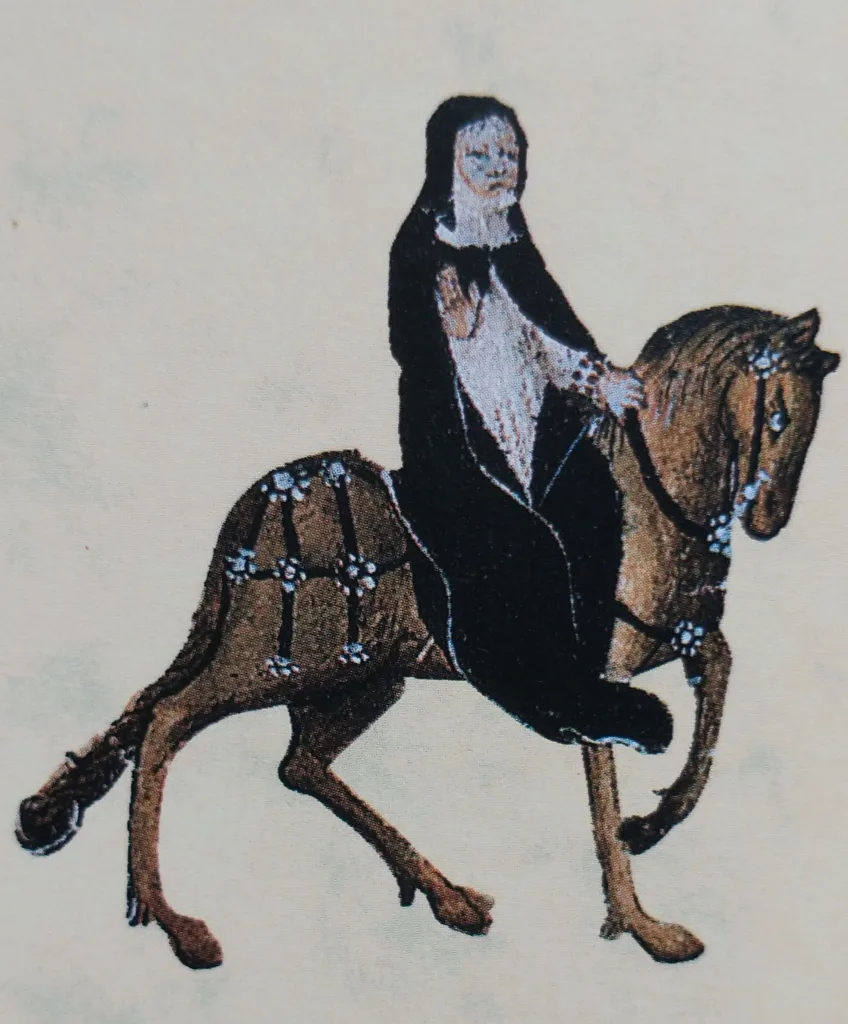
The Prioress from the Canterbury Tales by Geoffrey Chaucer from the Ellesmere manuscript. Her only oath is ‘By St Eloi’
When I read a reference to a Battle at St Eloi, it struck a chord as he is mentioned in the Canterbury Tales. It is an oath sworn by the delicate Prioress:
There was also a nun, a prioress, Who, in her smiling, modest was and coy; Her greatest oath was but “By Saint Eloy!” And she was known as Madam Eglantine. Full well she sang the services divine(5) Intoning through her nose, becomingly; And fair she spoke her French, and fluently. At table she had been well taught withal, And never from her lips let morsels fall, Nor dipped her fingers deep in sauce, but ate(10) With so much care the food upon her plate That never driblet fell upon her breast.
The reason is sticks in my mind is that the Prioress is shown as a cultured, well-mannered, delicate woman. And yet, she tells the most tremendously anti-Semitic tale. I hope that Chaucer meant this contrast. Someone who knows the forms of good behaviour without a clue in her hand that the most important of the Commandments is ‘Love Thy Neighbour like thyself.’ Another irony is that St Eloy was noted for refusing to swear an oath, and yet, the Prioress swears, by St Eloy.
St Eloi
Anyway, St Eloi was a very popular saint in the medieval period. According to legend, he was was having trouble shoeing a horse, which he thought was possessed. So he cut the horse’s leg off, re-shoed the amputated leg and then reattached the leg back on the horse. The horse trotted off, none the worse for the experience.
Properly called St. Eligius he is the patron saint of horses and cattle, farriers, blacksmiths, metalworkers, goldsmiths. The Saint was also responsible for converting Flanders to Christianity in the 7th Century. His Saint’s Day is 1 December. To look at the charge of rape against Chaucer look at my post here.
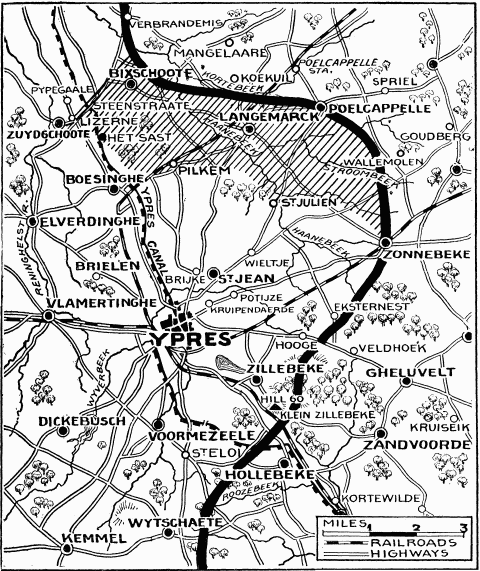
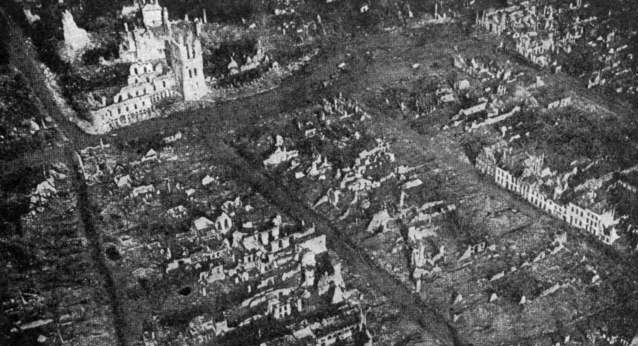
St Eloi is also the patron saint of mechanics in general (including the Royal Electrical and Mechanical Engineers, (forerunners of whom fought at Ypres). This brings me to what happened on this day in 1915, the British retook trenches at St Eloi. St Eloi was just behind the Southern edge of the Ypres Salient, a bulge of allied territory surrounded on three sides by German forces and the site of the five battles of Ypres. St Eloi had a mound which provided a perfect position for machine-guns to dominate the area and so became the focus of fierce fighting from 1914 through into 1918 when the Germans were finally pushed out of the Salient.
World War I destruction in Ypres (wikipedia)
Bravery at St Eloi
Here is a citation from a medal for bravery:
´For gallant behaviour on the morning of the 15th February 1915 at St. Eloi. A party of six stretcher bearers carrying wounded men from the firing line came under a heavy and sustained rifle fire. The bearers left their stretchers and ran to cover leaving Private Wright, D.C.L.I. (shot through the knee) and Private A. Stevenson, D.C.L.I. (shot through stomach) lying in open under heavy fire.
7679 Lance Sergeant T. Spanton, 6170 Rifleman E. Largen, and 1126 Company Sergeant Major S.M. Clay [together with Captain Brady] rushed some 50 yards across the exposed fire zone and carried in to cover the stretcher bearing Private Wright, whilst under heavy rifle fire. Private Stevenson, who was lying beside Wright, was found to be dead, and so was not carried in until dark. Lance Sergeant Spanton, Company Sergeant Major Clay, and Rifleman Largen have on several occasions done noticeably good work, showing fearlessness, resource, and devotion to duty.´
Fighting continued here from 1914 through into 1918 when the Germans were finally pushed out of the Salient.
War in Winter
I wanted to find something about the winter as experienced in World War 1. Why? Because I watched a very moving film about World War 1 by Derek Jarman called ‘War Requiem’. It put images to the requiem by Benjamin Britten. I also listened to a radio piece on ‘Spring Offensives’ to give a long view on what was happening in Ukraine.
I found this war poem which vividly sets a winter war scene:
Searchlight F. S. Flint
There has been no sound of guns, No roar of exploding bombs; But the darkness has an edge That grits the nerves of the sleeper.
He awakens; Nothing disturbs the stillness, Save perhaps the light, slow flap, Once only, of the curtain Dim in the darkness.
Yet there is something else That drags him from his bed; And he stands in the darkness With his feet cold against the floor And the cold air round his ankles. He does not know why, But he goes to the window and sees A beam of light, miles high, Dividing the night into two before him, Still, stark and throbbing.
The houses and gardens beneath Lie under the snow Quiet and tinged with purple.
There has been no sound of guns, No roar of exploding bombs; Only that watchfulness hidden among the snow-covered houses, And that great beam thrusting back into heaven The light taken from it.
For this was St. Valentine’s Day When every bird came there to chose their mate. Of every type, that men think may And that so huge a noise did they make That earth and sea and tree and every lake So full was, that hardly was there space For to stand so full was the place.
St Valentine’s Patronage
This is the first reference to St Valentine’s as a romantic day. And some people charge Chaucer with making the whole thing up! St Valentine, is supposed to have been martyred in the 3rd Century (290AD) on the Via Flaminia on February 14. He refused to stop marrying people in the Christian rites. Therefore, he is the patron Saint of lovers. Valentine is also the patron Saint of epileptics, fainting and beekeepers. According to legend, he taught a young blind girl how to look after Bees, and, sometime later, her eyesight was restored. He also is said to have treated a young man of epilepsy. Epilepsy was sometimes called the Falling Sickness, and so he is also the Saint of Fainting.
But until Chaucer, there was no particular link with romance. In fact, there are at least three Saint Valentines who were martyred in the Roman period. Their relics are scattered around Europe (have a look at this National Geographic article for the full S.P.). These include bones in Glasgow and his heart in Dublin. There are in total 11 Saints called Valentine in the list of Catholic Saints.
Another theory is that St Valentine has taken over the aspect of the God Cupid, as a Christian attempt to create a holy festival to replace the Lupercalia. See my post on the Lupercalia here.
St Valentine’s Day and Birds
Chaucer’s poem suggests one possible route to the link with romance. Early February is about the time when birds pair off. If they want to have their chicks at the optimal time, then they need to get going before spring has really sprung.
When I think of love, I don’t think of birds. Maybe, this is because I live by a Canal. Outside my garden, I frequently see and hear a Coot chasing his pair across the water before violently mounting her. But then they are fiercely monogamous and defend their nest, fearlessly, against much bigger birds. And swans glide by in beautiful family groups. But Magpies are my favourite lovebird because you see one, and then look around, and you very often see the partner. I have adopted an old tradition that you are supposed to say:
‘Hello, Mr Magpie! Where’s Mrs Magpie?’
And look for the mate. It is good luck if you see her and bad luck if you don’t. (Please feel free to assign your own favourite gender!)
‘One for Sorrow’ is a well-known nursery rhyme found in many variations, and is an example of ‘ornithomancy superstition’ whereby the number of Magpies you see determines some aspect of your future. Magpies normally mate for life, and are not gregarious during the nesting season, but thereafter, they ‘join together in large wintering flocks of more than 20 or so birds.‘. So, perhaps we need at least another seven lines for the rhyme? So, far I have never seen a flock of them. If you have a photo of a flock, please send it to me!
One for sorrow, Two for joy, Three for a girl, Four for a boy, Five for silver, Six for gold, Seven for a secret, Never to be told. Eight for a wish, Nine for a kiss, Ten a surprise you should be careful not to miss, Eleven for health, Twelve for wealth, Thirteen beware it’s the devil himself.
As to the likelihood of seeing thirteen magpies together – well I have seen them often in pairs, occasionally in threes and often alone.
Here is another, more dangerous version of the rhyme (you are more likely to see the Devil)
One for sorrow, Two for mirth Three for a funeral, Four for birth Five for heaven Six for hell Seven for the devil, his own self
For details of the history of versions of this poem, click here:
Bad Birds
Magpies don’t have a good reputation, traditionally being regarded as thieves and scavengers with untidy nests and eating habits. They are supposed to be attracted to shiny things, but Exeter University did some research which found that they have the normal Corvid’s curiosity for objects. But they are as happy to snatch a dull object as a shiny one. So, we can see they are very intelligent as well as faithful lovers. For me, a good-omened bird (as long as I see the two of them).
44BC – Julius Caesar was appointed dictator in perpetuum. Or perpetual dictator of the Roman Republic. Coins were issued with the phrase DICT PERPETVO.
1400 -Richard II died shortly after Epiphany Rising, a failed plot to restore him to the throne. Some think he was starved to death in captivity in Pontefract Castle. Or he starved himself. His body was taken to London and put on display in St Paul’s Cathedral on 17 February. His remains were taken to one of his favourite palaces at King’s Langley Priory on 6 March. Henry V had his remains ‘translated’ to Westminster Abbey. King’s Langley was a Royal Palace lived in by Eleanor of Aquitaine and Edward II, as well as Richard II. It is near Slough.
‘The accepted tale of the king’s death is that in despair and grief at the death of his friends, King Richard refused to eat or drink, although a few say he was purposely starved to ensure he died as if from a natural death. Another rumour is that when an esquire mentioned the words ‘King Henry’ while he was eating dinner, Richard struck him with the knife he was using. Guards charged in and the king, pushing the table away, took a bill out of one man’s hand and managed to slay four of them but one leapt onto the chair he had vacated and felled him with a stroke of his poleaxe.’
1876 – Alexander Graham Bell applies for a patent for the telephone
1895 – The Importance of Being Earnest, first produced at the St James’s Theatre, London
1918 – Russia finally adopts the Gregorian calendar. see my post here.
First Published in February 2023, revised and updated in February 2024, 2025 On This Day added 2026
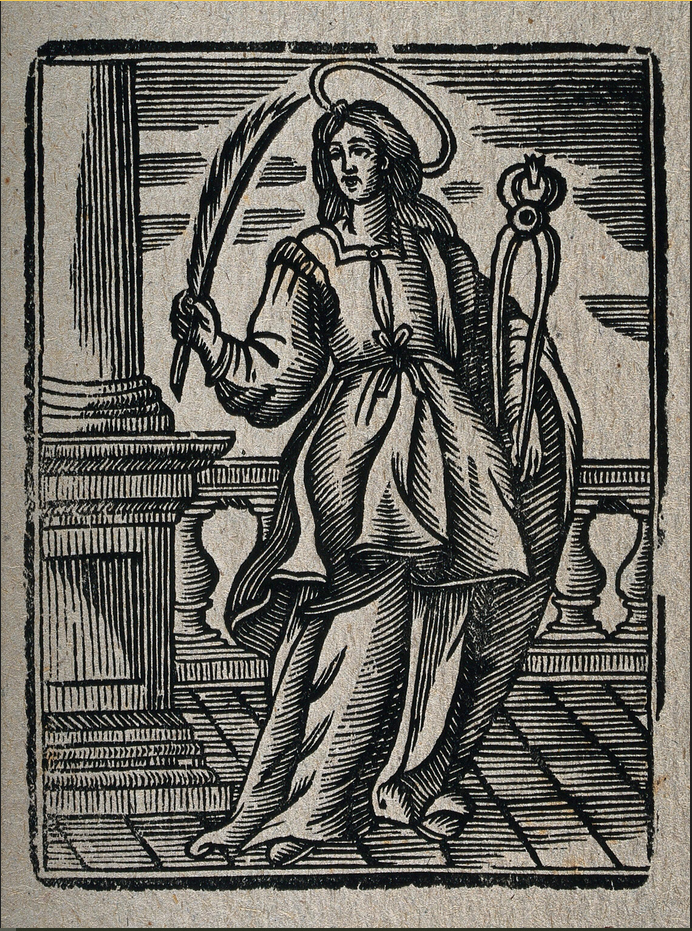
Saint Apollonia. Woodcut. Saint of Toothache Wellcome Collection. Public Domain Mark. She is shown with forceps, extracted tooth and the martyr’s palm.
The 9th of February is the Feast of St Apollonia. She was martyred at Alexandria in 249 AD during the persecution of Emperor Decius. (see also my post on St Agatha) She was attacked during an anti-Christian riot and struck around the face knocking her teeth out. Then, she was taken to a bonfire and told they would throw her in if she did not renounce her faith. So, without waiting, she spoke a prayer and walked into the fire. This information is recorded in a near-contemporary letter from St Dionysius of Alexandria. This is rare well documented martyrdom. Because her teeth were knocked out she is, therefore, Saint of Toothache.
Suicide or Martyrdom?
St Augustine of Hippo touches on this spat of martyrs, often young women, killing themselves rather than losing their virginity, or like St Apollonia embracing death in the face of violent persecution. His answer is that like Samson, they are commanded by God to take their own lives, which is ok. Elsewhere, he condemns suicide as it is against the commandment ‘Thou shalt not kill’. He explains that God did not add ‘thy neighbour’ to it so it also forbids killing oneself. By contrast, it was added to ‘Thou shalt not bear false witness against thy neighbour’. The rest of St Augustine’s argument comes from Plato’s Phaedo. The introduction to the book on the Project Gutenberg web site sums up the arguments:
According to one explanation, because man is a prisoner, who must not open the door of his prison and run away—this is the truth in a ‘mystery.’ Or (2) rather, because he is not his own property, but a possession of the gods, and has no right to make away with that which does not belong to him.
The Project Gutenberg EBook of Phaedo, by Plato translated by Benjamin Jowett
Cloves for Toothache
I can remember my Grandmother prescribing cloves for me when I had toothache. And this was, and is, a common remedy. In my case, we would keep a clove or two in the mouth close to the site of the pain. According to Natural Ways to Sooth an Toothache cloves contain
‘Eugenol, a natural form of anaesthetic and antiseptic that helps get rid of germs. Eugenol is still used in dental materials today’
Dr John Hall, Shakespeare’s son-in-law, tended to use a pill to soothe sore gums. He also used an oil from a wood called ‘Ol. Lig. Heraclei’ which may be oil from the Bay Tree. (‘John Hall and his Patients’ by Joan Lane). Most of his tooth cases seem to be sore gums. This suggests to me Dr John Hall did not generally do dental work.
Death by Toothache
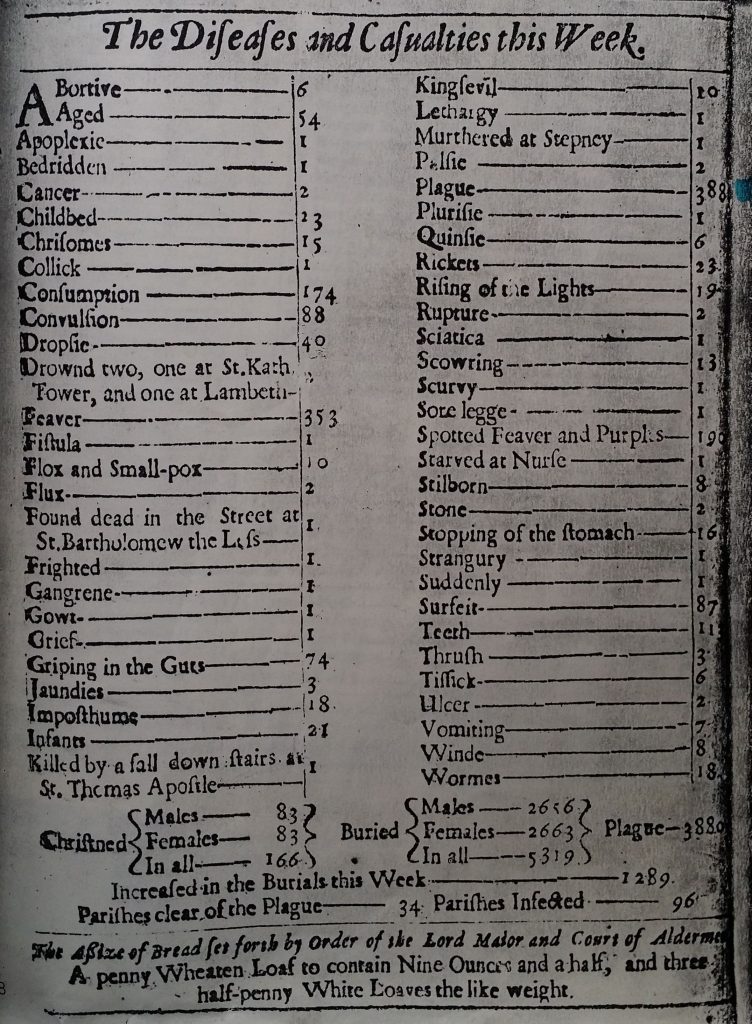
To get a tooth drawn you could go to a Barber Surgeon, a Blacksmiths or specialist Tooth Drawer. It would be terrifyingly painful. Probably only done when the pain was unbearable. Just think what a premium you would pay for a really competent drawer? The drawers would not have any formal training, but the skills would be passed on by the drawer to his apprentice or assistant. ‘Teeth’ was a common cause of death – most likely from infection or an abscess.
List of causes of death, London during the plague of 1665. Teeth killed 11 people
Magic and Toothache
John Aubrey, an erudite and educated 17th Century writer, reports on the use of Magick for tooth care. When he relates these unlikely cures he often provides information that the person who told him the story is worthy of belief. So he seems to give some credence to the efficacy of these magical ‘cures’. But, judge for yourself; this is what he wrote:
To Cure the Tooth-ach.
Take a new Nail, and make the Gum bleed with it, and then drive it into an Oak. This did Cure William Neal, Sir William Neal’s Son, a very stout Gentleman, when he was almost Mad with the Pain, and had a mind to have Pistoll’d himself.
To Cure the Tooth-ach, out of Mr. Ashmole’s Manuscript Writ with his own Hand.
Mars, hur, abursa, aburse. Iesu Christ for Marys sake, Take away this Tooth-ach.
Write the words, Three times; and as you say the Words, let the Party burn one Paper, then another, and then the last.
He says, he saw it experimented, and the Party immediately Cured
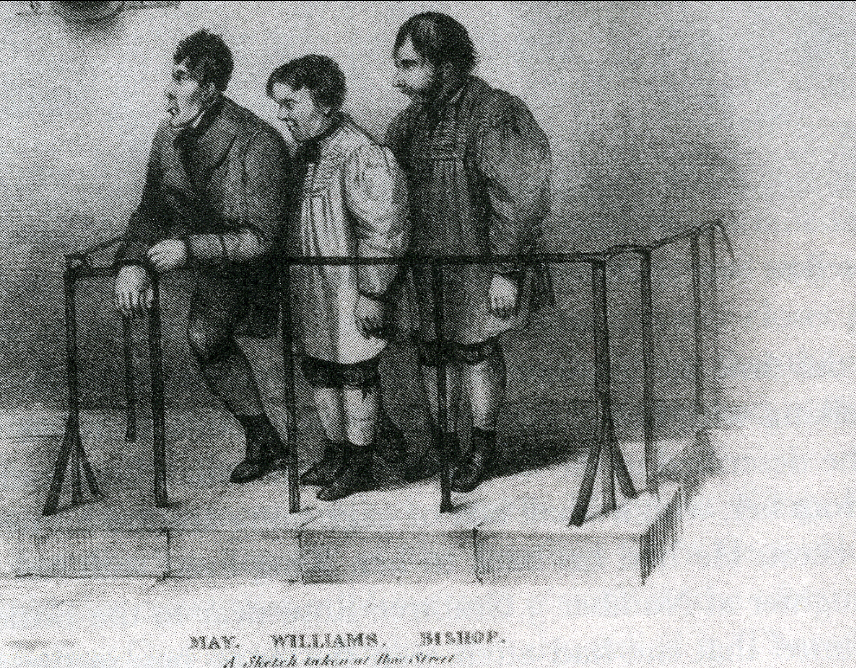
May, Williams and Bishop at the Old Bailey accused of murder in pursuit of bodysnatching
Teeth and the Body-Snatchers
In 1832, in London Bishop, Williams, and May were accused of body snatching. After killing the Italian Boy (wonderful book by Sarah Wise ‘The Italian Boy‘) they jemmied out his teeth. Then, took the teeth to a South London Dentist. with whom they bargained for a good price. (They used the term ‘cheapened’ – I cheap, you cheap, we are cheapening: meaning to barter). The dentist wanted to use the dead boy’s teeth for false teeth for his patients. If memory serves, he paid £1 for them.
The teeth were used as evidence in the trial of the murderers. When the trial was over and the accused punished, the dentist asked for the teeth back! Two of the murderers were hanged but the third freed for turning King’s Evidence. Thereafter, the teeth were released back to the Dentist. He promptly put them in the window of his surgery as an advert for his professional skills!
Earlier, one of the Borough Boys Resurrectionist gang (based in Southwark, London) toured the battlefields of the Peninsular Wars collecting teeth. He made a substantial sum selling them to dentists as false teeth. They became known as Waterloo Teeth.
When I first wrote this in I added ‘How things have changed!’ But in recent years there have been reports of people undertaking their own dental work, if they cannot get access to an NHS dentist. Effectively, it seems that the Conservative Government was allowing dentistry to slip out of the NHS just like it did with eye health. For a study in what has happened to Dentistry in the UK in recent years, please look at this report here.
On This Day
1907 – the National Union of Women’s Suffrage Societies (NUWSS or Suffragists) organised the so-called the Mud March. This was the ‘first large procession’ in support of votes for women. It was called the Mud March because of the downpour of rain on the day.
1916 – Conscription started in World War 1 with the call-up of unmarried men aged between 18 – 41.
1933 – The Oxford Union passed the resolution ‘the House will in no circumstances fight for King and Country.’
Bird of the Month The Blackbird. The common Blackbird is a true Thrush. The male is black with a yellow beak and the female is dark brown with a yellow beak. The Blackbird begins to sing as early as January, and is one of the birds who sing first early in the morning. British Blackbirds do not migrate, but Northern European Blackbirds often migrate to the UK in the winter for warmer weather. Viruses have put the species under some threat and they need help to get through the winter. ArkWildlife suggests this is what you should feed blackbirds:
‘Mealworms A top choice, mimicking their natural insect diet.
Is an 18th Century nursery rhyme which refers to the medieval habit of baking a pie crust, and putting it over a bowlful of live birds. When it was opened all the birds, well sing the song to remind yourself what they do?
Sing a song of sixpence A pocket full of rye Four and twenty blackbirds Baked in a pie When the pie was opened The birds began to sing Wasn’t that a dainty dish To set before the king?
The king was in his counting house Counting out his money The queen was in the parlor Eating bread and honey The maid was in the garden Hanging out the clothes When down came a blackbird And pecked off her nose
Sing a song of sixpence A pocket full of rye Four and twenty blackbirds Baked in a pie When the pie was opened The birds began to sing Wasn’t that a dainty dish To set before the king?
A stinging Cure for Lust
Another story told of the Blackbird is a similar tale I have told before about holymen and temptation. So St Benedict was pecked on the cheek by a Blackbird. Next day he finds himself assailed with lust. It was the Devil disguised as the Blackbird he decides that infected the Monk. Then Benedict did what a number of saints did in similar circumstances. He threw himself, naked, in a patch of nettles and brambles and rolled around, until his body was sore afflicted. But he had overcome his lust.
Then St Kevin held out his hand and a blackbird laid her eggs in it. So he stayed still for the two weeks it took the fledglings to hatch! (for more on St Kevin see my post here)
Icy Sedgwick has an excellent website on the folklore of Birds, containing a nice podcast, which for those who love a north-east accent will enjoy.
Winter’s End in ‘Winters in the World’ by Eleanor Parker
Eleanor Parker’s book, on the Anglo-Saxon Year, is a wonderful book. It has a poetry about it, that also provides an insight into how Anglo-Saxon thought the world works. For a non-Old-English speaker, it, also, really gives some understanding of the language. It reveals that for the Anglo-Saxons, Winter’s End was on the 7th February. We are now in the season of ‘lencten’. This probably comes from ‘lenghtening days’ or Spring as we call it. The word eventually got absorbed into the Christian calendar, giving us the name of the fasting season, which is ‘Lent’.
So Winter began, for the Anglo-Saxon, on 7th October and ended on the 7th February. January was called ‘Gēola‘ the month of Yule. February ‘Sol-mōnaþ‘ which is Mud month. The Venerable Bede in the 8th Century calls this the:
‘month of cakes which they offered to their gods in that month’.
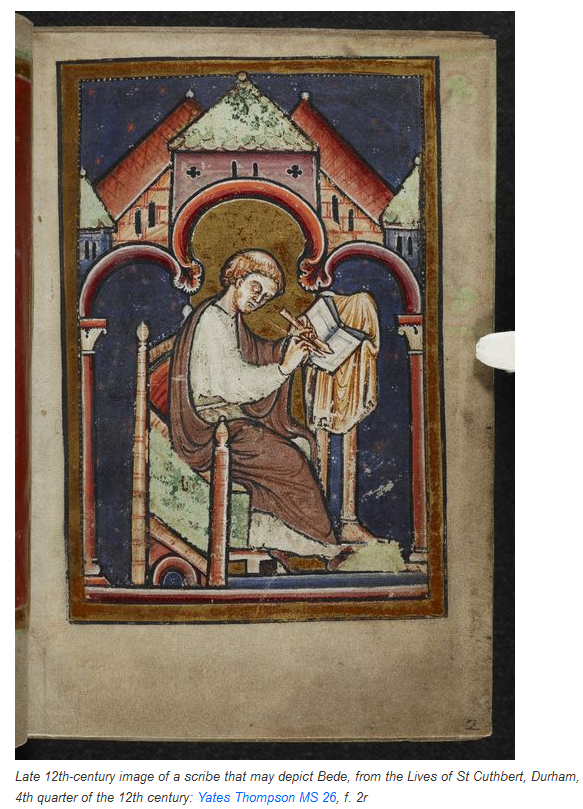
Thought to be the Venerable Bede, the first historian of the English
Bede tells us that before conversion to Christianity, the Anglo-Saxons had two seasons – Winter and Summer. Winter began on the first full moon of October, which they called Winterfylleth. The summer was called ‘sumor’ or ‘gear’ which developed into our word ‘year’. As in: ‘he was a boy of 10 summers.’
Roman, Celtic and Saxon Winter’s End
There is some sense in Winter’s End on February 7th. Lambs are being born; buds and shoot are appearing on branches and poking up from the cold earth. So, their winter is essentially, the time when nothing is growing, while ours is more aligned to the coldest period.
The Roman author Marcus Terentius Varro divided the Roman Year into 8 phrases and his Winter/Spring divide is also on 7th February. This is when, in Italy, the west winds began to blow warmer weather. So farmers ‘purged’ the fields, readying them for planting. They would be cleared of old growth and debris. Then blessed, weeded, pruned with particular attention given to preparing the grain fields, the vineyards, olive trees and fruit trees.
The Celtic year began at Halloween, and the spring begins with Imbolc, a week earlier than the Saxon on the 1st of February.
Anglo-Saxon Winter
In the section on Winter, Eleanor Parker gives a poetic description of winter. What seems particularly interesting about it is that the harshness of winter is often paired with descriptions of the ruins of Roman Civilisation. So, the despair of winter, the barren soil, the fight for survival is made more melancholic by the comparison to failed civilisation. Nature battering away at the useless ruins, and the destruction of people’s dreams.
Here, is a flavour of the juxtaposition of the bleakness of winter and the sadness of lost society. It is from ‘The Wanderer’ an alliterative poem from the Exeter Book, dating from the late 10th century. I have presumed to change a couple of words to make it a little more accessible.
Who’s wise must see how ghostly it has been when the world and its things stand wasted — like you find, here and there, in this middle space now — there walls totter, wailed around by winds, gnashed by frost, the buildings snow-lapt. The winehalls molder, their Lord lies washed clean of joys, his people all perished, proud by the wall. War ravaged a bunch ferried along the forth-way, others a raptor ravished over lofty seas, this one the hoary wolf broke in its banes, the last a brother graveled in the ground, tears as war-mask.
“That’s the way it goes— the Shaper mills middle-earth to waste until they stand empty, the giants’ work and ancient, drained of the dreams and joys of its dwellers.”
As I read this, I wonder if it is a tradition that began in the cold of Scandinavia? England, at least Southern England, can often have mild, rather than ferocious winters?
However, there is also an idea about the circularity of life and the interconnectedness of everything. There are 4 Seasons, 4 Ages of Man, and the cycle was from childhood to old age, from Spring to Winter. We start young, and become vigorous, and then we decline and eventually die. And so does the world of the Anglo-Saxons. The world of Adam was young, restored to vigour by the coming of Jesus. Now the World was in its old age awaiting the Apocalypse, before the Day of Judgement. So Winter was connected with Old Age and Death.
Bede’s Metaphor for Winter
Parker recounts a beautiful image of Bede’s. The King of Northumberland is thinking of taking his wife’s religion. He, therefore, invites the Christian evangelist, Paulinus to his court. Inclined to convert. He asks the opinion of one of his pagan advisers, who answers to the effect.
‘We are in the Great Hall, gathered warm with friends and family around the roaring fire, with Winter raging outside. A sparrow comes in from a hole in the end wall, flies through the warm of the Hall, and flies out through the other side. Such is life. The Hall is this world, we are the Sparrow, and as pagans we have no idea what happens before we enter the Hall, nor what happens after we leave. How much better it is to embrace a religion that can give us certainty as to what happens when we leave the hall.’
Lovely image, although, the pagan adviser does seem to have made his mind up to try Christianity? . What I like about it is that it echoes feelings I have. We as a species worry about what happens after death. It seems to many so final, to others unknowable. But I think ‘I don’t worry about what happened before I was born, so why should I worry about what happens after I die?’ It’s the same state of non-being. It gives me some comfort that I’m going back where I came from.
1812 – Dickens born in Portsmouth. His father was the son of a Butler and a clerk in the Royal Navy Pay Board. He has much in common with Mr Micawber. His mother, Elizabeth Dickens was a source for the character of Mrs Nickleby. Dickens told a friend that his mother came to him exasperated by the stupidity of Mrs Nickelby. Dickens said words to the effect: ‘Little did she know that Mrs Nickleby was based on her’. Here is a section of Nicholas Nickleby that makes the point.
Nicholas Nickelby From Chapter 1
‘Mr Nickleby looked about him for the means of repairing his capital, now sadly reduced by this increase in his family, and the expenses of their education.
`Speculate with it,’ said Mrs Nickleby.
`Spec—u—late, my dear?’ said Mr Nickleby, as though in doubt.
`Why not?’ asked Mrs Nickleby.
`Because, my dear, if we should lose it,’ rejoined Mr Nickleby, who was a slow and time-taking speaker, `if we should lose it, we shall no longer be able to live, my dear.’
`Fiddle,’ said Mrs Nickleby.
`I am not altogether sure of that, my dear,’ said Mr Nickleby.
`There’s Nicholas,’ pursued the lady, `quite a young man—it’s time he was in the way of doing something for himself; and Kate too, poor girl, without a penny in the world. Think of your brother! Would he be what he is, if he hadn’t speculated?’
`That’s true,’ replied Mr Nickleby. `Very good, my dear. Yes. I will speculate, my dear.’
Speculation is a round game; the players see little or nothing of their cards at first starting; gains may be great—and so may losses. The run of luck went against Mr Nickleby. A mania prevailed, a bubble burst, four stock-brokers took villa residences at Florence, four hundred nobodies were ruined, and among them Mr Nickleby.’
Mr Nickleby ends up dead having falling 202 ft from the top of the Monument. In 1810 Elizabeth’s father, Chief Conductor of Monies in the Navy Pay Office was found guilty of embezzling £5,689 3s 3d.
The Celtic Year showing Imbolc, the new Irish Bank Holiday
I just came across this which I published last in 2023. I should have republished it last weekend. But here it is. The Irish created a brand new Bank Holiday for St Bridget. The first one was Monday 6th February 2023. It followed a public holiday given in 2022 for Health Workers in March. The timing of the Bank Holiday is explained by the Irish Post:
St Brigid’s Day itself falls on February 1 each year but going forward the Imbolc/St Brigid’s Day public holiday will fall on the first Monday in February, unless February 1st falls on a Friday.
This means that Ireland now has a public holiday on the 4 Celtic festivals of Samain (Halloween), Imbolc (St Bridget’s Day), Beltane (May Day) and Lughnasa (Lammas Day). These festivals are quarter-days, which mean they fall halfway between the Solstices and Equinoxes.
The Independent wrote that ‘then-Tánaiste, Leo Varadkar, said‘ ….“This will be the first Irish public holiday named after a woman.” He also is quoted as saying:
“It marks the half-way point between the winter solstice and the equinox, the beginning of spring and the Celtic New Year.”
Extra Bank Holidays in the UK?
There are occasional calls for a new Bank Holiday in the UK. It’s often a Conservative MP calling for a National Day for the British. More often than not they suggest Trafalgar Day 21st October would be a suitable date. This commemorates the great Naval battle in 1805 in which Nelson was fatally wounded. It has several virtues in their eyes. Firstly, it is a day that confirmed Britain’s mastery of the Seas , an ideal day for celebrating patriotism. Secondly, it is the school half-term, and gives a much-needed day off between summer and Christmas. Thirdly, they can propose the day should be taken from the May Day Bank holiday. This coincides with the International Worker’s Day, which is obviously ‘a bad thing’.
Here is an example: the MP for Portsmouth MP’s supported a call for Trafalgar Day here: . The report says: ‘there are currently no bank holidays in the UK which celebrate battles or war victories’. (Portsmouth News 2016).
This, I think, leaves the rest of us thinking: ‘What planet do these people live on?’ Yes, Trafalgar Day would have been a great day for a Bank Holiday, if this were 1839. Maybe even 1939. But now Trafalgar is just not on any ordinary person’s radar. We don’t think so very much about the Napoleonic War or Nelson. Nor do we often sing ‘Heart of Oaks, are our Men’ any more. In short, it is a reminder how distant from the rest of us some MPs are. By contrast, how progressive Ireland seems.
Productivity
The Trade Union Congress proposed the need for more bank holidays. We only have the usual eight annual bank holidays for workers in England and Wales. Scotland has nine or ten; the average for the EU is ‘12.3 bank holidays a year. Finland and Romania get 15, while workers in Japan have 16 public holidays in total’.
A radio programme ‘The Bottom Line’ compared productivity in Britain and France. It revealed that Britain is now 20% less productive than France, (10% worse since Brexit). And how do we make up that productivity deficit? Yes, indeed, by working longer hours for lower wages. It appears that the French high tax, high workers’ protection regime, means they have to find ways of getting more out of their workers in their working hours. While we can just hire and fire, and are happy to make people work in a more inefficient way. Strange isn’t we are told that the French economy is a victim of socialism. Turns out Socialism is more productive.
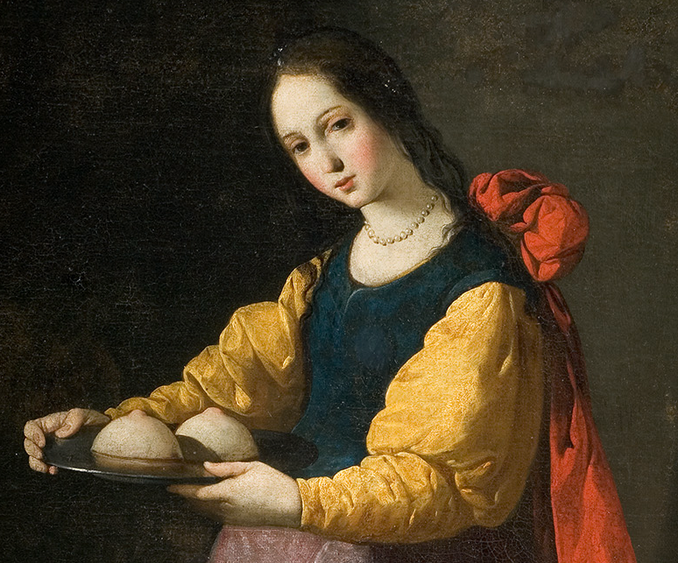
Saint Agatha, detail from a painting of Francisco de Zurbarán – she is carrying her severed breasts
She is a Sicilian Saint, who refused to sleep with a powerful Roman (Quintianus) in the third Century. St Agatha was imprisoned, tortured, had her breasts pincered off, and still refused to sleep with him and died in prison. She is remembered in Sicily by cakes shaped as breasts eaten on her feast day (I kid you not).
Minne di Sant’Agata, Sicilian (Wikipedia)
St Agatha Patronage
Her patronage springs from the usual mixture of deep and simplistic identifications. So she is ‘the patron saint of rape victims, breast cancer patients, martyrs, wet nurses, bell-founders, and bakers.’ As she is from Sicily ‘she is invoked against eruptions of Mount Etna.’ And therefore also against fire and earthquakes.’ (Wikipedia).
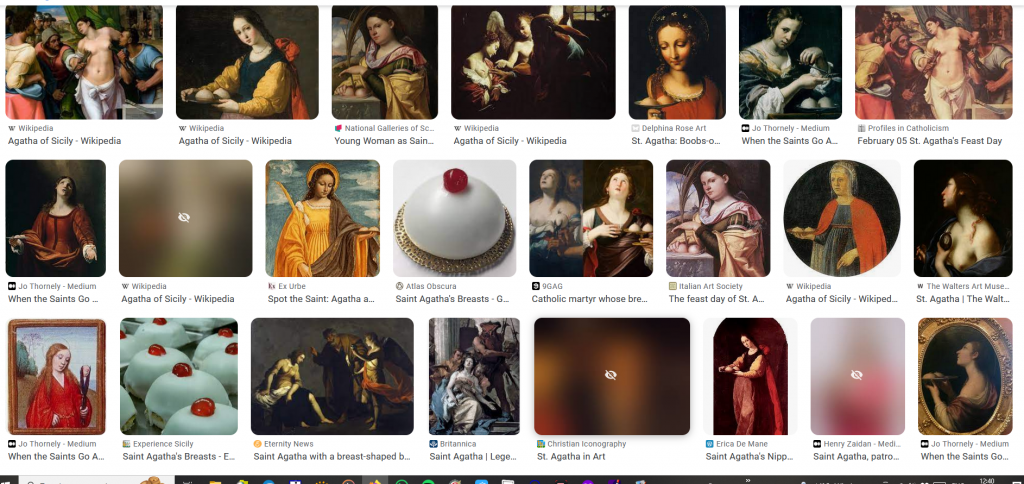
Bell Founders and Bakers? So, the bakers and bell founders, it is suggested, may have mistaken the trays of breasts as bells or loaves? Unlikely in my opinion, as Google image search shows they look clearly like breasts. They are cakes, of course, so that can help explain the Bakers, but the Bell Founders?
She was martyred, at the age of 20 (231-251AD), in the last year of the reign of Emperor Decius (Emperor 249 to June 251 AD). Thus, she is an early martyr whose cult was established in antiquity. But many of the details of her life and death are, as usual, apocryphal and from later traditions.
Results of a search for images of St Agatha in Google
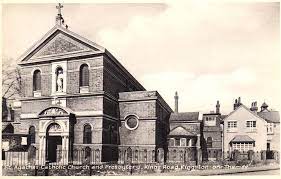
St Agatha’s Church, Kingston on Thames
St Agatha and Etna
Detail of a Portrait of St Agatha by Cariana (Paintedin 1516-17). In the backgrouns is Catania
A year after her death, Mount Etna erupted. According to the story, the Christians of her home town of Catania lifted the Martyr’s veil towards the flowing lava. And the City was saved as the lava flow stopped. Hence, she protects against eruptions and by extension, earthquakes, and fire. This part of the story I got from my friend Derek who sent me the link to a piece written by Father Patrick van der Vorst. This also has the full image of the detail of painting by Cariani I show here.
2 BC – Caesar Augustus is granted the title Father of the Country (pater patriae) by the Roman Senate. Ovid celebrated this day in his alamanac poet Fasti. He seems to be praising Augustus mentioning him with the divine Julius Caesar, and Romulus and Reamus, founders of Rome.
Book II: February 5: Nones
Now I wish for a thousand tongues, and that spirit Of yours, Homer, you who celebrated Achilles, While I sing the sacred Nones in alternating verse. This is the greatest honour granted to the calendar. My wit deserts me: the burden ís beyond my strength, This special day above all I am to sing. Why did I wish, foolishly, to lay so great a task On elegiac verse? This was a theme for the heroic stanza. Sacred Father of the Country, this title has been conferred On you, by the senate, the people, and by us, the knights. Events had already granted it. Tardily you received Your true title, you’d long been Father of the World. You have on earth the name that Jupiter owns to In high heaven: you are father of men, he of gods. Romulus, give way: Caesar by his care makes your walls Mighty: you made such as Remus could leap across. Tatius, and the little towns of Cures and Caenina, Knew you: under this Leader all the sun sees is Roman.
But suddenly the verse turns dark, and the references to Augustus are now slights and accusations. He continues:
You owned a little patch of conquered land: Caesar possesses all beneath Jupiter’s heavens. You raped married women: under Caesar they are ordered To be chaste: you permitted the guilty your grove: he forbids them. Force was acceptable to you: under Caesar the laws flourish. You had the title Master: he bears the name of Prince. Remus accused you, while he pardons his enemies. Your father deified you: he deified his father. Already Aquarius shows himself to the waist, And pours the gods flowing nectar mixed with water, And you who shrink from the north wind, be pleased, A softer breeze is blowing from the West.
Ovid only finished the first 5 chapters of his calendar poem. He was exiled from Rome by Augustus, we don’t know why. But perhaps this is why he was exiled, because he was willing to defame the Godly Tyrant, Augustus, who had destroyed the Roman Republic. Dictators demand flattery, not criticism. Ovid paid the price. For more on Ovid’s exile please read my post on his abandonment of the Fasti here.
1811 – The Prince of Wales appointed Prince Regent during his dad’s, George III, mental incapacity
1924 – The famous pips, the time signal, first broadcasted by the BBC from Greenwich
1944 – War time diarist, Joan Wyndham receives letter from Norwegian lover Hans Gundersen. It confirms he is still alive and that she loves him. Follow the link to read his drunken letter and Joan’s reaction.
1953 – Last foodstuffs taken off Rationing in the UK. From this day forward, people could eat as many sweets and as much chocolate as they wanted. In the War they were limited to 2oz per person, and post war 6oz per person per week.
1990 – the last pips broadcasted from Greenwich by the BBC, henceforth the BBC generated their own pips.
First published in 2024, and republished in 2025, Ovid section added 2026
John Constable. National Gallery of Art seascape with two sailboats. public domain
‘I am this morning, admitted a student at the Royal Academy; the figure which I drew for admittance was the torso. I‘m now comfortably settled in Cecil Street, Strand number 23. I shall begin painting as soon as I have the loan of a sweet little picture by Jacob Ruysdael to copy. Since I have been in town, I have seen some remarkably fine ones by him. …
Smith’s friend, Clanch has left off painting, at least for the present. His whole time and thoughts are occupied in exhibiting an old, rusty, fusty head with a spike in it, which he declares to be the real embalmed head of Oliver Cromwell. Where he got it, I know not.; ’tis to be seen in Bond Street at half a crown admittance.’
John Constable. Letter to John Dunthorne, 1799. From ‘A London Year. 365 Days of City Life in Diaries, Journals and Letters’ compiled by Travis Elborough and Nick Rennison.
John Constable in London
Constable would have had a short walk to the Royal Academy (in Piccadilly) from the Strand. As a painter, he subsequently spent his summers painting in Suffolk and his winters in London. When his wife became ill with Tuberculosis, they moved to Brighton. But he continued to return to London. Constable lived in a cottage in Hampstead, and is buried in the family tomb at the bottom of the graveyard of St John-at-Hampstead Church in Hampstead.
Royal Academy Photo KFlude
I don’t know what the Torso referred to was, but there was (and still is) a fine collection of plaster casts. The students used these for models.
A fine figure of the older man? Photo by K Flude of Zeus in the basement of the Royal AcademyPrint on display at the Royal Academy of students drawing the sculptures in the Collection. Photographed by K Flude.
Cromwell’s Head
As to the head, it is a fascinating tale, which I partly tell on my Martyrdom of Charles I post. here: But here is more details, relevant to the Constable quote. At the Restoration of Charles II Cromwell’s body was dug up. Then the head was stuck on a pole on top of Westminster Hall. It blew off probably in 1684. The head was on display at a museum, but then no one knows where it was until, in 1799 the Hughes brothers, bought ‘it’ for £230. It was exhibited in Bond Street. Entrance fee was 2 Shillings and 6p. Constable’s acquaintance Clanch who I think is actually John Cranch was the publicist for the event.
The display was not a success because the provenance was not clear. All Cranch could say was Cromwell’s head was the “the only instance of a head cut off and spiked that had before been embalmed; which is precisely the case with respect to the head in question”. But then Henry Ireton’s was also treated thus, and maybe others. A head is now in Cambridge, Sidney Sussex College, which Cromwell attended.
The Wikipedia page on Cromwell’s Head, here., has a very full description of its travels.
Weather Outlook
Feb fill the dyke Either black or white But if with white, ’tis the better to like
If February gives much snow A fine summer, it doth foreshow.
If in February there fall no rain. ‘Tis neither good for hay nor grain.
From The Perpetual Almanack of Folklore by Charles Kightly
On This Day
211 – Roman Emperor Septimius Severus dies at Eboracum (modern York, England). Leaving two sons, Caracalla and Geta, to dispute the succession. For several years York was the HQ for the Roman Emperor.
1555 – John Rogers, Vicar of the Holy Sepulchre Church in London and translator of the Bible, burned at the stake in Smithfield. The first of over 200 English Protestant martyrs condemned in the reign of Mary I. For more about Smithfield burnings see my post here.
1789 – George Washington unanimously elected as the first President of the United States. A great leader, who freed his slaves after his and his wife’s deaths, but who also evaded the rules against selling slaves. To consider the wrongs and rights of the issue look here.
1838 – ‘I walked with my daughter Charlotte across the Serpentine, much to my child’s delight, although I own I did not like to hear the ice cracking under the weight of thousands’.