Molly Bloomsday is a new festival, an offshoot in Derry of the Dublin based Bloomsday. Both are celebrated on 16th June which is the day on which the great book Ulysses by James Joyce is set (16 June 1904). It was published in 1922.
Bloomsday is named after Leopold Bloom and is an international festival celebrating Ulysses. Molly Bloom is her husband who has a soliloquy at the beginning of the book. The Molly Bloomsday concentrates on Molly and women’s literature. The Dublin version is a literary festival as well with people dressing up as characters from the famous book, readings, plays etc..
The Bloomsday Book
Joyce thought Odysseus was the only all-round character in literature. Not a one dimensional hero, but a man with a complex character, not always making the good choice. He based Ulysses, loosely, on Homer’s plot. The main characters, Leopold and Molly Bloom were based on Odysseus and Penelope. Stephen Daedalus was Telemachus, their son. Daedalus is Joyce’s alter-ego.
What makes the book so great is that Joyce was, with Virginia Wolfe, one of the first great Modernist writers. They used stream of consciousness from the characters’ points of view from deep in their heads. This is how Joyce describes Ulysses according to Djuna Barnes:
“The pity is … the public will demand and find a moral in my book—or worse they may take it in some more serious way, and on the honour of a gentleman, there is not one single serious line in it. … In Ulysses I have recorded, simultaneously, what a man says, sees, thinks, and what such seeing, thinking, saying does, to what you Freudians call the subconscious.”
Ulysses and I
My copy of Ulysses is very well travelled. I very often take it on holiday. I start on Chapter 1, and at some point before the end of the holiday I am still on Chapter. I stop reading. I’ve got past the beginning of Chapter 2 once.
Don’t get me wrong, I am fully convinced it is a brilliant book. It’s my best friend’s favourite book. So one day I WILL READ IT!
Modernism & the Steam of consciousness
When I first published this piece I made a terrible typo and talked about the ‘steam of consciousness’. So I republished it immediately so not to embarass myself for too long. But, actually, I quite like the sound of a steam of consciousness. But what could it mean?
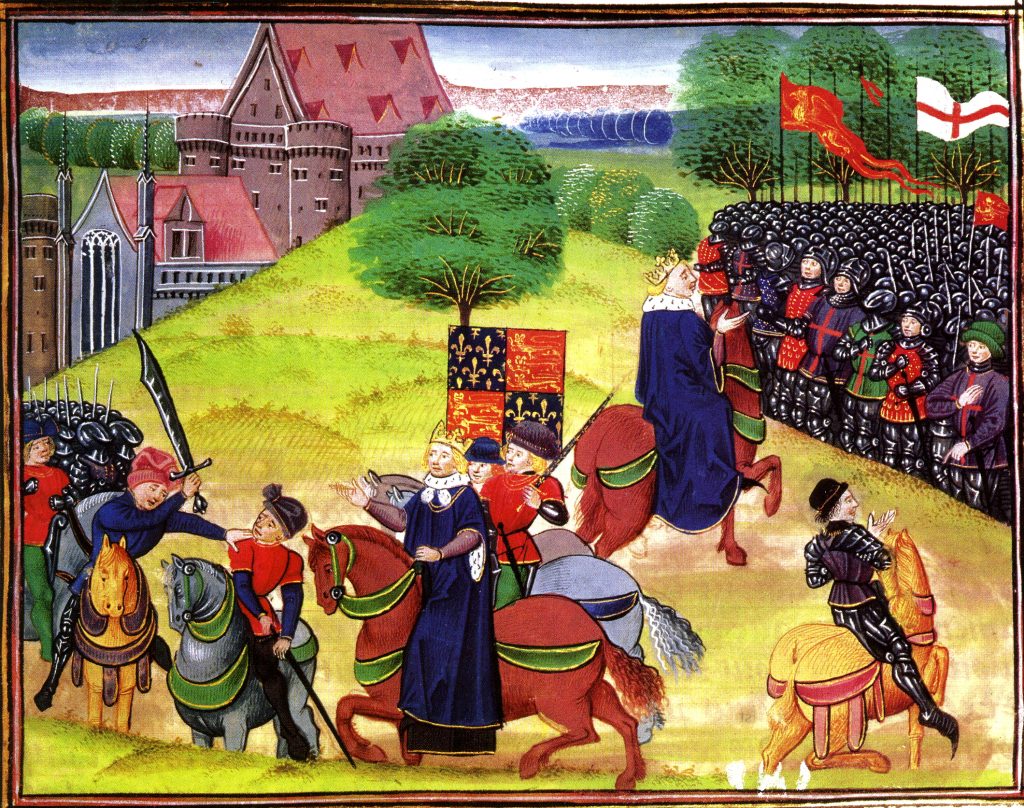
Smithfield & the Peasants’ Revolt. illustration from ‘Chroniques de France et d’Angleterre’, by Jean Froissart, c.1460-80. Walworth is showing killing Wat Tyler, King Richard is shown twice, first watching the death of Tyler, and secondly taking control of the Rebels
On the 15th June, King Richard went to pray at Westminster Abbey before the climax of Smithfield & the Peasants’ Revolt. He prayed at the shrine of St Edward the Confessor. A King who knew all about the sins Kings are forced to commit to rule an unruly Kingdom and could intercede on the King’s behalf in Heaven
The Peasants’ met at Smithfield, or maybe they had camped out there overnight. It was a big field where the livestock market was held. And where people were executed. Most famously Scottish patriot, William Wallace, who was hanged, drawn and quartered here on 23 August 1305. It was also used for jousting, and one of the streets off Smithfield is called GiltSpur Street.
The King, Smithfield and the Peasants’ Revolt
The King had agreed to meet the Peasants again. We don’t know how that was organised. The King turned up supported by a group of men who included members of the City of London Corporation including the Lord Mayor, Fishmonger, William Walworth. They seem to have worn armour under their clothes. The King’s Party lined up in front of St Bartholomew’s the Great Priory.
The rebels were on the other side of the field, presumably armed with the weapons and armour they had plundered from the Tower of London. It is not clear exactly what happened, and the sources are prejudiced against the rebels.
The Rebels demands were: the abolition of all Lords except the King; all bishops except the Archbishop; all monasteries except the Friaries and the replacement of the false House of Commons, with the True House of Commons.
Wat Tyler rode towards the King’s party. Got off his pony, spat out the wine he had been drinking, and ‘Hailed, Brother’ slapping the King on the shoulder. This was not normal court etiquette.
One of the King’s party shouted at Tyler that he was a thief and a murderer. Tyler drew his sword, and William Walworth struck him down, mortally wounding him.
Commentators speculate that this might have been part of a plan. To arrive seemingly without armour, to provoke a crisis, and disrupt the rebels.
The City’s part in the events in Smithfield is fascinating. City Merchants were not generally fighting men, but they seem to be the active group the King could rely on. Interestingly, there is no evidence that the Rebels attacked the Guildhall and destroyed the legal records. They attacked most important legal institutions in London, in the days before Smithfield. So why no attack on the Guildhall?
This surely must be because the Guildhall was protected by a competent military force. And it seems these are the same people who took on and defeated Wat Tyler.
In Smithfield, the Rebels didn’t know what to do. Is it possible the King’s party shielded the murder of Tyler behind a screen of people? So they didn’t know what happened and therefore didn’t know what to do?
For surely this was a moment of true danger. The Rebels would have had hundreds if not thousands in Smithfield, some at least well armed. Some must have been archers who would have been deadly. This is not that long after the Battles of Crecy and Poitiers, where the flower of the French Nobility was killed by the English Archers. Archers were normally rank and file soldiers, exactly the class of people supporting the Rebellion. Tyler was taken to St Bartholomew’s Hospital, where he died of his wounds.
In the moment of crisis, the King is said to have ridden forward on his horse and told the Rebels:
‘I will be your leader.’
And then he led them, like the Pied Piper of Hamlin, to their destruction.
He led them out of Smithfield into the field surrounding and told them they had their Charters so it was time to go home. And mostly they did.
The Execution of Treasurer Robert Hales and Chancellor Archbishop Sudbury on the Day the King met the Peasants at Mile End
To recap. On June 14th the 1381 Rebels have control of London. They are destroying any repository of legal records they can find. People are walking the streets dispensing street justice. Foreigners who speak Flemish are being beheaded. Enemies of the people are being dragged out of sanctuary and beheaded. Properties of the leaders of the government are being ransacked and burnt.
The King is in the Tower with his advisors, fearful that the Rebels will breach the defences. I would love to be a fly on the wall of that conversation. You would think it would go something like.
‘Sire. Your safety is paramount. We will leave the castle and draw off the rebels so you can go to a place of greater safety.’
What happened is astonishing. The Royal plan was to send the 14-year-old King Richard out to draw off the rebels so that the hated Chancellor of England, Archbishop Sudbury and the Treasurer of England, Robert Hales could slip away unseen! Putting the young boy king in the direct line of fire!
There are two explanations. Hales and Sudbury were arrant cowards. Or the King was very confident of his safety and despite his youth made his advisors accept his command. This was an age where young princes took adult responsibilities early.
The King left the Tower on horse back, accompanied by two half-brothers and his mother (and others). Their reception was hostile. We have eyewitness accounts of angry rebels pulling at the King’s bridle and that of one of his attendants from the City government. The King sent his mum and brothers back to the Tower as it was too dangerous. We can only assume the King sent them back sure that the peasants did not blame him for the mess the country was in.
He went to Mile End. His clerks set up tables and began writing charters freeing the peasants from feudal duties and turning their tenure into monetary rents.
As each village received its charter, many of the villagers went home. Back at home they sometimes attacked the people who had been manipulating the legal system, believing the King had given them permission to punish the guilty.
Whether the king believed in the justness of their claim or was just placating them to gain time, we do not know. But some historians believe that the young King was sympathetic to some of their claims, until older counsel made him change his mind.
Not all the rebels followed the King to Mile End, nor went home when their charters were sealed. It is thought Wat Tyler and thousands of rebels stayed at the Tower.
They saw the Archbishop of Canterbury trying to escape. They forced their way into the Tower. Here they jumped up and down on the Queen Mother’s bed, stole armour and weapons. Then dragged Hales, Sudbury, a Franciscan Friar (William Appleton, John of Gaunt’s physician), and John Legge, a royal sergeant to the scaffold at Tower Hill and beheaded them. Their heads were put on poles and paraded around town.
When the King left Mile End he couldn’t go to the Tower so he went to Baynards Castle, near Blackfriars. We also know that, the King’s cousin, Henry Bolingbroke was in the Tower. He was the son of the hated John of Gaunt. Years later, when he was King, he acknowledged the fact that a Londoner had been instrumental in saving his life in the Tower on the 14th of June, 1381. The man was fighting charges of stealing gold from the ransacking of Gaunt’s Savoy Palace. He was given a pardon.
That night rebels remained in London, and the king’s cause had been considerably weakened.
The Archbishop’s Head
You may wonder what happened to his head! Well, here is the answer!
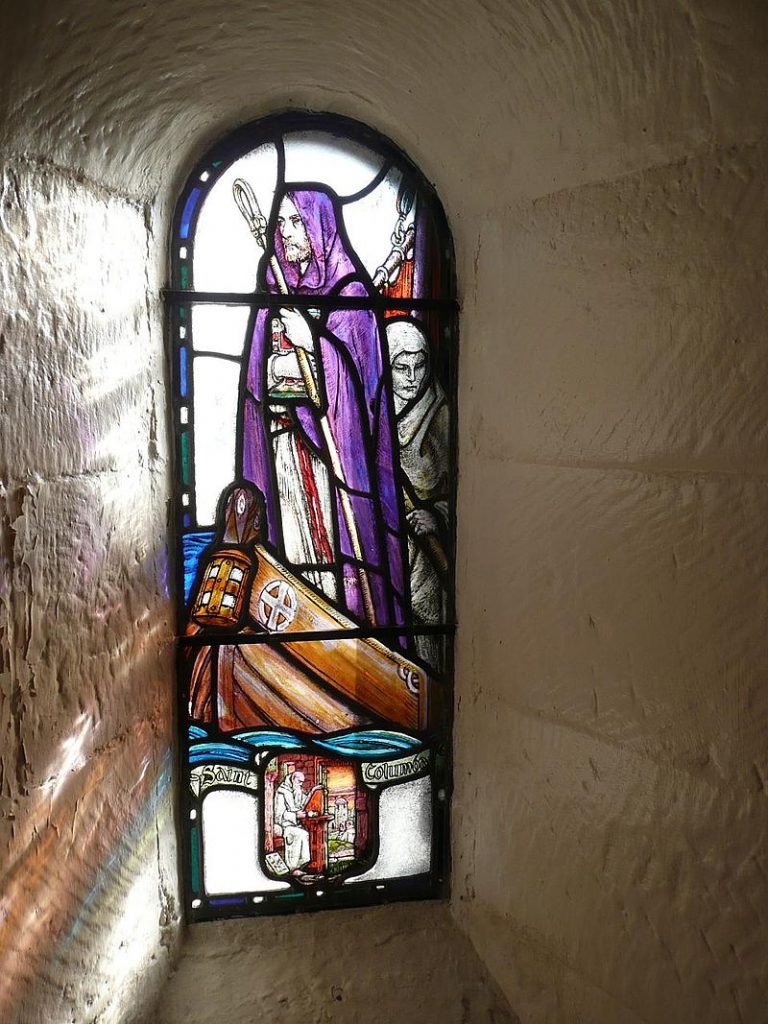
St Columba Stained Glass window in St Margaret’s Chapel Edinburgh Castle Photo by Graham van der Wielen Wikipedia CC BY 2.0
St Columba, or Colmcille is one of the most important saints for the early transmission of Christianity. He was born in 521 and said to be a descendant of the possibly legendary Irish King Niall of the Nine Hostages. (The Hostages were a token of Niall’s power over Ireland as they came from the five provinces of Ireland. These are Ulster, Connacht, Leinster, Munster, andMeath. The other four hostages represented Scotland, the Saxons, the Britons, and the Franks.)
St. Columba was sent at an early age to be brought up as a Monk, and went on to set up Monasteries in Ireland at Derry and Durrow. In 563, he left Ireland, possibly because he got involved in a dispute that had a deadly outcome. He went into exile to Scotland and set up the famous Monastery on the island of Iona, Inner Hebrides. This is off the coast of what would one day be called Scotland. At the time, it was under the control of the Kingdom of Dál Riata, which was, Gaelic, nominally Christian, and controlled parts of Ulster and Western Scotland.
From Iona, Columba led the conversion of the Picts to Christianity. The Picts were Britons, speaking a different dialect of Celtic than the Gaels of Ireland and Dál Riata. Their name is said to have been given by the Romans and meant Painted Men. A shared religion, which St Columba brought from Ireland, helped towards the eventual union of the Gaels, the Picts and other British groups into the Kingdom of Alba. Alba is the Gaelic name for Scotland – meaning white, and from which we also get Albion. Alba became Scotland, which is derived from the Roman word for the area which in Latin was “Scotia”. Iona became the traditional burial place of early Scottish Kings such as Macbeth (Mac Bethad mac Findlaích). These Kings were crowned at Scone and buried in Iona. Alba was also able to take territory from the Anglian Kingdom of Northumbria, namely, the Scots-speaking areas South of the Firth of Forth. (Scots being a dialect of English). There were also Norse settlers in the Ireland so Scotland was made of a coalition of Gaelic, Brittonic, Norse and English speakers.
St Columba and the Loch Ness Monster
Much of the events of this part of Columba’s life are recorded by St. Adamnan in The Life of Saint Columba. This was written in the 7th Century, much of which is apocryphal. One notable story tells how he came across a group of pagan Picts who were mourning a child killed by a monster in the River Ness. St Columba revived the child. He then sent one of the Brothers to swim across the Loch to fetch a boat. The “water beast” pursued the Monk and was about to attack him when St Columba told the monster to stop. So it did, retreating to the depths of Loch Ness. Thus began the legend of the Loch Ness monster.
St Columba died in 597AD. Iona continued to prosper and in, 634 sent St Aidan from Iona to found the Monastery at Lindisfarne. The island is on the Eastern coast of Britain in the Anglo-Saxon Kingdom of Northumbria. This Kingdom of the North Angles, was one of the most powerful at the time and Lindisfarne was instrumental in its conversion. The tradition of evangelism took hold in the British Isles, and it was from here that much of the German-speaking world was converted to Christianity.
This is St Columba’s legacy.
Northumbria’s Contribution to the development of Christianity
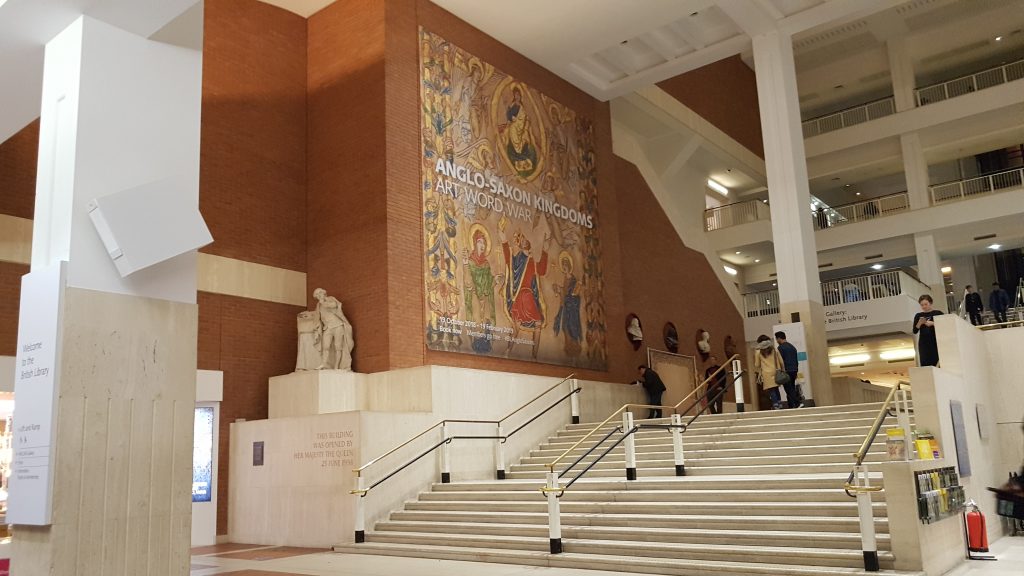
There is a developing understanding among scholars that this Irish inspired form of Christianity, fused with the Anglo-Saxon Northumbria took a leading role in ritual, art, scholarship in the Roman Catholic world. Just stop and think about that sentence for a moment. The northern parts of an out of the way set of islands off the edge of Europe took a leading role in the development of Western Christianity. This was highlighted in a recent exhibition of Anglo-Saxon art at the British Library.
British Library with Poster for Anglo-Saxons Kingdoms Exhibition, Photo K Flude
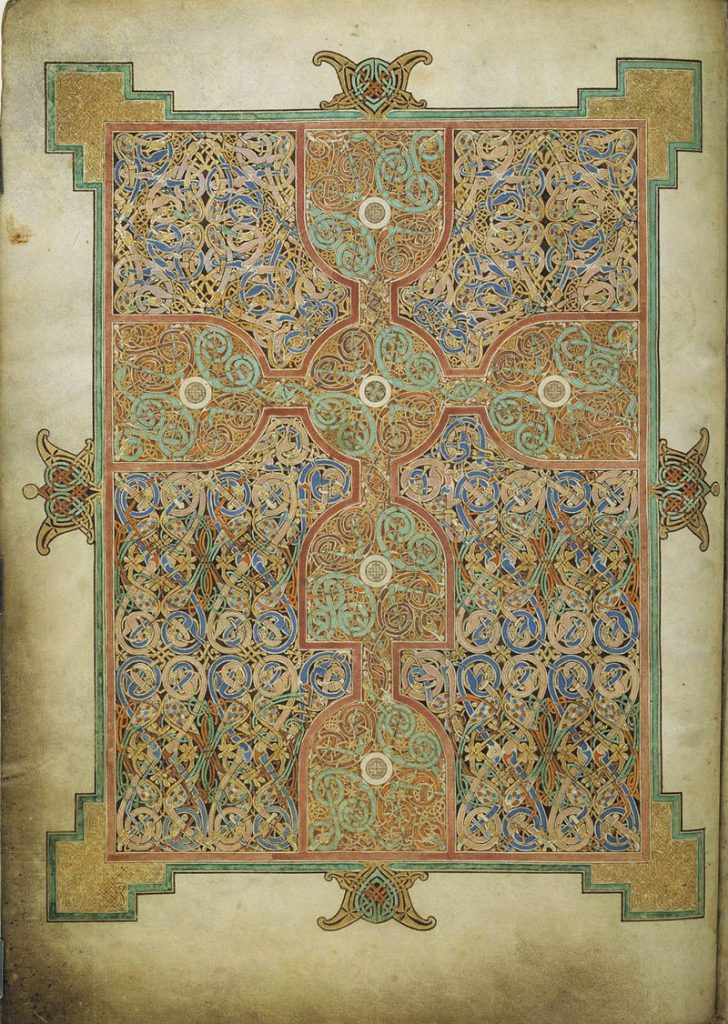
A look at the Lindisfarne Gospel and the Book of Kells showcases the amazing art of this period. For a real treat, look through this scrollable virtual copy of the Lindisfarne Gospel. (Currently this is unavailable, I suspect since the BL was hacked. So instead, here is a slightly breathless online introductory video of the Gospel.)
The Book itself has been missing from the displays of the British Library for a couple of years, but was on display in Northumberland in 2022. I’m not sure whether it is yet back on display at the British Library. I think not. You can see the Book of Kells at Trinity College, Dublin or look at their online offering here: Not quite as joyous an experience as the online Lindisfarne but beautiful enough.
Carpet Page from the Lindisfarne Gospel Photo Wikiepedia Eadfrith – Lindisfarne evangeliarium, tapijtbladzijde op f26v, Matteüsevangelie
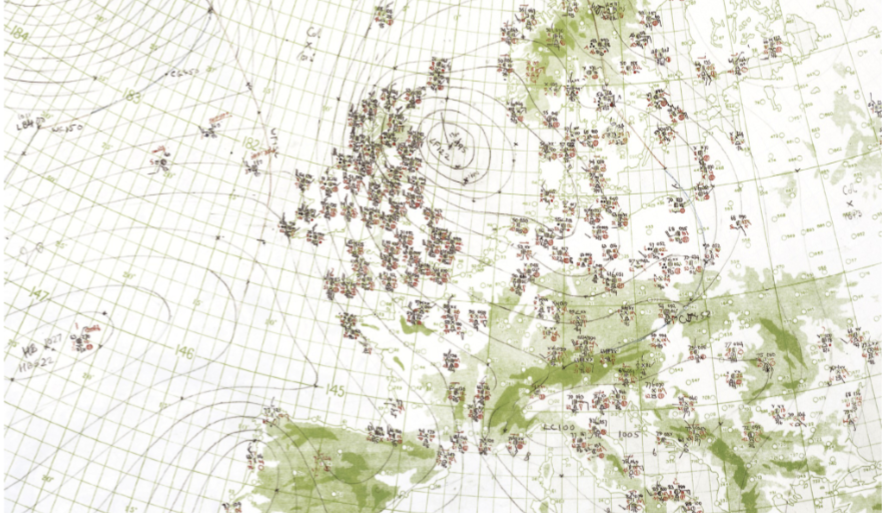
North Atlantic chart of weather for June 6th 1944. D Day. Showing occupied Europe with observations obtained from the enigma machine
In 2014 or thereabouts I went to a play by David Haig which was based on the true story of a weather forecaster’s role in D Day. James Stagg’s advice was that the weather on June 5th, the intended day, was too volatile. He suggested the 6th June 1944 instead.
The play was called Pressure and was great because it really conveyed the enormity of the decision that Ike, Churchill and others had to make. To go ahead in bad weather risked enormous casualties and the failure of the Landings. To postpone, might mean Hitler discovered the location of the invasions and might lead to disaster.
Major characters portrayed in the play included Ike and his driver, Kay Summersby with whom he was very close. Also depicted was an American forecaster who disagreed with the British meteorologist James Stagg. How much of the play was for dramatic effect and how much is true, I’m not entirely sure but it is a fascinating D Day story.
The maps were hand drawn and partially based on intercepted data decoded by the enigma machine. Stagg recommended postponing the landings one day from the 5th to the 6th of June, when it was hoped the ideal combination of calm seas, low water at first light and a full moon would occur.
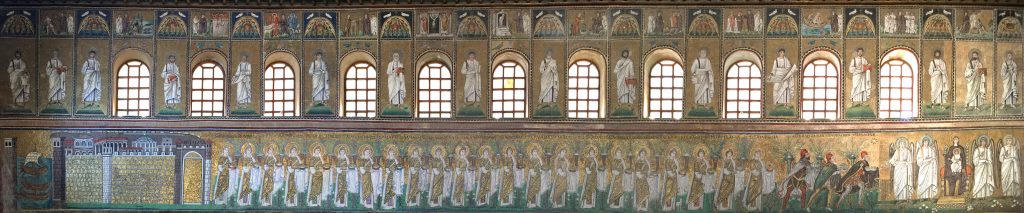
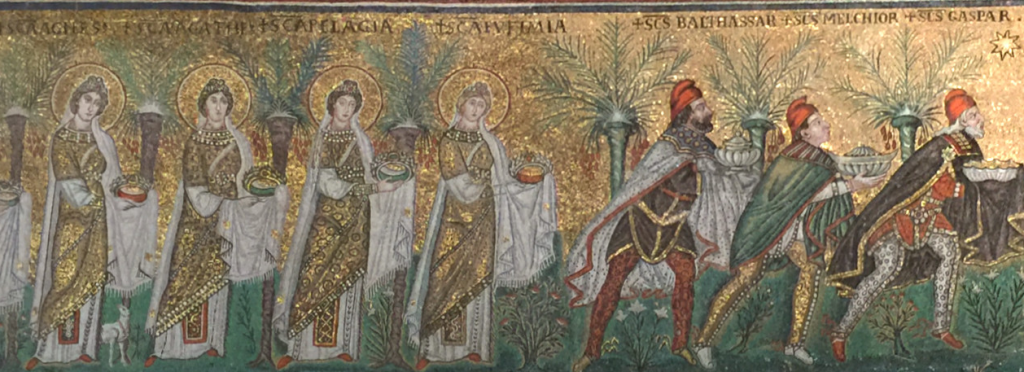
Procession of female saints leaving Classis (bottom left) behind the Three Kings heading to the Virgin Mary (bottom right between four angels). Basilica of Sant’Apollinare Nuovo (pic. Wikipedia)
Today, I am in Ravenna. One of those places where the history brings gasps of amazement. To honour my visit, I thought I should roll out last year’s post. This is what I said:
When I revised my Saint Agatha post (link see below), I felt I needed an early image of Agatha. After all, her cult spread early on, and therefore, was likely to be genuine.
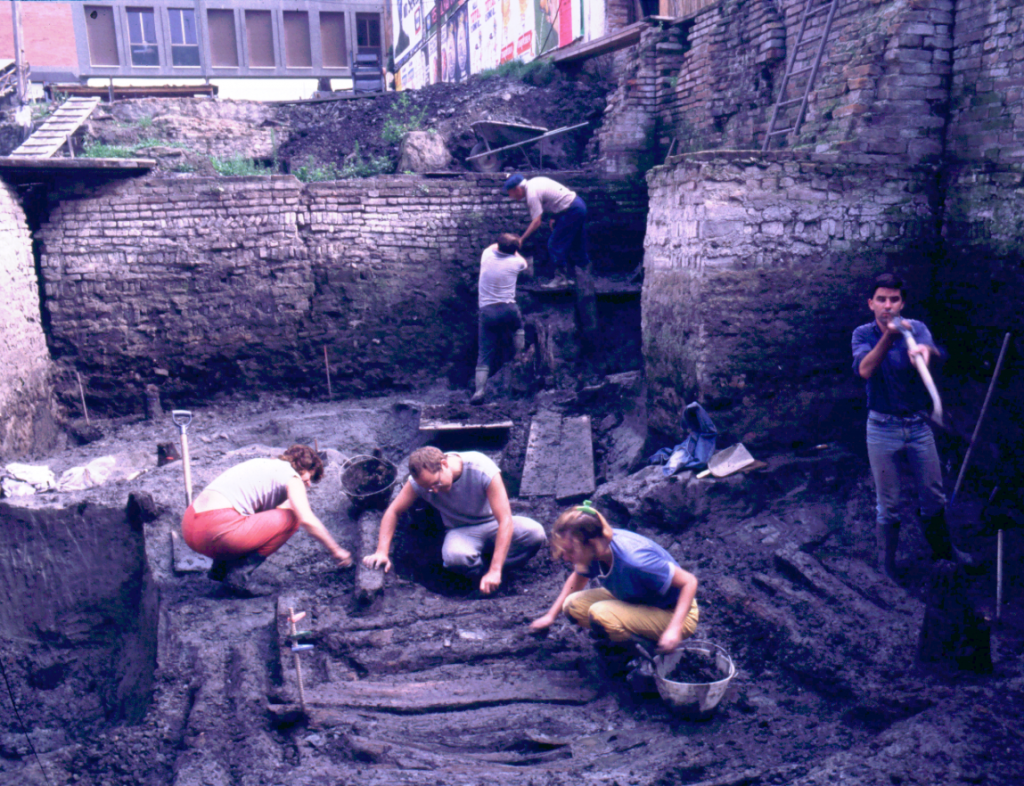
As I started to track down her image I was led, with some joy, to one of the most amazing Churches in the wonderful town of Ravenna. I visited the Basilica of Sant’Apollinare Nuovo with some wonderment when working as an archaeologist at Ferrara, in Emilia-Romagna. Forty Years ago.
I found out that Agatha was one of 22 female Saints on one of the walls of the Church. I discovered a pretty comprehensive description of the Church. As I looked at it, I noticed the record was made by, or involved, Professor Bryan Ward-Perkins. He was the Director of the site my friends and I worked on in Ferrara! (And I met him again last night, 2025 for the first time in years! We had dinner with fellow archaeologists, and Bryan was talking about the work he did on the Saints of St Apollinaire.)
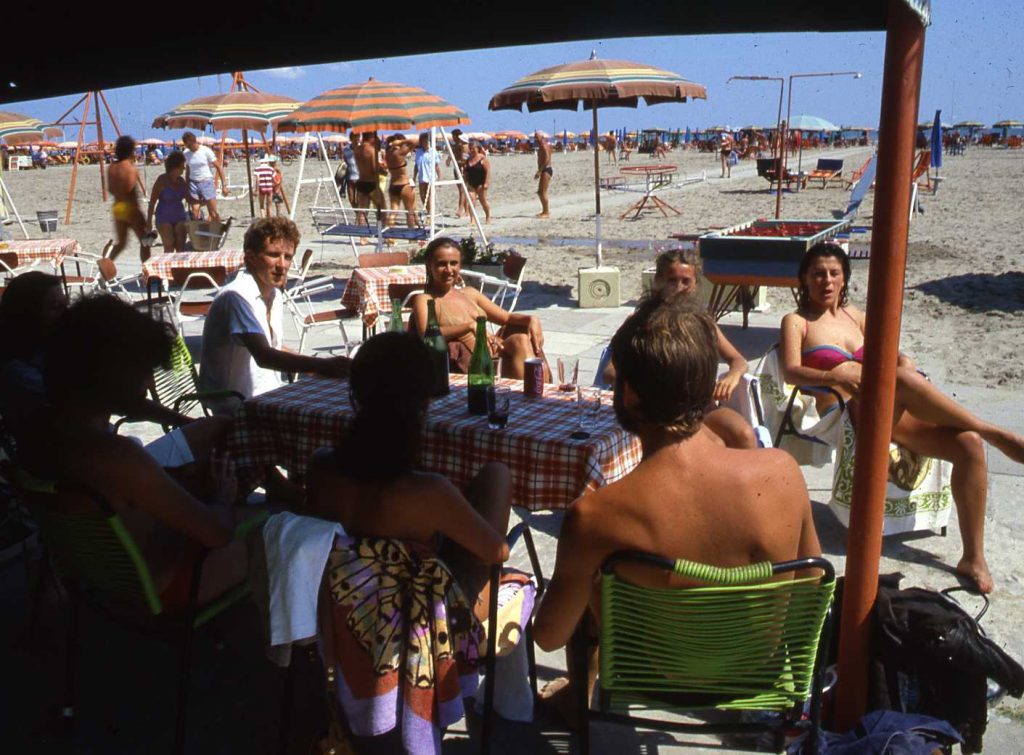
Medieval Excavation in Ferrara. The author is in the centre of the photo,
Ravenna
I’m guessing Bryan suggested we visit Ravenna on one of our trips to the beach at nearby Rimini. Ravenna was so awesome because the City became the capital of the Roman Empire in the West. It took over when Rome fell, then it was part of the Ostrogothic Kingdom, then of the Byzantine Empire. It spanned the period of the Arian Heresy.
And so, it was provided with some of the great glories of 5th and 6th Century Architecture. These include the Mausoleum of Galla Placidia, the Neronian Baptistery, the Basilica of Sant’Apollinare Nuovo, the Arian Baptistery, the Archiepiscopal Chapel, the Mausoleum of Theodoric, the Church of San Vitale and the Basilica of Sant’Apollinare in Classe. It’s hard to overestimate the impact on a young British archaeologist of seeing 5th Century buildings with roofs and astonishingly detailed mosaics still intact. Please visit!
Detail showing the first four female saints behind the Three Kings. Basilica of Sant’Apollinare Nuovo wikipedia
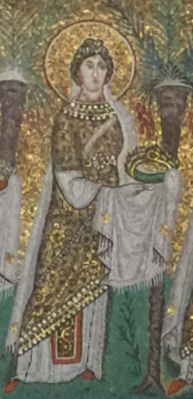
Bryan Ward-Perkins description says ‘All the saints are haloed, bear crowns and are dressed in elaborate court dress. Unlike the men …., all have essentially the same youthful features. The only saint with a distinguishing attribute is Agnes, who is accompanied by a lamb.’ The men are given some personality, some have white beards others are youthful. While all the female martyrs are, essentially young virgins, and cannot be distinguished from each other. St Agatha, the list says, is the Saint next to Agnes with her lamb; the third in precedent. You can see her above and in detail below.
St Agatha Basilica of Sant’Apollinare Nuovo wikipedia
Motorcycling from Ravenna to Inferno
Enough of the sublime! Now for the ridiculous. Whether on this visit or another, we decided to have a day at the beach at Rimini. After the day on the beach, a collective decision to stay over was made. The reason was to go to one of the big clubs (did we still call them discos?) probably to dance to ‘Frankie Goes to Hollywood’.
Archaeologists, Italian and English, on the beach at Lido di Spina
However, the hotels were all full. So I decided, late at night, to go back to Ferrara, on my own on my 175 cc Yamaha motorbike.
My Yamaha 175cc bike looked something like this but was red. A thing of underpowered beauty.
Thing was, I had started the day in Ferrara in the blazing Italian summer heat. So, I had hopped onto my bike dressed in shorts and t-shirt. Ferrara was 77 miles away (says google). One hour into the trip back, I was getting pretty cold, and really not enjoying driving through the lonely countryside. Therefore, I decided to pull off the main road to find a rural hostelry for what remained of the night.
Now, I remember this very vividly – the only likely road I could find was signposted to ‘Inferno’. I shrugged my shoulders, wondering what that was about, and drove towards it on a very deserted road. Eventually, I came to a sign which told me I was about to enter ‘Inferno’.
There was something very surreal about the situation. My courage failed me! I was not going to stay in a ‘motel’ in a place called ‘inferno’! I had seen too many horror films set in Motels and one in Inferno seemed madness. So, I turned round and continued my cold journey to Ferrara.
Inferno
Whenever I tell this story, I have some doubt about it. Did I really drive into a place called ‘Inferno’? But I have, for the first time, checked Google. It tells me that the road off the Rimini to Ferrara road goes through somewhere called: Vicolo Inferno, 40026 Imola BO, Italy.
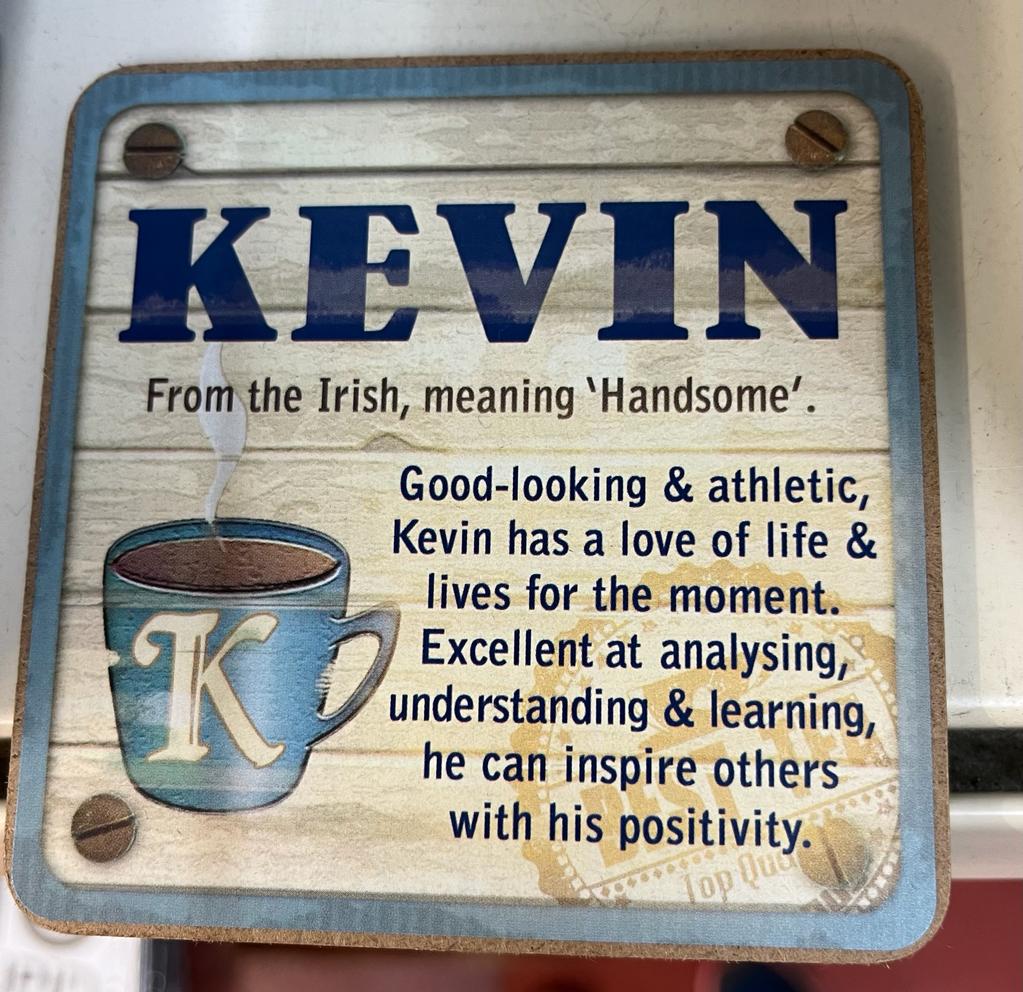
Thank you very much to my subscriber for alerting me to St Kevin’s Day which is my Saint’s Day. I was aware of St Kev and that the name meant ‘of noble birth’ but that’s was the extent of my knowledge.
But a little research on Wikipedia while on the train to visit my Dad, revealed that Kev lived to the grand old age of 120, born in 498 and died in 628. As my Dad is 97 and still going strong, maybe he and St Kevin will inspire my longevity?
Briefly, St Kevin met the great St. Columba; had a poem written about him by the marvelous Seamus Heaney (https://poetryarchive.org/poem/st-kevin-and-blackbird/); a song by the Dubliners; several mentions by James Joyce and a long distance path, the St Kevin’s Way, part of the Camino de Santiago network, named after him. And St Kev can help us understand the weather for the rest of June :
‘The weather on St Kevin’s Day will last all month‘.
So that means uninterrupted sun. At least in Ravenna where I currently am.
Live recording of Dubliners’ Song about St Kevin
Coemgen, as he is known in Irish, was a hermit, living in a cave-like ledge above a lake. His piety attracted followers and a monastic settlement. He was known for his ascetic life and love for nature. So, a role model for all us Kevins?
His hagiography was written very late, so little of it can be confirmed. But, like other saintly hermits, he is associated with being tempted by women or the devil disguised as a woman. (St. Anthony the Great, St. Benedict of Nursia, Saint Chrysanthus, St. Vitus, St. Bernard of Clairvaux, St. Hilary etc.) Unfortunately, rather than just resisting his temptress, Coemgen is said to have drowned her. Not so good!
On the other hand, my sister sent me this photo of a souvenir from a shop in Northumberland.
That’s more like it! And oh so true! Clearly we, handsome, clever, positive, analytical Kevins have a lot going for us, despite the name.
For more on the Temptations of Hermits read this article:
Nechita, Andrea.“Offering Body, Pleasure, and Wealth: The Visual Representation of Women Tempting Saints (Fifteenth and Sixteenth Century).” Annual of Medieval Studies at CEU, 20 (2014): 96-112. For a summary, and some tempting illustrations, look here.
This post sprang from something that my grandson said to in the middle of the park. He was curious as to why I was concerned that the park toilets were out of action. He told me I could, like him, just pull down my trousers and wee, right here, right then, up against the tree in the park. My attempt at explanation drew a perplexed, ‘What?’ ‘What?’ is his new word. After an explanation, his next word is invariable another ‘What?’.Hopefully the relevance of this will become apparent.
May and June are the most prolific months for dandelions, which used to be known as ‘piss-a-beds’. They are diuretic and were often eaten, and so might well have consequences for the young trainee child.
John Hollybush in his 1561 ‘The Homish Apothecary’ says:
‘When a young body does piss in his bed either oft or seldom: if ye will help him take the bladder of a goat and dry it to powder, and get him to drink with wine, or else take the beans or hinder fallings of a goat, and give him of the powder in his meat morning and evening, a quarter ounce at every time.’
(quoted in ‘The Perpetual Almanac by Charles Kightley)
Hinder fallings are what falls out of the hind-quarters of a goat. I’m not sure even an indulgent Grandparent is allowed to give droppings and wine to the little ones. Nor can I find any mention of goat products in modern medical recommendations. So I won’t be recommending this as a practical aid.
Medically, dandelions were very well regarded. Mrs Grieve’s ‘Modern Herbal’ reports that it are diuretic and a general stimulant to the system but particularly the urinary system. They were good for liver and kidney complaints; gall-stones; and piles. They were considered excellent to eat and drink. Particularly, dandelion sandwiches using young leaves, with salt, pepper, and lemon juice. They were also taken in salads, teas, and beers.
We used to blow the seeds from the dandelion seed head saying ‘She loves me. She loves me not’ at each blow, until the truth was revealed.
First written in June 2023, revised june 2024,2025. Rewritten 2025
Of course, the real news today is a new Pope and the 80th Anniversary of Victory in Europe Day. But, I can let other media covers those stories. (But more on VE Day below.)
Helston Furry Dance
At the end of the May Day/Beltane Festival, Helston in Cornwall holds its Furry (or Floral) Dance. It is normally on the 8th May. But it changes date if the 8th is a Sunday or a Monday (Helston’s market day). But it isn’t. So the Floral Dance was held asusual on the 8th May.
Padstow holds, perhaps, the most famous May Day festival on May 1st. Padstow feels more of a ‘pagan’ festival, while Helston is a more sedate, gentlemanly, dance. Padstow is more fuelled by a belly full of ale, while Helston by a Pims No 1, or a Gin and Tonic?
Do, have a look at both youtube videos and watch the Padstow one until at least you see the ‘obby ‘orse and the teaser dancing.
Children born between the two days, May 1st and May 8th are considered to have been ‘born with the skill of man and beast and power over both.’
On This Day
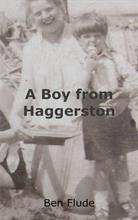
1945 – Victory in Europe Day. Official end of the War in Europe with the definitive surrender of Nazi Germany to the Allies, signed by Field Marshal Wilhelm Keitel in Eisenhowers HQ on 8 May 1945 (VE Day). Churchill broadcast the official end of the war at 3pm. In 2025, it was the 80th Anniversary of the defeat of Fascism. A truly significant date with a diminishing number of veterans and eye witnesses surviving to carry the torch. My 97 year old Father is one and he went to London to celebrate that magical day when the war in the west was over. this is what my dad wrote in his recently publish autobiography ‘A Boy from Haggerston:
At last, the War in Europe was over. This day would forever be known as VE day. Both my grandparents had survived the Blitz and only Uncle Charlie’s (my dad’s elder brother) two sons had lost their lives – Charlie died at Salerno and is buried near the beach in the war grave, and Jimmie died, aged 18, at the battle of Reichwald Forest, and is buried in the war grave in the forest. According to David Warren, who is now a battlefield tour guide, received information that Jimmie was reported by the Commanding Office as a typical bright Cockney lad.
Following the end of the war, we were then introduced to images of the emaciated prisoners in the recently freed concentration camps in the newspapers, and in the Pathé news broadcast at the cinema. The terrible news that the Nazis killed millions of Jews in an attempt to wipe out the Jewish race in occupied Europe, spread to a horrified world. This vile campaign is now known as the Holocaust, but is more precisely described as ethnic cleansing.
Jean and I went up to London for VE Day and later also for the VJ Celebrations, where there was singing and dancing in the streets. We went by train to Waterloo, and then walked to Piccadilly. We went with our friends Esther and Bob. It was a great time.
Front cover of ‘A Boy fomr Haggerston’ by Ben Flude
Now, it is up to us and the young to stop such a war ever starting again. What we know is that the vast majority of us don’t want war, but somehow we let it happen. That is our task how to create a world where war is unthinkable.