A perpetual almanac of the Year. Folklore, Customs, Myths, Legends, Religions, Ceremonies. Calendars, How the year, months, days, hours, minutes work. Who started them. How different societies have different arrangements. Zodiacs, Seasons, Folklore, Gods and Goddesses. Its all here day by day.
My WordPress system decided to publish my notes upon the Parrot rather than reminding me to finish off the page. So, here is the updated post again.
The Parrot was republished for free on August 4th 2024 by the York St Johns University Critical Editions team, and they have enabled you to get your free copy by following the link at the bottom of the post.
Published in 1746 ‘The Parrot’ by Elizabeth Haywood was a satire on the male-dominated London Society of the time. It was published in 9 parts. The name comes from the viewpoint from a Parrot’s perch in a wealthy London house. The Parrot is an enslaved creature that has travelled the world, observer to its follies. The bird wonders why people should dismiss opinions simply on the basis of A Parrot’s green colour.
The introduction to the author by the team says:
‘Eliza Haywood (c. 1693-1756) was one of the first generation of writers to “live by her pen.” Throughout her career, Haywood adopted many roles: she was an actress, playwright, novelist and prolific essayist.However, she always used her platform to celebrate and advocate for women.‘
I’ve been taking groups around Britain from London to Edinburgh and have fallen behind on my postings.
So, I am going to post a few posts today to put them on my Almanac of the Past. They will be brief, and will be worked up for a re-publication in greater length next year.
Archaeological Discoveries at Elverton St. Westminster
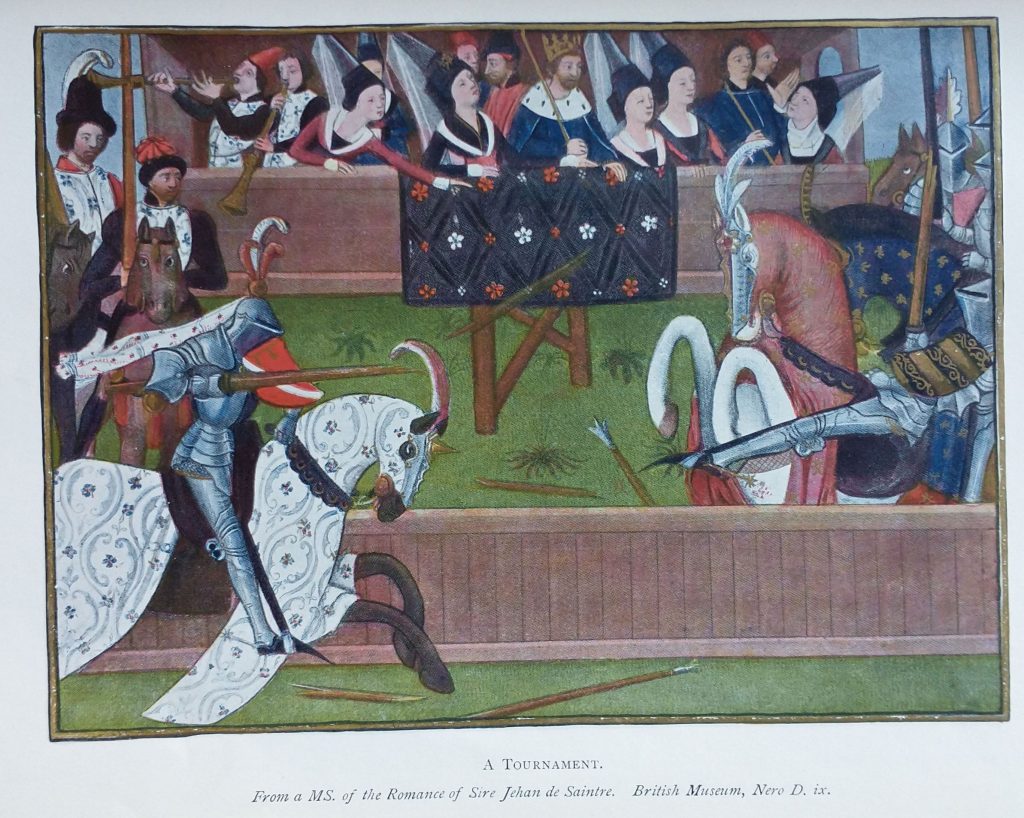
Near the site of the medieval jousting arena in Westminster, London at Elverton St, archaeologists, nearly 30 years ago, excavated a Cemetery which contained the remains of horses. The University of Exeter has recently revealed the results of their analysis of the horses’ bones. The 15 animals studied were found to be above average in height, and marked by a life where they had been worked hard. Analysis of their teeth suggested they came from as far afield as Scandinavia, the Alps, Spain, and Italy.
Three of the animals are the largest found in England at the time. The findings suggest they might be from a Royal Stud farm, providing war, jousting or hunting animals for the elite.
I have just come back from my very first Leap Year Walk, which I gave tonight for London Walks. It was one of a series of my walks, which are about the year through London’s History. So far, I have done, a New Year Walk, an Imbolc Walk (1 February, St Brigid’s Day), a Spring Equinox Walk, a May Day Walk, a Summer Solstice Walk, an Autumn Equinox Walk, a Halloween Walk, and a Winter Solstice Walk. All, at their core, have the subject of the year, how it is arranged, and celebrated in different cultures and different times in London.
I hoped to get this post done, today, but on arrival at home my burglar alarm was ringing, so had to get an emergency electrician out to pacify my neighbours, and tracking down the fault meant turning my house upside down. I rushed it out, with many bad proof reading errors and ommissions, And have now, on the dawn of a new month, and a new Season, updated it. Probably, knowing me, it still has a far few errors! Now, I am rushing to look after my Grandson!
So, the reason there is a leap year, is that the Sun and the Moon have different cycles, which cannot be easily aligned. And secondly, the solar year is not a fixed number, it is not 365 days, but 365 days and a bit.
Originally though, probably, most cultures lived their lives with time keeping controlled by time markers from their everyday environment, days and nights, the waning and waxing of the moon, the seasons, and the changes in the rising and setting of the Sun. Budding nature would have provided other markers as to when to sow, to harvest, to prune, to slaughter, to worship and marry.
The months were given by the cycle of the Moon, which also gave us tides and menstrual cycles. The months were given names, which were often associated with the weather. The trouble was that the Solar year did not align with the Moon, soon the months would get out of kilter with the seasons. So over time, the society would find it was winter in June, or summer in December. (which is OK if you live in Australia).
Society dealt with this in a number of ways. It could be ignored, why shouldn’t it be cold in June, why should June always be in Summer? Another way was to add in extra days, or months, every so often to make sure June remained in the Summer. This is what Egypt, the early Romans and the Celts did. They kept their months aligned to the actual movements of the Moon, and aligned their Solar Year with it by the addition of extra days or a month or two. or a combination of both.
I reported on this in my post on the Terminalia for February 23rd. As I wrote:
Terminus was an old ancient God who was the God of the boundary, the border, the edge, the liminal God. February was the last month of the original Roman year, but the rulers of Rome added an intercalary month every so often, called Mercedonius in an attempt to keep the Solar year in tune with the seasons. And when the intercalary month was added, the last five days of February were given to Mercedonius and the resulting leap year was either 377 or 378 days long.. So, in those years, the 23rd of February was the Terminus of the year. (For more on Terminalia look at my post for February 23rd on Terminalia-god-of-the-boundary)
Now, as the Roman Republic became more sophisticated, the intercalary months were added at the direction of the Pontiffs, supposedly every two and sometimes every three years. But the Pontiffs were often swayed by political advantage, and by the time of Julius Caesar the seasons had got wildly out of sync with the calendar year. The Dictator, therefore, instituted ‘the Year of Confusion’ which was over 400 days long and brought in the Julian Calendar which realigned the calendar back in line with the seasons.
Caesar spent time with Egyptian Astronomers, trying to understand their solution to the problem. They identified that the year was not 365 days long but 356.25 days, so JC ‘fixed’the issue with a leap day every four years. Based on the almost correct calculation of a solar year being 365.25 days. The new calendar was inaugurated on the Kalends of Januarius 709 AUC, or as we would call it I January 45 BC. It became, in time, something the Romans were very proud of – rationalising, measuring, time itself. Romans counted their dates from the time their City was founded by Romulus in what we call 753 BC or 753 BCE. So, 45 BCE in our reckoning is 709 ab urbe condita (AUC ‘from the founding of the City) as the Romans saw it.
I prefer not to use BCE because it seems ‘dishonest’ to me. The idea of AD BC was made up based on a guess as to when Jesus was born. Changing BC to BCE may rid the date of an explicit Christian identification but masks the fact that there is no such thing as the ‘Common Era. What the Common Era is, is the idea made up in the Late Roman period guessing when Jesus was born/ So I think call a spade a spade, even if it’s a broken meaningless spade that is not fit for purpose, either replace it with something rational, or real or call it what it is.
The interesting thing is that Caesar put the leap year in on the 24th February. Why? Because February, being the month of death, was the end of the year. March 25th was originally the beginning of the Roman year (Caesar moved it to January 1st). Why March 25th? Because it was the Spring Equinox. If you look at my post for March 25th you will find out it is the date of the creation of Humanity, the Birthday of Adam, the conception of Jesus, and until 1752, the day the year number changed in Britain.
The other strange thing about the new leap day was that it was not called February 25th. It was not given a number. Rather, February 24th was two days long. This continued in Britain until the date February 29th started appearing in calendars in the 15th Century, although the legendary Lawyer, Edward Coke (1552 – 1634), refers to the two days of February 24th, but the two day 24th was completely replaced by February 29th in the 16th Century.
One slight complication to the story of February 29th was that February 29th did exist before the Julian reforms. When February was not interrupted by the intercalary month, as described above, it was 29 days long. Julius Caesar made the months alternate 30 and 31 except for February which was 29 days long. When the Senate gave Julius the honour of having the 7th Month named after him, things were OK, but then Augustus wanted the same thing. The Senate duly gave him the next month, which became known as August, but it only had 30 days. This could not be allowed! So they made it up to 31 and stole the 29th from February and made February only 28 days long. This change also meant that there were now three 31 days months in a row, so they reduced September from 31 to 30, boosted October to 31, reduced November to 30 and boosted December to 31,
Hence, we can no longer remember Caesar rational allotment of days in the month, and we need to hum to ourselves:
Thirty days have September April, June, and November February has twenty-eight alone. All the rest have thirty-one. Excepting leap year – that’s the time When February’s days are twenty-nine.
But Caesar had not solved the problem of the shifting year, he had just minimised it. By the Council of Nicea in the early 4th Century (and not yet called AD!) the small error had changed the date of the Spring Equinox, from March 25th to March 21st. So, when Constantine convened the Council to bang the heads together of the Church leaders to unify their religion, particularly in regard to the date of Easter, and whether Jesus was equal to God. They fudged the complex issue of the date of Christ’s death, and used March 21st as the foundation of their calculation on the moon-based festival of Easter (more of which at Easter!)
It wasn’t until the 16th Century that Pope Gregory, solved the problem of the inaccuracy of Caesar’s solution, by introducting the Gregorian Calendar, for which see my post here.
Archaeology discoveries. The Image is a sketch of the ‘Facial Reconstruction, Impossible Factual/BBC’
Interesting Archaeology discoveries.
The following discoveries were reported in Salon IFA the newsletter of the Society of Antiquaries of London in Salon: Issue 526 7 February 2024, which you can see here:
Pliny the Elder’s Villa found near Vesuvius?
The 1st Century seafront villa, with views of the Bay of Naples and of Mount Vesuvius, has been excavated at the town of Bacoli, which was the port of Misenum. Pliny commanded the fleet as ‘Praefectus classis Misenensis’. Pliny tried to rescue his friends and family, ignoring warnings saying ‘Fortune favours the brave’, ‘Audentes Fortuna luvat’. It didn’t and he died, at Stabiae, by toxic fumes. Read more about the villa here:
Face Reconstructed for a Victim of Roman Crucifixion
A male skeleton found, 4 years ago, in a Roman cemetery in Fenstaton in Cambridgeshire was found with a 2-inch nail through his heel bone. BBC 4 has made a documentary about the recent reconstruction of the man’s face by, as Salon reports it:
‘US forensic artist Joe Mullins, of George Mason University, Virginia. He usually works with law enforcement agencies, reconstructing the faces of modern-day crime victims. ‘
To follow the details, read more here, or watch the BBC documentary, ‘The Cambridgeshire Crucifixion’, which can be viewed on BBC iPlayer.
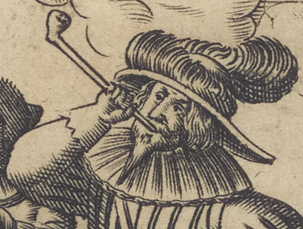
Coltsfoot is a daisy-like plant which is flowering about now. Gerard’s Herbal of 1633 suggests that the ‘fumes of the dried leaves taken through a funnel’ is good for those with coughs and shortness of breath. He suggests that it is smoked like tobacco and it ‘mightly prevaileth.’
This idea, Mrs Grieves says in her herbal (1931), is endorsed by ‘Dioscorides, Galen, Pliny, and Boyle’. And Coltsfoot is ‘nature’s best herb for the lungs’. (This is historic information re herbs and NOT current medical advice, as Coltsfoot can be very dangerous!).
Detail from Lobspruch deß edlen hochberühmten Krauts Petum oder Taback Nuremberg, 1658 New York Public Library Public Domain
My grandson and parents found a 19th Century pipe bowl, much like the one above, by the Thames where there were many fragments of clay pipe. For more on 17th Century smoking, have a look here.
Blossom is also coming out in London a little early. (2022 we had a false spring when Cherry Blossom came out, and I think we are now just getting used to it, so I don’t think it is being noted so much in 2024). Blackthorn (I think) is coming out in profusion in my local park. Photos below by the Author of Haggerston Park in East London. Left February 2022, Right Feb 23.
One thing I am trying to improve in my Almanac of the Past, is to include more specific London content. This can be difficult on a daily basis. But I think I have, by chance, found a solution. I was trying to glue the toe flap on a perfectly good pair of trainers so that it did not flap, and I needed a heavy weight to press the two edges together. I found a random couple of heavy books for the purpose. 24 hours later, I lifted the books to discover the failure of my project. But, as I returned the books to their place in the book case, I found the heaviest was called ‘A London Year. 365 Days of City Life in Diaries, Journals, and Letters.’ Compiled by Travis Elborough and Nick Bennison, published in 2013, and the price on it of £5.99 makes me feel I must have bought it second hand. Have I opened it before now? Indeed, I had forgotten its existence, but Cometh the Hour, Cometh the Book! What a timely rediscovery.
Cholera in London. The news of the Cholera being in London has been received abroad. According to the feelings of the different nations towards England, France, who wish to court us has ordered a quarantine in her ports of three days; Holland, who feels aggrieved by our conduct at the conference, one of 40 days. The fog so thick in London that the illuminations for the Queen’s Birthday were not visible.
24th February 1832 Thomas Raikes, Diary 1832 (from ‘A London Year’ Compiled by Travis Elborough and Nick Bennison, 2013,
I think the Conference mentioned above was the London Conference of May 1832, which aimed to establish a Kingdom of Greece with a King, It was set up by Foreign Secretary Lord Palmerston without discussion with the Greeks and ended up giving them a Bavarian King. King Otto. Otto was forced from the throne in a revolution in 1862, and replaced by a Danish King, from whom Prince Philip, Duke of Edinburgh was descended.
I have a friend with whom I argue about the sanctity of the book. She believes they need to be treated like the priceless spear carriers of culture that they are. While I, read them in the bath; turn down corners to mark my place; underline interesting phrases, mark paragraphs and commit other forms of libricide. (is there such a word?)
In my defense I note that I used to work at the Freud Museum, where they studied the marginalia in Freud’s Library to gain insight into his thought processes and influences.
But I recently came across the clincher to my ongoing argument in Charles Nicholls’ marvelous book on Shakespeare’s life as a lodger (‘The Lodger’) in Silver St. just down the road from the Guildhall in the City of London.
He quotes Shakespeare’s Cymberline where Iachino finds a book by Imogen’s bed and says:
‘She hath been reading late: The Tale of Tereus. Here, the leaf’s turn’d down.
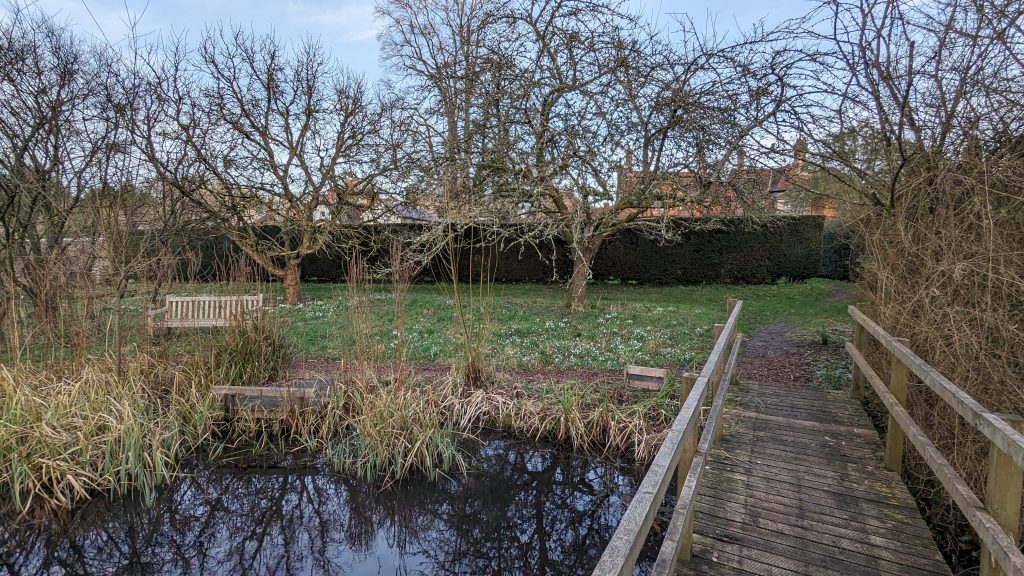
Snowdrops in late January 2024, Gilbert White’s House Selborne (Photo Kevin Flude)
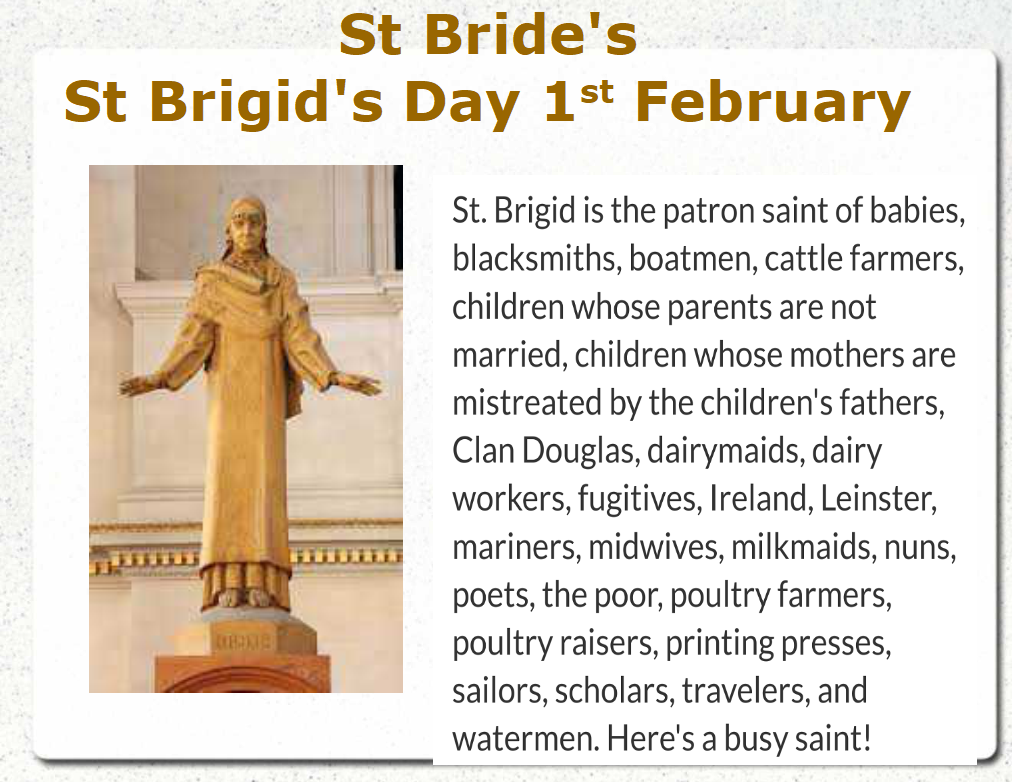
Today is Imbolc, one of the four Celtic Fire Festivals. It corresponds with St Bridget’s Day, which is a Christian festival for the Irish Saint, and is the eve of Candlemas. Bridget is the patron saint of all things to do with brides, marriage, fertility, and midwifery (amongst many other things, see above). And in Ireland, last year (2024) was the very first St Bridget’s/ Imbolc Day Bank Holiday!
St Bride’s Statue, St Bride’s Church. Fleet Street from K.Flude’s virtual tour on Imbolc
St Bridget, aka Briddy or Bride, converted the Irish to Christianity along with St Patrick in the 5th Century AD. She appears to have taken on the attributes of a Celtic fertility Goddess, called Bridget or Brigantia, so some doubt she was a real person.
Brigantia
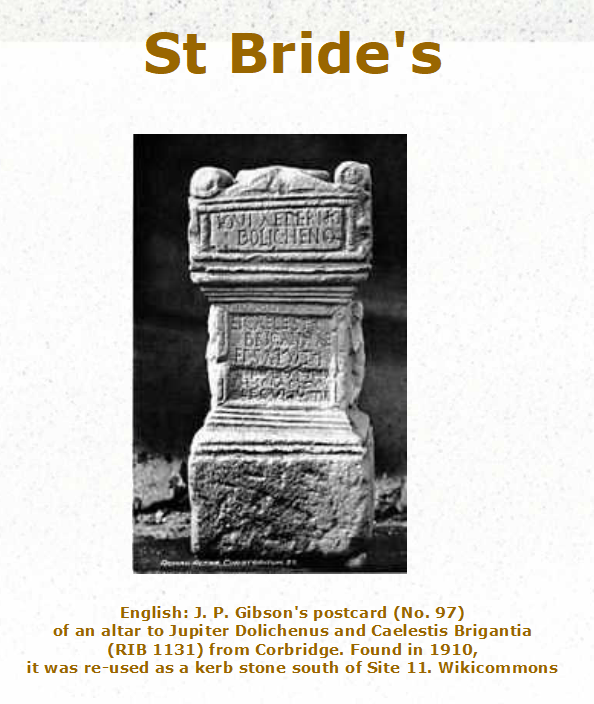
There are Roman altars dedicated to Brigantia The Brigantes tribe in the North were named after the Goddess. The Brigantes were on the front line against the invading Romans in the 1st Century AD, and led by Queen Cartimandua. Cartimandua tried to keep her independence by cooperating with the Romans, while, a few years later, Boudica took the opposite strategy. But both women appear to have had agency as leaders of their tribes and show a great contrast with Roman misogyny.
Altar to Brigantia from K Flude’s virtual tour on Imbolc
Last day of medieval Christmas and the Lords of Misrule.
This was the end of the Christmas period. John Stow, in the 16th Century describes the period between Halloween and Candlemas being the time that London was ruled by various Lords of Misrule and Boy Bishops (see my post here). In the piece below Stow goes on to talk about a terrible storm that took place on st February 1444.
Against the feast of Christmas every man’s house, as also the parish churches, were decked with holm, ivy, bays, and whatsoever the season of the year afforded to be green. The conduits and standards in the streets were likewise garnished; amongst the which I read, in the year 1444, that by tempest of thunder and lightning, on the 1st of February, at night, Powle’s steeple was fired, but with great labour quenched; and towards the morning of Candlemas day, at the Leaden hall in Cornhill, a standard of tree being set up in midst of the pavement, fast in the ground, nailed full of holm and ivy, for disport of Christmas to the people, was torn up, and cast down by the malignant spirit (as was thought), and the stones of the pavement all about were cast in the streets, and into divers houses, so that the people were sore aghast of the great tempests.’
Wells dedicated to St Bridget
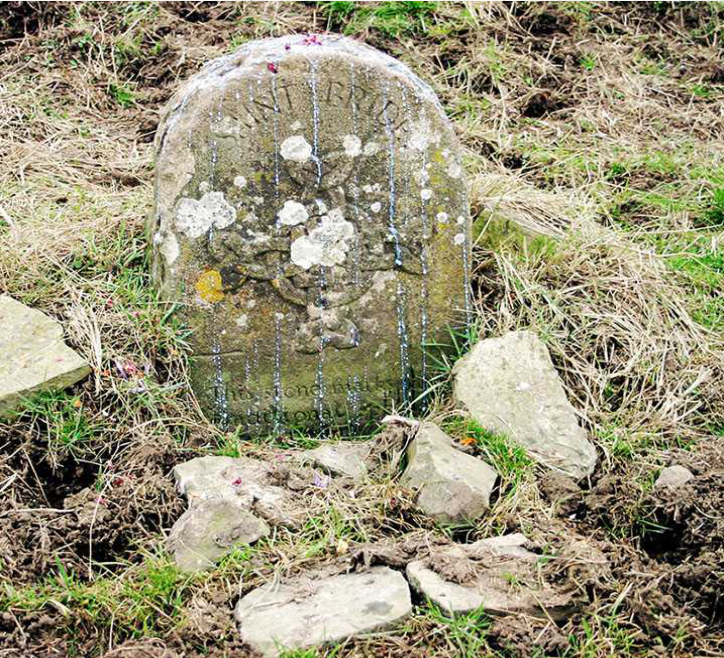
There are many wells dedicated to St Bride. They were often used in rituals and dances concerned with fertility and healthy babies. And perhaps, the most famous, was near Fleet Street. Henry VIII’s Palace of Bridewell, later an infamous prison, was named after the Well. St Bride’s Church has long been a candidate as an early Christian Church, and although the post World War Two excavations found nothing to suggest an early Church, they did find an early well near the site of the later altar of the Church, and by the remains of a Roman building, possibly a mausoleum. Therefore, it is possible that the Church was built on the site of an ancient, arguably holy, well.
St Bridget’s Well, Glastonbury
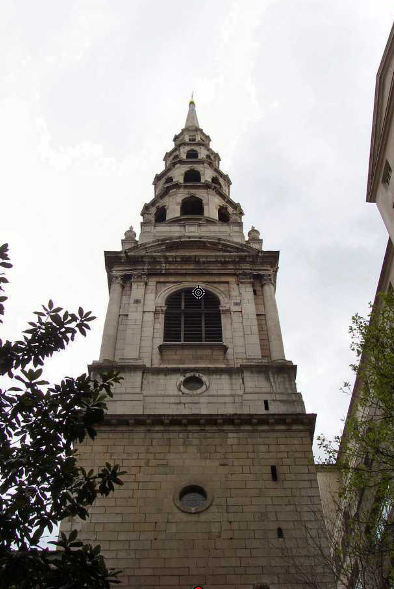
The steeple of St Brides is said to be the origin of the tiered Wedding Cake, which, in 1812, inspired a local baker to bake for his daughter’s wedding.
Steeple of St Brides Fleet Street
Imbolc and St Bridget’s Day are the time to celebrate the return of fertility to the earth as spring approaches. In my garden and my local park, the first snowdrops, violets, and daffodils are coming out, and below the bare earth, there is a frenzy of bulbs and seeds budding, and beginning to poke their shoots up above the earth, ready for the Spring. In the meadows, ewes are lactating, and the first lambs are being born.
Violets, bulbs, and my first Daffodil of the year. Hackney (2022), London by K Flude
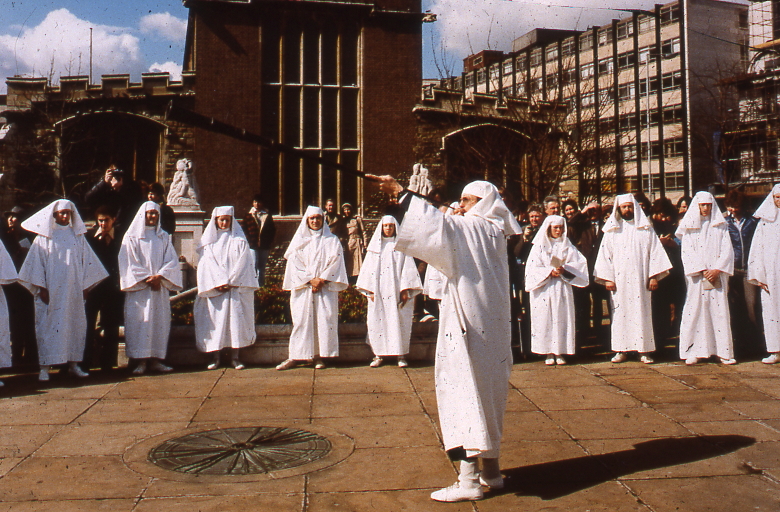
I, occasionally, do walks about Imbolc and other Celtic festivals, in conjunction with the Myths and Legends of London, and at May Eve, the Solstices, Halloween and Christmas (when I have time). See the walks page of this blog
And let’s end with the Saint Brigid Hearth Keeper PrayerCourtesy of SaintBrigids.org
Brigid of the Mantle, encompass us, Lady of the Lambs, protect us, Keeper of the Hearth, kindle us. Beneath your mantle, gather us, And restore us to memory. Mothers of our mother, Foremothers strong. Guide our hands in yours, Remind us how to kindle the hearth. To keep it bright, to preserve the flame. Your hands upon ours, Our hands within yours, To kindle the light, Both day and night. The Mantle of Brigid about us, The Memory of Brigid within us, The Protection of Brigid keeping us From harm, from ignorance, from heartlessness. This day and night, From dawn till dark, From dark till dawn.
I have been waiting to post this for a long time, as it relates to Christmas. (Was it really a month ago?) By the way, I have added to some text to yesterday’s Brexit posts.
This evening is also Imbolc, the Celtic Festival to Brigantia and St. Bridget of Kildare. Candlemas tomorrow.
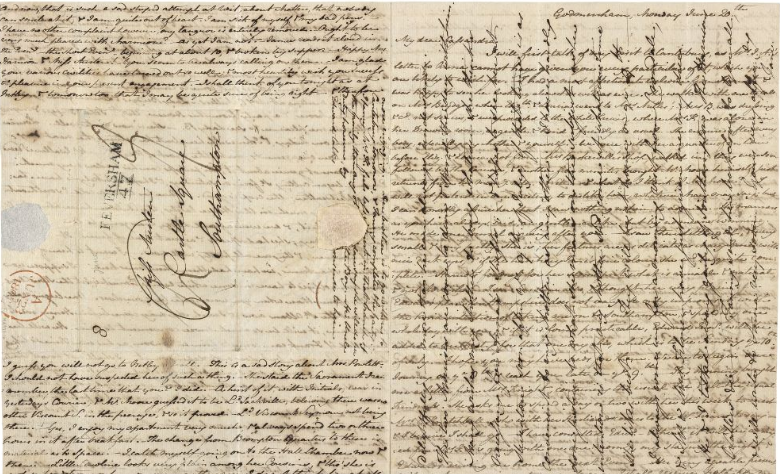
This is a letter from Mary Musgrove in Persuasion (Chapter 18). This is Jane Austen’s most mature and probably the best novel,. Here the moany Mary Musgrove writes a typically FOMO letter which illustrates how Christmas, for the well, off really continued to February 1st and Candlemas.
February 1st “My dear Anne,–I make no apology for my silence because I know how little people think of letters in such a place as Bath. You must be a great deal too happy to care for Uppercross, which, as you well know, affords little to write about. We have had a very dull Christmas; Mr. and Mrs. Musgrove have not had one dinner party all the holidays. I do not reckon the Hayters as anybody.
The holidays, however, are over at last: I believe no children ever had such long ones. I am sure I had not. The house was cleared yesterday, except of the little Harvilles; but you will be surprised to hear they have never gone home. Mrs. Harville must be an odd mother to part with them so long. I do not understand it. They are not at all nice children, in my opinion; but Mrs. Musgrove seems to like them quite as well, if not better, than her grandchildren.
What dreadful weather we have had! It may not be felt in Bath, with your nice pavements; but in the country it is of some consequence. I have not had a creature call on me since the second week in January, except Charles Hayter, who had been calling much oftener than was welcome.
Between ourselves, I think it a great pity Henrietta did not remain at Lyme as long as Louisa; it would have kept her a little out of his way. The carriage is gone to-day, to bring Louisa and the Harvilles to-morrow. We are not asked to dine with them, however, till the day after, Mrs. Musgrove is so afraid of her being fatigued by the journey, which is not very likely, considering the care that will be taken of her; and it would be much more convenient to me to dine there to-morrow.
I am glad you find Mr. Elliot so agreeable, and wish I could be acquainted with him too; but I have my usual luck: I am always out of the way when any thing desirable is going on; always the last of my family to be noticed. What an immense time Mrs. Clay has been staying with Elizabeth! Does she never mean to go away? But perhaps if she were to leave the room vacant, we might not be invited. Let me know what you think of this. I do not expect my children to be asked, you know. I can leave them at the Great House very well, for a month or six weeks.
I have this moment heard that the Crofts are going to Bath almost immediately; they think the Admiral gouty. Charles heard it quite by chance; they have not had the civility to give me any notice, or of offering to take anything. I do not think they improve at all as neighbours. We see nothing of them, and this is really an instance of gross inattention.
Charles joins me in love, and everything proper.
Yours affectionately,.”
It is my paragraphing rather than the original. The mystery of the book is how such a lovely, considerate, able daughter like Anne, can be from the same family as both her awful sisters, and her monstrous, egotistical father.
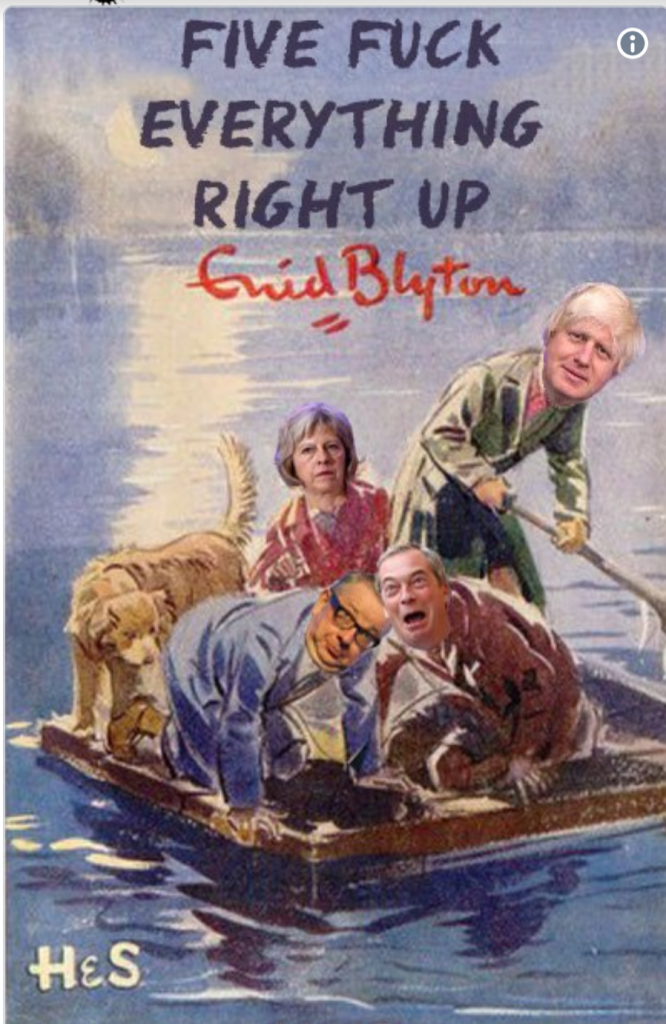
Satirical Ladybird Book Front Cover showing Johnson, Farage, May and Gove up Creek with an inadequate paddle
On this day in 2021, the United Kingdom, formally left the European Union.
I remember vividly the morning the referendum result was announced. We were in Glasgow for my daughter’s Graduation, and we all burst into tears.
I remain angry, (as you can see from the tags to my post, below, made exactly one year ago). It’s not so much at the idea, but the stupid way Brexit was done, with no planning or regard for consequences, just this blind idea that we, the British, were special.
Tags on my Brexit anniversary post last year
So how is it going? Support for Brexit has gone right down. 60% think it was a mistake, 35% think it was the right decision. The country is in a complete mess, most of our institutions are failing because of lack of money and a truly incompetent Conservative government. Even Nigel Farage has agreed that ‘Brexit has failed.‘
But, at least, under Sunak, the Conservatives have stopped going on about ‘Brexit Opportunities’ and have got rid of the ridiculous Jacob Rees Moog. As I write, I am listening to another rational compromise with the EU, by Sunak’s government, which has, seemingly, cleared up, Boris Johnson’s mess over the border with Northern Ireland. Sunak, at least seems like a grown up and has a more pragmatic approach to Europe.
Britain’s economy is doing badly, partly as a result of losing unhindered access to the biggest free market in the world. However, no party is actively campaigning to rejoin, and, it seems clear, that as time goes on we will gradually, in small steps, as Sunak has done, creep closer to the European Union. I would guess we will probably find our own version of associate membership at some point, in 5, 10, 20 years time.
Here, I want to take ‘the long view’ on Brexit. One important point to make, at the outset, is about British/English exceptionalism. When I was at school we were taught the history of ‘This Island Story’, our Commonwealth, how we had the created Parliamentary democracy and how Churchill won World War 2. This fed a feeling that we should never kowtow to European Bureaucrats. So how far back can we trace this sense of difference to Europe?
In the Upper Palaeolithic and early Mesolithic Britain was physically part of Europe, the Thames was a tributary to the Rhine. Archaeologists have recently been investigating the landbridge to Europe under the North Sea which is now called ‘Doggerland’ after the name of that portion of the sea. This was swept away by rising meltwater in about 8,000 years BP and made us an Island. And, so, Britain had an Island identify which we were very proud of until recent times. I can’t remember the last time someone referred to us as ‘an Island race’ but this was the title of CHURCHILL, Winston S.’s book: ‘The Island Race The History of the English-Speaking Peoples’
As farming spread from Asia Minor it took an extra thousand years to bridge the Channel.
Map of the spread of farming through Europe, showing Northern France, farming c 5000BC but Britain only in about 4000BC Source: https://agro.biodiver.se
The ‘native’ Britons eventually became speakers of the NW European group of languages called ‘Celtic’, but the Romans never called us that, they called us Britons, although Julius Caesar and others make it clear that the Britons often helped out rebel Celtic tribes in Gaul (France).
The most interesting difference is at the end of the Roman period. When the western part of the Roman Empire fell in the 5th Century, it was taken over by Germanic Kings. The Franks in France and Germany; the Anglo Saxons (etc.) in England; the Lombards in Italy and Goths, Visigoths, Vandals in Spain (and N. Africa).
On the mainland, the German Kings became native, the Roman culture endured, as did the Latin language, and Christian religion. And the tradition of Roman law and culture. French, Italian, Spanish, Romanian are all romance languages based on Latin.
Across the Channel in England, the same thing happened. German Kings took over from the Roman Empire. But here our German Kings didn’t adopt the Latin language. Nor indeed did they adopt the native Celtic dialect of Brittonic, and they changed the religion back to pagan. So English culture is Germanic and not Roman, Western European states were built on Roman foundations. In the Western areas of the British Isles, never very, if at all, Romanised, retained their Celtic heritages, either retained or adopted Christianity and used Latin as the language of learning and religion.
So, unlike most of Western Europe, England does not have a foundation in Latin culture and Roman law.
In AD 407, Britain threw off Roman rule and took independent control. We had 4 leaders of no great distinction in a short span. Seems familiar?
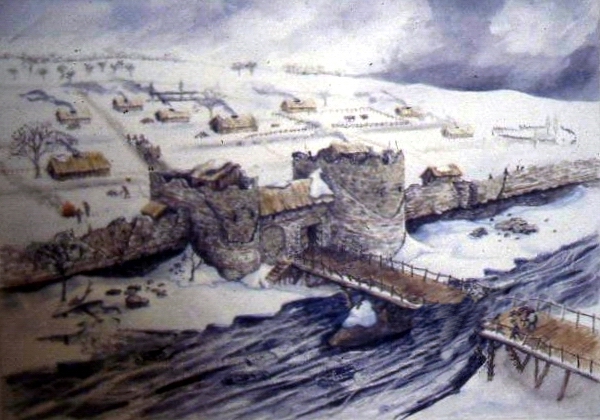
London in the 5th Century Reconstruction painting.
Then the Britons wrote, in AD 410, a letter to the Emperor Honorius asking him to take us back. He said, ‘Sorry, pals, the Goths are at the gates of Rome, but you can raise your own Armies to defend yourself.’
Now, the archaeology of this period is very difficult, so it’s hard to know what happened in detail. But we do know that coins went out of circulation, pottery manufacture ceased in Britain and Roman Towns declined dramatically.
My friend, Oxford Professor Bryan Ward-Perkins, wrote a book on the Decline of the Roman Empire in which he says that we next reached the level of international trade achieved at the height of the Roman Empire in 1500. 1000 years after the fall of Rome. Technically, a recession that lasted 1,000 years. It would seem that the destruction of a free trade zone can be a disastrous choice.
Lecture by Prof. Bryan Ward Perkins on the End of the Roman Britain.
In the early medieval period, Britain largely existed in a North German, Scandinavia North Sea economic zone, until the Norman Invasion of 1066 which brought us back into Europe. Clashes with the Catholic world broke out on occasion, such as the murder of Thomas Becket at the behest of Henry II, and over the use of English to read the bible after Wycliffe’s translation.
This came to a head in the 16th Century Reformation, Britain isolated itself from European Catholic Culture.
Despite the worst destruction of cultural heritage in England’s history, the economic impact of ‘going it alone’, doesn’t seem to have been that bad. It can be argued that the selling off of the one third of the land of the kingdom owned by the monasteries boosted the gentry and broadened the elite to include a more entrepreneurial class. Also, the downside in terms of turning our back on Europe wasn’t so destructive because Catholic Europe wasn’t a free trade zone, and much of Northern Europe was protestant.
But the next really significant difference was the changes instituted by Napoleon as he subdued and changed and, to an extent rationalised and liberalised the continent. He had dreams of creating a United Europe of Nations, in the process dismantling the Empires that held sway (such as the Holy Roman Empire, and the Austro-Hungarian Empire)
As a consequence, most legal systems in Europe are based on Roman Law as amended by the Napoleonic code, while England, by contrast, is based on the Common Law. Napoleon’s attempted blockade of trade with Britain, had an impact but as Britain controlled the seas and was a global trading nation and Empire made it much less dependent on trade with Europe. Secondly, the economy was on a war footing so lost production was more than compensated for. So, there is a case to be made that there are fundamental differences in British History which might explain our attitude to the EU. But, it feels, to me, that the main issue is that we don’t see ourselves as a normal European state but as something special.