Myths, Legends & Halloween Virtual Tour October 31st 2024

Bran's head taken to Tower Hill
King Bran’s head buried at Tower Hill

Virtual Walk: Thurs 31st October 2024 8.00pm

On Thursday, I am doing my first London Walk Virtual Tour of the winter season.

The walk tells the story of London’s myths and legends and the Celtic origins of Halloween.

The walk will tell the story of London’s Myths and Legends, beginning with the tale of London’s legendary origins in the Bronze Age by an exiled Trojan called Brutus. Stories of Bladud, Belinus, Bran and Arthur will be interspersed with how they fit in with archaeological discoveries.

As we around the City, we also look at the origins of Halloween celebrations and how they may have been celebrated in early London


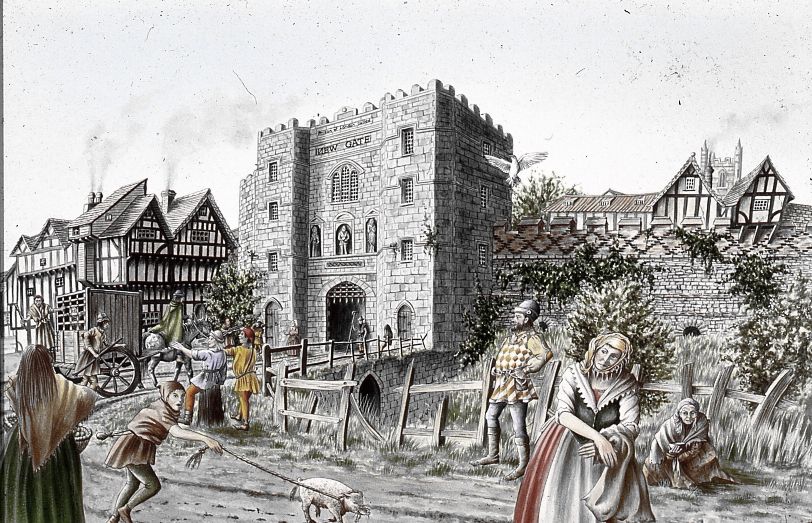
The virtual route starts at Tower Hill, then down to the River Thames at Billingsgate, to London Bridge and Southwark Cathedral, to the Roman Forum at the top of Cornhill, into the valley of the River Walbrook, passed the Temple of Mithras, along Cheapside to the Roman Amphitheatre, and finishing up in the shadow of St Pauls.

To book:

REVIEWS (from London Walks website)
“Kevin, I just wanted to drop you a quick email to thank you ever so much for your archaeological tours of London! I am so thrilled to have stumbled upon your tours! I have wanted to be an archaeologist since 1978 at the ripe old age of 8 years,… I was told for years that I could not be an archaeologist [for any number of reasons, which I now realise are completely ridiculous!], so I ended up on a different course of study. And now at the age of 50, it is my one great regret in life. So, I am thoroughly enjoying living vicariously through you, the digs you’ve been on, and the history you bring to life for us! British archaeology would have been my specific area of study had I pursued it. ?? Thank you SO MUCH for these! I look forward to them more than you can imagine, and honestly, I’ll be sad if you get them down to 1.5 hours! They’re the best 2 hours of my week! 🙂 Best, Sue

St Simon and St Jude’s Day October 28th

Image by Christian Wöhrl from Pixabay

A day when it is ‘certain to rain heavily’. Well, that wasn’t true last year.  On this day you, supposing you want to find who your true lover is, must:

Carefully peel an apple in one piece.
Turn round three times with the peel in your right hand
Drop the peel over your left shoulder
See what shape letter the peel forms on the ground, and this will be the first letter of your true love’s name.
And if it breaks into pieces, you are doomed, probably, to never finding your true love.
To make this work, you also have to recite:

St Simon and St Jude, on you I intrude
By this paring I hold to discover
Without any delay, to tell me this day
The first letter of my own true love.

Jude is the Saint of:

Lost Causes
Desperate causes
Hopeless causes
And if that is not enough also the Hopeless and the Despairing.

So maybe the apple peel isn’t going to work for you (although Jude is also the Patron Saint of the Impossible!)

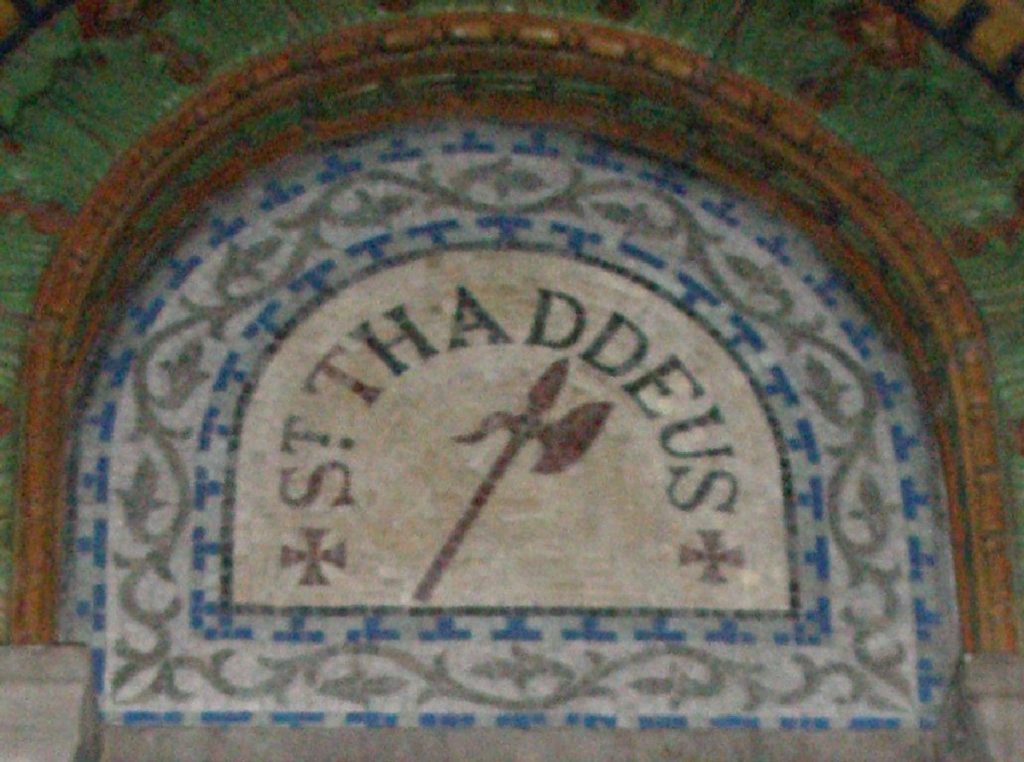
Jude aka Thaddeus was martyred with an axe. Simon the Zealous was martyred by being sawn in half, and is, of course, therefore, the patron saint of woodcutters and lumberjacks. They are linked by the same Saint’s day because they went to Syria together to preach where they were met their fates, and they are also associated with woodworking.

WikipediaBy Bruce Andersen – Own work, CC BY-SA 2.5, https://commons.wikimedia.org/w/index.php?curid=1855844

There are at least four Judes. One of them may have been Jesus’ brother. He or another Jude wrote the Epistle of St. Jude.

More on St Simon and St Jude

Partial Eclipse August 27th – 28th 2026

Loughcrew Neolithic carvings.

August 27th – 28th sees a partial lunar eclipse.

Could ancient people’s predict eclipses? Well, lunar eclipses are relatively easy to predict, while solar eclipses are difficult. But it is likely that Babylonian and Assyrians astronomers could. Have a look at https://www.queensu.ca/gazette/stories/eclipses-were-once-associated-death-kings-attempting-predict-played-key-role-birth for more details,

There are plenty of people who believe that eclipses can be predicted by Stonehenge. And it certainly can be used that way, but this doesn’t mean it was. A series of stones, and posts in concentric circles with sight lines to innumerable features on the horizon offers many ways of making calculations which combined with observations over a long period COULD predict, predictable celestial phenomena. Doesn’t mean they were. So it is very difficult to say what they were capable of, and only the most obvious alignments can be certainly confirmed.

This Washington Post article below suggests the Loughcrew Cairns near Dublin were built about the time of a total eclipse, and that one of the stones with complicated carvings on may show a lunar eclipse. If you look at the sketch of the stone above, you will see the biggest circle, near the middle, may represent the moon, and it obscures the circle behind it which may represent the sun. Read this for the details: https://www.washingtonpost.com/news/wonk/wp/2017/08/18/this-5000-year-old-stone-carving-may-be-the-worlds-first-drawing-of-an-eclipse/

What is striking is how can they say it was built around the time of a total eclipse and make that seem significant because there is no way archaeological dating is accurate enough to give any idea whether it was built for a particular day. Also, there are many more circles and objects on the large stone, and to pick two out to prove what you want it to prove, is not proof. We are left with the intriguing possibility, but it is no more than that.

The Kalendar of Shepherds

French 15th Century ‘Kalendar of Shepherds’

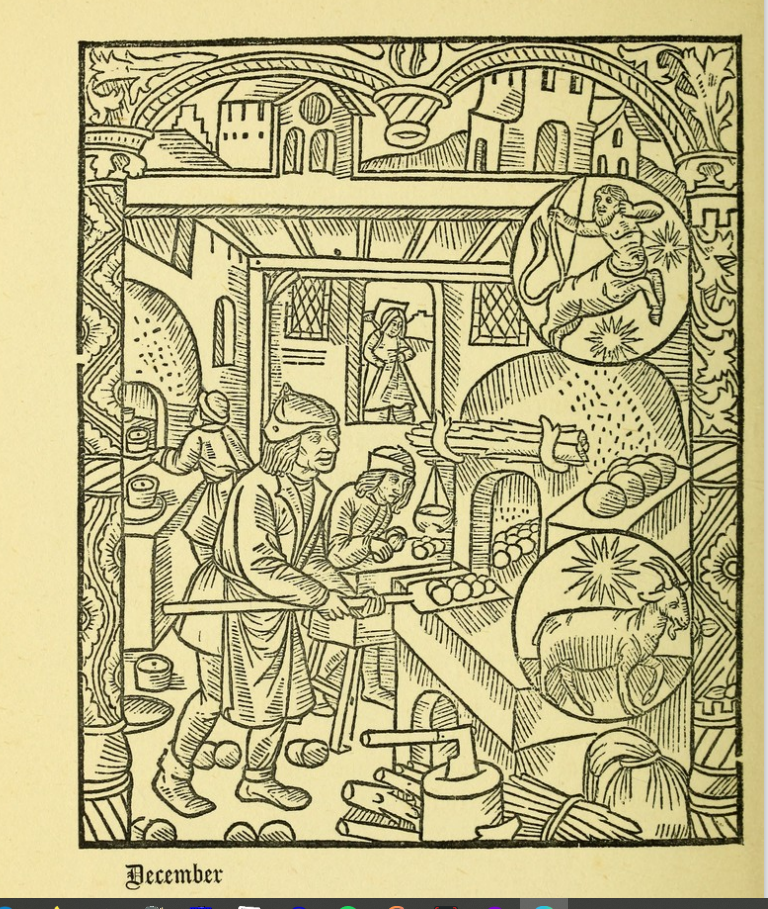
I am finishing my post on September, and using the Kalendar of Shepherds. As you may have noticed, I often use the Kalendar of Shepherds to provide an insight into how the seasons were seen in the past. Mostly, I use it for the posts at the beginning of each month. I have created this page as a placeholder to put information on the Kalendar for anyone who is eager to explore it more or to make use of it. Each month I will link to it, so I do not have to repeat the basic information about the Kalendar. Much of this text was contained in the December post, and I have used this month as my example. Tomorrow, you will get the September version.

About the Kalendar of Shepherds.

The Kalendar was printed in 1493 in Paris and provided ‘Devices for the 12 Months.’ The version I’m using is a modern (1908) reconstruction of it. It uses wood cuts from the original 15th Century version and adds various texts from 16th and 17th Century sources. (Couplets by Tusser ‘Five Hundred Parts of Good Husbandrie 1599. Text descriptions of the month from Nicholas Breton’s ‘Fantasticks of 1626.) This provides an interesting view of what was going on in the countryside every month.

For more on the Kalendar look at my post here.

The original Kalendar can be read here: https://wellcomecollection.org/works/f4824s6t

To see the full Kalendar, go here:

The Kalendar of Shepherds has an illustration for each month (December above) which shows typical activities for the time of year, and has inserts to identify the astrological signs of the month. So, in December they are baking and collecting firewood. The star signs are Sagittarius (November 22 – December 21) and Capricorn (December 22 – January 19).

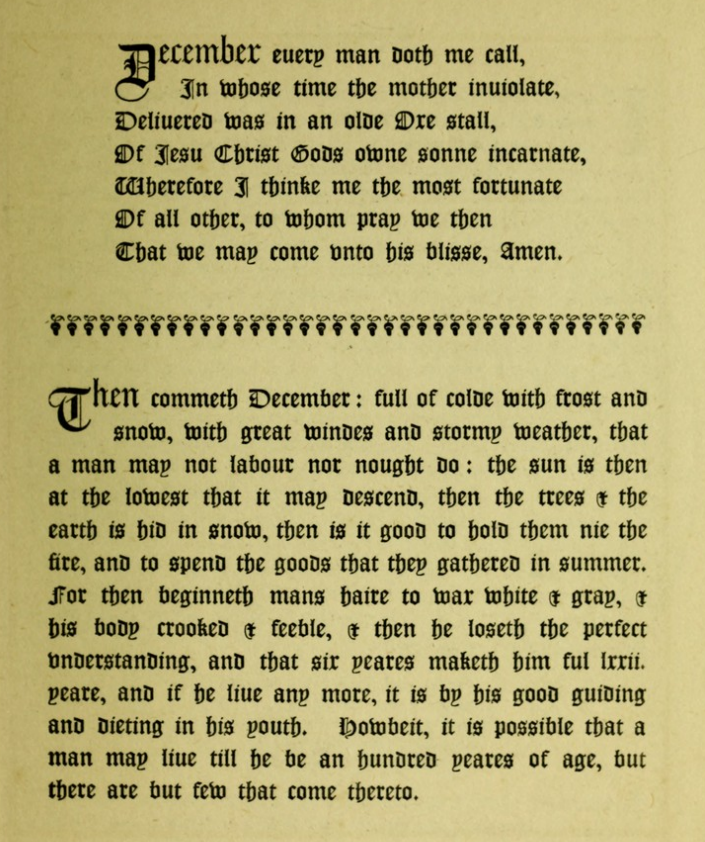
The text below gives a vivid description of December weather and then elaborates on the last six years of a man’s life, with hair going white, body ‘crooked and feeble’. The conceit here is that there are twelve months of the year, and a man’s lot of ‘Six score years and ten’ is allocated six years to each month. So December is not just about the 12th months of the Year but also the last six years of a person’s allotted span. The piece allows the option of living beyond 72, ‘and if he lives any more, it is by his good guiding and dieting in his youth.’ Good advice, as we now know. But living to 100 is open to but few.

Kalendar of Shepherds

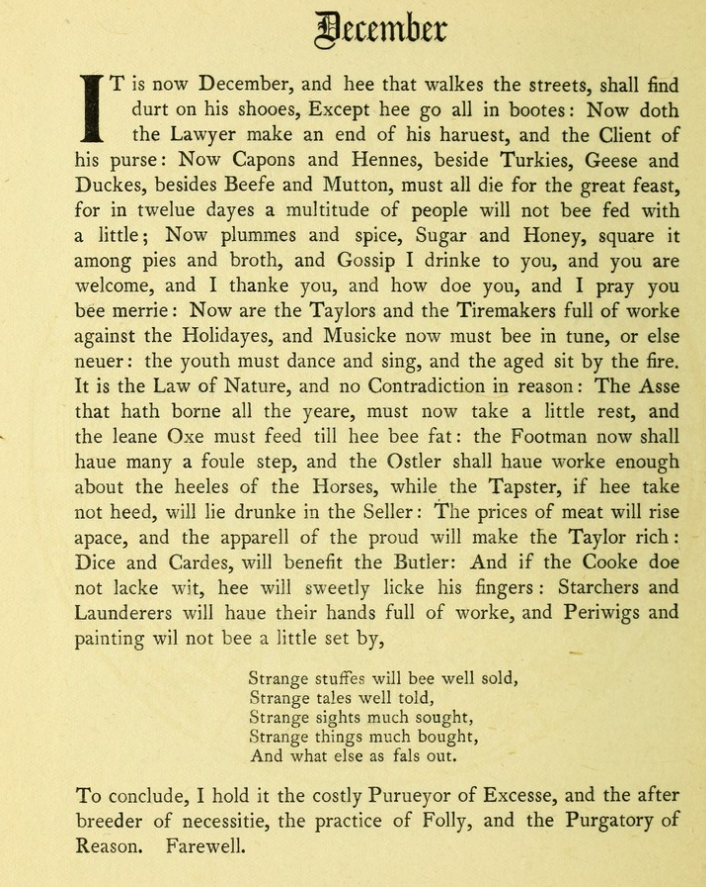
The longer description of December (shown below) is by Breton (1626) and gives a detailed look at the excesses of Christmas, who is on holiday, and who working particularly hard. But it concludes it is a costly month.

Nicholas Breton’s ‘Fantasticks of 1626 – December

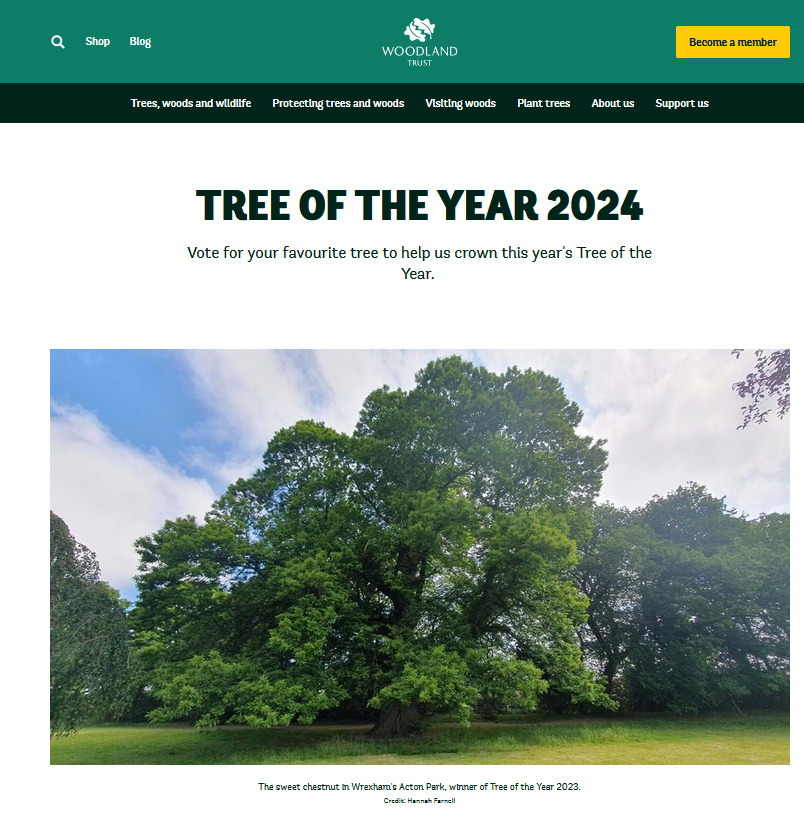
Tree of the Year Competition Shortlist 2024

Screenshot of the Woodland Trust ‘Tree of the Year’ Competition.

To see the magnificent twelve, click here!

(We know it will be an Oak.)

Results on October 29th

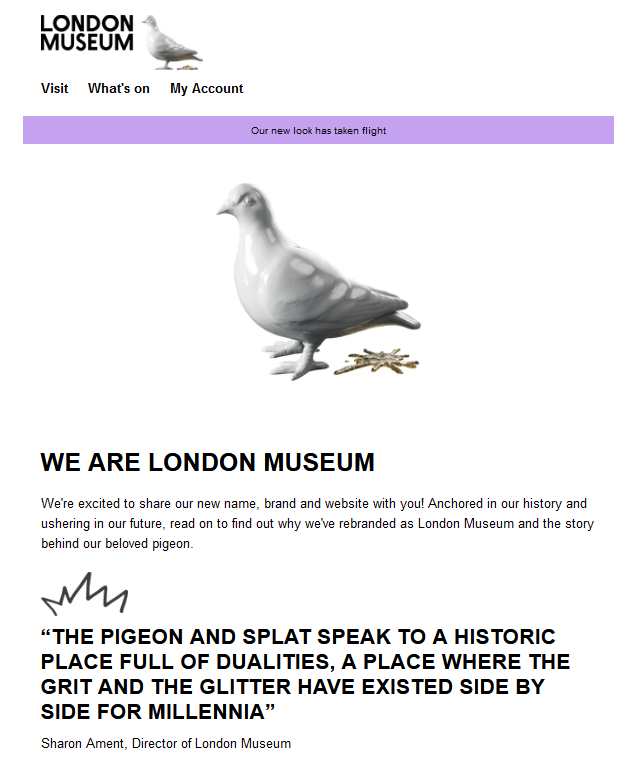
The London Museum Pigeon & Splat!

Screenshot concerning the new Logo of the Museum of London

I was quite surprised to see the image above appear in an email to my inbox. The London Museum (was the Museum of London) announced the Pigeon and Splat as the new logo to replace the old Dick Whittington one. I received the email on the 27th July 2024.

Is this a breath of fresh air? An unfussy humourous joke which 5 year old will love? Is a Pigeon uniquely London? Is the Splat too clever by half, or is it completely daft?

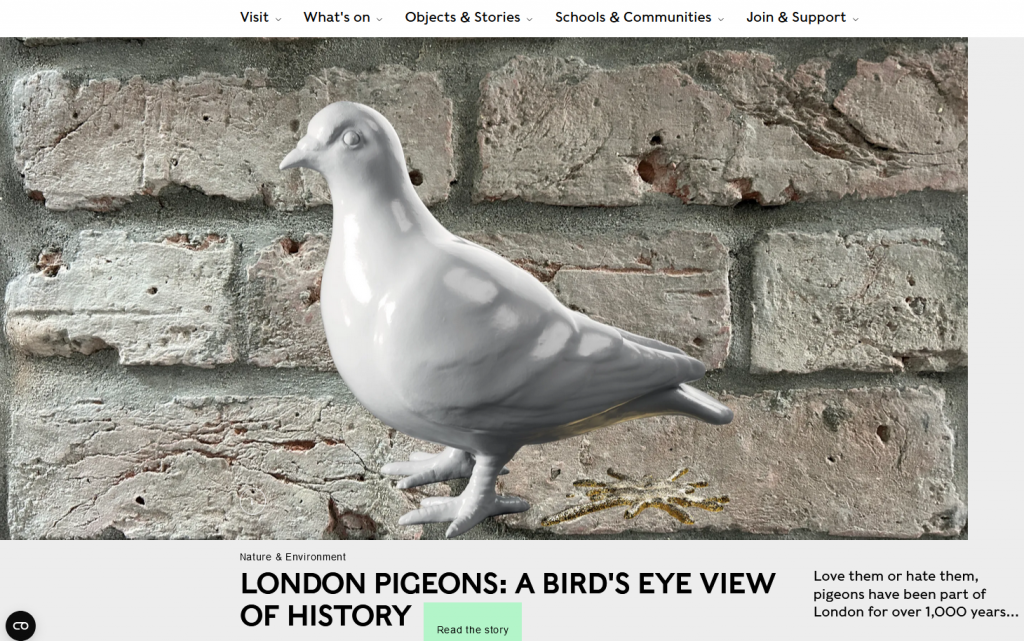
I’ll leave it to you to decide. However, a visit to the London Museum Website on 15/08/24 reveals the Pigeon logo displayed without the Splat!

Screenshot of London Museum’s new logo without the Splat!

Further down the page, is an article on the history of Pigeons and London, where there is a vestigial splat!

It seems to me there has been a climb down since I received the email on 27th July. Or are they phasing the Splat! in? Comments please.

For more on the new logo look at the Museums Associations’s Web site here. ‘The pigeon was chosen to symbolise the brand as “an impartial and humble observer of London life”, the museum said in a blog post on the redesign.’

Screenshot from the London Museum Web site with image of a Pigeon with a vestigial Splat!

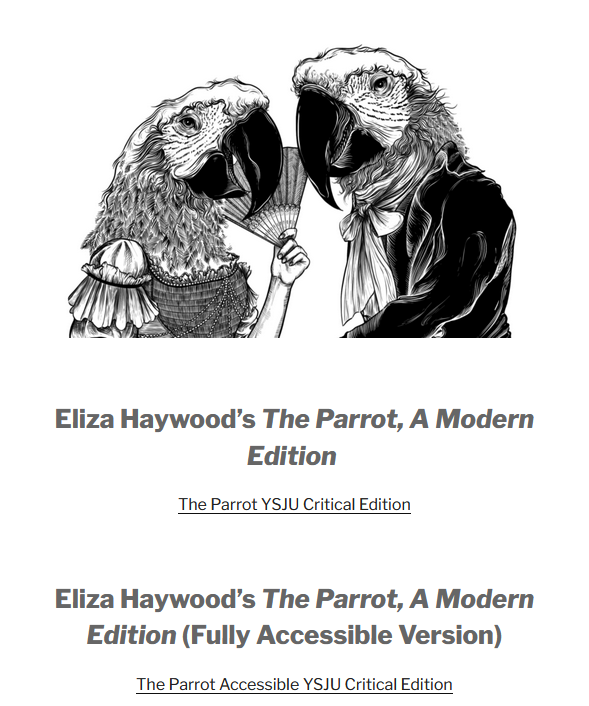
‘The Parrot’ an 18th Exposé Republished

My WordPress system decided to publish my notes upon the Parrot rather than reminding me to finish off the page. So, here is the updated post again.

The Parrot was republished for free on August 4th 2024 by the York St Johns University Critical Editions team, and they have enabled you to get your free copy by following the link at the bottom of the post.

Published in 1746 ‘The Parrot’  by Elizabeth Haywood was a satire on the male-dominated London Society of the time.   It was published in 9 parts. The name comes from the viewpoint from a Parrot’s perch in a wealthy London house. The Parrot is an enslaved creature that has travelled the world, observer to its follies. The bird wonders why people should dismiss opinions simply on the basis of A Parrot’s green colour.

The introduction to the author by the team says:

Eliza Haywood (c. 1693-1756) was one of the first generation of writers to “live by her pen.” Throughout her career, Haywood adopted many roles: she was an actress, playwright, novelist and prolific essayist. However, she always used her platform to celebrate and advocate for women.

Here is the Guardian’s description of the book https://www.theguardian.com:

It was launched on Sunday 4th August and is available to download at:

https://blog.yorksj.ac.uk/ysjucriticaleditions/read-eliza-haywoods-the-parrot/

May Posts & Medieval Royal Horses

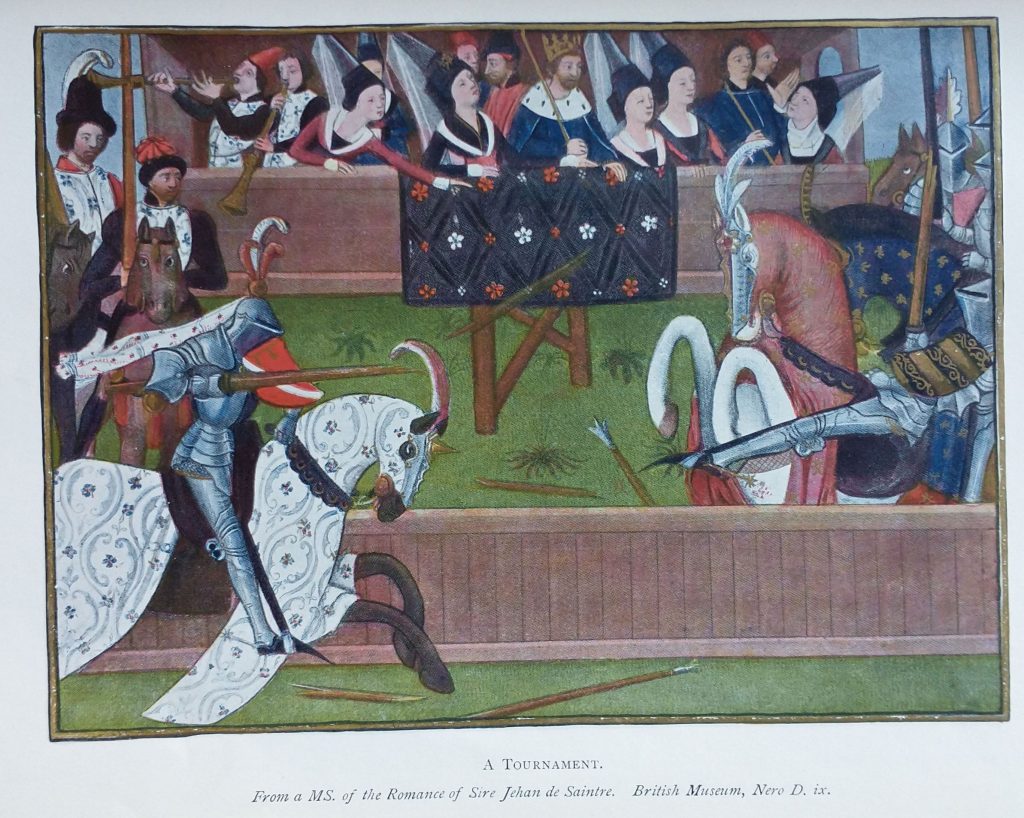
Medieval illumination of a medieval tournament

I’ve been taking groups around Britain from London to Edinburgh and have fallen behind on my postings.

So, I am going to post a few posts today to put them on my Almanac of the Past. They will be brief, and will be worked up for a re-publication in greater length next year.

Archaeological Discoveries at Elverton St. Westminster

Near the site of the medieval jousting arena in Westminster, London at Elverton St, archaeologists, nearly 30 years ago, excavated a Cemetery which contained the remains of horses. The University of Exeter has recently revealed the results of their analysis of the horses’ bones. The 15 animals studied were found to be above average in height, and marked by a life where they had been worked hard. Analysis of their teeth suggested they came from as far afield as Scandinavia, the Alps, Spain, and Italy.

Three of the animals are the largest found in England at the time. The findings suggest they might be from a Royal Stud farm, providing war, jousting or hunting animals for the elite.

For more details read: https://www.bbc.co.uk/news/uk-england-london-68632099

Mothering Sunday & Simnel Cake

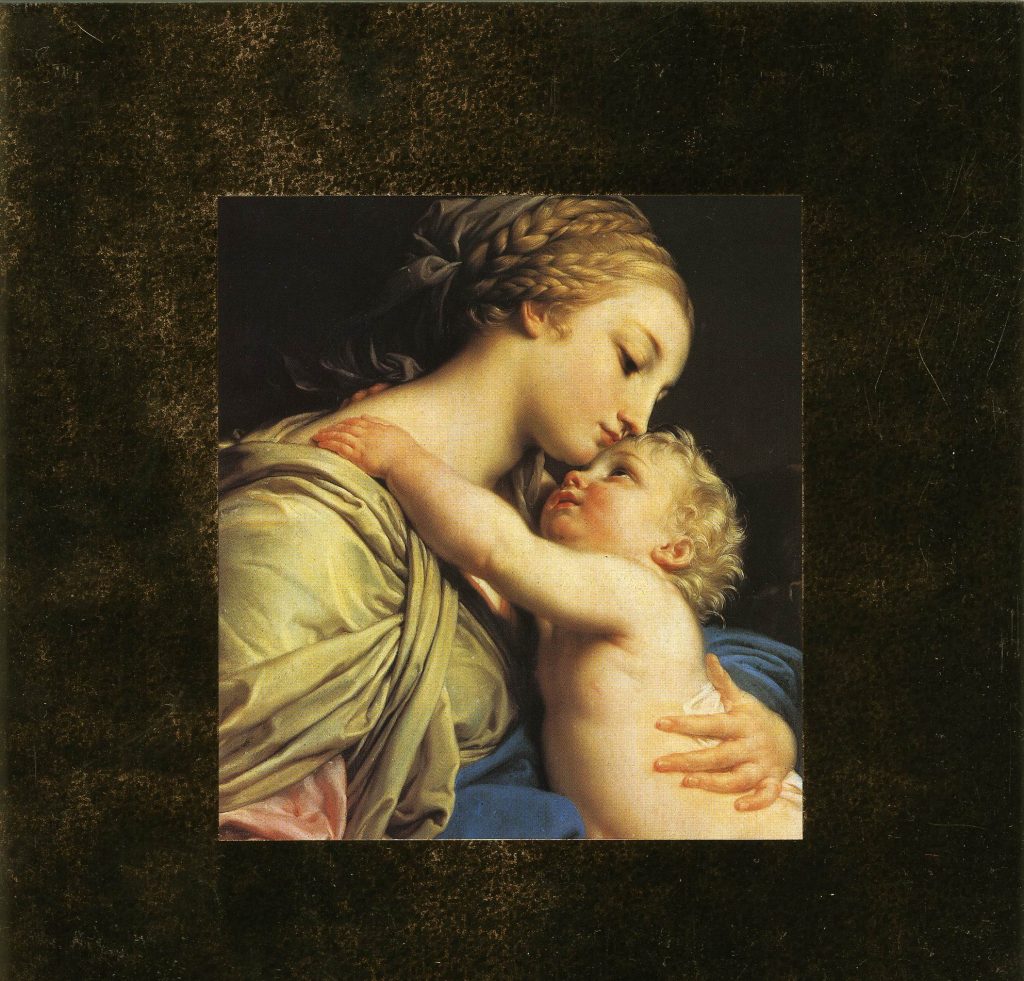
In 2026 Mothering Sunday is on March 15th. In 2027 it will be on March 7th. Strangely, very little to do with Mothers! Mothering Sunday is the 4th Sunday in Lent and is a day in which we are enjoined to visit our Mother Churches. It, therefore, became a day when people made processions to their Churches.  Servants and workers could go to their home parishes, and not only go to the Mother Church but also to say hello to their mothers.

It was called Mothering Sunday when I was little but since then has morphed into the Americanism that is Mother’s Day.

In Church the Reading is often Isaiah 66:10–11

‘Rejoice ye with Jerusalem; and be ye glad for her, all ye that delight in her: exult and sing for joy with her, all ye that in sadness mourn for her; that ye may suck, and be satisfied with the breasts of her consolations.

Jerusalem is personified, here, as the Mother. Further associations with motherhood came from the Gospel for the day which is John 6:1–14, the story of the Feeding of the Five Thousand, which led to associations with the bounty of Mother Earth.

In the medieval period visits to the Mother Church seem to have become fiercely competitive. The Bishop of Lincoln, Robert Grosseteste decreed:

In each and every church you should strictly prohibit one parish from fighting with another over whose banners should come first in processions at the time of the annual visitation and veneration of the mother church. […] Those who dishonour their spiritual mother should not at all escape punishment, when those who dishonour their fleshly mothers are, in accordance with God’s law, cursed and punished with death.

(Letter 22.7 – Wikipedia)

Simnel Cake

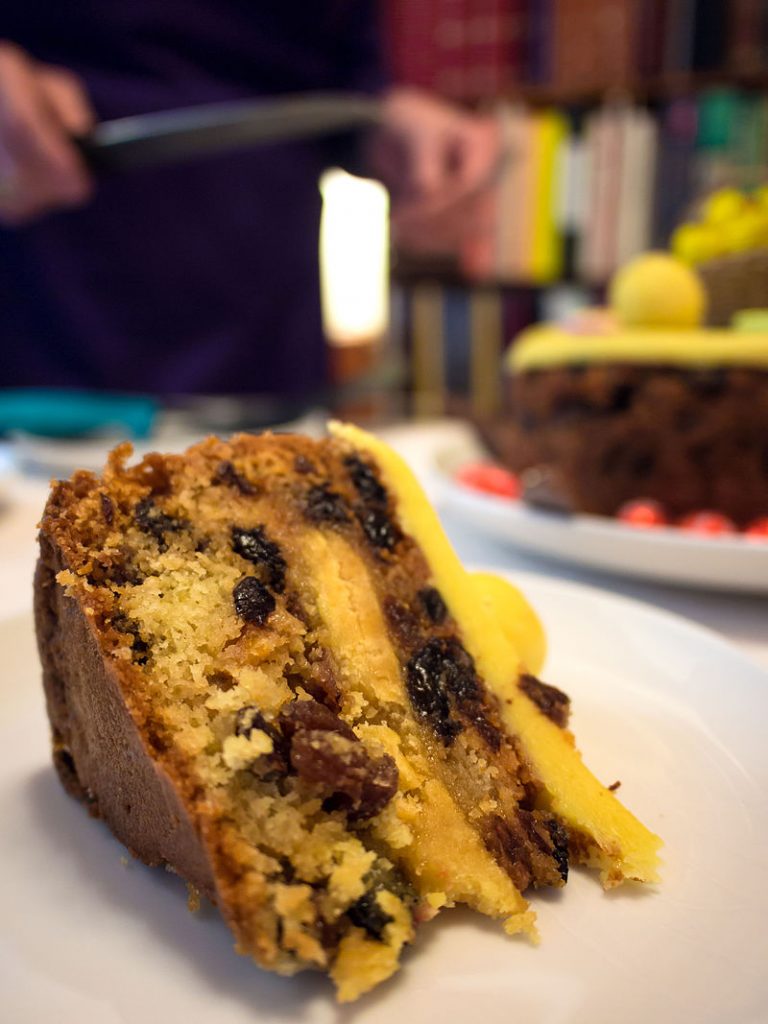
It was also the Sunday in the fasting period of Lent in which the restrictions were relaxed, so you could eat what is called Simnel Cake.

I’ll to thee a Simnel bring
‘Gainst thou goest a-Mothering
So that, when she blesseth thee
Half that blessing thou’lt give me.

Herrick Hesperides 1647

Photo: James Petts from London, England – Simnel cake (wikipedia
Easter 2012

The Simnel cake is a fine flour light fruit cake (Latin simila, fine flour), with layers of marzipan in it. It often has 11 balls of marzipan on the top, representing the 11 (not Judas) apostles. The cake is first boiled for two hours and then baked.

Now, I know 95% of my American readers hate fruit cake, but believe me when I tell you – you are completely wrong! Its delicious, and here is the BBC’s recipe for you to try:

https://www.bbcgoodfood.com/recipes/easter-simnel-cake

And I’m beginning to see that cake is an emerging theme of this Almanac of the Past.

Written in March 23, slightly revised in March 24, and 25

Read this version of the Leapday post

Sorry, it was badly proofread and I have added quite a lot more interesting detail.

So read this version