Old Lammas Day & Handfasting August 12th

Before 1752 and the introduction of the Gregorian Calendar this was Lammas Day (see my post (here). 

Charles Kightly in his ‘Perpetual Almanac of Folklaw’ quotes an 18th Century description of the Scottish practice of trial marriages:

At the Lammas Fair, it was the custom for unmarried persons of both sexes to choose a companion, according to their liking, with whom they were to live till that time next year.  This was called Hand-fasting, or hand in fist.  If they were pleased with each other, then they continued together for life: if not, they separated, and we’re free to make another choice. ‘

Old Statistical Account 1794, Parish of ‘Eskdalemuir’

Previously, I posted about the selling of wives at country fairs as depicted in Thomas Hardy’s Mayor of Casterbridge.  Look here to see it.

Handfasting & Shakespeare

Handfasting was an established part of what my grandmother would call courting.  There are many sources of information about it but the most interesting one I have come across is the one Shakespeare was involved with.  This is described in detail in Charles Nicholl’s book ‘The Lodger’.  This investigates Shakespeare’s time living in lodgings in Silver Street, between the Guildhall and the Aldersgate in the City of London.

He was called as a witness to a marriage between the daughter of his landlord and their apprentice.  The son-in-law accused his father-in-law of not paying the agreed dowry.   Shakespeare was called because he had been instrumental in bringing the young ones together and seems to have presided over their handfasting.

It was recognised that a marriage could be contracted by a pledge in front of witnesses while holding hands.

The Church insisted that a Church marriage should be held before sex could be enjoyed.  But popular opinion was that it was permissable and often after the Handfasting ceremony the couple would be sent to bed with ceremony.

George Wilkins a fellow lodger and playwright used handfasting in a play of his.  Shakespeare used the custom as a central part of the plot in Measure for Measure.  As You Like It also pivots around a betrothal.  These plays were written about the time Shakespeare was involved in his own betrothal drama.

For much more detail read the excellent book by Charles Nicholl who also wrote a wonderful book in Christopher Marlowe called ‘The Reckoning’

Finally, Charles Kightly also alerted me to this method of choosing a wife (please don’t try this at home):

So William Roper came one morning pretty early to Sir Thomas More with a proposal to marry one of his daughters… who were then both together abed in their father’s chamber asleep. He carries Sir William into his chamber and takes the sheet by the corner and suddenly whips it off. They lay on their backs and their smocks up as high as their armpits. This awakened them and immediately they turned on their bellies. Quoth Roper I have seen both sides and so gave a pat on the buttock he made choice of, saying Thou art mine.  Here was all the trouble of the wooing.’

Quoted in John Aubrey ‘Brief Lives’. Late 17th century.

Perseid Shower at its peak today

Perseid meteor shower coming to its peak.  But they arrive every year. This year from July 17th to Aug 24th.  As this roughly coincides with St Lawrence’s Day on August 10th they are also known as the Tears of St Lawrence.

https://www.timeout.com/london/news/perseids-2025-how-to-see-the-biggest-meteor-shower-of-the-year-in-london-this-week-072125

On This Day

1981 – IBM PC launched

St Clare’s Day & the Minoresses of St. Clare August 11th

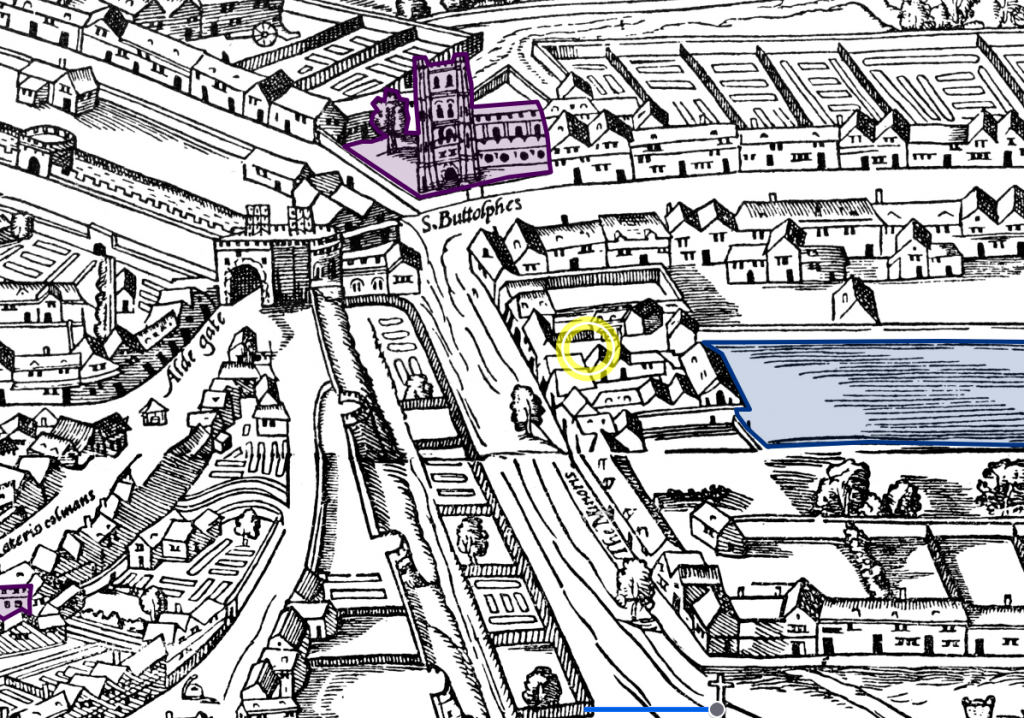
The ‘Agas’Map of 16th Century Map of London showing the Abbey of the Minoresses of St Clare with the yellow circle and St Botolphs in mauve just outside Aldgate. from the Map of Early Modern London project.

Today is the Feast day of St Clare of Assisi.  An area of the City of London, called the Minories, is still to this day named after the Abbey of the Minoresses of St. Clare without Aldgate. This was was founded in 1294. The Abbey was part of the Order of St Clare or the Poor Clares as they were known . A minoress was a nun from the Order of Friars Minor (aka Franciscans) .who were also known as the Minoresses of St Clare.

Fresco of Saint Clare and sisters of her order, church of San Damiano, Assisi Wikipedia

Clare Sciffi was born in Assisi to a rich family. On Palm Sunday, 20 March 1212 Clare left her house, after refusing offers of an advantageous marriage. She had been inspired by hearing St Francis the founder of the Franciscan Monks who was also from Assisi. St Francis facilitated her transfer to Benedictine Nunneries. Her sisters followed her, one renamed Agnes became an Abbess and eventually a saint in her own right. Her family tried repeatedly to take her back into secular life. Eventually, they gave in – apparently when they saw that she had cut her flowing locks off and donned a plain robe.

A small nunnery was set up for them next to the church of San Damiano. More women joined, and they became known as the “Poor Ladies of San Damiano”. They undertook to live impoverished, and secluded.

The Franciscan friars were an itinerant order where the Friars preached to the people and were supported by begging. But this was not possible for women at that time so they lived a simple life of labour and prayer.:

‘The nuns went barefoot, slept on the ground, ate no meat, and observed almost complete silence.’ Wikipedia

Here is a site that gives information about the new Museum that will be established on the site of the Poor Clares. It also gives an outline history of the site.

https://www.ianvisits.co.uk/articles/new-museum-to-show-archaeology-from-the-abbey-of-st-clare-70048/?utm_source=newsletter&utm_medium=email

The following link explores the illustrious noble women who choose to be buried in the Minories. It shows how important the Poor Clares were considered to be. It was dissolved by Henry VIII in 1539.

To read about the nearby Roman Bastion at Crosswall see my post here:

St Lawrence August 10th

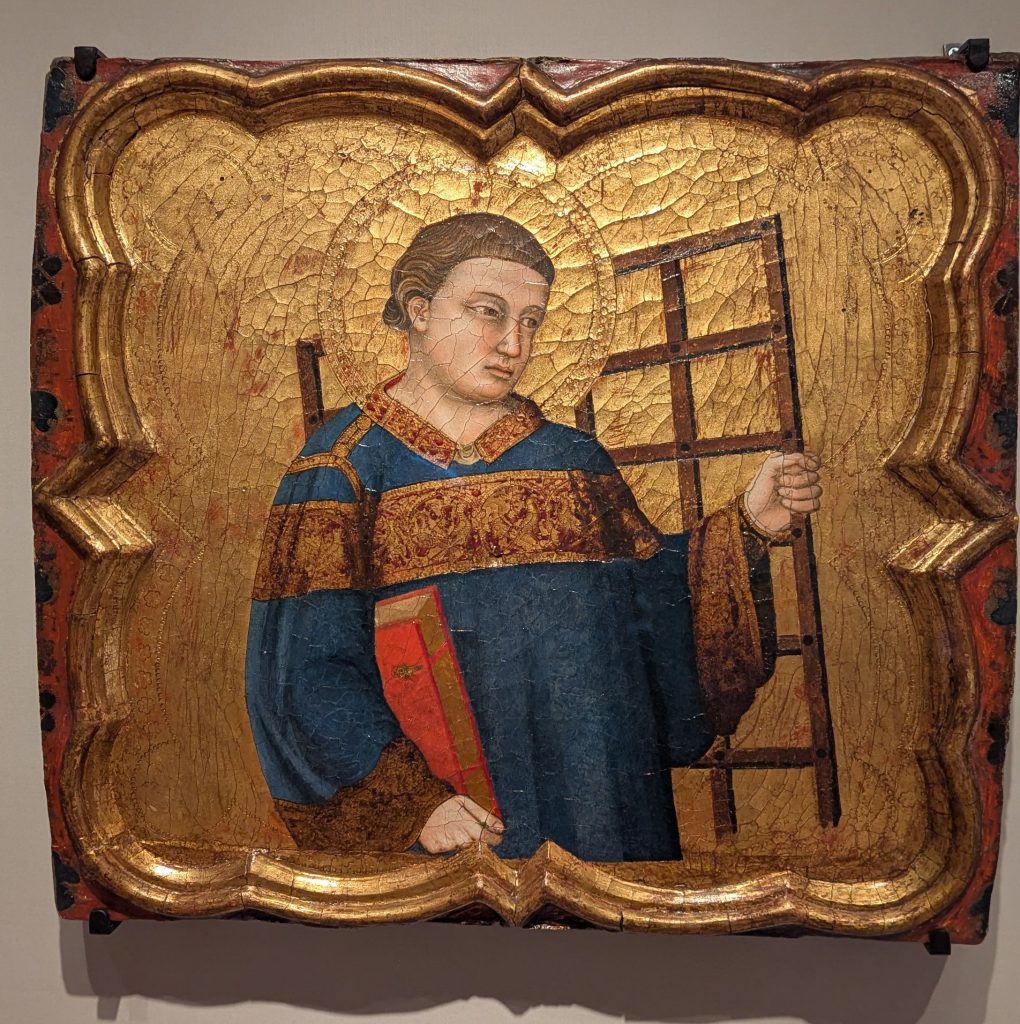
St Lawrence with his griddle, Courtald Gallery Master of the Fogg Pieta 1310-1340

The Martyr Treasurer

St Lawrence was the Treasurer of the early Church in Rome.  He was called in front of a magistrate and told to hand over the treasures of the Church.

He said: 0k I’ll need three days to do that.

3 days later he came back with sick people, disabled people, old people, orphans.  These, he said, are the treasures of the Church of Rome. He had also distributed the treasures to the poor to prevent then getting into Roman hands.  He is, thus, the patron saint of the poor.

So, the Romans sentenced him to be executed on a griddle over a fire.  I presume because they hoped he might relent and give information about where the treasures really were. Where he was executed is not known but, normally, martyrdoms were held at an amphitheatre. When the burning was halfway through, Lawrence turns to the executioner and says: ‘Turn me over.  I’m done on this side’.

So, he is the patron saint of City Officials, Cooks and Comedians! Also Tanners, Butchers and Librarians. He was martyred during the persecution of Valerian 258 AD.

St Lawrence in London

St Lawrence Church in London is on the site of the Roman Amphitheatre.  Now, us archaeologists didn’t know this till the 1980s.  But presumably they did know it in the medieval period when they built a Church dedicated to a man martyred in an amphitheatre.  Unless the attribution is a lucky coincidence.

For more about the London Amphitheatre see my posts here and here.

Because the Perseids Meteor Shower are at their peak around this period, they are called the tears of St Lawrence.

Gladiators

The British Museum has been touring its ‘Gladiators of Britain’ exhibition. It is currently as the Grosvenor Museum in Chester – until 25th January 2026, and then in Carlisle from 7th February to 19th April 2026. Recent research has shown that a young man buried in what seems to be a Gladiators Cemetary near Michelgate in York has lion’s teeth marks on his pelvis. When talking about Gladiators I was always reticent about whether animals as exotic as Lions would have been used in the distance province of Britannia. Now we know they were. The Exhibition has a marble relief from Ephesus showing a venetor (beast fighter), taking on a lion. We also know one Roman legionary in Britain had the title of Bear Keeper.

Displayed on the poster above is the Colchester vase which shows an actual gladiatoral combat. The gladiators are named as Secundus, Marius, Memnon, and Valentinus. Secundus and Marius are fighing a bear, while Memmon is fighting Valentinus. Memmon is a secutor and Valentinus, a retiarius. The secutor is the chaser and lightly armed with a heavy shield and short sword. The retiarius has a net and trident. Memmon is described as a 9th time victor, and Valentinus, a legionary of the Legio XXX Ulpia Victrix raises his finger to acknowledge defeat.

Although death and life threatening injuries were often the result, the competition was also was not, necessarily, a fight to the death, it was a fight until one or other was defeated. So they could be ended by surrender. Gladiators tombstones, often announce the number of fights a gladiator was invovled in such as fighting 25 fights of which he was victorius in 22. The chairman of the show would be given the duty of deciding whether the defeated deserved to be spared, or hit over the head with a big hammer. The Gladiatorial cemetary in Driffield Terrace, York has a high proportion of decapitated corpses. The normal ratio is 5% or less of decapitated skulls. Of the 80 burials in Driffield Street 46 were decapitated. Many of the young men in the cemetary have healed wounds. One had leg irons one which showed evidence of being put on while still red hot from the blacksmiths forge.

(This will be improved and revised in August 2026)

On This day

Death of Cleopatra August 10th 30BC

August – Octavian’s Month

The Roman month

August was originally ‘sextilis’ or the 6th Month of the ten-month Roman Calendar. It became the 8th Month when January and February were added to the calendar to make a 12 month year.  By tradition, this happened during the reign of King Numa Pompilius. Originally set as a 29-day month but changed to a 31-day month in the reforms of Julius Caesar. It was subsequently renamed August by a sycophantic Senate trying to flatter the divine Octavian, Emperor Augustus. (more of my posts about the Roman Calendar here and here)

The Celtic August

In modern Irish, it is Lúnasa, which means the month of the festival of Lughnasa. It is a harvest festival, celebrating the ripening of wheat, barley, rye, and potatoes. In Ireland, it is the festival of the God Lugh, celebrated with games, fairs, and ceremonies. Lughnasa is 6 months after Imbolc. It marks the ending of lactation of lambs and the beginning of the tupping season. (impregnation of the ewes). It can be celebrated by climbing hills, visiting springs, wells, lakes and eating bilberries. (Myths and Legends of the Celts. James MacKillop).

In Welsh, it is Awst which comes from the Latin.  Called Calan Awst in Wales, it is the festival of August. In Gaelic Scotland it is called Lunasuinn, and Laa Luanistyn in the Isle of Man.

Lughnasa is one of the Celtic quarter days,. They are halfway between the Solstices and Equinoxes. They are: Samhain (1 Nov) Imbolc (1 Feb), Beltane (1 May) and Lughnasa (1 Aug). All are, or can be seen to be, a turning point in the farming year.

The Gallic Coligny ‘Celtic’ Calendar records August as a ‘great festival month’. The stone-carved Calendar was found near Lyon, whose Roman name was Lugodunum. The town is named after the Gaulish God Lugos. It is thought he is related to the Irish God, Lugh and the Welsh Llew Llaw Gyffes. He has an unstoppable fiery spear, a sling stone, and a hound called Failinis. The Romans associate Lugos with Mercury, and the Church associated Lugh with St Michael.

Lughnasa was founded by Lugh himself to honour his foster mother Tailtiu at Brega Co. Meath. Tailtiu became one of Ireland’s greatest festivals, springing from the horse races and marital contests set up by Lugh.

Anglo Saxon August

In Anglo-Saxon: the Venerable Bede, writing in the 8th Century, says August is Wēodmōnaþ or the Weed Month. Named because of the proliferation of weeds. Why does that seem such an unsatisfactory name for August? An early Kentish source calls the month Rugern – perhaps the month of the harvest of Rye? (Winters in the World by Eleanor Parker).

Lammas

For the Anglo-Saxons, August brings in the harvest period. This is the most important months of the year. The Harvest brings in the bounty of the earth. It needs to be carefully collected, enjoyed but not wasted. It begins with the festival of Lammas, which derives from the English words for bread and mass. The Bread Mass when bread made from the first fruits of the harvest is blessed.

Kalendar of Shepherds

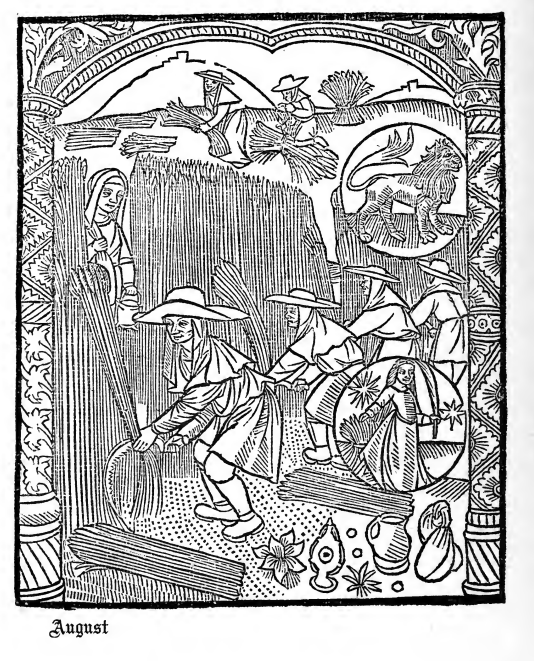
Kalendar of Shepherds, August

The 15th Century illustration in the Kalendar of Shepherds, above, shows that the Harvest is the main attribute of the Month, and the star signs, Leo and Virgo.

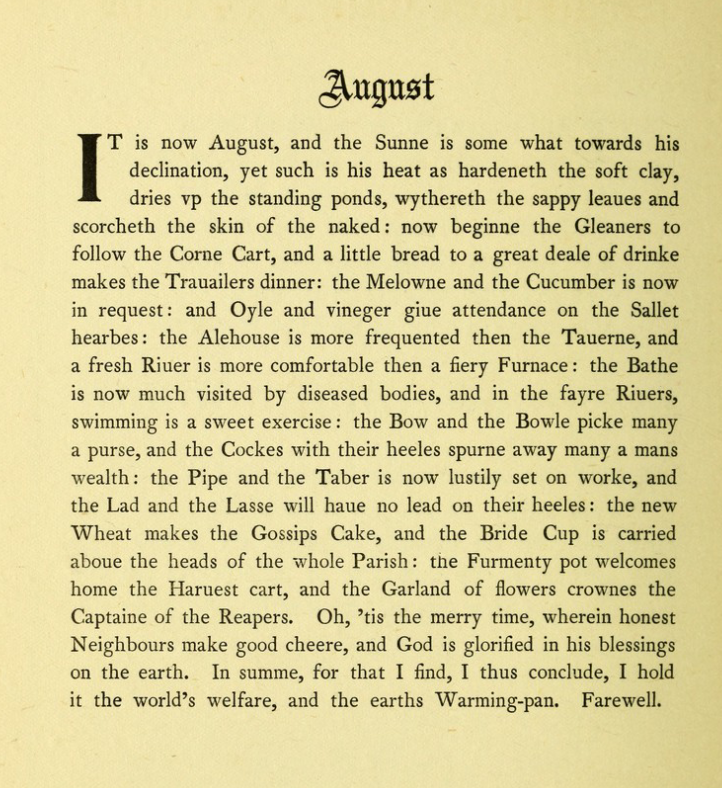
The 16th/17th Century text in the Kalendar of Shepherds gives an evocative insight into the month.

(For more about the Kalendar)

First Published in 2024, revised in August 2025