The Spring Equinox March 20th

Video by Heike Herbert of Druids at the Spring Equinox at Tower Hill, London

New content will be found at the bottom in the ‘On This Day section.’ So, Spring has sprung, not only meteorologically speaking but also astronomically. We are 20 days into the meteorological Spring which started on 1 March (see my post here.) Today, we are starting the astronomical or solar Spring.

The 20th of March is the Spring Equinox, or Vernal Equinox, midway between the Winter Solstice and the Summer Solstice. The sun has been rising further north each day since December 21st. Today it rises due East, and sets due West. The day and night are roughly equal in length (although by no means exactly). At 14:45 today, the Sun is directly overhead at the Equator.

The term vernal comes from the Latin for Spring, and today is the Primavera, the first day of Spring. The Anglo-Saxons originally used the word lencthen (Lent) for Spring. But later adopted the idea of the ‘springing’ of the year when the plants bud. In Middle English, the word Spring is also used for sunrise, the waxing of the moon and the rising tides. These are called spring tides. But also for the sprouting of the beard and the first appearance of pubic hair! Happy Spring Time!

Printemps

Up to the 15th Century, the English also used the French term ‘prime-temps’ in the sense of ‘first times’. This follows the idea that the year is young, while Winter represents old age. As we shall see, on March 25th, there was also a belief that the world was created in Spring at the Equinox. Jesus was also conceived at this point of the annual cycle. (see my post /march-25th-the-beginning-of-the-universe-as-we-know-it-birthday-of-adam-lilith-eve-conception-of-jesus-start-of-the-year)

Zodiacally, if that is a word, Spring is Aries (brave and impulsive); Taurus (sensual and stubborn), and Gemini (dynamic and talented).

Druids at Tower Hill
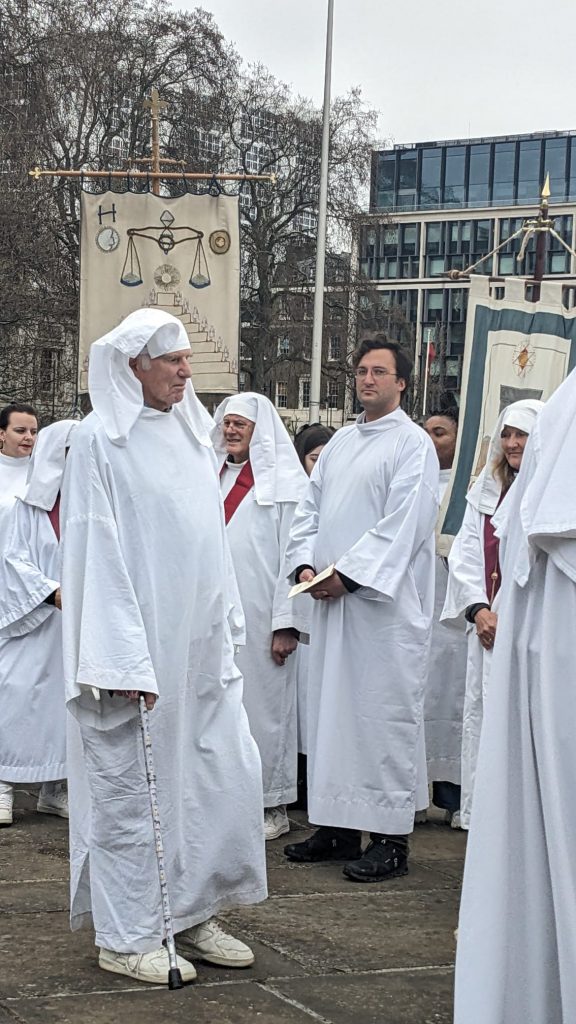
Druids at the Spring Equinox Tower Hill London, Photo by Heike Herbert

The Druids have a ceremony at Tower Hill every year on the Spring Equinox. When I last attended I remember the druid costumes were often made with nylon sheets, and their footware was mostly tennis shoes. I see from the photos the nylon has at least been replaced with cotton, and the plimsolls with trainers. Not quite sure what that pair of black trainers are doing in the picture!

As my photos are getting long in the teeth, I have used photos by Heike Herbert. She attends most years. The ones above from 3 years ago. In 2025, she reported that the atmosphere has been affected by a street food market,. This restricted the space for the Druid Circle. The food stalls are there every Thursday, so it only impacts the Druid assembly once every 7 years! In 2026 the Druids meet at Tower Hill at 12 noon.
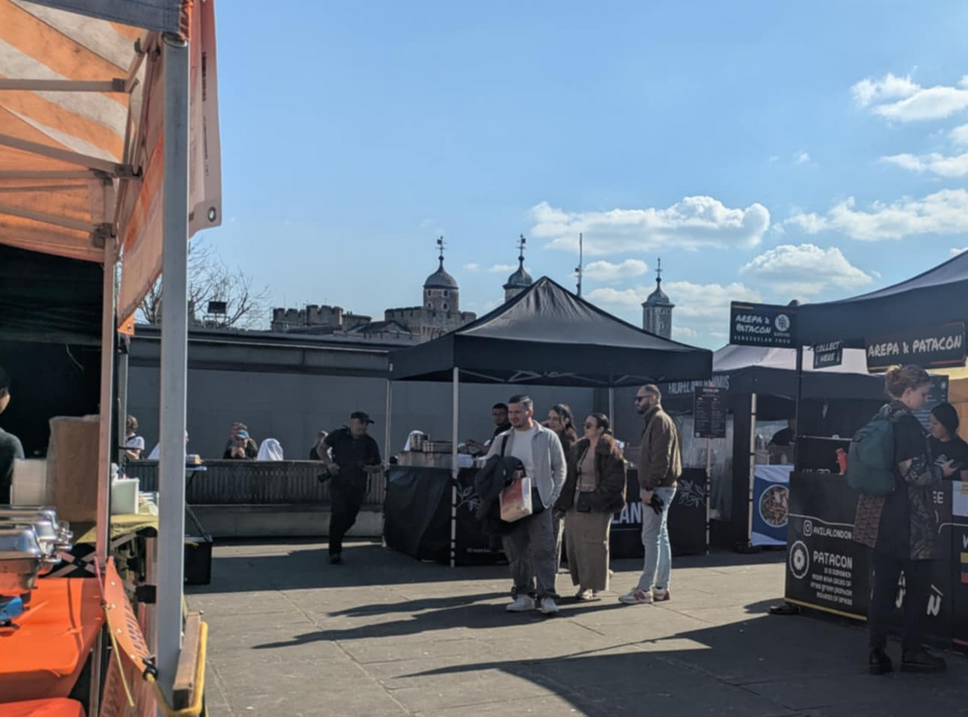
Tower Hill, Spring Equinox, 2025 and street food, Photo by Heike Herbert

Modern Druids

I say modern druids because there is no convincing evidence that the modern fellowships of Druids can trace their origins back to prehistory. Druidry was reinvented in the 18th Century — for example, the Ancient Order of Druids was formed in 1781. They were set up as societies in the tradition of the Freemasons. They held to belief in the fundamental importance of nature. However, one group, the British Circle of the Universal Bond, claim descent from a group persecuted by the Bishop of Oxford in 1166. Look at their website for more details and for an idea of their beliefs.

Prehistoric Spring Equinox

When did the Equinox first had importance for human society? The answer is, probably, at least as long as we have been reasoning creatures. On January 14th, I draw attention to a recent discovery by an amateur ‘citizen scientist’. He suggested there was evidence in Cave Painting for the use of a Palaeolithic Calendar. Follow this link to see the post.

Stonehenge and the Sun

At Stonehenge, in the old Car Park, they found three huge Pine post-holes in a line. Dating evidence shows they were erected in the Mesolithic period, thousand of years before Stonehenge. They align to the direction of the Mid-Summer Sunrise and Mid-Winter Sunset (NNE/SSW). If, and it’s a big if, you were sighting from Stonehenge itself, which was built some 5000 years in the future.
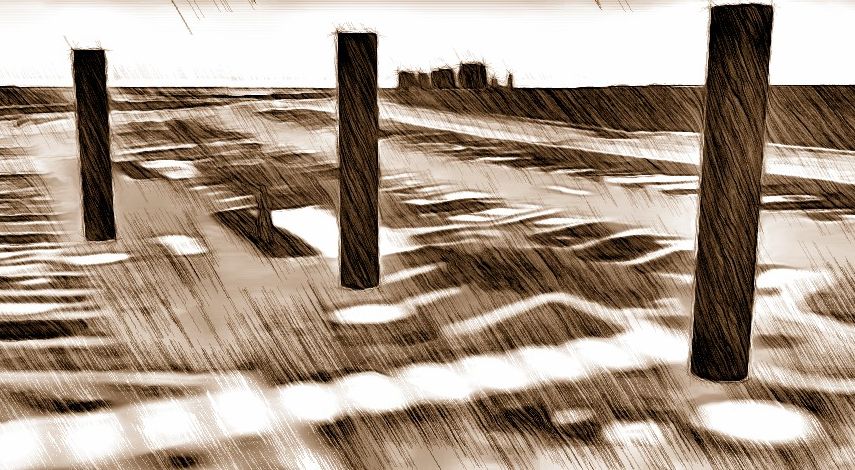
Imaginary reconstruction of the Carpark Postholes

It is a bit of a stretch using two pieces of evidence so far apart in time. But recent excavations have revealed that there are natural periglacial striations in the soft chalk bedrock at Stonehenge. These lines point to the Solstices. They not only predate Stonehenge but also the three post holes. The striations may well have been visible from the time they were created when the glaciers melted.

Around 12,000 years ago (date from my memory so approximate), the climate changed and the glaciers melted. This left a lot of water rushing around the landscape. At Stonehenge, it gouged out striations in the chalk. By chance, or as ordered by the Gods/Goddesses/Divine Nature, the striations pointed to the Solstice Axis. Richard Jacques excavations in the Stonehenge area revealed that the aurochs came to the Stonehenge area for grazing and water. Aurochs are huge wild cows with enough meat on them to feed 200 people. So, the solar axis is near a place where the Gods/Goddesses/Divine Nature provided super-abundance in the guise of herds of Aurochs.
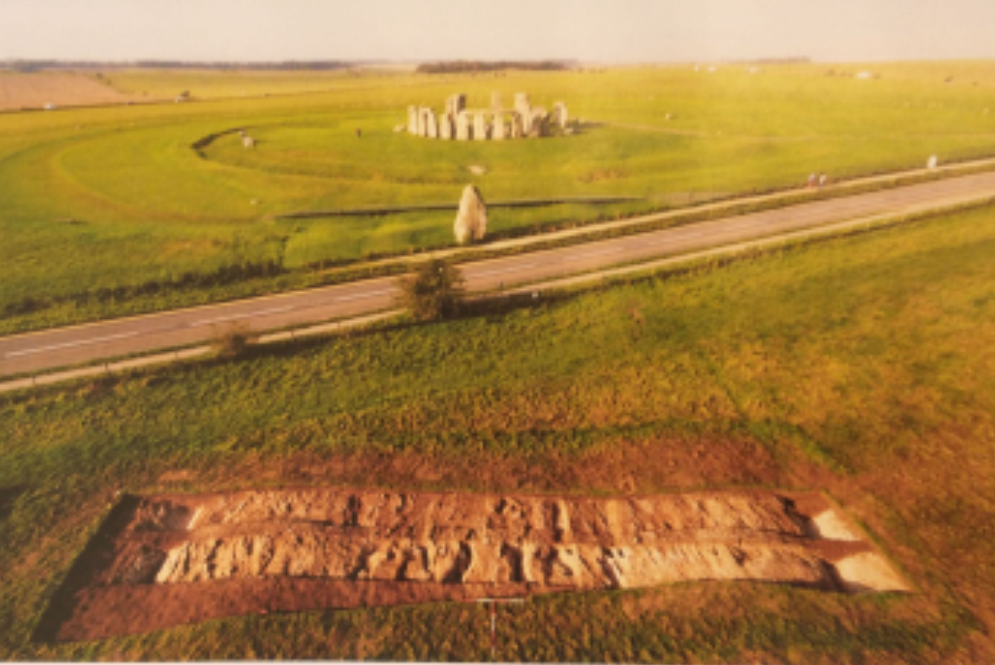
Foreground shows the periglacial striations aligned on the Solstice. Source Current Archaeology?

Burial Mounds aligned to the Equinox

That the major movements of the Sun were of interest to Neolithic and Bronze Age society is confirmed by the alignment of many megalithic monuments dating from 3,600 BC onwards, including, of course, Stonehenge. All around the UK are long barrows and other burial mounds, many of which are indeed sited/sited E-W to the Equinoxes. Many are fairly approximate. But at Loughcrew, County Meath in Ireland the Vernal Equinox shines right into the burial chamber. The sun’s light shines onto a stone marked by stone carvings. Similar alignments exist at Knowth and Dowth in the Boyne Valley. More about Loughcrew in my post here)

Harmony & the Spring Equinox.

The Equinox also has another role, which is to be the anchor of the cardinal points. The world is orientated to North, South, East, West. The Equinox is a time when there is a harmony, a balance in the universe. Therefore, it is a fortunate, a lucky time, a time to fall in love or undertake notable undertakings. But, in the Christian world marriage traditionally had to wait a little longer, until after the commemoration of the death of the Messiah,

On This Day

Today, is The International Day of Happiness. This was set up by the UN on 28 June 2012. This year’s theme:

explores the relationship between social media and happiness, highlighting the potential challenges for our wellbeing as well as ways we can all use tech for good.

Go to the web site for more information. But these are the three steps they suggest: (I’ve cut and pasted them from the site)

Step 1: Choose

Be mindful of if, when and how much you are on social media.

  • Pause and ask yourself, “What do I really want to do right now?” Keep a list of analogue activities you can do instead, like playing music, drawing, gardening or going outside for a walk.
  • Set a timer so scrolling is a short snack rather than a wormhole.
  • Give your mind space to think, keep the bedroom phone free, try a ‘digital sabbath’.

Step 2: Connect

Don’t let scrolling be a substitute for real connection.

  • Phone a friend for a chat, or send some voice notes, instead of scrolling.
  • Make plans offline, get excited about your next adventure with loved ones.
  • Use social media to connect with supportive friends and communities that are meaningful to you.

Step 3: Curate

Personalise your experience to support your wellbeing.

  • Follow plenty of positive accounts – bloom scroll, don’t doom scroll.
  • Share and amplify uplifting stories, messages and ideas, be aware of misinformation.
  • Be kind in the comments, it matters more than you think.

If you have found this useful, spread the word and encourage others to do the same. Use the hashtag #InternationalDayOfHappiness.

The World Happiness Report

This is published annually by the Wellbeing Research Centre at the University of Oxford. More details here. Finland is top for the 9th year in a row. US is 23rd, UK is 29th. These are the top 25 happy countries:

  1. Finland
  2. Iceland
  3. Denmark
  4. Costa Rica
  5. Sweden
  6. Norway
  7. Netherlands
  8. Israel
  9. Luxembourg
  10. Switzerland
  11. New Zealand
  12. Mexico
  13. Ireland
  14. Belgium
  15. Australia
  16. Kosovo
  17. Germany
  18. Slovenia
  19. Austria
  20. Czechia
  21. United Arab Emirates
  22. Saudi Arabia
  23. United States
  24. Poland
  25. Canada

I’m going out for a walk, to phone a friend and to move my narrow boat as it’s a beautiful sunny day. Winter Solstice in Helsinki? Happy Days!

First Written in March 2023, and revised in March 2024, 2025, OnThis Day added in 2026
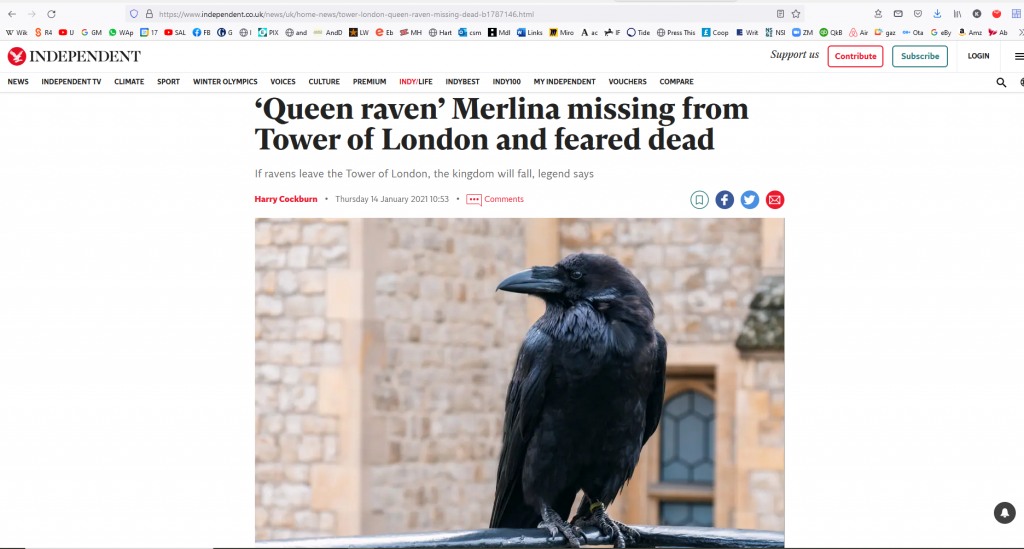
The Raven, the Palladium and the White Hill of London February 18th

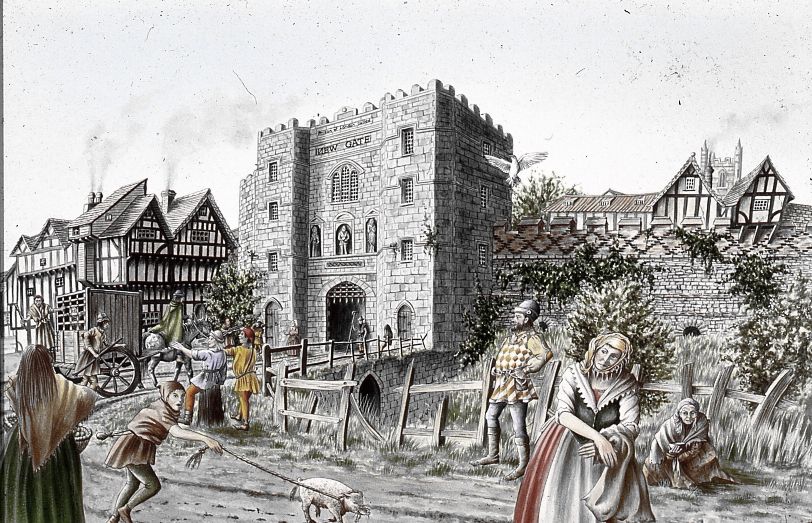
Shows a photo of a missing Raven at the Tower of London
The Independent January 2021 The Raven the Palladium of Britain

The Raven – the Palladium of Britain

Corvus corax is hatching. An early nesting bird, the Raven is the biggest of the Corvids. They were pushed to the west and north by farmers and game keepers but are making a comeback. Ravens are finding towns convenient for their scavenging habits. So they, again, cover most of the UK except the eastern areas. The Raven is one of the Palladiums of Britain.

A Palladium is something that keeps a city or country safe, They are named after a wooden statue of Pallas Athene, which protected Troy. Perceiving this, Odysseus and Diomedes stole the Palladium from Troy shortly before the Trojan Horse episode. Troy fell and the palladium went to Italy (I’m guessing with Diomedes who is said to have founded several cities in Italy). It ended up in Rome.

The Romans claimed to be descendants of Trojan exiles led by Aeneas. So it was back with its rightful owners. It protected Rome until it was transferred to the new Roman capital at Constantinople. It then disappeared, presumably allowing the Ottoman Turks to conquer the City of Caesar? To read of London Stone as a Palladium see my post here.

The Raven, Aneirin & Arthur

The Ravens habits (it is said they know where the battlefields are before they are fought) and their black plumage have made them harbingers of death. In poetry, Ravens glut on blood like the warriors whose emblem they are. Here is a very famous quotation from Y Gododdin, a medieval poem but thought to derive from a poem by the great poet Aneirin from the 7th Century.

He glutted black ravens on the rampart of the stronghold, though he was no Arthur.’

This is one of the much argued-about references to King Arthur in the ‘Was he a real person’ trope. The point being, it doesn’t make sense to mention Arthur if King Arthur wasn’t a real person. The story at the Tower of London is that the Ravens kept in the Tower, with clipped wings, keep Britain safe from Invasion. (But see below).

Bran’s Head – the original Palladium of Britain?

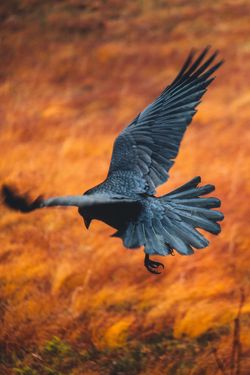
A raven landing with a brown background
By Sonny Mauricio from Unsplash

The Raven was also the symbol of the God-King Bran. Bran was one of the legendary Kings of Britain. His sister, Branwen, was married to the King of Ireland. To cut a long story short, Branwen was exiled by her Irish husband to the scullery. She trained a starling to smuggle a message to her brother, to tell of her abuse.

So Bran took an army over the Irish Sea to restore her to her rightful state. But the ships were becalmed. Mighty Bran blew the boats across the sea – he was that much a hero. Bran was mortality wounded in the fighting that followed. This was a problem because he had previously given away his cauldron of immortality.  He gave it to the Irish King in recompense for the insults given to the Irish by Bran’s brother, who hated anyone not British.

Bran’s Head Returns to London

So, the dying Bran, told his companions to cut off his own head and take it back to the White Hill in London. His head was as good a companion on the way back as it was on the way out, and the journey home took 90 years.

At last, they got to London, where Bran told his men to bury his head on the White Hill. As long as it stays here, he said, Britain would be safe from foreign invasion. The White Hill is said to be Tower Hill with its summit at Trinity Gardens, although Primrose Hill is sometimes offered as an alternative.

This was one of the Three Fortunate Concealments and is found in ‘the Triads of the Island of Britain.’ The Triads are from medieval manuscripts which preserve fragments of folklore, mythology and history. They are grouped in groups of three.

Arthur and Bran’s Head

But many years later, King Arthur saw no need for anybody or anything other than himself to protect the realm. So he had the head dug up. Calamity followed in the shapes of Sir Lancelot and Mordred which led to the end of the golden age of Camelot and conquest of Britain by the Saxons. This was one of the Three Unfortunate Disclosures.

If we want a rational explanation for the story, there is evidence that Celtic cultures venerated the skull, and palladiums play a part in Celtic Tales.

So what was Arthur doing destroying the palladium that kept Britain safe? Vanity is the answer the story gives. But, perhaps, it’s a memory of Christian rites taking over from pagan rituals? God, Arthur might have thought, would prefer to protect his people himself rather than Christians having to rely on a pagan cult object.

Ravens in the Tower of London

The story of Bran’s head is inevitably linked to the Ravens in the Tower who, it is still said, keep us safe from invasion.  As you can see from the photo at the top we still get in a tizz when one goes missing.

Sadly, and I am probably sadder about this than most, the link between the Tower, Bran, and the Ravens cannot be substantiated. Geoffrey Parnell, who is a friend of mine, told me that while working at the Tower of London he searched the records assiduously for the story of the ravens.  He found no evidence of the Raven myth & the Tower before the 19th Century, and concluded that it was most likely a Victorian invention. IanVisits has a 2025 story about the Ravens, and also concurs that the Ravens are a recent myth.

The Welsh Triads give a total of two palladiums for Britain, a couple of nationalistic fighting dragons.

Three Fortunate Concealments of the Island of Britain

The Head of Bran the Blessed, son of Llyr, which was concealed in the White Hill in London, with its face towards France. And as long as it was in the position in which it was put there, no Saxon Oppression would ever come to this Island;
The second Fortunate Concealment: the Dragons in Dinas Emrys, which llud son of Beli concealed;
And the third: the Bones of Gwerthefyr the Blessed, in the Chief Ports of this Island. And as long as they remained in that concealment, no Saxon Oppression would ever come to this Island.

All good but then came:

The Three Unfortunate Disclosures:

And there were the Three Unfortunate Disclosures when these were disclosed.
And Gwrtheyrn the Thin disclosed the bones of Gwerthefyr the Blessed for the love of a woman: that was Ronnwen the pagan woman;
And it was he who disclosed the Dragons;
And Arthur disclosed the head of Bran the Blessed from the White Hill, because it did not seem right to him that this Island should be defended by the strength of anyone, but by his own.

Gwrtheyrn is Vortigen, the leader of the Britons after the fall of the Roman Empire in Britain, one or two leaders before Arthur. Vortigern, which means something like strong leader in Welsh was a real person in so far as he, unlike Arthur, is mentioned by Gildas a near contemporary source.

The story of the dragons is supposedly from the pre-Roman Iron Age.  Every May Day, the Dragons made a terrible noise, causing miscarriages and other misfortunes. So, King Ludd, whom legends says gave his name to London (Ludd’s Dun or Ludd’s walled City), drugged the dragons.  He had them buried in a cavern at Dinas Emrys in Eryri (Snowdonia). The Red Dragon represented the Britons (also called the Welsh) and White Dragons the Saxons.

Vortigern, Merlin and Vortimer

Hundreds of years later, (five hundred?) after the Romans had come and gone.  Vortigern was trying to build a castle in Eryri at Dinas Emrys.  But the walls keep falling down. ‘You need the blood of a boy born not of man’, his necromancers say.  They find a boy called Ambrosius aka Merlin whose mother had lain with an incubus.  Merlin accused the necromancers of ignorance and explains the wall collapse is caused by two dragons.  They find the cavern and let the dragons go.  The walls now stand undisturbed. But the Welsh Red Dragon and the Saxon White Dragon can not now be at peace, and the Britons are defeated by the Saxons.

Vortigern betrayed his own people for the lust of Rowena the daughter of Hengist, the Saxon. Hengist was given the province of Kent as his reward, and thus began the Anglo-Saxon take over.

Vortigern’s son is Gwerthefyr (or Vortimer). He was a better man than his dad and fought to keep the Saxons out. After Vortimer’s death his bones were buried at the chief ports on the South Coast. Here they acted as a palladian and they kept the country safe.  But they were moved to Billingsgate, in London and put in a Tower. The loss of the palladium allowed the Saxons to land safely on the Kent coast and consolidate their increasing hold over Britain and turning it into England.

Birds in Love

Here is a lovely little medieval poem. It was found in 1931 in the end leaf of a manuscript where someone had been testing their goose quill and scribbled these three lines:

All the birds have begun their nests

Except for me and you

What are we waiting for now?

This is from Dr Florence H.R.Scott’s lovely medieval substack here:

Wet Weather

Why it is so wet in the UK at the moment (February 18th)? The answer seems to be that there is a block of cold weather over the States that is moving the Jet Stream south, bringing lots of wet weather. But there is also another block of cold weather over Scandinavia. This means that the low pressures being driven by the Jet Stream, have no where to go and are stopping and dumping their rain all over the UK.

To hear the Observer’s explanation listen here.

On This Day

3102 BC – the death of Krishna starts Kali Yuga, the fourth and final yuga of Hinduism.

1478 – George, Duke of Clarence, traitor to his Brother, Edward IV, was executed in private at the Tower of London. It is said he was drowned in a vat of Malmsey Wine.

1678 – First Part of Pilgrim’s Progress by John Bunyan published.

1991 – The IRA plant bombs at Paddington station and Victoria station in London. The IRA gave warnings, and the Victoria bomb went off at 4.20am and caused no casualties. At or just before 7am, the IRA warned that all London Stations were to be bombed in 45 minutes time. The Authorities were slow to clear the stations and at Paddington a bomb went off at 7:40am. 1 person was killed and 38 people were injured. 11 days earlier, the IRA attacked Downing St with a mortar bomb attack.

Written on February 21 revised in February 18th 23, 24, 25, Birds in Love, Wet Weather and On This Day added in 2026

Mile End & the Peasants’ Revolt, June 14th 1381

The Execution of Treasurer Robert Hales and Chancellor Archbishop Sudbury on the Day the King met the Peasants at Mile End

To recap.  On June 14th the 1381 Rebels have control of London.  They are destroying any repository of legal records they can find. People are walking the streets dispensing street justice.  Foreigners who speak Flemish are being beheaded.  Enemies of the people are being dragged out of sanctuary and beheaded.  Properties of the leaders of the government are being ransacked and burnt.

The King is in the Tower with his advisors, fearful that the Rebels will breach the defences.  I would love to be a fly on the wall of that conversation. You would think it would go something like.

‘Sire.  Your safety is paramount.  We will leave the castle and draw off the rebels so you can go to a place of greater safety.’

What happened is astonishing.  The Royal plan was to send the 14-year-old King Richard out to draw off the rebels so that the hated Chancellor of England, Archbishop Sudbury and the Treasurer of England, Robert Hales could slip away unseen! Putting the young boy king in the direct line of fire!

There are two explanations. Hales and Sudbury were arrant cowards. Or the King was very confident of his safety and despite his youth made his advisors accept his command.  This was an age where young princes took adult responsibilities early.

The King left the Tower on horse back, accompanied by two half-brothers and his mother (and others). Their reception was hostile. We have eyewitness accounts of angry rebels pulling at the King’s bridle and that of one of his attendants from the City government. The King sent his mum and brothers back to the Tower as it was too dangerous. We can only assume the King sent them back sure that the peasants did not blame him for the mess the country was in.

He went to Mile End.  His clerks set up tables and began writing charters freeing the peasants from feudal duties and turning their tenure into monetary rents.

As each village received its charter, many of the villagers went home.  Back at home they sometimes attacked the people who had been manipulating the legal system, believing the King had given them permission to punish the guilty.

Whether the king believed in the justness of their claim or was just placating them to gain time, we do not know. But some historians believe that the young King was sympathetic to some of their claims, until older counsel made him change his mind.

Not all the rebels followed the King to Mile End, nor went home when their charters were sealed.  It is thought Wat Tyler and thousands of rebels stayed at the Tower.

They saw the Archbishop of Canterbury trying to escape.  They forced their way into the Tower.  Here they jumped up and down on the Queen Mother’s bed, stole armour and weapons.  Then dragged Hales, Sudbury, a Franciscan Friar (William Appleton, John of Gaunt’s physician), and John Legge, a royal sergeant to the scaffold at Tower Hill and beheaded them.  Their heads were put on poles and paraded around town.

When the King left Mile End he couldn’t go to the Tower so he went to Baynards Castle, near Blackfriars. We also know that, the King’s cousin, Henry Bolingbroke was in the Tower.  He was the son of the hated John of Gaunt.  Years later, when he was King, he acknowledged the fact that a Londoner had been instrumental in saving his life in the Tower on the 14th of June, 1381. The man was fighting charges of stealing gold from the ransacking of Gaunt’s Savoy Palace.  He was given a pardon.

That night rebels remained in London, and the king’s cause had been considerably weakened.

The Archbishop’s Head

You may wonder what happened to his head! Well, here is the answer!

To be continued. See also my post peasants-revolt-june-13th-1381/

First published in 2025.

.