Shrove Tuesday – Pancake Day – Mardi Gras – End of the Carnival

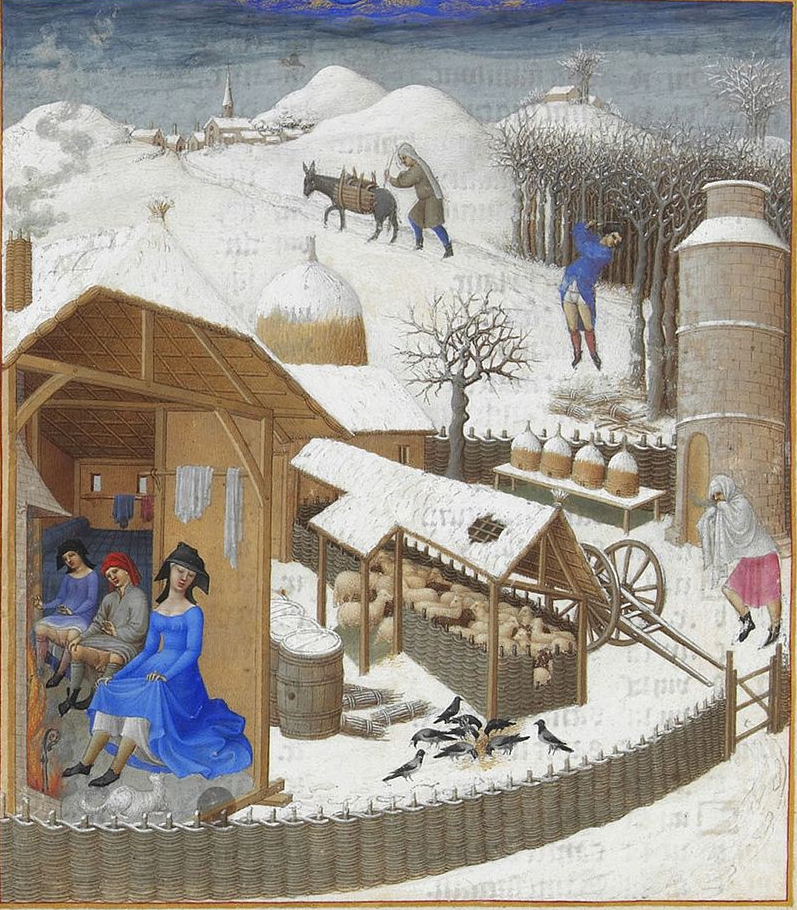
Les_Très Riches Heures du Duc de Berry February (Detail)  The people inside are warming their legs and their hands in front of a roaring fire.
Les Très Riches Heures du Duc de Berry February (Detail) The people inside are warming their legs and their hands in front of a roaring fire.

Shrove Tuesday & Carnival

This year, February 17th is Shrove Tuesday, the end of the Carnival. Etymology-on line says the origins of the term Carnival are:

1540s, “time of merrymaking before Lent,” from French carnaval, from Italian carnevale “Shrove Tuesday,” from older Italian forms such as Milanese *carnelevale, Old Pisan carnelevare “to remove meat,” literally “raising flesh,” from Latin caro “flesh” (originally “a piece of flesh,” from PIE root *sker- (1) “to cut”) + levare “lighten, raise, remove” (from PIE root *legwh- “not heavy, having little weight”).

Folk etymology has it from Medieval Latin carne vale ” ‘flesh, farewell!’ ” Attested from 1590s in the figurative sense of “feasting or revelry in general.” The meaning “a circus or amusement fair” is attested by 1926 in American English.Related entries & more 

www.etymonline.com

Pancake Day/Shrove Tuesday

Pancake Day is another name for Shrove Tuesday. It is the day we eat up all our surplus food. Then on Ash Wednesday we must begin our lenten fast and turn our mind to repentance. Pancake Day, in the UK, is celebrated with a simple pancake with lemon and sugar. Here is a recipe from the BBC. On the other hand, Shrove Tuesday can be a day of excess before the 40 days of restraint. Shrovetide was normally three days from the Sunday before Lent to Ash Wednesday, the beginning of Lent. (Here is my post on Ash Wednesday).

Mardi Gras

In France, it’s called Mardi Gras which means Fatty Tuesday, in Italy Martedi Grasso. In New Orleans it stretches from Twelfth Night to Shrove Tuesday. But as we saw, in my post on Fat or Lardy Thursday‘ the Carnival period was more normally a week. In most other places it is one to three days. In Anglo-Saxon times there was ‘Cheese Week’, ‘Butter Week’, ‘Cheesefare Sunday’ and ‘Collop Monday’, preceding Ash Wednesday.

Shrove Tuesday the Day to be Shriven

Shrove Tuesday is the day we should be ‘shriven’ which means to make confession. The Church has been leading up to Easter since Advent – before Christmas. (See more on Advent Sunday here). Easter is the date of the conception and, also, the date of the execution and apotheosis of Jesus Christ. So the pious should confess their sins, then undertake their lenten fast before entering the Holy Week purged and sin-free.

In the Anglo-Saxon Church, there was a custom called ‘locking the Alleluia.’ The Church stopped using the word Alleluia from 70 days before Easter. Alleluia represented the return from exile in Babylon. So, with the approach of the death of Christ it was not felt appropriate to be celebratory.

The sombre nature of this block of time was highlighted by Ælfric of Eynsham (c. 955 – c. 1010).

Now a pure and holy time draws near, in which we should atone for our neglect. Every Christian, therefore, should come to his confession and confess his hidden sins, and make amends according to the guidance of his teachers; and let everyone encourage each other to do good by good example.

Ælfric, Catholic Homilies Text Ed. Peter Clemoes quoted in ‘Winters in the World’ Eleanor Parker

Time for Football!

Shrove Tuesday was the traditional time for football games, in the days before football had any rules to speak of. It was a wild game. Teams tried to get a bladder from one end of town to the other, or one side of a field to the other. In Chester, the Shrove Tuesday football game was held on the Roodee island. It was so rowdy that the Mayor created the Chester Races specifically to provide a more sedate alterative to the violence of the ‘beautiful game.’

Here is a youtube video of Shrovetide Football at Royal Asbourne in Derbyshire. You will notice it seems chaotic but if you look at the participants directed the action you can see how involved they are in it.

Royal Asbourne Shrove Tueday Football

In London, Henry Fitzstephen wrote about Shrove Tuesday Games in London in the late 12th Century:

‘Every year also at Shrove Tuesday, that we may begin with children’s sport, seeing we all have been children, the school boys do bring cocks of the game to their master, and all the forenoon they delight themselves in cockfighting. After dinner all the youths go into the fields to play at the ball. The scholars of every school have their ball, or baston in their hands. The ancient and wealthy men of the City come forth on horseback to see the sport of the young men and to take part of the pleasure in beholding their agility.’

Fitzstephen was the first biographer of Thomas Becket.

Pancake Race

The City of London has an annual pancake race at the Guildhall Yard. It is an inter-livery company competition. The Livery Companies also known as medieval Guilds, have to run across the Guildhall while holding a frying pan and pancake. There is a zone marked out where they have to toss the pancake. Here is a youtube video of the 2023 race.

Pancake Day/Shrove Tuesday Pancake Race

First published on February 21st, 2023 republished on February 13th 2024, and March 4th 2025, February 17th 2026

Becket & St. Thomas Day & Wassailing December 29th

Murder of Becket at Canterbury Cathedral 1170
Murder of Becket at Canterbury Cathedral on 29th December 1170 (Late 12th Century Manuscript from British Museum)

On the fifth day of Christmas
my true love sent to me:
5 Golden Rings; 4 Calling Birds; 3 French Hens; 2 Turtle Doves
and a Partridge in a Pear Tree

St Thomas Becket

The fifth day of Christmas is dedicated to Thomas Becket, our most famous Archbishop of Canterbury. He was martyred at Canterbury on this day in 1170. But, he was made a Saint in 1173.  This is double-quick time, as the Pope was determined to rub Henry II’s nose in his complicity with the murder.

Becket was a Londoner from a well-known London family, who became a friend of Henry II. Henry was troubled by the freedoms and fees owed to the Catholic Church. So he thought it would be a good idea to make his friend Archbishop. But as soon as Becket became Archbishop he went ‘native’, became a very stubborn and adamant defender of the Pope’s privileges in Britain. After various confrontations, Henry said, in anger, ‘Who will rid me of this troublesome priest?’ And three knights took him at his word, so Becket was murdered in the Cathedral in Canterbury.

Illustration from ‘an old manuscript’ showing Henry II being scourged in penance for his part in the death of Becket

Lousy Saints

In November 2023 Katherine Harvey wrote an article, in History Today’ called ‘Lousy Saints’. It began with the discovery that Becket wore a hair shirt.  This is how it was described:

This goat hair underwear was swarming, inside and out, with minute fleas and lice, masses of them all over in large parches, so voraciously attacking his flesh that it was nothing short of a miracle that he was able to tolerate such punishment.’

Becket was a former sophisticated courtier.  The assumption is that Becket sought this discomfort deliberately. He also concealed the horror under magnificent clothes. The monks duly cited the lice as evidence of the piety of the man who was willing to suffer for his religion. They even suggested that the daily agony of the lice was worse than the swift death at the hands of the Knights.

Many other pious clerics were similarly lousy by choice. Society as a whole found uncleanliness of this magnitude disgusting. They had the technology to avoid it too. Becket himself had a manservant to look after his clothes and access to a bath. But he limited his baths to once every 40 days by choice. The fact that it was a choice is why people admired such discipline on the part of people like Becket. Altogether very strange and disturbing to this modern reader.

Bridge and Pilgrimage

Soon, a new, magnificent bridge was built to replace the wooden London Bridge. In the centre of that Bridge was a grand Chapel dedicated to St Thomas Becket. It was refurbished by the renowned architect Henry Yevele (c. 1320 – 1400). It was here that pilgrims began their pilgrimage to Canterbury. That is, they travelled from where he was born, to where he was martyred.

Stained Glass window showing St Thomas's Chapel on London Bridge (Window is in St Magnus the Martyr's Church on the site of the approach to London Bridge
Stained Glass window showing St Thomas’s Chapel on London Bridge (this window is in St Magnus the Martyr’s Church on the site of the approach to London Bridge

The Legend of the Epic Walk of Mathilda Becket

In London, there was a legend that his mother, Mathilda, was a Muslim who fell in love with Thomas’s dad, Gilbert, during the Crusades. She helped him escape captivity. He abandoned her and return to England. She then found her own way from Acre to London. She made the journey knowing only the name ‘London’ in English and walked most of the way.  On St Thomas Day, people walked around St Paul’s multiple times to commemorate her epic walk of love.

The story was told as true from the 13th Century until the 19th Century. Then researchers found that Mathilda had more prosaic Norman origins. The speculation is that the foundation of the Hospital St Thomas of Acre on the site of Becket’s birthplace led to the story of his connection with Acre. I was quite disappointed to find out the tale I told was a myth which is told in full here:

Medieval St Thomas’s Pilgrim’s Badge showing the murder of Becket. The ampullae contained holy water.

Henry VIII’s hatred of Becket

When Henry VIII began the reform of the Church of England, he was particularly keen to end the cult of Becket. This rebel against one of the great Kings of England.

Thomas Becket, sometime archbishop of Canterbury, shall no longer be named a saint, as he was really a rebel who fled the realm to France and to the bishop of Rome to procure the abrogation of wholesome laws, and was slain upon a rescue made with resistance to those who counselled him to leave his stubbornness. His pictures throughout the realm are to be plucked down and his festival shall no longer be kept, and the services in his name shall be razed out of all books.

Westminster, 16 Nov. 30 Hen. VIII’

A blog post by the British Museum highlights some fascinating research.  Henry’s government ordered the deleting of unacceptable content in church service books.  Research into the deletion of content found that it was very varied in extent, except where it concerned Becket.  The vast majority of references to him were either completely defaced or mostly defaced, suggesting that Henry had a particular hatred of Becket.

Henry made a lot of money from the gold and jewels that were stripped from Becket’s magnificent shrine at Canterbury Cathedral.

Another of my posts is on Becket and can be read here.

Wassailing

Black and white drawing of a servant Bringing in the Wasaill Bowl (from Washington Irving's 'Old Christmas
Bringing in the Wassail Bowl (from Washington Irving’s ‘Old Christmas’)

The Twelve Days of Christmas are full of wassailing.

Was hail Drinc hail

The name comes from the Anglo-Saxon version of ‘Cheers’ or good health. Its ceremonial use is described by Geoffrey of Monmouth, writing in 1135.

From that day to this, the tradition has endured in Britain that the one who drinks first at a banquet says “was hail” and he who drinks next says “drinc hail.”

Geoffrey is explaining how Vortigern, in the 5th Century, betrayed Britain for the love of Rowena. She was the Saxon King Hengist’s daughter, and, only incidentally, speculating on the origins of the tradition of wassail.

Geoffrey of Monmouth tells us that the word means ‘Good Health’ or as we would say ‘Cheers!’

For more on Vortigern, leader of the Britons in the 5th Century read my post here.

Wassail

This has at least two different facets. Firstly, it is a formal drinking tradition at the centre of Christmas hospitality. Secondly, it is part of the tradition of the Waits, the Mummers, and Carol Singers. These are groups who go around the village singing or performing in exchange for a drink or some food, or money.

Wassailing is either a lovely gentle social activity, or it is an anti-social custom in which the drunkards get to stand outside your house caterwauling. In effect they are demanding drink with menaces. Imagine a Trick or Treat with the drunkards from the pub instead of children!

A Wassail bowl would be full of some form of mulled alcohol or hot punch. A couple of pints of ale or cider, a pint of wine/brandy/mead. Add sugar, cinnamon, and nutmeg. You should have an apple or crab-apple floating in the bowl. To find out more, look at ‘British Food, a History’ here.

‘Into the bowl is first placed half a pound of sugar in which is one pint of warm beer; a little nutmeg and ginger are then grated over the mixture, and 4 glasses of sherry and 5 pints of beer added to it. It is then stirred, sweetened to taste and allowed to stand covered for 2 to 3 hours. Roasted apples are then floated on the creaming mixture and the wassail bowl is ready.

The Curiosities of Ale and Beer, by John Bickerdike, published about 1860 from a Jesus College, Oxford recipe of 1732. (From Recipes of Old England by Bernard N. Bessunger

Wassail in the Orchard

For this New Year’s Eve custom see my post here:

First Published on 29th December 2022, republished in December 2023, 2024,2025