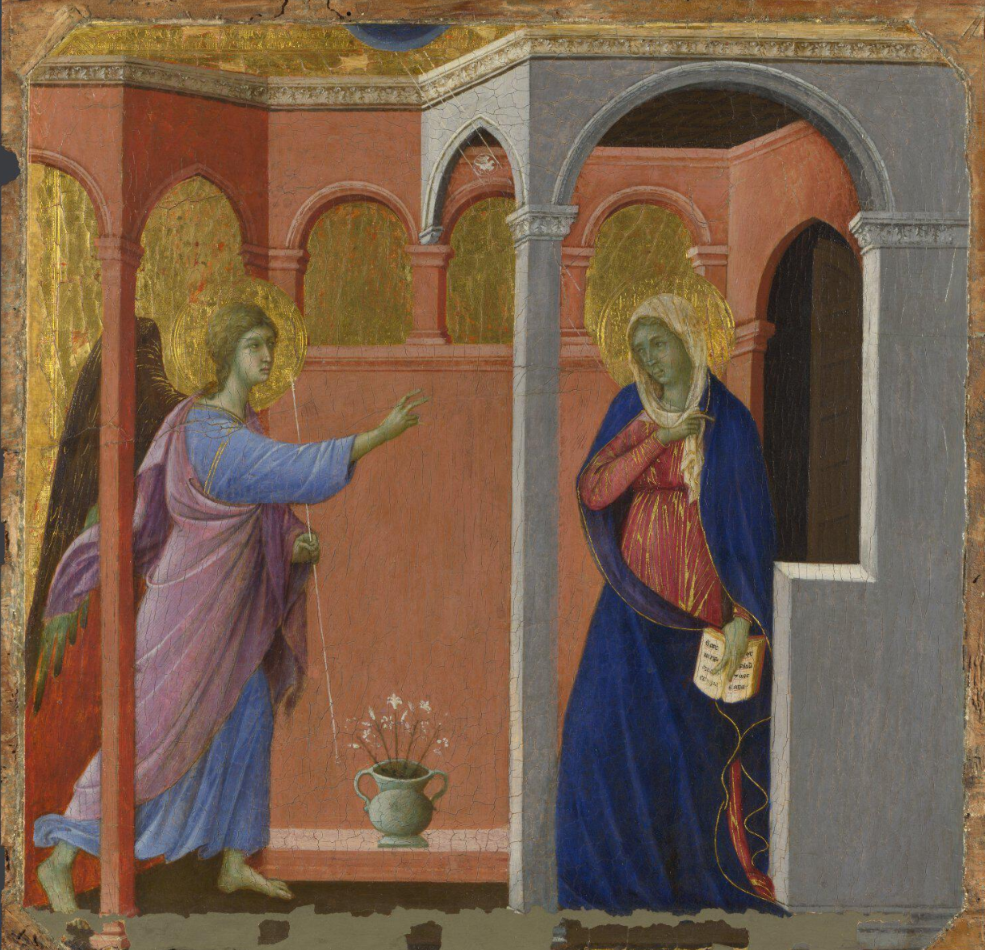
The Annunciation by Duccio
Today, is the anniversary of the conception of Jesus Christ, called the Annunciation. I told some of this story yesterday which was St Gabriel’s Day. So, sorry for any repetition but I think the extra detail makes it worthwhile! There is a third post in my Annuciation series where I go into the wider implications of the date March 25th, and how it has a fundamental place in Christian Theology.
The picture above is by Duccio, from Sienna in Italy. It shows the Archangel Gabriel bringing Mary the news that she is to give birth to the Son of God. It is in the Sainsbury Wing of the National Gallery. This was the second painting on the National Gallery tour I used to give. The Tour told the story of the development of perspective. I had been reading a book on the subject by David Hockney.
The painting shows that Duccio does not understand single-point perspective. But then, no one could do perspective at that time in Europe. This skill was lost following the Roman Period. But at the beginning of the 14th Century, painters like Duccio from Sienna, and Giotto from Florence, were groping towards more realistic representation.
You might say they wanted a more human depiction, in which events are shown in spaces that are trying to look real. Filled with more realistic looking people and beginning to show on their faces real emotions. Previously, the Byzantine style produced iconic, storytelling images, that were somewhat cartoon-like rather than realistic. Here, is a detail from one such.
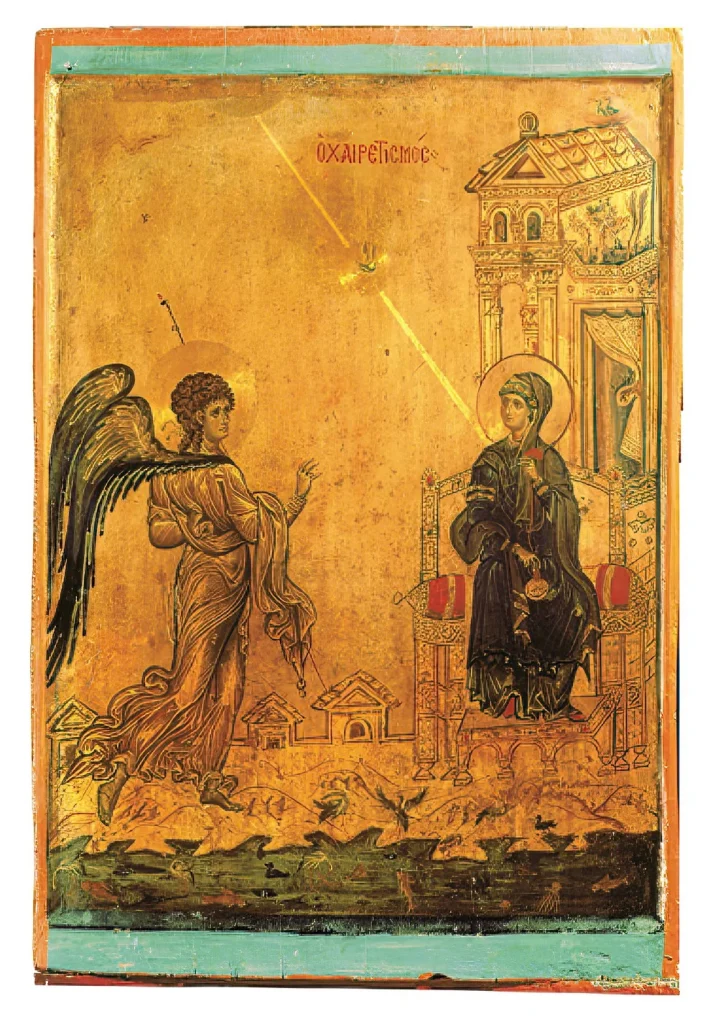
The encounter takes place in a space that is not very real. But it does tell the story effectively.
Moving towards Perspective
Now, look at the Duccio, he uses the arcading at the top of the painting to give an impression of this being an encounter in a real space. The Archangel Gabriel is moving through that space decisively. This is not just a picture with a story, it shows Duccio’s interest in capturing a fleeting but incredibly emotional moment. It happens to be the most important moment in the history of the world (from a Christian view point), the moment that the son of God is conceived as a human.
Gabriel is striding purposefully towards Mary, who has come out of her house to see him. He saying ‘Hey, you are going to give birth to the Son of God.’
She looks overwhelmed, (as you would) holding her arm protectively towards her. ‘What me?’ she might be saying. But she is also pointing at the Bible where this moment in time is predicted by Isaiah. Their faces are quite realistic, Mary is clearly emotional.
Also, if you look at Gabriel’s feet he is quite well grounded unlike many other medieval paintings, where people often seem to be floating above the ground. Mary, too is firmly, anchored, although you cannot see her feet.
It is by no means ‘perfect’ because they don’t yet know the rules of perspective. Neither have they discovered they could use lenses to create ‘photorealistic’ portraits. But they are searching for methods that can bring spaces and people towards realistic life. It mirrors a humanistic trend to see Mary not as a sort of Goddess, but as a real mother. A key point in the Renaissance. (For more on perspective, see my post on Giotto and Palm Sunday. )
The Moment of Conception
Above the arcading can be seen a small sphere of blue sky from which emanates several ‘rays’ and a tiny Holy Dove. As I told the story, yesterday, the rays are coming from Heaven to her womb which is hinted at by the red of her dress. The National Gallery commentary, which you can read here, suggests ‘The conception takes place at the moment she hears the words, which is why a tiny white dove, representing the Holy Ghost, flies towards her ear‘.
This made me stop and think – the tiny dove is heading to her ear is it? Really? Why? Gabriel is the messenger saying the words, the words head to the ear. The Holy Dove is a symbol of the Holy Spirit, part of the Trinity of Father, Son and Holy Ghost. Its role, in the painting, is to show that God is the Father. So why, would the Holy Spirit enter by the ear?
I have been using a ruler to try to see if the National Gallery are right! It’s difficult to be sure with a reproduction. but my ruler says the rays from Heaven are neither heading to the ear nor directly to the womb but in the general direction of her body. If they are right that the rays from heaven are heading for her ear, then is this rather the moment she is being told she will conceive rather than the moment of conception?
The Conception in St Luke
But the National Gallery text accepts that it is the moment of conception that is shown. So, I’ve looked at Luke 1:26-38:
‘Do not be afraid, Mary, for you have found favour with God. And now, you will conceive in your womb and bear a son, and you will name him Jesus.‘
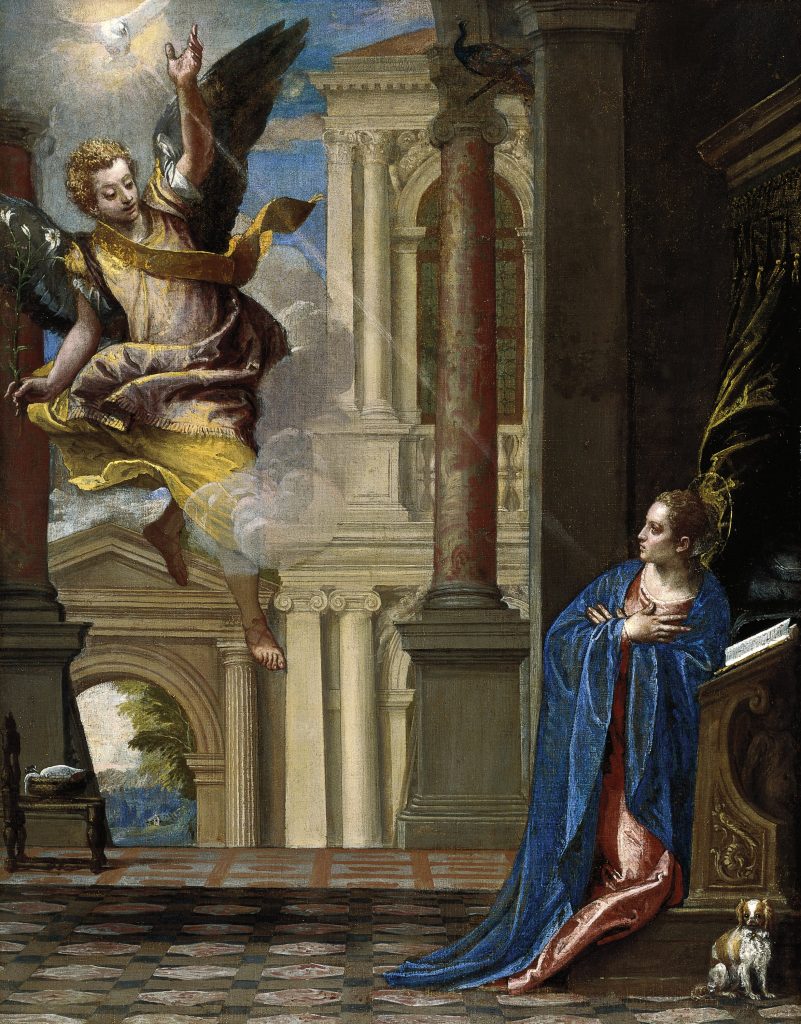
On first reading he is telling her she will conceive, but reading it more carefully he is saying ‘now, you will conceive’. So Duccio is paying very careful attention to the Gospel. By the time Gabriel finishes his sentence, she will have been impregnated by the Holy Dove. Looking at other paintings of the Annunciation the rays from heaven head generally towards the virgin, sometimes to her head, nothing suggesting the ear. In the St Catherine’s Monastery’s Annunciation, above, the ray is going to Mary’s back. Veronese’s ‘The Annunciation’ is similarly going towards Mary’s Back, shoulder, or breast. The Annunciation by the Master of the Judgement of Paris which I showed yesterday has the ray heading to Mary’s lap.
Rossetti’s Annunciation
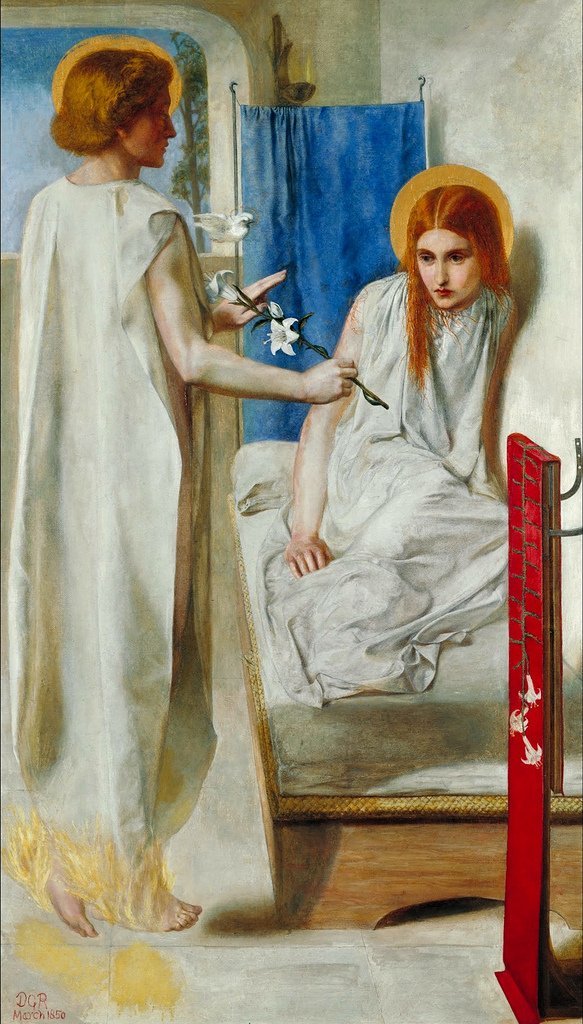
I’ve included a 19th Century Rossetti painting because it is so beautiful. It shows a lilly representing purity, instead of the rays, pointing to Mary’s womb. The use of white throughout also represents Mary’s ‘purity’. While the Blue is the traditional colour for Mary. The use of the primary colours red and blue with the predominant White, gives a vivid clarity to the picture. At the time, showing the Virgin as a red-head was quite controversial.
By the way, look at the feet in the Rossetti’s painting. This is an early Rossetti painting, who was a poet and I’m not sure he yet had the skills to ground feet. But he takes advantage of it in this case and confirms Gabriel’s supernatural status by giving Gabriel fiery feet but no wings. Subsequently, Rossetti concentrated on paintings of women from the waist up. Since, first writing this, I have visited an exhibition of Rossetti’s drawings, and they show a very capable draughtsman.
For more on March 25th and the Universe and everything, see my post here (which will be revised later today).
On This Day
If Easter fell on March 25th it was thought to be bad news, particularly if on Good Friday. As the world was created, according to Christians, round about March 25th, God being a logical being, would end it on its anniversary. And all those people who went to the top of the hill, to see out the Day of Judgement, had to trudge down again, murmuring ‘Maybe next time.’ Hampstead Heath was a popular place for Apocalyptaphiles to go in London, the Green next to White Stone Pond, to be precise.
1306 – Robert the Bruce crowned King of Scotland.
1807 – The Abolition of the Slave Trade Act became law.
1843 – the first Tunnel built under a River was opened at Rotherhithe designed by Marc Isambard Brunel, and helped by his son Isambard Kingdom Brunel. I managed the Brunel Engine House for a few years, which was the steam engine house to pump out the water from the tunnel. In fact, a Babylonian (?) Queen built the first tunnel under a River, but what she did was divert the river, build the tunnel, redirect the River back to its original course. So strictly, the Brunels built the first tunnel constructed under a River while the River was still flowing above. I find that most firsts are much more complicated that you think!
1949 – Hamlet became the first British Film to win the Oscar for Best Film. Lawrence Olivier also won the Best Actor Oscar and he was the Director of the Film too. Olivier was the first person to achieve this double feat, and the only one until 1998, when Roberto Benigni won both Oscars in Life Is Beautiful.
Source: Chambers Book of Days
First published 2024, revised 2025, Revised and On This Day added 2026