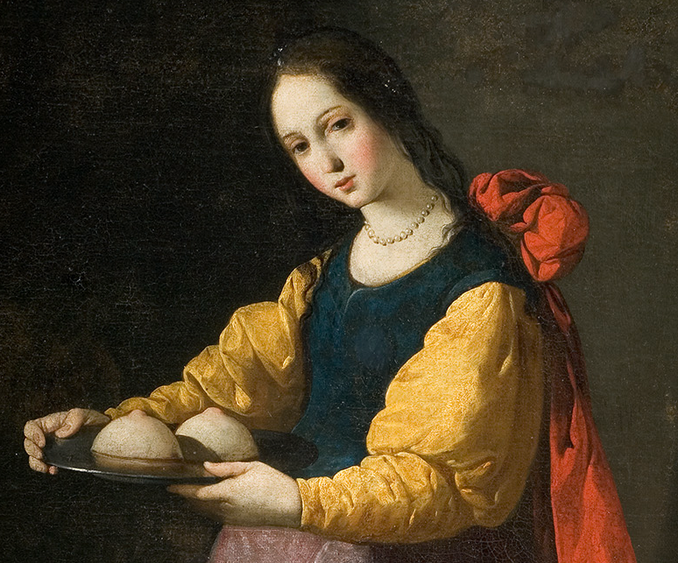
She is a Sicilian Saint, who refused to sleep with a powerful Roman (Quintianus) in the third Century. St Agatha was imprisoned, tortured, had her breasts pincered off, and still refused to sleep with him and died in prison. She is remembered in Sicily by cakes shaped as breasts eaten on her feast day (I kid you not).

St Agatha Patronage
Her patronage springs from the usual mixture of deep and simplistic identifications. So she is ‘the patron saint of rape victims, breast cancer patients, martyrs, wet nurses, bell-founders, and bakers.’ As she is from Sicily ‘she is invoked against eruptions of Mount Etna.’ And therefore also against fire and earthquakes.’ (Wikipedia).
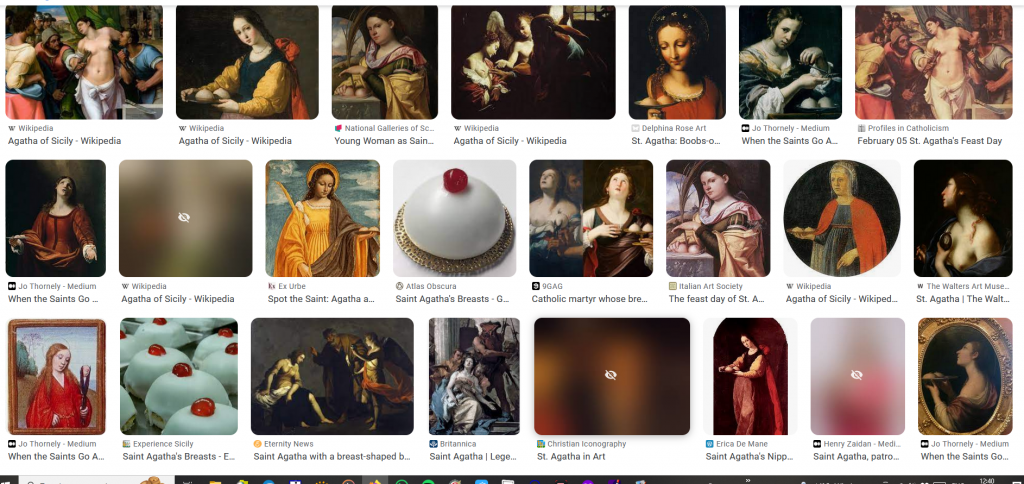
Bell Founders and Bakers? So, the bakers and bell founders, it is suggested, may have mistaken the trays of breasts as bells or loaves? Unlikely in my opinion, as Google image search shows they look clearly like breasts. They are cakes, of course, so that can help explain the Bakers, but the Bell Founders?
She was martyred, at the age of 20 (231-251AD), in the last year of the reign of Emperor Decius (Emperor 249 to June 251 AD). Thus, she is an early martyr whose cult was established in antiquity. But many of the details of her life and death are, as usual, apocryphal and from later traditions.
St Agatha and Etna
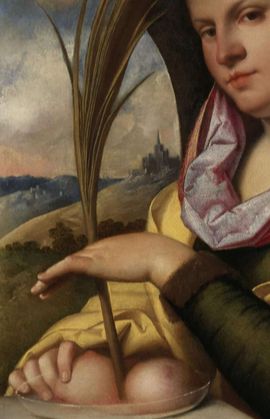
A year after her death, Mount Etna erupted. According to the story, the Christians of her home town of Catania lifted the Martyr’s veil towards the flowing lava. And the City was saved as the lava flow stopped. Hence, she protects against eruptions and by extension, earthquakes, and fire. This part of the story I got from my friend Derek who sent me the link to a piece written by Father Patrick van der Vorst. This also has the full image of the detail of painting by Cariani I show here.
For an explanation of gory matrydom’s please read my post on St Blaise.
For more on St Agatha, Ravenna, and a story about my motorcycling days please look at this post.
On This Day
2 BC – Caesar Augustus is granted the title Father of the Country (pater patriae) by the Roman Senate. Ovid celebrated this day in his alamanac poet Fasti. He seems to be praising Augustus mentioning him with the divine Julius Caesar, and Romulus and Reamus, founders of Rome.
Book II: February 5: Nones
Now I wish for a thousand tongues, and that spirit
Of yours, Homer, you who celebrated Achilles,
While I sing the sacred Nones in alternating verse.
This is the greatest honour granted to the calendar.
My wit deserts me: the burden ís beyond my strength,
This special day above all I am to sing.
Why did I wish, foolishly, to lay so great a task
On elegiac verse? This was a theme for the heroic stanza.
Sacred Father of the Country, this title has been conferred
On you, by the senate, the people, and by us, the knights.
Events had already granted it. Tardily you received
Your true title, you’d long been Father of the World.
You have on earth the name that Jupiter owns to
In high heaven: you are father of men, he of gods.
Romulus, give way: Caesar by his care makes your walls
Mighty: you made such as Remus could leap across.
Tatius, and the little towns of Cures and Caenina,
Knew you: under this Leader all the sun sees is Roman.
But suddenly the verse turns dark, and the references to Augustus are now slights and accusations. He continues:
You owned a little patch of conquered land:
Caesar possesses all beneath Jupiter’s heavens.
You raped married women: under Caesar they are ordered
To be chaste: you permitted the guilty your grove: he
forbids them.
Force was acceptable to you: under Caesar the laws
flourish.
You had the title Master: he bears the name of Prince.
Remus accused you, while he pardons his enemies.
Your father deified you: he deified his father.
Already Aquarius shows himself to the waist,
And pours the gods flowing nectar mixed with water,
And you who shrink from the north wind, be pleased,
A softer breeze is blowing from the West.
Ovid only finished the first 5 chapters of his calendar poem. He was exiled from Rome by Augustus, we don’t know why. But perhaps this is why he was exiled, because he was willing to defame the Godly Tyrant, Augustus, who had destroyed the Roman Republic. Dictators demand flattery, not criticism. Ovid paid the price. For more on Ovid’s exile please read my post on his abandonment of the Fasti here.
1811 – The Prince of Wales appointed Prince Regent during his dad’s, George III, mental incapacity
1924 – The famous pips, the time signal, first broadcasted by the BBC from Greenwich
1944 – War time diarist, Joan Wyndham receives letter from Norwegian lover Hans Gundersen. It confirms he is still alive and that she loves him. Follow the link to read his drunken letter and Joan’s reaction.
See my post here for another Joan Wyndham diary entry.
1953 – Last foodstuffs taken off Rationing in the UK. From this day forward, people could eat as many sweets and as much chocolate as they wanted. In the War they were limited to 2oz per person, and post war 6oz per person per week.
1990 – the last pips broadcasted from Greenwich by the BBC, henceforth the BBC generated their own pips.
First published in 2024, and republished in 2025, Ovid section added 2026