Yew Sunday Palm Sunday

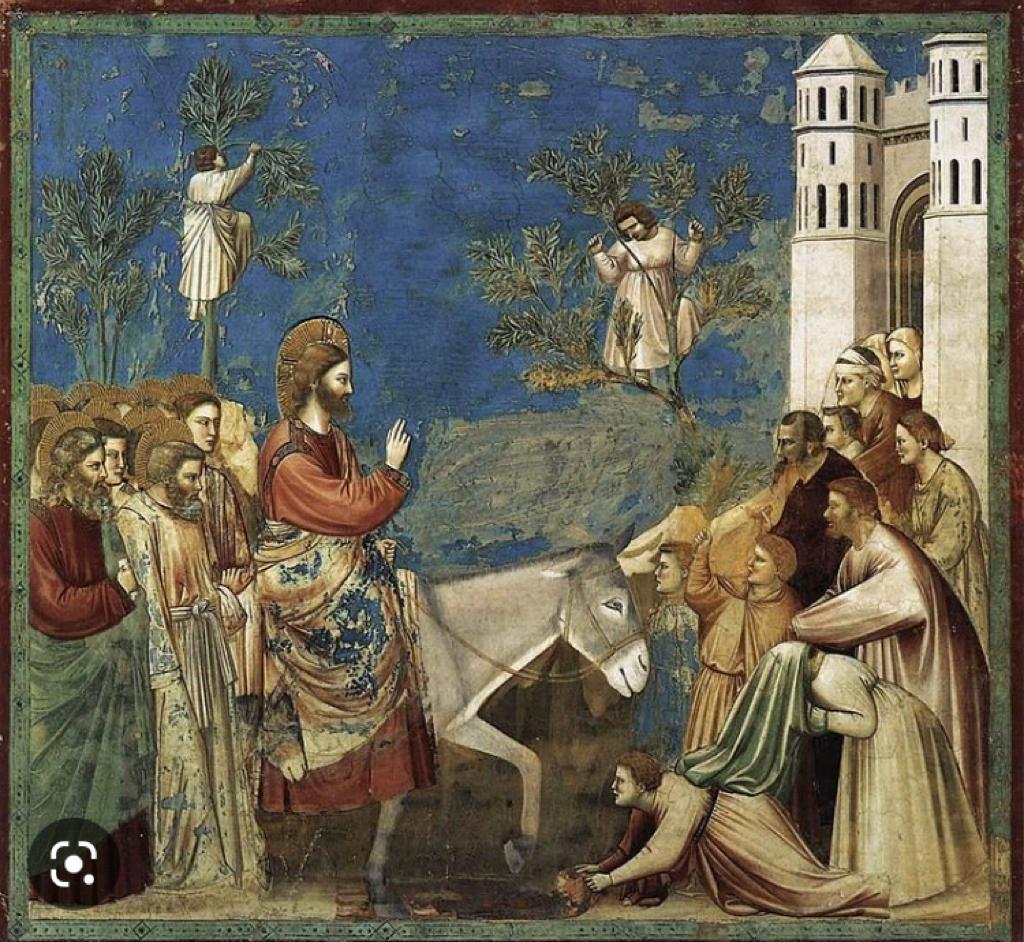
Palm Sunday (Yew Sunda) by Giotto. Entry into Jerusalem from the Cappella degli Scrovegni in Padova (sent to me by Lucia Granatella)

Yew Sunday (Domhnach an Iúir in Irish) is the medieval name for Palm Sunday. This is the day that Jesus entered Jerusalem in triumph on a donkey, with palm leaves being laid in front of him. It has always been very curious to me, this triumph preceded such heavy and heartbreaking tragedy. It is the Sunday before the Betrayal, which leads to the Crucifixion on Good Friday and the Resurrection on Sunday. A busy week for the Church.

I got a little insight into the powers of the procession when on a Field trip to Nice with Students from Central Saint Martins College. We set the Students the task of creating an ‘art intervention’. They came up with the idea of a Procession to the Mayor. It was extraordinary how deploying a few placards, saucepans as drums, and some chanting could create an instant event,. It made people smile and join in, even if clueless about the cause!!

Palms

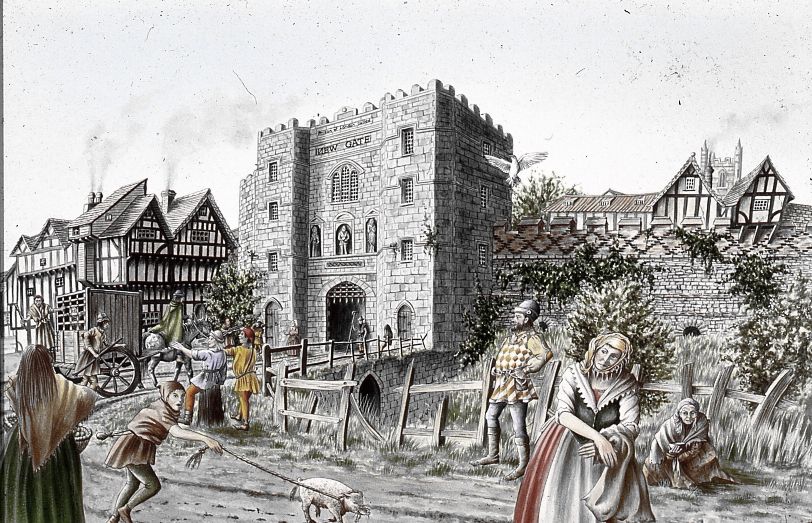
Palm Sunday can be celebrated by making crosses out of palms, or with processions bearing palm branches or eating special cakes. There is always room in any ritual for cake). But in the North, where do you get your Palms from? So, it was often substituted by Box, or Olive or Willow and particularly, in Britain and Ireland, by Yew. Yew is evergreen and is so long-lived as to be a symbol of everlasting life. (I wrote more about the Yew here). See also my post on Ash Wednesday.

Giotto Bondone

Giotto was a Florentine painter of the 14th Century of whom Giorgio Vasari, in his essential guide to the artists of the Renaissance, ‘The Lives of the Artists‘ said of the 10 year old:

One day Cimabue, going on business from Florence to Vespignano, found Giotto, while his sheep were feeding, drawing a sheep from nature upon a smooth and solid rock with a pointed stone, having never learnt from any one but nature. Cimabue, marvelling at him, stopped and asked him if he would go and be with him. And the boy answered that if his father were content he would gladly go. Then Cimabue asked Bondone for him, and he gave him up to him, and was content that he should take him to Florence.

There in a little time, by the aid of nature and the teaching of Cimabue, the boy not only equalled his master, but freed himself from the rude manner of the Greeks, and brought back to life the true art of painting, introducing the drawing from nature of living persons, which had not been practised for two hundred years; or at least if some had tried it, they had not succeeded very happily.

Written in 1550.

Giotto & The Development of Perspective

If you look at the painting, above. you will see, even the faces of the people are rounded and, and at least somewhat, individual. The crowd scene, particularly, to the right, has some depth. The people further away seem to recede from the viewer. This contrasts with the Byzantine style of paintings, where figures either float or seem to stand on or support themselves on each other’s shoulders. The Gate into Jerusalem has been rendered by an arist who has seen something that he believes has the key to realistic scenes. One day it will be rediscovered, and named single-point perspective.

Yes, Giotto doesn’t know the secret but he is working to find out what the trick is. The people in the trees are also in the distance. These are the giant strides that Vasari is referring to in the quotation above. Realistic people, in spaces with depth. The donkey is quite sweet too! Cimabue, Giotto’s Master was particularly good at painting Crucifix scenes.

For more on early attempts at creating perspective, see my post on Duccio and the Annunciation here.

Digital tour of the Cappella degli Scrovegni

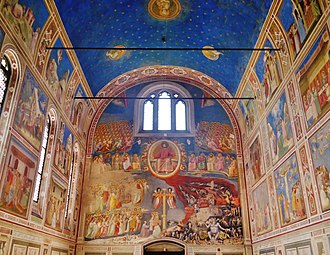
The Cappella degli Scrovegni in Padova is a World Heritage Site decorated by Giotto and his team. They covered all the walls and ceiling with frescos. Depicting the Life of Jesus, the Life of Mary, and the Last Judgement.

Giotto, The Last Judgement. Cappella degli Scrovegni, In Padova. Wikipedia

Here is a real Digital Heritage treat – a 360 Degree tour of the Chapel! Follow the link below. If it seems to be taking a long time to load press the information button. Once pressed will allow the panorama to load immediately.

https://www.haltadefinizione.com/en/image-bank/giotto-di-bondone-scrovegni-chapel-360-view/

First Published in 2024, revised in 2025, 2026

Whitsun

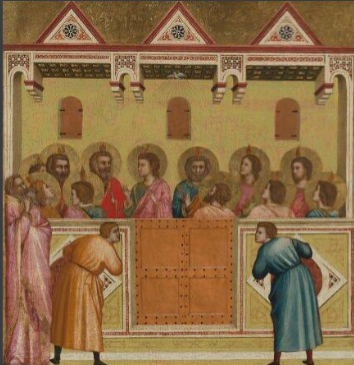
Pentecost by Giotto and Workshop, probably about 1310-18, National Gallery

Today, is Whitsun or Pentecost. (Sun, May 24th 2026, 16 May 2027, 4 June 2028), 50 days after the Crucifixion. Celebrated on the 7th Sunday after Easter. The Day the Holy Ghost descends on the disciples.  According to one of my teachers, it gave the disciples the power of expression and turned them from bereft disciples to self-confident Apostles.   They could now begin to spread the Christian message.

Giotto’s painting shows the Apostles with their halos in the chamber. There are 12 of them, St Matthias having replaced the dead, Judas. The Holy Spirit is represented by the little dove in the centre of the Ceiling. The narrative is carried by the two men in the foreground leaning towards each other. We imagine them saying something like ‘What’s all this about! Galilean nonentities, lost their guru and yet, confident, speaking authoritatively to all and sundry and they can all understand them?

Giotto was a forerunner of the Renaissance. According to the great Giorgio Vasari (30 July 1511 – 27 June 1574) who wrote about the advances in painting achieved by Italian artists:

‘that very obligation which the craftsmen of painting owe to nature, who serves continually
as model to those who are ever wresting the good from her best and most beautiful features and striving to counterfeit and to imitate her, should be owed, in my belief, to Giotto, painter of Florence, for the reason that, after the methods of good paintings and their outlines had lain buried for so many years under the ruins of the wars, he alone, although born among inept craftsmen, by the gift of God revived that art, which had come to a grievous pass, and brought it to such a form as could be called good.

The miracle was that this boy, a poor shepherd with no training in art was able to show nature its true face.

One day [the artist] Cimabue, going on business from Florence to Vespignano, found Giotto, while his sheep were feeding, drawing a sheep from nature upon a smooth and solid rock with a pointed stone, having never learnt from anyone but nature.’

One of the points Vasari is making is that the Byzantine Art had lost the use of perspective, something the Romans knew. Paintings had become cartoon like spaces had no solidarity, groups of people stood on shoulders. If you look at the painting above you will the room the Apostles are in has the beginnings of a realistic space, the rafters slope down to a vanishing point. The Apostles are ranged convincingly around the space. Their faces are rounded and realistic. They are separated from the outside world by a dividing wall. And two dudes at the front are convincingly on the ground, rather than hovering in mid air (though I might have cropped the photo too closely!)

It would be over one hundred years before photo realistic portraits and realistic perspective paintings were rediscovered but Giotto showed the way.

For more on Giotto see my post here:

And on Italian art and perspective my post here

First published on June 8th 2025