John Constable in Bond Street February 4th 1799

John Constable. National Gallery of Art seascape with two sailboats. public domain

I am this morning, admitted a student at the Royal Academy; the figure which I drew for admittance was the torso. Im now comfortably settled in Cecil Street, Strand number 23. I shall begin painting as soon as I have the loan of a sweet little picture by Jacob Ruysdael to copy. Since I have been in town, I have seen some remarkably fine ones by him. …

Smith’s friend, Clanch has left off painting, at least for the present. His whole time and thoughts are occupied in exhibiting an old, rusty, fusty head with a spike in it, which he declares to be the real embalmed head of Oliver Cromwell. Where he got it, I know not.; ’tis to be seen in Bond Street at half a crown admittance.’

John Constable. Letter to John Dunthorne, 1799.
From ‘A London Year. 365 Days of City Life in Diaries, Journals and Letters’ compiled by Travis Elborough and Nick Rennison.

John Constable in London

Constable would have had a short walk to the Royal Academy (in Piccadilly) from the Strand. As a painter, he subsequently spent his summers painting in Suffolk and his winters in London. When his wife became ill with Tuberculosis, they moved to Brighton. But he continued to return to London. Constable lived in a cottage in Hampstead, and is buried in the family tomb at the bottom of the graveyard of St John-at-Hampstead Church in Hampstead.

Royal Academy Photo KFlude

I don’t know what the Torso referred to was, but there was (and still is) a fine collection of plaster casts. The students used these for models.

A fine figure of the older man? Photo by K Flude of Zeus in the basement of the Royal Academy
Print on display at the Royal Academy of students drawing the sculptures in the Collection. Photographed by K Flude.

Cromwell’s Head

As to the head, it is a fascinating tale, which I partly tell on my Martyrdom of Charles I post. here: But here is more details, relevant to the Constable quote. At the Restoration of Charles II Cromwell’s body was dug up. Then the head was stuck on a pole on top of Westminster Hall. It blew off probably in 1684. The head was on display at a museum, but then no one knows where it was until, in 1799 the Hughes brothers, bought ‘it’ for £230. It was exhibited in Bond Street. Entrance fee was 2 Shillings and 6p. Constable’s acquaintance Clanch who I think is actually John Cranch was the publicist for the event.

The display was not a success because the provenance was not clear. All Cranch could say was Cromwell’s head was the “the only instance of a head cut off and spiked that had before been embalmed; which is precisely the case with respect to the head in question”. But then Henry Ireton’s was also treated thus, and maybe others. A head is now in Cambridge, Sidney Sussex College, which Cromwell attended.

The Wikipedia page on Cromwell’s Head, here., has a very full description of its travels.

Weather Outlook

Feb fill the dyke
Either black or white
But if with white, ’tis the better to like

If February gives much snow
A fine summer, it doth foreshow.

If in February there fall no rain.
‘Tis neither good for hay nor grain.

From The Perpetual Almanack of Folklore by Charles Kightly

On This Day

211 – Roman Emperor Septimius Severus dies at Eboracum (modern York, England). Leaving two sons, Caracalla and Geta, to dispute the succession. For several years York was the HQ for the Roman Emperor.

1555 – John Rogers, Vicar of the Holy Sepulchre Church in London and translator of the Bible, burned at the stake in Smithfield. The first of over 200 English Protestant martyrs condemned in the reign of Mary I. For more about Smithfield burnings see my post here.

1789 – George Washington unanimously elected as the first President of the United States. A great leader, who freed his slaves after his and his wife’s deaths, but who also evaded the rules against selling slaves. To consider the wrongs and rights of the issue look here.

1838 – ‘I walked with my daughter Charlotte across the Serpentine, much to my child’s delight, although I own I did not like to hear the ice cracking under the weight of thousands’.

John Cam Hobhouse, Diary, 1838. From ‘A London Year. 365 Days of City Life in Diaries, Journals and Letters’ compiled by Travis Elborough and Nick Rennison. See my post on the Great Freeze of 1895 with a picture of skating on the Serpentine.

1992 – Hugo Chávez ousts Venezuelan President Carlos Andrés Pérez in coup.

First Published February 4th 2026
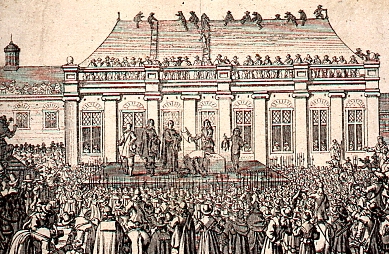
The Martyrdom of Charles I & ‘Get Back’ January 30th

Banqueting Hall and Execution of Charles I
Banqueting Hall and the Martyrdom of Charles I

January 30th is the anniversary of the execution of King Charles I. Today, he was beheaded as a murderer and traitor. Or as a Royalist would see it, it is the anniversary of the Martyrdom of Charles I.

Thousands came to see the execution, amongst them Samuel Pepys. They crowded around the scaffold outside a window of Inigo Jones’s magnificent Banqueting Hall, in Whitehall, London. Charles was brought into the Banqueting House. There he must have looked up at the magnificent Peter Paul Reubens’ ceiling. Charles had commissioned the painting to depict of the Apotheosis of his father, James I. It was the symbol of the Divine Right of the King to rule.

Scaffold to Heaven?

I doubt he saw the irony. I suspect he thought he was going to heaven to join his father, in glory as a Martyr to his religion. He walked outside, through the window, into the cold January air. Two of his bloodstained shirts still exist, probably to stop him shivering. He wanted to be seen as going fearless to his death not shivering with fear. Then, he made a short speech exonerating himself. He spoke without stammering for the first time in his public life. The Rooftops around were lined with spectators. Black cloth framed the scaffold. As the executioner axe fell, there was a dull grown from the crowd (most could not see the axe falling).

This was on January 30th, 1648. But, if you look at a history book, it will tell you it was in 1649. This was before our conversation to the Gregorian calendar. Then the year number changed not as we do on January 1st but on March 25th. This was the day the Archangel Gabriel revealed to the Virgin Mary that she was pregnant. For more on the importance of March 25th look at my Almanac entry here:

Oh the stupendous, and inscrutable Judgements of God’

On the same day, twelve years later, in 1661 Oliver Cromwell and his chief henchmen were dug up from their splendid Westminster Abbey tombs. Their bodies were abused by official command. Cromwell’s head was stuck on the top of Westminster Hall. There it remained until blown off in the Great Fire of 1703 (or 1672, or 1684). Then, it taken to Cambridge, Sidney Sussex College, which Cromwell attended. Only the Head Porter knew where. (According to someone who came on my Oliver Cromwell Walk last year.) Whether it is his head or not is disputed. The tale of the head is told in detail here.

The Royalist, John Evelyn, said in his diary:

This day (oh the stupendous, and inscrutable Judgements of God) were the Carkasses of that arch-rebel Cromwel1, Bradshaw, the Judge who condemned his Majestie and Ireton, sonn in law to the usurper, dragged out of their superb Tombs (in Westminster among the Kings) to Tybourne, and hanged on the Gallows there from 9 in the morning till 6 at night, and then buried under that fatal and ignominious Monument in a deep pit. Thousands of people (who had seen them in all their pride and pompous insults) being spectators .

Samuel Pepys records by contrast:

…do trouble me that a man of so great courage as he was should have that dishonour, though otherwise he might deserve it enough…

Pepys served the Parliamentary side before the restoration of Charles II, when he adroitly, swapped over to the Royalist side.

Every year, I do a Guided Walk and a Virtual Tour on Charles I and the Civil War on this day or the last Sunday in January. Look here for details.

On This Day

1661 – Oliver Cromwell’s corpse disinterred and ritually executed

1826 – The Menai Suspension Bridge, is opened. Designed byThomas Telford. It is considered the world’s first modern suspension bridge.

1933 – Hitler appointed Chancellor of Germany

1969Get Back to Where you Once Belonged – the anniversary of the rooftop concert in Saville Row where the Beatles played ‘Get Back’.

YouTube Clip with scenes from the Roof Top Concert

First published in 2023, revised on January 29th 2024,2025, 2026

Oliver Cromwell and his Lucky Day September 3rd

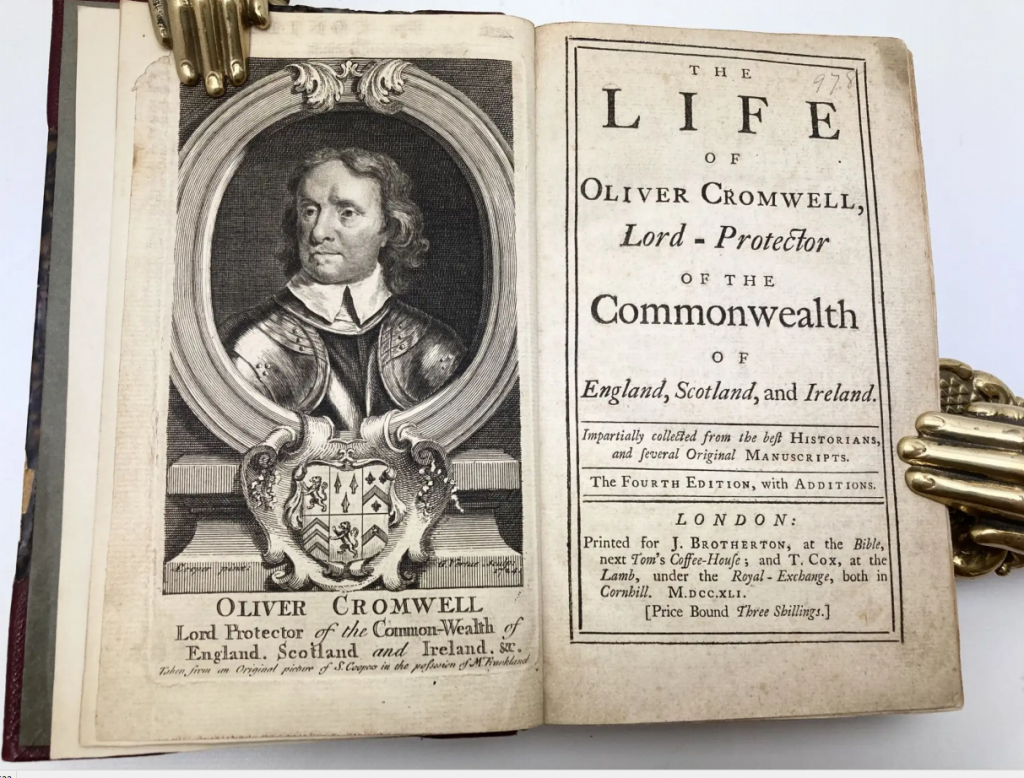
Frontispiece of ‘The Life of Oliver Cromwell’

September 3rd was Cromwell’s Lucky Day. This was because it was the date of two of his most famous victories. On September 3rd 1658 he refused to accept that he was dying because it was his lucky day.  Unluckily, he was wrong.

The Battle of Dunbar September 3rd 1650

Engraving of Charles I

After the execution of King Charles I, the Scots chose Charles II as their King. This changed the Scots from allies of the English Parliament to enemies. The Lord General of the New Model Army, Thomas Fairfax, refused to lead an attack on their erstwhile allies. So Oliver Cromwell was promoted to command. He launched a preemptive attack but the army was ill prepared, and the campaign seemed in danger of failing. They took Arthur’s seat and bombarded Edinburgh and Leith from its heights. But they could not take Edinburgh.

In need of supplies, Cromwell retreated to Dunbar, which is on the North Sea, close to the Firth of Forth. The Scots advanced on Dunbar, and Cromwell came out to meet them. After a hard battle, the English Calvary outflanked the Scots and the Battle was won. Pride, Monk, Lilburne and Lambert were all involved in the Battle. Cromwell claimed to have killed 4,000 Scots and captured 10,000. Scottish sources suggested over 1,000 Scottish casualties and 5,000 prisoners.

The Battle enabled Cromwell to seize control of Edinburgh, and Leith. So he could then cross the First of Forth and attack Fife, where he was also successful.

Cromwell interpreted the overwhelming victory as a

“A high act of the Lord’s Providence to us [and] one of the most signal mercies God hath done for England and His people”.[ (Wikipedia)

See my post on the execution of Charles 1st here:

March on England

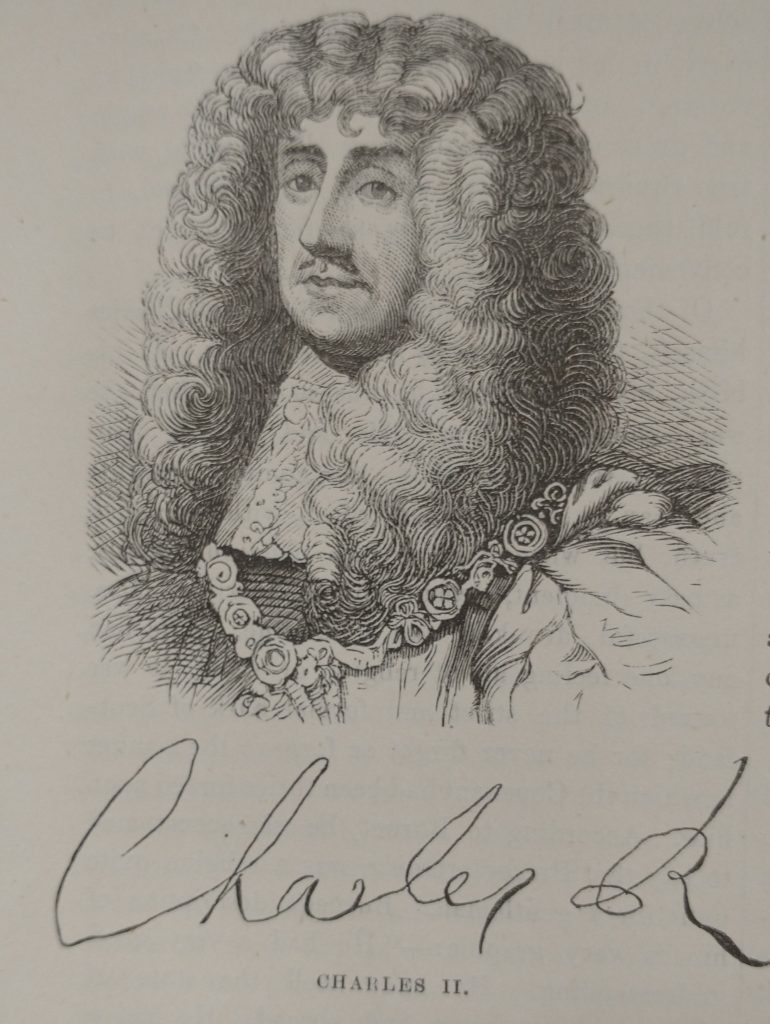
engraving of Charles II
Engraving of Charles II

Meanwhile, the Scottish Army marched South in to England. in an attempt to raise the support of English Royalists. King Charles II was now with them, They hoped Cromwell would be held up in Fife, but he wasn’t. He secured Perth and put General Monck in charge in Scotland. Lambert was sent to harrass the Scottish Army as they marched south. Meanwhile, Cromwell forced marched his way to the Tyne. General Harrison had collected fresh troops from Newcastle and joined Cromwell. Thomas Fairfax came out of retirement and raised troops in Yorkshire. The Southern troops were collected at Banbury by General Fleetwood. 14,000 militia men from the trained bands of London joined the march to intercept the Scottish Invasion.

The Battle of Worcester September 3rd 1651

The decisive battle took place at Worcester, which the Royalist occupied. It was an unusual battle in that it took place on both sides of the River Severn. Cromwell delayed the start of the battle to build two pontoon bridges. This meant he could reinforce his troops on either side of the River. It also delayed the start of the battle to his lucky day.

The pontoon bridges proved decisive. The Parliamentary side had over 30,000 troops while the Royalists only 16,000. Cromwell could shore up besieged formation with troops from the other side of the River. The Royalists were pushed back to the High Street. Here, they rallied to allow King Charles II to escape. And that was the end of the Second English Civil War. (The first being the defeat of Charles I, the second the defeat of Charles II).

Charles II made a hair-raising escape from England, hiding in an Oak Tree. Eventually, finding a ship on the South Coast at Shoreham, in Dorset to take him into a long exile. (see my post on Charles’ escape here🙂

Of the Scottish army, perhaps 3,000 men were killed and 10,000 taken prisoners. Some prisoners were conscripted into the New Model Army and sent to fight in Ireland. Many of the rest (perhaps up to 8,000) were forced into indentured labour. They were sent to New England, Bermuda, the West Indies or the Fens. Others were taken to London and detained in prison camps. One of which was at Tothill Fields in Westminster. Conditions were often appalling, leading to death by disease and malnutrition.

American Presidents pay their respects to the ‘famous’ Battlefield.

John Adams and Thomas Jefferson visited the site of the Battle in 1786. Adams reported:

‘The people in the neighborhood appeared so ignorant and careless at Worcester that I was provoked and asked “And do Englishmen so soon forget the ground where liberty was fought for? Tell your neighbors and your children that this is holy ground, much holier than that on which your churches stand. All England should come in pilgrimage to this hill, once a year”‘

And indeed will now only see the battle as one of the many battles of the Civil War. Generally, we are not aware of its special significance.

Cromwell’s Death September 3rd 1658.

By now, the Monarch in all but name, Cromwell, the Lord Protector fell ill, probably of malaria. Then, when weakened, his kidney stone infection turned to septicemia. On August 30th, there was a mighty storm, the like Europe had not seen for hundreds of years. And there was talk of the Lord taking him away in the furious storm. As he weakened he was asked to name his successor. He appeared to affirm when the name of his son Richard was spoken to him. But, it wasn’t very clear. He rallied, perhaps hoping that if he could survive to September 3rd, he would overcome his illness.

On the day, he said to his doctors ‘I tell you I shall not die this hour; I am sure on’t …. I speak the Words of Truth upon surer grounds than Galen and Hippocrates furnish you with.’

But he died on his lucky day. He was given a splendid funeral and was buried in state among the Kings and Queens in Westminster Abbey. And then in 1660 dug up, executed posthumously at Tyburn and buried under the Gibbet.

See my post on the Puritans’ abolition of Christmas here:

See my post on John Evelyn’s diary entry on the Restoration of Charles II to the throne.

First written in September 2025

News of Virtual Tours

Sorry to send an additional post but coming up are a couple of fascinating Virtual Tours which I would like to remind you of!

Tonight is an exploration of early 19th Century London. It is based on the 1809 Picture of London Guide book. An original copy was given to me by someone grateful to have attended one of my lectures at the Old Operating Theatre Museum. It is a tour of what Jane Austen could have visited on her walks around London. There are Austen associations, but mainly we are looking at London in 1809.

Jane Austen’s ‘A Picture of London in 1809’ Virtual Walk Mon 7.30 27th Jan25 To book

Yesterday, I was asked to give a Cromwell’s London walk as a 75th Birthday present. I haven’t done one for at least 25 years. But I really enjoyed the research. So added a guided walk and a virtual tour to my programme. This is the first time I have done this VT and it is a cracking story.


The Civil War, Restoration and the Great Fire of London Virtual Tour 7:30pm Thurs 30th Jan25To book

Finally, April is the month we go on pilgrimages, as Chaucer said (in Old English). So, in addition to my Chaucer Walks, I have added a Virtual tour so we can go all the way to Canterbury.


Chaucer’s London To Canterbury Virtual Pilgrimage 7.30pm Friday 18th April 25 To book

I may add one or two more before the Sun comes back

To see all my walks see this page.