March 25th Feast of the Annunciation

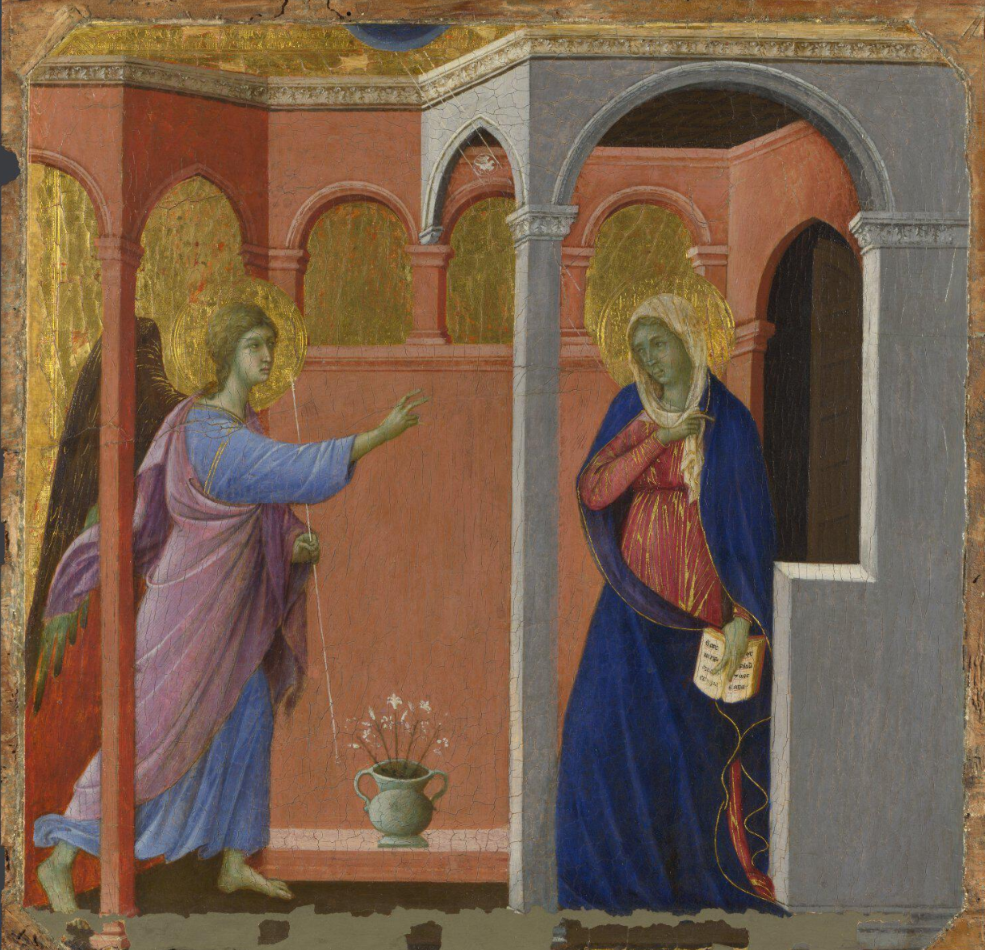
Duccio's painting of the Archangel Gabriel bringing the news to Mary that she is to be the Mother of the Son of God.
Duccio’s The Annunciation. Egg Tempera on Wood c 1307-11

The Annunciation by Duccio

Today, is the anniversary of the conception of Jesus Christ, called the Annunciation. I told some of this story yesterday which was St Gabriel’s Day. So, sorry for any repetition but I think the extra detail makes it worthwhile! There is a third post in my Annuciation series where I go into the wider implications of the date March 25th, and how it has a fundamental place in Christian Theology.

The picture above is by Duccio, from Sienna in Italy. It shows the Archangel Gabriel bringing Mary the news that she is to give birth to the Son of God. It is in the Sainsbury Wing of the National Gallery. This was the second painting on the National Gallery tour I used to give. The Tour told the story of the development of perspective. I had been reading a book on the subject by David Hockney.

The painting shows that Duccio does not understand single-point perspective. But then, no one could do perspective at that time in Europe. This skill was lost following the Roman Period. But at the beginning of the 14th Century, painters like Duccio from Sienna, and Giotto from Florence, were groping towards more realistic representation.

You might say they wanted a more human depiction, in which events are shown in spaces that are trying to look real. Filled with more realistic looking people and beginning to show on their faces real emotions. Previously, the Byzantine style produced iconic, storytelling images, that were somewhat cartoon-like rather than realistic. Here, is a detail from one such. 
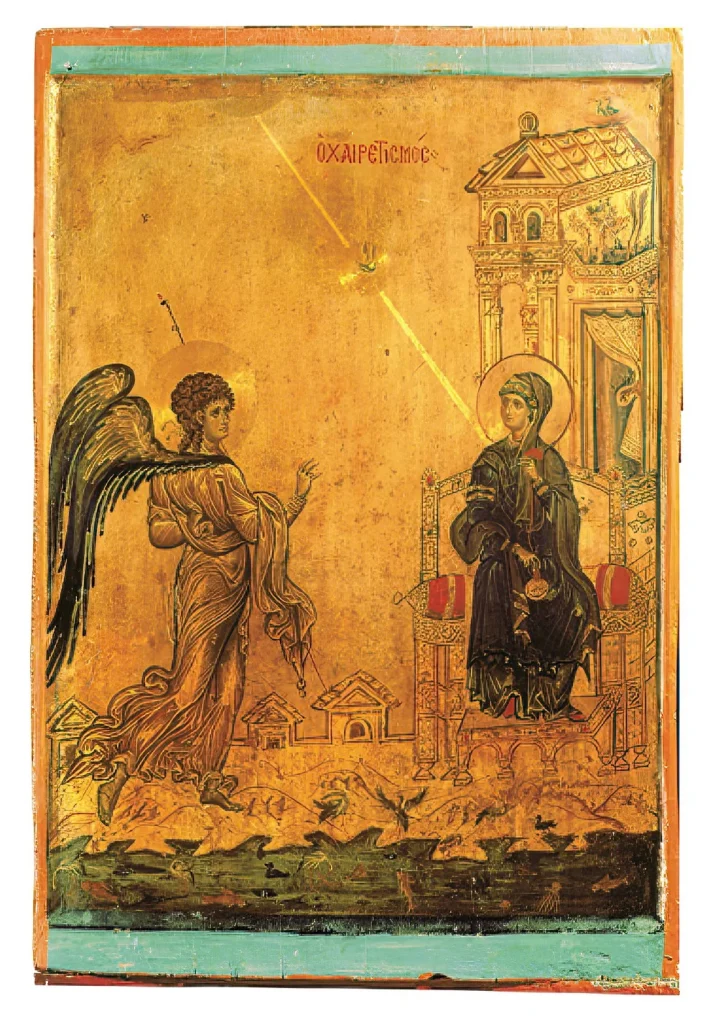
The Annunciation, St Catherine's Monastery,   12th Century. showing the archangel gabriel telling Mary about the conception of jesus
The Annunciation, St Catherine’s Monastery, 12th Century.

The encounter takes place in a space that is not very real. But it does tell the story effectively.

Moving towards Perspective

Now, look at the Duccio, he uses the arcading at the top of the painting to give an impression of this being an encounter in a real space. The Archangel Gabriel is moving through that space decisively. This is not just a picture with a story, it shows Duccio’s interest in capturing a fleeting but incredibly emotional moment. It happens to be the most important moment in the history of the world (from a Christian view point), the moment that the son of God is conceived as a human.

Gabriel is striding purposefully towards Mary, who has come out of her house to see him. He saying ‘Hey, you are going to give birth to the Son of God.’

She looks overwhelmed, (as you would) holding her arm protectively towards her. ‘What me?’ she might be saying. But she is also pointing at the Bible where this moment in time is predicted by Isaiah. Their faces are quite realistic, Mary is clearly emotional.

Also, if you look at Gabriel’s feet he is quite well grounded unlike many other medieval paintings, where people often seem to be floating above the ground. Mary, too is firmly, anchored, although you cannot see her feet.

It is by no means ‘perfect’ because they don’t yet know the rules of perspective.  Neither have they discovered they could use lenses to create ‘photorealistic’ portraits. But they are searching for methods that can bring spaces and people towards realistic life. It mirrors a humanistic trend to see Mary not as a sort of Goddess, but as a real mother. A key point in the Renaissance. (For more on perspective, see my post on Giotto and Palm Sunday. )

The Moment of Conception

Above the arcading can be seen a small sphere of blue sky from which emanates several ‘rays’ and a tiny Holy Dove. As I told the story, yesterday, the rays are coming from Heaven to her womb which is hinted at by the red of her dress. The National Gallery commentary, which you can read here, suggests ‘The conception takes place at the moment she hears the words, which is why a tiny white dove, representing the Holy Ghost, flies towards her ear‘.

This made me stop and think – the tiny dove is heading to her ear is it? Really? Why? Gabriel is the messenger saying the words, the words head to the ear. The Holy Dove is a symbol of the Holy Spirit, part of the Trinity of Father, Son and Holy Ghost. Its role, in the painting, is to show that God is the Father. So why, would the Holy Spirit enter by the ear?

I have been using a ruler to try to see if the National Gallery are right! It’s difficult to be sure with a reproduction. but my ruler says the rays from Heaven are neither heading to the ear nor directly to the womb but in the general direction of her body. If they are right that the rays from heaven are heading for her ear, then is this rather the moment she is being told she will conceive rather than the moment of conception?

The Conception in St Luke
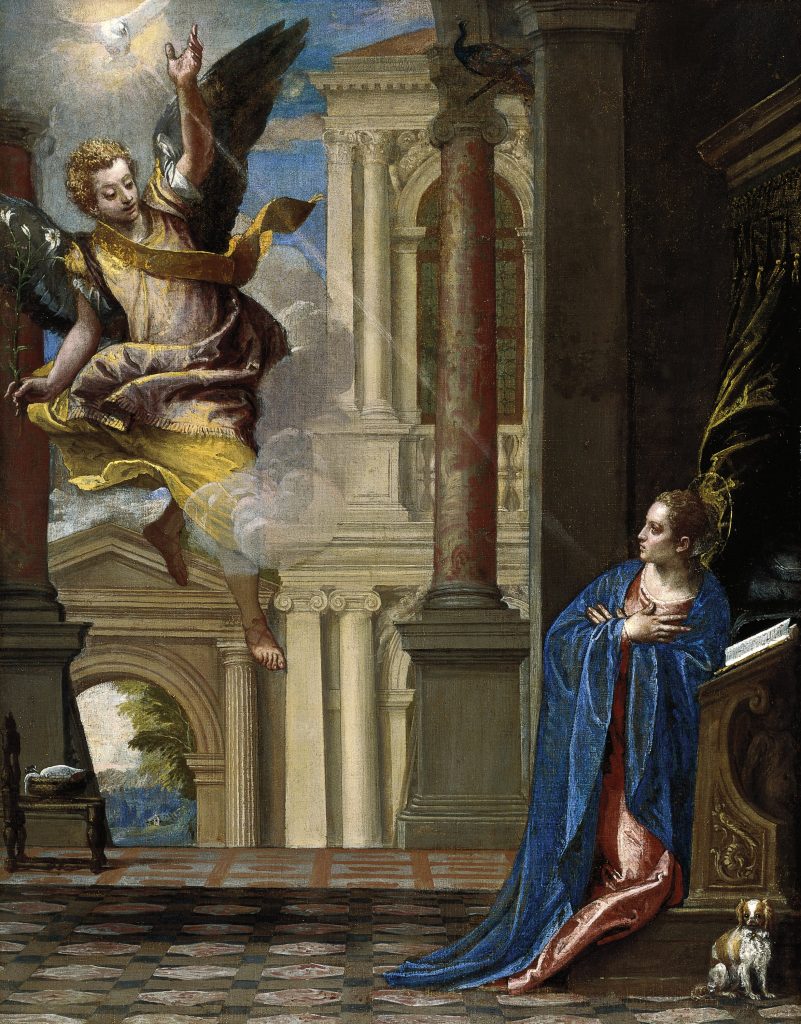
Veronese ‘The Annunciation’

But the National Gallery text accepts that it is the moment of conception that is shown. So, I’ve looked at Luke 1:26-38:

Do not be afraid, Mary, for you have found favour with God. And now, you will conceive in your womb and bear a son, and you will name him Jesus.

On first reading he is telling her she will conceive, but reading it more carefully he is saying ‘now, you will conceive’. So Duccio is paying very careful attention to the Gospel. By the time Gabriel finishes his sentence, she will have been impregnated by the Holy Dove. Looking at other paintings of the Annunciation the rays from heaven head generally towards the virgin, sometimes to her head, nothing suggesting the ear. In the St Catherine’s Monastery’s Annunciation, above, the ray is going to Mary’s back. Veronese’s ‘The Annunciation’ is similarly going towards Mary’s Back, shoulder, or breast. The Annunciation by the Master of the Judgement of Paris which I showed yesterday has the ray heading to Mary’s lap.

Rossetti’s Annunciation
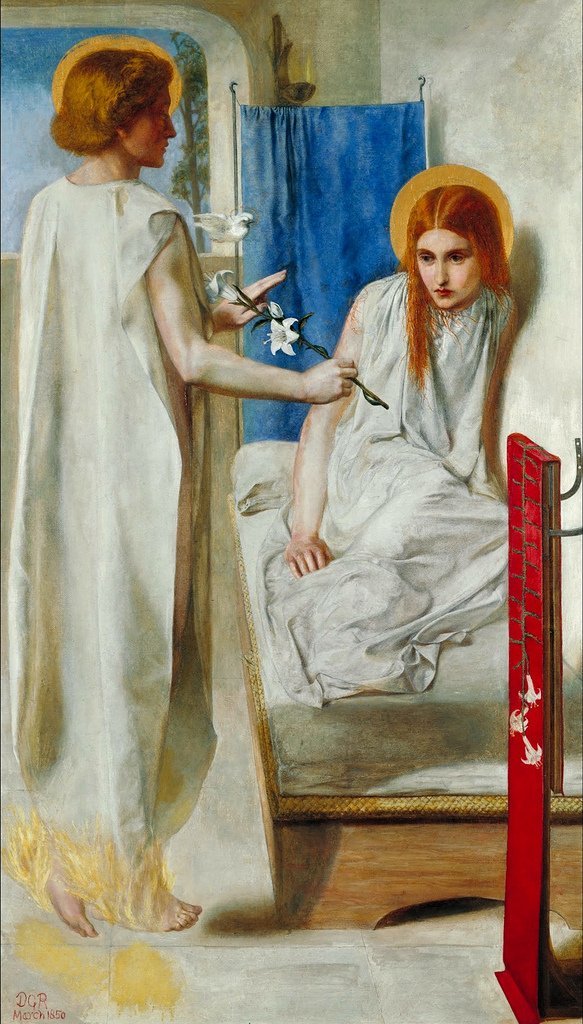
The Annunciation by Rossetti originally known as Ecce Ancilla Domini! 1849 - 1850
The Annunciation by Rossetti originally known as Ecce Ancilla Domini! 1849 – 1850

I’ve included a 19th Century Rossetti painting because it is so beautiful. It shows a lilly representing purity, instead of the rays, pointing to Mary’s womb. The use of white throughout also represents Mary’s ‘purity’. While the Blue is the traditional colour for Mary. The use of the primary colours red and blue with the predominant White, gives a vivid clarity to the picture. At the time, showing the Virgin as a red-head was quite controversial.

By the way, look at the feet in the Rossetti’s painting. This is an early Rossetti painting, who was a poet and I’m not sure he yet had the skills to ground feet. But he takes advantage of it in this case and confirms Gabriel’s supernatural status by giving Gabriel fiery feet but no wings. Subsequently, Rossetti concentrated on paintings of women from the waist up. Since, first writing this, I have visited an exhibition of Rossetti’s drawings, and they show a very capable draughtsman.

For more on March 25th and the Universe and everything, see my post here (which will be revised later today).

On This Day

If Easter fell on March 25th it was thought to be bad news, particularly if on Good Friday. As the world was created, according to Christians, round about March 25th, God being a logical being, would end it on its anniversary. And all those people who went to the top of the hill, to see out the Day of Judgement, had to trudge down again, murmuring ‘Maybe next time.’ Hampstead Heath was a popular place for Apocalyptaphiles to go in London, the Green next to White Stone Pond, to be precise.

1306 – Robert the Bruce crowned King of Scotland.

1807 – The Abolition of the Slave Trade Act became law.

1843 – the first Tunnel built under a River was opened at Rotherhithe designed by Marc Isambard Brunel, and helped by his son Isambard Kingdom Brunel. I managed the Brunel Engine House for a few years, which was the steam engine house to pump out the water from the tunnel. In fact, a Babylonian (?) Queen built the first tunnel under a River, but what she did was divert the river, build the tunnel, redirect the River back to its original course. So strictly, the Brunels built the first tunnel constructed under a River while the River was still flowing above. I find that most firsts are much more complicated that you think!

1949 – Hamlet became the first British Film to win the Oscar for Best Film. Lawrence Olivier also won the Best Actor Oscar and he was the Director of the Film too. Olivier was the first person to achieve this double feat, and the only one until 1998, when Roberto Benigni won both Oscars in Life Is Beautiful.

Source: Chambers Book of Days

First published 2024, revised 2025, Revised and On This Day added 2026
Leap Day & and the Roman Calendar February 29th

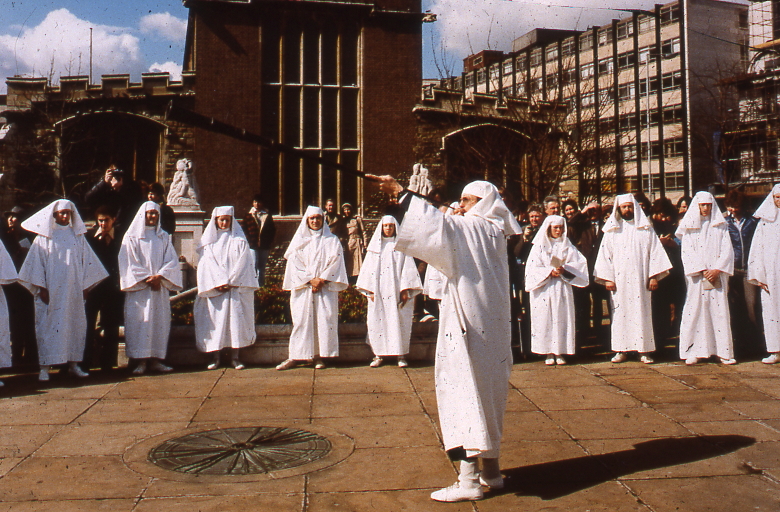
Druids at All Hallows, by the Tower

I have just come back from my very first Leap Year Walk, which I gave tonight for London Walks. It was one of a series of my walks, which are about the year through London’s History. So far, I have done, a New Year Walk, an Imbolc Walk (1 February, St Brigid’s Day), a Spring Equinox Walk, a May Day Walk, a Summer Solstice Walk, an Autumn Equinox Walk, a Halloween Walk, and a Winter Solstice Walk. All, at their core, have the subject of the year, how it is arranged, and celebrated in different cultures and different times in London.

I hoped to get this post done, today, but on arrival at home my burglar alarm was ringing, so had to get an emergency electrician out to pacify my neighbours, and tracking down the fault meant turning my house upside down. I rushed it out, with many bad proof reading errors and ommissions, And have now, on the dawn of a new month, and a new Season, updated it. Probably, knowing me, it still has a far few errors! Now, I am rushing to look after my Grandson!

So, the reason there is a leap year, is that the Sun and the Moon have different cycles, which cannot be easily aligned. And secondly, the solar year is not a fixed number, it is not 365 days, but 365 days and a bit.

Originally though, probably, most cultures lived their lives with time keeping controlled by time markers from their everyday environment, days and nights, the waning and waxing of the moon, the seasons, and the changes in the rising and setting of the Sun. Budding nature would have provided other markers as to when to sow, to harvest, to prune, to slaughter, to worship and marry.

The months were given by the cycle of the Moon, which also gave us tides and menstrual cycles. The months were given names, which were often associated with the weather. The trouble was that the Solar year did not align with the Moon, soon the months would get out of kilter with the seasons. So over time, the society would find it was winter in June, or summer in December. (which is OK if you live in Australia).

Society dealt with this in a number of ways. It could be ignored, why shouldn’t it be cold in June, why should June always be in Summer? Another way was to add in extra days, or months, every so often to make sure June remained in the Summer. This is what Egypt, the early Romans and the Celts did. They kept their months aligned to the actual movements of the Moon, and aligned their Solar Year with it by the addition of extra days or a month or two. or a combination of both.

I reported on this in my post on the Terminalia for February 23rd. As I wrote:

Terminus was an old ancient God who was the God of the boundary, the border, the edge, the liminal God. February was the last month of the original Roman year, but the rulers of Rome added an intercalary month every so often, called Mercedonius in an attempt to keep the Solar year in tune with the seasons. And when the intercalary month was added, the last five days of February were given to Mercedonius and the resulting leap year was either 377 or 378 days long.. So, in those years, the 23rd of February was the Terminus of the year. (For more on Terminalia look at my post for February 23rd on Terminalia-god-of-the-boundary)

Now, as the Roman Republic became more sophisticated, the intercalary months were added at the direction of the Pontiffs, supposedly every two and sometimes every three years. But the Pontiffs were often swayed by political advantage, and by the time of Julius Caesar the seasons had got wildly out of sync with the calendar year. The Dictator, therefore, instituted ‘the Year of Confusion’ which was over 400 days long and brought in the Julian Calendar which realigned the calendar back in line with the seasons.

Caesar spent time with Egyptian Astronomers, trying to understand their solution to the problem. They identified that the year was not 365 days long but 356.25 days, so JC ‘fixed’the issue with a leap day every four years. Based on the almost correct calculation of a solar year being 365.25 days. The new calendar was inaugurated on the Kalends of Januarius 709 AUC, or as we would call it I January 45 BC. It became, in time, something the Romans were very proud of – rationalising, measuring, time itself. Romans counted their dates from the time their City was founded by Romulus in what we call 753 BC or 753 BCE. So, 45 BCE in our reckoning is 709 ab urbe condita (AUC ‘from the founding of the City) as the Romans saw it.

I prefer not to use BCE because it seems ‘dishonest’ to me. The idea of AD BC was made up based on a guess as to when Jesus was born. Changing BC to BCE may rid the date of an explicit Christian identification but masks the fact that there is no such thing as the ‘Common Era. What the Common Era is, is the idea made up in the Late Roman period guessing when Jesus was born/ So I think call a spade a spade, even if it’s a broken meaningless spade that is not fit for purpose, either replace it with something rational, or real or call it what it is.

The interesting thing is that Caesar put the leap year in on the 24th February. Why? Because February, being the month of death, was the end of the year. March 25th was originally the beginning of the Roman year (Caesar moved it to January 1st). Why March 25th? Because it was the Spring Equinox. If you look at my post for March 25th you will find out it is the date of the creation of Humanity, the Birthday of Adam, the conception of Jesus, and until 1752, the day the year number changed in Britain.

The other strange thing about the new leap day was that it was not called February 25th. It was not given a number. Rather, February 24th was two days long. This continued in Britain until the date February 29th started appearing in calendars in the 15th Century, although the legendary Lawyer, Edward Coke (1552 – 1634), refers to the two days of February 24th, but the two day 24th was completely replaced by February 29th in the 16th Century.

One slight complication to the story of February 29th was that February 29th did exist before the Julian reforms. When February was not interrupted by the intercalary month, as described above, it was 29 days long. Julius Caesar made the months alternate 30 and 31 except for February which was 29 days long. When the Senate gave Julius the honour of having the 7th Month named after him, things were OK, but then Augustus wanted the same thing. The Senate duly gave him the next month, which became known as August, but it only had 30 days. This could not be allowed! So they made it up to 31 and stole the 29th from February and made February only 28 days long. This change also meant that there were now three 31 days months in a row, so they reduced September from 31 to 30, boosted October to 31, reduced November to 30 and boosted December to 31,

Hence, we can no longer remember Caesar rational allotment of days in the month, and we need to hum to ourselves:

Thirty days have September
April, June, and November
February has twenty-eight alone.
All the rest have thirty-one.
Excepting leap year – that’s the time
When February’s days are twenty-nine.

But Caesar had not solved the problem of the shifting year, he had just minimised it. By the Council of Nicea in the early 4th Century (and not yet called AD!) the small error had changed the date of the Spring Equinox, from March 25th to March 21st. So, when Constantine convened the Council to bang the heads together of the Church leaders to unify their religion, particularly in regard to the date of Easter, and whether Jesus was equal to God. They fudged the complex issue of the date of Christ’s death, and used March 21st as the foundation of their calculation on the moon-based festival of Easter (more of which at Easter!)

It wasn’t until the 16th Century that Pope Gregory, solved the problem of the inaccuracy of Caesar’s solution, by introducting the Gregorian Calendar, for which see my post here.

See the following posts for the Roman Year:

Romulus’s 10 month year here

Roman Months here and more on the Ides of March here