
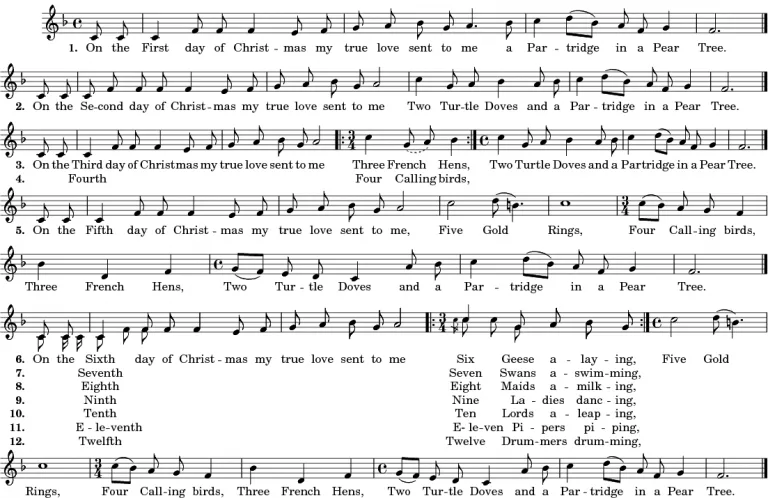
On the ninth day of Christmas, my true love sent to me
Nine ladies dancing, Eight maids a-milking, Seven swans a-swimming,
Six geese a-laying, Five gold rings,
Four calling birds, Three French hens, Two turtle-doves,
And a partridge in a pear tree.
Ripping up the Year
On this day in 1793 the National Convention in Revolutionary France decreed that Year II of the Republic had begun the day before. That is on New Year’s Day, January 1st. But, by October, they decided that the French Revolutionary Calendar should not have begun on January 1st but on the Autumn Equinox. The point being, I imagine, that January 1st, chosen by Julius Caesar had become a random date, not fixed to any external, astronomical event of significance.
The Revolutionaries, wanted their calendar to be completely rational. So they, retrospectively, made 22 September 1792 the first day of Year I. The Equinox has the virtue of having equal days and nights, and with the Sun rising due east and setting due west. Why the Autumn one? I don’t know but, the traditional calendars in Northern Europe, the Celtic and the Northern European tradition had an autumnal start to the Year. The idea being that the harvest is in, the growing has been completed, plants are beginning to die. Seeds are in the ground. So it’s the end of the growing year, therefore the beginning of the next year. It also had the virtual that it was not the Spring Equinox. For, Christians believed that the world was created on the Equinox, and Adam and Jesus born 4 days after the Spring Equinox. (see my post on March 25th)
By choosing a radical and rational reform of the Calendar, the Revolutionaries were following Julius Caesar’s example. His Julian Calendar tidied up the old Roman Calendar. However, Caesar did kept many of the essentials in place. The French, by contrast, almost completely ripped up the calendrical rule book. For more on the Julian Calendar read my post here.
Slippy January
Let’s start with the names of the months. The concept of the month they kept but got rid of the irrational Latin-based names. They replaced them with neologisms derived from seasonal indicators, as you will see. But it’s more fun to begin with the names as reported, satirically, by John Brady. He published these in England in 1811. The list starts with ‘October’ as the year began at the Autumnal Equinox. The seasons are separated by semicolons.
Wheezy, Sneezy and Freezy; Slippy, Drippy and Nippy; Showery, Flowery
and Bowery; Hoppy, Croppy and Poppy.
The historian Thomas Carlyle suggested somewhat more serious English names
in his 1837 work ‘The French Revolution: A History’ namely:
Vintagearious, Fogarious, Frostarious; Snowous, Rainous, Windous; Buddal,
Floweral, Meadowal; Reapidor, Heatidor, and Fruitidor.
The actual revolutionary names were: Vendémiaire, Brumaire, Frimaire; Nivôse, Pluviôse, Ventôse; Germinal, Floréal, Prairial; Messidor, Thermidor, Fructidor
Each month was a rational 30 days, (12*30 = 360) leaving 5 days of the solar year to be sorted out. These were given to the Sans Culottes as holidays and called complimentary days. The leap year was similarly given to the Sans Culottes; an extra day, every 4 years. It was a copy of the Egyptian year, which had inspired Caesar to make the Roman year rational.
Working flat out 10/10
And like the Egyptians, the 7-day week went out the window. The month was divided into three décades of 10 days. The tenth day, the décadi, being a day of rest. By my calculations, the ‘lucky’ Sans Culottes gained 5 days at the end of the year. But lost 16 Sundays, a net lost of 11 days over the year. I’m guessing they would have been compensated somewhere in the year? By time off to celebrate various revolutionary festivals, such as the 14th July (celebrating the storming of the Bastille)? The days were called primidi (first day) duodi (second day) tridi (third day) etc.
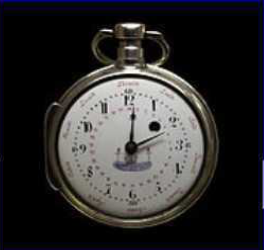
The hours of the day were decimalised. So each day was divided into 10 hours, rather than the 24 hours we use. The hours into 100 decimal minutes, and the minute into 100 decimal seconds. This meant that an hour was 144 conventional minutes; a minute 86.4 conventional seconds, and a second 0.864 conventional seconds.
So, had we adopted the French Revolutionary Calendar as we did the metric system this would be quartidi 13th Nivôse, Year 234. (According to the calculator at French Calendar although I’m less than sure about the day of the week!)
Thank you, Napoleon?
The French Revolutionary Calendar did not survive Napoleon, who recalled the conventional calendar. Time keeping returned to the Gregorian standard on 1 January 1806.
I do like the idea of the 10-day week. But I would prefer it to be 6 days of work and 4 days of leisure, thank you. I do wish we could rename our months: Wheezy, Sneezy and Freezy; Slippy, Drippy and Nippy; Showery, Flowery and Bowery; Hoppy, Croppy and Poppy.
To find out more look at Wikipedia and consult John Brady (1812), Clavis Calendaria: Or, A Compendious Analysis of the Calendar; Illustrated with Ecclesiastical, Historical, and Classical Anecdotes, vol. 1, Rogerson and Tuxford
The Metric System & English Exceptionalism
Notably, Napoleon did not reverse the Metric System. This was initiated in 1799, by the Revolutionary Government, shortly before it lost power in the Coup of 18 Brumaire which took place in Year VIII and installed Napoleon in power. Brumaire is November roughly?
The metric system not only survived, it prospered. Notably absent from the universally accepted system are English-speaking Countries, The UK, US and Canada being the main abstainers. Make of it what you will, but I think the main reason as that we don’t think we should be told what to do by foreigners who we rescued from the Germans. This is, of course, nonsense, given the contribution of the Russians, and all the others who fought to defeat fascism, but it is something that lingers as an idea. (Oh, how I hate you Brexit voters!).
Introducing a Rational System?
We made our coinage metric on 15 February 1971, and from 1962, stopped and started introducing the Metric System. The system was enshrined in UK law with the accession to the European Economic Community. We are now in a strange pickle where our children are mostly fully metric while we boomers are ambivalent. I buy my beer in pints (I’m lying I am the sort of wimp who orders beer in half pints). But petrol in Litres, although I only know how many miles my car does to the gallon. (I no longer have a car).
We measure long distances in miles, and short distances in a strange combination of both. I might go to ask a timber merchant for a couple of metres of 2 by 4. (2 inches by 4 inches is a standard size of wood). (I hate DIY!)
I buy butter in grams and fruit in a £1 container’s full. In summer, I use Fahrenheit as I spend a lot of time with Americans, telling them about our Quintessential country. In winter, I return to the universal world of Centigrade.

On this Day
Today, is special for the Cybele, Isis, Aphrodite and Ishtar, and is the Vigil for St Genevieve of Nanterre. Paris. (more tomorrow). It is also a Bank Holiday in Scotland.
1492 Spain Conquered Al-Andalus, ending the Reconquista and Islamic rule in Spain with the fall of Granada.
1959 the Russians launch Luna 1, the first human-made object to escape Earth’s gravity.
In your Garden
Clean and repair gardening tools. Plan Spring Flower Beds. Check whether you need more evergreens or flowering heather to add interest to a winter garden.
First Published Jan 2nd 2023, republished Jan 2024, 2025 and 2026