Time to Tup your Sheep – November 7th

City Farm, Hackney. Small flock of Bluefaced Leicester Sheep, the big golden one is the Ram, the others are the ewes he has tupped. Photo K Flude

The old Shepherd’s saw is:

‘In with a bang and out with the fools’.

The bang is Guy Fawkes Day on November 5th, and the fools are a reference to All Fools Day on April 1st. The gestation period of a ewe is 147 days (on average). (sheep-farmers-year). So farmers introduce the Ram into a field of Ewes on or around November 5th. This means the lambs will be born around the beginning of the traditional lambing season.

(see my posts on Guy Fawkes Day and All fools Day)

Tupping Times

The Ewes have been enjoying themselves in the fields, The flocks have been thinned out, with the young ones being sent to market, mostly for meat. The grass has been growing at the end of the summer, with the wetter weather. The ewes will be in excellent condition, and will have been thoroughly checked by the shepherd.

The chosen ram will be dressed with a harness on his chest, which will have a sheep’s crayon on it. The crayon is known as raddle or reddle. The ram, also know as a tup, will mate with whichever of the ewe(s) that catch his eye. Each one he tups (mounts or covers) will be left with a paint mark, from the reddle on his chest, on her back. The farmer will inspect the ewes periodically. A ewe with two or more reddle marks on her back, will be taken out of the field. This will force the ram to spread his attentions to the, as yet, untupped, ewes. He will continue until all ewes have been tupped. And then onto the next field full of ewes. Diggory Veen is the Reddleman in Hardy’s ‘Return of the Native’. I talk about him, lambing and reddle in my post here.

Some of the young ewes will be kept to reinforce the flock. Males will only be kept if they will be sold to another farmer as a tupping ram. They cannot breed on the farm as this will lead to inbreeding. So, a ram will be purchased or swapped from another farm. The farmer will want to choose one that fits into his/her idea of what the ideal sheep is. whether it is grown for meat, or to be hardy, or for its wool etc.

Raddled

To be raddled is to be flushed, red with drink, or over made up. It has a sense of dissipation about it. One might have more sexual encounters than is normal. Just like the ewe with too many raddle marks on her back? Or the Raddle man with a red face and hands from all the raddle he handles?

Bluefaced Leicester Sheep and my Hat!

I was delighted to see my local City Farm had a small herd of Bluefaced Leicester Sheep. I was visiting with my Grandson when I took the photograph at the top of the page. The sherderdess told me the blue-marking in this case was not a result of mating. She thought 2 or more of them were already pregnant, however.

My association with the breed comes from a lovely yarn shop in Conwy (Ewe Felty Thing) which had a rail of clothes marked ‘wearable art’. I bought a woolly beanie which they told me was:

‘Hand-spun, hand knitted from a bluefaced leicester sheep.

Hand-spun, hand knitted Beanie from a Bluefaced Leicester sheep. purchased at (Ewe Felty Thing) Photo K Flude

I still have it. It cost a small fortune, but worth every penny!

A bluefaced Leicester Ram, might cost £1000 if a bought as a lamb, £4,000 if bought as a shearling, or up to £40,000 if a prize lamb. It is one of the biggest lambs with a long back, and longwool with ringlets. There is no wool on the face and neck so you can see its blue-grey skin, below the white hair – hence its name. It is often bred with hill sheep ewes, which combines the prolificacy of the ram with the mothering abilities of the ewes.

Generally, nowadays the wool from a shearing will only be worth about 80p in today’s market. This will not pay for the cost of the shearing, but it is necessary for health and hygiene reasons.

Posted on 7th November 2025
A VIRTUAL TOUR THROUGH THE WHOLE ISLAND OF GREAT BRITAIN. NO. 2 CONWY

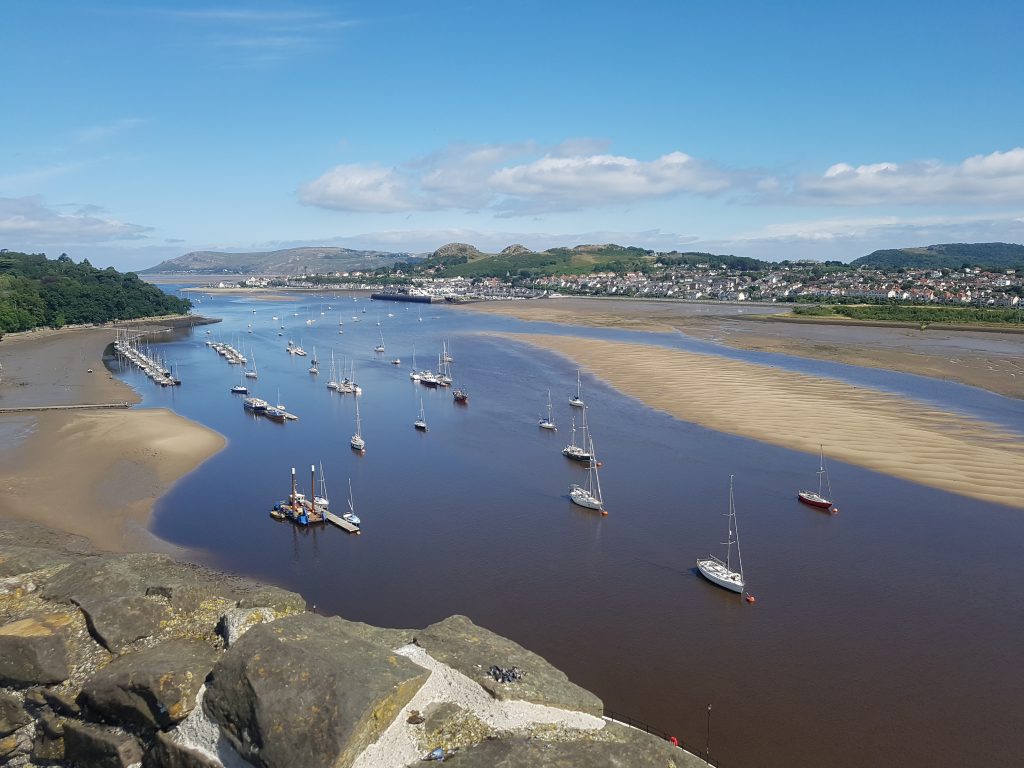
Conwy Estuary from the Castle, looking towards Deganwy to the North

Monday 7th March 2022 7.00 pm

See the gateway to Snowdonia and its magnificent Medieval Castle, Town and Bridges

Borrowing my title from Daniel Defoe’s early chorography, my first circuit is from Chester to Edinburgh. Now on our second stop we are taking a virtual tour of the gateway to North Wales – the delightful town of Conwy.

For a small town Conwy has everything – an absolutely magnificent Medieval Castle, a City Wall that is still intact around the entire Circuit. Some of the great feats of bridge and tunnel engineering, and a pocket sized town containing historic buildings, nice pubs, and the ‘smallest house in Great Britain.’

It is not only picturesque but was a settlement of enormous strategic importance in the invasions by the Romans and the English. And to finish the tour we will take a small excursion into Snowdonia to see what it guarded

To Book:

Podcast

BWALCH-Y-DDEUFAEN -GIANTS, COBBLERS & THE TEARDROP EXPLODES

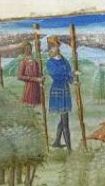
Giants from a medieval illustration

Julian Cope, of the Teardrop Explodes, wrote a wonderfully illustrated guide book of the megalithic sites in the UK. While you read why don’t you listen to the wonderful ‘When I dream.’

I lent the Modern Antiquarian to someone so have to use the website to share what he said about the standing stones of Bwalch-y-DDeufaen, near Conwy.

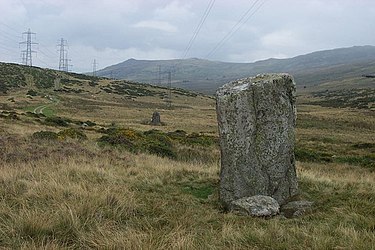
‘I’m really taken with these stones. The sense of deep time seems to hang around them, from the ageless mountains, through the monument builders, the tramp of Roman soldiers, into a hinterland of iron and wire. Rather than detracting, the pylons add to this sense that we’re standing in the midst of a palimpsest, layers of time and people still there, just below the surface. And perhaps we’re a shadowy presence in earlier and later times, too.

Julian Cope www.themodernantiquarian

Terry Hughes Wikipedia  / Bwlch y Ddeufaen Northwest Standing Stone / CC BY-SA 2.05

I’m working on a virtual tour of Conwy (Monday 7th March 7pm) and I remember a wonderful story from my several visits to Conwy pre-Covid. So, in my own words:

A Cobbler with a string of old shoes to be repaired hanging on a string around his neck, came upon a Giant carrying two huge stones in his hands. Behind him walked his wife carrying smaller stones in her apron. They were struggling over the Pass with the weight of the stones, and asked the Cobbler anxiously how far it was to the the Island of Anglesey? The Cobbler asked why they wanted to know and the Giant answered. ‘We plan to settle there and these stones are to build a bridge across the Menai Straits’.

The Cobbler came from Anglesey and was alarmed by the idea of the havoc a couple of Giants would cause. So he replied ‘ I don’t know how far it is but I have worn out all these shoes on the way.’

The Giant looked at the string of worn out shoes, looked at his wife and they decided to abandon their journey. He threw the two standing stones in the air and they landed in the ground where they have stood ever since, and his wife threw her smaller stones away too.

This is an explanation of the 2 large standing stones and two smaller ones at Bwalch-y-Ddeufane. They are either Neolithic or Bronze Age. Geoffrey of Monmouth wrote, int eh Twelfth Century, that the indigenous inhabitants of Britain were giants, descended from Poseidon, and the daughters of Albion. They were wiped out by King Brutus, the Trojan (for that tale come to my Myths and Legends of London Walks).

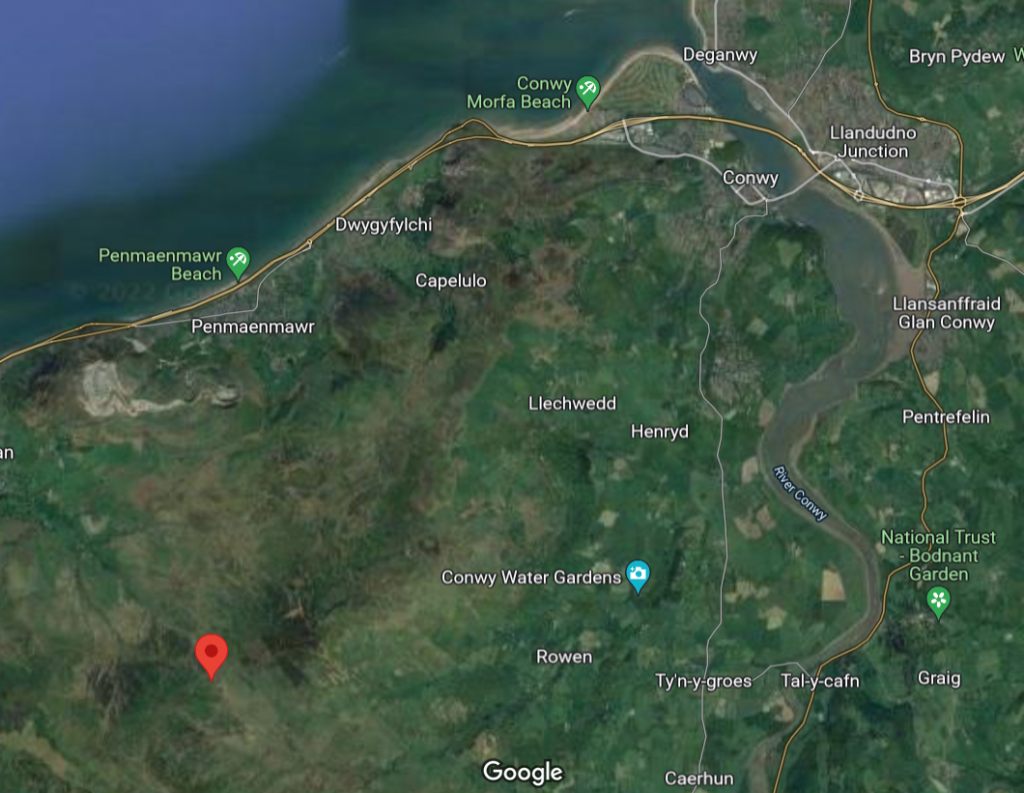
Bwalch means gap or pass and the track here was the prehistoric track and Roman Road that lead to Mona from Conwy and Chester. In fact they even considered it as a possible route for Euroroute 22, before deciding to continue the route along the A55 through Conwy. It was a massive construction project costing £200 million pounds and only made possible by European money as it was a strategic route to Holyhead and Ireland.

Below Bwalch-y-Ddeufane at Caerhun was the Roman Auxiliary Fortress that controlled this vital crossing of the Conwy. It is thought that this became the Civitas Capital of the Deceangli, who controlled the land from the Conwy to the Dee Estuary before and during the Roman period.

Google Satellite image showing Bwalch-y-Ddeufane, the Roman site of Caerhun, the river crossing at Tal-y-Cafn, Conwy and the A55 (the yellow coast road).Euro route 22