This post is about St Augustine and Christianity in Roman and Post Roman Britain. But first:
On This Day
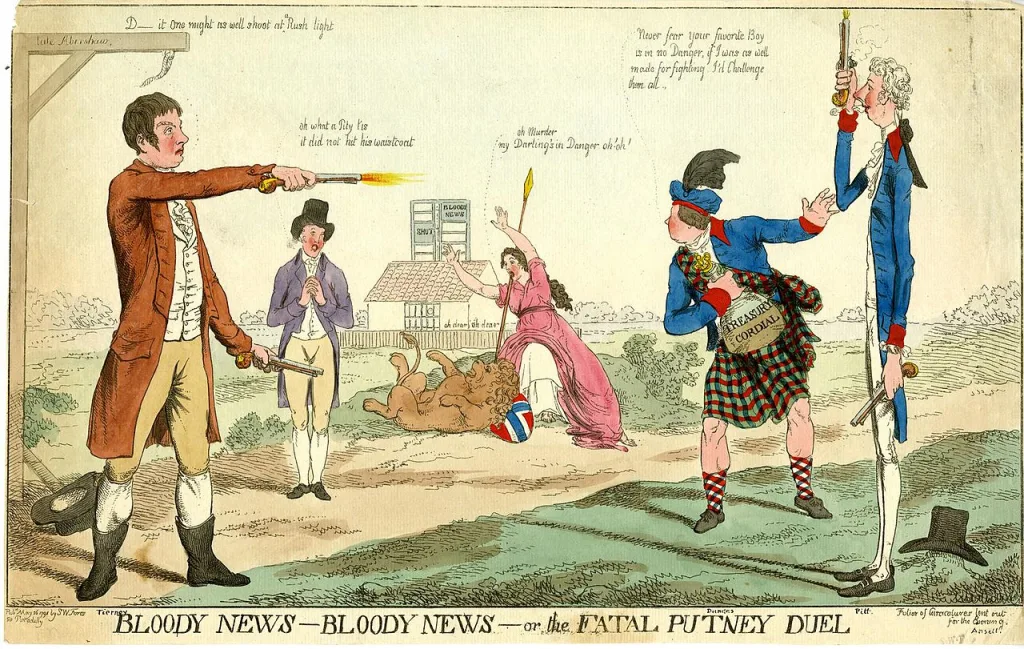
On May 27th 1798, Prime Minister Pitt, a Tory, meet George Tierney on Putney Heath for a two pistol duel. In the absence of the Whig Leader Charles James Fox, Tierney questioned the Prime Minister’s plan to increase the Royal Navy’s man power. Pitt suggested Tierney’s opposition came about through ‘desire to obstruct the defence of the country’. Tierney objected, the Speaker upheld his complaint. Pitt refused to withdraw the remark. Tierney sent his second to demand satisfaction. Pitt accepted. Both missed their first shots, Pitt shot his second shot vertically up. The seconds stopped Tierney responding. The King was furious that Pitt should put his own pride against the interests of the Country. The other two people are the seconds.
The Cartoon above shows, skinny Pitt on the right, Tierney on the left under the shadow of the Gibbet. Britannia is horrified with the British Lion in the background. Behind them is one of the new Telegraph systems which is conveying news of the duel.
The Augustinian Mission
St Augustine brought Christianity to England, leading the mission sent by Pope Gregory to Canterbury in 597AD. He was the Abbot of a Monastery in Rome before the Pope sent him to convert the Angles. I tell the story of the mission in my post: March-12th-St-Gregory-Punster-Extraordinary/.
Augustine is the patron saint of England and the Anglican Communion. But he is not the person who brought Christianity to Britain. To England, maybe. Britain. No. The Romans did this. I summarise the evidence in my post on St Lucius, who is claimed to have brought Christianity to Britain in the 2nd Century. Our first martyr was St. Albans. (see my post on St Albans here.
Feast Day(s) of St Augustine.
We have a variety of days to celebrate St Augustine of Canterbury. These are according to Google; 26 May (Anglican, Eastern Orthodox, and Catholic Extraordinary Form calendar in Great Britain). 27 May (Catholic Ordinary Form calendar). 28 May (Catholic Extraordinary Form calendar outside Great Britain).
Perhaps, like the Venerable Bede he died after Dusk? (see yesterday’s post.)
Romano-Britain and Christianity
There is good reason to think Christianity was strong in Roman Britain, particularly in towns. There is also some evidence of non-Christian religious centres surviving in the countryside (the Roman word for non-Christians, pagans, comes from the Latin word paganus, which meant someone who lived in the country.)
After the Romans, the Christian Church continued to thrive, with a host of Saints particularly in Cornwall, and Wales. The first substantial eye-witness account of post-Roman Britain, dated to the early 5th Century, concerns the Catholic Bishop Germanus. This shows a battle for souls in Britain not between Christians and Pagans, but between Catholics and other Christians who the Catholic Church targeted as heretics. I talk about this in my post about St Germanus here.
The next insight comes from the conversion of the Irish to Christianity later in the 5th Century. St Patrick’s account gives an eyeyewitness view. What is interesting is that St Patrick’s family were living in a town where aspects of Roman life were still continuing. After being kidnapped by Irish raiders, St Patrick went on to lead the conversion of the Irish (with the help of St Bridget). See my post on St Patrick here, St Bridget here.
I cannot see any sense of personality or charisma in the story of St Augustine. But Welsh history shows him to be an unsympathetic hierarchical character.
Clashes with Celtic Christianity
What many people forget is that St Augustine came to a country with over two hundred years of Christian belief. So, meetings were held between the British Church and St Augustine, culminating in the Synod of Chester in the early 7th Century. Seven British Bishops and others prepared for their response to St Augustine’s insistence on the primacy of the Roman Catholic Church. One of the contentious issues was the ‘computus’ for deciding the date of Easter. Another was the style of the monks’ tonsure. But it was a major step for the British churches to align themselves with a foreign ecclesiastical structure.
The delegates were advised by a wise hermit to arrive late at the planned meeting with St Augustine to see how he reacted. If he got up and welcomed them, then he was a fit leader to follow. If he acted imperiously, then he was not worthy. St Augustine failed the test, the meeting was a failure. And St Augustine cursed the British, which was said to have led to a military campaign against them by the Anglo-Saxons. The British lost the subsequent battle of Chester. It was said that 2000 monks from the nearby monastery of Bangor-in-Dee were slaughtered. This seems like a huge exaggeration, unless the definition of a monk was just loosely people associated with the Monastery..
The battle severed the connections between the British Kingdoms in Cumbria and Scotland from the Kingdoms in Wales and made it very unlikely that the British would ever regain control of Britain from the English.
The two churches were reconciled at the Synod of Whitby (664AD). For more about the calculations for Easter and the Synod of Whitby look at my post here.
First written on 27th May 3025, revised On This Day added 2026