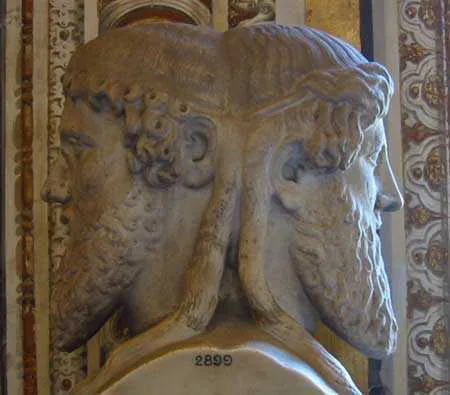
January is when people buy diaries, calendars and almanacs. January is named after the Roman God Janus. He faces both ways, to the old year and forward to the New Year. January is Ionawr in Welsh. An ceud Mhios Biadhna in Gaelic meaning ‘the first month of the year’.
This is a Roman Barrel from Scotland is shown on the Trimontium Web Site with the name Januarius on it.

Almanacs
Arguably, they grew from medieval manuscript Books of Hours. The 1493 Kalendar of Shepherds, published in Paris, was particularly important. Each month has a succinct description of the activity. Moreover, there was important information for farmers and others. Eventually, a British version was made.
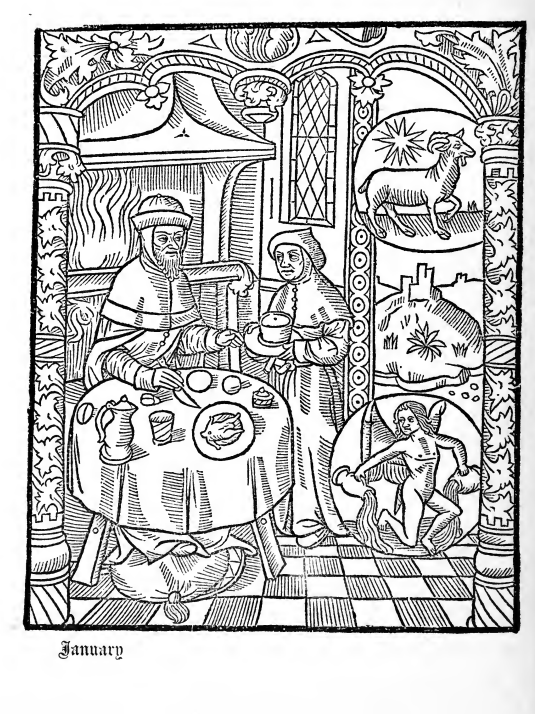
Kalendar of Shepherds
The Kalendar of Shepherds was printed in 1493 in Paris and provided ‘Devices for the 12 Months.’ I use a modern (1908) reconstruction of it using wood cuts from the original French and adding various text from English 16th and 17th Century sources. The text of the month (as shown above) is provided from a 17th Century source. It gives an interesting view of the countryside in January. To see the full Kalendar, look here:
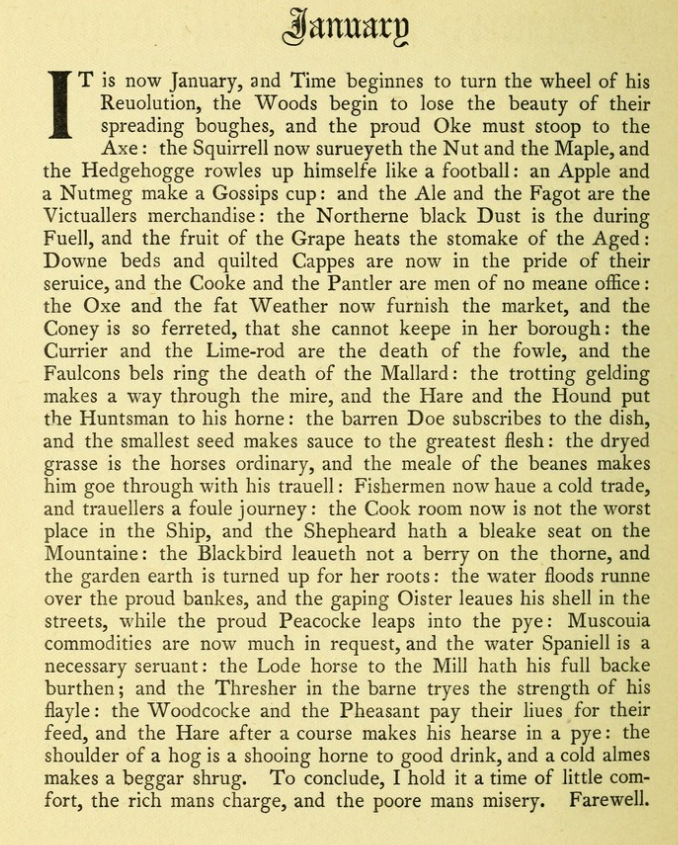
Nicholas Breton, the writer of the text above, concludes that January:
‘is a time of little comfort, the rich man’s charge, and the poore man’s misery.’
The rich man is burdened by having to help out all the poor people who depending upon him to get through the shortages of winter. The image for January shows that January is best spent indoors by a roaring fire, eating pies.
Months of Your Life
The Kalendar introduces a ‘conceit’ which is that the year mirrors our lives, and we can forecast what will happen in our lives by looking at the months.
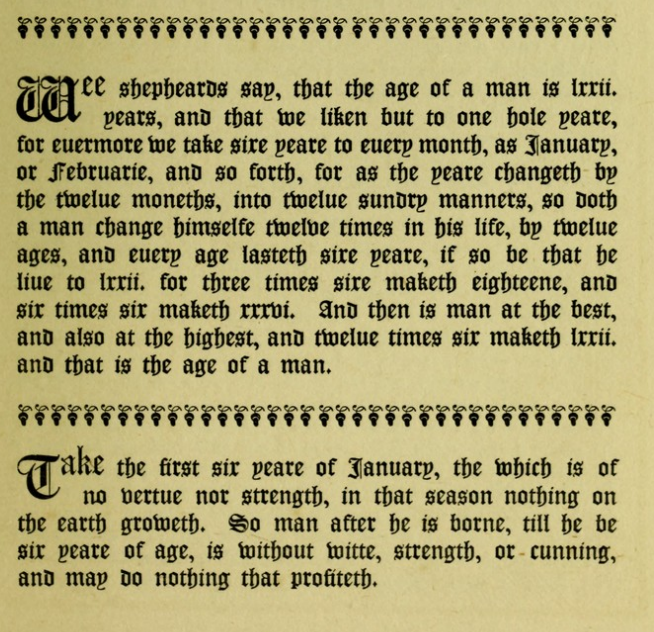
So our lives, which are of 72 years, can be divided into 12 ages of man, each of 6 years. So, January represents the first 6 years of a person’s life. And as you can see, that during these first 6 years, the child is ‘without witte, strength, or cunning, and may do nothing that profiteth‘. As the year changes every month, so, ‘a man change himself twelve times in his life’. At three times 6 (18 or March) a child becomes a man, and 6 times 6 (36 or June) man is at his best and highest. And at 12 times 6 (72 or December) man is at the end of his allotted span.
Shakespeare numbered the Ages of Man as seven, in the great speech of Jacques in ‘As You Like it’ I dealt with this and other Ages of the World in my post:
Growth of the market for Almanacs
By the 1600s almanacs were the most published form of book apart from the Bible. Lauren Kassell in ‘Almanacs and Prognostications’ reports estimates that by 1660 one third of every household had one.
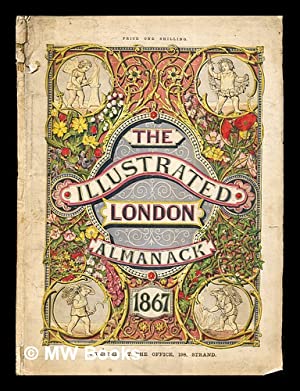
Originally, they had a Calendar for each month, and information about the phases of the month, the tides. They gave predictions of the weather, and health issues likely to occur at that time of the year. Astrology was an important element. London Almanacs contained further information about the year, its ceremonies and elections of officials. As this informational side to the almanac grew, they included lists of monarchs, interesting stories, verse foretelling the weather, recipes and cures.
The earliest almanacs were made of wood and were called ‘clog almanacs. You can read more about them on my post here:
The Modern Almanac – Old Moore’s

As the New Year dawns, we might turn to an almanac to see what the year has ahead. Newspapers and the web have now taken over largely from almanacs. They print articles about the upcoming highlights of the Political, Sporting, Gardening or the Musical year. But almanacs are still produced. One of the most popular is Old Moore’s which has been in production since 1697. For more on Old Moore’s see my post here. As you can see, they promise to help with your gambling, gardening, fishing and help you through the year with predictions and horoscopes.
Originally published in 2024, republished in 2025. Content moved to new page and expanded 2026.