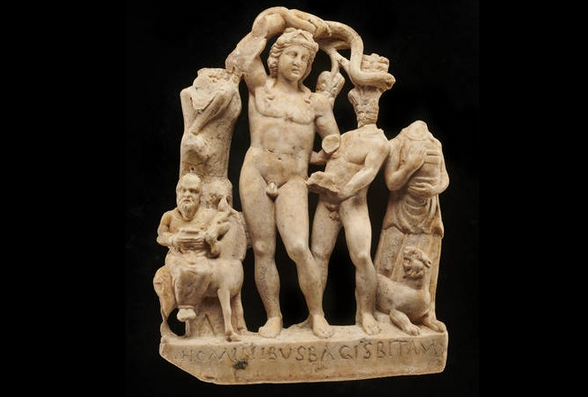
Marble statue of Bacchus from the Temple of Mithras London. The inscription reads ‘hominibus vagis vitam’ Translation … (give) life to men who wander. Bacchus is in the middle, the little old man on the left is Silenus. The drunken tutor to Bacchus.
On the eighth day of Christmas my true love sent to me: 8 Maids a Milking; 7 Swans a Swimming; 6 Geese a Laying 5 Golden Rings 4 Calling Birds; 3 French Hens; 2 Turtle Doves and a Partridge in a Pear Tree
Closing Time
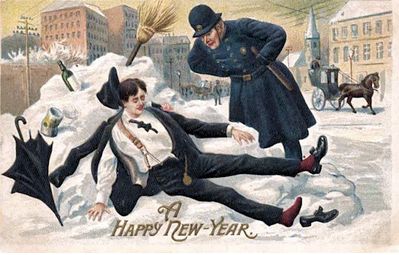
The 8th day, New Years Day, is the day of the Throbbing Head. In ‘Closing Time’ Leonard Cohen wrote about drinking to excess. I like to think he refers to Christmas and New Year’s Day:
‘And the whole damn place goes crazy twice And it’s once for the devil and it’s once for Christ But the boss don’t like these dizzy heights We’re busted in the blinding lights of closing time.
Trouble is the song mentions summer. Oh well. You can enjoy the official video on YouTube below:
Hangover Cure
What you need is a hangover cure. Nature provides many plants that can soothe headaches. And in the midst of the season of excess, let’s start with a hangover cure.
Common ivy Photo by Zuriel Galindo from unsplash
Ivy and Bacchus
Ivy, ‘is a plant of Bacchus’…. ‘the berries taken before one be set to drink hard, preserve from drunkenness…. and if one hath got a surfeit by drinking of wine, the speediest cure is to drink a draft of the same wine, wherein a handful of ivy leaves (being first bruised) have been boiled.’
Culpeper Herbal 1653 quoted in ‘the Perpetual Almanac’ by Charles Kightly
Bacchus often wore an ivy crown around his head. Romans used Ivy to fend off hangovers.
Bacchus and Wine Making
The image of Bacchus, at the top of the post, is from a fascinating article by the Museum of London on wine making in Roman Britain. It suggests wine in Britain was first made in Brockley Hill, in South East London as little as 20 or 30 years after the Roman Conquest of AD43. The evidence was the discovery of Roman Wine Amphora made locally. This is taken as evidence that the amphorae were made to contain local wine. Direct evidence of a vineyard has been found in Northamptonshire but fron the 2nd Century AD.
Bacchus is the Roman version of the God Dionysus who was the God of ‘wine-making, orchards and fruit, vegetation, fertility, festivity, insanity, ritual madness, religious ecstasy, and theatre.’ Essentially anything that could make you loss your head, and escape your inhibitions. But he could also relieve pain, reduce anxiety, free you from subjugation and therefore he was subversive. The Roman State suppressed and regulated the Bacchanalian Festivals.
Skullache, and Willow,
Crack Willow Trees on the Oxford Canal, August 2021
Now, if that gives you a headache, one of the best documented folk hangover cures is willow bark, useful for headaches, earaches, and toothaches. Here is a record of how simple it was to use:
‘I am nearly 70 years old and was born and bred in Norfolk… My father, if he had a ‘skullache’ as he called it, would often chew a new growth willow twig, like a cigarette in the mouth.’
‘A Dictionary of Plant Lore by Roy Vickery (Pg 401)
In the 19th Century, they discovered that Willow contained salicylic aciacid, from which aspirin was derived. As a child, I remember chewing liquorice sticks in a similar way. We chewed, supposedly for the pleasure and the sweetness, not for the medicinal virtues of the plant.
Country Weather
January 1st’s weather on the 8th Day of Christmas was cold, but bright in the morning, a little bit of rain at lunch time, and a dry but cloudy afternoon. So, according to Gervase Markham, the 8th Month, August, will be sunny to begin with, with some rain in the middle, and cloudy end of the month. (source: ‘The English Husbandman’ of 1635.)
On this Day
Today, is the Day the Nymphs in Greece dedicated to Artemis, Andromeda, Ariadne, Ceres. (according to the Goddess Book of Days by Diane Stein.)
First Published in 2024, republished in 2025, 2026
Jane Austen’s London Walk 2.30pm Sun 31st May 2026 To Book The First Blitz – Zeppelin London New Walk! 6pm Sun 31 May 2026 To Book Roman London – Literary & Archaeology Walk 3pm Sat 6th June 2026 Tobook The Rebirth Of Saxon London Archaeology Walk 11am Sun 7th June 2026 To book Tudor London – The City of Wolf Hall 3pm 4th July 2026 To Book Jane Austen’s London Walk 2:30pm Sun 5th July 2026 To book London. 1066 and All That Walk 11.30am Sun 12th July 26 Tobook Bloody, Flaming, Poxy London 3pm Sun 12th July 26 To book Myths, Legends, Archaeology and the Origins of London 3pm Sat 1 Aug 2026 Tower Hill Underground To book The Decline And Fall Of Roman London Walk 11:15am 2nd Aug 26 To book Jane Austen’s London Walk 2:30pm Sun 2nd Aug 26 To book Chaucer’s Medieval London Guided Walk 11.00am Sat 5th Sept 2026 To book Jane Austen’s London Walk 2:30pm Sun 5th Sept 2026 To book Jane Austen’s London Walk 2:30pm Sat 24th Oct 2026 To book
For a complete list of my guided walks for London Walks in 2026 look here
Monday 1st January 2025 7.00 pm On this Virtual Walk we look at how London has celebrated the New Year over the past 2000 years.
The New Year has been a time of review, renewal, and anticipation of the future from time immemorial. The Ancient Britons saw the Solstice as a symbol of a promise of renewal as the Sun was reborn. As the weather turns to bleak mid winter, a festival or reflection and renewal cheers everyone up. This idea of renewal was followed by the Romans, and presided over by a two headed God called Janus who looked both backwards and forwards. Dickens Christmas Carol was based on redemption and his second great Christmas Book ‘The Chimes’ on the renewal that the New Year encouraged.
We look at London’s past to see where and how the New Year was celebrated. We also explore the different New Years we use and their associated Calendars – the Pagan year, the Christian year, the Roman year, the Jewish year, the Financial year, the Academic year and we reveal how these began. We look at folk traditions, Medieval Christmas Festivals, Boy Bishops, Distaff Sunday and Plough Monday, and other Winter Festival and New Year London traditions and folklore.
At the end, we use ancient methods to divine what is in store for us in 2023.
The virtual walk finds interesting and historic places in the City of London to link to our stories of Past New Year’s Days. We begin, virtually, at the Barbican Underground and continue to the Museum of London, the Roman Fort; Noble Street, Goldsmiths Hall, Foster Lane, St Pauls, Doctors Commons, St. Nicholas Colechurch and on towards the River Thames.
The Civil War, Restoration and the Great Fire of London Virtual Tour
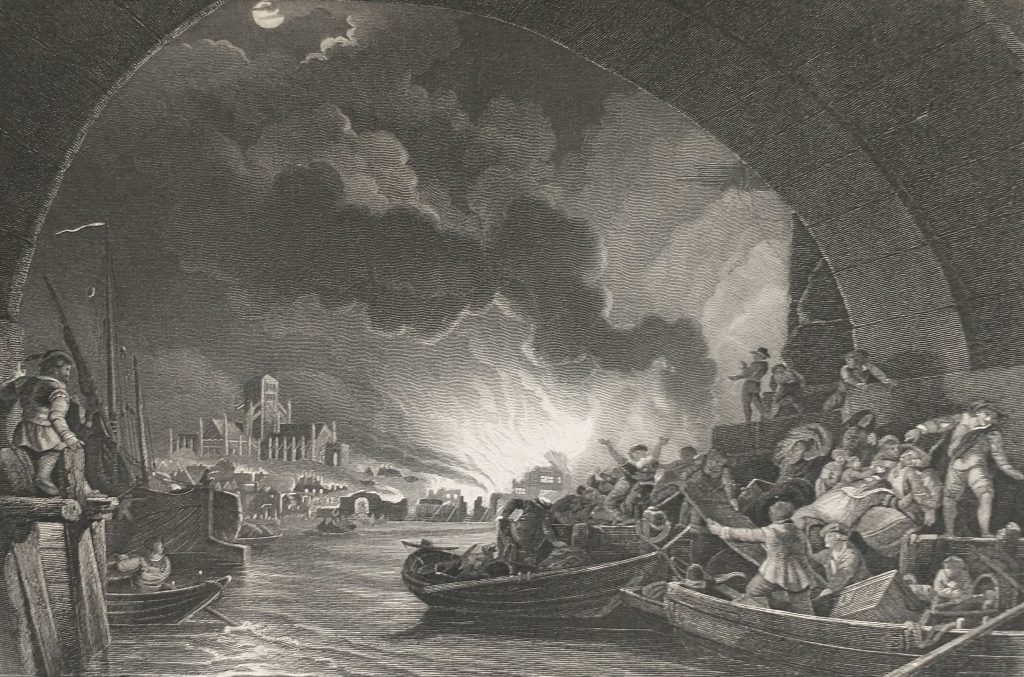
The Great Fire of London looking towards StPauls Cathedral from an old print
7:30pm Fri 30th January 2025
January 30th is the Anniversary of the execution of Charles I and to commemorate it we explore the events and the aftermath of the Civil War in London.
Along with the Norman Conquest of 1066 and winning the World Cup in 1966 the Great Fire in 1666 are the only dates the British can remember!
And we remember the Great Fire because it destroyed one of the great medieval Cities in an epic conflagration that shocked the world.
But it wasn’t just the Great Fire that made the 17th Century an epic period in English History. There was a Civil War, beheading of the King, a Republic, a peaceful Restoration of the Monarch, the last great plague outbreak in the UK, the Glorious Revolution and the Great Wind.
The Virtual Walk puts the Great Fire in the context of the time – Civil War, anti-catholicism, plague, and the commercial development of London. The walk brings to life 17th Century London. It starts with the events that lead up to the Civil War concentrating on Westminster and ends with a vivid recreation of the drama of the Fire as experienced by eye-witnesses. Route includes: Westminster, Fish Street Hill, Pudding Lane, Monument, Royal Exchange, Guildhall, Cheapside, St Pauls, Amen Corner, Newgate Street, Smithfield.
Roman London – Literary & Archaeology Walk
11.30 am Sun 9th Feb 2025 Monument Underground Station
also on 11.30am Sun 27th Apr 25 but starting from Moorgate
London Roman Riverside Wall o
This is a walking tour features the amazing archaeological discoveries of Roman London, and looks at life in the provincial Roman capital of Londinium.
This is a walking tour that features the amazing archaeological discoveries of Roman London, and looks at life in the provincial Roman capital of Londinium.
Our Guides will be Publius Ovidius Naso and Marcus Valerius Martialis who will be helped by Kevin Flude, former Museum of London Archaeologist, Museum Curator and Lecturer.
We disembark at the Roman Waterfront by the Roman Bridge, and then explore the lives of the citizens as we walk up to the site of the Roman Town Hall, and discuss Roman politics. We proceed through the streets of Roman London, with its vivid and cosmopolitan street life via the Temple of Mithras to finish with Bread and Circus at the Roman Amphitheatre.
Zinger Read: Talk about a high-quality one-two punch. This walk investigates the groundbreaking archaeological discoveries of Roman London. And then it reconstructs life in a provincial Roman capital using archaeological and literary sources. Discoveries – insights – like flashes of lightning in a cloud. We begin at the site of the Roman bridge. We might be decent young Roman citizens in togas, having this and that bit of explained to us as we make our way towards the Roman Town Hall. From there we head to the site of the excavation called ‘the Pompeii of the North.’ Followed by the Temple of Mithras. We finish with a walk along the Roman High Street in order to end at the site of the Roman Amphitheatre. So, yes, welcome to London as it was 2,000, 1,900, 1,800, 1,700 and 1,600 years ago. And, yes, the walk’s guided by a real expert, the distinguished emeritus Museum of London archaeologist Kevin Flude. That means you’ll see things other people don’t get to see, delve into London via fissures that aren’t visible, let alone accessible, to non-specialists.
REVIEWS “Kevin, I just wanted to drop you a quick email to thank you ever so much for your archaeological tours of London! I am so thrilled to have stumbled upon your tours! I look forward to them more than you can imagine! They’re the best 2 hours of my week! 🙂 Best, Sue
Jane Austen’s London Anniversary Guided Walk
2.30 pm Sunday 9th Feb 2025
Green Park underground station, Green Park exit, by the fountain To book
Also
9 February 2025
Sunday
2.30 pm
4.30 pm
8 March 2025
Saturday
2.30 pm
4.30 pm
6 April 2025
Sunday
11.30 am
1.30 pm
2025 is the 250th Anniversary of Jane Austen’s Birth in Steventon, Hampshire. We celebrate her fictional and real life visits to Mayfair, the centre of the London section of Sense & Sensibility and where Jane came to visit her brother
“It is a truth universally acknowledged, that a Jane Austen devotee in possession of the good fortune of a couple of free hours today must be in want of this walk.”
People associate Jane Austen and her characters with a rural setting. But London is central to both Jane Austen’s real life and her literary life. So, this tour will explore Jane’s connections with London and give the background to Sense and Sensibility, a good part of which is based in this very area. We begin with the place Jane’s coach would arrive from Hampshire, and then walk the streets haunted by Willougby; past shops visited by the Palmers, the Ferrars; visit the location of Jane Austen’s brother’s bank and see the publisher of Jane’s Books. The area around Old Bond Street was the home of the Regency elite and many buildings and a surprising number of the shops remain as they were in Jane Austen’s day.
Jane Austen’s ‘A Picture of London’ in 1809 Virtual Walk
With the help of a contemporary Guide Book, Jane Austen’s letters, and works we explore London in 1809.
‘The Picture of London for 1809 Being a CORRECT GUIDE to all the Curiosities, Amusements, Exhibitions, Public Establishments, and Remarkable Objects in and near London.’
This Guide Book to London might have been on Henry Austen’s shelf when his sister, Jane, came to visit him in London. But it enables us to tour the London that Jane Austen knew in some detail. We will look at the Curiosities as well as the shopping, residential, theatres areas as well as the Port, the Parks and the Palaces.
The guided walk is a thank you to Alix Gronau, who, having been to one of my lectures in 1994, wanted the book to come to me. I have had the book restored and am using it to explore London in 1809.
Jane Austen’s London Anniversary Walk
Jane Austen’s London Anniversary Walk 2.30 pm Sunday 9th February 25 To book
A Virtual Tour of Jane Austen’s Bath
7.30pm 10th February 2025
Tudor London – The City of Wolf Hall 11.30am Sat 22nd Feb 25
Myths, Legends, Archaeology and the Origins of London
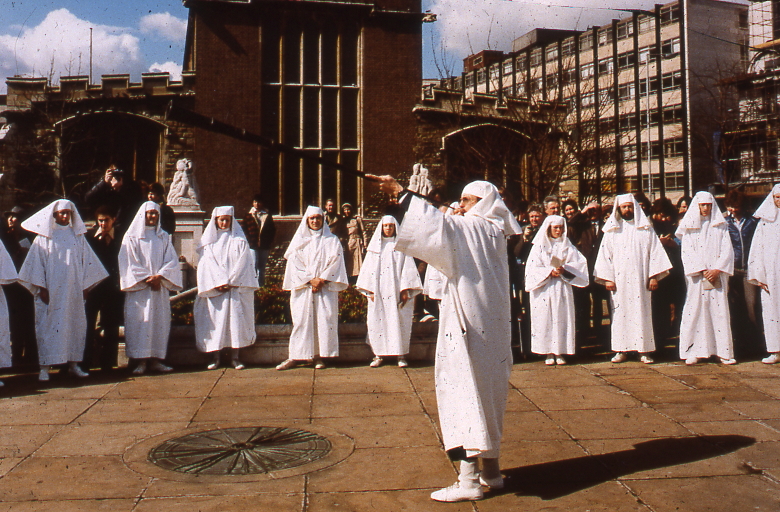
Druids at All Hallows, by the Tower
2.30pm Sat 22nd February 2025 Tower Hill Underground
The walk tells the stories of our changing ideas about the origins of London during the Prehistoric, Roman and Saxon periods.
The walk is led by Kevin Flude, a former archaeologist at the Museum of London, who has an interest both in myths, legends and London’s Archaeology.
The walk will tell the story of the legendary origins of London which record that it was founded in the Bronze Age by an exiled Trojan and was called New Troy, which became corrupted to Trinovantum. This name was recorded in the words of Julius Caesar; and, then, according to Legend, the town was renamed after King Ludd and called Lud’s Dun. Antiquarians and Archaeologists have taken centuries to demolish this idea, and became convinced London was founded by the Romans. Recently, dramatic evidence of a Bronze Age presence in London was found.
When the Roman system broke down in 410 AD, historical records were almost non-existent, until the Venerable Bede recorded the building of St Pauls Cathedral in 604 AD. The two hundred year gap, has another rich selection of legends. which the paucity of archaeological remains struggles to debunk.
The walk will explore these stories and compare the myths and legends with Archaeological discoveries.
The route starts at Tower Hill, then down to the River at Billingsgate, London Bridge, and into the centre of Roman London.
Roman London – Literary & Archaeology Walk 11.30am Sat Mar 8th 25 Jane Austen’s London Anniversary Walk 2.30pm Sat 8th Mar 25
The Decline And Fall Of Roman London Walk 11.30 Sat 22nd March 2025 London. 1066 and All That Walk Sat 2.30pm 22nd March 2025
Jane Austen’s London Anniversary Walk 11.30am Sun 6th Apr 25
Chaucer’s Medieval London Guided Walk 2:30pm Sun 6th Apr 25
and
Chaucer’s London To Canterbury Virtual Pilgrimage 7.30pm Friday 18th April 25 To book
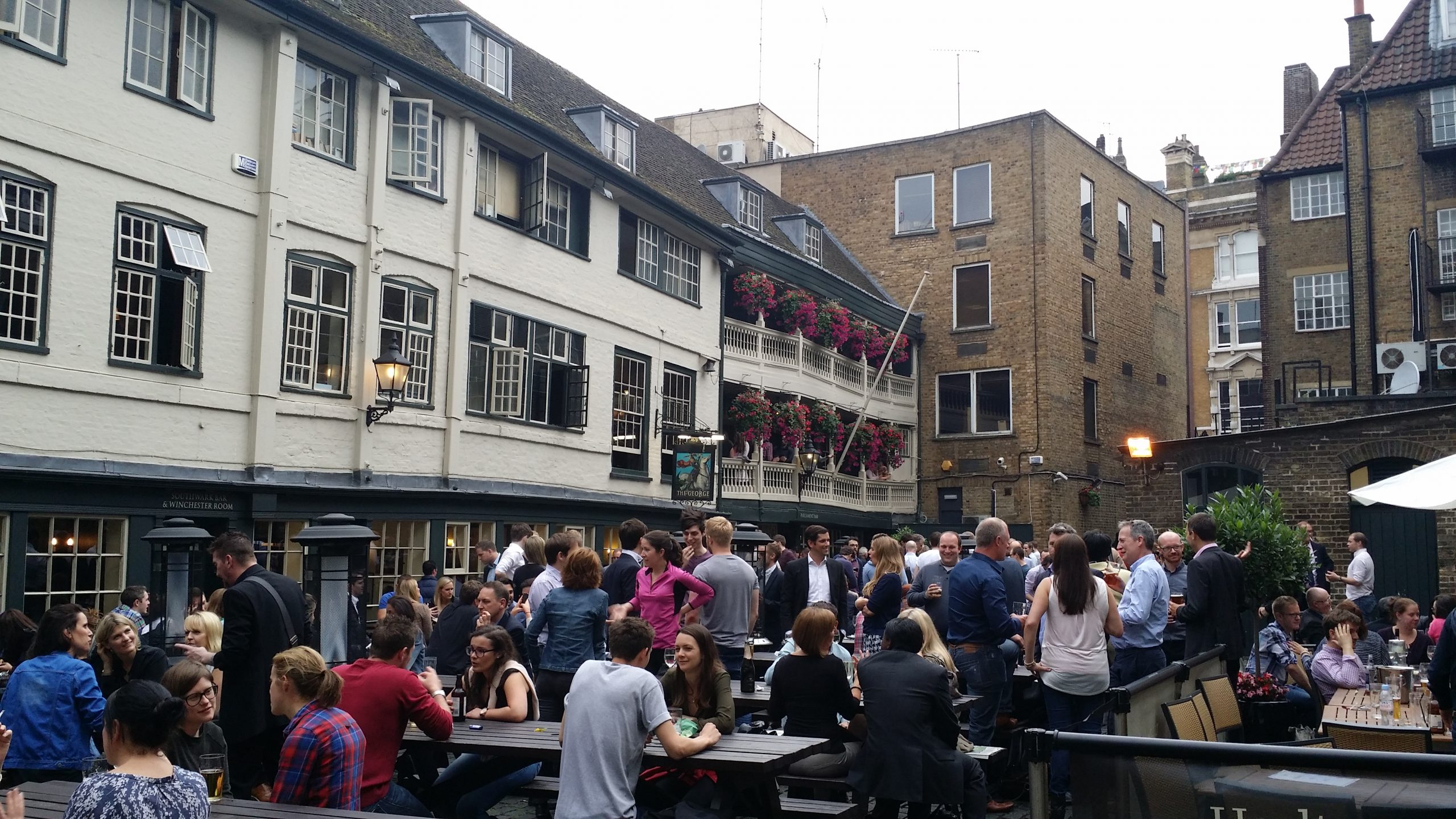
George Inn,Southwark
A Walk around Medieval London following in the footsteps of its resident medieval poet – Geoffrey Chaucer
One of the spectators at the Peasants Revolt was Geoffrey Chaucer, born in the Vintry area of London, who rose to be a diplomat, a Courtier and London’s Customs Officer. He lived with his wife in the Chamber above the Gate in the City Wall at Aldgate. His poetry shows a rugged, joyous medieval England including many scenes reflecting life in London. His stories document the ending of the feudal system, growing dissatisfaction with the corruption in the Church, and shows the robust independence with which the English led their lives.
His work helped change the fashion from poetry in French or Latin to acceptance of the English language as suitable literary language. This was helped by the growth of literacy in London as its Merchants and Guildsmen became increasingly successful. In 1422, for example, the Brewers decided to keep their records in English ‘as there are many of our craft who have the knowledge of reading and writing in the English idiom.’
Chaucer and other poets such as Langland give a vivid portrait of Medieval London which was dynamic, successful but also torn by crisis such as the Lollard challenge to Catholic hegemony, and the Peasants who revolted against oppression as the ruling classes struggled to resist the increased independence of the working people following the Black Death.
A walk which explores London in the Middle Ages, We begin at Aldgate, and follow Chaucer from his home to his place of work at the Customs House, and then to St Thomas Chapel on London Bridge, and across the River to where the Canterbury Tales start – at the Tabard Inn.
This is a London Walks event by Kevin Flude
Roman London – Literary & Archaeology Walk 11.30am Sun 27th Apr 25
Roman layer opus signinum,
Tudor London – The City of Wolf Hall 3:00pm Sun 27th Apr 25
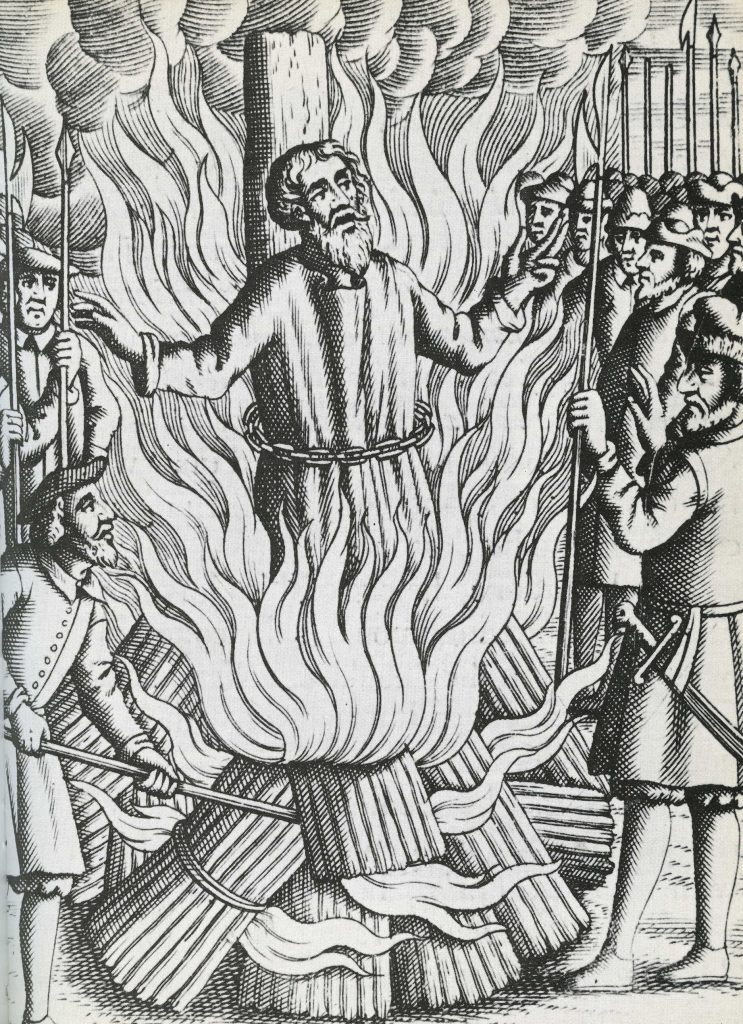
Thomas Bilney martyred in Smithfield.
The Walk creates a portrait of London in the early 16th Century, with particular emphasis on the life and times of Thomas Cromwell and Thomas More during the Anne Boleyn years.
More and Cromwell had much in common, both lawyers, commoners, who rose to be Lord Chancellor to Henry VIII, and ended their careers on the block at Tower Hill.
The walk starts with an exploration of Smithfield – site of the stake where heretics were burnt alive and of St Bartholomew’s Monastery – given to Richard Rich after his decisive role in the downfall of Thomas More. We continue to St Paul where Martin Luther’s books were burnt, and later, where Puritans preached against dancing round the Maypole.
We walk along the main markets streets of London, to Thomas More’s birthplace, and to the site of More’s and Cromwell’s townhouses before, if time allows, finishing at the site of the Scaffold where More and Cromwell met their ends, overlooking where Anne Boleyn was incarcerated in the Tower of London
To Book: https://www.walks.com/our-walks/tudor-london-the-city-of-wolf-hall/
A Boy From Haggerston before the War. 6pm 1st May 2025 Shoreditch Library.
Myths, Legends, Archaeology and the Origins of London 11.30am Sun 25th May 25 To book
The Decline And Fall Of Roman London Walk 3pm Sun May 25 To book
The Peasants Revolt Anniversary Guided Walk
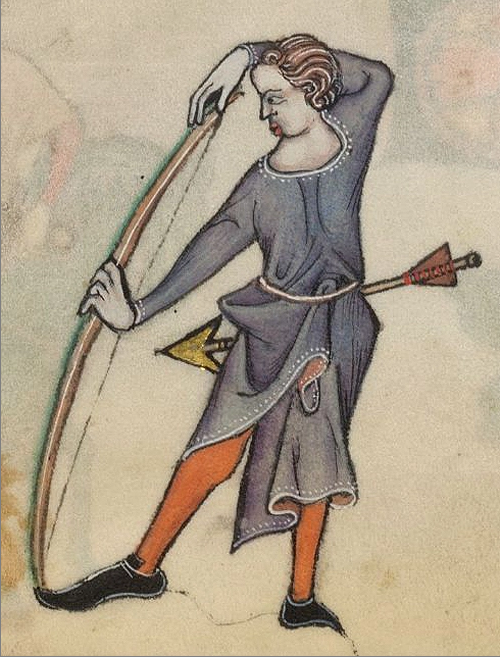
Medieval drawing of an archer
6.30pm Wed 11th June 2025 Aldgate Underground To book
An Anniversary Walk tracking the progress of the Peasants as they take control of London in June of 1381
Short read: The Summer of Blood
Long read: The Peasants’ Revolt. The greatest popular rising in English history. This is the anniversary walk. The London Walk that heads back to 1381, back to the Peasants’ Revolt. You want a metaphor, think stations of the cross. This is the stations of the Peasants’ Revolt walk. We go over the ground, literally and metaphorically. Where it took place. Why it took place. Why it took place at these places. What happened. The walk is guided by the distinguished Museum of London Archaeologist His expertise means you’ll see the invisible. And understand the inscrutable.
On the anniversary of the Peasants Revolt we reconstruct the events that shook the medieval world. In June 1381, following the introduction of the iniquitous Poll Tax, England’s government nearly fell, shaken to the core by a revolt led by working men. This dramatic tour follows the events of the Revolt as the Peasants move through London in June 1381.
We met up with the Peasants at Aldgate, force our way into the City. We march on the Tower of London as the King makes concessions by ending serfdom, at Mile End. But the leaders take the mighty Tower of London and behead the leaders of Richard’s government. Attacks follow on the lawyers in the Temple, the Prior at St. John’s of Jerusalem, Flemish Londoners, and on Lambeth and Savoy Palaces.
The climax of the Revolt comes at Smithfield where a small Royal party confront the 30,000 peasants.
Tudor London – The City of Wolf Hall 11.30am 13th July 2025 To Book Jane Austen’s London Anniversary Walk 3pm Sunday 13th July 25 To book Roman London – Literary & Archaeology Walk 11.30 am Sat 2nd Aug 2025 ToBook Chaucer’s Medieval London Guided Walk 2:30pm Sat 2nd Aug 2025 To Book Myths, Legends, Archaeology and the Origins of London 11.00am Sat 16th Aug25 to Book Roman London – Literary & Archaeology Walk 6:30pm Wed 24th Sept 2025 To book The Archaeology of London Walk 6.30pm Fri 3rd October 2025 To Book Chaucer’s Medieval London Guided Walk 11:30pm Sat 4th Oct 25 To book The Decline And Fall Of Roman London Walk 11.30pm Sat 8th Nov 25 To book Jane Austen’s London Anniversary Walk 2.00pm Sat 23rd Nov25 To book Rebirth of Saxon London 23rd Nov 25 Roman London – Literary & Archaeology Walk sat 11am 6th Dec 2025 To book Cromwell’s and More’s Tudor London Walk 2pm 7th Dec25 To book Jane Austen’s London Anniversary Walk 2.30pm Sun 14 Dec25 To book Christmas With Jane Austen Virtual London Tour 7.30pmTues 16 Dec25 To book The London Equinox and Solstice Walk 11:30pm Sun 21st Dec 25To book The London Winter Solstice Virtual Tour 7.30pm Sun 21 Dec 25 To book
Previous Years Archives
Here are previous archive of guided walks and events
John Stow reports on the Lord of Misrule. Memorial in St Andrew’s Church
On the sixth day of Christmas
My true love sent to me 6 Geese a Laying; 5 Golden Rings. 4 Calling Birds; 3 French Hens; 2 Turtle Doves and a Partridge in a Pear Tree
The Lord of Misrule, Masters of the Revels, and Boy Bishops
The Roman festival of Saturnalia reversed the rules so that slaves, ruled and masters served. It was held between 7th and 23rd of December. It also included giving gifts. In the medieval period, the disorders of Saturnalia was continued. Monarchs, Lords and Gentlemen, City Institutions elected Lords of Misrule, Masters of the Revels, and Boy Bishops. John Stow was London’s first great historian. In his Survey of London, he wrote of the Lords of Misrule in London. They were chooses at Halloween and continued until Candlemas, in early February. See my post here for more details on Candlemas.
From John Stow’s Survey of London
This is what Stow says:
Now for sports and pastimes yearly used.
First, in the feast of Christmas, there was in the king’s house, wheresoever he was lodged, a lord of misrule, or master of merry disports, and the like had ye in the house of every nobleman of honour or good worship, were he spiritual or temporal. Amongst the which the mayor of London, and either of the sheriffs, had their several lords of misrule, ever contending, without quarrel or offence, who should make the rarest pastimes to delight the beholders.
These lords beginning their rule on Alhollon eve, continued the same till the morrow after the Feast of the Purification, commonly called Candlemas day. In all which space there were fine and subtle disguisings, masks, and mummeries, with playing at cards for counters, nails, and points, in every house, more for pastime than for gain.
Against the feast of Christmas every man’s house, as also the parish churches, were decked with holm, ivy, bays, and whatsoever the season of the year afforded to be green. The conduits and standards in the streets were likewise garnished; (…) , at the Leaden hall in Cornhill, a standard of tree being set up in midst of the pavement, fast in the ground, nailed full of holm and ivy, for disport of Christmas to the people…
Holm is an evergreen oak. Its Latin name is Quercus ilex. The Tree in Leadenhall Street was also used as the Maypole. And he tells us it was destroyed in the great wind of 1444. You can read all about that here. You might also like to see my posts. These include information about John Stoww and midsummer celebrations and Boy Bishops, and l Stow’s Memorial.
Murder of Becket at Canterbury Cathedral on 29th December 1170 (Late 12th Century Manuscript from British Museum)
On the fifth day of Christmas my true love sent to me: 5 Golden Rings; 4 Calling Birds; 3 French Hens; 2 Turtle Doves and a Partridge in a Pear Tree
St Thomas Becket
The fifth day of Christmas is dedicated to Thomas Becket, our most famous Archbishop of Canterbury. He was martyred at Canterbury on this day in 1170. But, he was made a Saint in 1173. This is double-quick time, as the Pope was determined to rub Henry II’s nose in his complicity with the murder.
Becket was a Londoner from a well-known London family, who became a friend of Henry II. Henry was troubled by the freedoms and fees owed to the Catholic Church. So he thought it would be a good idea to make his friend Archbishop. But as soon as Becket became Archbishop he went ‘native’, became a very stubborn and adamant defender of the Pope’s privileges in Britain. After various confrontations, Henry said, in anger, ‘Who will rid me of this troublesome priest?’ And three knights took him at his word, so Becket was murdered in the Cathedral in Canterbury.
Illustration from ‘an old manuscript’ showing Henry II being scourged in penance for his part in the death of Becket
Lousy Saints
In November 2023 Katherine Harvey wrote an article, in History Today’ called ‘Lousy Saints’. It began with the discovery that Becket wore a hair shirt. This is how it was described:
‘This goat hair underwear was swarming, inside and out, with minute fleas and lice, masses of them all over in large parches, so voraciously attacking his flesh that it was nothing short of a miracle that he was able to tolerate such punishment.’
Becket was a former sophisticated courtier. The assumption is that Becket sought this discomfort deliberately. He also concealed the horror under magnificent clothes. The monks duly cited the lice as evidence of the piety of the man who was willing to suffer for his religion. They even suggested that the daily agony of the lice was worse than the swift death at the hands of the Knights.
Many other pious clerics were similarly lousy by choice. Society as a whole found uncleanliness of this magnitude disgusting. They had the technology to avoid it too. Becket himself had a manservant to look after his clothes and access to a bath. But he limited his baths to once every 40 days by choice. The fact that it was a choice is why people admired such discipline on the part of people like Becket. Altogether very strange and disturbing to this modern reader.
Bridge and Pilgrimage
Soon, a new, magnificent bridge was built to replace the wooden London Bridge. In the centre of that Bridge was a grand Chapel dedicated to St Thomas Becket. It was refurbished by the renowned architect Henry Yevele (c. 1320 – 1400). It was here that pilgrims began their pilgrimage to Canterbury. That is, they travelled from where he was born, to where he was martyred.
Stained Glass window showing St Thomas’s Chapel on London Bridge (this window is in St Magnus the Martyr’s Church on the site of the approach to London Bridge
The Legend of the Epic Walk of Mathilda Becket
In London, there was a legend that his mother, Mathilda, was a Muslim who fell in love with Thomas’s dad, Gilbert, during the Crusades. She helped him escape captivity. He abandoned her and return to England. She then found her own way from Acre to London. She made the journey knowing only the name ‘London’ in English and walked most of the way. On St Thomas Day, people walked around St Paul’s multiple times to commemorate her epic walk of love.
The story was told as true from the 13th Century until the 19th Century. Then researchers found that Mathilda had more prosaic Norman origins. The speculation is that the foundation of the Hospital St Thomas of Acre on the site of Becket’s birthplace led to the story of his connection with Acre. I was quite disappointed to find out the tale I told was a myth which is told in full here:
Medieval St Thomas’s Pilgrim’s Badge showing the murder of Becket. The ampullae contained holy water.
Henry VIII’s hatred of Becket
When Henry VIII began the reform of the Church of England, he was particularly keen to end the cult of Becket. This rebel against one of the great Kings of England.
‘Thomas Becket, sometime archbishop of Canterbury, shall no longer be named a saint, as he was really a rebel who fled the realm to France and to the bishop of Rome to procure the abrogation of wholesome laws, and was slain upon a rescue made with resistance to those who counselled him to leave his stubbornness. His pictures throughout the realm are to be plucked down and his festival shall no longer be kept, and the services in his name shall be razed out of all books.‘
Westminster, 16 Nov. 30 Hen. VIII’
A blog post by the British Museum highlights some fascinating research. Henry’s government ordered the deleting of unacceptable content in church service books. Research into the deletion of content found that it was very varied in extent, except where it concerned Becket. The vast majority of references to him were either completely defaced or mostly defaced, suggesting that Henry had a particular hatred of Becket.
Henry made a lot of money from the gold and jewels that were stripped from Becket’s magnificent shrine at Canterbury Cathedral.
Another of my posts is on Becket and can be read here.
Wassailing
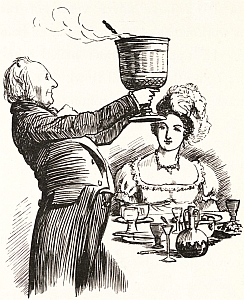
Bringing in the Wassail Bowl (from Washington Irving’s ‘Old Christmas’)
The Twelve Days of Christmas are full of wassailing.
Was hail Drinc hail
The name comes from the Anglo-Saxon version of ‘Cheers’ or good health. Its ceremonial use is described by Geoffrey of Monmouth, writing in 1135.
‘From that day to this, the tradition has endured in Britain that the one who drinks first at a banquet says “was hail” and he who drinks next says “drinc hail.”‘
Geoffrey is explaining how Vortigern, in the 5th Century, betrayed Britain for the love of Rowena. She was the Saxon King Hengist’s daughter, and, only incidentally, speculating on the origins of the tradition of wassail.
Geoffrey of Monmouth tells us that the word means ‘Good Health’ or as we would say ‘Cheers!’
This has at least two different facets. Firstly, it is a formal drinking tradition at the centre of Christmas hospitality. Secondly, it is part of the tradition of the Waits, the Mummers, and Carol Singers. These are groups who go around the village singing or performing in exchange for a drink or some food, or money.
Wassailing is either a lovely gentle social activity, or it is an anti-social custom in which the drunkards get to stand outside your house caterwauling. In effect they are demanding drink with menaces. Imagine a Trick or Treat with the drunkards from the pub instead of children!
A Wassail bowl would be full of some form of mulled alcohol or hot punch. A couple of pints of ale or cider, a pint of wine/brandy/mead. Add sugar, cinnamon, and nutmeg. You should have an apple or crab-apple floating in the bowl. To find out more, look at ‘British Food, a History’ here.
‘Into the bowl is first placed half a pound of sugar in which is one pint of warm beer; a little nutmeg and ginger are then grated over the mixture, and 4 glasses of sherry and 5 pints of beer added to it. It is then stirred, sweetened to taste and allowed to stand covered for 2 to 3 hours. Roasted apples are then floated on the creaming mixture and the wassail bowl is ready.‘
The Curiosities of Ale and Beer, by John Bickerdike, published about 1860 from a Jesus College, Oxford recipe of 1732. (From Recipes of Old England by Bernard N. Bessunger
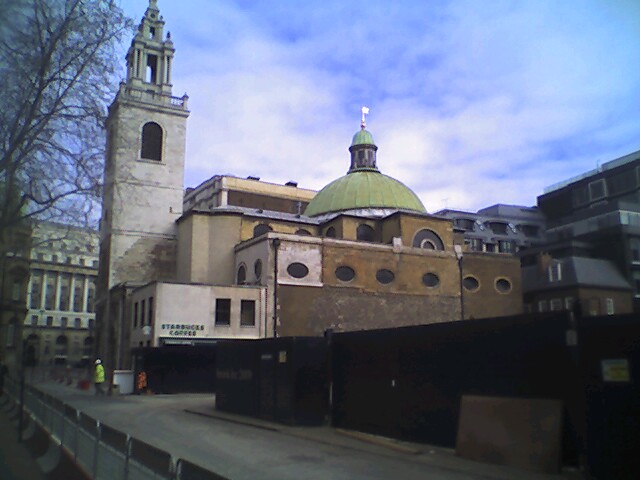
St Stephens, Walbrook. This view of the Church is not normally visible. The brown brick area to the right is much ‘cruder’ than the left. Christopher Wren was saving money by not ‘finishing off’ parts that were not visible from the public thoroughfare. Photo by the Author in 2008
On the second day of Christmas my true love sent to me: 2 Turtle Doves and a Partridge in a Pear Tree
Feast Day of St Stephens
It is the Feast day of St Stephen. He was the first Christian Martyr and was stoned to death not long after Jesus’ apotheosis. He was a deacon in the early Church, brought before the Sanhedrin for blasphemy. At the trial, he made a long speech outraging the audience. St Paul was in the audience (also known as Saul).
Stephen attacked the importance of the Temple to Judaism, making parallels with idolatry. Perhaps, I wonder, this explains why there are so few early Christian Churches identified in the archaeological record? Were they consciously avoiding large Temple Basilican structures to differentiate themselves from pagan religions?
Wrens & Presents
The 26th is the day when Wrens could be hunted. Read my post about Robins and Wrens and their seasonal importance here. Also, the day, people gave presents (Boxes) to servants and working people. Other days for presents included St Nicholas’s Day (December 6th), Christmas Eve, Christmas Day, New Year’s Day, and Twelfth Night.
St Stephens Walbrook
Wren’s most beautiful Parish Church is dedicated to St Stephen. It is one of the first Parish Churches to have a dome. There is also a splendid Altar designed by Henry Moore. I took a Swedish Choir around the City of London on a guided walk. St Stephen’s was open, and, once inside, they just fancied the acoustics. So, they sang. I recorded. Listen below:
In 1858, James Ewing Richie wrote about ‘Boxing Night’ in ‘The Night Side of London’. I’ve mixed it up with another source. So here is a list of the people who might come knocking at the door for their traditional Boxing Day Box.
Richie’s advice was to tie up your knocker to avoid paying these people:
The Chimney sweep. Then varlets playing French Horns pretending to be the Waits – {The Waits were licensed musical beggars}
Then came the Turncock, who switched the water supply to your side of the street on alternative days. Followed by the Postman, the Dustman; the Road Waterer in summer, and the Road Scrapper in Winter. After this, the real Waits turned up for a musical turn. Then the Lamplighter, the Grocer’s Boy and the Butcher’s Boy.
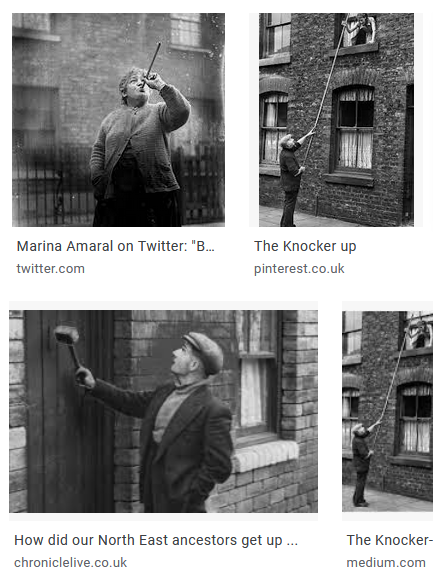
I imagine the Knocker-upper also got a Box. My grandmother told me about the knocker-upper in Old Street in the early Twentieth Century. He would tap on the window with his long stick to wake up those people without a reliable clock.
Google search image of the ‘knocker-upper’, the lady at top left worked in Limehouse and is using a pea-shooter.
Richie records that he had to give a tip to 6 people who wished him a Happy Christmas on his way to work. The tip he gave was half a crown each. He thought his wife would be lucky to get away with a shilling per person for the trade men listed above. Strange that he gave more than twice as much to random strangers than his wife gave to people who served them all year. Perhaps this reflects his belief that the size of his tip reflected his position in society. It is all curmudgeonly. This is probably because he believed it would be spent on drink, leading to the miseries of drunkenness.
The Drunkards Children by Cruikshank 1848. Cruikshank was a famous illustrator from a dynasty of visual satirists and one of Dickens illustrators. The story shows the effect of alcoholism on a family. It ends with the suicide from London Bridge of the mother.
First Published on Dec 26th 2022, Republished December 2023, 2024, 2025
Drink at a Georgian Christmas might well be port. Then the next favourites would brandy, claret, punch, rum, porter. So says my source Henry Jeffreys in his book ‘Empire of Booze’ and in this Guardian article:
Claret, probably, originally outsold port. But the wars against France and the difficulty of importing French wine, saw a transfer to wines from our ‘oldest ally’ Portugal. But the travel distance was longer, so the wine was fortified to help preserve it better. Hence, the British addiction to port. Sherry was also popular for similar reasons, being a fortified white wine. Shakespeare calls it ‘sack’ and sometimes ‘Canary’. (Toby Belch ‘says thou lack’st a cup of canary ‘ in ‘Twelfth Night’, which is a Christmas play.) See below for more on Sack and Shakespeare.
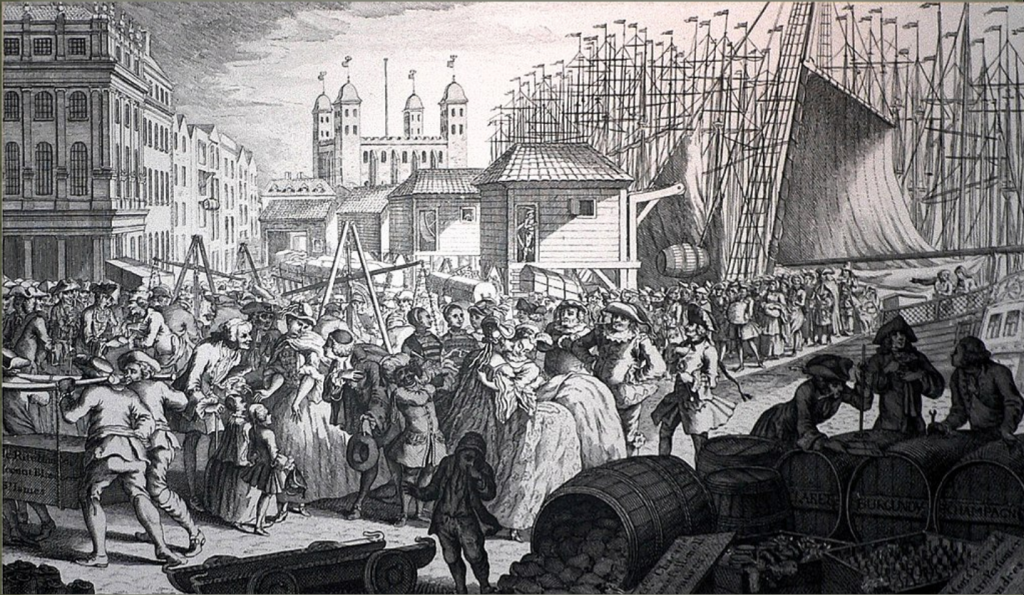
Louis Philippe Boitard‘s satirical engraving ‘Imports from France’ Looking east towards the Tower of London. Barrels at the front right are marked Claret, Burgundy and Champagne.
Georgian Alcohol consumption was prodigious. Samuel Johnson said, ‘All the decent people in Lichfield (where Johnson came from) got drunk every night and were not the worst thought of‘. The Prime Minister. William Pitt the Younger said, ‘I have drunk three bottles of port without being the worst for it. University College has witnessed this.’ He is referring to his college at the Oxford University. He might be considered to be another of our Prime Ministers who have first disgraced themselves at Oxbridge only to rise to rule the unfortunate British nation? However, in those days, Port was sold in pint measures (45cl) and was 16%, while now it is 20% and sold in 75cl bottles. So, maybe we are almost as bad?
Even so, three bottles is still a lot. A drunken population would have not only increased the death rate but also increased violence and abuse. Gout was one result of too much drinking and a rich diet.
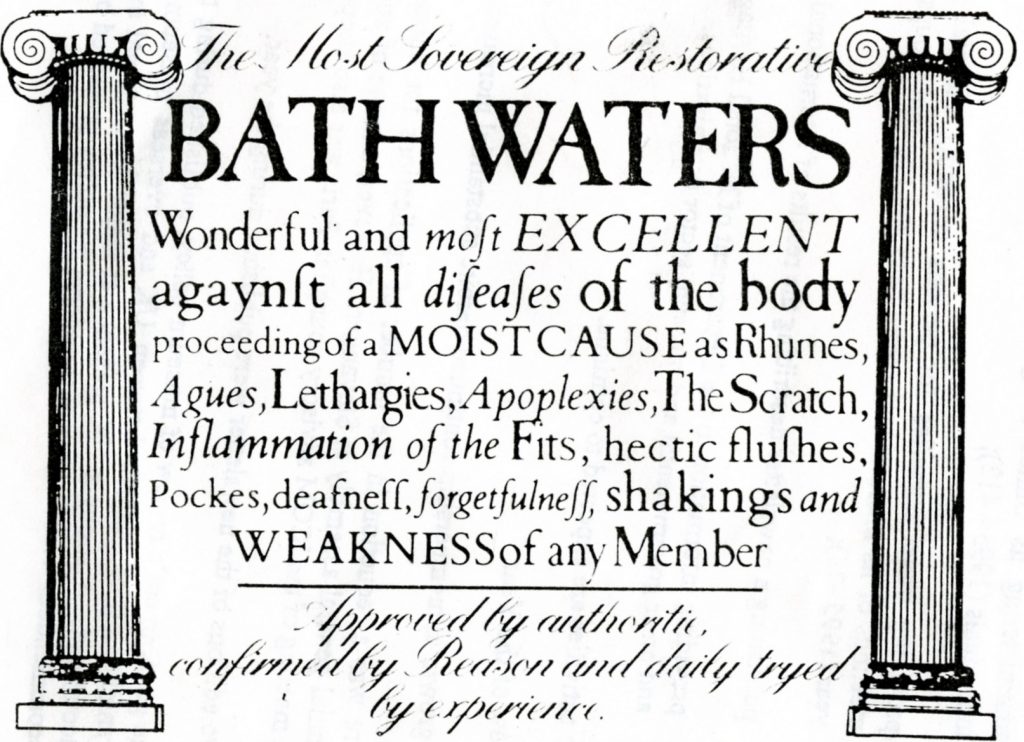
Gout. 18th Century Bath
However, this is Christmas so let’s end on a high note, so here are a couple of recipes!
To make ye best punch
“Put 1½ a pound of sugar in a quart of water, stir it well yn put in a pint of Brandy, a quarter of a pint of Lime Juice, & a nutmeg grated, yn put in yr tosts or Biskets well toasted.”
And Gin? The cheap gin panic had calmed down by the 1770s after no less than eight Gin Acts of Parliament. Booths and Gordon’s Gins were established in London during this period and Gin almost a respectable drink.
There appears to have been a shortage of Gin punch recipes in the 18th Century, but by the end of that century this recipe survives from London’s Garrick Club
– half a pint of gin, lemon peel, lemon juice, sugar, maraschino, a pint and a quarter of water and two bottles of iced soda water.
You would not need many of these to become quite relaxed quite quickly!
Sack and Falstaff.
Sir John Falstaff in Henry IV eulogies on sack saying it not only makes for excellent wit but also the best soldiers:
“A good sherris sack hath a two-fold operation in it. It ascends me into the brain, dries me there all the dull and crudy vapors which environ it, makes it apprehensive, quick, forgetive, full of nimble, fiery, and delectable shapes, which, delivered o’er to the voice, the tongue, which is the birth, becomes excellent wit“.
The second your excellent sherris is the warming of the blood; which cold and settled, left the liver white and pale, which is the badge of pusillanimity and cowardice; but the sherris warms and makes it course from the inwards to the parts extremes. illumineth the face, which, as a beacon, gives warning to all rest of this little kingdom, man, to arm; and then the vital commoners and inland petty spirits muster me all to their captain, the heart, who, great and puff’d up with this doth any deed of courage—and this valour comes of sherris. that skill in the weapon is nothing without sack, for that it a-work; and learning, a mere hoard of gold kept by a devil till sack commences it and sets it in act and use. Hereof it that Prince Harry is valiant; for the cold blood he did naturally inherit of his father, he hath, like lean, sterile, bare land, manured, husbanded, and till’d, with excellent endeavour of drinking good and good store of fertile sherris, that he is become very hot and valiant. If I had a thousand the first humane principle I would teach them should be to forswear thin potations and to addict themselves to sack.
Merry Wives of Windsor
In the Merry wives of Windsor Falstaff is still always drinking sack. He asks Bardolph ‘Go fetch me a quart of sack; put a toast in’t.‘ Toast is thought to freshen up stale sack. Also, it could be drunk hot as suggested by Falstaff asking for:
‘Go brew me a pottle of sack finely.’
Bardolph asks if he wants the sack with eggs but Falstaff refuses asking for his sack to be a
‘Simple of itself; I’ll have no pullet-sperm in my brewage.’
A simple is the opposite of a compound, so pure with no additions (apart from the toast!). Pullet sperm is, in think, a dismissive reference to eggs. Sack posset was original a medicine but later a popular treat made with eggs, cream, spices and sack. Once concocted, the top would be a foamy or crusty cap, the middle a custard and the bottom a spicy hot alcohol.
First Published in 2022 and revised December 2023, 2024, 2025
The Solstice and the East Pediment of the Parthenon
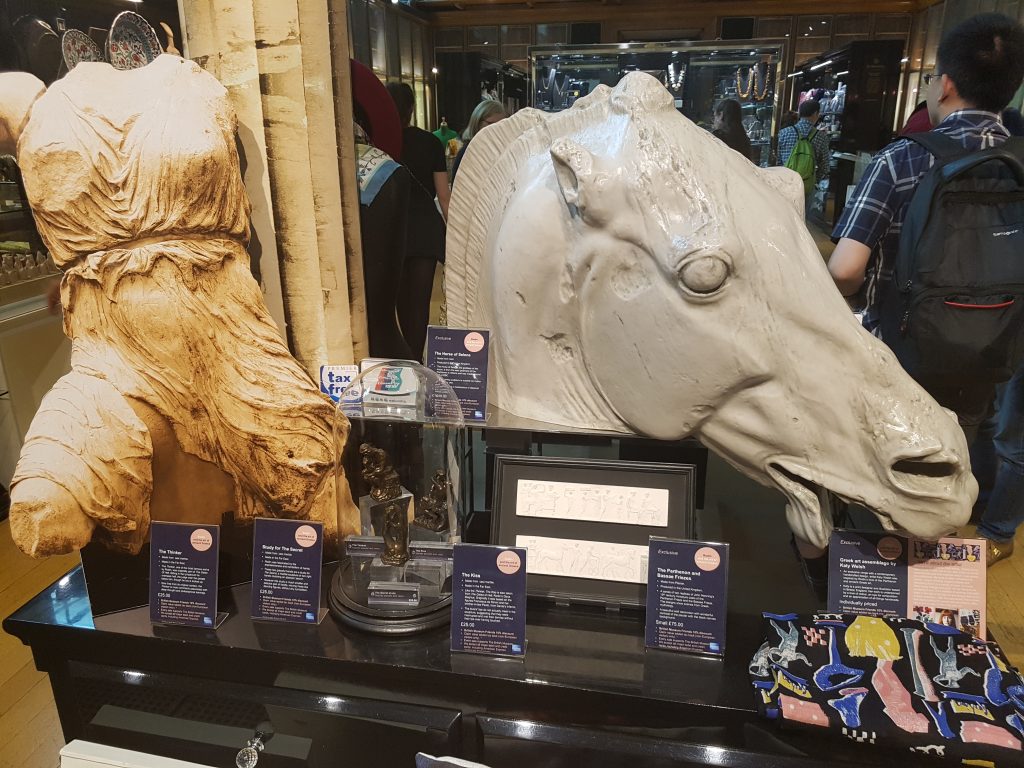
British Museum Shop, reproductions of Hestia and Selene’s Horse from the Parthenon Marbles
At the Summer Solstice, I took a group to the British Museum and, a few days later, to Stonehenge, and managed to ‘integrate’ the two into a solstice narrative. At the BM, over years of trying to explain the sculptures, I have been building in my mind an interpretation of the Pediment that gives, I hope, an original insight into the possible intentions of the sculptors. I don’t know how ‘true’ it is, but I do think it gives an insight into metaphor and symbolism in great works of art. Bear in mind that there is a lot of uncertainty about some of the attributions, and, that the male and female virtues that I am talking about are traditional ones, not necessarily how we would express it in the modern world.
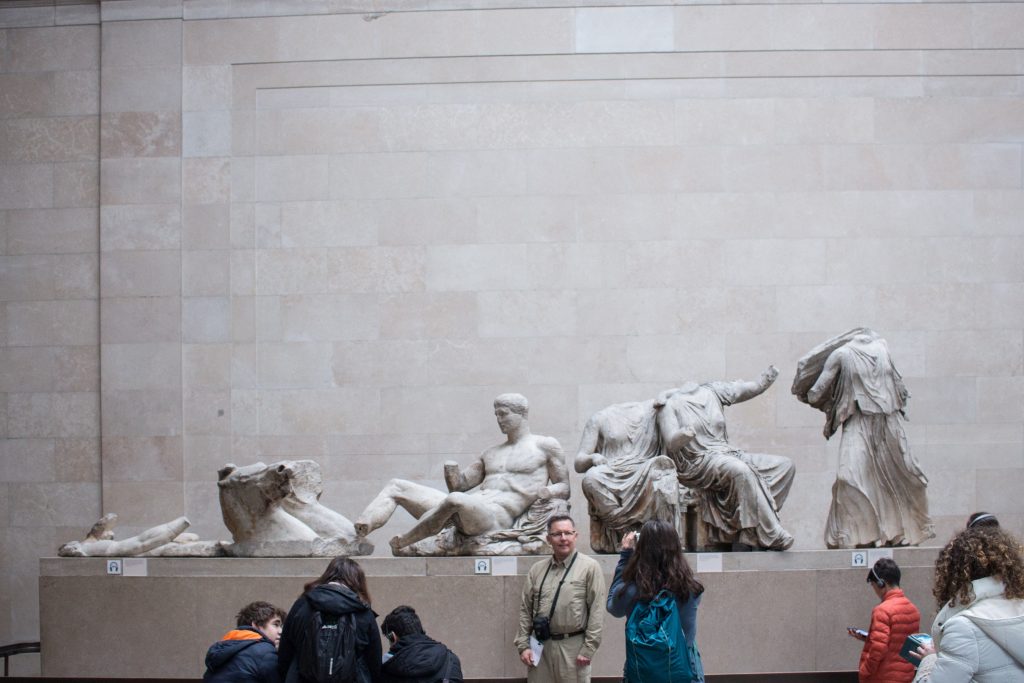
At the left of the above photography, you see the horses that take Helios chariot into the sky to bring up the sun to light the world every day. Most sun deities are male, and the Sun gives light and life to the world, without it this earth is an inert block of ice cold stone. The next statue is casually laying back and looking fit, relaxed and not looking as if he is in that position because of the impossible triangular Pediment space he inhabits. He is the epitome of male strength, usually identified with Hercules but other people have other ideas and a young Dionysus is another suggestion. Whoever he is he represents male beauty and strength. So this end of the pediment represents the Sun and male virtues. This is the East Pediment of the Parthenon which is orientated to the rising sun, a little north of east.
Next figure is Demeter, the goddess of fertility, the goddess of the earth. Placed here to remind us that the Sun needs the Earth to create life and sustenance. It reminds us that the universe is not male, the male only works in conjunction with the female. Demeter is cuddling her daughter Persephone, the Goddess of Hades. She reminds us that life is a cycle of death and life. Plants die, turn into soil and create the conditions for future life.
Next is Hebe, daughter of Zeus and Hera, wife of Heracles (Hercules). She is the cupbearer to the Gods and gives them the ambrosia that keeps them forever young. She is the Goddess of Immortality, a reminder that the universe is eternal.
Next to Hebe is a void where there was the central statue of the east pediment depicting the Birth of Athena (according to Pausanias who wrote a guide in the 2nd Century BC to the Temple). Athena was born from the head of her father Zeus- a virgin birth. Athena therefore is, in some ways, the greatest of the Olympians, as she has the virtues of her female sex and the virtues of her father’s masculinity (and, dear Gods, hopefully not the massive ‘Me Too’ vices of her father). She is therefore, wise, nurturing, just, intuitive, decisive, a leader; an ideal combination of male and female.
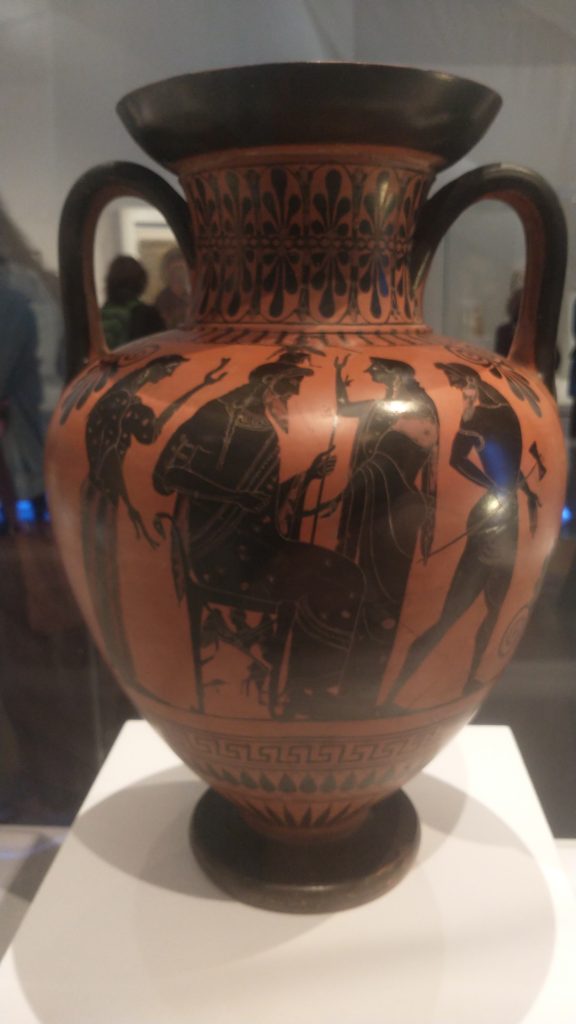
Zeus (sitting) Hephastus to right (looking back with Axe) Athena just visible above Zeus’s head
Her back story is that her dad, Zeus eats her mum, Metis, who is pregnant with her. Sometime later, he has a cracking headache. Hephaestus, the disabled artificer God hits Zeus over the head with an axe to clear the headache. Zeus gives birth to a fully formed Athena through the split in his head. She was known as Athena Parthenos, Athena the Virgin. Her name is originally Athene but it got changed to Athena in 500 BC.
Hestia, Dione, Aphrodite, Horse of Selene’s chariot
To Athene’s left is Hestia (Vesta for the Romans). Her name means “hearth, fireplace, altar” and she is the goddess of the domestic sphere, of the comforts of home, of a warm fire enjoyed by a loving family.
The next set are two beautifully draped women languidly leaning on each other, and these are Dione, with her daughter Aphrodite – the Goddess of Love. Dione is the daughter of Gaia and Uranus daughter of earth and sky. So, here, counterpoised to Hercules, are epitomes of women. Women of power, creation, and love.
Finally, we have the exhausted horse of Selene. Her chariot takes the moon into the sky, positioned opposite to Helios and the Sun. Selene is the Moon goddess, and the Moon is beautiful, powerful as it gives us the tides and fundamental to the life of humans as she presides over the menstrual cycle. Compared to the movements of the Sun which any fool can work out, and which are relentless (symbolising Justice) the movements of the Moon are mysterious to most of us. So Selene is beautiful, powerful, creative and the Goddess of Intuition.
So, if you put it all together, the East Pediment of the Parthenon shows that the world is a union of the male and the female, balanced between the two with Zeus and Athene in the middle, with Athene holding the main part because she, in her person, represents both the male and the female.
Of course, we know that the Athenian society was a patriarchal one with women mostly kept in the domestic sphere. But here, at least, women were given an equal billing in the organisation of the Cosmos.
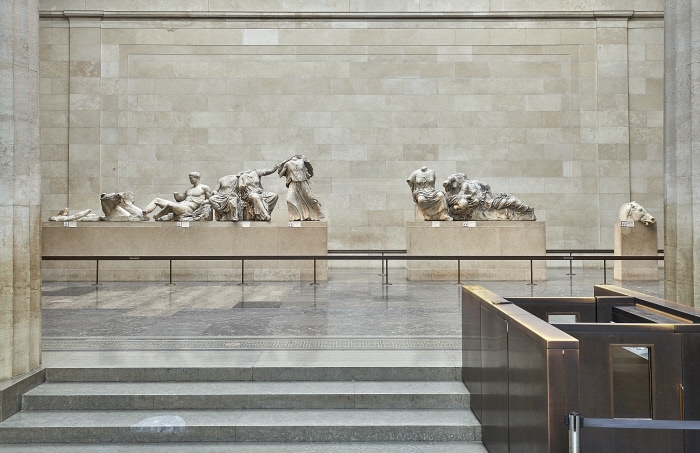
Sculptures from the east pediment of the Parthenon
I must end by warning the reader that this is only my interpretation. I am not a scholar of Ancient Greece. I have come to my own conclusion based on spending a lot of time looking at the marbles, doing Solstice Virtual Tours, and mostly informed by the labels in the gallery, with of course, some reading including Mary Beard’s book entitled ‘Parthenon’ and the BM’s guidebook. In particular, I have not incorporated into my ‘story’ the sculptures that were in the gaps that do not survive or only in fragments scattered throughout the Museum world. However, what we do know is that in the centre is Zeus and Athene and at the edges are the chariots of the Sun and the Moon. And so fitting to celebrate the Solstice.
So, the old Sun is dying, and if the Sun keeps going down we are all going to die. With all of nature dying or hibernating, evergreens are a symbol of a promise/proof that life will continue through the dark days. So, with its bright-green leaves and its luminous berries, Holly is the ideal evergreen for the Solstice. And as the prickles symbolise Christ’s Crown of Thorns, and the berries the red blood of Jesus, the symbolism works, too, for Christians.
Henry Mayhew (editor of Punch) in his ‘London Labour and London Poor’ (1851–62) talks of Christmasing for Laurel, Ivy, Holly, and Mistletoe. He calculated that 250,000 branches of Holly were purchased from street coster mongers every Christmas. He says that every housekeeper will expend something from 2d to 1s 6d, while the poor buy a pennyworth or halfpennyworth each. He says that every room will have the cheery decoration of holly. St Pauls Cathedral would take 50 to a 100 shillings worth.
He also calculates that 100,000 plum puddings are eaten. Mistletoe he believes is less often used than it used to be, and he hopes that ‘No Popery’ campaigners will not attack Christmassing again.
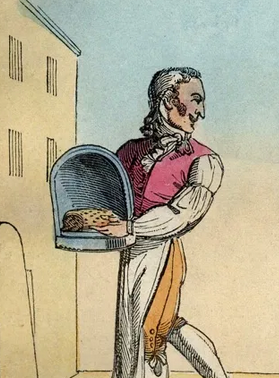
Hot plum pudding seller from Sam Syntax Cries of London, 1820s from the Gentle Author Spitalfields Life website
Culpeper on Ivy (1814 edition):
‘Ivy’ says Culpeper in his Herbal of 1653, its winter-ripening berries are useful to drink before you ‘set to drink hard’ because it will ‘preserve from drunkenness’. And, moreover, the leaves (bruised and boiled) and dropped into the same wine you had a ‘surfeit’ of the night before provides the ‘speediest cure’. (The Perpetual Almanac of Charles Kightly)
It is so well known to every child almost, to grow in woods upon the trees, and upon the stone walls of churches, houses, &c. and sometimes to grow alone of itself, though but seldom.
Time. It flowers not until July, and the berries are not ripe until Christmas, when they have felt Winter frosts.
Government and virtues. It is under the dominion of Saturn. A pugil of the flowers, which may be about a dram, (saith Dioscorides) drank twice a day in red wine, helps the lask, and bloody flux. It is an enemy to the nerves and sinews, being much taken inwardly, out very helpful to them, being outwardly applied. Pliny saith, the yellow berries are good against the jaundice; and taken before one be set to drink hard, preserves from drunkenness, and helps those that spit blood; and that the white berries being taken inwardly, or applied outwardly, kills the worms in the belly. The berries are a singular remedy to prevent the plague, as also to free them from it that have got it, by drinking the berries thereof made into a powder, for two or three days together. They being taken in wine, do certainly help to break the stone, provoke urine, and women’s courses. The fresh leaves of Ivy, boiled in vinegar, and applied warm to the sides of those that are troubled with the spleen, ache, or stitch in the sides, do give much ease. The same applied with some Rosewater, and oil of Roses, to the temples and forehead, eases the head-ache, though it be of long continuance. The fresh leaves boiled in wine, and old filthy ulcers hard to be cured washed therewith, do wonderfully help to cleanse them. It also quickly heals green wounds, and is effectual to heal all burnings and scaldings, and all kinds of exulcerations coming thereby, or by salt phlegm or humours in other parts of the body. The juice of the berries or leaves snuffed up into the nose, purges the head and brain of thin rheum that makes defluxions into the eyes and nose, and curing the ulcers and stench therein; the same dropped into the ears helps the old and running sores of them; those that are troubled with the spleen shall find much ease by continual drinking out of a cup made of Ivy, so as the drink may stand some small time therein before it be drank. Cato saith, That wine put into such a cup, will soak through it, by reason of the antipathy that is between them.
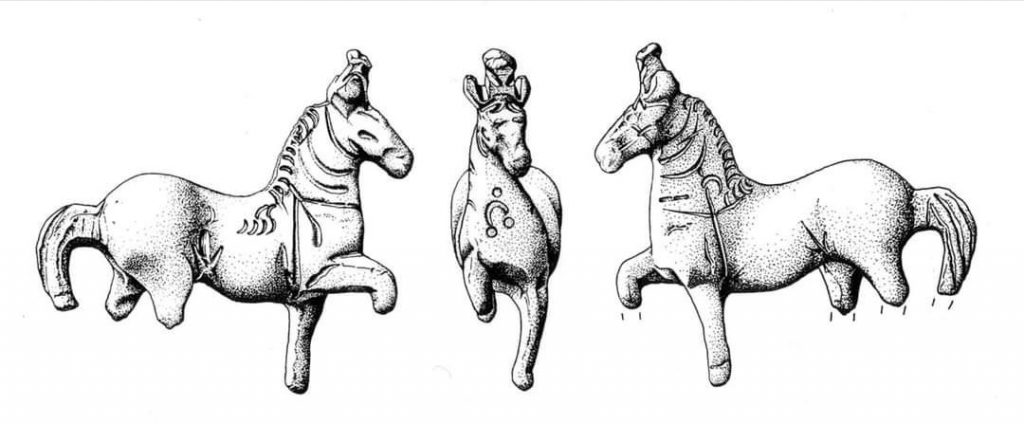
Roman Horse from Bunwell, Norfolk. Illustration by Sue Walker.
In 2021 I posted about Eponalia for the 18th Dec but I have now added the text to this page.
I’ve been too busy working on my Jane Austen and Christmas Virtual Tour ) to post over the last few days. And I have, therefore, shamelessly stolen this post off my Facebook friend Sue Walker, who is a talented archaeological illustrator, artist and a very good photographer.
She wrote: ‘the 18th December is the festival of the Celtic goddess Epona, the protector of horses, she was adopted by the Romans and became a favourite with the cavalry. This finely sculpted bronze horse with a head dress and symbol on its chest is 37mm high – found in Bunwell #Norfolk #Archaeology’
First published on December 17th 2022, Revised and republished December 2023
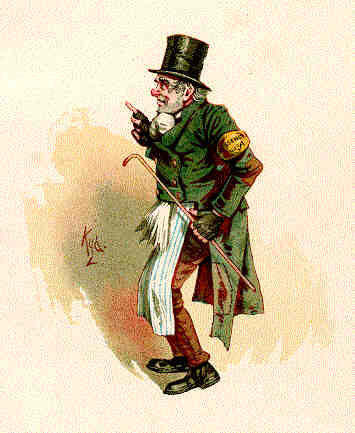
Trotty Veck 1889 Dickens The Chimes by Kyd (Joseph Clayton Clarke)
As Christmas looms, seasonal publications have a mixture of wonder and joy at the coming family reunions and festivities mingled with an awareness that, for some, Christmas will depend on the Food Bank or the Charity Shelter. The weather is now cold, living costs continue to rise at the very time extra spending is needed to unlock the joy of the Season. Also to counter the dark, the cold, and the spectre of death which, in fact, has always been central to the season of winter.
Charles Dickens’ Christmas Books epitomise this dichotomy.And by adding an element of the supernatural, provided a vehicle for joy and hope. It also came with a forceful political message that the authorities and the rich were not doing their Christian duty to alleviate poverty. Christmas Carol contrasts the wealth of a mean rich Stockbroker with the family of his poor employee Bob Cratchit, and provides a powerful tale of redemption.
The Chimes
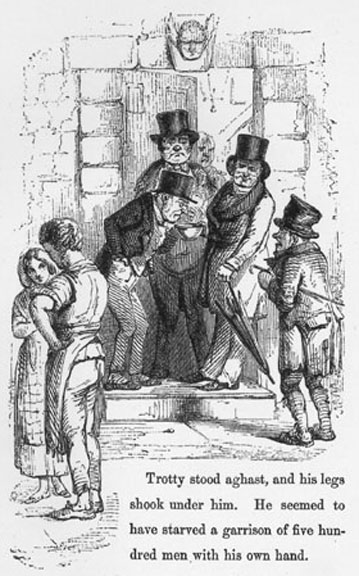
But in this post I want to concentrate on his second Christmas Book, ‘The Chimes’. It was published on December 16th, 1844. And tells the story of the stick-thin Trotty Veck who is an aged City messenger, nicknamed Trotty because of his habit of keeping himself warm by running on the spot. He is afraid to let his daughter, Meg, marry as he has so little hope for the future. While he is worrying, he, Meg and her intended Richard are approached by Alderman Cute and Mr Filer.
Meg, Richard, Mr Filer, Gentleman, Alderman Cute and Trotty Veck. Probably located by the door of St Nicholas, Colechurch, City of London.
Cute represents the financial industries in the City of London and the Law. Filer the new breed of political economists. These, working with the ideas of Malthus and the new science of Statistics, had proved, that generous support for the poor would, inevitably, lead to a country full of poor people and no rich people. And thus, they justified the Poor Law Amendment Act of 1832. At this time Dickens was a Parliamentary reporter (1831-1834), and he observed the cruelty and absurdity of this piece of iniquitous legislation. In 1929 my mother was born in a workhouse, where she had been taken by her unmarried mother. She was so ashamed she didn’t tell her children until she was in her 70s.
The Workhouse
That is the legacy of the cruel Workhouse system. It was based on providing the lowest possible level of support offering separation from family, meagre food, and sparse comforts. This the rate payers believed would encourage the poor to stop being lazy and get back out there to earn their own living. Thus allowing taxes to fall. (brilliantly satirised by Dickens’ Oliver Twist, asking for ‘More’).
Below, I enclose the scene from the Chimes, which satirises the attitude of the governing classes.
‘And you’re making love to her, are you?’ said Cute to the young smith.

‘Yes,’ returned Richard quickly, for he was nettled by the question.
‘And we are going to be married on New Year’s Day.’

‘What do you mean!’ cried Filer sharply?Enough  ‘Married!’

‘Why, yes, we’re thinking of it, Master,’ said Richard.  ‘We’re rather in a hurry, you see, in case it should be Put Down first.’

‘Ah!’ cried Filer, with a groan.  ‘Put that down indeed, Alderman, and you’ll do something.  Married!  Married!!  The ignorance of the first principles of political economy on the part of these people; their improvidence; their wickedness; is, by Heavens! enough to—Now look at that couple, will you!’

...

‘A man may live to be as old as Methuselah,’ said Mr. Filer, ‘and may
labour all his life for the benefit of such people as those; and may heap up facts on figures, facts on figures, facts on figures, mountains high and dry; and he can no more hope to persuade ’em that they have no right or business to be married, than he can hope to persuade ’em that they have no earthly right or business to be born.  And that we know they haven’t.  We reduced it to a mathematical certainty long ago!’

Alderman Cute was mightily diverted, and laid his right forefinger on the side of his nose, as much as to say to both his friends, ‘Observe me, will you!  Keep your eye on the practical man!’—and called Meg to him.

...

‘Now, I’m going to give you a word or two of good advice, my girl,’ said the Alderman, in his nice easy way.  ‘It’s my place to give advice, you know, because I’m a Justice. ...

‘You are going to be married, you say,’ pursued the Alderman.  ‘Very
unbecoming and indelicate in one of your sex!  But never mind that.
After you are married, you’ll quarrel with your husband and come to be a distressed wife.  You may think not; but you will, because I tell you so. Now, I give you fair warning, that I have made up my mind to Put distressed wives Down.  So, don’t be brought before me.

You’ll have children—boys.  Those boys will grow up bad, of course, and run wild in the streets, without shoes and stockings.  Mind, my young friend!  I’ll convict ’em summarily, every one, for I am determined to Put boys without shoes and stockings, Down.  Perhaps your husband will die young (most likely) and leave you with a baby.  Then you’ll be turned out of doors, and wander up and down the streets.  Now, don’t wander near me, my dear, for I am resolved, to Put all wandering mothers Down.  All young mothers,of all sorts and kinds, it’s my determination to Put Down.  Don’t think
to plead illness as an excuse with me; or babies as an excuse with me;
for all sick persons and young children (I hope you know the
church-service, but I’m afraid not) I am determined to Put Down.

And if you attempt, desperately, and ungratefully, and impiously, and
fraudulently attempt, to drown yourself, or hang yourself, I’ll have no pity for you, for I have made up my mind to Put all suicide Down!  If there is one thing,’ said the Alderman, with his self-satisfied smile, ‘on which I can be said to have made up my mind more than on another, it is to Put suicide Down.  So don’t try it on.  That’s the phrase, isn’t it?  Ha, ha! now we understand each other.’

Project Gutenberg - The Chimes by Charles Dickens
It is a savage burlesque of a satire but at its core, Filer provides the economic/statistical justification. Cute enforces it by legal harassment of the poor. Dickens was writing after a recent introduction of legislation making suicide a punishable offence.
Government Cruelty
This has a contemporary resonance. During my lifetime, the first British Government to be cruel in its provision of benefits, in my opinion, for the poor was Teresa May’s Conservative Government. Her laws made getting help so difficult that people died as a result of the deliberately difficult system. ‘I, Daniel Blake’ a 2016 film by Ken Loach brilliantly captured the essence of this system. That government’s treatment of the Windrush generation was a similar example of bureaucratic cruelty. And the continual decline of the benefit system over the 14 years of Conservative Government meant that the poor bore the brunt of austerity. Keir Starmer started his period in office on the wrong foot too cutting benefits to the poor.
Dickens, progressive propagandist
The piece above reminds us what a brilliant propagandist Dickens was. Every generation of children, since he wrote Christmas Carol, has read it or seen it in popular retellings such as The Muppet Movie. I think it could be argued that the ‘More’ scene in Oliver Twist and the Christmas Carol have made the case for compassionate care and redemption far better than contemporary Christianity or political parties.
In the Chimes. these two men discourage Trotty from letting the young ones marry. He has a dream and sees the hopeless result of his decision: suicide, prostitution, crime. When he wakes up, he realises that what they do have is hope. Hope springs eternal and he lets them marry.
For more on this scene, have a look at the Victorian Web
Dickens was not a socialist. ‘Hard Times’ shows that Dickens was against strikes, despite leading a strike when he was a young newspaper man. He was a free trade Liberal; a reformer who believed that the rich needed to do their Christian duty and provide charitable support, pay decent wages and look after their dependents and servants. He thought society should care less about the dogma of Christianity but look to its essence, ‘love your neighbour like yourself’. This, alone, was sufficient to right the wrongs caused by the selfish.
First Published on December 16th 2022, republished and revised in December 2023, 2024, 2025